Skip to content
  • Home
  • Subscribe / donate
  • Events calendar
  • News
    • Local
    • National
    • Israel
    • World
    • עניין בחדשות
      A roundup of news in Canada and further afield, in Hebrew.
  • Opinion
    • From the JI
    • Op-Ed
  • Arts & Culture
    • Performing Arts
    • Music
    • Books
    • Visual Arts
    • TV & Film
  • Life
    • Celebrating the Holidays
    • Travel
    • The Daily Snooze
      Cartoons by Jacob Samuel
    • Mystery Photo
      Help the JI and JMABC fill in the gaps in our archives.
  • Community Links
    • Organizations, Etc.
    • Other News Sources & Blogs
    • Business Directory
  • FAQ
  • JI Chai Celebration
  • JI@88! video

Recent Posts

  • Sharing her testimony
  • Fall fight takes leap forward
  • The balancing of rights
  • Multiple Tony n’ Tina roles
  • Stories of trauma, resilience
  • Celebrate our culture
  • A responsibility to help
  • What wellness means at JCC
  • Together in mourning
  • Downhill after Trump?
  • Birth control even easier now
  • Eco-Sisters mentorship
  • Unexpected discoveries
  • Study’s results hopeful
  • Bad behaviour affects us all
  • Thankful for the police
  • UBC needs a wake-up call
  • Recalling a shining star
  • Sleep well …
  • BGU fosters startup culture
  • Photography and glass
  • Is it the end of an era?
  • Taking life a step at a time
  • Nakba exhibit biased
  • Film festival starts next week
  • Musical with heart and soul
  • Rabbi marks 13 years
  • Keeper of VTT’s history
  • Gala fêtes Infeld’s 20th
  • Building JWest together
  • Challah Mom comes to Vancouver
  • What to do about media bias
  • Education offers hope
  • Remembrance – a moral act
  • What makes us human
  • המלחמות של נתניהו וטראמפ

Archives

Follow @JewishIndie
image - The CJN - Visit Us Banner - 300x600 - 101625

Tag: history

The need for transparency

The need for transparency

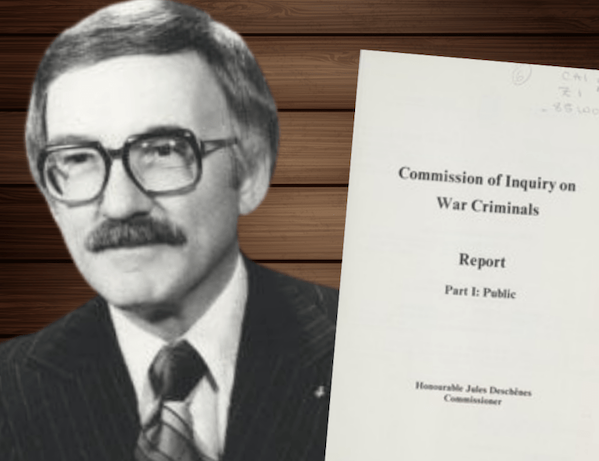
Justice Jules Deschênes, who was appointed by the Canadian government in February 1985 to oversee the Commission of Inquiry on War Criminals in Canada. (screenshot from B’nai Brith Canada)

For nearly four decades, Jewish human rights organizations have been trying to figure out how Nazi war criminals were able to gain citizenship and refuge in Canada following the Second World War. Why were high-ranking members of the Nazi Allgemeine Schutzstaffel (Nazi SS) and Waffen SS troops who fought on Germany’s behalf considered eligible for Canadian citizenship? And who were they? What were their names?

The answers to many of these questions can be found in an obscure list of reports held in government archives. Since 1985, when the Deschênes Commission was appointed to investigate allegations that Nazi war criminals were living in Canada, B’nai Brith Canada and other Jewish organizations have been urging the federal government to release all the commission’s findings. Those records include an historical account of Canada’s post-Second World War immigration policies, written by historian Alti Rodal (the Rodal Report).

“We have always felt that providing the general public with a greater understanding of Canada’s ‘Nazi past’ is a significant venture to providing closure to that time period,” explained Richard Robertson, B’nai Brith’s director of research and advocacy. “This is important because, at a time of rising antisemitism, where there are less and less survivors of the Holocaust around, it is essential that we furnish educators and advocates with as many tools as possible to enable as fulsome a teaching of the [history of the] Holocaust,” including, noted Robertson, those decisions that may have indirectly made it easier for Nazi perpetrators to escape prosecution. 

The Hunka affair

Last September, a critical portion of the documentation was made public by the federal government after it was revealed that a former member of the Waffen SS Galicia Division, Yaroslav Hunka, had received a standing ovation in Parliament. Human rights advocates wasted no time in calling for the rest of the Deschênes Commission’s documents to be released, arguing that the unredacted reports could help further Holocaust education in Canada and avoid such mistakes. More than 15 groups, representing Jewish, Muslim, Iranian and Korean ethnic communities and interests, supported B’nai Brith’s petition and, on Feb. 1, the Trudeau government released the bulk of Rodal’s account. 

That move has given human rights organizations access to a wealth of information about the politics, the thinking and the apprehensions that often steered the government’s decision not to prosecute or extradite war criminals. Compiled as an historical account of Canada’s post-Second World War policies, the 618-page redacted Rodal Report provides details that aren’t revealed in Deschênes’ deliberations.

Set against the backdrop of today’s rising antisemitism, the report illustrates that Canada’s current struggle to balance the needs of those targeted by antisemitism and discrimination with other democratic principles, like free speech and privacy, is nothing new.
screenshot - Alti Rodal, author of the Rodal Report
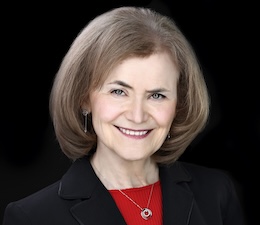
Alti Rodal, author of the Rodal Report. (screenshot from Ukraine Jewish Encounter)

According to Rodal, Canada’s postwar immigration policies were heavily influenced by a belief that extraditing naturalized Canadian citizens for war crimes would be, in the words of Prime Minister Pierre Elliot Trudeau, “ill-advised.” 

“Trudeau’s concern,” Rodal wrote, “was that the revocation [of citizenship of an alleged war criminal] could alarm large numbers of naturalized citizens who would be made to feel that their status in Canada could be insecure as a consequence of the politics and history of the country they left behind.”

And Pierre Trudeau was not alone in his reticence to bring Nazi war criminals to court.

“All those goals which Canadian society has set for itself can certainly not be achieved by short-circuiting the legal process in the hunt for Nazi war criminals,” the commission wrote, while examining whether a military court might be an appropriate venue for litigating charges of war crimes. 

By the time the commission concluded its research, it had effectively struck down every available legal mechanism for pursuing action against most former Nazis living in Canada. The Deschênes Commission determined that war criminals could not be prosecuted under Canada’s Criminal Code, but neither could they be tried by military tribunal. Nor could they be successfully prosecuted under the Geneva Conventions for acts of genocide or crimes against humanity. And Canada’s extradition laws would be ineffectual in many instances, including when it came to approving requests from Israel. Israel didn’t exist at the time of the Holocaust, the commission reasoned, and thus didn’t meet Canada’s requirements for requesting extradition of Second World War criminals.

New laws, similar challenges

Canada’s only remedy would be to amend its laws going forward. In 2000, nearly 14 years after the release of the Deschênes Commission’s report, the Crimes Against Humanity and War Crimes Act was given Royal Assent. Antisemitism, hate speech and hate crimes are now federal offences as well, covered under Section 319 of the Criminal Code. However, some legal experts say the process of bringing charges of antisemitism or hate crimes to court remains too onerous.

In June, the Matas Law Society and B’nai Brith hosted an educational webinar on the legal strategies available to Canadian lawyers when pursuing charges of antisemitism. Gary Grill and Leora Shemesh, two Toronto-based lawyers who have recently represented victims of alleged antisemitism in Ontario, offered different views as to why it is so hard to bring a hate crime to court.

“We have the tools,” acknowledged Shemesh, “we’re just not effectively using them.” She said she has represented several alleged victims of antisemitism and, in each one of the cases, the charges were later dropped.

Grill, on the other hand, suggested that the issue had to do with initiative. “It’s about political will” when it comes, for example, to ensuring that prosecutors understand that “death to Zionists” is veiled hate speech and should be prosecuted as antisemitism. “The education is easy,” he said. “We can educate prosecutors. We can educate police. It’s not a problem. [But] this is about will. It’s not about law.”

“There are problems with certain [parts] of Section 319 and [its] enumerated defences,” Shemesh said. “Prosecutions under the Criminal Code for the promotion of hatred … require the approval of the attorney general to proceed, which, I say, has partially explained why such prosecutions have been rare in Canadian jurisprudence.” 

In Robertson’s opinion, there can be value in legislative oversight. The attorney general’s sign-off “is a safeguard to ensure that our hate crimes legislation … is only utilized when warranted. I believe it is designed to prevent overuse,” he said. “Listen, there’s nothing wrong with that. There’s nothing wrong with having checks and balances to ensure that the proper charges are being laid and the severity of these charges warrant such. The issue is the reluctance of the attorney general to sign off on these charges and the procedural, I would say, slow-downs in effecting the sign-off. These are the issues. If we can perfect the procedures around the sign-off, then this is a completely fine check and balance.”
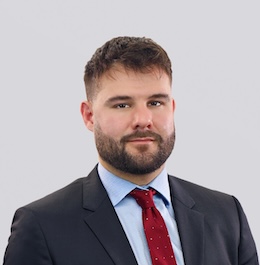
photo - Richard Robertson, director of research and advocacy for B’nai Brith Canada
Richard Robertson, director of research and advocacy for B’nai Brith Canada. (photo from  B’nai Brith Canada)

As for addressing the rise in antisemitism that Canada is experiencing today, Robertson believes the answer lies in ensuring Holocaust education is available and continues. That requires ensuring public access to the documents that most accurately tell the story – including those of Canada and other allied nations.

“With the recent issues that we’ve seen regarding immigration into Canada, I think [the Deschênes and Rodal reports serve as a] narrative that is more relevant than ever. I think it is important for us to understand our mistakes of the past so that we don’t repeat them in the future,” Robertson said. “And, as well, when it comes specifically to Holocaust education, I think it is important for Canadians to appreciate the level of complicity, if there was any complicity, in our government helping Nazis escape prosecution following the culmination of the Holocaust in World War II…. It helps to paint the totality of the picture of just how widespread the Holocaust was.”

Robertson said Canadians often think of the Holocaust as a “European issue,” that it only adversely impacted Jews in Europe. “So, understanding Canada’s role and [the Holocaust’s] aftermath helps to globalize the narrative, and perhaps that will help Canadians to better appreciate the truly global impact of the Holocaust [and the trauma] that is still ongoing.” 

To date, most of the Deschênes documents have been made public, with the exception of Part II of the original report, containing the identity of members of the Nazi party who were granted immigration to Canada. The ancillary documents, such as the Rodal Report, also contain information that has not been made public. B’nai Brith Canada continues to lobby for their release.

Jan Lee is an award-winning editorial writer whose articles and op-eds have been published in B’nai B’rith Magazine, Voices of Conservative and Masorti Judaism and Baltimore Jewish Times, as well as a number of business, environmental and travel publications. Her blog can be found at multiculturaljew.polestarpassages.com.
Format ImagePosted on September 20, 2024September 18, 2024Author Jan LeeCategories NationalTags antisemitism, B’nai Brith Canada, Canada, Deschênes Commission, history, Holocaust, immigration, Nazis, Richard Robertson, Rodal Report

A harrowing survival story

Almost every Holocaust survivor’s narrative involves some combination of extraordinary coincidence, righteous humanity amid dystopia or a series of chance events that astonishingly result in survival against all odds. The number of such flukes in the life of Vancouver woman Malka Pischanitskaya may convince readers of the author’s conclusion that survival was her destiny.

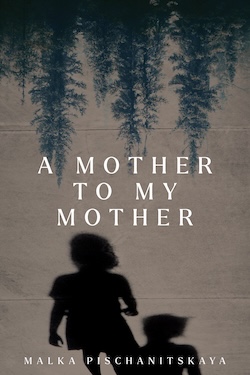
image - A Mother to My Mother book coverPischanitskaya’s memoir, A Mother to My Mother, is one of the latest releases in the Azrieli Foundation’s Holocaust Survivor Memoirs Program. Begun in 2005, the program has now published scores of firsthand testimonies of Canadian Holocaust survivors, many in both official languages, and all of them available free of charge to educational institutions.

Pischanitskaya’s Ukrainian Jewish family knew its share of misery before the emergence of Nazism and war. Her father abandoned her mother before Malka was born, in 1931, and she was raised in grinding poverty by her grandmother and great-aunt while her mother worked in a nearby village and saw Malka some weekends. 

The Stalinist-induced Ukrainian famine of the 1930s killed between three and five million people. The Nazi invasion of the Soviet Union, and its perpetration of the “Holocaust by bullets,” killed 1.5 million Jews, mostly shot at close range and buried in mass graves.

Young Malka’s earliest life, despite hardships, was not without happy memories of Jewish holidays and the changing of the seasons. These are tempered with stark recollections. Without electricity or anything but firewood for heat, she recalls Ukrainian winters so cold the ink at school would freeze solid.

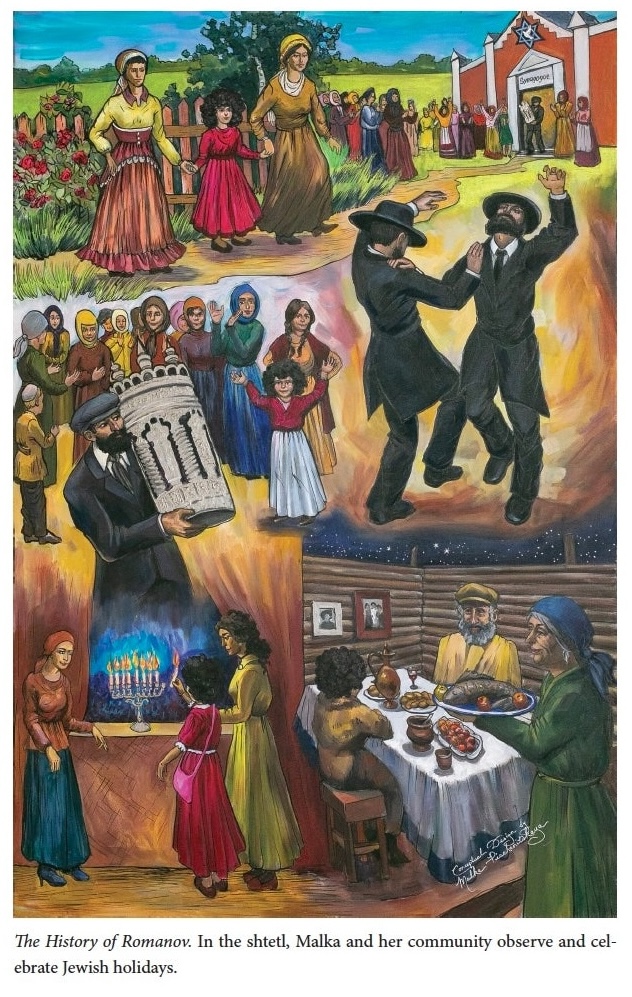
image - A page from Malka Pischanitskaya’s memoir A Mother to My Mother, which includes paintings that she created for a 2019 exhibition
A page from Malka Pischanitskaya’s memoir A Mother to My Mother, which includes paintings that she created for a 2019 exhibition.

After the Nazi invasion of Poland and the beginning of the war, in 1939, five refugee families from Poland arrived in Romaniv (alternatively: Romanov). 

“I have often wondered how much my community found out from these refugee families about what was happening under the Nazis in Poland and whether this made them more aware of the disaster that was to come,” writes Pischanitskaya. 

What was to come was beyond imagining – which may help explain why Malka and her family remained in Romaniv when some other Jews fled further east into the Soviet Union.

“We were not ready – there had been no mental preparation for this moment – so we did not accept the offers to escape,” she writes.

Soon, the Nazis arrived and young Malka witnessed Jews being killed in the streets. The randomness of those murders was replaced with methodical mass executions. The story, starkly told, is predictably shocking, and differs significantly from what happened further west. Rather than ghettos and concentration camps, the Holocaust in the east was typified by summary roundups and mass killings of entire communities, usually in adjacent forests. 

On Aug. 25, 1941, Ukrainian police gave Romaniv’s Jews 30 minutes to congregate in the centre of town.

“Those who were unable to walk had been taken out of their homes on stretchers,” she writes, disabusing Jews of the desperate idea they were being assembled to perform forced labour.

“We walked toward the beautiful park located a couple kilometres from the centre of town,” writes Pischanitskaya. “The crowd of close to 2,000 walked with visible sadness, expressions of disbelief.

“Men were rounded up, separated from their families, and then marched deeper into the forest where, previously, pits both massive and deep, had been dug. Women, children and the elderly were forced into rooms in the military building. Crowded in, there was hardly space to stand. Windows were locked. No fresh air; no water; no washrooms. People screamed, fainted, losing their minds; children were scared and restless.

“One by one, several groups of Jewish people were taken to slaughter. While we were kept in the building, waiting our turns, the heavy ring of machine gun fire instilled extreme fear and terror in all. The slaughter of the Jews from the Romaniv community continued from early morning until dusk – the sun had faded from our lives forever.” 

Then: the first of the miracles that spared the life of Malka and her mother.

“Eventually, mothers with children were let go from the building,” she writes. “Perhaps the murderers were tired from their orgy of death and torture, or perhaps there was no room in the pits for the rest of us, but those who had to remain were slaughtered. We left them, still alive, when we had the chance to run for our lives.”

Here, Pischanitskaya catalogues the names of the many family members killed that day. She goes into grim detail about what witnesses reported from the pits.

Thus began years of hiding – and a succession of near-misses, any one of which would likely have been fatal.

The relationship that gives the book its title, of young Malka mothering her mother, is a story of a parent so paralyzed by events that she becomes almost incapacitated. Malka’s astonishing and perilous actions to ensure their survival form the bulk of the book. She begs door to door in the villages where they hide, often receiving small portions of food. At one home, she sees her own portrait on the wall, apparently pillaged from Malka’s family home after they fled – an uncanny and grotesque coincidence.

When, after the war, they returned to Romaniv, “Almost nothing remained except for memories.”

“Adult survivors went to the mass graves to pray for and memorialize their loved ones, and to bear witness,” writes Pischanitskaya. 

Of all the people who survived and showed up alive after the war was Malka’s “so-called father,” as she calls him, a man whose sadistic cruelty Malka and her mother would have been better off without.

In a twist, the mother who had been “a dependent child” transformed into a courageous woman who pursued Polish and Ukrainian police for war crimes.

Like so many survivors, Pischanitskaya demonstrated improbable resilience, marrying, becoming a teacher, becoming a mother, escaping the Soviet Union, migrating to Canada and raising a successful family that continues to contribute to Vancouver’s Jewish and broader community. 

A Mother to My Mother is illustrated with harrowing, moving paintings that Pischanitskaya created for an exhibition titled Romanov: A Vanished Shtetl, which was presented at the conference of the World Federation of Jewish Child Survivors of the Holocaust and their Descendants, held in 2019 in Vancouver.

To order a copy of A Mother to My Mother in print or ebook format, or any other survivor memoir, visit memoirs.azrielifoundation.org.

Posted on September 20, 2024September 18, 2024Author Pat JohnsonCategories BooksTags A Mother to My Mother, art, Azrieli Foundation, history, Holocaust, Malka Pischanitskaya, memoir, painting, Ukraine

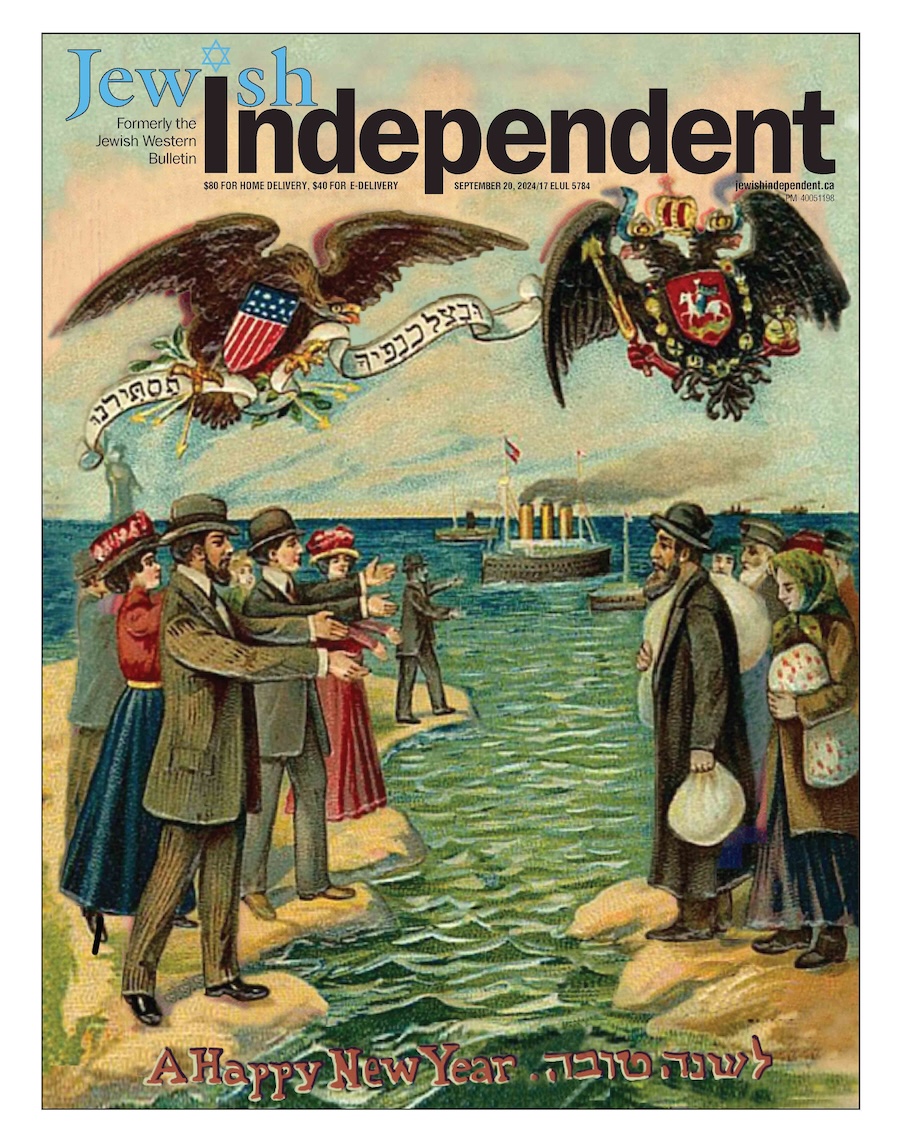
About the 2024 Rosh Hashanah cover

I came across this Rosh Hashanah greeting card in the 2017 Forward article “The Curious History of Rosh Hashanah Cards in Yiddish” by Rami Neudorfer. The image was copyrighted by the Hebrew Publishing Company, New York, 1909, and the high-resolution version we used for the cover comes from the postcard collection of Prof. Shalom Sabar (emeritus) of the Hebrew University of Jerusalem.

image - JI Rosh Hashanah 2024 cover“The card depicts two eagles in the sky: under the Imperial Eagle of the Russian coat of arms, a group of impoverished, traditionally dressed Russian Jews, carrying their meagre belongings, line Europe’s shore, gazing with hope across the ocean,” wrote Neudorfer. “Waiting for them are their Americanized relatives, whose outstretched arms simultaneously beckon and welcome them to their new home. Above them, an American eagle clutches a banner with a line from Psalms: ‘Shelter us in the shadow of Your wings.’”

Not only did Prof. Sabar provide the image for the cover but he offered further explanation of the card’s meaning. The verse quoted is partially based on Psalms 57:2; the fuller quote is taken from Psalms 17:8 – “Hide me in the shadow of Your wings.” In the illustration, the quote is changed to be in the plural: “Hide us in the shadow of Your wings.” And it appears in this form in the Ashkenazi siddur, where it is part of the Hashkivenu prayer, said Sabar. The full text can be found at sefaria.org.il/sheets/29587?lang=bi, where they translate the phrase as “and cradle us in the shadow of your wings.”

The message of a passage to freedom is not only enhanced by the Psalms quote, but also that the birds depicted are eagles, Sabar added. This is a reference to the liberation of the Jews from Egypt, he said, as in Exodus 19:4 – “You have seen what I did to the Egyptians, and [how] I bore you on eagles’ wings, and I brought you to Me.”

Posted on September 20, 2024September 18, 2024Author Cynthia RamsayCategories Celebrating the HolidaysTags antisemitism, eagles, Exodus, freedom, greeting cards, Hebrew Bible, Hebrew Publishing Company, Hebrew University, history, immigration, Jewish Forward, pogroms, Rami Neudorfer, Rosh Hashanah, Russia, Shalom Sabar, symbolism, United States
Bucharest a city of contrast

Bucharest a city of contrast

There is an abundance of street art in Bucharest. (photo by Deborah Rubin Fields)

What could be more Israeli than the hora? Well, truth be told, the hora is not Israeli! The word hora comes from Romania. And, like the origins of the hora, the Romanian capital, Bucharest, is a place where the unexpected should be expected.

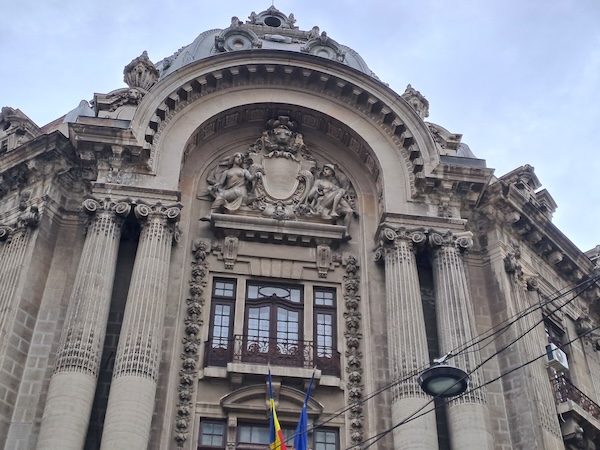
When you walk along Bucharest’s broad boulevards, one word comes to mind – palatial. There is the former Cantacuzino Palace, today’s George Enescu National Museum; the Elisabeta Palace, the private residence of the former Queen Elizabeth of Greece (born Princess Elisabeta of Romania), following her 1935 divorce from King George II of Greece; the former Royal Palace, today’s National Museum of Arts; the Romanian Athenaeum, today a major concert hall; the Palace of the Deposits and Consignments, still a bank, but today called the CEC Palace; and the Palace of Parliament.

Bucharest once had strong ties to Paris, and French is still mandated in schools. It was called Little Paris, so it should not be a surprise to see that Bucharest’s Manu-Auschnitt Palace is a copy of Paris’s Hôtel Biron (today’s Rodin Museum). While smaller in size, many older private homes were built with stunning stone (perhaps even cement) arches and columns, bas reliefs incorporating figures of lions, men and women, shields, gryphons, eagles, the angel of death, and various free-standing sculptures. In this home, the windows are in national-romantic and neo-Romanian style. Paris-inspired art deco metal work appears on door grills, door overhangs and the tops of buildings. Five classy examples of art deco building in Bucharest are 1 Piata Sfântul Stefan; the Ministry of Justice at 53 Bulevardul Regina Elisabeta; the Telephone Company Building on Calea Victoriei; the “Union” Building on 11 Strada Ion Campineanu; and 44 Calea Calarasilor.

photo - The Old Palace of the Chamber of Commerce in Bucharest, a city full of former palaces
The Old Palace of the Chamber of Commerce in Bucharest, a city full of former palaces. (photo by Deborah Rubin Fields)

In addition to the number of stunning palaces, there is also an abundance of street art. Some of this street art is commissioned and appears on the sides of various buildings. It is often colourful and imaginative. There is, however, a lot of graffiti, which, apparently, began to appear after the 1989 Romanian revolt against the communist regime. Graffiti is illegal, but, as I was told, the consequences depend on the discretion of who catches the graffiti artist or how fast the artist can run.

Jewish presence in Romania dates to Roman times, when the country was a province called Dacia. The first mention of Jews in Bucharest is from the 16th century. Jews came to Bucharest from two directions: Sephardi Jews came from the south, mainly from the Ottoman Empire; later, Ashkenazi Jews came from the north. The latter, from Galicia or Ukraine, settled in Bucharest after having lived in Moldavia. As in other European countries, Jews were at various times tolerated, even integrated into general city life.  At other times, however, they were punished in one way or another.

The Jewish population of Bucharest grew significantly, particularly in the second half of the 19th century. In 1835, some 2,600 Jews lived there; this number jumped to 5,900 in 1860. In the 1800s, nine synagogues were constructed and, by 1900, the total Jewish population had risen to 40,500, making Bucharest by far the largest Jewish community in Romanian territory. By 1930, the city’s Jewish population was 74,480. Jews settled in virtually all the city districts, especially in areas where economic growth was fastest. Bucharest’s Jews laboured as artisans, metalworkers, merchants and bankers.

In the early 19th century, there were several instances in which Jews were accused of ritual murder. This led to violence and pogroms. While, on the books, Jews were to be given citizenship, government after government dragged its feet in making emancipation stick. In general, being Christian was a prerequisite for Romanian citizenship, although a complex naturalization process was theoretically made available to Jews. When, in 1866, Jewish French lawyer Adolph Crémieux came to Bucharest to help push for Jewish political emancipation, rioters attacked Jewish shops and synagogues. Toward the end of the century, many antisemitic organizations existed, due in large part to nationalist leader Alexandru C. Cuza’s political activities. In particular, his followers organized antisemitic agitation against Jewish students at Bucharest University. 

After Germany, Romania is directly responsible for more Jewish deaths in the Shoah than any other country. For most of the Second World War, Romania allied with Nazi Germany. According to official Romanian statistics, between 280,000 and 380,000 Jews were murdered or died in territories under Romanian administration during the war. Antisemitic legislation downgraded the identity of Jewish citizens to second-rate status: they lost the rights to education and health care, their property was confiscated, and they were forced to perform hard labour. In September 1942, approximately 1,000 Jews were deported to Transnistria.

Despite such treatment, most of Bucharest’s large Jewish community was spared the worst horrors of the Holocaust. Between 1941 and 1943, Bucharest-based Chilean charge d’affaires Samuel del Campo saved the lives of more than 1,200 Romanian and Polish Jews by issuing them Chilean passports, thus preventing their deportation to Nazi concentration camps.  A memorial stands in front of the former Ashkenazi Great Synagogue, commemorating the January 1941 paramilitary Iron Guard’s (Legionnaires’) savage murder of 125 Bucharest Jews, an action reminiscent of Nazi techniques, with the skinning of the victims and the hanging of them on meat hooks. 

Shortly after the Second World War, Bucharest experienced a great influx of Jews, as refugees arrived from concentration camps and from several areas in Romania where they continued to feel unsafe. By 1947, the Jewish population had grown to 150,000.

After the first years of the communist regime and the closing of Jewish welfare and religious institutions, Bucharest continued to be a centre of Jewish communal and cultural life due, in large part, to Chief Rabbi Moses Rosen, who coped with the inconsistencies and peculiarities of Romanian official policy – particularly during the 1965-1989 dictatorship of Nicolae Ceausescu. When former US ambassador Alfred Moses first visited Bucharest in 1976, a young Jew approached him saying, “Don’t believe what they tell you. The situation here is terrible, especially for Jews. We are blamed for everything that goes wrong. Help us get out. There is no future for Jews in Romania. Everything you hear is a lie, a lie, a lie.”

After the rebirth of the state of Israel, many Jews made aliyah. By 2000, only 3,500 Jews were left in Bucharest. Today’s Jewish life in Bucharest focuses on three synagogues, a community centre, a kosher restaurant and the Centre for the Study of the History of Romanian Jews. 

In 2021, a Romanian survey reported one-fourth of respondents saying they didn’t know or couldn’t say exactly what the Holocaust was. Another 35% said they couldn’t identify the Holocaust’s significance for Romania. In 2022, the populist Alliance for the Union of Romanians (AUR) opposition party called Holocaust education a “minor topic” when it was mandated in Romanian high schools. This party currently holds 12% of parliament seats and some people predict it will become a major political force in the near future.

On a more positive note, a few years after the death of Jewish Romanian Nobel laureate Elie Wiesel, at age 87, Bucharest memorialized him with a bust in the Piata Elie Wiesel. 

Finally, if you hear what sounds like a Slavic language spoken in Bucharest, it might just be Ukrainian. Since Russia began its attack on Ukraine two years ago, 11,000 Ukrainian men of conscription age have illegally fled to Romania. It is too early to say how this population will impact Bucharest life. 

Deborah Rubin Fields is an Israel-based features writer. She is also the author of Take a Peek Inside: A Child’s Guide to Radiology Exams, published in English, Hebrew and Arabic.

Format ImagePosted on September 20, 2024September 18, 2024Author Deborah Rubin FieldsCategories TravelTags Bucharest, Canadian Jewish Holocaust Survivors and Descendants, history, murals, palaces, Romania, street art
Trip sparks realization 

Trip sparks realization 

Starting in 1539, it took Spain 250 years to construct the six-level fortress El Morro in Puerto Rico, and Spain’s former power still emanates from the walls. (photo by Lauren Kramer)

I was in Old San Juan, Puerto Rico, recently, when the full magnitude of the Spanish Inquisition hit me like a ton of bricks.

The scene seemed an unlikely one for a blast from the Jewish past. I was with Pablo Garcia, a fast-speaking guide with Spoon, a boutique food and history company, and we were standing in the Plaza del Quinto Centenario, in front of fortifications that were more than 500 years old.

These were fortifications Spain built in the 1500s, not long after Christopher Columbus “discovered” Puerto Rico in 1493. “Discovered,” because the indigenous Taino people had been there for centuries but, for reasons that seem unfathomable now, that didn’t matter to the Spaniards.

Back home in Spain, 300,000 Jews were being expelled, murdered in the Inquisition or forced to convert to Catholicism, with some of them practising their Judaism underground. To appreciate the kind of force they were up against, you just need to pay a visit to Old San Juan and lay eyes on El Morro.

Spain started building El Morro in 1539 and it took 250 years to construct the six-level fortress. Its thick, stone walls, 185 feet above sea level, were punctuated by garritas, dome-shaped sentry booths located shouting distance from one another, so that, when one sentry perceived a threat on the horizon, he simply yelled a warning to his cohorts. El Morro guarded the city’s harbour from invaders and its bastion, with barracks, dungeons and storerooms, still holds original cannons that face the ocean in preparation for defence. 

The sites are so well preserved that, were the Spanish to resume control today, one feels certain they’d need very little additional infrastructure to guard the island. I looked at those stone walls that safeguarded the island from many battles over the centuries and marveled at the sheer strength of the Iberian Union. It dawned on me that the Jews of Spain really didn’t stand a chance against a power like this in 1492.

I was jolted back to reality when we stopped for a caffeine buzz at Don Ruiz, a coffee shop located in what was once Spain’s Ballajá Barracks. The coffee beans are from a four-generation family farm specializing in single-harvest, hand-picked beans, Garcia said. “In the 1700s, coffee was big business in Puerto Rico and one in every six cups of coffee worldwide was made with beans grown on the island. Coffee money built our roads and sealed our dams,” he said. 

Over the next three hours, I wandered between restaurants in beautifully preserved, colourful buildings in Old San Juan’s narrow, brick-laid streets. I sipped soursop juice, a local hangover cure with a pear-like taste, and sampled mofongo, a pastry made from mashed, fried green plantains. 

Spain maintained a stronghold on the island until 1898, when it became the US territory it remains to this day. But the Spanish influence remains pervasive, easily perceptible in the cuisine, the history of the island, the language and the islanders’ distinct cultural identity. 

Garcia stopped outside a local bank with a circular symbol above the door. “That’s the seal of Puerto Rico, still used to stamp new laws to this day,” he said. The seal depicts a tower representing Queen Isabella of Castille, a lion representing King Ferdinand II of Aragon and a cross, symbolizing Catholicism and Spain’s “discovery” of the “New World.”

It struck me as interesting that these two Catholic monarchs, the architects of the Spanish Inquisition, are still being lauded. Their legacies are sealed in Puerto Rico’s legal documents even today, and the authority they wielded 500 years ago still can be seen in those seemingly impenetrably thick stone walls of El Morro. 

Lauren Kramer, an award-winning writer and editor, lives in Richmond.

Format ImagePosted on September 20, 2024September 18, 2024Author Lauren KramerCategories TravelTags colonization, El Morro, history, Inquisition, Puerto Rico, Spain

Education a key issue

Students across British Columbia have returned to the classroom. On university campuses, the activism that had roiled those spaces during the last academic year has returned to a boil. Jewish students are facing more of the horrible same.

Even public high schools are not immune, with reports of harassment of Jewish students and inappropriate comments by teachers and other students.

About a year ago, the government of British Columbia announced that Holocaust education would become a mandatory part of the Grade 10 curriculum. This came as a surprise to many people, who were shocked that it is still possible for a student to graduate from the public education system in this province without encountering anything about the Holocaust. To be clear, this is probably not usually the case, but what a student learns about that dark history has been left to the discretion of teachers.

Starting next year, that will no longer be the case. Students will have to study the Shoah. This is a positive development in many ways. Holocaust education is an entry-point to critical discussions about human rights, dignity, oppression, genocide, totalitarianism and a vast range of crucial topics. 

From a Jewish perspective, at a time of increasing antisemitism, this is especially welcome. The dangerous potential of unchecked antisemitism is, of course, the ultimate and unique lesson of the Holocaust. Sensitizing young citizens to this message is an important part of addressing anti-Jewish racism. 

The curriculum is still in development and we trust that educating about the Holocaust will be done in the context of a larger history of antisemitism. It would be a mistake to let students conclude that antisemitism is a product exclusively of a different place (Germany) and time (1933 to 1945). The Holocaust, students must understand, was part of a much longer trajectory of anti-Jewish racism and it must not be seen as anomalous in this larger context.

While there was much satisfaction at the announcement that this history would become mandatory in the curriculum, there is cause for concern.

When dealing with issues of extraordinary sensitivity – gender, race, sexuality, religion, treatment of historical events – parents, elected officials and the broader society depend on the ability and integrity of teachers to deliver this content in appropriate ways. This is where we have reasonable apprehensions. 

While it is the government that mandates curriculum content, it is obviously teachers who deliver it. The teachers’ union, the British Columbia Teachers’ Federation, has a long history of disseminating anti-Israel materials and adopting biased approaches to the issues of Israel, Palestine and the conflict there.

This year, a group of (mostly Jewish) educators applied to the BC Teachers’ Federation to create a specialist group to help equip teachers to educate on the Holocaust. Astonishingly, the BCTF rejected the application for recognition – a recognition that is, apparently, almost rubberstamped for most other topic areas – without any suitable explanation. Given the history of the BCTF on this subject, many people have understandably come to their own conclusions about what was behind this rejection.

By the nature of their roles, teachers have a vast amount of leeway in transmitting information. The government will set out learning outcomes and expectations for this component, but the potential for inappropriate messaging in individual circumstances is great. Off the top of our heads, for example, we can imagine teachers equating the Holocaust to contemporary events and universalizing beyond the edges of what is reasonable given the uniqueness of the Holocaust in the context of antisemitism throughout the ages.

Not only does the government need to create a curriculum for the subject matter, it might do well to consider a curriculum for teachers to address appropriate and inappropriate ways of addressing the topics raised, including comments from students who have seen the inescapable propaganda accusing Israel of “genocide” and equating Israelis with Nazis.

In just over a month, British Columbians will elect a new government. Whichever party forms government will necessarily have to find a way to work with British Columbia’s teachers to ensure the useful delivery of this curriculum material.

When candidates call or knock on your door, it would be good to remind them that Holocaust education is an important issue for you (as are many other issues, addressed in the story here). Let them know that ensuring this new component of the curriculum is handled appropriately is something you will be watching for as a new government – NDP, Conservative or, given the bizarre upheavals in politics recently, some other group – sets course on this important initiative. 

Posted on September 13, 2024September 11, 2024Author The Editorial BoardCategories From the JITags antisemitism, BC Teachers' Federation, BCTF, curriculum, education, Election, history, Holocaust education, politics, racism
Emanu-El celebrates its 160th

Emanu-El celebrates its 160th

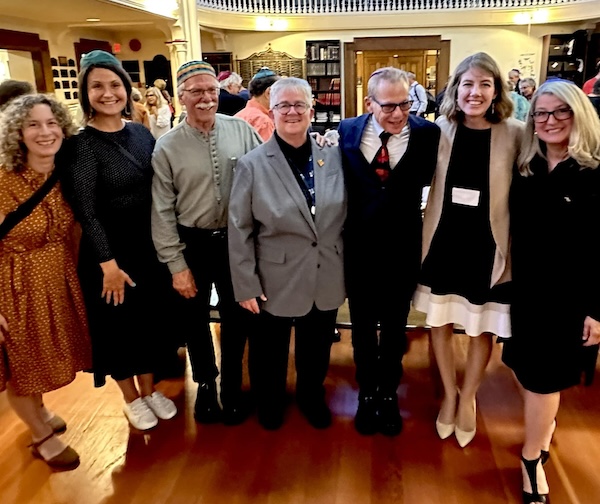
Left to right: Congregation Emanu-El president Ilana Stanger-Ross, MLA Grace Lore, Prof. Richard Kool, Victoria Mayor Marianne Alto, Emanu El’s Rabbi Harry Brechner, MP Laura Collins and MLA Lana Popham on Aug. 18 at the shul’s 160th birthday party. (photo posted on Facebook by Lana Popham)

Victoria’s Congregation Emanu-El, the oldest synagogue on the West Coast and the oldest synagogue still in continuous use in Canada, has been commemorating its 160th anniversary with various events this summer, including an evening concert and an afternoon of poetry, music and food.

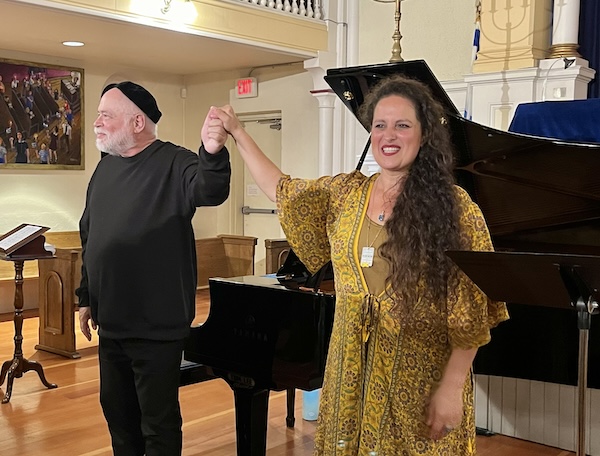
On Aug. 15, Tehila Nini Goldstein, a soprano based in Berlin, performed Ladino, Yiddish, Spanish, Hebrew and Yemeni songs, accompanied by Robert Holliston of the Pacific Opera Victoria and the Victoria Conservatory of Music. Goldstein has won the Tel Aviv Music Academy Singing Competition, received a scholarship from the America Israel Cultural Foundation and taken home a prize in the Liederkranz Foundation Competition in New York.

On Aug. 18, municipal, provincial and federal politicians, as well as representatives from several religious groups, attended an anniversary ceremony, emceed by Richard Kool, a professor of environment and sustainability at Royal Roads University.

photo - On Aug. 15, Tehila Nini Goldstein performed songs in multiple languages, accompanied by Robert Holliston. The event was part of Congregation Emanu-El’s 160th anniversary celebrations
On Aug. 15, Tehila Nini Goldstein performed songs in multiple languages, accompanied by Robert Holliston. The event was part of Congregation Emanu-El’s 160th anniversary celebrations. (photo by Penny Tennenhouse)

The events coincided with a campaign, still underway, by the Conservative shul on the corner of Blanshard and Pandora “to restore, preserve and revitalize” the synagogue. The Romanesque Revival building, a National Historic site, is having work done on both its exterior and interior.

Restoration began this spring, with repairs to the brick outside of the building to ensure structural integrity. Interior restorations include repairing water damage and wall cracks; painting the sanctuary; replacing lighting, smoke detectors, sound and security systems; and refinishing flooring and external doors. Regarding security, Emanu-El plans to set up CCTV cameras, with other systems to improve preparedness.

In August, the congregation held a general meeting at which a motion to increase the complete restoration budget to $1.5 million easily passed, with no objections and one abstention. According to the shul, the meeting filled four Zoom screens, with some members tuning in from Nova Scotia, staying up well past midnight in the Atlantic time zone. 

Scores of individuals and families have contributed to the architectural revitalization project. The synagogue offers the opportunity to “buy a brick” with a minimum donation of $54. The Ronald S. Roadburg Foundation, the Victoria City Heritage Trust and the Jewish Federation of Victoria & Vancouver Island are among the organizations supporting the project.

Jews first started arriving in Victoria in sizable numbers in the 1850s, with the majority traveling from San Francisco. During this era of prospectors, fur traders and steamships, those looking for gold needed to stop in Victoria, the provincial capital, for a mining licence, before moving onto the places where gold was discovered on the mainland. 

The first Jews in town came with the prospectors, supplying mining camps with food, clothing, household goods and tools. By the end of the 1850s, roughly 200 Jews were living in Victoria and, by 1860, the Victoria Hebrew Benevolent Society, the first Jewish organization in Western Canada, purchased a burial site, which still serves the community to this day.

The congregation came into being in 1862, when community members purchased the synagogue’s present site, and a cornerstone-laying ceremony, attended by the many local luminaries of the time, took place on June 2, 1863. The building was designed by the first professional architect in Victoria, John Wright.

Over the course of Emanu-El’s existence, there have been some leaner times, particularly in the mid-part of the previous century, as Vancouver became the dominant provincial city. In the 1940s, with only a handful of paid-up families, the synagogue was in bad shape. To prevent the building from being condemned, its brick exterior was covered with stucco, its windows were blocked and a false ceiling was installed to help with heating. 

In 1978, a group of volunteers decided to bring the synagogue back to its original condition, which cost, at that time, some $370,000, much of it coming from the Jewish community. Completed in 1982, the restoration was celebrated in a way similar to the original dedication in 1863, with people from many cultures coming together to honour the occasion. 

In 2003, as the community continued to expand, Congregation Emanu-El added more space to host social and cultural activities. In 2013, the synagogue had its 150th birthday with musical and theatrical events, lectures, an auction, and a gala dinner at the Empress Hotel. There was also a reenactment of the original cornerstone-laying ceremony, including a parade. Today, the synagogue grows still, with hundreds of members of all ages.

On Sept. 15, at 2 p.m., Emanu-El will be the setting for a conversation between Eleanor Wachtel, the writer and broadcaster most known for hosting Writers & Company on CBC Radio One, and Gregor Craigie, who leads the On the Island morning show for CBC in Victoria.

Reflecting on the long history of the synagogue, this year’s b’nai mitzvah class at Congregation Emanu-El wrote: “When you come in the doors, you feel different from how you feel outside. There’s an ancient and respectful vibe here. That’s the sort of feeling we get in this building; we want to honour that age.” 

For more information, visit 160emanuel.ca. 

Sam Margolis has written for the Globe and Mail, the National Post, UPI and MSNBC.

Format ImagePosted on September 13, 2024September 11, 2024Author Sam MargolisCategories LocalTags anniversary, Emanu-El, history, milestones, Tehila Nini Goldstein, Victoria
Argentina, 30 years later

Argentina, 30 years later

Jewish Federation of Greater Vancouver executive director Ezra Shanken, left, and Centre for Israel and Jewish Affairs Pacific region vice-president Nico Slobinsky were in Buenos Aires last month. (photo from Jewish Federation)

Nico Slobinsky was a 15-year-old high school student in Buenos Aires when, on July 18, 1994, the principal announced that their Jewish community centre and administrative hub had been blown up in an apparent terror attack.

The Asociación Mutual Israelita Argentina (Argentine Israelite Mutual Association, or AMIA) building was attacked by a car laden with 275 kilograms of explosive ammonium nitrate fertilizer and fuel oil. The building collapsed, killing 85 and injuring more than 300. 

The AMIA attack remains the most significant terrorist attack in Argentina’s history. Two years earlier, though, the Israeli embassy in Buenos Aires was the target of a suicide bombing, on March 17, 1992, in which 29 were killed and 242 wounded.

“I remember vividly the morning that the building was targeted and blown to pieces,” said Slobinsky, now the Pacific region vice-president of the Centre for Israel and Jewish Affairs (CIJA). “I remember the pervasive feeling [that] we are no longer safe and what’s going to become of us. I remember the dinner that night at my family’s home, where the bombing, the targeting of the AMIA, was all that my parents were talking about and what was going to happen next. There was a lot of uncertainty at the time and, 30 years later, I can tell you that the same feeling of lack of justice and lack of safety persists.”

The perpetrators of the AMIA bombing have never been brought to justice, nor have the perpetrators of the earlier embassy attack. Hezbollah claimed responsibility for the 1992 embassy bombing but it was only this year that an Argentine court ruled that Iran was behind the 1994 bombing, through their international terror subsidiary Hezbollah.

Two of Slobinsky’s friends were murdered in the attack and many in his circles of acquaintances were killed or injured. He attended and helped organize memorial events on the anniversaries of the AMIA bombing when he lived in Argentina, until 2000, and then joined with the Argentine community in Israel when he lived there. 

Last month, Slobinsky traveled to Buenos Aires for ceremonies marking the 30th anniversary of the atrocities. He was joined by a small delegation of other Vancouver Jewish community leaders, including Ezra Shanken, chief executive officer of the Jewish Federation of Greater Vancouver, and his wife, Rachel Shanken, director of operations at Jewish Family Services Vancouver; Karen James, who is on the national board of CIJA and also on the board of the Jewish Agency for Israel (JAFI); and Candace Kwinter, who is on the board of  JAFI, as well as the board of Jewish Federations of Canada-UIA, and her husband, Alan Kwinter, who is on the board of Congregation Beth Israel.

The anniversary of the terror attack coincided with a meeting of the World Jewish Congress in Buenos Aires, which the Vancouverites attended.

It is widely believed that there was government complicity in the AMIA attack. Police who were routinely stationed in front of the building departed before the bombing. Rubble from the building, which should have been preserved for investigation, was dumped in a river. In 2015, Alberto Nisman, a prosecutor leading the AMIA investigation released a 300-page report accusing then-president Cristina Fernández de Kirchner and other political leaders of covering up Iranian involvement. Hours before Nisman was to present his findings to parliament, he was found dead in his apartment. The government declared it a suicide.

James was impressed with the panoply of world leaders who attended the AMIA commemoration and the WZO conference, particularly Javier Milei, the new president of Argentina, who has made justice for the AMIA terrorists a belated priority. The presidents of Uruguay and Paraguay were also in attendance, as were Jewish parliamentarians from around the world, including Liberal Member of Parliament Anthony Housefather, and special envoys for antisemitism from scores of countries, including Canada’s Deborah Lyons, Deborah Lipstadt of the United States and Michal Cotler-Wunsh of Israel.

Family members of the bombing victims spoke and time has not lessened the agony of the attack, said James. 

“They were sobbing and some couldn’t finish speaking,” she said. “There’s never been closure for them. It was so emotional. I was in tears.”

Candace Kwinter said that standing shoulder to shoulder with the families affected 30 years ago was an act of bearing witness. 

“We’ve all been to Israel since 10/7 and it just feels like another deep, dark, awful part of our history,” she said.

Supporting Slobinsky in the return to the time and place of the bombing was a motivator for those who joined the trip, according to Alan Kwinter.

“It was important certainly to support Nico and also, in this time when there is rising antisemitism and there are so many people that are turning their backs on the Jewish people, I feel that it’s important for us to come together as a community, a global community as well as the local community, and for us to be there with those families that lost their loved ones and have never had justice,” he said. “It was important for me that we show solidarity with them, that they feel that they’re not alone.”

Slobinsky acknowledged the emotional impacts of the commemoration and drew contemporary connections from lessons of the past.

“It was difficult to be there with thousands of Argentinians on the streets still asking for justice 30 years later,” he said, noting that this early life experience reinforced his commitment to taking a leadership role in Jewish life. 

“For those who argue that Canada should embrace the Iranian regime by reestablishing diplomatic ties, the 30th anniversary of the AMIA bombing that we just attended is just another painful reminder that Iran and its proxies like Hezbollah must be held accountable not only for the horrific attack on the AMIA [but] for their export of terrorism around the world,” said Slobinsky. “In memory of my friends Viviana and Christian and to the victims, the survivors and their families – I will never forget.” 

Format ImagePosted on August 23, 2024September 4, 2024Author Pat JohnsonCategories Local, WorldTags Alan Kwinter, AMIA, Argentina, Argentine Israelite Mutual Association, Asociación Mutual Israelita Argentina, Candace Kwinter, history, Karen James, memorial, Nico Slobinsky, terrorism
Talkin’ about the JI

Talkin’ about the JI

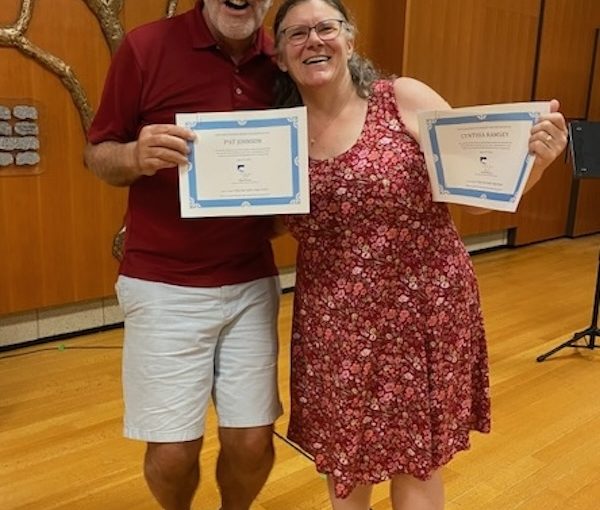
Pat Johnson and Cynthia Ramsay after their presentation about the Jewish Independent at Congregation Har El’s Seniors Lunch July 17. The pair were asked to participate by lunch organizers Tim Newman and Kala Solway. They each received a certificate of thanks and a thank-you gift from Noga Vieman, the synagogue’s programming and education director. (photo by Lorraine Katzin)

Format ImagePosted on July 26, 2024July 25, 2024Author The Editorial BoardCategories LocalTags Cynthia Ramsay, Har El, history, Jewish Independent, Jewish journalism, Pat Johnson

A picture is worth a thousand words

In the first few years of 1900, my paternal grandparents – who had been married since 1886 – came to a decision. Economic life in Pinsk was too challenging and a drastic lifestyle change was required. So, in 1905, my grandfather, Yehiel Rubachka, age 34, journeyed alone from Pinsk (then under control of czarist Russia) to find work in Toronto. He knew Yiddish and a bit of Russian, having served in the Russian army for three years. He left behind my 27-year-old grandmother, Liba, and their four young children, Bessie (born in 1899), David (1902), Minnie (1903) and Herschel (1905), in Pinsk Karlin. Today, Karlin might be called a suburb of Pinsk.

On the one hand, Pinsk, with its sizeable and well-organized Jewish population (according to Yad Vashem, 21,819 or 77.3% of the city’s population, in 1896) offered the comfort of the familiar. On the other hand, living conditions were not good. By the time my grandfather left Pinsk, he and my grandmother had buried five children. There were also political and social issues, such as the fact that, in czarist Russia, Jews by and large lived under restrictions: forbidden to settle or acquire land outside the cities and towns, legally limited in attendance at secondary school and higher schools, virtually barred from legal professions, denied the right to vote for municipal councilors, and excluded from serving in the navy or the guards. Not to mention the repercussions of the failed 1905 Russian revolution, and the deaths and damage done by periodic Cossack attacks.

It is not clear what my grandfather’s relocation ultimately meant. For all intents and purposes, entering Canada was fairly easy; he did not need a passport or a visa to enter the country. But did he go to Toronto to test the waters so to speak – perhaps Canada would turn out to be no better than eastern Europe? Or was his plan, from the start, to make enough money to bring over the rest of the family? Or was it all left open-ended? On the birth certificate of one of my aunts, his occupation in Canada was listed as a (humble) rag collector. 

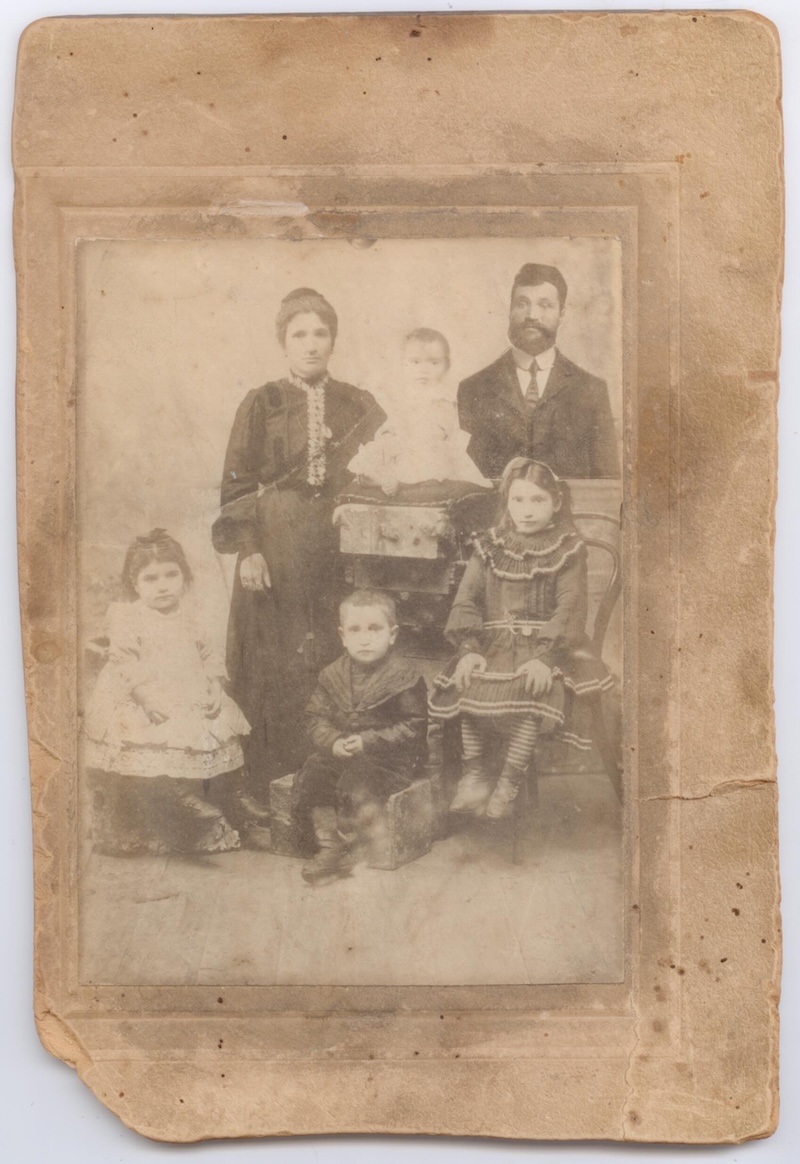
In any case, around 1906, my grandparents decided a family portrait was needed. (Since my Uncle Herschel still looks like an infant, this photo was probably produced earlier than the 1910 date my father held to.) The problem, of course, was that the family was based in two distant locations, Toronto and Pinsk. So how was such a picture taken? 

photo - Deborah Rubin Fields' grandfather and family
A family living on separate continents in the early 1900s has a photo with everyone in it. (photo from Deborah Rubin Fields)

According to Rita Margolin, a Yad Vashem historian, glass plate negatives were in use from the 1850s through the 1920s. They were popular with both amateur and professional photographers. In these years before courier and other delivery services, it would have been tricky to safely send glass negatives, they might have shattered in mailing. This suggests that some other method was used for putting together the two photos that became the family portrait.

Margolin further elaborated that a Pinsk photographer named Rendall might have made the composite image, as he was active in Pinsk in 1910. She pointed out, however, that photographers generally displayed their name on the photos they took, and my family’s photo is lacking a signature both on the front and the back side. (It is probably not a good idea with my unskilled hands to search for a signature by separating this very old photo from the cardboard to which it is pasted.) The lack of signature might mean that the photo I have is a copy and not the original.

Early 20th-century photo studios preferred photomontage – the production of images by physically cutting and joining combined photos – to create, for instance, tall-tale postcards. Tall-tale postcards are also known as “exaggerations.” Examples of these kinds of postcards include hilarious old farming photos in which farmers are seen pushing a wheelbarrow or a wagon containing giant harvested onions or enormous potatoes. 

According to my father, the late Sidney (also known by his Yiddish name, Sheya) Rubin, z’l, my grandfather was added to the picture. One photographer with whom I consulted agreed that this is a likely scenario, as normally the head of the family would be prominently featured in the front, rather than the back, row of a photo. 

In my family’s photograph, my grandmother is standing, facing the camera, straight on and straight-faced. My Aunt Bessie is sitting on a wooden chair while my Aunt Minnie is sitting on what might be a tree stump. My Uncle Dave is sitting on a suitcase. The baby, my Uncle Herschel, dressed in some sort of baby’s gown, sits atop a stack of cases. My grandfather, with a somewhat wistful look on his face, is cleverly placed behind a trunk, with only his upper torso visible.

My grandfather’s family left Pinsk and joined him in Canada in 1911. Sadly, all the relatives who remained in Pinsk were killed in the Shoah. My father’s family settled at Toronto’s 13 Leonard Ave. Between 1880 and 1928, 70,000 Jews left Russian-held territory for Canada.

Four more children were born in Toronto. These included two more aunts, one uncle and my father. Rachel or Rae was born in 1911, Birdie (often called by her Yiddish name Faigel) was born in 1913, Harvey (often called Mo) was born in 1915 and my father was born in 1917. My father’s family, however, did not remain in Toronto. In 1920, they moved to the United States, settling in Chicago. Along the way, the family name was changed to Rubin. My grandfather’s first name was anglicized to Joseph and my grandmother’s first name was anglicized to Elizabeth (or Lizzie). My grandfather became a naturalized American citizen in 1953. By that time, he had been living in the United States for more than 30 years but, still, he signed his naturalization papers in Yiddish.  

As a child, I remember visiting the street where my father had lived as a young child. Perhaps surprisingly, the missionaries still had a close-by storefront. According to reports, missionaries had been “working” in the area since the time my grandfather was living in Toronto. Although they apparently succeeded in converting very few Jews, it did not stop them from trying for years on end.

Photoshop and other digital photo editing tools are a great help to today’s photographers. In the early 1900s, of course, computers and such programs did not exist. Yet, in the early 1900s, photographers on two continents managed to make a composite image nonetheless. 

Deborah Rubin Fields is an Israel-based features writer. She is also the author of Take a Peek Inside: A Child’s Guide to Radiology Exams, published in English, Hebrew and Arabic.

Posted on July 26, 2024July 25, 2024Author Deborah Rubin FieldsCategories WorldTags family, history, immigration, photography

Posts pagination

Previous page Page 1 … Page 11 Page 12 Page 13 … Page 57 Next page
Proudly powered by WordPress