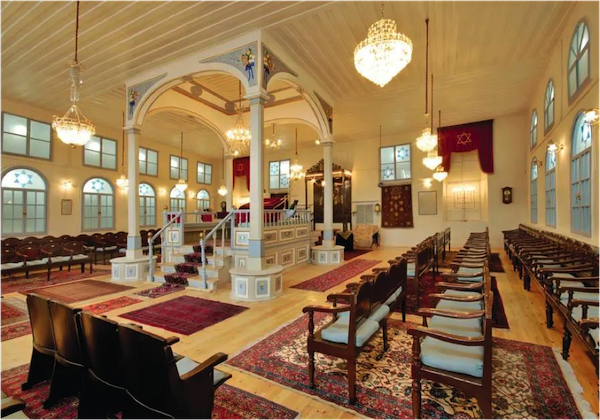
Algazi Synagogue was built in 1724 and has been renovated several times. (photo from Izmir Jewish Community Foundation)
The Izmir Jewish Community Foundation’s Izmir Jewish Heritage Project, for the preservation of Jewish heritage within the Turkish city, has started its activities. The project, financed by the European Commission, also has Our City Izmir Association as a partner.
Home to various cultures and religions, Izmir is one of the cities that has attracted Jewish immigration since ancient times. In the light of current data, the first concrete evidence of the Jewish community’s existence in the city dates to the fifth or sixth century CE. Sephardi Jews expelled from the Iberian Peninsula in 1492 and 1497 came to the Ottoman lands and settled in Izmir and its surroundings.
Since the middle of the 16th century, synagogues, hospitals, cemeteries and other institutions were established within the social, economic, cultural and administrative structure that started to form the present Izmir Jewish community. Most of the historical buildings that have survived to today are located in the Old Jewish Quarter, known as the historical centre and downtown of Izmir.
The Jewish population fluctuated after the 16th century due to earthquakes, epidemics, fires and global political, economic and sociological migrations. In the 1800s, Izmir was home to approximately 50,000 Jews, mostly Sephardi. A significant decrease in the population began in the early 1900s, when many people migrated to Europe and the Americas. Another massive outward move took place to Israel, after the establishment of the Jewish state in 1948. Today, the Jewish population of Izmir is about 1,100 people.
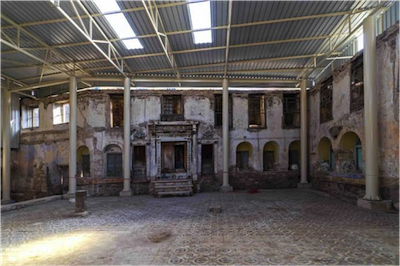
Hevra Synagogue, which was founded in the early 17th century, is located within a complex of four synagogues that share a courtyard marketplace in Izmir. (photo from IJCF)
In parallel with the decrease in population, out of the city’s 34 synagogues, only 13 remained. With shrinking congregations, some of the synagogues were neglected and even disappeared over the years. In addition, seismic activity and environmental threats have put these structures in peril. As a result, all of the synagogues that have survived to the present day have to be preserved and restored.
Six of the nine synagogues in Kemeralti, the bazaar area at the heart of the city, tell the stories of centuries. Adjacent to one another and with their special architecture, they have unique value in the world. Currently, the area, consisting of the nine synagogues, one chief rabbinate building, five kortejos (courtyards) and the Juderia (Jewish district) creates a density of structures that is also of unique cultural and touristic value.
The 36-month heritage project includes:
A masterplan for the region of the Old Jewish Quarter, located in the historical centre of Izmir, including conservation and restoration plans for the Hevra and Foresteros synagogues, which date to the 17th century. These synagogues, witnessing much of the Izmir Jewish community history, are unique, as they form a compound of four synagogues facing the same courtyard.
This compound of synagogues will be promoted in Turkey and worldwide, to be recognized as a cultural heritage site, a tourist destination and an intercultural dialogue centre.
A platform strengthening communication with local, national and international networks will be established. A physical location where the platform will carry out its work is also planned.
Four books will be written and published on subjects such as Izmir Sephardi stories, Izmir Sephardi women, Jewish press in Izmir, and traditional synagogue textiles.
Conferences, workshops, training and study visits will be organized.
Works on corporate identity, website, brochures, short films, etc., will be brought to life in order to increase institutional capacity and promote this heritage.
While the project is funded by the EU, the content is entirely under the responsibility of the Izmir Jewish Community Foundation.
בפעמיים האחרונות כתבתי ארוכות על הטיול הטוב שעשיתי לוויקטוריה הבירה של מחוז בריטיש קולומביה. זאת בעידן הקוביד כאשר אי אפשר לטוס יותר לאירופה שאני אוהב אלה “רק” לטייל במחוז היפה שלנו.
לאחרונה הספקתי לבקר בשני מקומות בבריטיש קולומביה לראשונה מאז עברתי לקנדה לפני למעלה משש עשרה שנה. הראשון שלא היה מעניין במיוחד – היה לעיירה טופינו בקצה הרחוק (המערבי) של האי ונקובר והשני שהיה מאוד מעניין – היה העיר קולונה בעמק אוקנגן.
לטופינו טסתי במטוס הים שנוחת במים כך שפגשתי מעט נוסעים בטרמינלים הקטנים של ונקובר ושל טופינו. הטיסה לטופינו נמשכה שישים וחמש דקות ובמטוס הקטן מלבד הטייס היו עוד שתי נוסעות. הנוף מהמטוס שטס בגובה נמוך מרשים ביותר. תחילה רואים את פארק סנטלי ולאחר מכן את מי האוקיאנוס השקט השקטים בדרך לאי ונקובר. גם חציית האי מהצד המזרחי למערבי כדי להגיע לטופינו יפה ביותר.
טופינו היא עיירה קטנה שמונה בסך הכול כאלפיים תושבים. מרבית התיירים באים אליה כדי לגלוש בגלים הגבוהים של האוקיאנוס או לעשות ספורט אתגרי אחר. וכן לטייל ביערות הגשם ובסביבה.
בגלל מגפת הקוביד האיים של האינדיאנים שסמוכים לטופינו היו סגורים למטיילים ולכן נאצלתי להסתפק בטופינו הקטנה בלבד. בתור תייר שמחפש תרבות לא מצאתי הרבה לעצמי בטופינו. לאחר הנחיתה הלכתי ברגל בערך כרבע שעה למלון מאק הממוקם ברחוב הראשון בסמוך למים. המלון היה נחמד ונקי אך בגלל המגפה הקפטריה שלו הייתה סגורה ולכן אכלתי במסעדות בחוץ.
הביקור בטופינו התפרש על פני לילה אחד בלבד וטוב שכך מבחינתי כי לא מצאתי עניין בעיירה הקטנה והנידחת הזו. ירדתי לחוף הים הפראי וטיילתי להנאתי. לאחר מכן הסתובבתי במרכז העיירה הקטן ומצאתי קפה נחמד לאחר הצהריים. בחיפושי הנואשים אחר תרבות מצאתי את הגלריה של רועי הנרי ויקרס. מדובר באמן אינדיאני (בן שבעים וחמש כיום) שזכה להכרה ברחבי העולם ואף קיבל פרסים רבים. רכשתי ספר שמכיל את היצירות שלו אותו הבאתי כמתנה לבת זוגתי בוונקובר. לאחר הביקור בגלריה המעניינת חיפשתי מקום לארוחת ערב. מתברר שבערב בטופינו ישנן ארבע מסעדות פתוחות וחוץ מזה כל העיירה סגורה. לאחר הארוחה הסתובבתי קצת באזור ומצאתי שתושבי העיירה הולכים לישון מוקדם מאוד. אחרי שמונה בערב הכול חשוך וסגור.
למחרת בשעות הצהריים המוקדמות הייתי אמור לטוס בחזרה לוונקובר במטוס הימי אך בגלל הערפל הכבד הטיסה בוטלה לצערי. כיוון שבקו טופינו ונקובר יש רק טיסה יומית אחת של המטוס הימי הבנתי שלא אוכל באותו יום לעשות את הדרך חזרה עמו כאמור בגלל הערפל. בנוסף הייתה טיסה אחת בלבד של מטוס רגיל (מופעל על ידי חברת פיסיפיק קוסטל) אך היא כבר יצאה לכיוון ונקובר. לכן לא הייתה לי בררה אלה לחפש אוטובוס הביתה.
למזלי ברגע האחרון מצאתי אוטובוס בקו טופינו אל העיר נאיימו שבמזרח האי ונקובר. היה זה אוטובוס קטן והנסיעה נמשכה כארבע עשות תמימות. באמצע נאלצנו לעצור לחצי שעה כיוון שתיקנו את הכביש בין טופינו לננאיימו. לאחר מכן עצרנו למספר דקות לשתייה ושירותים בפורט אלברני ומשם הגענו במהירות יחסית לננאיימו. המעבורת עדיין לא עזבה את המעגן בנניאמו, כך שיכולתי לעלות עליה ולשוט בנוחות לעבר ווסט ונקובר. משם מצאתי אוטובוס מהיר לדאון טאון ונקובר והגעתי סוף סוף הביתה. אם כן הדרך חזרה נמשכה שעות מרובות עד שהגענו לוונקובר.
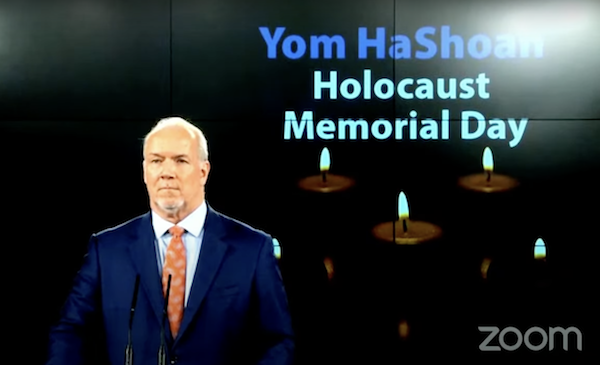
B.C. Premier John Horgan opened the commemorative event. (screenshot)
A uniquely British Columbian virtual commemoration of Yom Hashoah, Holocaust Remembrance Day, took place April 8, convened by the Government of British Columbia in partnership with the Vancouver Holocaust Education Centre (VHEC) and the Centre for Israel and Jewish Affairs, Pacific Region.
Premier John Horgan opened the event.
“On Yom Hashoah, we remember the six million Jewish lives that were lost during the Holocaust. We also remember and honour the millions who lost their lives or were murdered because of their ethnicity, sexual identity or disability,” said the premier. “Today, we also pay tribute to Holocaust survivors and, as that community grows smaller, it’s all the more important that we work together to carry that message forward – that we will never forget and it will never happen again, especially in light of the ongoing threats of violence and discrimination Jewish people are facing worldwide today.”
Horgan noted an incident in Victoria where a Chabad centre was defaced with antisemitic graffiti a day earlier.
“These are the types of acts we must stand together and fight against with a united voice, regardless of where we come from, regardless of our orientations or ethnicities or our faith. We must stand against antisemitism and racism whenever we see it,” said Horgan. “As we light the candles at Yom Hashoah in remembrance, we must remain vigilant and, as we take action today and honour those who lost their lives and those who have struggled since the Holocaust, we must again remember that we cannot repeat our past.”
Michael Lee, MLA for Vancouver-Langara, also spoke.
“As the living memory of the Holocaust fades, the important act of remembering and coming together each year grows in importance,” he said. “It is our collective responsibility to ensure that we never forget and such a thing never happens again, because, sadly, this is not just about remembering history, but about standing together today against the racism, bigotry and antisemitism that still exists in our world.… As a community, now and every day, we must stand against these acts of hate and bigotry.
“Today, on Holocaust Remembrance Day, we are reminded of why it is so important to come together, to reflect and to ensure that the past is not forgotten. We must remember both the parts of this dark, dark history that we must not let be repeated and the acts of heroism that took place amid such tragedy. Even during a period of humanity’s darkest chapters, there was still good in the world, people who risked their lives to hide and save others from the Shoah. Amidst the horrors and atrocities, there were tales of love, hope and bravery, including with the many righteous among nations, people who demonstrated that light can triumph over darkness. Today, we reaffirm our commitment to never forget; remember the victims, the survivors and the heroes; and we pledge to build a better world in their memory.”
Dr. Robert Krell, founding president of the VHEC, lit six memorial candles. The premier lit a seventh candle “to honour the millions of Roma, Slavic, LGBTQ2+ and people with disabilities who lost their lives.”
Krell, speaking on behalf of Holocaust survivors, noted that 1.5 million of the six million Jews murdered in the Holocaust were children. An estimated 93% of Jewish children in Europe were murdered, which makes his survival extremely remarkable. The fact that both his parents survived, when more than 80% of Dutch Jews were killed, is additionally miraculous.
Dr. Robert Krell spoke on behalf of Holocaust survivors. (screenshot)
“I had lost all grandparents, uncles and aunts,” Krell said. “One first cousin remained. The war left its mark and I bear a special responsibility to remember what happened and try to derive lessons from that unfathomable tragedy. The tragedy was unique in its objectives, its focus and its ferocity. Jews were extracted wherever they resided, whether Paris, Prague or Vienna, whether city or countryside or the isles of Rhodes or Corfu. The enemy pursued us and tortured and murdered without mercy, without exception.”
While Dutch citizens remember the Canadian military’s role in liberating that country, Krell also noted Canada’s failure to save European Jews before the war.
Krell also addressed the issue of the International Holocaust Remembrance Alliance’s Working Definition of Antisemitism. Around the world, he said, 34 countries have adopted the definition, as has the province of Ontario.
“As a survivor who has been deeply involved in Holocaust remembrance and education, it strikes me as unconscionable not to accept the IHRA definition to assist us all in recognizing the signs and symptoms of the scourge of Jew hatred,” he said.
Yom Hashoah fell the day before the federal New Democratic Party convention that was to consider a resolution rejecting the IHRA definition. The matter never made it to the floor, but another resolution condemning Israel passed by an overwhelming margin.
“It is my hope that we will soon see the provincial government’s adoption of the IHRA definition of antisemitism,” said Krell.
Rabbi Dan Moskovitz of Temple Sholom also took up the issue of the antisemitism definition.
“The International Holocaust Remembrance Alliance’s definition of antisemitism is, I think, the tool that guides us in our work to combat anti-Jewish sentiments,” he said. “I want to urge our provincial government to join other jurisdictions in embracing the action that is required to combat both historical and contemporary hatred of the Jewish people.”
He added: “When we think of the death of a human being, we mourn the loss of the body and the soul, but, in my work, standing with too many grieving families at graveside, it is not the body that we miss most, that is merely the vessel for the soul, the part of that person that is unique in all the world,” he said. “That’s the part that we fall in love with and are forever changed by. The soul of another leaves an imprint on our heart. So, today, we remember six million murdered Jewish souls, their lives that have been extinguished, their dreams unrealized, their loves and relationships gone forever. We pray that those dear souls are comforted and embraced under the wings of God’s presence and that now, remembered so publicly, will never be forgotten.”
Moskovitz then chanted El Moleh Rachamim and a version of the Mourner’s Kaddish that includes the names of the Nazi death camps.
In addition to the B.C. event, the Vancouver Holocaust Education Centre also partnered on April 8 with the Neuberger Holocaust Education Centre in Toronto, the Azrieli Foundation, Canadian Society for Yad Vashem, Facing History and Ourselves, Friends of Simon Wiesenthal Centre, March of the Living Canada and UIA in a Canada-wide Yom Hashoah online program that included survivor testimony from individuals across the country and a candlelighting ceremony.
A day earlier, the VHEC partnered with the Montreal Holocaust Museum for a virtual program focusing on the importance of remembrance in the intergenerational transmission of memory. Survivors and members of the second and third generations spoke about their experiences. Video recordings of all three events are available at vhec.org.
In 2002, when the once and future prime minister of Israel, Binyamin Netanyahu, visited Montreal, a violent riot by anti-Zionists erupted at Concordia University. That was a turning point in a now two-decades-long period of anti-Israel and, in some cases, anti-Jewish activism on Canadian campuses.
Universities across Canada would go on to host events such as Israel Apartheid Week and, on multiple campuses, countless peaceful and less peaceful attacks on Israel and its supporters have occurred. As all of this has transpired, Concordia has had the reputation of having probably the most anti-Zionist and antisemitic campus culture in the country. So, many Jews and other observers were stunned when the Concordia Student Union issued an apology to the Jewish community. Released the day before Yom Hashoah, the statement from the CSU began: “Today, we strive to acknowledge our mistakes and begin the process of correcting ourselves.”
The 500-word letter of apology was an unequivocal denunciation of past CSU actions and approaches.
“Overall, our mistakes can be described in one word, indifference,” it reads. “Indifference to one of the world’s oldest forms of discrimination. Indifference to the concerns of our Jewish students. Indifference to the struggles they have faced. While a common topic of our meetings has been how the CSU can tackle other forms of discrimination or support certain minority groups, the Jewish community and antisemitism are seldom brought up.… The CSU has assisted in fostering a campus culture where Jewish students are afraid to openly identify as Jewish…. Our silence on these issues only benefits the oppressors and sets the belief that these acts are somehow justifiable, which encourages the oppressors to continue this behaviour. This behaviour continues well outside the boundaries of our campus and into a society where they may harm many more individuals.”
In addition to the apology for past behaviours, the statement promises concrete action now and in the future. All elected student union officials will receive training on antisemitism every year. Executive members of all Concordia campus clubs will also receive annual training to identify antisemitism and help foster an environment where Jewish students and members of the community can feel safe and fully included. A bystander prevention program is being developed to help students “identify and safely intervene and/or support Jewish students if they witness an act of antisemitism.”
“While we stood idly by in the past while acts of antisemitism occurred, we hope not to repeat those mistakes again and hope the Jewish community will give us another chance to support them in the future,” the apology concludes.
The statement was issued after a process of listening to Jewish students express their fears and experiences with antisemitism at the university. It was drafted by Eduardo Malorni, currently the student life coordinator of the CSU, who will assume the role of general coordinator (the equivalent of union president) in June.
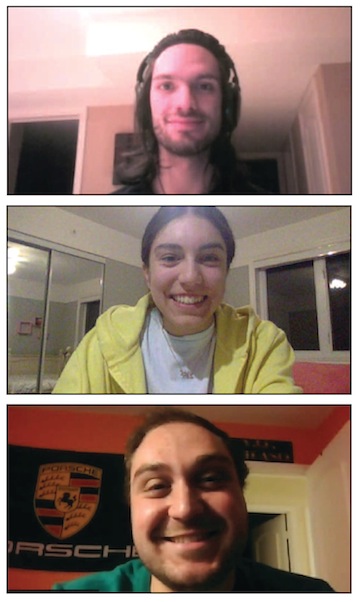
From top: Concordia Student Union councilors Eduardo Malorni, Nicole Nashen and Harrison Kirshner spoke to the Independent via Zoom about the CSU’s apology to Jewish students. (screenshots)
“We got feedback that it was very appreciated,” Malorni told the Independent. “Some people brought up that it was too little, too late, which is a fair criticism for an organization that’s been around as long as us. But our feedback all seems to be positive.”
Two Jewish campus leaders who also spoke with the Independent were emotional.
“I cried the first time I read it,” said Nicole Nashen, an elected CSU councilor and incoming president of Concordia Hillel.
“We cried together,” said Harrison Kirshner, a vice-president of Concordia Hillel, a CSU councilor and incoming executive member.
“As a student, when I first came to Concordia, I knew in my mind what type of institution this is and I knew that I had to hide part of myself in a sense,” said Kirshner. He would think twice, he said, before mentioning celebrating Jewish holidays, for example. Part of the progress that culminated in the apology, he suggested, was students like him opening up and sharing their experiences.
“I realize that conversation and speaking to people about what we face is a much better way than hiding it and not talking about it and not addressing those issues,” he said. “Because, if we don’t address them, nothing is going to change. But, if we do address and we do talk about the experiences that we face, change can stem from that. That’s what we are seeing happening.”
The campus climate is significantly better than he expected when he arrived.
“I noticed that people were receptive to those discussions, people that I thought maybe wouldn’t be receptive to those discussions were receptive to those discussions,” he said. “Part of the reason is because, instead of going in with a fighting attitude, we need to go in with a respectful attitude, a dialogue attitude, an attitude that allows us to open up a conversation with our fellow councilors who I consider to be allies, friends.”
Nashen also acknowledged a feeling in the pit of her stomach when fellow students would raise the topic of ethnicity.
“I didn’t know how I was going to be labeled or what the reaction was going to be or what assumptions are going to be made about me because of the fact that I’m Jewish,” she said. Elected to the CSU recently for the second time, she said she never foresaw being so welcomed.
Both Kirshner and Nashen credit Malorni, who is not Jewish, for encouraging them to share their stories and for making other Jewish students comfortable to come forward and share their experiences. The letter, they said, came from his heart.
“It did come from the heart,” Malorni admitted, “but it only came from the heart because Harrison and Nikki were so open about talking about the issues they faced and also in setting up meetings with other Jewish students who would never have come near the CSU with a 10-foot pole, setting up meetings and saying it’s safe, you can explain it to them, they’re not going to bite your hand off, because students would never have told us 95% of what they told us, unless those meetings were facilitated by both Harrison and Nikki. That’s why I think, in terms of writing the apology, when it came down to it, it became – I wouldn’t say it was easy to write it – but the words were a little easier to come from brain to paper.”
The letter, of course, comes from a new group of CSU leaders, not from the individuals who were involved before and perpetrated some of the extreme activities, such as a Passover Against Apartheid event a few years ago. The current crop of leaders was elected in a campus vote that saw extremely low turnout. However, Malorni noted, student union votes at Concordia and most universities are notoriously and chronically low, so the small number of voters who endorsed the current leaders is commensurate with the number who voted for the earlier, problematic representatives.
“The majority of messages that I’ve received are shock,” Nashen said. “I would have never imagined this could have ever happened at Concordia.… I think a lot of people, especially maybe people who went to Concordia and were involved in Concordia 10 to 20 years ago, but haven’t kept in the loop about CSU affairs, were just utterly shocked, could not believe it. Then, a lot of current students were reaching out to me saying, ‘I just had shivers reading this.’ I can’t believe that our issues are really being taken seriously and that the CSU really cares to help us fight antisemitism.”
She acknowledged that the apology is the beginning of a process, not the end.
“I don’t think this was a fix-all,” she said. “I think this was the first step that the CSU is taking toward telling the Jewish community that they do care about us now and they are ready to start listening to us and taking our issues seriously. What really put the cherry on top was not just words but it came along with actionable steps.”
Malorni said Concordia has had a national reputation as a tough campus for Jewish students, but he is well aware that other campuses have also had their experiences with conflict.
“While we had the worst reputation for it, it’s not something that doesn’t exist at the other universities,” he said. When the apology was posted, he said, commenters from all over North America recounted their own experiences with antisemitism at their universities.
“It’s not a thing limited to Concordia, despite our little extra bad reputation,” he said. “It’s something that seems to have crossed the bounds of our land.”
Purim 2020, which took place in early March, brought with it added significance. For some, it represented the last time they gathered in a Jewish setting in person, outside the home. For others, it was the first “live” service to be canceled as a result of SARS-CoV-2. In the days that ensued, lives changed as the perils of the coronavirus became apparent. School, work and religious services all moved online; personal contact with friends and family became exceedingly limited; travel, for most people, ceased.
Among the societal issues compounded by the pandemic have been increased isolation, drug dependence, and food and job insecurity. Underlying these problems has been COVID-19’s effect on mental health, including within the local Jewish community. As a result, numerous groups have stepped up their efforts to help the most vulnerable, and all those who have been impacted by the pandemic. During the past weeks, as the first anniversary of COVID-19 came and went, the Jewish Independent spoke with several people at the forefront of handling the Greater Vancouver Jewish community’s response.
At Jewish Family Services (jfsvancouver.ca), efforts to tackle mental health issues have widened, as more people have been seeking the agency’s support. Early on, JFS opened a crisis line that runs seven days a week, from 9 a.m. to 9 p.m. (604-588-5719 or [email protected], with the promise to respond within 24 hours).
“People are struggling, without a concrete end to the restrictions, and so demand for emotional support and learning different coping skills has surged. Our crisis line is always there for people who need immediate help and, for many community members, this is the easy way to connect with a counselor. If someone wants to remain anonymous, that is absolutely an option, we do not require a caller to identify themselves,” JFS chief executive officer Tanja Demajo told the Independent.
From its launch at the start of the pandemic to August 2020, the JFS Community Crisis Line received 955 calls, serving 494 individuals. Case workers spent 2,052 hours on the line. Additionally, 166 individuals accessed free programs offered by the JFS mental health and wellness team via telehealth and video conference – a 40% increase compared to pre-COVID times.
“Many are struggling with the added role of being a caregiver in the pandemic context, as well as dealing with their own emotions, so our workshops and support groups provide a community where people are able to vent, talk and support one another. We also connect people with friendly callers. These services have been a lifeline for many of our clients,” Demajo said.
A report released by the JFS client advisory committee last summer highlighted many ongoing concerns. One alarming quote from a client cited in the report reads, “COVID-19 has been depressing and frightening for me. My anxiety has been through the roof and I’ve had an increased number of panic attacks and migraines. My chronic health conditions have increased in severity and I have new ones. My nightmares and terrors have also increased.”
Prior to the pandemic, some JFS clients were already battling with mental health issues, often severe, which have been aggravated by the need to now cope with unaccustomed fears and anxieties. Some people, according to JFS, have refused to go outside, whether it be to the grocery store or outside for a walk. This problem is often felt by seniors, who, like everyone, need exercise and who confront serious health conditions such as heart disease, diabetes and high blood pressure.
Many housebound JFS clients depended on family and friends visiting for social and emotional connection before COVID hit and have been feeling deeply alone since the pandemic began. Irritability and anger are rising. Senior clients who were used to spending significant time with their grandchildren are missing them desperately. “I miss hugging my grandchildren,” is a common refrain.
Since mid-May of last year, there have been weekly depression and anxiety support group meetings with JFS’s mental health outreach therapist, Kevin Campbell. Run on Zoom, the 90-minute sessions teach coping skills and allow a safe place to talk and share. The group focuses on cognitive behavioural therapy and mindfulness techniques. JFS also has an active seniors caregivers support group led by Lily Shalev.
Not all COVID-19 developments in connection to mental health are grim, JFS notes. Due to technological developments, some of those experiencing isolation are able to access telehealth, work from home, get home deliveries and view a variety of educational and cultural offerings online, including many synagogue activities.
Jewish Addiction Community Services Vancouver (jacsvancouver.com), an organization that helps community members navigate the troubles of various substance abuse issues, has held one-on-one meetings on Zoom ever since COVID started.
“Clients seem to like this kind of individual counseling better, as it allows for greater intimacy, even though it is on Zoom,” said Shelley Karrel, manager of counseling and community education at JACS. “What people liked most about the group meeting was the getting together physically.”
To help those who would prefer to meet in person, Karrel has arranged for one-on-one socially distant coffee meetings. “What JACS has done is to make ourselves more available to someone when they want to talk, and to be able to schedule a meeting fairly quickly. As a registered clinical counselor, I am able to offer clients tools and exercises for managing their symptoms and for exploring the root causes when the issues of anxiety and depression are evident. Some of my clients are finding AA meetings helpful online. And, like with our clients, some are not using that medium for the same reason – it’s not personal enough.”
For ongoing support, JACS has a monthly email that lists many resources for people, if they want to reach out for specific help. JACS is also beginning a new program, Sustaining Recovery, that offers additional support in the form of a structured plan to help someone develop goals and be able to keep track of their progress. This plan, JACS finds, is very useful in creating accountability and support.
Inclusion services at the Jewish Community Centre of Greater Vancouver (jccgv.com/inclusion) continues to provide a number of targeted social and recreational programs intended to engage, educate and provide meaningful lifelong learning opportunities, as well as engage individuals with diverse needs. The programs are rooted in Jewish values and the principles of social connection, community building and belonging.
“Social isolation is a prevalent issue for individuals with diverse abilities [and] this reality was exacerbated by the COVID-19 shutdown,” explained Leamore Cohen, coordinator of inclusion services. “These communities have been particularly impacted by the loneliness, uncertainty and economic hardships caused by the global pandemic, leaving these individuals at higher risk for numerous health challenges. The work we do in the inclusion services department creates the needed awareness of the individuals we support. But, now more than ever, community members are looking to us for routine and engagement at a time when they are most vulnerable.”
As people have settled into life with COVID-19, “these individuals continue to be shut in and vulnerable to mental health challenges,” she added. “In response, we offer a hybrid of virtual and in-person programming throughout the week that is both accessible and safe. In-person programs adhere to best COVID practices, and our virtual offerings allow for those who are unable to attend in person to access programming and community virtually.”
The Bagel Social Club, for example, met weekly in pre-COVID times as a means to increase avenues for integration, self-reliance and wellness. The program has shifted to weekly social clubs over Zoom and a weekly Relax and Just Breathe class, which includes gentle stretching, breathing exercises and visualizations.
As the lockdown took effect last year, Jewish Federation of Greater Vancouver (jewishvancouver.com) began convening multiple stakeholder groups to determine the pandemic’s impact on many aspects of Jewish communal life. A common thread during these discussions involved concerns about the impacts of increased social isolation on seniors, families and youth. Federation also hosted several webinars on mental health for community members, related to the impacts of COVID-19.
“Through this work, we were able to identify a number of key initiatives that we could support both financially and organizationally,” said Shelley Rivkin, vice-president of global and local engagement at Federation. “These include over $170,000 in emergency funds to Jewish Family Services, part of which was used to support the emergency care line; funds for Jewish Seniors Alliance to expand their peer support program; and the organization of several webinars with community psychologists directed toward young adults, families and teens.
“The Jewish Community Foundation, Federation’s endowment program, has also supported a number of projects to enable community agencies to undertake mental health initiatives,” she added. “Support for mental health issues for both agency employees and leaders was also identified as a priority for the community recovery task force when they launched their first grant round. It will continue to be highlighted as we move into the next grant round.”
Last December, youth workers voiced concern about the mental well-being of youth and young adults. Consequently, Federation hosted a roundtable with key leaders to ascertain how community members in this age range are faring, especially when faced with so many disappointments and cancellations over the past year. Based on these conversations and others, Federation will be collaborating with these agencies to develop a community mental health strategy for children and youth.
Sam Margolishas written for the Globe and Mail, the National Post, UPI and MSNBC.
Dr. Noah Alexander was the keynote speaker at the Jewish Seniors Alliance Spring Forum on March 21. (photo from medicalmentorcommunity.com)
Can I Trust That? Evaluating Health Information Online was the topic of the Jewish Seniors Alliance Spring Forum, held virtually on Sunday, March 21.
Gyda Chud, co-president of JSA, welcomed about 100 people to the afternoon event. She reminded attendees of the four foundational elements of JSA: outreach, education, advocacy and peer support. She then turned the mic over to Tamara Frankel, a member of the program committee, to introduce the guest speaker, Dr. Noah Alexander.
Alexander is a practising emergency physician at Vancouver General Hospital. Although he usually works on the front line, he also works to empower patients. He does this through his role as the associate director of digital health literacy at the InterCultural Online Health Network. This organization helps members of many different communities understand and manage their chronic health conditions.
Alexander began his talk by stating that his goal was to provide a systemic approach to health education. He highlighted many elements, beginning with the question, How do you know who to trust in this information age?
When using a search engine (he likes to use Google Chrome), use key words or short sentences to find information. When looking at the search results, consider whose website it is, their credibility and the value of the content. Credibility and content are key to the whole process. For example, who wrote the article or blog, and are they known and respected? How old is the entry? Is it relevant to the question you’re asking? Is it peer-reviewed or is the writer or organization accredited? Check the site’s URL: for example, .com entities are usually commercial and profit-based, whereas URLs ending in .org, .gov and .edu are not-for-profit.
Check both the credentials of the authors and whether they are being paid and, if so, by whom. If the entry has advertisements, there is likely to be a bias involved, Alexander warned. He said people should not trust a Wikipedia entry for important information, as anyone can add their own comments to the post. Rather, use a credible health website such as the BC Centre for Disease Control, HealthLink BC, Vancouver Coastal Health, or any other government agency.
If an article’s page contains links to other websites, there could be a conflict in that they may be selling merchandise. Red flags should be raised when cures are being offered and sold online, said Alexander. Do not trust simple, non-medically proven solutions, or advice contained in group chats. Make sure that there is a privacy policy.
Alexander then presented an interactive quiz based on his presentation, after which Chud thanked him for clarifying the elements involved in seeking accurate health information online. She also summarized the questions attendees posted in the chat and Alexander answered a number of them.
The answer to the question posed about health information online – “Can I Trust That?” – is yes … if you follow Alexander’s suggestions.
Shanie Levinis program coordinator for Jewish Seniors Alliance and on the editorial board of Senior Line magazine.
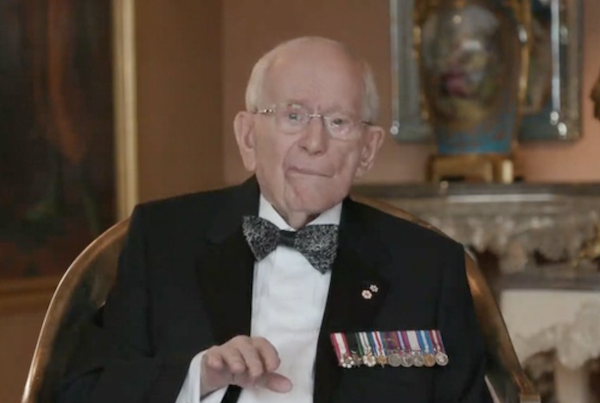
Joe Segal accepting the Greater Vancouver Board of Trade’s Rix Award for engaged community citizenship in an April 7 online celebration. (screenshot)
The Greater Vancouver Board of Trade paid tribute to Joe Segal on April 7, honouring him with its Rix Award for engaged community citizenship, in recognition of his many philanthropic endeavours and decades of community service.
The postponed 2020 Governors’ Banquet & Rix Awards was reimagined for the virtual gathering, which was dubbed the Governors’ Gala and Rix Awards. The event also saw the board’s Rix Award for engaged corporate citizenship bestowed on CN, and its immediate past chair, Lori Mathison – who currently serves as president and chief executive officer of Chartered Professional Accountants of British Columbia – inducted into its council of governors, along with Kari Yuers, president and CEO of Kryton International Inc. Gala co-chairs were Lorne Segal and Brent Cameron.
Born in Vegreville, Alta., in 1925, Joe Segal’s early years included losing his father at aged 14, stretches of financial hardship and hard labour building the Alaska Highway. He fought in the infantry in the Second World War, where, along with his compatriots, the Calgary Highlanders, he participated directly in the liberation of the Netherlands.
Following the war, he arrived in Vancouver with $1,500 in his pocket and set to work on more entrepreneurial pursuits. While he started small in war surplus goods, his hard work and tenacity led him to found the Fields department stores and, ultimately, take over Zellers before launching Kingswood Capital Corp., a conglomerate with interests in real estate, manufacturing and financing.
Despite his success, Segal has remained firmly grounded in the community where he built his businesses and raised his family. It is a tribute to his character that his impact and life in the city are perhaps most marked by his generosity – both with his time, as a mentor, and philanthropic endeavours.
A recipient of both an Order of Canada and an Order of British Columbia, Segal’s more recent years have been defined mainly by his philanthropy.
He served on the board and as chancellor of Simon Fraser University for six years. And, in perhaps one of his most visible contributions in Vancouver, Segal donated the historic Bank of Montreal building at 750 Hastings St. to SFU, creating a home for the Segal Graduate School of Business.
In 2010, he and his wife Rosalie donated $12 million to the VGH and UBC Hospital Foundations to create the Joseph and Rosalie Segal and Family Centre, a 100-private-room acute care centre serving the mental health needs of people in crisis. The substantial gift, made prior to mental health concerns being mainstream, is just another demonstration of his strong connection to the needs of the community. There are countless other organizations who are recipients of the Segals’ work and philanthropy.
Together with his partner Rosalie, the Segals have passed along the philanthropic genes to their children Sandra, Tracey, Gary and Lorne. The Segal family has supported mental health charities for more than 20 years. Their awareness was sparked after they were invited to attend the Coast Mental Health’s Courage to Come Back Awards, which honours individuals who have overcome major life challenges. The event has been chaired by their son, Lorne, for the past 15 years.
In a complex world, Joe Segal’s life offers a clear example for leaders today and the leaders of tomorrow. Simply put, a life well-lived will be most marked by the ways in which we give back to our community and contribute collectively towards a brighter future.
The Rix Awards are an initiative of the Greater Vancouver Board of Trade, presented in honour of the late Dr. Don Rix, who served as chair of the organization in 2008-09. Award recipients are chosen each year by a special selection committee of the board of directors, based on a number of criteria.
Lana Pulver has agreed to lead the Jewish Federation of Greater Vancouver’s 2021 annual campaign. She comes to this role with vast volunteer experience. She has served the past two years as the campaign’s major gifts chair and served as both chair and vice-chair of women’s philanthropy. She served on Federation’s board of directors for five years, including on the executive committee. And, she served on the board of governors of the Jewish Community Foundation for 12 years, during which time she chaired both the professional advisory and development committees – not to mention the numerous roles she’s held with other organizations and her professional accomplishments.
* * *
Family physician Dr. Anna Wolak, medical director at King Edward Medical Centre in Vancouver, has been appointed the associate head of the department of family medicine at Providence Health Care.
* * *
Artist Lilian Broca was invited to contribute to Letters from the Pandemic: A 30th Anniversary Commemorative Public Writing Project of the Graduate Liberal Studies Program of Simon Fraser University. The project is hosted by The Ormsby Review and her letter, which was published in February, can be found at ormsbyreview.com/2021/02/14/broca-pandemic-magdalene. She addresses the letter to Mary Magdalene, the subject of her latest mosaics series.
* * *
On March 11, Rabbi Dan Moskovitz of Temple Sholom and his family took the Oath of Canadian Citizenship, making them now both Canadian and American citizens.
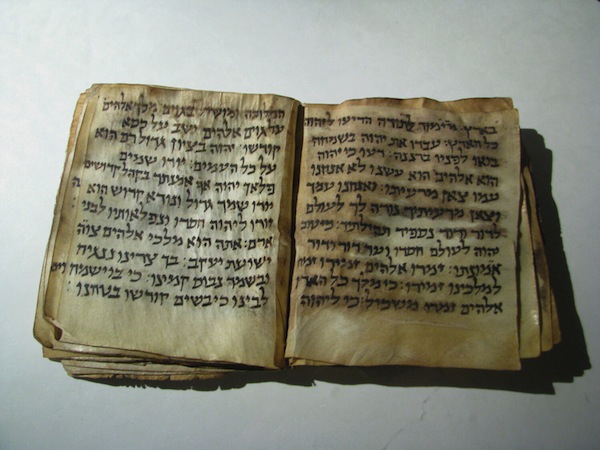
Afghanistan is seeking to repatriate a 1,200-year-old siddur, which is currently housed at the Museum of the Bible in Washington, D.C. (photo from Museum of the Bible)
The National Museum of Afghanistan, established in 1919 at the former Bagh-i-Bala royal palace overlooking Kabul, reflects both the multifaith heritage and tortured history of the Central Asian country that once dominated the Silk Road linking Europe and East Asia.
Following the outbreak of Afghanistan’s civil war in 1992, the museum was repeatedly shelled. It suffered heavy damage in a May 12, 1993, rocket strike. The combination of Taliban mortars and looters resulted in the loss of 70% of the 100,000 prehistoric, Hellenistic, Buddhist, Hindu, Zoroastrian, Islamic and Jewish objects once in its collection. Those pilfered artifacts flooded antiquities markets in London, Paris, New York and elsewhere. Now, the pro-Western regime of President Ashraf Ghani Ahmadzai – formerly an anthropology professor at Johns Hopkins University in Baltimore, Md. – wants its cultural legacy returned. Among the treasures it is seeking to repatriate is a 1,200-year-old siddur (prayer book) – the world’s oldest Hebrew manuscript after the Dead Sea Scrolls.
“It is our responsibility to get back our ancient treasures,” said Abdul Manan Shiway e-Sharq – the country’s deputy minister for information and publications in the Ministry of Information and Culture – in the first-ever on-the-record interview between an Afghani official and an Israeli journalist.
Shiway e-Sharq said photos of the ancient siddur in Kabul’s National Museum, dating from 1998, contradict the ownership documents provided by the Museum of the Bible in Washington, D.C. The MotB says it bought the siddur in 2013 from antiquities dealers in the United Kingdom who provided provenance documents showing the manuscript had been in Britain since the 1950s. The MotB paid $2.5 million for the prayer book. Though Shiway e-Sharq appraised the unique volume at $30 million for insurance purposes, it truly is priceless.
The prayer book may have belonged to the Radhanites, a little-known group of medieval merchants, some Jewish, who traded along the Silk Road linking Christian Europe, the Islamic world, China and India during the early Middle Ages. The Radhanites’ entrepôts and Afghanistan’s early Jewish community were likely destroyed in the 12th and 13th centuries, as the Mongol Empire grew from the steppes of Mongolia to extend from Europe to China.
Responding to a query, MotB’s chief curator Jeff Kloha said the museum will share results of an investigation when completed.
“As noted on the museum’s provenance research web page, museum staff continues to work with external scholars and experts to research this item’s historical and religious significance, as well the item’s history in (apparently) Afghanistan and later Israel and the United States,” Kloha said. “That research is progressing and nearing completion.”
The allegation that the MotB’s rare Afghan Hebrew prayer book is another ancient Near Eastern treasure that was smuggled out of its country of origin is the latest in a series of scandals about looted and forged antiquities that has rocked the Museum of the Bible since its 2017 opening.
The MotB recently shipped 8,000 clay tablets back to Baghdad that may have been taken from the Iraq Museum in 2003, when looters overran it during the American invasion that toppled Saddam Hussein. At the end of January 2021, the U.S. Department of Homeland Security returned 5,500 papyrus fragments from the MotB with “insufficient” provenance to Egypt’s Ministry of Tourism and Antiquities, concluding Cairo’s efforts since 2016 to regain its antiquities. And, the museum has acknowledged that all of the Dead Sea Scroll fragments it acquired are forgeries.
MotB founder Steve Green, an evangelical Christian whose family owns the Hobby Lobby craft store chain, and chief curator Kloha have worked to tighten the museum’s acquisition policies after the U.S. government reached a settlement with Hobby Lobby in 2017 requiring the chain store to pay a $3 million fine for illegally importing ancient artifacts.
Leon Hill, the in-house counsel for Transparent Business Solutions, a Dutch company that specializes in corporate integrity management, is keen to see a resolution to the dispute over the ancient siddur. He is dismissive of Green’s explanation that he and Kloha are novices in the museum business and the acquisition of artifacts. “They can’t continue to say that. They’re no longer new. They have a duty to know better. They have a duty to the history and heritage of the artifacts they purport to protect.”
He accused the MotB of “cultural imperialism.” He said, “We hope that we won’t need to be hired by the Afghan government, and that the Museum of the Bible will do the right thing in the right way quickly.”
Gil Zohar is a writer and tour guide in Jerusalem.
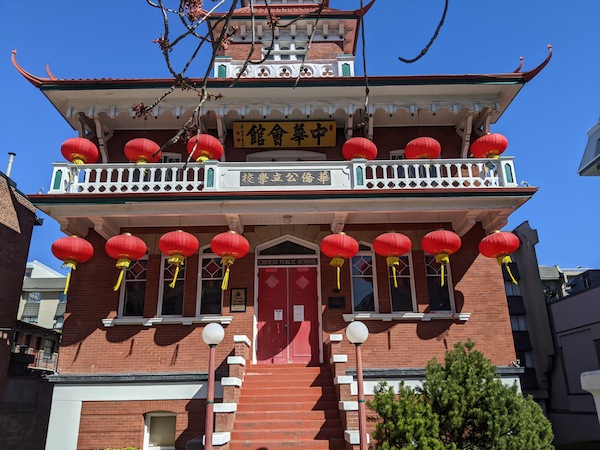
במשך שנים נעשו עבודות נרחבות של שימור וטיפול בציינה טאון של וקיטוריה, וכנראה לעיריית ויקטוריה, לקהילה הסינית ולשאר התושבים זה חשוב מאוד. (רוני רחמני)
כפי שציינתי ברשימה הקודמת לאחר שעברתי בדיקת קורונה שתוצאותיה היו שליליות, החלטתי לצאת סוף סוף לחופשה קצרה בעיר ויקטוריה – בירת מחוז בריטיש קולומביה.
לאחר הביקור בגלריית באטמן המעניינת יצאתי ביום שישי לסיור מודרך בסירה באזור נמל ויקטוריה. הסיור בסירה הקטנה (מאותו דגם של הסירות השטות בוונקובר – מהאי גרנוויל ואליו), כרוך בתשלום של שלושים ושניים דולר. לא זול כיוון שמדובר בסיור בן ארבעים וחמש דקות בלבד אך שווה כל דקה. המדריך המנוסה שהשיט את הסירה הסביר לעומק את ההיסטוריה של ויקטוריה, האינדיאנים שכרגיל היו המתיישבים הראשונים כאן, הבריטים, האמריקנים וכמובן הקנדים. מתברר שחברת הרכבות היא שבנתה את מלון אמפרס המפואר, שמנוהל כיום על ידי רשת פיירמונט היוקרתית. המלון נבנה על קרקע בוצית שיובשה וכך גם נוקה כל האזור שהיה מלא בפסולת רעילה ממפעלים תעשייתיים שונים. עוד מתברר שלאחרונה משפחת בוסה האיטלקית רכשה את מלון אמפרס במחיר זול במיוחד שעומד על כארבעים וחמישה מיליון דולר. לא ברור למדריך ולנו כיצד הם שילמו כל כך מעט על מבנה מפואר וגדול. מכל מקום בשלב זה רשת פיירמונט עדיין מנהלת את המלון ולא ידוע מה יקרה לאחר שיסתיים החוזה עמה. אגב משפחת בוסה מחזיקה גם בחברת בנייה שבונה ללא הפסק בוונקובר ובסביבה. המדריך הסביר כיצד אוניות ענק של קווי שייט שמפעילים קרוזים מפוארים, עוגנות בנמל וקיטוריה, לאחר שהגיעו מארה”ב והן בדרכן לאלסקה. בוונקובר קשה לאוניות הענקיות לעבור מתחת לגשר ליונס גייט בדרכן לעגינה בקנדה פלייס שבנמל ונקובר. לעומת זאת בנמל של ויקטוריה אין לאוניות שום מגבלות בגלל גודלן. לקראת סיום הסיור ראינו בתים צפים בהם גרים תושבים מקומיים וכן אזור תעשייתי באו עוגנות אוניות משא, שמובילות גרוטאות של מתכת למפעל סיאטל.
את הערב סיימתי בארוחה טובה במסעדת קקטוס שבעיר ובעידן הקוביד ישבנו בחוץ. כהרגלי אכלתי סלט בריא בתוספת נתחי עוף רזים. כוס יין אדום משובח תוצרת ארגנטינה הנעים את הזמן.
(רוני רחמני)
ביום שבת ארגנתי לעצמי שני סיורים מודרכים רגליים: הראשון – בציינה טאון המעניינת של ויקטוריה. בניגוד לוונקובר ציינה טאון בוויקטוריה נקייה להפליא (כמו זו של מונטריאול בקוויבק). הסיור היה מרתק ושמענו הסברים על הציינה טאון הראשונה בקנדה. הסינים הגיעו תחילה בעידן הבהלה לזהב. לאחר מכן פתחו מפעלים למכירת סם האופיום כאשר בשעתו זה היה חוקי. לאחר שהממשלה הקנדית קבעה שהתעסקות באופיום אינה חוקית עוד, הציינה טאון של ויקטוריה החלה לגסוס ואז התפתחה דווקא הציינה טאון של ונקובר. במשך שנים נעשו עבודות נרחבות של שימור וטיפול בציינה טאון של וקיטוריה, וכנראה לעיריית ויקטוריה, לקהילה הסינית ולשאר התושבים זה חשוב מאוד. לעומת זאת בוונקובר נראה שלאף אחד לא אכפת שציינה טאון המקומית גוססת, מלוכלכת, בתים נוטים להתפורר והומלסים רבים הפכו את הרחובות באזור לביתם הפרטי. פשוט מביש.
את הביקור המוצלח בוויקטוריה חתמתי בסיור מורדך נוסף והפעם בנושא ההיסטוריה העשירה של העיר. המדריך סיפר לנו על המלחמות המקומיות, השליטה הבריטית, ההתנגדות ולבסוף ההסכמה להצטרף לקנדה תוך הבטחה להקמת רשת פסי רכבת. שמענו בהפתעה כי לוויקטוריה היה גם צד אפל וחשוך בעיקר באותם ימים של תקופת הבהלה לזהב. רבים מהעובדים שנשכרו לביצוע המלאכה בזבזו את כספם על שתיית אלכוהול מרובה בעיר. אחרים מצאו להם נערות ליווי וחגגו עימן עד השעות המאוחרות של הלילה.