Though North American stock indexes have risen to new heights in recent months, anyone who regularly checks financial news these days is unlikely to encounter the words “calm” and “steady” indescriptions of present-day markets. Rather, financial media are inclined to employ adjectives such as “turbulent” and “rocky.” Some headlines are saying the market (or sectors within it) is in bubble territory. Meanwhile, gold, often a refuge for those looking for stability, has also climbed to all-time highs.
David Heyman, a financial adviser for Edward Jones in Victoria, said it’s hard to decide whether we are in a bubble or not. COVID, he argues, exposed the vulnerabilities of the world’s supply chains, and many governments, especially in the United States, focused on domestic industries as a means not to be dependent on suppliers in other parts of the world.
“This is inflationary and costly, but it partly explains the strength in stock markets. Trump, in particular, is determined to bring industrial production back to the US. This trend is expected to continue for many years,” Heyman said.
To avoid risk in the event of a precipitous market decline, Heyman advises those close to retirement to have portfolios heavier in bonds and GICs (guaranteed investment certificates). For those in the earlier stages of their careers, he thinks equities, in the long run, are the way to go.
“History shows you can make a lot more in the stock market than you can in the bond market, but you’ll have to be able to withstand the volatility and endure the next recession, which will come one day,” he said.
In Canada, Heyman said, high prices in the housing market and the fact that interest rates may not fall as low as hoped have put the domestic housing market under pressure. Further, unemployment in Canada is heading upwards, while tariffs are in place and a trade deal remains elusive. There is a similar situation in the United States, he added, with inflation expected to remain high.
“The impact of tariffs in Canada has not been fully felt, as the Canadian dollar has declined to compensate, but Canada is more exposed to US tariffs than most countries. Sharply lower immigration in Canada will also have a dampening effect on the economy,” Heyman said.
Shay (Shy) Keil, senior wealth advisor at ScotiaMcLeod, said many people are worried that a market correction is imminent but that each investor would be impacted differently.
“Be mindful of what you own and make sure you are not overly concentrated in any one area,” Keil said. “When you are young, you have the time to weather 10-15% declines in the stock market. When you are retired or nearing retirement, your ability to withstand a market decline is absolutely a function of how you are invested, and the reality is that many people do not know what risks are in their portfolios.
“The challenge is that, when markets are volatile, investors often shift to much lower rate GICs/bonds without considering the significant impact it will have on their monthly income,” said Keil. “We would recommend to consider investing more into blue chip investments that will potentially maintain strong income and historically may not be as impacted by market volatility.”
Keil specializes in guiding clients with tax-smart strategies and cash flow solutions. “Earning predictable and consistent income is valuable in all market and economic cycles,” he said. “Our clients sleep better knowing they can draw from this income without touching their original capital, even when markets are volatile.”
This year has been a stellar one for technology stocks. As of Oct. 16, the sector on the S&P 500 index, where many mutual funds are invested, has risen more than 19%, with some companies climbing nearly 35% year-to-date. Consumer and energy stocks have shown much more modest increases and have declined in some cases.
On the Toronto Stock Exchange, most sectors have done well in 2025, with IT and materials leading the way during the current bull market. Consumer staples, utilities and health care are often considered stocks that perform well in bear markets.
In general, bonds, while offering a lower return, tend to be more stable than stocks. GICs are investments with set rates of return that are guaranteed up to $100,000 by the Canada Deposit Insurance Corporation (CDIC).
When investing, one should understand that there is a risk of losing money. While financial institutions may present packages that draw attention to positive returns over the course of several years, they will also include words to the effect that funds are not guaranteed to go up, values fluctuate and future results may not mirror past performance.
Sam Margolishas written for the Globe and Mail, the National Post, UPI and MSNBC. This article is for general informational purposes only and does not constitute financial, investment or other advice.
Following 12 years as president of the Jewish Community Centre of Victoria (JCCV), with many accomplishments to his credit, Larry Gontovnick will hand over the reins of the organization to Deborah Bricks at the JCCV’s annual general meeting in December.
A charitable nonprofit, the JCCV houses a deli, gift shop and library. It is also home to the Jewish Federation of Victoria and Vancouver Island, PJ Library, Jewish Family Services and Kolot Mayim Reform Temple. Additionally, it provides a location for Bema Productions, the Victoria Jewish theatre, to hold its auditions and rehearsals, and it hosts other Jewish organizations, such as Hadassah-WIZO and Camp Miriam, for meetings and events. Among the activities the JCCV organizes are webinars with guest speakers, a virtual Jewish conversation café, drop-in mahjong, a book club and Israeli dance.
After 12 years at the helm of the Victoria Jewish Community Centre, Larry Gontovnick is handing over the reins to Deborah Bricks. (photo from Larry Gontovnick)
Gontovnick, by far the longest-serving president of the JCCV since its founding in 1989, oversaw the raising of grant monies to renovate the centre’s kitchen, revitalize the interior and exterior of the building, enhance its security system and improve its audio-visual system.
The technical side of operations witnessed the redesign of the JCCV website, which now offers an online calendar and a PayPal option for donations and membership dues. A newsletter was implemented for communications with members and friends, and a payment device was installed at the centre for purchases.
“I am most proud of maintaining the warm, friendly and welcoming environment of the deli and centre, and maintaining this important facility for the Jewish community in Victoria,” Gontovnick told the Independent about his time running the JCCV. “I am very thankful for the wonderful staff and volunteers at the centre and the board members, who have all been a great pleasure to work with.
“I will now turn my attention to three beautiful grandchildren and being the best zayde I can be. My wife and I will continue our travels, as well as thoroughly enjoy living in one of the most beautiful places on earth.”
A notable and ongoing program started under Gontovnick’s leadership is the Victoria International Jewish Film Festival (VIJFF), now in its 11th year.Bricks is the current director of the VIJFF.
“I am so pleased that Deborah, a current board member and director of the VIJFF, will be standing for president at the upcoming AGM,” said Gontovnick, who believes the energy and enthusiasm he brought to the centre will be furthered by his successor.
An event planner with deep roots in Jewish culture and community, Bricks has been designing and orchestrating arts and culture events – music, cinema and literature – through Deborah B Event Management, both in Toronto and, for the past 10 years, in Victoria. She holds a bachelor’s degree from the University of Toronto in religious and cinema studies and a master’s in media and communications from the New School for Social Research in New York.
“The JCCV president role – a combination of strategic direction, community building and operational oversight – is especially important now,” Bricks said. “JCCV provides a home, a makom [place], for programs, services and events important to communities of Canadian Jews and our culture, such as the Lox, Stock & Bagel Deli, loved by community.
“And there are untapped directions for new, meaningful programs, services and events that build community among Jews in Victoria, seniors and families alike, and with our neighbours in Canada.”
As part of her community-building goals, Bricks is already engaging younger Victoria-area Jews from her own network to join the JCCV and its board, as well as older community members, who may enjoy the experience of Jewish community via the JCCV.
Part of her vision as president, Bricks said, is to direct a new strategic plan for the JCCV that eventually transforms it (i.e., its constitution) into a Jewish community arts and culture centre. As a formal arts organization, the centre could access more local, provincial, federal and other grants.
Deborah Bricks will be both president of the JCCV and director of the Victoria International Jewish Film Festival. (photo from Deborah Bricks)
Bricks told the Independent that she sees the JCCV “serving up something Jewish-ish for everyone.”
While president, Bricks will continue as director of VIJFF, leading its planning, film curation and event strategy.
“As Victoria’s only Jewish cultural festival, we try to spotlight Canadian-Jewish filmmaking and filmmakers,” Bricks said. “This year, we have three films by Canadians, ranging from stories about a Franco-Moroccan mother and son, about Yiddish in Sweden, and about the early Jewish immigrant experience in Montreal.”
Also playing will be Sabbath Queen, which follows the story of Rabbi Amichai Lau-Lavie, the heir of 38 generations of Orthodox rabbis who became a drag queen and the founder of Lab/Shul, an experimental “God-optional” congregation based in New York. It will be followed by a discussion with filmmaker Sandi DuBowski (via Zoom) and Victoria drag king Dublin Tendre.
This year’s festival runs Oct. 18-23 and features seven film events at the Vic Theatre. For more information, visit vijff.ca.
Sam Margolis has written for the Globe and Mail, the National Post, UPI and MSNBC.
The inaugural Solidarity Cycle, in 2017. (photo by P. Simson)
We didn’t ride 100 kilometres, or even quite 50. It was a glorious symbolic ride in celebration of the many years of Solidarity Cycle, a much-beloved event that has seen dozens of cyclists and hundreds of supporters unite bike and heart to raise more than $400,000 for the Stephen Lewis Foundation Grandmothers to Grandmothers Campaign.
Even though Solidarity Cycle has pushed its last pedal – the event having been canceled this year – three members of Tikun Olam Gogos, who rode in the inaugural event back in 2017 and have served in numerous capacities every year since, just couldn’t let go.
Monday, Sept. 8 was a perfect day as Marie Henry, Darcy Billinkoff and I set out: not a drop of rain, not a wisp of smoke, just sunny skies with occasional clouds and a light breeze.
Nothing could keep us down, not Darcy’s fractured ribs, Marie’s stress injuries or my right hip, waitlisted for replacement. Could this “Wride of the Wrecked” be a clue to Solidarity Cycle’s demise?
There were more portents to come, but first it was time to ride.
Many features of our route to Westham Island came with joyful reminders of the previous cycles: cornfields reminiscent of the years of Chilliwack corn and chili celebration dinners, acres of sunflowers like those popping the Pemberton Valley ride the year of pandemic and big smoke, and kilometres of dike trails like those we traveled in Pitt Meadows. The one-lane, wood-deck river crossing onto the island was a refreshing antidote to that !@#$%!!! (oops, I mean challenging-but-fun) Golden Ears Bridge.
We reached our designated turn-around point, the Reifel Bird Sanctuary, to find the birds behind locked gates.
Even more dismaying, Emma Lea’s dairy bar was shut tight. NO ICE CREAM?! Clearly, the closed signs said it was time to wave a regretful goodbye to the ride that has fueled our summers and our love for the grannies these past eight years.
But, still, we weren’t quite done.
We topped off our ride with Heineken and lunch on the deck of the Riverhouse Restaurant and Pub, an indulgent reminder of many post-cycle beer and burger banquets. We always suspected we consumed more calories than we burned.
In the absence of a formal event this year, I did not solicit sponsorships. However, I set up a fundraising page to show my appreciation for the many people who have supported Solidarity Cycle over the years. Please do visit the page because there is a message there for you: slf.akaraisin.com/ui/grandmotherscampaign2025/p/BarbaraHalparin.
Without the yearly opportunity Solidarity Cycle has afforded you, I urge you not to forget the grandmothers and grand-others aiming to alleviate the scourge of HIV/AIDS that continues to significantly impact Africa. Here are some other ways you can continue your steadfast support for them, now that crucial international aid has been withdrawn.
First, attend Tikun Olam Gogos’ other fundraising events. Second, be on the lookout for another in our fabulous concert series in the near future. Third, buy our merch! We sell our signature tote bags, pouches and other items, including our special edition O Canada line, at Fancy This Gifts (5044 48 Ave., in Ladner), by appointment at Joyce Cherry’s home boutique (604-261-5454) and on our website, tikunolamgogos.org.
You can also find our goods at several upcoming craft fairs: St. Thomas Aquinas Secondary School (Nov. 2); Dunbar Community Centre, St. Faith’s Church and St. Thomas More Collegiate (all Nov. 22); St. James Community Square (Nov. 30); and Kensington Community Centre (Nov. 30).
And, please – share your fundraising brainwaves with us because, of course, we are looking for a successor to Solidarity Cycle!
At the Canadian Shaare Zedek Hospital Foundation (CSZHF) event on Sept. 7, which marked the foundation’s 50th anniversary: left to right, Col. Ilan Or, Israeli defence attaché to Canada; Rafi Yablonsky, CSZHF national director; Dr. Marla Gordon, CSZHF Western region board member; Dr. Arthur Dodek, CSZHF Western region board member; former prime minister Stephen Harper; Dr. Robert Krell, 2025 Western Region recipient of the Kurt and Edith Rothschild Humanitarian Award; Rabbi Andrew Rosenblatt of Schara Tzedeck Synagogue; Ilan Pilo, CSZHF Western Canada director; and Sam Sapera, CSZHF board chair. (photo by Alina Ilyasova)
Former prime minister Stephen Harper was on friendly ground when he addressed a packed sanctuary at Congregation Schara Tzedeck earlier this month. The former Conservative leader, who led the country from 2006 to 2015, is known as a stalwart ally of Israel and the audience of mostly Jewish Vancouverites welcomed him heartily.
The Sept. 7 event was the first fundraising gala for the newly formed Western region of the Canadian Shaare Zedek Hospital Foundation. The event and the surrounding campaign succeeded in funding nine incubators for the hospital’s pediatric department.
The event featured Harper in conversation with former BC premier Gordon Campbell, who told the audience that, of the prime ministers he served with concurrently when he was premier from 2001 to 2011, Harper was his favourite.
Harper said people ask him why he supports Israel so strongly.
“Has it got to do with religion or your view of the Jewish community?” he asked rhetorically. “I mean, there are a million reasons, but, as prime minister of Canada, the reasons were really simple. Here is this one country in the Middle East that shares our values and that is a friend of this country – and the people who are the enemies of that country are enemies of this country.”
Harper told the audience that there are a lot of loud voices condemning Israel and threatening Jewish Canadians, but, he said, they are not unanimous. “There are still a lot of people in this country that understand the value of our Jewish community, that are friends of the state of Israel, and that thank you for everything you do,” he said.
Harper lauded Israel for its actions to set back Iran’s nuclear program, arguing that the brief Israel-Iran conflict has positively realigned the region. People had warned that Israel’s attack on Iran’s nuclear capability was a dangerous escalation that could “lead to World War Three,” he said.
“We know that not only was [the nuclear program] set back considerably, but the United States and Israel sent a real message that, if we see it again, we’re going to do the same thing again.”
The results of the Israeli actions were overwhelmingly positive, Harper said. There was a very limited Iranian response – and, notably, no other nations coming to Iran’s aid, he said.
There were broader repercussions around Israel’s action against Iran and in the larger regional conflict, he added. Hezbollah was decapitated and the Lebanese government is now trying to push Hezbollah out. Hezbollah’s allies in Syria lost power. Hamas is massively degraded.
Campbell expressed dismay at Prime Minister Mark Carney’s statement that Canada would recognize Palestinian statehood at the United Nations if the Palestinians meet a number of conditions.
“My problem with that … the Palestinian Authority has never done one of the things that the prime minister said,” Campbell said.
“I’m trying to give the new government a chance,” Harper replied, calling the Carney government a “kind of improvement” on the previous administration. “The only interpretation you can put on it is in fact rewarding the events of Oct. 7th.”
Harper said he cannot recall any precedent for Canada, or any other country, recognizing a state that does not exist.
“But, on top of that,” he said, “Who exactly are you? … There is no leadership among the Palestinian populations, including the [Palestinian Authority], that actually unequivocally recognizes the right of a Jewish state to exist. It’s great to say, ‘I favour theoretically a two-state solution,’ but the problem is this other state would be a state that does not support a two-state solution. You’d actually be moving further away from that objective.”
While Israel’s military actions have improved the geopolitical situation in the Middle East, Harper acknowledged there has been a concurrent spike in antisemitism in Canada.
“I really feel a lot of sympathy for ordinary Jewish people who face this in their private [and] professional lives and feel intimidated,” he said. “I guess that the only advice I can give you is to be resolute.… You can’t let those occasions slip. You can’t let them go by.”
Harper said he has been accused of dismissing criticism of Israel as antisemitic, an assertion he rejects.
“Being opposed to policy of the government of Israel is not antisemitic,” he said. “But being opposed to Israel because it is the only Jewish state in the world is the definition of antisemitism.”
Harper spoke, as he has previously to Jewish audiences, of his father, Joseph, who came of age during the Second World War, when the world was existentially threatened by fascism.
“One of the consequences of that is he grew up just as a very determined opponent of antisemitism in a period – we’re talking the ’40s, ’50s – where some of these things were expressed openly. He was very vocal in opposing that. And, frankly, he is just turning over in his grave watching some of what is happening today.”
Despite almost a decade out of office, the former Conservative prime minister did not shy away from politics, crediting the Liberal party with running an excellent campaign earlier this year and identifying shortcomings in the Conservative party’s approach.
Harper cited Donald Trump’s intervention in the campaign as a factor and anxieties around the Canada-US relationship for upending conventional wisdom, including polls that had predicted a Conservative landslide before former prime minister Justin Trudeau resigned.
“I do think the [Conservative] party has to take a hard look at what went right and what went wrong,” said Harper. “The Liberals displayed incredible tactical flexibility, and we did not show the same level of flexibility.”
Of the Conservatives, he said: “We ran a very principled campaign, but we need to show a lot more adaptability when circumstances change.”
Harper and Campbell also addressed economic issues. The former prime minister said the challenges presented by the current American administration are a chance to diversify Canada’s trade relationships.
“If we have an opportunity to be a genuine globally connected economy, instead of just kind of an economic appendage to the United States, which in some ways we have become, I [see] opportunity,” he said.
Both Harper and Campbell, in their time, were advocates for the economic benefits of resource extraction.
“Resources are not the only thing we have, but it’s a big, big comparative advantage,” Harper said. “We’re the country that has an unlimited range of natural resources in a rule-of-law environment, far removed from conflict zones. Do you know how rare that is in the world when it comes to vital resources? And that’s what we have. And we’re not getting them out of the ground, and we’re not getting them around the world.… We’ve got to get our energy to Asia. We’ve got to get our energy to Europe.… It will bring billions of dollars into Canada, create thousands and thousands of jobs in Canada. We are up against the clock, and the clock doesn’t care much about us.”
The Sept. 7 program began with a video showcasing Shaare Zedek Hospital’s achievements in maternal and neonatal care, as well as the range of advanced medical procedures for which the hospital is known. The religious and ethnic diversity of the hospital’s staff and patients is a particular source of pride for the facility’s leadership and their Canadian supporters.
Harper spoke highly of the hospital, which treats more than a million patients a year.
“The Shaare Zedek Hospital is, to me, emblematic of just so much of what has made Israel a remarkable country,” he said. “[It has] become a world-leading institution that services people beyond politics, race, religion, ethnicity … just a tremendous institution.”
The event was presented by the Canadian Shaare Zedek Hospital Foundation in partnership with the Jewish Federation of Greater Vancouver, Congregation Schara Tzedeck, the Jewish Independent and the Jewish Medical Association of British Columbia. Organizers expressed special thanks to CJPAC, the Canadian Jewish Political Affairs Committee, for their community support.
Ilan Pilo, Western Canada executive for Canadian Shaare Zedek Hospital Foundation, announced the success of the event, which resulted in funding for nine “Giraffe” incubators – each one costing $50,000 – for the hospital where 22,000 Israeli babies are born annually.
Dr. Robert Krell was awarded the Kurt and Edith Rothschild Humanitarian Award. (See jewishindependent.ca/harper-speaks-at-gala.) The award was presented by Dr. Arthur Dodek, a member of the board of the Jewish Medical Association and of the CSZHF, and Sam Sapera, chair of the board of the CSZHF, which marks its 50th anniversary this year.
The event was co-emceed by the Jewish Medical Association’s Dr. Marla Gordon and Zach Segal, who was a Conservative candidate in this year’s federal election.
Israeli journalist Rolene Marks, chair of WIZO’s Hasbara Division, was the keynote speaker at CHW Vancouver Centre’s Opening Lunch and Fashion Show on Sept. 14. (photo by Cynthia Ramsay)
“I know that, as a community, you are feeling vulnerable and you are feeling that you have to be the mouthpiece or, as I call it, the litmus test, for however Israel is prosecuting a war so many miles, so far away, from you,” Israeli journalist and advocate Rolene Marks told those gathered at CHW Vancouver Centre’s Opening Lunch and Fashion Show on Sept. 14. “And I want to tell you that, although Israel’s not perfect – even though we are the only country in the world expected to prosecute a perfect war – you can be proud of the state of Israel.”
Left to right: Claudia Goldman, Rolene Marks and Toby Rubin at the Sept. 14 event. (photo from CHW)
Marks, who, among other things, chairs WIZO’s Hasbara Division, was the event’s keynote speaker. Toby Rubin, president of CHW Vancouver Centre, welcomed the 150-plus guests at the Richmond Country Club Sept. 14, acknowledging the presence of Judy Mandleman, Rochelle Levinson and Claudia Goldman – three local Jewish community members who have been presidents of national CHW. She noted that the current national president, Tova Train, would be speaking, as would Lisa Colt-Kotler, chief executive officer of CHW, and Marks.
“This luncheon today is raising funds for two very important projects that we have here locally,” said Rubin. “One is JOLT, and the other is Franny’s Fund [which supports six youth advocacy centres across Canada, including the Treehouse Vancouver Child and Youth Advocacy Centre]. JOLT is the Jewish Outreach Leadership Training program at Canadian Young Judaea, and provides camperships to seven camps across Canada, including our very own Camp Hatikvah. Today, we are honoured to have with us the president of Camp Hatikvah, Joanna Wasel, who, along with the camp director and staff has worked with CHW these past two summers with the campers.”
Last year, Wasel and staff spearheaded making keychains and bracelets for Israeli soldiers, which Colt-Kotler and Train hand-delivered on a visit last January to patients at the Gandel Rehabilitation Centre at Hadassah Hospital, said Tobin.
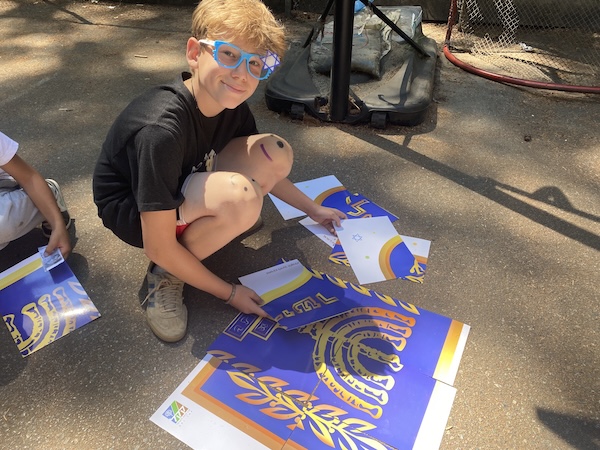
This year, campers in Hatikvah’s first session created their own version of the Maccabi Games, as a fundraiser for HaGal Sheli (My Wave), “a surfing program that is used to help people combat stress, anxiety and PTSD,” said Rubin. “And you can only imagine, since Oct. 7, how important that program is.”
The initiative raised more than $7,000 for HaGal Sheli, said Rubin, who also noted that the brunch’s table decorations of books, toy cars and pens would be given to Treehouse Vancouver. Many of the books were donated by Vancouver Talmud Torah, she said.
Train, who came to the event from Toronto, spoke about being from Edmonton, calling herself “a Westerner at heart.”
“I never imagined myself taking on the role of national president,” she said, “but I’ve always believed with my whole heart that, if I cannot serve Israel by wearing a uniform, then my obligation is to serve in every other way I can. That’s why CHW speaks so deeply to me. For more than a century, this organization has invested in education, health care and social services. And, today, especially after Oct. 7, those needs have never been greater – Rolene shared with me a statistic this morning that more than 10,000 IDF soldiers have been treated for mental health issues across the country since Oct. 7.”
After a video about CHW’s various impacts, Colt-Kotler presented a plaque to Bernard Pinsky, in his role as chair of the Ronald S. Roadburg Foundation.
“CHW, at our core, is philanthropy, and we were founded, as you know, in 1917, by a very dedicated, special woman named Lillian Freiman,” said Colt-Kotler, describing Freiman as “an example of philanthropy” and “of dedication to the Jewish community,” and as “the essence of what a CHW woman is … an empowered woman.”
Lisa Colt-Kotler, chief executive officer of CHW, presents a plaque to Bernard Pinsky, chair of the Ronald S. Roadburg Foundation. (photo from CHW)
She continued, “We created the Lillian Freiman Society to recognize individual donors for their generous philanthropy, starting at $100,000, and the Ronald S. Roadburg Foundation generously donated to Michal Sela Forum …to combat domestic violence, to provide innovative solutions for the protection from and prevention of intimate partner violence,” said Colt-Kotler.
Pinsky said he pushed the foundation to have women’s empowerment as one of its focuses because, from the time he was a teenager, he has been influenced by his sister, Helen Pinsky, who attended the brunch.
“She’s a real feminist,” he said. “And somebody who taught me that women’s empowerment and women’s protection is very, very important in life, and I think it’s no less important today than it was over 50 years ago, when she talked to me about it.”
When Marks took to the podium, she acknowledged the Israel Defence Forces soldiers, who are “fighting 24/7 to protect the state of Israel.”
“I also want to take a moment to acknowledge the over 900 soldiers who have fallen in defence of the state of Israel and the many who are wounded, both physically and who carry those invisible wounds,” said Marks.
“It is an absolute imperative that I mention that we still have 48 hostages languishing in the hell of Gaza,” she added. “Every second counts…. We want them home now.”
Marks specializes in media, public relations and training on Jewish- and Israel-related issues. She hosts a radio program called Modiin and Beyond and is a contributor on Johannesburg’s Chai FM. She co-founded Lay of the Land, hosts The Israel Brief on YouTube and serves as a national spokesperson for the South African Zionist Federation. She is currently doing a doctorate at Middlesex University London, in media, politics and antisemitism.
“I’m the W in the CHW [Canadian Hadassah-WIZO] – I represent World WIZO, Israel’s foremost women’s organization in terms of working for empowerment,” said Marks. “And we have seen, certainly in the last two years, the voices of Jewish women and the experience of Israeli women on the 7th of October completely erased from the feminist landscape.”
Israel is fighting a war on multiple fronts, she said, acknowledging how vulnerable the diaspora community feels because of what is put out in the media, which filters onto the streets and makes it into government policy.
“I know that every day you hear the accusations: genocide, mass starvation, bombing of civilian infrastructure, like hospitals. And I can tell you that, as somebody who is living through the war and covering the war, the situation is not what you are being painted out to answer for.”
Marks was in Gaza a few weeks before the CHW brunch.
“I saw mountains – mountains and mountains – of humanitarian aid marked United Nations, UNICEF, World Food Program, and more. Things like medical kits, baby formula, flour, oil, pasta, hygiene kits, all languishing in the sun. Now, accompanying the few of us that went in, apart from our incredible soldiers, were two journalists from Australia’s ABC [network]…. The IDF said to us, we’re here to answer questions, but, guys, go off, find your stories; there was no interference. And these two journalists stood in front of a big mountain of aid marked United Nations and, in his piece to camera, the correspondent said, ‘This is the image that Israel wants you to see with regards to humanitarian aid.’ And you could hear the collective jaw drop from the rest of us, including colleagues from the Arab media, because we know what we saw. But my point is this: the bias and the narrative-building start in the field.
“I’ve had several instances where I’ve gone into the field with the foreign media,” she said. “And, despite what they have seen, they have turned it into an agenda that they can push to put the pressure on Israel, and to put the pressure on you as a community.”
Marks stressed that “we can hold our heads up high as a community and as a people. There is nothing dirty about the Z word.”
Zionist, she said, “just means a belief in the existence of the nation-state of the Jewish people in our ancient homeland.”
In the fight against antisemitism, everyone must play a role, said Marks, whether “sharing on your social media or writing letters to the press or getting involved in your community organizations. We are a people that have survived millennia of blood libels, persecution, and attempts to erase our history and our narrative.”
This can include something like wearing a Magen David, she said: “When you show your pride and you show your strength, you stand up to the hate, you stand up to the misinformation.”
She added, “The truth always comes, but we need your help to make that happen. When people accuse us of genocide, I can tell you, as somebody who has been working on the ground, the complete opposite is true.… Our army inoculates children against polio in the Gaza Strip, and drops leaflets, and moves civilians out of harm’s way.”
She recommended people follow Israel’s COGAT (Coordinator of Government Activities in the Territories) website, where you can track the humanitarian aid going to the Gaza Strip and related news.
Referring to the murder of American activist Charlie Kirk, she said “it was symptomatic of something very, very frightening that is spreading around the world, and that is a move to disengage in discourse, a move to shut down conversation. And it is so important that we have these conversations. It is so important that we interrogate the truth and the facts.”
In the question-and-answer period, Marks suggested the lack of support from allies like Canada, France, the United Kingdom, Australia and others, is “a big campaign to deflect from problems that are domestic.”
“It’s very, very distressing for us in Israel to see our allies taking the side of Hamas, and also treating us like the naughty child of the world,” she said. “And part of that is, we believe, that many countries have forgotten or don’t know what it’s like to live under constant threat. We live under constant threat … wars within wars.”
Marks recalled what Israeli President Isaac Herzog told British Prime Minister Keir Starmer in a recent meeting: “Friends can sometimes disagree – but don’t reward terror.”
While in Vancouver, Marks also spoke at a CHW-Community Kollel event on Sept. 12.
The fashion show part of CHW Vancouver Centre’s opening event featured local community members sporting clothes from Maison Labelle Boutique and After Five. (photo from CHW)
The Sept. 14 speeches and brunch were followed by an intergenerational fashion show, with models sporting clothes from MaisonLabelle Boutique and After Five. Walking down the runway were grandmothers, mothers, daughters, granddaughters and friends.
Rudolf Vrba, in the 1960s. (photo from University of British Columbia. Archives)
Rudolf Vrba’s escape from Auschwitz and testimony helped alert the world to the horrors of the Holocaust, and Vrba is credited with saving the lives of more than 100,000 Hungarian Jews. On Oct. 26, 2 p.m., at Schara Tzedeck Cemetery Chapel in New Westminster, a commemoration ceremony will be held for Vrba. The program will feature reflections on his life, legacy and enduring impact from Dr. Robert Krell and Dr. Joseph Ragaz, and will conclude with the dedication of a memorial monument inVrba’s honour.
Jewish Addictions Community Services (JACS) welcomes two members to its team.
Jordana Jackson, JACS’s new addictions specialist, is a certified addiction counsellor. In addition to having a wealth of experience working in addiction and recovery spaces throughout Vancouver Coastal and Fraser Health authorities, she is the founder and director of AWARE (Addicts With Aspirations Recovery Entertainment), a therapeutic performance-arts program. Jackson is already making a difference at JACS, creating navigation support structures and providing counseling for clients.
Elana Epstein, JACS’s new group facilitator, is a certified recovery coach. More importantly, she has years of experience being a mother of a child who struggled with addiction and is now in recovery. At JACS Family Circle, Epstein is using both her spiritual and professional skill sets to hold space for individuals whose friends and family have been affected by addiction. These group counseling sessions are an important aspect of JACS.
* * *
Elvira Molochkovetsk takes on the role of a community connector in Victoria. This position is a joint Jewish Federation of Victoria and Vancouver Island (JFVVI) and Jewish Federation of Greater Vancouver project. Her goal is to connect and engage all community members but, in particular, those who do not attend any existing synagogue or Jewish association.
Over the past two years, Molochkovetsk has been part of the JFVVI as a PJ Library parent, volunteer, connector and, for the past year, as PJ Library coordinator for Vancouver Island and the Gulf Islands. PJ Library has focused on connecting people with children up to the age of 13 and, in her expanded role as a connector, Molochkovetsk will be expanding it to reach out to teenagers, seniors and young entrepreneurs.
The parents of four kids, Molochkovetsk and her husband, Dimitri, have run family businesses for the last decade. Almost three years ago, they moved to Victoria from Winnipeg, where they lived for seven years. They both grew up in Israel and have family there.
On Sept. 30, Canadian Friends of Sheba Medical Centre will host Medicine Reimagined, an evening with Prof. Amitai Ziv, deputy director of Sheba Medical Centre and head of its Rehabilitation Hospital, which is the national rehabilitation facility of Israel. Ziv is also the founder and director of the Israel Centre for Medical Simulation (MSR), an innovation hub for improving patient safety and clinical training.
Originally from Montreal, Ziv is spending his sabbatical in Vancouver at the University of British Columbia.
“This will be the first Canadian Friends of Sheba event in Vancouver, as we launch our chapter here, and we are truly thrilled to welcome Prof. Amitai Ziv,” Galit Blumenthal, manager of donor relations and events at Canadian Friends of Sheba Medical Centre, told the Independent. “Our goal is to raise awareness of Sheba Medical Centre and highlight its profound impact both in Israel and on the global stage.”
Prof. Amitai Ziv, deputy director of Sheba Medical Centre and its Rehabilitation Hospital, speaks in Vancouver on the topic Medicine Reimagined. (internet photo)
Sheba Medical Centre was established in 1948. Located in Tel HaShomer, near Tel Aviv, its website notes the facility has 159 medical departments and clinics, almost 2,000 beds and 75 laboratories, and receives about 1.9 million clinical visits and 200,000 emergency room visits a year. Its seven major facilities comprise a cancer centre, an academic campus, a research complex and four hospitals: children’s, women’s, acute care and rehabilitation. It also has several centres of excellence and institutes, notably for cancer, and heart and circulation. It counts 10,000 healthcare professionals, 1,700 physicians and 200 PhD research professionals.
“I support them, along with many other Israeli institutions, as I feel that this is at least some contribution that I can make during these difficult times,” said Tova Kornfeld, who connected Canadian Friends of Sheba Medical Centre (CFSMC), which is based in Toronto, with the Independent.
“I sometimes feel powerless living here in Canada when I see what is happening in Israel,” said Kornfeld. “If I can help in any way, whether by bringing awareness to the work being done by the various organizations or by making financial contributions, then I feel I must. As far as Sheba is concerned, it stepped up to the plate when Soroka Hospital was hit by an Iranian missile and took in all the ICU patients.
“It is also the biggest rehab hospital in Israel and is providing rehabilitation for thousands of soldiers who have been injured since Oct. 7,” she added. “I have family members in the IDF and it is comforting to know that, if something were to happen to any of them, there would be hospitals like Sheba to care for them.”
Ziv’s areas of expertise are medical education, simulation and rehabilitative medicine, and he has served as a consultant and speaker at academic and health institutions around the world. The event in Vancouver will offer a look at Sheba Medical Centre and its innovations in, among other things, the rehabilitation field.
On Sept. 30, Vancouverites will also get to meet Einat Enbar, chief executive officer of CFSMC, which was established in 2017 to raise awareness and funds for Sheba Medical Centre, the care it offers, the research it conducts and the educational training it provides.
For Kornfeld, there is another aspect to supporting Israeli organizations and institutions. She hopes that financial and other assistance from the diaspora “gives the Israelis caught in the fray the message that we have their backs and that we are all in this together regardless of where we live. I would hope that this would be comforting to them when it appears that most of the world is against not only Israel but the Jewish people themselves.”
For more information on CFSMC and SMC, visit shebacanada.org. To attend the Sept. 30, 7 p.m., event in Vancouver (location upon registration), go to weblink.donorperfect.com/ProfAmitaiZivInVancouver. While free to attend, donations are welcome. Readers can email Blumenthal at [email protected] with any questions.
Every area of Southwest British Columbia is exposed to some form of natural hazard, warns Nicky Hastings, a physical scientist with the Geological Survey of Canada at Natural Resources Canada, who spoke at Har El’s seniors lunch earlier this month. (photo by meggomyeggo / flickr)
Those who attended Nicky Hastings’ talk at Congregation Har El earlier this month came away with a renewed awareness of the many natural hazards we’re exposed to by living in British Columbia.
Hastings, a physical scientist with the Geological Survey of Canada at Natural Resources Canada, specializes in coastal science and disaster risk reduction. Her Sept. 3 talk at the synagogue’s regular seniors’ lunch was titled Living on the Edge: Geology, Natural Hazards and Risk in Southwest British Columbia.
Nicky Hastings (photo from Nicky Hastings)
Hastings explained that we’re located on the cusp of the Pacific Rim of Fire, an area prone to earthquakes and volcanoes. But we’re also exposed to flooding in the deltas and floodplains, snow avalanches, wildfires and their smoke, storm surges, sea-level rise and the effects of climate change. This means that every area of the region is exposed to some form of natural hazard.
“We know these hazards are here, and things need to be done to address them – and some of that mitigation is happening,” said Hastings. Drive the Sea-to-Sky Highway and you’ll see rock bolts attached to stabilize the slopes and reduce the risk of rockslides, she said. Lions Bay has a spill channel and catchment basin to catch the debris flows caused by intense periods of rain.
Modeling by the Geological Survey of Canada is being done to predict what earthquake ruptures might look like, and who might be impacted.
“We looked at two tsunamis that already occurred, to see how sea level might change if similar events were to recur, and our modeling did not show those big, 20-metre waves we saw in the Indonesia tsunami,” she said. “It’s more the west coast of Vancouver Island that will likely be impacted.”
While those of us who live in Delta and Richmond might feel comforted by the 600-plus kilometres of dykes that protect the shorelines, that infrastructure can give a false sense of security, Hastings said. “Dykes are engineered structures that need to be maintained and updated. They can breach,” she said. The 2021 floods, for example, caused $2.7 billion of damage and claimed the lives of 6,000 animals.
Hastings encourages everyone to participate in the annual Great ShakeOut Earthquake Drills to prepare for earthquakes, which will be held on Oct. 16, at 10:16 a.m.
“Sign up online at shakeoutbc.ca and practise this drill so it becomes second nature,” she said. “In an earthquake, you have seconds to minutes to act to protect yourself, and you need an emergency readiness kit so you can take care of yourself for 72 hours.”
Scientist Nicky Hastings recommends that everyone sign up for the annual Great ShakeOut Earthquake Drills, which takes place Oct. 16.
A new early warning system for earthquakes will send out alerts that can give businesses time to shut down elevators, and cities time to stop hospital operations, open fire station doors and stop trains, she said.
Other monitoring programs and mapping are being done on volcanoes like Mount Baker and Mount Garibaldi. While the last major eruption was in the 1800s, Hastings warned that volcanoes can cause big landslides and volcanic ash can damage aircraft, collapse roofs, cause lung damage and injure animals and plants.
“The seismic monitoring we’re doing creates more awareness – it gives us a chance to mitigate and know how to plan and prepare,”she said.
Hastings’ main takeaway was the need for Southwest BC residents to live with awareness. She lamented that, even with the warnings in place and the research her organization continues to do, communities are still building infrastructure in harm’s way, such as floodplains. Sustainable development in British Columbia, she said, requires striking a balance between growth and an ongoing awareness of the dynamic, hazard-prone landscape we call home.
Lauren Kramer, an award-winning writer and editor, lives in Richmond.
Dr. Ted Rosenberg speaks with an audience member at the Medical Outcomes of Emerging Antisemitism event held at Beth Israel Sept. 4. (photo by Pat Johnson)
Dr. Ted Rosenberg never imagined he’d become an activist but, after the anti-Zionism and antisemitism he witnessed at the University of British Columbia faculty of medicine after Oct. 7, 2023, he couldn’t keep silent.
The 30-year practitioner, who resides in Victoria, addressed a group at Congregation Beth Israel on Sept. 4.
Rosenberg resigned from his post as clinical assistant professor at UBC’s faculty of medicine in January 2024, after repeated attempts to get the school to address antisemitism were essentially ignored. Since Oct. 7, he has written blogs, testified about the antisemitism before the House of Commons and, most recently, self-published the book Ayekha, Where Are You?
After Oct. 7, Rosenberg said he noticed that Jewish doctors weren’t regarded the same way they had been. Before that day, he’d experienced the odd antisemitic comment from patients. After it, he knew that a torrent of hatred towards Jews was coming, and that he needed the language to deal with it.
His activism began after 225 UBC medical students signed the petition “A Call for Action on Gaza,” which called for a ceasefire, condemned Israel as “a settler-colonial state,”
accused Israel of “collective punishment through indiscriminate bombing of civilians” and claimed that “Palestinian people have been continually abused, traumatized and killed by the settler state of Israel and its Western allies for over 75 years.”
In response, Rosenberg wrote to UBC president Benoit-Antoine Bacon, dean of the faculty of medicine Dermot Kelleher and other university officials.
“I assumed they didn’t understand these complex issues,” he said. “I explained to them that antisemitism leads to dehumanization, and I suggested we work together to meet with the students, talk about the petition and about antisemitism.”
Rosenberg described the dean’s response as a “boilerplate letter.”
“He said I could file a complaint through the university’s DEI [diversity, equity and inclusion] program – which has nothing about Jews or antisemitism,” Rosenberg noted.
Demoralization set in as further incidents in the faculty failed to garner any action from the university.
Some 284 physicians wrote to the dean, describing the dangerous environment at UBC for Jewish students, faculty and patients. They received no response. Then, a professor Rosenberg worked with posted a picture of Jesus in the rubble of Gaza on social media. Rosenberg made the decision to resign.
“I’d been begging these leaders to stand up and speak about this, to model respectful dialogue, and no one was saying anything,” he said. “I realized the faculty of medicine had adopted hardwired ideological positions, and I felt I had to opt out and make a public statement about it.”
After his resignation, Rosenberg received a call from a retired dean, who admitted, in tears, how badly he’d felt about his colleague’s treatment. “He said the senior administration at UBC had silenced him and others, tying their hands. He spoke of how people were intimidated to speak out even when they shared my views, because they feared they’d be marginalized. He was looking for absolution.”
In May 2025, Rosenberg received a call from Member of Parliament Anthony Housefather, requesting he testify in Parliament the following week about the antisemitism he’d experienced. Rosenberg felt an enormous responsibility to get his testimony right. “In my work as a physician, I look after old people. I’m not a genocidal maniac,” he said. “But that’s what my students are thinking about me.”
While antisemitism has not subsided, Rosenberg is optimistic that truth and sanity will ultimately prevail. In his work with Doctors Against Racism and Antisemitism, he’s been writing letters to different medical departments, but, for the most part, those letters have been dismissed.
“I think there’s a systemic bias in the Western world against Israel and Zionism and a lingering bias against Judaism,” he said. “The title of my book, Ayekha, is a question to the world: where the hell are you? People need to wake up and look at the truth.”
Rosenberg noted that one requirement of entrance into medical school at UBC right now is a demonstration of your social justice activism.
“The epitome of evil in the social justice narrative is settler-colonialism, and the worst settler-colonialism is Zionism,” he noted of the school’s view.
“This means Jews are not going to get into medical school. I’ve had Jewish medical students email me to say they changed their names to non-Jewish names, just to get in. This is real, and BDS [boycott, divestment and sanctions] is happening. We need to speak out against it and be aware that DEI does not include us as Jews.”
Lauren Kramer, an award-winning writer and editor, lives in Richmond.