Skip to content
  • Home
  • Subscribe / donate
  • Events calendar
  • Business Directory
  • FAQ
  • News
    • Local
    • National
    • Israel
    • World
    • עניין בחדשות
      A roundup of news in Canada and further afield, in Hebrew.
  • Opinion
    • From the JI
    • Op-Ed
  • Arts & Culture
    • Performing Arts
    • Music
    • Books
    • Visual Arts
    • TV & Film
  • Life
    • Celebrating the Holidays
    • Travel
    • The Daily Snooze
      Cartoons by Jacob Samuel
    • Mystery Photo
      Help the JI and JMABC fill in the gaps in our archives.
  • Community Links
    • Organizations, Etc.
    • Other News Sources & Blogs
  • JI Chai Celebration
  • JI@88! video

Recent Posts

  • SFU honours Gloria Gutman
  • Lifting people’s spirits
  • Wedding a ray of light
  • Indigeneity and Zionism
  • Rule of law broken: councilor
  • Football and its roles
  • The burden of defence
  • Fish Café returns after fire
  • All right in what goes wrong
  • Nuns & mermaids at TUTS
  • Camp offers holiday retreat
  • Students and mentors inspire
  • Once-in-a-lifetime trip
  • 100 dancers, one heart
  • Money for the sciences
  • What “Jewish food” means
  • Have a cookie, schnitzel too
  • Federation now across BC
  • Israel fighting for its existence
  • Deal strengthens Iran
  • Patriotic belonging diminishes
  • A campaign to engage
  • Upstanders’ first live event
  • Responding to Carney
  • Having your own home
  • Music a family tradition
  • Musical to warm heart
  • Community milestones … June 2026
  • Sharing her passion for Israel
  • Or Shalom reopens its doors
  • JFS from past to future
  • Need holistic approach
  • Sharing stories, advice
  • Journalist shares fears
  • Skills to live together
  • Road to independence

Archives

Follow @JewishIndie
image - CJN box ad Rockowers 2026

Byline: Rebeca Kuropatwa

Traveling beyond classroom

Traveling beyond classroom

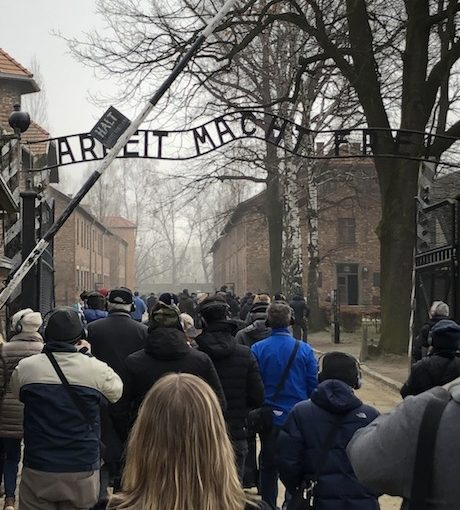
Springfield Collegiate Institute students walking into Auschwitz. (photo by Jim Osler, SCI)

Holocaust education is commonplace in Jewish schools. But, in public schools, discussion about the Shoah is at each teacher’s discretion. Some 14 months ago, teachers at Springfield Collegiate Institute public school in Oakbank, Man., decided they would take 30 Grade 11 and 12 students to see Second World War sites firsthand.

Despite that Oakbank is home to few Jewish families, the school has been inviting Holocaust survivors to speak to students and has been educating its students about the Holocaust for years. Last year, teachers Jim Osler and James Chagnon made the decision to take things further.

“While this was not on a topic brought up in a regular class, we organized activities outside of class time for these students in the evenings and on the weekends to educate them a little more,” said Chagnon of preparing the students for the 12-day trip, which started March 20.

“We visited a synagogue and talked to a rabbi about what it means to be Jewish, because we don’t have any experience with that,” Chagnon told the Independent. “We went and met two Holocaust survivors, who talked about their experiences in the camps. And we went to a conference on antisemitism hosted at the Rady JCC [in Winnipeg]. So, we did a lot of prep work outside of the school with these guys to make sure they’d be ready for what they’d be experiencing.”

Chagnon referred to a recent study that found that only about 30% of Canadian high school students had awareness or knowledge of the Holocaust.

“I had always taught English here in the school in addition to history – novels like The Diary of Anne Frank – and these seem to be getting pushed to the wayside,” said Chagnon. “The younger generations these days, especially in a community like ours that doesn’t have a big Jewish population … it’s just something I don’t think parents have a lot of experience with and, so, it’s not passed onto the kids. So, if they don’t learn about it in school or as part of our programs or clubs, they maybe aren’t going to learn about it at all.”

The school had wanted to take more than 30 students on the March trip, but had to stick to that maximum for logistical reasons. Participating students had to fundraise to pay their way.

Madison Stojak, in Grade 12, and Anna Palidwor, in Grade 11, were both born and raised in rural Manitoba, and had little knowledge or interaction with Jews prior to attending Springfield Collegiate.
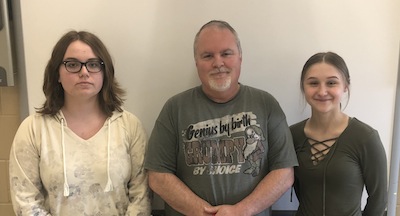
photo - Springfield Collegiate Institute student Ana Palidwor, left, teacher James Chagnon, centre, and student Madison Stojak
Springfield Collegiate Institute student Ana Palidwor, left, teacher James Chagnon, centre, and student Madison Stojak. (photo by Jim Osler, SCI)

“Hearing Holocaust survivors’ stories and then going to the camps, like Auschwitz and Birkenau … you could remember what the survivors said and picture it, what they must have gone through while they were there,” Palidwor told the Independent. “How we felt while we were there has stuck with everybody after we came back. Also, we’re more aware of the race issues that are out there… That’s definitely stuck with me … realizing it’s still here, wherever we go, the hate.”

While the school group was at the Warsaw Ghetto, a man on a motorbike drove by and gave the middle finger to a group of Israeli students who were standing beside them. “After all that, you’re just more aware of it, anywhere you go,” said Palidwor.

Both Stojak and Palidwor have talked about their experiences with family and friends.

“When I shared it with my family members, it was kind of surreal to them,” said Stojak. “They were like, ‘How could other people treat people like this? How could this happen? How come no one stopped it?’ They were questioning the same things I think all of us were questioning on the trip.”

“One of the strong points we really tried to push on the students, in terms of their learning, to understand, is that this isn’t the first time this has happened,” Chagnon said. “We definitely want it to be the last time, so we can’t just sit by and be passive bystanders anymore. When you see antisemitism, you are now obligated to call it out, draw attention to it, so we can change the way the world works.”

When the students returned from the trip, they were taken aback by some of the reaction they heard from fellow students who did not go.

Stojak said, “I hadn’t heard any comments before the trip like these – until they realized we were there … people started making rude comments … hateful comments. I think they were saying it to get us upset, and I also think that they’re really undereducated and don’t understand how serious it is.

“One comment someone said to me was, ‘Don’t touch me with your Holocaust hands!’ That’s what someone said to me. And, as soon as he said that, I said, ‘What did you just say?’ And he repeated it. I looked at him and said, ‘You didn’t just say that to me. That’s ridiculous. Do you know how many millions of people died there? That’s not something you should be saying.’

“I stood up immediately and shut it down,” said Stojak. “It made me feel sick to my stomach. How could someone make a comment like this? When he said that, I pictured standing there at Auschwitz or Birkenau and thinking, how could someone be so ignorant to say that?”

“These kinds of comments are making us want to be more active,” said Palidwor, “and to explain it to more people who weren’t there and tell them what the Holocaust is.”
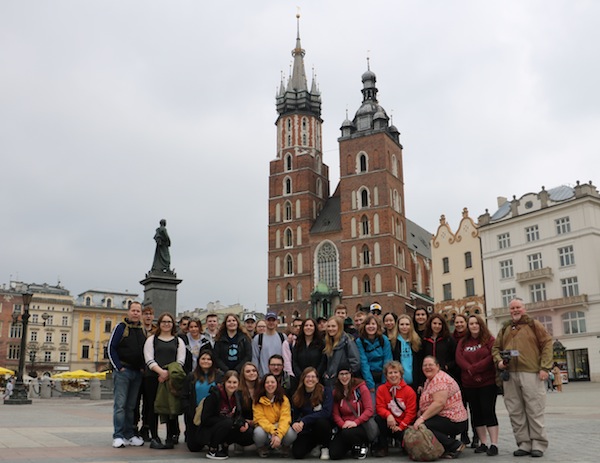
photo - The 30 Springfield Collegiate Institute students, three parent chaperones and two teachers in the old town square in Krakow, Poland
The 30 Springfield Collegiate Institute students, three parent chaperones and two teachers in the old town square in Krakow, Poland. (photo from SCI Students)

One of the things that stuck in Chagnon’s mind from the trip was the incident with the Israeli students. He noticed that there were a dozen security personnel with the Israeli student group but none with the Canadian school group.

“One of my students said, ‘Wow, I didn’t understand how bad it was – that these kids on a school trip from Israel have to be accompanied by security guards,’” said Chagnon. “That kind of struck me and I made sure to point it out to my students. It gives you a bit of perspective for the Jewish community – how scared they must be all the time – that they can’t send students to learn about the history of their people, their culture and religion, without having to send security with them.”

Another thing that stood out for Chagnon occurred when the group was visiting a Jewish cemetery and noticed that locals use the cemetery as a bathroom stop for their dogs.

“I’m a guest in their country, but I was shaking, I was so angry,” he said. “I couldn’t believe people would show such indignity to a group of people who suffered so much already.
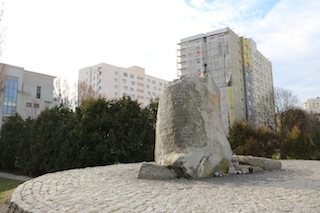
photo - The memorial at Mila 18 Ghetto Uprising site in Warsaw, Poland
The memorial at Mila 18 Ghetto Uprising site in Warsaw, Poland. (photo by Jim Osler, SCI)

“We had a nightly debrief at the end of every evening,” he continued, “where we sat around and talked about the day, how we felt about it and our reactions to it, and that’s one thing I brought up … that some of this stuff may seem to have gone away … maybe it isn’t as bad as it was, but that doesn’t mean it’s not there, just bubbling under the surface, waiting for an opportunity to pop up.

“For me, that’s the reason we did a trip like this, and I know Jim [Osler] feels the same way.… They say people who don’t study history are doomed to repeat it and, for me, that’s very true. You have to talk about these things, even the ugly things in history, so we don’t let it happen again.”

Rebeca Kuropatwa is a Winnipeg freelance writer.
Format ImagePosted on May 3, 2019May 1, 2019Author Rebeca KuropatwaCategories NationalTags Anna Palidwor, antisemitism, education, Holocaust, James Chagnon, Jim Osler, Madison Stojak, Manitoba, Springfield Collegiate
Israeli crisis line volunteers

Israeli crisis line volunteers

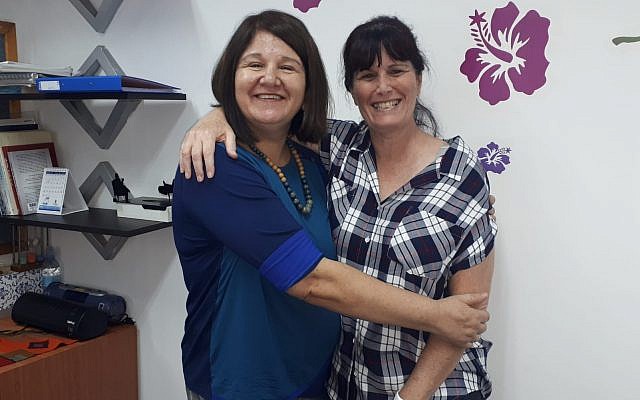
Ety Siton, left, director of the Kfar Saba branch of ERAN, also oversees the Toronto volunteers. She is pictured with Sigal Almog, co-founder of Toronto’s ERAN project. (photo from ERAN)

Finding enough volunteers in Israel for the night shift of the country’s emotional crisis hotline, ERAN, proved difficult. So, its chief executive director, David Koren, came up with the idea of looking for Israeli volunteers living in North America to help cover this time period.

ERAN is a confidential service, offered over the phone or the internet, which provides free, anonymous emotional support to people in Israel of all ages, in Hebrew, Russian, Arabic and English.

Sigal Almog and Galya Sarner, both former Israelis living in Toronto, were at a conference in Washington, D.C., in 2017 when they heard of Koren’s mission. They sent out a call for volunteers through their network, and further recruited two social workers, Anat Gonen and Sabina Mezhibovsky, to co-found and open a chapter of ERAN in Toronto last year.

“Right now, in Toronto, we have 16 volunteers,” Gonen told the Independent, adding, “We have around 85 volunteers in the four North American branches. I think they are answering, each month, around 800 calls. So, that is 800 calls that, before we had those volunteers in North America, were unanswered, because nobody was there at night.”

“Just think about the message behind it,” said Sarner. “It’s unbelievable, probably saving the lives of so many in need who couldn’t get help, because not enough volunteers were there to give them the minimum support they were asking for.”

All four Toronto co-founders knew of the ERAN helpline prior to becoming involved with it in Canada, though none had used it themselves.

photo - David Koren, chief executive director of ERAN
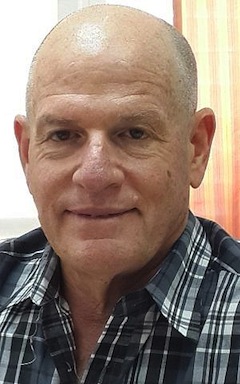
David Koren, chief executive director of ERAN. (photo from ERAN)

“ERAN is part of daily life in Israel,” said Sarner. “It’s a very distinguished project and, when we heard from Koren that he was looking to expand his global networking and to work with the North American community, we didn’t think twice. We knew we’d do whatever it took to launch the branch of ERAN in Toronto.”

Almog, who was also at the 2017 conference, recognized that this was a great opportunity to connect with and help people in Israel from Toronto. Nearly 80 former Israelis came to the initial information session in the city and, after screening them all, the branch accepted around 20 volunteers, who went on to get special training from ERAN and then started taking calls from Israel.

Volunteers do not need to have any particular degree, but they do need to possess specific skills.

“You need to be able to have some kind of empathy and self-awareness to know how to listen, [and to] understand and have a conversation in Hebrew, Russian, Arabic or English,” said Gonen. “One of the things we also found to be a struggle is that some of the people, especially those who’ve been here many, many years, can’t write in Hebrew. This is also a requirement, as they need to write a report in Hebrew. But, mostly what we need are people who are able to listen, to try not to give advice, and to be able to commit to the process,” to take a number of shifts per month.

“Whenever a volunteer answers the phone, they are told to say, ‘Eran, Shalom’ … keeping it very neutral, as, for some people on the line, it’s not a great evening…. It actually can be a pretty bad one,” said Sarner.

When a person in an emotional crisis dials 1201 from anywhere in Israel, they will be connected to a trained volunteer, who will try to direct them to those who can best help them; for example, a soldier with another soldier, or a Holocaust survivor with someone knowledgeable about the issues survivors face.

North American volunteers are taking shifts between 5 and 9 p.m., and 9 p.m. and 1 a.m., EST. Each volunteer signs into the ERAN system from their own computer and takes calls in their home.

“They have to be at home, because they have to be in a quiet room, a closed room, so nobody can hear the conversation they’re having and nobody interferes with what they say,” said Gonen.

Though the volunteers are in Toronto, they are trained to keep that fact out of the conversation. This way, explained Gonen, the caller is more likely to feel comfortable with them, thinking they are in Israel and able to identify with their struggle.

Running the Toronto chapter has been challenging, as the branch does not receive financial support from ERAN Israel or from the Toronto Jewish community. But, they have received some support from private donors and the Schwartz/Reisman Centre (in Vaughan, Ont.) provides space for ERAN volunteer training.

“We don’t have any kind of money that comes from ERAN Israel and everything we do here we pay for from our own pockets,” said Gonen. “The training … Sabina and I are volunteering to do every month. And, when we meet, all four of us will bring snacks for the meeting or things like that, because we want to make sure people feel appreciated for doing this. So, we’re looking for donations to help us run the branch.”

“We’re looking to expand support from our sponsors, because we did receive very touching sponsorships, mainly in the beginning, during the time of the initial training,” said Sarner. “But, in terms of the monthly meeting, it takes place at Schwartz/Reisman JCC. We’re very lucky to have the support of the JCC, but we definitely need to expand and find more sponsors and donors.”

The feeling shared by the co-founders and volunteers is that of gratitude to be able to have a direct impact on the lives of Israelis in Israel.

“We give a lot to ERAN,” said Almog. “We work many volunteer hours, but I feel like each one of the volunteers gets so much out of it. It’s brought a lot of meaning to our lives here, as Israelis who live outside of Israel.

“The volunteers just told us last week, someone who went to Florida and didn’t participate in the last training, that she really missed ERAN. It has become very meaningful in the lives of each one of us.”

“Anything you do in life,” Sarner added, “you have to do with love – with love and respect – and the respect we have among the four of us, it means so much to me. In Toronto, from the volunteers to the sponsors and the support of the community at large, it makes it even more meaningful to me. It has touched my heart and soul to be part of such an important initiative.”

ERAN is always looking for more North American volunteers and would like to open a chapter in Vancouver. For more information, visit app.etapestry.com/onlineforms/SchwartzReismanCentre/ERAN.html.

Rebeca Kuropatwa is a Winnipeg freelance writer.
 

Format ImagePosted on May 3, 2019May 1, 2019Author Rebeca KuropatwaCategories WorldTags David Koren, ERAN, Galya Sarner, Israel, mental health, Sigal Almog, suicide, Toronto, volunteering
Trying to make access equal

Trying to make access equal

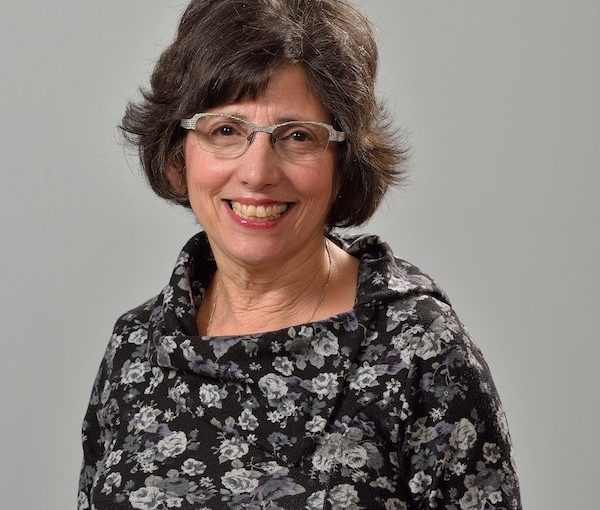
Dr. Cheryl Rockman-Greenberg (photo from Rockman-Greenberg)

In the 1970s, when Dr. Cheryl Rockman-Greenberg was eyeing the budding field of genetics as a career, she had to become a pediatric doctor first. Now, Rockman-Greenberg counts her clinical background as a blessing, one that, today, geneticists no longer require.

“Having a strong background in clinical medicine certainly always helped me in my career, because the kind of genetics I was always interested in was in rare metabolic diseases,” said Rockman-Greenberg. “These are diseases often caused by enzyme deficiencies that go by very elaborate names. Having a good foundation in clinical medicine through pediatrics certainly helped me.”

Rockman-Greenberg, who lives in Winnipeg, was invited to speak at the city’s Congregation Shaarey Zedek Sisterhood Interfaith Luncheon on April 30.

“I learned that the luncheon was spearheaded through the sisterhood in many ways to promote information sharing between the faiths,” she said, noting that a purpose of the event is education and “to look at how we can build bridges between people of different faiths and not build walls.”

“From a global perspective,” she said, “I think it fits the themes of the interfaith luncheon. And, from a Jewish perspective, I’ve certainly been involved over the years, particularly with the National Council of Jewish Women, of increasing awareness of the importance of genes for health, and bringing together some of the advocacy groups in rare genetic disorders.

“I helped the National Council put out a brochure on carrier testing on new genetic disorders in the Ashkenazi Jewish population that has been extremely well-received worldwide. This information is always evolving.”

At the luncheon, Rockman-Greenberg was planning to discuss, among other things, Bill S-201, also known as the Genetic Non-Discrimination Act, which passed into law in Canada in 2017, though it is still being challenged by insurance companies in Quebec.

“This is a remarkable act in the sense that it does protect Canadians from the use of genetic test results outside of medical care and medical research,” Rockman-Greenberg told the Independent. “In other words, genetic test results do not have to be disclosed to insurance companies or employers. We’re one of many countries who have such legislation in place, and many people here have worked for years and years lobbying for similar legislation for Canada.”

Methods of genetic testing continue to advance, said Rockman-Greenberg. Tests that were nonexistent or very complicated to administer as recently as two decades ago can now be done quickly and inexpensively.

“The evolution has dramatically changed over the past 10 years, particularly in the sense that the techniques we use to diagnose genetic disease have dramatically changed – from studying one gene at a time, to being able to sequence the entire genome of an individual,” she explained.

When Rockman-Greenberg refers to “new genetics,” she is referring to the ability to offer state-of-the-art, revolutionary genetic testing that was not possible just 10 years ago. It is this access that Rockman-Greenberg is lobbying for now.

“Everybody doesn’t have the same access to the testing in Canada,” she said. “It’s certainly not uniform from province to province or within provinces. So, many people are very committed to ensuring there are strategies in place to promote fairness.

“Notwithstanding that, the legislation is going to protect people against disclosing information that is already in place. I think we are ahead of the game because we have this in place. But, we are not ahead of the game in making sure people are going to have access to new diagnostic testing and new therapeutics in a way that’s going to be equal across the board.”

Rockman-Greenberg’s focus on rare metabolic diseases means that she has witnessed firsthand the struggles to get specialty drugs approved through a system focused on the big diseases, such as diabetes and cancer.

“You may get a new drug for diabetes that will be approved and available for patients very quickly, whereas some of the new drugs for other diseases I treat can take years and years before they go through the approval process,” she said.

Rockman-Greenberg thought that the topic was an appropriate one for an interfaith gathering, “as everybody having the same chance to be successful is very important to me. I work with families and patient support groups to help remove barriers and help people feel empowered.”

She said, “There are many challenges in dealing with rare diseases and I try to work both sides: the patient side, as well as advocate for changes at the government level, to make sure there is fairness in access to new therapies.”

Rebeca Kuropatwa is a Winnipeg freelance writer.
Format ImagePosted on April 19, 2019April 17, 2019Author Rebeca KuropatwaCategories NationalTags Cheryl Rockman-Greenberg, equality, genetics, health, human rights, interfaith, law, NCJW, Shaarey Zedek, Winnipeg
Safe, healthy and respectful

Safe, healthy and respectful

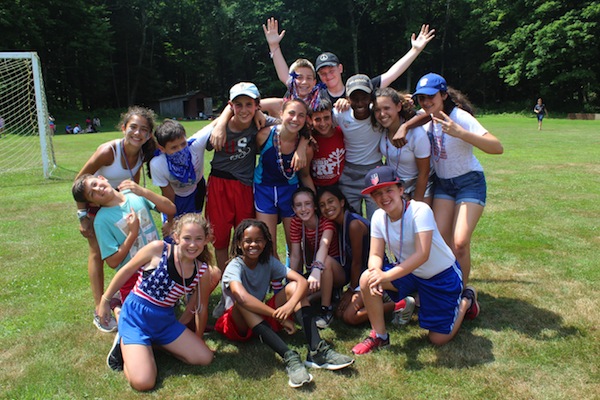
Campers at Pennsylvania’s Camp Havaya. (photo from Camp Havaya)

In Pirkei Avot (Ethics of Our Fathers), Ben Zoma says, “Who is honourable? One who honours others.” The Foundation for Jewish Camp’s Shmira Initiative “aims to make camps safe, healthy and respectful model communities. Shmira, in Hebrew and in the vernacular of Jewish summer camp, means guard duty, embodying the social and individual responsibility every community member has to ensure a safe environment.”

For some camps, the initiative provides practical training that has been needed for some time. But, at Camp Havaya in Pennsylvania, camp director Sheira Director-Nowack told the Independent that they have been operating on the initiative’s principles for many years.

“We have people who go by ‘he,’ by ‘she’ and by ‘they,’ as rabbis, teachers, students, educators, campers and staff,” said Director-Nowack of the camp, which is part of the Reconstructionist movement. “So, for us, the sexual harassment piece is something we’ve always discussed, have always had a policy for. I used to work at a camp that did not have that defined as clearly and they had some real challenges. We don’t have some of those challenges here, because it’s very up front and very clear – how you treat all people, not just insofar as gender, but in all areas of inclusion.”

At Camp Havaya, respect is constantly discussed.

“The name of our camp mascot is Howie Bee,” said Director-Nowack. “We talk about ‘how we be,’ using that as a fairly common statement to talk about how we should treat each other with respect, kindness … better than you’d want to treat yourself, you’d want to treat the other person … and, not just as a Jewish phenomena, but as a human phenomena.”

While Director-Nowack acknowledged that, every so often, they run into power conflicts in a relationship, they try to ensure it never gets near the point of harassment.

At Camp Havaya, she said, flirtation is discouraged. For example, there are strict rules as to what clothing is acceptable. Everyone must wear shirts at all times and clothing should be loose fitting. They also have no boys against girls competitions. Instead, all sports are open to everyone and, while everyone swims together, there are rules about appropriate swimwear.

Language and attitude is another area that is closely monitored at the camp. “We don’t use the word ‘broad’ or ‘chick,’ we don’t use a lot of derogatory terms,” said Director-Nowack. “We don’t make jokes at other people’s expense.

“We want everyone to treat each other how they would treat their own family or themselves…. There’s not a constant need for romance or underlying things that go into that modern love thought and, because of that, we don’t see certain behaviours that other places might see.”

The concepts of the #MeToo movement are discussed at camp, as are other relevant topics, like Black Lives Matter and the Israeli-Palestinian conflict.

“Our constituency is made up of people who are interested in these things … also, things like respect for people with special needs, inclusivity, race, culture and minorities,” said Director-Nowack. “We don’t talk about these things because they’re hot topics. We were talking about them before they were considered cool to talk about.

“We also give the credit to younger people, because it is them who are changing the verbiage, changing ideas. They are bringing them to us and we are bringing them to camp, because, if camp is a microcosm of society, then we want to be part of that.”

If and when the topic of sex comes up, Director-Nowack said she teaches her staff to turn the conversation back to the camper and ask why he or she is wondering about it.

Camp Havaya has a no-sex policy. If inappropriate behaviour is observed, Director-Nowack said, ‘We don’t punish people for behaviour, but I may or may not ask them if camp is the appropriate place for it. I don’t feel like there’s any place at camp where you could be sexual appropriately, and that’s what we talk about.

“We don’t hook up in the middle of the woods – that’s just not what we do. And, we really don’t have a lot of that. I don’t think I’d kick someone out of camp just because they kissed someone. But, I’d say something like, ‘I just walked passed you kissing … not what I want to see, not OK, not cool.’ If it got further than that, it would depend on the kid, the parent, the discussion and the situation. We’re dealing with human beings and we have an environment that’s not constant.”

Still, staff members do talk with campers about consent, in an effort to ensure all of them are comfortable in their own space at all times.

“Our goal is to create young leaders in the Jewish community who are thoughtful and intelligent, and who are, therefore, going to go out and lead a Jewish life and know themselves,” said Director-Nowack. “We love that some people find their love and their relationships at camp. But, I also love that people find their independence at camp … or that they want to lead a more productive Jewish life without a partner…. We want our kids and staff to leave camp as people who are going to make decisions guided by some basic values.”

For more information on the Shmira Initiative, visit jewishcamp.org/shmirainitiative.

Rebeca Kuropatwa is a Winnipeg freelance writer.
Format ImagePosted on April 19, 2019April 17, 2019Author Rebeca KuropatwaCategories WorldTags #MeToo, camp, children, ethics, harassment
Educating rabbinical students

Educating rabbinical students

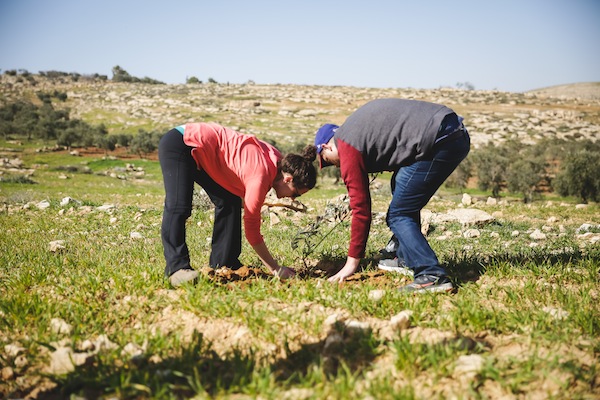
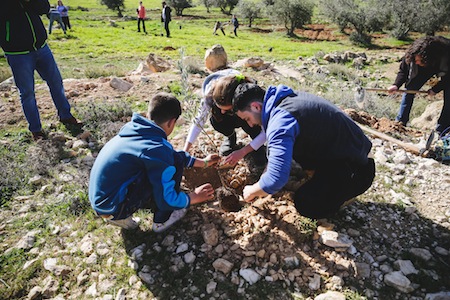
T’ruah students help plant trees in the Hebron Hills. (photo from T’ruah)

U.S.-based T’ruah: The Rabbinic Call for Human Rights works in Jewish social justice circles in Israel and North America.

“We work with human rights of both Israelis and Palestinians…. We’ve also worked on introducing rabbis and rabbinical students, and also congregations, to what’s happening in West Bank and more,” executive director Rabbi Jill Jacobs told the Independent.

T’ruah, which supports a two-state solution, offers the Year-in-Israel program for rabbinical students.

“Students study in Jerusalem at various institutions,” said Jacobs, “but they don’t necessarily get to see human rights issues up close. We take them once a month to see a human rights issue on the ground, either in the West Bank with Palestinians, in Bedouin Israeli communities in the Negev, asylum seekers, etc.”

At these sessions, students meet with Israeli human rights and other leaders on the ground. The program is held during students’ free time, separate from their regular studies.

“The goal of the program is to help them develop a rabbinic moral voice,” said Jacobs. “As rabbis, they’re going to be called on to speak about Israel. The question is, how do they talk about Israel as a rabbi? Rabbis talk out of their values, and also are generally dealing with politically diverse communities…. So, the question is, how can a rabbi speak in a way that will push people to listen to perspectives they might not otherwise listen to, [based on] Jewish texts and Jewish values?”

Jacobs recognizes that the information they provide is not comprehensive. Their focus is to give students the opportunity to interact with human beings – to meet Palestinians, Bedouins and others and learn from them what their life experience is like.

“It’s also crucial to us that they are meeting with Israeli human rights leaders,” said Jacobs. “Very often, there’s a dichotomy that suggests that being pro-Israel means supporting the right-wing government of [Binyamin] Netanyahu and that being pro-Palestinian means being against Israel. We’re pro-human rights and we want them to meet Israelis working every single day to push for human rights in their own country because they love their country. We want them to see that there are actually people who are changing the situation.

photo - T’ruah students planting trees
T’ruah students planting trees. (photo from T’ruah)

“We hear a lot from the students that our program gives them hope. Sometimes, they are so hopeless about what is happening in Israel and then they meet people, both Jewish and Palestinian communities, who are trying to change their situation.”

One T’ruah graduate is Rabbi Philip Gibbs, spiritual leader of Congregation Har El in West Vancouver.

“During my year in Israel, during my second year of rabbinical school, I had the opportunity to then be a fellow with T’ruah for their rabbinical student program,” Gibbs told the Independent. “I really appreciated the opportunity, both because, at least the year I was doing it, there was clearly a huge focus on the Israeli-Palestinian conflict. But, also because the way, in terms of educating about social justice issues in Israel, they were able to show some of the other issues happening – whether it was meeting with Bedouins, talking to some asylum seekers from Africa … really seeing what their home-grown needs are and seeing how it developed into a strong sense of the how they were fighting for many of those needs through the legal systems in Israel.”

Gibbs met with Palestinians who had been displaced from the Jerusalem area after the 1967 war. “We had the chance to hear their narrative,” he said, “highlighting how their status as refugees during that conflict had really come into question because of both the policies of Jordan, as they were occupying the area, as well as some of the motivations of different settler organizations in their attempt to create a much stronger Jewish presence behind the Green Line… I felt like that was more educating us in understanding the way that the nature of a lot of these neighbourhoods had been going back and forth.

“For the Israeli settlers, they felt they were reclaiming a neighbourhood that was Jewish. For the Palestinians that had been living there, their legal status was caught up in layers of legal confusion of having that area under control of many different authorities over the past 150 years.”

Gibbs has not yet had an opportunity to bring this part of his rabbinical education to his congregation directly, but it has definitely played a role in how he shares his perspective regarding, for example, the upcoming Israeli election.

“I’m making sure there’s a deeper sense of having the recognition that a lot of these questions that are coming up, some of these issues are on the minds of most Israelis … but that, no matter what, a lot of the work that human rights organizations are doing, a lot of that is going through the overt legal system of Israeli government.”

Regarding the many Israelis he has met who work for human rights organizations, Gibbs said he appreciated the way their main motivation was a deep sense of trying to make their country the best it can be, noting that every government needs to be transparent in their treatment of their citizens, allowing for a certain amount of criticism.

“That’s something coming from a place of love and it’s the most ideal way to get things done in a constructive way,” said Gibbs. “People can debate about how much people living outside of Israel are supposed to be making any sort of direct intervention, which happens on both sides of the political spectrum, but, I think, there’s absolutely nothing that we should hide in terms of understanding the full array of political work happening in Israel.”

Rebeca Kuropatwa is a Winnipeg freelance writer.
Format ImagePosted on April 12, 2019April 10, 2019Author Rebeca KuropatwaCategories WorldTags Diaspora, Har El, Israel, Judaism, Philip Gibbs, rabbis, T'ruah, tikkun olam
Memory still debated

Memory still debated

Dr. Laura Beth Cohen (photo from Dr. Laura Beth Cohen)

Although the Srebrenica genocide – the killing of more than 8,000 Bosnian Muslims by Bosnian Serb forces in July 1995 – occurred more than 20 years ago, it still affects the people of Bosnia and Herzegovina every day, according to Dr. Laura Beth Cohen, director, Kupferberg Holocaust Centre, Queensborough Community College, City University of New York.

Cohen was in Winnipeg on March 8 to speak as part of the Mauro Centre for Peace and Justice: Brown Bag Lecture series. She spoke on the topic Conflicted Walls: Untangling Transitional Justice and Traumatic Memories at Bosnia’s Memorial.

“There was an opportunity to participate in the first fellowship called Summer University Srebrenica and so I decided to go,” Cohen told the Independent. “I learned very quickly – that was in the summer of 2010 – that, to really understand Bosnia, it was not enough to take a course and learn about it from books. It’s very important to understand what’s actually happening there, and the best way to do that is to actually go there. It’s a place with intense beauty, legacy and a wonderful history of different ethnic groups coming together, living in harmony.”

But, the legacy of the last war, which lasted from 1992 to 1995, is still very much present. In fact, she said, the current government is debating about it.

“Here, in America, we talk about the Second World War as if it’s confined to the past,” said Cohen. “But, in many places in Europe, the Second World War, that memory, is very much alive. And, once you’re in an environment like that, it really starts to help you, not only sort out what has taken place, but you can see … because you’re not part of that country, or you don’t belong to that population … you can start to see different ways that those memories of the past are interacting in contemporary life, and are incredibly problematic.”

When Cohen was in Srebrenica, she was taken by how much the memory of the genocide affects the surviving population, how much it is fought over. The country and government are split into two ethnic entities that are a result of the Dayton Accord, which was signed after the massacre in Srebrenica. One side was deemed the perpetrator; the other, the victim.

“It is not a big surprise there are very different perspectives between the sides over what happened in Srebrenica,” said Cohen. “The RS [Republika Srpska] government in the last month has created a new commission on Srebrenica to, once again, reexamine the facts and evidence to determine whether or not genocide took place … even though genocide took place and was proven multiple times, and especially in the international criminal tribunal. So, this debate over what happened and denial over what happened is still occurring within Bosnian society, as well as, particularly, in Srebrenica.”

This, of course, makes it very difficult for the residents of Srebrenica and the region to move forward, she said.

“It’s a place that would really benefit from having a lot of people just step away … and allowing the population to just live, move forward, and gain attention for things that they really need support with – economic relevance, additional support for education, and rebuilding parts of the community,” said Cohen. “But, with the memory so volatile and kept alive, it really overshadows what’s taking place there. You can imagine trying to raise your family, regardless of your ethnicity, in a place where the past is constantly looming, and it’s a grotesque past. How do you bring your children up in that world?”

According to Cohen, the constant and continued fight over the politics and memory of what happened at Srebrenica does not allow people to learn about what happened or why, and that this is preventing coping mechanisms from being put into place; mechanisms that could help stop other massacres from happening.

“We only focus internationally once a year – on July 11, during the annual commemoration of the Srebrenica genocide that takes place at the memorial – so we often don’t understand what’s taking place there the other 364 days of the year,” said Cohen.

“People visit the 9/11 memorial in downtown Manhattan. They visit Auschwitz-Birkenau in Poland. They visit Kigali Genocide Memorial [in Rwanda]. These memorials serve as an educational component. For local residents and national citizens of these countries, they also serve as places of memory making,” she said.

In Srebrenica, Cohen hopes to eventually see ways of involving the local community in dialogue initiatives that facilitate the creation of memorials, ones that speak to the locals, helping them repair their communities.

“While we, as Jews, have a view of what Auschwitz-Birkenau is, to the people of Poland, it’s a German extermination camp on Polish soil,” said Cohen. “And, to the local people in Oswiecem, which is the Polish name of the town that the camp was built by, they struggle with having that kind of site in their community.”

When it comes to Srebrenica, she said, “We get stuck in the conversation of the politics over the genocide and what happened. What then happens is, a lot of these issues play out at the memorial. Part of this conversation is theoretical, but part of it is to help us understand that these are not static locations. They are very much interactive places, where memories are not only being promoted, but shaped by the larger discourse where they are situated.”

Cohen said the part of Bosnia, Herzegovina and Srebrenica that has always drawn her is “not only the friends I’ve made, but a vibrancy of life in Bosnia that gets lost in the discussion. The culture is beautiful, the people are beautiful, the relationships that people have with each other are beautiful. And, despite all of the horror of the last war, and despite all the history, and the Second World War and before that, it’s a place where there’s a lot of love and a lot of hope. That’s something that keeps, especially, international activist scholars engaged in what’s taking place there … and that, we can’t lose sight of when we talk about all the politics and things that aren’t going well.”

Rebeca Kuropatwa is a Winnipeg freelance writer.
Format ImagePosted on April 12, 2019April 10, 2019Author Rebeca KuropatwaCategories WorldTags Bosnia, genocide, Herzegovina, Laura Beth Cohen, memorials, Srebrenica, tikkun olam
Making change her business

Making change her business

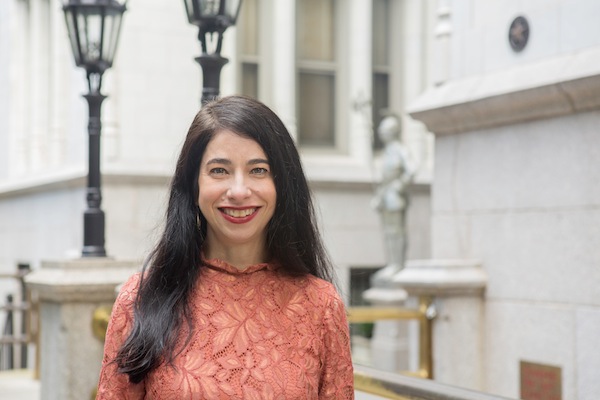
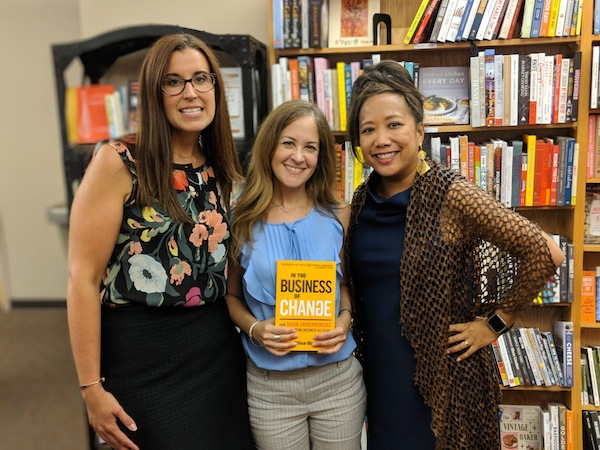
Elisa Birnbaum, centre, with Laura Zumdahl of Bright Endeavors, left, and Maria Kim of Cara Chicago. (photo from Elisa Birnbaum)

Toronto-based Elisa Birnbaum, editor-in-chief of SEE Change magazine, aims to inspire and give hope in many ways. Her book In the Business of Change: How Social Entrepreneurs are Disrupting Business (New Society Publishers, 2018) is but one of those ways.

“I’m a lawyer by training, but was always a writer on the side, enjoying writing and storytelling,” said Birnbaum, who was born and raised in Montreal in an Orthodox Jewish family. “I decided to try writing out for a little bit and to go back to law after. That was 15 years ago. I never went back to it.

“I was writing a lot about the nonprofit and charitable sector in Canada, as well as in the U.S., and I was also writing a lot about business, a strong interest of mine, too. I noticed how there was a melding of the two – how a lot of challenges in the nonprofit and charitable sector … how they could be helped through business and through business savvy…. So, when I saw what social enterprise was all about and how it was using business to solve social challenges, I realized the importance of that. I became really intrigued and interested. It was an area that, I thought, ‘Hey, this is something I really want to explore further.’”

Birnbaum started pitching stories about social enterprises to any editor who would listen. While some of her work went out via mainstream media, Birnbaum felt more was needed, so she co-founded SEE Change, which is devoted to telling the stories of social and environmental enterprises.

“I thought they symbolized a new way at looking at business,” she told the Independent. “I really felt this was the future, with how we work with business and how communities can tackle social challenges through business, and these types of savvy-ness and skills.”

After years of publishing the magazine, Birnbaum wanted to put together a book of such stories, both to delve more deeply into the phenomenon and, hopefully, to inspire and teach readers how to take on the task of starting a social enterprise.

“A lot of times, I’d get some young people or even older people who were interested in social entrepreneurship themselves, and they’d like advice and tips, and were constantly looking for more information from anyone who’d done it before,” she said. “So, I thought, I could also provide lessons learned, tips, advice and resources … so, a bit of storytelling, as well as a resource for those who are starting up or looking to start their own.”

As far as the response to the book so far, Birnbaum said she has been asked by schools and organizations to speak about the topic. “There were people who had never heard about it before and are now really inspired by the storytelling, which is great,” she said. “There are other people…. I was at a couple of universities recently, and some students there said they picked up the book and were now interested in starting their own social enterprise.”

According to Birnbaum, a very broad definition of a social enterprise is a business, whether nonprofit or for-profit, that has a social or environmental mission at its core, as opposed to a business that has profitability and sustainability at its core. The unique aspect of social entrepreneurship, she said, is that it approaches business in a new way.

In her book, Birnbaum makes a point of highlighting a large array of social enterprises from around the world, including a few in British Columbia. For example, Saul Brown’s Saul Good Gift Co. (itsaulgood.com) creates gift boxes filled with locally made artisan food that people can give their loved ones across Canada, and Reena Lazar’s Willow (willoweol.com) helps with end-of-life planning.

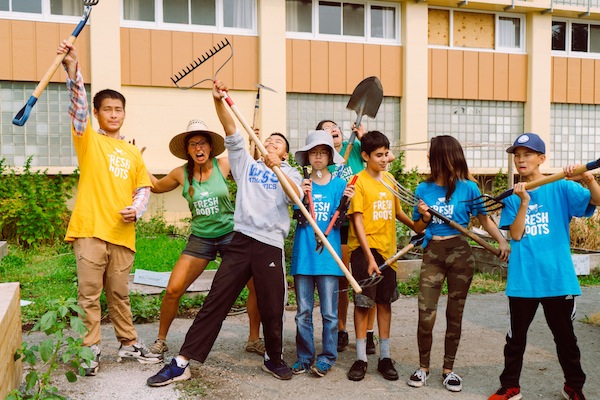
photo - Fresh Roots offers students experiential learning opportunities.
Fresh Roots offers students experiential learning opportunities. (photo from Fresh Roots)

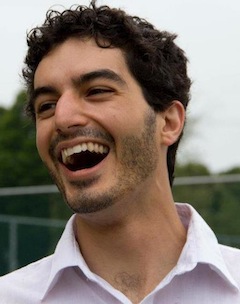
Marc Schutzbank, director of Fresh Roots (freshroots.ca), grew up in the United States and moved to Vancouver to finish his education at the University of British Columbia 10 years ago on a Fulbright scholarship, looking at the economic viability of urban farming. This line of study led him to an organization called Plant to Plate, in Pittsburgh, Penn., where he attended University of Pittsburgh.

“As part of my research, I was looking at urban farms in Vancouver – if they were growing, how much food they grow, who they’re sharing it with,” Schutzbank told the Independent. “I have a finance degree, so I was looking at if they were making any money. As I was doing that, there were a couple of people who were doing work in the social space. So the goal wasn’t to grow and sell food; the goal was to share it or to reduce barriers to employment. And so, as I was getting to know them, Fresh Roots was moving from backyards into school grounds.”

One particular backyard caught Schutzbank’s attention. He wanted to know how much food was being grown in such a small space. He discovered, to his amazement, that this one backyard could feed three families. As they expanded to eight backyards, they could feed 35 families.

One of those backyards was adjacent to an inner-city elementary school with a rundown garden plot. The school invited Fresh Roots to develop the plot. As they did, the students, teachers and parents became increasingly interested. The teachers began using the garden as part of their curriculum, as a place to build learning capacity.

“It turns out that, when kids are outside growing food, their academic confidence increases,” said Schutzbank. “They are able to find some success, and this is often in places with kids that are having a hard time finding success inside the classroom [in straight rows]…. Learning like that doesn’t work for everyone.”

photo - Marc Schutzbank, director of Fresh Roots
Marc Schutzbank, director of Fresh Roots. (photo from Fresh Roots)

Another benefit of this was that bullying decreased at the school, as kids had a positive physical outlet. As well, Schutzbank found that, as the saying goes, “If you grow it, you eat it.”

Other schools picked up on what was happening and asked Fresh Roots to do the same at their schools. Fresh Roots is now at four high schools and one elementary school.

Fresh Roots also started a salad bar program for students – twice a week, all of the students get to eat the produce from the garden.

“In Canada, we are the only G7 nation that doesn’t have a federal meal program,” explained Schutzbank. “It’s a bit crazy that Canada doesn’t have that. All those kids without lunches are hungry, regardless of how much food is at home. It’s really critical for learning, to have food…. So, at Fresh Roots, our vision is good food for all – so everybody has access to healthy land, food and community.”

In addition to the food they grow, Fresh Roots supports and encourages teachers to have classes outside in the garden. “They need to touch, taste and feel,” said Schutzbank of the students. “Those are really critical parts of our senses and a really important way of learning.”

As well, Fresh Roots provides employment – especially in the summer – for youth who are struggling.

Schutzbank said you can’t grow food without eating and sharing it, so Fresh Roots’ philosophy is “around sharing all the food back through the programs and everything we are doing.”

Rebeca Kuropatwa is a Winnipeg freelance writer.
Format ImagePosted on April 12, 2019April 10, 2019Author Rebeca KuropatwaCategories Books, WorldTags business, Elisa Birnbaum, Fresh Roots, Marc Schutzbank, social enterprise, tikkun olam
Synchronizing rhythms

Synchronizing rhythms

Dr. Shimon Amir researches circadian rhythms and clock genes. (photo from Shimon Amir)

When our circadian rhythm is disrupted, it can cause a brain disorder that manifests in a series of detrimental conditions too numerous to list, but that includes insomnia, depression and Parkinson’s disease.

“Circadian rhythms are daily observations in behavioural, physiological and metabolic processes,” explained Dr. Shimon Amir, professor of psychology, Concordia University in Montreal, and director of the university’s Centre for Studies in Behavioural Neurobiology. “In fact, everything you can measure in an organism follows a daily rhythm – a 24-hour cycle generated by internal clocks present in each and every cell in our bodies. And they are synchronized with the environmental light cycle. So, there is tuning between the internal rhythms and the solar cycle. Those are the rhythms.

“Most people might think that rhythms are driven by the light-dark cycle, but that’s not the case. They are generated by a clock that is present in every cell. The clocks are made of a set of genes called ‘clock genes’ and they oscillate – form feedback logs that last each cycle, with each cycle lasting about 24 hours.”

Amir was born and raised in Israel and moved to Montreal for his PhD. He went back to Israel to work at the Weizmann Institute of Science, but later returned to Montreal to teach and do research on circadian rhythms and now, too, clock genes.

According to Amir, circadian rhythms allow organisms like flies, rats, monkeys, humans and even plants to anticipate and respond to the demands of their environment.

“Rhythms can be disrupted by various means,” he said. “Ones that are most common are traveling across time zones, working shift work and eating at the wrong times. But, the main reason for the disruption is movement across time zones. Your clock is synchronized to your location. So, if you move from, say, Vancouver to Montreal, the clock has to be advanced, as you’ll wake up in Montreal three hours earlier, right? That takes time and the mismatch between environment and internal cycles causes various metabolic, behavioural, cognitive and other problems.”

While there are clocks in every cell of the body, all these clocks report to the master clock in the brain. That clock receives input from the eyes – light information that resets the master clock daily.

When we use lights at night, the master clock gets disrupted. “The clock is very sensitive to light at night,” said Amir. “Say you’re asleep and you want to go to the bathroom in the middle of the night. You turn on the light and that causes a disruption of the clock. Another way to disrupt the clock is the time that you eat. Eating should occur during the day.

“The reason light is so disruptive at night is that one arm of the clock is a hormone called melatonin. Melatonin is exceedingly sensitive to light. It is secreted during the night and is suppressed during the day. But, if you turn on the light at night – even very brief exposure to light at night – it suppresses the melatonin rhythm.”

Amir suggested using a sleep mask to keep light away, as well as learning to use the washroom at night without turning on a light. “You can adapt to the dark very quickly and be able to see,” he said.

While Amir’s initial research interest was in circadian rhythm, over the last 10 years, he has expanded his focus to other clocks in the brain – those that control different types of behaviours and pathological conditions, such as depression, anxiety, drug addiction and diseases like Parkinson’s.

Through experiments with mice and rats, Amir has been working to configure which brain clock controls, or affects, how the rodents handle stimulation and what happens if these clocks are turned off or disrupted.

“So, the clocks are made of several particular genes called clock genes,” said Amir. “We have various molecular, genetic and viral tools to manipulate those genes directly … in different regions of the brain…. We’re seeing what happens when an animal that has a brain region that doesn’t have a clock or particular clock gene that stops the clock … how the animal behaves and what are some of the pathological consequences of this condition.”

Amir and team use various animal models of disease, looking into what happens when you take out the clock and if it correlates with enhanced depression and anxiety.

“The circadian rhythm is really a very fundamental system that you can say controls everything,” said Amir. “When the system is disrupted, it has important implications for varied disorders.”

photo - Dr. Shimon Amir
Dr. Shimon Amir (photo from Shimon Amir)

The main goal is to understand the evolutionary function of the clocks and what they do to enable adaptation of organisms to their surroundings. But, also, the hope is that, by having better understanding, it will help in identifying new avenues of therapies.

With jet lag being such a hot topic in regards to circadian rhythm, Amir suggested a few ways to keep it at bay. “There are some ways to shorten jet lag, but there’s no way to avoid it,” he said.

“When you go east, you have to be exposed to light in the morning, in order to readjust to the new time zone. When you are exposed to light early in the morning, it induces in the clock a ‘face advance,’ it advances the clock. But, if you go west, you have to be exposed to light at night, early night. The transition between the evening and night, that’s where you have to be exposed to light, and that’s where it is ‘face delay.’ It will delay the face of the clock, because you have to wake up later when you go west.

“You need to be intentionally exposed to light in the evening or have light exposure a bit longer before you go west … or wake up very early, be exposed to light early in the morning, if you go east.

“Going through jet lag is very unhealthy,” he said. “If you do it very often, it will affect you in various ways, negatively, of course. Except, you can’t avoid it … as you go see family and grandchildren, and others, in Israel.”

Rebeca Kuropatwa is a Winnipeg freelance writer.
Format ImagePosted on April 12, 2019April 10, 2019Author Rebeca KuropatwaCategories WorldTags circadian rhythm, science, sleep
Okanagan interfaith initiative

Okanagan interfaith initiative

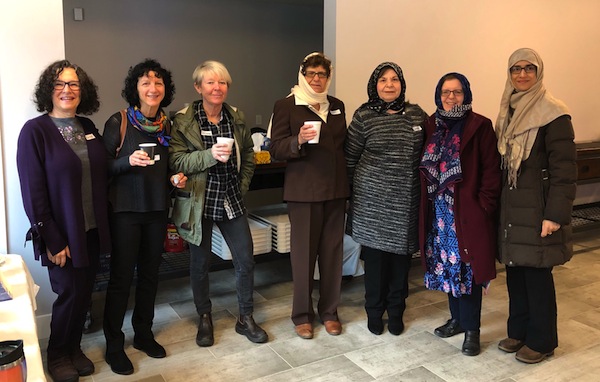
Women from the Okanagan Jewish and Muslim communities at a Feb. 9 event, which is the first of hopefully many bringing the communities together. (photo by Steven Finkleman)

The Jewish and Muslim communities of Kelowna and its surrounding areas have started celebrating their similarities with neighbourly get-togethers.

Coming from a mixed religious background, Okanagan Jewish Community member Philippe Richer-Lafleche knows well how upsetting it can be to be labeled or misunderstood. Yet, he has consciously chosen to look beyond his negative experiences.

“I feel that we’re not called to religion. God doesn’t call us to religion. He calls us to relationships,” said Richer-Lafleche. “We talk about the covenant as a relationship. We have communities, and out of communities come tradition, and out of tradition and culture comes religion. When you get hung up on the religious thing and the symbolism, and forget about the relationship, that’s when we get into trouble…. For me, what’s important is how I relate to myself, the world around me and the people I live with.”

Last summer, OJC president Steven Finkleman asked Richer-Lafleche if he would consider being part of the board and Richer-Lafleche agreed. A few months later, Finkleman and Richer-Lafleche began talking about connecting with the growing Muslim community in hopes it would provide a blueprint for connecting with the other local communities, including First Nation, Sikh, Christian, Hindu, Buddhist and others.

“We began by approaching the mosque,” Richer-Lafleche told the Independent. “Steven knew somebody who’s on their council, got in touch, and we had a meeting. We thought that the two of us would go to the mosque and meet with one or two people. We met with the entire board for the mosque – about eight people, three women, five men, I think. They said they’ve wanted to do this, too, and had been talking about how.”

The Muslim community appointed Rehan Sadiq as their lead in the initiative, and Richer-Lafleche and Sadiq began meeting at the local Tim Hortons almost every weekend for coffee and conversation, becoming friends in the process.

The first event bringing together the communities took place Feb. 9 at the Kelowna Islamic Centre, and the next one is being planned for this spring at Kelowna’s Beth Shalom Congregation.

“The concern I had was just how many people at the synagogue would be interested,” said Richer-Lafleche. “But, it worked out very well, with about two dozen people from both sides, open to families and people of all ages.

“It started with a 10-minute talk – somebody from the mosque, somebody from the synagogue, talking about the community, how the community in Kelowna or in the Okanagan developed, where the Jews or Muslims here came from … some of the challenges in the community…. There was a little bit of talk about some of the shared values, and I think a lot of the people from the synagogue were astounded that there weren’t a lot of differences, that a lot of the values were the same.”

Once the formal part of the event took place, participants had lunch together and mingled, then took a tour of the newly built mosque, which included a call to prayer.

“There was a young fellow who calls to prayer, beautiful voices in Arabic, from my perspective it was absolutely beautiful, moving,” said Richer-Lafleche. “People from both sides said this was the beginning of a relationship between the two communities, but also core for interfaith connection with other communities.”

Both Richer-Lafleche and Sadiq are working on other ways for their communities to connect with, learn about and support each other.

“I know, in the Islamic world, Jews living in the Islamic world throughout our history, there was this interchange between Muslims and Jews, with science, literature, philosophy, and even spirituality,” said Richer-Lafleche. “It’s unfortunate that, in the 20th century, it seems to have broken down. Maybe, in a small way, in a small part of the world, with a very small group of people, we can start to do something like that … and maybe peace in the world.

“I know there may be a few people at the synagogue that may be very uncomfortable with the fact that there’s this connection with Muslims … and that’s just simply fear,” he added. “We’re stepping outside that comfort zone and you progress slowly.”

“We had a very small Jewish community,” said Sadiq, referring to Pakistan, where he was born. “When I came here [in 2008], there was a very small mosque, housed in an old church. We recently built a large mosque and wanted to find ways to connect with the Jewish community.

“My children go to public school and have friends of all different faiths. I don’t want my kids to be biased. I want them to explore and appreciate. I want them to get to know our neighbours.

“I’m glad that our story is newsworthy and very important. One-on-one interaction is the best way to move forward, instead of relying on what we hear in the news.”

“There’s a saying,” added Richer-Lafleche. “‘When you look into the face of another human being, it’s wonderful when you realize you’re actually looking into yourself.’ And it’s that connection that we need in this world. I think that’s what’s important.”

For more information about the OJC, call 250-862-2305 or visit ojcc.ca.


Rebeca Kuropatwa is a Winnipeg freelance writer.
Format ImagePosted on March 22, 2019July 2, 2020Author Rebeca KuropatwaCategories LocalTags interfaith, Jews, Kelowna, Muslims, OJC, Okanagan, Philippe Richer-Lafleche, Rehan Sadiq
The dangers of drones

The dangers of drones

An image of drones filling the sky from Reva Stone’s Falling. (photo from Reva Stone)

Multi-awarding-winning Winnipeg artist Reva Stone researched drones for three years and then began creating art to share some of what she had learned about how the technology affects our lives. The exhibit erasure, which comes from that research, features three works – Falling, Atomic Bomb and Erase. It is on display at the University of Manitoba’s School of Art Gallery until April 26.

“I’m very much an observer of what’s going on with new technologies, so when I saw the impact that UAVs [unmanned aerial vehicles] were starting to have – especially with war and changing the nature of war – I applied for and got a Canada Council [for the Arts] grant to do a lot of research and reading about what actually is happening,” Stone told the Independent.

She went so far as to get two quadcopters, to understand what they really sounded like, and hoping to use them in her art, which she has.

“I was working on this, and then I started thinking about our skies filling up with these commercial and militarized drones and how they were basically machines … that could fall out of the sky … that could crash into each other, that could bring down an aircraft. We were filling up our skies,” she said. “And then, about two years ago, I was reading and realized that we were now targeting not other countries, but targeting humans.”

photo - Artist Reva Stone’s exhibit erasure warns about the use of drones in our society
Artist Reva Stone’s exhibit erasure warns about the use of drones in our society. (photo from Reva Stone)

Stone ended up making five or six individual pieces that deal with different aspects of the use of drones, but relate to one another. Depending on the exhibition venue, she decides which ones will work best together in a particular space.

Originally, drones were developed for spying purposes for the military. Later versions were outfitted with weapons for protection and assault. More recently, commercial drones have been developed. Now, anyone can buy a drone for as little as $20. This easy accessibility is challenging our society, contends Stone, causing hazards to planes in airports, affecting people at parks and disrupting the peace.

“Drones are becoming these things that fly in the air that have no human controllers … that are almost autonomous,” she said.

Stone often uses computers, movies, motors and speakers to help fully immerse visitors in her art pieces.

The work Falling, she said, “is an animated video that I made that has to do with what I see as a very new future, wherein UAVs are ubiquitous, because of civilian, military, commercial and private use.

“It’s almost slow motion or balletic on a massive screen,” she said. “There’s constant falling out of the skies, sometimes flipping as they fall. Sometimes, there’s a drone that has exploded in the sky … sometimes, small and far away and, sometimes, they’re so big when they fall through the sky that they look almost life-size and you’ll have to back away from the screen … that will be the feeling you get. Then, sometimes, there are these little windows that open up and you look through, into another world, and that world is more about what we’re fighting about – the fact that we are actually using these to make war. Other than that, some of them are commercial, some are cute, some are scary looking … and it’s like a continuous rain coming down.”

Atomic Bomb is also a film.

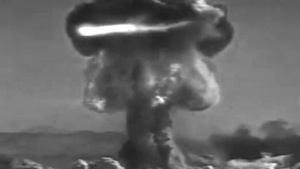
“I started with an early atomic bomb explosion,” said Stone. “It was a 30-second film and I made it into an almost 20-minute video. I really slowed it down and altered the time to give the impression that the person in the exhibition space is looking at a still image caught in time. I show this video together with texts that I found speak to the history of the use of radio-controlled airplanes and UAVs, and to longheld ideas about collateral damage – the relationship between … the use of atomic bombs and the use of drones and collateral damage, which, to me, is a huge issue with the use of drones as military.”

photo - A single frame from Reva Stone’s Atomic Bomb video piece
A single frame from Reva Stone’s Atomic Bomb video piece. (photo from Reva Stone)

The first text is from Harry Truman, the American president who made the decision in the Second World War to use the bomb, and it reads: “The world will note that the first atomic bomb was dropped on Hiroshima, a military base. That was because we wished, in this first attack, to avoid, insofar as possible, the killing of civilians.”

The next one is from John Brennan, Central Intelligence Agency director from 2013 to 2017: “There hasn’t been a single collateral death because of the exceptional proficiency, precision of the capabilities we’ve been able to develop.”

According to Stone, “This is just bullshit. But this is part of the cleaning up of the media presentation of all these ideas and all these things I’ve been researching, that I’ve been noticing going on over time. And, it has actually made me change the name of the work. I was going to call all three of them a totally different name. Recently, maybe a month ago, I changed it to erasure because of the erasure of people, the erasure of a lot of critical dialogue that’s been happening since I started researching in 2015 … how we are mediated, what we are presented with as a culture. The info is so mediated by how it’s reported, and if it’s reported.”

Stone wants “her audience to consider how the capabilities of such technology may be turned against citizens and how governments might, and do, get away with employing them in the name of patriotism in ways that ultimately test the ethical and moral values of its citizenry,” notes the exhibit description. “With news cycles moving so rapidly, the reports of deadly events quickly fall from memory, seemingly erased from public consciousness.”

The third piece, Erase, is interactive. Stone said it is based on what, in her view, the Obama administration practised – the targeting of individuals based on algorithms, mostly guilt by association.

“With this one, I’m actually replicating the procedure,” she said. “I have my two quadcopters that are doing the surveillance and capturing people in the exhibition space, unbeknownst to them. Then, they get captured and saved.

“Then, it’s a process that goes on, that they get played back. And you begin to realize that you’re under surveillance, the people in the space. And, every so often, a target comes up over one of them, one of the captured images. It’s really intense and an explosion occurs, and that person actually comes out of my captured list. That person will never show again. They’ve been erased.”

The exhibit erasure opened Feb. 7. For more information about Stone and her work, visit revastone.ca.

Rebeca Kuropatwa is a Winnipeg freelance writer.
Format ImagePosted on March 15, 2019March 14, 2019Author Rebeca KuropatwaCategories Visual ArtsTags art, atomic bomb, cultural commentary, democracy, drones, military, privacy, Reva Stone, technology, war

Posts pagination

Previous page Page 1 … Page 5 Page 6 Page 7 … Page 31 Next page
Proudly powered by WordPress