
Skip to content
  • Home
  • Subscribe / donate
  • Events calendar
  • News
    • Local
    • National
    • Israel
    • World
    • עניין בחדשות
      A roundup of news in Canada and further afield, in Hebrew.
  • Opinion
    • From the JI
    • Op-Ed
  • Arts & Culture
    • Performing Arts
    • Music
    • Books
    • Visual Arts
    • TV & Film
  • Life
    • Celebrating the Holidays
    • Travel
    • The Daily Snooze
      Cartoons by Jacob Samuel
    • Mystery Photo
      Help the JI and JMABC fill in the gaps in our archives.
  • Community Links
    • Organizations, Etc.
    • Other News Sources & Blogs
    • Business Directory
  • FAQ
  • JI Chai Celebration
  • JI@88! video

Recent Posts

  • BGU fosters startup culture
  • Photography and glass
  • Is it the end of an era?
  • Taking life a step at a time
  • Nakba exhibit biased
  • Film festival starts next week
  • Musical with heart and soul
  • Rabbi marks 13 years
  • Keeper of VTT’s history
  • Gala fêtes Infeld’s 20th
  • Building JWest together
  • Challah Mom comes to Vancouver
  • What to do about media bias
  • Education offers hope
  • Remembrance – a moral act
  • What makes us human
  • המלחמות של נתניהו וטראמפ
  • Zionism wins big in Vegas
  • Different but connected
  • Survival not passive
  • Musical celebration of Israel
  • Shoppe celebrates 25 years
  • Human “book” event
  • Reclaiming Jewish stories
  • Bema presents Perseverance
  • CSS honours Bellas z”l
  • Sheba Promise here May 7
  • Reflections from Be’eri
  • New law a desecration
  • Resilient joy in tough times
  • Rescue dog brings joy
  • Art chosen for new museum
  • Reminder of hope, resilience
  • The national food of Israel?
  • Story of Israel’s north
  • Sheltering in train stations

Archives

Follow @JewishIndie
image - The CJN - Visit Us Banner - 300x600 - 101625

Byline: Rebeca Kuropatwa

Winnipeg gives ambulance to Israel

Winnipeg gives ambulance to Israel

Dror Fuchs in Israel with the ambulance donated  by Winnipeg. (photo by Ariel Karabelnicoff)

In May 2013, the first Winnipeg-donated ambulance took to the streets of Israel. The vehicle was largely donated by allocations from Jewish Foundation of Manitoba fundholders responding to an ambulance fundraising drive, with additional money from members of the general community topping off donations. Another campaign for a second Winnipeg-donated ambulance is already on its way.

The Canadian Magen David Adom (CMDA) Winnipeg chapter ambulance-drive telethon was held on Nov. 24, 2013, with lead CMDA Winnipegger organizers Yolanda Papini Pollack and Sheldon Zamik, assisted by members of the CMDA Winnipeg chapter.

Growing up in Israel, Papini Pollack said she had to learn early on that it is never too early to prepare for a crisis.

“It’s rewarding to have a small role in saving the life of someone in need,” she told the Independent. “It scares me to think someone won’t get the medical treatment s/he needs due to a lack of operational ambulances.

“Magen David Adom has always been instrumental in helping save lives of Israeli residents, regardless of their ethnicity or religion. It’s an organization that unites all sectors of Israeli society.”

A filmmaker and educator, Papini Pollack created a short video clip to help convey the message of the fundraising drive and also spearheads the annual telethon.

“It was a great feeling to accomplish our goal last year, but there was also a feeling of fulfilling a duty,” she said. “This is something I had to be involved in, as I have a responsibility to the people of Israel. This is the least I can do.”

CMDA’s Winnipeg chapter wants to send more ambulances to Israel.

“It will be amazing if even one person in Israel would be able to say, ‘My life was saved thanks to an ambulance sent by people of Winnipeg.’”

“Wouldn’t it be great if Winnipeg could send an ambulance to Israel every year?” she asked. “It will be amazing if even one person in Israel would be able to say, ‘My life was saved thanks to an ambulance sent by people of Winnipeg.’

“Last year’s donors were so happy to see that 100 percent of their money was used to buy the ambulance. They were also thrilled to see a concrete photo of what their donation was able to achieve – the actual ambulance serving the people of Israel and being appreciated.”

Papini Pollack has received many messages from people in Winnipeg, expressing their thanks, as well as from people in Israel very appreciative of this lifesaving gift.

“Hearing that all the volunteers want to ride in the new Winnipeg ambulance was one of the most heart-warming things I heard all year,” she said.

The Winnipeg chapter of CMDA will continue raising awareness about the importance of MDA, while raising funds to send the second Winnipeg-sponsored ambulance to Israel.

“Our goals are very attainable,” said Papini Pollack. “We already raised a large portion of the needed money needed, with hope our community will succeed again this year.

“People wanting to get involved are welcomed to join our committee or help in other ways. We always need more volunteers and donations of any amount.”

Ariel Karabelnicoff, executive director of Canadian Associates of Ben-Gurion University of the Negev, Manitoba Region, first heard about the ambulance fundraising drive last September, having crossed paths with Papini Pollack at the Prophecy Conference, an event to which they were both invited to have a booth.

“When I heard the first ambulance was on its way, it felt amazing,” said Karabelnicoff. “I was proud of my colleagues and the people of Winnipeg. And, as I shared with other people news that the ambulance was on its way, they too were proud and impressed.”

Karabelnicoff’s current connection to MDA is through his friend’s son, Dror Fuchs, a 16-year-old who volunteers with MDA (during his free time, on weekends) in Israel.

“I heard from John Plantz, a Christian Zionist who is one of the main organizers of the Prophecy Conference in Winnipeg and who is part of the fundraising campaign for the ambulance, that he is very excited that Winnipeggers successfully sent an ambulance,” said Karabelnicoff.

“Recently, Dror sent me a photo of a brand new ambulance he was volunteering on and he mentioned it came from Winnipeg. You could probably imagine how I felt inside.”

To donate to the Winnipeg chapter ambulance drive or the Vancouver chapter ambulance drive, send a cheque to CMDA head office in Montreal (at CMDA, Suite 3155, 6900 Decarie Blvd., Montreal, QC, H3X 2TB), with mention of where you would like the money to go to, call 1-800-731-2848, or visit cmdai.org. CMDA is a registered charity and all donations will be acknowledged with a tax receipt.

Rebeca Kuropatwa is a Winnipeg freelance writer.
Format ImagePosted on May 2, 2014May 2, 2014Author Rebeca KuropatwaCategories IsraelTags Ariel Karabelnicoff, Canadian Associates of Ben-Gurion University of the Negev, CMDA, Dror Fuchs, Jewish Foundation of Manitoba, Magen David Adom, Sheldon Zamik, Yolanda Papini Pollack
Jewish sea turtle swims again

Jewish sea turtle swims again

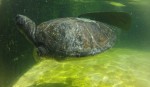
Hofesh can swim now, thanks to a flipper made of polypropylene that is durable but flexible. (photo by Baz Ratner from Yanic Levy)

When a young green sea turtle with both his left limbs nearly severed washed up on Israel’s Mediterranean shore four years ago, the first thing on the rescuers’ minds was how they could save his life. The rescuers amputated both of the turtle’s limbs, which left him unable to swim or even keep his head above water – he was able only to stay on dry land or navigate in shallow ponds. Things changed when Shlomi Gez, a student from Hadassah Academic College in Jerusalem, happened upon the turtle rescue centre’s website.

Gez had been looking for a final project to complete his studies. “As soon as I saw the place, I was inspired, and I knew I could help solve their most acute problem, which was Hofesh,” he said.

The biggest hurdle for Hofesh – that’s the name given to the rescued sea turtle – was the loss of balance. Losing both limbs on the same side interfered with the stability needed for swimming. “A flipper enables fish to retain their balance, so I decided to adapt the idea to a sea turtle,” Gez told the Independent.

Gez’s designed a specialty flipper made of polypropylene that is durable but flexible. He attached it to Hofesh’s back with a harness – and it worked. As Gez fine-tuned the prototype, the permanent flipper was recently glued to Hofesh’s shell with a special glue designed to grow with the shell as the turtle grows.

“At first, we could only put him in a shallow-water pool because he would have drowned but, now that he has his artificial flipper, he swims completely normally,” said Yaniv Levy, director of the rescue centre.

The centre has rescued more than 500 sea turtles – green turtles, a highly endangered species, and loggerheads – since it was founded 15 years ago, and successfully returned about 70 percent of them to the sea.

Unfortunately, Hofesh cannot be set free – if his flipper ever came loose, he would drown. But as a member of a globally endangered species, Hofesh has been selected for a breeding program. “We hope his offspring will be returned to the sea,” said Levy.

Although Hofesh’s disability is visible, this does not bother his new mate, a blind green sea turtle, named Tsurit. They swim together in their shared tank at the centre. “He nibbles her neck and likes to frolic with her,” said Levy, noting green sea turtles have about the same average life span as humans, but reach sexual maturity only around the age of 30.

In 1930, the green turtle population was at around 30,000. At the time, they were called, “the Edible Sea Turtle,” hunted nearly to extinction. Today, there are fewer than 30 wild green turtles in the area.

In 1930, the green turtle population was at around 30,000. At the time, they were called, “the Edible Sea Turtle,” hunted nearly to extinction. Today, there are fewer than 30 wild green turtles in the area.

The centre runs a breeding program, which currently includes 26 green sea turtles. Its hospital treats the green turtles and the more common, but also endangered, loggerhead species, with some 15 patients in care. Like Tsurit and Hofesh, most have been injured by boats and fishing nets.

“It’s unfortunate that Hofesh will never be free,” said Levy, “but he has a good life here.”

The hope, of course, is that Tsurit and Hofesh’s union will increase the population of rare green sea turtles in the Mediterranean.

Sea turtles lay 300-500 eggs per breeding season. During a female’s lifetime, she can lay around 6,000 eggs.

The survival rate of young sea turtles is estimated as only one in every 100 hatchlings reaching sexual maturity. In the Mediterranean alone, about 1,000 turtles are injured annually.

The Israeli Sea Turtle Rescue Centre is part of the world network focused on treating injured turtles. Its aim is to create a better future for the turtles’ near-extinct populations, to raise public awareness for better life, to achieve a society that better cares for its oceans and seas and to help reestablish an environmental balance. The new dedicated rescue centre inside the existing Alexander River National Park, where the river forms an estuary flowing into the Mediterranean, will be isolated from noise and populated areas.

Another Israeli turtle story involves a groundbreaking medical device used to treat terror victims helping save the life of a Caspian turtle at the Israeli Wildlife Hospital, Ramat Gan Safari. This turtle posed a challenge for veterinarians, as its shell had too big a crack to fix the standard way (with bolts and wire). The veterinarians turned to the head of the plastic surgery unit at Hillel Yaffe Hospital in Hadera, Dr. Morris Topaz, an Israeli doctor who treats terror victims.

Topaz originally created the device to help people who lost areas of skin too far separated to sew together yet too close together to do a skin implant. It brings the two edges of existing skin closer to each other, eliminating the need for skin implants. With the special device, they glued the unique plastic device on both sides of the turtle’s fracture and connected them with a special plastic string that looks a lot like a zip tie.

Seeing his device in action on a turtle, Topaz decided to donate the idea and device to the Israeli Wildlife Hospital for future cases.

More than 2,200 injured wild animals are brought to the Israeli Wildlife Hospital annually. About 60 percent of the animals are treated, rehabilitated and returned to the wild.

Rebeca Kuropatwa is a Winnipeg freelance writer.

Format VideoPosted on May 2, 2014July 9, 2014Author Rebeca KuropatwaCategories IsraelTags Alexander River National Park, Israeli Wildlife Hospital, Morris Topaz, Ramat Gan Safari, Yaniv Levy

Posts pagination

Previous page Page 1 … Page 30 Page 31
Proudly powered by WordPress