Skip to content
  • Home
  • Subscribe / donate
  • Events calendar
  • Business Directory
  • FAQ
  • News
    • Local
    • National
    • Israel
    • World
    • עניין בחדשות
      A roundup of news in Canada and further afield, in Hebrew.
  • Opinion
    • From the JI
    • Op-Ed
  • Arts & Culture
    • Performing Arts
    • Music
    • Books
    • Visual Arts
    • TV & Film
  • Life
    • Celebrating the Holidays
    • Travel
    • The Daily Snooze
      Cartoons by Jacob Samuel
    • Mystery Photo
      Help the JI and JMABC fill in the gaps in our archives.
  • Community Links
    • Organizations, Etc.
    • Other News Sources & Blogs
  • JI Chai Celebration
  • JI@88! video

Recent Posts

  • SFU honours Gloria Gutman
  • Lifting people’s spirits
  • Wedding a ray of light
  • Indigeneity and Zionism
  • Rule of law broken: councilor
  • Football and its roles
  • The burden of defence
  • Fish Café returns after fire
  • All right in what goes wrong
  • Nuns & mermaids at TUTS
  • Camp offers holiday retreat
  • Students and mentors inspire
  • Once-in-a-lifetime trip
  • 100 dancers, one heart
  • Money for the sciences
  • What “Jewish food” means
  • Have a cookie, schnitzel too
  • Federation now across BC
  • Israel fighting for its existence
  • Deal strengthens Iran
  • Patriotic belonging diminishes
  • A campaign to engage
  • Upstanders’ first live event
  • Responding to Carney
  • Having your own home
  • Music a family tradition
  • Musical to warm heart
  • Community milestones … June 2026
  • Sharing her passion for Israel
  • Or Shalom reopens its doors
  • JFS from past to future
  • Need holistic approach
  • Sharing stories, advice
  • Journalist shares fears
  • Skills to live together
  • Road to independence

Archives

Follow @JewishIndie
image - CJN box ad Rockowers 2026

Byline: Rebeca Kuropatwa

Winnipeg’s CMDA donates second ambulance

Winnipeg’s CMDA donates second ambulance

The ambulance being sent to Israel by the Winnipeg CMDA is the same type as the one pictured here. (photo from CMDA)

With the recent violence and tensions in Israel, Magen David Adom (MDA) is, once again, being pushed to its limits – working in a state of high alert and keeping most of its equipment in service 24 hours a day. And though tensions are high in Jewish communities outside of Israel, as well, the recent Operation Protective Edge seems to be bringing out the best in people, including additional financial support for Israel.

One such Canadian example is in Winnipeg, where people are pouring their energy into helping to send ambulances and medical equipment to Israel via Canadian Magen David Adom (CMDA). Winnipeg’s local CMDA chapter sent an ambulance to Kiryat Shmona last year. Now, it is sending its second ambulance to Israel, which will be stationed in the south.

While most of the support has come from the local Jewish community, there is growing support from Manitoba’s Christian community, who are eager to show their support for the Jewish state.

One of the leading figures in that group is Pastor John Plantz, who has been leading tours to Israel every year via his Beauty Field Tours to Israel. Plantz said he was looking for a tangible way to help Israel aside from visiting the country with his tours. He was first introduced to CMDA through materials he came across at a local Jewish community centre and, later, around 2009, through a meeting with CMDA Winnipeg member Ami Bakerman. Plantz invited Bakerman to set up a CMDA table at a local Bible conference he organizes each year.

Looking for even more ways to support Israel, Plantz recently purchased a grove of 1,000 trees, along with Beauty Field Tours group-mates John and Janice Thiessen, through the Jewish National Fund. The grove will be planted in the Yatir Forest.

“My joining the Winnipeg CMDA chapter came through an invitation from Ami [Bakerman],” said Plantz. “I was very excited about the opportunity to help this organization get ambulances for the state of Israel and to be able to help get practical resources to people in a time of need in a country that I’ve truly come to love.”

Some 25 years ago, Plantz discovered that his grandfather was Jewish. Since then, he said, “I decided to support, in practical ways, the Jewish community here, in Winnipeg, and also the state of Israel.”

Plantz sees it as “a privilege” to introduce many more Christians to CMDA at the many events he attends by handing out CMDA tzedakah boxes and other CMDA materials. Also, Plantz said, “By informing people of the need[s] in the state of Israel, it gives them the opportunity to give and help.

“I was so pleased to hear when CMDA had sent their first ambulance to Israel just over a year ago, as I was a part of that through our Bible conference, along with many others from that event.

“And now to think that another ambulance will be sent this month brings great joy to my heart and it should be celebrated by all who’ve had a part. I’d like to give the glory to the God of Abraham, Isaac and Jacob for putting it into the hearts of many to respond.”

He added, “I believe that the time to help is now, for the need is great in Israel and lives are at stake. Let’s get involved today.”
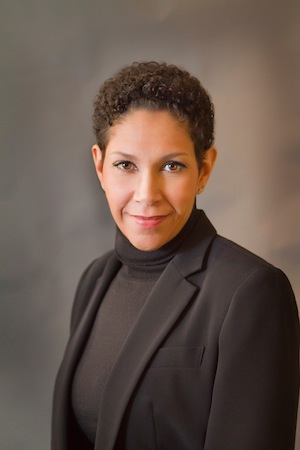
photo - Laurelle Harris
Laurelle Harris (photo from Laurelle Harris)

Another local CMDA chapter member is Laurelle Harris, a lawyer and a director of Levene Tadman Golub Law Corp.

“I’m thrilled to have been able to play a very small role in the chapter having been able to send two ambulances so far,” said Harris. “To be able to contribute to the safety and well-being of people in Israel is amazing.”

Harris joined the Winnipeg chapter of CMDA about two years ago. “The ability for MDA to provide emergency services is essential to the well-being of all those living in or visiting Israel,” she said.

“At the time, I didn’t know how long it would take to be in a position to send one ambulance. Actually sending two makes me believe that we’re on a roll and can achieve our goals in the future.

“To be able to send a second ambulance – an intensive care unit (MICA), no less – during the current conflict with Hamas makes me feel that Winnipeggers have done something tangible to make a difference right now,” she added. “Winnipeggers have, quite literally, helped MDA save lives in real time.”

According to Harris, the Winnipeg chapter’s ability to send more ambulances depends on the continued financial support of the general community in Winnipeg and throughout the province, as well as adding more volunteers with diverse skill sets and backgrounds.

“During this particularly difficult time for Israel, as she remains under attack, there are a number of ways that people can help,” said Harris. “But, most importantly, is to give to any cause that will have a direct impact on service provisions. CMDA is one such organization that will not just be of benefit in the immediate, but will also have a lasting impact in times to come. When this crisis is over, gifts given now will continue to have a lasting impact for years into the future.”

For more information or to donate to the Winnipeg chapter ambulance drive, email Winnipeg chapter treasurer Bakerman, [email protected]. You can also donate online at cmdai.org or by calling 1-800-731-2848. CMDA is a registered charity and all donations receive a tax receipt.

Rebeca Kuropatwa is a Winnipeg freelance writer.
Format ImagePosted on August 22, 2014August 21, 2014Author Rebeca KuropatwaCategories NationalTags Beauty Field Tours, Canadian Magen David Adom, CMDA, Israel, John Plantz
Herzliya Science Centre students launch satellite

Herzliya Science Centre students launch satellite

A group of Herzliya Science Centre students working on Duchifat 1 in the clean room with Dr. Ana Heller. (photo from Herzliya Science Centre)

In Israel, high school students helped launch a satellite into space – something typically reserved for university students.

“The Herzliya Science Centre (HSC) is the science campus for Herzliya’s middle and high schools,” explained Dr. Meir Ariel, the director general of the centre, which opened in 2007.

Some 1,500 students attend HSC advanced labs, studying and experimenting in physics, chemistry, electronics, biotechnology, computer science and robotics. “The jewel of the crown is our space and satellite lab, the only lab in Israel where high school students can design and build satellites and send them into space,” said Ariel.

This lab is attended by 40-50 of the brightest, most dedicated students from various schools in Herzliya and beyond.

“Duchifat 1, the first Israeli nano-satellite, weighing less than one kilogram, required multidisciplinary knowledge – from electronics to software, communications, thermodynamics and astrophysics – to construct,” he said.

Students wanting to participate began in Grade 9, with a two-year training period that provided the basic scientific knowledge needed to become candidates for membership in the space and satellite lab.

“Teenagers aren’t intimidated by technology and have little fear of failure,” said Ariel. “The success of the team relies on the ability of its members to be creative, innovative, disciplined and, most importantly, highly motivated.”

Collaboration with the Israel Aerospace Industry was crucial for the project’s success. Each team was led by an experienced engineer. Students not only learned from their mentors, but they were also exposed to state-of-the-art technology, tools and developmental procedures.

“Duchifat 1 served as a pedagogical platform, allowing high school kids from all over Israel to communicate, send commands, receive telemetry and experiment with a real satellite,” said Ariel. “Its other mission was search and rescue from space via its APRS transponder.”

photo - Dr. Meir Ariel, HSC director, at the pre-launch briefing
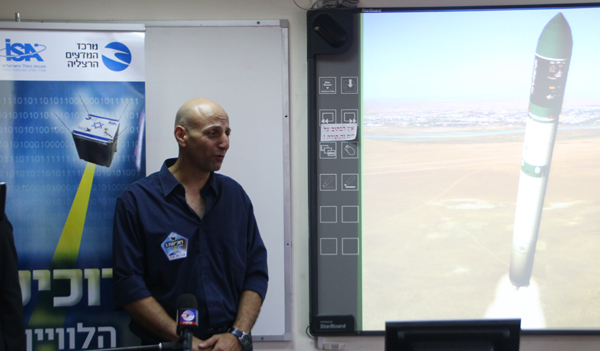
Dr. Meir Ariel, HSC director, at the pre-launch briefing. (photo from Herzliya Science Centre)

Duchifat 1 was successfully launched into space aboard the Dnepr launcher a couple of months ago, on June 19.

“To reduce costs, Duchifat 1 was actually a ‘hitchhiker’ aboard a rocket that carried bigger satellites into the same orbit,” said Ariel. “Since then, Duchifat 1 has been orbiting around earth and is being tracked from the ground station at HSC by the same high school students who built it.”

Shenhav Lazarovich, 19, was one of the students who helped build Duchifat 1. She heard about the opportunity during an open day at Handasaim Herzliya High School, when learning about HSC.

“The first meeting with Dr. Anna Heller was something I won’t forget,” said Lazarovich. “She entered the room and said she’s leading a project with a goal to build a Pico satellite that will be totally designed and programmed by high school students. In that moment, I decided I want to be one of the team.”

Lazarovich had two major responsibilities in building Duchifat 1 – buying and upgrading the lab equipment (including satellite parts) and serving as the programming team’s EPS (electronic power system) programmer.

The other student on Lazarovich’s team was Ori Opher, who was responsible for finding solutions to various battery-related problems, like low battery discharge time and battery thermal issues.

“The battery is the heart of the satellite and needs to work at its best to fulfil the main goal of the satellite – saving lives (as an SOS signal transmitter),” said Lazarovich.

The satellite was launched by Dnepr 1, a Russian missile converted for space launching use. At this launch, it had 37 satellites from countries around the world.

photo - The mission patch of Duchifat 1
The mission patch of Duchifat 1. (photo from Herzliya Science Centre)

“It was an amazing experience,” said Lazarovich. “We gathered around with 37 teams all over the world and watched how our ‘baby’ made its way to fulfil its destiny. Anna [Dr. Heller] has been working on this project for more than 10 years and I was there for the last four.

“When we got signals from space, all of us started crying and laughing. We’re one of the first teams to receive satellites signals from space, not to mention the youngest team in the launching program. The excitement, the energy, is something I can’t describe with words.”

Yarden Carmel, 17, decided to take part in the Duchifat 1 project about three years ago, after switching to a different high school, where one of the mandatory classes was Satellites and Space.

“We were having our guided tour and, in one of the stops, they had Dr. Anna Heller, the project lead, talking about the project,” said Carmel. “She said something I’ll always remember, that she ‘isn’t looking for mathematicians or science geniuses, but for students with fire in their eyes.’”

Carmel and his team worked on the memory management of the satellite. “Duchifat 1 got some kilobytes flash memory, like those used in the portable flash drives, but with much less memory capacity,” he said. “Our mission was to find an algorithm that would hold the information the satellites generate (like life status) and receive (like stress signals from earth) for the longest time without being overwritten by new information.

“It had to be enough time for it to be able to fly above our ground station in Israel, so we could download all the data. It might sound easy, but remember we’re dealing with much less memory capacity than in a normal PC or a Mac. We have less than one megabyte to work with and it took us a few times to get the best algorithm.”

Carmel, who also will help build Duchifat 2, still recalls being rendered speechless when seeing the live footage of the missile going up. “It even rocked the HQ building we were in,” he said. “We were all either crying with happiness, staying stressed and silent, or just repeating, ‘Here’s Duchifat!’ and ‘We made history!’”

Duchifat 2 is one of a network of 50 miniature satellites built by university teams all over the world. “The satellites will be launched in 2016, with a mission to perform atmospheric research within the lower atmosphere (between 200 and 380 kilometres altitude), which is the least explored layer of the atmosphere,” said Ariel. “Duchifat 2 is the only satellite in this network built by high school students. All [the] other 49 satellites were built by universities.”

“During these difficult times in Israel,” said Lazarovich. “I’ve wanted to say that the key for a better future is science and education. Combining these on both sides will result only in good to the whole region and the entire world. Science is an endless source for development and making the world a better place.

“When adults are asked to do a big task, they always think about why it’s not possible to do [so].… When children [are] asked to do a big task, they just do it. They don’t see the limits that adults do. And, even if they do, they are not afraid to just try it anyway.”

The launch video, and other Duchifat 1 videos, can be seen on YouTube.

Rebeca Kuropatwa is a Winnipeg freelance writer.
Format ImagePosted on August 22, 2014August 21, 2014Author Rebeca KuropatwaCategories IsraelTags Anna Heller, Duchifat 1, Duchifat 2, Herzliya Science Centre, Meir Ariel
Healing effects of medical clowns

Healing effects of medical clowns

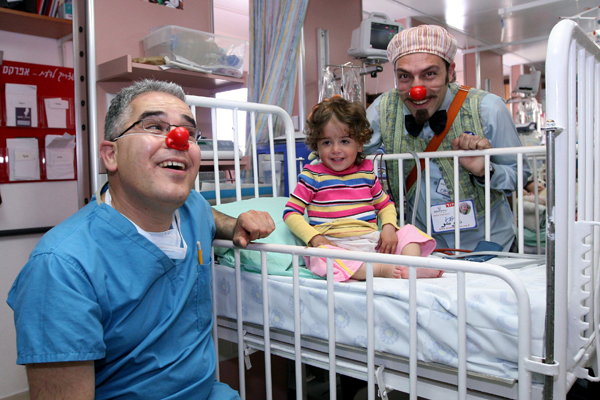
Talia Safra and Nimrod Eisenberd of Hadassah Mt. Scopus Hospital in Jerusalem interact with a patient. (photo from Dream Doctors Project)

While clowns have brought smiles to the faces of many children, both healthy and sick, the latter clowning generally has been done on a volunteer basis and without the presence of a medical team. Recently, however, Israel became the first place in the world to recognize the medical benefits associated with positive attitude and laughter. Most Israeli hospitals now offer clown therapy and, due to its growing acceptance and success, the University of Haifa will be the first to offer a clown degree.

This all started with Jacob Shriqui, an Israeli shaliach to Geneva who went on to work in Israel’s health-care industry. Once he retired, Shriqui returned to visit some friends in Geneva and was invited to a meeting in a hospital in Lausanne. When he entered the hospital, he got lost and, in his wandering, he happened to walk by the pediatric department. To his surprise, he saw a giggling child out of the corner of his eye. Upon further investigation, he noticed the clown who was making the child smile.

“The idea came to him that if there is a thing like that, it should also be in Israel, because, until then, there was no medical clowning in Israel,” said Daniel Shriqui, Jacob’s son and past director of the Dream Doctor Project.

When he returned to Israel, Jacob Shriqui used his connections from the time he was stationed in Geneva to create the Magi Foundation, with its main function being the Dream Doctors Project in Israel. Built with the help of philanthropic members of the Jewish community in Geneva, in September 2001, the project started off with three clowns. After a year of experiments and positive feedback, he went from hospital to hospital proposing the concept.

“This is how we grew from three clowns to 127 today, in nearly every hospital in Israel,” said his son. “The main thing was, when my father came to the hospital, he said, ‘Look, we have a tool. It’s called a medical clown. We’re going to give him all the best training we can, and you’re going to try this tool like any other medical device. We don’t know exactly what it does or whether or not it will be effective. If it’s not, you can end the project whenever you want. If it is, you have to take on the responsibility of operating it.’”

From the start, the medical clowns in the hospitals were part of the medical team, a situation desired both by the hospitals and by the clowns.

“We work as part of the medical team because we believe that medical clowning is a medical profession, just like any other, and that it can be very successful,” said Daniel Shriqui. “But first, we had to convince the doctors and nurses of the benefits of having a clown when you take blood from the veins of a child. The child doesn’t cry because the clown is acting and playing with him.

photo - David Shilman (Dream Doctors) playing with his patient, and the nurse at Rambam Medical Centre, Haifa
David Shilman (Dream Doctors) playing with his patient, and the nurse at Rambam Medical Centre, Haifa. (photo from Dream Doctors Project)

“Another example is when a child is taken for a repair surgery after being sexually abused. Typically, the first test after that is done by the doctor, and by the clown paralleling, and everything is recorded.

“We see it really facilitating the work, and being able to work more smoothly with the children, [and] with the parents, too.”

Another part of the hospital-clown agreement is that the hospital gets the clowns’ services for one year for free with no obligation and no contract. If after one year, the hospital is happy with the results and wants to continue with the project, the hospital needs to start participating in the payment for the clown services.

“We knew we were here to stay when, last year, the head of the Ministry of Health in Israel called and said, ‘I need your clowns immediately,’” explained Shriqui. “‘We’re going to vaccinate all the children in Israel under nine years old for polio. We’re going to open almost 1,000 vaccination stations and I need all your staff, more than 100 clowns, to be present in the station to help us to do this.’” For the first three months, most of the clowns went from station to station and helped the nurses vaccinate the children.

“I suggested to one of the biggest hospitals in Israel, two years ago, that they use a clown in the oncology department for adults,” said Shriqui. “A few months ago, there was a budget problem and the hospital told the department we have to stop the clown service. A week later, the hospital manager received a letter signed by 70 patients, doctors and nurses, protesting against no longer having the clowns come to the unit twice a week. They explained why it is so very important, that the clowns transform the unit from a sad [one] to more positive.”

The increasing demand for hospital clowns is coming from within the medical field. The project works to fill the requests for services, but sometimes hospital budgets do get in the way.

“Especially in the oncology department, the children often are in the hospital for a really long time,” said Shriqui. “Unfortunately, many times it ends by the death of the child. But, during these months, sometimes years, there is a special relationship formed between the clown and the child, because our clowns work at the same place for years.

“In Israel, it’s a bit different…. The clown gives their own private cellphone numbers to the parents. I remember one case where the parents called a clown when he was off duty, at home, and said, ‘Listen, tomorrow we have to go to chemo and we’d like you to come assist, because the child asked that you to be there.’”

The project held a conference in October 2011, where clowns from around the world came to Israel.

“We help many clowns that come from all over the world and work with us to learn how to do this work better with medical teams, and then to be really involved in the processes and the medical treatments,” said Shriqui. “My philosophy is that a clown has to work freely. To get the best from the clown, you have to free him to be part of the team – and we have proof that if you free the clown, even to be in the operating room, you get unbelievable results.”

Rebeca Kuropatwa is a Winnipeg freelance writer.

 

Format ImagePosted on July 11, 2014July 9, 2014Author Rebeca KuropatwaCategories IsraelTags Daniel Shriqui, Dream Doctors, Jacob Shriqui, medical clowns
Winnipeg’s garment industry still going strong

Winnipeg’s garment industry still going strong

Marissa Freed (photo by Rebeca Kuropatwa)

The garment industry has played a vital role in the development of the Jewish community, the city of Winnipeg, and even the province of Manitoba over several generations.

On May 8 at Rady Jewish Community Centre’s Berney Theatre, the Jewish Heritage Centre of Western Canada hosted a panel discussion on Winnipeg’s Garment Industry – Past, Present and Future. CBC Radio’s Terry McCloud was the moderator, panelists were Bill Brownstone, Marissa Freed, Howard Raber, David Rich, Bob Silver and Gary Steiman. From the discussion, it seems as though most of the panelists did not plan to get into the industry, but stumbled into it by chance.

Brownstone, for example, took over for his father after his father had a heart attack. “I was home for the summer, in June, and was to make one trip to his territory…. So, I made the one trip and, 55 years later, I made the last trip,” said Brownstone. “That was how I got into it.”

Freed also grew up in the business. “It was around all the time, certainly because of my father and, more so, because of my grandfather and my great-grandfather,” she said. “I’ve always loved fashion, so that was the exciting part, but certainly not the business part.”

Freed’s great-grandfather started a sewing and pad factory, which was, over the years, transformed into more of an outerwear and ladies wear company, also offering tailored items, like uniforms.

“Something we’ve been doing for a long time is government uniforms,” said Freed, listing some of their clients, such as the RCMP and Parks Canada. “For the Canadian Olympic teams, we made the opening ceremony jacket for the athletes. And in the HBC stores, we did all the replicas.”

Raber’s grandfather started in gloves in 1924. “My zaida started being a glove cutter,” he said. “In 1934, the partner came to the realization that no one was manufacturing dress gloves in Western Canada. So, they started a company, called Perfect Fit Glove [and he was involved there from] around 1934-1941, manufacturing the majority of the dress gloves for people like the Eaton’s bale order, which at that time hosted 90 percent of the retail shares in Canada.”

In 1941, when Raber’s grandfather’s partner’s son and Raber’s father finished school, his zaida suggested they buy him out, which spawned the company Raber Glove that same year.

“Now, we make all domestic leather gloves and mitts for many uses, for many customers: the RCMP, the military, police departments across Canada,” said Raber. “We also supply a lot of independent stores from coast to coast that stick to [us because of] the quality we make, and we’ve existed that way … 99.99 percent of all gloves coming into North America come from offshore.”

Rich’s father started his business, with four operators and himself, in 1939. It was called Winnipeg Pants and Sportswear, with one of the main buyers at the time and for many years following being Eaton’s.

“Today, we have a factory in Winnipeg,” said Rich. “We still manufacture high-quality work outerwear. We also deal in Asia, Bangladesh, China and Cambodia. People ask us how we can make a living dealing with people [worldwide] like that. I tell them I come from the North End [of Winnipeg] … [so] if I can’t deal with these guys, nobody can.”

Silver recalled his closest neighbor driving up at eight o’clock in the morning, informing him that his dad had died. “I made my way back to Winnipeg and a lot of people were pointing fingers and wondering who would take care of the business,” said Silver. “I said, ‘Not me. I’m going back to B.C.,’ but my great-uncle, who was around at the time, asked me to come in and help him sell the business. That was 37, 38 years ago and I have yet to be able to sell it.”

Silver discovered that no one was willing to buy unless he was willing to stay and manage the company, spurring him to do just that. “So, I bought it with some partners and then the drive for success kept me going,” he said.

Weston Glove Works was established around 1921 by Silver’s grandfather and three great-uncles and, in the beginning, exclusively manufactured gloves.

“In 1921, gloves were one of the most important parts of work wear, because all work was outside with your hands,” said Silver. “Then, they branched off into coveralls, overalls and other types of work wear. Then, they got into casual wear, and then into polyester leisure suits.

“I was interested in developing a brand that could sell a large volume of merchandise for Victoria Beckham, and the jeans were about $300. I thought we could do about 20 to 25 million dollars globally.

“At the same time that I was making garments for Victoria Beckham that sold for $300, I was making jeans for Walmart that sold for $15. People would ask what the difference was between the two, and I’d say $285 – except the ones for Walmart would last longer.”

“At the same time that I was making garments for Victoria Beckham that sold for $300, I was making jeans for Walmart that sold for $15,” he continued. “People would ask what the difference was between the two, and I’d say $285 – except the ones for Walmart would last longer.”

Last but not least, Steiman spoke about how he got into the industry. His grandfather started one of the first garment companies in Winnipeg, making, among other things, buffalo coats for the Winnipeg police force as early as 1900. Steiman came into the business in 1962.

“I remember, as a young boy, I hated to go up to his shop to get a leather jacket, which I had to do every two years, because it stunk, was noisy, was sweaty, and people yelled at each other. It was the last place I could envision myself having a career.”

Rebeca Kuropatwa is a Winnipeg freelance writer.
Format ImagePosted on June 27, 2014June 25, 2014Author Rebeca KuropatwaCategories NationalTags Bill Brownstone, Bob Silver, David Rich, Gary Steiman, Howard Raber, Jewish Heritage Centre of Western Canada, Marissa Freed
Tooshaaya all natural

Tooshaaya all natural

Tom and Tzameret in studio. (photo by Galit Reismann)

An Israeli mother and daughter duo have combined to create designer pieces that use exclusively natural textile, with a focus on nature, and creations that become an extension of the wearer of any shape or size.

Tzameret, 50, and Tom, 28, began their business from home when Tom was at Israel’s Shenkar College of Design, in her second year of studies (2009). Tzameret, an art therapist by profession, was looking to do something different, and building this business with her daughter was the perfect fit.

The pair began the work little by little while Tom was finishing school. After Tom graduated with honors in 2011, with a bachelor of design, she and Tzameret invested all the time, energy and resources they could into their brand. For the past 18 months, they have been working out of a studio in Jaffa.

Tooshaaya is a design studio for eco-textile accessories with the driving concept of “body, home, soul.” For now, they create accessories like scarves, shawls and cardigans, but they plan to soon also design accessories for the home and soul.

“I’ve wanted to have my own business since I was a little girl,” said Tom.

During the summer between her second and third year at Shenkar, Tom said, “I wanted to make my own products, like scarves, and sell them. My mom was at a point when she wanted to take a small break from therapy.

“As always, I shared my prototype with my mom. We started talking about it and the idea to work together came up. I thought it was a great idea.

“Me and my mom are complete opposite in a lot of things. That can make us feel crazy sometimes, but it also makes us perfect business partners and designers. Also, we always know how much we love each other and that we want the best for each other.”

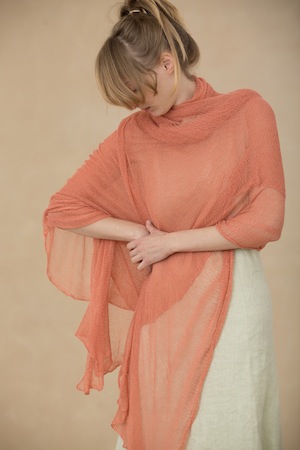
photo - A Tooshaaya bamboo cardigan modeled by Lior Sachar
A Tooshaaya bamboo cardigan modeled by Lior Sachar. (photo by Ami Bornstein)

Tzameret has always loved art, creation and design. Also, she said, “I love Tom, believe in her, and appreciate her talent. Since she was four or five years old, it has been very clear she is gifted in art and has her own unique way of looking at things.

“We decided to join forces and talents, and create an exciting journey together. Although it’s not always simple to be a business partner with your daughter, it’s a huge privilege. I’m very proud.”

When Tom was in college, she “learned the textile industry is the second-most-polluted industry in the world.” She said, “As a textile designer, I see it as my responsibility to design and create ecological textile.” Tooshaaya’s motto is “Touched by nature.”

Tom and Tzameret chose to work only with natural materials, especially with new eco-fibres like bamboo and soy. “These fibres, in addition to the eco part, have special and very important qualities, like UV protection, hypoallergenic, temperature adjustments and [the] creation of amino acids, which is healthy for the skin,” explained Tom. “They’re good for the world and the body. Of course, we also believe in sustainability and love the energy of natural materials around our bodies.”

Tooshaaya designs are inspired by the sights, shapes, textures and colors of nature. “With each of our designs, even when there are few similar items, no one [item] is the same,” said Tom. “Each has its own unique design and process of production, which is mostly handmade.

“We believe that, when we feel comfortable, it’s easier to be connected to nature and express who we are.”

It has proved challenging to find natural materials, however. “Yarns are imported by us,” Tom said. “Also, producing natural materials is slower and more complicated than it is with synthetic or mixed yarns.

“Israel is a small and challenging market, in general, and particularly for niche designers,” she added. “We’re glad to have local [from Israel] and international loyal and return clientele who love our designs, appreciate our work and share our concepts.

“When I look at nature, I see infinite organic beauty composed of stability and softness, a tension between order and disorder, and the changes wrought by time, giving everything its unique character.

“My art and designs are a constant search for this organic esthetic. When I design an item, like a scarf, I create a second skin that looks organic and feels like a natural continuation of the body. The item’s unique character comes from the person who wears it, through movement and over time.”

Each item is made using special knitting techniques, with fine and delicate threads, hand dying, embroidering, weaving and felting. The items can be worn with a variety of clothing types and styles. Most are one-size-fits-all, suitable for sizes 36-44 (EU).

“Our ability to create custom-size orders, including plus sizes, is also somewhat unique,” said Tom. “Our items can fit almost anyone. And our ability to ship worldwide is very exciting. We send packages to all continents of the world, from the U.S. to Turkey, Russia, Thailand, Australia, Hong Kong, Canada and Italy.

“We love our work. What is most satisfying is when customers tell us how much they enjoy wearing our items, and we can see how our ideas are reflected in reality and bring happiness to others.”

For more information on Tooshaaya, visit toosha.com, toosha.com/#!video/c65q, or like them on Facebook, facebook.com/toosha.eco.design.

Rebeca Kuropatwa is a Winnipeg freelance writer.
Format ImagePosted on June 27, 2014June 25, 2014Author Rebeca KuropatwaCategories IsraelTags eco-textiles, Tooshaaya
PJ Library launches Lantern Library for Arab Israeli kids

PJ Library launches Lantern Library for Arab Israeli kids

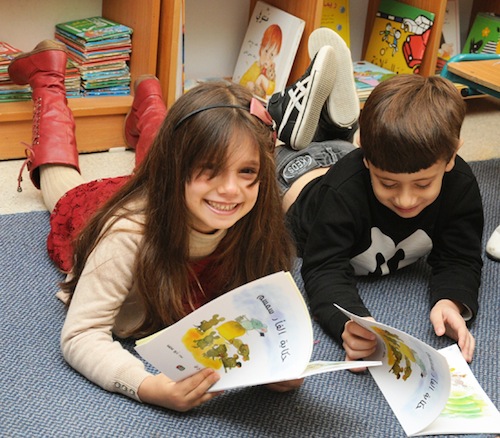
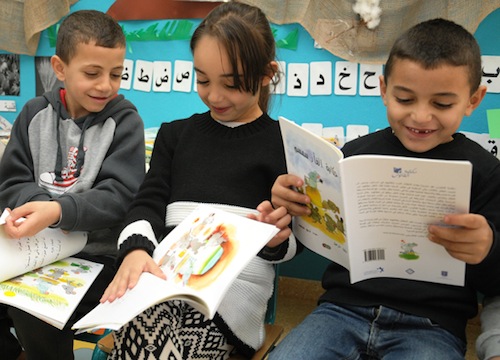
Children in Baka al-Gharbiyah enjoying Maktabat al-Fanoos books and working with their teacher on their storytelling skills. (photo by Akmal  Nagnagy)

PJ (aka “pajama”) Library is taking the PJ concept to Israel’s Arab population, with the creation of the Lantern Library (Maktabat al-Fanoos, in Arabic). Now Arab, Bedouin and Druze kindergartens, special-education Israeli schools and some preschools will start receiving books.

The first book to be distributed is a story about a mouse named Soumsoum, and it has already become quite a sensation in Arab, Bedouin and Druze state-run schools in Israel.

photo - Children enjoying their books about Soumsoum the Mouse as part of the Maktabat al-Fanoos program, which fosters a love of reading
Children enjoying their books about Soumsoum the Mouse as part of the Maktabat al-Fanoos program, which fosters a love of reading. (photo by Akmal Nagnagy)

Galina Vromen, former international correspondent for Reuters who joined the Harold Grinspoon Foundation more than 10 years ago, launched the Israeli version of PJ Library in 2009, called Sifriyat Pijama, for the Jewish Israeli population.

Like its North American parent program, PJ Library, Sifriyat Pijama aims to inspire discussion at home about values and Jewish heritage and to instil a love of books. Unlike the North American program, Sifriyat Pijama books are distributed via government preschools and are then taken home.

“Some 215,000 children and their families receive the books, which is about 80 percent of all children in Hebrew-language state preschools,” said Vromen. “The children receive eight books a year. By the time they finish their three years of preschool, they have a 24-book home library.”

Lantern Library is a sister program to Sifriyat Pijama and, like its counterpart, Lantern Library books are delivered by courier to each classroom, with a copy for each child and two classroom copies.

After the teacher introduces a book and usually also conducts book-related activities (i.e. a discussion, a play, an art project), the book goes home to each student and his/her family.

“The books are culturally appropriate, but still chosen with a view to inviting discussion on values – universal, humanistic values rather than Judaism’s specific take on a value,” said Vromen. “But often, it comes down to much the same concepts, like honoring parents, being hospitable, visiting the sick, caring for one’s community and helping others.”

Lantern Library, like Sifriyat Pijama, is funded and operated in partnership with the Israeli Ministry of Education. But with Lantern Library, “We also work with the California-based Price Family Charitable Fund, which has long been active in funding and operating programs for young children and their parents in the Israeli Arab community through its Bidayat (Beginnings) Early Childhood Centres,” said Vromen.

The foundation and the Price Family Charitable Fund committed to start a pilot project this year, with or without the ministry, offering to provide additional matching funds if the ministry came on board.

“The ministry did find some funding, so instead of our initial plans to start with 5,000 children, we ended up launching a program for close to 50,000 kids,” said Vromen.

photo - reschoolers in Baka al-Gharbiyah receiving their picture book, to enjoy at school and with their families at home
reschoolers in Baka al-Gharbiyah receiving their picture book, to enjoy at school and with their families at home. (photo by Akmal Nagnagy)

The most immediate goal was to get good books out to every classroom and to each child. Other goals were to ensure teachers understand how to effectively integrate the books into the classroom and to understand their role in encouraging parents to read at home.

“Ultimately, we want children to love books, so they’ll be motivated to read,” said Vromen. “We don’t aim to teach children to read. Before children learn to read, they need to want to read through having positive experiences with books and being excited about the stories and the places they take you. We hope to encourage those positive, crucial experiences with books.”

The books have been received with great enthusiasm, added Vromen. “The teachers are extremely positive and send us lots of pictures of the activities they do with the kids. We post some on the program website, which is also exciting for the class.

“The parents are delighted to be getting the free, quality books. Arab parents, like Jewish ones, recognize the importance of education for their kids, and know that starts with books.”

According to Vromen, some Arab families have many books in their home and some have none. “Like elsewhere, people who don’t have a tradition of reading or don’t have the resources to buy books, don’t have as many as those who do,” she said. “Arabs have a long, honored tradition of oral storytelling. In many cases, this takes the place of a tradition of reading. We hope the practice of reading books together in the family will flourish alongside the oral tradition, reinforcing and complementing it.”

Vromen said with a smile, “I’ve yet to meet a child who, when given a choice between going straight to bed or being read a story first, chooses to go to bed without a story. It’s not just the reading. It’s the cuddling together, the looking at the illustrations together, and talking about what the characters feel or what might happen to them next that creates an emotional attachment to books, as well as, of course, enhancing the parent-child relationship.”

The foundation has considered electronic books, but has found that, for now, the time is not yet right. “The online book industry is much less developed in Israel than in America, so it’s still rare for Israelis to read books in Hebrew online,” said Vromen. “The issue is whether or not online books can provide the same emotional experience between parent and child as a paper book. The jury is still out on that, but as an avid electronic book reader myself, I personally don’t see a problem.”

Maktabat al-Fanoos, Sifriyat Pijama and PJ Library, according to Vromen, are all based on the concept known in Judaism as “girsa d’yankuta” (Aramaic for “learning with one’s mother’s milk”). This idea “assumes we develop a lifelong attachment to the stories, narratives, rituals and concepts we imbibe as young children,” said Vromen. “Parents don’t always realize how fleeting those early childhood years are – how sweet and also how precious is the opportunity to read and talk to children about things that matter. So, I hope they seize that opportunity.”

To learn more about Lantern Library, visit al-fanoos.org. English is available by clicking on the top left “En” button on the home page.

Rebeca Kuropatwa is a Winnipeg freelance writer.

Format ImagePosted on May 23, 2014May 22, 2014Author Rebeca KuropatwaCategories WorldTags Galina Vromen, Harold Grinspoon Foundation, Lantern Library, Maktabat al-Fanoos, PJ Library, Sifriyat Pijama

David Matas – a distinguished alum

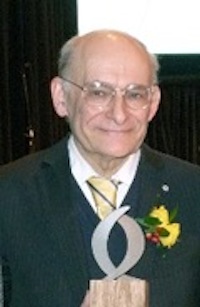
Winnipeg lawyer David Matas received a distinguished alumni award from the University of Manitoba (U of M) at a gala on the evening of May 1. Matas joined four others – Chau Pham (young alumni), Scott Cairns (professional achievement), John Bockstael (service to U of M) and Bruce Miller (community leadership) – in receiving the award. The event featured performances by U of M alumni, including Juno-nominated performers Erin Propp, Larry Roy and Desiree Dorion.

photo - David Matas
David Matas (photo by Ian McCausland)

On stage, Matas told attendees he is currently working on an autobiography, with the working title Why Did You Do That? He said, “The book seeks to justify my human rights activism. Writing the manuscript has made me introspective, attempting to justify my behavior to myself.”

There are pluses and minuses to receiving this award, said Matas, with a smile. “To be sure, it’s a boost to my self-esteem … [though the] downside is the increased expectations.”

Matas, who is a human rights lawyer in Winnipeg and senior legal counsel for B’nai Brith Canada, said that after having received the Order of Canada, “it didn’t become any easier. To the contrary, afterwards, my court opponents continued as before – disagreeing with everything I had said and adding that my arguments weren’t worthy of the Order of Canada. I hate to think what lies in store for me in court now that I’ve won the distinguished alumni award,” he joked, receiving warm applause.

Outside the courtroom, Matas more seriously added that the award might add welcomed weight to his positions and opinions. “I draw your attention to one particular position of mine: that the University of Manitoba should not be hosting Israel Apartheid Week.

“The decision this year to allow Israel Apartheid Week to go forward was particularly troubling in light of the fact that the University Student Union had stripped the sponsoring group of its student status and funding.”

Next year, as in past years, Matas said, he will be telling the university, “Don’t give this week a university forum.”

Later, he added, “Human rights advocacy, I realize, is often not one-dimensional – opposing rights against wrongs – but, rather, rights and against rights, and determining where the balance lies.”

Thanking the Alumni Association, Matas said, “It gives me the incentive and reinforcement to engage in this debate in years to come. The debate about where the balance lies is one in which we must all take part.

“I never drop a human rights cause until it’s resolved. I’ll be at it until the problem disappears – or I disappear.”

Rebeca Kuropatwa is a Winnipeg freelancer writer.

Posted on May 16, 2014May 14, 2014Author Rebeca KuropatwaCategories NationalTags B’nai Brith Canada, David Matas, human rights, University of Manitoba
Winnipeg’s HAlt program offers alternatives to a hysterectomy

Winnipeg’s HAlt program offers alternatives to a hysterectomy

Shauna Leeson and Dr. Richard Boroditsky. (photo by Rebeca Kuropatwa)

According to Dr. Richard Boroditsky, medical director of Winnipeg’s Mature Women’s Centre, hysterectomies are procedures that happen too frequently and are often unnecessary. Boroditsky has spearheaded a new program to give women effective alternatives to hysterectomies.

The program, called HAlt (Hysterectomies Alternatives), is managed by Kerry Antonio, and previously by Shauna Leeson, both nurse clinicians who have been working at Mature Women’s Centre since 2004. In 2006, the centre moved to Victoria Hospital.

There are currently three physicians working with HAlt – Boroditsky, his son Dr. Michael Boroditsky and Dr. Deb Evaniuk.

Patients are often referred by their family physician. The majority are in the age range of 30-55, with heavy or painful periods, and all want to improve their quality of life. Women in the post-menopausal stage are also seen at HAlt. “The majority of the patients we see here have benign ‘disease,’” Leeson told the Jewish Independent.

“Too many women are being told they have only two choices: do nothing or get their uterus taken out. We see about 20 new patients per month. We’re here to give them other options to hysterectomy and we do this because we understand the consequences of having one.”

Leeson added, “If a women in her 40s or 50s is going to have a hysterectomy, she may need to take six to eight weeks or up to three or four months off work and her regular duties, where often her problem can be treated with medication or other alternatives.”

According to Boroditsky, “Manitoba probably has one of the highest hysterectomy rates in Canada, with some 2,300 hysterectomies per year in the province.

“Traditionally, the main reason for doing about 70 percent of hysterectomies has been abnormal bleeding. And, before we had some of the newer alternative hysterectomy technologies, there wasn’t much we could offer women.”

The doctor said one of the most common issues they see is a condition called uterine fibroid (benign lumps in the uterus). “We used to believe this meant women in this situation automatically needed a hysterectomy,” he explained.

“Hysterectomy is a major operation with major complications – including risks of general or spinal anesthesia, hemorrhaging, infection and damage of organs around the uterus,” like the bowel, bladder, ureter, etc. “With these serious, major complications that can occur, we shouldn’t be taking hysterectomies lightly,” he said. “We can’t look at hysterectomy as the ultimate treatment for uterine bleeding – it shouldn’t be the first choice. It should only enter into the picture after you’ve tried or considered all other available alternatives.”

In the past, Boroditsky said that he has done at least as many, if not more, hysterectomies than other physicians, but that has changed in recent years. “I’ve gone the other way. I now believe hysterectomies should be only a last resort.”

He added, “One particular study was done about eight or nine years ago in the States, where they looked at several thousand hysterectomies and found that some 70 percent of them could have been treated or managed with other alternatives.”

In Europe, alternatives to hysterectomies are more accepted due to the attitudes of both the doctors and the patients, said Boroditsky. “In Canada, many women, and even doctors, don’t know about or will not consider alternative options.

“There is a lot more cost involved in having a hysterectomy than there is for the alternatives: cost to the system, physical and psychological cost to the woman and to her family. The only way we can make an accurate diagnosis of abnormal uterine bleeding is to look inside the uterus (hysteroscopy). Once you make the diagnosis, there are many alternatives for treatment, depending on each individual case, whether that’s with pills, a device or otherwise.”

The HAlt website offers basic information and some of the benefits of the alternatives to hysterectomy. “Due to the risks associated with major surgery, as well as the negative effects hysterectomy can have on a woman’s self-esteem, their sexual experience and perceived desirability, women are seeking alternative treatments to fibroids and uterine bleeding. The HAlt program aims to provide women with information and awareness of options, including the use of medical alternatives to control bleeding, minimally invasive surgery, and other less invasive techniques.”

Some of the medical alternatives available today include the use of an intrauterine progestin device, which prevents pregnancy but significantly reduces menstrual flow; pituitary gonadotropin inhibitors, which lock estrogen receptors in the uterus to suppress hormone levels and thin the lining of the uterus; oral contraceptives to minimize and regulate menstrual bleeding; gonadotropin-releasing hormone, which produces a menopause-like state, indirectly lowering estrogen levels and shrinking fibroids; and selective progesterone receptor modulators, which act directly on the fibroids and the lining of the uterus, leading to fibroid shrinkage and decreased bleeding.

As noted on the website, patients can consider adding procedures in consultation with their doctors, such as endometrial ablation, hysteroscopic resection of polyps and fibroids, as well as uterine fibroid embolization.

Rebeca Kuropatwa is a Winnipeg freelance writer.
Format ImagePosted on May 16, 2014May 14, 2014Author Rebeca KuropatwaCategories NationalTags Deb Evaniuk, HAlt, hysterectomy, Mature Women’s Centre, Michael Boroditsky, Richard Boroditsky, Shauna Leeson

TEDxJaffa speaker says porn habit is detrimental

It is not every day that the subject of pornography gets centre stage at a major venue of a vast international audience such as TEDx, but that is just what happened recently – at TEDxJaffa in Israel.

The featured speaker, Ran Gavrieli, has been all over Israel and beyond, speaking about pornography addiction and how it afflicts women and men alike, as well as impacting children, even those as young as five years old, according to researchers.

photo - Ran Gavrieli
Ran Gavrieli (photo from Ran Gavrieli)

According to such research and to candeobehaviorchange.com, a website dedicated in part to sexual addiction, watching pornography and sex brings about a chemical reaction in the brain similar to that produced by consuming drugs or alcohol. As the brain releases a surge of endorphins and other powerful neurochemicals, like dopamine, norepinephrine and serotonin, these “natural drugs” produce a rush or a high. Statistics reveal that people all over the world use pornography as a form of escape and self-medication.

At the TEDxJaffa talk, Gavrieli had the opportunity to explain his personal position on the topic, including how porn watching affected his mind and, consequently, his relationships with the opposite sex. The talk can be viewed at YouTube, under the title, “Why I stopped watching porn: Ran Gavrieli at TEDxJaffa 2013.”

Gavrieli holds a BA in gender studies and theatre, and a master’s, and is working on a PhD in gender studies. He has been an outspoken activist against human trafficking and prostitution since 2008. He gives approximately 400 lectures a year to audiences of all ages, including military units and high-tech organizations.

He said he began viewing porn when he was in his twenties. “I soon felt the distortion of my mind,” he recalled, “and I began doing something about it around the age of 30.

“Porn did not change my general perception of women, but it did invade my intimate life. By doing that, it made me look at women in an automatic way, through ‘porn lenses.’ This contradicted who I am, so I had to uproot this habit for my personal well-being.”

Gavrieli said, “I felt [feelings] without the ability to name them, but when I started reading [work by feminist author and activist] Catharine Mackinnon, it all became crystal clear.”

Gavrieli was approached by TEDxJaffa organizers after some of his views were published in popular media in Israel. “The experience was great, because it gave the option to communicate with people all over the globe,” said Gavrieli.

“It is my day job to do these talks, 90 minutes each. But usually it’s to an audience of few hundreds, not millions. I am very grateful to the TEDxJaffa team for allowing me to do so.”

Since the TEDxJaffa talk, Gavrieli has continued receiving positive feedback from viewers. “The comments were fabulous. I keep on getting tons of them every day on Facebook,” he said. “The only thing I am still waiting for is the TED official website to put me on their front page for a couple of days. My talk is only on YouTube for now.”

Gavrieli’s goal is to “deconstruct power relations between genders, between people,” he explained. “In so many aspects, we try to strive for equality in our society, but in terms of sex and money, we regress.

“Prostitution is where sex and money intersect. So many self-made women don’t want to be called ‘feminist,’ or feel disappointed with feminism. It is because of equality not prevailing. Sex and money are how we preserve oppression toward women.”

Porn watching by the numbers

According to Gavrieli, “In Israel, like in the U.S. and all other Western countries, porn is being watched on regular basis by 92 percent of 12-year-old boys. The same rate of girls is exposed as well, even when they don’t wish to be.”

As a father himself, Gavrieli emphatically asked, “Are we cool with porn being, by far, the Number One educator of sexuality and intimacy of our kids?

“Israel is not dealing with it. Not yet. Just like the U.S., the Israeli government cares more about money and taxes coming in from porn than it cares about [the] education, values and identity of the next generations.”

Statistics at familysafemedia.com show that the average age of first internet exposure to pornography is 11 years old, with 90 percent of 8-to-16-year-olds having viewed porn online (most while doing homework). As well, the website notes that 40 million Americans regularly visit internet porn, with 10 percent admitting to it being an addiction.

The male/female breakdown is at 72 percent male, 28 percent female. While 17 percent of women admitted to having a pornography addiction, nearly 10 million were found to access adult websites on a monthly basis. Women are more likely than men to use adult chat rooms and be more discrete about their cyber activity. In fact, 70 percent of women keep their cyber activities secret.

Rebeca Kuropatwa is a Winnipeg freelance writer.
Posted on May 16, 2014May 14, 2014Author Rebeca KuropatwaCategories WorldTags pornography, Ran Gavrieli, TEDxJaffa

Ignite! festival is youth driven, skill building

For one week each spring, the Cultch comes alive with hundreds of local artists between the ages of 13-24 for the Ignite! Youth Festival. This is the 15th year of the event.

“The festival is a great place to discover new and emerging artists across Metro Vancouver and beyond. There’s food, laughter, dancing, dressing up, exciting acts and good times,” said Ellie O’Day of O’Day Productions, which handles publicity for the annual event. The festival “was created and run by a youth panel, working countless hours to put on an amazing festival every year, showing how important it is to have an opportunity like Ignite!,” she explained.

photo - Ellie O'Day
Ellie O’Day (photo from Ellie O’Day)

Hundreds of youth are involved in what is now Vancouver’s largest youth-driven arts festival, which includes showcases of music, dance and spoken word, the world première of three one-act plays, a visual arts exhibit and a variety of other acts. Events will be held in the Historic Theatre, Vancity Culture Lab, the Cultch lobby and the café galleries from May 2-10.

Though the festival is put on by youth, it is supported by a vast network of arts professionals to mentor the youth and help build their skills. Last year, a publicity mentorship was added to the list of mentorship opportunities. Publicity mentees get the opportunity to work with O’Day, the festival’s publicist five years running.

O’Day was brought up in a Reform Jewish family in the eastern United States and launched her career on radio in the late 1970s in Vancouver. From broadcasting, she expanded into writing, arts administration and arts advocacy, teaching music business for 21 years, and then – via her work as a publicist – helping to promote some of her favorite things: media and performing artists.

“I may have been thousands of kilometres away from my family and the customs that were part of our Jewish family life for many decades, but one of the principles that has stuck with me – particularly as I did not have children myself – is that we live on in the wisdom and knowledge we share with the coming generations,” she said. “That principle is so important to me that I would feel unfulfilled without it.”

O’Day does publicity for many shows at the Cultch, which is a complex of (now) three theatre spaces. “They have invested in this youth program,” said O’Day. “On staff, there is one youth program coordinator, currently Robert Leveroos,” who serves as guide, and also oversees a group of about 20 youth panel members who serve as the organizers of the festival.

During the weekend prior to the main festival, there is a showcase for mentored songwriters, spoken word artists and dancers. During the festival itself – which begins today – three short plays are presented in repertory. The young playwrights have been mentored by professional local playwrights; the young directors have been mentored by professional local directors.

“Last year, as a nearing-retirement publicist, I suggested we ‘mentorize’ the publicity, too,” said O’Day. “Young people may be savvy about social media, but don’t really understand how traditional media works.”

The publicity mentee helps with festival publicity. “Landon Krentz’s application indicated he was already doing some arts administration work, which meant he’d have a familiarity with the general infrastructure of arts organizations, which would add to his skill set,” said O’Day about this year’s publicity mentee.

photo - Landon Krentz
Landon Krentz (photo from Ellie O’Day)

Krentz and O’Day met a few times and split up the work, contacting artists for information, sending out media releases and following up on them.

Calling O’Day “my amazing mentor,” Krentz said he decided to join the mentorship program to improve his media relations skills and to become more involved in the industry. As the president of British Columbia Rainbow Alliance of the Deaf, Krentz has been involved with accessibility coordination, as well as with serving the deaf queer communities. A fundraiser and event coordinator for the contemporary dance community by day, Krentz is one of very few bilateral profoundly deaf people working in the arts community. “I hope to become a stronger advocate for deaf members and challenge audism in every day life,” said Krentz.

Some backstage roles, like stage management, lighting design, etc., have also been included in the mentorship program more recently. This year, promotional photography is being mentored by the Cultch’s house photographer.

“We’re not mentoring people to take over our positions next year,” O’Day explained. “The idea is to disseminate our skill sets and help mentor the next generation – who will eventually take our place(s).” The festival is all about empowerment, sharing knowledge and collaboration, she added.

There is an open application process in the fall/winter, when mentorship spots become available. In total this year, there are 18 mentorships, including three each in dance, songwriting and directing, two each in spoken word, playwriting and collaborative creation, and one each in publicity, photography, lighting design and stage management. The mentors hail from various disciplines and are all practising their art/craft in their professional lives.

Jane Heyman, a veteran director and theatre educator, is among the director mentors, as is Stephen Drover, artistic director of Rumble Theatre. A new category, collaborative creation, is mentored by Barbara Adler, who worked with spoken word mentees in the past. Among the dance mentors are Amber Funk Barton and Tara Cheyenne Friedenberg.

photo - Tara Cheyenne Friedenberg
Tara Cheyenne Friedenberg (photo by Wendy D Photography)

“This program is very unique,” Friedenberg, who is a dancer, choreographer and artistic director of Tara Cheyenne Performance, told the Independent. “It’s not a training program, but more of a lab with the amazing goal of a big performance in the fabulous Cultch. It’s an opportunity to mix with other youth committed to making art and to get guidance and support from some movers and shakers in Vancouver’s vibrant arts scene.”

O’Day added, “Each mentor’s role is going to be unique. Hopefully, they will be generous to share their knowledge and to let the mentee do a lot of the work, so they get hands-on experience.”

The Ignite! Youth Festival (igniteyouthfest.ca) runs until May 10. Tickets ($2 for youths 12-19, $6 for students/seniors, $10 for adults) are available online at tickets.thecultch.com or by calling 604-251-1363.

Rebeca Kuropatwa is a Winnipeg freelance writer.
Posted on May 2, 2014May 1, 2014Author Rebeca KuropatwaCategories Performing ArtsTags Amber Funk Barton, Barbara Adler, Cultch, Ellie O’Day, Ignite! Youth Festival, Jane Heyman, Landon Krentz, O’Day Productions, Rainbow Alliance of the Deaf, Rumble Theatre, Stephen Drover, Tara Cheyenne Friedenberg.

Posts pagination

Previous page Page 1 … Page 29 Page 30 Page 31 Next page
Proudly powered by WordPress