Skip to content
  • Home
  • Subscribe / donate
  • Events calendar
  • Business Directory
  • FAQ
  • News
    • Local
    • National
    • Israel
    • World
    • עניין בחדשות
      A roundup of news in Canada and further afield, in Hebrew.
  • Opinion
    • From the JI
    • Op-Ed
  • Arts & Culture
    • Performing Arts
    • Music
    • Books
    • Visual Arts
    • TV & Film
  • Life
    • Celebrating the Holidays
    • Travel
    • The Daily Snooze
      Cartoons by Jacob Samuel
    • Mystery Photo
      Help the JI and JMABC fill in the gaps in our archives.
  • Community Links
    • Organizations, Etc.
    • Other News Sources & Blogs
  • JI Chai Celebration
  • JI@88! video

Recent Posts

  • SFU honours Gloria Gutman
  • Lifting people’s spirits
  • Wedding a ray of light
  • Indigeneity and Zionism
  • Rule of law broken: councilor
  • Football and its roles
  • The burden of defence
  • Fish Café returns after fire
  • All right in what goes wrong
  • Nuns & mermaids at TUTS
  • Camp offers holiday retreat
  • Students and mentors inspire
  • Once-in-a-lifetime trip
  • 100 dancers, one heart
  • Money for the sciences
  • What “Jewish food” means
  • Have a cookie, schnitzel too
  • Federation now across BC
  • Israel fighting for its existence
  • Deal strengthens Iran
  • Patriotic belonging diminishes
  • A campaign to engage
  • Upstanders’ first live event
  • Responding to Carney
  • Having your own home
  • Music a family tradition
  • Musical to warm heart
  • Community milestones … June 2026
  • Sharing her passion for Israel
  • Or Shalom reopens its doors
  • JFS from past to future
  • Need holistic approach
  • Sharing stories, advice
  • Journalist shares fears
  • Skills to live together
  • Road to independence

Archives

Follow @JewishIndie
image - CJN box ad Rockowers 2026

Byline: Rebeca Kuropatwa

No more ice scraping

Who would have thought a solution to ice stickiness would come from a semi-tropical country like Israel?

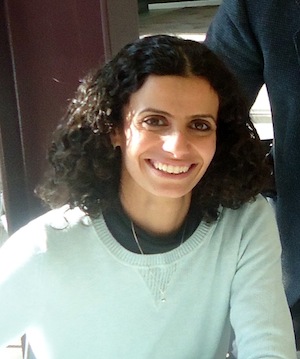
Prof. Hanna Dodiuk heads up the department of polymers and plastics engineering at Shenkar College in Ramat Gan. She specializes in adhesion and adhesives science and technology, characterization and formulation of polymer adhesives, special coatings, surface and interfaces analysis, nanotechnology and aging of polymeric materials.
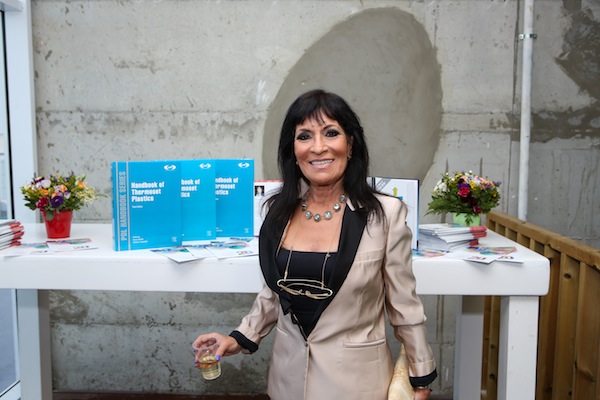
photo - Prof. Hanna Dodiuk
Prof. Hanna Dodiuk heads up the department of polymers and plastics engineering at Shenkar College in Ramat Gan. (photo from Prof. Hanna Dodiuk)

Born in 1948 in Krakow, Poland, to two Schindler’s List Holocaust survivors, the family made aliyah to Israel in 1949. Dodiuk served in the air force, and then studied chemistry at Tel Aviv University. In 1979, she joined the Israeli Armament Development Authority (ADA), also known as Rafael. From September 1991 to June 1997, Dodiuk was the ADA’s director of its materials and processes department.

Her research led to the creation of a surface to which ice cannot stick, a material she created while on sabbatical with a large bio company in Germany. “They invited me to develop surfaces that don’t adhere to anything, that are easy to clean, and that have super-hydrotropic surfaces,” she said. The company needed this to develop what Dodiuk referred to as “a microfluidic machine.”

“This small machine can only work with very small water droplets at minus-12 degrees,” she said. “To take such a little amount, you have to ensure the fluid is not absorbed on the surfaces.”

In her research, Dodiuk turned to biology and nature, studying how leaves react with water.

“While most leaves are weighted by water, lotus leaves, even if in mud and water, aren’t, so they remain fresh and clean forever,” she said.

Using a high-resolution microscope, Dodiuk found that the morphology of the lotus leaf is very unique. “It has small mountains of microns that have a very small circle in the diametre of a nano range, which is 10 to minus-nine metres. A water drop cannot enter the width between two nano particles, so it begins to fall off and slide. Therefore, the water doesn’t add weight.”

Dodiuk said this is not a new chemistry concept. It has been used in Teflon-like materials for years. But, while Teflon works well with oil, water can still get it wet and weigh it down.

Early on, Dodiuk found great success with the lotus leaf. Three years into the research, ADA asked her to help create a super-hydrotropic coating usable on glass to prevent ice from interfering with navigational systems by sticking and blocking the view. Dodiuk found a lab that would allow her to imitate ice adhesion in Quebec, where she conducted the experiments.

“We’re the only [technology] in the world that can reduce the adhesion of ice,” said Dodiuk. “You cannot avoid it totally, but you can reduce by a factor of 18. If you reduce the adhesion of ice by a factor of 18, you really avoid ice adhesion.”

This surface has numerous significant applications. “Airplane wings can take off, but the special coating that was so great at reducing the adhesion of ice was simply not durable,” she said. “If, for example, they were to apply very high winds, it would start coming off and nano particles would be lost, as the adhesion of the micro and nano particles wasn’t good.

“With the lotus plant, if its surface is damaged, it will repair itself. But, technology doesn’t know [how] to repair itself, so they had to find another solution. That is when the University of Massachusetts stepped in with funding and lab facilities.”

Aided by two university students in the plastics engineering department working to create a special film with the right properties at a very low cost, Dodiuk said they are now halfway to completion. The final product will be a stick-on film, like Scotch tape, but with nano particles on one side, not visible to the naked eye. It will be able to be applied to anything, from windows and wings of airplanes to car windows during the winter.

“We always laugh at the end of the day,” said Dodiuk. “Israel [doesn’t] have an ice-adhesion problem, yet we invented the solution.

“Once you talk about super-isophobic, easy-cleaning or self-cleaning [technologies], everyone is sold.

“Even with textile, it would be one that never gets dirty. For things to get dirty, the dirt has to adhere. If you avoid adhesion, you’ll stay clean forever. Can you imagine not needing to wash your things, as nothing will adhere to [them]?”

“Can you imagine all of New York and Vancouver never needing to be cleaned?”

The potential application possibilities are endless and multi-directional, with spin-offs that can be used in elemental technology, like car or high-rise windows with no need to clean off dust or dirt. “Can you imagine all of New York and Vancouver never needing to be cleaned?” asked Dodiuk.

“With this special coating, those windows will remain totally clean. Just a little bit of rain will take off all the dust. The rain won’t stick to the window, only to the dust.”

Through it all, Dodiuk emphasized, she succeeded in accomplishing all of this work, to date, in a “male-dominated environment. I really think [women] should go into science and technology. [Many women] are going into many areas today, but not science and technology.”

Rebeca Kuropatwa is a Winnipeg freelance writer.


Posted on October 24, 2014October 23, 2014Author Rebeca KuropatwaCategories IsraelTags ADA, Hanna Dodiuk, innovation, Israeli Armament Development Authority, science, Shenkar College

Doctor trailblazes in Toronto

With its Centre for Bedouin Studies and Development, Israel’s Ben-Gurion University (BGU) encourages Bedouin students to enrol at the Negev university by providing financial assistance and programming aimed at retention and academic success. One of the first students to go through the BGU program is Dr. Rania Okby, who is currently doing a fellowship in advanced obstetrics in Toronto.

At the young age of six, Okby, who was born in Be’er Sheva, decided she wanted to become a pediatrician, because, she said, “I really loved my pediatrician. I never had any problems going there when I was a kid, and I kind of wanted to be like her.”

photo - Dr. Rania Okby at the Asper Campus in Winnipeg earlier this year
Dr. Rania Okby at the Asper Campus in Winnipeg earlier this year. (photo by Ariel Karabelnicoff)

Okby’s parents divorced when her father expressed his desire to marry another woman. “Polygamy is a common practice in the Bedouin community,” she told the Independent. “About 30 percent of Bedouin women are in a polygamy system. My mom didn’t agree to that. She said, ‘OK, whatever, you want to get married? OK. But, I’m going to leave the house.’ She left the house with six kids – four girls and two boys.”

Okby, while in high school, spent one day a week at BGU, part of the university’s recruitment programs for Bedouin high school students. One such program, Seeds of Medicine, helps identify the best students, those who have a chance to be accepted into medical school.

“We were two female students who did very well in the project,” said Okby. “We went through interviews like other candidates for medical school. And, that’s how I became a medical student.”

In her first year in medical school, Okby had the opportunity to help deliver a baby. “I remember how it felt to be part of giving birth, dealing with birth and helping women … so, I fell in love with obstetrics and gynecology … and that’s how I decided to do that,” she said.

As it happened, Okby went on to become the first female Bedouin doctor in the world.

“My whole family was proud I was accepted,” she said. “They saw how hard I worked. I studied in high school five days a week and then I went another day to study in the university. And, you know what? On the seventh day, I would volunteer on a few projects.”

Financing was not an issue, as BGU covered expenses and the university is supporting Okby while she is doing her fellowship in Toronto.

“Being at the university at large, the fact that there’s more and more Bedouins going to BGU – especially girls – because of the Centre for Bedouin Studies, connects the Jewish community with the Bedouin community in an interesting way,” said the doctor.

The way Okby sees it, “If you’re more exposed to different people or cultures, you understand that they are human beings, just like you. It doesn’t matter if they’re Jewish, right? So, being exposed to one another at the university, for sure, makes it better. And the more educated people are, the more they will hopefully accept one another.

“There are many friendships between Arabs, Bedouins and Jews. It’s normal, because if you’re in contact with people, you become more comfortable with them. There’s a lot of Jews who volunteer in the Bedouin community, and there are some Bedouin who volunteer in the Jewish community – not necessarily in their own community.”

What is paramount in Okby’s mind is, “Education, education, education. To become equal, we have to first become empowered. Bedouins suffer from very low social economic, education and health status … everything is lower. So, to become equal, we have to be empowered.”

Life in Toronto

During the first two months Okby was living in Toronto, a friend stayed with her, and the doctor’s mom also joined her during the second month. Since September, Okby has been living on her own, along with her two daughters, in an area referred to as “the Kibbutz.”

According to Okby, “There are about 35-40 families, Israeli families, in the area, and 97 percent of them are Jewish. Most of them are doctors who came to do their clinical fellowships, but some of them are post-doc. We live in the same area and most of our kids go to the same school, so the older kids help the new kids adapt to school.”

Okby’s youngest daughter just started Grade 1, and the parents had a party for all their kids who were starting first grade.

“Now, during Sukkot, everyone is celebrating,” said the doctor. “On exchange day, everyone who has things they don’t need brings them, and everyone picks what they need. We support each other, help each other, do trips and Friday night dinners together.”

Understanding the issues

Bedouins make up 25 percent of the Negev population. But, Okby said, “In labor and delivery, we’re about 55 percent, because we give birth to a lot of kids (the average is six to seven kids), we suffer from a lot of gynecological problems, we have a high rate of relative marriages and we have a high rate of malformation.

“We have three times the rate of neonatal deaths compared to the Jewish population. Forty percent of that is due to malformation, which is a result of relative marriages. Bedouin women [also] suffer from postpartum depression – 30 percent compared to 10 percent in Jewish society.

“It’s similar to the indigenous people here, in Canada. We have many of the same problems as the aboriginals.” This is one factor Okby plans to focus on when she returns to Israel. “The university is very interested in the issue, too,” said the doctor. “Maybe we’ll have a minorities health department or something like that to research it further, to make the situation even better for those kids and mothers.”

Rebeca Kuropatwa is a Winnipeg freelance writer.
Posted on October 17, 2014October 27, 2014Author Rebeca KuropatwaCategories WorldTags Abe Chapnik, Ben-Gurion University, BGU, Rania Okby
Vancouver now home for Liran Kling

Vancouver now home for Liran Kling

Julia Glushko and Liran Kling at last year’s U.S. Open. (photo from Liran Kling)

Israeli tennis coach Liran Kling now calls Vancouver home. He moved here after being invited to do so by Canada’s No. 2 female tennis seed, Sharon Fichman.

Kling, 33, has played and coached tennis since he was a kid.

Born in Ramat Gan, he was one of the top junior players in Israel. After three years of army service, he attended College of Charleston in the United States on a tennis scholarship and then began coaching, in 2006, staying on for two years at the college before returning to Israel.

In 2010, Kling began coaching one of Israel’s promising young female players, Julia Glushko. Over four years, Kling helped Glushko become Israel’s No. 1 seed, a ranking she shares off and on with fellow tennis star, Shahar Peer.

After the 2014 Australian Open, however, Kling and Glushko parted ways. “It was a great experience for both of us,” said Kling of their time together. “We achieved a lot in the four years we worked together. There was just a mutual feeling that our partnership had run its course and we both felt it was time for a change. Julia is a great player and I wish her all the best in the future.”

 Moving to Vancouver

“When I stopped working with Julia, Sharon contacted me to see if I was interested in coming to work with her and her team in Vancouver,” said Kling.

“Sharon is Canada’s No. 2 player, after Eugenie Bouchard. She is ranked 127 in the world in singles and 90 in doubles. Her somewhat low ranking is due to the fact that she is coming back from knee surgery and, in the past, she had a number of wins against top 50 players, so we know she has the potential to do that and more.”

About working with Fichman, Kling said, “We believe she can be ranked among the top of women tennis.” He added, “Our Israeli background helps us find common ground and to develop a strong working partnership.”

Fichman was born in Toronto to Israeli parents and has an older brother who was born in Israel. She began playing tennis at age 5 and, at 13, became the youngest player to win Canadian nationals for girls 18 and under. Later, at 14, she became the youngest player in Canadian history to play on the Canadian Federation Cup team.

Before becoming a professional, Fichman was ranked as high as No. 5 in the world for girls 18 and under, winning the Australian Open and Roland Garros titles in doubles, and reaching the quarter finals in singles of two grand slams. As a professional, her career high ranking to date has been 77th in the world in singles and 48th in world doubles.

Fichman competed in the 2005 Maccabiah Games for Canada and won the gold medal in the women’s open singles event. She was the flag bearer for the Canadian Maccabiah Team.

“The Canadian Tennis Federation has been very supportive of me and my tennis career and I am proud to play for Canada,” said Fichman.

Kling and Fichman first met on the Women’s Tennis Association tour, when Kling was still Glushko’s coach. When Fichman began looking for someone to join her team in Vancouver, she said Kling was her first choice. “The fact that he is Israeli is simply a bonus,” she said.

“He is very observant and has a great eye for the game of tennis,” said Fichman about Kling. “As a former player himself, he understands what it takes to be successful as a professional tennis player, so I take a lot of confidence in his input and feedback on and off of the tennis court.”

Both Fichman and Kling are new to Vancouver. Fichman said both she and Kling “would like to be better introduced to the Vancouver Jewish community,” while Kling said, “I’m enjoying my time here…. As far as the winter season goes, I was told to bring an umbrella. I look forward to learning how to ski this winter.”

The two are working out of a tennis centre in Surrey.

Rebeca Kuropatwa is a Winnipeg freelance writer.
Format ImagePosted on October 17, 2014October 17, 2014Author Rebeca KuropatwaCategories LocalTags Julia Glushko, Liran Kling, Sharon Fichman, tennis

Circumcision evolution

The “scientizination” of brit milah, circumcision, has had several implications, according to Dr. David Koffman, assistant professor, department of history, York University.

photo - Dr. David Koffman
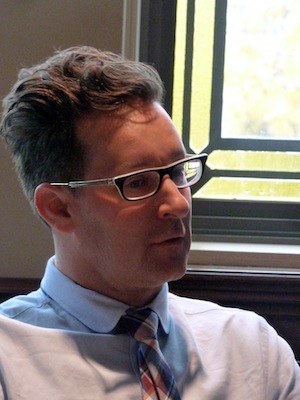
Dr. David Koffman (photo by Rebeca Kuropatwa)

Koffman spoke at the University of Manitoba on Sept 19, hosted by the university’s Hillel Winnipeg. He centred his talk around the influence of the interdenominational New York Board of Rabbis, which was founded in 1914 to train and certify mohels. The board centralized, coordinated, promoted and professionalized Jewish circumcisions in New York state throughout the 20th century, he explained. They trained mohels in the newest surgical techniques, methods of asepsis and hygiene, newly developed clamps and devices, provided malpractice insurance and acted as a guild/gatekeeper for Jews entering the profession. By the mid-1960s, the board opened a school to train mohels.

“Its job was to control the narrative, to keep it Jewish in the face of changing norms in America,” said Koffman. “By the 1940s, the popularity of circumcision, long seen as Jewish barbarism, began to skyrocket among gentile parents for their newborn sons.”

Circumcision changed from being mainly a religious rite to a surgical procedure in the 20th century.

“Secular medicine’s enthusiasm for circumcision put Jewish medical men along with many other Jews in a bind,” said Koffman. “On one hand, the growth of endorsing opinion by experts about circumcision from a variety of medical subfields offered the most gratifying validation mohels and clergymen could ever hope for. Urologists, surgeons, gynecologists, even psychiatrists, indicated the right vilified by Christians in America no less than elsewhere before the 20th century. Mohels eagerly then sought medical training and certification and proudly fused religious rhetoric about brit milah with newfound medical rhetoric on health advantages.

“On the other hand, medicine’s capture of circumcision and its popularity among non-Jews presented an entirely new set of problems for religious Jewish leaders of the non-Muslim world. The penis, concealed in public, but revealed when naked in private, remained a key sign of Jewish difference where it mattered the most, to make more Jewish babies. Perhaps more threatening than the erosion of the boundary between Jews and gentiles was that science itself might strip the fundamental religious meanings….”

With respect to Christianity, Koffman explained, “During the Second Great Awakening, Christians turned to circumcision as the foil to the conversion experience. The reborn, or born again, were circumcised by accepting Christ … they were as un-Jewish as they could get. This was a metaphor of circumcision.

“Keep in mind that Jan. 1st in the Catholic calendar was the Feast of Circumcision, eight days after Jesus’ Dec. 25th birth.” This is a practice that no longer exists, however, as it was removed by the Church in 1960 and renamed the Solemnity of Mary, he added.

“There was a striking discord between Jesus and his followers that Jesus himself was circumcised,” he pointed out. “Most questions had little to do with the Jews…. Where, for example, did Jesus’ foreskin go? Was he reunited with it during the rapture?”

Turning to the science, Koffman said, “By the 1920s, circumcision was becoming the mark of high social standing for many, for it indicated that a mother had the ability and means to deliver her baby in a hospital by an attending physician.”

In the first two decades of the 20th century, civic planners argued that universal circumcision would help restrict the spread of tuberculosis, syphilis and other venereal diseases. Before this development, said Koffman, circumcision was, for Jews, at its core, “a sign of the holy covenant between God and Israel, as prescribed to Abraham in Genesis 10 … and [of] God’s promise to Abraham’s descendants.

“In essence, mohels ‘scientized’ milah but, in doing so, they invited new predicaments for the Jewish body. Embracing medicine achieved many short-term gains. It accrued medical status for mohels, insisting that they were on par with physicians.

“Perhaps most importantly, embracing the science of circumcision [made it possible] for American Jews to make a broad public reckoning of their historic contributions to medicine and science.

“The transformation of circumcision from ritual once exclusive to Semites to a medical procedure available to all also posed a threat to American Judaism because medicine for all its power hollowed milah of its mysteriously potent spiritual power. For the first time in Jewish history, there was a very real possibility of huge numbers of illegitimate milah, circumcisions performed on boys by someone other than a mohel, or at the wrong time, or in the wrong manner. The Jewish penis would grow to be indistinguishable from its non-Jewish counterparts. All this helps explain why the board worked so hard to represent mohels at hospitals, aiming to control its narrative.”

The board conducted research in the 1930s and 1940s about hospital-regulated circumcision, which required that mohels be certified. It encouraged public and private hospitals to make circumcisions available and encouraged hospitals to provide space to perform the rite, as well as educational materials to obstetrics and gynecology professionals about the benefits of circumcision.

“Jewish parents were increasingly having their sons circumcised in hospitals, paid for by insurance companies, instead of at home or at synagogue,” said Koffman.

“By the 1960s, religious justifications began to give way to the anxieties about the infant’s pain,” said Koffman. “Mohels, wearing their medical hats, assumed it a given or perhaps an integral part of circumcision.” One manual produced in the 1950s, entitled Welcome Home Mother and Son, included no fewer than eight references to pain and anxiety.

The board also supplied a steady stream of support materials to agencies, synagogues and rabbinical associations interested in promoting circumcisions in other states and countries. By the mid-1960s, the board positioned itself not just as a regulator of New York State, but as the custodian of the practice and an advocate of circumcision.

“Milah literature doubled down on the medical benefits, but also emphasized the theological benefits,” said Koffman.

“The great scholar Elliot Wolfson called Jewish circumcision ‘the cut that binds,’” said Koffman. “It’s a severance that connects Jewish boys to their fathers and grandfathers, to Jews across time and borders.”


Rebeca Kuropatwa is a Winnipeg freelance writer.


Posted on October 17, 2014October 17, 2014Author Rebeca KuropatwaCategories LifeTags brit milah, circumcision, David Koffman, Hillel Winnipeg
Museum of Human Rights hopes to inspire

Museum of Human Rights hopes to inspire

Winnipeg’s Canadian Museum of Human Rights is now open for visitors. (photo from CMHR-MCDP) 

The Sept. 19 opening ceremonies for the Canadian Museum for Human Rights (CMHR) were broadcast live on several networks, and live streamed on the CMHR website (humanrights.ca). The opening celebrations lasted through the weekend, with more than 40 performances at the Forks market and downtown Winnipeg, including free public tours of the museum and a concert on Saturday night, featuring Buffy Sainte-Marie, A Tribe Called Red, Shad, Marie-Pierre Arthur, Ashley MacIsaac and others.

The excitement among museum staff was palpable ahead of the opening weekend, said Matthew McRae, a museum representative. “Everyone here, whether they started two years ago or two months ago, has put in so much work to make this project happen. It’s truly amazing to watch all the little bits I’ve worked on coming together to make a whole. What’s more, this is really a once-in-a-lifetime opportunity.”

McRae has been with the museum for two years, researching gallery content and gathering background on different feature stories for the museum’s core exhibits. When asked to pick his favorite story from the museum, he said, “There are lots of amazing stories I’ve had a chance to research during my time here, so it’s hard to pick just one. However, the story Wilcox County High School’s first integrated prom, held in 2013, is something I’m very happy it made its way into the museum. The school, located in southwest Georgia, in the U.S.A., had never had an integrated prom.

“In 2013, Mareshia Rucker and her friends decided they wanted to be able to go to prom together, regardless of their skin color or background, and so they fundraised and organized their own integrated prom, despite opposition from some members of the community. Their story got picked up by the international media and, in the end, the school announced it would hold an official prom for all its students in 2014.”

McRae conducted an oral history with Rucker and the young woman’s prom dress will now be featured at the museum. “A prom dress is not something you would normally associate with human rights, but that’s perhaps what’s so neat about it,” said McRae. “It tells people that human rights struggles can come in all sorts of forms, and it tells people they are still going on today, all around us.”

Ensuring people from around the world can access and use the museum’s content and knowledge base has been a major focus. While the museum does not have specific projections for online attendance, McRae said, “We are expecting people to log on from all across Canada and the world. There will be lots of chances for people to feel connected to Canada’s new national museum.”

The museum will continue working with various community groups, human rights organizations, academics and stakeholders. There are plans to organize and participate in many events, including lectures, panel discussions and art projects.

“This will involve anything we can think of to build awareness and education about human rights and to encourage public discussion from multiple perspectives,” said McRae. “We will pilot a national student program in 2015 and hope to eventually bring students from across Canada here for an immersive educational experience in human rights.”

The museum has also developed programs for school groups and the public, so all ages can make the most of having a human rights education hub in Winnipeg.

“Above all else, the museum will be a place of inspiration where people can learn about the many different ways people as groups and individuals have worked to promote human rights, resist violation and overcome adversity,” said McRae. “This is the only museum in the world solely devoted to human rights awareness and education, and we explore human rights concepts with an international scope, but through a uniquely Canadian lens.

“As the first national museum established outside the National Capital Region, the CMHR will be a source of Canadian pride – not to mention an iconic piece of architecture already being noticed around the world.”

“Gail Asper fought to have her father’s dream become a reality,” said Stephanie Lockhart, who attended the opening ceremonies with her husband. “She brought this incredible dream to life. What a tremendous gift for our children, our children’s children, and for many generations to come. To be able to visit this place and have the opportunity to learn all about our human rights – the history, for good and bad – their view of human rights will be transformed and actualized because of what they will have learned in this spectacular place.

“For me, the museum truly represents one of the most significant accomplishments articulating the dignities of humankind. All human beings are born free and equal with dignity and rights.”

MLA Andrew Swan, minister of justice and attorney general, said, “I was truly inspired by the opening ceremonies…. As a lifelong Winnipegger and Manitoban, I am fiercely proud that the CMHR is located here, the first national museum outside of Ottawa/Hull.

“My favorite moment was watching [singer] Maria Aragon – a young woman from a local school and daughter of an immigrant family – perform at the opening.”

Winnipeg City Councilor Jenny Gerbasi was also in attendance. “There was a significant inclusion and a feeling of deep respect for Aboriginal, Inuit and Métis communities throughout the event,” said Gerbasi. “I was very moved by the words of Dr. Wilton Littlechild, when he talked about ‘a new spirit and a hope for positive change … a call to action and honoring the human rights of all people.’

“The umbrellas had to come out as rain started prior to and throughout the ceremony … but it did not dampen the spirits or the sense of excitement of the audience.”

Rebeca Kuropatwa is a Winnipeg freelance writer.
Format ImagePosted on October 3, 2014October 1, 2014Author Rebeca KuropatwaCategories NationalTags Andrew Swan, Canadian Museum for Human Rights, CMHR, Gail Asper, Matthew McRae
Asper vision spurred action

Asper vision spurred action

(photo by Rebeca Kuropatwa)

Miracle at the Forks: The Museum that Dares Make a Difference, which chronicles the 14-year journey to plan, build and open the Canadian Museum of Human Rights (CMHR), was launched on Sept. 22 at the museum with Gail Asper, Moe Levi, Stuart Murray, and co-authors Peter C. Newman and Allan Levine. The 200-page book, released by Figure 1 Publishing, officially hit the bookstands on Sept. 23.

In her remarks at the launch, Asper said that she was pleased with the volume’s title. “I love it because it is miraculous … being inside this museum we’ve talked about for 14 years … this is a really great time for Winnipeg, Manitoba and the world.”

She continued, “We started on this journey to find a way to educate our youth about our human rights violations that occurred in our history and to inspire people to take action. This has been a long, often challenging, and many times miraculous journey from dream to reality. That’s why we’re thrilled that non-fiction writers Peter C. Newman and Allan Levine are here and have written a compelling book, recounting the story from the day Dad – Israel (Izzy) Asper – dreamed of a centre for human rights and gave Moe Levi the mandate to make it happen, to the completion of the building this year.

“During the dark days after my dad’s passing, it was Moe’s support, his ridiculous optimism and resolve, that kept us going…. And, of course, thank you to the federal government under the leadership of Stephen Harper, this maverick person whose courageous decision to make this a national museum ensured our going forward. Also, thanks to our 8,200 donors who’ve made this day possible.”

Newman described the book’s overarching purpose. “Canada was built on dreams as well as appetites. This country was founded by waves of immigrants with big ideas and big dreams. The [Canadian] Museum of Human Rights will dramatically alter Winnipeg’s skyline. But its name is a misnomer; museum is too limiting a description. That’s a venue people visit to remind one another of past lives … memories that can light up a rainy Sunday afternoon.

“This museum is to make a difference. This book is about how this idea, which seemed far too risky to be Canadian, actually came about. Its purpose is more significant than its contents…. If you consider this notion, it really defines what this is all about. Its existence will turn focus on its mission. The key to this great achievement is the image you get of a long time ago.”

Co-author Levine said, “I was fortunate to spend a lot of time with Izzy Asper and listen to him talk…. He told me often, one of the secrets of success came down to perseverance. He just never gave up on anything he did.

“The CMHR project gave new meanings to that. As Peter and I were researching and writing the book, I was struck by the amazing perseverance of Gail and Moe, and other members of the Asper family and foundation. They refused to quit, and are standing in the museum today.”

Levine read aloud excerpts from the book’s section “A Magnificent Conception,” about the delay in getting the museum off the ground.

“You see, Asper was not a journey-to-the-destination type of person. He was a just-get-to-the-destination kind of guy. So, if you’d told him in 2003, prior to his death, that more than a decade later the Museum for Human Rights would not be open, he would have been appalled.

“Back in 2000, once the initial idea of the Museum of Tolerance, as it was first referred to, began to germinate, and after Asper had found a spot at the Forks where he wanted to build it, plans advanced methodically and purposefully.

“Asper’s vision, although not clearly articulated initially, was to establish a museum that would teach the lessons of the Holocaust as well as examine human rights in a Canadian context against the backdrop of the Charter of Rights and Freedoms. There was a part of Canada’s history that had never been told, and he spoke really with as much passion about the Holocaust as he did about the Japanese, Chinese and Aboriginal societies, in particular.

“The project Asper envisioned was unique for several other reasons, factors that would prove a stumbling block difficult to hurdle, the grandeur of the museum Asper had in mind was akin to the Guggenheim Museum in Spain.

“One misconception that stands out is how people believe that he intended this to be a private museum … the opposite is true. Right from the beginning, he stated that he only wanted to spearhead this project, not run it or control the agenda.

“In the early years, Asper had underestimated the opposition he was to face from just about every corner – skeptical politicians who questioned the need for such a mammoth and expensive museum, academics and journalists who did not believe the museum of human rights could be done properly, or whether it was even necessary.

“Ottawa bureaucrats protested loudly about placing a national rights museum anywhere but in Ottawa, and a collection of naysayers who questioned the use of the Asper Foundation’s use of tax-payer money as part of an alleged scheme to advance so-called Jewish interests.

“Yet, even if he had known of the obstacles that stood in his path, Izzy would never have quit. Always he had persevered. As Gail recalls about her father, there’s a great quote that comes ‘Do it: do or do not. There is no try. Let’s just get the job done.’

“At the same time, there had been times when he had tried and tried and tried, and he failed. But the bottom line is, if you keep trying, the perseverance will pay off somewhere.”

When finished reading the first book excerpt, Levine shared, “Izzy, by the way, dictated things. Gail was instructed by her father that she was to dedicate half her day, every day, to the museum.

“So this, I quote, from Izzy’s letter to his daughter: ‘You must get up and end every day and ask yourself, what did I achieve in finding 60 million needed from the private sector for the museum? You are not to take any calls, answer any letters, or have any meetings with people who are seeking donations from the Asper Foundation. That is Moe’s job, and not to be duplicated.

‘I’m spelling all of this out because this is your opportunity to prove that you can act like a senior executive, and not to be distracted by everything that happens to go by. I hope you can exercise for us and discipline the outlined above.

‘This is the way I’ve operated all my life and, in my opinion, the only way you can accomplish things that everyone thinks can’t be done.’” Levine added, “And Gail obviously followed that [instruction].”

“Working with Allan and Peter has been one of the joys of putting this whole project together,” Levi added in his remarks. “It made me reminisce with Gail, and many times we laughed and cried thinking back [on] this incredible journey. I think it’s a great book. The key thing here is all the proceeds of this book go to the Friends [of the CMHR]. Anytime you buy it, you’re helping a child come to visit the museum in Winnipeg.”

Rebeca Kuropatwa is a Winnipeg freelance writer.
Format ImagePosted on October 3, 2014October 1, 2014Author Rebeca KuropatwaCategories BooksTags Allan Levine, Canadian Museum of Human Rights, CMHR, Gail Asper, Izzy Asper, Miracle at the Forks, Moe Levi, Peter C. Newman, Stuart Murray
SoftWheel reinvents the wheel

SoftWheel reinvents the wheel

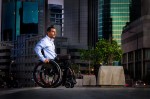
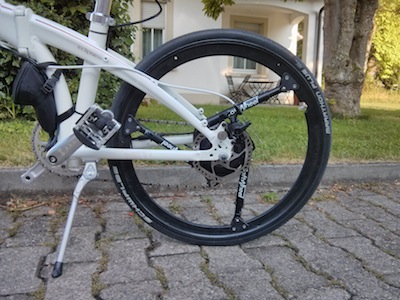
The concept of SoftWheel was initially imagined as an improvement for wheelchairs, but its potential uses are numerous. (photo from SoftWheel)

While new patents and inventions appear all the time, they don’t often aim at a mainstay, like the common wheel, which has had the same design for thousands of years.

Many inventors have focused on how a wheel connects to a vehicle through different suspension systems. An Israeli startup has infused the suspension right into the wheel itself, with a selective shock absorption system.

Dubbed “SoftWheel,” the concept was imagined by Israeli farmer Gilad Wolf when, a few years ago, he broke his pelvis and was confined to a wheelchair.

“Sitting on one of the more sturdy wheelchairs, having to manoeuvre around his fields, Gilad decided to design an improved model with suspension,” said Ronny Winshtein co-founder, inventor and former chief executive officer of SoftWheel.

Wolf partnered with some colleagues and an Israeli nonprofit organization for rehabilitation technologies called Milbat and, together, they approached Tel Aviv-based Rad-Biomed Accelerator to assist in funding and developing the project.

“Rad-Biomed CEO David Zigdon liked the idea but decided to come up with a product that would be disruptive in technology and market orientation,” said Winshtein.

(photo from SoftWheel)

With Winshtein, they decided they would put the suspension in the wheel and make it selective – i.e., to work only at high-magnitude shocks – otherwise, the wheel would remain purely round and concentric, functioning like any other wheel.

In 2011, SoftWheel was founded with this notion in mind, and it attracted some of the best and brightest players in Israel to the wheel business. One of them, Ziv-Av Engineering, assisted them in developing the wheel’s unique mechanism.

“Putting suspension into the wheel has many advantages, like giving you the freedom to plug in the suspension onto any frame you like,” said Daniel Barel, SoftWheel’s current CEO. “You can just pick one out of a catalogue. As well, the suspension covers 360 degrees of incoming shocks, rather than [the] linear shocks absorbers provided in most frames.”

Barel explained why a design like theirs had not been done until now. “With promise comes challenges, and having the shocks in the frame of a flexible wheel creates design challenges for the rest of the vehicle’s frame – a challenge fairly non-existent in wheelchairs.”

The biggest problem with wheelchairs is adding suspension to the chair, as it adds weight. “Active wheelchair users commonly disconnect the wheels from the frame when getting into their car, etc., and pull the wheelchair components with a single hand from the ground to the passenger seat … so, weight becomes a major issue,” said Barel. “By adding suspension (meaning, adding some weight) to the wheels, which are always lighter than the frame, [it is easier to manoeuvre the chair portion].… On the other hand, SoftWheel understands the need to have the lightest possible wheels, so the overall wheelchair weight won’t be more than current lightweight wheelchairs.”

What makes SoftWheel’s wheel better than any other, according to Barel, is the embedded suspension. “It’s a real suspension with not only springs, but also dampers, which are needed to absorb the shock. Also, it’s selective, so, during a ride on a regular road, the hub won’t wobble within the frame, keeping more of the good propulsion energy.”

The company has filed several different patent applications for utility and design that they are confident will provide broad protection to their inventions.

Barel acknowledged it is difficult to reconsider one of the oldest possible technologies ever invented, but also exciting.

“We’re currently focused, first and foremost, on the market, with a first product for active wheelchair users … in the very near future,” said Barel. “We also made substantial progress in designing similar wheels for commuter bicycles, some of which also include a motor in the wheel hub.” The prototype is featured in the video below.

“We also develop concepts for other types of vehicles based on our know-how and technology, and have been in discussion with some very interesting players in Israel and abroad,” he added.

The company is very proud to be part of the Israeli startup Kaleidoscope. Winshtein believes that it is not by chance that so many innovative technologies have originated in Israel. He said it is embedded in the culture, the atmosphere, jokingly adding, “Probably, also [the] heat and humidity, but mostly the openness, from any level, to try and change the world for the better.

“SoftWheel has been a globally oriented company from day one, and we already have good and friendly ties with different global and national players from different market segments.”

One of the other companies that has shown interest is an aircraft landing gear manufacturer. Another focus for SoftWheel has been implementing the technology on city bikes, as more and more cities introduce bikes that anyone can pick up and return at different locations (for a cost).

“As the wheels reduce the impact of typical street blows, both wheelchairs and bikes that use them can move around freely without having to access ramps,” said Barel. “The suspension systems currently available in city bikes are unsuitable for such obstacles and often result in the rider taking the impact. Eventually, the product will sell itself and, in doing so, it has to answer real needs for real individuals.

“Like with any new concept, you do everything in your power to bring into the market the best possible product, under time and budget constraints. With time and growth, and feedback from the users, we’ll naturally be able to improve the product in different parameters, ones we already have in mind and ones we probably hadn’t thought of yet.”

Rebeca Kuropatwa is a Winnipeg freelance writer.


Format ImagePosted on September 19, 2014September 18, 2014Author Rebeca KuropatwaCategories IsraelTags Daniel Barel, Gilad Wolf, Ronny Winshtein, SoftWheel, technology
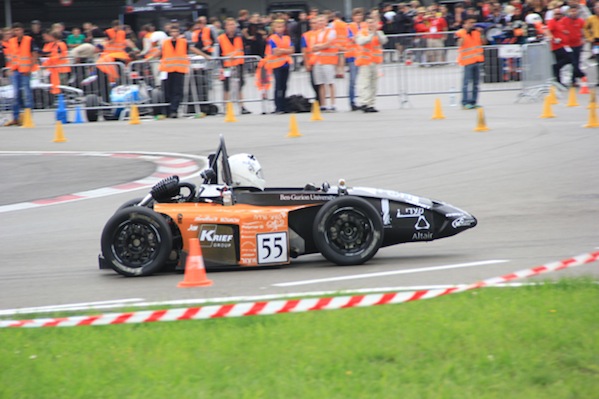
BGU student-built car races

BGU student-built car races

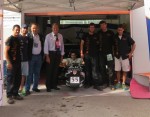
In Italy, at Ben-Gurion Racing’s pit, from left to right, BGR2014 team leader Dudy Daud, project manager Tamir Plachinsky, main sponsor of the event Giampaolo Dallara, former EU president and former Italian prime minister Romano Prodi and the rest of the BGR team. (photo from BGR)

Israel is not known for manufacturing cars, let alone race cars, but that hasn’t stopped students from Ben-Gurion University from doing just that.

At their first race this year, in Austria Aug. 17-20, the car had an oil leak in the middle of the endurance race. “The car was stopped and we were very disappointed,” said mechanical engineer Tamir Plachinsky.

At the second race, however, in Italy Aug. 29-Sept. 1, the team fared better. They finished 21st overall out of 44 teams, completing all of the events, including acceleration, skid pad, autocross and hard endurance (which was incomplete in Austria).

“The team is extremely happy to have finished the event,” said Plachinsky. “We showed again the strength of our students – that, even in a year like we had [in Israel], we managed to build the most advanced car we’ve ever built and to race it in two races.”

Plachinsky began the initiative to build the first-ever Israeli Formula SAE project in 2010. After the successful participation of the first Ben-Gurion Racing (BGR) team in 2011 in the Italian race, Plachinsky was granted a six-month apprentice opportunity at the Italian racecar manufacturer Dallara. Upon his return, he started managing the race-car project at the university.

photo - The team celebrates after the race in Italy. (photo from BGR)
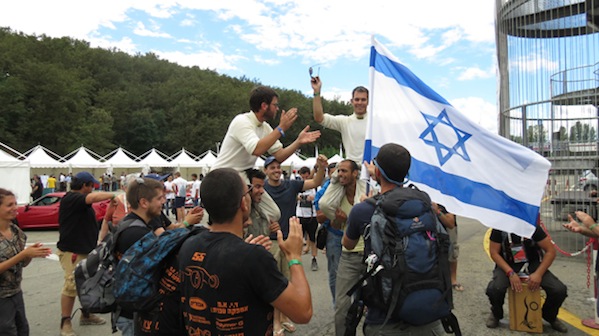
The team celebrates after the race in Italy. (photo from BGR)

This year’s car is the fourth that students have designed and manufactured in the team. The aim is to redesign a new car each year for the Italian event, with a new group of students to replace the graduate students who have completed their studies.

“Each year starts with a new team and new goals, and you never know what will happen until the race,” said Plachinsky. “Think of it like a manufacturing company that forms at the beginning of the year with a new CEO … and everything [is] needed. And, at the end of the year, all the personnel retire from the company and you hire completely new staff.”

This year, Plachinsky said, “We started with new goals for the team and we knew we wouldn’t have enough time and resources to complete the car, but we still worked as hard as possible to keep to the time table and find support.”

The creation of the team occurs around September. The new team meets with the old team and learns about the current car. “We go over the good systems and the bad ones, where we need to improve and develop, and what should be left as is,” explained Plachinsky.

For 2014, the team consisted of 31 mechanical engineering students together with five students from the university’s department of management and design students from Bezalel Academy of Arts and Design in Jerusalem.

“We’re confident and believe in our ability to face any difficulty we’ll encounter,” said Plachinsky.

This year’s design concept was formed in September 2013. “They put into it their previous three years’ experience and a lot of courage to make it a better car from the 2013 model – one that put a new standard for race cars produced in Israel,” said Plachinsky.

This car, dubbed the “BGR14004,” had two unique features. The main frame is built from carbon fibre, instead of welded steel tubes, and the students designed their own gearbox.

“The carbon frame, also called ‘monocoque’ (Latin for ‘single shell’) is the first of its kind ever produced in Israel and allows for [a] lighter and stiffer chassis,” said Plachinsky. This is a feature the university students have been developing over the past two years.

“Together with the frame, we managed to design and manufacture the new gearbox,” he added. “This will enable the car to access a much better power supply, giving the driver help in reducing lap times.”

The main assembly was done in the university’s new compound, but the different parts were manufactured at various factories supporting the team. The carbon fibre frame was made at Composite Materials Ltd. in Modi’in, the gears were made at Ashot Ashkelon Industries Ltd. in Ashkelon, and the 3D-printed intake manifold was made at Aran Research & Development Ltd. in Caesaria. “But, as much as possible, we’re trying to keep the manufacturing of the parts in the Be’er Sheva area and the south of Israel,” said Plachinsky.

In competition

photo - Ben-Gurion Racing’s Formula SAE student race car at the autocross run in Austria
Ben-Gurion Racing’s Formula SAE student race car at the autocross run in Austria. (photo from BGR)

Registration for the races in Italy and Austria was in January 2014. “Once we knew we had spots at those events, all that was left to do was to build the car,” said Plachinsky. “This [was] no easy task, especially this year, because of the complicated manufacturing of the new frame and also – and maybe mainly – due to the fact that almost half the team got recruited to serve in the army. Even with these difficulties, we managed to complete the car just in time for the Austrian event, after a month of working 25 hours a day.”

Overall, Plachinsky said everyone is very happy with how the car performs. “It shows all the features we designed into it and is faster than last year’s car,” he said. “The students’ devotion to complete the car and represent the team, the university and the country in the best way possible has just been unbelievable.

“Arriving at the event with the car you’ve designed and built is an amazing feeling,” he continued. “Adding to that is the fact that the Austrian event is held at the famous Red-Bull Ring and that the Italian event, our traditional race, is always an amazing experience.”

The financial side

Getting the funding necessary for such a project is daunting – and most participating teams get 10 times the funding that BGR does, according to Plachinsky.

“We received support from the university and some companies and factories (from 2013 and continuing into 2014) but, as the design level goes up, so does the need for support,” he said. “Also, as we’re now on tour in Europe for three weeks; it’s not cheap or easy to organize and finance.”

Plachinsky and the team are approaching companies in Israel that they feel will want to collaborate with them “on a joint development basis or for marketing interest.” He said, “We want to show them how amazing this project is and that they can earn something by supporting us, having there be positive publicity, connections to the university, future employees, and so on.”

Plachinsky said of donors, “None of what we do would happen if it wasn’t for the good hearts of those people. We’ll be forever grateful.”

Looking ahead, the team’s goal is, as always, to advance into new areas and technologies. For the coming year, the plan is to participate in the Austrian and Italian events once again. This time, with a new car that will be the first electric race car made in Israel.

Although the team has not yet begun building it, the general concept is in place. “Some team members from next year’s team are here with us [in Italy], learning about the competition, the race and the car as much as possible before the current team will clear the stage for them,” said Plachinsky.

BGR is continually seeking assistance in helping them “represent Israel in the most amazing way and to educate the future engineers and automotive industry of Israel,” said Plachinsky. “And, for this, we greatly need to find further financial support.”

Rebeca Kuropatwa is a Winnipeg freelance writer.
Format ImagePosted on September 12, 2014September 10, 2014Author Rebeca KuropatwaCategories IsraelTags Ben-Gurion Racing, Ben-Gurion University, BGR, BGU, Tamir Plachinsky
Israelis invent handheld spectrometer

Israelis invent handheld spectrometer

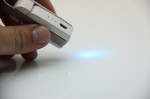
SCiO allows users to find out the molecular breakdown of almost anything. (photo courtesy of Consumer Physics)

Consumer Physics, a technology startup based in Israel, was founded on the idea of empowering people to learn more about the physical world in which they live, according to the company’s chief executive officer, Dror Sharon.

A collaboration of two Technion electrical engineering graduates, Sharon and Consumer Physics chief technical officer Damian Goldring, the company has been honing in on coming up with “an affordable, handheld device that would allow people to explore the world around them and get a better sense of what things are made of,” said Sharon.

The business partners discovered that they could miniaturize a spectrometer (optical sensor) to scan material objects, much like the technology used to miniaturize optics for smartphone cameras.

After several years of research and development, this idea became Consumer Physics’ first product, dubbed “SCiO.” It can analyze a vast number of physical materials and provide information previously unavailable without large-scale laboratory equipment.

SCiO provides real-time molecular breakdowns, and can tell you anything from how much fat is in your latte to what the unmarked pill in your medicine cabinet is, and whether or not your plants need to be watered.

By miniaturizing the spectrometer to about the size of a USB flash drive, and using technology and products that are cost-efficient, Consumer Physics has made spectrometry both affordable and accessible.

SCiO includes a light source that illuminates the sample and a spectrometer that collects the light reflected from the sample. The spectrometer breaks down the light to its spectrum, which contains all the information required to detect the molecules in the sample.

SCiO communicates the information from the sample to a smartphone wirelessly, which then sends it out to a cloud-based service for review.

Creating a global database of possible materials that the scanner will encounter is one of the biggest challenges SCiO programmers face.

“Advanced algorithms rely on our updatable database of matter to analyze the spectrum and deliver information about the sample back to the user’s smartphone in real time,” said Sharon.

Considering the buzz their device has already spurred, Sharon said, “People are interested in SCiO to be able to learn more about their physical world in a way that, until now, they haven’t been able to.”

Some people have shown interest in specific applications, like being able to track the nutritional aspects of the food they eat, or being able to select the sweetest melon at the supermarket. Others, especially developers who supported Consumer Physics in its early stages, are excited about what future applications there might be for the company’s hardware.

“We’re working diligently to ensure we ship the products to our early supporters on schedule, and are currently growing our research and development team internally to support the demand for SCiO,” said Sharon. “Professional applications, like consumer applications, will vary, based on what the community of developers creates.”

Soon, SCiO will be available in Canada and around the world. “We were very pleased to see that our Kickstarter backers came from five continents, and will continue to support our global community,” said Sharon.

Right now, Canadians can pre-order SCiO for $249 from the company website (consumerphysics.com). Early Kickstarter supporters will receive their SCiOs in December 2014, while later purchases are expected to be shipped in March 2015.

“It’s safe and easy for kids to use, but they’ll need a smartphone to see the results,” said Sharon. “SCiO can teach children all about the world around them – from gardening to biology and nutrition – and we’re also looking forward to seeing what educational applications will be built for children.”

Rebeca Kuropatwa is a Winnipeg freelance writer.
Format ImagePosted on September 12, 2014September 10, 2014Author Rebeca KuropatwaCategories IsraelTags Consumer Physics, Damian Goldring, Dror Sharon, SCiO
Hundreds unite to stitch Torah

Hundreds unite to stitch Torah

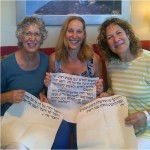
Sisters Brenda Silver, Susan Rubin and Mimi Wolch are among the hundreds who will contribute to the Torah Stitch by Stitch project. (photo by Phillip Silver)

A new Torah scroll is in the making. The brainchild of Temma Gentles, Holy Blossom Temple’s artist-in-residence in Toronto, the project originated from a chance encounter Gentles had with Marilynne Cass a year ago.

Gentles, an award-winning Judaic textile artist, is the artistic director of Torah Stitch by Stitch (TSBS), while Cass is the project’s executive coordinator.

“I fell in love with the concept and have thoroughly enjoyed seeing this dream turn into a reality,” said Cass about accepting Gentles’ invitation to join the team when the project was just beginning.

Gentles came up with the idea while on sabbatical in Israel several years ago, when seeking a way to help people engage in the words of Torah. As a textile artist, she envisioned creating a cross-stitched Torah.

“Temma chose cross-stitch because it’s a universally known craft that has been traditionally taught to young girls around the world for adorning clothing and household items,” said Cass. “It was also often the way in which girls learned their letters and numbers. While it’s a simple skill to master, it can still produce amazingly beautiful pieces of work. Using cross-stitch for TSBS has been an inspired choice, as it has allowed people from around the world to work together on a single project.”

Gentles designed a new font for Hebrew letters and divided the entire Torah into 1,463 four-verse segments for people to work on. TSBS participants range from men and women in their teens to those well into their 90s, from skilled stitchers to novices.

“There is no skill test to pass,” said Cass. “The only requirement is that each person commits to following the stitching graph correctly, complete their canvas in a timely manner and treat the work with respect.”

TSBS stitchers come from many different religions – from Judaism to Christianity, Buddhism to Islam. “Even though we’re doing the Torah (the Five Books of Moses), this isn’t an exclusively Jewish project,” said Cass.

“The Torah is the basis of three of the world’s major religions and TSBS has universal appeal,” she added, noting the project includes avowed atheists and the mother superior of a convent. “Everyone is welcome,” said Cass. “In fact, we’re actively looking for more Muslim stitchers.”

While many TSBS stitchers are from the Toronto area, the project has spread throughout Canada.

“I found out about this project from my sister, Brenda Silver, who met the artist through her synagogue in Toronto,” said Susan Rubin, chief financial officer of a downtown Vancouver junior mining company, who resides on the North Shore. “Both of my sisters volunteered to do panels, so I decided to sign up for a panel, too.”

Rubin paid $18 to cover the kit cost and received the template for the verses, the fabric and the embroidery threads in the mail. “At first, it was difficult to figure out how to start, but soon I got the hang of it,” she said. “I hadn’t done any cross-stitching for about 40 years, but it’s not that difficult. I worked on the cross-stitching at night, doing an hour here and an hour there. After about six months, it was done. It was very satisfying work and fun to do.”

Gentles asked Rubin to be more involved in the project and asked whether she would like to be a coach. “I was pleased to take a position,” said Rubin. “I’m one of many volunteers assisting Temma. Some volunteers are helping people with the stitching, while others are helping to compile the finished panels.”

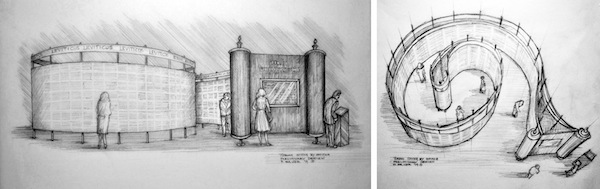
image - The display for the Torah scroll has been designed by Phillip Silver
The display for the Torah scroll has been designed by Phillip Silver. (illustration by Phillip Silver)

Rubin is helping keep track of the 700 stitchers. “I assign each stitcher a coach, so they have someone to contact if they run into trouble,” she said. “I also follow up with the stitchers who’ve had their panel for over six months and haven’t yet completed it. If someone cannot complete their panel, we try and find out why and offer help or, if need be, find a volunteer to adopt the panel. It’s important that all panels are complete, so the finished project is the entire Torah.

“It’s been interesting to hear feedback and personal stories from the volunteers. Even though this is a folk art project, there is a spiritual overtone and the stitchers receive great satisfaction in working with the words of the Torah.”

TSBS now has nearly 900 participants in 13 countries, with more applications coming in each week.

“Our ultimate goal is to have all 1,463 panels completed,” said Cass. “We’re more than halfway there.” The books of Genesis and Exodus have been finished, and stitchers are now working on Leviticus.

“We expect it to take another year before all the remaining canvases have been assigned,” she added. “Meanwhile, we’re working on the final details for the display format.”

The display has been designed by Phillip Silver, one of Canada’s foremost stage designers. It will be about 2.5 metres high and nearly 100 metres long. “The finished work will be museum quality and we hope it will be exhibited in several museums,” said Cass. “The goal is to allow people to feel as if they’re wrapped in the Torah.”

The project’s registration form, more information and helpful tips are available at torahstitchbystitch.temmagentles.com.

Rebeca Kuropatwa is a Winnipeg freelance writer.
Format ImagePosted on August 29, 2014August 28, 2014Author Rebeca KuropatwaCategories Visual ArtsTags Brenda Silver, Marilynne Cass, Mimi Wolch, Phillip Silver, Susan Rubin, Temma Gentles, Torah Stitch by Stitch, TSBS

Posts pagination

Previous page Page 1 … Page 28 Page 29 Page 30 Page 31 Next page
Proudly powered by WordPress