Skip to content
  • Home
  • Subscribe / donate
  • Events calendar
  • Business Directory
  • FAQ
  • News
    • Local
    • National
    • Israel
    • World
    • עניין בחדשות
      A roundup of news in Canada and further afield, in Hebrew.
  • Opinion
    • From the JI
    • Op-Ed
  • Arts & Culture
    • Performing Arts
    • Music
    • Books
    • Visual Arts
    • TV & Film
  • Life
    • Celebrating the Holidays
    • Travel
    • The Daily Snooze
      Cartoons by Jacob Samuel
    • Mystery Photo
      Help the JI and JMABC fill in the gaps in our archives.
  • Community Links
    • Organizations, Etc.
    • Other News Sources & Blogs
  • JI Chai Celebration
  • JI@88! video

Recent Posts

  • SFU honours Gloria Gutman
  • Lifting people’s spirits
  • Wedding a ray of light
  • Indigeneity and Zionism
  • Rule of law broken: councilor
  • Football and its roles
  • The burden of defence
  • Fish Café returns after fire
  • All right in what goes wrong
  • Nuns & mermaids at TUTS
  • Camp offers holiday retreat
  • Students and mentors inspire
  • Once-in-a-lifetime trip
  • 100 dancers, one heart
  • Money for the sciences
  • What “Jewish food” means
  • Have a cookie, schnitzel too
  • Federation now across BC
  • Israel fighting for its existence
  • Deal strengthens Iran
  • Patriotic belonging diminishes
  • A campaign to engage
  • Upstanders’ first live event
  • Responding to Carney
  • Having your own home
  • Music a family tradition
  • Musical to warm heart
  • Community milestones … June 2026
  • Sharing her passion for Israel
  • Or Shalom reopens its doors
  • JFS from past to future
  • Need holistic approach
  • Sharing stories, advice
  • Journalist shares fears
  • Skills to live together
  • Road to independence

Archives

Follow @JewishIndie
image - CJN box ad Rockowers 2026

Byline: Rebeca Kuropatwa

Architect of bestselling book

Architect of bestselling book

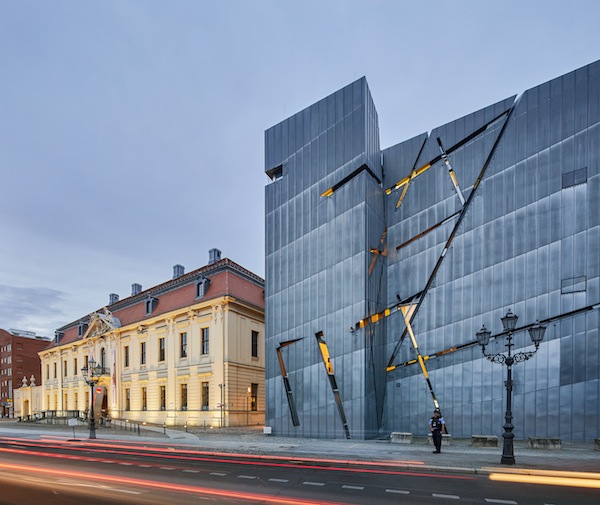
Daniel Libeskind designed the Jewish Museum in Berlin. (photo ©Hufton+Crow)

A gifted musician turned world-renowned architect, Daniel Libeskind can now add bestselling author to his list of accomplishments, with his unique book Edge of Order (Clarkson Potter, 2018), written with Tim McKeough.

Libeskind was born in Poland to Holocaust survivor parents. He spent his first 11 years in a communist, totalitarian state.

“I was born in a homeless shelter right after the war, and we were then lucky to be able to leave the first time the Iron Curtain opened,” Libeskind told the Independent. “We were able to go to my first paradise, which was Israel. Israel was only 8 years old at that time. It was amazing to go from black-and-white to full colour and the beauty of liberty.”

Of Libeskind’s father’s large family, his only surviving sister, who survived Auschwitz, was living in New York. So, after only two-and-a half years in Israel, the Libeskinds made their way to the United States.

But, before leaving Israel, Libeskind was an accordion virtuoso, at only 13 years old. Winning a competition with Itzhak Perlman, he had the opportunity to play for Isaac Stern. After hearing him, Stern suggested that Libeskind transition into playing piano, but Libeskind found the adjustment too difficult.

“Maybe that’s why I became an architect,” he said. “If I hadn’t played the accordion, I would have never been an architect, I would have become a famous pianist. I have to say that Isaac Stern, who I knew subsequently, told me I was the only person that they ever gave this [honour] to that didn’t become famous in music.”

In the United States, Libeskind’s family settled in the Bronx. When it came time for him to choose a career path, he didn’t know what to do, as he excelled in math, science and art.

“I really wasn’t sure because, in my life, I had never met an architect, an engineer, a doctor…. I had little idea of so-called professions that existed in a world somewhere beyond the Bronx,” he said. “I discovered that architecture combined all my interests – painting, drawing, mathematics, science … all the things I loved to do.”

Libeskind tried working for some well-known architects, but felt uninspired. So, for many years, he worked as a professor of architecture at various universities around the world and then as head of a school of architecture.

image - Edge of Order book cover“I really invented a path of architecture through my drawings,” he said. “My drawings were not figurative drawings of imaginary buildings. I drew the internal structure of architecture, what architecture is when you don’t have a client. I drew these drawings almost like musical scores.

“For many years, I did that and I was considered, like some others, as a paper architect … somebody who’s just on paper. But, then I won the competition for what later became the Jewish Museum in Berlin…. It was not originally called the Jewish Museum, it was called the Berlin Museum with a Jewish department, but I negated that, as I never believed Jews should be a department….”

It took more than 10 years to build the Jewish Museum in Berlin. It was scheduled to open the fall of 2001, but then 9-11 happened, so the opening was delayed.

Libeskind felt the need to go to New York. When construction on the World Trade Centre site was being considered, Libeskind was asked to be a judge of the entries. He could not make it to the judging on time, so instead entered his own design idea. He won the competition and became the master planner of the project.

In writing Edge of Order, Libeskind wanted to share his creative process and how he approaches architecture.

“I believe every member of the public is capable … of not only appreciating design and architecture but of participating in it, hands-on,” he said. “I always say, ‘Every human being can pick up a brush and start painting. Anybody can sit down and write a poem. Anybody can take their iPhone and make a film. Anybody can sit down and write a melody. But, when it comes to architecture, they think it’s a world of the impossible.”
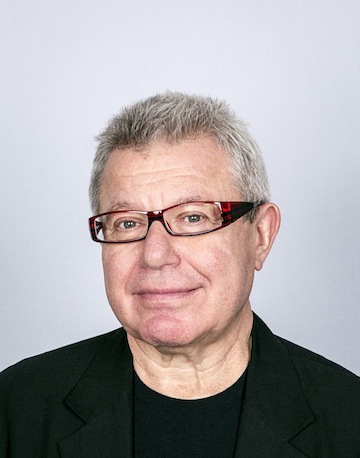
photo - Daniel Libeskind’s book, Edge of Order, which he wrote with Tim McKeough, is a bestseller
Daniel Libeskind’s book, Edge of Order, which he wrote with Tim McKeough, is a bestseller. (photo by Stefan Ruiz)

In Edge of Order, Libeskind shows how architecture is just another artistic field that anyone can do, explaining how buildings are not made by some abstract hieroglyphic methodology, but are part of culture, just like music and geometry. The book encourages people to participate and engage with architecture directly where they live.

“Most people think … everything is irreversible, that you’re born with it and that’s that. People don’t realize that they can change,” said Libeskind. “They can make the world a better place, a more meaningful place.

“Architecture is such an important aspect of the world,” he continued. “We take it for granted, but it’s what the world looks like to us, the window we have to the world.”

Libeskind wrote Edge of Order with the hope of inspiring people to think about how they can do things, instead of feeling like they don’t have the credentials or know-how to design their dreams. He thinks that everyone is an architect and he wants to help people realize that they, too, can build.

“My ideal reader could be a young person who doesn’t know what they want to do, or it can be an older person who had always wished to be an architect,” said Libeskind. “My point is that everybody can be, and that everybody already knows so much more about architecture than about anything else … because we all live somewhere … even if you’re homeless.”

He said his idea is about freedom – “freedom to build, to really direct the world to a better way.”

In Edge of Order, Libeskind also talks about the importance of embracing democracy and that we need to be vigilant against forces that would impoverish the human potential.

“When I see what is happening in the world … of course, we see the evils around us and we have to fight against them … and have the sense that the world is a better place than we see on television or on the news,” he said.

Currently, Libeskind is working on dozens of museums around the world, spanning all the continents.

“I’m such a lucky architect on every continent,” he said, adding, “I’m a very fortunate person.”

Rebeca Kuropatwa is a Winnipeg freelance writer.
Format ImagePosted on March 8, 2019March 6, 2019Author Rebeca KuropatwaCategories BooksTags architecture, Daniel Libeskind, design, memoir
Intergenerational connection

Intergenerational connection

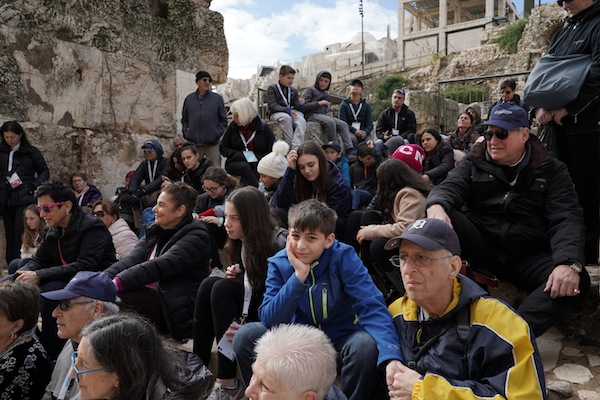
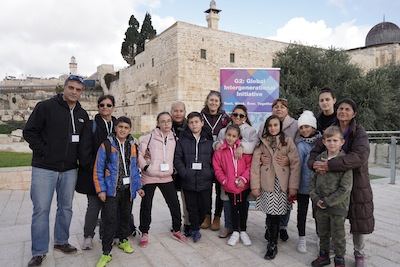
Grandparents and grandchildren discover their roots in Jerusalem with the G2: Global Intergenerational Initiative. (photo by David Salem / Zoog Productions)

The G2: Global Intergenerational Initiative is a new yearlong program being offered by the Jewish Agency. It helps bring grandparents and grandchildren closer with activities and conversations. It is spearheaded by Jay Weinstein, a rabbi from New Jersey who now lives in Israel.

“I work in the partnership unit, trying to build relationships between Jews around the world and Israelis,” Weinstein told the Independent. “I bring my connections from North America and also am exposed to Israeli communities here … trying to build bridges with Israel and overseas.”

The project stems from findings gleaned from meetings that the Jewish Agency held in a few prominent Jewish communities, which pointed to a lack of programming provided to older adults and a lack of an Israel connection among the young.

“We went to our partners on the ground, saying, ‘Let’s come up with something together’ … versus coming up with the idea ourselves and then trying to sell it or take it somewhere,” said Weinstein. “We wanted to do it in collaboration.

“Much of what we do in the Jewish community is for the younger generation,” he continued, “but, here, you have … people who spent their lives building up the federations, schools and synagogues. They’re usually the ones volunteering and donating, [yet] we’re failing to have something to really offer to them.”

Certainly, grandparents can be a positive influence in creating a Jewish identity in their grandchildren.

“When they’ve done studies asking young adults why they are involved in Jewish life or Jewish programming, what came back involved Jewish grandparents,” said Weinstein. “That’s even truer in interfaith marriage, [where] the role of the Jewish grandparent passing down values to their grandchildren is of even greater importance.”

The G2 initiative brings grandparents and grandchildren together over the course of a year through activities and creative projects.

“It gives grandparents the chance to think about what is important to them, about what they want their grandchildren to know about, how their family narrative makes them unique, and special things they care about,” said Weinstein.

Participating grandkids should be in Grades 5 and 6, preteens old enough to have deeper conversations, while still under the guidance of their parents “and they aren’t yet too cool to be with Grandma and Grandpa to do the activities,” said Weinstein.

“It’s not a text-based study. It’s more experiential,” he said. “And, at the monthly meetings, we give the grandparents and grandchildren things to do on their own time without a facilitator, like a little mesima (activity) or venture to do in the community.”

Each month has a different focus, such as discussing the most important Jewish gem of a place. This particular theme gives grandparents the opportunity to take their grandchildren to one of their favourite places and explain why it is important to them. Then, the grandchildren guide the grandparents to the most important Jewish gem to them, also sharing why it is important. If the grandparents and grandchildren so choose, they can record the visits on a two-minute podcast to share with others.

“Based on the partnership platform, we have communities overseas doing it with communities in Israel,” said Weinstein. “And, over the course of the year, they’ll connect with each other digitally. Sometimes, they’ll be synchronized and do a Zoom call, sometimes unsynchronized. One of the bigger goals of the unit is to connect Jews from around the world to Israel and, on the other hand, to teach and educate Israelis about what Jewish life is like outside of Israel.”

photo - grandparents and grandchildren in Israel on a G2 trip
(photo by David Salem / Zoog Productions)

Many larger Jewish communities can run G2 on their own, in-house, connecting with their sister city in Israel, but most communities won’t be able to carry it out on the same scale as that of the Jewish Agency.

“We believe there is power in the global Jewish community,” said Weinstein. “To be part of a worldwide network of people is a wonderful experience. I don’t think, oftentimes, that a fifth or sixth grader in Vancouver is connected with another Jewish fifth or sixth grader in Miami and Sydney … and we believe that is a very powerful experience. We’ve been in touch with the Jewish Federation in Vancouver and they are interested in G2.”

The partnership unit needs a local organization to launch the program in a region.

“In most cases, [the partner] is the federation, as they are our national partner, but, that being said, we’ve designed this program to be brought to any organization,” said Weinstein. “So, if there’s a synagogue that wants to participate in G2 or a JCC, we can work with them.

“I’ve gotten a tremendous amount of interest from communities all around North America and the world. People understand that grandparents and grandchildren have this special and unique bond. When we can build meaningful Jewish experiences around the grandparent and grandchild relationship, it’s just very powerful.”

The yearlong program includes an eight-day visit that the grandparents and grandchildren take to Israel – traveling about the country, learning and meeting their Israeli partners. They also get the opportunity to stay in the homes of their Israeli partners for part of the trip, getting a firsthand glimpse at everyday life in Israel.

While there is a cost for the program, G2 works with the different community partners to subsidize some of that, and is also looking for philanthropic partners.

“We’d love to have a partner to help us bring this around the world and not have a barrier of prices and expenses prohibiting families from participating,” said Weinstein. “We truly believe … sometimes we use the language of Birthright … that it’s a birthright of every grandparent to have meaningful Jewish experiences with their grandchild, including traveling with them to Israel.”

For more information, visit g2family.org.

Rebeca Kuropatwa is a Winnipeg freelance writer.
Format ImagePosted on February 22, 2019February 21, 2019Author Rebeca KuropatwaCategories WorldTags Diaspora Jews, family, G2, Israel, lifestyle
Sports talent runs in family

Sports talent runs in family

Sarah Jacobsohn is the Ultimate Canada 2018 Junior Female Athlete of the Year. (photo from Sarah Jacobsohn)

Last month, Ultimate Canada named Sarah Jacobsohn the 2018 Junior Female Athlete of the Year.

“I was in the middle of biology class, looked at my phone, and saw that one of my teammates had texted me saying congratulations and a long paragraph,” recalled Jacobsohn about hearing of the award. “And I was like, what’s going on? I had no idea.

“Then, I saw the article that was written about me and I got the notification that they had selected me for the award … and I started crying in the middle of class and I called my mom. It was so surreal and just amazing.”

Jacobsohn was born in St. Louis, Mo., in 2000, and moved with her parents and older sister to Winnipeg in 2006. She has been attending Gray Academy of Jewish Education since then, and will be graduating this year.

Athleticism runs in the family. Both of Jacobsohn’s parents played sports into adulthood. She also gets her height from her parents: her mom is 5’11” and her dad is just over six feet.

photo - Sarah Jacobsohn is the Ultimate Canada 2018 Junior Female Athlete of the Year
Sarah Jacobsohn is the Ultimate Canada 2018 Junior Female Athlete of the Year. (photo from Sarah Jacobsohn)

Jacobsohn has played sports for as long as she can remember. “I played Timbits soccer since I was in Grade 1, then I continued playing competitive tennis and soccer. Once I found ultimate, I quit all those other sports to play ultimate,” she told the Independent. “For my high school, I still play volleyball, basketball and ultimate but, on a competitive level, I gave the others up for ultimate.” (That said, she remains a competitive player at the other sports. For example, on the school’s varsity basketball team, she has been averaging 37 points per game.)

Ultimate was designed to be played without referees. “The spirit of the game is heavily emphasized, which is something you don’t find a lot in competitive sports in this day and age,” said Jacobsohn. “Essentially, it’s about maintaining a level of sportsmanship and integrity while playing the sport. You have to make the calls yourself and communicate with other players on the other team. And, it’s always maintained, that sportsmanship and respect for other players. Even at the highest level, ultimate is still heavily dependent on player communication, which I think is amazing.”

At the higher levels, there are “observers,” who help the players regulate the game, but they only intervene when asked by the players to do so. And, even after having been asked for their opinion, it is still up to the players to accept or disregard an observer’s call.

“I think that’s what a lot of sports have lost in the past few decades,” said Jacobsohn. “That competitive atmosphere takes away from the sportsmanship, and it shouldn’t. There should be a balance.”

In ultimate, she said, “people understand that, to keep that respect of the game, they have to be honest. It’s really amazing to see that, even at the highest level.”

Jacobsohn started playing ultimate in Grade 6 and, at 14 years old, her coach convinced her to try out for the provincial junior team. She made the team, as one of the youngest in the group. It was there that a national coach spotted her and, at age 15, she traveled to Vancouver for the national tryouts and made the team.

Jacobsohn participated in her first world championship in Poland in 2016, and Canada took home the gold. Last summer, Jacobsohn, as captain, led the provincial team to a gold medal. She went on to captain Team Canada to a bronze medal at the world championship in Waterloo, Ont.

All of these feats, as well as her extensive involvement in the ultimate and broader communities, contributed to Jacobsohn being chosen for the athlete-of-the-year award.

“The award is strictly based on achievements from the past year,” said Jacobsohn. “So, last year, I was captain of my provincial team and we won gold at nationals for the first time ever. Then, as captain of Team Canada, we won bronze at the worlds. And, I’ve done a lot of community stuff locally.

“I’ve been involved in the Winnipeg ultimate community for six or seven years, which is a lot, when I’m only 18 years old. I’ve gotten to know essentially the entire ultimate community. I’ve literally grown up in this community – finding a lot of leadership opportunities in it and chances to voice my opinion. I fight a lot for gender equity and voice that opinion a lot in the Winnipeg ultimate community.”

Jacobsohn serves on the Manitoba Disk Sports board, offering suggestions, as a high school student, about tournament arrangements and how the province runs the sport. She also has been very involved in the Winnipeg Ultimate Women’s Competitive League, helping to get a lot of juniors involved.

“As a very competitive female athlete, I understand my responsibility growing up as a female athlete in today’s world,” she said. “I have an immense responsibility to stand up and role model for other female athletes, and I’m not scared to do that.

“And, going to school where I’m one of six girls in my grade, I’ve been able to gain respect from a lot of boys and change perspectives on what being a female athlete means.”

Now, Jacobsohn is busy training for the under-24 national team tryouts. And, while her main aspiration is to become a doctor, like her dad, she is hoping to continue playing ultimate competitively for many years to come.

Rebeca Kuropatwa is a Winnipeg freelance writer.

Format ImagePosted on February 22, 2019February 21, 2019Author Rebeca KuropatwaCategories NationalTags Sarah Jacobsohn, sports, Winnipeg, youth
PJ Library extends program

PJ Library extends program

Florencia Katz and family. (photo from Florencia Katz)

PJ Library, which provides Jewish children with free Jewish-themed books and CDs, has expanded its program and now serves readers up to 11 years old.

Available in Jewish communities across North America, PJ Library is supported by local Jewish federations and many other donors. In Winnipeg, the program is in its 10th year, and Florencia Katz has been coordinating it since 2011. As a mom of two, she has experienced firsthand the impact the books have on her kids.

Eventually, Katz’s children aged out of the PJ Library program, which is for kids ages 6 months to 8 years old. But now, with the new program, PJ Our Way, Katz’s younger child, Tali, can once again enjoy the perks of PJ.

“PJ Our Way is the next chapter of PJ Library, for kids ages 9 to 11,” explained Katz. “Kids throughout the United States and Canada are eligible to enrol in the program from the day they turn eight-and-a-half until the day before their 12th birthday.

“The Harold Grinspoon Foundation, with the generous support of PJ Alliance Partners, provides PJ Our Way subscriptions at no cost to families or partner communities.”

PJ Our Way is considered the next chapter of PJ Library because it follows the same goals of the original program: engaging families and children in Jewish values, content and, ultimately, community.

PJ Our Way offers tweens the possibility of engaging online – allowing them to choose their own book, write book reviews, blog and more.

“My children and family have enjoyed the PJ Library program for years and, as avid readers, my kids were quite sad to stop receiving books at home once they aged out from PJ Library,” said Katz.

“My daughter, Tali, currently 10-and-a-half, was over the moon when I told her that she can now sign up to PJ Our Way. On the morning of the launch of PJ Our Way in Canada, before going to school, we signed up as one of the first sign-ups in Winnipeg, and maybe all Canada.

“As a parent, I am excited that, through this amazing program, my daughter will have the opportunity to keep reading quality Jewish-themed literature. The possibility that this program offers to engage online to choose the book, watch and read reviews, and submit their own reviews makes [it] attractive and exciting for this demographic.”

Tali was excited to pick her first book and spent some time on the PJ Our Way website, reading reviews and the synopses of all the available books, before choosing.

After narrowing her choice down to two books, she asked her mom for help deciding which to pick. After reading each book summary herself, Katz went to the parent section of the site to read more about the Jewish concepts and values and about the positive role models featured in each book. This helped her suggest which book her daughter might enjoy the most.

“Besides the synopsis and the concepts and values section provided for parents, there is also a section called Talk it Over, which suggests a question to discuss with your child after reading the book,” said Katz.

“I will definitely check all the information out and make a point of including it into our conversation about the book if it comes up. I will also suggest to my child to write a review of the book after she is done, so other kids can read it, the same as she read reviews when she picked the book. I want this experience to be enjoyable and fun, so I will not put any pressure or make it feel like a school task.”

Katz said the more Tali reads and learns about Jewish culture and tradition, the better equipped she will be to make her own decisions on how to live her Judaism when she grows up.

Candice Tenenbein, another parent who is part of the Winnipeg PJ Library initiative, is also very excited to have her older son, Jacob, 9, be part of PJ Our Way.

“Every month, our boys eagerly await their newest PJ Library arrivals,” said Tenenbein. “Both of our boys are avid readers. Recently, we were becoming sad that our older son, Jacob, was graduating out of this program. When we heard from Katz that PJ Our Way is now available in Winnipeg, we immediately signed up! We love that the books are exciting and fun to read, and that they all have a Jewish connection.

photo - Candice Tenenbein and family
Candice Tenenbein and family. (photo from Candice Tenenbein)

“In our home, we celebrate Shabbat and all the Jewish holidays. These books and the online portion will add more layers to raising our children to be more knowledgeable about, and proud of, their Jewish heritage.”

Tenenbein is also looking forward to her sons spending time on their iPads in a more educational and productive manner, instead of just watching videos. PJ Our Way offers a safe and protected online environment.

At the Tenenbein house, all family members read the books provided by PJ Library, as they love to discuss their favourite parts of each one and share their thoughts of how the books impacted them.

“Jacob is especially excited that his friends will also be joining PJ Our Way,” said Tenenbein. “The kids are planning to choose the same books each month, so they can have their own book club.

“Growing up, my mother, may she rest in peace, instilled in us a love of reading and a pride in our Jewish heritage. Now, as a mother myself, I understand how truly important opportunities are which provide for our kids to understand what the religion means to them and their daily lives.

“This is especially important in today’s environment, where antisemitism and its newer anti-Israel BDS face are becoming more prevalent. My husband and I are grateful for the excellent education our children receive at Gray Academy [in Winnipeg]. PJ Library and PJ Our Way are excellent supplements for helping foster and strengthen these feelings in our children.”

Jacob is also excited about going online and becoming part of a larger community of Jewish peers. He is looking forward to being able to share his thoughts about each book and read what others have to say.

“He cannot wait to begin blogging once he reads his latest PJ Our Way book!” said Tenenbein.

These days, getting paper mail is not common, so PJ kids receiving a free gift in the mail, addressed just to them, is a unique and individual part of the experience. The online aspect then allows them to connect with other Jewish kids who are reading the same books as them. For more information, visit pjourway.org.

Rebeca Kuropatwa is a Winnipeg freelance writer.

Format ImagePosted on February 22, 2019February 21, 2019Author Rebeca KuropatwaCategories BooksTags books, children, Judaism, literacy, parenting, PJ Library
Teaching entrepreneurship

Teaching entrepreneurship

Students at the Bachar school in Even Yehuda, which educates for leadership and entrepreneurship, prepare to welcome a delegation of educators from developing countries, who came to learn how Israeli schools educate for entrepreneurship. (photo from Galit Zamler)

For Galit Zamler, a course that began as a volunteer position at one school has become a full-time job, with more and more schools picking up her program.

In 2009, when Zamler’s third child was in Grade 6, his school principal wanted to have an after-school activity. She brought representatives of a company that was not only expensive to hire, but would only present to outstanding students, and required at least 20 of them.

Seeing the value of educating kids about entrepreneurship, Zamler – who has an MBA and has co-founded two businesses – told the principal that she would do such a presentation at no charge, as long as her son could be one of the participants. A month later, Zamler was teaching her first group of 12 children. She knew she was onto something great after she had sent the students’ parents notes about what was being taught, and the parents responded with thank you letters.

Word spread and, after volunteering for six years, Zamler turned her volunteer work into a full-time career. Now, 10 years into it, she said, “At the beginning of the course, I’d count each one of them, but now there are a lot of schools and there’s awareness of the need to teach entrepreneurship. I don’t need to go and try to convince anyone. They are going out looking for it.”

One of the first things Zamler teaches is that there are different kinds of entrepreneurs. It is not strictly about entrepreneurs of technology or inventions, and it is not just about opening a business. Students are taught that, to succeed, one must stand out from others – be creative and make their initiative unique.

“Then, they raise ideas and learn that there are no bad ideas,” said Zamler. “Each idea can be good and that’s how we do it. Being critical will prevent others from raising ideas. It’s very important that the class be open-minded and let everyone, whatever their idea, say it aloud and learn to explain it. Sometimes, what they have in their head is not clear to the others. They learn to stand in front of the class and explain their ideas.

“It’s not that every idea is great,” she clarified. “It’s just that we won’t criticize ideas. We ask questions to understand, and we discuss what difficulties we see in ideas – things like, how much it will cost, who will need it, to take a good look at it.

“Sometimes, this makes the student drop an idea, because they understand it can’t be implemented…. For example, there was a student who said she wanted every student to have a cupboard in the class to put their books into. The kids asked where she would put them, with very little space. And, she realized it couldn’t be done.”

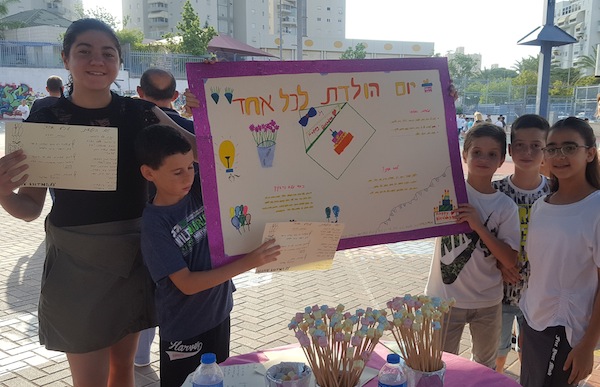
photo - Sixth graders at the Hayovel school in Ashdod present their social project: A Birthday to Everyone
Sixth graders at the Hayovel school in Ashdod present their social project: A Birthday to Everyone. (photo from Galit Zamler)

Once all the ideas are shared with the class, students start to determine which ones they like the most and come up with business plans – tackling the process like a cake recipe, considering which ingredients they will need to bring their concepts to life. This includes the physical elements, as well as how to make their business unique, part of which involves seeking advice from experts in various fields to see if any changes might be needed.

Only then do the students try to implement their project, which can sometimes be as simple as composing a letter to the municipality.

“I have a school that wanted to have a gym,” said Zamler. “But, the school is small and there’s no place. So, they wrote a letter. The municipality sent an expert to explain why it can’t be done, but gave them money to buy equipment for activities they can move from place to place; using it outside and bringing it back inside as needed. And, they were satisfied with this.”

The curriculum is offered to grades 2 through 9 in Israel and it is funded in part by the government, as principals are allowed some leeway to allocate funds as they see fit within a list of external programs pre-approved by the Ministry of Education.

“Sometimes, they teach it as a science class,” said Zamler. “Other times, it is categorized as a life skills lesson in the curriculum … and, when the school principal thinks it’s important, he or she finds a way.”

Zamler – and other parents – consider the entrepreneurship course a great addition to what is being taught in school, as it will help in practically every aspect of life.

“I think, sometimes, it’s the parents that bring the program to the schools, because they know that children learn something useful for life … not just the ordinary curriculum,” which includes things that may not “help them when they grow up, as things change so quickly,” said Zamler.

Even armed with this entrepreneurial knowledge, Zamler acknowledged that the overwhelming majority of students – 90% to 95% – will end up as employees. But, she is hoping they will be leader employees.

“I was an employee with entrepreneur skills, and that’s what helped me go from the bottom up to management,” she said. “Being an entrepreneur in an organization means that you think big, you do more than you are told. Those are the kinds of workers we need in the workforce.”

While Zamler has not yet conducted follow-up studies on the students who have taken the program, other countries are taking note and looking for ways to implement the program in their own schools.

“The foreign office brings delegations to Israel twice a year and takes them to a school that educates for entrepreneurship,” said Zamler. “And what we see is that, instead of students who don’t like to go to school, we see students who are really enjoying their time in school, because they have choices.

“The army is also looking for these kinds of students…. If they don’t have these kinds of skills – persistence, creativity, and working on team goals – the army doesn’t want them. We know it helps them in the future, in the army and, I think, the workforce.”

The Hebrew Academy in Miami Beach was the first school outside of Israel to implement the program. Also, a company from Hong Kong has purchased the licence to bring the program there.

“They do amazing things there and they’re opening more and more classes,” Zamler said of Hong Kong. “But, there, it is an after-school activity, because it’s hard to bring it into the public school curriculum.”

Zamler has created an online training program for both students and teachers wanting to bring entrepreneurship into their school. For more information, visit tomorrowsuccess.com.

Rebeca Kuropatwa is a Winnipeg freelance writer.
Format ImagePosted on February 8, 2019February 7, 2019Author Rebeca KuropatwaCategories IsraelTags children, education, entrepreneurship, Galit Zamler, Israel
Children are also stressed out

Children are also stressed out

The most important thing as a parent is to be able to identify when your child is stressed. (photo from Psychology Foundation of Manitoba)

Despite the numerous technological advances we have achieved to make our lives easier, we are more stressed than ever. Even children are affected.

American psychologist Dr. Robin Alter moved to Toronto in 1980 to work at the city’s mental health centres. Her focus is on children’s health and, over her 36-year career, she has helped treat more than 10,000 families.

“If you’re just in private practice, you don’t get to do that…. You can’t see that many people,” Alter told the Independent. “So, I started thinking that I really need to start writing down what I’ve learned from this incredible experience and try to give it back.

“A lot of the things I was learning on the ground, in those face-to-face meetings, were things I couldn’t read about. It was not written in the studies I was reading. My experience, and what works for people or doesn’t, is different than what was written in books or journals.”

In addition to numerous articles, many of which can be found on her website (docrobin.com), Alter is the author of the book Anxiety and the Gift of Imagination and The Anxiety Workbook for Kids.

When she was in university, Alter’s teacher, Judy Levy, helped steer her toward working with children.

“I loved talking with them and finding ways they could express themselves so we could understand what they were feeling and why they were behaving the way they were,” said Alter. “Then, I came to Canada. I walked into these children’s mental health centres and looked around and I found all these people who shared the same mission as me…. I was ecstatic, realizing that I’m not doing this by myself. I’m doing this with an army of people who are passionate, who are inspired to dedicate their lives and energy to helping children and families.”

When the system switched to providing such care in a hospital setting, Alter opted to work from the outside, to educate people about how changes in society are affecting kids.

According to Alter, the effects of stress start at infancy for many kids, as they are thrust into a daycare environment for eight to 10 hours a day.

“That’s very hard for kids if you think about it,” she said. “When you’re with your family, you can let your hair down, right? You can be yourself, be relaxed. You’re protected, cared for, special. When you’re in a large group of other kids – even if it’s a good place – they have a number of kids to look after … there is always stress involved, some kids who want the toy you want to play with.

“You don’t have the skills yet to figure out a compromise, so you’re just fighting over the toy or feeling left out. Everybody seems to be playing with somebody and you don’t have anybody to play with. And, you know, there’s not always going to be an adult who notices that you’re under stress.

“The children leave their home early in the morning, spend all day in a competitive environment, and [are] picked up at the end of the day just to have dinner, a bath and go to bed…. Going to bed, too, is stress-inducing for all of us, but especially for kids. And we wonder why they are having trouble keeping up.

“I think there’s an epidemic of sleep deprivation,” she added. “Kids really don’t know how to unwind at night, how to take their worries and put them aside. I know most parents have a fairly good bedtime routine, where they read to their kids and turn out the lights, but I think it can be improved. Kids need to learn how to turn off their minds and put the day to rest.”

Alter has conducted nearly 6,000 psychological assessments and continues to do more. For this, there is a form that parents fill out – in 90% of these assessments, parents identify problems with sleep.

According to Alter, Vancouver’s Dr. Gabor Maté, an expert on child development, believes that many kids who are identified as ADHD (attention deficit hyperactivity disorder) are really just sleep deprived and misdiagnosed. And, if they get diagnosed as having ADHD, they will likely get medication – medication that causes sleep deprivation, further intensifying the problem.

The most important thing as a parent, said Alter, is to be able to identify when your child is stressed. The key to doing this is paying attention mainly to what is not being said. “Look for the cues,” she said. “Kids have a different response, but, usually, it’s a change in behaviour. They stop and, sometimes, their eyes get wider. We can do things to alleviate that stress, explain things to them. For example, the other night, at dinner, I drank a little bit of water, and then I was talking to Lewis [her 2-year-old grandson] and he turned to me and said, ‘Baba, you just spit at me!’

“He looked horrified at that. Why would his grandmother spit at him? Something he’s learned in daycare is that you don’t spit. He looked like I had just done this horrible thing. We explained to him that I didn’t spit at him, that it was water that came off my lips and that I’d never spit at him. Then he became unstressed.

“So, sometimes, just explaining what’s going on; giving the kid a good explanation can alleviate the stress. Those are minimal stresses. But, sometimes, there are big stressors going on.”

While stress can be overwhelming, it is important to remember that we don’t want to completely eliminate it. “Stress is our passport, or what we need to have an interesting life,” said Alter.

We have to learn that stress is a part of life and that we need to learn ways to de-stress. This is a main focus of the Psychology Foundation of Canada program Kids Have Stress Too, for kids 3 to 5 years old.

One of the strengths of the program is that it relays that stress is normal, everybody gets stressed. “And, you know, you can identify it in other kids,” said Alter. “When other kids are stressed, you can identify it in yourself and you can help yourself to feel better…. You can learn how to come back, bounce back from stress.

“I was at a session, my own personal professional session with a mother. She was very stressed by her daughter, who was 5 years old and had been diagnosed with epilepsy. The mother was very stressed by the diagnosis and the symptoms. The kids were in the room.

“The 5-year-old heard her mother talking about how stressed she was – and the kid had actually been through the Psychology Foundation program Kids Have Stress Too. Her ears perked up at the word ‘stress’ and she said, ‘Mom, I know what to do when you get stressed.’ The mother said, ‘You do?’ And the kid said, ‘You sing a song.’ She had a song she learned in the program and she sang it to her mother, and it was very cute and helpful, and the mother laughed. Laughter is a good way to alleviate stress.

“Another good way of helping kids alleviate stress is to encourage them to be helpful to others. When we are kind to others, when we reach out and give people food, and share – all those things alleviate our stress.”

The Kids Have Stress Too program teaches children to be aware of when they are stressed. Some kids feel nausea or a rush, as if an alarm system is going off in their body. Some kids feel it in their tummies. Others feel it in their heads. Once they learn what these feelings mean, it normalizes it and then it is not so scary. So, they are able to take care of themselves and sometimes take care of others.

“If you see other kids going through the program, someone stressed, they sometimes put their arm around them and say, ‘It’s OK. Everything’s alright, so let’s go play, let’s go do something fun,’” said Alter. “And that’s what it’s all about.

“There are wonderful little techniques,” she said. “The one I like most is the cloud push. You stand up and put your hands up and push the clouds away, like you’re pushing all the stress away. You’re getting rid of all the things you don’t want. Push them into the sky. Let them fly away.”

Alter shared a story about visiting a junior kindergarten class, where she read the kids a book about animals having a bad day and getting stressed. She was taken aback by the responses she got from the 4-year-olds when she asked them if they had ever had a bad day.

“I turned to them and said, ‘Well, the orangutan is having a bad day. Have you ever felt that way?’ And, I look up to see this whole sea of faces, all shaking their heads as hard as they can, saying, ‘No. No. Never!’ And, I was shocked. I realized that, even at this age, the peer pressure of how we’re not supposed to feel that way, not supposed to admit to others that we feel bad, was already instilled so early.

“Then, they went to little tables independently. We gave them crayons and paper, and each one of them drew these amazing pictures of things in their life that stress them out. One kid drew a picture of his mom having cancer and going to the hospital. Another kid drew a picture of his father leaving the family. And, I realized that they got the message, what I was reading about. They were not going to admit it in the group, but they were very eager to talk about it individually.

“We need to help kids realize that they are not alone with these problems or feelings,” said Alter. “That’s one of the biggest strengths of the program – an adult can help kids, too, by talking about their stresses.”

Parents need to be sharing their feelings with their kids, and then showing them how we move past them, she said.

“Kids don’t so much listen to what we say as much as what we do,” said Alter. “Kids are more doers. And so, for example, getting them out to the yard and doing exercise – throwing a ball around or something – is a good way to alleviate stress.

“Many kids stop talking because we use words they don’t understand, and they just don’t understand what we’re talking about. But, they understand action and behaviour. So, doing things with them and encouraging them to do things is a lot more helpful. Also, laughing is a way to alleviate stress. So, telling a joke, being silly, or just letting … stress out that way is great.

“Kids need to know that when they are out there in the ‘jungle’ of school that their parents are behind them and that they are not alone in whatever is going on,” she said. “Our daughter had a lot of trouble in grades 4 to 6 – bullying, mistreating stuff. Every night, we’d strategize what she could do, have long conversations. None of them worked. She’d say, ‘I tried that. It didn’t work.’ She knew that we were behind her, that she wasn’t alone. She had a team who understood how difficult the situation was. I think all those things help.”

For more information on the Kids Have Stress Too program and more, visit psychologyfoundation.org.

Rebeca Kuropatwa is a Winnipeg freelance writer.
Format ImagePosted on January 25, 2019January 24, 2019Author Rebeca KuropatwaCategories NationalTags healthcare, lifestyle, parenting, Robin Alter, science
Effects of crystal meth

Effects of crystal meth

Winnipeg Mayor Brian Bowman speaks at the Nov. 22 forum Wide Awake. According to Ivy Kopstein of Jewish Child and Family Service of Winnipeg, he “is advocating to all levels of government for resources to deal with this health crisis.” (photo by Nik Rave)

“It is a significant issue in both Winnipeg and Vancouver,” Dr. Ruth Simkin told the Independent. “In Vancouver, it has been overshadowed by the opioid crisis, but is a significant problem there, too. It is seen in the Winnipeg Jewish community. I don’t have stats on its prevalence in this particular group, but it is likely similar to other populations.”

Simkin is a family physician working at a community health clinic in Winnipeg and part-time with the addictions unit/addictions consult service at the Health Sciences Centre (HSC) and Rapid Access Addictions Medicine (RAAM). The JI recently interviewed her about addiction; in particular, to methamphetamine, in light of a Nov. 22 forum in Winnipeg on the topic.

Wide Awake – An Eye-Opening Look at Methamphetamine in Winnipeg was held at the Asper Jewish Community Campus. It was co-presented by Jewish Child and Family Service (JCFS) of Winnipeg, Gray Academy of Jewish Education and the Rady Jewish Community Centre.

Amphetamines were developed in the late 1900s and used commercially from about 1930 for various reasons, including nasal congestion and to keep soldiers awake. Because of their adverse effects and addictive properties, however, their use became legally restricted in the 1970s.

Methamphetamine (crystal meth) belongs to the amphetamine class of drugs – stimulants that speed up the body’s central nervous system. Although not legally available in Canada, crystal meth has been used recreationally for a very long time.

“The initial effects of methamphetamine on the user are a sense of well-being or euphoria, increased energy and alertness, increased confidence and little need for food or sleep,” said Simkin. “Unwanted potential side effects include racing heart, dry mouth, nausea and vomiting, anxiety and restlessness. It can also produce paranoia, delusions and aggressive and violent behaviour.”

“Methamphetamine comes as a powder that can be used by ingesting, snorting, smoking or injecting,” explained Dr. Erin Knight, medical director of the HSC’s addictions program, who was a Wide Awake panelist. “It also comes in a crystal form (crystal meth). It is produced in illegal labs with fairly inexpensive and sometimes toxic ingredients. It may be made with ingredients from antifreeze, batteries and cleaning fluid.”

It is estimated that one percent of students in Manitoba from grades 7 to 12 have tried methamphetamine over the last year. It is easily accessible and inexpensive. Its price has dropped significantly in the last few years, from approximately $30 per gram to $10 per gram.

In her work at the HSC, it is common for Simkin to see patients who use meth, usually along with other drugs.

“It is a growing problem,” said Simkin about the use of the drug. “It is very accessible, cheap, has a prolonged effect on the user – six to eight hours if injected and 10 to 12 hours if smoked – and it is very reinforcing (addictive).

“As well, its effects are more unpredictable than other drugs. The number of users has doubled over the last few years. And, we’re also seeing a shift from individuals smoking meth to them injecting meth.”

According to Sheri Fandrey of the Addictions Foundation of Manitoba – who also was a Wide Awake panelist – drug mixing increases the potential for challenging behaviours and the possibility of a serious overdose. That meth is bought and sold in an unregulated market increases the risk that it may contain adulterants and contaminants that can cause further harm.

“There is no specific treatment in terms of medication,” said Simkin regarding addiction to meth. “There is some evidence for the use of motivational interviewing (MI) and rewards-based treatment.”

A recent Winnipeg Regional Health Authority (WRHA) report stated that, in the 2014-2015 fiscal year, 682 people who sought treatment at the Addictions Foundation  had used meth over the prior 12 months. A year later, that number had increased to 1,198. Meth was no longer being reported to be an occasional drug, and women were using more than in the past.

“As far as we know, meth use crosses all lines: rural/urban, high/low income and male/female,” said Simkin. “However, as with other substances, there are higher risk groups. These higher risk groups are students, low-income, rural, homeless, disenfranchised groups and people with co-occurring mental health disorders.”

Last year’s theme for Addictions Awareness Week, chosen by the Canadian Centre for Substance Use and Addiction, was “All Walks of Life.” Substance use issues and addiction do not discriminate by age, gender, class or religion.

Simkin said this is a complex and difficult issue, but suggested that having education programs in schools would be helpful, as are forums such as Wide Awake.

As a community, Simkin said there are several things that can be done to improve the situation:

1. Reduce the stigma around substance use in general, so people who need help aren’t afraid to seek it.

2. In terms of government, increase funding for detox beds and addiction treatment, including harm-reduction services.

3. Work on other determinants of health, like poverty, housing and education, as well as mental health, to try to prevent addiction in the first place.

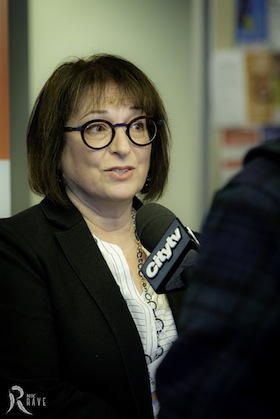
photo - Ivy Kopstein, coordinator of the substance use and addictions program at Jewish Child and Family Service of Winnipeg, answers a question from CityTV at the forum Wide Awake
Ivy Kopstein, coordinator of the substance use and addictions program at Jewish Child and Family Service of Winnipeg, answers a question from CityTV at the forum Wide Awake. (photo by Nik Rave)

Another resource now available in Winnipeg are the RAAM clinics that have been instituted recently by the WRHA to provide low-barrier access to resources for individuals needing help with substances abuse issues, including crystal meth.

“The City of Winnipeg and law enforcement are responding to the crisis on the streets and have included public education programs in all areas of the city,” said Ivy Kopstein, coordinator of the substance use and addictions program at JCFS Winnipeg. “Our mayor is advocating to all levels of government for resources to deal with this health crisis.”

“Emergency Medical Services (EMS) has now been given the authority to give meth users the antipsychotic drug Olanzapine,” Simkin offered by way of an example.

When a loved one has a substance abuse issue, it impacts the whole family, she said. Family members may feel stressed and anxious and it’s important for them to also seek support.

In British Columbia, the B.C. Centre on Substance Use (bccsu.ca) “is a provincially networked organization with a mandate to develop, help implement and evaluate evidence-based approaches to substance use and addiction.” Other resources include Crystal Meth Anonymous (crystalmeth.org), which is similar to Alcoholics Anonymous and lists a meeting place on Hornby Street in Vancouver, and Jewish Addiction Community Services (778-882-2994 or [email protected]).

Rebeca Kuropatwa is a Winnipeg freelance writer.
Format ImagePosted on January 18, 2019January 16, 2019Author Rebeca KuropatwaCategories NationalTags addiction, drugs, health, meth
Dealing with the water crisis

Dealing with the water crisis

An experimental date palm orchard in the southern Arava Valley, where water consumption and response to salinity is monitored. Based on data measured in these lysimeters, local farmers are advised on recommended quantities of irrigation water daily. (photo from Zehava Yehuda)

“Growing up in Israel, I have been aware of the water problem [since] quite early in my childhood,” said Dr. Zehava Yehuda. “When I graduated, however, the country was still relying mostly on rain. We could still expect rain-blessed years, and the Sea of Galilee to overflow occasionally.”

Over the last two decades, however, only once has there been a year with enough rain to allow for the opening of the Degania Dam, which regulates water levels in the Sea of Galilee (the Kinneret) and the lower Jordan River.

Yehuda spoke on Nov. 27 at a Winnipeg Friends of Israel event at the city’s Temple Shalom. She recently moved to Winnipeg with her family and is currently working at the local Jewish National Fund office as program and communications coordinator, while searching for a research position.

“I graduated from the Hebrew University, faculty of agriculture, department of soil and water, worked on iron uptake in plants, and did post-doctoral studies on phytoremediation of soils contaminated with heavy metals,” said Yehuda. “Phytoremediation is the use of hyper-accumulator plants that tolerate and are able to absorb high concentrations of specific metals.

“I worked as a lab manager and associate researcher at the HU, and as a soil and water researcher at the Centre for Agricultural Water Use Efficiency Research, Southern Arava Research and Development Experimental Station, Yotveta.”

According to Yehuda, soil and water are fundamental resources affecting all forms of life, food security and ecosystem sustainability.

Israeli water authorities have been streamlined to funnel through one office to simplify management and five large-scale desalination plants have been built, she said. Desalinated water now accounts for about 85% of domestic urban water. However, the plants were built late in the crisis.

“Israel is facing a five-year drought that is depleting the country’s most important bodies of water and deteriorating their quality,” said Yehuda. “Israel had not foreseen a sequence of arid years like this.

“The cumulative deficit in Israel’s renewable water resources before the current rain season amounts to approximately two billion cubic metres – an amount equal to the annual consumption of the entire state.

“There are many reasons for the current water situation,” she said. “First, Israel is situated in an arid region, where 60% of the county is desert. Meanwhile, population growth and standard of living have grown significantly.

“This not only has dramatically increased water consumption, but it has also aggravated the load on the coastal aquifer, one of the three major water resources in the country. Israel has also committed by peace treaties to transfer about 85 MCM [million cubic metres] to Jordan and the Palestinians … and, in fact, it transfers much more.

“Most of the water consumption in the world is used for irrigation. Israel has been recycling water for agriculture for decades. About 90% of fresh water is reused.

photo - Water scientist Dr. Zehava Yehuda speaks at a Winnipeg Friends of Israel event Nov. 27
Water scientist Dr. Zehava Yehuda speaks at a Winnipeg Friends of Israel event Nov. 27. (photo from Zehava Yehuda)

“Since the invention of drip irrigation in Israel, efforts have been directed to improving drippers, irrigation regimes and understanding plants’ actual water consumption to efficiently use water in agriculture.”

Further to this, Israel focused on innovative technologies to turn an older, expensive desalination solution into a more practical one, by improving the membranes that remove the salt and reducing the energy needed to run the plants.

“As of today, about 40% of drinking water in Israel is supplied as desalinated seawater, and this percentage is expected to grow even more,” said Yehuda.

Because the membranes also strip the water of other essential nutrients, she said Israel’s water authorities have been supplementing the desalinated water with, for example, “magnesium, a mineral critical for proper heart functioning, among other functions,” but it is expensive to do so and “[a]dding it to all desalinated water would significantly raise its cost.”

Another concern with desalination is that the brine (removed salt) is being returned to the sea, and the ecological implications for the sea are not fully known.

“With all this desalinated water available, both the population and the Israeli authorities wrongly assumed that Israel had solved her water problems, and that saving water was no longer a necessity,” said Yehuda. “The authorities have since changed their position back to the need to save water.”

Plans have recently been approved to build more desalination plants to better meet the growing need for water during the dry months and to redirect unused desalinated water during the winter months to the Sea of Galilee; in a sense, using the lake as a reservoir.

“The current crisis has led to the realization that a comprehensive master plan for policy and for institutional and operational changes is required to stabilize the situation, and to improve Israel’s water balance with a long-term perspective,” said Yehuda.

“Despite the fact that water pumping from the Kinneret was massively reduced, I do not expect water levels to return to what they were 15 years ago when Lake Kinneret – Israel’s biggest fresh water source – and underground aquifers were full. Hopefully, resources will not continue to deteriorate.”

Yehuda provided a rundown of the different water-related experiments with which she has been involved, including an experimental date palm orchard in the southern Arava Valley, where water consumption and response to salinity is monitored. Based on the data collected, local farmers are advised on recommended quantities of irrigation water daily.

Event attendee Carina Blumgrund said, “We all know that Israel is at the forefront of developing smart resources to irrigate, and that they had done drip systems and are always trying to research how to be proactive, like taking advantage of the heat to have off-season production and export to Europe … but we don’t really know about the details…. It was really interesting hearing about current issues. I had no idea about water levels…. And I didn’t know about the treaties, about sharing with neighbours.”

Rebeca Kuropatwa is a Winnipeg freelance writer.
Format ImagePosted on January 18, 2019January 16, 2019Author Rebeca KuropatwaCategories IsraelTags desalination, environment, water
Camp for those with aphasia

Camp for those with aphasia

Sea to Sky Aphasia Camp provides a three-day retreat to 30 campers and their family members at Zajac Ranch in Mission, B.C. (photo from Sea to Sky)

Aphasia is a communication impairment most often caused by stroke, but it can also be due to any brain injury. It impacts a person’s ability to speak, understand spoken language, and the ability to read and to write.

“It’s important to understand that, while communication is impaired, a person’s cognitive function is not,” said Eavan Sinden, a speech-language pathologist at the University of British Columbia, about the condition. “This is something Sea to Sky [Aphasia] Camp focuses on – that we can create a communicably accessible and supportive environment, while acknowledging the inherent competence.

“But, there are some prominent researchers in the world of aphasia now who are looking at expanding on [the] definition … so that it would include the impact of aphasia on a person’s life – the impact it has on a person’s identity, on a person’s ability to participate in social events, their ability to work, their ability to be in the role that we assume … mom, dad, daughter, whatever … changing the definition a little bit to include that impact.”

Out of the 100,000 people in Canada who will suffer a stroke this year, 35% of stroke survivors will live with some form of aphasia. Further to that, 62% of these survivors will experience depression after the stroke.

Sinden teaches and does research at UBC’s School of Audiology and Speech Sciences. One of her primary roles within the school is to coordinate the Sea to Sky camp every September. This fall, it will run Sept. 20-22.

The camp, which is entering its 10th year, provides a three-day retreat to 30 campers and their family members at Zajac Ranch in Mission, B.C., in a facility specifically designed for people with unique abilities and challenges.

To make the camp a reality, Sinden and UBC partner with Douglas College’s therapeutic recreation program, and March of Dimes Canada. “There’s a lot of support for this camp,” Sinden told the Independent. “In addition to being a camp for people with aphasia, those 30 campers come with family or friends, if they choose.

“We also have 36 healthcare-professional students who come for the weekend to learn a little bit more about what it’s like to live with a chronic impairment, such as aphasia. They are speech-language pathology students, audiology students, therapeutic-recreation students, nursing, pharmacy, dental hygiene and physiotherapy – a whole range of care students who opt, every year, to do this. Without them, we wouldn’t have enough support. It’s really great to have these layers of partnerships in the community. They really help create that communicably accessible environment.”

There is also a group of clinical leads, healthcare professionals in the community, who have been working with aphasia and who volunteer the weekend of the camp to work with the students.

A disturbing trend, according to Sinden, is that aphasia is affecting younger and younger people. “This is the frightening part,” she said. “We have people anywhere from 30 or 31 to their late 70s or early 80s, a real range, but the majority are in their 50s and 60s. It’s no longer something you’d think just happens to older people. The Heart and Stroke Foundation has written quite a few reports on that.”

At Sea to Sky, participants can do yoga, horseback riding, cooking, singing, dancing, campfires, basketball, swimming, arts and woodwork.

“A lot of our activities are run by people with aphasia, as well, who have come to the camp for many years and are now leaders in that way,” said Sinden. “The students also take a role in working on some of those activities.”

All accommodations and meals are included in the $250 cost for the weekend.

“It’s a really terrific way for people with aphasia in the community to come together, socialize and be with people who’ve been on similar journeys,” said Sinden. “Aphasia can be very isolating, so it can be incredibly powerful to meet people with whom you have a shared experience, who you can see that idea of, ‘OK, I can do this.’ Maybe, if I’m a little earlier on in my recovery and I see someone 10 years post doing something that I didn’t think would be possible … that can open up opportunities.

“We have a great core group who come year after year,” she added. “But, I have to say, especially this year, we had quite a number of newcomers, which is exciting. We’re always trying to extend our reach and support the community of people with aphasia.”

While the number of people suffering from aphasia has increased, the camp has been able to accommodate the demand – but just barely, due to space and funding.

“We’re fortunate in that March of Dimes, UBC and Douglas College support us with grants, but every year we hope to still get the funds,” said Sinden. “It’s never a sure thing. There’s a huge need for more community support. If we could take more campers or run more camps, we would also be happy to do that and it’s something on our wish list.”

This year, Sinden is starting a campaign called Sponsor a Camper, asking donors to give $250 so someone can attend the camp. Other support is raised via the Stroke Recovery Association of British Columbia and Fraser Health.

For more information, visit srabc.ca or aphasia.ca.

Rebeca Kuropatwa is a Winnipeg freelance writer.

Format ImagePosted on January 18, 2019January 16, 2019Author Rebeca KuropatwaCategories LocalTags aphasia, British Columbia, camp, Eavan Sinden, health
Organ donation awareness

Organ donation awareness

Left to right are panelists at a recent National Council of Jewish Women panel on organ transplants: Dr. Aviva Goldberg, Rabbi Yossi Benarroch, Marshall Miller and Na’ama Miller. (photo from NCJW)

On Dec. 11, the Winnipeg section of National Council of Jewish Women (NCJW) held an organ donation awareness event, featuring community members Rabbi Yossi Benarroch, Dr. Aviva Goldberg, and husband (organ recipient) and wife (organ donor) Marshall and Na’ama Miller.

Benarroch spoke first, after a welcome from organizers and a video about organ donation (youtube.com/watch?v=5cfaAWTH5zM).

“The short of it is, basically, that Jewish law permits organ donations,” he said. “There’s no question about that. Of course, when we talk about law, law is complicated and there are lots of opinions. There’s an ideal in Judaism, which is one of those foundations, and it’s called ‘pikuach nefesh doche hakol’ … which basically means that, in Judaism, there’s nothing more important than saving a life.

“I’m a very observant Jew and I keep kosher,” he said, “but if I had to eat something that wasn’t kosher – pork or whatever – in order to save my life, then Jewish law says you’re obligated to do that.”

Benarroch said it is written that, if someone saves a life, it is as if they have saved the entire world. Furthermore, he said, we are called to not stand idly by if another person is suffering. “We are obligated to intervene and actually obligated to help that individual,” he said.

Marshall Miller, who was diagnosed with progressive kidney disease more than 25 years ago, eventually required replacement therapy.

“Slowly, over time, my kidney failure began to get worse and worse,” he shared. “The disease progressed to the point where, a few years back, my GP at the time said, ‘Marshall, you’re now at the point where you have to go see a specialist because I can’t do anything more for you here … you need an expert to deal with your situation.’

“Everybody who suffers from kidney disease understands that, what kidneys do, among many things, is purify your blood. When your blood isn’t being purified properly, you can start to feel kind of lousy. I think my family can attest to the fact that I was starting to feel lousy. I think my whole family suffered along as I did, as I got sicker and sicker.”

When his kidney function was down to less than 10%, the specialist started talking seriously about replacement therapy. This involved dialysis three times a week until a matching donor could be found.

During the search for a donor, Na’ama Miller decided to find out if she might be able to help other people in her husband’s situation. As it turned out, she was a match for her husband.

“We were told it was a one hundred million shot,” she said. “And so, we were next faced with a bit of a dilemma … because it was scary for the kids. But Samantha and Maya were very much in favour of it, because they didn’t want me to be miserable anymore.”

She said, “People ask me, how I could do this … if it was hard. I give everyone the same answer. It was a no-brainer, a very easy decision for me. As Marshall said … we were all suffering along with him.”

“It’s worth it. You saved a life,” her husband added. “We hope this event here – even if only one more person signs up … hopefully, more and more people will choose to do it among the Jewish community after hearing the story.”

After the Millers spoke, a second video was screened, about a former Winnipegger who donated a kidney to save the life of a woman in California, who he has never met.

“Right now, in Canada, there are over 4,500 people waiting for an organ transplant – 4,500 Marshalls,” said Goldberg, who is the director of the Canadian Society of Transplantation and chair of the Transplant Manitoba kidney allocation review committee. “We don’t have 4,500 Na’amas. That’s why we need donors – both living and also deceased donors.

“That’s what we want to talk about today,” she said, “even if you don’t go forward to become a living donor, which is a really big deal. It’s not something that every person in this room is going to be able to do and that’s totally fair. But, there’s something that everyone in this room can do and that’s to sign up for organ donation after you’ve died – say that this is something I’d like to do, that you’d like to leave a legacy … you can save lives after you’ve died, either with organ or tissue donation. You can save lives by donating organs – heart, liver, lungs, pancreas, kidneys and even small bowel – but, also tissue donation.”

In some cases, people can donate their corneas to help improve the life of others. According to Goldberg, Manitoba, last year, was the fourth on the world list of most donors.

While Goldberg implored people to sign up as donors online, she further reminded them that talking to family about your willingness to be a donor is also very important – and not just immediate family, as they might be in the same car with you when you have a horrific accident, for example.

“The way that organ donation works in Canada, here, in Manitoba, is that after someone has died and they are potentially going to be an organ donor, their family is approached,” said Goldberg. “If you sign up for the registry, it’s a way of saying to your family, on the very worst day of their lives, that this is something your loved one wanted – wanted so much that they went to the registry, signed up, made that choice. It’s a hard discussion to have … [but] it’s so important to do.”

During the question-and-answer period, one attendee asked if there was an age limit for someone to donate an organ. The answer? “No.”

Another question was about the possibility of rejection and, to that, Marshall Miller shared his experience. “I suffered from a mild early rejection,” he said. “But, the ability to detect the rejection and be able to remedy it is incredible. They were able to treat me with medication instantaneously and, really, it was a non-issue for me. Even though there is a risk of rejection, it can easily be found if you attend your appointments and take your medication.”

For information on organ donation in British Columbia and to register, visit transplant.bc.ca.

Rebeca Kuropatwa is a Winnipeg freelance writer.

Format ImagePosted on January 11, 2019January 9, 2019Author Rebeca KuropatwaCategories NationalTags healthcare, Judaism, NCJW, organ donation

Posts pagination

Previous page Page 1 … Page 6 Page 7 Page 8 … Page 31 Next page
Proudly powered by WordPress