Skip to content
  • Home
  • Subscribe / donate
  • Events calendar
  • News
    • Local
    • National
    • Israel
    • World
    • עניין בחדשות
      A roundup of news in Canada and further afield, in Hebrew.
  • Opinion
    • From the JI
    • Op-Ed
  • Arts & Culture
    • Performing Arts
    • Music
    • Books
    • Visual Arts
    • TV & Film
  • Life
    • Celebrating the Holidays
    • Travel
    • The Daily Snooze
      Cartoons by Jacob Samuel
    • Mystery Photo
      Help the JI and JMABC fill in the gaps in our archives.
  • Community Links
    • Organizations, Etc.
    • Other News Sources & Blogs
    • Business Directory
  • FAQ
  • JI Chai Celebration
  • JI@88! video

Recent Posts

  • Zionism wins big in Vegas
  • Different but connected
  • Survival not passive
  • Musical celebration of Israel
  • Shoppe celebrates 25 years
  • Human “book” event
  • Reclaiming Jewish stories
  • Bema presents Perseverance
  • CSS honours Bellas z”l
  • Sheba Promise here May 7
  • Reflections from Be’eri
  • New law a desecration
  • Resilient joy in tough times
  • Rescue dog brings joy
  • Art chosen for new museum
  • Reminder of hope, resilience
  • The national food of Israel?
  • Story of Israel’s north
  • Sheltering in train stations
  • Teach critical thinking
  • Learning to bridge divides
  • Supporting Iranian community
  • Art dismantles systems
  • Beth Tikvah celebrates 50th
  • What is Jewish music?
  • Celebrate joy of music
  • Women share experiences 
  • Raising funds for Survivors
  • Call for digital literacy
  • The hidden hand of hate
  • Tarot as spiritual ritual
  • Students create fancy meal
  • Encouraging young voices
  • Rose’s Angels delivers
  • Living life to its fullest
  • Drawing on his roots

Archives

Follow @JewishIndie
image - The CJN - Visit Us Banner - 300x600 - 101625

Byline: Cynthia Ramsay

Flamenco of contrasts

Flamenco of contrasts

Lili Flamenco / Liat Har Lev performs two solos in the Dance Centre’s Open Stage Edition #3 on May 6, 8 p.m. (photo from Lili Flamenco)

The Scotiabank Dance Centre’s Open Stage Edition #3 on May 6 includes two solos choreographed and performed by Lili Flamenco / Liat Har Lev: We Shall Not Forget, dedicated to the six million Jews killed in the Holocaust, and Lemons, in the flamenco style Alegrias, which means “happiness” in Spanish.

“Although my family was not directly affected by the Holocaust, growing up in a Jewish family I heard and learned about it…. I created this piece with the hope that I and the audience will connect to the experience of the victims and survivors on a deeper level and remember what they endured just because they were Jewish,” Har Lev told the Independent.

In contrast, she said, “Lemons has an uplifting, joyful mood and a vibrant rhythm, harmony and pulse. It has more of a traditional flamenco flavour and will be performed with a guitarist [Peter Mole] and singer [Pat Keith]. It is inspired by my personal artistic journey and celebrates optimism and grit. I chose to perform it in conjunction with We Shall Not Forget because it has a lighter mood … and is completely different stylistically.”

Har Lev performed We Shall Not Forget last year as part of the Dance Centre’s International Dance Day events. (See jewishindependent.ca/a-celebration-of-dance.)

“I started developing We Shall Not Forget in 2020 during the pandemic with the support of the 12 Minutes Max program. I had access to support and feedback from facilitators, I received subsidized studio space at Scotiabank Dance Centre, and had the opportunity to participate in an informal public showing which, unfortunately, had to be featured on Zoom because of the pandemic. I never actually performed We Shall Not Forget to a live audience.”

In addition to Har Lev, Open Stage Edition #3 features dance works by Kiruthika Rathanaswami and Malavika Santhosh (in the classical Indian dance style of bharata natyam), Lili Shilpa Shankar (bharata natyam) and Voirelia Dance Hub (contemporary dance). For tickets, visit thedancecentre.ca.

Har Lev will also be performing at the Festival of Israeli Culture at the Jewish Community Centre of Greater Vancouver on May 14.

Format ImagePosted on April 28, 2023April 26, 2023Author Cynthia RamsayCategories Performing ArtsTags Alegrias, dance, Festival of Israeli Culture, flamenco, Holocaust, Liat Har Lev, Lili Flamenco, Scotiabank Dance Centre
Rabbi launches book at BI

Rabbi launches book at BI

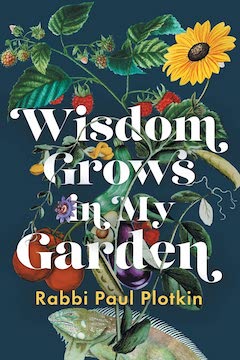
Rabbi Paul Plotkin returns to Congregation Beth Israel for the Canadian launch of his new book, Wisdom Grows in My Garden. (photo from AIA Publishing)

In part to fill his need to nurture – his kids off to college and his congregation less reliant on him – Rabbi Paul Plotkin took up gardening. Not only has he produced some of the most expensive tomatoes, taking into account all the capital that goes into every one that makes it into a salad or sandwich, but he has produced a new book: Wisdom Grows in My Garden (AIA Publishing). And he will launch that book in Canada on May 10, 7:30 p.m., at Beth Israel Synagogue, where he began his rabbinical career.

“I started in the summer of 1976 as Rabbi [Wilfred] Solomon’s first assistant, and he left for Israel after breaking his Yom Kippur fast on the way to the airport, and the 26-year-old ‘kid’ took over. Rabbi [Marvin] Hier was away from the Schara Tzedeck for most of the year preparing to build what was to become the Simon Wiesenthal Centre, so I was thrust into the position of often being the Vancouver non-Reform senior rabbi. It was quite a ride. It was a good thing I didn’t know what I couldn’t do, or I would have been paralyzed with fear. Instead, I jumped in and went to work.”

While BI was his first pulpit, Plotkin said, “I had been a youth director of my home synagogue while in college and in New York while at the seminary. I learned a lot about programming and leadership from those jobs and translated it into heading a synagogue.”

He admitted that the experience “was not without mistakes but what I couldn’t entirely appreciate was the menschlichkeit of my members. They appreciated my enthusiasm, my passion and my sincerity and pardoned most of my excesses and faults. It was a truly Canadian thing. I know now how special it was because my other two congregations in Florida were a lot different. Years later, I would share privately that my ‘worst critics’ in Vancouver treated me better than my good friends in Florida. By being thrown into the fire and succeeding – succeeding was a low bar, if the shul was still standing when Rabbi Solomon returned, I would have been praised – I learned of the potential people had for change, of their desire for knowledge, and that I could actually help transform people into greater commitment to mitzvot and the Jewish people.”

Plotkin was born and raised in Toronto, but has lived in South Florida for more than four decades. He is rabbi emeritus of Temple Beth Am and served on the Rabbinical Assembly’s committee on Jewish law and standards for some 20 years. He is the founding chair of its kashrut subcommittee and also is in charge of kashrut for Ben’s Kosher restaurant chain. He loves food and cooking. And Canada still holds a special place for him – he and his wife own a townhouse in Whistler, “primarily as a new summer cottage for after retirement,” he said. “We will be there for four months this summer.”

An avid writer, publishing articles in various newspapers and magazines, Plotkin has a blog on medium.com. He published a book some 20 years ago – The Lord Is My Shepherd, Why Do I Still Want?: Ancient Wisdom for the Modern Soul (Eakin Press) – but waited until retirement to write his second.

“First, in those days, I had to triage my time and creative mental energy. I also needed more age and seasoning for all of the pieces to melt together. Pirkei Avot teaches us to see wisdom in the elderly. Great red wine isn’t great in its first year. It takes years to develop nuance and subtlety. Creation of the book was no different.”

The idea came to him in a dream, he said.

“Unfortunately, I was still in my active work years, with an 1,100-family congregation. Finding time to breathe was hard, let alone write a book, so I made it a priority in retirement. Over the years after the dream, new ideas would come to me in the garden and I would jot them down and throw them into a file with the dream material.”

image - Wisdom Grows in My Garden book coverIn describing the book, Plotkin said, “Technically, it is a narrative memoir, because it is my story and told entirely from my perspective, but it is not in its heart a memoir. It revolves around the garden, but you won’t improve your tomato growing by reading the book. It is, in essence, a life lesson book (indeed, there are 25 life lessons in the book) that will help guide you to a better life. It is filled with humour and stories, two tools that featured prominently in 40 years of sermons. It will offer the reader some important guides to navigating a better life. I like to tell Jewishly knowledgeable audiences that the garden was my ‘Torah,’ my book is the Midrash.”

Plotkin said “gardening is a wonderful emotional and humbling pastime” and cited a recent article that “extolled its value as an alternative choice for exercising.”

“If you haven’t got time,” he said, “try a few herbs in a pot on the windowsill. If you have a black thumb, grow zucchini. In northern climates, everyone grows so many, they start to call friends they don’t have to offer them some. If you read the book, the irony of this last statement will become clear.”

Of the feedback he has received so far – from readers in his own demographic, as well as that of his mid-40s son, from Jews and non-Jews, from observant people and atheists – Plotkin said, “much to my shock, they all liked it and, yet, like a Rorschach test, they all found messages in my lessons that reflected their needs or interests. There is something in this book for everyone.”

Chapter 1 of Wisdom Grows in My Garden takes place at Beth Israel, said Plotkin. “I hope many readers and especially those who may remember me from their bar/bat mitzvahs and weddings that I officiated at will come out to the evening and say hello,” he said.

Format ImagePosted on April 28, 2023May 1, 2023Author Cynthia RamsayCategories BooksTags Beth Israel, education, gardening, lifestyle, Paul Plotkin
Powerfully against othering

Powerfully against othering

Into the Little Hill runs May 19 and 20 at SFU Goldcorp Centre for the Arts, Fei and Milton Wong Experimental Theatre. (photo by Flick Harrison)

“Into the Little Hill is a powerfully emotional opera,” soprano Heather Pawsey told the Independent.

Pawsey is the artistic director of Astrolabe Musik Theatre, which, with Simon Fraser University Woodward’s Cultural Programs, is presenting the opera’s Canadian première May 19-20. A multidisciplinary, modern take on the medieval story of the Pied Piper of Hamelin, Into the Hill features two singers, three dancers and live music. Written by English composer George Benjamin with libretto by Martin Crimp, Jewish community member Idan Cohen of Ne.Sans Opera and Dance is the local production’s director and choreographer.

“From the moment I first heard Into the Little Hill, I knew I had to have dancers in the production,” said Pawsey. “My company, Astrolabe Musik Theatre, has been experimenting with dance and movement in classical music, in varying degrees, for over 10 years now. Dance and movement are such normal, natural, innately human ways of expression, yet we see it so rarely in opera and classical music.”

When she heard Into the Little Hill, she said, “I literally saw the dancers in my mind … and knew that this was the perfect opera to intentionally incorporate them as amplifications of the characters, as commentators on the story, and as true partners with the singers (who are also precisely choreographed).”

After that, she was just “waiting for the perfect person with whom to work.” And she found that person in Cohen – his company, Ne.Sans, exists to reimagine and reconnect opera and dance.

“When Idan and I met in Amsterdam in 2018 on an opera I was singing and he was directing, I knew at the first rehearsal that he was the person I’d been waiting for: someone who knows music, who knows dance, who can work with professional dance artists and with singers who may have little or no dance training, and whose knowledge and experience come together in a profound understanding of the possibilities of singing and dance.”

“We’ve connected on so many levels,” said Cohen of Pawsey, who introduced him to Into the Little Hill. “Since then,” he said, “we’ve enjoyed many long conversations about this wonderful opera that is so close to both our hearts. I am so excited to finally be able to share our version of this brilliant work.”

“As far as I know,” said Pawsey, “l’Opéra de Montréal is the only other company in Canada to have produced one of George Benjamin’s operas (Written on Skin, his second). In 2014, I watched Written on Skin on MediciTV and literally got goosebumps. Singing contemporary music is a huge part of my career, yet I had never heard of this composer nor heard music anything like his: crystalline, precise, profound, spare, yet filled with emotion, colour, shadow, passion and power. I looked him up immediately and discovered that Into the Little Hill was (at that time) the only other opera he’d written…. I knew then that I had to produce (and sing!) it; that it would have dancers; and, voilà! A decade later, here we are. This opera speaks so profoundly against ‘othering.’ I know that people will come away having experienced something powerful, intense and beautiful.”

Pawsey and mezzo-soprano Emma Parkinson sing all six of the opera’s characters.

“One of the things I love the most about Into the Little Hill is its exquisite precision,” said Pawsey. “Vocally, orchestrally, dramatically, dramaturgically there are no extraneous notes, no extraneous words, and the power of this concentration is intensified by having only two singers portray all the roles. We aren’t distracted by multiple singers coming on and off the stage, nor by the differing ranges and timbres of their voices – we have focus.

“We also have gender-neutrality, something that is difficult to achieve in traditional opera, where characters’ genders have historically been determined by voice-type (ie. tenor, soprano, etc.). Having only two singers sing all the roles makes gender, sexual orientation or how one presents to the world irrelevant, and leaves the make-up of the characters to each individual audience member’s imagination. As an artist, it frees me from having to imagine or recreate assumptions about how ‘men’ or ‘women’ move, behave and speak (sing), and allows me to enter fully into what that character is actually expressing. My hope is that this also helps audiences to identify more freely with the characters.”

The opera speaks to Cohen on many levels.

“As a queer artist, a descendant of Holocaust survivors, coming to Canada from Israel/Palestine, I have always valued the importance of raising voices of underserved communities and to acknowledge our troubled past, learn from it, and aspire to do better,” he said. “I chose to leave my country in search of a better future and, as I arrived in Canada in 2017, I was amazed to find how relevant the history of Canada is to my own, from multiple angles, both as the oppressed and the oppressor, often against my will.

“My work is embedded in this life experience and perspective, and I am passionate in telling classical stories through alternative lens,” he continued. “Into the Little Hill is such a powerful opera that speaks of the human condition in a very creative way. There are different ways to speak of the tragic history of Western culture, and one of the reasons I chose to be an artist is because I see the importance of speaking of the violence and hurt, and to fight against discrimination.

“This opera is such a great, complex example of the fact that there is no one source of harm, and not one source of knowledge and perspective,” he said.

Critics have generally lauded Into the Little Hill, though some have expressed concern over the way in which the story is told.

“The narrative style of this opera imposes a certain detachment or distancing,” Pawsey said. “Traditionally, opera is all about emotion – big, huge, dare I say OPERATIC emotion! Here, Martin Crimp’s libretto uses Brechtian techniques (such as the Narrator directly addressing the audience, breaking the fourth wall, etc.) to discourage the audience from becoming too emotionally involved. Brecht used these techniques to encourage a deeper focus on the socially significant aspects of the story. This is particularly relevant in this opera’s tale of ‘who are we labeling as the “rats” in our society, what are we willing to do to get rid of them and what happens when we refuse to “pay the piper,” ie. take responsibility for the consequences of our actions?’

“Detachment, distancing – this is what we, as humans, do when we label, when we ‘other,’ when we divide into ‘us’ and ‘them.’ It’s a part of the de-humanizing process, which allows us to plan or to undertake horrific acts. But this is not to say that audiences will feel emotionless at the end of Into the Little Hill,” she stressed. “Fascinatingly, the muting of emotion evoked for individual characters and their stories makes us feel even more deeply and keenly the emotion of the story overall and how its outcome affects all the characters – and, by extension, us.”

Into the Little Hill takes place at SFU Goldcorp Centre for the Arts, Fei and Milton Wong Experimental Theatre. Conductor Leslie Dala is music director for the production, whose orchestration includes bass flute, basset horns, mandolin and banjo. Lighting design is by Victoria Bell, with costume design by Elena Razlog. The dancers are Juolin Lee, Daria Mikhalyluk and Hana Rutka.

For tickets and more information, visit littlehill.eventbrite.ca.

Format ImagePosted on April 28, 2023April 26, 2023Author Cynthia RamsayCategories Music, Performing ArtsTags Astrolabe Musik Theatre, dance, Heather Pawsey, Idan Cohen, Into the Little Hill, Ne. Sans, opera, theatre
Creating opportunities

Creating opportunities

The Jerusalem Business Development Centre (MATI) helps people create or expand businesses in Jerusalem. Two leaders of the Israeli organization visit Vancouver on May 11 as part of a Canadian tour. (photo from CFHU Vancouver)

Every year, the Jerusalem Business Development Centre, known in Hebrew by the acronym MATI, helps thousands of people create or expand businesses in Jerusalem. It does this through a range of services – from personal mentoring to training in various fields to the granting of loans – focusing its efforts on new immigrants, the ultra-Orthodox and residents of East Jerusalem.

On May 11, as part of a Canadian tour, Michal Shaul Vulej, deputy chief executive officer of MATI, and Reham Abu Snineh, MATI’s East Jerusalem manager, will be in Vancouver for “a conversation about shared living in Jerusalem, about mentoring and creating entrepreneurial opportunities for women and promoting diversity as strength.”

Abu Snineh joined MATI in 2011, as a project coordinator for a program to promote women’s entrepreneurship in East Jerusalem. Today, she heads the East Jerusalem branch, leading a team of seven employees.

“The beginning was challenging,” she told the Independent. “The decision to join an Israeli organization was inconceivable. I was afraid of the reactions and criticism of those around me. It also took me awhile to get comfortable with the staff. In addition, I did not speak Hebrew. I grew up in East Jerusalem and studied for my law degree and, later, further degrees in Jordan. All of my studies were in Arabic and I had never considered working with an Israeli organization. I realized that, if I ever wanted to really be able to help my community, I had to find a way to move forward and, over time, things settled down and today I feel completely part of the team.”

For Abu Snineh, it’s the social impact of MATI that most excites her – “The feeling that I am helping people in a difficult socioeconomic situation; helping individuals, families and women to improve their economic situation in general.”

For Shaul Vulej, it’s the “combination of social welfare and the entrepreneurship and business development – the stories of the women who manage to start a business, make a living and be financially independent, and even employ other women.”

MATI measures success by the number of participants, the number of businesses that develop, the number of businesses that expand and the number of new jobs that are created in Jerusalem because of its activities. All MATI’s programs include participant feedback, an annual review and an evaluation process.

Abu Snineh and Shaul Vulej shared one of MATI’s success stories with the Independent, that of Hiba, a fashion design instructor. They said Hiba, 36, grew up in East Jerusalem in a traditional Muslim family and was married at age 16. Despite various factors hindering her progress, she studied fashion design and proceeded to hold several jobs. She wanted to establish a sewing and fashion design school, so she joined some of MATI’s programs: the business establishment and management course, a digital marketing workshop and, recently, a program for import/export from Turkey, which will allow her to import fabrics herself. Together with her artisan husband, she rented an apartment and currently trains several groups, as part of a professional training project for teenagers, and promotes her business.

About 60% of MATI’s clientele are women, who have a range of educational backgrounds. The organization focuses on residents of East Jerusalem who are looking for employment, people who want to start a business, and existing business owners who need assistance to take the next step.

Abu Snineh described some of the challenges people living in East Jerusalem face. Difficulty communicating in Hebrew contributes to a “difficulty in being able to develop entrepreneurship and businesses that can be relevant also in Western Jerusalem, a barrier in the ability to market and sell goods and services to the Hebrew-speaking public, a barrier in dialogue with institutions and authorities in the business framework.”

A lack of trust in the Israeli government system, which does not recognize many of the East Jerusalem businesses as legal entities, has “created a situation where legal business owners in the country received grants, [while] many of the businesses in East Jerusalem (mainly small and medium-sized ones) were left without the financial security granted to others,” said Abu Snineh.

Other factors include the political and security situation, digital barriers that make it difficult to market outside of East Jerusalem or online, insufficient knowledge about business laws, “which blocks the ability to make the business legal and granting rights alongside obligations,” and “a lack of domestic and foreign tourism.”

When asked how Vancouverites could help or participate in MATI, Abu Snineh and Shaul Vulej said, “To help us establish the first hub in East Jerusalem…. A hub would provide the appropriate and technology atmosphere similar to other areas in the world.”

Also needed, they said, is support for “all the ongoing programs that provide for the progress of Arab society in East Jerusalem” and for “a program for the advancement of women in East Jerusalem.”

The May 11 event is presented by the Jerusalem Foundation in partnership with Canadian Friends of Hebrew University, and it is sponsored by the Asper Foundation, as well as the Canadian Memorial United Church. It takes place at the Canadian Memorial Centre for Peace, 1825 West 16th Ave., starting at 7 p.m. To reserve a spot, visit cfhu.org/upcoming-events or call 604-257-5133.

Format ImagePosted on April 14, 2023April 12, 2023Author Cynthia RamsayCategories Israel, LocalTags Asper Foundation, business, Canadian Friends of Hebrew University, CFHU, economy, education, equality, Jerusalem, Jerusalem Foundation, justice, MATI, women
Part of New Wave’s Season 3

Part of New Wave’s Season 3

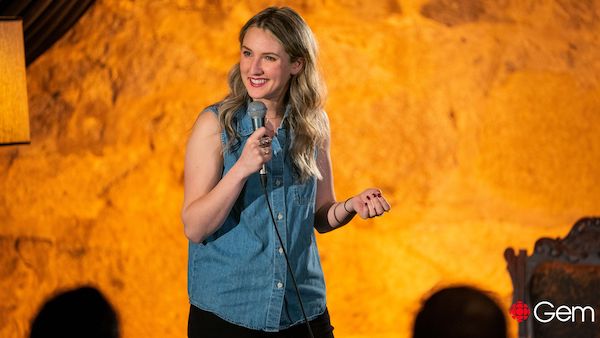
Laura Leibow is one of the 14 comics featured on The New Wave of Standup, now streaming on CBC Gem. (photo by Emily Cooper)

The whole thing was a highlight really! I still kind of had that post-COVID ‘I can’t believe I get to take the stage again’ sense of wonder in me at that time,” comedian Laura Leibow told the Independent. “Combine that with getting to see comics I respect and love do their thing made the whole experience very cool. Plus, I love staying in hotels.”

Leibow was speaking about the taping of the latest season of The New Wave of Standup, a Just For Laughs Vancouver and CBC original series, which is now streaming on CBC Gem. Leibow and fellow Jewish community member Jacob Balshin are two of the 14 comics featured on the show.

“I try really hard to approach taped sets in the same way I’d approach ones that are not being taped because, ultimately, it’s just about that live experience between you and the crowd and, hopefully, the tape will capture that,” said Leibow. “The only major difference is I mind the subject matter I cover a little more when I’m being filmed, so my mommy and daddy don’t get mad at me!”

Balshin went into the New Wave set having worked out more of what he was going to say than he usually does. “I love writing and try and work every day on my comedy. I do not like repeating the same set over and over again though,” he said. “It can make me depressed. Leading into the taping, I only ran the set a few times. I was just getting back into comedy after the last COVID lockdown in Ontario and did not want to take a break from having fun to repeat the same jokes over and over. I try not to overthink things. Comedy is the easy part of my life. The rest is the struggle.

“After I got off stage that night, I went to another show,” he said. “It was next door to where we were shooting and was actually part of a tour I was on…. I was able to make it in time to do my spot. I bombed trying new stuff. No one in the audience knew I had just filmed for TV 20 minutes earlier. Both sets held the same weight to me – I just want to make people laugh, and get better. I do not think any one set matters that much. And, if it does, I will be prepared because I know I have put in the work.”

It took Balshin time to find his comedic voice. “I did not know my own voice when I started comedy, so I would speak like other people who I was a fan of,” he said. “Now, it is not something I think about. Everything I do is naturally me. And that feels like a really good place to be – and something I always wanted. To me, the goal is to be yourself. Anyone can be funny, but only you can be yourself. So, over the years, it has been more about actually living a life and less about what happens on stage.”

While Leibow seems to have experienced a less drastic evolution, she, too, has reached the point where, she said, “I’m far less concerned now with trying to impress certain people than I am with just talking about what I think is funny.”

Leibow said, “My comedic voice is driven largely by my ADHD [attention-deficit / hyperactivity disorder], friendship, laughter, feminism, silliness, clay, and Jews. No, I don’t know if I can really nail down my comedic voice other than saying that it really is largely driven by my scattered brain and throwing spaghetti at the wall. If something really tickles me, and it seems to be making other people laugh, then that’s great!”

Both Leibow and Balshin have topics they won’t cover in their acts.

“I won’t tell a joke that denigrates or harms a marginalized group and I prefer to stay in my lane when it comes to certain issues,” said Leibow. “I’m not going to boldly speak out of turn on a topic about which I’m not well informed. I also try not to violate the privacy of my family members. Unless I think of a good joke that would require me to do so.”

Balshin only writes material that is about him. “I only have my own story to tell,” he said. “I hope my comedy makes you feel good when you watch it. And I always feel bad when someone has a bad night. If any joke I ever tell hurts someone, I am interested to know why and am willing to listen.”

On stage, Balshin interacts with the audience quite a lot.

“It is a part of my comedy that naturally developed from doing comedy in rooms in Toronto, where the audience … [wants] you to feel present and talk to them,” he said. “I struggle with social anxiety off stage and rarely talk to people. It is pretty fun to have a space where that seems to not exist for me at all. And I love when the audience opens up to me. It feels like the reward I get for being so open with them. And to know they trust me sometimes is really special.”

photo - Jacob Balshin
Jacob Balshin (photo by Emily Cooper)

Balshin tours the country regularly. “I’ve performed in places with populations in the hundreds many times in my career. For many, I am the first Jewish person they have ever met,” he said. “From my own experience, I would say there is a big difference between hate and ignorance. I would say the vast majority of what I have encountered firsthand is ignorance. Most people though do not care that I am Jewish. We are all just people.

“I hope to be funny and genuine enough on stage so that anyone who came in with any misconceptions or hate towards Jewish people can recognize someone who has nothing but love to give. Even though we are different, we can all relate to the weird experience that is living.”

In addition to being part of The New Wave of Standup, Balshin’s debut standup comedy special will be airing on his YouTube channel in the next few months. “It’s called 30 and Breathing Funny,” he said. “It was recorded on my 30th birthday and it would mean a lot if you gave it a watch. It better showcases my style of comedy and includes some material about being Jewish that is not in the CBC taping.”

Balshin moved to Vancouver last year, after a breakup. “When I arrived at the airport, friends Bobby Warrener and Malik Ellassal [also on New Wave this season] picked me up and immediately helped the move feel far less lonely. Getting to do my first TV taping with both them a few months later helped relieve me of that same feeling of loneliness,” he said. “And getting to watch them both kill, knowing how hard they both work and how much they deserve it, was definitely a highlight. Go watch their episodes! They are two of the funniest young comics in Canada.”

Rounding out The New Wave of Standup lineup are Brendan D’Souza, Travis Lindsay, Rachel Schaefer, Courtney Gilmour, Charles Haycock, Seán Devlin, Dino Archie, Heidi Brander, Jackie Pirico and Mike Green. To watch, go to gem.cbc.ca/the-new-wave-of-standup.

Format ImagePosted on April 14, 2023April 12, 2023Author Cynthia RamsayCategories Performing Arts, TV & FilmTags CBC Gem, comedy, Jacob Balshin, Just for Laughs, Laura Leibow, standup, The New Wave of Standup
Who decides what culture is?

Who decides what culture is?

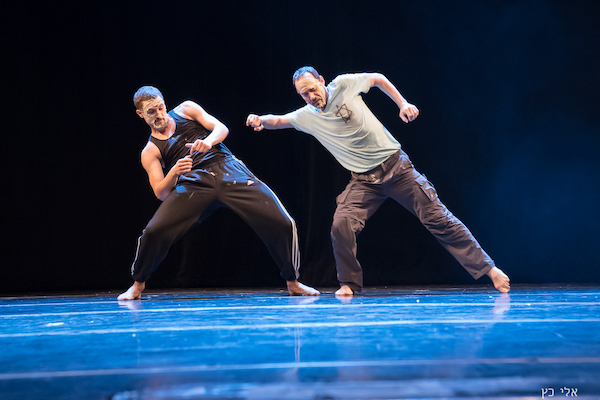
Mourad Bouayad, left, and Hillel Kogan in We Love Arabs, which is at the Dance Centre April 13-15. (photo by Eli Katz)

“I don’t have answers so I can only ask questions,” Israeli choreographer Hillel Kogan told the Jewish Independent. “If this is changing people’s political views, I doubt it, but at least what I’m trying to do is to put the questions on the table and make people, audiences, and myself see that art is not a separate sphere, that art is part of politics and social and cultural systems … and this is what I’m trying to expose in my pieces.”

The JI interviewed Kogan in advance of the Vancouver run of We Love Arabs, which is being presented at the Scotiabank Dance Centre by the Dance Centre and Théâtre la Seizième April 13-15. There will be both English- and French-language performances of this work, which also has Hebrew and Spanish versions. Kogan will dance the duet here with Mourad Bouayad.

We Love Arabs premièred at the 2013 Intimadance Festival in Tel Aviv. The brief outline for the piece, which Kogan has on his website, begins: “I address the audience, my name is Hillel Kogan. Some say that I do political art. I want to show you today how dance has the power to promote coexistence between Arabs and Jews in Israel. I invited an Arab dancer here….” The video teaser offers a glimpse of Kogan’s physicality, humour, tenderness, intelligence.

Born in Tel Aviv, Kogan has performed with and created for companies and choreographers around the world. At Batsheva Dance Company, he is director of educational programs. He is pursuing a master’s degree in cultural studies.

We Love Arabs garnered awards, and it has traveled to more than a dozen countries. The Vancouver show was postponed twice, said Mirna Zagar, executive director of the Dance Centre. First due to a scheduling conflict and then due to COVID. “However, I believe the work is just as relevant now as it was when we started,” she said. “It is an exceptional work that continues to engage audiences internationally.”

The Dance Centre often partners with other arts organizations, as a means of pooling resources and amplifying opportunities to show international artists. “This collaboration is along these lines,” she said. “I have known Esther Duquette, the now-outgoing artistic director at Théâtre la Seizième, for some years and the nature of this piece – multilingual and straddling theatre as well as dance – made it a perfect opportunity for our organizations to work together.”

The April 14 performance and talkback will be in French; the other two shows and the April 15 talkback in English. Kogan speaks six languages: Hebrew and Russian because his parents were born in the Soviet Union and he was born in Israel; he studied English in school; he learned French from working two years in Switzerland, and Portuguese and Spanish from working in Portugal for seven years. He doesn’t speak Arabic.

“This is interesting,” he said, “because this piece, We Love Arabs, is an autocritical peace that asks exactly this. Why am I facing the languages and cultures of the West and not the languages of my neighbours and of my co-citizens in Israel? Why don’t I read the books of Arabic writers? Why doesn’t Arab culture interest me, and why do I identify myself as ‘Western,’ which is a bit strange?”

It is both a geographic question, he said, living as he does in Israel, and a social, historical, cultural and political question. “And the piece deals with this question: who decides what the general culture is, and why I am – and why the Israeli art field, at least as I see it, is – so orientalist, which means looking at the Orient, at the Arab as inferior and wanting to impose on it the Western culture.”

The different versions of We Love Arabs resulted from Kogan’s wanting to perform the piece abroad, in the language the audience speaks. “I think it brings more this idea of relevance to the space,” he explained. “If I did the piece in Hebrew with subtitles, it would be more like a piece from Israel … and be framed as something local and in my perspective. The universality of the piece is one of the ideas – I want people to identify with it and, by choosing their own language, I feel there is more chance to make them sense that they are part of it as well.”

Kogan had no idea of how much impact We Love Arabs would have. “It was created for a small niche festival in Israel,” he said, and “for a specific audience who is already convinced in the political opinions that I hold. So, I didn’t imagine it ‘big.’… As I performed the piece out of Israel, I understood that the question of Jews and Arabs in Israel is just a microcosm of a more universal question: of the situation of power between minority and majority, and the way we see ‘the other’ – who is the master of the culture in any nation?”

In looking at the question, Kogan asks: “Who is invited to participate in creating a national identity, what is Israeli or what is Arab Israeli? It is not very different than the question of, I don’t know, for example, in Canada: who is invited, what is Canadian? Is it French? Is it American? Is it English? I don’t know the minority situation in Canada, but I know there is a history with Native Canadians. So, are they also invited to take part in culture? How much are they participating in mainstream dance, literature, music? How do we define what is high art and what is popular art? What is folk and folklore? And what is universal art?”

Initially dancing the duet with Kogan was Adi Boutrous, an Israeli Arab dancer who is also a choreographer and so not always available. Bouayad, who is French, danced in Israel in the Batsheva junior company. “This is how we met, so I invited him to perform with me,” said Kogan. “And, of course, it’s very different for an Israeli Arab to play the role of an Israeli Arab than for a French half-Arab person, because to be an Arab in France is different than to be an Arab in Israel.”

Not wanting to speak for Bouayad, Kogan noted that, while Bouayad may define “himself first as French, and his relationship with his Arab origins are just an extra part of his being,” for Israeli Arabs, he said, “I’m not sure that they are first Israeli and then Arab because of their own perception of themselves – but also the way the majority looks at them, the state looks at them, society looks at them, Jewish society looks at them.

“We often make the mistake even in the language, and we forget to say that Arabs are Israeli as well. We say Israelis and Arabs – even when we refer to Arabs who are citizens of Israel and who hold an Israeli passport, we call them Arabs, and we call ourselves, the Jews, Israelis…. We are both Israeli and the difference between us in definition is our religion. In a country like France, where it’s a republic and religion has at least formally not such an important role in the definition of citizenship and of nationality, then, of course, the change of cast is also changing the relationship.”

Kogan has no illusions that art can change the world. Elected politicians “are the ones who should change the world,” he said. For him, art is there to reflect, to inspire. “Art, for me, is a place for the imagination, for the possibility of not necessarily escaping reality, but giving an alternative to reality…. If art can feed the imagination and then, as an outcome of this feeding of imagination, can change the reality, OK, that’s great. But I think that … when artists try to change the world by their art – in history, at least as far as I see, it ends in political propaganda and just serves the hands of politicians.”

As many funny moments as there are in We Love Arabs, they have a profound purpose.

“I have anger towards some of the cultural systems, and the questions that I’m asking are involved with hard emotions. I feel that humour allows me to take some distance from the aggression and from being so emotionally involved,” said Kogan. “It allows me to laugh about myself as well. It allows me to invite people to laugh about a question without making it not serious. The laughing, I feel, is a tool to invite people to enter a conversation, to agree to criticize, to agree to ask questions … to see the bias, to be aware of the stereotypes, to be aware of the prejudgments that we have…. The laughter is just a means in order to speak about something very serious.”

For tickets to We Love Arabs, call 604-736-2616 or visit thedancecentre.ca.

Format ImagePosted on March 24, 2023March 22, 2023Author Cynthia RamsayCategories Performing ArtsTags Arab Israelis, culture, dance, Dance House, Hillel Kogan, Israel, Jewish Israelis, Mourad Bouayad, social commentary, theatre
Systemic change possible?

Systemic change possible?

Eleanor Boyle’s Mobilize Food! Wartime Inspiration for Environmental Victory Today offers concrete ideas for how food systems can be transformed. (Julie Doro Photography)

I plan to make the Honourable Woolton Pie. Just for fun, not necessarily because I think it’ll taste wonderful, though it might. Named after Lord Woolton (Frederick Marquis), who was appointed minister of food in 1940 Britain, it represents several of the British government’s goals during the war years: it was “meatless, thrifty, filling, and made use of domestically produced in-season foods.” The recipe is in Eleanor Boyle’s latest book, Mobilize Food! Wartime Inspiration for Environmental Victory Today (FriesenPress, 2022). The book is the only reason I know who Woolton is. More importantly, the book offers many reasons to feel less naïve for mostly believing that humankind can save ourselves and the planet before we kill ourselves and the planet.

Mobilize Food! is an optimistic examination of Second World War rationing and other wartime policies in England and how the lessons from that period could help us counter the climate crisis by changing our food systems, to start. Lest one think that Boyle is a pie-eyed dreamer, she has solid credentials – a bachelor’s in psychology, a master’s in food policy and a doctorate in neuroscience. The Vancouverite also has been a journalist and she taught for many years. She wrote the book High Steaks: Why and How to Eat Less Meat (New Society, 2012).

image - Mobilize Food! book coverDespite all of Boyle’s education and experience, she still believes that radical change is possible. This is heartening in and of itself. But it’s the 42-page bibliography that I found more assuring. The recommendations Boyle makes in Mobilize Food! are based on extensive research. And they consider what individuals, governments and businesses are already doing, as well as what they could be doing more of (which is a lot). She is not arguing for a socialist utopia, or a utopia of any sort, though she does imagine more engaged, civic-minded communities than I think currently exist anywhere in the world. That said, she gives an example of a city that apparently has ended hunger – Belo Horizonte, Brazil, “which in 1993 declared access to food as every citizen’s right. It then implemented food price subsidies, supply and market regulation, supports for urban agriculture, education on food preparation and nutrition, and job creation in the food sector.”

How does this relate to Second World War Britain? As did Britain during the 1940s, Belo Horizonte set up state-subsidized restaurants that are open to everyone (to avoid stigmatizing people on lower incomes), it feeds kids in the public education system every day, it partners with private grocery stores so that they can sell cheaper fruits and vegetables, and it supports family farms, among other actions “that help democratize food.”

Boyle provides copious data and examples of how the food industry, as it stands, is contributing to climate change “by contributing at least a quarter of human-caused GHGs [greenhouse gases].” It does this through its use of fossil fuels, the cultivation of monocultures (“vast, unnatural acreages of single-species crops”) and destroying ecosystems by removing or burning vegetation, among other activities. One of the eye-opening stats is: “Some analysts calculate the contribution of livestock to overall anthropogenic GHGs as at least 30% and as high as 51%.”

Boyle argues persuasively that how we produce and consume food can be transformed. The first half of Mobilize Food! runs through all that Britain did to make significant changes, “from national agricultural policy to the family dinner plate. They didn’t wait for dire food shortages or society-wide agreement of exactly how to proceed. Even before war was declared, government set up a high-powered food committee to craft plans for making food systems crisis-ready.” They used multiple strategies and strived for general engagement using PR campaigns and other tools. “The programs were simple but transformational,” writes Boyle, “based on shifts toward domestically produced, plant-rich and minimally processed foods. Together those programs adequately fed the population – and, in many ways, better than prewar, by providing broader and more equitable access to food and enhanced health [reducing diabetes and heart disease, for example].”

The wartime measures also show that people can change how they eat and act, she notes. But leadership is key – Lord Woolton was very charismatic, it seems, and, on the larger scale, Boyle writes, “Only governments have the mandate for the public good, the oversight for national strategy and the legislative levers. Only public officials can do the necessary system-wide planning, coordinate sectors, forge agreements across regions, and make the tough decisions.” Lastly, such massive change relies on everyone participating: “We’ll need to think systems-wide and involve every segment of society, every community, every food-related business and civic organization, and every one of us.”

Boyle admits this all “sounds like fantasy. But, as the story of World War II Britain shows, such a transformation has occurred.” Am I personally convinced we have what it takes to mobilize so drastically? The larger whole is still too much for me to contemplate, but I can eat even less meat and fewer processed foods, buy more from local growers, invest in businesses that improve the environment and/or social outcomes, support politicians who are working toward a healthier and more inclusive society. No doubt, there is much more that I could be doing, but it’s a start.

I’m glad that I read Mobilize Food! Full of images (including awesome wartime PR posters), data and stories from people who lived through the war effort, it is engaging on many levels. It reminded me that what seems impossible may not actually be so. And the importance of hope – combined with action – cannot be overstated.

For more information, visit eleanorboyle.com.

Format ImagePosted on March 24, 2023March 22, 2023Author Cynthia RamsayCategories BooksTags climate crisis, education, Eleanor Boyle, England, environment, governance, history, Mobilize Food!, policy, rationing, Second World War
Burying sacred books

Burying sacred books

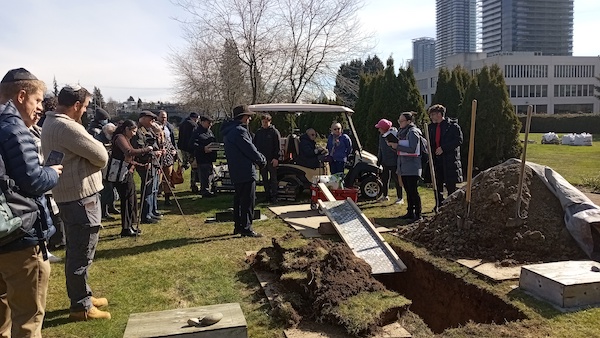
On March 9, community members gathered to bury sacred Jewish texts at Beth Israel Cemetery. (photo by Cynthia Ramsay)

According to Jewish law, no sacred texts and objects are allowed to be thrown out. This includes anything with God’s name printed on it. These texts and objects must be buried in a respectful way,” explained Rabbi Jonathan Infeld of Congregation Beth Israel in an email to the Jewish Independent about the March 9 Genizah Project ceremony at the synagogue’s cemetery. “Since a burial spot is not always convenient, people store their sacred material in a special place called a genizah until they can be buried.”

A few months ago, Infeld received a phone call from Eugene Barsky, a librarian at the University of British Columbia. Barsky was looking for a place to bury a considerable number of sacred books that were beyond repair. Infeld “immediately said yes.”

“But I wanted to do much more than just bury the materials,” the rabbi said. “I asked if he would be interested in a community-wide program, and Eugene also agreed. After that, we sought other interested parties including UBC Jewish studies, Hillel BC, King David High School, Peretz Centre and the Waldman Library.”

Representatives of these organizations were present on March 9, including students from KDHS and UBC. Infeld spoke about how sacred objects and texts not only give Jews a connection to our spiritual existence, but a social connection as well.

“And, no matter what differences we may have as a people, we are brought together within a rubric of study, of prayer, all connected to the written word,” he said. “For us, as a Jewish people, the book is sacred. For us, as a Jewish people, study is a sacred task, a sacred opportunity. And so, it only makes sense that, when we have studied, have brought a book to its conclusion, that’s literally falling apart, we don’t just throw it away, but the book, or the sacred object, has become our friend and become part of us. And so, according to Jewish tradition, we bury it.”

Barsky highlighted one of the many books being buried: a Pentateuch (the Five Books of Moses) published in Furth, Germany, in 1805. “I wish we could preserve these books, but some of them are molding,” he said. “We have a preservation lab at UBC but they reviewed them and some of them just could not be preserved.”

Barsky asked two members of the Vancouver Jewish Folk Choir – Stephen Aberle and Aurel Matte – to sing a couple of songs. The pair led “Hinei Ma Tov,” about how pleasant it is when sisters, brothers, all of us, gather together; and “Al Sh’loshah Devarim,” about the three things on which the world stands (Torah, divine service, acts of love) and by which the world endures (truth, justice, peace).

For UBC student Ellie Sherman, the burial ceremony was particularly meaningful, “as someone who spends every day reading more and more information, paying close attention to authors and narrators, and focusing on crafting assignments with correct references, to give credit where credit is due.”

She said, “The need for the genizah recognizes that the significance of words is beyond two-dimensional figures on a page, that the lessons we learn and the knowledge we gain from our books can be infinite, just as the meaning behind the words.”

Gregg Gardner, associate professor and Diamond Chair in Jewish Law and Ethics at UBC, shared how the name genizah came about. “The ancient rabbis of the first centuries tell a story about a king,” he said. “The king’s name is Munbaz. This king travels to Jerusalem, where there is drought and a famine. To provide relief, Munbaz gives away his fortune to the needy. Munbaz bizbez, Munbaz spends. His brothers confront him and demand an explanation as to why he’s giving away the family fortune…. Munbaz says that he does not bizbez the fortune … but rather he ganaz the fortune, he stores it, he saves it…. Munbaz explains that, by giving your money to charity here on earth, you do not waste your money … you save it in the world to come, in the afterlife.

“The word genizah literally means ‘storing’ and, in doing so, it can denote hiding from view,” he said. “Ancient Jewish traditions going back to the first centuries, the Second Temple period, talk about hiding many things, even the holy vessels from the Jerusalem Temple, and there are traditions in which the word ganaz is associated with storing valuables.”

Gardner said, “We are here at a cemetery, essentially taking these books out of use, laying them to rest, and yet, at the same time, going back thousands of years, the genizah has been a story not only about death, but about Jewish life.”

Richard Menkis, associate professor of medieval and modern Jewish history at UBC, picked up on this last aspect. During the planning for the burial, he said, there was a feeling towards solemnity, even mourning. But, he said, “there was a whole other sensibility that we could be bringing to it.”

He spoke of the Jews of Algeria, who would place items wherever they could around the synagogue and “several weeks later, they would carry them, the books, the other objects, in sacks. They’d escort them to the cemetery and bury them and, on that day, there would be a feast and special hymns for the occasion. There were similar customs in the community in Morocco of Meknes.

“The Sephardic Jews of Jerusalem had a custom of placing sacred objects and texts in the walls of the synagogue and, every three to seven years, would … joyously take them from the synagogues to a special section in one of the cemeteries in Jerusalem.”

The joy would come, said Menkis, from knowing that “the respect and honour that they were giving to these items would bring down upon them a variety of divine segulot, a variety of blessings. For some, it might be, we can call down rain. For others, it might be to prevent a plague.”

Menkis said, “I embrace the Genizah Project as the moral opposite of a horrible feature of modern life – the book burning. While the book burning denigrates ideas and discussion, the genizah shows reverence for ideals and aspirations.”

Those gathered were reminded of this reverence by Rabbi Kylynn Cohen, senior Jewish educator of Hillel at UBC, who led the service by the gravesite. As in the burial of a human body, she said, it is up to us to do the carrying when a person – or, in this case, the books – cannot go forth themselves.

Everyone helped transport the books from the chapel to the gravesite. Maiya Letourneau, head librarian of the Waldman Library, held up a book with gold embossing, another with lace embroidery. She said, “When we’re thinking about the memories that books create and the importance that they have in our lives, as a librarian, it can be really, really hard to take a book out of the collection, but it’s part of maintaining a healthy library, it’s part of making sure the library is useful for years to come, and it’s just an important part of what we do.”

After those gathered recited the Kaddish d’Rabbanan, the prayer that is said whenever a minyan of Jews finishes studying, Rabbi Stephen Berger, head of Judaic studies at KDHS, spoke about the class he brought to the ceremony, which has been studying Malachi, the Book of Kings. “It’s not just that we study to know,” he said. “The studying itself, opening the book and learning the book is a religious act in Judaism. And that’s why we treat it so carefully and so succinctly and sanctify it…. All these acts [serve to remind us] this is who we are, and we should live up to the title of the People of the Book.”

BI Rabbi Adam Stein concluded the ceremony with Eitz Chayim Hi, which most congregations sing when putting the Torah scrolls back in the ark at the end of a Torah service. It describes the Torah as a tree of life.


Format ImagePosted on March 24, 2023March 22, 2023Author Cynthia RamsayCategories LocalTags Adam Stein, Aurel Matte, Beth Israel, books, Ellie Sherman, Eugene Barsky, genizah, Gregg Gardner, Hillel, JCC, Jonathan Infeld, Judaism, KDHS, Kylynn Cohen, Maiya Letourneau, Richard Menkis, Stephen Aberle, Stephen Berger, UBC, Waldman Library

Local heads new office

B’nai Brith Canada has returned to Vancouver. This time with a local office headed by Aron Csaplaros, who was born and raised in Vancouver.

B’nai Brith and its now-defunct newspaper the Jewish Tribune last made their presence felt here in 2009. In an interview with the Jewish Independent, Csaplaros emphasized “that our organization is not the B’nai Brith of the 1960s or 1970s, or the 2000s. Mr. [Michael] Mostyn took over control of our organization in 2014 as CEO and has created a ‘B’nai Brith 2.0.’ We are still heavily involved in affordable housing, feeding the vulnerable and seniors and social programming (something we hope to bring to B.C. as well in the future), but our main focuses have been advocacy and combating antisemitism.”

photo - Aron Csaplaros is the regional manager of the new local office of B’nai Brith Canada
Aron Csaplaros is the regional manager of the new local office of B’nai Brith Canada. (photo from B’nai Brith Canada)

As regional manager, Csaplaros said, “My mandate is 100% focused on combating antisemitism in our province. This includes responding to incidents of antisemitic vandalism, liaising with Jewish organizations on university campuses regarding antisemitism, and also keeping tabs on antisemitic individuals and organizations active in B.C. and devising strategies, which can range from working with local police and Crown prosecutors on criminal charges, removal of their platform, which they use to spread hate, or other legal measures we can take. I am also working on having the provincial government and municipalities across B.C. adopt the crucial IHRA [International Holocaust Remembrance Alliance] definition of antisemitism.”

Csaplaros acknowledged that there are already organizations based in British Columbia that deal with antisemitism and discrimination.

“B’nai Brith’s goal, and my presence in B.C., is not to compete with, duplicate or replace the important work that other organizations do,” he said. “On the contrary, we plan to work together with other organizations when we can establish a united front against antisemitism and Jew-hate.

“The value that B’nai Brith, and my presence here, adds is our laser focus on fighting antisemitism and the legal acumen that B’nai Brith possesses to aid us in this goal. We have several staff lawyers with expertise in criminal law and constitutional law, and many of our staff members (including myself and our CEO, Michael Mostyn) have legal backgrounds in litigation. This gives the ability to devise creative strategies when dealing with antisemitic organizations and individuals, and allows us to work closely with police departments and Crown prosecutors.

“We also have a Canada-wide network of volunteer Jewish lawyers called the Matas Law Society,” he said. “These lawyers are available to assist us in anything from writing submissions for parliamentary committee hearings, to intervening in court cases that impact the Jewish community.

“We are also the only Jewish organization in Canada to have an anti-hate hotline and a mobile app with the same purpose, where people can report incidents of antisemitism or other forms of discrimination. In addition, we have produced an annual, comprehensive audit of antisemitic incidents in Canada, and this publication is used by, among other entities, Statistics Canada, the U.S. State Department and Tel Aviv University. B’nai Brith does not engage in Israel advocacy, and we only respond to issues concerning antisemitism in Canada affecting Canadian members of the Jewish community. We also have a lean but well-connected team working at our organization, which allows us to respond quickly to incidents as they arise.”

Csaplaros started his position as the B.C. regional manager for B’nai Brith in January, and has met with local leaders in the Jewish community, politicians, and leaders of non-Jewish organizations that are also involved in combating hatred and discrimination, he said.

Csaplaros was born to a family of Hungarian immigrants, with his grandfather having been the first to arrive in Canada, in the 1950s. His parents arrived in 1995.

“I was brought up in a traditional Jewish household, and my paternal grandmother is a child survivor of the Holocaust,” he said. “I grew up very close to Congregation Schara Tzedeck, the synagogue which I am a member of and still attend to this day with my wife. I sit in the same seat that my grandfather purchased over 30 years ago, and it gives me great pride to continue his legacy by sitting in his seat and regularly attending services and events at the synagogue.

“I attended Vancouver Talmud Torah all the way from preschool until graduating in seventh grade,” he continued. “I then spent a year at King David High School, before transferring to Pacific Torah Institute (PTI) [which is no longer in Vancouver] and completing high school there. I then spent three years in their post-high school program, before attending Yeshivas Chofetz Chaim in New York for a year, where I received my bachelor’s degree in rabbinical studies.”

Throughout his time at PTI and at the yeshivah in New York, Csaplaros said, “I was engaged in learning with community members and teaching how to read Jewish source texts in their original format. I was also involved in community outreach, spending time and studying with elementary and high school-aged students from disadvantaged backgrounds. I also served on the board of directors of PTI.”

After his bachelor’s degree, Csaplaros attended law school at the University of Calgary, completing his articles at Kornfeld LLP.

“I’ve always had a passion for research, advocacy and governmental affairs, and I regularly participated in debates organized by Federation,” he said. “Yeshivah studies also involve debate and plenty of research, so that is another reason I chose to pursue a yeshivah education for several years. I then decided that the best way for me to develop my advocacy skills and learn more about the structure of Canada’s government was to attend law school…. I knew from the beginning of my legal studies that I wanted to be a litigator and, in the future, focus on human rights and civil liberties matters. Throughout law school, I was involved in initiatives to increase access to justice for members of the Indigenous community.”

During his time at Kornfeld LLP, Csaplaros said, “I focused on litigation, including construction, real estate and general commercial litigation. I was fortunate to appear in court several times and run a small claims trial on my own.

“These experiences further strengthened my desire to be an advocate,” he said, “and, as my time as an articling student at the firm was coming to a close, I learned that B’nai Brith Canada was looking for a regional manager for B.C. whose main mandate would be advocacy and fighting antisemitism and hatred in all forms. I knew that B’nai Brith Canada is a leader in fighting antisemitism in Canada, and I also knew that I could use my knowledge of the legal system to help me further this goal.”

Csaplaros can be reached at [email protected].

Posted on March 10, 2023March 9, 2023Author Cynthia RamsayCategories LocalTags antisemitism, Aron Csaplaros, British Columbia, B’nai Brith Canada, safety

Helping people stay at home

People are living longer and, ideally, they’d be living longer at home. Pragmatically, this means that they and their primary caretaker(s) would need support not just for medical care, but for errands and companionship, as well. Enter Rona Goodman and her small business, Bubbymobile.com.

“Bubbymobile.com is a senior concierge service that offers a multitude of non-medical services to families. They include companionship, lunch, errand running, grocery shopping, accompanying to medical appointments and check-ups, transportation, walks and more,” Goodman told the Jewish Independent.

photo - Rona Goodman
Rona Goodman (photo from Bubbymobile.com)

Goodman thought of the concept for Bubbymobile.com a few years ago but waited until the pandemic subsided and it was safe to launch.

“I would say it’s been around a year since I started, and it is going very well,” she said. “It’s growing organically and that’s the way I wanted it. Mostly word of mouth and recommendations, and that’s the best advertising you can get. I would love to meet more families in the community.

“The concept came to fruition when I was visiting my friend’s mom who was in a seniors home. I would take her for walks and be her companion. I met several people in the facility who didn’t have anyone visit them or assist with their non-medical needs. After researching, I thought this service would be a great resource to complement what is already out there.”

Goodman named her business after her maternal grandmother.

“My bubby was the best and the matriarch of our family,” said Goodman. “I’m from Montreal and grew up with a close family because of my bubby and zadie. Every Friday night since I can remember, we would have dinner at their house with my family, aunts, uncles and cousins. We all grew up together and I wanted to honour my bubby with the name.”

Goodman said she had two wonderful grandmothers, but “my dad’s was my grandmother…. Both were lovely but I did spend more time with my bubby cause of Friday night dinners. But we (me, my brother and sister) did visit my grandmother and would take her out for drives and lunches/dinners and had lovely visits. She made the best coleslaw…. Both of my grandfathers passed when I was pretty young. Everyone has had a bubby or grandmother or grandfather, so it’s really in honour of them all!”

For Goodman, two of the best things about being Jewish are family and giving back. “You take care of the ones you love and give back to others who may not be as fortunate,” she said. “There was always an extra plate for dinner at Bubby’s house for drop-ins and friends. You also must be compassionate, patient, a good listener, understanding, kind and giving to do this kind of work. That’s how I walk through this world and this service is a natural fit for me. I also do volunteer work for VCDS (Vancouver Cancer Drivers Society), a wonderful organization that involves transportation.”

In addition to Bubbymobile.com, Goodman is a musician and a public-relations professional.

“My professional life has always been about passion, creativity and being of service,” she said about the common threads that tie her diverse endeavours together. “I’ve worked in the music industry for over 25 years in many areas of the business. From record labels, musician, songwriter to sales, marketing and publicity. As a PR person, I’ve learned a lot about communication, understanding people’s needs, listening to their stories and reaching out and engaging community – I think it brings out the kid in me and keeps me vibrant and young. These qualities are important when working with seniors, as it’s parallel in many ways.

“As a composer, songwriter and producer, I tell stories through music, lyrics and composition,” she added. “Music is a healer and there is nothing better to lift the soul. To be a composer, you need to write about life’s experiences and adventures. That’s why I love hearing the stories shared by my seniors. What a gift to be in their presence really. I would happily pick up my guitar and sit and play some music for someone that I’m working with. It’s fun and I’m grateful that I can give that little extra service to my clients. There is nothing better than to share the love of music.”

Ultimately, Goodman would like to be able to offer Bubbymobile’s services in every community in the province.

“In the long term,” she said, “I would like to build the business so it can develop into a franchise opportunity across Canada. The more I talk with people, the more excited they are that I’m doing this and how much it is needed. As we grow older, we are living longer, and I find it does provide some relief for families looking for that extra support. I’ve talked with families who may not be living in Vancouver who need extra assistance for their loved ones. Many are also too busy with work and raising families to visit during the week. That’s why I’m here – for that extra support.”

Posted on March 10, 2023March 9, 2023Author Cynthia RamsayCategories LocalTags Bubbymobile.com, companionship, healthcare, Rona Goodman, seniors

Posts pagination

Previous page Page 1 … Page 22 Page 23 Page 24 … Page 84 Next page
Proudly powered by WordPress