Skip to content
  • Home
  • Subscribe / donate
  • Events calendar
  • News
    • Local
    • National
    • Israel
    • World
    • עניין בחדשות
      A roundup of news in Canada and further afield, in Hebrew.
  • Opinion
    • From the JI
    • Op-Ed
  • Arts & Culture
    • Performing Arts
    • Music
    • Books
    • Visual Arts
    • TV & Film
  • Life
    • Celebrating the Holidays
    • Travel
    • The Daily Snooze
      Cartoons by Jacob Samuel
    • Mystery Photo
      Help the JI and JMABC fill in the gaps in our archives.
  • Community Links
    • Organizations, Etc.
    • Other News Sources & Blogs
    • Business Directory
  • FAQ
  • JI Chai Celebration
  • JI@88! video

Recent Posts

  • Zionism wins big in Vegas
  • Different but connected
  • Survival not passive
  • Musical celebration of Israel
  • Shoppe celebrates 25 years
  • Human “book” event
  • Reclaiming Jewish stories
  • Bema presents Perseverance
  • CSS honours Bellas z”l
  • Sheba Promise here May 7
  • Reflections from Be’eri
  • New law a desecration
  • Resilient joy in tough times
  • Rescue dog brings joy
  • Art chosen for new museum
  • Reminder of hope, resilience
  • The national food of Israel?
  • Story of Israel’s north
  • Sheltering in train stations
  • Teach critical thinking
  • Learning to bridge divides
  • Supporting Iranian community
  • Art dismantles systems
  • Beth Tikvah celebrates 50th
  • What is Jewish music?
  • Celebrate joy of music
  • Women share experiences 
  • Raising funds for Survivors
  • Call for digital literacy
  • The hidden hand of hate
  • Tarot as spiritual ritual
  • Students create fancy meal
  • Encouraging young voices
  • Rose’s Angels delivers
  • Living life to its fullest
  • Drawing on his roots

Archives

Follow @JewishIndie
image - The CJN - Visit Us Banner - 300x600 - 101625

Byline: Cynthia Ramsay

Beautiful life despite illness

Beautiful life despite illness

Rachel Goldman and her husband, Geoff McLennan. (photo by Avi Dhillon)

Rachel Goldman is this year’s Courage to Come Back Award winner in the medical category. She couldn’t be there in person at the Vancouver Convention Centre June 9, but she did accept the honour virtually.

After introducing herself, Goldman said, “Forty months. Forty months! That’s 1,216 days or 29,200 hours. That’s the total amount of time I have spent secluded from the world, due to COVID. Can you even imagine? So, here I am, speaking before 1,700 of you, sharing my story. It’s a surreal and humbling experience, but one that I am striving to embrace with courage and gratitude.”

Goldman explained what it has been like to have been born with CVID, common variable immune deficiency.

“For 40 years, I have caught and recovered from thousands of illnesses – lived through years of isolation and endured the roller coaster that is chronic illness,” she said.

“A common cold is never just a cold. It’s a sinus infection that leads to intravenous antibiotics. It’s a kidney infection that leads to weeks or months in an isolated hospital room. It’s my body triggering anaphylaxis to the antibodies being infused into me. Challenging? Absolutely.

“Not being able to be with you tonight to receive this amazing award in person is just one more of these challenges. I have my incredible father [Paul Goldman] there to accept this award on my behalf. Now, due to his attendance in my place, we will have to stay apart for at least 72 hours in hopes of minimizing my infection risk.

“Life altering? Most definitely,” she said.

“What it hasn’t done is stopped me from doing the best I can to live my life within the realm of what I can make possible, not what seems impossible.”

Goldman and her husband, Geoff McLennan, live in New Westminster and have two young children. A typical day for her starts at 6 a.m. to get their kids ready to go to Vancouver Talmud Torah.

“Once they leave, I am pretty exhausted, so I have to go back to bed and lie down for a couple hours,” she told the Independent. “I try to get outside every day and go for walks around our neighbourhood. With the weather becoming nicer, sometimes I will see a friend very distanced outside on our patio. I get my kids’ stuff ready for the next day for school … try to exercise and rest. I often write and usually have lots of doctors’ appointments, for the most part, over the phone or via Zoom. Then I get ready for my kids to come home. We try to have a normal evening of homework, dinner, bedtime and then time with my husband. Then rest again.”

That’s if she’s feeling OK. “If I am unwell,” she said, “then antibiotics and the meds I have to take to ensure I don’t have an allergic reaction to the meds keeps me mostly in bed. The meds make me feel very ill.

“If the infection is severe, then the antibiotics will require hospitalization, either inpatient or day treatment, to be delivered intravenously through a PICC [peripherally inserted central catheter] line.

“In terms of treatment,” she said, “I give myself weekly subcutaneous intravenous immunoglobulin infusions, which I infuse into my stomach through four needles.”

Because of her health, Goldman, a sports radio and television producer, had to stop working in 2017. She also has had to adapt how she volunteers at VTT, something she loved doing in-person. Unable to go into the school anymore, she said, “I have spent a lot of time volunteering virtually and helping out at home. I think I have become a master at cutting out projects for the school.

“Our Jewish community has been integral to our family,” she said. “Our children’s school has been the one constant in their life when everything else has been very chaotic. We travel 45 minutes each direction every day to bring our kids into Vancouver to attend VTT. We are eternally grateful for the love, support and kindness that the Vancouver Jewish community and Vancouver Talmud Torah has shown our family. They have lifted us up when things couldn’t have been more difficult. In turn, my kids could not feel safer, more well-loved and more connected with the Vancouver Jewish community.”

Goldman is a lifetime member of CHW, formerly known as Canadian Hadassah-WIZO, and has been a supporter of Jewish Federation of Greater Vancouver’s Choices event. In her younger days, she attended VTT and went through the entire Young Judaea summer camp system.

Her parents, Paul and Claudia Goldman, are also involved in the local and national Jewish communities. Her mother has been a volunteer with CHW for four decades, in many capacities, including becoming a national president and its lead representative internationally. Her father has served on synagogue boards and as a member of the Federation task force that led to the establishment of the Richmond Jewish Day School; as well, he has been involved with the Centre for Israel and Jewish Affairs and its predecessor, the Canada-Israel Committee, including as a member of CIJA’s national board.

During the pandemic, said Rachel Goldman, “The only way I could maintain close contact with my parents and my extended family was for them to limit their own activities in compliance with my specialist’s immunological protocols in order to protect me from potential infection. Those precautions are only now being partially loosened by my specialists.

“I had to home-school my two kids for 22 months during the pandemic as per my medical team’s instructions,” she said. “The kids only returned to full in-person schooling in March of 2022.

“If anyone goes into a high-risk environment or is exposed to anyone with COVID, then there is an isolation period of at least 72 hours, as has happened since the gala.

“I am still not able to attend anything at my kids’ school, their birthday parties, dance recitals, etc., any situation that occurs indoors,” she said. “Also, I am not able to travel via commercial airlines currently, which is very difficult since my sister [Naomi] and her family made aliyah eight years ago.”

Goldman wears a mask anytime she leaves her home, which is rarely, unless she is outside with her kids.

“If anyone in the house is sick, masks go on and I am double-masked,” she said. “If anyone is COVID positive, as happened in the last week, I have to leave the house for an extended period of time and we will have to isolate. I have not been inside in public since the beginning of the pandemic outside of medical appointments. I am just starting to have very distanced visits with a few friends now that the weather is getting better. Outside is the best and safest place for me.”

Her immediate family only recently started to take their masks off and, if they go into crowded places, they continue to mask.

Goldman has been to Israel twice for treatment, most recently in January 2020, after two years of constant hospitalizations for infections that stemmed from a sinus surgery she had in the hope of reducing infections. She said her medical team concluded “that the complexity of my condition required highly specialized expertise to determine a plan for continuing treatment, but none was available in Canada…. I conducted an intensive investigation for the relevant expertise, both in the U.S. and internationally, and determined that my best choice was Jerusalem’s Hadassah Hospital. I chose Hadassah because of its reputation as one of the world’s best research hospitals and, in particular, its multidisciplinary approach to diagnosis and treatment.”

Unfortunately, the medical tests – including many not typically available in Canada, as well as a complete set of genome sequencing and genetic testing – were interrupted by COVID. Goldman was urged to return home immediately. “At the time, they did not divulge why but, as time progressed, it became clear that the reason was due to the start of the COVID-19 pandemic,” she said.

Next steps for Goldman would involve establishing a new baseline. Because her current treatment includes the introduction of immunoglobulins extracted from the blood cells of others to boost her immune system, she said many of the tests that look at antibodies give false readings, as they aren’t interpreting her own system. “As a result,” she said, “it will be necessary to take me off all medications in a closely monitored hospital setting to be able to zero in on precisely what is going on with my immune system, in order to determine the best course of treatment going forward.”

The risk of doing this during COVID – and an increase in other respiratory diseases being treated in hospitals – has been too high and Goldman’s medical team is not comfortable with her flying on a commercial flight.

“I am now in the process of working towards re-setting a timetable with Hadassah to continue the process that was interrupted in 2020,” she said. “The logistics are complicated, but I am hopeful that I’ll have some clarity on that very soon so I can restart this process in the hopes of regaining some of my life and freedom back.”

It had been five years that Goldman’s aunt had been wanting to nominate Goldman for a Courage to Come Back Award.

“Finally, while hospitalized over the winter holidays, I agreed,” said Goldman. “I got the call from [chair] Lorne Segal and the Courage to Come Back Awards about winning a few months later … right before my kids’ spring break. I was shocked at first because this was the first time I had ever shared anything about my illness publicly. Even people closest to me didn’t really know the details and extent of my health condition.

“I didn’t realize that the way in which I have dealt with my health condition was something to be celebrated. Once I started thinking about it some more, I was truly humbled and very grateful to be recognized. I realized that this process, for me, was really about giving me a voice and the ability to hopefully help and inspire others with complex chronic medical conditions who are suffering in silence.

“By getting my voice back, it has allowed me to do more than just survive,” she said. “I decided that courage is absolutely something to be celebrated. I want to show my kids that, despite all of the obstacles being thrown at me and our family, we can rise above it all and have a beautiful life.”

Format ImagePosted on June 23, 2023June 22, 2023Author Cynthia RamsayCategories LocalTags chronic illness, common variable immune deficiency, Courage to Come Back, COVID, CVID, family, health, Rachel Goldman
Honouring ancestors’ stories

Honouring ancestors’ stories

Juan Villegas rehearsing Edictum, choreographed by Vanessa Goodman, which is about Villegas’s Sephardi ancestry. The work is part of Dancing on the Edge’s EDGE One July 6 and 8 at the Firehall Arts Centre. (video still from Vanessa Goodman)

“I am very happy to be able to share my work and talk about Sephardic Jews, as I am doing a lot of research and I am discovering a lot about my own culture and where it comes from,” Juan Villegas told the Independent about Edictum, a new work with Vanessa Goodman about his family heritage, an excerpt of which he will perform at this year’s Dancing on the Edge July 6 and 8. “Throughout history, the Jewish community has suffered a lot and I am very happy to be able to pay respect, honour, shed some light and help tell the story of my ancestors,” he said.

Villegas and Goodman had already started their collaboration when Villegas found out that his ancestors were Spanish Jews who, following the Alhambra Edict of Expulsion in 1492 and the persecution of Jews by the Spanish Inquisition, sought refuge in Colombia.

In 2015, Spain passed legislation to offer citizenship to members of the Sephardi diaspora, but the window of opportunity to apply was only a handful of years and Villegas’s family missed it. However, they did apply to Portugal, which passed a similar law, also in 2015. Given the number of applicants, it could be several years before the family finds out. For the application, certified records were needed, so Villegas’s siblings hired a genealogist.

“They did both of my parents’ family trees and both ended up having the same ancestor – Luis Zapata de Cardenas, who came to Antioquia, Colombia, from Spain in 1578 and whose family had converted to Catholicism in Spain,” he said. “What is unclear to me is whether Luis Zapata de Cardenas was a practising Jew and was hiding it or if his family back in Spain became Catholic and raised him Catholic. I find it very hard to believe that people fully converted to Catholicism, as religion is so embedded in one’s culture and must be very difficult to switch by obligation. So, this is probably when they started disguising some Jewish rituals as Catholic, which happened a lot in Colombia.”

Villegas left Colombia in 2003, at the age of 18, concealing from his family his real reasons for leaving.

“I told them that I was going to only be in Canada for eight months to study English and then come back to Colombia,” he shared, “but deep inside I knew that I wanted to find a way to stay in Canada. I am gay and had a hard time growing up in Colombia – without realizing it, I was also escaping from a traumatic childhood, as I had been sexually abused and bullied at school. I was lucky enough that my parents helped pay for ESL studies in Canada and then I was able to do my university studies in Vancouver at Emily Carr University.”

After getting a bachelor’s degree in design from Emily Carr, Villegas worked at a design studio but was let go when the economy collapsed in 2008. He took about a year to figure out what he wanted to do next.

“I had a lot of unresolved trauma and I think it was a combination of having the time and (unconsciously) wanting to be healed from trauma that I started taking yoga and dance classes,” he said. “I met a dance artist named Desireé Dunbar, who had a community dance company called START Dance and she invited me to join her company. Vanessa [Goodman] had just graduated from the dance program at SFU and she was in the company also, this was back in 2009. Then, in 2010, I joined the dance program at SFU and Vanessa came to choreograph for us a couple of times. I always loved working with her and I felt like I connected with her.”

Graduating from SFU with a diploma in dance, Villegas moved to Toronto, where he danced for a few years. When he returned to Vancouver in 2017, he started following Goodman’s work. Intrigued, he asked if she would choreograph something for him and she agreed.

“And that piece that we created was about family,” he said, “but we left it at that, because I did not get the grants I needed to continue the work. So, when I discovered about my Sephardic Jewish ancestry, I pitched the idea to her and she agreed (without me knowing that she also has a Jewish background).”

video still - Juan Villegas rehearsing Edictum
Juan Villegas rehearsing Edictum. (video still from Vanessa Goodman)

Everything fell into place, he said, including some funding, so they took up work again this year on Edictum, which is Latin for order or command. The project was always intended to be a solo for Villegas, and they had started by “diving into his family history and the names of his ancestors to build movement language,” said Goodman.

“Since his family found that they have Jewish ancestry and were a part of the diaspora from Spain and Portugal in the 1400s, we found it very relevant to revisit the starting material and expand on this history inside the work,” she said. “I was raised Jewish culturally and we found, through conversations about our family rituals in relation to culture, food and celebration, there were some very interesting links between his family’s expressions of their identity and mine. We have woven these small rituals into the piece and have found a very touching cross-section of how this can be shared through our dance practice in his new solo.”

Goodman is also part of plastic orchid factory’s Ghost, an installation version of Digital Folk, which will be free to visit at Left of Main July 13-15. It is described on plastic orchid factory’s website as “a video game + costume party + music and dance performance + installation built around the desire to revisit how communities gather to play music, dance and tell stories.”

“I began working with plastic orchid factory on Digital Folk in the very early days of its inception,” said Goodman. “James [Gnam] and Natalie [Purschwitz] began researching the work in 2014 at Progress Lab, and I was a part of that initial research for the piece. Since then, the work has been developed over a long period of time with residency creation periods at the Cultch, at Boca del Lupo, at the Shadbolt, at SFU Woodward’s, and it has toured Calgary and northern B.C. This work lives in several iterations, but the Ghost project is a beautiful way for the work to live in a new way one more time. The cast got together at Left of Main in December of 2022 and filmed the piece for this upcoming iteration…. It is exciting to see a work have such a rich life with so many incredible artists who have been a part of this project.”

Dancing on the Edge runs July 6-15. It includes paid ticket performances at the Firehall Arts Centre, where Edictum will be part of EDGE One, and offsite free presentations, such as Ghost. For the full lineup, visit dancingontheedge.org.

Format ImagePosted on June 23, 2023June 22, 2023Author Cynthia RamsayCategories Performing ArtsTags ancestry, Catholicism, Colombia, dance, Dancing on the Edge, DOTE, Edictum, family, history, Juan Villegas, Judaism, Portugal, Spain, Vancouver, Vanessa Goodman
Immerse yourself in music

Immerse yourself in music

Screenshot from the video for the song “Medicine,” made by Gigi Ben Artzi, featuring Yonatan Gat and the Eastern Medicine Singers. “Medicine” comes off Gat’s album Universalists.

You never know when a life-changing moment will happen. For musician Yonatan Gat and members of the Eastern Medicine Singers, a chance encounter at the 2017 South by Southwest (SXSW) Music Festival in Austin, Tex., has led to a unique continuing collaboration that melds experimental and powwow music in a way that is simultaneously ancient and contemporary, energizing and hypnotic.

Fans of Gat and the Medicine Singers will be happy to know they are performing at this year’s Vancouver Folk Music Festival, which runs July 14-16 at Jericho Beach Park. They will be joined by Daniel Monkman (Zoon), an experimental Anishinaabe musician from Toronto (Tkaronto), and local oud player and guitarist Gord Grdina, who also mixes multiple musical styles. For newcomers to Medicine Singers’ music, definitely go down the internet rabbit hole. Chances are that you’ll want the in-person experience, to be immersed in the sound.

The Eastern Medicine Singers are an Algonquin drum group from Rhode Island “dedicated to keeping the eastern woodlands American Indian culture alive.” They sing and drum in the language of Massachuset and Wampanoag dialect, and have produced several CDs together. To differentiate from their traditional powwow style, they call themselves Medicine Singers for collaborative projects with musicians of other traditions, like Gat. Their debut full-length album in this capacity is the self-titled Medicine Singers, which came out in 2022 on Stone Tapes, a sub-label of Joyful Noise, and Mothland in Canada.

“The result is a spellbinding musical experience, cycling through a kaleidoscope of sounds, from psychedelic punk to spiritual jazz and electronic music,” reads the description on Joyful Noise’s website. “But the genre-smashing album remains firmly rooted in the intense physical power of the powwow drum and the Medicine Singers’ connection to their ancestral music, creating a daring and ambitious record that celebrates tradition, while boldly breaking away from its restrictions or, in the words of Medicine Singers’ leader Daryl Black Eagle Jamieson: ‘These two cultures can work together, and blend together, to show people how we can work together and make something beautiful.’”

Gat is accustomed to these kinds of partnerships and musical innovation. In Israel, he was part of the punk band Monotonix. In the United States, he has released a few full-length albums, each more varied than the last, with the latest being American Quartet (Stone Tapes, 2022), described as a “punk slash-and-burn reimagining of one of the defining works of the Western classical canon – Antonín Dvořák’s legendary string quartet – written while Dvořák was, like Gat, an expatriate living in New York City.”

A good place to start your exploration of Gat and the Medicine Singers is by watching the video of the 2018 track “Medicine,” which was included on Gat’s second album, Universalists (Joyful Noise, 2018). The fruit of an impromptu recording session, this release caught a larger public’s imagination and the rest, to be cliché, is history – yet continues to be groundbreaking.

The Jewish Independent had the chance to talk with Gat via email this week.

JI: What was it about the Medicine Singers’ performance/repertoire at SXSW 2017 that so mesmerized you?

YG: I was playing a show in a club during SXSW and Eastern Medicine Singers were playing outside. I didn’t know them personally and my band were watching them outside just before we went on. I thought their style (six people powerfully hitting a drum and singing call-and-response vocals) could mesh well with my trio and, also, just like them, we played on the floor in the middle of the audience. So, after they were done playing, I invited them to sit in with us. They famously said no at first and then changed their mind after they heard our music.

Our improvisation style leaves a lot of room for new musicians to join and freely do their thing. I think Eastern Medicine Singers noticed that, too, and when they joined us – it quickly became one of the most incredible shows we’ve ever played. The audience was feeling that as well. When I looked up, I noticed everyone in the crowd was crying, and that’s how our collaboration began, and we’ve been touring nonstop around the world since 2017.

JI: In an interview, you talked about taking piano lessons as a kid and, even then, improvising. What do you love about improvising?

YG: I took piano lessons as a kid but I never cared about learning to read sheet music. I just wanted to improvise. At some point, I started playing bass, but when we did Monotonix, we wanted a trio of guitar-drums-vocals, so I moved to a 77 Fender Mustang tuned two tones down to C with bass strings running through a custom-made humbucker pickup to make it sound more low-endy. I learned to play the harmony on the open strings while doing the lead on the highs.

We played 1,000 shows that way with Monotonix and I discovered myself as a guitarist along the way. I never practised or cared about technique, but being the only instrument except drums made me work hard and grow as a player. When I started my own band, I was able to build it around improvisation, which helped me learn even more about myself as a musician and human. Improvisation doesn’t have to be confined to jazz, long solos or anything like that – it’s more a way to live life, to respond to the world around you, get to know yourself better every night.

JI: From where do you draw inspiration for your compositions?

YG: When we record, we like to create a zone that’s radically free, where it’s all about the musician’s self-expression as it relates to the collective and we just let the tapes roll and have fun with it. Our studio days are very fun and wild and free. We also record other situations – practices, soundchecks, hangs. Sometimes, we record in some of the best or most interesting studios in the world, sometimes we record on iPhones or broken tape machines someone left behind.

It doesn’t matter what it is, we just gather material (usually hours of music) and then the process of editing begins, which is when the “composition” happens. In that way, most of the writing is actually the editing. Everything else is just about having a good time and making sure every musician gets documented the way they envisioned.

JI: You have played in Vancouver before. What are you most looking forward to on this upcoming visit?

YG: I was always lucky to play inspiring shows in Vancouver. My first time in town was a wild DIY punk show in a place called Emergency Room back in ’08. People were going crazy, falling on the band (we were playing on the floor). That vibe just continued to Biltmore Cabaret, where we played so many times after that. Just a sweaty haze with everyone losing their minds and melting into one another.

The last time I was in town was for Vancouver Jazz Fest back in 2019 with Medicine Singers. That was fun. I’m not used to playing jazz fests (they probably think we’re too loud or something) but it was so cool to play to an audience that was following the instrumental parts and appreciating the playing that comes with the freedom and energy.

Vancouver Folk will be a special one for sure. We don’t often play on the floor nowadays, but Medicine Singers transcend the stage. This show really creates a kind of connection between audience and musicians I’ve never seen before. It still has all the magic we discovered in 2017, the first time we played together.

My experience working and learning from Medicine Singers led us to start a label together, Stone Tapes, which is more like a community of musicians, or a collective. I think that represents what we do in the best way possible, and I’m looking forward to coming back to Vancouver and backing Medicine Singers along with other musicians from that collective.

For the full Vancouver Folk Music Festival lineup and tickets, visit thefestival.bc.ca.

Format ImagePosted on June 23, 2023June 22, 2023Author Cynthia RamsayCategories MusicTags Medicine Singers, Vancouver Folk Music Festival, Yonatan Gat
Honouring human spirit

Honouring human spirit

Lorne Segal, chair of the Courage to Come Back Awards. (photo from kingswoodproperties.com)

This year marked the 25th anniversary of the Courage to Come Back Awards – and 18 years since Lorne Segal has been chair of the event.

“The first year I attended Courage as my father’s guest, I thought it was just another event – until I saw the box of tissues on the table. That’s when I knew Courage was different,” Segal told the Independent.

“Courage is so important because of the stories,” he said. “They give us hope. The stories that are shared every year move me and the whole room to tears, they put our own lives into perspective, and remind us of what the human spirit is capable of.

“And, of course, there’s the fact that Courage raises funds for such important programs at Coast Mental Health, which simply wouldn’t happen if it weren’t for the generosity of those in the room, who are inspired to give thanks to the stories our recipients graciously share with us. Programs like peer-support training, brain training, meals, art therapy, therapeutic gardening and much more are only possible thanks to donations – and they truly make such a difference for those who are able to access them.”

This year, the awards dinner took place at the Vancouver Convention Centre on June 9, and the honourees were Jodi Gray (mental health category), Rachel Goldman (medical), John Oakley (addiction), Patricia Henman (physical rehabilitation) and Danielle Laviolette (youth). The event included a special tribute to Segal’s father, Joe Segal.

“Joe always said, ‘Give until it hurts.’ His commitment to giving back to his community was such an inspiration to me and to so many around him,” said Segal. “After he passed away last year at the age of 97, I wanted to create an opportunity to share his message one last time, and to honour his incredible work over his long life. It was really moving for me and my family to hear so many people talk about how my father had touched their lives – I continue to be inspired by him every day.”

Calling it “truly a family event,” Segal said his children Matthew and Chanelle have been coming with him since they were little, and “there’s no doubt the recipients’ stories have shaped their lives and inspired them in their own pursuits. My wonderful wife Melita’s unwavering support for Courage and Coast amazes me every day,” he continued. “She may not be officially chair but she has certainly played a big part in the success of the event – she is always talking about the event to anyone she meets and many who attend do so because of her word of mouth.”

Many other members of the family also attended on June 9, said Segal, including his brother Gary and wife Nanci. “My sisters Tracy and Sandra could not be there but were part of our family donation in Joe’s honour,” he said.

Reflecting on his 18 years as chair, Segal said, “Honestly, I didn’t realize it was going to be this long when I signed up for the job, but, every year, I am moved by the recipient’s stories and just know they need to be shared.

“Twenty-five years ago, people were not talking about mental health,” he added. “It wasn’t a ‘sexy’ cause, as my father would have said, and the Courage to Come Back Awards have helped to create a lot of awareness and conversation. It’s my hope that these awards continue to help make us all more understanding…. It’s hard to believe we had 1,700 in the ballroom this year after four years without an in-person event, when it wasn’t that long ago we were barely allowed 10 people in one room! But we have continued to innovate and find ways to share our recipient’s stories and raise funds for Coast Mental Health Foundation.”

For more information, visit coastmentalhealth.com.

Format ImagePosted on June 23, 2023June 22, 2023Author Cynthia RamsayCategories LocalTags Coast Mental Health, Courage to Come Back, fundraising, Lorne Segal, philanthropy
KDHS chai celebration

KDHS chai celebration

Left to right: Jeff Ross and Stephen Kaye, King David High School co-presidents in 2006, and Diane Friedman and Alain Guez, this year’s co-presidents. (photo from KDHS)

“At King David, Jewish memory and education intersect, creating a unique and powerful learning experience that prepares our students for a lifetime of meaning and purpose,” said King David High School board co-president Alain Guez in his closing remarks at the school’s Golden Thread Gala May 18.

The gala is KDHS’s primary fundraising event of the year, and more than 300 people filled the ballroom at Congregation Beth Israel, including some 50 King David alumni, to celebrate the school’s 18 years in its current building, at Willow Street and 41st Avenue. The school itself is double chai (36) years old, its origins being found in Maimonides Secondary School, which opened in September 1987.

“We would not be here today if Maimonides … had not started us on our path, our derech, to where we are now,” said head of school Russ Klein in his opening remarks.

“This evening is to celebrate what our community has built together,” he said. “The Diamond Foundation, who support so many of our community efforts, made King David possible with their generous support, belief in our importance, and their strong Jewish values.”

Rabbi Stephen Berger, head of Judaic studies at KDHS, noted that the event was taking place on erev Yom Yerushalayim. He compared Yerushalayim – “a holy place for all people, all people can worship G-d in this one place” – to KDHS, in that there are many different Jewish schools in Metro Vancouver but only one high school, and this one high school has to serve everybody across the religious and cultural spectrum. “We don’t always get it right, but it is a place where we can try, and respect and show love to everybody,” he said.

Event co-chairs Heidi Seidman and Sherri Wise said a few words about the school, as well. “It is important to note,” said Seidman, “that not one student is left behind and, when you look around the room tonight, you are all part of the village that makes that possible.”

As auctioneer, Fred Lee – who is a regular contributor to CBC, the Province, Boulevard and Vancouver Magazine – stressed this idea. He spoke about the Jewish community and the importance of the high school. He also helped raise funds that will go towards the school’s programs and students. There was a silent auction, a 50/50 draw and other opportunities to donate.

photo - Throughout the Golden Thread Gala, there were musical performances
Throughout the Golden Thread Gala, there were musical performances. (photo from KDHS)

The gala featured panelists Stephen Kaye, and Jeff Ross and Reisa Schwartzman, who were integral to the transition of the school from Maimonides to King David, and for taking the school from the portables it occupied on Baillie Street to having its own building on Willow. They were introduced in a video by their respective children, David Kaye and Zachary Ross, graduates of the inaugural KDHS Class of 2006.

Stephen Kaye came to Canada from South Africa, where there is a network of Jewish day schools called King David Schools. He described himself as “very passionate about Jewish education” and said, “The feedback we got from the community was that, if we could show enough commitment from parents to send their kids to a Jewish high school, there would be support from the community.” It was a hard sell, he said, but then the Diamonds bought the land at Willow and 41st.

Stephen and Sandy Kaye shlepped three kids from North Vancouver to King David in Vancouver, noted Klein, who emceed the panel discussion.

Ross spoke of studies showing that kids who have gone to a Jewish high school are more Jewishly knowledgeable and involved. And yet, he said that, in the beginning, there was almost a feeling that you were sacrificing your children to the experiment of a new high school, but that didn’t turn out to be the case. Ross gave Rabbi Mordechai Feuerstein, a co-founder of Maimonides, kudos for his efforts to keep the school going.

When the school was in “the shack” (portables) on Baillie Street, said Schwartzman, there were fewer than 60 kids and now there are more than 270. Back when she was helping bring KDHS into existence, she said she was confident this growth would happen, based on a survey that was conducted at Vancouver Talmud Torah, which would be the main feeder school into the high school. She was president of VTT at the time, and the survey of parents showed that about 50% of the kids from VTT would go to a Jewish high school if there were one.

Quality education was important to everyone, said Schwartzman, and one of the things the group behind KDHS did to ensure quality was to bring Perry Seidelman in as principal. Seidelman, who had some 30 years’ experience in teaching and administration at the time, had been contemplating retirement, but took on the principalship and held the position until 2008; he was succeeded by Klein.

In a video that featured Gordon and Leslie Diamond and their daughter Jill Diamond, as well as Class of 2023 students talking about how the school has positively impacted them, the Diamonds spoke of how proud they were of KDHS, its students, staff, and all the people who have given it its “personality” and contributed to its success. Calling the school “a labour of love for the Diamond Foundation,” Jill Diamond said, “And the most wonderful thing about King David is that it is teaching the Jewish values of tikkun olam, of chesed, of mitzvot and of tzedakah to the next generation of leaders of our community.”

Such has been the growth of the school that it added a modular unit last year, the building of which was funded by the Diamond Foundation. In her remarks with Guez, KDHS board co-president Diane Friedman spoke about how the addition is affectionately called the school’s “East Campus,” and thanked the foundation, as well as the donors who filled the modular with state-of-the art equipment, furniture and technology.

The evening came to a close with Klein and Seidelman. The former principal said he had worked at many schools before King David, and that he liked all of them – but he “loved King David.” He said he felt very proud as he looked around the room.

The gala also featured, under the direction of music teacher Johnny Seguin, the KDHS jazz band, who played at the cocktail reception – Luca Jeffery, Max Kimel, Jesse Millman and Nikki Wiseman – and performances throughout the night by singers Ella Ankenman, Kailey Bressler, Rachel Gerber, Mhairi Hemingson and Nikki Wiseman, with choreography credit given to Shai Rubin.

Gala committee members were Cyndi Ankenman, Dalia Bressler, Laura Feldman, Andrea Foxman, Nicole Ginsberg, Margaret Hemingson, Anna Herman, Ruth Jankelowitz, Joelly Simkin and Annie Simpson. Other volunteers were Lina Chernov, Kim Fisher, Jessica Forman, Simon Karsyente, Matilda Rosman Levsky, Melina Baum Singer, Gaenor Vaida, Jacqueline Wener and King David students Danielle Agulyansky, Eden Almog, Ali Fadida, Tamir Gini and Yuli Kabazo.

Format ImagePosted on June 9, 2023June 8, 2023Author Cynthia RamsayCategories LocalTags Alain Guez, Diamond Foundation, diamonds, Diane Friedman, Fred Lee, fundraising, Golden Thread Gala, Heidi Seidman, KDHS, King David High School, Russ Klein, Sherri Wise, Stephen Berger
Laugh for good causes

Laugh for good causes

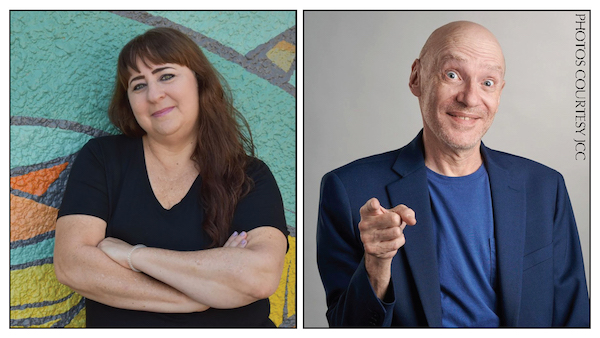
Helen Schneiderman headlines and David Granirer emcees the Stand Up for Mental Health show at the Jewish Community Centre of Greater Vancouver on June 1. (photos from JCC)

“There are many comedy shows out there, but not many like this one,” Kyle Berger told the Independent. “I keep saying that this will be the ‘feel-good comedy of the year,’ but it really will be. These comics will show us that we can laugh at just about anything and feel inspired at the same time – with all proceeds going to incredible causes. I can’t wait!”

Berger is the sports coordinator at the Jewish Community Centre of Greater Vancouver and the delegation head of JCC Maccabi. He is also a stand-up comic and a producer with Rise of the Comics. It is in all these capacities that he is participating in the Stand Up for Mental Health comedy show at the JCC on June 1, 7:30 p.m.

A joint fundraiser for the Stand Up for Mental Health (SMH) Comedy Society and JCC Maccabi Vancouver, Berger is producing the event, with the support of Stand Up for Mental Health, and will be performing a set himself. “It will be a huge honour for me to share the stage with this crew,” he said.

“This crew” includes SMH founder, counselor and comedian David Granirer.

“Stand Up for Mental Health is my program teaching stand-up comedy to people like myself with mental illnesses as a way of building confidence and fighting public stigma,” Granirer explained. “We have been around since 2004 and have trained approximately 300 comics and done hundreds of shows for government, corporations, the military, correctional facilities, medical schools, etc.”

photo - Kyle Berger
Kyle Berger (photo from JCC)

Berger attended one of those performances last year, in which SMH Comedy Society showcased “their students’ incredible talents, and I absolutely loved it,” he said. “I knew some of the SMH Comedy board members from working together in the comedy scene and made the connection right away. They are always looking for venues and new audiences and I knew I wanted to do something with comedy as a JCC Maccabi Games fundraiser, so inviting them to team up seemed like a no-brainer to me.”

Also performing next week will be Helen Schneiderman, who headlines the show.

Schneiderman’s comic career began in 2018, when she took a comedy course at Langara College that was taught by Granirer. She said she did it, “mainly to get off the couch. I didn’t expect to love it so much, nor to continue doing it after the class. But, once I got my first few laughs, I was hooked. Over the past couple of years, I’ve gotten more comfortable sharing my experiences and perspectives, and I try to remember to always have fun up there.”

Being able to do stand-up comedy has influenced how Schneiderman navigates through life.

“I now see the world through ‘funny glasses,’” she said. “Every interaction and experience has the potential to be a joke – not always a good joke, but a joke nonetheless. My day job is delivering leadership training and so I get to have a captive audience, even at work.”

In addition to her day job and other involvements, Schneiderman has been on the board of SMH Comedy Society for four years, and board president for the past two years.

“I’m involved with the organization because it’s doing really important work to tackle the stigma of mental health,” she said. “It’s a fantastic program, and I am in awe of the comics who share their stories with so much vulnerability and smart humour.”

People can find out more about SMH at smhsociety.org. Post-pandemic, the society is once again holding live classes and shows, as well as continuing to put on Zoom shows. The pandemic, said Granirer, “made me realize that, by being creative on Zoom, we could reach people all over the English-speaking world. It also made me realize how much people need to have in-person contact in order to maintain their mental health.”

One of the reasons SMH is teaming up with JCC Maccabi Vancouver for this show, he said, is “because they’re a great organization and exercise is crucial to maintaining good mental health.”

The decision to partner was easy for Berger.

“As the delegation head for Vancouver’s JCC Maccabi squad, I am always looking for ways to raise money for scholarships so that anyone who wants to participate in the JCC Maccabi Games experience can do so,” he said. “At the same time, producing and performing stand-up is another hobby and passion of mine, so it always makes sense to me to raise money through laughter. I always love the opportunity to work with other causes or charities, and this one was a match made in heaven.”

The June 1 Stand Up for Mental Health show is being presented by JCC Maccabi Vancouver and Life is Still Funny, which Berger described as “a group of local comedians who might be considered, well, not particularly young, but still quite young at heart! Made up of locals like Helen, Ray [Morrison], as well as recent Canada’s Got Talent contestant Syd Bosel. They are all involved with SMH Comedy Society.”

In addition to Schneiderman, Berger and Granirer, Morrison will perform, as will a few SMH students. Tickets are $20 (plus fees) and are available at eventbrite.ca. There will be a cash bar and a raffle draw at the show. Berger said half of the proceeds will go to SMH Comedy Society and half to JCC Maccabi Vancouver.

Format ImagePosted on May 26, 2023May 25, 2023Author Cynthia RamsayCategories LocalTags comedy, David Granirer, fundraising, Helen Schneiderman, JCC, JCC Maccabi, Jewish Community Centre of, Kyle Berger, Stand Up for Mental Health, stand-up
Sizzlin’ Summer in June

Sizzlin’ Summer in June

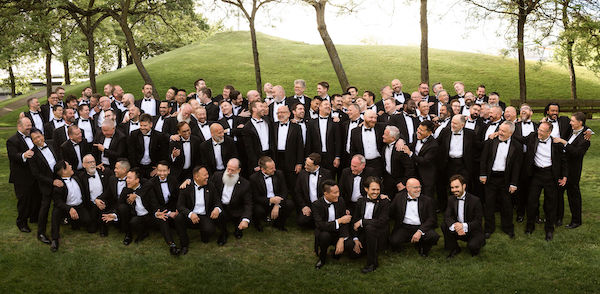
The Vancouver Men’s Chorus “brings such an effervescent joy to the shows and the spring season in particular is a big party for the chorus and audience alike.” (photo by Mark Burnham Photography)

The Vancouver Men’s Chorus (VMC) Sizzlin’ Summer concert promises to be a lively and entertaining experience.

“The VMC is more than just your average choral concert – we have the chops to pull off some pretty complex vocal arrangements, but we also like to mix that up with pure upbeat fun,” said Jewish community member Dr. David Rothwell, who is one of the choreographers of the show, which sees several performances June 9-17 at Performance Works on Granville Island. “The group brings such an effervescent joy to the shows, and the spring season in particular is a big party for the chorus and audience alike,” he said. “Whether it’s pulling out some disco moves for a nostalgic trip to ABBA’s heyday, or donning umbrellas after a hairy forecast from the Weather Girls, the choreography put together by myself and my fellow choreographers (Randy Romero and Jason Yau) helps tell the story of our music and elevates that entertainment factor even higher. We even get the entire chorus to join along in their own way.”

Humphrey Tam, VMC’s vice-president of marketing and communications, as well as a singer in the choir, shared a sneak peek at the repertoire.

“In Sizzlin’ Summer,” he said, “we have music ranging from your pop classics like ‘The Raining Men,’ ‘Girls Just Wanna Have Fun,’ ‘Summer Breeze,’ to new hits like ‘Summer Time Sadness’ by Lana Del Rey and ‘New Rules’ by Dua Lipa, to the world première performance of ‘Ocean Songs’ by composer Gerry Ryan (former arranger and first tenor of the VMC) who, sadly, passed away few years ago.”

Conducting Sizzlin’ Summer will be VMC artistic director Willi Zwozdesky, who has been with the chorus since its inception; resident accompanist Dr. Stephen Smith has been with the VMC since the 1990s.

“Both of them are instrumental in the success of the Vancouver Men’s Chorus,” said Tam. “In 2021, we expanded our musical team to include an assistant conductor, David Buchan, who brought in another layer to our sound. On top of that, we have a full orchestra band in our concerts!”

The chorus rehearses every Wednesday, except during July and August, when they take a break; there are also extra rehearsals on Sundays a month or two before a concert.

While VMC is an audition-required group, Tam said the “singers are a mix of people with tons of background in music and theatre to someone who has no previous musical experience. We welcome everyone to audition and, even if you can’t sing, there are plenty of opportunities to join the chorus as a volunteer to help out with productions.” He said he was, before joining the chorus, “one of those who had no musical background except for playing the clarinet for one year back in Grade 8.”

Rothwell, who used to teach dance before moving to Canada from Australia, is an animator by trade, so “movement is my bread and butter, whether on the stage or the screen,” he said.

“After moving to Vancouver in 2018 with my husband, we saw the VMC performing their hearts out in the annual Pride Parade. We were quick to reach out to see if they were taking new members and, five years later, we’re basically part of the furniture!” said Rothwell. “We both grew up immersed in music, and it’s been a perfect way to pursue our interests and build a network of vibrant, talented friends in Vancouver’s queer community.”

About Jewish community, Rothwell said, “My mum reconnected with our family’s Jewish roots when I was a teen, so while I wasn’t immersed in that side of my heritage until that point, I’ve grown to recognize and appreciate the tenacity, humour and joie de vivre that I feel is ingrained in the Jewish spirit, including my own. These days, I’ll gladly join a seder and keep everyone’s cups full to the brim!”

For VMC member Dr. Etienne Melese, much of his connection to Judaism also came from his mother. “When I was young,” he shared, “she taught me about all the Jewish traditions, holidays, and growing up in New York helped, too.”

Proud of being Jewish, he said, “I feel the history deeply.” While Melese’s paternal grandfather survived the Holocaust, other members of his family did not. “We still visit their memorial in Paris (Mémorial de la Shoah) every time we visit, and I think about the courage it took survivors to live through that time,” he said.

Melese, who earned his PhD in immunology from the University of British Columbia and is currently working in biotech on designing new therapeutics for diseases such as cancer, said, “I came to the Vancouver Men’s Chorus because I wanted the opportunity to sing again. I had spent six-plus years doing my PhD and, during that time, had not been singing in a choir, which I used to enjoy so much! Also, the community – I wanted to expand my network of friends.”

Melese has been in many choirs over the years. What draws him to singing, he said, is “being able to express yourself. I find, through music, I am able to access so many feelings that are hard to just put into words…. I find there is an energy to choirs that can really change your outlook that day.”

Knowing that such benefits can come from choral singing, the Vancouver Men’s Chorus remained active during the pandemic, albeit in different ways.

“It was a very difficult time for the chorus,” said Tam. “From a choir point of view, not being able to sing as a group and perform was a huge loss to us; but, on top of all things, the VMC is a huge support group for our members, it’s a huge chosen family. Every week when we meet, we share our stories and we socialize. Not having that bonding time with each other definitely was strange and hard for some of us. Luckily, despite not being able to sing together, we still continued to have Zoom activities throughout the entire 2020 and 2021, and we recorded two digital concerts to keep doing what we love. Starting September 2021, we rehearsed together again but with masks and social distancing, and performed our first in-person concert in two years with Making Spirits Bright 2021 (also with masks on). Thinking back, I really don’t know how we did that.”

The VMC is a diverse and inclusive group, with members ranging from 18 to 70+ years old, said Tam. “We have open rehearsals every September and January for anyone to come join us at our rehearsals and sing with us,” he said. “From there, they can see if we are a good fit for them and sign up for an audition.”

Rothwell is keen for more people to experience the choir. “In addition to our spring season in June, the VMC also is well underway in preparing for our December season, Making Spirits Bright,” he said. “As always, our music selection committee makes sure to include songs for all holidays of the season; celebrating Hanukkah continues to be a mainstay of our setlist, along with the winter solstice and more. We’re gearing up for another great show this December, so I’d also encourage readers to keep an eye out for our next show, Cheers!, later this year.”

But, returning to Sizzlin’ Summer, Melese shared his favourite song: “‘The Summer Nights,’ a play on Grease, so fun!”

For tickets and more information, visit vancouvermenschorus.ca.

Format ImagePosted on May 26, 2023May 26, 2023Author Cynthia RamsayCategories MusicTags choral singing, David Rothwell, Etienne Melese, Humphrey Tam, music, Sizzlin’ Summer, Vancouver Men's Chorus
Yiddish alive and well

Yiddish alive and well

Yiddish has the odds stacked against it – the vast majority of its speakers were murdered in the Holocaust, its use was repressed in the postwar Soviet Union, Israel favoured Hebrew over it, and it faced the challenges that any immigrant language faces in a new country, including in Canada. Yet, Yiddish lives on, and can continue to do so, and even flourish, contends Rebecca Margolis, director and Pratt Foundation Chair of Jewish Civilization at Monash University, in Australia.

Margolis, who is originally from Canada, will be in Vancouver to launch her new book, Yiddish Lives On: Strategies of Language Transmission, at the Peretz Centre for Secular Jewish Culture on May 23, 7:15 p.m. Introducing Margolis will be the Vancouver Jewish Folk Choir with the song “Yomervokhets,” a Yiddish translation of “Jabberwocky” by Raphael Finkel, set to music by the choir’s conductor, David Millard.

The event is particularly special, as Margolis uses the Vancouver Jewish Folk Choir – in which I’ve sung for more years than I can recall – as one of many examples of a “created language space.” Such spaces are “sites that are deliberately created to support the continuity of a language that is not commonly a mother tongue or widely spoken,” she writes.

image - Yiddish Lives On book coverThe small section that features the choir cites the work of local Yiddish scholar and translator Faith Jones, who is a member of the choir as well, and the book references a paper that she and I wrote together in tandem with the 2019 online exhibit marking the choir’s 40th anniversary. I have to say it was an exciting surprise to find a paper I co-wrote quoted, but it’s a quote from Faith’s 1999 thesis on the Yiddish library of the Peretz Centre (the choir’s home, too) that helped me clarify some of what draws me to Yiddish. In commenting on the intersections between Yiddish, politics and identity, Faith wrote that “what these strands have in common is the belief in the power of human beings to alter the course of history. In left political life, in feminist theory, in the movement for lesbian and gay equality, in the political culture of secular humanism, it is not the past which is romanticized, but the future. Yiddish does not offer the path to the past as much as to a collective future which is linked with the past: a better future, but better because of human endeavour.”

It is this human aspect – the intention we can possess – that runs through all of Margolis’s examples of the ways in which people, specifically Canadians, have kept Yiddish alive. She conceptualizes her book “as a series of expanding rings of engagement with the language and culture.” Each chapter focuses on a ring, while acknowledging the rings are interconnected: families (1950s to today), youth theatre groups (1960s to 1970s), literature (1970s to 1980s), singing (1990s to 2000s) and new media/technology (2000 to today).

Margolis explains that Yiddish exists in two communities: the Haredim (ultra-Orthodox), who speak Yiddish in their everyday lives, and the secular, people “for whom continued engagement with the language has taken place despite maintaining linguistic acculturation.” Margolis’s book is mostly about the latter group, but she does discuss the Haredim quite a bit and, to a much lesser extent, the experience of preserving Scottish Gaelic, which, she says, “is undergoing revitalization in Canada and abroad,” and Indigenous languages.

Yiddish Lives On is an academic book, but easy to read, and there are common threads that recur, so that, if you don’t quite understand a concept on first encounter, you will when it is used in a subsequent context. In addition to discussing scholarly texts, Margolis talks about Yiddish writers – in Canada between 1950 and 2020, more than 200 books were published in Yiddish! – and analyzes movies and shows like the web series YidLife Crisis, which was created by and stars Eli Batalion and Jamie Elman, two Montreal secular Jews who speak Yiddish, using “provocative comedic dialogue,” Margolis notes, “to address contemporary issues around Jewish identity.”

Margolis doesn’t expect that Yiddish will ever return to regular, everyday use by non-Haredim, however, she convincingly argues that “a language lives by being used” and that the many spaces that have intentionally been created for Yiddish – “from raising children as native speakers to a virtual Yiddishverse” – bode well for the language’s continuity.

To attend the book’s launch and the mini-concert that precedes it, register at peretz-centre.org.

Format ImagePosted on May 12, 2023May 11, 2023Author Cynthia RamsayCategories BooksTags language, Peretz Centre, Rebecca Margolis, singing, Yiddish, youth groups
The experience of a lifetime

The experience of a lifetime

There was no question that Zac Abelson (centre) would attend the Excelerate23 Summit in New York City this past March. (photo from Zac Abelson)

“I believe my Excel journey is only just getting started,” Zac Abelson told the Independent. “The last summer and the Excelerate conference have solidified my belief that there are not only bright young leaders in the world that will one day make an incredible impact, but that the Jewish community will forever be one that is strong, defiant, welcoming and passionate.”

Born in South Africa, Abelson moved to Canada with his family when he was 8 years old. “I have now lived in Vancouver for 15-plus years, being part of the Chabad Jewish community while growing up in South Surrey,” he said. “I learned my bar mitzvah on a tape recorded by my grandfather with the Chabad rabbi and went back to do my bar mitzvah with my grandfather in South Africa.”

Last year, Abelson was one of 60 international students chosen for a Birthright Israel Excel summer internship in Israel. One of the highlights of working with Deloitte, the company with which he interned, was “getting to learn and understand how the Israeli culture conducts business and truly see the impact they have on the world without most people knowing,” said Abelson.

Birthright Israel Excel, which started in 2011, is described as a business fellowship that offers select students an internship in Israel, followed by membership in a “community of peers focused on professional development, personal growth, Israel engagement and philanthropy.”

The most exciting part about being selected for the program, said Abelson, was the people.

“Excel selects not only the best and brightest but also the most genuine and caring individuals,” he said. “Being able to spend 10 weeks in a tight-knit community made every moment a life-changing experience and every memory one I will never forget. Mix those people with all that Israel has to offer and you have a recipe for an incredible summer.”

It was “an adjustment to be surrounded by so many talented people from the best schools in the world,” he acknowledged. “One can see it as daunting, but I chose to see it as an opportunity to learn and mix with the people who will push me to be a better version of myself.”

Abelson has just completed his studies at the University of British Columbia Sauder School of Business, graduating with a bachelor of commerce. “I now work full-time in real estate development,” he said, “helping shape and grow diverse and sustainable communities.”

In March, Abelson was one of more than 300 Birthright Israel Excel fellows from around the world who gathered in New York City for the Excelerate23 Summit.

“Having had such an incredible time with the Birthright Excel community this past summer in Israel, attending the Excelerate Summit in New York City was no question,” he said. “The opportunity to again be surrounded by such incredible Jewish leaders and innovators is rare and one I wanted to take full advantage of.”

Throughout the March 24-26 weekend, attendees participated in networking, industry panels and discussions about topics such as business development, Jewish identity and Israel engagement. The summit also held workshops on combating antisemitism.

Among the events Abelson attended was one entitled Scrappy to Scaled: How Entrepreneurs Turned Startups into Sustained Multi-Figure Operations.

“This was a fantastic session where we truly got to hear the grit required to turn an idea into a reality,” he said. “What I found fascinating was listening to Nathan Resnick – seeing how, rather than conforming to the expectation of what businesspeople and investors would look for, he allows his true light and personality to shine through, ultimately getting investments in the person over the product.

“Additionally, listing to [activist and former NBA player] Enes Kanter Freedom speak about his journey from hatred of the Jewish people to now embracing the community was eye-opening. It was unbelievable to see how his deep passion for acceptance and the international community drives him every day despite all that he has had to sacrifice. It also puts into perspective the sad reality of how stuck in the past the world still is and how unwilling to speak on important issues many sporting organizations still are.”

When asked what three things he would recommend about the Excel program, Abelson said, “One, you don’t know the value of an international network until you truly have one. Excel has allowed me to since travel the world and feel comfortable knowing there will always be an Excel fellow somewhere close by.

“Two, the feeling of connecting with like-minded, passionate and bright Jewish business leaders … will fill you with joy and hope for the future of both Israel and the world.

“Three, the Excel experience is more than just adding the internship to your resumé. It’s an experience of a lifetime that everyone in interviews will be intrigued with and ask you more about. Few in the workplace have such a wonderful story to tell.”

For more information about the programs offered, visit birthrightisraelexcel.com.

Format ImagePosted on May 12, 2023May 11, 2023Author Cynthia RamsayCategories Israel, LocalTags Birthright Israel Excel, business, education, Excelerate23, leadership, Zac Abelson
Teapacks brings happiness

Teapacks brings happiness

Israeli music pioneers Teapacks perform at the Queen Elizabeth Theatre May 14 (photo from Teapacks)

“We will bring a lot of Mediterranean happiness, with a lot of Jewish chutzpah,” Israeli singer-songwriter Kobi Oz told the Independent about Teapacks’ upcoming concert here on May 14. The event at Queen Elizabeth Theatre is the culmination of the community’s many Israel @ 75 celebrations.

Teapacks will sing about 30 of their hits, spanning their more than 30 years of composing and performing. Plus, said Oz, there will be many “duets with our fabulous female lead vocalist Shani Yizhari, one Arik Einstein cover, one Moroccan song and our version of Hatikvah.”

Teapacks was established some 35 years ago. Named after the correction fluid Tipp-Ex, Oz has explained the choice to be related to the band’s aim to “erase boundaries between people,” but the English transliteration of the name was changed relatively early on to Teapacks to avoid infringing on the trademark. (The Hebrew remains the same.)

Oz and Gal Peremen (bass) are founding members, and Rami Yosifov (guitar) is basically one, too. The rest of the band is Yizhari (vocals), Motty Joseph (drums), Shahar Yampolsky (accordion and synthesizer) and Adam Mader (violin, mandolin, flute and trumpet).

“We are good friends,” Oz told the Independent. “Playing in a band like ours is like riding a bike – you cannot unlearn it. We are like a mobile circus, very different from each other but something funny and worth dancing is always happening when we start making music together.”

photo - Teapacks members are good friends
Teapacks members are good friends. (photo from Teapacks)

Teapacks is credited by many as having led the way in making Middle Eastern music popular in Israel.

“Teapacks is basically a get-together of three kibbutz members from the northern Negev, with me from Sderot, a small town populated with Israelis who made aliyah from Morocco,” Oz explained. “From the start, we tried to make music that would go with each other’s taste – I brought the rai [Algerian folk] music influence and they came with rock and Israeli folk. Mizrahi Oriental music was ‘underground music’ and wasn’t played on the radio as often as it should be. Teapacks offered a sound that was suited to ’90s playlists, with refreshing ethnic lines and sound – Teapacks opened the door to [Israeli singer] Sarit Hadad with two smash hit duets.”

Oz said the band “started as a funny electronic pop band. With time, we became more acoustic, with social awareness messages, incorporating an elegance – accordions with oud and rock beats.

“We were pioneers in Israeli hip-hop from 1992, but our 1999 Disco Menayak album was filled with sampled tracks from old Israeli vinyl [recordings],” he said. “Our last three albums are all about blending these styles and creating the right balance between electronic and acoustic instruments, hip-hop and Israeli and North African folklore.”

About performing in the Diaspora for Yom Ha’atzmaut, Oz said, “I believe the Jewish people is one big cultural fabric, in Israel and all over the world. We know that music is a great way to celebrate this deep connection. For us, it’s like singing for our families. A lot of politicians are trying to tear us apart, inside and outside Israel. We believe that our music is the right dance floor for a lot of people longing to be together.”

The concert event at the Queen Elizabeth Theatre on May 14 starts at 6:30 p.m. The program will include the national anthems of Canada and Israel and a prayer for Israel by the Jewish day schools (Vancouver Hebrew Academy, Vancouver Talmud Torah and Richmond Jewish Day School). Local Israeli dance groups will perform, there will be a few speeches, a surprise video and Teapacks. The night’s emcees are honorary co-chairs Jonathan and Heather Berkowitz.

For tickets ($18 plus fees; children under 5 are free), go to jewishvancouver.com/israel75.

Format ImagePosted on April 28, 2023April 26, 2023Author Cynthia RamsayCategories Celebrating the Holidays, Local, Performing ArtsTags Israel, Jewish Federation, Kobi Oz, Mizrahi, rock and roll, Teapacks, Yom Ha'atzmaut

Posts pagination

Previous page Page 1 … Page 21 Page 22 Page 23 … Page 84 Next page
Proudly powered by WordPress