Skip to content
  • Home
  • Subscribe / donate
  • Events calendar
  • News
    • Local
    • National
    • Israel
    • World
    • עניין בחדשות
      A roundup of news in Canada and further afield, in Hebrew.
  • Opinion
    • From the JI
    • Op-Ed
  • Arts & Culture
    • Performing Arts
    • Music
    • Books
    • Visual Arts
    • TV & Film
  • Life
    • Celebrating the Holidays
    • Travel
    • The Daily Snooze
      Cartoons by Jacob Samuel
    • Mystery Photo
      Help the JI and JMABC fill in the gaps in our archives.
  • Community Links
    • Organizations, Etc.
    • Other News Sources & Blogs
    • Business Directory
  • FAQ
  • JI Chai Celebration
  • JI@88! video

Recent Posts

  • Zionism wins big in Vegas
  • Different but connected
  • Survival not passive
  • Musical celebration of Israel
  • Shoppe celebrates 25 years
  • Human “book” event
  • Reclaiming Jewish stories
  • Bema presents Perseverance
  • CSS honours Bellas z”l
  • Sheba Promise here May 7
  • Reflections from Be’eri
  • New law a desecration
  • Resilient joy in tough times
  • Rescue dog brings joy
  • Art chosen for new museum
  • Reminder of hope, resilience
  • The national food of Israel?
  • Story of Israel’s north
  • Sheltering in train stations
  • Teach critical thinking
  • Learning to bridge divides
  • Supporting Iranian community
  • Art dismantles systems
  • Beth Tikvah celebrates 50th
  • What is Jewish music?
  • Celebrate joy of music
  • Women share experiences 
  • Raising funds for Survivors
  • Call for digital literacy
  • The hidden hand of hate
  • Tarot as spiritual ritual
  • Students create fancy meal
  • Encouraging young voices
  • Rose’s Angels delivers
  • Living life to its fullest
  • Drawing on his roots

Archives

Follow @JewishIndie
image - The CJN - Visit Us Banner - 300x600 - 101625

Byline: Cynthia Ramsay

B’nai mitzvah tutoring

B’nai mitzvah tutoring

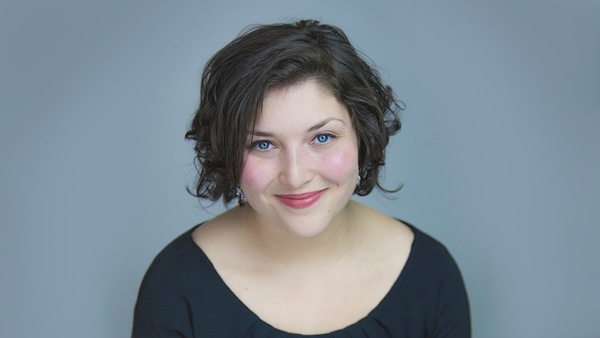
Sasha Kaye (photo from B’nai Mitz-Van)

Sasha Kaye recently launched B’nai Mitz-Van, a tutoring service that prepares b’nai mitzvah students for their Torah and Haftarah readings. She also offers basic voice training, performance anxiety management and d’var Torah writing support.

Kaye completed a double major in voice performance and psychology for her bachelor’s degree from the University of British Columbia, and she has a master’s degree in performance science from the Royal College of Music in London, England. In her master’s thesis, Kaye examined the experiences of musicians with moderate-to-severe performance anxiety in simulated performance environments.

“I came back to Vancouver in January 2023,” Kaye told the Independent. “Most of my time so far has been spent unpacking and readjusting to life in Vancouver!”

Kaye grew up attending Congregation Har El, where she is a member. She has led services as a lay cantor. “I performed at various holiday and milestone community events, and participated in extracurricular, Jewish-led activism with peers from King David High School,” she said about her younger years.

Kaye has performed with the University Singers choral ensemble, UBC Opera, the Vancouver Orchestra Club and Postmodern Camerata, among other groups. She performs as a solo recitalist and has almost 10 years of teaching experience.

“I came up with the idea for B’nai Mitz-Van while I was still in London, and the idea was partially inspired by my master’s thesis,” she said of her latest venture. “In addition to struggling with an anxiety disorder, I had particularly vivid performance anxiety as a musician. The two collided pretty spectacularly for my own bat mitzvah. Despite being well-prepared for it, I was constantly ruminating on potential mishaps and catastrophizing the consequences. What if I got so anxious that I forgot the trope for my Torah reading? What if I forgot the words? What if my voice cracked? What if I dropped the Torah? I would let my family down. These cognitive distortions are evident to my adult self, but the distress was very real to 12-year-old Sasha. When I told people I was anxious, they told me I had nothing to be anxious about. While I’m sure they were trying to reassure me, this ultimately dismissed my feelings and made me feel much worse. I had zero tools to cope with or manage my anxiety.”

Kaye said she has little recollection of the bat mitzvah itself. “I was so anxious, I essentially blacked out,” she said. “Based on second-hand information, I did well enough on the day, but I was unable to enjoy the simchah – and that’s ultimately what the day should have been about. B’nai mitzvot should be joyous occasions for everyone, including the b’nai mitzvah themselves.

“As someone who knows how to chant Torah and Haftarah, and knowing what I know now about performance anxiety, my hope is that B’nai Mitz-Van can both teach young adults what they need to know for their special day, and also give them the tools to manage feelings of nervousness or anxiety that they may have.”

Kaye has experience teaching b’nai mitzvah-age kids from when she used to teach singing lessons, which she did for about three years, and she has five more years of experience teaching older students.

“Performance anxiety is extremely common,” said Kaye. “While it may or may not necessarily impact the quality of your performance, that doesn’t make it any less uncomfortable to deal with.

“The experience can manifest cognitively, meaning through the kinds of thoughts you have, like fixating on the possibility of making mistakes in performances and overestimating the consequences; physiologically, meaning through bodily sensations like racing heart, dry mouth, shaking or feeling restless; emotionally, like feelings of nervousness, dread or irritability; or behaviourally, like avoiding practising.

“How to manage performance anxiety is the million-dollar question!” she said. “There are a number of techniques and methods that have been researched, and different things may work for different people. Some things that can help pretty reliably, if they are practised, are feeling prepared in your material; breathing exercises, like box breathing; grounding exercises that focus your senses on the here and now; and examining your self-talk, that is, how you talk to yourself in your own mind.

“Retraining self-talk can take a long time and it can be very challenging,” she acknowledged, “but it helps to start by noticing how you talk to yourself. Would you speak that way to a friend who was going through the same thing? If not, chances are your self-talk needs some adjusting from the harsh and self-defeating to the encouraging and self-supporting.”

About working with b’nai mitzvah-aged kids, Kaye said they “are at a really fascinating stage in life. They’re starting to come into their own sense of self, and they’re able to start thinking critically about the world around them without the cynicism that can follow us as adults. There’s an enthusiasm and idealism for tikkun olam that’s really refreshing.”

And, given her years of experience as a tutor of academic writing, Kaye can help students organize their enthusiasm and their ideas into a clear and concise d’var Torah. “More importantly,” she said, “I help them find their own way of relating to their parsha, so they can find the lesson they want to share with the congregation.”

Kaye offers both in-person and online lessons. She can be reached at [email protected] or 236-515-9469.

Format ImagePosted on March 10, 2023March 9, 2023Author Cynthia RamsayCategories LocalTags B'nai Mitz-Van, b'nai mitzvah, education, Judaism, music, Sasha Kaye, tutoring, writing
Artfully exploring heritage

Artfully exploring heritage

Lindsey Tyne Johnson (photo from Lindsey Tyne Johnson)

Returning from a Birthright trip to Israel in 2019, artist Lindsey Tyne Johnson was inspired. Learning the aleph-bet, she made a laser-engraved spirit board in Hebrew, but accidentally arranged the letters left to right, as they would be in English, and not right to left, as Hebrew is read. The mistake spurred her not only to create the exhibit Hebrew Spelled Backwards, which is on display at the Kamloops Art Gallery until April 1, but to explore her cultural heritage, from which she had been estranged, and learn more about Judaism.

The other, more sombre, inspiration for the Hebrew spirit board and the exhibit was, Johnson writes in a blog post, a “desire to feel closer to my brother after the events that left him homeless and his eventual passing.”

“Born with the name Liam, my brother changed his name to his chosen Hebrew name, Noah as an adult,” she writes on her website (lindseytynejohnson.com). “My mother had mentioned our Jewish ancestry to us as children, but my brother was the only person to explore it…. I can still remember it as what my mother called ‘one of his many phases’ in his late teenage years. She chalked it up to a phase, but it’s the string I use to tie memories of my brother together.”

“My brother was the first person I witnessed who explored their Jewish heritage,” Johnson told the Independent. “When he moved to Vancouver in his early 20s, he legally changed his name to his Hebrew name, Noah. He struggled a lot with his mental health, and there were times when I felt like I was losing the brother I grew up with. It was an attempt to feel closer to him that I went on Birthright and had a bat mitzvah. I wanted to remember the part of him that was happy, passionate and excited about life.

“My brother lost his life to fentanyl in 2021. It was devastating and broke my family apart,” said Johnson, who has two other siblings. “Many struggle to understand substance abuse/mental illness’s connection to generational or cyclical trauma. It’s unfair to look down upon those who might suffer from those things. I try my best to advocate for the destigmatization of mental illness where I can, though I’ve had to be careful not to let others’ ideas also negatively affect my mental health.”

While not a large exhibit, Hebrew Spelled Backwards is powerful, thought-provoking in a serious way, but also using humour. For the exhibit’s images, Johnson explains on her website, “The sandy colour palette was chosen as a tribute to the desert, a significant location in Jewish history and culture. I use digital media to blend traditional Jewish motifs with modern techniques, creating a dynamic visual experience.”

Johnson said, “Like many artists, my process is sporadic and requires a particular head space to create something I’m happy with. I often have ideas for pieces while doing mundane daily activities; if I don’t write them down, they’re lost forever. I practise a lot of sequential art, which is usually silly comics about everyday life, but they’re generally never seen by other humans. My style reflects the graphic novels I like to consume. I can’t help but be inspired by artists like Craig Thompson and Marjane Satrapi, both visually and thematically. My dream is to produce a graphic novel one day.”

The Hebrew Spelled Backwards exhibit comprises not only Johnson’s artwork, but her voice. Each picture has a QR code and viewers can hear Johnson give explanations of the Hebrew words and some context for the images, making the exhibit more accessible and inclusive. The illustrations variously include Jewish symbols and/or Hebrew text, supernatural elements, pop art iconography (a Warholesque can of Birthright’s Instant Bat-Mitzvah, for example) and current topics of concern, like rapper Ye’s antisemitic comments, poignantly drawn as a short series of cellphone text messages from a mom to her child that ends with the child asking, “mum, why is ye mad at us?” This is one of the works that, as the exhibit description reads, “examines the complexities of identifying as Jewish and the fear and uncertainty that often come with it.”

“I have a couple of fears about identifying myself as Jewish,” Johnson told the Independent. “Initially, when diving into Jewish culture and Judaism as a religion, I was afraid people might not think I was ‘Jewish enough,’ since only one of my parents has Jewish ancestry. My siblings and I were raised without Jewish traditions or education…. Having a bat mitzvah really helped with that fear, though. I’m also grateful that I’ve never really encountered anyone from the Jewish communities I’ve belonged to that has made me feel that way.

image - “RaeF” by Lindsey Tyne Johnson
“RaeF” by Lindsey Tyne Johnson

“The other part of that fear was that people would think differently of me or assume certain tropes or ideologies about me if I publicly identified myself as Jewish. This is an unfortunate reality I’ve experienced, even if subtly. Most commonly, people think I’m OK with antisemitic jokes or jokes that involve the Holocaust. It’s an exhausting thing to experience.”

Putting together the exhibit has allowed Johnson not only to explore her fears, but also her own biases.

“Creating these pieces required me to reflect on the experiences of people like Batsheva Dueck (aka Cynical Duchess, a modest fashion content creator) or more conservative Jews, who experience more assumptions made about them based on their dress or religious beliefs,” she said. “Since working on this exhibition, I’ve been more sensitive to times when I’ve excused antisemitic values expressed by my peers or acquaintances. When I lived in Brooklyn, I lived with someone who spoke quite negatively about Hasidic communities. This has been an excellent opportunity to witness my biases and encourage others to reflect on their biases or assumptions, too.

“It’s also allowed me to tie other pieces of my identity together,” she continued. “I’ve been able to connect my Irish ancestry with my Jewish ancestry, for example. It has given me a sense of wholeness or completeness and I’ve accepted that I can be many things all at the same time and I’ve accepted that that’s OK. We all contain multitudes.”

Johnson went to Ireland this past summer to visit where her Ashkenazi family moved to in the 19th century, and “to visit the Irish Jewish Museum and Waterford treasures.”

“I was probably in the fourth grade when my mother talked to my siblings and me about it,” said Johnson of first learning about her Jewish heritage. “It was after I had come home and talked about how we were learning about World War II at school. It was surreal to hear my mother, an immigrant from England, talk about a side of our ancestry that had never really been discussed before. I didn’t understand what it meant at the time.”

Johnson herself has lived many places. She was born in Edmonton in 1993, but her family moved to Saskatchewan and then Prince George, B.C., shortly after.

“I spent most of my youth in Prince George but moved to Dawson City, Yukon, as soon as I could save up enough money to attend the Yukon School of Visual Arts,” she said. “Yukon SOVA is a one-year foundational arts program. Still, I decided to stay in the Yukon upon completion and remained in the territory for about five years before I moved to Brooklyn in 2018. I was in Brooklyn for only half a year before moving to Kamloops to be closer to my family, but it made a lasting impression. Going from a territory of 35,000 people to my neighbourhood in Williamsburg with four times that amount was dizzying.”

Johnson said she loves the Kamloops Jewish community. “I joined shortly after moving to Kamloops from Brooklyn and felt incredibly welcomed,” she said. “The [Okanagan Jewish Community Centre] president, Heidi Coleman, is a huge inspiration and comfort to me. It’s pretty relaxed in terms of how often we have gatherings. We don’t have a synagogue or a place to meet, so we usually celebrate holidays at someone’s house. The ‘younger’ (20 to 30 years old) of us have a close bond, and I often have a group of us over for various holidays, too.”

Johnson is currently in her third year at Thompson Rivers University, where she is doing a bachelor’s in criminology. “I’m most interested in victimology,” she said. “I think Canada and most of the world fail victims of crime to an astronomical degree. It’s wild to think about how much attention we give criminals without considering how we could better support the survivor or victims of their crimes.”

Artistically, she is planning a piece that more specifically honours her brother Noah. “I want to educate the general public about how the consequences of generational or cyclical trauma can lead to mental health struggles like substance abuse,” she said. “I would like to highlight that it’s not specifically someone’s ‘fault’ for struggling the way they do.”

For more on Johnson, visit lindseytynejohnson.com. Kamloops Art Gallery’s website is kag.bc.ca.

Format ImagePosted on February 24, 2023February 22, 2023Author Cynthia RamsayCategories Visual ArtsTags digital art, family, Hebrew, history, intergenerational trauma, Kamloops Art Gallery, Lindsey Tyne Johnson, social commentary, stigma, substance abuse
Series tries to inspire climate action

Series tries to inspire climate action

Tikkun olam, repairing the world, is a central tenet of Jewish life, but sometimes the task can seem overwhelming. The climate crisis looms large for all of us, but especially for younger folks, who will bear the brunt of its effects. A new graphic novel for 6-to-12-year-old readers offers an optimistic, fun story about the power of kindness – towards ourselves, other people, animals, the environment – to energize and inspire us to action, to at least try and fix things.

I Can Hear Your Heart Beep, published by Planet Hero Kids in Vancouver, is the first book of the children’s graphic novel series Steve and Eve Save the Planet. Written by Paul Shore and Deborah Katz Henriquez, with imaginative and colourful illustrations by Prashant Miranda, the book is being released on Feb. 25, in recognition of International Day of the Polar Bear, which takes place Feb. 27. One of the book’s two main characters is a polar bear, Steve, who lives in the Arctic. Steve, Eve (an electric vehicle) and their friends come to realize that it is up to them to do whatever they can to clean up the environment and try to stem the global warming that is, among other things, reducing the animals’ food supply.

image - I Can Hear Your Heart Beep book coverEve ends up in the Arctic accidentally. Bullied and ostracized by her “gassy car cousins,” who tell her, “You’re just a heartless machine, sister – like us – you’ll never make a difference in this world!” she takes off (she has wings) to find her “pack,” other electric vehicles. On her way to Norway, she experiences a malfunction that lands her in the Arctic, where she is found by Steve, who’s having problems of his own – driven to stealing food because he’s so hungry, and missing his parents, who went away to find food and haven’t returned.

I Can Hear Your Heart Beep is the genesis story of the two likely-to-become environment heroes, Steve and Eve. We find out their motivations and meet their first sidekicks/allies, the other Arctic animals, and Burger the Booger, their first nemesis of, no doubt, more to come.

For readers wondering about the choice of an electric car as a heroine, Shore writes on the book’s website: “The spark that started our Planet Hero Kids journey first became visible when my pyjama-wearing 8-year-old daughter spontaneously hugged an electric car! That day of our first EV test drive, my daughter laid her little body on the car’s hood with arms outstretched across it, and with one ear against the smooth metal she said, ‘she has a heartbeat.’ The fact that the car seemed calm, gentle and fun … seemed to tell her that the machine was as friendly as a family pet.

“The realization that young children intuitively understand what is healthier for them and the planet sent me in search of partners to help create an uplifting climate action kids book that would cultivate hope and a sense of opportunity during the challenging era in which our children find themselves growing up.”

Shore took the idea to Henriquez, who, he told the Independent, he “first met at an author’s reception at the JCC book festival several years ago!” The pair began their collaboration, eventually connecting with Miranda.

I Can Hear Your Heart Beep can be ordered from Amazon. For more information on the series, visit savetheplanetbook.com.

Format ImagePosted on February 24, 2023February 22, 2023Author Cynthia RamsayCategories BooksTags children's books, climate crisis, Deborah Katz Henriquez, Paul Shore, Planet Hero Kids, Prashant Miranda, tikkun olam
Fresh new fairy tale

Fresh new fairy tale

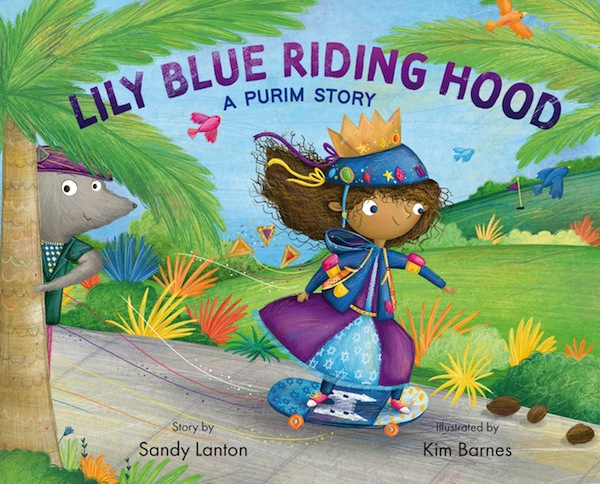
Making old, familiar stories new and fresh again. Writer Sandy Lanton and illustrator Kim Barnes do just this with their take on Red Riding Hood: Lily Blue Riding Hood, published by Seattle’s Intergalactic Afikoman.

Lily loves to skateboard and almost every page of Lily Blue Riding Hood is full of movement, as she swiftly rolls to everywhere she needs to be. On Purim, it’s to Granny’s house, with her blue hoodie pulled over her Queen Esther costume, its crown atop her helmet, her backpack full of hamantashen she’s just baked (leaving behind the messiest of kitchens). On the way, she passes Thaddeus T. Wolfe and chats long enough with him that the smell of the hamantashen gets him plotting how he can get Granny’s treats for himself.

Readers can make their own treats using the recipe for Lily’s Skateboarding Hamantashen, which are the regular triangle shape, but then attached to a long flat cookie, the “skateboard,” and either small round cookie or candy “wheels.” The recipe page also includes a paragraph on what Purim is and how it’s celebrated.

Lily Blue Riding Hood is a colourful and humour-filled modern-day Jewish fairy tale that will make both adult and child readers smile.

Format ImagePosted on February 24, 2023February 22, 2023Author Cynthia RamsayCategories BooksTags children's books, fairy tales, Intergalactic Afikoman, Kim Barnes, Purim, Sandy Lanton
Emotionally packed film

Emotionally packed film

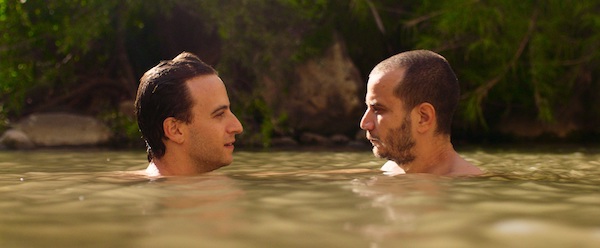
Ofir Raul Graizer’s America features a love triangle of sorts, between Iris (Oshrat Ingadashet) and Eli (Michael Moshonov), above, who meet at her and Yotam’s flower shop, and Yotam (Ofri Biterman) and Eli, whose afternoon swim turns tragic. (screenshots courtesy Beta Cinema)

On Feb. 23 at Fifth Avenue Cinemas, the Vancouver Jewish Film Festival offers an award-winning teaser to next month’s festival. Ofir Raul Graizer’s America is an emotionally packed film that says as much with dialogue as it does visually.

We meet Ilai Cross in Chicago, where he is a beloved swimming teacher. With gentle sensitivity and patience, he helps kids overcome their fears and become comfortable in the water. He is great at his job, and seems happy, if solitary.

A phone call from a lawyer informing him that his father has died sends Ilai – whose real name, it turns out, is Eli Greenberg – back to Israel. He’s obviously uncomfortable being “home,” his policeman father’s retirement plaques and guns everywhere. There are reasons Eli left Israel for the (mythical) land of opportunity, America, which we eventually find out.

In contrast to his father’s stark, rundown, predominantly beige house and untended yard is the vibrant, life-filled flower shop of his childhood friend Yotam and fiancée Iris, and their brightly coloured living space, where they welcome Eli for dinner. Between some too-long hugs and what seem like yearning looks, one wonders just how close were friends Eli and Yotam, but the film gives nothing away.

image - Yotam and Eli swimming
(screenshot courtesy Beta Cinema)

When the two friends go swimming at an old haunt, an accident leaves Yotam in an extended coma. At first blaming Eli for the incident, Iris eventually bonds with him, in part because of their shared loss. When, 18 months later, Yotam wakes up, life changes again for Eli and for Iris, both of whom must make their own decisions as to what they consider the morally responsible way forward.

The acting is excellent. While Oshrat Ingadashet was awarded for her performance at the Jerusalem Film Festival last year, both Michael Moshonov, as Eli, and Ofri Biterman, as Yotam, deserve kudos, as well. All three actors play their roles with quiet force, emoting as much in a gesture as in words. The relatively sparse dialogue invites viewers to focus on what else is pictured in each scene, and Graizer lets shots of newspaper articles, an actor’s face or the landscape help tell the story. He respects viewers’ ability to handle ambiguity, answering enough questions to satisfy, but leaving much to discuss afterward. Cinematographer Omri Aloni’s work adds beauty and depth to the production.

America screens at the Rothstein Theatre on Feb. 23, at 7 p.m. To see the trailer and buy tickets to see the movie, visit vjff.org.

The Vancouver Jewish Film Festival opens March 9 and runs to March 16 at Fifth Avenue. There will be more in-person screenings March 17-19 at the Rothstein Theatre and select films will be available online March 19-26.

Format ImagePosted on February 10, 2023February 9, 2023Author Cynthia RamsayCategories TV & FilmTags drama, Israel, Ofir Raul Graizer, Vancouver Jewish Film Festival, VJFF
JDC’s Ukraine efforts

JDC’s Ukraine efforts

Marina Sonkina shares her experiences as a volunteer with the JDC in Poland last year, helping Ukrainian refugees. (photo by Masumi Kikuchi)

This year’s annual Raoul Wallenberg Day in Vancouver honoured the American Jewish Joint Distribution Committee (JDC) for “its courageous support for Ukrainian refugees.”

“In addition to vast internal displacement, from a population of 41 million Ukrainians, eight million (mostly women and children, and some seniors) have fled to Europe and other parts of the world,” said Alan Le Fevre in his opening remarks.

Le Fevre is on the board of directors of the Wallenberg-Sugihara Civil Courage Society, which hosts the Wallenberg Day commemorations. This year, the event was presented in partnership with Congregation Beth Israel, and it took place at the synagogue on Jan. 22.

The JDC’s work helping Ukrainian refugees “continues its illustrious history,” said Le Fevre, noting that, “since its founding in 1914, the JDC has provided support for refugees whenever and wherever needed, propelled by Jewish values and a commitment to mutual responsibility.”

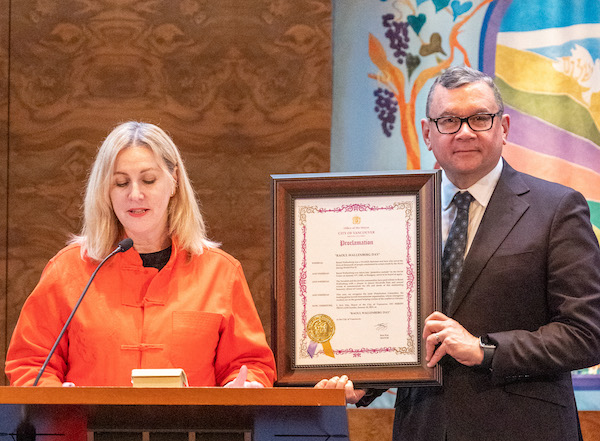
The City of Vancouver’s proclamation of this year’s Wallenberg Day was read by Deputy Mayor Sarah Kirby-Yung, attending on behalf of Vancouver Mayor Ken Sim. She was joined by Councilor Mike Klassen.

Kirby-Yung had helped celebrate the start of the Lunar New Year that morning, and still had on the red jacket she had worn for that event because the Asian community “has suffered much in the past few years, [with] anti-Asian hate and, sometimes, that plight has been very analogous to what our Jewish community has suffered” and one of the best things about the city, and what she sees in the work of the JDC, is “communities and cultures, and people of different faiths and backgrounds, who come together to stand against injustice and to support each other.”

photo - Vancouver Deputy Mayor Sarah Kirby-Yung reads the city’s proclamation of this year’s Wallenberg Day, the framed copy of which is being held by Councilor Mike Klassen
Vancouver Deputy Mayor Sarah Kirby-Yung reads the city’s proclamation of this year’s Wallenberg Day, the framed copy of which is being held by Councilor Mike Klassen. (photo by Masumi Kikuchi)

WSCCS board member George Bluman introduced the afternoon’s guest speaker, Dr. Marina Sonkina, a local educator and writer. “Soon after Russia attacked Ukraine, Marina applied to volunteer with the Jewish Joint Distribution Committee, as someone who speaks Russian, Ukrainian and other languages and as someone who has been a refugee herself,” he said. “Almost immediately, she was accepted and flew to Poland at the end of March.

“After arriving in Warsaw, about five hours later, Marina was at the Polish-Ukrainian border, where she served in a camp as a frontline responder, offering fleeing refugees medical and psychological support.”

Sonkina, who has relatives in Russia and Ukraine, said most of her family is out of Russia at this point.

“If we are talking about why didn’t Russians resist,” she said, “I think those more than one million people who left Russia when the draft, conscription, was announced, that is the only accessible form of not revolt, but saying no to Putin. Otherwise, it is pretty much a fascist state.”

While Putin is the person who launched the war, she wondered about others’ culpability: all those who overlooked Putin’s actions over the 22 years of his being power, which has seen him poison his opponents and annex Crimea, among other things. What was the West’s role, she asked, as they worked with Putin as a business partner first, putting his authoritarianism second?

In Warsaw, Sonkina was one of the people who met Holocaust survivors being extracted from Ukraine, to be housed in Germany. The next day, she worked in a refugee camp, where there were already more than two million refugees. (For more on Sonkina’s experience in Poland, read her account at jewishindependent.ca/helping-ukrainian-refugees.)

JDC helped everybody, said Sonkina. A moral responsibility to repair the world, tikkun olam, is part of JDC’s mandate and she saw this responsibility in action. She remarked on the goodwill of people from around the world, of a range of ages, who were helping in different ways, including taking refugees into their homes. The strength and independence of the refugees also left an impression on Sonkina – they didn’t want to take handouts, she said, and they wanted to know whether they could get jobs in the country that harboured them.

“One of the things that I quickly realized – a part of persuading them to go to this country or that was just the human contact that was so important,” she said. The refugees she met had experienced such trauma, and her acknowledgement of what they had gone through allowed some of them to cry. “It was sometimes hard,” Sonkina admitted, visibly emotional. “But there were also funny stories,” she added, sharing a couple of those stories before WSCCS board member Gene Homel took the podium.

An historian teaching about Europe in the 20th century for many years, Homel had been in Ukraine eight or nine years ago, and he echoed what Sonkina had said about Ukrainians’ “intense loyalty” – “the attachment to the land, culture and language” – but, he said, “I want to make the point that, in Ukraine today, the focus of loyalty is a civic one, it’s on the national state rather than ethnicity, it’s a pluralistic and multiethnic society that’s being created, forged largely as a result of Russia’s criminal attack on Ukraine.”

Homel provided a brief overview of the JDC’s work from its founding in 1914 to its current work with Ukrainian Jews and non-Jews, and he introduced businessman and philanthropist Gary Segal, who became familiar with JDC’s work in 2007, on a Jewish Federation of Greater Vancouver trip to Ethiopia, led by JDC professionals. He’s been a board member since 2012.

“I marvel at the compassion, intelligence, resourcefulness and resolve with which the dedicated staff and volunteers carry on their sacred work,” said Segal, noting that JDC helps communities of all backgrounds and faiths, and doesn’t just respond to acute situations, but also to endemic poverty, food insecurity and the plight of refugees, as well as antisemitism.

“Since 1914, we’ve rescued more than one million Jews in danger, from places like Ethiopia, Yemen, Bosnia and Herzegovina, and Ukraine,” said Segal, who spoke about various JDC initiatives, including its medical programs in countries like Ethiopia.

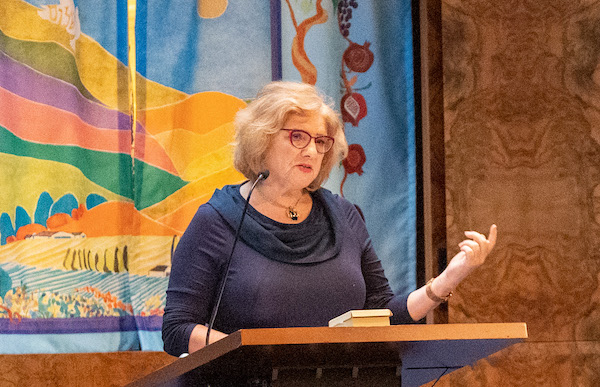
photo - Gary Segal, a board member of the American Jewish Joint Distribution Committee, speaks about JDC’s history and his involvement with the organization
Gary Segal, a board member of the American Jewish Joint Distribution Committee, speaks about JDC’s history and his involvement with the organization. (photo by Masumi Kikuchi)

It was on that 2007 trip that Segal met Dr. Rick Hodes, JDC’s medical director in Ethiopia, whose care for kids with severe spinal deformities (with Ghanaian spine surgeon Dr. Oheneba Boachie-Adjei) inspired Segal to get involved, too. He brought a young Ethiopian to Vancouver for back surgery and established in Vancouver the organization Bring Back Hope, which has raised some $3 million to support spine surgeries, preventative screening, and more. (See jewishindependent.ca/oldsite/archives/jan11/archives11jan14-02.html and several articles on jewishindependent.ca.)

Returning to JDC’s work in Ukraine since the war began, Segal noted that, to date, the organization “has cared for 35,000 vulnerable and elderly poor; it evacuated 13,000 Jews from Ukraine; provided over 40,000 refugees with food, medicine, trauma support; received over 19,000 incoming calls at the emergency centre; and provided over 1.3 million pounds of humanitarian assistance.”

Segal then brought his talk around to Raoul Wallenberg, Sweden’s special envoy to Hungary in 1944, who saved tens of thousands of Jews from deportation and death. “The original fund of $100,000 that [Wallenberg] received from the War Refugee Board came from the American Joint Distribution Committee and, when that was finished, he received additional funds from the JDC,” said

Segal, who concluded, “I would say, so much of what JDC does is giving hope. Hope is a powerful word, an essential element in everyone’s life…. Hope can give us the strength and the will to continue in our darkest moments, to aspire and believe that things can and will be better.”

On behalf of the JDC, Segal accepted, with thanks, the Wallenberg-Sugihara Civil Courage Award from Le Fevre.

Other components of the afternoon included a few words from Beth Israel’s Rabbi Jonathan Infeld, a short documentary on Norwegian Fridtjof Nansen, who received the 1922 Nobel Peace Prize for his work on behalf of displaced persons after the First World War, and a compilation of JDC’s work in Ukraine since the Russian invasion.

WSCCS board member Judith Anderson introduced the videos, giving more of Nansen’s background and achievements, including “the repatriation of 450,000 prisoners of war, mostly held in Soviet Russia” and “[in] response to a severe famine in Soviet Russia, Nansen directed relief efforts that saved between seven million and 22 million people from starvation.”

Anderson said, “The Nansen story is directly relevant to Ukraine. The headquarters for Nansen’s mission to Russia was in Ukraine’s Kharkiv, and Nansen donated part of his Nobel Peace Prize money to establish a major agricultural project in Ukraine.”

She thanked the Norwegian Refugee Council and the Nobel Peace Centre for permission to show the videos about Nansen and JDC staff members and directors – Shaun Goldstone, Solly Kaplinski and Alex Weisler – for compiling the material for the Ukraine Crisis video.

The Wallenberg-Sugihara Civil Courage Society is named after Wallenberg for his actions during the Holocaust, and Chiune Sugihara, who, as vice-consul in Lithuania for Japan during the war, issued transit visas that allowed thousands of Jews from Poland and Lithuania to escape. For more information on the society and to see videos of the Jan. 22 event, visit wsccs.ca.

Format ImagePosted on February 10, 2023February 9, 2023Author Cynthia RamsayCategories LocalTags Alan Le Fevre, American Jewish Joint Distribution Committee, Gary Segal, Gene Homel, George Bluman, JDC, Judith Anderson, Marina Sonkina, refugees, Sarah Kirby-Yung, Ukraine, Wallenberg-Sugihara Civil Courage Award, Wallenberg-Sugihara Civil Courage Society, war

Lives shaped by war

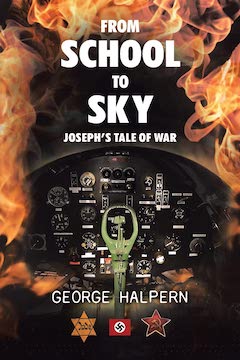
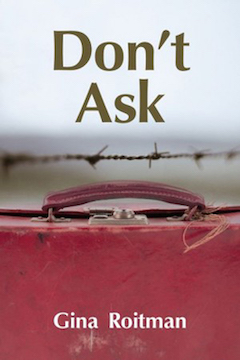
Heroism and survival took on new meaning for me after reading George Halpern’s From School to Sky: Joseph’s Tale of War and Gina Roitman’s Don’t Ask. The first is a biography of a certain time in Halpern’s father’s life, the latter is a fictional work that centres around a daughter’s search for her mother’s history during that same time period, the Second World War. Both books are featured at this year’s Cherie Smith JCC Jewish Book Festival.

Halpern takes part in the Feb. 12, 10 a.m., by-donation event A Literary Quickie, in which he and seven other authors each have five minutes to pitch their books. Roitman appears with Lynda Cohen Loigman (The Matchmaker’s Gift: A Novel) in A Day to Celebrate Human Closeness, which takes place at 2 p.m., on Feb. 14 ($18).

image - From School to Sky book coverHalpern’s pitch to me included only some of the actions that make his father, Joseph Halpern, a hero. In reading the book, which is based on months’ worth of interviews George did with his dad, who died in 2011, I discovered several more reasons. Joseph was a fighter pilot for the Russian Air Force (Joseph’s town, Vladimir Volynsky, was in the part of Poland annexed by the Soviet Union weeks after the war started). He was a Soviet prisoner for a spell, then trained as a special forces commando. He was captured by Nazis on a mission, but escaped. Following the war, he defected (to the Americans in Berlin), taking his Russian plane with him, but then returned to Russia to fulfil a promise he made to someone who had saved his life. He founded an orphanage, helped create the Israeli Air Force, etc., etc.

The most compelling part to me of Joseph Halpern’s story, however, is his honest appraisal of himself, his humility and his humanity, even though he wasn’t always humane. He admits his “fearless attitude would be combined with special training – including brainwashing – and I would truly believe that I was invincible.” He is open about wanting to have killed more Nazis than he did, and that he personally killed someone in an act of revenge. His complexities include the life he had to build after immigrating to Canada, caring for his kids through his wife’s struggle with mental illness, obtaining two doctorates, working with NASA, finding love again and more.

Similarly, though in a fictional setting, Roitman’s novel deals with multi-layered human beings, some of whom survive because they committed acts of which they are not proud – and they carry the guilt for the rest of their lives. As Joseph’s trauma travels beyond his own self and is passed on in some degree to his children, so does the character Rokhl’s carry over to her daughter Hannah.

Rokhl doesn’t talk much, and certainly not about her experiences during the Holocaust, in contrast to her husband, who has already passed away when the novel begins – what little Hannah knows of her heritage has come from her father. Hannah only receives her mother’s wisdom through notes that Rokhl leaves her, the last of which Hannah finds in her mom’s purse after Rokhl dies, apparently by suicide: “I am not her,” it says.

image - Don’t Ask book coverDon’t Ask traces Hannah’s attempt to figure out the mystery of that note and deal with the grief of her mother’s death, while also brokering a real estate deal between a German buyer and a Holocaust survivor who lives in Quebec and owns a tract of land in the Laurentians. Hannah’s parents immigrated to Montreal after the war; Hannah, their only child, was born in a DP camp in Germany, which they had called home. Since the Holocaust, “Her father could not say the word ‘German’ without spitting” and, in her last encounter with her mother, in which Hannah shared the news that she was traveling to Germany, her mother had threatened, “If you go, it will be over my dead body, do you hear me?”

In the guise of a budding romance between Hannah and Max, her counterpart in Germany, Roitman addresses many challenging questions about the intergenerational nature of culpability and forgiveness, of duty to one’s parents and the responsibility for building one’s own life, of nursing hatred or risking love. She does so in a fashion that sometimes pushes belief – for example, Hannah and Max are not young, yet they lack much understanding of what attraction is, and Hannah, despite her professed curiosity about her mother’s past doesn’t explore until the end of the book four boxes of her mother’s notes, which have sat in her closet for an undisclosed amount of time prior to her mother’s death. Yet, Roitman also writes in a way that makes you care about the characters and what happens to them. The story of Rokhl’s Holocaust experiences and that of Hannah’s budding relationship (and the weight of history that it and the real estate deal unearth) are enthralling and Don’t Ask is a hard book to put down until you finish it.

Posted on January 27, 2023January 26, 2023Author Cynthia RamsayCategories BooksTags Cherie Smith JCC Jewish Book Festival, fiction, George Halpern, Gina Roitman, Holocaust, Joseph Halpern, memoirs, non-fiction, Second World War
Reading expands experience

Reading expands experience

Letters that highlight friendship, writing that facilitates healing, stories that dissect societal mores – the books reviewed by the Jewish Independent this week represent only a small fraction of those featured at the Cherie Smith JCC Jewish Book Festival this year.

While the official festival runs Feb. 11-16, opening with Dr. Gabor Maté in conversation with Marsha Lederman about his latest book, The Myth of Normal: Trauma, Illness & Healing in a Toxic Culture, there are a couple of pre-festival events this month: German writer Max Czollek launches the English version of his book De-Integrate! A Jewish Survival Guide for the 21st Century on Jan. 19 and American-Israeli photographer Jason Langer presents his book Berlin: A Jewish Ode to the Metropolis on Jan. 26. As well, there is a post-festival event, on Feb. 28, which sees former federal cabinet minister and senator Jack Austin launching his memoir, Unlikely Insider: A West Coast Advocate in Ottawa.

If the books reviewed by the Independent are any indication, attendees of the festival can expect to have their views challenged and their perspectives broadened; they will be moved, disturbed and amused, sometimes all at once.

Intimate portraits

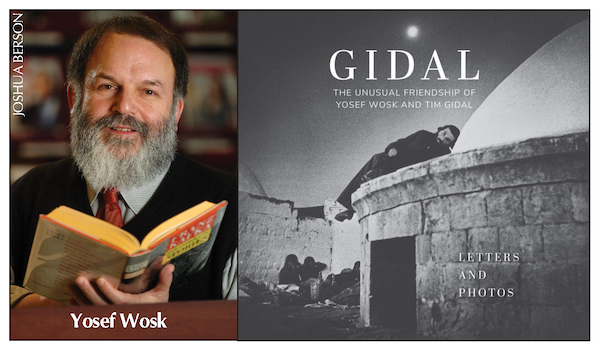
Two years ago, the JCC Jewish Book Festival featured the book Memories of Jewish Poland: The 1932 Photographs of Nachum Tim Gidal (jewishindependent.ca/gidals-photos-speak-volumes). It was the fulfilment of a dying request that Israeli photographer Tim Gidal made in 1996 to Vancouver scholar, writer and philanthropist Yosef Wosk. The book was released at the same time that an exhibit of its photos was mounted at the Zack Gallery (jewishindependent.ca/jewish-poland-in-1932).

The friendship between Wosk and Gidal was evident in that book and in the exhibit. How the two men – separated in age by some 40 years and in geography by almost 11,000 kilometres – became such good friends is the subject of Gidal: The Unusual Friendship of Yosef Wosk and Tim Gidal, written by Wosk (and, technically, Gidal) and edited by another of Wosk’s good friends, Alan Twigg.

photo - Alan Twigg
Alan Twigg (PR photo)

The bulk of Gidal is letters that Gidal and Wosk wrote to each other from 1993, soon after they met, through to Gidal’s death in 1996. The postscript is a letter from Wosk to Gidal’s wife, Pia, mourning Gidal’s death and hoping that “his work and vision continue to inspire others.” Twigg has masterfully edited the multi-year correspondence, which comprised hundreds of letters, into an engaging narrative that offers insight into the core of these undeniably brilliant men, their work, ideas, loves, frustrations, sadnesses and more. Their vulnerability makes this a brave publication for Wosk to have created, and a meaningful one.

The other main component of Gidal is, of course, Gidal’s photographs, which, Wosk writes in the afterword, “serve as background to the letters.” As he did with Memories of Jewish Poland, Wosk mostly lets the photographs speak for themselves. Each photo section has a theme but each image within the section is simply captioned, placed and dated, without commentary.

There is a short chapter on Gidal and one on his and Wosk’s friendship and how this book came about. Gidal is creatively and esthetically put together. Each letter is headed by a key quote from the missive and the date it was sent. Images are included of some of the actual letters, most of which were sent by fax. It is interesting to contemplate whether this fount of communication would exist if it had been made via email.

Wosk and Twigg will talk about Gidal on Feb. 14, 7 p.m., at the book festival. The event is free of charge.

 Therapeutic memoirs

Paired together for a presentation are Margot Fedoruk and Tamar Glouberman. The program categorizes them as “modern-day women” who will be presenting their “offbeat memoirs,” summarized by the question, “How B.C. is that?” Indeed, both Fedoruk and Glouberman tell coming-of-age stories of a sort, Fedoruk’s beginning in her 20s and Glouberman’s in her 30s. And they both lead outdoorsy, independent lives that could be described as the B.C. ideal, yet both have also faced many challenges and darker sides of that ideal.

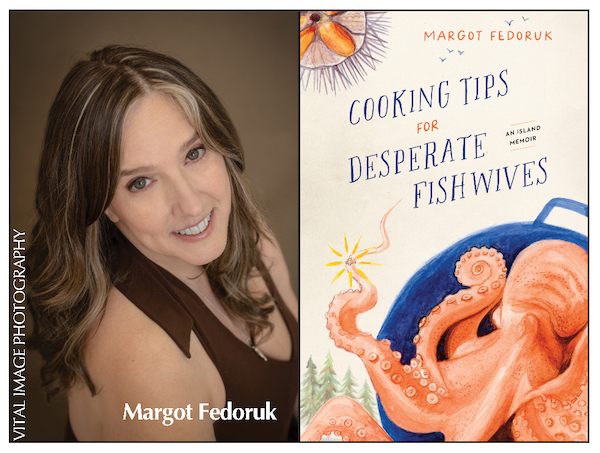
Fedoruk is the author of Cooking Tips for Desperate Fishwives, in which she openly shares her anxieties of being married to a West Coast sea urchin diver – she is lonely without him, must raise their two daughters mostly without him and is worried that an accident may result in her having to live without him. Yet, she loves Rick, even though she does try (unsuccessfully) to convince him to take up another profession and stay closer to home. The pair moves around a lot, and Fedoruk herself takes up many different jobs over the years to make ends meet. But they stick together, getting married after their daughters are all grown up and have left home.

images - Margot Fedoruk and Cooking Tips for Desperate Fishwives coverAs dysfunctional as their relationship appears at times, Fedoruk had a more challenging life before she met Rick. Her father is a horrible man, her mother dies of cancer and she and her sister lose the family home to her mother’s second husband, also a horrible man. And there’s more. It is no wonder she leaves Winnipeg, eventually settling in British Columbia, though settling may be too strong a word, as she and her family do live in several different places on the coast, with some time in Calgary.

What makes Fedoruk’s memoir unique is the inclusion of a recipe in almost every chapter that reflects the mood or subject matter of the chapter, like the Killer Lasagne in the introduction, which begins, “The night I ran over Rick with my car, I was over four months pregnant with our first daughter.” Other recipes include Easy Curried Chickpeas With Rice, which appears as an affordable comfort food in a chapter about her being exhausted, on her own, caring for her two then-young daughters; and Wild-crafted Stinging Nettle Pesto, which comes after one of her descriptions of the soaps she makes – her business is Starfish Soap Company.

Near the end of her memoir, Fedoruk mentions that she has started therapy. I would have liked her to have written this book further into that process. As honest as she is about her feelings and circumstances, the memoir would have been more layered and impactful had she been further along in understanding how her traumatic childhood experiences, her genes and other factors affect how she moves through the world.

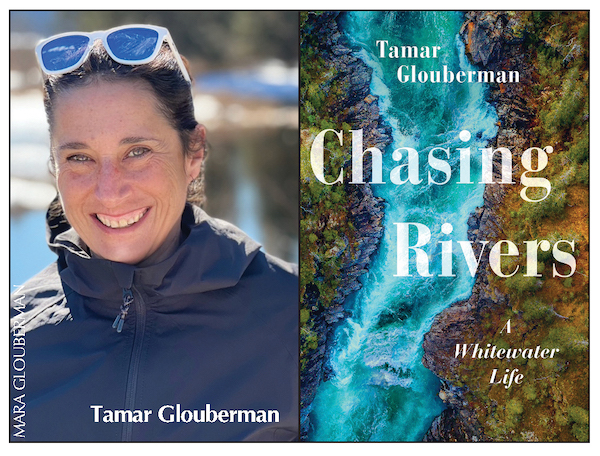
Glouberman has a less tragic background but a similarly transient life – and also loves something that gives her both great joy and great anxiety, the latter of which eventually takes over. In Chasing Rivers: A Whitewater Life, she shares her emotional journey of trying to make a life as a whitewater rafting guide.

images - Tamar Glouberman is the author of Chasing Rivers: A Whitewater LifeOne of the few women to guide tours, Glouberman does face sexism, her skills often underestimated by clients, but her male bosses and colleagues all seem to appreciate her abilities – certainly more than she does. She is constantly worried about making a mistake that will kill her or someone else and, while this is rational, given her job and its risks, the feeling becomes overwhelming. With an accident on the road – there is a lot of travel required to get to places like Chilko River, Williams Lake and further afield, outside the province – and her worst nightmare coming true on a rafting trip, Glouberman’s fears have very real incidents on which to grow.

Glouberman tries other types of work, but is always drawn back to the water. She struggles with depression and has a few other harsh experiences that add to her self-doubt. She tries various forms of therapy, some of which make her feel worse. Her family is supportive, though, and her sister’s home in Whistler is a refuge. She is only beginning her journey to healing when the memoir ends, and part of that has to do with getting into a master’s writing program. Both she and Fedoruk, who also went back to university for a writing degree, thank several people for their memoirs coming to fruition.

Glouberman and Fedoruk present at the book festival Feb. 12, 2 p.m. (tickets are $18). They also speak at Congregation Har El that day, at 11 a.m.

The price of victory

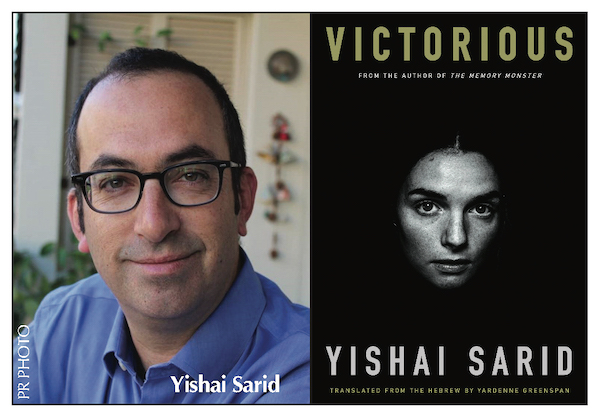
The harm inflicted on a society by war culture is front and centre in Israeli writer Yishai Sarid’s book Victorious. The main character, Abigail, is a military psychologist who, basically, tries to make soldiers into better killers, both “helping” them through trauma after they’ve experienced it and teaching them ways to be immune to trauma so that they can “beat the enemy.” Her father, who strongly disapproves of her work with the army, is a renowned clinical psychologist. On more than one occasion, he tries to talk her out of working for the military, but does not succeed. That the character of the father is dying of cancer is not coincidental.

images - Yishai Sarid and Victorious book coverAbigail blurs professional lines everywhere, working for the married man who fathered her son, the man who is now the army’s chief of staff; sleeping with a patient/friend; trying to become close friends with a former patient; and having a sexual relationship with one of the young soldiers whose unit she’s evaluating. The lessons she teaches are chilling, as is her abandonment of a patient who becomes too difficult for her to handle and some of her other actions.

She believes her job is her patriotic duty, even as her own son, Shauli, enters military service, in the paratroopers no less, and her fears for him fight with her pride in his choice. Though, with both his father and mother being staunch militarists, it could be argued that Shauli doesn’t really have a choice.

Victorious is a sparingly written novel that readers will not only ponder but feel well after they put it down. Translator Yardenne Greenspan must be given credit for making Sarid’s words as impactful in English as they are in Hebrew.

Sarid’s book festival event is Feb. 12, at 8 p.m. Tickets are $18.

For the full author lineup and to purchase festival tickets or passes, visit jccgv.com/jewish-book-festival or call 604-257-5111.

Format ImagePosted on January 13, 2023January 11, 2023Author Cynthia RamsayCategories BooksTags Alan Twigg, fiction, JCC Jewish Book Festival, Margot Fedoruk, memoirs, photography, Tamar Glouberman, Tim Gidal, Yishai Sarid, Yosef Wosk
Controversy welcome

Controversy welcome

Soldiers of Tomorrow, about Itai Erdal’s experiences in the Israeli army, is at the Roundhouse Feb. 3-5. (photo from the Elbow Theatre)

“I know that this play will piss off a lot of people on both sides of the conflict, but I welcome the controversy. I am taking some strong stances and talking about some explosive subject matters (pun intended) so, if it wasn’t going to piss people off, then I probably didn’t do my job properly,” Itai Erdal told the Independent. “I think it’s good to challenge people and I welcome the discussion that this play will generate.”

Erdal was talking about Soldiers of Tomorrow, which he wrote with Colleen Murphy. The play is part of this year’s PuSh International Performing Arts Festival, and sees its world première Feb. 3-5 at Roundhouse Performance Centre.

Presented by the Elbow Theatre and PuSh, Soldiers of Tomorrow is directed by Anita Rochon and performed by Erdal with Syrian musician Emad Armoush.

“When I was a kid growing up in Israel, peace seemed inevitable – it was just a matter of time, there were countless songs about the day peace will arrive. The adults would always say, ‘By the time you grow up, we won’t need an army anymore.’ No one says that today,” writes Erdal on his website. “Most Israelis accept that their children will be soldiers. One day, when my nephew was 8, he came home from school with an empty box to fill with stuff to send to soldiers on the front line. Inside the box his teacher had written: ‘To the soldiers of today from the soldiers of tomorrow.’”

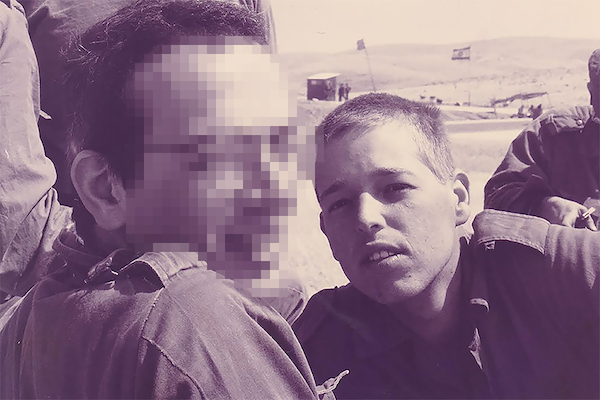
This experience inspired the play. While fictional, it is about real events that happened to Erdal during his time in the Israel Defence Forces in the early 1990s.

“I served in the army for three years and as a combatant soldier,” said Erdal. “I would have had to be in the reserves until the age of 45, which I didn’t want to do. I was in Jerusalem during all the suicide bombings in the ’90s and my reluctance to continue to be a soldier and my exhaustion of the political situation definitely contributed to my decision to immigrate to Vancouver.”

Erdal has made his mark here in many ways, including as an award-winning playwright, performer and lighting designer. He created the Elbow Theatre in 2012 “to confront urgent social and political issues.” Soldiers of Tomorrow is its sixth production. The PR blurb notes that, in it, Erdal “relates his actions in the army, exploring his personal culpability in the face of complex geopolitical forces in his former country – a place that he loves ‘with a broken heart.’”

“I pitched the idea for this play to Colleen Murphy in 2018 when we were working together in Stratford,” Erdal told the Independent. “We met a few times that year, but it really took off when the pandemic started. For almost two years, Colleen and I would meet on Zoom every Monday and Thursday for two hours. It was really great to have a project during the lockdown, it kept me sane.”

Although it is a one-man play, Armoush will also be on stage with Erdal, performing the music live. As to how he connected with Armoush, Erdal said, “I was looking for a Palestinian musician but there aren’t many of them in Vancouver and Emad was highly recommended by my Israeli musician friends.”

About the timing, Erdal explained, “During my lifetime, the situation for Palestinians has only gotten worse, it never gets better. Israel recently formed the most extreme right-wing government in its history, with several openly racist and homophobic ministers. Many Israelis and Palestinians are bracing themselves for the worst. Unfortunately, this play is more relevant than ever.”

He is not concerned about how Jews in general or Israelis specifically will be perceived by non-Jewish people who see the play.

“I am a very proud Jew and, even though I criticize the state of Israel, I do so because I love it, and I think that love is clear in the play,” said Erdal, who shared the following quote from the play: “I am aware that this is a topic that intimidates many Canadians. I’ve seen the glazed look in your eyes. I’ve had many people ask me to explain the conflict to them and, after one minute, they are searching for the exit. I’ve also seen many people twist themselves into pretzels in order not to take sides because they were concerned about appearing antisemitic. I hope by the time you leave here, you’ll be able to criticize Israel without worrying about appearing antisemitic.”

Soldiers of Tomorrow is at the Roundhouse Feb. 3-4, 7:30 p.m., and Feb. 5, 2 p.m., with a post-show talkback after the Feb. 4 performance. The show is 75 minutes long, with no intermission. Tickets ($34) can be purchased at pushfestival.ca.

The PuSh International Performing Arts Festival runs Jan. 19-Feb. 5. It features 20 original works – theatre, dance, music, multimedia and circus – from 12 countries and includes six world premières, one North American debut, six Canadian and two Western Canadian openings and one Vancouver première. Single tickets start at $34 in-person, $25 online, plus there are pay-what-you-can and free events; passes, which offer a discount and other perks, are available for both in-person and digital shows. Visit pushfestival.ca or call 604-449-6000.

Format ImagePosted on January 13, 2023January 11, 2023Author Cynthia RamsayCategories Performing ArtsTags Elbow Theatre, IDF, Israel Defence Forces, Itai Erdal, memoirs, PuSh Festival, theatre
Community tree of life

Community tree of life

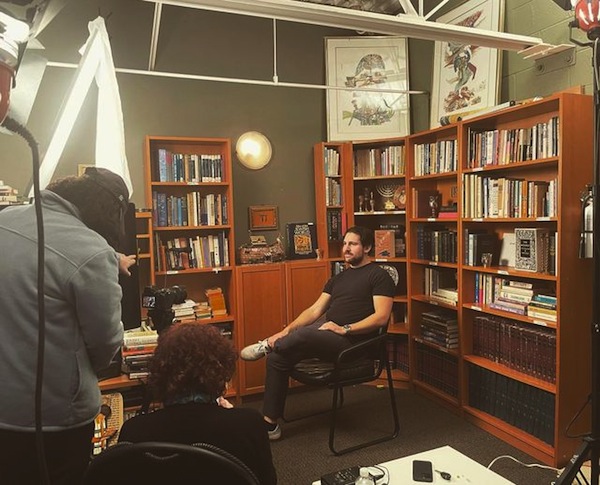
Daniel Shalinsky being interviewed and filmed as part of White Rock South Surrey Jewish Community Centre’s oral history project, which will form part of the community’s Feb. 5 Tu b’Shevat Gala, along with singer Tania Grinberg, speaker Karen James and more. (photo by Helen Thomas Mann)

The White Rock South Surrey Jewish Community Centre Tu b’Shevat Gala will take place on the evening of Sunday, Feb. 5, the start of the holiday. With the theme “Strengthen Our Roots,” a main component of the event will be community members’ oral histories.

“The idea for the project came about in a very multidirectional way,” Helen Thomas Mann, WRSSJCC president, told the Independent. “First, we wanted to host an annual fundraising event and, with our membership drive being around the High Holidays, Tu b’Shevat seemed like a good time for it.”

Tu b’Shevat, the 15th of the Hebrew month of Shevat, is the New Year of Trees. 

“Naturally,” said Thomas Mann, “the theme for a Tu b’Shevat event would be trees, so we began focusing on our ‘tree of life’ as a community. But we were coming back together after a three-year lull from the pandemic – we needed people to remember why this place is important, and why it should continue to exist. The idea became, let’s honour our roots, our history as a community of nearly 30 years; remember the branches that connect us to our Jewishness and the WRSSJCC, and celebrate our leaves, the future of our community.

“As a new president and newer member of the community,” she said, “I felt sensitive to the fact that, although I was playing a leadership role in the organization, there were many people who had worked hard before me to create this warm Jewish space. Our new board didn’t have to reinvent the wheel. I made it my mission to learn those stories.”

A therapist by profession, Thomas Mann is naturally interested in people’s stories, she said. “I had a conversation with Alysa [Routtenberg] from the Jewish Museum and Archives of British Columbia, and that’s where collecting life stories of people in our community came about. She provided me with a recording device. Then it occurred to me that these life stories and the stories of the JCC itself could be incorporated into our celebration.

“I was scrolling the WRSSJCC Instagram account, and I saw a person we follow, and who follows our organization back, who had beautiful fine art photos. Their website said they were passionate about storytelling. I took a chance and reached out, and the person happened to be Yaacov Green, who participated in the JCC as a child and whose father was a president of the JCC for many years! Yaacov generously offered to donate his time to record and edit these interviews to make a short presentation for the Tu b’Shevat event, and a longer version to be submitted to the Jewish Museum and Archives of B.C.”

During the project, Thomas Mann said, “Marcy Babins from the museum mentioned this may be the first representation of Jews from our outlying community in the archive, so I’m thrilled we will be represented. There’s such a rich history here of creative, scrappy and very grassroots Jewish community-building efforts. It’s been very inspiring to learn about. We have interviewed 23 people so far, plus we are having two make-up days…. We are also completing a few Zoom interviews for those who are no longer local.”

Everyone in the community was invited to participate, whether new to the community or having been a part of it for a long time. One of the participants was Daniel Shalinsky, who was interviewed for the project by his grandmother, Helen Lynn Lutterman.

“He attended Hebrew school at the JCC and spent lots of time there as a child,” said Thomas Mann. “There are pictures of him as a child with a hammer, literally building our WRSSJCC alongside his family. His parents are Hertha and Steve Shalinsky, who we are honouring at the Tu b’Shevat event. Their family, including Steve’s brother and his wife, Ken and Andrea Shalinsky, were integral in acquiring our physical space. Steve was a president for many years. For more on the fascinating story of how the space was acquired, you will have to attend the event to find out!”

In addition to the community histories, award-winning Yiddish singer Tania Grinberg will be featured at the celebration. And the night’s keynote speaker will be Karen James, who will share the story of her experience at the 1972 Olympics in Munich. James was there with the Canadian Olympic swim team, and witnessed a group of people climbing over the wall of the Olympic village. Only later would she find out that those people held hostage and then murdered 11 Israeli athletes. “She will share how witnessing this event impacted her life, her connection to her Jewish identity, and her relationship with the WRSSJCC,” said Thomas Mann of James’ presentation.

The Tu b’Shevat fundraiser is for specific programming, as well as operating expenses of the WRSSJCC.

“We are fundraising to generally pay our bills, and our hope is to be able to hire a part-time employee to support our admin needs and flourishing programming,” Thomas Mann explained. “We also have a list of ‘wishing tree’ items that range in dollar amounts from new oven mitts to computer monitors, and open amounts for specific purposes such as donating towards a child in need’s Hebrew school tuition. Long term, we would love to be able to find a new building space where we could have a stand-alone building, as opposed to being in a strip mall, with an outdoor area for a sukkah and community garden. That would be our pie-in-the-sky donation! We are a 100% volunteer-run organization, so every contribution counts.”

The entire community is welcome to the Feb. 5 event, which will be held at the White Rock South Surrey Jewish Community Centre, 32-3033 King George Blvd., in Surrey. “We considered the ease of hosting in a different location for space restrictions, but it seemed too important to centre the space,” said Thomas Mann. “Plus, our tree of life is on the wall, and we will be unveiling the new additions at the event.”

Tickets will soon go on sale – keep an eye on Instagram (@wrssjcc) and Facebook (White Rock South Surrey JCC).

Format ImagePosted on December 23, 2022December 21, 2022Author Cynthia RamsayCategories LocalTags community centre, fundraising, gala, Helen Thomas Mann, JCC, oral histories, South Surrey, synagogues, Tu b’Shevat, White Rock, WRSS, WRSSJCC

Posts pagination

Previous page Page 1 … Page 23 Page 24 Page 25 … Page 84 Next page
Proudly powered by WordPress