Skip to content
  • Home
  • Subscribe / donate
  • Events calendar
  • News
    • Local
    • National
    • Israel
    • World
    • עניין בחדשות
      A roundup of news in Canada and further afield, in Hebrew.
  • Opinion
    • From the JI
    • Op-Ed
  • Arts & Culture
    • Performing Arts
    • Music
    • Books
    • Visual Arts
    • TV & Film
  • Life
    • Celebrating the Holidays
    • Travel
    • The Daily Snooze
      Cartoons by Jacob Samuel
    • Mystery Photo
      Help the JI and JMABC fill in the gaps in our archives.
  • Community Links
    • Organizations, Etc.
    • Other News Sources & Blogs
    • Business Directory
  • FAQ
  • JI Chai Celebration
  • JI@88! video

Recent Posts

  • Zionism wins big in Vegas
  • Different but connected
  • Survival not passive
  • Musical celebration of Israel
  • Shoppe celebrates 25 years
  • Human “book” event
  • Reclaiming Jewish stories
  • Bema presents Perseverance
  • CSS honours Bellas z”l
  • Sheba Promise here May 7
  • Reflections from Be’eri
  • New law a desecration
  • Resilient joy in tough times
  • Rescue dog brings joy
  • Art chosen for new museum
  • Reminder of hope, resilience
  • The national food of Israel?
  • Story of Israel’s north
  • Sheltering in train stations
  • Teach critical thinking
  • Learning to bridge divides
  • Supporting Iranian community
  • Art dismantles systems
  • Beth Tikvah celebrates 50th
  • What is Jewish music?
  • Celebrate joy of music
  • Women share experiences 
  • Raising funds for Survivors
  • Call for digital literacy
  • The hidden hand of hate
  • Tarot as spiritual ritual
  • Students create fancy meal
  • Encouraging young voices
  • Rose’s Angels delivers
  • Living life to its fullest
  • Drawing on his roots

Archives

Follow @JewishIndie
image - The CJN - Visit Us Banner - 300x600 - 101625

Byline: Cynthia Ramsay

Reflecting on life of creativity

Reflecting on life of creativity

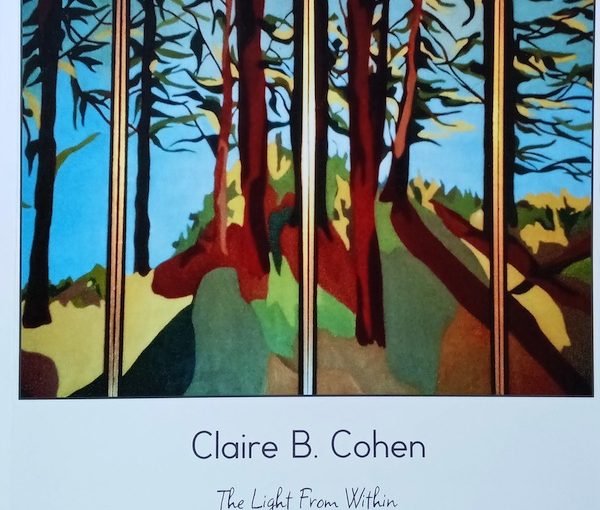
Earlier this year, Claire B. Cohen published a book of her 30-plus years as an artist. She made it for family and friends, as a record of her artistic legacy.

“Art is a powerful and a creative force of self-expression. To create art is to develop an ability to communicate visually what cannot be expressed in words.

“By creating the process of art, we change the way we see the world,” Claire B. Cohen told the Independent. “In understanding ourselves, we find areas where we feel limited. In understanding ourselves, we stand up for ourselves and can present ourselves authentically to others. An artist’s creation is unique and original to their work.”

Earlier this year, Cohen published a slim volume, mainly with images that burst from the pages, outlining her 30-plus years creating art. We glimpse the range of her work – landscapes, portraits, semi-abstracts, flowers, multimedia collages and a compartmental series, in which colourful abstract canvases were “connected sequentially in a zigzag for using piano hinges.” Flow and fun describe this series, her portraits – both colour and black and white – capture the personalities of her subjects, her landscapes and collages are bold and full of movement but also balance. The book touches on her work as an art therapist.

Originally from Israel, Cohen came to Canada in 1964. She studied fine arts at York University in Toronto and the University of Ottawa, and later earned her master’s in art therapy and counseling from U of O in 1987. She had many solo exhibits and group shows in Ottawa, and elsewhere, over the years. The book takes readers to 2006, with an exhibit list to 2009. She moved to Vancouver in 2012.

“I continued to paint after moving to Ottawa, but my move to Vancouver changed my focus, since joining my family had taken much of my time, being richly involved with newborn grandchildren,” said Cohen. “However, I still continued painting and showing new work in Vancouver galleries, as well as donating paintings to different organizations in Vancouver, such as hospitals, Louis Brier [Home and Hospital], friends, and creating more collages and multimedia-based work. I participated in group art shows and sold some to the public.”

Cohen said her reason for producing the book “was to create a place to keep all of my art as a legacy to leave to my family in remembrance of my story. COVID times were affecting my spirit, my mood was down and … the idea came about to focus on creating the book for my family and friends.”

During the pandemic, Cohen said she started to lose her connection to creativity. 

“Friends cut off from each other, as much as children and family,” she said. “I slowly lost my energy and interest, as well as the need I once had to be close to my easel. The paints, the brushes, the colours all lost their meaning and the need I had to paint slowly deteriorated.”

She began to look back at her past, which, she said, “led me to wake up from my dormancy and questions such as ‘what is my meaning of life?’ I discovered my paintings in storage and wanted to create a book.

“I reflected further on my body of work and questioned: why did I dedicate my years to painting? Was there any purpose to it? The answer eventually arrived – yes. There are many purposes to be alive, and work as an artist, investing my life in art. In my case, most of it was to leave a memory to my next generation.”

Cohen’s most recent exhibit and sale was at Britannia Community Centre in 2021. Art can be cathartic, whether one is making it or experiencing it.

“The process of creating art has a great intensity and full force of emotions that lead to a freedom and release when the piece is complete,” she explained. “Looking at these pieces that I created many years ago leads to a sense of nostalgia and a softening of that intensity. These pieces have followed me through many moves and lives, and have a story of their own that has evolved with the emotions that once created them. The language of art cannot be explained in words, the language of these emotions is form, line, colour and brush strokes.”

This language can help heal, as Cohen well knows from her art therapy practice.

“The more we know about ourselves, the more we learn to grow and develop our abilities to stand our ground,” she said.

Describing art as “a powerful and unique way to explore our creative forces,” she explained that people who participate in art therapy use the “materials to express the self and communicate visually,” composing stories. In a group setting, they “collaborate and share with others … connect and integrate parts of his/her inner self, gain confidence and reduce stress in a supportive environment, with the aid of the instructor.”

It was both a dream and a need for Cohen to do art therapy and counseling.

“I realized that art is not just for selling and decorating homes, rather it was a way to find myself, to grow and see who I am, and to help others with their healing.”

To see Cohen’s body of work, go to clairebcohen.wixsite.com/portfolio/home.
Format ImagePosted on December 23, 2022December 22, 2022Author Cynthia RamsayCategories Books, Visual ArtsTags art, art therapy, Claire Cohen, family, health, memoir, painting
Lights shine united at RJDS

Lights shine united at RJDS

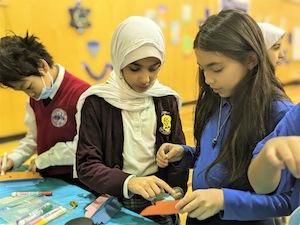
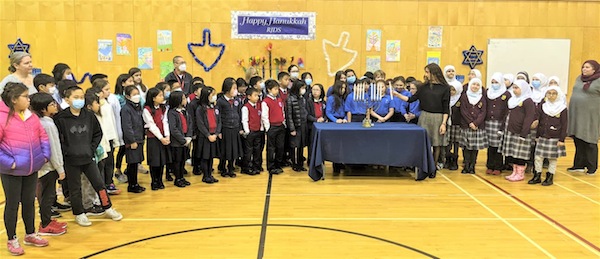
On Dec. 12, Richmond Jewish Day School hosted Cornerstone Christian Academy, Richmond Christian School and Az-Zahraa Islamic Academy. (photo from RJDS)

For the second year in a row, Richmond Jewish Day School hosted a holiday celebration at the school to promote community care, empathy and understanding.

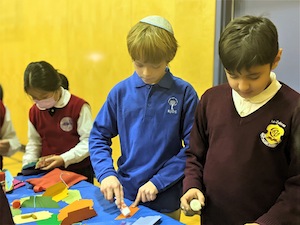
On the morning of Dec. 12, the Shine a Light project saw three schools joining RJDS to share their winter traditions. The posting on RJDS’s Facebook page reads: “Cornerstone Christian Academy made 3-D stars to signify the star of Bethlehem, Az-Zahraa Islamic Academy made lanterns to represent light in Islam, Richmond Christian School made a stained-glass craft and talked about the advent season and, finally, our school taught the others how to play the dreidel game! We all have a role to play. Today, we dispel the darkness on antisemitism and hatred.” 

“Last year, we did an evening event during Hanukkah called A Celebration of Light and invited members of the Highway to Heaven community,” RJDS principal Sabrina Bhojani told the JI.

The No. 5 Road area in Richmond, which is home to RJDS, is also home to some 20 different religious and/or cultural institutions, hence the moniker “Highway to Heaven.” Richmond Mayor Malcom Brodie and Ezra Shanken, chief executive officer of Jewish Federation of Greater Vancouver, were among the attendees last year – and this year – along with several city councilors and others.

“This year, we changed the name and format to create a more kid-friendly celebration, and invited various schools to attend,” said Bhojani. “Activities of the students included those that showcased their personal winter-themed traditions and included singing and arts and crafts.”

photo - This year's Hanukkah celebration featured several activities for the kids
This year’s Hanukkah celebration featured several activities for the kids. (photo from RJDS)

The Shine a Light program was made possible by a grant from the Jewish Federations of North America, said Bhojani.

In addition to her land acknowledgement on Dec. 12, Bhojani said, “We also acknowledge the Elders, the keepers of traditional knowledge, wisdom and Indigenous ways of knowing. We have much to learn about resilience and responsibility. We commit to asking questions, being open to learning from others and acknowledging that that which we do not know.

“We also commit to make the community we share with you a more peaceful, loving and safe place through the First Peoples’ principles of learning.”

photo - kids doing arts and crafts
(photo from RJDS)

With regard to the day’s program, she said, it was “designed to help each of us develop our understanding and respect for one another’s faith and culture while growing in appreciation, understanding and commitment to our own faith traditions and their meanings. We hope that, through education and events like this one, we will collaboratively encourage people to work together, sharing the responsibility for addressing stereotyping, prejudice, racism, discrimination, antisemitism and social exclusion.”

She noted, “Today, as we gather together, we celebrate the unity and the unique religious coexistence of where we live. I hope you are reminded that is up to each and every one of us to be a ‘Shine a Light’ in the darkness of racism and discrimination.”

One parent who saw the event photos on Facebook wrote Bhojani an email. Having experienced antisemitism, they wrote: “What RJDS is teaching, its values, and [the] education the children are receiving, it’s world changing. It’s hope. It’s proof of a better future.”

Format ImagePosted on December 23, 2022December 22, 2022Author Cynthia RamsayCategories Celebrating the Holidays, LocalTags diversity, Hanukkah, Highway to Heaven, interfaith, RJDS, Shine a Light
Artist advocates for nature

Artist advocates for nature

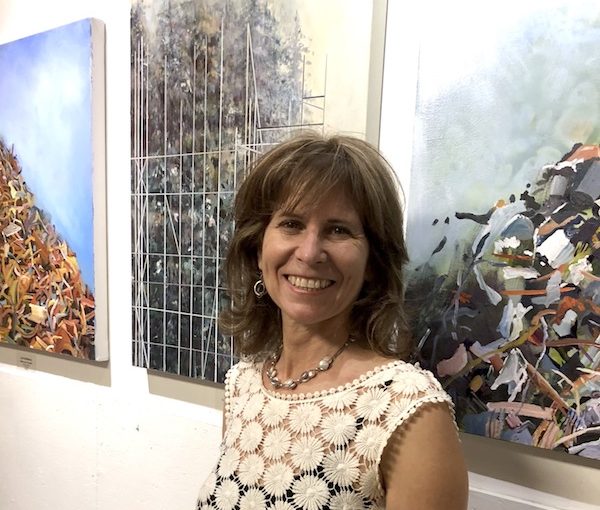
Lori Goldberg’s artwork reminds viewers that “that which we discard doesn’t disappear.” (photo from Lori Goldberg)

If you attend a performance at Queen Elizabeth Theatre, you will see the artwork of Lori Goldberg. She is one of the artists whose creations are at the theatre for another couple of weeks. The exhibit opened Oct. 29.

“Queen Elizabeth Theatre has a program for exhibiting artwork by local artists,” Goldberg told the Independent. “There was a call that was sent out a few years ago and I responded. I was accepted and the work was to be installed just when the pandemic began, so it was postponed until this year.

“It is an ideal venue,” she continued, “as thousands of people a week attend events at the Queen E.  My art has a message about climate change and it is important that it gets seen by as many people as possible. My pieces are on exhibit until Dec. 19, and people are only able to see it if they have a ticket to an event. Alternatively, I am available to take anyone interested on a private tour.”

The paintings in the exhibit come from three ongoing series: Plasticity, Poetics of the Discarded, and Reconstructing Nature.

“For many years, I have been investigating what happens when two opposing places – cities and nature – collide, connect and transform,” said Goldberg. “Through more awareness and experience firsthand, many of my works have ultimately been about the precarious relationship that we have with our natural world. Seeded in environmental advocacy, an animating factor in my practice has been reclaiming, recycling and reimagining refuse.”

photo - “Rogue Fish” by Lori Goldberg
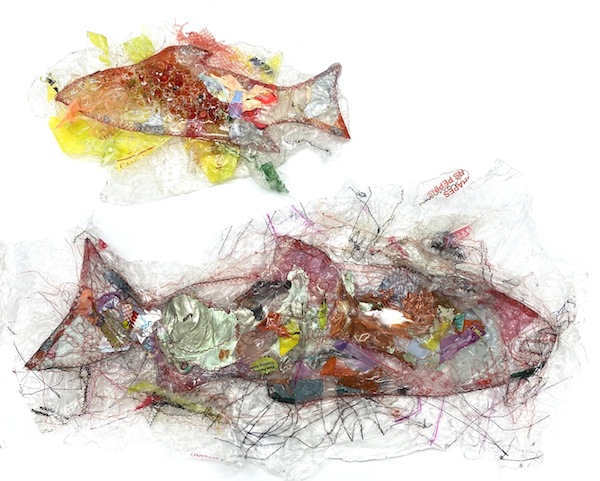
“Rogue Fish” by Lori Goldberg (photo from Lori Goldberg)

In the description of Plasticity on her website, Goldberg mentions her discovery that ink can be transferred from, say, a plastic bag, to canvas. Her creative process invites such discoveries.

“I am a diverse artist and my ideas dictate my art,” she explained. “My practice has primarily focused on painting, but I have had to explore other mediums to adequately express my concept.  Besides paint, I have explored photography, assemblage and sewing.  I have worked with clay, glass, so-called ‘trash’ from my studio, single-use plastic bags that I fuse on canvas, and I have stuffed lost socks with fabric remnants given to me by tailors.”

For Goldberg, the camera is her “sketchbook” and a photo is generally the starting point for her painting.

“My work references the physical world at one point in my creative process,” she said. “When I research and gather information, I look for source material that is usually filtered through my own photo documentation. Other photo images can come from friends, the internet or by random discovery. I also use memory, dreams – and always my imagination. I take parts of photos that resonate for me and incorporate that visual language – usually recontextualizing and altering it – in my work.”

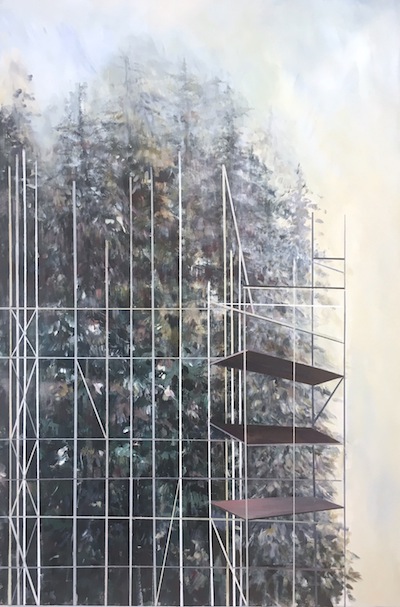
As an example, Goldberg spoke about the series Reconstructing Nature, which references nature/urban tensions found in Vancouver. “There is no lack of trees here and our city is in constant state of flux, with the demolishing of buildings and the construction of new ones, so I take photos of the nature that is all around me, but also of the scaffolding and cranes that are so prominent in the city as well,” she said. “In the Poetics of the Discarded series, I started by visiting a number of refuse sites, with an interest in memory and objects. Within the refuse, there were mounds and mounds of history: the detritus of days spent, life and death, business, conveniences used, sentimental things and so much more. I would photo-document these toppling heaps of refuse and re-contextualize and resurrect them as a visual reminder of the ongoing narrative between humans and their environment, reminding us quietly: that which we discard doesn’t disappear.”

photo - “Reconstructing Nature” by Lori Goldberg
“Reconstructing Nature” by Lori Goldberg (photo from Lori Goldberg)

While Goldberg does not paint on location often, she said, “My creative process is to go out into nature or the city, experience it, document it and return to my studio. Having said that, making work outdoors is becoming more interesting to me and it is a future direction that I plan to spend more time doing.”

With her art, Goldberg said, “I would like to think that I am creating work that is impactful to the viewer and especially the younger generation, that they will be empowered to take action towards making a difference as they engage with the world.

“The works are meant to be educational and I hope that they impart to the viewer a sense of personal responsibility – that they put to action what they feel and be one small ripple of change to create a better future for themselves.”

An educator for more than 30 years, Goldberg has taken her classroom outside and into the public arena, where, she said, “I create hands-on workshops using materials that address repairing the planet and healing ourselves. I created a project titled Lost Socks, where the public stuffed and sewed lost socks together to create a long tubular form that stood for connection, diversity and difference. Recently, I have used single-use plastic packaging to create wearable art. What I enjoy about these workshops is that they attract all ages and so it is intergenerational and accessible to all.

“Artists are essential in our communities,” she stressed. “Some of us choose to create work that challenges topics that are highly charged and sensitive, but, without venues in which to work and to exhibit, the messages cannot be passed on. I appreciate the exhibits I have had over my life at the JCC – I cannot imagine what would happen if we lost such a significant public space as the Sidney and Gertrude Zack Gallery. It is a venue for Jewish artists and Jewish content. It reinforces Jewish identity, conversations and connections. It is a gallery that has assisted me in my journey as an exhibiting artist and has given me opportunities to work with preschoolers, seniors and poets.”

Goldberg believes in giving back and donates her work frequently to different organizations, such as Big Brothers. “My recent donation was to Tikva Housing,” she said. “I gave them three paintings from my Judaica series. There is a satisfaction that is hard to explain, but it is a joy to be able to offer something of value to make others feel uplifted.”

Goldberg is currently applying for artist residencies in different parts of the world.

“I am interested in responding to the environment that I would be in and allowing it to dictate the direction of my work,” she said. “I want to contextualize my work in such a way that I am creating awareness about our healing of our planet but indirectly, through healing ourselves. Artist residencies offer opportunities for new perspectives and fewer distractions, so you can shed the restraints and discover what is there, but has been hidden.”

For more information, visit lorigoldberg.ca.

Format ImagePosted on December 9, 2022December 7, 2022Author Cynthia RamsayCategories Visual ArtsTags environment, Lori Goldberg, nature, painting, Queen Elizabeth Theatre

Love through good and bad

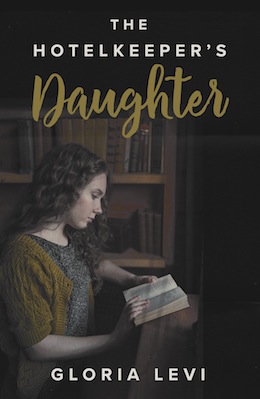
Gloria Levi’s recently published creative memoir The Hotelkeeper’s Daughter is a tribute to her family. And not just the family from whom she comes – the people who inhabit the main part of this story – but also the family she has made herself, the family members in the book with whom she shares her memories and those outside of it, who will read the story.

image - The Hotelkeeper’s Daughter book coverThe memoir is “creative” because memory, almost by definition, is unreliable, and, with this book, the 90-plus-year-old Levi is going back to her childhood. The character Gilda, her avatar of sorts, is trying to make sense of her past:

“They are all gone … Jerry, Macey, Sadie … and Ida and Leo … Bubbie … I, Gilda, at the age of 90, am the only one left of my family of origin. I am the Omega generation, the last letter of the Greek alphabet. I remember so vividly the sweetness of family togetherness, extended family visits, our tight-knit community. How I loved them and felt loved by them: their vitality, their enduring values, their struggles, losses and successes, their remarkable resilience. They are a deep part of me. They are the heroes of a bygone era.”

Speaking to her son and great-grandson, Gilda takes us to Powell Street, in Brooklyn, N.Y., 1938. She is 7 years old. She vividly describes her community, the neighbourhood of Brownsville. Her parents, grandmother and three siblings live downstairs in a duplex shared with her uncle and aunt and their family, who live upstairs. Money is sparse.

“During their usual pinochle card game one Saturday evening in March,” writes Levi, “my father turned to his cousin, Big Eliezer, and said, ‘Eli, I really need to make a change. I don’t want to go on like this. I know I can do better than my chicken store. What do you think, if you, Sammy and I were to rent a summer hotel? My brother Benny runs a hotel with partners. He’s doing just fine. You know, with your catering experience, Eli, and the younger energy and determination of Sammy and me, I think we could make a go of it. What do you think?’ Sammy nodded in agreement. Uncle Shimon closed his hand of cards and stared.”

And the rest, as they say, is history – and the meat of this memoir. Life isn’t easy as the daughter of hotelkeepers. Gilda had been happy on Powell Street, had many friends and her favourite activities. She was very close to her grandmother, who didn’t initially go with the family, and her parents were absorbed in the business. Gilda was lonely and often felt invisible. She has a challenging relationship with her mother, Ida.

Through Gilda’s story, we see how families like hers – an Eastern European Jewish family who immigrated to the United States – struggled and succeeded in their new homeland, through the Great Depression and the Second World War. We also see how Gilda grows into herself and begins to find her own way. The memoir ends in 1948, as Gilda starts university.

As 90-year-old Gilda looks back at this foundational decade of her life, relating her story to her son Daniel and great-grandson Lenny, she ultimately reflects not only on what has passed, but what is yet to come.

“To the Lennys of today and the Idas of yesterday, I want to affirm their vision, their energy, and their inspiring dedication to build a fairer, more just and loving society.”

Posted on December 9, 2022December 8, 2022Author Cynthia RamsayCategories BooksTags family, Gloria Levi, history, Hotelkeeper's Daughter, memoir

One is never too old to learn

I had the privilege of seeing Mark Leiren-Young’s play Bar Mitzvah Boy when it premièred at Pacific Theatre in 2018. It was funny, edgy and insightful, and well-acted by Gina Chiarelli and Richard Newman. It contained a lot of local references, making it even more special.

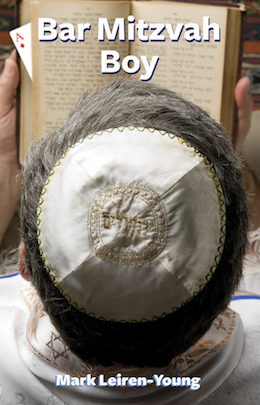
image - Bar Mitzvah Boy book coverWhat I see from the Playwrights Canada Press edition, which was published in 2020 and arrived at the JI sometime in 2021, is that Leiren-Young’s notes on various aspects of the play allow productions to change certain references and pronunciations to localize the action, thereby making it special no matter where it is performed. For instance, the audience first meets Rabbi Michael Levitz-Sharon, who is in her mid-30s to maybe 45 years old, on a jogging path, “dressed in sweats and a ball cap for a local sports team.”

The next scene: in the rabbi’s office, there sits a man in his mid-60s or older, Joey Brant, “decked out in prayer regalia – including tefillin, which are on incorrectly.” This is our first hint that he, despite initial appearances, is not a rabbi or a religious Jew. When Michael arrives, Joey assumes that the relatively young woman in running gear doesn’t belong at the synagogue – and certainly isn’t the congregation’s spiritual leader. This exchange sets the tone for the essentially two-person play that unfolds. The other cast member is Sheryl, the receptionist, who is never seen, only heard. As described by Leiren-Young, the actor of this role (which was Jalen Saip in 2018 at Pacific Theatre) should have “the accent you want the woman who runs your local deli to at least pretend to have.”

I love having these types of stage direction “made public.” It is a completely different experience to read a play than to attend it in person. It’s almost like listening to the acoustic version of one of your favourite pop musicians – if they are able to sing on key and play their chosen instrument skilfully, they really are excellent at their craft. Similarly, if the words of a play still make you laugh and cringe and move you emotionally in other ways, with no cues from actors or audience members, it is a very well-written play. Bar Mitzvah Boy in book form made me do all those things – I chuckled a lot throughout, and also got teary near the end. Michael and Joey (the bar mitzvah “boy,” btw) are both dealing with some serious, raw issues.

Since I finished the book, I’ve been revisiting some of the many topics it covers. I’ve thought about my own beliefs about Judaism and faith, what happens after we die, what makes a good friend, parent or spouse, how people navigate challenges differently, the ways in which a congregation (or any other group) can be both supportive and trying at the same time.

Leiren-Young dedicates the publication to his mother, Carol Leiren: “I guess it was worth sending me to Talmud Torah.” For viewers or readers of Bar Mitzvah Boy, it certainly was worth it – thank you.

Posted on December 9, 2022December 8, 2022Author Cynthia RamsayCategories BooksTags Bar Mitzvah Boy, comedy, drama, Judaism, Mark Leiren-Young, play

Playing against hatred

A basketball game may not be able to bring about world peace, but at least one game has acted as a bridge to increasing mutual understanding and empathy.

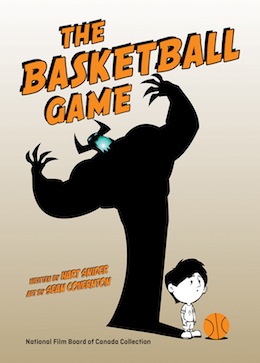
The graphic novel The Basketball Game (Firefly Books, 2022) is based on the National Film Board of Canada animated short of the same name. Written by Hart Snider and illustrated by Sean Covernton, it is based on Snider’s memories of his first year at Jewish summer camp. It proved to be a unique experience.

image - The Basketball Game book coverIt was July 1983. The camp was Camp BB Riback in Pine Lake, Alta. Snider was 9 years old and “totally homesick,” finding refuge in the comic books he had brought with him. That is, until he meets Galit. (The book is dedicated to his “partner, collaborator, inspiration and best friend, Galit,” his daughter and his parents.)

For young Hart, Camp BB made him feel at home. “Even both my parents went to this camp,” he writes. “It was a tradition in the community. It was a place to just be ourselves … and that was important because back then, growing up Jewish in Alberta wasn’t always so easy.”

Back then, in Eckville, Alta., the winter before Snider’s first summer at camp, teacher Jim Keegstra, “also the town’s mayor, was fired by the local school board.

“Believing the curriculum was ‘incomplete,’ Keegstra had been teaching Holocaust denial and antisemitic conspiracy theories in his classroom – that Jewish people had an international plot to control the world and were to blame for everything that’s wrong.”

But one Eckville parent, Susan Maddox, “noticed her 14-year-old son had some strange new opinions.” She looked through his notebooks, then filed a complaint with the school board.

Meanwhile, more than a thousand people attended a rally at the Edmonton Jewish Community Centre to figure out how to respond to the situation. One of the ideas proposed – by then Camp BB director Bill Meloff, z’’l – was to invite some of Keegstra’s former students to the camp for a “day of fun and fellowship,” which included the title’s basketball game.

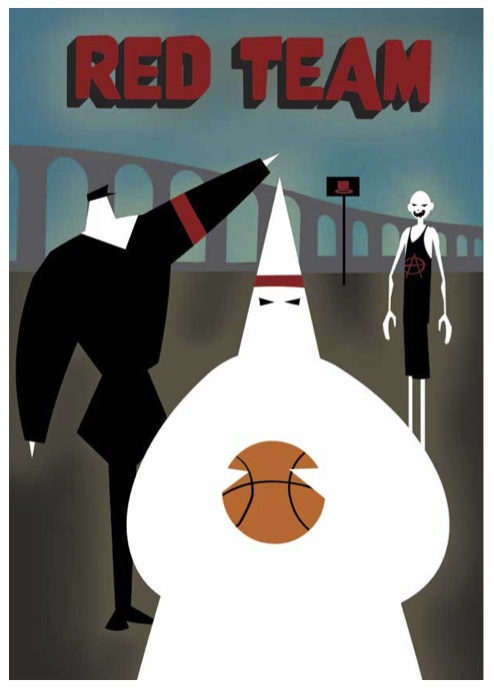
image - Team A: In The Basketball Game, each team imagines the other side as monstrous stereotypes – until they get to know one another. (Text by Hart Snider / illustrations by Sean Covernton)
(Text by Hart Snider / illustrations by Sean Covernton)

In a brilliantly drawn sequence, the team players are depicted as their negative stereotypes, how they see one another. Blue Team – a horned demon, a world-controlling banker and an evil wizard – versus Red Team – a skinhead, a Nazi and a member of the KKK. The game is intense. Then, an opposing player compliments Hart’s shot. “Thanks, man,” says Hart. The game continues, kids versus kids, no more monsters.

“Looking back, it’s amazing that it happened at all,” writes Snider. “That Keegstra’s students were invited to the camp, and they actually came.”

image - Team B: Team A: In The Basketball Game, each team imagines the other side as monstrous stereotypes – until they get to know one another. (Text by Hart Snider / illustrations by Sean Covernton)
(Text by Hart Snider / illustrations by Sean Covernton)

That’s the thing. Someone had to extend the invitation, and someone had to accept. An illustrated reproduction of an actual newspaper clipping from 1983 notes that attendance at the camp was voluntary and that a preliminary survey indicated that about 10% of Eckville Junior-Senior High School’s 186 students “would be willing to attend.”

Here we are, almost 40 years later and, as Snider notes in his introduction: “Racism, conspiracy theories and antisemitism are spread every day on social media and other platforms. The hate that Keegstra taught in his classroom is now found in memes, videos and forums. Over and over again, we are challenged with the question, how do we deal with fear and prejudice?

“I hope we can continue to find common ground and have empathy for each other, but, most importantly, I hope that parents and kids keep talking to each other.”

The book, intended for readers 12 years old and up, includes more on the Keegstra trial, discussion questions and a glossary.

Snider participates in the 2023 Cherie Smith JCC Jewish Book Festival, which takes place Feb. 11-16.

Posted on December 9, 2022December 8, 2022Author Cynthia RamsayCategories BooksTags animation, antisemitism, Camp BB, education, film, graphic novel, Hart Snider, Jewish Book Festival, Jim Keegstra, National Film Board, NFB, Sean Covernton, The Basketball Game, youth

We are inheritors of history

When Toronto poet Simon Constam emailed me with a request to read his debut collection of poetry, Brought Down, he described it as “notable because it addresses people’s daily experience of God and the Jewish religious tradition.” He noted, “it is provocative and well-written as can be attested to by the reviews of it thus far.” Indeed, the reviews I’ve read have been highly complimentary – and justifiably so.

I am neither religious nor a poetry buff, yet I found Constam’s poems engaging. I liked his challenging and questioning manner. At 70+ years old, he has wisdom gained from life experience that includes approximately a decade in which he followed Orthodox Jewish observance. His knowledge of Judaism infuses his writing and I had to look up a few names and concepts, even though there is a glossary at the end of this 61-page volume.

What I greatly appreciated about these poems is the theme that runs through most, if not all, of them: the title idea of “brought down,” as it refers to what we inherit from our ancestors, whether we’re talking about traditions, rituals, genes, coping mechanisms, etc. The lens through which Constam explores these ideas is his Jewishness. In “Yerushalmi,” for example, he writes:

“Today I seem to have the face of a man I briefly stared at, on a bus on Rehov King David in the fall of 1969. / I wear the same clothes, dark jacket, dark shirt, rough tan trousers, dust-scuffed brown boots. / The mirror shows me, grizzled, unkempt, stocky, stoic, almost seventy. / My face is the face my grandfather wore. / My parents, aunts, and uncles swore the resemblance is uncanny. My history is clear. / I was one of Titus’s captives marched through Rome in chains. I collected all my things in a sack to flee from Ferdinand and Isabella along the Jew-choked roads.  I missed my fate in Kielce and Bialystock. I hid in the forests by Kishinev.” It ultimately concludes: “I am the inheritor of a furious history that only in this place can I never deny or forget.”

In his struggles with God, Constam contemplates what it means to be Jewish, what it means to be human. While this all sounds quite serious, and it is, there is humour in this collection and, ultimately, it is hopeful. As much as he takes God to task, Constam is calling on all of us to question ourselves, and to accept our responsibility for the state of the world.

Posted on December 9, 2022December 8, 2022Author Cynthia RamsayCategories BooksTags history, Judaism, poetry, Simon Constam

Serious play with language

I always look forward to reading whatever Adeena Karasick writes, even though I know I won’t understand all of it. To be generous to myself, I’d say at least 20% of her latest publication, Massaging the Medium: Seven Pechakuchas (Institute of General Semantics, 2022), went over my head – or will require a few more reads and some discussions with friends to get the most out of it.

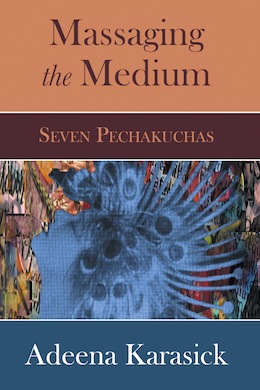
image - Massaging the Medium book coverMassaging the Medium is part of the Institute of General Semantics’ Language in Action series, which “publishes books devoted to creative modes of expression that can open the doors of perception and foster better understandings of the nature of language, symbols, communication and the semantic, technological and media environments that we inhabit.”

The preface is written by Maria Damon of the University of Minnesota. She explains, “For anyone still unfamiliar with the format, pechakucha – Japanese for ‘chitchat’ – is a highly stylized presentation form that comprises a public speech accompanied by 20 slides for visual demonstration, each of which is shown for 20 seconds, while the speaker addresses their (his/her) topic. Initiated in 2003 by a pair of architects working in Japan, the format (trademarked and copyrighted, by the way, in true contemporary entrepreneurial style) has spread to encompass a worldwide enthusiasm for a storytelling/info delivery style that relies on the visual as much as, or even more than, on the verbal.”

Given Karasick’s “dazzling linguistic pyrotechnics on page and stage,” writes Damon, the pechakucha format is ideal, “as the propulsive energy that characterizes her writing and reading style is given sharper urgency for being trapped in a small temporal space…. These seven tours de force of serious play celebrate meaning and unmeaning, communication and miscommunication, the happy errors/eros of semantic and sonic slippage, the glories of the im/p/precise.”

This description is better than I could ever give. I had to look up several terms, such as ’pataphysical – “a ‘philosophy’ of science invented by French writer Alfred Jarry intended to be a parody of science,” according to Wikipedia. “Difficult to be simply defined or pinned down, it has been described as the ‘science of imaginary solutions.’”

I also had to look up some of the names of people Karasick cites as if they’re old friends. While I’ve heard of folks like Jacques Derrida and Marshall McCluhan, and of Jewish texts such as The Zohar, my knowledge barely touches the surface. I think that’s part of why I have such fun with Karasick – I’ve no preconceptions going into my reading of her work and, while I don’t take it all in, I do feel as if my mind expands from the experience. She is at once academically rigorous, poetically versatile and sensically nonsensical, or nonsensically sensical (I’m not sure which would be most accurate).

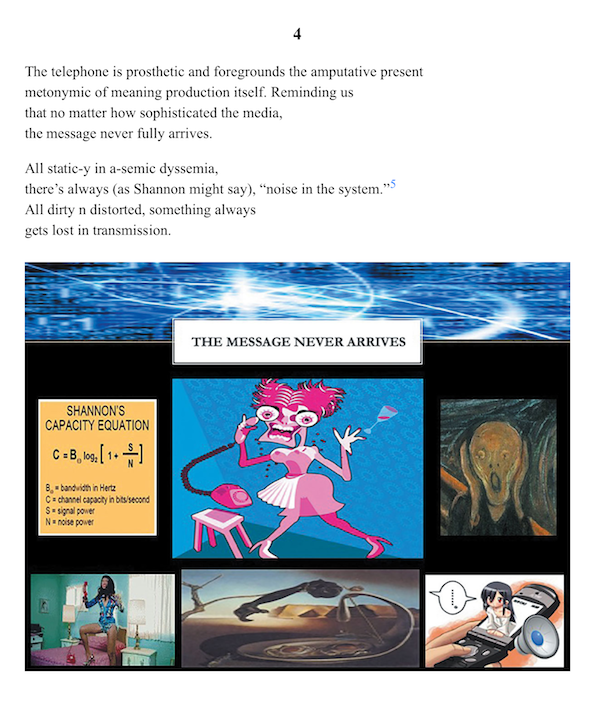
image - Here is but one example of a section of one of the pechakuchas featured in Adeena Karasick’s Massaging the Medium: Seven Pechakuchas, to give readers an idea of the book’s content and form. (© 2022 Adeena Karasick)
Here is but one example of a section of one of the pechakuchas featured in Adeena Karasick’s Massaging the Medium: Seven Pechakuchas, to give readers an idea of the book’s content and form. (© 2022 Adeena Karasick)

In her introduction, Karasick notes that the seven pechakuchas comprising this book were originally created for and presented at academic literary conferences that took place during the period of 2013 to 2019. For a printed publication, she had to adapt them.

“The visuals,” she notes, “consist of both found and original collaged material which both speak to and against the text. And each of the original slides were embedded with audio and video clips, gifs, other forms of kinetic digital media such as montages of sound poetry,” pop songs, movies and more. “What is illustrated here, however, are stills from the digital live motion presentation and, although originally all consisting of 20 separate components, they are now of slightly varying length.”

I can’t even begin to simplify any of the pechakuchas, in order to give an example of their content and form. Best to experience them yourself. Not everything will land – I enjoyed the first few most – but they do offer the possibility of changing how you think about many things. The list includes but is not limited to language, technology, physiology, time, space, cyberspace, mysticism, consumerism, reality, truth. As does any good Jewish text, it will raise more questions than it answers.

Posted on December 9, 2022December 8, 2022Author Cynthia RamsayCategories BooksTags Adeena Karasick, language, Massaging the Medium, pechakucha

Continuing Chelm tradition

It’s been eight years or so since I reviewed Mark Binder’s The Brothers Schlemiel, which recently has been reissued by Light Publications with the title The Village Twins, and written under Binder’s pen name, Izzy Abrahmson. I knew this story of Chelm would withstand the test of time for two reasons. First, we regularly publish a Binder/Abrahmson story in our holiday papers. Second, the stories are written in the style of Yiddish folk tales, which have proven staying power.

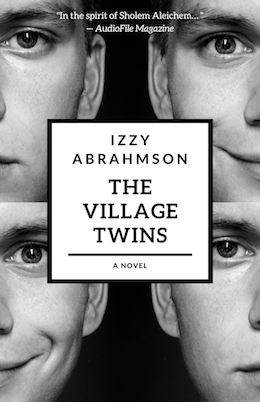
image - The Village Twins book coverAs Abrahmson explains in The Village Twins, Chelm is “a tiny settlement of Jews known far and wide as the most concentrated collection of fools in the world.” According to The YIVO Encyclopedia of Jews in Eastern Europe, the “first publication of Chelm-like stories appeared in Yiddish in 1597, and were tales of the town of Schildburg, translated from a German edition. Hence, these stories first entered Jewish culture as Schildburger stories, and it is unclear when they became connected to the town of Chelm. During the 19th century, a number of other Jewish towns figured as fools’ towns, including Poyzn. Over time, however, Chelm became the central hub of such stories, the first specific publication of which occurred in an 1867 book of humorous anecdotes, allegedly written by Ayzik Meyer Dik. Later, particularly in the early 20th century, dozens of collections of Khelemer mayses (Chelm stories) were published in Yiddish, as well as in English and Hebrew translations.”

The Village Twins is one of the latest such collections, and it does honour to its literary ancestors, providing wisdom in the guise of absurdity. The novel can be read on many levels, including as pure entertainment, as the story of a particular family living in a particular era and as a series of parables (it’s 414 pages long, which, I admit, was a bit lengthy for me). It is part of Abrahmson’s Village Life series, which includes several publications and a podcast, but can be read as a standalone novel. I am proof that a person might enjoy, but does not have to, read or listen to the other stories to follow this tale of the Schlemiel family that is centred around twins Abraham and Adam, who cause trouble from the day they are born.

The brothers make full use of their physical similarity throughout their life, from incidences as harmless as pranks around town to more serious situations, such as avoiding being drafted into the Russian army. What I wrote in my 2014 review still stands: Abrahmson “has created characters with whom we empathize…. He ably manages some fine balances: writing about silliness without the story becoming stupid, and evoking sentimentality while not becoming saccharine….. As well, through the vehicles of comedy and fantasy, [it] touches on many serious topics, from poverty to racism, to ethics in business, to whom people choose to be, and more.”

According to the press release, The Village Twins has been updated and revised, though I can’t speak to how, as my copy of The Brothers Schlemiel has long since been passed on. Along with this reissue came Binder’s pen name “to distinguish the series from his other work. By combining his Hebrew name, Isaac, with his father’s Hebrew name, Abraham … Izzy Abrahmson was born.”

As an editor, dealing with a writer with two names is a little unwieldy and I sometimes feel like the villagers of Chelm, who, for “many, many years” couldn’t tell Abraham from Adam. But that doesn’t diminish my enjoyment of Abrahmson’s – or is it Binder’s? – storytelling. He has won multiple awards for a reason. Anyone who likes a good folk tale will delight in The Village Twins.

Posted on December 9, 2022December 8, 2022Author Cynthia RamsayCategories BooksTags Chelm, folk tales, folklore, Izzy Abrahmson, Mark Binder, The Village Twins

A life-changing meeting

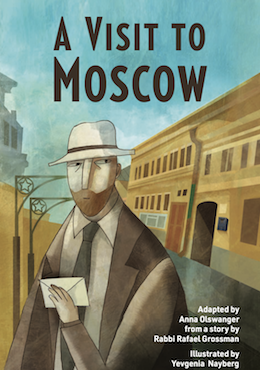
A Visit to Moscow is a beautifully illustrated and haunting graphic novel. In a brief 72 pages, it relates the story of an American rabbi who, on a 1965 trip to the Soviet Union, sneaks away from his delegation in Moscow to visit the brother of a friend – Bela hadn’t heard from Meyer for more than 10 years and was worried.

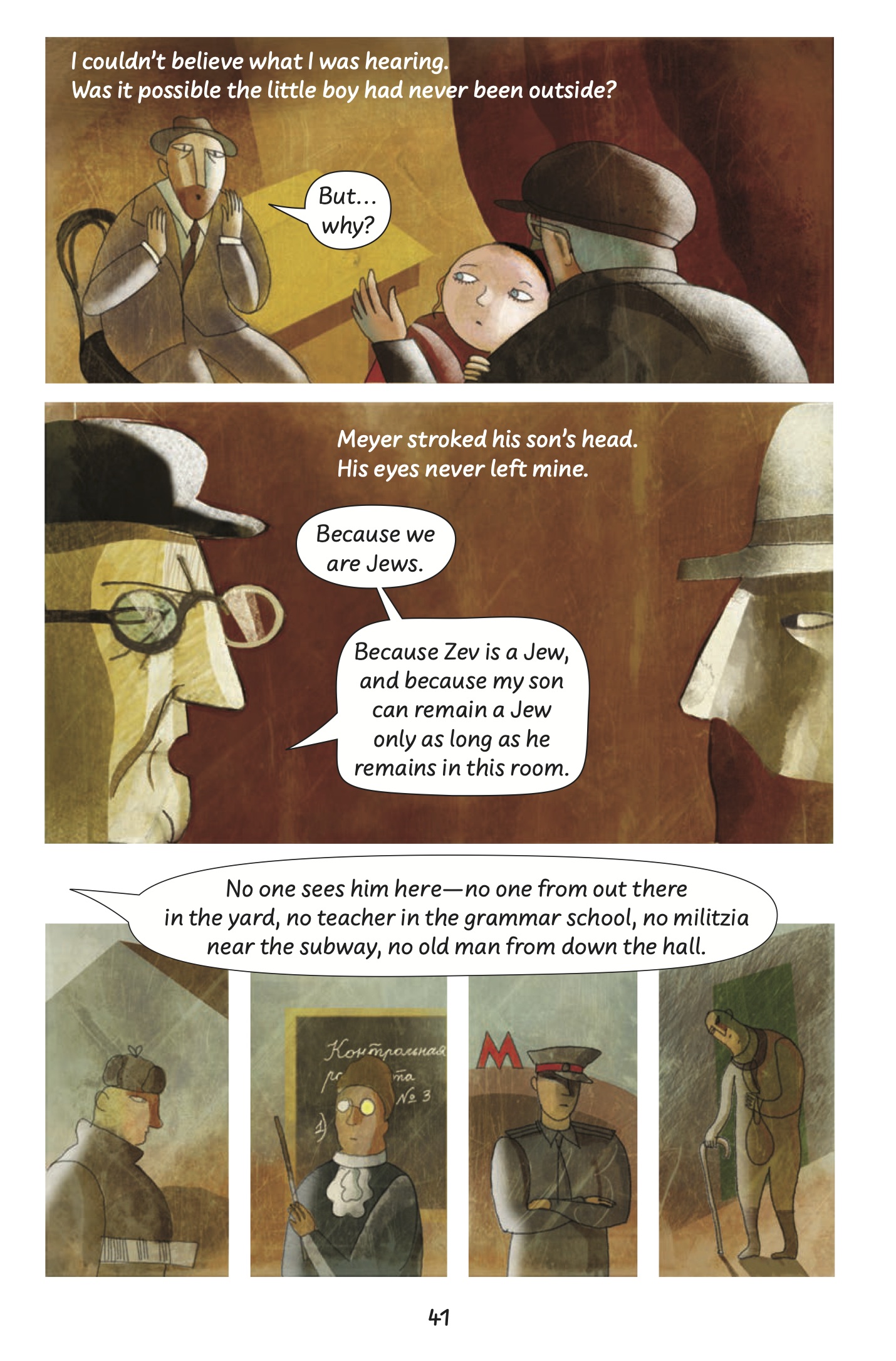
image - A Visit to Moscow book coverA Visit to Moscow (West Margin Press, 2022) is an adaptation by Anna Olswanger of a story told to her by Rabbi Rafael Grossman. It is illustrated by Yevgenia Nayberg, who captures in her palette, in the angles of her images, in her use of light and shadow, scratches and blurs, the claustrophobic fear that existed in that era in the USSR.

“Although the events of A Visit to Moscow are set before my time, the overall spirit of the Soviet Union feels very similar to what it was throughout my childhood when I lived there. I didn’t have to make a big leap to connect to the time period,” writes Nayberg in a section at the end of the book, where we get to see some of her preliminary sketches.

Olswanger knew Grossman, having collaborated with him on writing projects since the early 1980s. “One of our first projects,” she writes, “was a Holocaust novel with a character based on his cousin, a leader of the Jewish resistance in the Bialystok ghetto. As we planned out the storyline, Rabbi Grossman told me about an incident during a trip he made in 1965 to the Soviet Union, where he met a young boy whose parents were Holocaust survivors. The boy had never been outside the room he was born in.

“We never finished the novel, and then, in 2018, Rabbi Grossman died.”

Years later, Grossman’s daughter sent Olswanger a box of writings that Olswanger and the rabbi had worked on. It inspired Olswanger to revisit the story. But she didn’t have the whole story, so, on the suggestion of her editor, wrote A Visit to Moscow as historical fiction.

The main part of the book is incredibly moving. The tension as the rabbi makes his way to Meyer’s last known address is palpable in both text and images; the KGB are an ever-looming threat. When he arrives, it takes the rabbi time to gain Meyer’s trust and for Meyer to let the rabbi into his flat, where he meets Meyer’s wife and their son, Zev, who has never left their home. The rabbi promises to get them all to Israel.

image - Visit to Moscow is a powerful, if incomplete, story, written by Anna Olswanger and illustrated by Yevgenia Nayberg
Visit to Moscow is a powerful, if incomplete, story, written by Anna Olswanger and illustrated by Yevgenia Nayberg.

This core of the novel is well-written, easily understood and powerful. Unfortunately, this mid-section is bookended by ambiguous scenes. At the beginning, Zev hovers from heaven over his dead body, which is laying somewhere in a mountain range. In the throes of dying, he remembers the story of the rabbi’s visit, which leads into the main story, after which we see young Zev on a plane, remembering the ride and Israel’s beauty. In the midst of this, he wonders, “And later – was it years later? Was he a young man?” In the next panel, a fire burns in the aforementioned mountain range and the text reads: “He remembers a sudden flash. A burst of black smoke. Burning metal.”

I first thought that he and his parents had been killed in a plane crash on the way to Israel, so close to freedom but never reaching it. After madly flipping pages back and forth in the book, trying to figure out what I’d missed, I found what I was looking for in the About the Contributors section: “For over 25 years, Rabbi Grossman visited Zev and his family in Israel. He saw them together for the last time in 1992, the year Zev died at the age of 37, a husband and father, while on reserve duty with his army unit in Lebanon.”

A tragic ending either way, but at least Zev got out of his room and got to live more fully for those 25 years. “Every time I visited Zev in Israel,” wrote Grossman, “he was smiling.”

A Visit to Moscow could have benefited from a few more pages, to make the transition of Zev’s journey from the Soviet Union to Israel more understandable, and to include some aspects of his life in Israel, even if they were fictional. Olswanger and Nayberg have created something special, but it feels incomplete.

Posted on December 9, 2022December 8, 2022Author Cynthia RamsayCategories BooksTags A Visit to Moscow, aliyah, Anna Olswanger, freedom, graphic novel, history, Israel, Rafael Grossman, Soviet Union, Yevgenia Nayberg

Posts pagination

Previous page Page 1 … Page 24 Page 25 Page 26 … Page 84 Next page
Proudly powered by WordPress