Yuri Elperin’s solo show, Cycles of Being, opened at the Lipont Gallery in Richmond on Nov. 15. The show consists of Elperin’s large abstract mixed media paintings of the last few years. The art is powerful, eloquent and elegant, reflecting the artist’s personal voyage across Europe, Asia and North America, but also humanity’s collective journey. Memory, history and spirituality merge and interplay.
Elperin was born in Riga, Latvia, a year after the Second World War ended. Unable to pursue his artistic goals inside the limits prescribed by the Communist Party of the Soviet Union, he emigrated in 1977. Searching for artistic freedom, he lived in Rome for about a year while waiting for his Canadian immigration papers.
“During his time in Rome, and his subsequent travels and research across Spain, France and Italy, he immersed himself in Western modern art,” notes the Lipton Gallery’s site.
In Vancouver, Elperin has had a decades-long career as a commercial photographer and in film, and he became dedicated to being a full-time artist in 1998, according to the gallery. His current show explores Eastern and Western philosophies.
Many religions and philosophical tenets of both Eastern and Western cultures throughout time are concerned with common questions: What is life? Why are we humans here? What is the purpose of life? How does everything link together? Elperin’s art contemplates possibilities, and the show’s name, Cycles of Being, underscores the cyclical nature of our unending chain of existence.
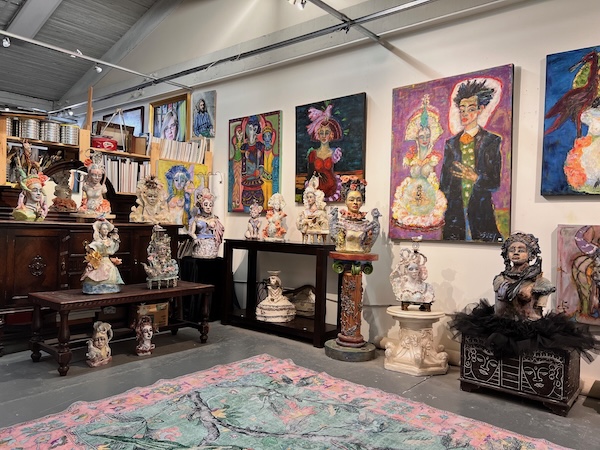
The paintings in this exhibit are three-dimensional, a fusion of paint and sculpture, golden leaf and marine plants. Paper, wood, metal and fabric combine and emerge as more than a sum of their parts.
The images tell stories, convey legends. They inspire questions and personal responses. Every title card in the gallery is a mini story, and the abstract artistic style suits the complexity of the philosophical exploration.
No reflection of the outside world manifests. No photographic likeness. Just meditations on the timeless themes of life, death and rebirth, which lead to further associations on the part of viewers.
The first painting that meets our eyes upon coming into the gallery is “Phase One” – a golden spread on the dark background. Does it reflect evolutionary theory or the world’s divine beginnings? One will interpret it according to one’s own beliefs.
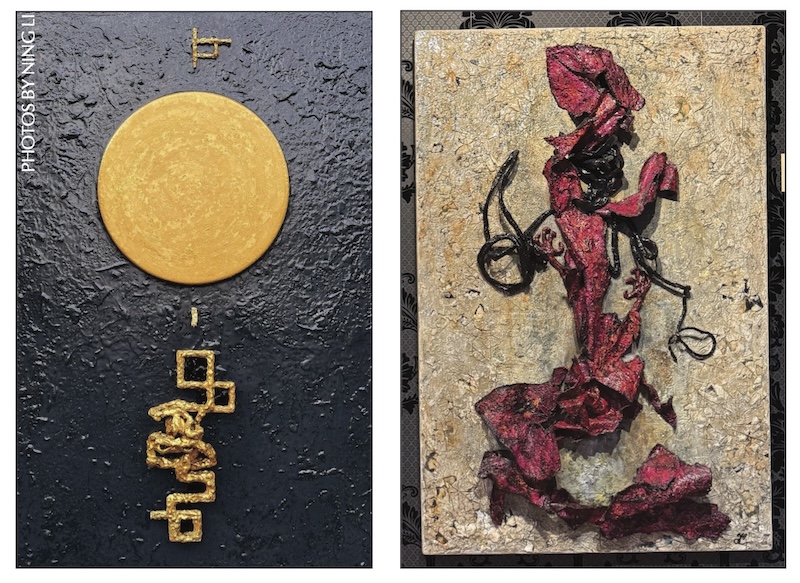
“Beginning of Endless Knot,” left, and “Impermanence” by Yuri Elperin, whose solo exhibition, Cycles of Being, is at the Lipont Gallery in Richmond until Dec. 4. (photos by Ning Li)
“Beginning of Endless Knot” continues the viewer’s journey, with its contrast of blue and gold, a simple circle versus a complex knot. In Buddhism, the endless knot represents, among other things, interconnectedness.
“Impermanence” reminds us that everything in the world is ephemeral. The red twisted shape, sinuous and enigmatic, teases with its perpetual dance. To me, it defies definition and implies that everything around us, physical and mental, is transient – the only constant is change.
On the opposite wall, the painting “Wu Zetian Dream” is a symphony in blue, a tribute to the only female ruler of China, Wu Zetian (624-705). During her reign, China became one of the greatest powers of the world. Many historians consider her the force that revitalized the Chinese culture and economy.
Many paintings in the exhibition include a circle as one of their main elements. The exhibit title piece, “Cycles of Being,” refers to the Buddhist idea that existence is an eternal sequence of birth, growth, transformation and renewal, that life and death are not linear, and that all living creatures are linked. This concept is represented by a mandala, a circular image of the universe.
Other images involving a circle are those of the five elements of wood, fire, earth, metal and water. The artist’s visualization of them incorporates what could be called the traditional colours and energies of those elements (blue for water, red for fire, for example), but go beyond literal meaning. Again, all is connected, there are no beginnings and no ends.
Readers can meet Elperin on Nov. 26, 3-5 p.m., at the gallery. The exhibit runs until Dec. 4. To learn more, visit lipontgallery.ca.
Olga Livshin is a Vancouver freelance writer. She can be reached at [email protected].
On Dec. 3, Rabbi Deborah Sacks Mintz will speak on Harnessing the Potential of Our Comfort Songs, as part of Kolot Mayim Reform Temple’s Building Bridges Speakers Series. (photo from Hadar Institute)
Kolot Mayim Reform Temple’s annual six-part series of free lectures – the Building Bridges Speaker Series – returned earlier this month with the Nov. 2 talk by Dr. Lori Şen of Shenandoah University on Classical Echoes in Ladino: Sephardic Songs Reimagined. It continues Dec. 3, with Rabbi Deborah Sacks Mintz of the Hadar Institute speaking on the topic Harnessing the Potential of Our Comfort Songs.
The Building Bridges Speaker Series’ theme for 2025/26 is Kolot Zemirot: The Many Voices of Jewish Music. In the wake of the dramatic rise in antisemitism following the events of Oct. 7, 2023, it is more important than ever to celebrate and amplify the rich tapestry of Jewish culture, history and heritage. This series of lectures will explore the role of music in shaping and sustaining Jewish identity across generations and around the world, delving into the diverse expressions of Jewish music – its history, traditions, and its cultural, religious and secular aspects. Music has always been a source of strength, resilience and hope for the Jewish people, and this series will highlight its power to unite communities and inspire pride in our shared heritage.
An educator, practitioner, composer, vocalist, multi-instrumentalist and facilitator of Jewish communal music, Sacks Mintz will explore, on Dec. 3, how Jews use the internal strength we source from singing our own anchor songs to serve our communities in times of disruption. For Sacks Mintz, the power of communal music ignites spiritual creativity, fosters participation and deepens connections within Jewish life.
Historian and lecturer David Benkof, “the Broadway Maven,” will speak in person in Victoria on Jan. 11, with hybrid access for a wider audience. His presentation will dig into Jewish creators, characters and themes that have shaped – and continue to shape – the world of Broadway, revealing how musical theatre reflects and influences Jewish identity.
A leading voice in the study of contemporary Israeli music, ethnomusicologist, Dr. Naomi Cohn-Zentner of Bar-Ilan University observes that Israeli songs about the war and the army have always been about a hope for peace, and this was even more the case after Oct. 7. Her Feb. 8 talk – called Music and War: An Optimistic View – will examine how Israeli musicians have responded to the tragedy, offering an exploration of music’s role in processing grief, inspiring resilience and connecting community in times of crisis.
On March 8, Dr. Joshua Jacobson, author, composer, scholar and founder and director of the Zamir Chorale of Boston, will speak on Jewish Music: What’s That? One of the world’s leading authorities on Jewish music, Jacobson will share his expertise in the history and ongoing evolution of Jewish music. His presentation will invite listeners to consider what we mean by Jewish music and how musical expression is a rich part of our identity.
Toronto author and biographer Michael Posner wraps up the 2025/26 series on April 12 with the lecture Hallelujah and Beyond: Leonard Cohen’s Torah of Song. Posner will explore Cohen’s Jewish heritage, philosophy and musical legacy and how Judaism influenced the singer-songwriter’s lyrics, philosophy and life.
The Jewish Independent will feature coverage of the lectures in future issues, including Şen’s Nov. 2 lecture, which can be viewed on Kolot Mayim’s website.
Kolot Mayim, from the Hebrew “Voices of the Water,” is Victoria’s Reform Jewish Congregation. The Building Bridges lecture series is partially supported by the Jewish Federation of Victoria and Vancouver Island and donations are gratefully accepted, with tax receipts available for contributions over $25.
The webinars are free and mostly occur monthly mostly on select Sundays (with the exception of Sacks Mintz’s), at 11 a.m., on Zoom. Pre-registration is required via kolotmayimreformtemple.com.
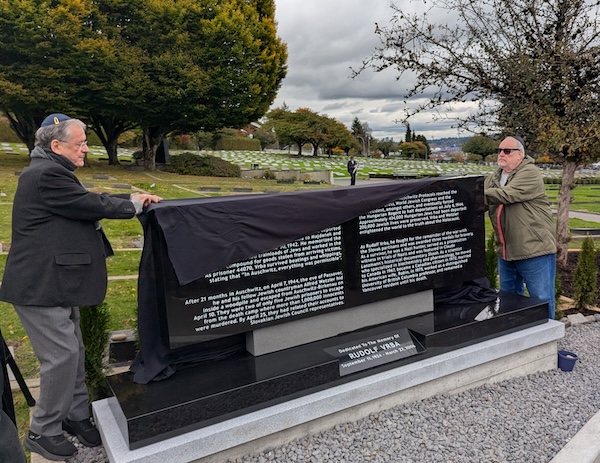
Robert Krell, left, founding president of the Vancouver Holocaust Education Centre, and Al Szajman, the current president, unveil the monument to Rudolf Vrba at Schara Tzedeck Cemetery. (photo by Pat Johnson)
Rudolf Vrba, a scientist who had a significant but comparatively quiet career in the laboratories and lecture halls of the University of British Columbia, enjoyed a comfortable life with his wife Robin in Vancouver before his death in 2006. Unbeknownst to thousands of his students over the years, Vrba may have saved more Jews during the Holocaust than any other individual. Despite this astonishing fact, his name has remained almost unknown not only among scholars of that history but even in his own adopted community of Vancouver.
At Schara Tzedeck Cemetery in New Westminster on Oct. 26, a monument was unveiled that seeks to remedy Vrba’s relative anonymity.
“Why do so few know his name?” asked Dr. Robert Krell, founding president of the Vancouver Holocaust Education Centre and a member of an ad hoc group that came together to recognize Vrba’s life and bravery. “Sir Martin Gilbert, the British historian, wrote that Vrba was directly responsible for saving at least 100,000 Jewish lives. Others now credit him with the preservation of as many as 200,000 Hungarian Jews.”
Before about 200 people gathered in the cemetery’s chapel prior to the monument’s unveiling, Krell recounted the exploits of Vrba and his co-conspirator, fellow Slovakian Jew Alfréd Wetzler, who were incarcerated in Auschwitz.
In April 1944, Vrba, just 19 at the time, and Wetzler, 25, contrived to conceal themselves within the Auschwitz compound, while, outside the camp, a massive search was undertaken by dogs and armed guards. After hiding silently in a woodpile for three days, the two men escaped and traveled for days by foot to Slovakia, where they shared all the information they had amassed about operations at the death camp. Vrba has been credited with having had an almost photographic memory and, over 22 months in Auschwitz, with Wetzler and he both having risen to positions of comparative privilege and trust in the camp, they were uniquely equipped to tell the world what was happening.
Vrba had worked on the arrival platforms at the camp, observing the incoming Jews and, later, in the “Kanada” compound, where the stolen valuables of arriving prisoners were stored. Wetzler was a registrar and clerk in the camp. The pair chose their moment to act because their vantage points alerted them to the imminent deportation of the last remaining large group of surviving Jews in Europe, those of Budapest.
Their account, which became known as the Auschwitz Protocols, or sometimes the Vrba-Wetzler Report, was the most credible and detailed information received to that moment about the extent of mass murder taking place in Auschwitz. More than 400,000 Hungarian Jews had already been murdered.
“The Jews of Budapest were next,” said Krell.
After dictating the report, Vrba joined the Slovakian army as a machine gunner and, later, joined the Slovak partisans, participating in 10 major battles and being awarded multiple medals for bravery.
After the war, Vrba completed a PhD in biochemistry at Charles University in Prague, then lived in Israel and England before serving as a research fellow at Harvard Medical School. He married Robin, an American, in 1975 and they made a home in Vancouver. Vrba was an associate professor in the department of pharmaceutical sciences at UBC for 30 years and Robin was a realtor.
The unfamiliarity with Vrba’s story in Israel, in particular, has been explored by Ruth Linn, a University of Haifa academic who first heard of Vrba when she was on sabbatical in Vancouver in the late 1990s. She returned to Israel and began asking if others with expertise in the field knew of Vrba, Wetzler and their escape. Her explorations led to her 2004 book Escaping Auschwitz: A Culture of Forgetting, which made the case that there was a deliberate effort in Israel to silence Vrba’s voice and obscure his history.
Vrba bore particular animus toward Rezső Kasztner, a leader of the Budapest Jewish community who went on to become a mid-level bureaucrat affiliated with the Israeli establishment and the Mapai party that led the country. Vrba – and others – viewed Kasztner’s actions as having saved the lives of Kasztner, his family and several hundred of his friends and associates at the possible expense of thousands of other Hungarian Jews. Vrba believed that, had ordinary Hungarian Jews been privy to the Auschwitz Protocols, as Kasztner was, they could have made their own decisions about whether to board the deportation trains.
The new monument and the unveiling ceremony were the culmination of several years of work by a group including Krell, Yosef Wosk, Geoffrey Druker, Joseph Ragaz, Arthur Dodek and Bernie Simpson, who formed a core committee advancing the project. Dodek, who emceed the Oct. 26 event, acknowledged additional contributions from the Kahn family, Ryan Davis, Marie Doduck and Jack Micner. Mayor Patrick Johnstone of New Westminster attended.
Organizers thanked the Schara Tzedeck Cemetery Board, including chairs Arnold Silber and Jack Kowarsky, and executive director Howard Jampolsky, as well as Schara Tzedeck’s Rabbi Andrew Rosenblatt.
Rosenblatt spoke of biblical and modern concepts of righteousness, citing Vrba as the definition of a hero.
“He did not escape from Auschwitz simply to save his own skin,” said the rabbi. “He escaped from Auschwitz to save Hungarian Jewry. He escaped from Auschwitz to warn the world.”
The monument, located adjacent to an area of the cemetery not yet open to burials, means that future generations who pass through mourning loved ones will have an opportunity to reflect on true heroism.
“I am struck anew by how singular his legacy was, how young he was, how hard he fought to bring the truth to the world,” said Hannah Marazzi, executive director of the Vancouver Holocaust Education Centre, which sponsored the ceremony. “It is a legacy of courage, brilliance, sorrow, resilience and endurance. But perhaps what I have treasured most is learning about his life and legacy from those here who have had the privilege of knowing him.”
Druker noted that the monument reflects an increased awareness of Vrba locally and hoped that the knowledge would expand beyond his hometown.
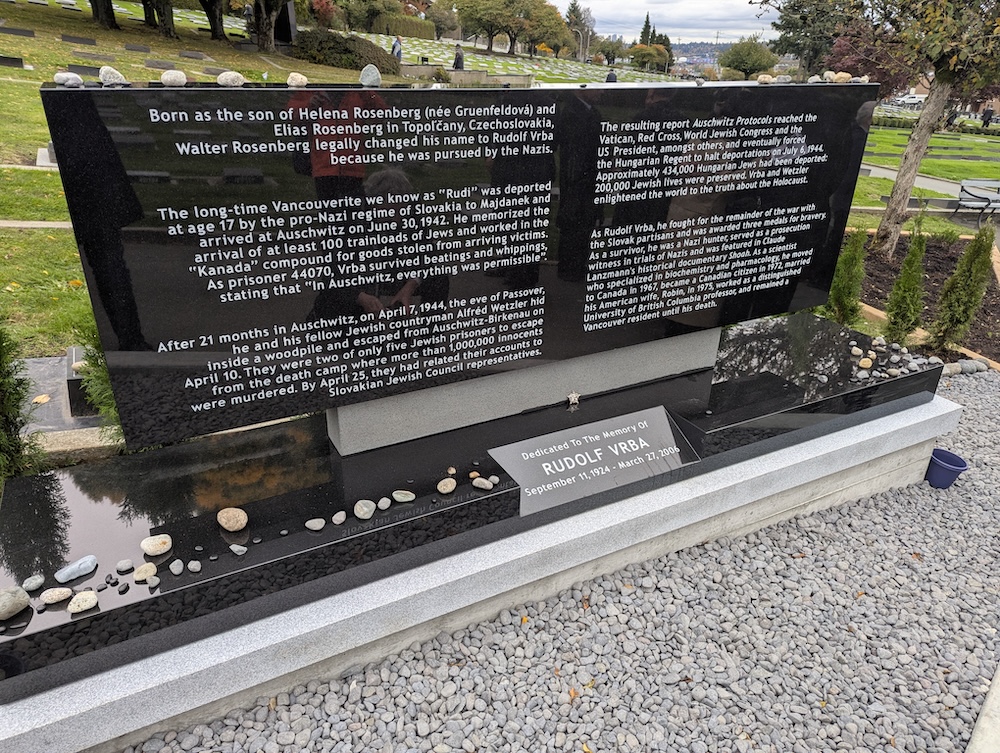
Druker read aloud the inscription, which recounts the details of Vrba’s life: his origins, his deportation to Majdanek and Auschwitz, his escape, his war heroism and his life as an academic.
“We hope that, in Israel, he will finally be recognized for what he is: a central hero that changed the course of the Holocaust for Hungarian Jews,” Druker said. “We want the world to recognize that too.”
The new monument to Rudolf Vrba at Schara Tzedeck Cemetery. (photo by Pat Johnson)
Chris Friedrichs, professor emeritus of history at UBC, put Vrba in the context of his times.
“The existence of Auschwitz was no secret to those leaders,” he said. “They knew that Auschwitz was the site of a vast industrial complex where German war production was being performed by forced labour. But, as we know, this report for the first time described the actual operations of the camp in terrifying detail, making clear that Auschwitz was not only a location of industrial activity, but also the site of mass extermination of human lives on a scale that nobody had previously fully grasped.
“A huge number of Hungarian Jews had already been sent to Auschwitz, but the approximately 200,000 Jews of Budapest had not yet been deported, and it was largely thanks to this warning that the deportations were halted and the lives of most of those 200,000 Jews were saved.”
The experiences Vbra underwent at a young age, as well as his anger that his escape and the report he helped draft did not save even more lives, affected him through his life. Friedrichs, who knew Rudi and Robin Vrba, said they enjoyed a happy life in Vancouver, but the past haunted Vrba.
“For, although he could escape from Auschwitz, Rudolf Vrba could never really escape from the Shoah,” said Friedrichs. “He knew too much and he cared too much to put what he had seen behind him.… Rudolf Vrba was dedicated to relating the facts, but there was also anger, and that anger was directed not just against the Nazis, but also against Jewish leaders during the war who could not bring themselves to inform their fellow Jews about what was happening in Auschwitz. He was like a biblical prophet who had inveigled against the wilful ignorance or stubborn disbelief of those who should have known better.”
Friedrichs credits Robin, who now lives in the United States and was not able to attend the unveiling, as “not only his cherished companion for over three decades,” but with ensuring that his legacy not be forgotten.
“In fact,” said Friedrichs, “that task is a challenge for all of us. Even the Jewish community of Vancouver never fully recognized the greatness of this man and the role he had played both in saving Jewish lives and in contributing to knowledge of the Shoah.”
The monument is a belated recognition, said Friedrichs.
“What we do today is overdue, but it is not too late,” he said. “Future generations will pass by this monument and realize how proud our community should have been that this man lived and worked for 30 years in our midst. As we watch the monument being unveiled, and if we gently lay some stones upon it, we will be paying a debt of gratitude to someone who is not only a hero of the 20th century, but should continue to be an inspiration for the 21st.”
On Nov. 29, sopranos Jaclyn Grossman, left, and Miriam Khalil will perform Salam-Shalom: Echoes of Home, a program they put together in an effort “to build bridges between our communities.”
“Salam-Shalom: Echoes of Home grew out of countless conversations between Miriam and me over the past few years – conversations that gave me a lot of hope during a difficult time,” Jaclyn Grossman told the Independent about her upcoming concert with fellow soprano Miriam Khalil.
“We shared what we were each experiencing, what our communities were going through, and how we might better understand and support one another,” said Grossman. “We both felt a deep need to do something meaningful and to use our voices and our art to foster empathy, connection and healing. This project is deeply meaningful to me because I hope it can create a space for reflection, healing and understanding for our communities, and for anyone who connects with its themes of home, acceptance and belonging. I truly believe we are stronger when we stand together, and I hope this concert helps build bridges that make that possible.”
Grossman and Khalil will be accompanied on piano by Gordon Gerrard, artistic director of City Opera Vancouver, which is presenting the concert. Idan Cohen (Ne.Sans Opera & Dance) will lend his experience in stage and movement, and Avideh Saadatpajouh has created projections that, among other things, highlight some of the textual elements.
“Jaclyn is a beautiful person and has always been someone that I have connected with,” said Khalil about why she wanted to be involved with the production. “Through many of our conversations, our shared dialogue grew and became something we realized we both needed in order to find healing. Jaclyn had mentioned that she had spoken to Gordon about the possibility of creating something together. What made this project so special was our dialogue from the very beginning. Through numerous meetings, we spoke about finding a way through song, language and poetry to create a space for healing and shared empathy and, most importantly, to build bridges between our communities. We longed for the same thing, peace and human connection – this recital is an extension of that longing and an expression of hope.”
As for his participation, Gerrard said he became interested after a conversation with Grossman more than a year ago. “I was distressed to hear that she had had several concert appearances canceled over recent months,” he said. “It seemed to me that many organizations seemed hesitant to present Jewish and Arab artists out of fear of controversy. The program was suggested by Jaclyn as a direct way to counteract this.”
Pianist Gordon Gerrard, artistic director of City Opera Vancouver. (photo from City Opera Vancouver)
About the risk of City Opera Vancouver being “canceled” for presenting Salam-Shalom, Gerrard said, “Certainly, we have committed to this special event after careful consideration of the charged environment that we are all a part of right now. We wanted to be sure that we acted responsibly, and that we would be able to create a respectful space for everyone involved. Because I trust Jaclyn, Miriam and Idan entirely, we’ve been able to have many helpful conversations about this event and how to go about it. This has given us at City Opera confidence that we are doing something that intends to create better understanding and, for us, this remains the priority.”
“Our goal with this project is to create a space for nuanced dialogue, where all voices can be heard and where empathy and understanding can grow,” said Grossman. “While this kind of work isn’t always easy, I believe it’s essential. In times like these, it’s more important than ever for communities to come together, listen to one another, and foster compassion. To me, standing together in empathy and respect for all people feels like the only path forward.”
“My concern,” said Khalil, “is that we have a responsibility to one another. If we keep being afraid, then no change will ever take place. We must unite and listen to each other. As Jaclyn mentioned, without compassion and empathy, the way forward feels unattainable. There is great growth in seeing and appreciating one another’s perspective.”
Grossman and Khalil chose the repertoire, and the result will be a concert of “beautiful and seldom performed works entirely curated by the two of them,” said Gerrard.
The hour-long program comprises melodies from myriad musical heritages, including Arabic, Hebrew, Ladino, Spanish and Yiddish. The concert’s press release highlights “Eli, Eli,” an arrangement of a poem by Jewish-Hungarian resistance fighter Hannah Szenes during the Second World War; “Mermaid Songs” by Palestinian-American composer Felix Jarrar; “Ukolebavka,” a lullaby by Jewish composer Ilse Weber, who wrote and performed songs to comfort children when she was interned in Terezín; “Ayre,” by Argentine Jew Osvaldo Golijov, which explores the themes of exile and belonging using the words of a Hebrew prayer and those of Palestinian writer Mahmoud Darwish; and “The New Colossus,” a setting of Emma Lazarus’s poem (inscribed on the Statue of Liberty) by pianist and composer Nate Ben-Horin, who is part of Grossman’s duo, the Likht Ensemble. Another of the songs on the program is “Mi Lo Yeshalach,” by contemporary Israeli composer Hana Ajiashvili. The complete repertoire, with all the lyrics, has been posted on cityoperavancouver.com.
“To me, Salam-Shalom: Echoes of Home is an urgent expression of a voice that feels increasingly silenced,” said Cohen. “I believe the growing calls to silence or divide rather than engage in dialogue are deeply troubling. When Jaclyn, Miriam and Gordon reached out, I immediately said yes.
“This project also speaks to my responsibility to uphold these values and address the horrors we are living through, through art,” Cohen added. “It’s easy to see conflict in simple opposites – right and wrong, us and them – but true understanding asks us to face complexities.
“Art,” he said, “should remain a space for reflection and critical thought, not moral posturing. I believe in its power to unite, to reveal our shared humanity, and to keep hope for peace alive.”
Created in 1995, the traveling exhibit Anne Frank: A History for Today is on display roughly 300 times a year. Mainly for school groups, people can visit the exhibit at Seaforth Armoury Nov. 11. (photo from Anne Frank House)
The traveling exhibit Anne Frank: A History for Today, hosted by the Consulate General of the Netherlands, is at Seaforth Armoury until Nov. 21. An opportunity for school groups to learn about Anne’s story and the legacy of her diary, the exhibit tours have already sold out, but the public is welcome to visit on Remembrance Day, Nov. 11.
While this is not the first time the exhibit has been in Vancouver, its presence at the armoury and museum is poignant. Started in 1920 by Scottish Canadians, infantry from the Seaforth Highlanders were on the ground in Amsterdam on May 8, 1945. They entered the city as part of the Allies’ liberating force.
Following months of battles and Germany’s surrender, the Seaforth Highlanders offered humanitarian aid to the city’s population. The close ties between the regiment and the people of the Netherlands are commemorated every year.
The school tours at Seaforth Armoury are led by volunteers trained by Phyllis Lewis, a staff member of Anne Frank House, said the house’s director of Canadian activities, John Kastner.
Arriving on Nov. 5, the exhibit required about six people half a day to set up, then there was peer training. The response to the call for volunteers was excellent, said Kastner, as has been the level of interest from local schools.
“I think the premise is from Anne Frank House in Amsterdam – there’s real value for people to become ambassadors of the message. People that are close to the same age as Anne are particularly effective when it comes to relaying the message of the diary,” he said.
Not all the exhibit’s stops are in metropolitan areas. Kastner described its journey to Anne Frank Public School in Vaughan, part of the Greater Toronto Area, then it went to Marathon, a mining community on the shore of Lake Superior, then to All Saints High School in Toronto, before being displayed at Ottawa’s Beechwood Cemetery (Canada’s national military cemetery) and the Dutch consulate in Vancouver, which sponsored it.
And the exhibition will keep moving, said Kastner. “It’s been very busy in 2025 – demand has been very steady and it has hardly been in storage at all.”
Created in 1995, the Canadian exhibitions are just some of the many around the world, in languages including Albanian, Arabic, Bengali, Bosnian, Korean, Macedonian and two forms of Portuguese. In total, the exhibit is on display roughly 300 times a year.
Paired with a 30-minute film, Who was Anne Frank?, the tour takes about 90 minutes. It comprises 11 panels of information that are the same worldwide and the 12th panel is curated specifically for the region. The version that arrived in Vancouver this week references the liberation of Amsterdam and all the panels are in both English and French, which is the case for all the Canadian showings, though the exhibit for northern Ontario is also in Inuktitut.
The docents bear a responsibility as ambassadors for Anne’s legacy and message, said Kastner. “You want people who are in classrooms, at dinner tables, in peer groups at schools, who are aware of the story, that become advocates of fairness, opponents of racism, opponents of prejudice, and we really see it in real life – that those docents become docents of the message of Anne Frank House.
“Every generation that comes through, you create a new generation that becomes familiar with the story and the messaging of Anne Frank – not only what she went through, but her optimism in a world surrounded by hate, prejudice and violence…. As people go through the exhibit, they become aware of what an important story it is,” said Kastner. “They come to realize that it is, by definition, a history for today – that it has relevance in today’s society.”
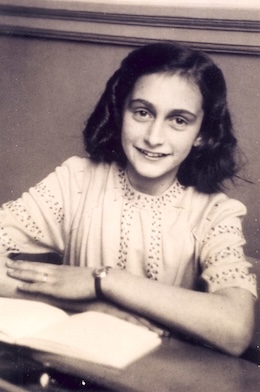
Anne Frank, in 1941. The traveling exhibit Anne Frank: A History for Today is at Seaforth Armoury until Nov. 21. (photo from Anne Frank House)
Kastner spoke about his personal connection to Anne’s remarkable outlook and values, referencing her often-quoted diary entry of July 15, 1944: “In spite of everything, I still believe that people are really good at heart.”
“I wish we could all be as optimistic as Anne was,” he said. “It was remarkable.
“There have been many periods since the Second World War when we’ve had many reasons to be pessimistic, and that’s why it’s a history for today. It’s a recurring message that continues. After 75 years, it still has relevance.”
Kastner praised the design of the exhibit, calling it “fantastic.”
“There’s a timeline ribbon that goes down the centre … the date and the year. Above the ribbon is what is happening in the world politically at the time. Below the ribbon is how it’s impacting people – Anne, her family and everybody else,” he explained. “The idea is that [some people think] what you see on the news doesn’t really matter…. This says, it should matter, it does make a difference. And that creates an awareness of current events, of being involved … of speaking out. Even in minor cases of prejudice, it’s problematic and [can lead] to a greater problem.”
When talking about this idea in Marathon, Kastner gave the example of name-calling. “Calling someone a name, a slur, we can see it as problematic but not the end of the world,” he said. Or, “graffiti on a kid’s locker, that’s not very nice, but it’s not the end of the world – but it leads to a huge problem when [such actions] become the norm.”
Kastner spoke highly of the 3D model of the house, which is “one of the great learning tools that goes with the exhibit.” There is power in asking teenagers, “Who can tell us where Anne slept?”
“When I went to Anne Frank House to work there, where my workspace was, I’d be looking at the courtyard and at the Annex, looking at the tree, and it’s absolutely surreal,” he said. “Being in the presence of that kind of history. There’s no replacement for that.”
It’s the same tree Anne would have seen.
“I’d be in her father’s office at the warehouse and there are all sorts of people traipsing through the house,” he said, and he’d think about “how you [would have] had to be deathly quiet, completely stationary, because people were using that office.”
Certain questions come up time and again. Students want to know how the Holocaust started, for example.
“The Holocaust didn’t start with people getting loaded on trains,” Kastner explains to the kids. “The Holocaust started with all sorts of things that Anne talks about – her bike being taken away, not being allowed to swim in the public pool, not being allowed to take public transit, then extended to larger things. Her dad not being allowed to have a job or own property.… It starts by slow increments.”
At Anne Frank Public School in Vaughan, the kids asked Kastner how Anne’s diary got published. He described the return of Anne’s father, Otto Frank, to the Annex, which had not changed since the day their hiding place was discovered. He told the students that Miep Gies, who had helped hide Anne and her family, “had taken the diary after the Nazis had left and kept it, gave it to Otto and he read through it and then said, I should publish this.”
Kastner said the kids marvel at the serendipity, the turn of events that led to “one of the most important books written by somebody under the age of 16.” He added, “The kids say that it’s amazing that [Otto] survived, that he got the book, that somebody wanted to publish it and then the idea that it’s become standard reading for millions of kids 70 years later.”
During the exhibition’s stop at Beechwood Cemetery, Kastner recalled two students asking him, “What is it about Jewish people? Why do they pick on Jewish people?” And, “Why didn’t somebody do something?
Kastner explained the scapegoat theory to these students. “It’s in Shakespearian plays, it’s throughout history: the idea of a common enemy often solidifies a group,” he said.
Each exhibition site brings different opportunities for learning, said Kastner. Getting it to remote locations can be tough but it’s worthwhile. Shipping the panels to Marathon, for example, was challenging, but Kastner applauded the motivation of the school there as “very noble and progressive.”
“Every place it goes, it has a different impact and it’s going there for a different reason,” said Kastner of the exhibition.
“The message,” he said, “is in Anne’s experience, Anne’s death – that has relevance in today’s society.”
Shula Klinger is an author and journalist living in North Vancouver.
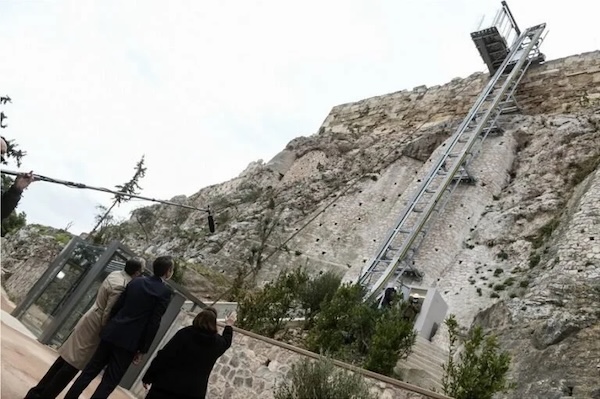
Before the 2004 Summer Paralympic Games in Athens, Greece, organizers installed an elevator in the Acropolis. (photo from greecehighdefinition.com)
What does sports have to do with human rights? This was the question posed by Vancouver Jewish community leader Zena Simces as she and her spouse Simon Rabkin launched the seventh annual Simces and Rabkin Family Dialogue on Human Rights Oct. 23 in a national online event.
There is evidence of discrimination and exclusion, racism, sexism, ableism, athlete exploitation and maltreatment, labour rights violations, sex eligibility and gender identity issues and safety concerns in sport, Simces said. There are also funding issues, such as the high cost of participation in sport, including at the community level.
Sport is about more than just an active and healthy lifestyle, Simces noted, though it is about that, too.
“It can help to address social isolation and loneliness, which have been identified as major health concerns, not only for older adults, but also for children and youth,” she said. “Sports can be democratic, as it invites everyone to belong and contribute to strengthening and building community, but there is a dark side.”
The dialogue was moderated by Wendy MacGregor, a consultant, educator and lawyer who is the founder and executive director of Athlete Zone, a nonprofit that provides Canadians with support, guidance and education in the pursuit of healthy sports environments.
“Unfortunately, with all those wonderful attributes that sports brings, it is not accessible to everyone worldwide and not even to all Canadians,” said MacGregor. She cited statistics indicating that youth participation numbers “are dropping off a cliff and especially girls are dropping out of sport.”
Some of the reasons for this include increased costs, travel time, difficulty of access to facilities, discrimination, maltreatment or abuse in sport and the increased commercialization of sport.
Panelist Bryan Heal, the social impact research lead at Maple Leaf Sports and Entertainment, spoke about a program his organization is involved with, called Change the Game, which advances youth access, equity and outcomes through sport.
Change the Game has engaged more than 25,000 young people around Ontario, he said, addressing factors of race, gender, ability, household income, geography and other factors around access and barriers.
More than 80% of young people who have participated in the program, he said, have experienced themselves or are aware of a problem in these areas but do not feel like they have anyone that they can talk to about it.
“There’s a culture and strategy of silence that is employed by default,” said Heal. “In a team environment, it can be incredibly isolating and deflating when you’re harbouring something like that. It draws people away to other sports, sometimes to leaving sports entirely.”
Jeff Adams, a lawyer specializing in labour, employment and human rights issues, is a decorated Paralympian, having won three gold medals in wheelchair races.
Accommodating different needs is fundamental and, too often, he said, excuses are made, such as the argument that sports facilities are often in buildings that are too old to be made fully accessible.
Before the 2004 Summer Paralympic Games in Athens, Greece, organizers installed an elevator in the Acropolis. “You want to talk about the most historically relevant building in the world,” he said. “It’s the cradle of civilization, and they put an elevator in it.”
An attitude exists that basic Canadian laws, embodied in the Charter of Rights and Freedoms, do not apply to the playing field, he argued.
“We are not applying the fundamental supreme law of Canada to athletes who are bleeding for their country in competition,” Adams said. “We have laws that work. We have anti-violence and harassment legislation baked into labour and employment laws.”
Amreen Kadwa, founder and executive director of Hijabi Ballers, a Toronto nonprofit creating positive experiences in sport for Muslim girls and women, said her group’s programs provide more than just access to sport.
“They create safe, culturally affirming spaces where women can play without judgment,” she said. “They can learn new skills, they can grow in their confidence and, beyond sport, we nurture leadership. It really is human rights in action.”
Female athletes face far more violence and discrimination in sport than their male counterparts, Kadwa said.
“But this number is even higher for racialized women,” she said. “Muslim women, a lot of them who are hijab-wearing Muslim women, are often seen as outsiders, whether through their outfits, their clothing, the stereotype, a lack of cultural understanding.”
The annual dialogue event is a partnership with the Canadian Museum for Human Rights and Equitas, an international centre for human rights education.
Ronnie Marmo brings his one-man show I’m Not a Comedian … I’m Lenny Bruce to the Chutzpah! Festival Nov. 18. (photo from dorensorellphotography.com via Chutzpah!)
In 2017, with the expectation of a six-week run, creator and performer Ronnie Marmo and director Joe Mantegna brought I’m Not a Comedian … I’m Lenny Bruce to the stage. Now, celebrating eight years and 468 performances, Marmo told the Independent, “we can not wait to bring it up to Vancouver for 469!”
I’m Not a Comedian … I’m Lenny Bruce is part of this year’s Chutzpah! Festival, which runs Nov. 12-23. It’s being presented on Nov. 18, 7:30 p.m., at the Rothstein Theatre.
Bruce, a groundbreaking standup comedian and satirist, was born Leonard Alfred Schneider in Mineola, on Long Island, NY, in 1925. He consistently pushed social and legal boundaries, being arrested more than once for what was considered obscenity in his day, including a conviction in 1964 for a performance he gave at Café Au Go Go in New York City. Bruce died two years later, at age 40, from an accidental overdose. He was bankrupt, basically not having been employable after the conviction. It would be 37 years before he was posthumously pardoned, by then-governor George E. Pataki.
In I’m Not a Comedian … I’m Lenny Bruce, Marmo told the Independent, “We bookend the show with the final moments of his life and take you on a journey through his first performance all the way to his demise. We learn about his family, we see his charm and success, his struggle with addiction, his long-standing fight with the judicial system. We don’t hold back. You really get a full theatrical experience of his entire life.”
Bruce is one of Marmo’s heroes.
“What inspires me about Lenny is how ahead of his time he was and how passionate he was about his pursuit of the truth. I have so much respect for someone who is willing to sacrifice everything and put it all on the line just to make sure he didn’t fall into suit with everyone else. I’m proud to be entrusted by the family to be the one to tell his story to the next generation.”
Marmo landed on the title for the show after hearing Bruce say, in an audio clip, “I’m sorry I wasn’t funny tonight … I’m not a comedian, I’m Lenny Bruce.” For Marmo, that comment resonated. “He wasn’t a comedian – he was so much more than that,” said Marmo of Bruce. “He was a satirist, a social commentator and a true advocate for the freedom of expression.”
The show has evolved a lot since its creation.
“As the writer, I am always tinkering with the script,” said Marmo. “For example, I removed the famous ‘N-word’ bit when we came back after the pandemic. I felt as though, even though the bit itself was in support of removing power from words so we don’t give them the chance to harm us, I knew that people might have a hard time hearing what Lenny was actually trying to say. Plus, even though I loved the impact it had on an audience, it kept me up at night thinking about it even before events like what happened to George Floyd. I have a responsibility as an artist to tell the absolute truth but also to not be tone deaf to the world around me. I don’t believe Lenny would have done that bit today.
“I also had long discussions with Kitty [Bruce, Lenny’s daughter] and my director, Joe Mantegna, who both agreed that it was best to remove it. So, I replaced it with ‘The Meaning of Obscenity,’ which, in my opinion, supports the show even more. So, I’m happy to make the switch, knowing it is not only the best fit culturally in this climate but also the strongest choice for the show overall. As a performer, my portrayal of Lenny evolves as I explore my own life and how I tell his story resonates differently depending on where I am in my life. I think it takes passion, dedication and an openness to watch it grow and evolve along with me.”
While I’m Not a Comedian … I’m Lenny Bruce premiered in 2017, Marmo said, “I’ve actually been with Lenny since 2005, when I did another show about him, called Lenny’s Back and Boy is He Pissed. On stage, I don’t separate us – it is my job as an actor to find where we meet in the middle. I try to focus on all the similarities that I identify with for Lenny. It is easy to keep it fresh because it is such an emotional ride and massive performance. I don’t feel like I ‘have it’ yet, which is refreshing, because it always feels just slightly out of reach.”
When Marmo did Lenny’s Back, which was brought to him by comedian Charlie Brill, he became “intimately involved with Lenny Bruce and his life.
“In getting to know him, I realized that there was so much of his story we weren’t telling. I wanted to get into the nitty gritty, I wanted to do his bits,” said Marmo. “So, I set out to write my own show.
“We initially started the show anticipating a six-week run,” he said. “This thing has caught fire in the most incredible way. It is a testament to just how relevant Lenny is today – perhaps even more than he was over 60 years ago! It truly has been a perfect storm: free speech, first amendment, cancel culture and not to mention the success of the Amazon series The Marvelous Mrs. Maisel. They really helped catapult Lenny’s name back into pop culture and have sold thousands of tickets for us. We have, in some ways, come very far and, in others, not far at all.”
Marmo described Bruce as “a very proud Jewish man,” who often incorporated Judaism and his Jewish heritage into his material. “He openly incorporated his Yiddish vocabulary into his bits and there is quite a bit of familiar references sprinkled throughout the show,” said Marmo. “His relationship with religion overall was complex but, rather than hiding his heritage, he celebrated it.”
As for what he thought gave Bruce the courage to run up against the country’s obscenity laws, Marmo said, “The truth. He held a mirror up to society and asked questions that everyone wondered about but never found any resolution to. He also fervently believed in our judicial system and always believed that it would prevail and he would be redeemed – something that he, unfortunately, didn’t see in his lifetime, but did come to fruition with his posthumous pardon in 2003 – the first in New York history, in fact. He spoke out loud what everyone whispered to themselves and his popularity was proof of how profound he was.”
Even though Bruce wasn’t alive to receive the pardon, Marmo still believes it was an important action.
“It was a landmark symbolic victory for free speech,” he said. “I think it was redemption. It was validation that Lenny had something to say to this society and that we are free-thinking creatives entitled to our artistic expression.”
For tickets to I’m Not a Comedian … I’m Lenny Bruce or any other Chutzpah! show, go to chutzpahfestival.com or call 604-257-5145.
Suzy Birstein, who creates out of Parker Street Studios, is among the many artists – including Esther Rausenberg, Ideet Sharon, Lauren Morris and others – who are opening their doors to the public during the Eastside Culture Crawl Visual Arts, Design & Craft Festival Nov. 20-23. (photo from Suzy Birstein)
More than 500 artists – including Esther Rausenberg, Ideet Sharon, Lauren Morris, Suzy Birstein and other Jewish community members – are participating in the Eastside Arts Society’s 29th annual Eastside Culture Crawl Visual Arts, Design & Craft Festival Nov. 20-23.
The festival will welcome visitors into the studios and workshops of Eastside artists in more than 80 registered buildings, including 20 buildings new to the Crawl – marking a 25% increase in options for exploring all that is on display across the Eastside Arts District (EAD). This year also marks the beginning of a three-year partnership with the Audain Foundation as the Crawl’s presenting partner, recognizing the importance of creative spaces and experimentation to a vibrant and healthy arts ecosystem.
“Vancouver is home to a growing number of artists who continue to create in the face of tremendous economic hardships and reduced access to studio space,” said Rausenberg, who is artistic director of the Eastside Arts Society (EAS). “Their unwavering passion, ingenuity and resourcefulness results in a richness of unique and diverse production and working artist spaces, creating exciting new opportunities for art lovers to explore, to discover and to be inspired.”
Encompassing the region bounded by Columbia Street, 1st Avenue, Victoria Drive and the Waterfront, the festival offers visitors a window into the artistic practices of artists living and/or working in Vancouver’s EAD, representing creators specializing in painting, jewelry, sculpture, furniture, leather goods, photography, glass works, textiles, and more.
As part of the Crawl, EAS will host a series of ancillary events, including the 2025 Preview Exhibition, a multi-venue, salon-style curated exhibition that explores a variety of media, formats, techniques and styles. This year’s theme of “Passion, Reason, Idiocy” invited participating artists to submit works that speak to the emotional, rational and foolish elements of their lived experience as working artists. The exhibition features juried works from 78 artists at three venues – Pendulum Gallery, the Cultch Gallery and Alternative Creations Gallery – until Nov. 30.
The 12th Annual Eastside Culture Crawl Film and Video Exhibition, in partnership with the Lumière Festival, will be projected outdoors nightly Nov. 13-16. Short films from eight participating artists – Ethan White, Garrett Andrew Chong, Cheree Lang, Fatima Travassos, Debra Gloeckler, Rashi Sethi, Isaac Forsland and Nisha Platzer – explore the theme of “Unity,” selected by Moving Art curators Rausenberg, Kate MacDonald and Sierra MacTavish.
This year’s series of Talking Art panels will be shared online, with two remaining. On Nov. 12, curated and moderated by Samantha Mains, artists Mackenzie Perras and Jes Hanzelkova will talk about artist practices that rely on the use of place, whether as a source for their concepts, art medium and materials, or site for performance. On Nov. 13, Mains will moderate while artists Jai Sallay-Carrington and Gina D’Aloisio explore artists whose practices have been changed by the influence of others, through participation in artist residencies or social media.
During the Nov. 20-23 festival, artists’ studios will be open 5-10 p.m. on Thursday and Friday, and 11 a.m.-6 p.m. on Saturday and Sunday. Full details of all the events, artists, talks and locations can be found at culturecrawl.ca.
The Team Vancouver delegation at the 2025 JCC Maccabi Games in Pittsburgh, Pa. (photo fromJCCGV)
When the Jewish community of Greater Toronto hosts the JCC Maccabi Games this summer, it will mark the first time that the Jewish teen athletics event has taken place north of the border since Vancouver hosted in 2006. And Team Vancouver, based out of the Jewish Community Centre of Greater Vancouver, will bring a delegation of at least 20 athletes to be a part of it.
The JCCs of Toronto will welcome approximately 1,600 Jewish teens from around the world Aug. 2-7, 2026, for this annual Olympic-style sporting event. The games will take over venues around Greater Toronto, offering a variety of team and individual sports.
“With the political climate being what it is these days, it’s really fantastic timing to finally have a set of games in Canada again,” said Kyle Berger, delegation head for Team Vancouver. “I can feel the excitement already building and we expect to be taking our largest delegation since before COVID.”
The JCC Maccabi Games, which engages 3,000-4,000 Jewish teens each summer, is focused on athletic competitions, but, Berger said, the true meaning of the games lies in the unique Jewish peoplehood experience it offers.
“From the powerful opening ceremonies, with the parade of athletes, and through the week of competition and special events, there is nothing that brings Jewish teens together like the JCC Maccabi experience,” he said. “This will be my 23rd set of games, but, when Team Israel enters the opening ceremony, with 10,000 people all waving their Israeli flags, cheering and singing together in a safe environment, it gives me goosebumps every time.”
Berger was involved with the games when Vancouver hosted in 2006 and said he appreciates how much hosting this event can bring a community together.
“Much like the way hosting the Olympics in 2010 brought the cities of Vancouver and Whistler together, hosting the JCC Maccabi Games really is a full-community experience,” he said. “And anytime it is in Canada, it’s special to be part of it and show off our amazing country. We will enter the opening ceremony with extra pride this year.”
The games in Toronto, which will take place at the same time as another set of games in Kansas City, will be one of the larger sets of games in recent years. Athletes aged 13-17 as of the date of the games will be able to compete in their choice of team or individual sports that include ice hockey – with a girls division for the first time – baseball, basketball, softball, volleyball, soccer, tennis, swimming, dance, track and golf.
Aside from the opening ceremony, the games will feature social events for the athletes and coaches, as well as Jewish and Israeli cultural programming, social action projects and an emphasis on the six middot (Jewish values) of tikkun olam (repairing the world), respect, joy, pride, big-heartedness, and Jewish peoplehood.
JCC Maccabi, a signature program of the Jewish Community Centre Association of North America, is part of the overall umbrella of the Maccabi World Union, which also includes the Maccabiah Games in Israel.
OneTable dinners – a platform for young professionals to meet on Shabbat – are occurring in 700 cities, including Toronto, but not yet Vancouver. (photo from OneTable)
My son moved to Florida in August, choosing the Sunshine State for its large Jewish community, great weather and the many outdoor recreational possibilities it offers when Vancouver is soaked with rain. He quickly found opportunities to engage with young Jewish professionals like himself, through a synagogue, but also through OneTable Shabbat dinners.
“I had an amazing Shabbat experience,” he told me, as he explained how it works.
Someone agrees to host a Shabbat dinner for a certain number of people, who each bring an item to help with the meal. OneTable reimburses the host $10 per person, which doesn’t cover the costs, but it helps, particularly if the host is feeling cash-strapped.
In my son’s case, the meal was take-out sushi, which was completely fine with the 20-somethings gathered around that Florida table. They talked, laughed and ate together, kindling new friendships and inspiring my son to play host at a OneTable Shabbat soon.
My curiosity piqued, I started making inquiries about OneTable. What a great fit this would be for Vancouver, I thought, given how difficult it is to make new Jewish friends here. That’s especially true for young Vancouverites looking for Jewish partners in a city with an intermarriage rate of 43%, according to a 2011 study and intermarriage rates in Canada have increased, according to another study that came out this year, so likely Vancouver’s has, too.
But it’s also a challenge for Gen Xers like me. What an incredible idea, to surround yourself with potentially new Jewish friends at a home table defined by challah and shared food! Alas, OneTable is not offered here.
Irit Gross, chief advancement officer at OneTable, described how the organization began in 2014, when two philanthropists united to address the epidemic of loneliness that was occurring. Young Jewish adults were focusing heavily on their mobile phones, and disassociating themselves from the traditional Jewish institutions where their parents and grandparents had socialized.
OneTable sent out a survey, asking young people what it would take to get them to choose Shabbat on a Friday night, rather than another option.
“People were socializing online, so we knew we needed to meet them in a virtual space,” Gross said. “We began investing in a platform similar to Airbnb, where, as a host, you could go online and post your dinner and, as a guest, you could join one. That’s the essence of how we started, with the goal of people going online to be offline.”
The $10 per person remuneration was added when OneTable realized money was a barrier to millennials wanting to host five to 10 people in their homes. The reimbursement allows the host to elevate their offering; for example, by buying better wine, or a nicer tablecloth for the event.
That first year, OneTable began in the Jewish heartbeat of North America – New York City. As the organization fundraised and collaborated with local federations in other cities, it quickly expanded to Chicago, Los Angeles, Boston and Miami.
“We knew where the young adults were and went to set up shop in those locations,” said Gross. Today, OneTable dinners are occurring in 700 cities, including Toronto, and 49 states, as well as Washington, DC.
The organization has engaged 320,000 unique individuals, with many returning for more. “Those 320,000 people have come back and either guested or hosted two or three times. That engagement rate shows that our goal and mission of creating a Shabbat ritual is coming to fruition and happening in the community,” she said.
Prior to Oct. 7, 2023, OneTable was engaging 40,000 unique individuals annually. “After Oct. 7, that jumped to 82,000 unique people, meaning we doubled in 2023 and sustained that increase in 2024,” Gross noted. “It’s been a marker for our organization, catapulting us to really think not just about how we’re addressing millennials, but, also, bringing Gen Zs together.”
After reading reports about how Jews across many different age groups were looking for ways to find community, OneTable expanded its offerings, though its core audience remains the 20-to-30-something demographic, which accounts for 95% of its time and budget.
The organization’s research is far from over. “We’re still trying to figure out how to stay relevant and continue to be the number one choice for young adults in their 20s and 30s, so they can create their own Shabbat rituals,” said Gross.
Five years ago, the UJA Federation of Greater Toronto requested collaboration with OneTable, beginning a conversation that would take two years before the program launched. OneTable began operating in Toronto in 2023 with a three-year funding grant, and Gross said Toronto has been one of its most successful communities.
OneTable is not in Vancouver, and there seems to be no conversations about it coming here. Prior to Oct. 7, the Ronald S. Roadburg Foundation reached out to OneTable.
“I think it’s a great organization, but we’re not funding in the space of young adult engagement,” said Mark Gurvis, the foundation’s chief executive officer. “If we were funding young adult engagement, we’d fund this for sure. Federation’s involvement is the key for this, and whether we’ll step in with Federation remains to be seen.”
I asked the Jewish Federation of Greater Vancouver about the possibility.
“While Vancouver doesn’t have OneTable, we’re fortunate to have many organizations that host meaningful Shabbat dinners and gatherings that bring people together throughout the community,” said Caryl Dolinko, Federation’s communications and marketing director.
“We are continuing to develop a family-connector model to strengthen engagement. We’re also happy to explore other initiatives and opportunities that are out there in the community, as we would love to do with OneTable.”
She continued, “Our focus remains on supporting the many partnerorganizations and community initiatives that already create opportunities for meaningful Shabbat experiences and peer connection.”
Dolinko gave the example of Axis, a Federation initiative for Jews in their 20s and 30s. “Last year, Axis held 15 events for 682 unique participants, with 345 attending multiple events,” she told the Independent. The network connected 32 volunteers to community organizations and maintains active WhatsApp and Instagram engagement, she said.
“We are restructuring our PJ program to prioritize mixed-heritage families and have expanded PJ Library access into public school libraries, pediatrician offices and other community spaces,” she added.
With an intermarriage rate like ours in Vancouver, I’d argue that the current model is not working. But no one is asking me.
I moved to this city to start my family, in 2000. Now, a quarter-century later, three of my children have left for other cities and countries, where their odds of meeting Jewish partners are much better. My youngest will follow in two years. I miss them desperately, but I want them to spread their wings – and I want them to marry someone Jewish.
Gross understands all too well that funding dollars need to go to other worthy initiatives.
“There are a lot of people out there fighting against hate,” she noted. “I don’t know if there are enough people fighting for the joy of Jewishness, the special rituals that remind us why we love our traditions.”
Lauren Kramer, an award-winning writer and editor, lives in Richmond.
Editor’s note: This article has been updated from the print version to better reflect Jewish Federation of Greater Vancouver’s commitment to youth engagement in the community.