Richmond Mayor Malcolm Brodie speaks to those assembled at RJDS’s Celebration of Light event. (photo by Adele Lewin Photography)
Richmond Jewish Day School is on No. 5 Road, which has been named the “Highway to Heaven” because it is home to more than 30 places of worship, education and cultural practice. The temples, churches and religious schools all celebrate light during the winter season and RJDS’s Celebration of Light event celebrated the diversity within the school and throughout Richmond.
Jewish Federation chief executive officer Ezra Shanken lights the chanukiyah. (photo by Adele Lewin Photography)
On the last night of Chanukah, Dec. 5, RJDS hosted a night of coexistence, unity and light. After parking at the India Cultural Centre, folks aged 5 to 70 lined up at the entrance as the school gym filled with excitement. The night moved through hopeful speeches given by Ezra Shanken, chief executive officer of the Jewish Federation of Greater Vancouver; Rabbi Yechiel Baitelman of Chabad Richmond; Rabbi Susan Tendler from Beth Tikvah Congregation; Richmond Mayor Malcolm Brodie; and Richmond City Councilor Bill McNulty. The words “bridges,” “freedom,” “unity,” “light” and “together” echoed. Also in attendance were city councilors Andy Hobbs and Alexa Loo, showing their support.
RJDS Choir sings. (photo by Adele Lewin Photography)
The RJDS Choir sang classic Chanukah songs, including a piece that called upon the audience to “celebrate our light,” and the school’s Israeli dancers showcased two Israeli dances.
RJDS students perform an Israeli dance. (photo by Adele Lewin Photography)
The voices of RJDS’s neighbours were also heard. The school sent the question out to the community asking what “light” means to them during this holiday season. Each response had a different point of view, however, at the core, every answer reflected on hope, optimism, knowledge, community, compassion, joy, openness, anticipation and the goodness in humanity. Respondents included Navshina Savory from the Richmond School District, Umran Bhatti from the Ahmadiyya Muslim community, Balwant Sanghera from Gurdwara Nanak Niwas (and chair of the Highway to Heaven Association), Edward James Wong from St. Monica Parish Roman Catholic Church, Baha’i community representatives, and Russ Klein and Rabbi Stephen Berger from King David High School. They all had thoughtful insights and their participation was appreciated, as was that of everyone who spoke at, attended and otherwise contributed to this event.
On their way out, guests could help themselves to coffee, water and Chanukah delights like latkes, sufganiyot and other fried goods. The night ended with hearts filled with the warmth that unity, a strong community and good food on a cold winter night can bring.
Actor Catherine O’Hara in a still from the four-minute video All of Us Shine by Jewish community member Hart Snider. (See jewishindependent.ca/revisiting-shop-class-misery.) For the 12th year, the NFB brought together acclaimed filmmakers to create short cinematic tributes to Canadian performing arts legends, as the Governor General’s Performing Arts Awards honoured laureates with two televised specials last month, one on CBC and one on Radio-Canada. All the short films are now available to watch (for free) at nfb.ca.
Also released early last month, marking Transgender Awareness Week, was the feature-length documentary Beauty by Christina Willings (jewishindependent.ca/liked-beauty-not-wall). It and more than 40 other related short and feature-length documentary and animated films can be accessed at nfb.ca/channels/lgbtq2.
Ben-Gurion University of the Negev ranks among the top 50 universities graduating successful entrepreneur company founders from its undergraduate programs, according to Pitchbook, a financial data firm that publishes annual data. BGU moved up two spots from last year’s rankings, marking its third consecutive year on the top 50 list.
BGU has graduated 314 founders whose companies have raised a total of $8.3 billion, according to Pitchbook. Among the top five companies led by BGU entrepreneurs in capital raised are Deel ($630m), Fireblocks ($492m), Exaware ($420m), Fabric ($336m) and Hibob ($277m).
BGU’s entrepreneurial focus is led by Yazamut 360°, a suite of program offerings designed to enhance BGU’s academic curriculum and infuse entrepreneurship into the DNA of a BGU student. Yazamut 360° established Cactus Capital – Israel’s first student-run venture capital fund. It has also created two accelerators, one focused on technology entrepreneurship (Oazis) and one on e-commerce. Oazis pairs faculty members with chief executive officers to create companies through BGN Technologies. The accelerators serve as a resource for all entrepreneurs on campus through professional mentoring, financial consulting and technological consulting.
The 2021 Pitchbook university rankings are based on the number of founders whose companies received a first round of venture funding between Jan. 1, 2006, and Oct. 31, 2021.
– Courtesy Canadian Associates of BGU, B.C. and Alberta Region
If the thought of cooking one more boring meal is just too daunting, Google your heart out – there are gazillions of cookbooks out there.
The days are short and dark and all I seem to want to do right now is stuff my face with comfort food. Some days that manifests as peanut butter and banana sandwiches, and some days it looks like pot roast and mashed potatoes. I rarely crave a salad or a stick of celery in this chilly, wet weather. Mind you, I have been tempted (and given into) a huge piece of pumpkin pie. That’s a daily serving of vegetables, right? I’m all about the carbs at the moment. Plus, peanut butter makes my coat nice and shiny. Or so says hubby Harvey.
Like a bear, I’m looking to bulk up for my winter hibernation. Although, when you think about it, we’ve been living through almost a two-year hibernation. It’s called COVID-19. I don’t know anyone who hasn’t found some comfort in over-indulging during this pandemic. Whether the target of our ill-placed attention is food, booze or online shopping, we’ve all been guilty of overdoing it in some way or other. Oh, I forgot to include Netflix, Prime Video and Crave. I do crave my Crave. I don’t know how many hours of my life I’ve given over to this pap. Not that I’m bragging. Actually, I’m kind of embarrassed by it, but, in a way, it’s keeping me sane because it lets me focus on something other than COVID. But enough about the C-word.
My guilty pleasure is doughy, savoury foods, packed with calories. That’s where the Perogy Toss comes in. I got this recipe decades ago from the catering company at Richmond City Hall’s cafeteria, where I often ate lunch during my working days. The recipe is still a winner. Add a salad and you’ve got dinner. Add a glass or two of wine and you’ve got a date.
Boil salted water in a large pot. Add frozen perogies and boil for four to five minutes (or whatever the directions say). Drain well. Rinse with hot water and drain again. Return perogies to the pot.
In a frying pan, heat the sundried tomato oil (or olive oil) until hot. Add onion and garlic and sauté until onion is soft and golden. Add olives, sundried tomatoes and capers. Stir.
When heated through, add to the cooked perogies in the pot. Heat on low for about one minute, tossing to fully coat the perogies. Add the basil and serve at once. Put sour cream on top, if desired – and who wouldn’t desire that?
Just in case this recipe doesn’t give you your year’s allotment of salt, here’s another one that will not only satisfy your craving for savoury, but holds its own as an appetizer served with pita or crackers. Some of you might be put off by the weird orange shade of this dip, but I’m sure you’ll get past that. If you’re a lazy cook like me, you’ll be happy to know that the only kitchen appliance you’ll need is a food processor.
RED PEPPER & FETA DIP
3 red bell peppers 6 oz feta cheese 2 tbsp olive oil 2 tbsp pine nuts
Cut in half and seed three red bell peppers. Place on a broiling pan, skin side up, and broil until skin is charred and blistered, turning over several times. This is what creates that smoky flavour.
Remove the skin from the peppers – some say sealing them in a brown paper bag while they’re cooling for five to 10 minutes creates steam and makes them easier to peel.
Once peeled, put the peppers in a food processor and add the feta cheese, olive oil and pine nuts. Blend till it’s nice and smooth.
Chill before serving. (I mean the dip, but you could also chill yourself with a glass or two of your favourite alcoholic beverage and a bag of chips.)
Serve with pita wedges or crackers. And don’t even think of substituting a different kind of nut. It’s just wrong. It’s got to be pine nuts.
I’ve made this dip for company loads of times and everyone likes it. It’s one of those go-to, quick-as-can-be appies that’s pretty much foolproof. Of course, your guests have to have a taste for feta cheese and pine nuts, but don’t most of us? (Maybe have an EpiPen ready just in case.) It’s definitely got a bit of an unusual flavour, but in a good way. It’s worth a try, if only to expand your repertoire … says the woman who ate the same California roll and agedashi tofu three or four times a week when she was single. However, I’ve since seen the error of my ways.
As you can tell, I’m all about the easy. And, if it tastes good too, score a win. I’ve never been one to fuss about food because it all gets eaten in a matter of minutes anyway, so why bother? I know, I know. What kind of an attitude is that for an accidental balabusta? But, like Popeye said, “I yam what I yam.”
As time wears on with this pandemic, I’m going to need to get more creative with my culinary adventures. I’ve fallen into the chicken, fish, meat, repeat, habit, and it’s getting old. I sure miss going out to restaurants on a regular basis. With the majority of us Canadians being doubly vaccinated, I think we’re moving in the right direction with this pandemic and, hopefully, it won’t be long before we embark on our “new normal.” G-d-willing, it will be an even better, more beautiful “normal.”
In the meantime, if the thought of cooking one more boring meal is just too daunting, get out your mother’s 1970s National Council of Jewish Women cookbook, Google your heart out or visit a bookstore near you, and tackle some new recipes. You might just discover your new favourites. Or maybe try a recipe swap with your close friends. You never know what tricks they might have up their sleeves. Caveat: choose friends whose culinary realm most resembles yours; otherwise, you may find yourself spending hours in the kitchen making some exotic breakfast, when all you really wanted was a new recipe for French toast.
Wishing you well in your hibernation. Don’t forget to turn the heat down, suspend newspaper delivery and stock up on toilet paper. I know, I know – newspaper? (Present company excepted, of course, and the JI is taking the month off, as well.)
Shelley Civkinaka the Accidental Balabusta is a happily retired librarian and communications officer. For 17 years, she wrote a weekly book review column for the Richmond Review. She’s currently a freelance writer and volunteer.
הכנסות לנסיעות בימים אלה הרבה יותר מסובכות בגלל תקנות הקוביד, השונות בין מדינה למדינה. אני טסתי ברחבי העולם פעמים רבות אך הפעם הטיסה לישראל ובחזרה עם עצירת ביניים באירופה מורכבת מאוד.
נדרשתי להקדיש מספר לא מבוטל של ימים ללמוד את הנושא, ובעיקר להתייעץ עם אחרים שכבר טסו לישראל, בעיקר מקנדה. ניסיונם חשוב לי מאוד כיוון שלא לא היה מושג בנושא, עד שפתחתי בהכנות לנסיעה בדצמבר. אני מתחיל עם ישראל לבקר את אמי ומשם ממשיך לגרמניה והולנד, כאשר מספר הנדבקים בשתי מדינות אלה גדל בימים האחרונים.
מזה חודשים ארוכים אני מתכנן את הנסיעה לישראל ונאלצתי לדחותה בגלל המגבלות השונות. הפעם אני מקווה התכנון יצא אל הפועל ואנחת בישראל בראשית דצמבר. הפעם בניגוד לביקורים קודמים שלי בתל אביב, אני מתכנן להקצות את מרבית זמני להיום עם אמי.
בשלב ראשון הבנתי שעלי לעבור ארבע בדיקות קוביד בנסיעה זו. הראשונה כאן בוונקובר עד שבעים ושתיים שעות לפני ההמראה, השנייה מיד עם הנחיתה בנמל התעופה בן גוריון, השלישית בתל אביב עד שבעים ושתיים שעות לפני ההמראה לאירופה, והרביעית באמסטרדם שבעים ושתיים שעות לפני ההמראה בחזרה לוונקובר. למרבית הפלא בדיקות קוביד בקנדה עבור הטסים נחשבות משום מה ליקרות בעולם. הבדיקה כאן עולה לי כמאתיים דולר. להערכתי עלות שלוש הבדיקות הנוספות (בישראל ובאירופה) יעלו לי גם כן ביחד כמאתיים דולר. כך שעלויות הנסיעה מתייקרות משמעותית.
לשמחתי הצלחתי לקבל חיסון שלישי של פייזר לקראת הנסיעה וזה אמור להקל עלי לעבור בין המדינות, וכמובן לשמור על בריאותי. יש לי כבר את פספורט החיסונים של הממשלה הפדרלית הקנדית שרק הוא טוב לנסיעות בעולם, בניגוד לפספורט החיסונים של ממשלת בריטיש קולומביה.
ומה קורה בנושא הטפסים: בעשרים וארבע השעות האחרונות לפני הנחיתה בישראל עלי למלא טופס מיוחד בנושא הקוביד מטעם מדינת ישראל. בעשרים וארבע השעות האחרונות לפני עזיבת ישראל עלי למלא שוב טופס מיוחד בנושא הקוביד מטעם מדינת ישראל. עם הנחיתה באמסטרדם עלי למלא טופס מיוחד בנושא הקוביד מטעם מדינת הולנד. ועם הנחיתה בברלין עלי למלא טופס מיוחד בנושא הקוביד מטעם מדינת גרמניה. עדיין לא ברור לי האם בשעת החזרה לאמסטרדם עלי למלא שוב טופס מיוחד בנושא הקוביד מטעם מדינת הולנד. לפני הנחיתה בקנדה עלי למלא את אפליקציית ארייבקאן בנושא הקוביד מטעם ממשלת קנדה. בקיצור לא חסרה לי עבודה בנושא הטפסים השונים.
אני מעריך שצפויים לי עדיין מספר נעלמים הקשורים בתקנות הקוביד של כל שלוש המדינות בהן אבקר, וכן של קנדה, שאינני יכול לחזות מראש. אני מאמין שהיערכותי הרצינית מראש וכן העובדה שקיבלתי כבר חיסון שלישי, יעזרו לי לעבור את כל המכשולים הבירוקרטים הצפויים לי בנסיעה מורכבת זו.
מספר מילים על השינויים בטיסות שגרמו לי להפסיד יום אחד מהביקור בתל אביב. כיוון שחברות התעופה מנסות להתייעל ולאחד טיסות כדי למלא אותן בנוסעים, הכרטיס שלי שונה כבר חמש פעמים. אני מניח שלא יהיו עוד שינויים כי אחרת אאלץ לבטל את כל הנסיעה. במקור הייתי אמור לטוס מוונקובר לפריז ביום שלישי אחר הצהרים, לנחות למחרת (רביעי) בבוקר. ולאחר המתנה של כשעה וחצי לצאת בטיסה לתל אביב ולנחות שם אחר הצהרים. כאמור הטיסה הזאת בוטלה ולאחריה בוטלו עוד שלוש טיסות שלי, ולבסוף מתברר שאגיע לתל אביב רק ביום חמישי לפנות בוקר.
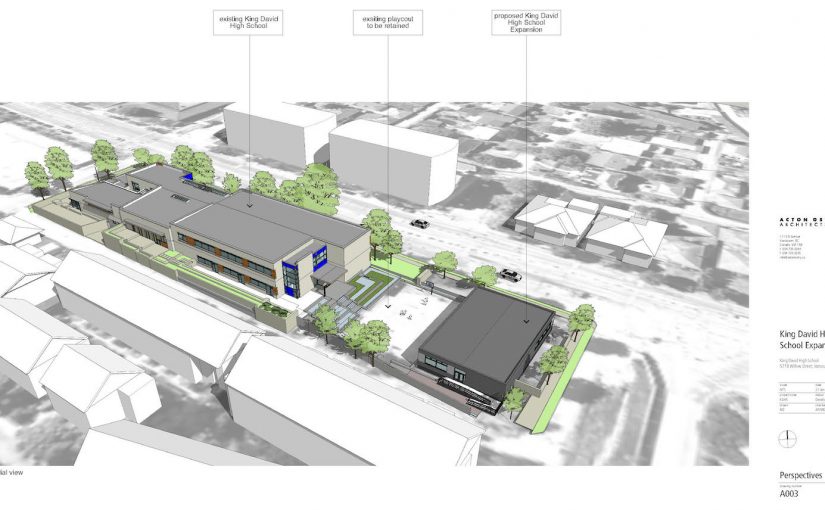
An illustration of the proposed King David High School expansion, as designed by Acton Ostry Architects Inc.
King David High School is slated for a whole new home in the redeveloped Jewish Community Centre of Greater Vancouver campus. However, that move could be eight, 10 or even a dozen years away. In the meantime, the continually growing student body needs more space – and that is why a new component is now being added, with intended completion this coming September.
Russ Klein, King David’s head of school, said the existing building, which opened in 2005, is at near-total capacity.
“Our room utilization rate is 98% for our regular classrooms,” he said. “There is zero wiggle room. Typically, a school’s utilization rate would be around 80%.”
This means that the school cannot increase course offerings, such as new Judaic studies programs or electives. The trend in secondary education is to offer a diversity of options to encourage students to explore their interests and passions. In addition, education is increasingly moving away from large group class lessons toward collaborations between pairs or small groups of students. That demands a greater number of more flexible spaces.
The new structure is a “modular unit addition,” Klein said, rejecting the term “portables.” The difference, he said, is that portables were inflexible, prefabricated buildings, while the new modular options can be adapted to whatever configuration an institution requires.
In King David’s case, it is expected to feature four classrooms, a small teachers’ work room, student changing rooms and a physical education office. In all, it will add about 3,500 square feet of space to the 40,000-square-foot school. The new building will be located at the east end of the property, adjacent the new Oakridge redevelopment, where a grassy hill now exists. Although this will result in a loss of that outdoor area, Klein said the hill is a nice place for kids to hang out in September and for a couple of months in the spring, but, for most of the year, it is not really usable space.
In addition to the changing expectations driven by educational trends, the school has been on a steady trajectory of growth. Enrolment is now at 240, up from 139 students 11 years ago.
The modular nature of the new facility slashes the time from conception to completion. It will take two or three months to prepare the site and another five or six months to construct the building. Acton Ostry, an architecture firm that has done many developments in the Jewish community, including KDHS, is leading the project.
While Klein acknowledges that the new building is a “stopgap” intended to allow the school to function adequately as they await the development of its new home in the JCC complex across the street, he adds that this is no chump-change endeavour.
“It’s an almost $3 million project,” he said. The funding is coming from the Diamond Foundation.
The Diamond Foundation – a family foundation directed by Leslie and Gordon Diamond and daughters Jill Diamond and Lori Glotman – purchased the land where the school is located and spearheaded construction of the building. The school pays rent to the foundation and then the foundation donates that money back to the school each year.
“I always think everybody should just recognize how generous the Diamonds are in everything they’re doing,” said Klein.
Examples of some of the new initiatives the space might accommodate are an expanded robotics program, as well as applied design and coding courses. Rabbi Stephen Berger, King David’s head of Judaic studies, would like to see more text-based education, where students can engage in chavruta-style learning, traditional, intense small group talmudic study, said Klein.
Comparative religions and other courses geared toward social action initiatives that inspire many students are other things Klein can envision growing thanks to the new space.
All of this is taking place as the JCC, in partnership with the Jewish Federation of Greater Vancouver and their constituent partners, proceed full-steam-ahead on the biggest capital project ever undertaken by British Columbia’s Jewish community. The two-phase redevelopment will see a 200,000-square-foot, state-of-the-art, multigenerational community centre constructed where the existing JCC parking lot is located. This will include expanded childcare, seniors’ services, arts and cultural spaces and amenities for all Vancouver residents, as well as becoming the home for more than 15 not-for-profit organizations, including a theatre and more space for the Vancouver Holocaust Education Centre.
Once that is completed, a second phase will commence on the site of the existing JCC building. This will include mixed-use rental housing, with units expected to be offered at or below market value and open to everyone. Beneath these residential floors, at street level, will be a “podium,” where the high school will be located.
Plans foresee a 60,000-square-foot school, which is a 25 to 30% increase over the existing structure – but Klein stresses those numbers don’t tell the entire story.
“The JCC is going to be built with two gymnasiums,” he said. “One of them will be dedicated to King David’s use, so we can use it whenever we want to, and then the JCC will be able to use it when we are not using it.” This is a reversal, of sorts, from the existing situation, where the high school can use the JCC’s gym when it is not otherwise occupied.
“That probably is as exciting to us as the extra learning spaces,” said Klein. “The other lovely thing for us is there going to be a small field, which is [currently] a real problem for King David.”
The field will be constructed behind the building, where the property juts out with an asymmetrical wedge at its southwest corner. The field will not be legal size, and so will not be suitable for competitive games, but will allow the school to hold practices at any time, unlike at present, where they have to rent fields, which are expensive and much in demand.
The redevelopment project has received $25 million commitments from each of the federal and British Columbia governments but a massive fundraising campaign is required to complete the project. When the school will be able to move into its new digs depends on a large number of variables.
“I’d say, best case scenario in my mind – and everyone will give you a different case – I think the best case is eight years,” said Klein. “Probably 10 to 12 is more realistic.”
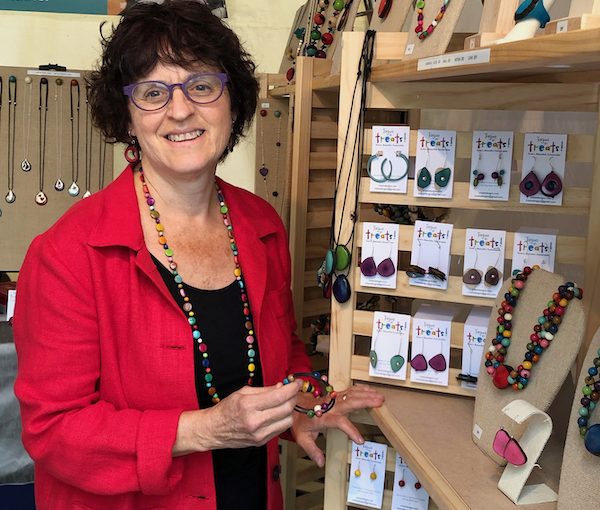
Ande Axelrod has developed a partnership with artisans in the village of Sosote, Ecuador, as her source for tagua beads. (photo from Zack Gallery)
The current show at the Zack Gallery, Affordable, opened on Nov. 17. It delivers on its name’s promise. Every item on display is less than $250 and thus in the realm of affordability for many people, not just art connoisseurs.
“That’s what I wanted for the Zack Gallery from the beginning,” said gallery director Hope Forstenzer. “I wanted to deepen the involvement of the JCC community in the gallery, wanted the art within people’s reach.”
Accordingly, this show looks more like a holiday craft fair than a high art exhibition.
“I don’t believe in the separation of art versus craft,” said Forstenzer. “For me, craft is another word for art, but art that is functional and affordable, designed for enhancing your life and your home rather than a wall of a museum. I hope we can make such a show an annual event.”
To achieve the artisan market feel, Forstenzer invited 10 artists in different media to participate. “They are all local B.C. artists,” she said. “Some Jewish, some not. I wanted to cater to different tastes, to represent different artistic fields. I wanted the show to be fun.”
Ceramics by Hitomi McKenzie.
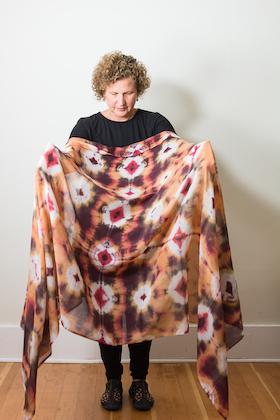
The atmosphere of the show is jazzy and welcoming. The giclée prints of well-known Vancouver artist Linda Frimer glow with greens and blues. The glass and jewelry twinkle. The ceramics by Hitomi McKenzie stand proud and bright. Mariana Frochtengarten’s colourful shawls in Shibori patterns add a touch of elegance.
Frochtengarten teaches textile art at the Jewish Community Centre of Greater Vancouver. “This is a great opportunity for me to show the community my personal work,” she said. “My work is based on the principles of Shibori – a Japanese manual tie-dye technique. I combine the ancient Japanese tradition with a contemporary approach.”
She works with natural fibres, mostly cotton and linen, and has been working as a textile artist for more than 25 years. “My way into textile art was a bit accidental,” she told the Independent. “I was born in Brazil. When I was in high school, I took a batik class for a hobby, but I fell in love with it.”
After graduating from high school, she studied at Fine Arts and Education University in Brazil and later completed her master’s in fine arts (textiles) at Nova Scotia College of Art and Design, in Halifax. “For 17 years, I worked with batik,” she said. “I had a business in Brazil and sold my works in stores, galleries, shows and fairs. I also experimented with some Shibori. I slowly moved on to my own form and interpretation of Japanese Shibori after moving to Canada in 2006. I love the elements of surprise involved in the process of Shibori and I am fascinated by the idea of creating different designs by blocking areas of the fabric before dyeing it.”
Another artist who works with an unusual material and technique is Ande Axelrod. Her company, Treats Designs, produces whimsical and sophisticated tagua jewelry: necklaces, earrings, pendants, and bracelets. Axelrod is very enthusiastic about her artistic creations. “Tagua is known as ‘vegetable ivory,’” she explained. “The tagua palms are native to the rainforests of Ecuador and other South American countries. The nuts grow and harden inside their seedpods. Some tagua nuts can grow up to six centimetres. Once the seedpods are ripe, they’re picked, and the seeds are dried in the sun, peeled and polished.”
The creamy white substance of the nuts is incredibly hard, similar to elephant ivory, hence the name. According to Wikipedia, a mature tagua palm can produce up to 20 pounds of vegetable ivory a year.
“Tagua nuts have been used as a substitute for ivory since the early 20th century,” Axelrod said. “The local masters carve the nuts into a variety of beads and buttons and dye them using bright natural colours.”
Mariana Frochtengarten shows of one of her colourful Shibori shawls.
She is thrilled to use tagua nuts as the base for her jewelry. “I worked as a graphic designer for more than 25 years. In 2011, a friend and I took some jewelry making classes and I explored a variety of media and techniques. The next year, I discovered tagua while traveling in South America. I was dazzled by the colours, and I loved how light and comfortable the pieces were. You could wear a bigger statement necklace or a pair of earrings and not have a sore neck or headache at the end of the day.”
The sustainability and eco-friendliness of tagua sealed the deal for her. “I wanted to save elephants and I was truly inspired by the vast creative potential of this versatile natural material. It also provides an economic incentive for the local communities to protect the rainforests,” she said.
Since then, Axelrod has developed a partnership with artisans in the village of Sosote, Ecuador, as her source for tagua beads. “Before COVID, I’d made annual visits to Ecuador each February. It gave me the opportunity to work with tagua throughout the process, from seed to bead. Of course, like everyone else, I’ve had to improvise these past two years. Zoom, WhatsApp, FedEx and Western Union have enabled me to stay in touch with my South American partners and get tagua here for me to create my jewelry.”
While Shibori scarves and tagua jewelry may more easily be thought of as unique artwork in the Vancouver context than photography perhaps, Michael Shevloff proves that he is an unquestionable master of the camera, producing his own singular creations. His images, both in colour and in black and white, are statements of his love for British Columbia: its forests, its mountains, its waterways, its streets.
“I do predominantly nature photography,” he said. “However, I also shoot street photography, portraits, and many other genres, both digital and film.”
For this show, Shevloff offers framed and matted photos and photo coasters. “In the past, I also produced books of my photos, collages, cushions and more. I even put one of my images on my phone cover. The choices are many, and there are online firms, as well as local places, that specialize in putting images on almost any surface.”
He has been taking photographs since he was a teenager. “That was a long time ago,” he joked. “I have albums filled with photographs from places I have worked and traveled throughout the years.”
For Shevloff, photography has always been a hobby, while he worked in information technology. It remains a hobby in his retirement, although he obviously has more time now to immerse in his artistic endeavours.
“Tropical Vancouver,” by Michael Shevloff.
“I have taken classes with professional photographers to hone my craft. And I belong to two photo clubs in Vancouver,” he said. “Vancouver PhotoClub is a well-organized group with monthly meetings and outings. I enjoy being a part of that club because they have assignments, which gives me a challenge and focus each month. They also organize exhibits, which gives me an opportunity to show my work.”
He belongs to the West End Photographic Society, as well. “That one is dedicated to film work and darkroom processing,” he explained. “They also organize exhibits. I enjoy the challenge of working with film and working with prints.”
The 10 artists of this show incorporate different art forms, different artistic philosophies, different ethnic roots and different price ranges. But one fact unites them all – every piece of art in the gallery for the next month is affordable.
The exhibit continues until Dec. 31.
Olga Livshinis a Vancouver freelance writer. She can be reached at [email protected].
Livona Ellis, left, and Rebecca Margolick, right, perform together Dec. 17 and 18 at Scotiabank Dance Centre. (photo by Faviola Perez)
Next weekend, choreographers and dancers Livona Ellis and Rebecca Margolick will première their first collaboration, a duet called Fortress. The Dec. 17 and 18 performances at the Scotiabank Dance Centre also feature four solo works.
Ellis performs Unmoved, “a response to the idea of overcoming the limitations we place on ourselves,” and Margolick’s solo Bunker draws “on themes of memory and the shared history of previous generations of women.” The other two solo pieces were revived last season specifically for them: Peter Bingham’s Woman Walking (away) (1997), danced by Ellis, and Allen Kaeja’s Trace Elements (2000), performed by Margolick. (See jewishindependent.ca/albert-solos-reimagined.)
Both dancers have had the chance to perform for live audiences recently and both have been touring – New York-based Margolick internationally with her own work and locally based Ellis with Ballet BC, for audiences in Ottawa and Montreal.
“From these past two years of experiencing how quickly it can be taken away and experiencing how deeply I miss it when it’s gone, performing has a renewed sense of urgency and importance for me,” Margolick told the Independent. “I’m so excited to perform for a live audience here in Vancouver, especially because last year, when we were about to do this show for a live audience, on the day of the show, we had to switch to livestream only. A lot of energy has been built in this show over the past three years, and I’m looking forward to being able to share it live.”
While Margolick and Ellis have known each other for a long time, Fortress is their first duet together.
“Livona has always been one of the best dancers and performers I know. We trained at Arts Umbrella together all through high school, but, since then, we hadn’t danced together, until now. So much of collaboration happens outside of the studio and so, in a way, I feel like through our friendship and conversations over the past number of years, the work and ideas were already starting to form and it felt natural to transition to a studio together.
“At the time we decided to work together, I had been creating a solo titled Harbour, which was about my grandmother and my relationship to her both in life and death. One day, Livona and I had a conversation about it and she began talking about her grandmother. I was moved by this, and this conversation naturally spiraled into how we’ve started to see our mothers and grandmothers differently; how we see their influence on us; our desires to become mothers one day, being in our 30s now; how dance has changed for us, etc. The conversation was vibrant and honest and there’s a lot of history and love between us and I just asked if she wanted to create together, and she said yes.”
Ellis added, “One of the silver linings about the pandemic is that we both found ourselves in Vancouver at the same time…. I have always admired Rebecca’s work from afar but we’ve never been in the same place long enough to even begin to think about a collaboration. She was working on Harbour and we started speaking about our family and our grandmothers. This sparked the inspiration for Fortress. We were both doing a lot of reflecting during our various lockdowns and quarantines and found we were thinking a lot about who we are as artists and as women. How does our matriarchal lineage affect who we are today?
“We both feel like we are in a moment of change or transformation,” Ellis continued. “We can feel our experience settling in and grounding us in a way that allows us to move forward into the next chapter of our careers. This felt like the perfect jumping off point to create a duet.”
The pair started creating that work this past August 2021, with a residency hosted by the B.C. Movement Arts Society, rehearsing at the Athletic Hall in Sointula. “We are now working with composer Ivan Shopov from Bulgaria to develop the music, and Mimi Abrahams to develop the lighting,” said Margolick.
For Margolick, while both Bunker and Trace Elements haven’t seen any changes choreographically, “as time goes on, and as I evolve, they naturally do as well.”
“Especially for Trace Elements,” she explained, “it’s been a journey since I began working on it with Allen Kaeja. I started to learn more about Jewish history and specifically Jewish leftist and Jewish resistance history, both in the U.S. and Europe. Specifically, in Trace Elements, there is a spirit of resistance and remembrance in the work, countering the text we hear out loud, text of German propaganda and generational indifference to the history of the Holocaust. In that, I think about resistance fighters, countering the narrative that Jews went quietly towards death – they didn’t. That is a history we’re not often told of, and it’s been a part of my Jewish education to learn that history. The work is really spiritual for me and every time I perform it, I feel the spirit of those who fought and those who keep fighting and inspire me to as well.
“More recently,” she said, “I’ve been learning about Jewish women activists and fighters, especially women like Hannah Senesh, Faye Schulman, Bella Abzug, Emma Goldman, Anna Sokolow and others. I can’t really explain into words how this knowledge affects my performance, but I feel it, and it gives me a sense of grounding and inspiration.”
Margolick highlighted the Jewish Women’s Archive and Judy Batalion’s book The Light of Days: The Untold Story of Women Resistance Fighters in Hitler’s Ghettos as resources.
Bunker is also steeped in research. While she premièred the full-length version of the piece (titled Bunker + Vault, which runs 35 minutes) a few weeks ago in San José, Costa Rica, the December performances will include only the first 10 minutes of the work.
“A part of my research for this piece included looking through the archives of the Clara de Hirsch Home for Working Girls at the 92nd Street Y from the late-1800s to mid-1900s,” said Margolick. “The Clara de Hirsch Home was a place where young, poor, mostly Jewish immigrant women were housed and supported with educational resources as they found jobs and worked towards being able to support themselves. These archives were records kept by the staff, with observations and notes about the women who resided there. These observations gave me a window into the lives of the women who lived there, ranging from extreme hardship, repression, mental health issues, Jewish culture, camaraderie, acts of extreme kindness and on and on. Some of these women informed the movements, and spirit of resilience and care in the work.”
Fortress + Four Solos is presented by the Dance Centre and B.C. Movement Arts Dec. 17, 8 p.m., and Dec. 18, 1 p.m. and 8 p.m. For tickets, visit thedancecentre.ca.
Left to right, the Hot Mammas are Mary Ella Young, Julie Brown, Georgina Arntzen. (photo by Dee Lippingwell)
The Hot Mammas are busy this holiday season – and year round. With three albums to their credit, they perform at venues ranging from jazz clubs to shopping malls. Readers can next see them at Robson Square Skating Rink on Dec. 15, and then at Water Street Café Dec. 18.
One of the holiday songs the group performs is “Mamma Julie’s Hanukkah Song,” so dubbed by Georgina Arntzen and Mary Ella Young because the third member of the Hot Mammas, Julie Brown, wrote it, and “too many songs are called ‘The Hanukkah Song’ or ‘Festival of Lights.’” (A video of it can be found via facebook.com/thehotmammas.)
Brown’s Jewish heritage is Ashkenazi. “My maternal grandfather, who I’m named after (Julius Cohen), was a rabbi,” she told the Independent. “My father always followed our traditions. My mother was a phenomenal cook and it’s because of her I’m able to make latkes, matzo balls, knishes, chicken soup, etc. When she didn’t want me to understand something she and her sisters were talking about over the phone, she’d suddenly switch from English to Yiddish. That’s where and how I picked up some fun expressions, which I use to this day.”
Born and raised in Montreal, Brown said she has been performing music since she could walk.
“My older, late, great brother Martin Overland was the founding member of the Canadian folk group the Raftsmen,” she said. “Your readers may recall the song ‘Something to Sing About,’ which was one of their hits. Martin had perfect pitch and the voice of an angel. He was also a terrific guitarist and accordionist. Eleven years my senior, we would sing together in harmony when I was a very young child. I still recall performing ‘Buttons and Bows’ in front of a roomful of relatives and friends.
“When the opportunity arose as a 10-year-old to actually sing on camera, I jumped at the chance. The Montreal kids show was called Small Fry Frolics and there I was with my cousin Shirley singing the Everly Brothers’ ‘Bye Bye Love’! At 15, I joined a rock band, while singing lead as Carmen in high school.
“The singing/performing didn’t stop at teacher’s college either,” she added. “McGill’s Macdonald College offered a two-year teaching diploma program at the time and, much to my delight, also had yearly talent shows.”
During her teaching days, Brown brought her ukulele to class. “The kids were as crazy about the Beatles as I was and we sang our buttinsky’s off to start the day,” she said.
While at university, Brown performed in stage plays and film. She recalled working on a movie directed by John Huston, which featured Sophia Loren – “and I was fortunate enough to garner a wee speaking role when Ms. Loren walked over to a table of background performers of which I was one, and asked me a question. I wasn’t supposed to answer her as a silent on-camera person but spontaneously blurted out a comment because I didn’t want to be rude. (Out of my peripheral vision, I noticed John Huston smacking his forehead.) And that was how I got my first ACTRA permit! Even after moving out to Vancouver and doing radio full time, I still continued to audition for film, TV and did a lot of voice work. In fact, I was the Telus voice for nearly 15 years – ‘We’re sorry, the number you have dialed is not in order. Please hang up and try your call again. Thank you, from Telus.’ That was me and one of 40 or so prompts I did for them.”
Brown left Montreal after the Front de libération du Québec “raised its ugly head in Quebec” and the Parti Québécois was in power.
“My child came home in tears from school with a notice that all English-speaking children had to be educated in French the following year,” she explained. “French didn’t come easy to my son but it was more than that. We lived in Canada, or so I thought. Stop signs had Nazi slogans scrawled across them. Shop windows in the English and Jewish communities were smashed and vandalized. An elderly Jewish woman who couldn’t speak French and wanted to order flowers for a friend was disgustingly treated over the phone because she was trying to place her order in English. The clerk hung up on her.
“As a teaching friend once said to me, if you say, ‘ich bin a Yid,’ you get it from both sides. I still don’t think the rest of Canada realized just how dangerous and revolting that regime was. Well, I did…. We came out to Vancouver for a visit and, with tears in his eyes, my son asked if we could move. And we did just that in 1978.”
Within a week, Brown got a job as a news broadcaster at CFMI, the sister station to CKNW.
“Not long after that, the program director allowed me to develop an interview show as well. I had been doing interviews at the Montreal radio station, along with news, so this was a huge relief to me. I love people and am a naturally curious person, so interviewing was, and still is, a good fit. My radio career blossomed here in Vancouver. Eventually, I co-wrote, co-produced and co-hosted Vancouver at Noon on KISS-FM for 11 years.”
In her more than two decades as a broadcaster, Brown interviewed hundreds of people, including Bob Hope, Paul Newman, Shirley MacLaine, Johnny Depp, Leonard Cohen, Eartha Kitt, Sarah McLachlan, Neil Diamond, Buffy Sainte-Marie, François Truffaut, Jackie Collins, Jim Byrnes, Rick Hansen and Dee Lippingwell.
For Brown, singing in choirs has always fed her soul, and it was in one of those choirs she met Arntzen and in another that they met Young. The Hot Mammas have been together now for 11 years.
“They are both family to me – my sisters,” said Brown. “All three of us love performing because we give to our audiences and they give back. Something magical and marvelous happens, no matter where we are or how many or how few people are in that audience. Synergy. Energy. Love. Music heals. It is the ‘universal language.’
“We sing songs we love. That’s how we choose our repertoire. Jazz, pop, rock ’n’ roll, folk, show tunes, you name it. We don’t just cover groups. We also write originals. In fact, one of our tunes is called ‘The Hot Mammas’ Song,’ and it’s quite amusing – all about being mothers who love their kids but have ‘traded in their aprons for a microphone.’”
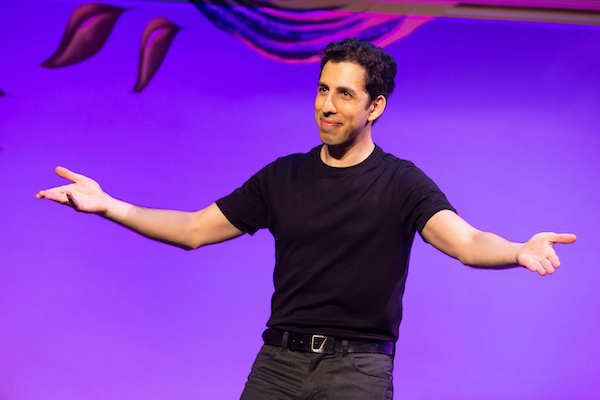
Vitaly Beckman will bring some of his best illusions yet to his Dec. 22 performance. (photo from eveningofwonders.com)
“I have been working very hard on some new illusions that I consider to be some of my best work yet,” Vitaly Beckman told the Independent. “I created a lot of my illusions during
no-show periods, a few of which I plan to include in the upcoming show.”
Vitaly: An Evening of Wonders returns to the stage on Dec. 22 at the Anvil Centre in New Westminster. While it is Beckman’s first live in-person performance in Canada since the pandemic started, he already has performed in theatres in the United States.
“It is certainly exciting to start doing live shows again – both performers and audiences could feel the void of live theatre during the past two years,” he said. “Life is really not the same without theatre.”
But there have been some benefits from the enforced hiatus.
“It is really helpful for the creative process to be able to focus on just one goal, and not be distracted by anything else for a period of time,” acknowledged Beckman. “So the lockdowns were helpful in that regard, as I managed to finish some really great illusions – one involves a sculpted bust, another involves an oil painting that comes to life and another, a matchbox. The latter I created while visiting my family in Israel. Actually, I’ve created a lot of my illusions in the past while vacationing there – it seems that the sunny place boosts my creativity.”
In addition to creating new material, Beckman has been busy in other ways, as well.
“It was certainly a long period to go without doing a single live show,” he said, “but I did a lot of magic for virtual performances and recorded an illusion for Penn & Teller’s Fool Us show, with a second appearance there.” (In that appearance, Beckman once again managed to fool the master illusionists.)
About returning to the stage, he said, “I was wondering if I would be ‘out of shape’ when performing again, however, from recent shows in the U.S., it was like riding a bike. I really enjoyed going back on stage and especially seeing how the audience left the theatre feeling uplifted and full of joy.”
For tickets to see Beckman on Dec. 22, at 7:30 p.m., click here.