Skip to content
  • Home
  • Subscribe / donate
  • Events calendar
  • Business Directory
  • FAQ
  • News
    • Local
    • National
    • Israel
    • World
    • עניין בחדשות
      A roundup of news in Canada and further afield, in Hebrew.
  • Opinion
    • From the JI
    • Op-Ed
  • Arts & Culture
    • Performing Arts
    • Music
    • Books
    • Visual Arts
    • TV & Film
  • Life
    • Celebrating the Holidays
    • Travel
    • The Daily Snooze
      Cartoons by Jacob Samuel
    • Mystery Photo
      Help the JI and JMABC fill in the gaps in our archives.
  • Community Links
    • Organizations, Etc.
    • Other News Sources & Blogs
  • JI Chai Celebration
  • JI@88! video

Recent Posts

  • SFU honours Gloria Gutman
  • Lifting people’s spirits
  • Wedding a ray of light
  • Indigeneity and Zionism
  • Rule of law broken: councilor
  • Football and its roles
  • The burden of defence
  • Fish Café returns after fire
  • All right in what goes wrong
  • Nuns & mermaids at TUTS
  • Camp offers holiday retreat
  • Students and mentors inspire
  • Once-in-a-lifetime trip
  • 100 dancers, one heart
  • Money for the sciences
  • What “Jewish food” means
  • Have a cookie, schnitzel too
  • Federation now across BC
  • Israel fighting for its existence
  • Deal strengthens Iran
  • Patriotic belonging diminishes
  • A campaign to engage
  • Upstanders’ first live event
  • Responding to Carney
  • Having your own home
  • Music a family tradition
  • Musical to warm heart
  • Community milestones … June 2026
  • Sharing her passion for Israel
  • Or Shalom reopens its doors
  • JFS from past to future
  • Need holistic approach
  • Sharing stories, advice
  • Journalist shares fears
  • Skills to live together
  • Road to independence

Archives

Follow @JewishIndie
image - CJN box ad Rockowers 2026

Tag: women

CHW empowers victims

COVID-19 isn’t the only global pandemic to worry about; the worldwide increase in domestic violence has been coined a “shadow pandemic” by the United Nations. Globally, an estimated one in three women lives with violence and fear. But the number of domestic violence complaints in Israel, for example, has increased by 800% since the beginning of COVID. True to its mission, Canadian Hadassah-WIZO (CHW) is leading the way to empower women by stepping up emergency support and services at this critical time.

CHW strongly believes that every human being deserves the right to achieve their full potential, while living in safety and security. CHW appointed its first chief executive officer, Lisa Colt-Kotler, who is spearheading a transition and new direction for the 100-year-old organization, with a history of support for women and children in Israel and Canada. This summer, CHW is launching a quadruple matching 24-hour crowdfunding campaign and proceeds will help empower victims of domestic violence.

image - S.O.S. – Starting Over Safely logoCHW’s summer campaign, S.O.S. – Starting Over Safely, has three priorities for projects in Israel: CHW Youth Villages, which provide a safe haven for at-risk adolescents and supports mental health through a variety of outlets; Essential Kits for Families, which provides the basic necessities needed to help each family start over safely after they leave an emergency shelter; and the Safety Net Program, which will empower women and their children by providing housing, financial help, social and personal support, employment support, and a network of other women in similar circumstances. Safety Net has nearly a 100% success rate of breaking the cycle of violence and preventing victims from re-entering a domestic abuse relationship.

Aug. 24-25, funds donated will be matched three more times by a loyal community of donors recognized as “Matching Heroes.” During the 24-hour campaign, which kicks off at noon in each centre across Canada, each gift donated on the website chwsos.ca will be quadrupled.

And, on Aug. 24, at 5 p.m. PST, CHW is hosting a free, star-studded, 90-minute virtual telethon experience during which viewers will learn more about how to help empower victims of domestic violence. To watch, just click on the link from the campaign website.

For more details, contact Irena Karshenbaum, CHW development officer for Western Canada, at [email protected] or 403-253-4612.

– Courtesy CHW

Posted on July 23, 2021July 21, 2021Author CHWCategories NationalTags CHW, domestic violence, fundraising, philanthropy, tikkun olam, women
Honouring women’s courage

Honouring women’s courage

Anne Petrie (photo from Maurice Yacowar)

The University of Calgary has organized a virtual exhibition to honour the efforts of Jewish women in the Canadian Armed Forces during the Second World War. Called She Also Served, it comprises a series of nine banners by various artists.

Originally scheduled to be displayed at the Military Museums in Calgary during Jewish Heritage Month in May, it has been made available online throughout 2021 and will be physically hung in May 2022. Of the 17,000 Jews who served in the Canadian armed services, more than 275 were women.

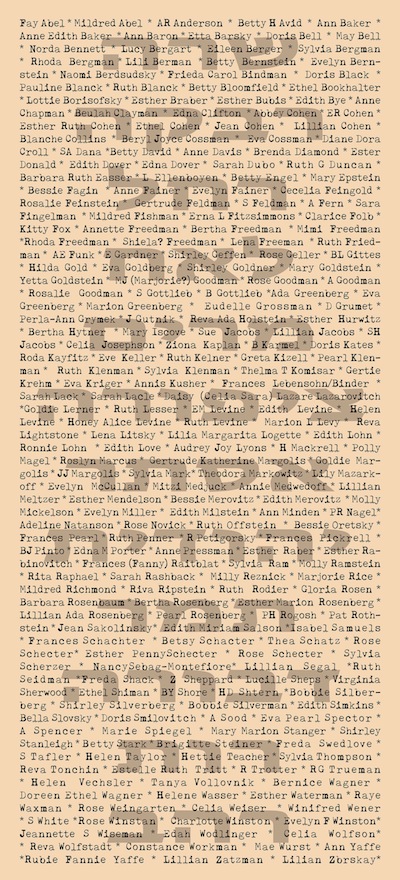
Among those selected to display their work is Anne Petrie of Victoria. For her banner, a digital print called “In the Tradition of Service,” Petrie chose to list all the known names of the Jewish Canadian servicewomen. She used a font that is reminiscent of the typewriters of the 1940s. Another layer of the banner has the names of 12 biblical heroines, confirming the tradition of Jewish women’s courage and dedication to serving their communities.

“I was immediately struck by knowing that, although they would not have had to hide their Jewish identity, it was still in those days not something that you would be comfortable being completely open about,” Petrie told the Independent. “Even if it was, at best, very casual antisemitism, it was a reality when they would have signed up. So, there you are fighting (even if it’s only at a desk) for something – a religion, a people, a culture – that you can’t really be openly passionate about.”

image - Anne Petrie’s “In the Tradition of Service,” 2021. Part of the She Also Served exhibit, now online
Anne Petrie’s “In the Tradition of Service,” 2021. Part of the She Also Served exhibit, now online.

For Petrie, She Also Served is an opportunity to reveal and contextualize the “Jewishness” of that other “them, the unsung and – worse – unidentified Jewish-Canadian women soldiers.” She said she is honouring them by naming them in “their doubly suppressed identities, as women and Jews.”

Petrie’s intention was to present the full names and rank (where available) of all the Jewish women known to have served. The collection of names fills the background layer of the 75-by-165-centimetre banner. Each name is in the colour of their respective services: olive green for army, dark navy for the navy and a lighter “air force blue” for the Women’s Army Corps. Emerging from the background in a larger, translucent Hebrew script, and in a camouflage pattern, are the names of Judaism’s biblical heroines, “themselves often subordinated by patriarchal tradition to the male heroes,” said Petrie.

“In making the banner itself, I was struck by how powerful it was to actually write out all the 279 names of the Jewish servicewomen that have so far been identified. I knew none of them personally, of course, but I felt that typing each name was a kind of acknowledgement and, strange as it sounds, I did feel a kind spirit or presence as I typed each of the names. I only wish we did know more about them, but I understand that research is continuing and, hopefully, there will eventually be stories attached to each of these women’s names,” she said.

Petrie thanked Janice Shulman and Rabbi Lynn Greenhough for their assistance with the project.

Prior to beginning her work as an artist, Petrie’s career spanned more than 30 years in radio and television, where she worked as a researcher, producer, documentary-maker, columnist and commentator in news and current affairs. She is also the author of several non-fiction books: Ethnic Vancouver, Vancouver Secrets and Gone to an Aunt’s: Remembering Canada’s Homes for Unwed Mothers.

After retiring from the CBC, she returned to school and obtained a bachelor of fine arts from the Alberta College of Art and Design in 2008. Since then, she has had a number of exhibitions. Her next exhibit, said/unsaid, is a two-person show with Jane Coomb – it opens at the errant artSpace gallery in Victoria (975 Alston St.) on July 9.

The other artists whose work is featured in She Also Served are Razieh Alba, Sophia Borowska, Alysa-Beth Engel, Lily Rosenberg, Talie Shalmon, Jules Schacter, Bev Tosh and Susan Turner. The representations exploring the servicewomen’s experiences range from naturalistic to abstract. Some works use archival photographs, while others use media include oil painting and paper-cutting.

The stories of 41 Jewish servicewomen are also featured on the website. These accounts were an impetus for the call for submissions for the exhibition, which was curated by the University of Calgary’s Prof. Jennifer Eiserman and librarian emerita Saundra Lipton. They ask for help in “completing the story” from anyone who has more information about the featured servicewomen and any of those identified in the list of names collected.

To view the exhibition, visit live-ucalgary.ucalgary.ca/she-also-serves/exhibition.

Sam Margolis has written for the Globe and Mail, the National Post, UPI and MSNBC.

Format ImagePosted on June 25, 2021June 24, 2021Author Sam MargolisCategories National, Visual ArtsTags Anne Petrie, art, Canada, memorial, Military Museums, Second World War, She Also Served, University of Calgary, women
CHW’s Brunch with Bakan

CHW’s Brunch with Bakan

Joel Bakan spoke at a CHW Vancouver Book Club event May 30. (photo from thecorporation.com)

The Canadian Hadassah-WIZO (CHW) Vancouver Book Club hosted a far-reaching 90-minute discussion with author, filmmaker, musician and University of British Columbia law professor Joel Bakan on May 30. Moderating the event, entitled Brunch with Bakan, was Toronto-based writer (and former Vancouverite) Adam Elliot Segal.

Bakan’s widely acclaimed 2004 book The Corporation: The Pathological Pursuit of Profit and Power explored the formation and behaviours of modern-day industrial behemoths. It was later turned into an award-winning film. His new book, The New Corporation: How “Good” Corporations are Bad for Democracy, released in 2020, also has a film attached to it – The New Corporation: The Unfortunately Necessary Sequel, which Bakan co-directed with Jennifer Abbott.

In the CHW event, Bakan shared tidbits about his upbringing, first in East Lansing, Mich., then moving to Vancouver at age 11. “I was a very young draft dodger,” he recalled, as his parents decided to move north at the height of the Vietnam War.

“Family and Judaism have been two of the pillars of my life,” he said, recounting how much of his current activism could be traced to his immigrant grandparents.

“Jewish people, by virtue of their history, understand persecution, they understand injustice. They haven’t had a choice but to understand injustice. Injustice has always been in their face. It’s no coincidence that Jewish people were leaders in the civil rights, labour and other movements,” said Bakan.

“Jewish people have always had an activist sensibility and I think it’s rooted, not only in that history, but in the ethics of the religion – chief among them is tikkun olam, that we have a duty to repair the world, which is very much a duty I take seriously,” he added.

In his recent book, which moderator Segal called a “tour de force” and “meticulously researched,” Bakan tackles such subjects as deregulation, the aviation industry and what he describes as the destructive dependence on technology. In it, he interviews not only influential legal and economic scholars but also references pop culture to explain more difficult concepts.

“I wanted the book to be readable,” he said. “I am an academic by trade, but I am a writer. I want the reader to feel pulled into a story. In all my writing for a popular audience, I try to get away from the academic notion of laying out the facts and instead lull the reader in by telling some good stories. And, once I have the reader, I try to engage them with some more analytical or informational kinds of things.”

Segal asked about Bakan’s Trump-era trip to the World Economic Forum in Davos, Switzerland, for the recent Corporation documentary project. It turned out to be a coup of sorts for a film crew to be allowed access to the normally secretive meetings of the world’s political and corporate elites in the Swiss Alps.

In this work, Bakan discusses the concept of corporate social responsibility, which, he contends, cannot do nearly enough to combat rising global social and environmental threats. He distinguishes between individuals at the top of corporations and the corporations themselves.

An example of this approach is Lord John Browne, the former chief executive officer of British Petroleum, whom Bakan portrays as a very cultured man and one of the “good guys,” who tried to get his firm to be at the forefront of corporate responsibility. However, the problem is that even the most benign, well-intentioned CEOs are hamstrung by their fiduciary and legal responsibilities to their shareholders, according to Bakan.

“A CEO can go a certain distance in trying to do a better job in terms of social or environmental responsibility, but you can’t go further in that direction in terms of what will be profitable,” said Bakan. “It’s great if corporations try to be a little better, but let us not be deluded into believing that they can go far enough to get us out of the mess we are in, be it the social mess or the environmental mess.”

The conversation turned to sports and the recent failed attempt by Europe’s top soccer clubs to form the Super League. The common thread with other societal issue is the goal of corporations or capitalism to commoditize everything, whether it be water, utilities, education or entertainment. In the case of the Super League, the vested corporate interests behind the initiative were trying to increase profits by “taking the local out of sports.”

“If you put the Toronto Maple Leafs in Dubai, they would make more money,” said Bakan. “The Super League stopped because the people and governments rose up.”

The discussion ended on an uplifting note for the future. Bakan advocated extolling the virtues that our societies value, such as democracy, freedom and equality, to create a world “in which people can flourish, where they can thrive, where they can be free, not just of government restrictions but ill health, hunger and poverty, where they can live lives of meaning and purpose in which their material needs are met.”

The past 40 years have seen corporations as drivers of policy rather than as tools, argues Bakan. “We need to understand that our democracy is what matters and its capacity to serve human flourishing and planetary survival. When we think about our policies, they need to be aimed at how we can use markets and corporations towards those ends – not how they can use us to serve markets and corporations.”

The film version of The New Corporation is available on several streaming services in Canada. As well, the CHW talk is available for anyone who donates $18 to CHW, for which a full tax receipt also will be provided. Visit chw.ca/thenewcorporation to register, or call the CHW Vancouver office at 604-257-5160. CHW supports programs and services for children and women, in healthcare and education, in Israel and Canada.

Sam Margolis has written for the Globe and Mail, the National Post, UPI and MSNBC.

Format ImagePosted on June 11, 2021June 10, 2021Author Sam MargolisCategories LocalTags business, Canada, Canadian Hadassah-WIZO, children, CHW, CHW Vancouver, corporations, democracy, healthcare, Israel, Joel Bakan, politics, women

Increased level of risk

Sheba Medical Centre recently published a study undertaken over three years by its department of obstetrics and gynecology in conjunction with Sheba Genetic Institute and the Genetics Institute in the Tel Aviv Sourasky Medical Centre, which found that women of Ashkenazi descent were twice as likely to have a baby born with Fragile X syndrome (FXS) compared to Jewish non-Ashkenazi women.

Nearly 600 female carriers of the FXS gene from various Jewish heritages participated in the study, which was published in the peer-reviewed publication Nature. Previously, it was known that only CGG repeats and AGG interruptions affect the risk for a child with FXS. This new research adds a third identifier, children of two Ashkenazi parents, allowing for better personalized genetic counselling for carriers who are trying to conceive.

FXS is the most common genetic cause of mental disability in an unborn child and causes intellectual disability, behavioural and learning challenges, and various physical characteristics. The prevalence of carriers in the Jewish population stands at about one in 150 women.

Dr. Noam Domniz of the IVF unit at Sheba Medical Centre said: “The new information from this study regarding the influence of ethnicity stresses the importance of providing more accurate and personally targeted genetic counseling to each woman, according to her personal level of risk. At Sheba, we aim to use this new approach to better evaluate each carrier’s risk level, empower them to make informed choices, leading to a clearer and safer road to motherhood.”

Posted on May 28, 2021May 27, 2021Author Sheba Medical CentreCategories IsraelTags Ashkenazi, Fragile X syndrome, FXS, genetics, Noam Domniz, science, Sheba Medical Centre, Sourasky Medical Centre, women

Tragedy and cruelty

Reports from eyewitnesses to the catastrophe at Mount Meron last week, on Lag b’Omer, recount a horrifying crush of humanity propelled as if by an external force. The tragedy of 45 lives lost and scores of seriously injured will be investigated by authorities after allegations that the potential for such a disaster had been foretold.

The investigation into Israel’s worst civilian disaster will likely look at structural factors that led to the stampede and the inability of attendees to escape as the throng converged into a choke point at the site.

A small silver lining in the horrific incident was the mobilization of Arab Israelis in villages near the mountain, who set up help stations to provide water and food to attendees as they gathered in the aftermath.

But the tragedy itself was exacerbated when some among the survivors turned on female Israel Defence Forces soldiers arriving to help. The event was attended almost exclusively by religious men and boys. When female soldiers arrived to deliver first aid and evacuation assistance, some were spit on, kicked and punched as they attempted to help the wounded and remove the bodies of the deceased.

Such misogynistic extremism will probably not be within the parameters of a government inquiry. And perhaps that is fine, because this is a symptom of a much larger societal problem and one that should be confronted thoroughly by the entire country. Interfering in the life-saving work of first responders is not only reprehensible, it is an abrogation of a foremost tenet of Judaism, pikuach nefesh, the saving of life. Most of the victims and survivors are shomer negiah, adhering to a religious principle that restricts or forbids contact between members of the opposite sex. In a deeply distorted interpretation, a number of men in the situation chose to elevate shomer negiah above pikuach nefesh. By spitting on rescue workers, the perpetrators were spitting on the very sacredness they imagined themselves to be defending. That is something that deserves serious consideration by religious people and by secular authorities as the country – and Jews worldwide – grapple with the aftermath of the entire incident.

Another tragic byproduct of the disaster has been reactions to the news among people who gravely lack humanity. Within hours of being posted, a story on Al Jazeera’s website about the tragedy was met with more than 10,000 comments celebrating the deaths. Among the representative comments: “Drinks on me, y’all,” “about time we got some good news on our media,” “I feel so happy, actually” and “May God ensure the bodies pile high.”

It is difficult to fathom that we live in a world where people would respond to a mass casualty event in this manner. It is also nearly impossible to imagine such a response if the tragedy had happened to anyone other than Jews.

For years, a robust discussion has occurred around whether, if or when anti-Zionism crosses a line into antisemitism. Did the callous, sadistic comments reflect a political statement about the right of Israel to exist? Were they even more base, a celebration of dead Jews just because they were Jews? Was it anti-Zionism that drove these depraved commenters, or was it antisemitism?

These questions throw a spotlight on the fundamental foolishness of the dichotomy. A semantic discussion about the motivations of people who would behave in this way gives far too much credence to their actions, as if there could, in some convoluted moral universe, be a justification for their cruelty.

Was it anti-Zionism? Was it antisemitism? At this point, does it really matter what we call it?

Posted on May 7, 2021May 6, 2021Author The Editorial BoardCategories From the JITags anti-Zionism, antisemitism, Israel, Judaism, Lag b'Omer, Mount Meron, pikuach nefesh, shomer negiah, women
The women of Israel

The women of Israel

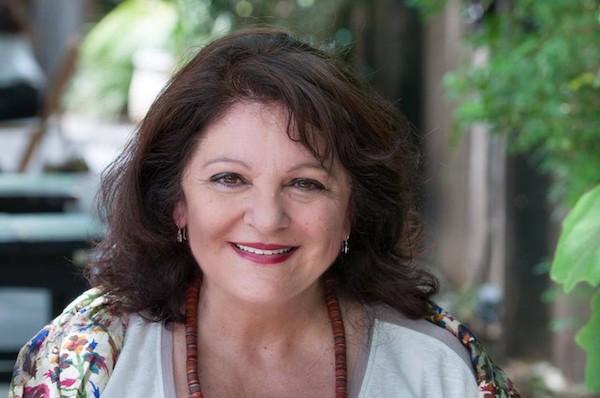
Curator and art historian Yael Nitzan, founder of Israeli Women Museum. (photo by Adi Eder)

How many “she-roes” of Israel can you name? Maybe you’d with Golda Meir, Israel’s first and only female prime minister. Or the tragic and courageous spy Sarah Aaronsohn and paratrooper Hannah Senesh. The list would include physician Vera Weizmann, the first first lady of Israel, who helped establish Chaim Sheba Medical Centre, now the largest hospital in the Middle East; and second first lady Rachel Yanait Ben-Zvi, who taught Jerusalem women how to grow vegetables, milk cows and make cheese so their husbands could go out and build the state.

These and many other women who played – and continue to play  – important roles in the history and culture of Israel will be immortalized later this year when the Israeli Women Museum opens in Haifa. The museum will showcase at least 100 noteworthy but not necessarily well-known women, from architects to lawyers to choreographers, says founder Yael Nitzan.

A curator, art historian and TV producer, Nitzan has overcome many roadblocks and setbacks in realizing her dream of opening Israel’s first museum dedicated to women.

“It was a struggle,” she admitted. “Now, with corona, the world has everyone sitting and listening, and, in three months, I accomplished what I could not accomplish in the past six or seven years.”

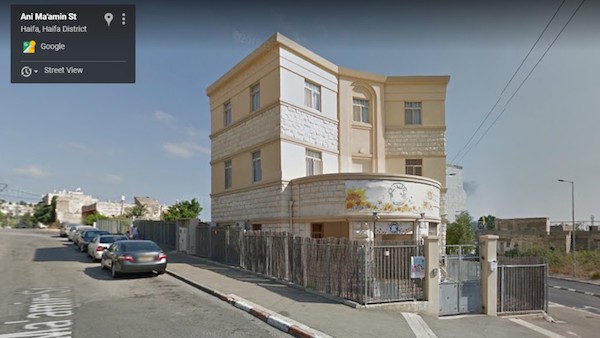
Nitzan gained the help of the Haifa Foundation in raising funds for the project, and she was given the rights to a former private school building in which the collections will be housed.

screenshot - The Haifa building that will house the Israel Women Museum
The Haifa building that will house the Israel Women Museum. (screenshot)

Brig. Gen. Gila Kalifi-Amir, former women’s affairs advisor to the Israel Defence Forces chief of staff, agreed to chair the museum. The board was joined by fellow Haifa residents Nadim Sheiban, director of the Museum of Islamic Art; and Prof. Aliza Shenhar, formerly a deputy mayor, ambassador to Russia and first female rector of an Israeli university.

“I found the right people,” Nitzan told Israel21c.

“There are currently about 45 women’s museums in the world, the most famous of which are the Women’s Rights [National Historic) Park in Seneca Falls, N.Y., and the Women’s Art Museum in Washington,” she said.

“The fundamental challenge in establishing a museum is not only in raising resources, but in creating a diverse and significant human and ideological infrastructure. The Israeli Women Museum must be a magnet of significance to the whole, or at least to large sections of, the population in Israel.”

Though Israel reportedly has the world’s highest ratio of museums per person, this will be the first one dedicated to the mostly unsung females responsible for weaving together its social, agricultural and business fabric. “Our museum will be on women in history and women in the arts,” Nitzan explained.

“The section on history commemorates the role of important women who have not been properly acknowledged.” Women like Hannah Maisel, who immigrated to Palestine in 1909 with a doctorate in agriculture and founded the region’s first agricultural training institute for women. And women like Rachel Roos Hertz (Harel), a Dutch resistance fighter who moved to Israel in 1950 after winning the U.S. Medal of Freedom and the U.K. King’s Medal for Courage in the Cause of Freedom, and became active in the Women’s International Zionist Organization (WIZO) – itself founded by Rebecca Sieff (Ziv) from the Marks family of Marks & Spencer, and whose name graces Ziv Medical Centre in Safed.

Some of the inspiration for this section comes from Prof. Margalit Shilo’s Women Building a Nation, a book published this year in Israel.

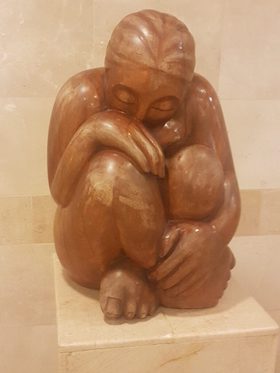
photo - Sculpture by 90-year-old Kati Paldi
Sculpture by 90-year-old Kati Paldi. (photo by Yael Nitzan)

“In the art section, we will spotlight women whose work was not considered important, as well as very important female artists of today whose work is rarely shown in museums,” said Nitzan.

Artists to be included run the gamut from Ziona (Siona) Tagger, one of the most important female Israeli artists of the early 20th century, to contemporary painter Haya Graetz Ran.

“Women in Israel contributed greatly to the establishment of the state, contributed to the construction of the infrastructure of settlement, education, defence, law, government, society, culture, cinema and theatre,” Nitzan said. “But, although they left their mark, they did not receive proper recognition and respect in building society.  The purpose of the museum is to raise their profile and to reshape the narrative of the critical role of women as full partners in leadership and public space design over the past century.”

Nitzan invites anyone to contribute stories or items relating to Israeli Jewish, Arab, Druze or Christian women, and even artists, poets and leaders from the Holocaust era who did not manage to get to Israel. She can be reached through the museum’s Facebook page. Donations for the project are being funneled through the Haifa Foundation.

Israel21c is a nonprofit educational foundation with a mission to focus media and public attention on the 21st-century Israel that exists beyond the conflict. For more, or to donate, visit israel21c.org.

Format ImagePosted on May 7, 2021May 7, 2021Author Abigail Klein Leichman ISRAEL21CCategories IsraelTags art, history, politics, She-roes, women, Yael Nitzan
Celebrating good deeds – JMABC @ 50

Celebrating good deeds – JMABC @ 50

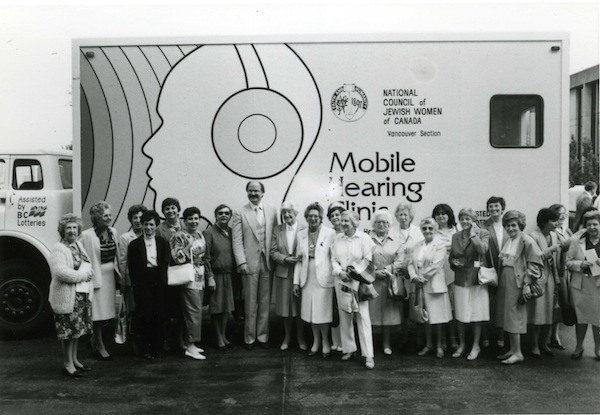
Then-Vancouver mayor Mike Harcourt and members of National Council of Jewish Women in front of the first Mobile Hearing Clinic, outside Vancouver City Hall on June 11, 1984. After raising the funds to build and operate the clinic on a trial basis, NCJW sold it to the provincial health department for the nominal price of $1. They did the same with a second mobile clinic in 1986. (photo from JMABC L.16459)

Passover is one of the foundational stories of Jewish tradition. Around the seder table each year, we learn from our elders the guiding principles of Jewish life: how to be a good person, think of others and pursue justice in the face of persecution.

These same themes can be found in the history of our community locally. The families who laid the foundations of our community, and those who continue to build its future, arrived here from all corners of the world. Mutual aid societies like the Hebrew Free Loan Association (HFLA) and the Jewish Federation of Greater Vancouver (preceded by the Jewish Community Chest and the Jewish Fund and Council) have helped welcome and support new arrivals.

The HFLA was established in 1915 by Solomon Weaver and, while it folded in 1936, it was revived in 1979 by the Jewish Family Service Agency under the leadership of Shirley Barnett. Going at first by the name of the Hebrew Assistance Association, the organization was established to aid a new wave of Jewish immigrants arriving from Russia. With initial capital provided by Joe Segal, Jack Diamond, Morris Wosk and Leon Kahn, the association began issuing loans of up to $3,000. To date, the HFLA has granted more than 2,000 loans, giving people “a hand up, not a hand-out.”

Passover also teaches us that we should apply these principles beyond our own community. As it is written in Exodus: “You shall not oppress a stranger, for you know the feelings of a stranger, having yourselves been strangers in the land of Egypt.” This philosophy can be seen as a guiding principle for community groups such as the Vancouver Holocaust Education Centre and National Council of Jewish Women (NCJW).

Founded in 1983 by local survivors of the Holocaust, the Vancouver Holocaust Centre Society for Education and Remembrance was formed with the goal of establishing an anti-racism education centre. This goal was realized in 1994 in the form of the Vancouver Holocaust Education Centre (VHEC). Education is central to the mandate of the VHEC and, each year, the centre reaches more than 25,000 students and teachers through exhibits, school programs, teaching materials and professional development initiatives for educators.

Since 1924, the Vancouver section of the NCJW of Canada has been dedicated to social action and human rights. For close to a century, its social justice efforts have taken diverse forms, from pioneering a provincial mobile hearing screening program for preschoolers to championing the cause of Nasrin Sotoudeh – illegally imprisoned in Iran – to recent fundraising and awareness initiatives against human trafficking.

These are just a few of the many organizations and individuals who make real the lessons of Passover each day. It has been inspiring to learn more about these and other people and groups as we at the Jewish Museum and Archives of British Columbia collect stories for our upcoming celebration book marking our 50th anniversary.

We invite you to share your story with us and be a part of this milestone publication. Share your family story, recognize someone notable, or sponsor this project. Full information is available at jewishmuseum.ca/fifty-years.

Format ImagePosted on March 19, 2021March 18, 2021Author Jewish Museum and Archives of British ColumbiaCategories LocalTags Hebrew Free Loan Association, HFLA, history, Jewish Federation, National Council of Jewish Women, NCJW, Solomon Weaver, tikkun olam, Vancouver Holocaust Education Centre, VHEC, women
Novel journeys shared

Novel journeys shared

Ilana Masad participates in the Cherie Smith JCC Jewish Book Festival on Feb. 23. (photo from the JBF)

Women are at the forefront of two new books. Specifically, how we perceive their (our) roles. Especially, with regard to motherhood.

photo - Myriam Steinberg participates in the Cherie Smith JCC Jewish Book Festival on Feb. 24
Myriam Steinberg participates in the Cherie Smith JCC Jewish Book Festival on Feb. 24. (photo from the JBF)

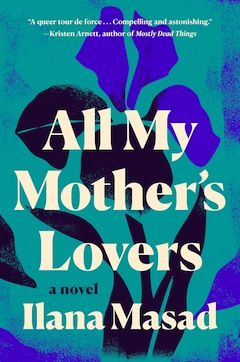
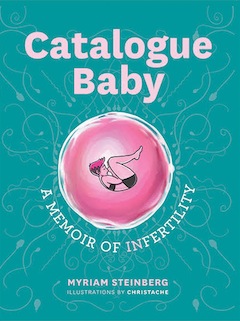
Ilana Masad’s debut novel, All My Mother’s Lovers, is told from the perspectives of a daughter and her mother, and highlights how much we cannot know about the people close to us, while Myriam Steinberg’s graphic novel, Catalogue Baby: A Memoir of Infertility, is a no holds barred sharing of her challenge to become a mom. Both Masad and Steinberg are participating in this year’s Cherie Smith JCC Jewish Book Festival, which takes place online Feb. 20-25.

While the premise is a stretch to my worldview, All My Mother’s Lovers is an extremely relatable read on many levels. Twenty-something Maggie’s mother, Iris, dies in a car crash and Maggie must return home for the funeral and shiva. But, along with her will, Iris has left behind six letters – all addressed to men Maggie hasn’t heard of – and Maggie quickly flees the communal mourning to deliver these missives.

Leaving behind her grief-addled father, who has been the emotional-support parent for her, and her younger brother, with whom she has an older-sister-bossy relationship, Maggie attempts to track down the unknown men. The space from her family and from her current partner, with whom there might actually be a substantial, meaningful relationship brewing, allows Maggie to deal with her long-held insecurities and naïve perceptions of what it means to be married, what it means to be a parent; basically, what it means to be a loving and reliable person. We get to know Iris through the letters and, though Maggie doesn’t get to benefit from these personal musings, she does learn more about her mom, which allows her to connect more deeply with her father, as well as to others in her life.

image - All My Mother’s Lovers book coverMasad’s writing is crisp, intelligent, wry and sensitive. The novel starts with a bang – Maggie answering her brother’s call (telling her about their mother’s death) while having sex with her girlfriend. The pace emphasizes Maggie’s confusion as she tries to understand her mother, and herself. Iris’s letters offer slower moments of reflection, but also were a way for Iris to try and better understand her own missteps and successes.

Steinberg’s Catalogue Baby also took me into a world I’ve never personally experienced, though I do know people who have so wanted to have a child but either could not conceive or had great difficulty conceiving. Steinberg’s refreshing openness on a topic that is often spoken about in whispers, if at all, is most welcome. And her voice is amplified by the colour-bursting, energetic and imaginative illustrations by Christache Ross, which take readers right close up into the physical and emotional upheaval and turmoil that Steinberg has lived.

image - Catalogue Baby book coverCatalogue Baby takes readers from Year One (starting January 2014), and Steinberg’s admission that her dedication to work, organizing the In the House Festival for 11 years, only occasionally gave her the time to put her “loneliness and unrequited motherhood” front of mind. Almost 40 years old at this point, she “didn’t have time to waste with someone who didn’t eventually want a family.” But, people being who we are, Steinberg nonetheless tries to make an unsatisfying relationship work, all while her biological clock (which follows her throughout the novel’s journey) ticked away. From when she finally decides to go it alone to when she gives birth to twins in late 2018, she goes through much. The list includes 123 blood draws, 31 ultrasounds, multiple fertility treatments, five pregnancies, thousands of supplements, about $100,000, help from dozens of family and friends, etc., etc. – and “25 litres of tears.”

To hear more about and from Steinberg, Masad and many other fabulous writers, check out this year’s Jewish Book Festival: jccgv.com/jewish-book-festival.

Format ImagePosted on February 12, 2021February 11, 2021Author Cynthia RamsayCategories BooksTags autobiography, fiction, Ilana Masad, infertility, JCC Jewish Book Festival, LGBTQ+, memoir, motherhood, Myriam Steinberg, women
More than meets eye

More than meets eye

Catalina Beraducci plays Noemí Goldberg in the Topic film Noemí Gold. (photo from Topic)

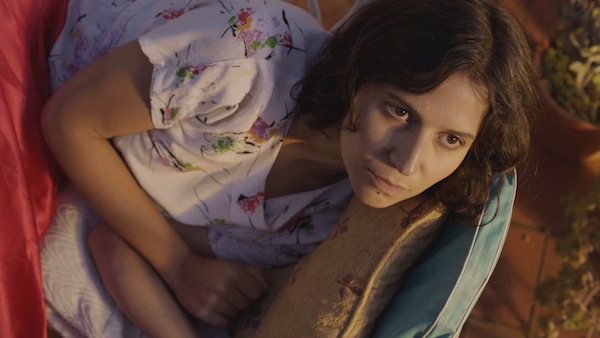
For his first feature film, writer and director Dan Rubenstein has done well. Noemí Gold, which is currently streaming exclusively on Topic, is a quietly engaging story that touches upon serious issues, though never delves into them. While the story is somewhat scattered and doesn’t always make sense, the acting is strong and the glimpse into Argentine culture interesting.

The title role is played by Catalina Beraducci, who is perfect for the part. Noemí Goldberg, 27, has accidentally become pregnant from a tryst with an egotistical artist of questionable talent and character. She is an unassuming person, recently graduating with her master’s in architecture, though she doesn’t appear to have a job. When she seeks a doctor who can perform an abortion – which was an illegal procedure in Argentina until just last month – she has some trouble raising the money she’ll need to go to Uruguay to get one.

Noemí has a couple close friends – eccentric roommate Rosa and party-girl Sol – both of whom help in small but important ways. Also in Noemí’s court is her grandmother, though we find out later in the movie that their relationship has had its complications. Lastly, while all this is going on, Noemí’s cousin, David, comes to visit from Los Angeles, where his family moved when he was 7, for tragic reasons we eventually find out.

David and Noemí were once close, but, for most of the movie, their interactions are strained. David works for an energy drink company and his job is, literally, to post photos on Instagram of himself enjoying the drink in various places and while doing various activities. (He is the only one in the film who has a job, it seems.) Social media plays a prominent role in the narrative as a whole – and, hopefully, younger viewers will take it not only as a representation of themselves in film but as a critique of how much time they dedicate to promoting the fun they are ostensibly having versus actually having fun.

Women’s rights, religion (via a discussion with and seduction attempt of two young Mormon missionaries), what constitutes art (one amusing scene features an objectively poor dancer filming her own performance using a camera on a selfie stick, while being cheered and applauded by an adoring audience), the importance of forgiveness, the challenges of being a good friend, the imperfection but necessity of family, and many other topics run through Noemí Gold. There are no pronouncements and the laidback pace could fool one into thinking there is not much of substance in the film, but they’d be wrong.

Format ImagePosted on January 15, 2021January 13, 2021Author Cynthia RamsayCategories TV & FilmTags abortion rights, Argentina, Dan Rubenstein, social media, women
Thoughts on Bahrain

Thoughts on Bahrain

Nancy Khedouri, a member of the National Assembly of Bahrain. (photo from bahrainthisweek.com)

Nancy Khedouri, a Jewish politician, writer and businesswoman from Bahrain, provided insight into the history of the Jewish community in the small Gulf state and its recent normalization agreement with Israel, signed in September. She spoke at a Nov. 29 Zoom talk organized by Canadian Friends of the Hebrew University and moderated by Ambassador Ido Aharoni.

A member of the National Assembly of Bahrain since 2010, Khedouri is also the author of From Our Beginnings to Present Day, a history of the Bahraini Jewish community, which started at the end of the 19th century.

“Bahrain was known as a place that always embraced people of various religious and cultural backgrounds. The Jews of Bahrain were always allowed to practise their religion freely,” said Khedouri, a third-generation Bahraini and descendant of Iraqi Jews.

The Jewish community in Bahrain totaled close to 2,000 people a century ago. From the 1940s through the 1960s, many Jews left the country on their own volition; they were never expelled, she pointed out. These days, their numbers are rather small, with roughly a half-dozen resident families, or about 40 individuals, covering all age groups. Most Jews living in Bahrain now came from Iraq.

“Overall, the Jewish people worked in various professions, tobacco, olive oil, electronics, some were in the record business – both my grandfathers were involved in the leasing of cinemas. Some of those here today work in the money exchange business. We have integrated very well in the texture of society. We are highly respected,” she said

One famous member of Bahrain’s Jewish community in the 1940s was a midwife known as Um-Jan, in Arabic, whose story influenced a popular 2020 Arabic television series Um Harun. When the community was larger it had a shochet (ritual slaughterer), and it still maintains a Jewish cemetery.

These days, Jewish traditions and festivals in Bahrain are taught and celebrated at home. Bahrain’s synagogue, located in country’s capital, Manama, is not presently in use. Established in the 1930s, the shul was funded by a Jewish pearl trader from France who wanted to create a place of worship for local Jews. At that time, he entrusted a community member with the responsibility of looking after the title deeds of the property. The synagogue is currently under renovation, and the hope is to have it reopen by Purim.

On the question of the tolerance shown towards Jews in Bahrain, Khedouri highlighted the “open-mindedness” of the ruling family and Islam, “a religion that teaches coexistence, peace and respect for one another. They have embraced the true values of being Muslim.” She pointed out that other religions live in peace in Bahrain: in addition to the synagogue, Bahrain houses churches and the only Hindu crematorium in the Gulf.

Aharoni remarked on the prominent role women seem to have in Bahraini society and public life. “Bahrain took pioneering steps to empower women. We have reached advanced stages,” said Khedouri. “We have had women as ministers and leading roles through the years.” Khedouri’s cousin, Houda Nonoo, served as Bahrain’s ambassador to the United States from 2008 to 2013.

Since the 1950s, women have joined the workforce and, since the 1960s, have started companies, said Khedouri. They joined the police force in the 1970s, she continued. And, now, Bahraini women constitute a high percentage of those employed as doctors. Nonetheless, there is still room for improvement, she said.

On the newly formed ties with Israel, Khedouri commented, “We must remember that Israel never posed a threat to the Gulf countries or the region. Seven decades of lost opportunity is a long time. Everyone met the new agreement with great excitement. We believe both countries will benefit. Israel will benefit by having a great trading partner.”

She expects joint collaborations in many aspects. There are opportunities, she said, in technology, in cinema, arts and tourism. In Manama, much preparation is underway for the arrival of Israeli tourists to the country. A number of hotels and supermarkets are offering kosher menus and products.

Khedouri lauded outgoing American president Donald Trump and his son-in-law and senior advisor Jared Kushner for being instrumental in bringing about a peaceful arrangement with Israel. Bahrain followed the United Arab Emirates in normalizing ties with Israel; afterwards, Sudan and, later, Morocco established deals with the Jewish state. These agreements collectively have been referred to as the Abraham Accords.

Bahrain’s political system is a constitutional monarchy with two legislative chambers. Its Council of Representatives is elected while its Consultative Council (or Shura Council), on which Khedouri sits, is appointed by the king.

Sam Margolis has written for the Globe and Mail, the National Post, UPI and MSNBC.

Format ImagePosted on December 18, 2020December 16, 2020Author Sam MargolisCategories WorldTags Bahrain, Canadian Friends of the Hebrew University, CFHU, history, multicultural, Nancy Khedouri, politics, women

Posts pagination

Previous page Page 1 … Page 5 Page 6 Page 7 … Page 15 Next page
Proudly powered by WordPress