Skip to content
  • Home
  • Subscribe / donate
  • Events calendar
  • Business Directory
  • FAQ
  • News
    • Local
    • National
    • Israel
    • World
    • עניין בחדשות
      A roundup of news in Canada and further afield, in Hebrew.
  • Opinion
    • From the JI
    • Op-Ed
  • Arts & Culture
    • Performing Arts
    • Music
    • Books
    • Visual Arts
    • TV & Film
  • Life
    • Celebrating the Holidays
    • Travel
    • The Daily Snooze
      Cartoons by Jacob Samuel
    • Mystery Photo
      Help the JI and JMABC fill in the gaps in our archives.
  • Community Links
    • Organizations, Etc.
    • Other News Sources & Blogs
  • JI Chai Celebration
  • JI@88! video

Recent Posts

  • Or Shalom reopens its doors
  • JFS from past to future
  • Need holistic approach
  • Sharing stories, advice
  • Journalist shares fears
  • Skills to live together
  • Road to independence
  • Cutting grass with scissors
  • Zionism as a solution
  • Deceit, desire & the divine
  • Reclaiming sacredness
  • Creative project ideas
  • Summer squares and cobbler
  • Thou shalt … summer commandments
  • Legal help for students
  • Revisiting myth of Lilith
  • Wrong person rebuked
  • Canada’s mixed messages
  • Questions for museum
  • Symposium on antizionism
  • Making soccer political
  • CJPAC lauds Pulver’s impact
  • City recognizes Vrba’s legacy  
  • Organ donation saves lives
  • Theodore’s March premiere
  • A healing Shabbaton
  • Supplying healthy food
  • A chime of metal tags
  • Yellowknife seder a first
  • Ishai energizes, unifies
  • A Lag b’Omer to remember
  • Expanding the healing
  • Hannah Senesh – a unique hero
  • Community milestones … May 2026
  • Sharing her testimony
  • Fall fight takes leap forward

Archives

Follow @JewishIndie
image - The CJN - Visit Us Banner - 300x600 - 101625

Tag: tikkun olam

An Israeli-Moroccan kitchen

An Israeli-Moroccan kitchen

The falafel plate at Ofra’s Kitchen. (photo from Ofra’s)

Ask Ofra Sixto what makes her Israeli-Moroccan restaurant successful and she’ll unabashedly tell you: it’s keeping a positive attitude. But it takes a whole lot of moxie, too.

After all, it isn’t easy to launch a new restaurant in the midst of an unexpected economic shutdown and to create enough name recognition that patrons are willing to line up at your door for takeout. But that all speaks to the allure of Ofra’s Kitchen, which opened this past December, just as the holiday season was coming into full swing. Sixto, who owned a Moroccan restaurant on Hastings Street with her brother years ago, said it’s been her dream to open another restaurant – this time centring on vegetarian and vegan dishes.

Her previous restaurant was called Jacqueline Moroccan Food and was named after her late sister. When her brother was forced to return to Israel, the two siblings realized they would have no choice but to close the restaurant.

Jacqueline’s “was very successful. Very,” Sixto acknowledged.

It was the venue’s eclectic Israeli-Moroccan cuisine that later gave her the idea for a vegetarian follow-up focusing on classic Israeli dishes and flavourful specialties from around the Middle East.

“There is a great need, I think, for good vegetarian cuisine,” she said.

As a “flexible vegan,” Sixto said she often has trouble finding truly appealing food when she eats out. “When I go to a restaurant and I ask, ‘Do you have anything vegetarian?’ they push a salad. I’m not a rabbit, I want something substantial, right? So, when you come to my restaurant, you actually eat food. You eat really, really good and healthy and fresh and made-on-the-spot food that makes you feel good.”

The choices run the gamut from iconic falafel and pita, shakshuka and Israeli salad to lesser-known Iraqi kube and delicately spiced Moroccan beet salad. Diners can also enjoy an array of traditionally made desserts and Turkish coffee.
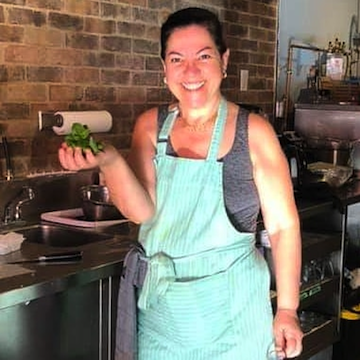
photo - Ofra Sixto’s restaurant focuses on vegetarian and vegan dishes
Ofra Sixto’s restaurant focuses on vegetarian and vegan dishes. (photo from Ofra’s)

Asked about her favourite dish, Sixto admitted she is partial to eggplant, which plays a starring role in several of her popular dishes. Her sabih – a Tel Aviv specialty that consists of fried eggplant, hard-boiled egg, tahina and an Israeli chutney – can be ordered as a pita sandwich or as a platter. She also serves homemade babaganoush and eggplant salad, early pioneer dishes that are still popular in Israel today.

“And, of course, my falafel is the best in town,” she said. “Not only by what I say but everybody else who eats it. It’s fresh, it’s crunchy outside, it’s moist and soft inside. It’s beautiful.”

But cooking isn’t the only exceptional quality that she brings to Denman Street. A big heart and an innate sense of civic responsibility are helping mobilize a small movement to ensure that those who can’t afford to eat at Denman’s restaurants also have food to eat.

Earlier this year, Sixto noticed that the number of individuals on Denman who were homeless was growing. She said the economic shutdown, which closed many establishments and sections of streets in downtown Vancouver, exacerbated the homeless problem, forcing many people onto Denman from Robson and Granville. Rather than ignoring the issue, Sixto decided to do something to help.

“When I would walk [to work] I would see so many homeless people. I decided, you know, I need to do something about it. I have the means and I could help – whatever my capacity is, right? So, I started feeding the homeless by giving away soup and falafels.”

And her reputation began to grow. “I mean, they are hungry,” said Sixto. “They get drinks, they get food, whatever they need.”

In time, she decided she could do even more. “I decided to make it a social thing and make people be a part of the solution.”

She began letting customers know that each $5 they donated would go toward feeding an individual who was homeless. Sixto said the idea is catching on. “It’s amazingly successful,” she said.

So far, Sixto estimates she has given out in excess of 1,300 meals. She admitted that the donations she receives don’t fully cover the out-of-pocket expenses. “But it doesn’t matter to me,” she said. “It’s not about that $5 that people give. It’s about the acknowledgment of the situation.

“You know, I speak with [the people living on the street],” Sixto said. “I stop and say, how are you today? Did you eat anything? How are you feeling? They are people. They were babies. Somebody loved them or not when they were babies, you know? Something happened to these people along their lives [before they got to where] they are. Nobody chooses to live on the street because it’s fun, right?”

In June, the province of British Columbia issued a revised health order to guide restaurants in how they can operate safely during the coronavirus pandemic. Sixto has taken those rules to heart. Her seating is about half-capacity, with tables situated two metres apart. And she has some gentle ground rules: patrons must agree to sanitize (either with hand sanitizer or by handwashing) when entering the restaurant and wear a mask when walking to and from the table.

Sixto also supports the province’s request to record the contact information of at least one customer per table. According to the province’s health office, the information is retained only in case COVID-19 contact tracing is necessary. Sixto said most people appreciate the effort that restaurant owners are making to keep their venues safe and comfortable.

When it came to navigating the recent shutdown, Sixto said her landlord played a big role. “My landlord is amazing,” she said. The temporary rent reduction allowed her to keep operating – “I never closed, not even for one day.”

Ofra’s Kitchen, located at 1088 Denman St., in Vancouver (604-688-2444, ofraskitchen.com), is open Israeli hours, starting at 11:30 a.m. and closing at “8ish” in the evening.

“As long as there are people, I’m feeding them. If you come by and I am there, I will open the door and seat you,” Sixto said. “Just like Israeli hours.”

Jan Lee’s articles and blog posts have been published in B’nai B’rith Magazine, Voices of Conservative and Masorti Judaism, Times of Israel, as well as a number of business, environmental and travel publications. Her blog can be found at multiculturaljew.polestarpassages.com.
Format ImagePosted on September 11, 2020September 10, 2020Author Jan LeeCategories LocalTags business, coronavirus, COVID-19, entrepreneurship, food, homelessness, Ofra Sixto, Ofra's, restaurant, tikkun olam, Vancouver
Cemeteries get an upgrade

Cemeteries get an upgrade

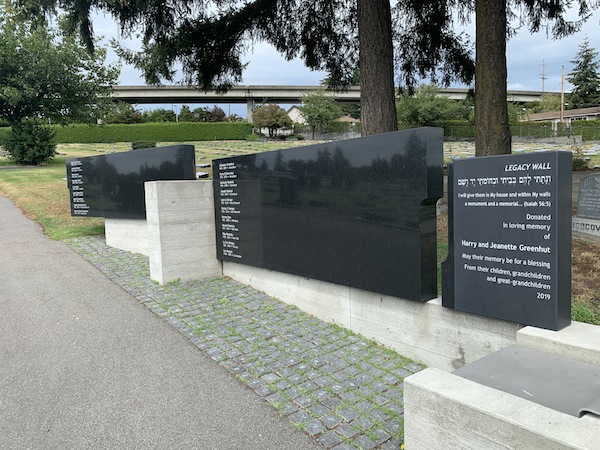
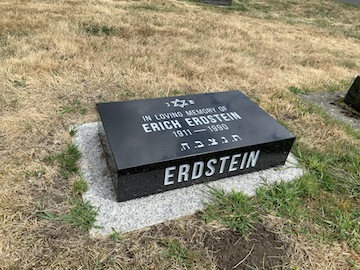
The new black granite memorial wall at Schara Tzedeck Cemetery in New Westminster allows people to memorialize loved ones buried in other cities. (photo from Schara Tzedeck)

What’s new at the cemetery? Not a question one tends to ask, but the Schara Tzedeck cemeteries in New Westminster and Surrey have seen some significant upgrades and additions in recent months.

At the New Westminster cemetery, which saw its first burial in 1929, 50 graves that did not have headstones have received permanent markers. More than 100 others will ideally also see stone markers added in the coming years as the cemetery board’s Chesed Shel Emet Fund is replenished.

There are plenty of reasons why a grave might not have a permanent headstone, according to Howard Jampolsky, executive director of the Schara Tzedeck Cemetery Board.

“Sometimes, somebody had no family, maybe they were destitute, alone in the world,” he said. “Sometimes, the families just don’t have money; sometimes, one spouse dies and they get a headstone and the other spouse dies and there is no one to put the headstone.”

Whatever the reasons, the graves, some dating back to the 1950s, had temporary markers.

The Chesed Shel Emet Fund was set up primarily with donations from cemetery board members, Jampolsky said, and the first batch of 50 headstones was purchased for these unmarked graves and placed in the last few months.

photo - One of 50 headstones placed on graves that, until now, had only temporary markers
One of 50 headstones placed on graves that, until now, had only temporary markers. (photo from Schara Tzedeck)

“We were hoping to do a big unveiling ceremony, where all the graves would be unveiled and we would invite the community,” he said. But COVID intervened. He hopes such a ceremony will occur in the future.

The headstones cost about $525 each and the board is welcoming donations from the community to the fund so they can proceed with placing more stones.

Also at New Westminster, a new black granite memorial wall has been created to commemorate people who are buried in other places.

“Sometimes, someone lives in Vancouver their entire life and they die and get buried in another place, maybe they’re sent to Toronto or Israel or somewhere else,” Jampolsky said. “This is an opportunity to memorialize somebody who lived in the city and contributed to the city’s life and they don’t have a headstone here. The other possibility is people who have parents or family buried in other places where they live and don’t have the ability to go and visit. If you want to come on the yahrzeit, you can come and put a rock on top of that.”

The New Westminster cemetery also has seen a green irrigation initiative recently completed.

“We spend a lot of money irrigating our green grass here, a lot of water,” he said. “We used potable city water.”

They have now drilled a well and are also capturing rainwater, which is pumped through the irrigation system. Not only is this better for the environment, Jampolsky said, but the $150,000 cost will be recouped in about eight years at current water rates. He sees the greening initiative as in keeping with Jewish burial tradition, which is respectful of the land, rejects concrete casings and does not include embalming.

In other significant news, the Surrey cemetery, which had its first burial about a dozen years ago, now has a chapel. Until now, funerals at the Surrey site were graveside only. A sad irony is that the pandemic has meant that, after the first couple of funerals in the new chapel, services had to be again curtailed to graveside only, and with limited attendance.

The $500,000 structure was completed in late 2019 and reflects the philosophy of the board, Jampolsky said, that all members of the community be treated equally. Those being buried in New Westminster had funerals in a chapel, while those in Surrey did not. The new Surrey chapel was funded within the existing budget, but, if a community member wanted to contribute to the chapel, Jampolsky said, naming opportunities could be considered.

“The other thing we’re doing in Surrey is spending more time and effort and money to make Surrey look a lot nicer,” he said. “We are doing more landscaping work, we’re planting flowers and doing things that make it look very, very nice. We’re putting a lot of effort into that property.”

The Surrey cemetery contains about 2,000 plots while the much older New Westminster site has about 10,000. While approximately 5,000 of the New Westminster plots are filled, Jampolsky acknowledges that he can’t accurately predict how long the cemetery has before it is full.

“It really depends,” he said. There are about 80 burials annually in New Westminster. That would suggest about 60 years before it is full. But the community is growing quickly, so perhaps it would be only 50 years. At the same time, a plot may be purchased and not used for decades, he said. If a young family purchased plots today, it is reasonable to assume some burials might not occur until the 22nd century.


Format ImagePosted on September 11, 2020September 10, 2020Author Pat JohnsonCategories LocalTags burial, environment, headstones, Howard Jampolsky, Judaism, New Westminster, philanthropy, Schara Tzedeck Cemetery, Surrey, tikkun olam

Community milestones … JFS chosen for challenge, Krajden appointed OBC, Micner ordained

Following a North American call for submissions and an exhaustive selection process, Jewish Family Services (JFS) in Vancouver has been chosen by the Network of Jewish Human Service Agencies for participation in Year Two of the NJHSA Jewish Poverty Challenge, an offering of the network’s Centre for Innovation and Research. The goal of the program is to help NJHSA member agencies better analyze the marketplace, launch and manage solutions, and implement sustainable measures for success to address the many dynamics associated with responding to Jewish poverty.

NJHSA has partnered with Start Co., a venture development consultancy firm based in Memphis, Tenn., with an expertise in launching startup, entrepreneurial initiatives and engaging municipalities, corporations and nonprofits in poverty reduction responses. The team at Start Co. will provide expert consultation assistance as JFS rethinks and redesigns products and services, adjusting assumptions and organization models. Throughout, special attention will be paid to the impact of COVID-19 on service delivery methods.

“We are so honoured to have been selected to participate in this challenge,” said Tanja Demajo, JFS chief executive officer, in a press release. “The demand for our services has increased during COVID-19 and we have had to pivot quickly. Although we have adapted, we are experiencing growing pains. This opportunity through the NJHSA and with Start Co. is timely in helping us address our pain points in an innovative way so we can be more efficient and can operate at a pace our clients are demanding during this crisis.”

Reuben Rotman, president and chief executive officer of the network, added, “The COVID-19 pandemic has even further heightened the critical need for innovative solutions to the challenges of Jewish poverty. With newly vulnerable clients reaching out for assistance in unprecedented frequency, the agencies are challenged to identify new ways of working and new efforts to achieve sustainable solutions for those in need.”

For more than 80 years, JFS has delivered a continuum of social services to individuals and families of all ages and in all stages of life in the Greater Vancouver area; its pillars of support include food security, counseling and mental health, care management, financial aid and home support.

The Network of Jewish Human Service Agencies is an international membership association of more than 140 nonprofit human service agencies in the United States, Canada and Israel. Its members provide a full range of human services for the Jewish community and beyond, including healthcare, career, employment and mental health services, as well as programs for youth, families and seniors, Holocaust survivors, immigrants and refugees, persons with disabilities and caregivers.

***

photo - Dr. Mel Krajden
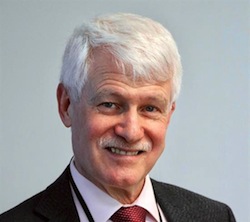
Dr. Mel Krajden (photo from bccdc.ca)

Dr. Mel Krajden is among those who will be appointed to the Order of British Columbia this year. The announcement of the 13 new appointments was made on BC Day, but the investiture ceremony will be postponed due to COVID-19 restrictions and held for recipients and invited guests at Government House in Victoria in 2021.

Krajden is medical director of the BC Centre for Disease Control (BCCDC) Public Health Laboratory and has made significant contributions to fields of research, including hepatitis, HIV, HPV and, most recently, COVID-19.

With the emergence of COVID-19, British Columbia and Canada needed urgent access to rapid, validated tests for the virus. Under his leadership at BCCDC, and relying heavily on his expertise, Krajden and his team were able to rapidly develop an assay for the province to commence testing in January 2020, weeks before other jurisdictions. Access to this test was an essential element in the management and control of the outbreak and the safety of British Columbians.

Krajden created the world-leading B.C. Hepatitis Testers Cohort, which integrates de-identified data on 2.4 million individuals tested for, or diagnosed with, hepatitis B, C, HIV and TB infections, linked to their corresponding healthcare administrative data since 1990, to create longitudinal medical histories. This cohort has produced influential pieces of evidence that shaped clinical and public health guidelines and policy in Canada and globally. He was instrumental in the development and continued progress of the Canadian Institutes of Health Research-funded Canadian Network on Hepatitis C, a multidisciplinary group committed to developing a national strategy for hepatitis C elimination.

Krajden was one of the key personnel in the STOP HIV initiative in British Columbia. This public health endeavour saw the implementation of acute HIV testing, allowing diagnosis during the most infectious period of the disease, resulting in timely interventions and communication to partners to reduce transmission. This undertaking helped lead to the lowest HIV incidence on a provincial scale in decades.

Krajden also played a pivotal role in global public policy changes in human papillomavirus (HPV) vaccine dosing regimen and the associated reduction of financial access barriers to care. Similarly, his work with respect to assessing the utility of HPV testing versus traditional Pap smears is expected to contribute to guidelines that will benefit women worldwide.

In his educational capacity, Krajden has the reputation of being a wonderful teacher and valued mentor, training researchers, health professionals and students at all levels. He is known for his willingness to provide input and advice despite numerous other commitments, contributing to the success of others. His dedication further extends into the clinical realm, where he always has patient interests at heart and never hesitates to devote his own time to make a difference in client outcomes.

In appointing Krajden to the Order of British Columbia, it is recognized that, over many decades, he has demonstrated exceptional innovation, leadership and sustained contributions to the province, country and the world. He is a highly respected visionary, scientist and educator who has inspired countless researchers and health professionals with his clinical excellence, dedication and generosity of spirit.

***

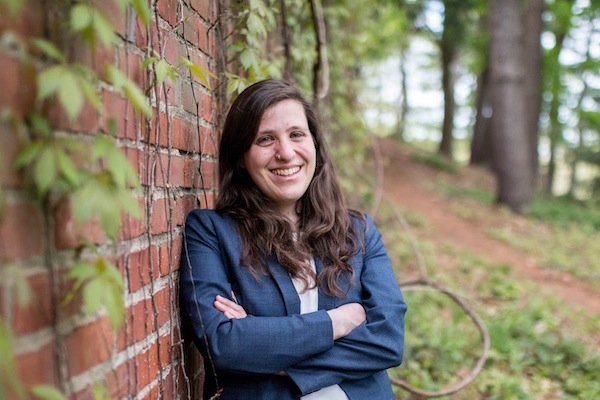
Rabbi Mimi Micner
Rabbi Mimi Micner

Tamara Micner, Rembrandt Koppelaar, Karen and Jack Micner and Dr. Talie Lewis are extremely proud to announce the ordination of Mimi Micner to the rabbinate. The virtual ceremony took place June 7 from Hebrew College in Boston. Mimi and Talie live in Watertown, a half-hour drive from Mimi’s new position, rab- bi at Temple Beth Torah in Holliston, Mass.

Mimi is the granddaughter of Kela (z’l) and Lito (z’l) Guincher, who are kvelling on the Richter scale above. She is also the granddaughter of Chaim (z’l) and Susie Micner, who are surely enormously proud as well.

Mazel tov, Rabbi Mimi! Bist 120!


Posted on August 28, 2020August 27, 2020Author Community members/organizationsCategories LocalTags BC Centre for Disease Control, BCCDC, coronavirus, COVID-19, food security, health, innovation, JFS, Judaism, medicine, Mel Krajden, mental health, Mimi Micner, Order of British Columbia, ordination, poverty, technology, tikkun olam
Real-life learning

Real-life learning

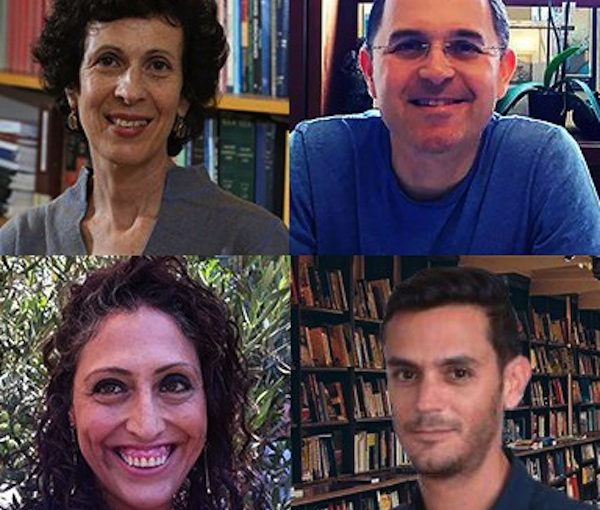
Clockwise from top left: Prof. Daphna Lewinsohn-Zamir, Prof. Guy Davidov, Ohad Amar and Vardit Dameri Madar of Hebrew University’s Clinical Legal Education Centre. (photos from cfhu.org)

Five representatives of Hebrew University’s Clinical Legal Education Centre (CLEC) took part in an online discussion about the legal aid the organization offers to disadvantaged individuals and groups.

“It is one of the jewels in our crown. CLEC has taught our students how social responsibility is an important part of the legal profession,” said Daphna Lewinsohn-Zamir, dean of HU’s faculty of law. “And it continues to do exemplary work during the coronavirus pandemic.”

Besides offering professional legal assistance to underprivileged people in Israel, particularly in the Jerusalem area, the centre provides students with hands-on experience. Each clinic, which is comprised of 16 students and includes six hours of field work each week, is overseen by an attorney and an academic advisor.

“The main goal is to demonstrate to students the difference between law in the books and law in action,” said Prof. Guy Davidov, CLEC’s academic director. “It is essential in showing how the law works in real life. We don’t want to be detached from the community in our ivory towers.”

Another key objective of the centre, Davidov said, is to present the potential (and limitations) of the law as a tool for social change, which also is better understood in practice and engagement.

To illustrate the scope of the centre, Vardit Dameri Madar, CLEC’s executive director, told the assembled Zoom audience the story of Hanna, a 32-year-old mother of six children, including one who has mental challenges. Hanna lives in severe poverty and is divorced after having suffered years of physical and mental abuse. She survives on minimum income benefits.

Just as the coronavirus struck, Hanna had her benefits stopped, said Dameri Madar. In spite of the pandemic forcing people to stay in isolation, the country’s housing department demanded that Hanna come to its offices in person to fill out the necessary documents to receive her benefits.

“Unlike a TV show such as LA Law, problems do not get resolved in the time it takes to watch an episode,” Dameri Madar explained. “In real life, it takes a long time to get a response from the housing department.”

After sending letters to the department and raising the issue in the media of Hanna’s possible eviction, a precarious circumstance shared by thousands of Israelis as the virus started, CLEC was able to make a difference – the housing department relented and allowed people to fill in their applications online.

CLEC handles 600 cases per year. The centre aims to address policy changes that affect broader populations; it initiates 35 to 40 policy change projects a year through tests cases, position papers, shadow reports, draft legislation and alternative models. CLEC also organizes about 90 lectures per year for the general population, as well as for specific groups, such as youth, single mothers and social workers.

This coming year, CLEC will run eight clinics, on the topics of at-risk youth, international human rights, marginalized communities, disability rights, criminal justice, the wrongfully accused, multiculturalism and women’s economic empowerment.

CLEC, too, has formed a Corona Crisis Program that manages existing cases related to poverty with responses in “real time”; provides Social Justice Operations Rooms on Facebook, with legal aid available in Hebrew and Arabic; and promotes policy changes stemming from the Facebook room and clinical activities.

“We decided that Facebook was a good tool to help answer people’s questions at a time when the rules were in flux,” said Ohad Amar, the lecturer at CLEC who started the Facebook groups.

From the Facebook groups, the public has easy access to specialized aid from attorneys, students and volunteers. To date, its 60 volunteers have helped more than 1,500 people.

Ariel Elkayam, a second-year law student, said “this is the best thing that happened to me with my studying here. I am so lucky to get to do this work. With the centre, you do teamwork. It really gives you a sense of belonging.”

Elkayam’s recent work with CLEC has been advocating for at-risk youth who have been fined and arrested for being out on the streets with nowhere to go during the COVID crisis – at a time when Israeli law enforcement has been clamping down on homelessness.

Every year, approximately 140 students are accepted to the CLEC clinics. For more information, visit openscholar.huji.ac.il/clinicallecen/book/clec-experience-assistance-impact-law-students.

Sam Margolis has written for the Globe and Mail, the National Post, UPI and MSNBC.

Format ImagePosted on August 21, 2020August 20, 2020Author Sam MargolisCategories IsraelTags Ariel Elkayam, CLEC, Daphna Lewinsohn-Zamir, education, Guy Davidov, Hebrew University, law, legal aid, Ohad Amar, social justice, tikkun olam, Vardit Dameri Madar
Need for Courage increases

Need for Courage increases

Corey Hirsch is among the honorees of this year’s Courage to Come Back Awards. (photo from Courage to Come Back)

“Believe me when I say that the stories we share are true journeys of bravery, resilience and strength in the face of adversity. They will leave you inspired and optimistic – a weekly dose of courage that I believe we need now, more than ever,” Lorne Segal, longtime chair of the Courage to Come Back Awards, told the Independent.

While the annual gala event had to be canceled because of COVID-19, every week this month, one of the five award recipients is being announced, and a video of their stories shared.

“We’re also sharing videos highlighting some of the incredible work of Coast Mental Health’s frontline workers during COVID-19,” said Segal. These can be viewed at couragetocomeback.ca.

“Every year,” said Segal, “the Courage to Come Back Awards raise critical funds that support over 40 of Coast Mental Health’s programs, which provide food security, mental health support for youth, peer support services and so much more. They are vital to the recovery of vulnerable people living with mental illness.

“In community mental health, the only way to meet this crisis is to increase capacity – that’s where Coast Mental Health comes in. Coast provides shelter, a roof overhead, a support system of caring individuals, and the dignity of a job and training through employment opportunities, all for individuals, young and old, dealing with mental health challenges.

“This life-saving work would simply not be possible without the generous support we receive during the Courage to Come Back Awards,” he stressed. “I invite people to watch, and share these incredible videos of courage. Then, if you can, I’m asking you to join me in supporting Coast Mental Health as they prepare for the second wave of this pandemic, a mental health crisis potentially as devastating as the first wave of COVID-19.”

At press time, three of the award recipients had been announced: Corey Hirsch in the mental health category, Amanda Staller in the addiction category and Rumana Monzur in the physical rehabilitation category; the youth and medical categories are still to come.

Hirsch was the first honoree announced. While not Jewish, he said, his surname is and, that “[t]here is very much the possibility that I have Jewish ancestry; it’s just never been investigated.”

A former NHL goaltender and goaltending coach, Hirsch is a commentator with Sportsnet, as well as being a public speaker and an advocate for mental health and wellness. Born and raised in Alberta, he was drafted by the New York Rangers in 1991 and was a member of the team when they won the 1994 Stanley Cup. Also in 1994, he won a silver medal with the Canadian men’s hockey team in the Olympics at Lillehammer. In 1995, he was traded to Vancouver, where he began losing his struggle with mental illness, but eventually reached out for help, and was diagnosed with obsessive-compulsive disorder.

Of the Courage to Come Back Award, he said, “It was very humbling to realize that I was in that category of people. And it was probably the first time it opened my eyes to realizing that what had happened – with coming out with my story in the Players Tribune [in 2017] – made a colossal impact on the world of mental health.

“There were people that came before me,” he acknowledged, pointing to Sheldon Kennedy, Theo Fleury and Clint Malarchuk. “Their stories helped me get my story out and made me feel safe,” he said.

Kennedy and Fleury were both abused by a coach when they were in junior hockey. Malarchuk, a fellow goalie and a friend, struggled with post-traumatic stress disorder after his jugular vein was accidentally severed by another player’s skate, as well as with obsessive-compulsive disorder, even attempting suicide.

Hirsch also mentioned sports journalist Michael Landsberg. “I met with Michael and Clint before my story came out because I was just terrified. Those two guys really helped me,” he said. (For coverage of talks by Landsberg in Vancouver, see jewishindependent.ca/lets-talk-mental-health and jewishindependent.ca/illness-not-weakness.)

“OCD, typically, doesn’t start from childhood trauma,” explained Hirsch, adding, “Most people I know can tell you the time, place, where they were at when their brains just kind of broke. There could be childhood trauma with people, but, for me, [there wasn’t any]. I was on my way to the NHL, I had athletic talent as a kid, lots of friends, no real signs of mental health [issues]. I had anxiety issues, [but] a lot of kids do.”

Hirsch grew up in Calgary, with parents he described as loving, and an older brother. Sports were encouraged. “Hockey was something that, you know, it’s a religion in Canada,” said Hirsch who, at age 16, moved to Kamloops to play the sport. “I had a really good junior career, won a national championship. From there, I went on to the Olympics. Things were looking like I was going to make millions playing in the NHL. I was on the road.”

Hirsch describes in detail the type of OCD with which he struggles in his article on the Players Tribune media platform.

“I think that what people thought OCD was, was the hand-washers, someone that’s organized and all that. There was a misconception, through stigma and other things, about OCD and people thought it was that,” he told the Independent. “So, how bad is that? You wash your hands too much. They didn’t take it very seriously … because that’s how OCD was portrayed.”

Hirsch is concerned about overall mental health, not only OCD. “I want to change the stigma to all of it,” he said.

As to why the stigma remains, he said, “Well, people don’t like to look inside, afraid of what they might find out. But, what you find out is that there’s a better life out there and you learn things…. Fear keeps people from getting help, stigma keeps people from getting help. It’s a great built-in excuse to say that you’re a man and men don’t get help; it’s a great built-in excuse if you don’t want to look internally. I get a lot of that.

“I got help, I live a great life. I’m not perfect – I’ll never say I am – but I still play hockey. I can still drink beer, I can still fix cars, I can still do all those things that are considered manly – I haven’t lost any of that. And the people around me are better for it. It’s tough to look inside and a lot of people don’t want to, but I know now it’s the best thing I’ve ever done.”

One of the reasons Hirsch decided to open up about his experiences is that, back when he was at his worst, in the mid-1990s, there was no readily available information on what he was experiencing.

“I scoured bookstores,” he said. “I did everything I could to try and find some hope, or even self-diagnose or [determine] that I wasn’t going to be like this the rest of my life. I felt so alone. I found nothing…. Part of it was because I didn’t even know what to look for, and I always said to myself, if I got better, that, one day, I would tell my story.

“I didn’t tell anybody anything, other than people close to me, for 20 years. I kept it in my chest. [But then] I met another NHL player who was active, in my retirement, and I met him, and he was in rehab for drugs. We got to talking, and I know now that mental health and addiction go hand in hand, so I spilled my story to him. And he looked at me and he said, that’s exactly what I’m going through.”

That was when Hirsch realized his story could help others who are suffering. “I need to let them know that they’re not alone,” he said.

Vancouver-based Hirsch is waiting out the pandemic in Toronto with his girlfriend. He is writing a memoir about his life with OCD, he plays golf, and spends time playing his guitar. “I’m terrible,” he said. “But I love it,” he said. “It’s been incredibly freeing. Music is so powerful and great for mental health. Any kind of art, it’s a great way to express, therapeutically, yourself.”

He is continuing his work in mental health and would like to see it become part of the curriculum in schools.

“If I could have known what I had when it happened to me and I could have gotten help the next day, I would have never ended up making an attempt on my life,” he said. “I don’t know what my NHL career would have looked like, but I would have never suffered and gone through what I went through for all those years, because early diagnosis is crucial with mental health.

“It’s not hard to teach our kids in high school, middle school, about anxiety, depression, OCD, bipolar, those things. They need that information. Why are we withholding it from them?”

Hirsch pointed to a U.S. Centre for Disease Control study finding that the suicide rate among people aged 10 to 24 increased 56% from 2007 to 2017 (see cdc.gov/nchs/ data/databriefs/db352-h.pdf).

“It’s like anything – teach our kids in school and then give them the tools and then hopefully we can put a dent in it,” he said, citing a need for a countrywide curriculum in health class. “That’s where we’re going to end the stigma … and suicide needs to stop being a taboo topic, it really does. It’s real and it’s happening and pretending it isn’t happening doesn’t make it go away.”

Format ImagePosted on July 24, 2020July 22, 2020Author Cynthia RamsayCategories LocalTags Coast Mental Health, Corey Hirsch, coronavirus, Courage to Come Back, COVID-19, Hockey, Lorne Segal, mental health, NHL, philanthropy, tikkun olam

Community Recovery Task Force appointed

COVID-19 continues to impact our community. Jewish Federation of Greater Vancouver estimates that local needs may increase by 50% over the next year. Therefore, it has established the Community Recovery Task Force, chaired by Risa Levine.

The purpose of the task force is to examine the myriad operational and financial issues facing our community as a result of COVID-19, and to assist Jewish Federation in responding to these challenges and changes, both presently and in the long-term. Through consultation with Federation’s partner agencies, the task force will be assessing the consequences of the pandemic on vulnerable community members, as well as on the ability of community organizations to deliver their core programs and services. Task force members will be looking to new, innovative approaches to enhance community organizations’ capacity, and recommending solutions that will support a strong, resilient and financially stable recovery as well as future sustainability.

The task force members have all held leadership roles with a variety of community organizations, and collectively represent the diversity of our community in terms of geography and life stage. In addition to Levine, they are Andrew Altow, Jill Diamond, Michelle Gerber, Hodie Kahn, Candace Kwinter, Shawn Lewis, David Porte, Justin L. Segal and Isaac Thau.

The task force is an integral part of Federation’s response to COVID-19, as is its three-phase approach to recovery. In phase one, it released targeted emergency funds in the first few weeks of the pandemic to address immediate and urgent community needs. As a second phase, it is currently working closely with major donors to maintain their support through the next two annual campaigns and to consider making contributions above and beyond their campaign gifts to support community recovery. In the third phase, every community member will have an opportunity to make a difference in our community’s recovery through participating in the annual campaign, which officially launches in September.

To learn more about the task force, to read the latest annual report or to donate, visit jewishvancouver.com.

– excerpted from the weekly email message of Jewish Federation of Greater Vancouver chief executive officer Ezra Shanken

Posted on July 24, 2020July 22, 2020Author Ezra Shanken JFGVCategories LocalTags annual campaign, coronavirus, COVID-19, economy, Jewish Federation of Greater Vancouver, JFGV, philanthropy, tikkun olam
Providing comfort and hope

Providing comfort and hope

Shiva Delivers organizers Madison Slobin, left, and Becca Schwenk. (photo from Shiva Delivers)

When 25-year-old Vancouverite Becca Schwenk considered how she could make a small impact to reflect Jewish compassion, care and kindness for local Black families during the Black Lives Matter protests, the Jewish ritual of shivah came to mind. She knew the power of shivah meals to soothe people in times of grief, so she and her longtime friend Madison Slobin, 26, decided to coordinate Shiva Delivers, a collective effort whereby Jews would cook a dinner meal for a Black household in Vancouver.

“We hoped it would lighten their load and bring a bit of joy,” Schwenk said. In emails, Facebook and Instagram posts sent to members of the Jewish community, the pair noted that “this past week has been one of grieving for Black folks. Not only have Black lives been disproportionately impacted and lost due to COVID-19, but we have witnessed police officers murder Black people in broad daylight, as well as in their own homes. As Jews, we know what it feels like to experience a collective tragedy, especially in the past two years, as antisemitic violence has been on the rise. We also know how much it has meant to us when other communities have demonstrated their solidarity.”

They encouraged volunteers to “cook with your loved ones, and have critical conversations about unlearning anti-Blackness and racism. It’s a beautiful thing when we can hold one another accountable, free of judgment, and keep our hands busy in some challah dough,” they wrote.

Their message spread quickly through social media and, within 24 hours, they had volunteers signing up to cook meals. Ultimately, they received 90 meals that they were able to deliver to 48 Black families in the Lower Mainland, from Surrey to East Vancouver and the University of British Columbia.

“People made beautiful, multiple course dinners including salmon with dessert, brisket and matzah ball soup, roast chicken with vegetables and delicious cakes,” Schwenk said. “It was really clear that considerable effort went into each dish and we felt really proud to drop these meals off.”

Those preparing the meals represented the diversity of the Vancouver Jewish community and deliveries came from Orthodox Jews, mixed families, rabbis and people from all political spectrums.

“We didn’t explain much about our initiative when we sent out the notification, but people just got it,” Slobin said. “We were unified by the instinct to do tzedakah through our collective love language of delicious food. I found it beautiful that our community is so united about the idea that Black lives matter, and that they really wanted to provide comfort to Black families during this time.”

The two friends are both professionally involved in human rights work. Slobin works for Vancouver Aboriginal Child and Family Services, while Schwenk is a diversity and inclusion consultant for Cicely Blain Consulting. Even though they’re not planning to organize a second Shiva Delivers event immediately, they hope it will inspire members of the Jewish community to do more.

“This was a way for us as a community to say, ‘We know how valuable comfort and nourishment are in moments like these, and we’ve got your back,’” Slobin said. “I want to see how folks draw inspiration from this and tap into the potential for solidarity beyond the Jewish community.” She noted that other Shiva Delivers initiatives were held in other parts of Canada and in the United States.

Feedback from recipients of the meals was overwhelmingly positive and grateful. “Thank you so much for doing this,” one recipient wrote. “We are grieving such a tremendous loss of life in the middle of this pandemic, where we are isolated from our wider community and loved ones. This helps a lot.” Another recipient said the display of kindness and generosity towards the Black community at this time was especially meaningful: “It means so much to be seen in our grief, and held and cared for in this way. Such community-to-community support is so deeply valuable and I truly believe it is our way forward into a collectively liberated world. Thank you for looking out for us and sending us love in my personal favourite love language – good food!”

Reflecting on the power of their event, Schwenk and Slobin said it provided “a glimpse into a hopeful future of what solidarity can look like. It allowed us to imagine a world where traditions are not only respected, but provide cross-cultural comfort.”

Lauren Kramer, an award-winning writer and editor, lives in Richmond. To read her work online, visit laurenkramer.net.

Format ImagePosted on July 10, 2020July 9, 2020Author Lauren KramerCategories LocalTags Becca Schwenk, Black Lives Matter, COVID-19, food, human rights, intercultural, Judaism, Madison Slobin, Shiva Delivers, tikkun olam
No Silence on Race

No Silence on Race

An open letter from Black Jews, non-Black Jews of colour and our allies to Jewish congregations, federations, foundations, organizations, nonprofits and initiatives, dated June 30, 2020.

We write this letter as proud members of the Canadian Jewish community. We are Black Jews and non-Black Jews of colour. We are Jewish community board members, educators and leaders. We write from a place of love for our Jewish identities and community, while also grappling with the cultural erasure, exclusion and structural racism that we experience in Jewish spaces. Nevertheless, we are compelled to be in Jewish community because it is who we are.

Over the past month, we have witnessed a racial reckoning within Canadian institutions. Police violence against Black and Indigenous people has continued unabated, with numerous deaths, including that of D’Andre Campbell, Eishia Hudson, Jason Collins, Regis Korchinski Paquet, Everett Patrick, Chantel Moore, Rodney Levi, Ejaz Ahmed Choudry and countless others. In the United States, the tragic murders of Ahmaud Arbery, Tony McDade, Breonna Taylor, Sean Reed, George Floyd, David McAtee and Rayshard Brooks have gripped the collective consciousness and have been the catalyst for a global call to action. We have witnessed and participated in protests and in conversations for structural change across all sectors and our Jewish community is not exempt from this dialogue.

No Silence on Race is born out of the necessity for inclusivity and racial equity in Jewish spaces. We acknowledge and are grateful for the longstanding work that Jews of colour and Jewish allies in Canada and the United States have dedicated themselves to in addressing structural racism within the Jewish community.

In this letter, we call on our Jewish community to uphold the tenets of justice and equality and to commit to the creation of a truly anti-racist, inclusive and equitable Jewish community.

The work that needs to be done to achieve this vision must happen collectively and systematically. To guide its implementation, we have devised nine pillars outlined below. These pillars are intended to support Jewish congregations, federations, foundations, organizations, nonprofits and initiatives in their transformation towards greater inclusivity and equity.

If you are aligned with the creation of an anti-racist, inclusive and equitable Jewish community, we ask that you sign this letter in support [at nosilenceonrace.ca]. If you are an organization, we ask that, in addition to signing your name, you write a public statement expressing your commitment to achieving this vision.

The nine pillars are:

1) Allyship: creating anti-racist, inclusive and equitable Jewish spaces begins with each individual. We call on everyone within their organizations to make a personal pledge to the work of allyship and to devise a personal plan of 10-15 comprehensive ways they will work towards becoming strong allies and leaders in the creation of more inclusive and equitable Jewish spaces.

2) Education: engage external facilitators for organization-wide anti-racism and anti-oppression education and training led by Black Jews, Jews of colour or people of colour consultants or consulting organizations.

3) Indigenous education and relationship building: engage in education about Indigenous peoples in Canada and cultural competency training. Build meaningful relationships with local Indigenous communities.

4) Equity consultancy: work with an equity consultant with a specialization in anti-racist work to formulate a multi-year strategic plan for your organization to create a roadmap towards inclusion, equity and anti-racist practices. This includes implementing non-discrimination policies, equitable hiring policies, anti-racist frameworks for organizational decision-making and a procedure to report and investigate any breaches of this policy.

5) Employment and recruitment: implement strategies to ensure equitable representation in your staffing, as well as development and retention planning to ensure these practices are adequately conducted.

6) Equity, inclusion, anti-racism advisory: accountability is essential. Create an advisory group to ensure that the equity-and-inclusion policy and strategies implemented are upheld at all levels of the organization. Create metrics to track ongoing anti-racism work.

7) Jews of colour leadership strategy: invest in a leadership strategy to ensure that Jews of colour are poised to be adequately represented in leadership roles in the community. This can include mentorships, educational scholarships and project grants.

8) Programming/events/partnerships: commit to more programming and partnerships with cultural institutions, with the goal of engaging in and elevating a diverse range of Jewish diasporas and histories.

9) Amplify the voices of Jews of colour in Canada: demonstrate explicit support for Jews of colour community groups and active initiatives. Engage in substantial outreach efforts.

We acknowledge that change takes time and recommend Jewish organizations create their own timelines for achieving the nine proposed pillars. We have designed these pillars as a guideline and we encourage all organizations to be intentional and creative in their implementation. While organizational priorities may have shifted amidst the realities of COVID-19, it is imperative that our community does not remain silent about how racial inequity plagues Jewish spaces. We look to the entire Jewish community in Canada to challenge ourselves to do more and to envision the path forward.

Jewish scholars as far back as Rabbeinu Bachya ben Asher, a significant rabbi and scholar from 13th-century Spain, call us to seek “Justice whether to your profit or loss, whether in word or action, whether to Jew or non-Jew.” So, we set our sights on July 9, which this year mark[ed] the fast of the 17th of Tammuz, where we begin the three-week period of mourning leading up to Tisha b’Av.

Tisha b’Av commemorates the destruction of the Temple. It is a time where we reflect on the divisions within our community. But, more importantly, it is a time to reflect on the cost of allowing those divisions to persist. During this holiday, we recognize the importance of taking a more active role in challenging each other and of doing more to make amends. It is in this spirit that we invite Jewish organizations across the country to engage in listening, introspection and action.

Creating anti-racist, inclusive and equitable Jewish spaces will require deep self-reflection, difficult conversations and an ongoing commitment to reimagining what the Jewish community can look like. Above all, it must be guided by the celebration of Jewish culture and a love for one another.

For individuals and organizations who believe in this movement, we invite you to join us in action by adding your name to this letter. We call on organizations to sign their name with the intention to issue a public statement by July 29, outlining your commitment to the vision of creating a more inclusive Jewish community.

The ground is shifting beneath us in ways that are undeniable and it is incumbent on each of us to play a role in shaping our collective future. When we honour our commitment to each other as Jews, our communities will reflect the beauty and diversity that truly exists within our culture.

Sara Yacobi-Harris, Akilah Allen-Silverstein and Daisy Moriyama

Format ImagePosted on July 10, 2020July 9, 2020Author No Silence on RaceCategories Op-EdTags Akilah Allen-Silverstein, anti-racism, Daisy Moriyama, education, equality, inclusion, Judaism, Sara Yacobi-Harris, tikkun olam
Helping people help

Helping people help

Help Each Other Today’s Ilya Goldman, left, and Carlos Taylhardat. (photo from Help Each Other Today)

Ilya Goldman and Carlos Taylhardat have created Help Each Other Today, a messaging platform that connects people who need help with those who want to help.

Goldman, a computer programmer and software engineer, was born in the former Soviet Union and made his way to Israel in 1990. He and his family moved to Vancouver in 1994.

“Eventually, I started my own marketing company (internet-exposure.com) in 2001,” said Goldman. “Recently, because of COVID-19, business did slow down, basically because not as many clients are working right now – a lot of my clients were local businesses.”

In light of the new situation, one of Goldman’s clients, Carlos Taylhardat of artofheadshots.com, started creating coronaSOS.com. While putting the site together, Taylhardat contacted Goldman and Goldman saw in it the potential to help many more people. So, together, they created helpeachothertoday.com.

“I wanted to move beyond just helping people during the coronavirus,” said Goldman. “I wanted to make it available for people when they need help, even after the pandemic is over. Also, I wanted to automate how people are being matched.”

People wanting help and people offering help first need to sign up for to the service, which they can do at no cost. Then, they can post an offer of or request for help that falls within the site’s categories of Delivery, Financial Support, Peer Emotional Support, or Any.

When posting, people need to submit a location, as the platform matches helpers and people needing help based on location, with people able to access posts in their area.

“Helpers will see help requests in their area and can decide if they want to help that particular person,” said Goldman. “Once they decide to help, they essentially offer this help, and they can chat on the website and arrange how.”

Taylhardat and Goldman have been volunteering their time and resources to help people during the pandemic. They considered incorporating ads into the platform, but decided not to, as they felt it would distract from the core concept of the website.

While no one monitors conversations, if ever an abuse of the system comes up, Goldman will step in and block users as needed. So far, no abuse has been reported.

Requests have ranged from a need for groceries or diapers to help with the cost of a wheelchair or in finding public housing.

image - Note of thanks to Help Each Other Today
A note of thanks to Help Each Other Today.

“Unfortunately, not all help requests can be answered,” said Goldman. “And, unfortunately, not every place has helpers available to help with every request. That’s why we’re trying to get more attention to the website, so all people who need help can register there … and, also, so people who can help can be there for those in need.”

Right now, help and helper posts are only shared within a city, but Goldman is working on a system that will let users choose a post radius.

“Currently, I think we’re helping in 1,091 cities around the world,” he said. “As we move further, we probably will be doing it one country at a time – starting with the U.S. and Canada, and then expanding it further.”

A recent Help Each Other Today media release noted, “The COVID-19 pandemic has made huge changes in all our lives and, often, those who were most vulnerable at the onset were also disproportionally affected by the virus – both by the disease itself and by its huge economic impact. On the other hand, this crisis also shows the great willingness of people to help each other, as many people donate their time and money to help those in need.”

“Social distancing is not social indifference,” Goldman told the Independent. “So, spread the word, post it on your social media, and help more people help each other.”

For more information, visit helpeachothertoday.com.

Rebeca Kuropatwa is a Winnipeg freelance writer.

Format ImagePosted on July 10, 2020July 9, 2020Author Rebeca KuropatwaCategories LocalTags Carlos Taylhardat, coronavirus, COVID-19, Ilya Goldman, internet, tikkun olam
Helping during the pandemic

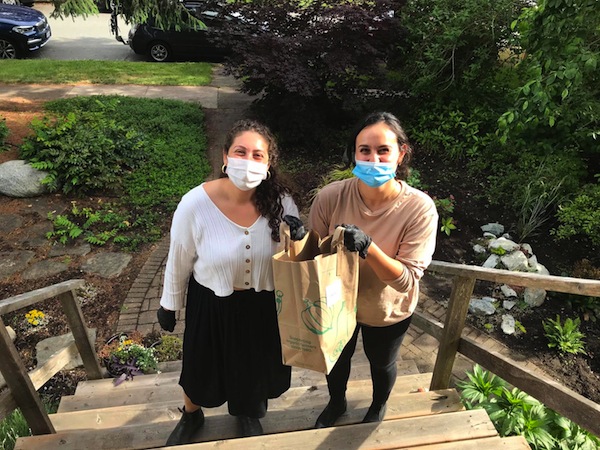
Helping during the pandemic

COVIDhelp Vancouver founders Imaan Jiwa, left, and Riva Siddiqui. (photo from COVIDhelp Vancouver)

An all-female team of Vancouver-area university students has created a platform to link people who may be more likely to succumb to COVID-19 with volunteers who can help them with essential tasks.

COVIDhelp Vancouver was launched by the University of British Columbia’s Imaan Jiwa and Riva Siddiqui shortly after the coronavirus was declared a pandemic in the spring. Soon thereafter they were joined by Jewish community member Rebecca Baron, who came on board as director of outreach communication.

The organization’s objective is to assist anyone they can, i.e., seniors and the immune-compromised, with such activities as grocery shopping, dog walking and the delivery of medicines. Volunteers also provide companionship for those who have been isolated as a result of the virus, through both online and socially distanced chats.

The students have provided a few ways for volunteers and clients to connect: the internet, telephone and a mobile app.

“We are trying to get to as many people as we can and create a platform to support our community,” Baron told the Jewish Independent. “This service is intended for anyone who needs support during this time, whether they are seniors, people with compromised immune systems, those who have recently returned from abroad, single parents, students unable to travel back home, frontline workers, or anyone else.”

As for her own involvement, Baron credited Vancouver Talmud Torah. “It taught me a lot about chesed [loving kindness] and helping people in the community,” she said.

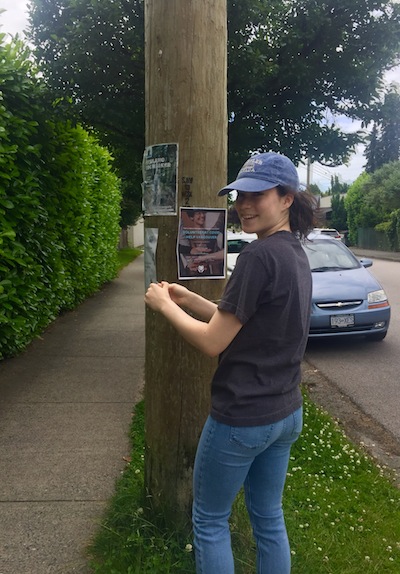
photo - COVIDhelp Vancouver’s director of outreach communication, Rebecca Baron, tapes a poster to an electricity pole to spread the word about the group’s services
COVIDhelp Vancouver’s director of outreach communication, Rebecca Baron, tapes a poster to an electricity pole to spread the word about the group’s services. (photo from COVIDhelp Vancouver)

Currently a third-year student in UBC’s Global Resource Systems Program, with a focus on global health and nutrition, Baron’s contributions to the community and beyond have been recognized. In 2017, she was the inaugural recipient of Temple Sholom’s Teen Tikkun Olam Award for her research on air quality and her efforts to address gender inequality in the sciences. That same year, she was one of the 18 young people honoured by the Jewish Independent with a JI Chai Award, receiving it for her science research and promotion, as well as her extensive and varied volunteer work.

Besides uniting volunteers with people in need, Baron’s other current pursuits include improving global literacy and advancing education for girls to ensure that all women receive equal opportunity in the workforce.

At present, there are more than 40 volunteers who have accomplished more than 30 tasks, and the COVIDhelp Vancouver team expects those numbers to grow.

The services offered are free, but the client has to arrange for payment of groceries and other goods. They can do this by paying the supplier directly or by ensuring the volunteer has the funds, pre-paying the helper via an e-transfer or PayPal payment, with cash as a last resort.

“All necessary precautions are maintained,” Baron said. “Our volunteers wear masks, use gloves and hand sanitizers and maintain social distance.”

She noted, “The current senior demographic in Vancouver makes up more than 15% of our entire population and this includes our grandparents, neighbours, great-aunts and -uncles. Those who are more likely to become severely ill or require intensive care might also experience a higher level of social isolation. The effects are compounded for those who don’t have access to technology platforms or have limited experience navigating the web. To help them stay connected, feel involved, purposeful and less lonely, we have created a COVID helpline. Now, all they have to do is dial our number and help will be on the way.”

COVIDhelp Vancouver stresses that all volunteers and users must adhere to health and hygiene requirements. Volunteers are screened before any client’s contact information is released.

Both founders of COVIDhelp Vancouver, Jiwa and Siddiqui, are masters of business management candidates at UBC. Jiwa, who just finished a bachelor’s degree in psychology, has a strong interest in the connections between social entrepreneurship and technology. For her part, Siddiqui hopes to create stronger pillars in society by strengthening social connections.

Other members of the team include volunteer coordinator Aimee Gray, who is completing her BSc in psychology at the University of Victoria and who also has an interest in learning about growing businesses, and Camryn Pederson, a UBC psychology student who wants to destigmatize mental illness and bolster community ties through volunteerism.

Those who wish to volunteer can do so by downloading the Zelos Team Management app on an iPhone or Android device, register as a volunteer and join the COVIDhelp Vancouver workspace. Volunteers should be healthy, display no symptoms of COVID-19, have not traveled or been in contact with anyone ill within the past 14 days and be practising social distancing.

Anyone who wants to spread the word by printing posters can download them from COVIDhelpvancouver.com.

Anyone who needs services should call 778-280-8686, leave a name and number and provide as much information about their request(s) as possible.

Sam Margolis has written for the Globe and Mail, the National Post, UPI and MSNBC.

Format ImagePosted on July 10, 2020July 9, 2020Author Sam MargolisCategories LocalTags coronavirus, COVID-19, COVIDhelp, Imaan Jiwa, Rebecca Baron, Riva Siddiqui, tikkun olam, UBC

Posts pagination

Previous page Page 1 … Page 9 Page 10 Page 11 … Page 30 Next page
Proudly powered by WordPress