Skip to content
  • Home
  • Subscribe / donate
  • Events calendar
  • Business Directory
  • FAQ
  • News
    • Local
    • National
    • Israel
    • World
    • עניין בחדשות
      A roundup of news in Canada and further afield, in Hebrew.
  • Opinion
    • From the JI
    • Op-Ed
  • Arts & Culture
    • Performing Arts
    • Music
    • Books
    • Visual Arts
    • TV & Film
  • Life
    • Celebrating the Holidays
    • Travel
    • The Daily Snooze
      Cartoons by Jacob Samuel
    • Mystery Photo
      Help the JI and JMABC fill in the gaps in our archives.
  • Community Links
    • Organizations, Etc.
    • Other News Sources & Blogs
  • JI Chai Celebration
  • JI@88! video

Recent Posts

  • Or Shalom reopens its doors
  • JFS from past to future
  • Need holistic approach
  • Sharing stories, advice
  • Journalist shares fears
  • Skills to live together
  • Road to independence
  • Cutting grass with scissors
  • Zionism as a solution
  • Deceit, desire & the divine
  • Reclaiming sacredness
  • Creative project ideas
  • Summer squares and cobbler
  • Thou shalt … summer commandments
  • Legal help for students
  • Revisiting myth of Lilith
  • Wrong person rebuked
  • Canada’s mixed messages
  • Questions for museum
  • Symposium on antizionism
  • Making soccer political
  • CJPAC lauds Pulver’s impact
  • City recognizes Vrba’s legacy  
  • Organ donation saves lives
  • Theodore’s March premiere
  • A healing Shabbaton
  • Supplying healthy food
  • A chime of metal tags
  • Yellowknife seder a first
  • Ishai energizes, unifies
  • A Lag b’Omer to remember
  • Expanding the healing
  • Hannah Senesh – a unique hero
  • Community milestones … May 2026
  • Sharing her testimony
  • Fall fight takes leap forward

Archives

Follow @JewishIndie
image - The CJN - Visit Us Banner - 300x600 - 101625

Tag: tikkun olam

Muslim leader an ally

Muslim leader an ally

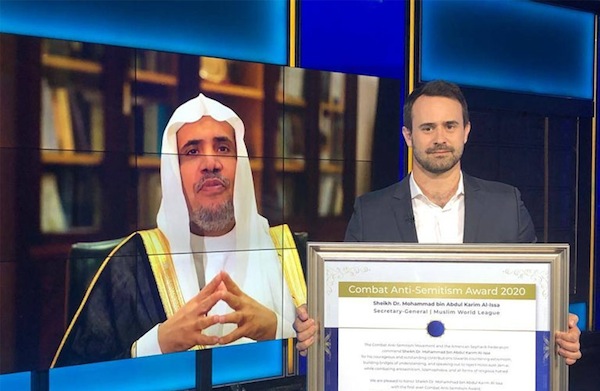
Sheikh Dr. Muhammad Al-Issa receives an award, virtually, from Sacha Roytman-Dratwa, director of the Combat Antisemitism Movement. (screenshot)

During a worldwide virtual event this month involving Jewish leaders and government officials from various countries, one of the leading figures in Sunni Islam was recognized for his work opposing antisemitism and Holocaust denial.

Sheikh Dr. Mohammed Al-Issa is the secretary-general of the Muslim World League and is a former minister of justice of Saudi Arabia. The Muslim World League is funded by the Saudi government, is based in Mecca and positions itself as a force for modernization and moderation in Saudi Arabia and the Muslim world. Earlier this year, Al-Issa led an historic trip of senior Muslim clerics and leaders to Auschwitz-Birkenau.

The online event, titled How Muslims and Jews Can Combat Anti-Semitism Together, featured Al-Issa via video from Saudi Arabia, joined by U.S. government officials including Sam Brownback, a former senator now ambassador-at-large for international religious freedom, and Elan Carr, special envoy for monitoring and combating antisemitism. The event was sponsored by the American Sephardi Federation and the Combat Antisemitism Movement, which bills itself as a non-partisan, global grassroots movement of individuals and organizations, across all religions and faiths, united to combat antisemitism. The organization’s director, Sacha Roytman-Dratwa, presented Al-Issa with the movement’s first annual award recognizing Muslim leadership against antisemitism.

“We have been reminded that, even in countries as advanced and multicultural as the United States, misunderstanding and mistrust is dangerous when allowed to fester,” Al-Issa said in an address that was translated from Arabic. “It can lead to anger, violence and social divisions that help no one. Everywhere in the world, we face challenges in building the bridges of communication, partnership and friendship. But, in a world with many complicated threats, from terrorism to global pandemics, our partnerships are more important than ever.”

He talked about the unifying global fight against coronavirus which, he said, “does not care if a person is Muslim or non-Muslim, Jew or non-Jew, Christian or non-Christian … rich or poor, educated or non-educated.”

That unity is a model for opposing the spread of hatred and intolerance, he said, even as extremists attempt to exploit the current uncertainty to push hatred and division.

He spoke of his visit in January to the death camp in Poland, as well as his numerous visits to synagogues and Jewish museums.

“I stood united alongside my Jewish brothers and said, ‘never again.’ Not for Jews, not for Muslims, not for Christians, not for Hindus, not for Sikhs, not for any of God’s children,” said Al-Issa. “History’s greatest horror, the Holocaust, must never be repeated.… The 1.1 million people murdered at Auschwitz were human beings, just like any other, just like any Muslim. And even though it has been 75 years since the gates of the Auschwitz death camp were torn down, creating a better world for future generations is a constant struggle that we must not give up on.”

He cited murders of Muslims in New Zealand, Christians in Sri Lanka and Jews in the United States as indications of the work remaining to be done.

“Whereas Jews and Muslims lived centuries together, in these last decades we have sadly grown apart,” he said. Since taking the helm of the Muslim World League in 2016, he has tried to build bridges with Jewish and Christian communities. He has also been vocal in fighting Holocaust denial in Muslim circles.

“There are those who still try to falsify history, who claim the Holocaust, the most despised crime in human history, is fiction,” he said. “We stand against these liars, no matter who they are or where they come from, for denying history can only serve to further the aims of those who perpetrate hateful ideas of racial, ethnic or religious purity.”

Continued genocides, in Darfur, Rwanda, Bosnia and now Myanmar, show that the lessons of the Holocaust are universal, he said.

“Muslims have a responsibility to learn them, heed the warning of history and stand as part of the international community to say, ‘never again,’” Al-Issa said. “We will act together to make just peace a reality for Jews and Muslims, and for all people, religions, civilizations and cultures.”

Format ImagePosted on June 26, 2020June 24, 2020Author Pat JohnsonCategories WorldTags American Sephardi Federation, anti-racism, Combat Antisemitism Movement, Mohammed Al-Issa, Muslim World League, tikkun olam

Providing meals, warmth

Several years ago, Chabad Richmond launched the Light of Shabbat program with the purpose of helping Richmond Jewish seniors celebrate Shabbat and feel connected. At first, the program involved making and delivering a free, homemade, kosher kugel and challah to six or seven Jewish seniors in the community every other week. As the program has grown, more people are receiving Shabbat meals, which now include soup, salad, a main dish, vegetables, dessert, Shabbat candles and grape juice.

Because of the COVID-19 crisis, the Light of Shabbat has expanded, and now approximately 140 meals are delivered every week to people in Richmond and beyond – an increase of more than 80%. And that number continues to grow. Now, not only seniors, but younger individuals, families and those in need can receive a Light of Shabbat meal weekly. Chabad Richmond hopes to expand the program even more.

A program like this doesn’t happen in a vacuum. More than 44 Light of Shabbat volunteers do everything from shopping, to food preparation, cooking, baking, packing and delivering the meals. Every volunteer plays an integral role.

Reaching out to help those in need is a core Jewish value. As we all know, the pandemic has resulted in people self-isolating, and many have little or no access to stores. Some have difficulty cooking, and others are simply feeling the desperation of social disconnection.

Supported through individual donations and foundation funding, Chabad Richmond’s year-round partner for the Light of Shabbat program is the Kehila Society. During the COVID-19 crisis, the Jewish Federation of Greater Vancouver has stepped forward and been supportive. In addition, Chabad Richmond has received donations of goods from Urist Cosmetics (hand sanitizer) and Real Canadian Superstore, Dan-D-Pak (food items), and a donor who wishes to remain anonymous provided facemasks.

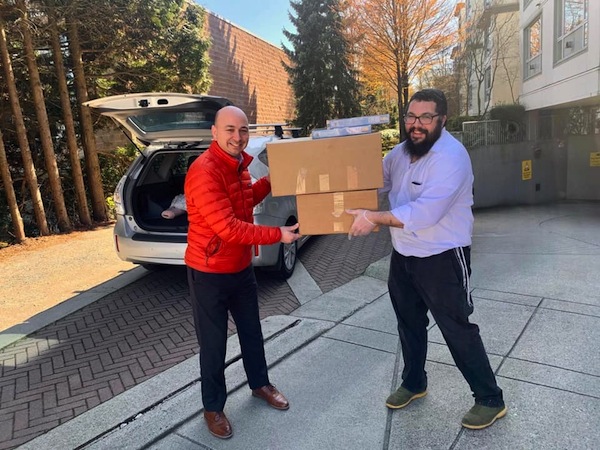
Several of the Light of Shabbat volunteers were recently interviewed. When asked about their personal experiences volunteering, many said they deliver the Shabbat meals. The volunteers deliver not only to seniors (some of whom have mobility issues), but also to people who have lost their jobs, people struggling with physical and mental health issues, and those who are grieving alone. As one volunteer said: “You just don’t know what people are going through right now.”

Several volunteers have gotten to know Light of Shabbat recipients quite well, have become part of their lives and have forged strong connections with them. A number of volunteers say they feel like a lifeline for the people they deliver to.

One volunteer started doing deliveries with his son before his son’s bar mitzvah a few years ago. Acknowledging that his own family is fortunate, he said: “It’s a way to show my son the importance of helping others, and expose him to a wide range of experiences.”

Every volunteer’s experience is different, but they all have one thing in common: they all enjoy volunteering and feel that they benefit as much if not more than those receiving the meals. “The socially distanced shmoozing and forming of new friendships is important to the people we deliver to,” said volunteer Jill Topp. “And to me, too.”

While the Light of Shabbat program is primarily for the Jewish community, volunteer Topp said that she delivers a weekly meal to a local Muslim family. The head of the family told her: “I don’t know what we would do without you.”

As for what motivates the volunteers, giving back to the community is key. One volunteer, who chose to remain anonymous, said she treasures celebrating Shabbat with her own family, and wants others to have that experience too, even if it’s only to eat a Shabbat meal.

Volunteer Michelle Zychlinski said, “Not only do the recipients appreciate the meal, but they really appreciate the social interaction,” even if it’s from a safe distance of two metres. “So, if I can help in some way, I’m happy to.”

Volunteer Yael Segal said, “I feel it’s my responsibility, as a part of this Jewish community, to help others. It’s my honour and privilege to do it.”

Yet another volunteer, Shannon Gorski, said she gets back tenfold what she puts into it and volunteer John Samuel said, “It’s so important that people have community support. They deserve to have a kosher meal on Shabbat and to feel connected.” Another volunteer said that this opportunity has “enlarged my life,” and she wants to do more.

The connections made between volunteers and recipients will likely last beyond the COVID-19 crisis, with quite a few volunteers saying that they definitely plan to visit with their newfound friends after it’s all over.

Segal said she rekindled an old friendship when she delivered the Shabbat meal to someone she hadn’t seen in years. “One of the Russian families I deliver to recognized me from when I first immigrated to Canada as a small child. I built a rapport with them and have a little visit each week. They really look forward to the visit and the Shabbat meal. Some of the people feel very isolated.”

In the end, it’s all about building relationships with members of the community. As one interviewee put it, “It’s so important for people in the community to know that they are not forgotten about. And it’s good to know that I’m making a difference. The Light of Shabbat program is a great means to connect with secular members of the community, too, and demonstrate that Chabad cares about them.”

Topp added, “I encourage anybody to volunteer – it’s a great thing for everyone involved.”

If you know someone who could benefit from the Light of Shabbat program, contact Chabad Richmond at 604-277-6427. If you would like to get involved as a volunteer with the program, go to chabadrichmond.com/lightofshabbat.

Posted on June 12, 2020June 11, 2020Author Chabad RichmondCategories LocalTags coronavirus, COVID-19, food, Judaism, Light of Shabbat, philanthropy, tikkun olam, volunteering

JFS uplifts with enewsletter

In the first eight weeks of Jewish Family Services Vancouver’s COVID-19 emergency response program, more than 400 calls were received, 1,500 meals and groceries were delivered, and 672 hours of service was provided on the Community Care Hotline. In addition to the challenges, JFS has also witnessed many stories of hope and gratitude, and has recently launched the enewsletter JFS Uplift, which every week will share highlights of what inspires JFS staff and volunteers to do the work they do. The lead story in the inaugural issue was on the new JFS Breakfast Club program.

On May 11, JFS staff came together to pack grocery bags full of healthy breakfast items and packets of Play-Doh as part of the club program. Fifty-eight families in several cities across Greater Vancouver received their goodies thanks to the help of volunteers.

“We realize parents are under much more stress during this time of uncertainty, especially given their added roles as teachers and ‘playmates.’ The Arnold and Anita Silber Family Foundation approached Tanja Demajo, the chief executive officer of JFS, to see where we could help. Together, we came up with the JFS Breakfast Club,” explained Arnold, Anita and Stacey Silber, sponsors of the club. “Breakfast is one of the most important meals of the day, so now healthy items are delivered to families. This is a great opportunity for us to get involved in supporting the health of young families. We hope to give parents one less thing to worry about during this difficult time.”

New families can register for the JFS Breakfast Club at jfsvancouver.ca/jfsbreakfastclub (some restrictions apply) and people who are interested in volunteering for JFS can email Kristina Moser at [email protected] or visit jfsvancouver.ca/emergencyvolunteer.

To subscribe to the JFS newsletter or for other information about JFS, visit jfsvancouver.ca.

Format ImagePosted on May 29, 2020May 28, 2020Author JFS VancouverCategories LocalTags COVID-19, families, JFS, Kristina Moser, Silber, tikkun olam
Sponsoring a refugee family

Sponsoring a refugee family

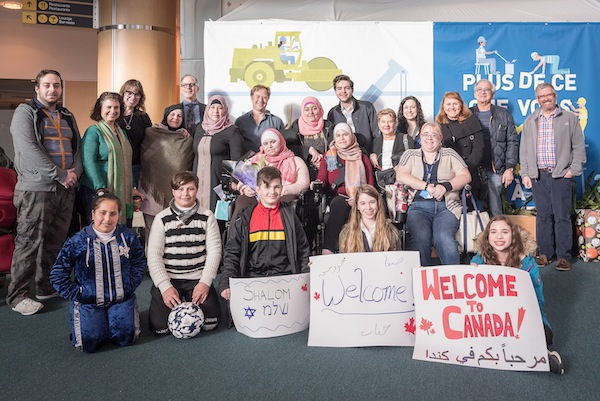
The Alsidawi family, sponsors and congregants at the Vancouver International Airport, January 2019. (photo by Adele Lewin Photography)

Canadian Jews have a long history of standing up for the rights and welfare of refugees. And while Jewish immigrants have often been at the receiving end of this generosity, Vancouver Jewish congregations have played a frequent and often crucial role in ensuring the safe relocation of many non-Jewish refugees as well. They have sponsored refugees from Tibet, families from Vietnam, as well as helped relocate Jews from North Africa and Hungary during times of political unrest. When Canada announced its intention to accept some 25,000 immigrants from in and around wartorn Syria in 2015, many Vancouver congregations once again stepped up to help.

The news of a little Syrian boy whose body had washed up onto a Turkish resort beach in 2015 became a haunting symbol of the war for many Canadians, Rosalind Karby and Miranda Burgess told the Independent. In November of that year, the two women, along with a small cadre of volunteers from congregations Beth Israel and Beth Tikvah, launched an appeal to sponsor a Kurdish family’s immigration to Canada. Karby, who is no stranger to philanthropic initiatives, said the decision to mobilize a sponsorship was a “no brainer” for her, and for many in the local Jewish community. “There’s no question. That [image] sort of galvanized us.”

By 2016, the effort to save Syrian civilians in peril had become an egalitarian issue: Orthodox, Conservative Reform and Renewal congregations here were finding their own ways to fundraise and reach out. In the Lower Mainland, Schara Tzedeck members voted to contribute funds to the Joint Distribution Committee’s humanitarian aid efforts, while Or Shalom, Temple Sholom, Beth Israel and Beth Tikvah applied to the federal government for permission to sponsor families to Canada.

Burgess said, for many, the decision to help fleeing Syrian families emanated from longstanding Jewish experience. “From wandering Aramaeans and other dispossessed Jews to post-Holocaust migrations, to a situation like this, it felt like a very direct line, I think, to a lot of people,” she said.

But, if the ethical decision to provide a lifeline for refugees was a “no brainer,” as Karby put it, the path to bringing that sponsorship to fruition was anything but simple. It was not merely a matter of overseeing their resettlement in Vancouver. There would be a long list of forms to fill out. There were meetings with immigration representatives and members of the Anglican Church archdiocese, which coordinated the sponsorship process for this program. And there were lengthy virtual meetings with the applicant family, who, for the time being, was living in a crowded refugee camp in eastern Jordan.

There was also an “exhaustive” number of details to collect, often over spotty wireless connections, to verify the family’s eligibility: education backgrounds, family histories, residences and connections for all adults. In all, about 40 pages of forms to fill out, said Burgess.

For the family, the application process had its own challenges. For Hanan Alsidawi, the mother, it meant repeated trips to the capital, Amman, an hour-and-a-half drive away from the refugee camp, to secure paperwork, signatures and permission. Her husband, who had been reported missing when the family fled Syria, had not been found. Making it to Canada safely now rested on Hanan’s own initiative and the kindness of strangers thousands of kilometres away in Vancouver.

Sponsoring a refugee family came with considerable financial responsibility. According to the Canadian government, the sponsors were in charge of covering all out-of-pocket costs for the family for one year, including food, lodging and incidentals. That meant the sponsors would need to have a minimum of $40,000 in the bank to qualify. Moreover, Burgess and Karby estimated, that was actually low: for a family of three, the cost of living would be closer to $50,000 a year. The team would need to raise at least $10,000 more than mandated by the government.

“At the time, BI had just completed five years of fundraising for the [synagogue’s] new building,” Karby said. It was also just wrapping up its annual High Holy Day Appeal, another important humanitarian project that relied on the congregation’s support. Asking the entire congregation to take on a third project – and quickly – seemed unrealistic.

After some thought, the sponsorship team decided to take a different tack: they would reach out to a smaller, select group of family and friends who might be able to cover the sponsorship. And they would put a top limit on each donation.

“We determined a maximum gift of $1,000 so that no one person would feel that they should just pay the whole thing and no one person could feel they had to meet up to some high standard,” Karby explained.

But that still meant coming up with at least 40 to 50 donations.

“So, we cast a wide net,” Burgess said. “We worked our networks.”

They appealed to donors both inside the congregations and out. They contacted people they knew had contributed to humanitarian initiatives before. And they appealed to friends far away.

“I went to graduate school in the United States and I have a big network south of the border,” Burgess admitted, noting that the idea struck a chord with American residents as well, “who, because of their own governmental circumstances weren’t able to do sponsorships but felt the same urgency.”

By the end of the appeal, they had received donations from as far away as Michigan, Massachusetts and Maryland. “All were very small, but contributed to the whole,” said Burgess.

They had met their goal – and then some. Karby said Beth Tikvah’s donation of $10,000, whose fundraising was coordinated by David Numerow, put the project over the top, bringing the total to just over $50,000.

Still, it took more than two years for the family to receive approval to immigrate. In January 2019, Hanan and her two children, Mahros and Safa, arrived at Vancouver International Airport to a fanfare of elated family and Jewish congregants. Some of the Alsidawi clan was already living in Vancouver, so Hanan and her children would be able to count on help with things like language interpretation and getting settled in their new city.

We were strangers, too

According to Congregation Beth Israel president Helen Pinsky, quite a number of BI congregants stepped up to support the initiative privately when it was announced. She said she chose to donate because the endeavour resonated with her values as a Jew.

“Many of us had been involved in sponsoring the Vietnamese refugees in the 1970s,” she said. “It had been a very happy, very successful experience for me.”

She said the experience taught her the value of such initiatives. The sponsorship, she said, “is certainly in keeping with our beliefs and how we should behave, according to our forefathers, and it seems like it is consistent with an organization of people who have strong feelings about pikuach nefesh, the saving of a soul.”

Rabbi Jonathan Infeld, who serves as Beth Israel’s head rabbi, said helping others is a core principle to the Jewish faith, specifically because of the historical experiences of the Jewish people.

“Torah tells us that we were foreigners in a foreign land and we need to care about foreigners, and people suffering,” Infeld said. That’s why the congregation – and other synagogues as well – felt it was essential to help Syrian families in distress. “We wanted to take up what the Torah told us in a very real, concrete way.”

Even though sponsors’ financial responsibilities ended in January, their bond with the Alsidawi family has not. Burgess and Karby continue to visit Hanan and her children and check up on their progress. By law, the sponsors are not permitted to offer further funding, and Karby admits that the transition will continue to take time for the small family.

For the volunteers, the past four years of effort was more than a gesture of generosity. It was crucial they help.

“You save one life, you save a world, and we were fated to do what, well, any human being should do, really,” said Karby. “But I think that our Jewish tradition of helping the needy, of trying to save a life definitely propelled Miranda and me.”

“Saving one life is as if you saved a whole world,” Burgess agreed. “And, now that geopolitics has intensified the Syrian crisis again and people are once again fleeing in vast numbers, I am so thankful we were able to help one family. I wish we could have helped all families, but to help one family is something and we were grateful we were able to do it.”

Jan Lee’s articles and blog posts have been published in B’nai B’rith Magazine, Voices of Conservative and Masorti Judaism, Times of Israel, as well as a number of business, environmental and travel publications. Her blog can be found at multiculturaljew.polestarpassages.com.

***

Note: This article has been amended to correct Rosalind Karby’s first name, which was misspelled in the original version.

Format ImagePosted on May 15, 2020June 5, 2020Author Jan LeeCategories LocalTags Alsidawi, Beth Israel, Beth Tikvah, Miranda Burgess, refugees, resettlement, Rosalind Karby, Syria, tikkun olam
Katz makes difference

Katz makes difference

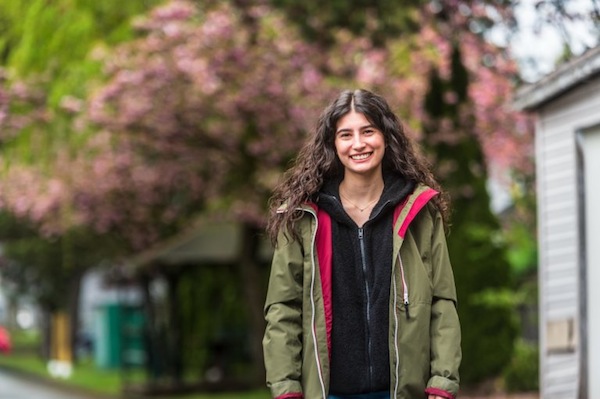
University of British Columbia student Ava Katz has been helping people with errands since the pandemic began. (photo by Paul Joseph/UBC)

First-year kinesiology student Ava Katz commutes to the University of British Columbia from Kerrisdale, where her housemates include her 91-year-old grandmother and a mother with a heart condition. In these extraordinary times, Katz doesn’t want her loved ones risking their health with unnecessary trips to the grocery store. So, in March, she began making those trips herself. As she was transporting groceries home from Save-On Foods, something occurred to her.

“It dawned on me that there are people in the community who don’t have family, who don’t have anyone else to go out for them,” said Katz.

Her final exams were just a couple of weeks away. It’s the time of year when most students’ instincts are telling them to clear their schedules of any distractions. Katz’s instincts were telling her to do something else.

She posted a public note on Facebook: “In wake of the spreading pandemic, I would like to offer my services to anyone who is compromised during this time. If you or someone you know is in need of groceries, household items, etc., please contact me directly and we can arrange for me to complete your needed errands free of charge.”

She indicated where she lived and her phone number, assuring people, “I will not enter your homes, only drop items off at the door. Priority goes to elders and individuals with compromised health. Please do not contact me to run errands for you if you are able and in good health.”

She asked readers to share the post. The calls came quickly. Just a couple at first, but more and more as her friends returned from school in the United States and overseas. They all had to self-isolate for 14 days, so they couldn’t do anything for their own grandparents who were shut in. Katz stepped in.

“That was just kind of a no-brainer for me,” she said. “I was happy to do those things, and still am.”

Katz has been shuttling to and from supermarkets and pharmacies all over Vancouver. Each outing brings her into the orbit of people who potentially carry the virus. Katz has heard the stories about the toll COVID-19 takes on its victims. She wears a mask and takes great care not to bring the virus to the people she’s helping.

She still makes the trips for her mom and grandmother, walks her two dogs, and also delivers food between two seniors homes twice a week as a volunteer for Congregation Beth Israel. It’s a lot to do, but, as far as Katz is concerned, it’s the least she can do.

“It definitely scares me that I could be exposing myself, but people need help,” she said. “I’d rather sacrifice myself than have a senior go into a grocery store and contract the virus instead.”

Many of the volunteers who were delivering food between the two seniors homes when COVID-19 arrived were older folks themselves. It was too risky for them to continue, so the congregation put out a call for new volunteers. Katz was among the first to step up, despite her busy exam schedule.

“Crisis brings out the best and the worst in people, and I think Ava is one of those examples of it bringing out the best,” said Krystine McInnes, volunteer coordinator for the synagogue. “The idea of selfless service and loving our neighbours as ourselves – she really embodies that.”

Helping people is in Katz’s blood. Her grandfather was a doctor for more than 60 years. She came to UBC thinking she would go into medicine eventually, too. Nothing during her first year has changed that. In fact, the COVID-19 outbreak has given her even more respect for the healthcare and support workers who keep our hospitals functioning every day.

“They are real heroes,” said Katz. “I have a huge respect for what it takes to provide care to so many people at a time like this and it reinforces my commitment to be a part of it.”

Format ImagePosted on May 15, 2020May 14, 2020Author Erik Rolfsen UBC Media RelationsCategories LocalTags Ava Katz, coronavirus, COVID-19, seniors, tikkun olam, UBC
Challah delivery

Challah delivery

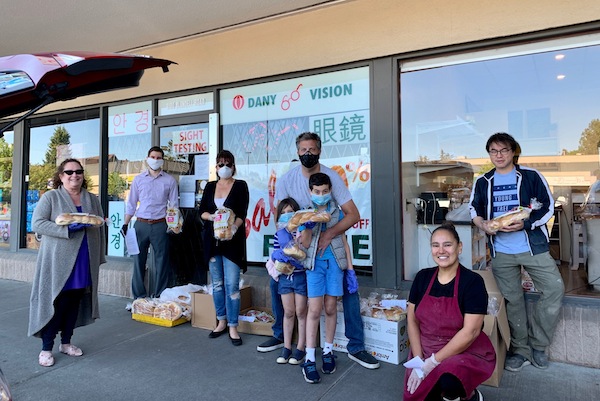
Left to right are Lynne Fader (Kehila Society), Adam Ben-Dov (Connect Me In), Toby Rubin (Kehila Society), Michael Sachs (with daughter Desi and son Izzy), Monica Flores and Steve Uy (Garden City Bakery). (photo from Kehila Society)

The Covid Challah Initiative was started by Michael Sachs and is a partnership between Richmond’s Kehila Society, Richmond’s Garden City Bakery, Jewish Federation of Greater Vancouver’s Connect Me In and North Vancouver’s Congregation Har El. The initiative aims to ensure that everyone in Metro Vancouver who needs a (free) challah is delivered one. (For the story of how the initiative started, see citynews1130.com/2020/05/03/challah-delivery-covid-richmond-family.) To sign up for a challah contact, visit jewishvancouver.com/challah-delivery. Each week’s registration opens on Monday and closes Thursday at noon – and people need to register each week, as this is not a recurring service.

Format ImagePosted on May 15, 2020May 14, 2020Author Kehila SocietyCategories LocalTags challah, Garden City Bakery, Har El, Jewish Federation, Kehila Society, Michael Sachs, tikkun olam
Community milestones … Lubavitch seders, JCC Jewish Book Award nominees

Community milestones … Lubavitch seders, JCC Jewish Book Award nominees

Ezra Shanken, executive director of Jewish Federation of Greater Vancouver, and Rabbi Chalom Loeub, chaplain of Chabad Jewish Student Centre, Vancouver, help with the delivery of seder meals. (photo from Lubavitch BC)

Lubavitch BC had its largest communal seder ever, with more than 1,000 participants. Families in Vancouver, Richmond, Surrey, Langley, Coquitlam, Burnaby, the North Shore and other areas of the province, enjoyed a complete seder with all the trimmings. And now is the time to say thank you to everyone who made this happen.

Firstly, Rabbi Yitzchak and Henia Wineberg, Rabbi Schneur and Shainy Wineberg, Rabbi Dovid and Chaya Rosenfeld thank Chabad of Richmond and the Community Kollel for partnering with Lubavitch BC to ensure that this project reached the largest number of people; Maple Grill, FortyOne Catering, Miriam Sklar and Lizzy Vaknin for their help with the organization and logistics; Sklar and Meir Jerbi for their help with packing and distribution; David and Diana Benjamin, Ezra Shanken, Glenn Berlow and numerous others for their help with the deliveries; and Rabbi Falik and Rebbetzin Simie Schtroks for coordinating the Langley and Surrey pickups and deliveries.

This project was not easy to accomplish in a short time. Extra amounts of matzah, wine, Haggadot, seder plates and Kiddush cups had to be sourced; ingredients and merchandise had to be purchased; and 1,000 meals had to be cooked and packed under the strict protocols of health and safety during COVID-19. Dozens of heartfelt notes of appreciation were received from members of the community, who shared how the project allowed them to have a wonderful Pesach under these difficult circumstances.

* * *

A program of the JCC Jewish Book Festival, the Western Canada Jewish Book Awards celebrate excellence in writing on Jewish themes and the achievements of authors from Western Canada. The shortlist for the 2020 honours was recently released. The winners were to be announced at a ceremony April 23, but that celebration has been postponed till later in the fall. The nominees are as follows.

  • The Nancy Richler Memorial Prize for Fiction: Daniel Goodwin (The Art of Being Lewis), Alex Leslie (We All Need to Eat) and Rhea Tregebov (Rue des Rosiers).
  • The Pinsky Givon Family Prize for Non-Fiction: Allan Levine (Seeking the Fabled City), Naomi K. Lewis (Tiny Lights for Travellers) and Heidi J.S. Tworek (News from Germany).
  • The Diamond Foundation Prize for Children/Youth: Jackie Mills (Little Synagogue on the Prairie), Ellen Schwartz (The Princess Dolls) and Harriet Zaidman (City on Strike).
  • The Lohn Foundation Prize for Poetry: Alex Leslie (Vancouver for Beginners), Dave Margoshes (Calendar of Reckoning) and Tom Wayman (Helpless Angels).
  • The Kahn Family Foundation Prize for writing on the Holocaust: Olga Campbell (A Whisper Across Time), Susan Garfield (Too Many Goodbyes) and Martha Salcudean (In Search of Light).
Format ImagePosted on April 24, 2020April 24, 2020Author Community members/organizationsCategories LocalTags books, JCC Jewish Book Festival, Jewish Community Centre, Lubavitch BC, Passover, tikkun olam, Western Canada Jewish Book Awards
NCJWC Vancouver plans, learns, noshes and welcomes newcomers

NCJWC Vancouver plans, learns, noshes and welcomes newcomers

Books for Kids volunteers at NCJWC Vancouver’s 96th AGM, left to right: Jodi Seidelman, Rhea Lazar, Gail Gumprich and Tanya Hebron. (photo from NCJWC Vancouver)

On International Women’s Day, March 8, National Council of Jewish Women of Canada, Vancouver section, planned, learned, noshed and welcomed newcomers.

Sunshine was all around the room at NCJWC Vancouver’s 96th annual general meeting, which took place at the Jewish Community Centre of Greater Vancouver in the Snider Senior Lounge.

Members were welcomed by president Catherine (Cate) Stoller and the new board was installed by Shirley Hyman, Limmud Vancouver program chair and longtime volunteer for NCJWC.

The new executive board is Stoller (president), Fran Ritch (treasurer), Jackie Krystal (co-treasurer), Linda Arato (recording secretary), Anne Lerner (vice-president, social action), Ricki Mintz (vice-president, engagement), Marnie Weinstein (vice-president, marketing and administration) and Rochelle Garfinkel (member-at-large). Appointed board members are Rhea Lazar (chair, Books for Kids program) and Sandy Hazan, Sarah Morel Shaffer and Jane Stoller (co-chairs, Operation Dressup).

After the AGM, Anna-Mae Wiesenthal, a Jewish history teacher at King David High School and a PhD student in Holocaust studies, gave a presentation on the “othering” of indigenous peoples in Canada during the settler colonial period and of Jews in Germany during the Holocaust.

Stressing the strong connection between NCJWC’s social action in the Jewish and non-Jewish communities in British Columbia, council’s advocacy nationally against antisemitism, its support for family services in Israel and its international role supporting human rights, Cate Stoller cheered the passing of the baton between generations. For more information about the Vancouver section of NCJWC, visit ncjwvancouver.org.

Format ImagePosted on March 27, 2020March 26, 2020Author NCJWC VancouverCategories LocalTags AGM, National Council of Jewish Women, NCJW, tikkun olam
Chai Lifeline in the city

Chai Lifeline in the city

A group of nine Jewish boys from Toronto was in Vancouver recently, courtesy of Chai Lifeline Canada. (photo from CLC)

A group of nine Toronto boys, aged 10-15, recently enjoyed a three-day, all-expenses-paid trip to Vancouver, courtesy of Chai Lifeline Canada, a national charity that supports the families of children or parents who suffer from serious illnesses.

The boys – each of whom has a sibling or parent who is sick – were invited on the trip as a diversion to their family challenges and as an opportunity to bond with other kids in similar situations. Students of seven different Toronto schools, the boys didn’t previously know one another, but came back from the Feb. 28-March 2 trip with strong, new friendships, said Chai Lifeline caseworker Shmuel Rosenberg.

Welcomed by the Vancouver Jewish community, the boys arrived in the city to a group of local boys handing out care packages and then joined them for an excursion to a trampoline park.

A special Shabbat was hosted by Congregation Schara Tzedeck, where the Toronto boys had the opportunity to bond with more of the local community and experience a walking tour of the city, led by Schara Tzedeck’s Rabbi Andrew Rosenblatt. Other weekend highlights included skating on the top of Grouse Mountain and hiking amid spectacular views.

Based in Toronto, with an office in Montreal, Chai Lifeline Canada has nearly 600 volunteers helping more than 2,000 family members nationally. The organization provides dozens of free initiatives to help give children stability and their families a sense of normalcy. Initiatives include counseling, tutoring for children missing extended periods of school, family retreats, sibling programs similar to that of Big Brothers, Big Sisters, and summer camps for kids. For more information, visit chailifelinecanada.org.

Format ImagePosted on March 20, 2020March 17, 2020Author Chai Lifeline CanadaCategories LocalTags Chai Lifeline Canada, education, Schara Tzedeck, tikkun olam, travel, youth
A focus on the environment

A focus on the environment

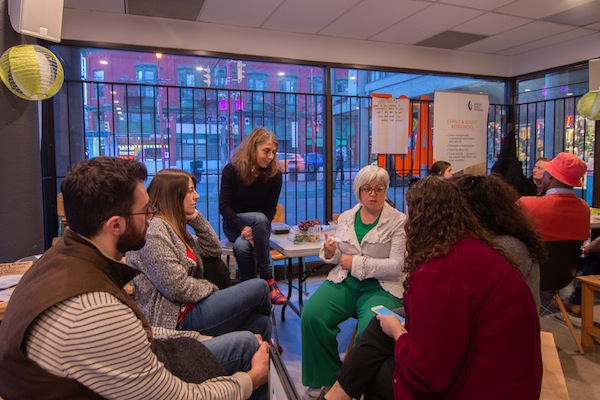
Transportation and sustainability consultant Tanya Paz, centre, participates in Tu b’Shevat Circle: Teachings from the Earth, an event spearheaded by Or Shalom Synagogue in partnership with Jewish Family Services, JQT Vancouver and UNIT/PITT Society for Art and Critical Awareness. Or Shalom’s Rabbi Hannah Dresner is seated on the stool to Paz’s right. (photo by Matt Hanns Schroeter)

More than two dozen individuals whose work involves food security and climate change issues met on Feb. 9 for Tu b’Shevat Circle: Teachings from the Earth, an event spearheaded by Or Shalom Synagogue in partnership with Jewish Family Services, JQT Vancouver and UNIT/PITT Society for Art and Critical Awareness.

Those who gathered work or devote time to such organizations as Grandview Woodland Food Connection, Sustainabiliteens, Coquitlam Farmers Market and Extinction Rebellion. They came together to explore various topics, including how their Jewishness intersects with their work in secular organizations, envisioning a sustainable world and the Jewish community’s role in social justice.

“I noticed that so many of these organizations are spearheaded by young Jews and felt it important to create an opportunity for them to see one another and recognize this aspect of kinship in their work … and whether this commonality enhances the work, draws them into kinship or stimulates any collaboration,” said Or Shalom’s Rabbi Hannah Dresner.

Or Shalom brought on Carmel Tanaka to organize a gathering. Through meetings with young adults and stakeholder groups, Tanaka met a number of people whose careers relate to food security and social justice, but most weren’t working for Jewish organizations nor were they connected to one another within a Jewish context. She and Dresner agreed it was worth bringing them together to see what conversations would blossom.

Tanja Demajo, chief executive officer of Jewish Family Services, said JFS provided funding for the event because they believed in the value of the project.

“There are a lot of Jewish and young Jewish people who are interested in food security and questions of accessibility, which is very interesting from a perspective of … whether this work is modulated by [Jewish] values and how this translates to day-to-day practice,” she said. “At the end of the day, it didn’t really matter if the different participants were working in a Jewish or non-Jewish community.”

Some attendees revealed that, for them, being Jewish is secondary to their focus on environmental issues.

“The room was full of people who identify in varying degrees with their Jewishness and, for some, it’s an important aspect of their identity and, for others, it isn’t integral,” Tanaka said.

Dresner spoke to the indelible connection between environmental action and Judaism. “In my understanding of Judaism, saving our world is at the heart of what it means to have a Jewish spiritual life,” she said. “Creative energy, or the vitality of spirit, is always flowing toward us. It’s what I’d call the ‘world that’s always coming,’ or the ongoing nature of creation. We can encourage and aid this vitality, helping to direct it where most needed, or we can impede the flow. When we are selfish and impede creative flow, the result is a deprivation of generative spirit, spirit denied to corners of creation, and we see results like species blinking into extinction.”

The rabbi wants to spend more time with young Jews working in social justice. “The Judaism I believe in mandates their work as the highest mitzvah of our moment,” she said. “It’s a misconception born of the compartmentalized Judaism in which many of us were raised not to understand that attention to the environment is a Jewish priority.”

Aaron Robinson, chair of Grow Local Society Tri-Cities, a food security group that runs the Coquitlam Farmers Market, said his work for the organization won’t ever have a Jewish mandate, but his Judaism is tied into what he does. “Personally, I can never underestimate the role that Jewish values play in the way I see the world, especially when it comes to tikkun olam,” he said, adding, “I guess it’s become engrained in me, but it was nice to bring it back to the surface to see, wow, there is this Jewish connection to all this work that we’re doing.”

Robinson appreciated the opportunity to connect with other Jews working in similar fields and hopes the conversations will continue.

Some people discussed not feeling supported by the Jewish community to undertake the work they do within a Jewish context. Tanaka said she believes the Vancouver Jewish community hasn’t focused attention on these issues until recently, citing the 2019 climate march and protests as a galvanizing factor, and said it’s time for the local community “to support young Jewish adults who are doing this kind of work … because these are Jewish issues at the end of the day.”

Some at the event suggested funding for environmental advocacy was needed. Dresner said there was also a desire for bridge building. “They seem to be asking for an arm of organized Jewish community to create some occasional containers for their gathering, just to share within the hybrid of their niche or to explore potential collaborations,” she said. “Or Shalom will be looking at finding funding to continue holding this group and its outgrowth in a loose, nurturing embrace.”

Demajo said the JFS food security program has already benefited from the event. “Being exposed to more city-wide programs and initiatives and being exposed to all different voices gives a different perspective to JFS,” she said, “because it opens up new ideas.”

Shelley Stein-Wotten is a freelance journalist and comedy writer. She has won awards for her creative non-fiction and screenwriting and enjoys writing about the arts and environmental issues. She is based on Vancouver Island.

Format ImagePosted on March 13, 2020March 12, 2020Author Shelley Stein-WottenCategories LocalTags Aaron Robinson, Carmel Tanaka, climate change, environment, food security, Hannah Dresner, JFS, Judaism, justice, Or Shalom, Tanja Demajo, tikkun olam, Tu b’Shevat, youth

Posts pagination

Previous page Page 1 … Page 10 Page 11 Page 12 … Page 30 Next page
Proudly powered by WordPress