Local team’s global impact

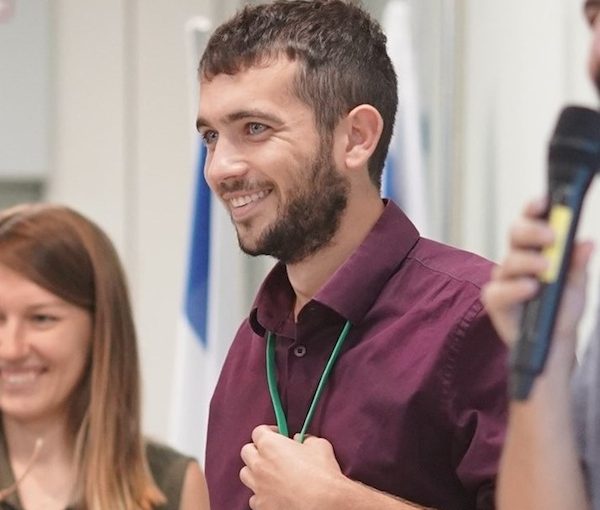
Ran Sommer (photo from the Walking School Bus)

Ran Sommer was working as a project manager for a health region and moonlighting as a volunteer for a very small Vancouver-based international education charity. A trip to India to see the charity’s work in action changed the direction of his career – and the course of the organization.

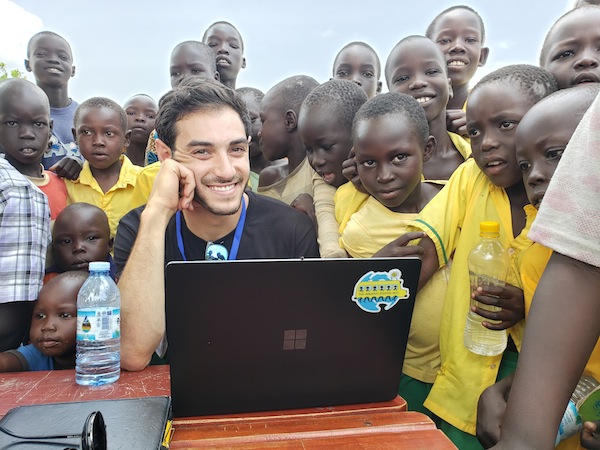
The Walking School Bus was the brainchild of another young innovator from the Vancouver area, Aaron Friedland, who has received numerous recognitions, including a Next Einstein award, which was presented by CNN’s Anderson Cooper, and as one of the Jewish Independent’s 18 Under 36 honourees. TWSB, as it is shorthanded, emerged out of a trip to Uganda

Friedland took, where he learned that many students in that country do not attend school because it is too far for them to walk. The first step in his venture to resolve the problem was a book by the same name, which started a fundraising campaign that led to the purchase of the first vehicle, which shuttles Ugandan kids to school then does duty as a taxi in the off hours to cover expenses and generate revenue for school materials.

When Sommer returned from earning undergraduate and master’s degrees at Wilfred Laurier University in Waterloo, Ont., Friedland was one of the first people with whom he reconnected. Both alumni of King David High School, they had been in the same social circles and Sommer had followed Friedland’s successes via social media. He came on board as a volunteer, serving as director of communications.

While Sommer was getting some good training at project management in his day job at the health authority, when he joined a self-funded trip to see TWSB’s operations in India, he was inspired to take a leap into the uncertain territory of a startup nonprofit.

“I was just so blown away to actually see what I was communicating about for the last year,” Sommer said, adding with a laugh: “To see not only that it was real [but] it was 10 times better than I thought it was and I should probably be communicating it better.”

The inspiration was mixed with sadness that he didn’t feel his full-time job was as meaningful. He and Friedland sat down, figured out how to scrape together enough to give Sommer a salary that would just cover his rent and expenses and Sommer became first-ever employee of TWSB, as director of operations. (Friedland was still unsalaried at the time.)

Despite rapid growth since Sommer’s hiring, it’s still a streamlined organization, with seven employees in Vancouver and eight overseas. But, with its tight budgets and small team, the organization has branched out in a range of directions.

The organization was never simply about getting kids from Point A to Point B. First, there is a research component. Graduate students develop symbiotic relationships with TWSB, joining self-funded excursions to the operations – now in India as well – and looking at data from the projects to enhance their delivery and outcome.

Once TWSB put in place the infrastructure to get students to school, they realized some were arriving hungry and thirsty, which impedes learning. The organization added water-catchment systems, chicken coops and community-supported agriculture to their operations. They developed supplementary curriculum, dovetailing with the objectives of the school systems where they work, including an offline database that serves as a sort of virtual library. In a country like Uganda, where a vast majority of the population does not have access to electricity, let alone wi-fi, the curriculum is aided by Raspberry Pi microcomputers – about $100 each – which can communicate with one another in a localized intranet, but not access the internet. Teachers can use the tablets to project material on screens – a benefit in places like some refugee camps TWSB works, where the teacher to student ratio can be one to about 260.

Throughout the charity’s projects are economic development initiatives that both help the communities they serve and create sustainable funding for their work. They created the BrightBox Macro classroom – a shipping container retrofitted into a solar-powered classroom. While students learn in a space that takes up about seven-eighths of the space, a solar charging room powers not only the shipping container classroom but the entire adjacent school. It also provides a charging hub, where people from the community can pay a few cents to charge their cellphones, tablets, flashlights or other electronics, similar to for-profit charging hubs common throughout the developing world. These fees will add up, according to projections, to eventually pay for the entire facility over time.

TWSB also has a small but aggressive fundraising arm that obtains grants from foundations and groups including National Geographic. The academic expeditions are funded by participants themselves, who are asked to raise an additional $1,000 to $2,000.

Based on studies that indicate students can double their reading comprehension exponentially in just months through the multisensory experience of reading the words while hearing them spoken, TWSB developed Simbi.

This “reading-while-listening application” uses different voices, accents and dialects to give the reader the most relevant voice available in their respective region. Again, outcomes are studied and the data shared to make the impacts greater. Simbi began as a part of TWSB curriculum program and then expanded independently as a startup aimed at an even broader market, with Friedland as chief executive officer, while he continues as executive director of TWSB. In addition to the thousands of students served by TWSB, Simbi is in use by another 10,000 who are not part of the project and the objective is to make Simbi available to unlimited numbers.

Through partnerships with Uganda’s minister of education and the United Nations refugee agency, TWSB has expanded its reach into refugee camps and remote public schools.

“There are currently 32,500 students who are interfacing with our technology,” Sommer said. In Uganda, there are 300,000 refugee students alone – not including others in low-income, remote or otherwise underserved communities. And, with expansion into India and a scalable model that they envision taking off globally,

Sommer predicts further exponential growth.

In addition to Sommer and Friedland both having attended Vancouver’s Jewish high school, there is another Jewish connection. The project began during Friedland’s studies in economics at McGill University, with the initial initiative launched within Uganda’s Abayudaya (Jewish) community.

While the Walking School Bus has grown, with 15 employees now around the world, its strength is still in the power of volunteerism, Sommer said.

“We’ve been able to maintain our values and the pillars of the organization because of an incredibly large army of volunteers that are so involved and motivated,” he said.
Most volunteer angels

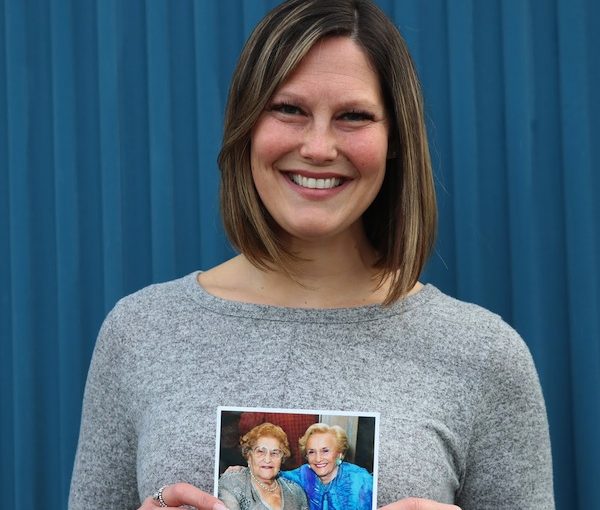
Courtney Cohen holds a photo of her grandmothers, Rose Lewin, left, and Babs Cohen. (photo by Lianne Cohen Photography)

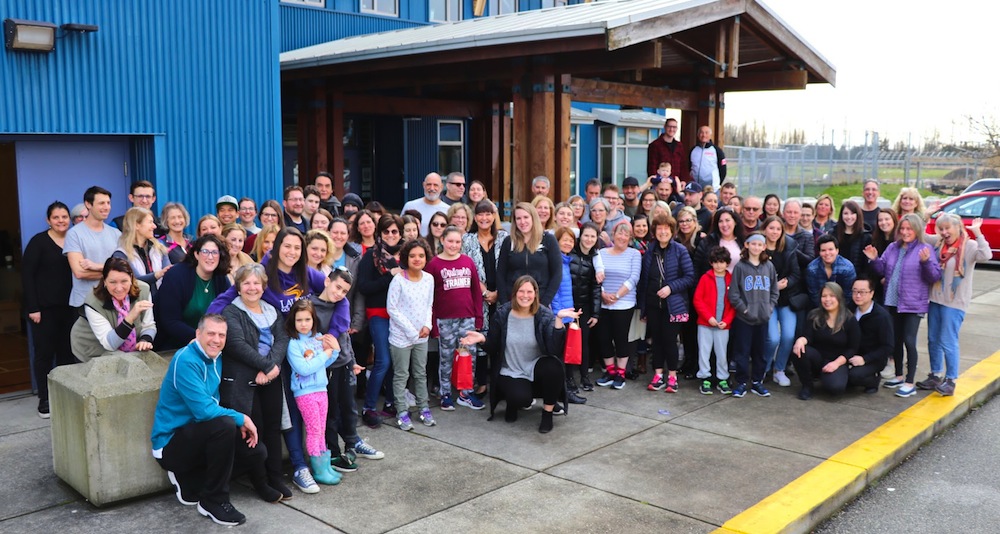
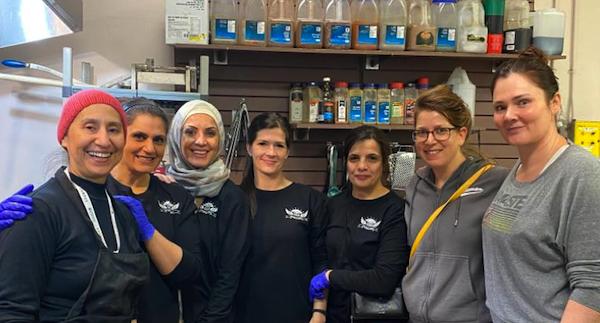
The seventh annual Rose’s Angels took place at Richmond Jewish Day School on Feb. 16. Held under the umbrella of the Kehila Society of Richmond, the event was founded by Courtney Cohen and Lynne Fader in 2013, in memory of Cohen’s grandmothers, Rose Lewin, who was a Holocaust survivor, and Babs Cohen. This year’s gathering saw the largest turnout for volunteers, with approximately 80 family, friends and community members coming together to assemble more than 1,000 care packages and several hundred warmth bundles, which were delivered to partner agencies.

A total of 24 not-for-profit agencies receive the care packages for their clients. Participating agencies included, but were not limited to, Richmond Family Place, Chimo Community Services, Jewish Family Services, Richmond Food Bank, Richmond Centre for Disability, Heart of Richmond AIDS Society, RainCity Housing, Richmond Multicultural Community Services and Gilmore Park United Church.

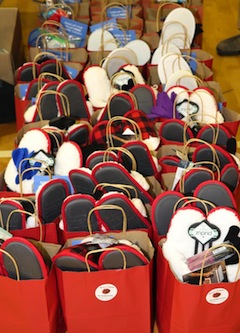
photo - More than 1,000 care packages were packaged on Feb. 16
More than 1,000 care packages were packaged on Feb. 16. (photo by Lianne Cohen Photography)

The packages consisted of toiletries, such as shampoo, soap and toothbrush; feminine hygiene products, including tampons, hair accessories, nail file and makeup; books, note pads, and arts and craft supplies; non-perishable food items, such as juice, oatmeal, granola bars, soup, coffee packets, trail mix and chocolate; and socks, gloves and scarves.

The items included in the packages were tailored to meet the needs of the recipients, as Fader and Cohen asked the agencies involved to survey their clients as to what items they would like to receive. The feminine hygiene and makeup products are donated via the Beauty for Babs component of Rose’s Angels, said Cohen.

“This event would not be possible,” she said, “if it wasn’t for our incredible donors and volunteers, who allow this event to be successful year after year. Individuals and businesses donate to Rose’s Angels through the Kehila Society of Richmond.”

photo - Volunteers at this year’s Rose’s Angels, which took place on Feb. 16 at Richmond Jewish Day School
Volunteers at this year’s Rose’s Angels, which took place on Feb. 16 at Richmond Jewish Day School. (photo by Lianne Cohen Photography)

She added, “People want to volunteer in their community and, sometimes, they don’t have the resources or connections that allow them to carry out their desire to give back. Rose’s Angels has grown into a strong pillar event in our community and it’s wonderful to see volunteers of all ages coming together to assemble care packages for those who they will never meet. It’s inspirational.”

Rose’s Angels takes place in February because, said Cohen, February is a special month – it’s Heart Month, Valentine’s Day and the month of her grandmother Rose Lewin’s birthday. Since its inception in 2013, the annual event has created and donated more than 5,000 care packages Richmond-wide, she said.

For more information about Rose’s Angels or to make a donation, contact Cohen or Fader at the Kehila Society of Richmond, 604-241-9270, or rosesangelsevent@gmail.com. For more information about the Kehila Society, visit kehilasociety.org.


Climate hot topic at Limmud

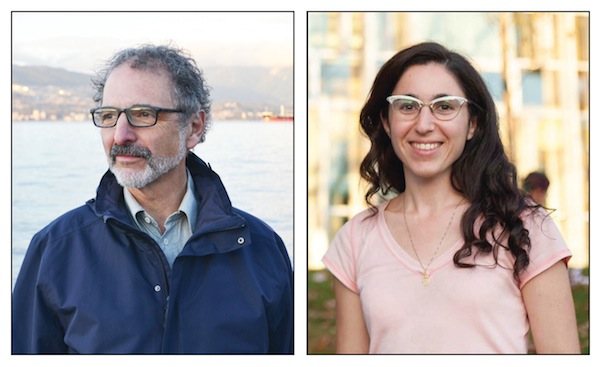
Dr. Larry Barzelai and Maayan Kreitzman will talk about environmental activism at Limmud on March 1. (photos from the interviewees)

Environmental activism is among Canada’s top news stories in recent days and the issue will be confronted from both a Jewish and a broader perspective by two leading voices at Limmud Vancouver next month.

Dr. Larry Barzelai, a Vancouver family doctor, assistant professor at the University of British Columbia’s faculty of medicine and B.C. chair of Canadian Association of Physicians for the Environment (CAPE), will present alongside Maayan Kreitzman, a PhD candidate at the Institute for Resources, Environment and Sustainability at UBC. The pair acknowledges that they come at the topic using different tactics, but aim for the same objective.

Kreitzman has been among those blockading the port and traffic.

“The actions happening in the streets right now are in response to this Coastal GasLink natural gas pipeline construction on Wet’suwet’an land,” she said. But this is only one element of the much larger picture, which is that oil and gas development is “occurring unabated and greenhouse gas emissions and ecological destruction is continuing unabated throughout the world, when we know that these activities are threatening our life-support system and are putting billions of people at risk over the next decade. People are already being impacted today.”

The issue brings together a host of concerns, she said, including “indigenous rights and sovereignty, the Canadian government’s complicity in a climate-unsafe future … as well as the business side of that from the private sector.”

Kreitzman has heard the complaints that disruptive protests may turn off potential allies and anger the general public.

“I think people’s emotions are valid and there is a valid concern about disrupting ordinary people that need to make a living and need to take care of their families,” she told the Independent. “On the other hand, I think many of the people that sometimes make these kind of complaints aren’t really the people that are struggling to feed their families. People that come from a place of privilege need to recognize that these protests inconveniencing them is a small price to pay for the types of progressive changes that will benefit all of us, including their children.”

Kreitzman said she and Barzelai will “bring a concise summary of the latest science to people so that they really understand the magnitude of the situation that we’re in.”

She said, “We’ll be speaking to a spectrum of different actions, from the personal to the more conventional campaigning type of approaches, like report-writing, research, lobbying, letter-writing, to direct-action approaches, which is what I’m most interested in, where people that have privilege start putting their bodies on the line and breaking the law on purpose, using the message of nonviolent civil resistance, which has been successful in many movements throughout history.”

Barzelai takes a more conventional approach to advocacy, but shares Kreitzman’s sense of urgency.

“Climate change, which we’re calling a climate emergency, is upon us,” he told the Independent. “It’s dramatic and we have to take big steps to do something about it. Maayan is taking a bit more radical approach to this. Myself and my group are a bit more middle-of-the-road, shall we say, but I think we both have the same endpoint in mind – that things have to change dramatically.”

CAPE, which has been around for about 25 years, focuses on the health impacts of environmental decisions and climate change.

“We see diseases that are spreading, we see cancers that are becoming more rampant, we are seeing the floods and the wildfires and the temperature changes that are dramatically affecting people’s health and we figure it’s our responsibility as doctors to look at climate change from a health perspective and to inform people of what’s going to happen unless we make dramatic changes,” he said.

Fracking is one area where he thinks British Columbia is “really going down the wrong path.”

“They’ve bought this myth that natural gas is clean energy, which it is absolutely not, and they are doing their best to increase rather than decrease global warming, and we think that’s the crucial issue that needs to be discussed in Canada and especially in B.C.,” he said.

Kreitzman and Barzelai will speak at Limmud Vancouver on March 1.

Tickets and more information can be found at limmudvancouver.com.

Help save local media

(photo from arkells.com)

In what seems like a random act of kindness, the Canadian rock band the Arkells has put out an offer to their fans. Subscribe to a community newspaper and get a swag T-shirt from the band.

Musicians are facing their own challenges these days, as streaming services are upending the traditional royalty and revenue streams of their industry. But they are perhaps not yet at the level of near-desperation the print media sector has been facing in recent years. The advent of the internet and other factors (but mostly the internet) have made people expect for free things we used to access primarily through purchasing.

Oddly, perhaps, many of us are prepared to pay for multiple subscription services for media – Spotify for music, Netflix, Crave, Disney and an ever-growing number of video services – but most people still react to paywalls on print media by finding a free (to them) alternative. As a result, print outlets from the New York Times and the Globe and Mail to, well, the Jewish Independent have struggled to find alternative sources of revenue and the means to compensate for the reality that readers are demanding (and getting) for free what they once paid for.

In keeping with the issue-driven approach to songwriting for which the Hamilton-based band is known, it was a pleasant and heartfelt message that the Arkells – whose lead singer, Max Kerman, is a member of the Jewish community – put out to their fans.

“If you’re an engaged member of your community, you’re probably thankful for the people who report the news. And even if you’re not, you’re probably still reassured to know that someone is keeping tabs,” they write.

“Good reporting not only keeps us in the loop, but also makes sure our big wigs are held accountable – to ensure there is no sneaky biz.

“Somewhere along the way, we took this for granted. We forgot that we have to pay for this vital service, and that reporting the news isn’t free. In our own city, we’ve seen our local newspaper continue to shrink, and we worry about its future and the future of other local newspapers.”

The band invites their fans to join them in investing in “the things that truly matter.”

“Let’s start,” they write, “by supporting your local paper or a daily publication you really admire. It’s been years in the making. No more running from that paywall.”

They are asking listeners to take out a year-long paid subscription to a print or online media platform (or gift one to a friend) and to let them – the Arkells – know. Then the specially designed band T-shirt will be on its way to you.

Obviously, a gesture like this is not going to save the industry. But it is sweet nonetheless, especially to see someone without a vested interest making this case. Then again, maybe their point is that every citizen does have a vested interest in the success, or at least survival, of local media.

For the Jewish community in British Columbia … that’s us! For 90 years now, the Independent and our previous incarnation the Jewish Western Bulletin have been printing the first draft of our community’s history. At the risk of sounding self-aggrandizing, there are times when we write stories as much for posterity as for this week’s readers. We know that the archives of this paper is often the first destination for people researching aspects of our community’s history. We believe that, decades hence, researchers will see in a visit to Vancouver by a renowned researcher or an act of tikkun olam or a project by local high school students as the germ of a movement, or a way-station in the progress of an idea, that is significant in its own right but also speaks to a larger trend in our community or society. Or maybe someone will just enjoy the read. In other words, we view our work as immediate and, ideally, enduring in some manner even we cannot foresee.

While in many cities across North America, the local paper is operated by the Jewish federation, here it has been run for well more than a half-century now by independent business operators taking a not insignificant risk for the community’s benefit. Operating a Jewish newspaper was never going to be the route to riches. The remarkably small number of people who have led this endeavour over the past nine decades knew this at the outset. But the challenges of the 21st century are particularly acute.

We thank you for your support and humbly ask you to recommit to our shared enterprise in this, our 90th, year. Perhaps a gift subscription to family or friends – especially younger generations, whose engagement is critical not only for the future of our newspaper but for our community. Or simply a gift to help sustain the paper, which would mean a great deal to the small team that puts this package together each week and, we believe, to the strength and future viability of our community. Plus, you could get a cool shirt for you, your kids or grandkids if you let the Arkells know about it!

Community planning critical

Alex Cristall, chair of the board of directors of the Jewish Federation of Greater Vancouver. (photo from JFGV)

Long active in the Jewish community, Alex Cristall started his current volunteer position as chair of the board of directors of the Jewish Federation of Greater Vancouver in June 2019. He spoke to the Jewish Independent about the role, and where he sees the organization as it enters a new decade.

JI: Could you go over your professional background and your work with Jewish organizations?

AC: I grew up in this community and was always surrounded by a culture of volunteerism. My professional background is in real estate investment, and my family’s values always drove our approach to business and to community involvement. From my grandparents to my parents to the way my wife Jodi and I are raising our children, giving back and getting involved with community has always been a priority, both in and out of the office. I started volunteering as a young adult and it’s grown from there.

JI: How did you become chair of Federation?

AC: Before taking on the role of board chair, I held a number of other leadership positions with Jewish Federation and with other organizations. At Federation, I served as chair of the 2016 and 2017 Federation annual campaigns, as chair of major donors, chair of men’s philanthropy and as a member of the board.

Anyone who knows me knows my love of sports, so my previous involvement with the JCC Maccabi Games and with Maccabi Canada came about very naturally. I also chaired the JCC Sports Dinner.

Serving as vice-president and then president of the JCC [Jewish Community Centre of Greater Vancouver] was instrumental in giving me a unique perspective that has been indispensable as chair of Jewish Federation. I got to see firsthand how important the partnerships between the organizations are, and how much partners rely on the community planning and fundraising expertise that Jewish Federation brings. At the time, Jewish Federation organized local missions, where we visited various partners, including the Jewish Food Bank and Tikva Housing Society, and learned about the range of needs in our community – and the range of responses.

It was very eye-opening, and that was when I got involved in men’s philanthropy at Jewish Federation and decided to learn more about the community. That ultimately led to a role on Jewish Federation’s allocations committee, where we were fully immersed in the entire breadth and depth of need – and opportunity for impact – in our community.

In my mid-30s, I was fortunate to travel to Ethiopia with members of Jewish Federation’s National Young Leadership Cabinet to see the work we were doing there with two of our international partners, the Joint Distribution Committee and the Jewish Agency for Israel. That was where I really began to understand the big picture of what we can accomplish for world Jewry in need.

More recently, I was able to visit our partnership region in Israel and learn about the particular challenges of living in the north, and the impact we’ve been able to make there as the result of a long-term strategic focus.

I’ve been in Israel many times, but, in terms of our partnership region and Beit Vancouver, this past spring was my first visit. It’s such a successful country overall, but I really saw the inequity that exists in the periphery. To see the contributions of our community and the future development plans of the region was inspiring, as was seeing what our Israel and overseas affairs committee, through annual campaign funds, and many local families are doing there with their investments…. It was very rewarding.

We need to continue to raise up that entire region…. Every mayor of our region came to greet us and that’s how you know how important our dollars are for youth. So many different things going on. When you see the respect that the different mayors have for the work we do and the people involved, it’s clear that our impact matters.

JI: What are your goals looking ahead?

AC: Our community is growing and changing all the time. As a Federation, we have been changing alongside it, which is positioning us to effect positive change in ways that can make an impact now and into the future.

We have a unique role in the community in terms of our planning function, and it’s a critically important piece that we bring to the table. We are focused on planning strategically to identify and prioritize needs locally, as well as in our partnership region in Israel. Our donors and fund-holders at the Jewish Community Foundation help us meet these needs. The partnerships we have developed over the decades are key to being able to get the work done in ways that are going to create lasting change.

We have made progress on every one of the areas of opportunity we identified in the strategic priorities, from affordability and accessibility, to seniors, engagement and, of course, community security. With big picture issues like these, the outlook is for the long term and so the work is ongoing.

At the end of the day, I would like people in our community to say that we made it easier for them to live Jewishly – whether that’s because we helped make a Jewish program more affordable, because we reached out to them where they live, because their aging parents were able to access a seniors’ program, or what have you.

JI: What challenges do you see before you?

AC: Our community is growing and its needs are constantly evolving, so there is always a lot of work to do, and that makes it exciting. I love a good challenge, and there are challenges everywhere we turn.

This community looks so different from when I was a child here. Even in the last decade it’s changed considerably. We’re more spread out and we’re more diverse.

More than half of our community is comprised of children, youth and young families, many of whom are really crunched by the high cost of living, and many of whom see their Jewish community engagement in ways that are very different from previous generations. At the same time, we have a growing population of Jewish seniors who need to stay connected and supported as they age. These are two of the big challenges facing our community right now. We also need to continue to meet our community’s needs through diverse revenue sources.

And last, of course, is the upcoming redevelopment of the JCC site into a true community hub. It’s still in the early stages, but Jewish Federation is poised to play an important role in this when the time comes. We’re proud to have entered into a memorandum of agreement with the JCC. [See jewishindependent.ca/historic-jcc-fed-agreement.]

JI: What excites you about the role?

AC: I feel very fortunate to work with an incredible group of volunteer leaders and professional staff, all of whom genuinely care about this community and about Israel.

From a personal perspective, some of the best lessons I’ve learned have come from volunteering with different community members and working with the Federation staff…. It’s very rewarding to meet with people in the community and see the reach and the impact of the good work we’re doing.

JI: What accomplishments are you most proud of thus far?

AC: One thing I am very proud of is how our donors have come to rely on Jewish Federation for our breadth of knowledge of community needs, our strategic approach and the strong relationships we’ve developed. Many of them trust us with all of their Jewish community philanthropy, and they come to us first when they have questions about where and how they want to make an impact.

I think we can be very proud of how we have taken a very strategic approach to growing the financial resources we generate, whether that’s through the annual campaign, through special project funding, or through legacy giving at the Jewish Community Foundation. As a result, our partners have more ways to access funding for the vital programs and services that align with high-priority community needs.

Community security is an area where we wish we didn’t have to focus our attention, but the reality is that we do. It was the first thing I really championed as chair of the annual campaign in 2016, and it was one of the first areas of strategic investment that we addressed from our 2020 Strategic Priorities [ourcommunity2020.jewishvancouver.com]. Since then, our community security advisory committee has taken an active role in addressing needs in this area and, on their advice, we hired a director of community security. Together, they are creating a culture of security consciousness.

Sam Margolis has written for the Globe and Mail, the National Post, UPI and MSNBC.

When Joseph went missing

A friend recently went through a scary time and, as a result, I did, too. His niece in Minnesota, a young mother, simply disappeared. She went out on a date and didn’t come home. Her mother was with the woman’s children. When she didn’t know what to do, she contacted police, the story was in the media and the important, informal networks of the Missing and Murdered Indigenous Women and Girls (MMIWG) swung into action.

Like many friends, I tried to pass the word along about a woman who was missing. Her family needed her. My friend couldn’t sleep. He worried. I worried. The worst part seemed to be not knowing how to help, what to do and what happened. Things seemed very dangerous.

Some in the Jewish community may say, this isn’t about me. They would be wrong on several levels. First, and most apparent, your prejudice is showing. There are many Jewish community members who have ties to multiple other communities in Canada. Yes, there are indigenous Jews; as well, there are many other cross-cultural, interreligious and inter-ethnic family connections of which you may not be aware.

Second, anyone can be at risk. Missing people and human trafficking are as old as time. When Joseph’s brothers throw him into a pit and then sell him to the Ishmaelites (Genesis 37:28), they’re participating in human trafficking and slavery. They turn Joseph into a missing person. His parents go through the anguish of not knowing what happened to their child. If you’re a parent or, heck, if you’ve ever lost a pet, it’s not hard to imagine this anguish.

Rashi’s commentary says that Joseph was sold several times. According to Midrash Tanhuma, he’s sold from the Ishmaelites to the Midianites and, from there, into Egypt. This description is not unlike what happens now to women captured in wartime. News reports offer similar stories of women enslaved today – by Boko Haram or, to mention refugees closer to home, Yazidi women who were enslaved by ISIS, some of whom have found homes in Canada.

Some believe slavery is a thing of the past, tied to faraway, evil people – like the narratives I’ve heard from Canadians about the American South. People might be evil, but they aren’t far away. This is a modern issue. Once a person is being trafficked, it’s very hard to break free. She’s possibly been forcibly confined, addicted to drugs, beaten and sexually assaulted. She may be hidden, unable to get help, and brainwashed by those who kidnapped her.

There are charities that work against human trafficking, and many nongovernmental organizations do, as well. However, I was recently invited to participate in a raffle. The business offered a prize in exchange for donating to an anti-trafficking organization. I got as far as clicking through to the organization’s donation page before I saw that it did its work through a lens of Christian evangelizing. Here’s what I found: “Agape International Missions has an incredible team of staff members and volunteers who faithfully carry out our mission, day in and day out. At AIM, we believe that Christ through His Church will defeat the evil of sex trafficking, so we invite you, the Church, to join us in this fight!”

Further, if you wanted to work for them, and you’re not Christian? Too bad. Here’s what their job search info looked like: “You should consider pursuing a career with AIM if: You’re a Christian; You agree wholeheartedly with our Statement of Faith. As the foundation for all we do, our Christian faith is a uniting factor among volunteers and staff.”

Essentially, this Christian organization uses an “us” versus them narrative, in which this religiously motivated group is all good. They are out to conquer this evil that happens to faraway (non-Christian) others. Sadly, if you change the religious ideology, I’m not sure Jewish communities are much different in how we portray social action issues.

Kidnapping, human trafficking, using sex as a weapon – many people like to think these terrible things don’t happen to “us.” However, this naïve view harms victims, perpetuating the idea that these things only happen to people far away or long ago, or who somehow did something wrong to deserve it.

Joseph, according to Jewish tradition, was our relative, a part of our family. His brothers kidnapped and sold him. My friend’s niece went missing this winter. This isn’t some ancient or distant problem. Some argue that, if Joseph hadn’t been his father’s favourite, or if he’d behaved better, this wouldn’t have happened to him – this is blaming a victim.

In Joseph’s case, he lived. He was found, and he flourished over time, in Egypt. My friend’s niece came home to her mother and children after a week. It’s still unclear what happened to her. It sounds like something like human trafficking may have taken place. We (helpers outside the family) may never know.

Every time a missing person is found safe, it’s lucky – but it’s not a sure thing. Often, many hundreds of people’s efforts go into finding someone, and keeping others safe.

If you’re sent a missing person’s information, don’t judge whether or not the person is “worthy.” Send it onwards. Just imagine if your relative or friend went missing – wouldn’t you want everyone’s help, without judgment or religious prejudice?

Joanne Seiff has written regularly for CBC Manitoba and various Jewish publications. She is the author of three books, including From the Outside In: Jewish Post Columns 2015-2016, a collection of essays available for digital download or as a paperback from Amazon. Check her out on Instagram @yrnspinner or at joanneseiff.blogspot.com.

Inspiring optimism with art

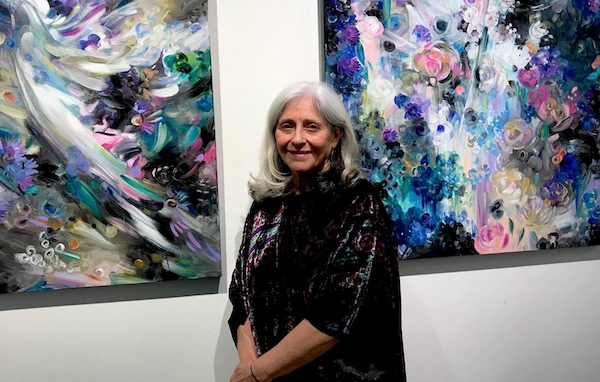
Linda Frimer’s exhibit, Beckoned by the Light, runs until Feb. 23 at the Zack Gallery. (photo from Linda Frimer)

“Since I was a child, I’ve always looked for the light – in the forest near my home and in the stories of my family. All the paintings in my show were inspired by light, the light of creation,” said Linda Frimer.

The exhibit, Beckoned by the Light, opened at the Zack Gallery on Jan 30. Originally, Frimer thought that her show would open simultaneously with the launch of her upcoming book, Connecting the Dots, and this is why the gallery exhibit opened in conjunction with the Cherie Smith JCC Jewish Book Festival. But life interfered, and the book is still a work-in-progress. Nevertheless, Frimer told the Independent, “I decided to go ahead with the show.”

Frimer’s paintings are beautiful, suffused with light. They are closer to impressionism than to realism, but every piece is unmistakably and uniquely hers. Light bathes the trees and the streams. It filters among the branches. It soars on dove’s wings over brilliant abstractions and illuminates mysterious paths winding through the woods. Light bursts into explosions of gladness and swirls like dancing fairies, inviting gallery visitors to share the luminous joy, to rejoice in the rainbow of colours.

“When I paint, I want to be positive,” the artist said. “Life is hard. That’s why I want joy in my paintings.”

To express her joy, Frimer uses bright colours, including gold and silver. “Gold and silver are great for all the recurring symbols in my paintings,” she explained. “One of my favourite symbols is wings – wings of the birds, like a dove, which is a metaphor for light.”

Another symbol that appears frequently is a tree. “Trees have wings, too. Sure, they are rooted in earth, but they reach for the sky, for the light,” Frimer said.

One more symbol populates many of her paintings – a flower, specifically a sunflower, which always strives to stretch higher, to touch the sun.

And then there are paths, roads to the light. Or to a better place. Or to someone you love. “I love people,” she said. “Love being a member of a group. I’m a member of several different groups.”

One of her groups – with five artist friends – attended her opening night and brought a gift: a wooden staff adorned with symbols of her art. Each object that was attached to the staff was created by a member of the group.

“We met through a project of the Hebrew University about 15 years ago,” Frimer said. “Now, we meet regularly, support each other in life and art. Whenever one of us has a show, the rest of us always make something symbolic for her.”

The group comprises Frimer, Nomi Kaplan, Lilian Broca, Barbara Heller, Sid Akselrod and Melenie Fleischer. “We call our group Five Hens and a Rooster,” Fleischer said with a laugh, as she presented the group’s gift to Frimer.

Music also plays a big part in Frimer’s artistic life. One could almost hear notes thrumming in her imagery. “I often listen to music when I paint,” she said. “I even dance sometimes. I love classical music, pop, all kinds, really.”

Frimer always starts a painting with an idea, but then her imagination takes over. “I follow my intuition,” she said. “Painting is a spiritual act for me. It’s like meditation. I love the process, the magic of creating. It’s wonderful to be able to express all that positive energy.”

In her opinion, everyone is an artist. Not necessarily a visual artist, but we all create in our own way. “It’s about how you feel, how you express yourself,” she said. “The process is much more important than the end result. I taught art a lot and I facilitated several healing artistic projects. It is great when I can help people tell their stories through creativity.”

Her new book is about that, too. “It’s my life story through art,” she said. “There are also creative exercises there, and some essays about different aspects of creativity. It’s about the healing power of the arts.”

Many of Frimer’s canvasses are large, expensive, fit for corporate headquarters or ballrooms, but the artist wants more than to sell her paintings for profit. “I believe in art reaching the public, being accessible. That’s why I make reproductions of my own work,” she said. “I make posters and giclée prints in different sizes. While my original paintings might not be affordable to many, anyone can afford a small print or appreciate a poster.”

In the same spirit, she often makes donations of her art to hospitals and synagogues. “When a painting hangs in a hospital,” she said, “I hope it might make someone feel better, help with their healing. In a synagogue, I hope my paintings might inspire and support. I studied colours and how they could aid in healing a body or a spirit. I even wrote about it in my book.”

Frimer’s bright paintings are permeated with hope and energy. They are celebrations of possibilities, as if the artist sees everything through the lens of optimism. And she shares that optimism freely with all of us.

Beckoned by the Light runs until Feb 23. For more information on Frimer and her work, visit lindafrimer.ca.

Olga Livshin is a Vancouver freelance writer. She can be reached at olgagodim@gmail.com.

Mark and Seth Rogen honoured

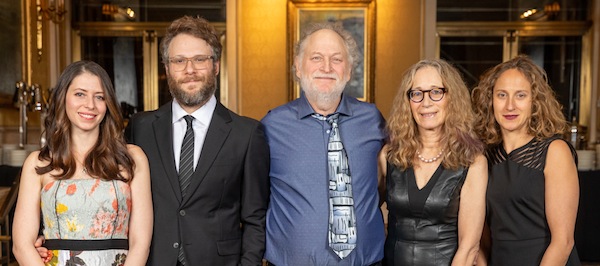
Left to right: Lauren Miller Rogen, Seth Rogen, Mark Rogen, Sandy Rogen and Danya Rogen at the ceremony in New York City at which Mark and Seth were honoured with the Generation to Generation Activism Award from the Workmen’s Circle. (photo from Mark Rogen)

Vancouver’s Mark and Sandy Rogen have good reason to be proud of their children and the Jewish values with which they raised them. Some of those values were highlighted as 2019 came to a close, when Mark Rogen and his actor, writer and producer son Seth were honoured on Dec. 2 with the Generation to Generation Activism Award from the Workmen’s Circle in New York.

The award recognizes the Rogens’ work promoting Jewish culture and traditions, while also carrying on the traditions of tikkun olam, repairing the world.

“What made it meaningful for us and for everyone who came was that it was an award about values,” Mark Rogen said in an interview with the Jewish Independent after a game of basketball at the Jewish Community Centre of Greater Vancouver. “It wasn’t about someone giving $2 million to get their name on a hospital. It was about recognizing people living in a positive way.”

Rogen said he and Sandy have always preached that value to their kids, along with the idea that they should always strive to “be a blessing.”

“That’s the way Sandy and I tried to raise Danya and Seth – to try to be a blessing and do what you can,” he explained. “Doing something one-to-one is just as good as doing something internationally. It’s where your heart is and I think Sandy and I are very happy to see that’s how Danya and Seth live their lives. That’s the pride.”

Rogen noted that, when his kids were young, they experienced many blessings. In those years, he said, the family had little money and institutions like Vancouver Talmud Torah, the JCC and Camp Miriam treated his children well, and “didn’t charge us a lot. So, Danya and Seth spent their formative years in the Vancouver Jewish community, and their friends today are from those years. Seth met Evan [Goldberg, his writing partner] at the JCC doing karate, and then they did bar mitzvah classes together.”

Knowing that his children are giving back as adults is important, said Rogen, who worked for the Workmen’s Circle for two years when the family temporarily moved to Los Angeles when Seth filmed Freaks and Geeks. Among other things, Seth and wife Lauren Miller Rogen founded Hilarity for Charity, which raises money for Alzheimer’s care, research and support.

That the recent award was a joint honour made it more meaningful to Seth Rogen. “To be honoured in any capacity is rare and lovely for me, but, to be honoured alongside my father was truly special and memorable,” he told the Independent. “My dad has always been dedicated to helping others and spreading goodness wherever he can. He worked for nonprofits most of my childhood and always strived to make the world a better place. He is someone I always go to for advice and his guidance is consistently geared towards not just what’s good for me, but what’s good for everyone.”

As for the Jewishness he often displays on screen, the actor said he rarely separates that part of himself from his work. “Being Jewish is inseparable from my identity in many ways, so it’s something I’ve always thought was good to acknowledge and integrate into my work,” he explained. “I simply am Jewish and I’m proud of myself and what I’ve done with my life.”

Seth Rogen’s biggest Jewish role, however, might be coming in the soon-to-be-released American Pickle, in which he plays a young man who comes to the United States in 1918 from a European shtetl, then gets trapped and preserved in a pickle barrel for 100 years before being united with his grandson in Brooklyn.

Danya Rogen – who is currently on the board of Vancouver Talmud Torah, on the personnel committee for Habonim Dror Camp Miriam and a regular participant on the JCC softball league team her father captains – joined many family members and friends in New York for the ceremony honouring her father and brother. She remembers her parents raising their awareness of important issues at a very young age.

“My parents, and my dad in particular, taught us to stand up for what we believe in and stand up for others who can’t do it for themselves,” she said. “My parents were also incredibly kind and generous, even when we didn’t have so much ourselves. All of those values have stuck with me my whole life. “I hope to live up to being a blessing and can pass those values on to my own children. I suppose the fact that I have become a social worker isn’t that surprising.”

Kyle Berger is Jewish Community Centre of Greater Vancouver sports coordinator, and a freelance writer living in Richmond.

Youth feed homeless people

Youth from Temple Beth Ora and Gathering Angels in Edmonton help out at Boyle Street Community Services shelter. (photo from Rabbi Gila Caine)

In Edmonton, Rabbi Gila Caine and Muslim leader Nesrine Merhi-Tarrabain have combined forces to serve their local community.

Caine is spiritual leader of Temple Beth Ora, a Reform synagogue in Edmonton with nearly 100 families, which celebrated its 40th anniversary last year. Merhi-Tarrabain is director of Gathering Angels, which runs an educational centre that teaches Muslim girls Islamic values.

Caine grew up in Jerusalem and moved with her husband, Ariel, and their two young children to Edmonton more than two years ago to lead Temple Beth Ora. Their kids attend the local Talmud Torah school.

Growing up, Caine learned early on, and more so in her early teens, to always be looking for ways to strengthen and help community. She wanted to bring that same mindset – of taking responsibility for your local community – to b’nai mitzvah-age kids at her Edmonton congregation.

“We’ve wanted to go out of the classroom and do stuff outside for a few years now,” Caine told the Independent in a recent interview. “And then, through another connection I have, with Salaam Shalom group, I asked one of them if perhaps they have somebody in their community that does stuff with kids … and that maybe we could do stuff together.

“I thought that would be really cool if we could get the b’nai mitzvah kids to go out and do stuff in the community, but with other youth of a different faith group,” she said.

Caine was connected with Merhi-Tarrabain. After some effort and time, the synagogue and educational centre managed to get together on a Saturday in November, preparing and serving both breakfast and lunch at Boyle Street Community Services shelter.

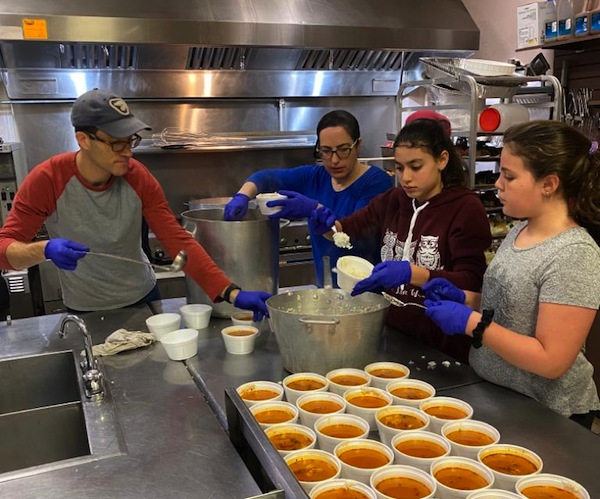
“We brought food with us, had her girls, my kids, and some parent volunteers working in two shifts there that day – working together, preparing sandwiches, cooking,” said Caine. “It was actually funny to see – it was more the parents that were connecting and talking … [while] the kids were basically doing their work quietly. But, the parents got into really nice conversations with each other and they served the food. And everybody from both sides came away feeling that we should do this again.”

photo - The interfaith initiative at Boyle Street Community Services was led by Nesrine Merhi-Tarrabain, third from the left, and Rabbi Gila Caine, second from the right
The interfaith initiative at Boyle Street Community Services was led by Nesrine Merhi-Tarrabain, third from the left, and Rabbi Gila Caine, second from the right. (photo from Rabbi Gila Caine)

Caine is hoping to make serving the community a tradition at Temple Beth Ora, possibly with Gathering Angels again, as well as with other groups.

When thinking of the best activity to launch the b’nai mitzvah community service initiative, Caine chose this particular one – preparing and serving food – as she knew from experience that many of the kids really enjoy dealing with food service, having seen them help out at the shul.

“Some of these kids are b’nai mitzvah kids and they want to volunteer again,” said Caine. So, the youth group counselors “will sit with them and talk to them about what they want to do. This is the next step,” she said.

After the November project, there was another food-related volunteering opportunity for the kids last year. They joined the Edmonton Jewish community as a whole to prepare a Christmas meal for another shelter. “They really wanted to take part in that,” said Caine. “And now we will see what they will come up with next.”

According to Caine, having Merhi-Tarrabain at the Boyle Street Community Services kitchen was beneficial for several reasons, including that she had volunteered there with the girls in the past and had experience. That meant Merhi-Tarrabain could offer tips about what food to bring and how to best help in the food’s preparation and serving.

“Now, some of the parents who were there, they want to initiate more of these things,” said Caine. “And now, we have a better idea of how to do that.”

Both faith groups understand that more such gatherings are necessary before the youth can make lasting connections.

Caine said her synagogue is trying to create a project with another Muslim youth centre in Edmonton and also with one of the city’s churches. “We’re trying to create a program,” she said, “where they will have meetings, talk and learn and do stuff together … hopefully resulting in some real connection-making.”

Rebeca Kuropatwa is a Winnipeg freelance writer.

Promoting fair trade in Israel

Raz Frogel (photo from Fair Trade Israel)

Raz Frogel, 23, has taken it upon himself to increase the number of fair trade items on Israeli store shelves.

Frogel, who lives in Dror Israel commune in Haifa, first read about child labour and improper working conditions when he was 16 years old. The article was about people working in cocoa fields and, after reading it, he announced to his parents that he would no longer eat chocolate, and explained why. He then spent the next two years in search of a solution.

“When I was 18 years old, I found fair trade and started doing research about it and looked into where I could find fair trade products,” Frogel told the Independent. “When I was released from the army, I started the fair trade movement in Israel.”

In his research, Frogel came across a 2016 article in the Independent: jewishindependent.ca/many-benefits-of-fair-trade.

“I realized nobody in Israel tried to promote fair trade or was trying to change the situation,” said Frogel. So, he took on the responsibility “and started to spread word of fair trade in Haifa, trying to make Haifa the first Fair Trade City in Israel. There are 2,000 cities in the world with the designation of fair trade towns,” he said, “but none in Israel.”

Frogel said many people try to shame companies into becoming fair trade employers, but he sees this as a wrongheaded approach, akin to movements and groups promoting the boycott of Israeli companies and products.

“We try to focus on the good companies and give them our support, and not on companies with what we see as wrong or bad practices,” he said. “I don’t want to shame anybody. I just want everybody to go fair trade.”

As a first step to achieve this goal, Frogel is trying to raise awareness.

“When you walk on a street in Israel, you can ask 10 people what fair trade is and maybe one will know,” he said. “So, before we can go to the companies and ask for fair trade products and change behaviour, we need to educate the public, create awareness.

“Ten years ago, there were no vegan products in Israel, but, when the community and demand grew and grew … there is now no coffee shop without soy milk or something like that. So, with fair trade, we need to copy this process. We need to raise awareness, create demand, and create communities that create demand. Then, we need to go to companies and ask for fair trade products.”

About 20% of Israelis live in poverty, the majority of whom are women, some of whom are paid less than minimum wage and suffer from other unfair labour practices. With this in mind, Frogel connected with an organization working to empower women. So far, Achoti (My Sister) is the only business in Israel that uses fair trade.

While fair trade in the food industry is a relatively known issue, Frogel pointed out that the fashion industry is also problematic.

If workers need to be paid more, that extra cost could be added to the price of the product. But, the extra money paid to the workers could come from another part of the industry chain. And, while investors want the highest possible return, it is up to us – the end users – to determine the value of a product by voting with our dollars or shekels, said Frogel. If the demand is high enough, more producers could be encouraged to enter the market, thereby increasing supply and placing a downward pressure on prices.

“I think there is no price to pay,” contended Frogel, “because, when you look at the U.K., the cheapest products in the store are fair trade, like Cadbury or Nestle … and Starbucks. When you look at fair trade in places where it’s common, it’s cheaper than non-fair trade products. When we talk to people, we try to explain to them that, when there is a demand, the prices of products will come down and everybody can support it.

“Right now, it’s very expensive to buy fair trade in Israel,” he admitted. “I can’t lie. But, we’re working on it and I don’t think fair trade should be more expensive.”

While Frogel is working on bringing fair trade to Israel, he hopes that readers will join the global movement, wherever they are, and join a local fair trade initiative to promote it in their communities.

Currently, Fair Trade Israel has a Facebook presence and the organization can offer tax receipts to donors through Achoti.

“We are trying to raise Friends of Fair Trade, wanting to raise a lot of support from all over the world, to show that fair trade is part of Jewish values,” said Frogel. He wants to see Israel become “a fair trade movement leader.”

Starting by focusing on Haifa, and Israel in general, Frogel is organizing events and doing advocacy work in schools and businesses. As far as getting Haifa recognized as a Fair Trade City, he is working to fulfil the requirements for such recognition, such as attaining a high level of fair trade awareness and product availability. “We have a lot of support from the city council and have a group of great people leading this project,” said Frogel. “We have stores with fair trade products, but not in every neighbourhood. We started programs in schools in the last month and we have special programs on campuses to raise fair trade awareness and product availability.”

For more information, visit achoti.com (which is in Hebrew) or contact Frogel at frogel.raz@gmail.com.


Rebeca Kuropatwa is a Winnipeg freelance writer.