Skip to content
  • Home
  • Subscribe / donate
  • Events calendar
  • Business Directory
  • FAQ
  • News
    • Local
    • National
    • Israel
    • World
    • עניין בחדשות
      A roundup of news in Canada and further afield, in Hebrew.
  • Opinion
    • From the JI
    • Op-Ed
  • Arts & Culture
    • Performing Arts
    • Music
    • Books
    • Visual Arts
    • TV & Film
  • Life
    • Celebrating the Holidays
    • Travel
    • The Daily Snooze
      Cartoons by Jacob Samuel
    • Mystery Photo
      Help the JI and JMABC fill in the gaps in our archives.
  • Community Links
    • Organizations, Etc.
    • Other News Sources & Blogs
  • JI Chai Celebration
  • JI@88! video

Recent Posts

  • Federation now across BC
  • Israel fighting for its existence
  • Deal strengthens Iran
  • Patriotic belonging diminishes
  • A campaign to engage
  • Upstanders’ first live event
  • Responding to Carney
  • Having your own home
  • Music a family tradition
  • Musical to warm heart
  • Community milestones … June 2026
  • Sharing her passion for Israel
  • Or Shalom reopens its doors
  • JFS from past to future
  • Need holistic approach
  • Sharing stories, advice
  • Journalist shares fears
  • Skills to live together
  • Road to independence
  • Cutting grass with scissors
  • Zionism as a solution
  • Deceit, desire & the divine
  • Reclaiming sacredness
  • Creative project ideas
  • Summer squares and cobbler
  • Thou shalt … summer commandments
  • Legal help for students
  • Revisiting myth of Lilith
  • Wrong person rebuked
  • Canada’s mixed messages
  • Questions for museum
  • Symposium on antizionism
  • Making soccer political
  • CJPAC lauds Pulver’s impact
  • City recognizes Vrba’s legacy  
  • Organ donation saves lives

Archives

Follow @JewishIndie
image - The CJN - Visit Us Banner - 300x600 - 101625

Tag: theatre

Chutzpah! coming soon

Chutzpah! coming soon

Josh “Socalled” Dolgin leads an evening of Yiddish songs as part of Chutzpah! 2021. (photo from Chutzpah!)

The Chutzpah! Festival returns this November, presenting music, theatre, comedy and dance that reflect the joy of coming back together. For more than two decades, Chutzpah! has been an annual highlight of Greater Vancouver’s arts season. From Nov. 4 to 24, artists will once again grace the stage of the Norman & Annette Rothstein Theatre, the festival’s hub, and share their work in person and online. Tickets go on sale Sept. 15.

The 21st Annual Chutzpah! Festival will include a variety of performances, paired with conversations and opportunities to interact with the artists. Audiences will have the chance to attend in-person shows, with COVID safety protocols in place, or enjoy digital streams from their homes. With an emphasis on artists from across Canada, the festival will also present work from Israel, the United States and the United Kingdom.

“Artists and arts enthusiasts alike have been eagerly awaiting our chance to come back together to share our stories,” said Jessica Mann Gutteridge, artistic managing director. “With the joy of reconnecting comes the knowledge that our lives have profoundly changed over the past year-and-a-half. The Chutzpah! Festival will explore and celebrate the many ways we tell stories now, with a variety of ways to experience and participate in the work.”

The festival opens Nov. 4 with a screening at the Rothstein Theatre of the Marx brothers classic A Night at the Opera, during which City Opera Vancouver will sing the operatic music parodied in the film. The 1930s cinema experience will include festive treats, glamour and a costume contest.

In the comedy realm – all in-person performances at the Rothstein Theatre – Canadian-born, New York-based stand-up comedian, storyteller and writer Ophira Eisenberg, host of NPR’s comedy and trivia show Ask Me Another, performs Nov. 10. Israeli-American stand-up comedian Avi Liberman is joined by special guest Jacob Samuel and host Kyle Berger on Nov. 20. And Iris Bahr, who impressed Chutzpah! audiences in 2020 with her festival hosting and her solo show DAI (enough),  performs her new solo show Nov. 23.

The dance performances at the Rothstein will be in-person events, as well as digitally streamed. Nov. 6 and 7, a Project inTandem double-bill features the works of Calgary producers and choreographers Sylvie Moquin and Meghann Michalsky, which explore the themes of female struggle and empowerment. Nov. 13 and 14, Shay Kuebler/Radical System Art return to Chutzpah! as resident artists with the third “chapter” of Kuebler’s research that began in 2018, after he read about the United Kingdom hiring a minister of loneliness. On Nov. 16 and 18, Ballet BC artist in residence Alexis Fletcher, who was 2019 and 2021 Chutzpah! resident artist, returns to the festival with a solo integrating movement and the visual art of Vancouver painter and HIV/AIDS activist Tiko Kerr, while 2020 and 2021 Chutzpah! resident artist Ne.Sans Opera & Dance, led by Idan Cohen, returns to showcase a new solo drawing inspiration from the myth of Orpheus and Gluck’s opera Orfeo ed Euridice, with co-creator Ted Littlemore (aka Mila Dramatic).

Theatre works featured are Lilach Dekel-Avneri and the Pathos-Mathos Company’s The Eichmann Project – Terminal 1 on Nov. 8 (digital stream available); The Flame – An Evening of Storytelling on Nov. 17, under the stewardship of artistic director Deborah Williams, featuring storytellers including Stephen Aberle, Glenda Zenoff, Eleanor Lipov and Helen Schneiderman, with musical guest Anton Lipovetsky; and Halifax-based Surplus Production Unit’s A Timed Speed-Read of the Triangle Shirtwaist Factory Fire Trial Transcript on Nov. 21 and 22.

Montreal’s Josh “Socalled” Dolgin, accompanied by a local string quartet, leads an evening of rediscovered Yiddish songs, with stories and perhaps a little magic, on Nov. 19, and Israel’s Guy Mintus Trio’s performs A Gershwin Playground Nov. 24. (Digital streams available for both shows.)

Nov. 8-12, Chutzpah! Festival favourite, U.K.-based theatre artist Tamara Micner, transforms her theatrical work-in-progress (workshopped in the 2020 festival) into an audio installation. Audience members will be invited into the Zack Gallery to listen to Micner’s reading of letters written to Paul Simon and Art Garfunkel, reflecting on how their music informs her feelings about friendship, activism, Jewishness and art. There will be opportunities to “meet” the artist via video stream for conversations about her work and ideas.

Throughout the festival, Bahr converses with festival artists, featuring her stand-up and a wide-ranging cast of characters.

Due to COVID-19 safety processes, all tickets must be purchased in advance and will not be available at the door. Visit chutzpahfestival.com starting on Sept. 15 or call 604-257-5145.

– Courtesy Chutzpah! Festival

Format ImagePosted on September 10, 2021September 9, 2021Author Chutzpah! FestivalCategories Performing ArtsTags Chutzpah!, comedy, dance, Iris Bahr, music, storytelling, theatre
Coveted Wife at Fringe Fest

Coveted Wife at Fringe Fest

Megan Phillips, left, and Hayley Sullivan in A Coveted Wife of East Van, part of the Vancouver Fringe Festival, which runs Sept. 9-19. (photo by Marn Norwich)

An all-star Jewish team consisting of poet Marn Norwich, director Ariel Martz-Oberlander, jazz musician Itamar Erez and actress Hayley Sullivan join forces to produce A Coveted Wife of East Van, the post-pandemic dating musical that you didn’t know you needed at this year’s Vancouver Fringe Festival. Light and fun, this show is the cathartic release we’ve all been jonesing for after months of pandemic isolation and, if you’re single, forced celibacy.

A Coveted Wife of East Van tells the story of Samantha Cohen as she navigates friendship, men and dating apps while making some very bad decisions along the way. Featuring both original music by Erez and familiar melodies from shows like Fiddler on the Roof, the story is set in Commercial Drive’s Café Deux Soleils. Samatha goes on a date with an East Van hippie, don’t forget the crystals; a mansplainer, need we say more; a pimp; and a murderer, who brings her ex’s head as an offering on their date. Just before things go horribly wrong, Samantha is saved by her best friend in this story about friendship, online dating and the search to find “the one.”

Norwich, an independent journalist for the CBC and Georgia Straight, and Erez, nominee for 2020 Instrumental Artist of the Year award, are joined by award-winning director Martz-Oberlander and Sullivan, as well as producer of the Or Festival Olivia Etey; Best of Fringe Award-winning actor Megan Phillips; winner of best comedy at the 2020 Florence Film Awards actor Mostafa Shaker; and set designer Michael Duggan, who has 30-plus years in the industry and has worked on more than 25 film productions.

A Coveted Wife of East Van opens Sept. 11, 3:30 p.m., and closes Sept. 19, 4:30 p.m., with several shows in between. The Fringe Festival runs Sept 9-19. For the full schedule, visit vancouverfringe.com.

– Courtesy Claudia Nobauer


Format ImagePosted on August 20, 2021August 20, 2021Author Claudia NobauerCategories Performing ArtsTags comedy, Coveted Wife of East Van, theatre, Vancouver Fringe Festival
Plays explore future of love

Plays explore future of love

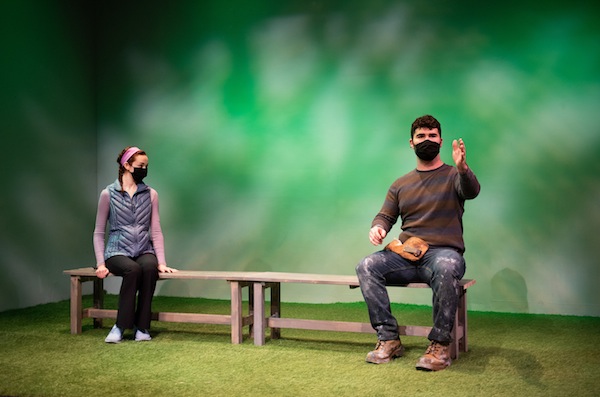
Katherine Matlashewski and Tanner Zerr in Fast Foward. (photo by Emily Cooper)

Since COVID-19, we have been learning how to relate to one another from a distance, as well as how to use the technologies, like Zoom, that have allowed us to retain a more personal connection than we could have if we had experienced the pandemic even a handful of years ago. While our reality seems stolen from the script of a futuristic sci-fi horror film, playwright Rosamund Small’s visions of love in the future and how technology affects it, TomorrowLove, are “hilarious, snappy, moving and refreshingly fun in these times,” according to Shekhar Paleja and Lauren Taylor, co-directors of Studio 58’s production of Small’s playlet collection.

Jewish community members Samantha Levy and Katherine Matlashewski are among the cast members of the production, which will be released online on Feb. 28 and available to watch individually or collectively until March 7.

Studio 58 is Langara College’s professional theatre training program, and this spring’s lineup – which TomorrowLove launches – is the first under the direction of Courtenay Dobbie. Both Levy and Matlashewski are in their second year of study.

“I was finishing up my first year when the pandemic began in earnest here,” Levy told the Independent. “COVID-19 has forced me to be more isolated from my school community through Zoom classes, but it has not taken away the care and dedication of my professors, or the support of my peers. We are still a family, even though we are distanced or online.”

It has become a hybrid program since the pandemic, with some classes online and others held in person with social distancing, said Matlashewski. “Since Studio 58 is a hands-on conservatory program, the transition to online studies was challenging at first,” she admitted. “The faculty and staff, however, have been extremely supportive during these uncertain times. They have all worked tirelessly to adapt our training while also prioritizing our safety.

“That being said,” she added, “as a result of COVID, students are now required to commute to and from the college quite a bit … [and] the hours of online Zoom classes are exhausting. Despite these challenges, I appreciate the continuation of our small in-person classes.”

Prior to her post-secondary training at Studio 58, Matlashewski appeared as Mopsy in King Arthur’s Court (Metro Theatre), where she received the Community Theatre Coalition Award for best supporting actress. Other select credits include Alana in Dear Evan Hansen (Laughing Matters), Luisa in The Fantasticks (Stage 43) and Little Red Riding Hood in Into the Woods: In Concert (Royal City Musical Theatre). Most recently, she was awarded the 2021 Cheryl Hutcherson Award by Applause! Musicals Society.

“I have been a part of the Vancouver theatre and dance community from a very young age,” said Matlashewski. “I feel incredibly blessed to live, create and play on the unceded territories of the Musqueam, Squamish and Tsleil-Waututh Nations.”

In TomorrowLove, Matlashewski said, “I have the pleasure of acting in the playlet called Fast Forward, alongside Tanner Zerr. This playlet explores themes of love, abandonment, age difference, time travel and the consequences that come with it.”

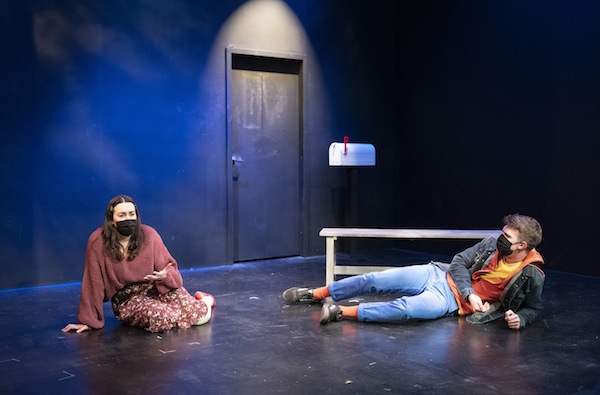
Levy plays the role of Jessie in the short play Take This Soul. “In Take This Soul, Jessie’s ex-partner, Rylan, shows up at her doorstep after having disappeared for four days,” explained Levy. “He tells an outlandish tale of an experiment in a distant country that has allowed him to return and present her with his literal soul.”

Samantha Levy and Riley Hardwick co-star in Take This Sou
Samantha Levy and Riley Hardwick co-star in Take This Soul. (photo by Emily Cooper)

In addition to this Studio 58 production, Levy’s acting credits include Love, Loss and What I Wore (Centaur Theatre), Fancy Nancy: The Musical (Côte Saint-Luc Dramatic Society, Segal Centre) and It Shoulda Been You (Dora Wasserman Yiddish Theatre, Segal Centre). Her TV and film credits include Annedroids and 18 To Life.

“I’ve been performing since the age of 5, when my parents signed me up for an extracurricular theatre troupe in my hometown, Montreal,” said Levy. “Little did they know that I would fall in love with performing! Since then, I’ve acted on stage and on screen, trained at the Stratford Festival’s Theatre Arts Camp, and dabbled in directing both plays and musicals. Now, I am so thrilled my love of acting has led me to Studio 58!”

But the experience is not what it normally would be, of course.

“During the pandemic, the lovely production team has been working extra hard to keep us all safe,” said Levy, “and that includes managing our schedules closely to avoid contact between folks. So, I have come to value the time I have with others in person even more. When we are in person, we are also wearing masks and social distancing at all times. This often means coming up with innovative new ways to express ourselves without proximity or touch on stage, which has been a wonderful challenge. It is incredibly uplifting for me to have the privilege to be able to continue to create with others, be vulnerable and connect.”

Acknowledging that the “pandemic has been an emotional rollercoaster for everyone,” Matlashewski said, “One of the challenges that I have faced is navigating acting while wearing a mask. Prior to COVID, I did not realize how much I relied on the non-verbal cues and facial expressions of my scene partners. However, now that two-thirds of the human face is covered by a mask, I find that I have to listen more closely to fully understand my scene partner. With that in mind, we all have had to adjust and be patient with ourselves and others.

“My biggest take away from acting during COVID is the importance of human connection,” she continued. “We have had to find new ways to connect and communicate while maintaining physical distancing. During the rehearsal process of Fast Forward, I discovered how social distancing impacted my acting choices. Since I had to maintain a two-metre distance from my scene partner, each movement that I made on stage had to be carefully considered. Our fantastic director, Lauren Taylor, guided us through this process and helped specify our blocking.

“Although we are required to maintain physical distance and wear masks while we are acting, I am thankful that I get to act in person for my first mainstage show at Studio 58.”

Reflecting on her connections to Jewish community and culture, Matlashewski said, “Within Judaism, community is a value that is held with the highest importance. Although we cannot gather in person, I invite you all to find the light where you can and share it with those around you.”

For her part, Levy said, “As my parents are across the country in Montreal and my brother (he’s a doctor!) is in St. John’s, Jewish culture and art are an anchor to the family who love me. Seeing Jewish representation in art is healing and beautiful.”

She then added a “non-performance-related anecdote.”

“I walked into a Jewish bakery during Chanukah to get a few latkes,” said Levy, “and I left with tears in my eyes and a bag full of items I had not planned to buy.”

To see one or all 13 of the TomorrowLove playlets, visit studio58.ca.

Format ImagePosted on February 26, 2021February 24, 2021Author Cynthia RamsayCategories Performing ArtsTags acting, coronavirus, COVID-19, Katherine Matlashewski, Langara College, Samantha Levy, Studio 58, theatre
Arts enhance inclusion

Arts enhance inclusion

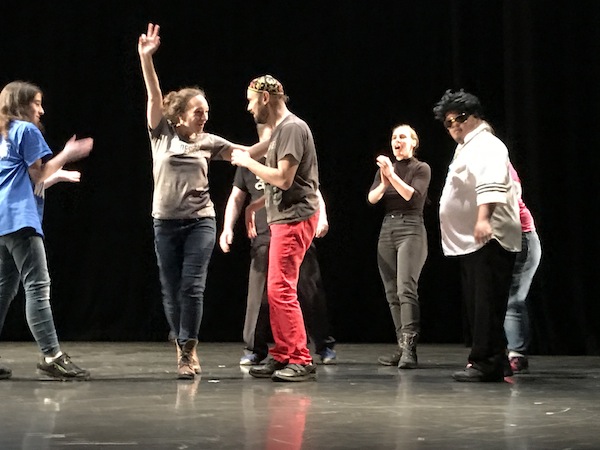
Matthew Tom-Wing, right, dressed as Elvis, was one of the participants in the 2019 Chutzpah! Festival finale. His mother, Elizabeth Tom-Wing, recalled it as a “standout moment for our community and for our son!” (photo from JCC)

February is Jewish Disability Awareness and Inclusion Month (JDAIM). It offers a wonderful time to look back at some of our community achievements in fostering inclusion at the Jewish Community Centre of Greater Vancouver; in particular, the 2019 Chutzpah! Festival’s Inclusion Project.

Mary-Louise Albert was artistic and managing director of Chutzpah! and the Rothstein Theatre for 15 years. Before she retired, she and I had many spirited conversations about the importance of creating access for local community members in all areas of Jewish communal life and at the JCC, which is the home of the festival and the theatre, and where I am the coordinator of inclusion services.

We believed that the arts are an important avenue for personal growth and skills development, and that they also bolster visibility and foster true belonging. We hoped that the JCC’s inclusion services and Chutzpah! could collaborate in some way and, through our conversations and Mary-Louise’s vision and expertise, the Chutzpah Inclusion Project crystalized.

After months of planning, in November 2019, members of the local community took to the Rothstein stage to participate in a first-ever Inclusion Project performance – an evening of dance and comedy with international inclusion advocate Pamela Schuller and professional dancers Troy Ogilvie and Rebecca Margolick. The event was the finale of the 2019 Chutzpah! Festival and a highlight of Albert’s final year with Chutzpah!

In preparation to take to the stage, participants had a yearlong introduction to theatre, including low-barrier and free classes with a specialist through the JCC’s Theatre Lab program. Participants attended many local productions through the JCC’s social club, and spent hours rehearsing and co-creating with Ogilvie, Margolick and Schuller over a series of workshops that would not have been possible without community partners and friends.

The 2019 performance received a standing ovation from the audience. The feeling of solidarity and acceptance between the audience and the performers was palpable. What was most amazing, Elizabeth Tom-Wing recalled, is that her son had the opportunity to “train and perform on stage with the professional dancers, along with his friends, and close off the three-week-long 2019 Chutzpah! Festival.” She recalled it as a “standout moment for our community and for our son!”

This project demonstrated that artists of mixed ability and skill can create a powerful and moving performance. Moreover, it reminds us that it is only through equity and action that belonging can be fostered. As diversity, equity and inclusion strategist Arthur Chan explains: “Diversity is a fact. Equity is a choice. Inclusion is an action. Belonging is the outcome.”

Leamore Cohen is inclusion services coordinator at the Jewish Community Centre of Greater Vancouver.

Format ImagePosted on February 26, 2021February 24, 2021Author Leamore CohenCategories Performing ArtsTags Chutzpah!, disability awareness, diversity, equity, inclusion, JCC, JDAIM, Mary-Louise Albert, theatre
Kirman Library spans the arts

Kirman Library spans the arts

The Kirman English and Yiddish Library at the Peretz Centre for Secular Jewish Culture is available for anyone in the community to access. (photo from Peretz Centre)

“Books are humanity in print” – Barbara Tuchman

The Kirman English and Yiddish Library at the Peretz Centre for Secular Jewish Culture was set up in 1976 by Paula and Shaya Kirman, members of the Peretz Institute – as it was then known – and dedicated Yiddishists. The two main purposes in establishing the library were, first, to collect and preserve the books that were scattered in different places in the community, and, second, to make these books available to the whole community in a lending library.

Paula Kirman, who worked as a cataloguer at the University of British Columbia library, volunteered many hours to set up a card catalogue and shelve the Peretz library in an organized way. Eventually, she resigned from her volunteer position because of a perceived lack of support from the Peretz Institute’s board of directors.

In 1999, in preparation for the construction of the Peretz Centre’s present building (in the same location the institute had been since the 1960s), the library books and card catalogue had to be boxed and removed. With the completion of the new building in 2000-2001, the organization was renamed the Peretz Centre for Secular Jewish Culture and the words of I.L. Peretz, considered by many as the “father” of modern Jewish culture, were prominently displayed above the entrance foyer: “A people’s memory is history; without a history, a people can grow neither wiser nor better.”

Sporadic attempts to restore the library were made, but, when Al Stein returned to Vancouver and joined the centre’s board of directors in 2001, much of the library was still in boxes and Kirman’s card catalogue was in disarray. Stein volunteered to lead the effort to restore the library, if the board would support it in two ways: vote for funding for new shelving and support Stein’s effort to obtain a grant from the Jewish Community Foundation of Greater Vancouver to hire a library technician and digitize the entire library, including the Yiddish books.

The grant proposal was successful. A newly graduated library technician, unfamiliar with Yiddish, was contracted and many hundreds of hours were spent properly transliterating each Yiddish book and journal title, digitizing the entire collection in accordance with the latest electronic library standards, relabeling each book, arranging for electronic hosting of the library catalogue, supervising the installation of new shelving and then, finally, shelving the books and journals in an organized fashion.

Thanks to large and small donations of both English and Yiddish books from individuals, from the Winnipeg Jewish Library and from the Isaac Waldman Jewish Public Library at the Jewish Community Centre of Greater Vancouver, as well as a small number of purchases, the Kirman Library of the Peretz Centre now contains nearly 4,000 books and journals and is almost at capacity. The collection includes titles by kabbalists, rabbis, atheists, historians, politicians, musicians, artists, humourists, and those who wrote fiction, plays and poetry – in other words, the entire spectrum of Jewish creativity, encompassing all the arts.

Most of the collection is now in English and is a unique treasure trove of information and pleasure for the casual reader and the scholar. Two collections are of note. The late Dr. Gersh Winrob donated his English-language collection of Holocaust literature, memoirs, history and analyses, certainly one of the largest in the community. And the late poet Miriam Waddington donated part of her library, mostly English-language literature and essays, with a bit of Yiddish poetry.

The Peretz Centre is a proud member of the Yiddish Book Centre, now the largest Jewish cultural organization in the United States.

The Peretz’s library catalogue may be searched from any computer via the Peretz Centre website, peretz-centre.org: click the Kirman Library tab and then the Catalog link. The library ID is Kirman Library. No password is needed.

Books and periodicals can be borrowed for a $10/year fee. Four items may be borrowed at a time, for a period of four weeks, which may be renewed if no hold has been placed on the item. And the library may be used whenever the Peretz office is open, so call ahead before coming down, or for more information about library policy in general, such as its overdue or lost items policy, or to obtain a library card: 604-325-1812, ext. 1, or [email protected].

If you have any specific questions or comments about the library, or wish to make a donation to it, Stein can be reached at 604 731-1193 or [email protected].

Format ImagePosted on February 26, 2021February 24, 2021Author Peretz CentreCategories LocalTags Al Stein, art, fiction, Gersh Winrob, history, Judaism, Kirman Library, Miriam Waddington, poetry, theatre, Yiddish
Fairy tales still relevant

Fairy tales still relevant

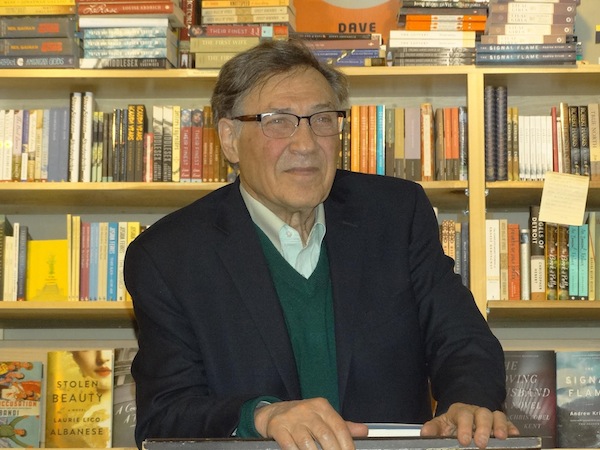
Jack Zipes gives the lecture Resurrecting Dead Fairy Tales on Facebook Feb. 17. (photo from MISCELLANEOUS Productions)

Some fairy tales are timeless in that they still have lessons to impart. For example, The Pied Piper, a story dating back to the Middle Ages, “is a tale of plague, greed, betrayal, conformity/confinement with allusions to child abuse,” explained Elaine Carol, co-founder and artistic director of MISCELLANEOUS Productions.

MISCELLANEOUS’s Plague project will have participating youth, along with professional artists, interpreting the Brothers Grimm’s The Pied Piper “from an intersectional, anti-racist, anti-oppression, queer feminist perspective.” In preparation, Carol told the Independent, “we have been reading our way through the mountain of brilliant writing by Jack Zipes, asking him many questions – even our film editor of Resurrecting Dead Fairy Tales is now reading two of his hundred or more published books.”

image - In Yussuf the Ostrich, political caricaturist Emery Kelen tells the story of a young ostrich who helps defeat the Nazis in northern Africa during the Second World War.
In Yussuf the Ostrich, political caricaturist Emery Kelen tells the story of a young ostrich who helps defeat the Nazis in northern Africa during the Second World War.

Zipes’ recorded Facebook Watch talk, Resurrecting Dead Fairy Tales, will be streamed Feb. 17, followed by a live Q&A with Zipes. Some of the lecture will be part of the documentary being created about the youth-centred theatre project, which will include various workshops and an eventual stage production at the Scotiabank Dance Centre in 2022.

“I have also been working with young professional artists Tiffany Yang, who was a youth in our Monsters production, national and international tours, and Julia Farry, our production assistant/outreach worker,” said Carol. “Tiffany has translated four indigenous Taiwanese folk tales that are stories of plague – mostly in coastal communities, including animal wonder tales of fantastical fishes and other fascinating narratives. Julia has translated three Japanese folk tales focusing on plagues. There are many plague stories that we still hope to collect, including the facts of disease spread by European settlers to the Indigenous people of Turtle Island, as research materials for our project-in-development.

“We are currently collecting these tales to bring to our youth cast after it is deemed safe to work with them in person,” Carol continued, “as we will be using theatre, hip hop/streetdance, contemporary dance, marimba and world music, urban music, performance art, etc., to co-create a new play. This play will be used as a vehicle for the youth to discuss their own experiences of living in a world pandemic.”

Zipes’ lecture was filmed in Minneapolis by MISCELLANEOUS Productions’ professionals. The professor emeritus of German and comparative literature at the University of Minnesota is an expert on folklore and fairy tales. He is a storyteller himself and the founder of the publishing house Little Mole and Honey Bear.

“My parents and grandmother always told me tales of different kinds,” Zipes told the Independent. “When I began studying for a PhD at Columbia University, I wrote my dissertation on ‘The Great Refusal: Studies of the German and American Romantics in the 19th Century.’ My interest in fairy tales grew as I realized that these imaginary tales hold more truth than the so-called realistic future. And I also was angered by Bruno Bettelheim’s book about fairy tales in which he imposed a Freudian interpretation on readers. Since then, I have been trying to reveal how relevant fairy tales are to our lives.”

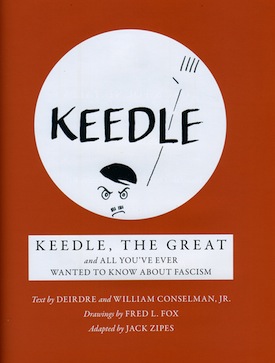
image - One of the fairy tales Jack Zipes has resurrected is Keedle, The Great, first published in 1940
One of the fairy tales Jack Zipes has resurrected is Keedle, The Great, first published in 1940.

The examples given in the lecture’s press release are from two books Zipes has translated and published: “For example, in Yussuf the Ostrich, well-known political caricaturist Emery Kelen tells the story of a young ostrich who helps defeat the Nazis in northern Africa during World War II. In Keedle, The Great, first published in 1940, Deirdre and William Conselman Jr. sought to give Americans hope that the world can overcome dictatorships. To the authors, the title character Keedle represented more than Hitler, but all dictators then and now.”

Zipes said, “I don’t think that my being Jewish accounts for my interest in fairy tales. My Jewishness makes me a bit meshuggah, and this is why I try to think out of the box and have developed a storytelling program for children without sanitizing the fairy tales. The best of folk and fairy tales have never been sanitized, and I use tales to tell so that children will be enabled to tell their own miraculous tales.”

“My Jewishness is complex,” said Carol, “because I am mixed-race Sephardic-Romani and Ashkenazi. One of one million reasons I love Jack Zipes and think his work is crucial is his lucid critique of the Disneyfication of fairy tales and folklore.”

Resurrecting Dead Fairy Tales starts at 5pm on Feb. 17 and is intended for older youth and adult audiences. On the day and time, click here for link to watch.

Format ImagePosted on January 29, 2021January 27, 2021Author Cynthia RamsayCategories Performing ArtsTags coronavirus, COVID-19, dance, education, Elaine Carol, fairy tales, fascism, history, Jack Zipes, MISCELLANEOUS Productions., music, Pied Piper, plague, storytelling, theatre, youth
craigslist cantata returns

craigslist cantata returns

Josh Epstein and Amanda Sum in do you want what i have got? a craigslist cantata, written by Veda Hille, Bill Richardson and Amiel Gladstone, and presented by the Cultch and Musical Stage Company. (photo by Emily Cooper)

Welcome back the cast of wild and wacky characters from the Craigslist community as they attempt to buy and sell online, all the while longing and searching for human connection – this time with a fresh, new perspective on social isolation, and livestreamed from all around the Cultch. The production features the original songs “300 Stuffed Penguins,” “Chili Eating Buddy,” “Decapitated Dolls,” and more. Joining actors Epstein and Sum in the cast are Meaghan Chenosky, Kayvon Khoshkam and Andrew Wheeler. Showtimes are Feb. 5-6, 4:30 p.m. and 7:30 p.m., and Feb. 7, at noon. Tickets ($25/$29/$58) can be purchased from 604-251-1363 or thecultch.com/event/a-craigslist-cantata.

Format ImagePosted on January 29, 2021January 27, 2021Author The CultchCategories Performing ArtsTags Amiel Gladstone, Bill Richardson, Craigslist, Josh Epstein, music, theatre, Veda Hille
Christmas Carol goes online

Christmas Carol goes online

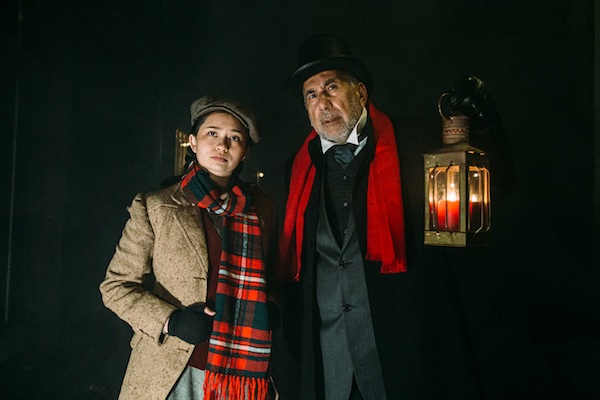
David Adams as Scrooge and Scotia Browner as Tiny Tim in Metro Theatre’s production of A Christmas Carol – The Radio Play. (photo by Nicol Spinola)

Metro Theatre was all set to provide socially distanced, safety-first live performances of A Christmas Carol – The Radio Play this month. But then the provincial restrictions on gatherings came down, and the struggling theatre company had to cancel its in-theatre run. But the production team used what holiday spirit it had to film the show and an online version will be available for viewers to watch from Dec. 21 through Jan. 3.

“We are fortunate to have our talented friends Nico Dicecco and [playwright] Erik Gow film the show and put together a beautiful digital stream of it that is available by donation,” stage manager Kat Palmer told the Independent.

Palmer has had a few shows canceled since the pandemic hit. “Right at the beginning of COVID,” she said, “I was in rehearsals for a sweet little concert Wendy Bross Stuart put together called With a Song in My Heart. I was also looking forward to Hello Dolly! at Theatre Under the Stars. And, most importantly, my company, Raincity Theatre, was gearing up for our production of Cabaret. Obviously, intimate, site-specific theatre is not possible during COVID.”

But A Christmas Carol – The Radio Play was created with COVID-19 protocols in mind. The theatre is a large space, enough for patrons to be distanced from one another. “Even the set was designed to keep actors more than six feet apart at all times,” said Palmer. In rehearsals, every cast member arrived masked and wore their mask until they were in their show spacing, she said. For the stage show, they were ready with two understudies, prepared to go on, lest “any actor wake up with any sort of tickle in their throat.”

But those plans went for naught when, last month, large public gatherings were prohibited and the show, which was to open Dec. 3, was delayed to organize the online version.

“It is no surprise that COVID has deeply impacted our arts community,” said director Chris Adams. “The Metro Theatre is a not-for-profit theatre company that relies on ticket sales to get by. Once a thriving arts hub in a former movie-house, Metro has been hit hard by COVID restrictions that have seriously impacted their revenue. The Metro also rents out their space to schools and dance companies over the quieter spring/summer months but, due to our new reality, that was also impossible this year. The Metro Theatre is at risk of closing its doors.”

Nonetheless, the show is also raising money for the charity Backpack Buddies.

“When Charles Dickens published A Christmas Carol in 1843, charitable giving soared overnight,” said Palmer. “The story has forever changed how we celebrate the holiday season and reminds us of the importance of generosity. It is in this spirit that the Metro always selects a charity to support each year at Christmas.

“Early in the show, we meet Abigail – an orphan who speaks of food insecurity. It is shocking to find parallels between children today and the Dickensian era. British Columbia has one of the highest child poverty rates in Canada, with 20% of children living below the poverty line. The Backpack Buddies program provides backpacks of food to children in need so that they do not go hungry over the weekend.”

A Christmas Carol – The Radio Play is an original work by writer Gow, based on the Charles Dickens novel, of course.

“With Christmas Carol, there is an expected order that ghosts appear. Erik has decided to shake it up,”

said Adams. “There are also some scenes that do not appear in the book that add an extra level of character development.”

The radio play stars David Adams as Ebeneezer Scrooge, who meets all the characters in A Christmas Carol, “from Bob Cratchit to Jacob Marley, but with only six actors creating and voicing over 40 of the beloved characters,” reads the play’s description. Joining David Adams “on stage” will be Roger Monk, Jill Raymond, Chris Ward, Emilia Michalowska and Scotia Browner. The COVID covers were Jim Stewart and Courtney Shields, who is also the assistant director of the production.

“All of our actors have created a character for their narrator in addition to playing every character in the piece,” said Palmer. “For the majority of our performers, they play four or five characters each. For the simplicity of the storytelling, David plays Scrooge but has also created a very unique and distinct character for his narrator. While David has played many Jewish characters, like the Merchant of Venice, Tevye and Fagin, he is not Jewish himself. Although, he has had to learn some Yiddish for roles from time to time.”

As for being a Jewish person working on a Christmas play, Palmer said, “At this time of year, I sometimes feel like Scrooge. I despise the commercialism of the holiday season, how it seems to consume the entire month of December and don’t get me started on cheesy Christmas movies. But, as a Jewish person working on this show, it is easy to see Jewish values on every page of the script. Yes, A Christmas Carol takes place at Christmas but, in many ways, A Christmas Carol is really a story of teshuvah, tzedakah and tikkun olam…. It’s a story that celebrates kindness, charity and human transformation – ideals that all parents hope to instil in their children – ideals that have deep roots in Jewish tradition. Don’t we all want to believe even the worst among us has a core of goodness?”

The filmed version of A Christmas Carol – The Radio Play is available by donation at metrotheatre.com.

Format ImagePosted on December 18, 2020December 16, 2020Author Cynthia RamsayCategories Performing ArtsTags A Christmas Carol, Backpack Buddies, Chris Adams, coronavirus, COVID-19, Kat Palmer, Metro Theatre, Scrooge, theatre, tikkun olam

Song’s enduring popularity

How does a 1940 Yiddish theatre song – probably based on a passage from the Talmud’s Tractate Bava Metzia – end up becoming a popular piece sung around the world?

Over a 75-year period, Aaron Zeitlin’s “Dona Dona” (in Yiddish, “Dos Kelbl,” “The Calf”) has been sung by some of the 20th century’s biggest English-speaking performers, including Joan Baez, Donovan, the Chad Mitchell Trio, Chad & Jeremy, and countless others. It has been sung in Japanese, German, French (in this version, the calf is replaced by a boy trying to figure out his future) Swedish, Hebrew, Russian, Italian, Catalan and Vietnamese. Zeiltin’s original “Dos Kelbl” was put to music by Sholom Secunda; in 1956, Arthur Kevess and Teddi Schwartz translated it into English.

“Dona Dona” was part of Zeiltin’s Yiddish play Esterke, based on the legendary relationship of a Jewish woman named Esther and King Casimir of Poland. Zeitlin first published it in 1932 in Globus, the Yiddish literary journal he edited. The play about Esterke and Kazimierz the Great was a Polish-Jewish mystery in four acts. Male and female actors sang “Dona Dona” as a solo, as a duet and as a chorus with orchestration.

Zeitlin was invited to New York for the performance of Esterke, which is an indication of how influential Yiddish theatre was in the pre-Second World War Jewish cultural world. With the outbreak of the war, however, he was unable to sail back to his family. His wife, two children, father and brother were killed in the Holocaust.

This terrible loss haunted Zeitlin for the rest of his life. Indeed, some maintain that “Dona Dona” represents the tremendous suffering and loss of life Jews experienced in the Holocaust. While Zeitlin – who was living in Poland in the 1930s – was certainly aware of the growing threat of Nazism, he composed the song before the Holocaust began.

Over time, the song has been interpreted in many different ways. In a 2010 article in The Jewish Magazine, Mendel Weinberger understands “Dona Dona” as a reference to the struggle between the physical and the spiritual. The calf represents the body, the seat of desire. The body seeks pleasure, wealth and honour, and is a slave to these desires. The calf on the way to the slaughterer is a metaphor for the body’s journey towards death. The calf (i.e. the body) is mournful because it has become attached to life and fears the unknown of the next world. The swallow, on the other hand, represents the soul, in Weinberger’s interpretation. The Divine Soul is a part of G-d’s Being and is not bound by the material limitations of the physical world; it is free to soar in the spiritual realms high above the earthly one.

Baez, who, probably more than anyone else in North America, was responsible for popularizing the English version of the song, has said she was attracted to the “beauty of the melody.” At the beginning of her long career, she started singing “Dona Dona” as a civil rights protest song. It appeared on her first album and became a “staple” in her performances.

In 1975, Seoul, South Korea, banned the playing of “Dona Dona.” The government considered the song to be leftist and violence-inducing. Two hundred and sixty other songs appeared on this blacklist.

Pointing to how times change or perhaps stay the same, in 2018, Liao Yiwu, a Chinese writer in exile, used “Dona Dona” to boost the morale of someone under long-term house arrest. He had been trying to get permission for poet Liu Xia (widow of Nobel Prize winner, dissident Liu Xiaobo) to immigrate to Germany. In a phone call that year, the severely depressed widow cried continuously, saying, “It is easier to die than to live.” Liao Yiwu played “Dona Dona” for his desperate friend, who has since been released and allowed to leave for Germany.

Given that Zeitlin had religious training, the Gemara of Talmud Bava Metzia 85a is a likely inspiration of “Dona Dona” and, therefore, probably best explains the song’s true meaning. The Gemara tells the story of how Rabbi Yehuda HaNasi, the redactor of the Mishnah, came to endure terrible pains. A young calf, destined for the slaughterhouse, met up with the rabbi. The calf placed its head under the rabbi’s coattails and cried. Yehuda HaNasi said to it, “Go! It was for this that you were created.” Because he should have shown greater mercy to the calf, the rabbi was punished for 13 years with great suffering. Only when he expressed pity for some baby weasels did his pains leave him.

Deborah Rubin Fields is an Israel-based features writer. She is also the author of Take a Peek Inside: A Child’s Guide to Radiology Exams, published in English, Hebrew and Arabic.

***

“Dona Dona” 

On a wagon bound for market
There’s a calf with a mournful eye
High above him there’s a swallow
Winging swiftly through the sky
How the winds are laughing
They laugh with all the their might
Laugh and laugh the whole day through
And half the summer’s night
Dona Dona Dona Dona Dona Dona Dona Don Dona Dona Dona Dona Dona Dona Dona Don

Stop complaining, said the farmer
Who told you a calf to be
Why don’t you have wings to fly with
Like the swallow so proud and free
How the winds are laughing
They laugh with all the their might
Laugh and laugh the whole day through
And half the summer’s night
Dona Dona Dona Dona … Don

Calves are easily bound and slaughtered
Never knowing the reason why
But whoever treasures freedom
Like the swallow has learned to fly
How the winds are laughing
They laugh with all the their might
Laugh and laugh the whole day through
And half the summer’s night
Dona Dona Dona Dona … Don

Posted on December 4, 2020December 2, 2020Author Deborah Rubin FieldsCategories MusicTags Aaron Zeitlin, China, Dona Dona, Esterke, Joan Baez, Mendel Weinberger, singing, South Korea, theatre, Yiddish
An homage and a sly middle finger

An homage and a sly middle finger

Ryan Beil, left, and Mark Chavez. (photos from Studio 58)

Studio 58’s 55th season continues with the world première of Theatre: The Play, a comedic love letter to the art form, written and directed by Ryan Beil and Mark Chavez.

The Nearlake Theatre Festival & Bar & Grill faces certain closure, unless it can produce a hit show. Dudley, the festival’s intrepid artistic director, throws out all the stops in an attempt to stage a masterpiece the likes of which the theatre world has never seen: Macbeth, War on Christmas. But, can the cast and crew deal with their personal demons before the punters show up? Theatre: The Play is both an homage and a sly middle finger to the world of theatre, asking, “Why would anyone work in this unforgiving and unstable field of make-believe?”

Studio 58 students in their fourth term will perform the play, which will be filmed and then offered online to viewers, who can watch from the comfort of their homes Nov. 29 to Dec. 6.

“We are so excited to push the boundaries of what it means to produce a play online,” said Beil, a member of the Jewish community, and Chavez. “To go beyond just setting up a camera and pressing record, instead making the experience for people watching at home just as electric as it [would be] for those watching in the theatre.”

Sign-up to watch (for free) at studio58.ca.


Format ImagePosted on November 27, 2020November 25, 2020Author Studio 58Categories Performing ArtsTags Christmas, farce, Langara College, Macbeth, Mark Chavez, Ryan Beil, Studio 58, theatre

Posts pagination

Previous page Page 1 … Page 5 Page 6 Page 7 … Page 13 Next page
Proudly powered by WordPress