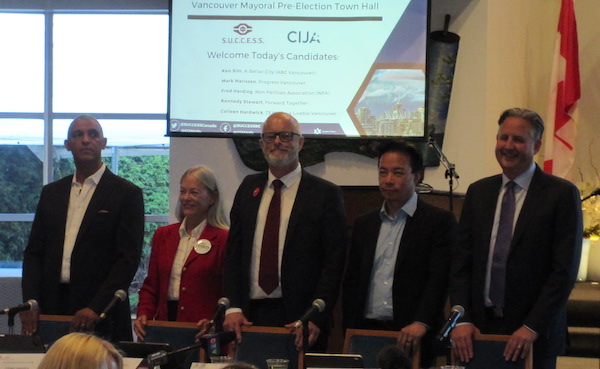
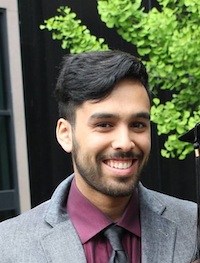
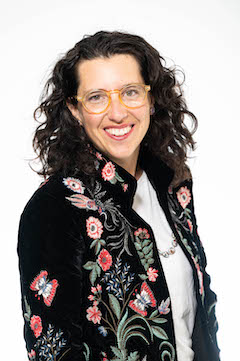
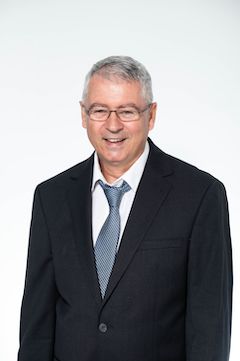
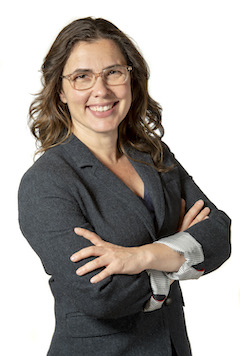
Left to right: Fred Harding, Colleen Hardwick, Mark Marissen, Ken Sim and Kennedy Stewart at the CIJA-SUCCESS Vancouver Mayoral Pre-Election Townhall last month at Temple Sholom. (photo by Pat Johnson)
A forum for Vancouver’s leading mayoral candidates briefly descended into mayhem when candidate Ken Sim criticized the current city council for failing to adopt the International Holocaust Remembrance Alliance Working Definition of Antisemitism.
The only other notable drama was the presence of a small group of protesters who had positioned themselves throughout the sanctuary at Temple Sholom synagogue. They rose and unfolded signs contending that anti-Zionism is not antisemitism. The protesters were ejected and the meeting continued.
In addition to the incumbent, Mayor Kennedy Stewart (who is running on the Forward Together slate), and Sim (with A Better City, or ABC), invitees included Fred Harding (Non-Partisan Association), Colleen Hardwick (TEAM for a Livable Vancouver) and Mark Marissen (Progress Vancouver).
There are 15 individuals running for mayor of Vancouver. The Sept. 7 forum’s organizers, the Centre for Israel and Jewish Affairs and SUCCESS, invited those they viewed as frontrunners.
The election is a rematch after Sim was bested by Stewart in 2018 by just 984 votes. Each candidate repeatedly accused the other of misrepresenting their own record or positions and those of their opponent.
Among other conflicts, Stewart and Sim argued over comments Sim had made on CKNW radio, in which Stewart claimed that Sim had promised to cut $330 million from the city’s budget. Stewart characterized this as a “massive and radical cut,” while Sim replied that he was not speaking about cutting the budget but about reallocating funds within the budget.
Sim’s proposal to add 100 police officers as well as 100 mental health nurses to deal with crime and social problems on the street were dismissed by Stewart, who said the mayor of Vancouver does not have the authority to make those hiring decisions.
Housing was the hottest topic at the meeting, with Stewart touting the incumbent council’s record.
“Last year, we approved almost 9,000 units of housing,” Stewart said. “That is double what we approved just a decade ago. We’ve changed the way and the kind of housing we’re approving…. We used to approve about 75% of very expensive condominiums, but we’ve switched now to about 60% rental and social housing. That is a massive change.… Just last year alone, we opened and built 1,600 units of social housing, which is an absolute record.”
Sim slammed Stewart’s claim as quantity over quality.
“He believes in providing quantity of housing and having big headlines in the media,” Sim said of Stewart, “but he’s not focused on the quality. How bad do these units have to be where people would rather live in a tent on Hastings Street than in one of these unlivable units?”
Later, Sim went on the offensive again when the topic came to community safety.
“You can’t just warehouse people,” he said. “If you do not have support services, you set them up for failure, and that’s what we have done.”
Hardwick lamented that the cost of housing may be pushing her children and grandchildren away.
“I don’t want to be the last generation of my family that can afford to live in Vancouver,” she said. “I have two kids in their 30s and during this term on council I gained two grandbabies and I have to say that I’m not happy … that they are seriously considering moving to Nanaimo because they can’t see a future here. This is what we hear over and over again.”
Marissen said the city of Vancouver has lost 7,000 people in the last year, even as the province gained 60,000 new residents.
Housing, homelessness and community safety merged in the discussion. Hardwick said she, her daughter and her grandchildren went to the Chinatown Festival in July.
“We were pushing along the stroller and trying to navigate between people passed out on the sidewalk with needles in plain view,” she said. “How am I supposed to explain to my grandchildren what’s going on here? It’s just shocking.… It has been 30 years since the closure of Riverview [mental hospital] and we’ve just seen things get progressively worse. Yet we continue to perpetuate the same failed policies. We’ve seen zero improvement and I’d like to hear anybody here saying we have an improved situation. What’s the solution? If we’re spending $1 million a day down there, maybe we better analyze where that money is going.”
Marissen seconded Hardwick’s words, saying there should be an audit of what is being spent in the Downtown Eastside.
Harding, a retired police officer, positioned himself as the voice of experience on safety.
“You cannot have harm reduction and safer supply without access to treatment,” he said. “We have to increase the treatment for people who are addicted and going through a crisis on our streets. I’m here basically because of this issue. I spent 30 years as a police officer. I understand what we need to do and how we need to work on strategic targeting of criminals. We have to work on cleaning up the streets and we do that by targeting the 3% who commit 95% of the crime.”
Stewart said the city is providing “wraparound services, including complex care,” to people who require them and accused opponents of advocating policing where medical interventions are needed.
“There is no way we are going to arrest our way out of it and that’s what a lot of my colleagues here at the table are pointing to,” Stewart said.
“Don’t let Mr. Kennedy [Stewart] trick you into believing that we are trying to police our way out of this,” Sim responded, saying that a range of responses are needed to confront what has become a dangerous situation, including for visible minorities. “In the last four years, our city has become more unsafe. Mayor Stewart was on the news saying that he felt safe in our city. Being a person of Chinese descent, I don’t have that same experience. In fact, residents across the city have told me over and over again that they do not feel safe.”
Safety as it pertains to minorities, including the Jewish community, emerged repeatedly. Sim noted that it was Councilor Sarah Kirby-Yung, who is running on Sim’s ABC slate, who proposed the adoption of the Working Definition of Antisemitism during the current council’s term.
“And Mayor Stewart actually voted it down,” Sim said. “I think it’s incredibly important that council [adopt the definition] so VPD can actually define what an antisemitic hate crime is.”
“The rise in antisemitism and the rise of anti-Asian hate has been profound,” said Marissen. “It’s a tragedy. Leadership matters.”
He said it wasn’t long ago that local politicians were accusing Asian people of causing the housing crisis in Vancouver. He said he would adopt the IHRA definition of antisemitism and urged more diversity work in schools.
“We need to educate our kids,” Marissen said. “It’s really important that people understand the history of all of this. We also need to give support to interfaith and intercultural groups.”
Voters throughout British Columbia will elect new mayors, councilors, school trustees and (depending on the jurisdiction) other officials on Oct. 15.
Over the past several decades, terms for municipal officials have gone from two years to three years to, now, four years. This makes the significance of these elections greater, as the choices we make as voters will last four years. (This longer commitment also may be one reason for what seems like an unusually large number of elected officials opting not to seek reelection this year.)
It is notable that voter turnout in municipal elections is almost always lower – often far lower – than in provincial and federal elections. In some ways, this is understandable. The “senior” levels of government are associated with greater powers, which may be true, and with portfolios that may seem “sexier.” Foreign affairs are more exciting than sewage (generally speaking) and the proper functioning of our healthcare system is, for many of us, literally a life-and-death matter, which the mowing of boulevards is not.
Local government issues, however, often affect our lives in the most intimate and powerful ways. Anyone who has traveled in places without well-functioning local governments sees the evidence around them. Uncollected garbage amasses on boulevards and in public spaces. Feral cats, dogs and rodents roam largely unhampered. Petty, even serious, crime may be rampant. In other words, when civic government is running as it should, it is often invisible. When it is not, it can make ordinary life difficult or, at worst, impossible.
As often-privileged citizens of developed Western countries, we can sometimes use hyperbole about the challenges facing our communities. Overheated rhetoric about issues as comparatively banal as bike lanes, which demand that car drivers share a bit of the road with cyclists, can become so frenzied one might think a cabal of medieval tyrants had stormed the ramparts at 12th and Cambie. We should really put things in perspective.
Successful cities are, in their way, modern miracles. It is precisely their success that blinds us to their exceptionalism. Imagine: no matter where you live in Vancouver, a truck comes past your home once a week to collect the recycling you leave on the curb, knowing it will be collected (depending on the weather) without incident. Your children are within walking distance of public schools that are of truly outstanding quality by any measure of time or place. The bus we curse for not showing up at the exact moment we arrive at the stop is, for all our complaining, a remarkable operation. Hundreds of small cogs combine to make a city run.
Of course, we have complaints. A recent Leger poll indicates that 48% of Vancouver respondents (and, for example, 60% in Surrey) said things in their city have gotten worse in the past four years. This may be true. Certainly there are serious issues affecting residents, including but not limited to a housing affordability crisis, widening inequality, a drug poisoning crisis, and the impacts of climate change. And yet, for many, things are still pretty good.
This is not to say that voters should not always be pushing our elected officials to be better and do much, much better; merely that we need to remember that we live in one of the most fortunate places in the world, with millions of people envying that which we take for granted. Things can be better, at all levels of government, but the occasional language we hear that our governments are “broken” or “failing” is shortsighted and out of proportion.
The at-large system, which operates in Vancouver and every other city in British Columbia, is a barrier to an informed electorate. Voters in the City of Vancouver, for example, are expected to make educated choices for one mayor, 10 city councilors, nine school trustees and seven park commissioners from – by our count – 138 candidates who are contesting these positions this year. There is no earthly way even the wonkiest voter could adequately inform themselves about the pros and cons of this many contestants.
But we should do our best. The adage that those who don’t vote have no right to complain is nonsense. Everyone has the right to complain.
But voting is not only a right, a franchise. It is an obligation. For whatever flaws B.C. communities might have, all of our cities and towns remain among the finest societies anyone could hope to live in. To preserve and strengthen the places where we live, voting is, almost literally, the least we can do.
As part of the Jewish Independent’s election coverage, we have traditionally profiled members of the community seeking elective office. And this year’s Oct. 15 municipal elections are no different.
* * *
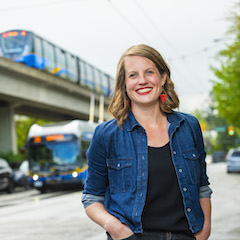
Christine Boyle, Vancouver council candidate (incumbent)
Christine Boyle was elected to Vancouver city council in 2018 representing OneCity. She asked to be included in the Independent’s coverage as a member of a mixed family.
Christine Boyle (PR photo)
Boyle, who describes herself as a community organizer, climate justice leader and United Church minister, is married to author and public policy researcher Seth Klein. They are raising two children in East Vancouver.
Boyle said she has spent her first term on city council “working tirelessly to strengthen tenant protections, and make it faster and easier to build social, co-op, nonprofit and rental housing in every neighbourhood of Vancouver.” Her other priorities include public transportation, safer walking and cycling infrastructure, increased funding for curb ramps, public washrooms “and other tangible improvements to access and community health.”
“I am running for a second term on council, alongside a strong team of OneCity Vancouver candidates, because of my deep concern about the housing crisis, the climate emergency and the toxic drug crisis,” she told the Independent. “And I’m running because I know there’s so much more we can do.”
“My husband Seth was raised in a culturally Jewish home, the child of a secular Jewish father and a spiritually rooted Jewish mother,” she said. “When we were first dating, I remember him asking if he thought our religious differences would be a problem for our families, and my response was that we had much more in common than not.
“Throughout my upbringing, my theological training and my time working in religious leadership, I have constantly sought out opportunities to connect across faiths on shared issues of importance, from climate, to discrimination and anti-racism, to Indigenous rights, and more.
“More than a decade later, these values continue to be core to my family. The ketubah [marriage contract] that hangs on our bedroom wall reminds us daily of our shared commitment to tikkun olam, the struggle to rebuild and repair the world, to find our shared place in the centuries-old movements for equality and interdependence.
“We have worked hard to instil a sense of awe in our children and a connection to the faith and cultural traditions of their people,” said Boyle. “Our kids have attended programs at Or Shalom and the Peretz Centre. I became a regular challah baker. And we reach out to friends and leaders in our faith communities as we navigate how to raise good kids in the world these days.”
* * *
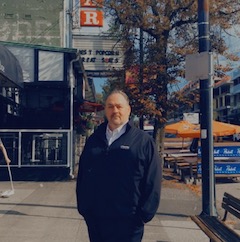
Ken Charko, Vancouver council candidate
Ken Charko is running as a Non-Partisan Association Vancouver candidate.
“I have always had a connection to the Jewish community,” Charko told the Independent.
Ken Charko (PR photo)
In his capacity as owner of the Dunbar Theatre and as a director on the board of the Motion Picture Theatre Association of British Columbia, he has been mentioned in the Independent over the years. Noting that he was profiled by former Menschenings columnist Alex Kliner in 2014, Charko said, “I have always been supporter of the arts and their importance in our community and the special connection the Jewish community has with the arts.”
Charko has run for Vancouver city councilor three times as an NPA candidate and, in 2018, as a candidate of the now-defunct Coalition Vancouver party. He said his top policy priorities concern “public safety and crime, including hate crimes; housing, including co-op housing on city land; arts venues and small business.”
While he initially thought of running in a federal election, he said, “Municipal politics is ‘touch politics,’ you feel the people and hear directly what each community needs and is looking for in an elected representative.”
He still has a lot of issues at the federal level that he wants to champion, he said, including “support for Israel, strong foreign policy, taxation fiscal policy and support for Ukraine,” but that, locally, he “can champion those policies more effectively as an elected council candidate.”
Charko acknowledged that “almost everyone running in this election wants the same thing I have mentioned above, including reduced tax increases. The choice for voters is who can get these things done. I am that person. I have always done that. As the only independent movie theatre owner on the Motion Picture Association board, I was able to get things done working with others.”
* * *
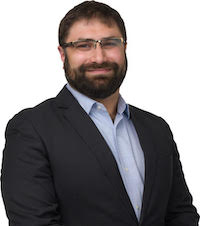
Jonathan Lerner, District of Lantzville council candidate
Jonathan Lerner is running for council in Lantzville, which is immediately north of Nanaimo.
“I grew up in the Jewish community in Vancouver, attending Talmud Torah, Temple Sholom and working for many Jewish organizations,” Lerner told the Independent. He has a degree in philosophy from the University of British Columbia and has worked with many nonprofit organizations.
Jonathan Lerner (PR photo)
“These have included many Jewish organizations, such as Hillel BC, CIJA, Jewish Family Services of Vancouver and the Vancouver Holocaust Education Centre,” Lerner said.
“During my career, I have helped to uplift communities through the power of the charitable sector, including raising millions of dollars for employment services, food banks, immigration services, animal welfare, student education and scholarships, anti-racism initiatives, and more,” he said. “While I intend to continue my career in the not-for-profit sector, I hope to put my experience in finance, management and community development to use in helping Lantzville fulfil its slogan of being a ‘lovable, livable’ community.”
His top political priorities include bringing more services directly to the people of Lantzville, such as library book-mobiles, preserving Lantzville’s scenic landscape and natural beauty, expanding councilor office hours, public hearings and town halls, and ramping up emergency preparedness for earthquakes, floods, fires, landslides and other major disasters.
“My Jewish education and upbringing have definitely affected my community connections and outlook, while spurring me to get involved in politics,” said Lerner. “I believe strongly in the value of tikkun olam and the need to help those who are vulnerable become vulnerable no longer. This has been a major source of my motivation for community and charitable involvement. I sincerely hope that municipal politics will be the next step in the evolution of my work toward building a better world.”
* * *
Ellison Mallin, District of North Vancouver council candidate
Ellison Mallin was born and raised in North Vancouver. He has a degree in political science and a record of volunteerism, which led him to his current full-time position as constituency assistant for MLA Susie Chant. Ellison has served on North Vancouver’s Rental, Social and Affordable Housing Taskforce and the Community Services Advisory Committee, acting as the chair in 2022. He has coached in the North Shore Inline Hockey League and also has worked in the music industry.
Ellison Mallin (PR photo)
“Housing affordability is the number one issue for me in this election,” he said. “We are losing workers and our sense of community because people can no longer afford to live on the North Shore. This causes a chain reaction that leads to many of our other top problems, like traffic and public safety. Solving our housing problems needs to be done as a priority so that we may address other issues.
“I also have a dedicated platform on transportation solutions, better spending and planning, environmental leadership, improving civic engagement and improving the health of our community,” Mallin said.
“I am the great-great-grandson of Rabbi David Belasoff, who was the first full-time Orthodox rabbi in Vancouver,” Mallin said. “He led the B’nai Yehuda (now Schara Tzedeck). My grandparents, Lil and Lloyd Mallin, used to host amazing Passover, Chanukah and Rosh Hashanah dinners, but when they passed those did not continue. I did take my Birthright trip in 2016 to explore Israel and became more connected with the Jewish community in Vancouver as a result. Connecting to the community really did help me find my identity and gave me a lot of the confidence I needed to put myself out there in electoral politics.… I attend the occasional social events that I am available for, and I do go to some public events held by Har El in West Vancouver. For me, the biggest barrier to attending more events is the traffic and distance to them from North Vancouver and would love to see more Jewish community opportunities in North Van.”
* * *
Carla Frenkel, Vancouver Park Board candidate
Carla Frenkel has more than a decade of experience in architecture, working on affordable housing, urban design, and environmental responsibility. She is running for park board with Vision Vancouver.
Carla Frenkel (PR photo)
“Finding alignment with Canadian values, we decided to immigrate to Vancouver [from the United States] in 2014,” she said. “We found an amazing community in Strathcona, anchored around Maclean Park, our community centre and gardens. Since 2018, I have been president of the Strathcona Community Garden, where I coordinate hundreds of volunteers, leading stewardship of Vancouver’s largest community garden. There, I spearhead a wetland project, which manages storm water while improving biodiversity. A mother of three, I chair the Strathcona PAC’s school grounds committee,” she said.
“Today we face monumental challenges of aging infrastructure, climate change and reconciliation,” said Frenkel. “From this arises unique opportunities to create resilient parks and community centres that serve the diverse needs of residents.”
Frenkel’s identity and core values are intrinsically tied to being Jewish, she said.
“I grew up in a progressive Reform synagogue, which reinforced tikkun olam, interconnectedness, social and environmental justice and mitzvot,” she said. “In high school, I followed suit, joining NFTY [the Reform Jewish youth movement], actively leading, planning services and gatherings. In university, I worked at the Berkeley Hillel, where I met my husband. Today, we are part of the Or Shalom community, where we share these traditions and values with our children.”
* * *
John Irwin, Vancouver Park Board candidate (incumbent)
John Irwin was elected to the Vancouver Park Board in 2018 with the Coalition of Progressive Electors and is seeking reelection with Vision Vancouver. Like Boyle, he is part of a mixed family and his spouse is Jewish.
John Irwin (PR photo)
He holds a PhD specializing in sustainable urban development, works as a lecturer at Simon Fraser University and Alexander College and also has worked as a policy analyst for the Tenant’s Rights Action Coalition (now the Tenant Resource Advisory Centre) and the Canadian Centre for Policy Alternatives, B.C. office. He worked in fair trade retail from 1996 to 2006. He is a father of three school-aged kids and lives in the Fairview neighbourhood.
Irwin has served on boards including the Society Promoting Environmental Conservation, Friends of False Creek (now the False Creek Watershed Society) and the West End Residents Association. He was chair of the Henry Hudson Out-of-School Society and is an advocate for affordable childcare.
“I am running for reelection with Vision Vancouver as a park board commissioner, as I think that we have much more to achieve regarding the climate crisis, active transportation, ‘reconcili-action’ and accessible and affordable parks and recreation,” he said. “In my first term, I brought forward many successful motions: the Stanley Park Mobility Study focuses on reducing automobile traffic and promotes active transportation by increasing cycling, walking and public transit in the park while increasing accessibility for those with disabilities; a motion requesting the Port Authority give the park board the go-ahead to work with the local First Nations to plan and build an Indigenous cultural healing centre in CRAB Park; a recent motion asking staff to design fully accessible playgrounds for all children, which will help those with disabilities play with their peers in an active and inclusive way.
“I have also been a strong voice against discrimination of all types: antisemitism, Sinophobia and Islamophobia, etc.,” said Irwin.
“For many years, I have found the Vancouver Jewish community to be very welcoming,” he said. “Although I am not Jewish, many synagogues have welcomed me, my partner who is Jewish and my three children, who have all attended Hebrew school. Our children celebrated their b’nai mitzvahs at Beth Israel Synagogue, where we regularly attend as members. The practice of mitzvah has reinforced my activism to do my part in making our society in Vancouver socially just and sustainable. I am inspired by the practices of atonement and ecological consciousness, such as that found in Tu b’Shevat, the Jewish new year for trees.”
* * *
Kyla Epstein, Vancouver School Board candidate
Kyla Epstein’s family left South Africa before she was born.
“I was raised in Toronto on the shoulders of my parents going to anti-apartheid rallies, marching in Pride protests, and attending public, alternative schools that were child-centred, social-justice-focused and showed me that public education and learning can take many forms,” she said.
Kyla Epstein (PR photo)
“Over the past two decades, my curiosity and desire to build relationships have led me to work in a variety of sectors, including business, philanthropy and nonprofit (including two years in Guatemala) and labour, before moving into my current role doing government and stakeholder relations at BCIT [B.C. Institute of Technology].”
Epstein has served on many boards and was a trustee and chair of the Vancouver Public Library board. She is now on the boards of the Vancouver Writers Festival, the Laurier Institution and the National Coalition for Dialogue and Deliberation. She has served on school parent advisory council executives for more than 10 years and is currently pursuing a master’s degree. She is running with OneCity.
“High-quality public education is one of the best ways that we, as a society, can care for future generations,” Epstein said. “Funding for the public school system should appropriately reflect the value of public education, not just for students and families currently in the system, but for communities and society more broadly.”
If elected, she said, she will advocate for funding to ensure that students with a range of diverse needs can thrive and every teacher and worker has the tools and resources they need; address climate change; stand up against any form of discrimination in schools; fully implement the United Nations Declaration on the Rights of Indigenous Peoples across the school district and develop reciprocal relationships with local First Nations for all planning decisions, especially those related to school board land; and improve Vancouver School Board governance by listening to people, being accountable and considering those who are most impacted.
“While not raised religiously, it is hard for me to untangle my identity from my being Jewish,” she said. “Many of my most special memories, or the moments that formed my sense of self, are grounded in Jewishness. Holidays such as Pesach have always been important to me because it is a regular reminder, through stories and songs, of the ongoing struggles for justice and liberation.
“I also feel a kinship with the emphasis on asking questions that is a part of my Jewishness,” she added. “The stories shared in my family about persecution faced by Jews have certainly contributed to how I see the world. Family stories of unwilling migration are regular reminders to me that everyone’s dignity and safety be upheld all around the world. My parents’ very difficult choice to leave South Africa and the activism I was raised with were rooted in the lessons of tikkun olam and I draw upon those lessons regularly.”
* * *
Fred Harding’s diverse DNA
During the mayoral candidates’ forum held at Temple Sholom Sept. 7, Non-Partisan Association candidate Fred Harding made a brief reference that he could become Vancouver’s first Jewish mayor. (He couldn’t. David Oppenheimer, Vancouver’s second mayor, was Jewish.)
Fred Harding (PR photo)
The Independent asked Harding about his roots after the meeting.
“My mother is from Germany – and my family was Jewish,” he said. “After she married my father, all my siblings were raised in Catholicism. My mother actually converted later on to Mormonism, so the Jewish faith was never practised in our home. The tragedy is that my family remained in Germany and so I never had a connection to the Jewish faith.”
At the age of 14, however, Harding traveled to Germany and met some of his great-aunts, who had been persecuted in the war and later received financial compensation.
He also has visited Congregation Har El.
“I had some very dear friends bring me to the temple in West Vancouver probably 12 years ago and that was my first experience,” he said. “I actually felt very, very welcome.”
He sees his family’s diversity as a benefit as he seeks to lead one of the world’s most multicultural cities.
“This is only a fraction of my DNA. I’m a German Jewish Catholic with a Mormon mother, a Christian father who came from Africa. I’m married to a Chinese lady, my granddaughter is Chinese, my eldest daughter is blonde and blue-eyed,” he said. “I feel the privilege of representing just about everything and I’m honuored for that background in my DNA.”
Voters across British Columbia choose local officials on Saturday, Oct. 15. Remaining advance voting days in Vancouver are on Oct. 8, 11 and 13 and vote-by-mail ballots can be requested until Oct. 11. For full details see vancouver.ca or your local municipal website.
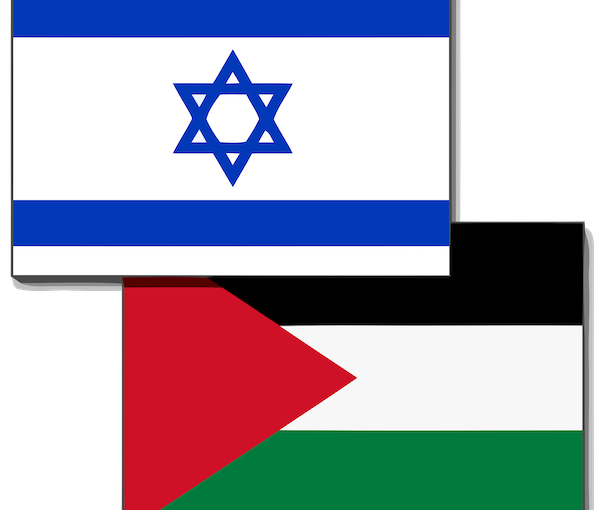
The Independent asked candidates we profiled two additional questions: “Will you (or won’t you) use your position as a platform to discuss international affairs, specifically Palestine and Israel?” and “If so, can you provide a brief explanation of your perspective on the subject?” (image from Wikipedia)
Civic politics generally deals with maintaining roads and sewers, reviewing development applications and a vast range of close-to-the-ground issues. But municipal politics has also been a place where a vast range of other issues are discussed. For example, Vancouver city council voted in 1983 to declare the city a “nuclear weapons free zone” and, formally or informally, members of council have felt free to address topics of national and global concern.
During debate around the city’s adoption of the International Holocaust Remembrance Alliance Working Definition of Antisemitism – which a majority of council voted to refer to committee, effectively defeating it – critics of the definition warned that it could place limits on the right to criticize Israel, despite that the definition explicitly states that it is legally non-binding. While the condemnation of antisemitism is not an international issue, examples accompanying the definition included several relating to anti-Zionism.
Because of the history of using civic positions as platforms for international issues, the Independent asked candidates we profiled two additional questions: “Will you (or won’t you) use your position as a platform to discuss international affairs, specifically Palestine and Israel?” and “If so, can you provide a brief explanation of your perspective on the subject?”
Christine Boyle, the incumbent Vancouver city councilor who voted to refer the IHRA issue to committee, said that commenting on international affairs is not generally part of the role of a city councilor.
“And there are so many important issues and struggles locally that continue to be the focus of my attention,” she said. “But my practice on any topic is to listen to and engage with communities most impacted on an issue, always seeking to uphold human rights, peace and justice.
“I have spent much of my adult life actively engaged in justice work, including opposing and challenging hate and discrimination, and working to strengthen the human rights of all people,” she continued. “I am deeply committed to challenging antisemitism and ensuring that Jewish residents in Vancouver feel safe at home, at worship, and everywhere.
“When a motion came to council asking Vancouver to adopt the IHRA Definition of Antisemitism, council received hundreds of emails on the subject, with a diverse range of perspectives on the topic,” said Boyle. “Even my own Jewish family members didn’t all agree on the issue. What I heard clearly from the community was that, while there wasn’t agreement on this definition, there was absolutely a need for the city to do more to address antisemitism and racism. And so council referred the definition to the City of Vancouver’s Racial and Cultural Equity Advisory Committee, with direction for staff to continue working vociferously to address antisemitism and other forms of racism and hate. Since then I have worked hard each budget cycle to ensure our anti-racism and anti-hate efforts are well funded and supported, and will continue that work.”
Vancouver council candidate Ken Charko told the Independent, “Yes, I would use my position as a city councilor as a platform to discuss international affairs [and] yes support of Israel will be part of that platform…. I support Canada moving its embassy to Jerusalem and recognizing it as the capital of Israel. I would use my position as a Vancouver city councilor and federal Conservative member to outline why Canada should do that under the next Conservative government.”
John Irwin, an incumbent member of the Vancouver Park Board, switched from the Coalition of Progressive Electors last election to Vision Vancouver this election because, he said, “There was a disagreement with COPE regarding their lack of acceptance of the IHRA definition of antisemitism (which was accepted by the Canadian government).”
He added: “As a local politician, I generally use my platform to discuss local issues.”
Carla Frenkel, also a candidate for the Vancouver Park Board, said simply: “I have no intention to use the role of park board commissioner as a platform for international affairs.”
Kyla Epstein, who is seeking a seat on the Vancouver School Board, said that, to her knowledge, international affairs do not regularly come up at the school board table, nor is it generally within the scope of the role of a trustee to take a position on international affairs.
“What I do know is that I bring to the role a deep commitment to human rights and an opposition to antisemitism, Islamophobia, anti-Palestinian racism, anti-Black racism, anti-Indigenous racism, and all forms of discrimination, racism and hatred,” she said. “In addition, my approach to governance is to listen, welcome different perspectives and reduce barriers for public and stakeholder participation – on any issue. I will fight to uphold a public education system that is a place of learning, curiosity and questioning. I will, no matter the issue that comes to the school board table, reach out to communities, listen and learn, and make my decisions to uphold human rights and equality.”
Ellison Mallin, running for council in the District of North Vancouver, said, “I am always discussing international issues with people, as, in this increasingly connected world, events that happen anywhere can affect us here.
“I do not intend to use any municipal specific platforms, or my position, to bring up Israel and Palestine, and will keep discussions on the subject to appropriate venues. I do recognize that, given my religion, there will likely be comments and questions directed to me, which I will not shy away from,” he said. “I strongly believe in Israel’s right to exist. A safe place for Jewish people to live and to foster Jewish identity and culture is needed. Perhaps, sadly, it is needed now more than ever, as we do see a rise in antisemitism in many areas. On that note, I do not deny Palestine’s right to exist, and believe a two-state solution is needed. I would also like to see Israel stop building settlements in the West Bank, as this further creates divides and hostilities.”
Jonathan Lerner, council candidate in Lantzville, said he does not see Middle Eastern affairs coming into play in Lantzville politics. But, he added: “Everyone familiar with my work will know that I am a strong advocate for respectful dialogue on these issues.
“Where I think municipal governments can play a larger role is in diversity, inclusion and anti-racism initiatives,” said Lerner. “Many communities, including the Jewish, Muslim and LGBTQ communities, have been targeted by an increase in hate crimes in Canada. Municipalities have a key role to play in addressing this issue. For example, governments of all levels are considering adoption of the International Holocaust Remembrance Alliance definition of antisemitism, as well as other racism classifications that help to define and address discrimination.”
Tony Yacowar will be vying for a seat on the Victoria city council this Oct. 15. Among his stated priorities, if elected, are affordable housing, addressing climate change and amalgamation within the Greater Victoria region.
Housing in Victoria, as in Metro Vancouver, is a primary concern among residents. Yacowar hopes to help pass the “Missing Middle Initiative,” a long-debated but deferred policy that he says would make it easier to add more housing units to areas of the city that have been traditionally residential.
“Victoria has an urgent housing crisis and we need leadership that will articulate a cohesive vision for the city in order to build the housing we need. We have an immediate deficit of between 4,500 and 6,300 homes. People need places to live. This impacts absolutely every aspect of city life. The healthcare crisis in this province is exacerbated by the fact that doctors and nurses can’t find places to live. We all want safe communities to live in and, if we aren’t able to provide housing to folks experiencing homelessness, we aren’t able to have safe communities for the long term,” Yacowar said.
“Gentle densification of our residential neighbourhoods is an important aspect of how we are going to accommodate the next generation of doctors and nurses, small business owners, artists and young professionals. Folks at all income levels need places to live. Missing Middle is not the solution to the affordability crisis, but it is the solution to the question of ‘where are these folks going to live?’”
Further, Yacowar would like to build density around the Douglas Street Corridor, the main thoroughfare linking the Victoria’s downtown and uptown, to support light rail transit. According to Yacowar, there is a strong connection between more homes and better transit in terms of reducing a city’s carbon footprint overall.
Yacowar is also pressing for amalgamation. “We need a cohesive vision for our city and we can’t have each municipality doing its own thing,” he said. “A city of 245,000 would be better able to advocate for more support from senior levels of government when it comes to housing and transit than a city of 91,000.”
A certified public accountant who is currently the chief financial officer at Royal Mountain Records, Yacowar regards having no prior involvement in politics as an advantage.
“I think it’s important to have a diverse set of views and backgrounds on council,” he said. “We don’t often get accountants in politics and I think there is a real benefit to having someone at the table with the kind of organizational and financial background that a CPA would bring, as well as someone representing the Jewish and LGBTQ communities. Quite often we have career politicians and bureaucrats running for office, but our democracy is at its best when we have folks of diverse backgrounds bringing different points of view to the table.”
Ben Isitt (PR photo)
Of the eight present councilors in Victoria, only one, Ben Isitt, is seeking reelection. Five councilors elected in 2018 are stepping down and two are running for mayor. Isitt, too, identifies as a member of the Jewish community.
Isitt has served as a city councillor and regional director since 2011. His short bio on the City of Victoria website notes that he is an author, historian and legal scholar, who has taught at the University of Victoria and other institutions. It notes: “Ben’s involvement in civic politics builds from grassroots volunteer work for social and ecological justice, in support of worker rights, climate action, Indigenous rights, non-violence, the abolition of poverty and racism, and protection of forests and farmland. Ben’s research on housing, land use, forestry and public education reflect this community-based approach, as does his hands-on experience as a former housing support worker with Victoria’s street community.”
Sam Margolishas written for the Globe and Mail, the National Post, UPI and MSNBC.
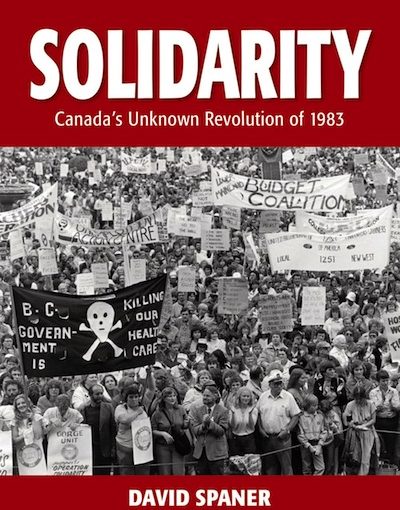
David Spaner’s new book, Solidarity: Canada’s Unknown Revolution of 1983, forms an archival testament of one of this province’s most dramatic epochs.
One of the funny things about watching the 1976 movie All the President’s Men, about how Washington Postreporters Bob Woodward and Carl Bernstein broke Watergate and brought down Richard Nixon, is that, after 138 minutes of sitting on the edge of your seat, you realize that you’ve watched nothing more than two men making phone calls and knocking on doors asking questions. In other words, stuff doesn’t need to blow up in order to make an excellent movie. This thought occurs when reading Vancouver author David Spaner’s new book, Solidarity: Canada’s Unknown Revolution of 1983. On the surface, the book is a litany of bureaucratic meetings and activists’ backstories. Together, they form an archival testament of one of this province’s most dramatic epochs.
Spaner, an activist and journalist who has been immersed in the left-wing ferment for most of his life, chooses a different Hollywood reference. At the end of the book, he alludes to the 1983 film The Big Chill, in which disenchanted middle-agers convene for a friend’s funeral and lament their glory days. For anyone who has been part of British Columbia’s left-wing movements – recently, in 1983, or decades earlier – this book will provide many Big Chill moments. An initial criticism might be the title, which alleges this history is forgotten. Any person who was living in British Columbia in 1983 and even moderately politically aware will not forget that riotous time, though Spaner revives it effectively for new audiences.
Spaner’s thesis is that British Columbia’s well-known legacy of progressive activism that began in the 19th century converged in 1983. All the economic, social, racial, gender and other movements cohered in response to unparalleled government excess – and then refracted again into the myriad organizations and causes that drive B.C. politics today.
The province’s long history of progressive activism weaves its way through the book. More volunteers from Vancouver signed up to fight Franco’s fascists in the Spanish Civil War than from any other North American city save New York, Spaner says. And, in a more trivial note, he claims that the Industrial Workers of the World got their nickname “Wobblies” right here. Greenpeace was founded in Kitsilano in 1971. Movements against the Vietnam War and nuclear warships found fertile ground here. A squatters’ park stopped development at the entrance to Stanley Park. A “smoke-in” in Gastown protested police brutality and called for loosened marijuana laws. The Simon Fraser University Women’s Caucus, formed in 1968, was, according to the book, not only the first such group in Western Canada, but the first in North America. The first rumblings of gay rights activists were heard in these parts around the same time.
With all this as a foundation, the events of 1983 exploded out of the results of the provincial election on May 5. Dave Barrett’s New Democrats, who had governed the province for a short but tumultuous two-and-a-half years beginning in 1972, had been widely anticipated to defeat Bill Bennett’s right-wing Social Credit government. Instead, Bennett pulled out a surprise victory – and then launched a “restraint movement” that was unprecedented in Canada and is often compared with Thatcherism in Britain and Reaganism in the United States. On July 7, Bennett and his cabinet “unleashed a far-right legislative avalanche that tossed asunder virtually every advance achieved by B.C.’s social activists and trade unionists,” Spaner writes. “In an instant, and from every corner of the province, there was a rising of resistance.”
Almost exactly two months after the election, Bennett’s Socreds dropped 27 radical bills, affecting every area of government operations. For starters, 1,400 members of the B.C. Government and Services Employees Union (BCGEU) were summarily fired the day after the bills were tabled. The government eliminated special education programs, reduced student loans, fired family support workers, took away autonomy from local school boards and mandated fewer teachers and larger class sizes. Environmental protections were removed, welfare rates frozen, healthcare facilities closed and programs, including the Human Rights Commission, were cut. Funding for programs in services like the Vancouver Women’s Health Collective were eliminated. They closed the Tranquille mental health facility in Kamloops and fired its 600 employees. Labour relations laws were amended to take away rights such as seniority, working hours and overtime in collective agreements. Tenants could be evicted without cause and the Rentalsman’s office was eliminated, meaning any disputes would have to go to expensive court proceedings. The Agricultural Land Act, intended by the Barrett government to protect farmland, was gutted. User fees for hospital care increased exponentially.
Organized labour mobilized as soon as they could shake off the disbelief about what they were confronted with. They formed Operation Solidarity, an umbrella covering 400,000 unionized workers in the province, under the not-so-gentle guiding hand of the B.C. Federation of Labour. A parallel group, the Solidarity Coalition, was a motley amalgam of community groups and activists, less hierarchical and disciplined than the trade union groups. (The names were lifted from the nascent Polish anti-communist movement emerging at the time, but the ruptures in the B.C. movement make the moniker somewhat ironic.)
The first big rally took place in Victoria’s Memorial Arena, attracting 6,000 protesters. This was where the initial idea of an all-out general strike gained currency – and the seeds of the movement’s destruction were planted. A massive rally followed in front of the old CN station at Thornton Park on Main Street in Vancouver, on July 23. Organizers had hoped for 2,000 attendees but 25,000 showed up.
As is common in activist circles, Jewish individuals played an outsized role. The author, who is Jewish, comes by his credentials naturally – his grand-uncle was a good pal of Dave Barrett’s dad, Sam, in East Vancouver. One of the most visible faces of the movement was Renata Shearer, a Jewish refugee from Nazi Germany who was fired as the province’s human rights commissioner. Feminist and union leader Marion Pollock and Carol Pastinsky, who grew up in a left-wing household that hosted meetings of the United Jewish People’s Order, are featured in the book. And, of course, Barrett, who, despite his recent defeat, led the charge in the legislature against the onslaught, was the province’s first, and so far only, Jewish premier.
Another Jewish person, Stan Persky, launched and edited the movement’s publication, Solidarity Times. The newspaper, funded by organized labour, provides one of many examples in the book about bitter feuds within and between the disparate factions in the Solidarity mishpachah (family). A bunch of young, idealistic journalists who were working under Persky got a taste of censorship that they might have expected in a career with the bourgeois press but perhaps had not anticipated from their comrades in the movement. “Remember who writes your checks,” a union apparatchik warned them after spiking a story that didn’t toe the union line.
One of the most visible schisms in the mass movement occurred at a huge rally where most of the rank-and-file attendees were apparently champing at the bit for a general strike, but the more cautious leader of the movement, Art Kube, instead urged everybody to get a copy of a petition, have their neighbours sign it and send it in to the government in Victoria.
Said one activist reflecting his response that day: “We want militant action. We want to shut down this province. Instead, were being told, ‘Go get a petition signed.’”
But, while Kube was the one who disappointed that day, many in the movement believe it was his illness – a physical or mental breakdown – that led to what many or most view as the ultimate betrayal of the entire project. The BCGEU and the teachers’ union went on strike, shutting down huge swaths of the province. As pressure built, an unexpected – and largely unwanted – resolution was hatched by one segment of the union movement.
Within the Solidarity movement, there were schisms between the far-left and the comparatively more right-leaning unions, between radicals who wanted transformative change and reformers more narrowly opposed to specific legislation. There were, of course, also a lot of very strong personalities, all packed together and stressed by the pressures of the time.
With Kube sidelined by illness, the B.C. Federation of Labour sent Jack Munro, one of British Columbia’s feistiest, foul-mouthed and most divisive union figures, to meet with Premier Bennett at his home in Kelowna. When other partners in the Solidarity movement found out that the meeting was taking place, they knew they were done for.
“Munro and Bennett reached the quick agreement, settling the BCGEU contract but offering little else to most Solidarity members,” writes Spaner. “Then they stepped out on the premier’s patio to announce their Kelowna Accord.”
“We were all in tears,” recalls one activist. “It was a horrible betrayal.”
Once a big swath of the union movement had pocketed what they wanted from the government, the larger movement effectively fizzled out.
“Some longtime union activists simply don’t have a bigger dream, so it was impossible for them to see the Solidarity drama as a failure. To them, it was just another contract negotiation,” Spaner writes.
But while the movement itself may be gone, the legacy lives on, Spaner argues. Those trenches formed a generation of B.C. activists, not least of whom is John Horgan, who was inspired by the lofty outrage of Barrett and marched down the road to join the NDP for the first time.
Spaner is no impartial observer. His stripes are on full display, but he delivers an insider’s view of the times – times that affect us still.
Leslyn Lewis, a candidate for the Conservative Party of Canada leadership that will be decided in the coming days, made a stir last week when she invoked the Nuremberg Code, apparently with regard to coronavirus vaccines.
The Nuremberg Code is a postwar set of principles on medical ethics arising from the horrific medical experimentations of the Nazi era. Although Lewis did not explicitly mention COVID-19, the issue was clear in context. She warned of government overreach, saying, “even in modern times the tenets of informed consent and voluntary participation in scientific experiments can be easily undermined by even our modern governments.”
If for no better reason than avoiding a communications crisis, reasonable candidates for elective office should avoid comparing things to Nazism. In almost every instance, there is nothing to be gained. In this instance, where the candidate appeared to be referring to a vaccine that can prevent or seriously reduce the impacts of a potentially deadly virus, the comparison is irresponsible and base.
Around the same time as Lewis was causing controversy here in Canada, Mahmoud Abbas, the Palestinian president, stood next to the German chancellor, Olaf Scholz, and declared that Israel had perpetrated “50 holocausts” on the Palestinians. Scholz has been criticized for not immediately condemning Abbas’s atrocious act of Holocaust desecration – words that took place on German soil.
This incident was a flashback to the time, in 1999, when Hillary Clinton, then the U.S. first lady, got in trouble for standing on stage with Suha Arafat, wife of Yasser, when Mrs. Arafat accused Israel of poisoning the Palestinian water supply. This accusation, an unoriginal claim pilfered straight from antisemitic Medieval European well-poisoning canards, was akin to the latest outrage from Abbas in both form and international reaction.
About the only time the West expresses any concern about such defamations is when they are uttered in the presence of world leaders in front of less credulous media than the Palestinian leaders face at home. While Clinton and Scholz certainly deserve some censure for not speaking out instantly in the face of such overt libels, their presence is a sideshow to the main event: a narrative that is founded on grotesque demonizations.
Abbas is no newcomer to Holocaust revisionism and defilement. His PhD dissertation at a Soviet university contests the number of Jewish dead and accuses Zionists of participating in the Shoah to advance their nefarious aims.
These sorts of lies – “holocausts,” poisonings, genocide, even Zionist sharks attacking tourists – are routine fodder for Palestinian leaders, newscasters, media and even the United Nations-funded Palestinian education system. It is the nature of dictatorial leaders and undemocratic movements that they grow intellectually lazy, having groomed an audience so inured to lies and exaggerations that they will accept, or at least not contest, the most depraved allegations. After 70-plus years of exposure to increasingly preposterous conspiracies like Zionist-trained sharks snapping at European tourists at beach resorts, many are ready to accept and repeat them.
“A lie gets halfway around the world before the truth has a chance to get its pants on,” Winston Churchill colourfully said. Churchill died before the internet was born. Today, a lie gets even farther even faster.
Mix the range and speed of the internet with millennia of conspiracies about Jews and the reality that most people are inundated with Israel-Palestine news without context, and it is easier to understand why people who are overwhelmed by complexity and who seek simple solutions don’t resist or even question such lies.
For similar reasons, we must both keep a critical eye on how science evolves with coronavirus and vaccines, as well as encourage people to get vaccinated, to reduce the risks of disease. Terrible experiments have been done on marginalized populations so, as a society, we must be sensitive to these experiences and traumas. The mistrust has a real history, but some people are using this fact to sow more mistrust in institutions and governments, which adds to the fires of conspiracy, which is bad for everyone, but in particular marginalized and minority populations.
While miles apart in quality, the remarks by Lewis and by Abbas deserve condemnation. The world, especially now, tends to move on quickly from one moral atrocity to the next, from this outrage to the next. But we cannot let these things go unchallenged – whether they come from dictators or from potential leaders in a democracy. The job of decent people is to come along and clean things up. It’s a dirty job. But somebody has got to do it.
As a former World Jewish Congress Ronald S. Lauder Fellow, I attended the first Ronald S. Lauder Fellowship Diplomacy Summit. The fellowship is an international cohort of top Jewish students with an interest in global Jewish advocacy who are invited to Europe to participate in high-level meetings with government institutions. From the moment I arrived at the summit in Brussels, the excitement felt by the other fellows and staff was infectious.
We began the trip in the European Union offices, hearing from EU members about the state of Europe and advocating for the European Jewish community. This was followed by a visit to NATO. The number of brilliant minds in these rooms was astounding, and it was such a privilege to watch as my small cohort of young Jewish students and professionals posed challenging questions to EU and NATO leaders regarding the state of European Jewry, global antisemitism and recent world tensions.
The same can be said about our visit to UNESCO in Paris the following day. As a media and information studies student with a niche interest in big tech policies, I was intrigued to learn about the organization’s recent report, History Under Attack: Holocaust Distortion and Denial Within Social Media, directly from its writers. I am hopeful that, combined with efforts to address online harms in countries such as Canada, the UNESCO report will spur positive change in hate speech regulation worldwide.
Once the summit concluded, with my Jewish pride at an all-time high, I hopped on a plane to Israel for a much-needed reunion with family and friends, celebrating Shabbat with my great-aunt and others at her beautiful Jerusalem apartment.
After we studied the week’s parashah (Torah portion), a neighbour began to translate a book written in Hebrew by our relative about our family’s history in Israel. Although I had heard these names growing up, I had not fully understood their weight or meaning. It was there, sitting with family and friends, and with the WJC experience fresh in my mind, that I began to appreciate their significance and what my Jewish heritage really means to me.
My great-great-grandfather was Zvi Pesach Frank, chief rabbi of Jerusalem during the end of the Ottoman Empire and the British Mandate of Palestine. He was instrumental in the creation of the Chief Rabbinate of Israel, and in the appointment of Rav Kook (Abraham Isaac Kook) as the first Ashkenazi chief rabbi. I learned more of his historic contributions and my family’s legacy of working to build and protect Israel.
My experience as a World Jewish Congress Lauder Fellow and attending the summit took on a new layer of meaning. Not only am I inspired and committed to continuing my work in global Jewish advocacy, but I have also developed a determination to follow this path, grounded in my profound pride in my family and their accomplishments over the generations. For that, I am grateful to World Jewish Congress, to my great-aunt and to the Centre for Israel and Jewish Affairs. I look forward to what’s ahead, fully appreciating the rationale supporting my aspirations, and I will hold the summer of 2022 near and dear to my heart.
Following the conference and my visit to Israel, it became clear to me that, in high school – when I found my footing in Jewish leadership and learned more about my intersecting Muslim and Jewish background – I had found the “what” of my life’s passion. It was this summer that I found the “why.”
Tia Sacks is a Vancouver native going into her fourth year at Western University in the faculty of media and information studies. She participated in the World Jewish Congress Lauder Fellowship and is currently the vice-president of the Israel committee at Hillel Western and an intern at the Centre for Israel and Jewish Affairs.
Team Canada’s 600-strong contingent marched into the opening ceremonies of the quadrennial Maccabiah Games July 14 at Jerusalem’s Teddy Coliseum. They were led by a trio of flagbearers – Toronto’s Molly Tissenbaum, a hockey goalie who has overcome serious health challenges to return to the ice, and Calgary twins Conaire and Nick Taub, volleyball players who are slated to enrol at the University of British Columbia in the fall. Canada sent the fourth largest team to the 21st “Jewish Olympics,” after Israel, the United States and Argentina.
The flag-bearing trio, their 600 teammates and about 10,000 others streamed into the stadium at the start of the largest-ever Maccabiah Games. Also on hand was an American visitor, President Joe Biden, who was the first U.S. leader to attend the event, flanked by Israel’s President Isaac Herzog and Prime Minister Yair Lapid.
The trio of leaders appeared jubilant, and no doubt there is a natural bond between Biden and Lapid that neither shares with either the former U.S. president Donald Trump or the once and possibly future Israeli prime minister Binyamin Netanyahu, who had a legendary bromance together.
While athletes began their friendly skirmishing for medals, the politicians began skirmishing themselves, around issues more existential than soccer scores.
Whatever personal affinity Biden and Lapid might share is at least partly restrained by reality. Lapid took over from Naftali Bennett as a sort of caretaker during the election campaign. Whether he remains leader after the votes are counted in November looks, at this point, less than likely.
Far more importantly, the two leaders disagree on the approach to Iran’s nuclear threat.
“Words will not stop them, Mr. President,” Lapid told Biden in their joint public remarks. “Diplomacy will not stop them. The only thing that will stop Iran is knowing that … if they continue to develop their nuclear program, the free world will use force. The only way to stop them is to put a credible military threat on the table.”
Biden has returned the United States to the Obama administration’s approach, aiming to revive the 2015 agreement between Iran and the West, which was supposed to slow that country’s march to nuclear capability. Trump withdrew the United States from the deal.
After Biden left Israel and headed to Saudi Arabia, words heated up dramatically Sunday. A top aide to the Iranian leader asserted that Iran already has the capability of creating a nuclear bomb but has chosen not to do so. In response, Aviv Kochavi, head of the Israel Defence Forces, responded with uninhibited forewarning.
“The IDF continues to prepare vigorously for an attack on Iran and must prepare for every development and every scenario,” Kochavi said, adding that, “preparing a military option against the Iranian nuclear program is a moral obligation and a national security order.” At the centre of the IDF’s preparations, he added, are “a variety of operational plans, the allocation of many resources, the acquisition of appropriate weapons, intelligence and training.”
Meanwhile, the inevitable moving pieces of Middle East politics continued shifting.
Biden walked a fine line, visually demonstrated by his choice to fist-bump rather than embrace the Saudi leader Mohammed bin Salman, who has on his hands the blood of dismembered journalist, author and Washington Post columnist Jamal Khashoggi, whose grisly murder at a Saudi consulate in Turkey shocked the world. Rumours of warming relations between Saudia Arabia and Israel – the rumours go from the opening of Saudi airspace to Israeli planes, to the full-on recognition of Israel – remain mostly that. Saudis reiterated the old orthodoxy that relations would never develop until there is a Palestinian state.
The United Arab Emirates, meanwhile, is openly mooting returning to diplomatic relations with Iran after six years. The UAE has sided with the Saudis against Iran in the ongoing proxy war in Yemen, but the Emiratis are making noises about “deescalating” tensions.
Back in Israel, meanwhile, divergent approaches to issues foreign and domestic are very much on the front burner. With the diplomatic niceties of welcoming the leader of Israel’s most important ally now in the past, parties are holding their primaries to select their leaders and lists for the Nov. 1 vote – the fifth since April 2019 – and forming new partnerships that reshape the landscape in advance of the nitty-gritty campaigning to come.
Much closer in time, the Maccabiah Games close Tuesday, with final results expected to be more definitive than the national election, which will almost inevitably end up with weeks of negotiations leading to a tenuous coalition government.
חזרתי מנסיעה שנייה לישראל בסוף חודש מאי. בראשית חודש פברואר טסתי בדחיפות לישראל כיוון שאמי היתה מאושפזת במצב קריטי בבית החולים איכילוב שליד ביתה, לאחר שנחנקה מחתיכת תפוח שהיתה בסלט שאכלה. היא נפטרה לאחר מספר ימים ונקברה בדיוק באותו יום בו אבי נקבר, שנה קודם לכן. הנסיעה השנייה לישראל במאי בוצעה על ידי כדי לעזור לאחי להמשיך ולפנות דברים מדירת הורי, במקביל לחתימה על מסמכים שונים בפני עורך הדין של המשפחה. זו בעצם הפעם הראשונה מאז שעזבתי את ישראל לפני למעלה משבע עשרה שנים (בראשית שנת אלפיים וחמש), שאני מגיע לשני ביקורים בשנה. מודה אני שזה יותר מדי בשבילי. הטיסות הארוכות, השינויים בזמנים וכן באופי של שתי המדינות (ישראל וקנדה) מעייפים מאוד
הביקור הנוכחי בישראל היה קצר ונועד כאמור לטיפול בעניינים משפחתיים ולא מפגשים חברתיים. לכן לראשונה מאז עזבתי את ישראל, לא הודעתי מראש לאף אחד מחברי שאני מגיע. למעט אחי ואשתו, באותה סיבה לא פגשתי את שאר חברי המשפחה. כיוון שהספקתי לעמוד בכל המחויבויות ניצלתי את מספר הימים המועט שנשאר לי לפגוש מספר קטן של חברים קרובים. למרות ההיכרות הארוכה, אותה שפה (עברית) בה אנו מדברים, הרגשתי הפעם יותר מתמיד כמה אנו רחוקים זה מזה. אין ספק שהמגורים מחוץ לישראל, הפכו אותי לרחוק וזר מול מה שקורה במדינה, ובעיקר אצל אלה שגרים בה. אינני בטוח שהייתי היום יכול לגור בישראל. זו מדינה שהולכת ומשתנה תדיר ולצערי לכיוון הלא נכון
לפני שטסתי בחזרה לוונקובר הצלחתי להסתובב קצת ברחובותיה העמוסים לעייפה של תל אביב. ומה מצאתי: רעש קשה שחלקו נובע מבניית רכבת תחתית, פקקים אינסופיים ובעיקר ישראלים שלא אכפת להם מכלום. הם מדברים בטלפונים בכל מקום, מעשנים בכל פינה, צופרים נון-סטופ בעת הנהיגה הפרועה שלהם ועוד ועוד. בכל ביקור אני שם לב שגם בתל אביב כמות חובשי הכיפות הולך וגדל. הזכרתי זאת לבעלת בית קפה בכיכר מסריק והיא הגיבה במשפט אחד: “כמות הדתיים והבורים הולך וגדל”. כנראה שהיא צודקת
לאחרונה שמענו שהממשלה החילופית בראשות בנט ולפיד לראש הממשלה הנצחי – נתניהו, לא הצליחה במשימתה להחזיק קדנציה שלמה, ובחירות חדשות יערכו במהלך חודש אוקטובר. לפיכך יש סיכוי גדול שנתניהו שעומד למשפט על מעלליו הלא חוקיים, יחזור שוב לכס השלטון, לאחר שישב כבר על כיסא ראש הממשלה במשך כחמש עשרה שנים. זה הדבר האחרון שישראל צריכה כיום, וזה הדבר העיקרי שימשיך להזיק למדינה ולאזרחיה. נתניהו הוא מלך מלכי הפילוגים. בתקופת שלטונו ההסתה נגד גורמי אכיפת החוק ובית המשפט גדלה באופן משמעותי, כמו גם השסע בין האזרחים: דתיים מול חילוניים, ימנים מול שמאליים, ספרדים מול אשכנזים ויהודים מול ערבים
כשאני מסתובב כיום בישראל אני מרגיש זר לחלוטין. אינני מתחבר למה קורה במדינה, אינני אוהב את התנהגות הישראלים וסדר העדיפות שלהם. גם מבחינה תרבותית אני מרגיש כיום רחוק וזר. זה לא מתאים לי יותר. הישראלים הופכים יותר ויותר ללאומניים, ימנים ודתיים. במקום דו שיח יש יותר שנאה ואלימות מילולית (ולפעמים גם פיזית), במקום סדר יום חדש ובריא יותר למדינה ולאזרחיה: ישראל חוזרת לאחור והדת תופסת מקום מרכזי בחיים
כשעזבתי את תל אביב בטיסה בחזרה לוונקובר, נשמתי עמוקות וניסיתי לארגן את מחשבותי. למסקנה אחת ברורה הגעתי: בשנים הקרובות אינני מתכוון לחזור ולבקר בישראל