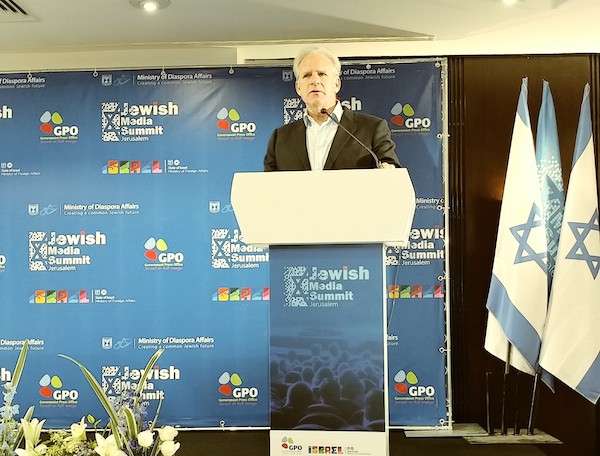
Author and former politician Michael Oren addresses the Jewish Media Summit, which took place in Jerusalem Dec. 19-22. (photo by Dave Gordon)
The Iranian threat, the new Israeli government, BDS, terrorism, and the challenges of aliyah, were just some of the discussion topics last December, at the fifth annual Jewish Media Summit, which took place in Jerusalem Dec. 19-22.
The nearly 100 attendees hailed from Israel and across Europe, as well as from South Africa, South America and North America, and included the Jewish Independent. Most panels and keynote addresses consisted of official spokespeople, politicians (incoming and outgoing) and organizational heads. The conference was organized by the Ministry of Diaspora Affairs, Ministry of Foreign Affairs, and the Government Press Office.
Former U.S. ambassador to Israel Michael Oren spoke about one of his pet projects. Oren is a former member of the Knesset and the author of several books, including Ally: My Journey Across the Israel-American Divide.
Several years ago, when Oren was a deputy minister in the Prime Minister’s Office, he proposed to Prime Minister Binyamin Netanyahu that Israel have a blueprint leading into the state’s 100th birthday – Oren’s book Israel 2048 will be published in April.
To write the publication, Oren investigated different areas of Israel’s future: social, education, health and foreign policies; Israel-Diaspora relations; Palestinians, Arabs. “We found experts in every field. It was a tremendous undertaking,” he said. “I would not shy away from any issue, controversial, even explosive.”
About Israel, he noted “we don’t have sovereignty over large areas of our territory,” referring to the 60% of the country that is the Negev Desert. As an example of what this means in terms of governance, he said there’s no application of Israeli law regarding housing there and so there are some 400,000 illegal Bedouin structures in the Negev.
“But if I built a two-millimetre addition to my balcony in Tel Aviv, I have a police car there, within seconds, giving me a big ticket,” he said. Additionally, he said there’s “an inability to enforce [other] Israeli laws” there, so there’s no control over guns, drug or human trafficking, and polygamy is rampant, despite it being illegal.
Of concern, he said, is that more Bedouin are being influenced by Islamic extremism and the Palestinian narrative.
“It’s critical that the 2048 initiative is not the initiative of religious people, of secular people, of right-wing, left-wing, Ashkenazim, Mizrahim. It’s everybody together,” he said. “If you want Israel to have a second great century … we have to work on it. And we have to work at it by talking to one another, about real solutions.”
Oren spoke with the Jewish Independent about how he thinks Israel will ease challenges to aliyah.
“What shocked me is that large segments of the population are no longer interested in large-scale aliyah,” he said. “I couldn’t get people in Israel and [in the] Israeli government to be very interested in encouraging aliyah from France.”
The predominant reason for this lack of interest in welcoming new immigrants from France or any other country in the Diaspora, he said, is that Israelis are becoming increasingly angry at how the many costs of new olim (immigrants) are offset by the state.
“This is going to play out now with Russia and Ukraine as well,” he noted. “So, while everyone’s focused on the grandfather clause [of the Right of Return], I asked a deeper question: to what degree is aliyah still a central tenet of our raison d’être of the Jewish people? Because, from my perspective, if we are not encouraging large-scale aliyah, we’ve lost a big sense of why we are here. And I see this as a danger.”
The largest section of Oren’s new book, however, deals with the Palestinians. Oren said he was involved in one way or another with “every peace initiative since 1993.”
On another topic, Oren noted that Benny Gantz, then-minister of defence, proposed a solution to the Iranian threat: “force our international partners” into offering “military intelligence and diplomatic cooperation.”
“Our actions must be preventative, before it is too late,” said Oren.
On a tour of the Tz’elim IDF base, a 10-minute drive from Gaza, Gen. Bentzi Gruber spoke about the ethics of combat, stressing that the army makes enormous effort to minimize innocent casualties. In contrast, he said, only two Hamas rockets hit the base, while thousands hit civilian areas.
Gruber added that he fights a psychological battle, too.
“I fight all my previous wars every night in my sleep. My wife wakes me up when I’m yelling,” said the deputy commander of the IDF armoured division. “Every soldier that fought in a war carries the scars with them. If you killed a terrorist or a civilian, that never leaves you.”
The tour included a mini-Gaza mockup city, a training area for the Israel Defence Forces.
Kibbutz Nirim, a few hundred metres from Gaza, has been hit by rocket fire from Gaza in recent years. The kibbutz’s spokesperson, Adele Raemer, who addressed the United Nations Security Council in 2018, said the village had to build safe rooms, as residents have just a few seconds to get out of harm’s way. One terror tunnel discovered nearby was 75 feet deep, 1.1 miles long, and made of 500 tons of cement.
Still, she said, she “has nothing against ordinary Gazans,” and locals participate in Project Road to Recovery, where Jews shuttle Arab patients to local hospitals “because we care about our neighbours.”
President Isaac Herzog encouraged Jews around the world to fight the BDS (boycott, divestment and sanction) movement, whether espoused by foreign governments or the media, on college campuses or elsewhere. He commented on those who disagree with Israel’s new government.
“Israeli democracy is vibrant and strong,” he said. “The many voices that compose us do not point to the weakness of our democracy, but our strength. The rule of law, freedom of speech, human and civil rights, these have been and always will be the wall of our democratic state.”
In a non-political talk, Neta Riskin, who plays Giti Weiss in Shtisel, spoke about the surprise hit, which has run three seasons. At first, the show’s publicist told them “there’s nothing to work with” and it wouldn’t last, but word of mouth and good reviews bolstered the show, she said.
For her, Shtisel “has nothing to do with religion. It has to do with people – longing, hope and people’s desires. The cultural restraints of the show made it more interesting. No dead bodies. No sex.” She said she was pleased that women’s stories were also being told in the show.
Shtisel is popular in the Haredi community, with people watching it on their phones, according to Riskin. “The show managed to bridge an un-crossable bridge,” she added, noting how popular it was among all stripes of Jews and non-Jews alike.
Dave Gordon is a Toronto-based freelance writer whose work has appeared in more than 100 publications around the world. His website is davegordonwrites.com.
A pageant of pandemonium consumed the United States House of Representatives last week as it took 15 votes to confirm Kevin McCarthy as speaker. The chaos was caused by a group of far-right congresspeople representing less than five percent of the total House membership. Eventually, McCarthy triumphed – well, squeaked through – by cutting backroom deals that will empower the extremists and weaken the office of the speaker.
Although the holdouts are on the far-right fringes of American society, personality was a major factor in the weeklong deadlock. The opponents have issues with McCarthy as a person and a politician as much as they have with his policies. To succeed, McCarthy had to agree to concessions and cough up inducements that defile the dignity of his office and put the House of Representatives in jeopardy of being hopelessly deadlocked and dysfunctional.
An analogous situation is unfolding in Israel, where Binyamin Netanyahu has returned to the prime ministership. To do so, he had to make some very grubby deals with some very distasteful people.
Here, too, personalities were at play, as much as policies. There is a swath of centre-right politicians who would have joined a coalition that was not headed by Netanyahu. As a result, to regain power, Netanyahu was forced to make deals with far-right figures who should never have been considered for inclusion in a democratic government.
Both of these situations speak to an unfortunate reality of parliamentary democracy. When a bloc fails to attain a comfortable majority, they can find themselves dependent on the support of narrowly focused, ideologically driven extremists that represent very few voters. In many cases, the extremist tail ends up wagging the dog.
This is regrettable and it is sometimes inevitable. Democracy is by no means without its downsides. In fact, Winston Churchill’s aphorism – “Democracy is the worst form of government – except for all the others that have been tried” – resonates here.
The foundational piece of democracy is free elections and the peaceful transition of power, a cornerstone that was attacked on Jan. 6 two years ago at the U.S. Capitol. That cornerstone is now under siege in Brazil, in a striking parallel – as if the supporters of defeated former president Jair Bolsonaro directly stole the playbook of the American Republicans’ “stop the steal” scheme to subvert the 2020 U.S. election.
Violent protesters ransacked Brazilian government buildings this week, stealing weapons and artifacts and vandalizing facilities. Brazil does not have as long a history of democratic infrastructure as Israel or the United States, which could make it more vulnerable to attack. One core difference in the Brazilian case, versus the Israeli or American situation, is that the threats, at this point, are coming from outside the government – the protesters are supporters of a defeated (and possibly self-exiled) former leader. In the United States, the insurgents have an apparent stranglehold on one of the houses of Congress and, in Israel, are fully in charge.
The biggest concern in a democracy comes when the extremist tail that wags the dog not only influences policies but actually begins chipping away at the institutional underpinnings of democracy itself. This is a legitimate concern in Israel, as some partners in the coalition are threatening the judicial system, the functioning of police and the very definition of Israeli citizenship. The vote for U.S. House speaker did not itself represent a threat to democracy, though the final votes poignantly took place on the second anniversary of the insurrection that was the greatest attack on American democracy since the Civil War – a moment from which the country and its democratic foundations still reel. And continued dysfunction in the House portends a difficult road ahead for U.S. democracy as voters tire of do-nothing legislative bodies and what some perceive as broken political systems.
Both Israel and the United States are on unprecedented precipices. (Brazil, ironically, probably less so.) However, in both Israel and the United States, entrenched civil society organizations and strong parliamentary opponents are in place to monitor and bolster the fundamentals of their societies. Those on the (geographical and/or ideological) outside should support in every way we can the movements for democracy, pluralism and tolerance in Israel, the United States and everywhere in the world where these values are threatened, including if we see dangers to them here at home.
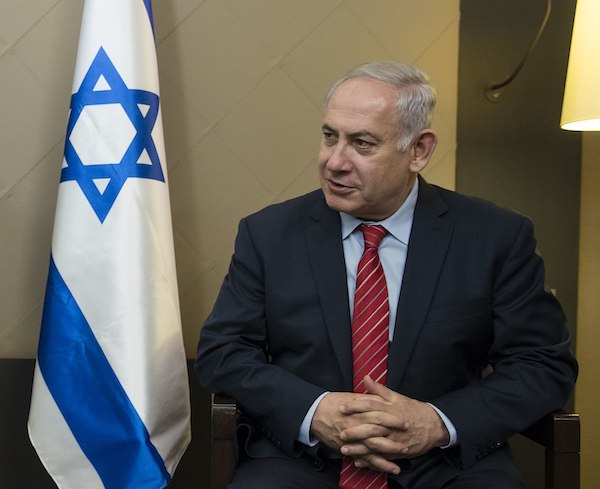
During coalition building negotiations, Binyamin Netanyahu had to consider lists of demands that would make even the pious cringe. (photo from president.gov.ua)
So, my mom doesn’t have to worry about me anymore. Ever since I moved to Israel, she’s been concerned about my safety. Well, Israel is now one of the five safest countries in the world to visit, according to Swiftest, an American travel insurance website. From homicide rates to natural disasters to rode carnage, Israel rounds out the top five safest places, just after Singapore, Denmark, the Netherlands and Switzerland. The most dangerous country to visit is South Africa. Canada was ranked the 21st safest country, so now I’ll have to start worrying about my mom’s safety. Just sayin’.
* * *
During coalition building negotiations, United Torah Judaism (UTJ) – holding seven seats Binyamin Netanyahu required to build his government – presented a list of demands that would make even the pious cringe. This included affirmative action for ultra-Orthodox job seekers in state-owned companies. More religious studies in secular schools. Less secular studies in religious schools, like science, arithmetic and English. More gender segregated beaches. (How often do the Orthodox go to the beach? Do they need additional beachfront real estate?) Legislation permitting yeshivah students to continue Torah studies and defer army service. And, are you ready for this? A demand to stop energy generation on Shabbat. Does this reek of theocracy-building or what? And it costs the Israeli taxpayer – about which the UTJ constituency knows little – about nine billion bucks a year!
Not to be outdone in chutzpah, Religious Zionist Member of the Knesset Orit Struk is reportedly a strong advocate of a government amendment enabling private businesses to refuse to provide services based on religious beliefs. But only if the same “widget” is available elsewhere at similar terms. Good thing she clarified that. Seriously! So a business owner can now deny selling to people of colour, to LGBTQ+ people, to Arabs and to others, Jews and non-Jews. If it’s justified by religious beliefs and becomes even more outlandish. Doctors could also decide who to operate on. Yes, bearers of the “hypocritic” oath: “I’m not operating on that guy. He’s homosexual.” OMG!
I’m not just sayin’, I’m shoutin’! Bring in some sanity!
* * *
Speaking of the Haridim, according to a new research study from the Hebrew University, Philip Morris spent more than $1 million on advertising to attract the ultra-Orthodox. Now what makes this demographic so influenced by cigarette advertising? Is this related to that sector’s education, or lack thereof, in the sciences and the deadly impact tobacco products have on health? Maybe the incoming government should introduce more secular education in the religious schools. Make Israel a more educated and healthier country.
And talking about education – in a survey by the education platform Erudera, Israel is the fifth most educated country in the world. More than 50% of Israelis hold a higher education degree. This despite Rabbi Yitzchak Godknofp, the United Torah Judaism’s party chairman, claiming that math and English studies have no effect on Israel’s economy in his lame attempt to defend these core subjects not being taught in Orthodox schools. Really, no effect?!
By the way, Canada was in top spot, with almost 60% of Canucks holding a tertiary degree. And in Canada all schools teach the three Rs.
Just sayin’.
* * *
Tel Aviv made the UBS Global Real Estate 2022 Bubble list, being in the top 10 cities with a severe housing bubble. Given Tel Aviv’s 2021 rank as the most expensive city, according to The Economist magazine and my wallet, this is really no surprise. To wit, housing prices increased threefold between 2001 and 2017. And, during 2022, climbed another 18%. This bubble was not only in Tel Aviv but throughout our tiny shtetl. Also included in the list of top 10 severe housing bubble cities are Toronto and Vancouver; Winnipeg – my home city – is not on the list.
Towards the end of 2022, Tel Aviv fortunately lost its place as the world’s most expensive city. It moved to third place, behind Singapore and New York. Coming in last were Damascus, Syria, and Tripoli, Libya. All things considered, I’d rather be living in one of the most expensive cities.
Just sayin’.
* * *
Not all is bleak. According to The Economist, Israel was the fourth best performing economy within the OECD during 2022. Metrics included GDP growth rate, annual inflation and share prices. Greece ranked first, the U.S. ranked 20th and Germany 30th. As a top world economy, shouldn’t prices be more reasonable in Tel Aviv? Just askin’.
* * *
Somewhat belated happy Hanukkah thoughts. Sufganiyot – Israeli jelly-filled donuts doused in oil – shouted out from every bread counter in the country. It made me more whimsical and homesick for the donuts of my Canadian youth, Tim Hortons – Tim Hortons bakes ’em. I’m all for celebrating the Maccabees’ triumph over the Syrian-Greek Seleucids’ empire in Judea – yes, Hanukkah is mainly about victory – and their eight-day oil-based menorah-lighting miracle. Just didn’t want my sufganiyot tasting like they had been sitting in oil for eight days. Just sayin’. Belated wishes for a happy Gregorian new year.
Bruce Brown is a Canadian and an Israeli. He made aliyah … a long time ago. He works in Israel’s high-tech sector by day and, in spurts, is a somewhat inspired writer by night. Brown is the winner of the 2019 AJPA Rockower Award for excellence in writing, and wrote the 1998 satire An Israeli is…. Brown reflects on life in Israel – political, social, economic and personal.
Among other things, Hanukkah is about bringing light into the darkness. There is plenty of darkness in the world and a vast range of concerns calling for radiance.
Mainstream media seem to have taken the cue that Hanukkah is the moment to discuss the alarming and rising phenomenon of antisemitism. Time magazine declares: “Amid antisemitism, Hanukkah celebrations carry new weight.” USA Today explained a new tradition: “On Hanukkah, the ninth candle reflects how anyone can fight antisemitism by sharing truth.” Here in Canada, both Prime Minister Justin Trudeau and Opposition Leader Pierre Poilievre highlighted antisemitism in their annual Hanukkah messages. Expect to see similar expressions of concern in a few days, as the end-of-2022 reflections on the good and bad of the year just passed and hopes for the fresh new year fill pages and airtime during the slow news days of the winter holidays.
We are not complaining. This issue needs thorough and ongoing coverage. It just seems, somehow, that writing and talking about what is often called the world’s oldest bigotry lacks new insights. Many agree that this is a problem. Few, though, have solutions beyond platitudes.
Finding innovative ways to think and talk about “the world’s oldest” anything is, by definition, a challenge. Some of the greatest scholars in the world have studied the problem, vast networks of activist organizations and Jewish communal agencies devote themselves to defeating it, and still it grows. If we had the definitive explanation or the silver bullet to solve it, you would not be reading it here – we would be sharing our wisdom from the dais of the Nobel Prize ceremony and as the lead story on the world’s media. Undaunted, a few thoughts:
The very phrase “antisemitism” may be problematic. The term was invented in the late 1800s by a proud antisemite to describe his orientation. But while there is a great deal of conscious and visible antisemitism in the world today that rightly raises alarms, there has always been an equally, perhaps more, worrying phenomenon in the form of unconscious bias about Jews that permeates many societies and individuals. This is more insidious and, therefore, more difficult to challenge.
It is worth noting that antisemitism is often most prevalent where no or few Jews exist, making it easier to project onto a largely imaginary enemy the fears and hatreds carried by the individual or the society. Similarly, we see a projection of Jewishness onto any unpopular phenomenon, an example being the “Great Replacement” theory, a paranoid fantasy in which whatever the perpetrator despises (in this case immigration) is cast as a problem with Jewish roots.
Both of these phenomena touch on what we suspect is the nut of antisemitism: it is a problem that affects Jews but it is not a problem of Jews. That is, if Jews did not exist, the antisemites would have to invent them – which is, in essence, precisely what they have done with the caricatured “Jew” that is demonized by antisemites.
This understanding, of course, does nothing to resolve the problem. And, again, a problem known as “the world’s oldest hatred” is not going to be solved in one generation with one easy antidote. It is encouraging, though, to see the range of responses to the problem, from more in-depth coverage in mainstream media to the statements of top leaders in Canada, as well as in the United States, where a major presidential effort against antisemitism is being led by Doug Emhoff, the second gentleman of the United States, who recently led a roundtable of leading thinkers, and in a host of other undertakings worldwide.
As is said in a different context, the first step to recovery is admitting you have a problem. As a society, we have a consensus that antisemitism is a growing problem. As we approach 2023, we hope those thoughts will turn to even more action in confronting this confounding blight.
Coalition negotiations continue in Israel after the fifth election in less than four years. And the signs are ominous for the future of Israeli democracy, for women’s equality, for religious pluralism, for LGBTQ+ rights, for peace and for coexistence.
Bezalel Smotrich, head of the Religious Zionist party, will be a major player in the new government, as will the leaders of two parties with whom he ran in an electoral slate: Itamar Ben Gvir, head of Otzma Yehudit (Jewish Power), and Avi Maoz, head of the religious extremist faction Noam.
Smotrich will apparently have unprecedented influence over the growth and governance of West Bank settlements. The explosive issue of “who is a Jew” – which determines eligibility for immigration under the Law of Return – will fall in part to Maoz, who wants to delegitimize non-Orthodox conversions and narrow the parameters under which an immigrant is permitted under the Law of Return from grandchildren of Jews to those born to Jewish parents. In addition to determining Jewish identity, Maoz has a preoccupation with homosexuality and has promised to ban Pride Parades and oppose equality for gay Israelis. (Netanyahu has said he won’t allow Maoz to diminish gay rights.) Netanyahu has promised to hand Maoz control over a NIS 2 billion budget (about $790 million CDN) for “external programming” in public schools.
Yair Lapid, the outgoing prime minister, railed against this allocation.
“If we don’t stop them, Avi Maoz and his unenlightened gang will put unenlightened, racist, extremist, misogynistic and anti-LGBT content into our children’s schools,” said Lapid.
Ben Gvir and his party call for the expulsion of Arabs they deem disloyal and he has suggested that the anti-Zionist religious sect Neturei Karta should be put “on a train.” Ben Gvir’s party advocates the absorption of the West Bank which, by necessity, would eliminate either the Jewish identity or the democratic nature of Israel – and we do not need to speculate on which Ben Gvir would be willing to discard.
The three horsemen have endorsed banning public transit and sports on Shabbat, eliminating a department that promotes women in the military, and snatching the power to appoint judges from a nonpartisan panel and putting it in the hands of politicians, in addition to a host of other far-right policy fetishes.
“This Israel is not going to be governed by talmudic law,” Netanyahu said in defence after attacks on his coalition agreements. This is precisely the direction his partners are headed, however, and the very fact that he was moved to make such a disclaimer is proof of how dangerously close the new government will be to crossing a religious-secular divide that the pioneers of the state consciously erected.
The jigsaw puzzle parliament is not Netanyahu’s fault – any prime minister was going to have to cobble together a mismatched majority. What is Netanyahu’s fault is the particularly rancid aspects of the coalition. Seeing the unlikelihood of the most hateful and divisive minor parties reaching the electoral threshold in the previous election cycle, Netanyahu personally intervened to urge them to band together to get into the Knesset. An historical precedent is worth reiterating: when the fundamentalist Rabbi Meir Kahane was elected to the Knesset in 1984, the entire chamber stood up and walked out when he spoke. By contrast, when Kahane’s ideological descendants were facing electoral oblivion in 2020, Netanyahu stepped in to help ensure their success. There are many cases in Israel (and other divided parliamentary democracies) where the extremist tail wags the more mainstream dog. In this case, to mix canine metaphors, the ostensibly mainstream leader laid down with dogs and woke up with fleas.
The controversies in Israel have already swept across the ocean. Diaspora Jewish communities are aflame in concern and condemnation. The longstanding divides between Israeli and Diaspora Jews are already being exacerbated – and the new government hasn’t even been sworn in.
The most stalwart voices of Diaspora Zionism are issuing warnings. Abe Foxman, longtime head of the Anti-Defamation League, came out of retirement to harrumph that his support for Israel is not unconditional. The usual suspects in the anti-Israel camp are crowing that their prognostications have proved spot-on. But, more worrying, are middle-of-the-road Jewish and non-Jewish voices who are looking at developments and wondering what it is they defend when they defend Israel. The multi-partisan support Israel has largely enjoyed in the United States, Canada and some other places will be further challenged by Israel’s nationalist, anti-pluralist and generally extremist policies.
In this space, we have repeatedly said that it is up to Israelis alone to determine what defence strategies are necessary to preserve life and limb against terrorist and other threats in Israel. It is Israelis who put their lives and the lives of their children on the line in national defence.
That exclusivity does not extend to policies like teaching homophobia in schools or limiting the role of women in the military – and it certainly doesn’t extend to policies, like the Law of Return, that directly affect Diaspora Jews.
People who care about the pluralist, democratic, inclusive Israel that was dreamed of and built by generations who came before us have a right – an obligation, in fact – to rail against what appears to be on the horizon for the country we care so deeply about, are invested in so much, and count on for Jewish safety and survival.
Flame Towers, in the capital city Baku, reflect the forward-looking economy and the ancient Zoroastrian roots of the Azerbaijani people. (photo by Pat Johnson)
It is a Muslim-majority country where Jews proudly draw visitors’ attention to the fact that their synagogues and day schools receive government funding and require no security. It is a majority-Shiite country with a primarily Turkic population, where Turkish flags wave alongside Azerbaijani standards. Yet, among its closest allies is Israel, which a survey indicates is the second most admired country among its citizens. It provides 40% of Israel’s oil and receives vital security and defence cooperation from the Jewish state. One of the country’s greatest modern heroes is a Jewish soldier who died defending the country in 1992.
Azerbaijan is an enigma that defies assumptions, especially when it comes to its Jewish citizens, who have experienced almost nothing but neighbourliness from their Azerbaijani compatriots for two millennia.
Along with a small number of other Canadian journalists and community activists, I was a guest last month of the Network of Azerbaijani Canadians during an intensive weeklong immersion in the country, including its Jewish present and past.
I won’t pretend I didn’t have to Google Azerbaijan to place it alongside its Caucasus neighbours Armenia and Georgia, between the Black and Caspian seas, inauspiciously bordered by two rogue nations, Iran and Russia. Like many people, my knowledge of Azerbaijan was limited to its 30-plus-year conflict with Armenia over the disputed Karabakh region, a conflict that has led to allegations of war crimes, ethnic cleansing and atrocities on both sides.
We traveled to Karabakh, a place of ghostly, abandoned, war-destroyed cities and countrysides plagued by an estimated million landmines. Helmeted workers pace slowly through what were once farms in the almost unimaginably Sisyphean task of demining a half-billion square metres of land. (Israeli drones and artificial intelligence are helping the process.) We visited cemeteries and monuments, drove highways lined for kilometres with portraits of war dead.
In a distinct counterpoint to this carnage, we visited the country’s Jewish residents and learned of the history of Jews and non-Jews in this place, a story of almost unprecedented fraternity unusual for any country, not least a majority Muslim society in a place where ethnic and territorial conflicts, and the ebb and flow of empires, has conspired against peace.
A history of diversity
Azerbaijan was a deviation on the standard Silk Road route, and so people were long familiar with those from the west and the east. But its economy exploded in the latter half of the 19th century, when oil was discovered. By 1901, the region, part of the Russian Empire, was producing fully half of the world’s oil.
This ancient and modern history brought waves of Jews, beginning in biblical times. The oldest communities of Jews in Azerbaijan are known as Mountain Jews, or Kavkazi Jews, whose Persian-Jewish language is called Juhuri. Neither Ashkenazi nor Sephardi, the Mountain Jews maintain some Mizrahi traditions and their practices are heavily influenced by kabbalah. They trace their presence back to the Babylonian exile following the destruction of the First Temple, in 586 BCE, but these ancient communities have been joined in more recent times by other migrants.
Jews from neighbouring Georgia, where communities have also lived since the Babylonian exile, migrated to Azerbaijan during the first oil boom, in the late 19th century. After the 1903 and 1905 Kishinev pogroms sent terrified Jews from across the Russian Empire fleeing to the New World and elsewhere, a group of Ashkenazim moved from throughout the empire to Azerbaijan, drawn by its reputation for intercultural harmony.
Today, Mountain Jews make up about two-thirds of the country’s Jewish population. (Ballpark estimates are that there are 30,000 Jews in Azerbaijan.) Most Mountain Jews – 100,000 to 140,000 – now live in Israel and there is a significant population in the United States. Those who remain, however, deflect questions about why they have not made aliyah or migrated to Western countries.
“This is my homeland. Why should I leave?” asked Arif Babayev, the leader of the Jewish community in the city of Ganja, adding: “I don’t know what antisemitism is. I’ve never experienced it.”
The community of Qırmızı Qəsəbə, or Red Town, has been known as “Jerusalem of the Caucasus” and also as “the last shtetl in Europe.” It is said to be the only all-Jewish (or almost-all-Jewish community) outside Israel. The streets of the mountain village, in the northeast region called Quba, were quiet on a November Sunday. Many of the people who call the village home actually spend most of the year working in the capital city Baku, returning in summer to what amount to summer homes. The older community members and a few families stay year-round.
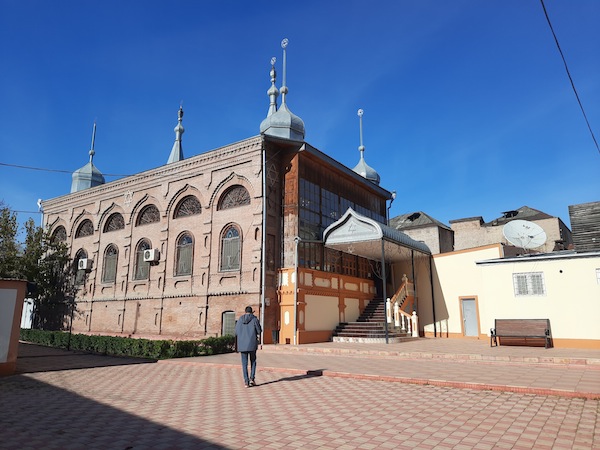
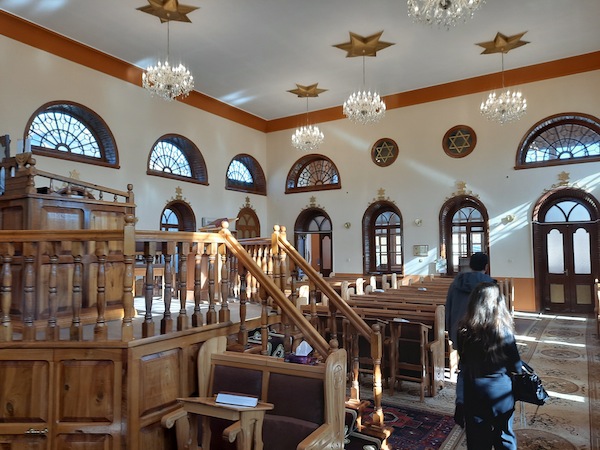
Three synagogues in the town survived the Soviet years – two still operating as congregations and one transformed into an excellent museum with original artifacts and in-depth exploration available on interactive screens where congregants once davened. The two synagogues, active on Shabbat and holidays, are intimate, magnificent structures. The Six Dome Synagogue, dating to 1888, was used as a warehouse and as a shmatte factory during the Soviet period and was restored and reopened for use in 2005.
The Six Dome Synagogue, which dates from 1888. (photo by Pat Johnson)Interior of the Six Dome Synagogue, which was restored to use by the Jewish community in 2005. (photo by Pat Johnson)
Throughout history, the Jews of the area worked in viticulture (their Muslim neighbours were ostensibly forbidden from alcohol-related tasks, though this is not a country with a large strictly observant religious population), tobacco growing, hide tanning, shoemaking, carpet weaving, fishing and the cultivation of the dry root of the madder plant, which is used in dyeing textiles and leather.
In the 1930s, there was a Stalinist crackdown on Judaism, but circumcision, kosher slaughter and underground Torah study survived. Since the end of the Soviet era and the dawn of independence, in 1991, Jewish life has both thrived and shrunk – many emigrated, but those who remained have revivified their cultural and religious roots.
In wealthy and modern Baku, signs of a flourishing Jewish community are found at two government-funded Jewish schools, each with about 100 students. They follow a government-created Jewish studies curriculum that includes Hebrew, Jewish history and tradition, as well as the official curriculum of the Azerbaijani education ministry. Like so many other places throughout the country, the school is festooned with photographs of the current president and his late father and predecessor.
The school’s leadership note that there is no security outside the institution, unlike in France or even Israel. The school is in a complex that includes a non-Jewish school and the students compete together in intermurals. Jewish and non-Jewish students celebrate the Jewish holidays together.
Nearby, the Sephardi Georgian congregation and the Ashkenazi synagogue share a building that was funded by the national government. The two sanctuaries are on different floors, each with their distinctive internal architecture and warm, inviting sanctuaries.
Ambassador optimistic
George Deek was the youngest ambassador in Israel’s history when appointed to head the embassy in Baku, in 2018. An Arab-Christian from a prominent Eastern Orthodox family in Jaffa, Deek was a Fulbright scholar at Georgetown University and held previous posts at Israeli missions in Nigeria and Norway. He is also, he noted, the Israeli diplomat geographically closest to Tehran.
The ambassador sees parallels between Azerbaijan and Israel, which are both young countries made up of people who are used to being bullied by their neighbours. Both peoples understand what it is to be small and to struggle to preserve one’s own culture, he said.
In addition to the large swath of Israel’s oil supply that comes from Azerbaijan, there is growing trade and cooperation between the countries across a range of sectors. In addition to strategic partnerships, they are sharing agriculture and water technologies in conjunction with the Arava Institute for Environmental Studies, in southern Israel. An Israeli company is building a Caspian desalinization plant and Israeli drip irrigation technology is being applied to Azerbaijani farms.
Tourism is a growing sector and Israel is a significant market: by next year, there will be eight flights weekly between Baku and Tel Aviv on the Azerbaijani state carrier, as well as regularly scheduled tourist flights on Israir.
Deek shared the results of a survey that seemed to provide proof of the historical and anecdotal things we had been hearing about the Azerbaijani connection not only to their Jewish neighbours but to the Jewish state. In a poll measuring Azerbaijanis’ positive opinions about other countries, Turkey came first and Israel second.
Despite all this upbeat news, and despite the fact that Israel has had an embassy in Baku almost since Azerbaijan gained independence, the diplomatic mission was not reciprocated, even as trade and person-to-person connections expanded. There is a range of geopolitical explanations for the lack of an Azerbaijani embassy in Israel and Deek told our group he hoped that Azerbaijan would soon be able to open one there. And, just a few minutes after we left our meeting with the ambassador, our guide received a phone call – Azerbaijan’s parliament had just approved a resolution to open an embassy in Israel.
The decision, after all this time, is due to a confluence of events. There had been fear of an Iranian backlash to more overt relations between Azerbaijan and Israel, but global disgust over the Iranian regime’s crackdown on anti-government protesters may have diminished Azerbaijani concerns. The close relationship between Azerbaijan and Turkey was probably another factor. With Turkish-Israeli relations back on a somewhat even keel after a chilly period, the time may have seemed right. With the long-simmering Karabakh conflict now concluded, as far as Azerbaijan is concerned, by the 2020 war that returned the region to Azerbaijani control, the country may be less wary of making waves among Muslim allies. That fear would likely be additionally assuaged by the Abraham Accords, which make warm Azerbaijani-Israeli relations less remarkable than they might have been just a few years ago. (Azerbaijan’s anti-Israel voting record at the United Nations is still a disappointment that some observers hope changes as ties grow.)
The tight relationship between Azerbaijan and Israel is, of course, viewed by Iran as a Zionist plot. Iran has both internal demographic and external security concerns about Azerbaijan. There are almost twice as many ethnic Azerbaijanis within the borders of Iran – about 15 million – than there are in the country of Azerbaijan, and the Islamic revolutionary regime doesn’t want any nationalist rumblings. Beyond this, the very existence of a secular, pluralist Azerbaijan stands as an affront to Iran. Azerbaijan is a majority Shi’ite country, like Iran. It is geographically and demographically small and, in the imagination of Iranian fundamentalists, it should be the next domino in the ayatollahs’ plan for regional domination. Instead, despite the familial ties across the Azerbaijani-Iranian border, intergovernmental relations are frigid.
What is it about Azerbaijan?
A new embassy. Burgeoning trade and tourism with Israel. Centuries of good relations between Jews and non-Jews. A level of comfort and security unknown to Jews in almost any other country, certainly any Muslim-majority place. What is it about Azerbaijan?
I asked a few people – religious leaders, a member of parliament, Jews and non-Jews – what the secret sauce is for the Azerbaijanis’ exceptional relations with their Jewish neighbours. No one had a pat answer.
It was people-to-people contact, one person told me. There was never a ghetto; Jews were integrated and part of a larger multicultural society. One theory is that, more recently, there have been lots of Jewish teachers in the school system, so Azerbaijanis get to know and respect Jewish people growing up. Another explanation is that Azerbaijanis view their national identity above their religious or other particular identities, so religious differences are not as divisive as in many places – a factor probably accentuated by decades of Soviet official atheism.
Rabbi Zamir Isayev, who leads the Georgian Jewish congregation in Baku, doesn’t have a simple explanation for why Azerbaijan, among the countries of the world, seems to be so good for the Jews. It’s simply in the nature of the Azerbaijani people, he says.
Azerbaijani history celebrates a number of notable Jews. The Caspian Black Sea Oil Company, which was central to the creation of the region’s dominant resource sector, was founded by Alphonse Rothschild, a French Jew, and other Jews have been involved in a range of resource and other sectors over the years.
In the short-lived government of the first independent republic of Azerbaijan, 1918 to 1920, the minister of health was a Jewish pediatrician, Dr. Yevsey Gindes. That government was also the first democracy in the Muslim world and among the first in the world to grant women the franchise. Like many countries that emerged from the collapse of the Russian Empire, Azerbaijan was quickly subsumed into the new Soviet Union.
Lev Landau, Azerbaijan’s 1962 Nobel Prize winner in physics, is widely fêted. Garry Kasparov, considered by some the greatest chess player of all time, is a (patrilineal) Jew from Azerbaijan. A long list of academics, athletes, musicians and business innovators have risen to the top of their fields in the country and abroad and are celebrated both as Azerbaijanis and as Jews. A hero from recent times seems to elicit an especially emotional connection.
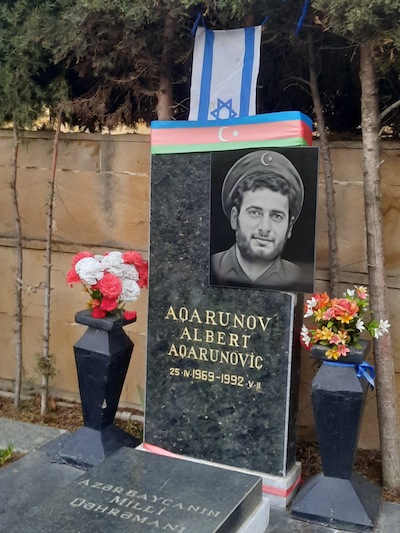
The conflict with Armenia, which began in the late 1980s and culminated most recently in a 2020 war, remains understandably fresh in the national consciousness. Highways and villages display thousands of portraits of war dead and the Alley of Martyrs in the heart of Baku is the final resting place of 15,000 Azerbaijanis, many from the final throes of Soviet domination and the two wars with Armenia. Among the most visited graves at the sprawling memorial park is that of Albert Agarunov.
The grave of Azerbaijani national hero Albert Agarunov, decorated with Azerbaijani and Israeli flags. (photo by Pat Johnson)
Agarunov was a young Jewish Azerbaijani who volunteered with his country’s defence forces and was a tank commander during the Armenian capture of the strategic Karabakh town of Shusha on May 8, 1992. The 23-year-old, already apparently such a legendary figure that the Armenians had put a bounty on his head, stepped out of his tank to retrieve bodies of slain Azerbaijani soldiers from the road when he was killed by sniper fire. Agarunov was posthumously named National Hero of Azerbaijan and was buried at the solemn national monument, in a service attended by both imams and rabbis. Today, Jews place stones on his grave and others place flowers.
In terms of Azerbaijani-Israeli relations, the large number of Azerbaijani-descended Jews who live in Israel create natural familial ties between the two places. Jewish remittances from Azerbaijani oil wealth helped purchase land in Palestine, an early portent of a connection between the two places. According to one museum piece, Jewish horse wranglers from the Caucasus made aliyah and became protectors of early kibbutzim and moshavim and helped put down the 1929 Hebron massacre, although I cannot find reference to this role online.
Whether that last detail is factual or not, what seems undeniable is that the story of Jews in Azerbaijan stands out as a model of coexistence and good neighbourliness in a world that has not always been so kind. This is a story that deserves to be told more widely.
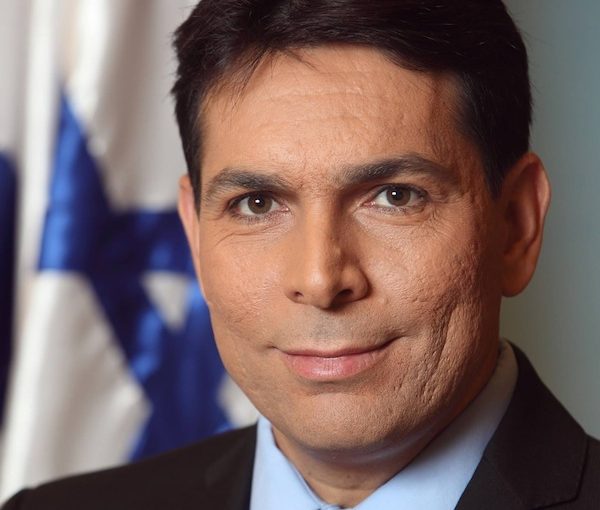
Danny Danon, former Israeli envoy to the United Nations. (photo from IGPO / Chaim Tzach)
“Jerusalem is an inseparable part of Israel and her eternal capital,” said an Israeli prime minister. “No United Nations vote can alter that historic fact.” This quote, which could have come from any of the country’s leaders, was in fact spoken by the first, David Ben-Gurion, in 1949, just days after the UN voted for the internationalization of the city. Israel’s issues with the agency, in other words, have existed for some time.
One wouldn’t expect a right-wing Likud party stalwart, well-known hothead and self-acknowledged non-diplomat to be one of Israel’s foremost voices to present an unambiguous defence of the UN. But, in his new book, Danny Danon does exactly that.
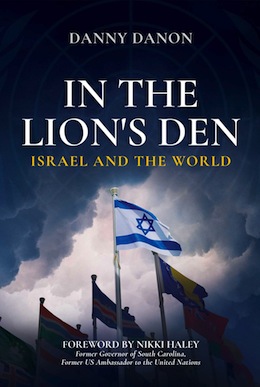
Danon’s book, In the Lion’s Den: Israel and the World, focuses on his term as Israeli ambassador to the United Nations, from 2015 to 2020. Before that, he was a Likud member of the Knesset and a minister in Binyamin Netanyahu’s government.
He acknowledges that, when he was appointed to the diplomatic post, commentators in Israel and elsewhere suggested that Netanyahu was deliberately poking a stick in the belly of the beast.
“There was an expectation that, because of my background and strong ideological beliefs, I would not fit into the world of diplomacy, that I was too much of a hawk and a ‘hardliner,’ which would make it difficult for me to build relationships and achieve anything of substance,” he writes.
Well, yes and no. He does not fit into the world of diplomacy. But he does claim a litany of successes. Danon devotes nearly 200 pages to justifying Israel’s engagement with the international body. Despite the routine censures of Israel and seeming obsession the General Assembly and several of the UN’s agencies have with Israel, Danon argues convincingly that taking on the haters in that forum is a worthy enterprise.
“What many people don’t understand is that there is a public UN and a private UN,” he writes. “The public face of the UN – at least when it comes to Israel – is aggressive and bullying. But, privately, you can build bridges, forge friendships and create a space for understanding, particularly if you are transparent.”
His own approach – far more bull in a china shop than circumspect diplomat – has its merits, he contends. His calling out of critics by name, apparently nearly unheard of in the hallowed halls of the UN’s Manhattan headquarters, may have drawn gasps, but it also seems to have made some think twice before talking.
“After a few times calling out the French ambassador in the media, not only did he reiterate that he did not appreciate it, which had no effect on me, but, more importantly, it made him much more careful in the words he used and actions he took going forward.” Danon said.
In one segment, the former ambassador goes into extensive detail about the efforts he made to derail two particularly troublesome resolutions. “Both resolutions were pointless,” he acknowledged, which might describe most of the General Assembly resolutions against Israel, but this comment, in turn, raises the legitimate question about why such energy and resources are devoted to fighting them. Danon’s argument is that it is in Israel’s interest not to ignore them and to take up the fight whenever and wherever possible.
If his own account of his time there is to be believed, Danon achieved many victories.
He caused the UN to officially recognize Jewish holidays so that, for example, no major meetings occur on Yom Kippur. He managed to get a small amount of kosher food onto the menu at the UN staff cafeteria – and it was promptly snapped up by non-Jews who view a hechsher as proof of healthy, quality food.
More substantively, he hosted more than 100 ambassadors on delegations or missions to Israel.
Partly as a result of a conference that Danon organized for fellow ambassadors on the subject of antisemitism, the UN issued its first-ever thorough report dedicated entirely to anti-Jewish racism.
After successfully pressuring for a UN bureaucrat who is Israeli to be promoted (apparently a challenge), he took on a more entrenched problem. The UN unofficially boycotts Israel, he writes, passing over Israeli options in the agency’s not-insubstantial procurement process. He set out what he called the three T’s.
“We would sell our relevant technology, offer training and provide troops,” he said. The first two he succeeded in.
“I believe the last T, providing troops to UN peacekeeping missions, will come in time,” he writes. “Sending troops is still an ongoing effort on our part. We have one of the best trained militaries in the world, and it knows how to deal with many difficult conflicts. We have so many security challenges that require us to engage in prevention, deflection and defence that it puts us in a unique position of having both the know-how and the experience on the ground. This gives us an advantage in comparison to others. We have the expertise to train UN forces, such as search and rescue, medical treatment in the field, and addressing acute emergency situations…. It has not happened yet, but I am hopeful. It remains a goal for the future.”
For all its flaws, Danon argues, the UN is a unique environment where an Israeli ambassador can shmooze with people he would never get to meet otherwise.
“Think of this: anytime a special envoy from Israel travels to an Arab country, it has to be done with the utmost discretion. If such visits were to be discussed publicly, they could become an issue that could result in political backlash or even violence from extremists and terrorists. At the UN in New York, you can meet anyone, anytime, in a legitimate and open forum, free from the anxiety of those who are determined to see you fail. Indeed, such exchanges between adversaries and friends are expected, which is why the UN is a useful tool despite criticisms about its effectiveness in the 21st century.”
UN ambassadors aren’t nobodies, either, and the connections an Israeli envoy can make there can bear fruit later.
“Once a term at the UN is over, you can be assured that many ambassadors turn their attention to political positions in their home countries, some going on to become heads of state or ministers of foreign affairs,” he said. “It is useful to have existing relationships with such people.”
The Israeli delegation at the United Nations has managed to peel away a few European countries from the European Union’s consensus position against Israel.
“As the Czech Republic, Hungary and Bulgaria grow more confident and economically strong, one of the ways they have and will continue to show their independence and sovereignty is the approach they have taken toward Israel. We have a great opportunity to continue to strengthen our bond with the people and governments; as young countries striving to grow, they understand and relate to Israel’s challenges. I believe they will continue to reject Western Europe’s automatic pro-Palestinian and anti-Israeli sentiment.”
More remarkably, Danon also managed to peel away members from the Arab bloc. In a secret ballot, Danon became the first Israeli ever elected chair of one of the UN’s six standing committees. There were far fewer votes against his candidacy than there are Arab countries at the General Assembly, he notes.
“I had the courage and vision – and the will,” he writes of the chutzpah he showed in his role. “I was often told, great idea, let’s do it next year. I always said, let’s do it now, we can get it done in two months.” (Memoirs are rarely testaments to humility.)
Though Danon argues that he made headway in his term at the UN, predictably, he didn’t make many friends. But he certainly made one. Nikki Haley, the U.S. ambassador appointed by Donald Trump, became fast pals with Danon, apparently joyfully collaborating to stick it to the enemies. (Haley wrote the foreword to the book.)
This alliance and the many other overt and covert bridges he built during his term were overwhelmingly with representatives of governments that are on the right of the political spectrum – sometimes on the far-right, like Brazil’s and Hungary’s.
Though he doesn’t address this fact, he would no doubt make the case that Israel must take its friends where it can find them. In the bigger picture of Danon’s time in the belly of the beast, perhaps the words of the late Yitzhak Rabin prove true: “You don’t make peace with friends. You make it with very unsavoury enemies.”
On Remembrance Day, we reflect on the sacrifices made by Canadians who fought to defend freedom. Many of us recall the solemnity of our childhoods standing in a school auditorium, first beginning to understand the meaning behind the poem “In Flanders Fields” and the moment of silence.
Similar ceremonies occur worldwide, including in places where the loss of life in wars has been far greater and more recent than our nation’s experience.
At the same time, it is impossible not to reflect on how some of the messages of tolerance, coexistence and peace seem to have been lost on leaders of various countries – as well as those who vote for them.
Across Europe, the Americas and some other places, extremism is growing. Far-right governments in Italy, Poland and Hungary advance xenophobic and scapegoating policies. While not yet reaching the highest echelons of power, far-right groups in Germany and France are growing in popularity. The defeat of Jair Bolsonaro, Brazil’s extreme-right and volatile president, is a bright spot, though the leftist Luiz Inácio Lula da Silva, who beat him only by a hair, demonstrated in his previous term as president that he is also no archetype of impeccable governance.
Enormously alarming were this week’s midterm elections in the United States. More than half of the Republican candidates for Congress and state offices, including crucial officials who oversee election processes, are “election deniers” who claim that the 2020 presidential race was not rightfully won by Joe Biden. The refusal of the former president to acknowledge defeat and accede to the peaceful transition of power, hand-in-hand with the insurrection at the Capitol on Jan. 6, 2021, represent the greatest threat to American democracy since that country’s Civil War. The last two years have shown how fragile this form of governance is and how dependent it is on the goodwill of its participants to abide by the rules and accept the will of the people. The fact that about half of American voters don’t seem the least bit bothered by this reality is the scariest part.
Then, and by no means least, are the results of Israel’s most recent national elections. The good news is that, after five elections in three years, the country will apparently have a stable coalition government. The bad news is that it will include individuals whose political and moral values should be scorned by people who support democracy, pluralism and respect. Itamar Ben-Gvir, leader of the third-largest bloc, was forbidden from serving in the Israel Defence Forces because military leaders deemed him too extreme. Until he decided to get serious about politics, Ben-Gvir had a framed photo in his home of Baruch Goldstein, the extremist who murdered 29 Palestinians in Hebron’s Cave of the Patriarchs in 1994. His policies include annexing the West Bank and forcibly expelling (at least some of) its residents, an idea that is, put mildly, against international law, and would almost certainly lead to a serious regional conflagration.
Israelis must deal with the situation they have created. Diaspora Jews and other supporters of Israel have a tough row to hoe as well.
Jewish organizations worldwide have issued unprecedented statements of concern and condemnation about internal Israeli affairs. There has always been tension, ranging from a low simmer to a full boil, between Israel and the Diaspora over a vast range of issues. Israelis, we must state, are the ones who put their lives, and those of their children, on the line to defend the Jewish state and they alone have the right to determine its direction. This does not mean, however, that the opinions and concerns of overseas family and allies do not matter.
Israel has always lacked dependable overseas allies. In far too many instances, this has been an unfair situation driven by geopolitical issues and, to an extent, bigotry and antisemitism. But Israel is not entirely blameless in its isolation. Decades ago, Golda Meir said, “I prefer to stay alive and be criticized than be sympathized.” Sometimes, Israel needs to make unpopular choices in the interest of its security.
There are moments when Israel’s hand has been forced, when its leaders have made choices that are unpopular among outside observers but deemed necessary for national security. This is not one of those moments. Israeli voters have chosen some extremely unsavoury people to represent them. They have sown the wind. It is the responsibility of decent people in Israel and abroad – including Jewish institutions – to advocate for tolerance and human rights in order to moderate the inevitable storm.
In an email briefing this week, the English-language news platform Times of Israel declared: “UN releases 2nd damning report on Israel; real estate soars.”
These were two unrelated stories. The United Nations had unveiled another in its persistent condemnations of the Jewish state and, on a completely different issue, it reported that Israeli housing prices have spiked 19% this year over last – the largest jump in recorded history.
As curious as this combination of stories was, it could hardly compete with an adjacent mashup about two of Israel’s leading far-right politicians, Bezalel Smotrich and Itamar Ben-Gvir, the latter of whom, in an apparent effort at humanizing himself, appeared on a cooking program: “Ben-Gvir stuffs peppers and Smotrich proposes legal reforms.”
But, returning to the first items. The connection between UN condemnation of Israel and soaring real estate prices in Israel may be remote but perhaps not random. In any country, high real estate prices indicate a demand for housing that is larger than the supply, a situation due in part to rising economic prosperity (which is not generally shared equally, it should be said, and is too complex to fully discuss in this space).
The larger issues, for our purposes, are the curious parallels between this fact and the accompanying story, about yet another of the UN’s broadsides against Israel. Late last week, a report by the United Nations Independent International Commission of Inquiry on the Occupied Palestinian Territory declared that Israel’s occupation of the West Bank is illegal. Not a surprise considering the commission’s mandate, to say the least. Leaving aside whatever legitimacy that investment of resources may or may not have on the ground, it is safe to say it will have little impact on most Israelis beyond a déjà vu. UN condemnations against Israel come fast and furious.
In their 2009 book Start-up Nation: The Story of Israel’s Economic Miracle, Dan Senor and Saul Singer argue that Israel’s economic miracle is not despite the external and internal challenges the country and its people have faced but, to a large extent, because of them. Political and economic isolation bred a degree of self-sufficiency. Military and terrorist threats demand enormous investments, which have had the largely unintended consequence of building a range of high-tech and other industry sectors. The imposition on young adults just out of high school with life-and-death decision-making authority accounts in part for the risk-taking that drives Israel’s entrepreneurship.
On a daily basis, Israelis may not make the connection between their broad economic successes and the incessant rhetorical assaults it receives from the UN and self-appointed arbiters of righteousness worldwide. Even in times of war and other existential threats, Israelis have traditionally continued building their individual and collective futures. What is more, they are consistently ranked in surveys and studies as among the world’s happiest people.
Fighting inflation and inequality, resolving the ongoing conflict, addressing infringements of human rights and all of the other challenges facing Israel must be addressed – and, in the seemingly endless successions of national elections the country is mired, there is no shortage of inventive and outlandish suggestions for resolving every issue.
There is a saying: living well is the best revenge. The world, including the world’s ostensible parliament, can rail all it likes. We should not ignore criticism. But we should celebrate the achievements that others ignore or defame. The arrows aimed at Israel, whether we or the slings that shot them like it or not, seem to strengthen rather than weaken the resolve of its people.
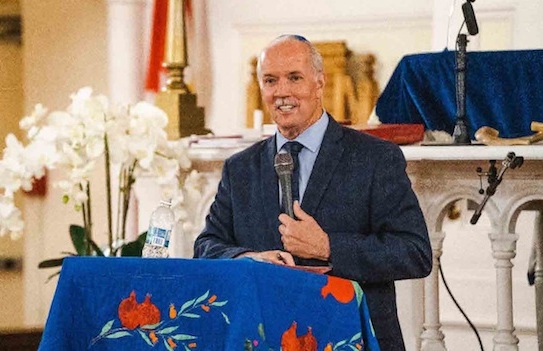
B.C. Premier John Horgan speaks at Congregation Emanu-El Synagogue in Victoria on the evening of Wednesday, Oct. 19. (photo from Jewish Federation of Victoria and Vancouver Island)
The Jewish Federation of Victoria and Vancouver Island and its partners, the Jewish Federation of Greater Vancouver and the Centre for Israel and Jewish Affairs, held a farewell reception to honour B.C. Premier John Horgan for his service. They shared their gratitude for the support, partnership and friendship of Horgan and his government. They commended the premier’s friendship with the Jewish community, and his resolve to fight racism and antisemitism, and to preserve the teachings of the Holocaust.