New era in U.S. politics

The explosive debate around abortion spurred by the U.S. Supreme Court’s rejection of a woman’s right to reproductive self-determination reminds us that the Jewish perspective on the topic is nuanced.

“Jewish law approaches each case according to its particular circumstances,” notes an article at chabad.org. This central dictum of halachah, Jewish law, makes generalizations difficult. One thing is almost universally accepted: abortion can be halachically required if the life of the mother is in danger.

In 2015, 83% of American Jews told Pew Research Forum that abortion should be legal in all or most cases, which is more than any other religious group, a finding around Jewish support for reproductive choice that has been true for decades. However, a story from the Jewish Telegraphic Agency recently noted that a growing alignment between some Orthodox Jews and the Republican party in the United States has led a minority of Jews to adopt what has been largely a conservative Christian approach to the subject.

The Orthodox Union released a statement that they are “unable to either mourn or celebrate” the court’s overturning of Roe. Their position is that an outright ban is unacceptable under Jewish law, but that abortion should be limited to cases where the mental or physical health of the mother is at stake, with an emphasis on the preservation of life. Further, they stated that abortion should be available regardless of someone’s economic status.

The tectonic decision by the court, overturning 49 years of precedent set by the landmark Roe v. Wade case, has set in motion frenetic activity across that country and beyond. State officials have had the issue thrown into their laps. The United States will become a patchwork of regulations on the subject. The ruling has led to triumphant celebrations by opponents of abortion and it has reenergized those endorsing reproductive freedom. What all of this will mean, not only for abortion rights but for social movements and society more broadly, can only be remotely imagined at this point.

The abortion decision was only one of several massive reversals of existing norms the U.S. court issued in its session. In other cases, the court made it more difficult for lower jurisdictions to limit access to firearms, weakened the power of federal agencies to address climate change and struck down a ruling that limited prayer in public schools (in this specific case, Christian prayer at school football games).

The succession of cases throws down a gauntlet that most people – whatever their opinions – knew was coming when the former president appointed three justices to the court, creating a 6-3 conservative majority.

In many cases, though, these decisions are deeply out of step with what the majority of the population believes. Of course, court rulings should not necessarily mirror societal norms. Historically, courts have made society-altering decisions in spite of opposition – desegregating public schools against the wishes of white racists, for instance. Leaving aside philosophy, public opinion may not be able to impact a Supreme Court packed with political appointees (three of whom testified in their nomination hearings that the abortion question was settled law) but public opinion will change society.

Anti-abortion activists (and anti-climate, anti-secularism and anti-gun control activists) have been celebrating their big wins in these cases.

In 1973, as pro-reproductive choice activists were celebrating their Supreme Court win, a new movement was gaining its footing. It would develop into one of the biggest, most powerful movements in American history, a new conservatism that led, among many other social and economic changes, to the elections of Ronald Reagan, two Bushes and Donald Trump. And it accomplished one of the core objectives it set out to address: it tipped the scales of the Supreme Court and stripped women of rights they have had since 1973.

Those who were celebrating in 1973 are today experiencing a vast array of emotions: grief, disillusionment, fear. But also rage, determination and purpose.

As the Roe decision did in 1973, last month’s ruling will launch a new movement that, like the new conservatism before it, will address a broad range of social issues and injustices. It was impossible, 49 years ago, to foresee the changes that would come. Whichever side one may be on, be assured that we have entered a new era.

Journey from prison to power

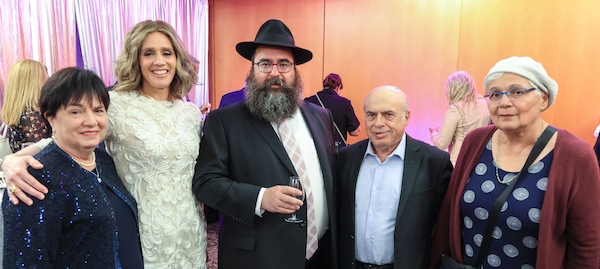
At the Freilach 25 gala on June 19, left to right, are Yocheved Baitelman, Chanie Baitelman, Rabbi Yechiel Baitelman, Natan Sharansky and Avital Sharansky. (photo by Kasselman Creatives)

Natan Sharansky, the most famous “Prisoner of Zion” and a former Israeli senior cabinet minister, shared reflections on his extraordinary life with a Vancouver audience last month.

Sharansky spoke June 19 at the Freilach 25 gala honouring Rabbi Yechiel and Chanie Baitelman on the 25th anniversary of their leadership of Chabad of Richmond. The event took place at Schara Tzedeck Synagogue.

Born in 1948 – the same year as the state of Israel – Sharansky was, like most Jews in the officially atheist Soviet Union, utterly disconnected from his Judaism. There was no brit milah, no bar mitzvah, no Jewish culture, language or tradition, he said – “What there was, was antisemitism.”

There were about 150 nationalities in the sprawling Soviet Union, each one of them identified on the fifth line of the official state identification issued to every citizen. Everyone, regardless of ethnic origin, was treated relatively equally, if not fairly, under the communist regime, with one exception. If someone said, “He has a fifth-line problem” or “the fifth-line disease,” it meant they were a Jew and, therefore, had more limited opportunities for advancement than members of the other national groups, said Sharansky.

While they had only the vaguest idea of what being a Jew meant – “There was nothing positive in this word ‘Jew,’” he said – his parents instilled in him the need to overcome the officially proscribed handicap through excellence.

“You must be the best at chess or music or whatever you’re doing,” they told him, “the best in your class, your school, your city.”

Sharansky – then called Anatoly – was 5 years old when Stalin died (on Purim). At the time, the so-called “doctor’s plot,” a Stalinist campaign to whip up antisemitism based on allegations that Jews were trying to assassinate Soviet leaders, was approaching a climax. Boris Sharansky told his two sons that the dictator’s demise was a good thing, but that they must not let on to others that they believed this.

Back at school, young Anatoly mimicked his fellow kindergarteners.

“We are crying together with all the other kids,” he said. “We are singing songs about the great leader.… You have no idea how many children are really crying and how many children are crying because their fathers told them to do it.”

This was Sharansky’s first conscious awareness of “doublethink,” the phenomenon in which Soviet citizens learned to compartmentalize what they knew from what they were supposed to know.

“You are reading what you’re supposed to read, you’re saying what you’re supposed to say, you are voting as everybody votes and you know that this is all a lie,” he recalled.

For Jews of his generation, the deracination from their heritage changed in 1967.

“The Six Day War was a big humiliation for the Soviet Union,” he said. “They had thrown in their lot with the Arabs.”

While the seemingly miraculous Israeli victory over the combined neighbouring Arab armies was notable, it didn’t change the perceptions of Soviet Jews overnight. It didn’t, for example, distract the young from their studies for university exams.

“But, over time, some things changed,” Sharansky said. “Those that loved you and those that hate you” changed their attitudes, he said. “They all look at you and say, ‘How did you Jews do it?’” Jews were upgraded, Sharansky has written. “We went from greedy, cowardly parasites to greedy, bullying hooligans.”

Soviet Jews did not consider themselves part of Israel, but at least some of their non-Jewish neighbours did. This sparked a new curiosity among Soviet Jews about their connection to Jews outside their realm and kindled pride in their identity for the first time.

Soon, smuggled copies of Leon Uris’s 1958 historical novel Exodus, about the founding of the state of Israel, found its way into circulation. The forbidden book was passed from hand to hand, not only because it was a page-turner, but because it was not the kind of book a Jew in the Soviet Union wanted sitting around the house.

Sharansky realized that the soldiers in Israel who had defeated the Arabs in 1967 were the same age as him.

“Suddenly, the university exams didn’t look so significant,” he recalled. So began a quest for identity and dissidence that would lead Sharansky to nine years in a Soviet prison, then, later, to nine years as a senior figure in Israel’s government and, later still, nine years as head of the Jewish Agency for Israel.

As Jews in the Soviet Union gained consciousness about their identity – and began their “treasonous” demands to abandon the communist state for Israel – they ignited a parallel and larger fight against Soviet tyranny. In his presentation, and more deeply in his book Never Alone: Prison, Politics and My People, co-authored with Gil Troy, Sharansky explained how he struggled with whether his fight was for his right to fully express his particular Jewish identity or whether it was a larger battle to free the millions of oppressed Soviets of all 150 or so nationalities.

At the same time, international solidarity that had begun as a tiny rally of Columbia University students in 1964 exploded into a massive global movement calling for the Soviets to free both “Prisoners of Zion” – those Jews imprisoned in gulags for openly confronting the Soviet powers – and the millions more Jews in the Soviet Union who were not free to leave the country.

As the Soviets grew more concerned about this international attention, they responded in two ways. They permitted some Jews to make aliyah – particularly middling troublemakers they preferred not to deal with – while imprisoning leaders like Sharansky, who soon became the leading face in the fight to free Soviet Jewry.

If Anatoly Sharanasky – who would rename himself Natan as his Jewishness evolved – was the face of the movement, his imprisonment required a voice to take up the mantle. This role was adopted by his wife, Natasha, who herself would become Avital as she, too, reconnected with her identity. As Avital Sharansky sat in the audience at Schara Tzedeck last month, her husband recounted her meetings with world leaders, Jewish community officials and anyone who would listen to her demands to free her husband.

Before being thrust into the roles of world-leading activists, Natasha and Anatoly – Avital and Natan – had a one-day honeymoon. They were hastily married and the next day she flew to Israel, not sure whether the Soviets would soon rescind her exit visa. She began her lobbying while he continued the activism that led him, three years later, to be sentenced to death by shooting for “high treason.”

Jews all over the world demonstrated, including a 250,000-person march on Washington in 1987. Soviet ambassadors in Western capitals were called in to explain their treatment of Jewish citizens. The U.S. Congress passed an amendment to a trade law, tying Jewish emigration and broader human rights issues to economic ties with the Soviets.

A Toronto man, Noah Landis (né Lantsevitsky), saw Sharansky on the news and did a little genealogy. Discovering a family connection, he contacted Irwin Cotler, Sharansky’s Canadian lawyer and later Canada’s minister of justice, who was able to go to then-prime minister Pierre Trudeau and demand that the government stand up for this relative of Canadian citizens being held hostage for his identity.

The ascent of Mikhail Gorbachev, with his liberalization programs of “glasnost” and “perestroika,” put the treatment of Soviet Jews further into the spotlight. In 1985, then-U.S. president Ronald Reagan met with Gorbachev in Geneva. At one point, Avital Sharansky, dressed in a prisoner’s uniform, accosted Raisa Gorbachev, wife of the Soviet leader, asking for her intervention. In private, Reagan demanded Gorbachev act on Sharansky’s case and, three months later, Sharansky was released, the first of the Prisoners of Zion to gain freedom. The day he was released from prison, Sharansky was stripped of his Soviet citizenship and flown to East Berlin, transported across to West Berlin and on to Israel, where he ended the very long day dancing at the Western Wall.

Sharansky’s attendance in Vancouver was to mark the quarter-century of commitment Rabbi Yechiel and Chanie Baitelman and their family have made to the B.C. community as Chabad shlichim in Richmond.

The rabbi said he felt “embarrassed and inadequate” at the recognition, saying, “Serving this community is not some great burden. It is in fact the greatest privilege imaginable.”

Baitelman spoke of the exponential growth Chabad of Richmond has seen in 25 years, including a huge increase in the number of educational programs delivered, meals prepared and shared, and youth activities, Hebrew classes and outreach programs initiated. The model of the late Lubavitcher Rebbe is one they try to emulate, said Baitelman.

“This is what we try to do – to ignite the soul of every Jew with the love of Torah, the love of Judaism and a passion for our Jewish traditions so that each person can realize their unique potential and fulfil the purpose for which he or she was created,” said the rabbi.

Chabad of Richmond is bursting at the seams, he said, and has begun a campaign to relocate to larger premises. On a personal level, Baitelman said he and his wife are not slowing down.

“We have no intentions of resting on our laurels, not for a minute,” he said. “Our work is only just beginning. Chanie and I pledge to work even harder, to grow this organization, to bolster our acts of chesed on behalf of this community, to increase the number of programs we have to offer.”

Shelley Civkin and Gayle Morris co-chaired the event. Steve Whiteside, president of Chabad of Richmond, welcomed guests, while his vice-president, Ed Lewin, offered closing remarks. Mark and Yolanda Babins introduced the keynote speaker.

Again: war triggers memories

Again and again the world does not learn. The ego of dictators and high-ranking politicians is inflated, bordering on insanity. There are many conflicts in the world, but it is Russia’s war on Ukraine that I’m thinking of at this moment.

Who is suffering from all this? The mother with her scared child in her arms, the father who is forced to stay behind and fight, the old and frail, the children in the orphanage who have nowhere to go, the 36-day-old baby boy who does not have yet an identification paper, a name of his own. Who is suffering? The expecting mother who is running, injured, between the ruins of the hospital; the children, scared, hiding in the bomb shelters, hearing explosions and not knowing if they will have a home to return to.

Again and again, people are running in fear, looking for safe shelter. All around them, shelling, sirens, bombardment, hundreds of tanks parading on main city streets, explosions, ruins and distraction.

All this is taking me back decades to another time, the Second World War: Romania, 1940. It triggers memories of my early childhood journey of displacement, fear, cold and hunger. Then 2 years old, my family and I – and thousands of other Jews from northern Romania – were driven out of our homes to the unknown. For one year we were forced to live in a ghetto in a city called Czernowitz (now in Ukraine) in terrible conditions.

After one year, the ghetto was dissolved and we were forced for days to walk by foot in deep mud, carrying bundles of our meagre belongings on our backs toward an area called Transnistria. Long lines of frightened people, old and young, crying babies, the sick and those with disabilities. Those who could not walk were left behind or shot. The Romanian or German soldiers riding on their horses where shouting and beating up anyone who did not comply with their orders.

They forced us to walk from village to village until we arrived in a place called Djurin, where we settled down. There, we lived for four years in terrible condition. My father was taken from us to a work camp. My mother collected dry wood bunches from the nearby forest and exchanged them for food with the Ukrainian women who felt sorry for us. Toward the end of the war, my mother was injured in a bombardment when the Germans were retreating.

I am glad that I was too young to remember most of my fears, but I can’t escape the ripples of horror from those times. They are engraved in my psyche, in my pores. I tremble now when I see the young children on the TV screen with their big, scared eyes. Maybe they are hungry, cold or frightened. I wish I could hug and console them and feed them with my special chicken soup.

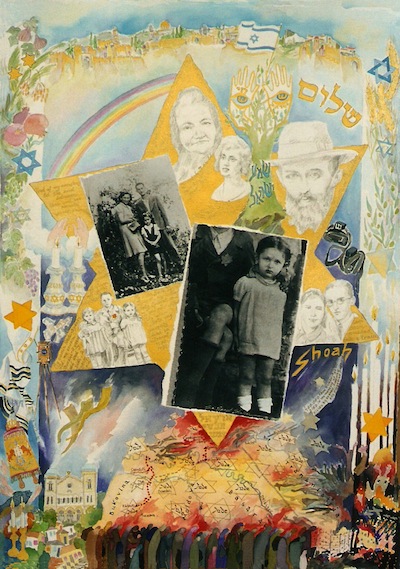
image - “Earth Don’t Cover Their Blood” by Sidi Schaffer, Gesher Project, 1998, mixed media
“Earth Don’t Cover Their Blood” by Sidi Schaffer, Gesher Project, 1998, mixed media.

For us, there was no place to seek shelter, nobody wanted us, and nobody cared. The world was silent to our plight. We were denied refuge from most countries. We should remember the destiny of the St. Louis ship, which carried Jewish refugees trying to escape the terror of the war in Europe but was not allowed to enter Cuba, the United States or Canada. The ship had to return to Germany, where 254 of the passengers were murdered by the Nazis. Nor should we forget the ship Struma’s disaster – it was torpedoed and sunk with 800 Jewish refugees, who were on their way from Romania to Palestine. We should not forget Canada’s Frederick Blair, who was in charge of the immigration branch at the time, or then-prime minister William Lyon MacKenzie King’s immigration policy “None is too many,” just when the Jews of Europe were in despair and looking for shelter.

War is evil, then and now and always. Still, I can’t stop being amazed at the differences I see in the world’s reaction of kindness and compassion toward the Ukrainian refugees these days. Moldova, one of the poorest countries in Europe, Poland, Romania and Germany – all have opened their gates with outstretched arms to help the tired mothers, scared children, orphans, the sick and the old. The world’s reaction shows me that the world is changing – including Canada – and that gives me hope.

Israel is bringing in thousands of people from the war zone. They give humanitarian assistance wherever needed. Synagogues in Ukraine, and Jewish congregations from around the world, help bring people to safety, like the Odessa orphanage children that were taken to Berlin.

Still, millions of people suffer because of politics and a madman who wants to expand his territory and his pockets.

I wish that we had in our camps some support, food and warm clothing, medical attention and safety. For us, the world was blind. Only the ones who survived live to tell.

We child survivors are now home for one another.

Sidi Schaffer was born in northern Romania. In 1940, she and her family were put into a ghetto in Czernowitz and, one year later, they were driven toward a concentration camp named Djurin, in northwestern Ukraine. There, in terrible conditions, they survived for four years. In 1945, they returned to Romania and, in 1959, they immigrated to Israel, where she received her degree in art education. In 1975, with husband David and their three sons, she came to Canada. In Edmonton, she went back to her studies and graduated with a bachelor of fine arts from the University of Alberta. In 1998, she and her family settled in Vancouver. Schaffer is a proud member of the Child Survivor Group of Vancouver.

Canada’s new direction?

Jewish Canadians were instrumental in building the Canadian labour movement and, by extension, the Cooperative Commonwealth Federation, which would go on to become the New Democratic Party.

Political scientists and others have observed that, as immigrant communities integrate into their new societies and become more economically secure, their voting patterns and ideological outlooks tend to move across the spectrum. While Canada has seen a small but steady growth of Jewish immigration in recent decades – with spikes during significant events like the end of the Soviet empire – the community, as a whole, is now firmly established.

Canadian Jews, like other groups that have deep roots in our relatively new country, have experienced economic and social success. Individual Jewish households, of course, face every range of economic and social challenge, issues that are addressed by a network of social service agencies guided by the principle Kol Yisrael arevim zeh bazeh, all Israel is responsible for one another. While there is a sacred instruction for Jews to care for our own, Jewish values have also played a role in the actions of Jewish Canadians in relation to the broader Canadian society. Through individual and collective activism, from individuals like David Lewis in the last century to groups like the Centre for Israel and Jewish Affairs today, Canadian Jews have influenced public policy and made the country better and more welcoming for all.

Despite whatever economic advances Canadian Jews have made as a group, it is often noted that, as a community, Jews tend to remain politically progressive. In a practical sense, this has been complicated by positions taken by some on the left, including trade unions, the New Democrats and the Green party. Jewish Canadians are overwhelmingly Zionist and, over the past 50 years, picking up steam in the past two decades, the left has become less and less supportive of Israel and Jewish self-determination. The debate about where anti-Zionism ends and where antisemitism begins is for another day. Stated simply, many Canadian Jews are progressive voters who, due to foreign policy issues, find themselves politically homeless. (The pro-Israel stands of the Stephen Harper government also shook many Jews away from their traditional political allegiances.)

With this context in mind, the surprise announcement Tuesday that the federal Liberal government has signed a supply and confidence agreement with the New Democrats may allow some progressive Zionist voters to have their cake and eat it too.

Under this deal – the same kind of agreement that the NDP and Greens in British Columbia signed to topple the B.C. Liberals in 2017 – the parties have agreed to advance things that have long been on the NDP agenda, such as a national dental care program and national pharmacare. It will apparently enhance ongoing reconciliation work through investments in Indigenous housing and continuing to confront the tragedy of missing and murdered Indigenous women and girls. Changes to the tax system and reducing barriers to participation in elections are also among the points released Tuesday.

The thorny issue of affordable housing will also be part of the mix – although what any government can successfully and substantively do on this issue remains a big question mark.

The provision of affordable universal child care – a promise made repeatedly by the Liberals and still not realized – is another marquis issue, as is addressing climate change and supporting workers.

The deal hearkens back to a similar one between then-prime minister Paul Martin, a Liberal, and the New Democrats, under Jack Layton, which buoyed a minority Liberal government in exchange for a $4.6 billion injection of federal funds into social programs.

For Canadian Jews who remain committed to progressive political values, the rather sudden announcement this week could be very welcome. Canada will (presumably) get a raft of new legislation on issues from environmental protections to economic justice, without subjecting Canadian foreign policy to the whims of a party that has signaled disregard to Jewish Canadians’ familial, historical and emotional ties to the state of Israel.

For those Canadian Jews who do not subscribe to this agenda, well, there is an opportunity for shaping an alternative. The federal Conservative party is in the early stages of what will be, it appears, a fight for the ideological soul of the party. The response to the Liberal-NDP deal by interim Conservative leader Candice Bergen was predictably skeptical. She called it a “power grab” by Trudeau, though time will tell whether a three-year reprieve from a snap election will allow the new Tory leader to cement their role before facing voters.

In any event, the battle lines for the next several years are being drawn. A Liberal-NDP agenda on one side and a possible new approach at the head of the Conservative party on the other.

We hope that Canada avoids the level of polarized partisanship we see in the United States and some other countries. It is, in fact, Canada’s history of moderation and compromise that has made it a welcoming place for Jews and other minority communities. However, it is always healthy in a democracy to have clear, definable choices.

The NDP and Liberals will be laying out their apparently ambitious agenda for the coming years. Those vying for the Conservative party leadership will now have a plethora of fresh policy initiatives to sink their teeth into to define themselves in contrast with this unexpected new informal coalition.

The ideologies of war

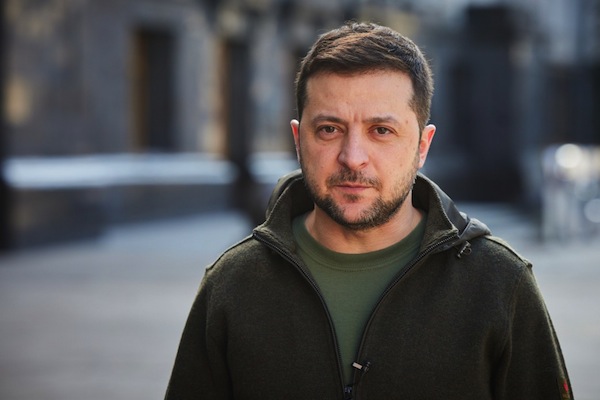
Hebrew University academic Samuel Barnai said Ukrainian unity extends beyond political parties and politicians, such as President Volodymyr Zelensky (pictured here), and the war is viewed as a great patriotic fight for Ukraine. (photo from president.gov.ua)

In the July 12, 2021, essay “On the Historical Unity of Russians and Ukrainians,” Russian President Vladimir Putin declares, “I am confident that true sovereignty of Ukraine is possible only in partnership with Russia. Our spiritual, human and civilizational ties formed for centuries and have their origins in the same sources. They have been hardened by common trials, achievements and victories. Our kinship has been transmitted from generation to generation. It is in the hearts and the memory of people living in modern Russia and Ukraine, in the blood ties that unite millions of our families. Together we have always been and will be many times stronger and more successful. For we are one people.”

This quote from Putin’s 2021 essay was shared by Prof. Yitzhak Brudny at a March 15 Hebrew University of Jerusalem webinar focused on “the ideological sources of the Russian-Ukrainian War.” The webinar featured Brudny, a professor of political science and history, and Samuel Barnai, an adjunct lecturer at the European Forum and at the HU’s Rothberg International School.

Brudny explained that Putin went even further in his claims just over a year after that essay. On Feb. 21, 2022, three days prior to the Russian invasion of Ukraine, Putin stated that “modern Ukraine was entirely created by Russia, more precisely, by the Bolshevik, communist Russia. This process began almost immediately after the 1917 revolution” and “Ukraine never had a tradition of genuine statehood.” Later in the speech, Putin points to Russia as being the main enemy in the eyes of the United States and NATO.

According to Brudny, these statements show a denial by Putin of Ukraine’s right to exist without an alliance with Russia and that the current Ukraine state is a “forepost of NATO” run by an “illegitimate, puppet government.” In Putin’s mind, he can justify the war because he sees it as rectifying an historical injustice caused more than a century ago, as well as remedying the security issues posed by a NATO-friendly state as Russia’s neighbour.

Brudny outlined the more recent history of Ukraine, from its 1991 independence from the Soviet Union (during its dissolution) to the present day. Ukraine stands in stark contrast to Russia in that it has accepted democratic electoral processes. Russia, meanwhile, has grown increasingly authoritarian and views a democratic state positioned between it and NATO countries, especially those that were part of the former Eastern Bloc, as a threat.

Barnai spoke to Russia’s military goals at the outset of the current conflict: destruction of Ukrainian air forces, destruction of Ukraine’s military headquarters, the besiegement of the capital Kyiv and the creation of a puppet government.

“Now that we are talking on the 20th day of the war, none of the targets have been reached,” said Barnai. “How can this be explained? In my opinion, one of the main reasons is the consolidation of Ukrainian society. There is widespread support for the president [Volodymyr Zelensky] and the government, which was not even the case two months ago. There is also support for accession to the EU and NATO, even in the Russian-speaking parts of Ukraine, which were less sympathetic to joining these alliances before,” he said.

In Barnai’s view, the present state of Ukrainian unity extends beyond current political parties and politicians, such as Zelensky, and the war is viewed as a great patriotic fight for Ukraine.

Barnai added that Putin, who has led Russia since Dec. 31, 1999, may have fallen victim to his own propaganda, “that Ukrainian-ness is an artificial tool to cause damage to the Russian people.”

The belief that Ukrainian culture is dangerous and must be eliminated runs deep in the Russian collective consciousness. Barnai gave several historical examples that illustrate this point. There was the suppression of the Ukrainian language by Czar Peter I in 1720. In 1763, Catherine the Great issued a decree banning the teaching of the Ukrainian language at the Kyiv-Mohyla Academy. In 1876, Alexander II prohibited the printing of all Ukrainian literature within the Russian Empire. And, in 1914, there was a decree by the last czar, Nicholas II, prohibiting the Ukrainian press. Despite a range of views on other historical matters, these and other Russian leaders shared a common desire to suppress Ukrainian cultural identity.

Barnai explained that there are close ties – historical, religious, and personal – between Russians and Ukrainians, and many have family connections to both countries. He said the real threat to Putin today is not NATO or the European Union, but “the success, even if it is limited success, of political and economic reform in Ukraine.”

This threat, Barnai concluded, plays out in the lack of true participation the Russians have in the political and economic processes of their country. “The main struggle of Putin for the last 22 years,” said Barnai, “has been to deprive Russians of their rights in the political arena.”

Sam Margolis has written for the Globe and Mail, the National Post, UPI and MSNBC.

Climate action update

Seth Klein speaks at the Press Conference from the Future on March 12. (photo by Lorne Mallin)

On March 12, hundreds turned out for a creative event that imagined what could be accomplished by 2025 with climate movement leaders in government.

“With the money that would have gone to piping some of the worst oil in the world to the West Coast, we have instead unleashed a wave of investment in healthy people and healthy land,” Kukpi7 Judy Wilson told A Press Conference from the Future in front of Vancouver Public Library’s central branch.

Wilson, secretary-treasurer of the Union of British Columbia Indian Chiefs, was speaking as if the twinning of the Trans Mountain (TMX) pipeline had been scrapped in 2023 and a TMX reparations and healing secretariat had been created.

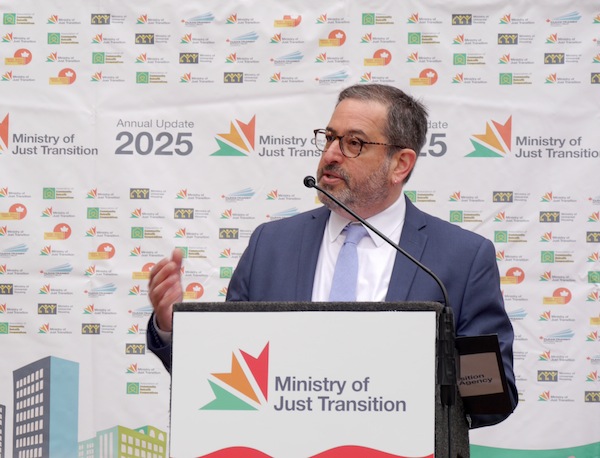
The press conference event was under the banner of a fictional ministry of just transition presenting an update on new programs and institutions slashing pollution, creating meaningful work, and addressing injustice and inequality in energy, Indigenous rights, housing, transit, public health and more.

There were two Jewish speakers: Seth Klein of the Climate Emergency Unit and filmmaker Avi Lewis as the minister of just transition, as well as Secwépemc/Ktunaxa filmmaker Doreen Manuel, director, Bosa Centre for Film and Animation, Capilano University; Rueben George, Sacred Trust, Tsleil-Waututh Nation; Khalid Boudreau, climate youth activist/organizer; Christine Boyle, Vancouver city councilor; Alison Gu, Burnaby city councilor; and Anjali Appadurai, Sierra Club BC.

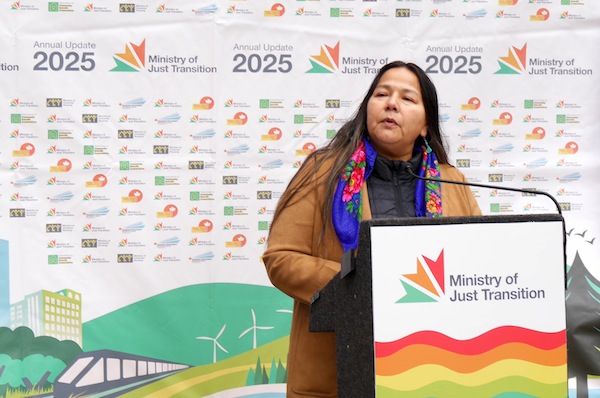
photo - Kukpi7 Judy Wilson addresses the Press Conference from the Future
Kukpi7 Judy Wilson addresses the Press Conference from the Future. (photo by Lorne Mallin)

Klein, author of A Good War: Mobilizing Canada for the Climate Emergency, spoke as chief executive officer and commissioner of the fictional Just Transition Transfer Agency. “Winning [on emissions reductions] also means leaving no one behind,” he said, “especially the regions that have long relied on revenue and jobs from oil and gas.”

Klein said that, like the Bank of Canada’s qualitative easing policies in the first year of the COVID-19 pandemic, the just transition could be financed in a similar way.

“Most of that year, the Bank of Canada was buying up federal government securities to finance the COVID emergency response to the tune of $5 billion every week for a year,” said Klein. “Once we embedded our climate emergency goals within the mandate of the Bank of Canada, the bank proceeded to do this again for a mere four weeks a year, generating $20 billion for climate and just transition programs.”

Lewis said his government is committed to climate action, having carefully studied the conditions and capacities of Canada’s advanced industrial economy. “We conducted an inventory of our conversion needs to determine how many heat pumps, solar arrays, wind farms and electric buses we needed to electrify virtually everything and end our reliance on fossil fuels,” he said.

Lewis encouraged the audience to make the future presented in the event happen. “Do you want to live in this future? Are we ready to fight for this future? Because this future we described here today is the work of all of us – the fruits of our imagination and struggle – and that’s what we came here today to commune around: the future we can build together.”

Manuel, portraying the chair of the land back secretariat, updated progress of an imagined Land Back Act, whose goal is “to reverse the land theft that underlies the colonial nation state of Canada. That means that 80% is being systematically returned to Indigenous jurisdiction.”

After the speakers, and entertainment by the Carnival Band, volunteers engaged members of the audience on their thoughts and feelings about the climate emergency.

The March 12 event was part of a national day of action calling for the passage of a national Just Transition Act.

“The Just Transition Act is the most important missing piece of climate legislation in Canada and it needs to pass this sitting of the House of Commons,” said Katie Rae Perfitt, senior organizing specialist with 350.org, one of the press conference’s sponsoring organizations.

“We cannot tackle the climate crisis without rapidly phasing out fossil fuels,” said Perfitt. “Canadians deserve immediate action from our federal government to make that shift happen in a way that puts workers and communities first.”

– Courtesy A Press Conference from the Future ogranizers

Get $5 off Ahed’s Knee admission at VIFF

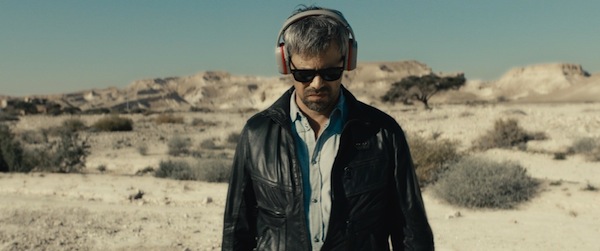
A still from Ahed’s Knee, which screens at Vancity Theatre March 25, 26 and 28. The movie – which won the Jury Prize at last year’s Cannes Film Festival – is about a celebrated Israeli filmmaker named Y, who arrives in a remote desert village to present one of his films at a local library. Struggling to cope with the recent news of his mother’s terminal illness, he is pushed into a spiral of rage when the host of the screening, a government employee, asks him to sign a form placing restrictions on what he can say at the film’s Q&A. Told over the course of one day, the film depicts Y as he battles against the loss of freedom in his country and the fear of losing his mother.

For $5 off the ticket price, use the promotional code VIFFKNEE22 at goviff.org/aheds-knee.

– Courtesy Vancouver International Film Festival

Peace hopes still alive

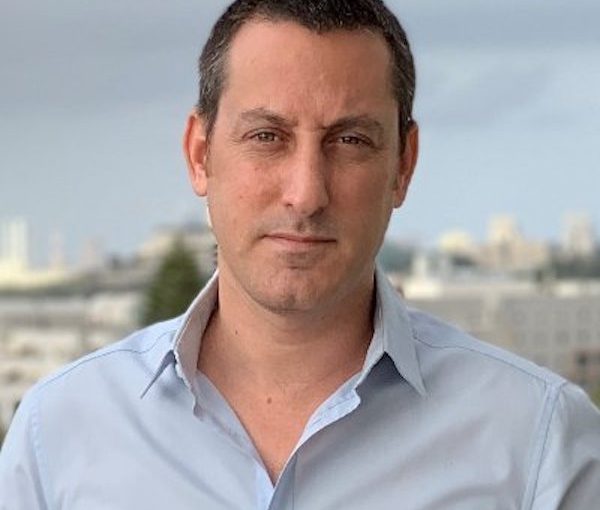
Barak Ravid (photo from Twitter)

An end to the Israeli-Palestinian conflict may be nowhere in sight, but the Israeli-Arab conflict may be coming to an end, says a leading Israeli diplomatic journalist.

Barak Ravid spoke virtually Feb. 20 in a presentation organized by the Jewish National Fund of Canada. Ravid, who reports for Axios from Israel, was formerly with Ha’aretz, where he worked for a decade as diplomatic correspondent and columnist, and is also a familiar face on Israeli TV. He was interviewed by Cynthia Ramsay, publisher and editor of the Jewish Independent.

Ravid spoke about his new book, Trump’s Peace: The Abraham Accords and the Reshaping of the Middle East, which is currently available only in Hebrew but should be out in English this summer.

Ravid acknowledges that Trump is a controversial figure and that the book’s title has received some pushback. “Peace is not the first thing that comes to mind when you say the word Trump,” he said. “I chose that name because it happens to be true.”

The author maintains that the Abraham Accords and the expanding normalization between Israel and Arab states would not have occurred under any other president.

“At the end of the day, Trump’s policies in the region closed down the trust gap that was open between the U.S. and the Israeli government … a gap that was opened during Obama’s term in office,” he said. “Whether it was warranted or not doesn’t matter. The gap was there. Trump’s policies in the region, mainly on Iran, closed down the gap and brought Israel and the Arab countries closer together.”

Trump’s decision to appoint his son-in-law, Jared Kushner, to deal with peace in the Middle East was key, according to Ravid. In interviews with Israelis and Arabs for his book, Ravid found that both sides viewed the appointment as proof of how central this issue was for Trump and served as an assurance that, when they spoke to Kushner, they were speaking to the president.

The ultimate reason the Abraham Accords were cinched, said Ravid, is that Trump did what he always claimed as his strength – he made deals. In return for normalizing relations with Israel, each party to the accords got something they wanted.

“For the United Arab Emirates, it was the arms sales, the sales of the F-35 fighter jets,” he said. “For Bahrain, it was an upgraded trade deal [with the United States]. For Sudan, it was removing them from the [U.S.] state department’s terrorism list. For Morocco, it was the U.S. recognition of Moroccan sovereignty over the Western Sahara…. Without those tangibles, those countries would not necessarily agree to take those steps.”

Ravid contends that Trump is not the only leader who deserves credit – Binyamin Netanyahu, who was Israeli prime minister at the time, was pivotal to the success. Ironically, he noted, the decision by most Arab politicians in Israel to reject the accords led Mansour Abbas to break away from the Joint (Arab) List and form a new party, Ra’am, whose participation in the new coalition government ultimately brought Netanyahu’s reign to an end.

“For the first time in history, an Arab party is a part of the coalition in Israel,” Ravid said. “In a strange way, the Abraham Accords enabled this change in Israel where Jews in Israel feel more comfortable towards Arabs and Arabs feel more comfortable joining the coalition and, therefore, Netanyahu’s biggest foreign policy achievement created the political conditions to get him out of office.”

It has long been an assumption that peace between Israel and Arab states would come only after a resolution of the Palestinian issue. When Netanyahu earlier tried to bypass the Palestinians and make friends in the neighbourhood, he was publicly shunned, said Ravid. But he kept plugging away behind the scenes, building relations in the region.

“It’s hard to go from zero to 100 in one step,” said Ravid. “You need to get to a situation where you narrow this gap and Netanyahu managed to take Israel and the Arab world from zero to, let’s say, 70. So, when the decision for the Abraham Accords came, the Arab countries didn’t have to go zero to 100, they needed to go 70 to 100.”

A third crucial contributor – who Ravid said deserves perhaps the most credit and who wants the least recognition – is the Crown Prince of Abu Dhabi, Sheikh Mohamed bin Zayed, the de facto leader of the United Arab Emirates. Bin Zayed has been trying to modernize his nation and he saw normalization with Israel as advantageous to his project. At the time, Netanyahu was threatening to annex about 30% of the West Bank into Israel. According to Ravid, bin Zayed saw a way to manoeuvre.

“He decided to be the most vocal opponent of annexation,” Ravid said. Bin Zayed told the Trump White House that, if Netanyahu dropped the annexation initiative, he would be ready to sign a peace deal with Israel.

For the White House, the annexation issue was a huge headache, said Ravid, and bin Zayed’s offer solved that problem while delivering a generational diplomatic breakthrough at the same time.

The big question is, what’s next? What about Saudi Arabia?

“That’s the crown jewel,” Ravid said. U.S. President Joe Biden sent his national security adviser, Jake Sullivan, to Riyadh and received a list of demands from Crown Prince Mohammed bin Salman Al Saud. All the demands were on the United States, not Israel, including that the Saudi monarch be invited to the White House.

Bin Salman has been an international pariah since the Washington Post commentator and Saudi dissident Jamal Khashoggi was murdered and dismembered in the Saudi consulate in Istanbul in 2017. The U.S. Central Intelligence Agency concluded that bin Salman ordered Khashoggi’s killing.

“Biden will have to take a very hard decision if he wants to move ahead with the Abraham Accords,” said Ravid, walking the fine line between rewarding a foreign leader who American intelligence has dubbed a murderer of a journalist and seeking to advance peace in the Middle East. But, if it works, the dominos will almost certainly fall into place, said Ravid.

“If Saudi comes in, then Indonesia comes in, then Kuwait comes in, then Oman comes in, then Muslim countries in Africa join, Pakistan,” he said. “It’s literally the end of the Arab-Israeli conflict – while the Israeli-Palestinian conflict will continue, obviously.”

In this regard, Ravid said, “The Palestinians decided to boycott the Trump administration in December 2017 after Trump announced he is recognizing Jerusalem as the capital of Israel and moving the embassy there. While I can understand Palestinian frustration and anger, and it makes complete sense to protest, the decision to boycott Trump until his last day in office, I think, was counterproductive to their goals, and didn’t get them anything in the end.”

On the flip side, Ravid argued, Netanyahu’s annexation of a big chunk of the West Bank would have put another nail in the coffin of the two-state solution.

“I think the Abraham Accords, even though the Palestinians won’t admit it, saved the two-state solution, at least for now,” said Ravid. “Some people think it’s gone already, but if you think the two-state solution is still alive, the reason it’s still alive is that the UAE normalized relations with Israel and stopped Netanyahu from annexing the West Bank.”

Bernice Carmeli, president of JNF Canada Pacific Region, opened the event, and Michael Sachs, executive director of JNF Pacific Region, closed it. Lance Davis, chief executive officer of JNF Canada thanked Ravid.

UN not hopeless, says Danon

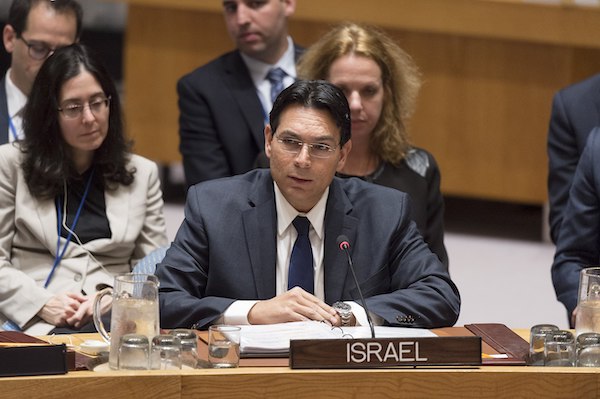
Danny Danon addresses a United Nations Security Council meeting in 2017, when he was Israel’s ambassador to the UN. (UN photo/Rick Bajornas via Wikimedia Commons)

Many Israelis and their overseas allies may see the United Nations as an assembly of antagonists, but a former top diplomat who spent five years there sees plenty of reason for optimism.

Danny Danon, who served as Israel’s ambassador to the UN from 2015 to 2020, spoke candidly during a livestreamed conversation Feb. 8 with Jonas Prince, chair and co-founder of Honest Reporting Canada, which hosted the event.

Danon was a Likud party member of the Knesset from 2009 to 2015 and served as minister of science, technology and space, as well as deputy minister of defence and deputy speaker. He is also an author and world chairman of the Likud party.

“I’m optimistic because we are starting to see change,” Danon said. “We are starting to convince countries to read the resolutions before they talk about them and we are able to see a few victories at the UN, including in the General Assembly.”

He cited two examples of victories during his time at the international body. Working with then-U.S. ambassador Nikki Haley, Danon proposed a resolution condemning the terrorist group Hamas. To pass, it required a two-thirds majority, which was not attained, but a plurality of the member-states supported the motion.

“For us, it was a victory,” he said. “People speak about disappointments but we have to also speak about achievements.”

One unequivocal achievement was when Danon was elected chairman of the legal committee of the UN.

“We got the support of 109 member-states who voted for me and only 44 voted against me,” said Danon. “I became the first Israeli ever to chair a UN committee.”

How did it happen? Secret ballots, he said. On resolutions where the votes of each country are publicly counted, Israel routinely experiences massively lopsided defeats. In secret ballots, the outcomes can be quite different. For example, there are 57 members of the Organization of Islamic Cooperation, which officially opposed Danon’s candidacy. Yet only 44 countries voted against him, he noted.

In his time at the UN, Danon also learned that ambassadors from the smallest countries are often the most persuadable. They do not have large foreign affairs apparatuses in their capitals and so they do not have bureaucrats overseeing their behaviour at the UN, giving them more freedom to vote as they wish.

One regret he has is that Israel did not run for a seat on the Security Council.

“I convinced the prime minister we should run because it’s a secret ballot,” he said. “Unfortunately, the diplomats in the ministry in Jerusalem convinced the prime minister that we don’t have the budget and the energy to run a successful campaign and we had to drop out at the early stage of the campaign, which for me was a big disappointment and I think it was a grave mistake.”

Over time, somewhere between 75% and 80% of country-specific condemnations at the UN have been directed at Israel.

“I call it diplomatic terrorism,” he said. “It has no connection to the reality. When you speak about human rights resolutions, you cannot ignore what’s happening in Syria, in Libya, in Yemen and blame Israel.”

Danon said the situation goes back to the very earliest era of the UN, when the Arab world rejected the Partition Resolution to create a Jewish and Arab state in the area of Palestine. To justify that rejection, and the rejection of every olive branch since, the Arab bloc has had to initiate resolutions against Israel, he said. This took off in earnest in the 1970s, with the infamous (since rescinded) “Zionism equals racism” resolution of 1975, he noted.

The UN General Assembly also engages in a sort of Groundhog Day every year, in which the same series of condemnatory resolutions against Israel is brought out and passed, year after year.

“I come from the Knesset, from the parliament,” he said. “Like every parliament in the world, once you pass a bill or a piece of legislation, you move on. That’s not the case at the UN. Every General Assembly takes the same resolutions you adopted last year and brings them back to the table.”

For all the energies expended against Israel at the UN, Danon argues little of it helps actual Palestinians.

“When you look at the outcome of those resolutions, we can agree that they are not helping the Palestinian cause,” he said. “On the contrary, it gives them empty victories so maybe they get a few headlines for a day or two and then what?… I call them feel-good resolutions, so maybe the Palestinians feel good for a day, but the Palestinian people don’t get anything.”

Danon said he also tried to raise awareness of Palestinian incitement to violence among his UN colleagues.

“Nelson Mandela once wrote that you are not born with hate, someone is teaching you to hate,” Danon said. “I focused on the Palestinian incitement, what they are teaching the kids in school, what they are showing them on Palestinian television, and I proved my case. I said, we can argue about a lot of things, but we cannot allow the Palestinians to continue with the education of hate propaganda against Jews. I showed them the textbooks of the Palestinians [and] what you can find on the internet telling Palestinian children how to stab a Jew, which knife to use and how to be effective.”

The former ambassador insisted he has nothing against humanitarian aid to Palestinians.

“On the contrary,” he said. “But make sure that the funds you are giving are not being used for terrorism and for incitement. Ask tough questions about … the results…. Instead of teaching the Palestinians and giving them the proper education, they did exactly the opposite.”

UN member-states should demand to see results from the billions of dollars poured into UNRWA, the United Nations Relief and Works Agency for Palestine Refugees in the Near East, which is a unique entity that acts as a quasi-governmental body for Palestinians. Rather than resolving the issue of refugees or other challenges facing Palestinians, Danon argues that UNRWA perpetuates the problems in order to justify and prolong its own existence.

The Palestinian refugee issue gets a great deal of international attention, he said, while the parallel number of Jewish exiles from that same era he calls “the forgotten Jewish refugees.”

“When my father’s family fled Alexandria, Egypt, in 1950, they left everything behind,” said Danon. “Nobody is coming and asking the Egyptian government to pay compensation, but at least it should be recognized and I think it’s a claim we shouldn’t abandon. We have to speak about it and make sure it will be brought up in future discussions as well.”

The Palestinian Authority’s President Mahmoud Abbas is 87 years old and Danon hesitates to predict whether the next leader will be a genuine partner for peace.

“I hope that, in the days after President Abbas, a leader will emerge that will care more about education, infrastructure, rather than coming to the UN and speaking against Israel,” he said.

Israel’s defensive actions, like those during the war with Hamas less than a year ago, can make the country unpopular, Danon admitted. While it would be nice to be liked by the world, Danon said some things are more important.

“I prefer the situation where we are today, where we are strong, independent and we have borders, we can protect our people rather than being a place where we beg for mercy from the international community,” he said.

Ukraine in the balance

At our press time, the people of Ukraine were waiting, as they have for weeks, to see what fate has in store for them. Vladimir Putin, the Russian despot, has been threatening to invade the country – again. Under Putin, Russia has already illegally occupied the Crimean peninsula and two enclaves in eastern Ukraine. Pro-Russian extremists are also in control in Transnistria, a breakaway entity to the west of Ukraine that the world community recognizes as part of Moldova. In the Russian countryside surrounding the parts of Ukraine that Russia has not already occupied, an estimated 190,000 Russian troops are poised to attack.

Putin’s designs on Ukraine are ostensibly about his concerns over Ukraine potentially joining NATO, which some Russians view as a step too far in the incremental loss of Russian dominance over what was once the Soviet Union and, before that, the Russian Empire. He is also motivated by his own desire for power and expanding his influence. Along with other Russian nationalists, Putin views Ukraine as more than a neighbouring country but rather an integral part of a sacred Eurasian (Russian-dominated, of course) land.

Western powers have warned and cajoled Putin, who seems to revel in tormenting his adversaries. He is almost certainly aware that no one (save, perhaps, himself) wants war. The United States, having just catastrophically escaped a military debacle in Afghanistan, has no interest in continuing their role as the world’s policeman. The leaders of France, the United Kingdom, Germany and other Western powers have warned of serious consequences if Putin follows through on what appear to be unconcealed ambitions to invade, but none of those countries will risk the lives of their young people to defend Ukrainian sovereignty. It was precisely occasions like this for which the United Nations was envisioned, but the ideals of its founders have run aground on the rocks of realpolitik.

Genuine threats of reprisals are limited to economic sanctions. Here, too, Putin knows that embargoes and other economic penalties would be devastating not only for his country but for the economies of the West. Western Europe depends on Russian oil and anything – military instability or international sanctions – could send fuel and heating costs, which are already at record highs in many places, further through the ceiling. At a certain point, that could threaten the stability of some Western governments. More worrying is the fact that Ukraine has always been, and remains, the “breadbasket” of the region. Military or economic disruptions that harm Ukraine’s ability to get products to market could lead to food shortages. The possibilities are bleak.

Canada is home to one of the Ukrainian diaspora’s largest populations. More than 1.3 million Canadians are from, or descended from, the place. A significant proportion of North America’s Jewish population, too, is from that area and an even larger proportion departed to the new world through Ukraine’s Black Sea ports.

Ukraine has somewhere between 43,000 and 200,000 Jews. Definitions of “who is a Jew” are complicated by nearly a century of enforced atheism and centuries more of rampant antisemitism. The 200,000 estimate is the number who would qualify for Israeli citizenship under the Law of Return.

According to the New York Times, synagogues have hired Israeli security guards and hired buses for rapid evacuations. The Jewish Agency is said to have evacuation plans at the ready.

For all Ukrainians, the past 100 years have been a series of tumults. Jewish Ukrainians have been especially vulnerable during these times of upheaval – and the older Jews today, and those with any sense of history, may rightly understand they have more to fear than other potential victims of a Russian invasion.

Israeli government officials have been remarkably tight-lipped on the subject, other than to urge the 12,000 Israelis in Ukraine to come home as soon as possible – reportedly only 4,000 have so far done so.

It is easy, understandable even, to suggest the time has come for Jews in Ukraine and other places where life is especially difficult, to leave for Israel or elsewhere. Certainly, we are thankful that Jews with nowhere else to go have a Jewish state ready to take them in.

But Ukraine is their home. There are hundreds of Jewish organizations and institutions in Ukraine, a place where Jewish civilization goes back 1,200 years and where a vast amount of Jewish culture emerged in the past several centuries, including important streams of Hasidism and many noted authors and artists.

As the world waits on Putin, the latest in far too long a line of Russian tyrants, we watch with a sense of helplessness, knowing that people are afraid and suffering. And we hope that those in power pull back from the brink.