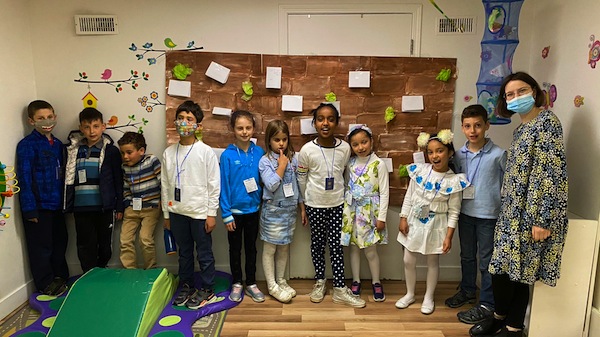
Grade 2 and 3 students of the B.C. Regional Hebrew School in Coquitlam with teacher Shifra Rabiski. (photo from Lubavitch BC)
In time for the upcoming school year, Lubavitch BC, in partnership with the Jewish Federation of Greater Vancouver, is launching a new curriculum for B.C. Regional Hebrew Schools. There is a need to engage Jewish children with a connection and pride for Israel and its central role in the Jewish past, present and future, and B.C. Regional Hebrew Schools has developed a program that does exactly this. Israel Quest is an immersive curriculum that enables children to form attachments to the Holy Land on practical, emotional and spiritual levels.
Using educational tools such as virtual reality, topography, theatre, filmmaking, STEAM activities and more, students relive the journey of the Jewish people in the land of Israel, from the time Jews entered the land, led by prophets and kings, until the untimely destruction of the Holy Temples. They discover the secret to the Jewish people’s eternal survival as a nation with tools established to keep Judaism thriving in the Diaspora.
Of the new program, Rabbi Dovid Rosenfeld, director of the Hebrew schools, said, “Education is at the core of everything. What we teach children in their formative years creates an indelible impact and foundation for their entire adult lives. And not only are the students themselves transformed, but the positive impact of their learning extends to their families, friends, classmates, communities and beyond.”
B.C. Regional Hebrew Schools is an affiliate of the Chabad Children’s Network (CKids), which has chapters in 26 countries and engages 25,000 children each year. Currently operating in three locations throughout British Columbia, it is gearing up for another year of Hebrew and Judaic learning, starting Sept. 1. Online registration is available at lubavitchbc.com/hebrewschool. More information can be found by calling 778-878-2025.
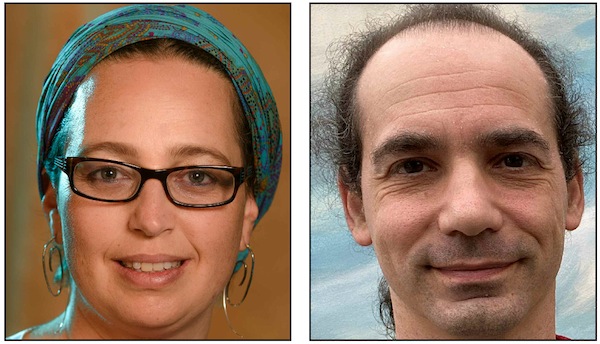
Dr. Odeya Cohen (photo by Dani Machlis/BGU) and Dr. Rami Puzis (photo courtesy)
Ben-Gurion University of the Negev (BGU) researchers discovered patterns of significantly decreased joy, increased sadness, fear and disgust among healthcare professionals (HCP) in the largest social media study to track emotional changes and discourse during the COVID-19 pandemic.
In the study, a multidisciplinary BGU team analyzed more than 53,000 HCP tweets from followers of several hundred Twitter accounts of healthcare organizations and common HCP points of interest. The most significant topics HCPs discussed during the pandemic were COVID-19 information, public health and social values, medical studies, as well as daily life and food. Approximately 44% of their discourse was about professional topics during the entire 2020 year.
The research indicates data-driven approaches for analyzing social media networks are helpful as a method for exploring professional health insights during both routine clinical situations and emergencies. The study will be published in the Journal of Medical Internet Research. A preprint is already available online. It was funded by the BGU Coronavirus Taskforce and by an Israeli Ministry of Science and Technology coronavirus research grant.
“Our findings, which track increasing sadness and decreasing joy, should be a warning to health organizations of the importance of better mental health support to help HCPs cope with the emotional consequences of the pandemic,” say Dr. Rami Puzis of BGU’s software and information systems engineering department (SISE) and Dr. Odeya Cohen of the department of nursing. “Most interestingly, HCP tweets expressed greater levels of fear just prior to pandemic waves in 2020. This indicates that many HCPs, beyond those working in epidemiology, observed, and were adequately qualified to anticipate pandemic development.”
Puzis goes on to say, “This suggests that decision-makers could benefit from investing additional resources into listening to the broader HCP community to track and anticipate bottom-up pathways for developing health crises.”
– Courtesy Canadian Associates of Ben-Gurion University of the Negev
Sar-El volunteers from Canada, the United States, England, Germany and the Caribbean at a base not far from Sderot in 2018. (photo from Ed Rozenberg)
This past July, I found myself shlepping boxes full of medical supplies and loading them onto pallets. How did I get here? I was volunteering in Sar-El, or Sherut LeYisrael, which means “service for Israel.”
Sar-El enables people, both inside and outside Israel, to volunteer to provide assistance to the Israel Defence Forces while contributing to the country, experiencing Israel and integrating into Israeli society. At present, due to COVID-19 and its resulting limitations on visitors, it is rare to meet a non-resident volunteer but, hopefully, that won’t be the case for much longer.
Sar-El volunteering comes in two types: arriving in the morning and leaving in the afternoon or arriving on a Sunday in the morning and leaving after lunch on a Thursday (sleeping on the base).
This recent volunteering stint, my wife Ida and I went to a central pickup spot in north Tel Aviv and were taken by bus with the rest of our group to the medical division (Matzrap, which is Hebrew shorthand for Centre for Medical Supplies) of Tel Hashomer, a large army base about 25 minutes away from the city. The usual group has about 15 volunteers, evenly divided between the sexes. Before COVID, the groups would consist of about 25 people, also evenly divided between the sexes, and about 60% Jewish and 40% non-Jewish. My co-workers have ranged in age from 20 to 92.
On arriving at the base, we are taken to our dorm building, with men and women sleeping on separate floors. We are told that there is to be no alcohol, drugs or romantic liaisons. Discussions of religion and politics are strictly forbidden. The group is led by two or three madrichot (female leaders) who are part of an IDF unit trained to lead Sar-El groups. It is important to remember that Sar-El is a unit of the IDF and, while on the base, you are under IDF jurisdiction, which means that you can’t leave the base except with hard-to-get permission. We receive uniforms, which we’re required to wear from the morning till after dinner.
A usual day begins with breakfast at 7 a.m. and the flag-raising at 8:15, followed by the singing of Hatikvah. This is often a very emotional moment, as we volunteers from all over the world are assembled with the same purpose, namely, to do something important for Israel. I have been on 10 Sar-Els and have met people from Canada, the United States, New Zealand, Australia, many European countries, South Africa, Brazil, Uruguay and Argentina. Volunteering with Sar-El is an extremely broadening experience and you make close friends for life.
Announcements come after the flag-raising. The madrichot ask us if there are any concerns or questions, and take care of them. We are then assigned to our workstations.
The work depends on the type of base. This was my fifth time in Matzrap, which deals with the packing and loading of medical supplies. Other parts of Matzrap deal with checking whether batches of medical equipment, such as stethoscopes, pressure gauges and night vision equipment, are functioning properly, or checking the expiration dates of drugs. The supplies are used in Israel, as well as by emergency units sent abroad to assist in disaster areas.
I first found out about Sar-El in early 2006 from an article in the Jerusalem Report. When the Second Lebanon war broke out, Ida and I flew to Israel and were assigned to a base in the Negev, where we loaded tanks, assembled army equipment, packed uniforms and weapons and loaded food.
One of my favourite activities in Matzrap is to help prepare worktables for adolescents with intellectual challenges. It is fulfilling to see these young people working and getting a feeling of accomplishment. There is always a small thank you ceremony at the end of the work period that I find quite touching. One thing that has struck me since moving to Israel in 2016 is the degree to which people here are encouraged to reach their potential no matter what their background and abilities.
Work continues till lunch at noon. After lunch and a rest period (and, for those who choose to participate, minchah prayers), we return to work till about 4 p.m. Dinner is at 6 p.m. and, at 7 p.m., there is an activity of some sort, either educational or entertaining, or both, such as quizzes, led by the madrichot. The atmosphere is relaxed.
Sar-El itself was the brainchild of General Aharon Davidi (z”l), a former head of the IDF paratrooper and infantry corps. In the summer of 1982, in the midst of the First Lebanon War, Golan Heights communities faced the prospect of losing their entire agricultural crop. The majority of able-bodied farmers and other workers were called up for army reserve duty and entire farms, with crops already ripened, were left unattended.
Davidi was then the director of community and cultural activities of the Golan and Jordan Valley. He sent a number of friends as a recruitment team to the United States and, within a few weeks, some 650 volunteers arrived to help. Those first volunteers expressed the wish that the project be continued. As a result, in the spring of 1983, Sar-El, the National Project for Volunteers for Israel, was founded as a nonprofit, nonpolitical organization. Sar-El is represented in more than 30 countries.
On many occasions, Sar-El volunteers work with soldiers who are assigned to the same workstations. At the beginning, the soldiers are amazed that there are people who actually volunteer for this but, after awhile, they feel more comfortable with the volunteers, they chat with them, get advice from older souls and practise their English.
The lunch on Thursday before the group returns to Tel Aviv can be a quiet time. By then, we have gotten used to one another, laughed, sweated and yelled at one another and many of us have become quite close. The madrichot always set up a WhatsApp group for anyone who wants to join and through which we get our notifications.
I have no doubt that, on balance, I have gotten more from volunteering for Sar-El than from any other contribution that I might have made through volunteering. It has been an enormously enriching experience for both Ida and myself.
Jack Copelovici and his wife, Ida, made aliyah from Toronto in 2016. Sar-El (Sherut LeYisrael) is one of the organizations for which they volunteer. They first volunteered for it in 2006.
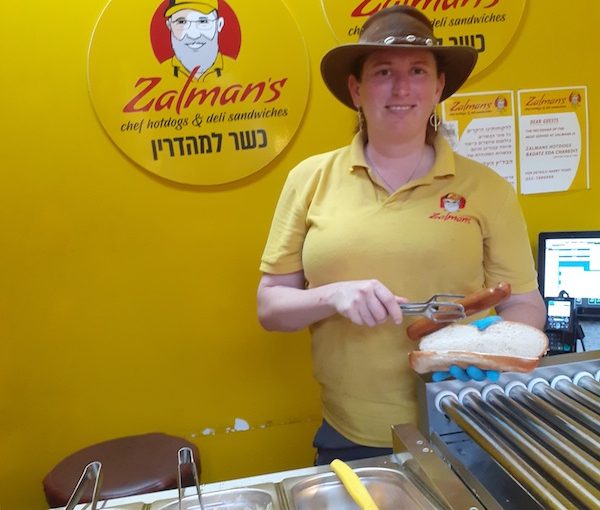
Unemployed tour guide Hannah Rosenberg is now serving up hot dogs for about $12.50 Cdn an hour. (photo by Gil Zohar)
For Anglo tour guides who have been unemployed since March 2020, the Israeli government’s recent decision to impose a seven-day quarantine requirement for visitors from the United States because of the coronavirus – that resulted in the cancellation at the beginning of August of 42 10-day Birthright trips – was another blow to a hard-hit industry.
Compounding the gloom caused by the week-long isolation order are two other decisions. The U.S. Centres for Disease Control recently warned against travel to Israel due to the rise in cases of the coronavirus as the Jewish state experiences another wave of COVID-19 infections and death. And, at the end of June, Bituach Leumi (Israel’s social service agency) ended payments to unemployed guides under the age of 60.
Hannah Rosenberg, 30, who completed a two-year certification course at the Hebrew University, leading to a series of Ministry of Tourism licensing exams in February 2020, is currently grilling hot dogs at Zalman’s in downtown Jerusalem for NIS 32 (about $12.50 Cdn) an hour. She remembers how the good times suddenly ended.
“March 18 (2020) was my last tour,” she recalled. She was two days into a seven-day tour with an American family visiting Jerusalem and the Galilee when a phone call from the U.S. State Department cautioned the family to leave immediately, lest they get stuck without a flight out. “It was a lie,” said Rosenberg, a native of Jupiter, Fla., the first of many she has heard from government officials.
“I applied to Bituach Leumi,” she said, “and was denied because I had not been working for the previous six months, during which I was studying for the tour guide exam.”
An ever-resourceful veteran of an Israel Defence Forces combat intelligence unit, Rosenberg kept applying and, after nearly a year, was given NIS 1,200 ($475 Cdn) monthly beginning in February. That payment ended in June.
“My parents are helping,” she said. “It’s the first time since I was a kid. It’s a hard thing to ask.”
Notwithstanding the hardship, Rosenberg has no plans to leave Israel. “I’m here for good,” she said, sharing that she still plans to pursue her dream to become an archeologist.
Mark Sugarman, 68, who made aliyah from Boston in 1971 and became a licensed guide in 1992, has had a relatively easier time. He’s simply become retired – but not by choice. His last tour was in March 2020, he said.
“We finished the tour, the typical 10-day Christian pilgrimage tour of the holy places. It was grueling. It was like being in the army and doing miluim (reserve duty). I was exhausted…. I went into a voluntary two-week quarantine. I didn’t know if I was infected and I didn’t want to infect anyone close to me…. By the time I came out of quarantine, we were in the first lockdown. I was stuck at home with my wife and dog in Talpiot. I was knackered,” he said, using a word he learned from his British clients.
“I applied for everything. A month later, I turned 67, so I officially reached the age of retirement and I got Bituach Leumi. I couldn’t get unemployment … because I took old-age pension, I wasn’t eligible. Whatever I get, I’m grateful.”
He added, “When I was working, I saved money. The last four years before COVID was a fat period. Now, it’s lean. I’ve been in the business for close to 30 years. I remember the Second Intifada, from 2000 to 2004, and that was a harder period than now. Everyone had to scramble at the time. I know how hard it is for my colleagues who have young families.”
Sugarman would like to go back to the United States for the unveiling of his mother’s headstone in November, but it’s problematic at this time.
“It’s been hard,” he said. “My mother’s funeral was on Zoom. Since the pandemic started, I [have] lost three family members and two friends. We were cut off from each other physically. People dying were isolated from their loved ones. Together with the loss of income, that’s been the hardest part.”
Daniel Gutman, 41, has worked as a tour guide since 2009. The Dallas, Tex., native remains philosophical about the situation. “I’ve had a little bit of work here and there, with some people visiting, family and seminaries and yeshivas, which needed two to four guides per capsule. That helped a little but, basically, I haven’t worked in the last 18 months.
Since Bituach Leumi stopped its payments at the end of June, Gutman said it has been challenging. “The government bailed us out for 18 months after they put me out of work. It was enough to survive. Now I’m back to March 2020, to square one, figuring out what I’m going to do. I’m dipping into my savings.”
On the positive said, he said, “Although I’ve taken a hit financially, I’ve had an 18-month sabbatical to be with my family.” But, he added, “I’m looking forward to getting back to showing people the country I love.”
Even during times of war and terrorism, tourists used to arrive, Gutman said. But not now. “Is there [national] value in tourism?” he asked. “If so, the government needs to support tour guides. Money has gone to bail out tour operators and hotels.”
Gutman loves his career and said he has no plans to retrain. “I am optimistic this will end.”
Chicago-born Ami Braun, 43, another veteran guide, also has scrambled to survive since benefits ended in June. He recently sent an email promoting online sales of the Four Species (etrog, palm, myrtle and willow) for the upcoming holiday of Sukkot. And he has conducted some virtual tours for the Beit Avi Chai community centre. “I have been a licensed guide for 14 years. This is my passion. I am doing whatever I can to stay afloat,” he said.
Braun has returned to guiding part-time at the Kotel Tunnels. “The pay is like a student job,” he noted. “It’s not something to live off of.”
In addition to being a writer, I’ve been a licensed guide for more than a decade. For the longest time after March 2020, I dreamed, every night, about guiding. It was a great adventure showing tourists my country, the West Bank, Jordan and Egypt, and I touched the hearts of a lot of people who fell in love with Israel. But those days are gone. I’ve been able to devote my time to editing a book about Hebron’s Jewish community, and to researching a study about Nazi collaborator Hajj Amin al-Husseini, the grand mufti of Jerusalem, who spent the years 1941 to 1945 living in Berlin and aiding the Third Reich. I’ve had clients send me to Portugal and to Germany, but now travel has all but ended. Every summer since 2005 my wife and I have visited family in Canada. This year was the first time we haven’t gone. We’ve cut back on all expenses, including hosting Shabbat guests.
Still, I consider myself fortunate. I have my good health, interesting research, food in the fridge, and a wonderful wife and friends. Everything else doesn’t matter.
Gil Zohar is a writer and tour guide in Jerusalem.
I’ve dealt with all kinds of conflicts as an Israel educator the past 25 years, from the mad parent who storms in and says, “Why do you have that map on your wall and not this map?” to the parents who get into fights in the carpool line because they don’t agree about something taking place or what somebody posted on Instagram.
Israel education could face even more pitfalls and political pressure this fall after May’s conflict in Gaza. A new survey of American Jewish voters that found 22% of all respondents believe that Israel is committing genocide against the Palestinians and that 20% of respondents under age 40 don’t believe that Israel has a right to exist.
It’s challenging to make the classroom a safe environment for such conversations if the home and community are not. That’s why we think it’s important to take the stance we have adopted at the Centre for Israel Education: educators should not use their podiums to spread their political views or launch polemics. Our job is not to tell students what to think, but rather to train them how to think, an effort best accomplished by incorporating as many primary sources and as many different voices as possible.
Taking that apolitical stance, checking your biases at the classroom threshold, is an empowering approach to the education about Israel for teachers and students. Educators can explain to parents that their job is to enable students to think critically for themselves, to assess sources, to understand the differences between history and narrative and between competing narratives, and to appreciate the ideals of a Jewish state and its realities, which are messy, complex and imperfect.
Israel educators should establish a tone of respectful discourse, incorporating listening and critical thinking at the beginning of the school year. It’s OK to disagree with somebody else’s opinions and ideas, as long as the discussion is based on stated sources.
That’s how we teach every other subject. A literature student, for example, who wants to assert that Nietzsche or Sartre was a nihilist has to provide evidence from texts, not just cite a parent, a teacher or a social media influencer.
Educators also must help students understand the vagaries of vocabulary? What words are laden and to whom? “Occupation” means different things to different people, and there are reasons some people talk of Judaea and Samaria while others speak of the West Bank.
Understanding vocabulary is a skill that needs to be taught, as are map reading and literary analysis. When we teach students these skill sets, we enable them to reach and defend conclusions based on documents they’ve examined themselves.
This educational approach is far different from the advocacy model: “If you hear X, you should say Y.” My two kids, who are now in college, would have rebelled if I had told them that. They would have done the opposite just because they were teens.
We can’t engage, empower and prepare students for tricky conversations by teaching them automatic answers or avoiding the complexities altogether. That path leads to students concluding that their teachers lied to them and to believing the worst accusations against Israel.
Instead, we educators must tackle these difficult topics by modeling respectful, informed conversations regardless of personal opinions about, say, whether Israel used disproportionate force in Gaza in May. We must provide historical context and complexity to equip our students with resilience and help them become critical consumers of information so that the slogans they encounter on campus and social media don’t resonate.
This endeavour can’t be limited to one Judaic studies classroom; it has to be embedded into the daily consciousness and experiences of everyone in the school. It requires support from non-Jewish educators and those teaching science and math, literature and social studies. It involves school administrators, board members, rabbis and parents engaging in the same respectful, informed conversations, and accepting that the best practice in Israel education is to treat it as education.
That’s how we can avoid the pitfalls and politicization of teaching about Israel and produce thoughtful Jewish adults who can engage with difficult questions rather than drown in competing narratives.
Tal Grinfas-Davidis the vice-president of outreach and pre-collegiate school management initiatives for the nonprofit, nonpartisan Centre for Israel Education in Atlanta and is a former Jewish day school principal.
“Antisemitism is hate, and it is not acceptable at SFU,” said Simon Fraser University president and vice-chancellor Joy Johnson. (photo by Jeff Hitchcock / flickr)
The president of Simon Fraser University met with Jewish students recently and issued a statement condemning antisemitism on campus and directing those who experience anti-Jewish racism to appropriate resources.
After meeting with Jewish students, Joy Johnson, Simon Fraser’s president and vice-chancellor, tweeted on July 12: “Their experiences were deeply upsetting.”
“Antisemitism is hate, and it is not acceptable at SFU,” she added. “If you are experiencing discrimination or hate, help is available. Please reach out.”
The university, in consultation with the SFU Multifaith Centre and Hillel BC, created a resource for those who have experienced antisemitism. This includes links to campus chaplains, confidential counseling and critical incident support for significant events.
Like many university campuses, SFU has a history of anti-Israel activism that can often veer into antisemitic imagery and tropes. The latest eruption occurred at the first council meeting of a newly elected Simon Fraser Students Society. Occurring around the time of the most recent conflict between Hamas and Israel, the council meeting passed a resolution endorsing the boycott, divestment and sanction movement against Israel (BDS) in what Jewish students view as a biased and unfair meeting.
The student society’s resolution – titled “SFSS Response to the Israeli Colonization of Palestine” – accused Israel of “disproportionate violence,” claiming “worshippers at the Al-Aqsa Mosque were indiscriminately targeted by Israeli police forces” and condemning “the ongoing persecution of the Palestinian people by the government of Israel.” The resolution endorsed the BDS movement and expressed no parallel concerns about Palestinian terrorism, violence, incitement or human rights abuses. It also accused the United States and Canada of complicity in perceived Israeli misdeeds. The resolution passed unanimously.
The student society brought in Dalya Masri, a Palestinian activist, to provide “expert” testimony before the vote, said Katia Fermon, outreach coordinator for Hillel BC, the Jewish student organization.
“She gave a presentation, which was beyond hurtful for Jewish students,” said Fermon. Masri, she said, compared the First Intifada to the sort of peaceful rallies that happen on the streets of Vancouver.
“My students have family that died in the First and the Second Intifada,” Fermon said. “This is not a strange thing for us, and she just mentioned it like it was a rally.”
The presenter accused Israel of taking over territory in 1967, while eliding the larger facts around the Six Day War and other realities, she said.
Fermon said that, in preparation for the vote, the SFSS consulted with Independent Jewish Voices, but did not consult with Hillel.
“That fact is very hurtful,” she said. “Independent Jewish Voices is not a club on campus, however Hillel Jewish Students Association is. They pay their dues.… We are a part of that union. Those voices were not asked for or heard.”
Hillel BC issued a statement condemning the student society’s approach.
“Instead of supporting an open and extensive dialogue amongst students, the SFSS has chosen to perpetuate the agenda of a movement whose use of harmful terminology fails to address the root causes of the conflict, ignoring centuries of complex history in which power dynamics constantly shifted,” it reads. “This rhetoric further sows hate and division instead of helping work towards a peaceful two-state solution. The SFSS has decided to single out the state of Israel instead of opening a space for adequate dialogue between Jewish, Israeli and Palestinian students on campus wherein we may critique the policies of the state while being mindful of the hate that may result in endorsing certain statements, activists or movements.”
It added that BDS “openly traffics in antisemitic conspiracies and dog whistles” and noted that nearly two decades of BDS activism has not “freed Palestine from violence or oppression. Instead, it has been to stoke aggression and polarization online, in the streets and on campuses.”
In a statement to the Independent, Nico Slobinsky, director of the Centre for Israel and Jewish Affairs, Pacific region, said: “The statement by SFU’s president is an important step in denouncing the rising tide of anti-Jewish hate on campus. CIJA thanks president Dr. Joy Johnson for recognizing that SFU is not immune from antisemitism. Combating anti-Jewish hatred is not only about protecting Jews but also about protecting the very fabric of our society, on and off campus.
“CIJA appreciates the strong friendship and commitment shown by Dr. Johnson to creating a campus that is inclusive, diverse, safe and open to all students,” Slobinsky added. “CIJA looks forward to working with SFU alongside our campus partner, Hillel BC, towards ensuring a healthy campus environment.”
Students have been studying remotely for more than a year and so most of the discussion, which has included a litany of offensive comments, has taken place on official and unofficial online platforms, including the primary undergraduate forum.
One Israeli student, who asked to remain anonymous, said she was one of a few who spoke up in opposition to the prevailing bias in the dialogue.
“I didn’t expect it to go smoothly,” she said. “There was a lot of backlash in the moment and it is still going on.… A lot of comments are being deleted and monitored but there are a lot of hateful comments.”
The statements frequently included slogans such as “From the river to the sea, Palestine will be free” and other comments promising the annihilation of Israel. Israel was compared with Nazi Germany, Rhodesia, apartheid-era South Africa and plantation-owning slaveholders. Concerns about the safety of Jewish people were dismissed as efforts to “stifle” legitimate criticism of Israel.
“As an Israeli, I don’t want to believe they said them personally to me,” the student said. “I try my best not to take all those comments personally, but sometimes it gets there.”
As she and other students prepare to return to campus this fall for the first time in more than a year, she said she is not concerned for her personal safety, but she is worried about some of her friends.
“I was born in Israel and I have a little bit of Israeli inside of me so, for myself, I’m not that worried,” she said. “Obviously, it’s not a nice experience.” Whether the online threats and vitriol turn into real-time incidents remains to be seen, she said, but some of her Jewish friends are already taking cover.
“They are not wearing their Star of David,” she said. “They never say out publicly that they are Jewish: to not get into a conflict, to avoid any debate on the matter, they just decided not to. I think it’s a shame…. It is a shame that we live in Canada in the 21st century and people are choosing to hide part of their identity. For myself, it’s a big chunk of my identity, so I’m not going to hide it, but I can’t blame people who choose to. I empathize with them.”
Paralympic world champion rower Moran Samuel (photo by Detlev Seyb)
Israel is sending its largest-ever Olympic delegation – 89 athletes – to the Tokyo Olympics, set for July 23 to Aug. 8. And it’s sending 32 athletes to Tokyo for the Paralympics, which run Aug. 24 to Sept. 5. Do any of these competitors have a good chance of bringing home a medal?
Israel has won nine medals in 16 Summer Olympic Games: five bronze and one silver in judo, a bronze in canoeing, and a bronze and a gold in sailing.
In contrast, its Paralympic athletes have earned 123 gold, 123 silver and 129 bronze medals since 1964. However, the competition has gotten stiffer in recent years. At the London 2012 Paralympic Games, Israel won eight medals, including its first gold in wheelchair tennis. In 2016, the Paralympic team came home with just three bronze medals, won by Moran Samuel in rowing, Doron Shaziri in shooting and Inbal Pezaro in swimming.
Israel21c asked Jerusalem-based sports journalist Joshua “the Sports Rabbi” Halickman for his insights.
Olympic hopefuls
Like everyone else, Halickman has his eye on Linoy Ashram, 22. She won gold and bronze medals in the 2021 Rhythmic Gymnastics World Cup, among her many other medals. Last weekend, she won a further five gold medals at the Rhythmic Gymnastics Grand Prix in Tel Aviv – for ball, hoop, clubs, ribbon and all-around contests.
“Linoy is currently the world’s No. 1 rhythmic gymnast, based on competitions that took place in the past few months,” Halickman said. “She is one of the big hopefuls for the Israel Olympic committee. She was really gearing for summer 2020 and there was a concern that she would lose that level of achievement, but, a year later, she’s only gotten better.”
However, he noted, Ashram will be up against the Russian twins Arina and Dina Averina, who are widely expected to medal. “So it won’t be easy,” he said. “You’ve got to have a perfect performance; one mistake and you’re finished.”
Ashram will do one of her routines to a version of “Big in Japan,” a song by Alphaville. Indeed, Halickman said, “I feel she is going to be big in Japan.”
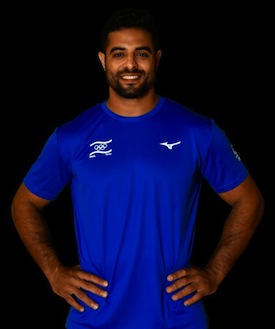
Judoka Sagi Muki (photo from Israel Olympic Committee)
In judo, Sagi Muki, 29, is the reigning world champ in his under-81-kilogram weight category and is coming into the Tokyo Games as a realistic medal contender. “But he has not performed as well as he would have liked to in the past half year,” said Halickman. “He’s taken medals at minor competitions but not up to par compared to before the pandemic.”
Israeli judoka Peter Paltchik, 27, “has been at the top of his game over the past half year and has maybe a better chance than Sagi,” said Halickman.
Aside from those three, Halickman mentioned a couple of athletes who could surprise everyone and win a medal. One is female judoka Timna Nelson–Levy, 27, who won the 2021 Tel Aviv Grand Slam in the under-57-kilogram category. Another is swimmer Anastasia Gorbenko, only 17, who won a gold medal at the 2021 European Championships.
“Anastasia will compete in a slew of different swimming events. It’s the first time in ages Israel has a swimmer taking part in so many different categories,” said Halickman.
Swimmer Anastasia Gorbenko (photo from Israel Olympic Committee)
Perhaps the most anticipated Israeli Olympic event, however, will be baseball. With only six teams in the competition, Team Israel has a 50-50 chance of winning a medal, Halickman pointed out.
“It will be a top-level competition because they’ll be playing against world heavyweights like the United States, Japan and Mexico,” he said.
“Whenever Israel goes to the Olympics, Jews around the world want Israel to succeed,” he added. “But baseball is unique because it’s so American and this team is primarily American immigrants. They understand it’s a huge responsibility to represent the Jews in the Diaspora.”
Bottom line? “Israel could walk away from the Olympics with a half dozen medals or none. Nothing is guaranteed in sports,” said Halickman.
Paralympic hopefuls
Just as in the 2016 Rio Games, Israel’s Paralympic team is anticipated to do well in shooting, rowing and swimming in Tokyo. In particular, said Halickman, shooter Doron Shaziri and rower Moran Samuel are expected to reach the winner’s podium.
Shaziri, 54, has won five Paralympic silver medals and three bronze medals over seven Paralympic Games. His teammate Yulia Tzarnoy, who won a bronze medal at the last World Championships, also has a reasonable shot (pun intended) at medaling in Tokyo.
Samuel, 39, who competes in singles rowing, won a bronze medal in Rio. She’s also a national wheelchair basketball champion.
In swimming, the ones to watch are world champions Mark Malyar, 21, and Ami Dadaon, 20.
In May, Dadaon set two world records in his disability class at the European Para Swimming Championships: the 100-metre freestyle and 200-metre freestyle. The following month, at the World Para Swimming World Series, he improved his time in the 200-metre freestyle by less than a second, setting another world record.
Mark Maylar competing in Portugal. (photo by Ron Bolotin / Israel Paralympic Committee)
Malyar set a world record at the 2021 World Para Swimming World Series Finale in the men’s 800-metre freestyle in his disability class, breaking his own record, set in 2019, by more than 13 seconds.
To help Israelis get pumped for the Paralympics, the Telma cereal company is featuring the photos and stories of three Paralympic athletes on a special edition “Cornflakes of Champions” package. They include swimmer Veronika Girenko, rower Achiya Klein and goalball player Roni Ohayon.
Israel21c is a nonprofit educational foundation with a mission to focus media and public attention on the 21st-century Israel that exists beyond the conflict. For more, or to donate, visit israel21c.org.
* * *
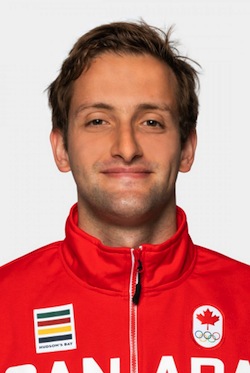
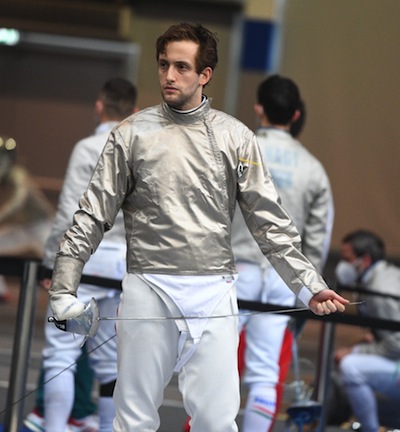
Tel Aviv-born fencer Shaul Gordon, a former Richmond resident who now lives in Montreal, is part of Canada’s Olympic team. According to his bio on olympic.ca/team-canada, “Gordon made his senior fencing debut for Canada in 2013. He has since represented Canada at two Pan American Games and six FIE World Championships.
“Gordon earned his first career senior individual medal at the Pan American Championships in 2018, when he captured silver. Later that year, he won gold at an FIE Satellite event in Belgium.
“Gordon followed up his terrific 2018 with an even more successful 2019, starting with helping Canada bring home a third straight silver in team sabre from the Pan Am Championships. At the FIE World Championships, he advanced to the quarterfinals for the first time ever. At the Lima 2019 Pan Am Games, he also helped Canada to a team sabre silver, while winning a bronze in the individual sabre.
“Gordon fenced collegiately at Penn State for his freshman year before transferring to the University of Pennsylvania. He finished second at the NCAA Championships in 2013, tied for third in 2014, was a three-time All-American and finished his college career with an overall record of 143-30.”
הסייף הישראלי שאול גורדון, ייצג את קנדה בתחרויות הסיף באולימפיאדת טוקיו שתתקיים בחודש הבא (יולי), ביחד עם 11 סייפים קנדים נוספים.
בניגוד לשאול, אחיו הצעירים מתי גורדון שמשחק רוגבי שביעיות ותמר גורדון שמתחרה אף היא בסיף, משתייכים דווקא לנבחרות ישראל. משפחת גורדון כולה גרה כאן בקנדה: האב אליהו גורדון עובד בממשלה הפדרלית בוונקובר, האם מוניקה גורדון מלמדת באוניברסיטת יו.בי.סי שבעיר, שאול לומד במונטריאול שקוויבק, מתי לומד בקינגסטון שבאונטריו ואילו תמר גרה עדיין עם ההורים בוונקובר.
שאול גורדון יליד תל אביב בן ה-26, גר בוונקובר מאז בגיל עשר. הוא סיים תואר ראשון
בשפה וספרות צרפתית באוניברסיטת פנסילבניה בפילדלפיה ב-2016. אחרי מכן עבר למונטריאול ללמוד בפקולטה למשפטים באוניברסיטת מקגיל. השנה סיים לימודי תואר מתקדם במשפטים והוא מתמחה בחוקי חלל ותעופה.
גורדון עזב את ישראל בגיל ארבע ועבר עם משפחתו לטורינו שבאיטליה. בגיל שבע החל להתאמן בסיף בסגנון חרב. כשהיה בן 10 עברה המשפחה לקנדה. הוא משתייך לנבחרת קנדה מאז 2011. נבחרת הקנדית הגיעה עימו למקום השני במשחקי פאן אמריקה טורונטו ב-2015. גורדון הגיע למקום השני באליפות האמריקות בהוואנה ב-2018. הוא זכה באליפות ישראל וכן במקום השלישי במשחקי פאן אמריקה בלימה ב-2019. ואילו נבחרת קנדה הגיעה עמו באותם משחקים למקום השני. גורדון זכה במקום השמיני באליפות העולם בבודפשט ב-2019 וזה בעצם ההישג הגדול ביותר בקריירה שלו. כיום הוא מדורג במקום ה-22 בדירוג העולמי.
– איך ההרגשה להגיע אולימפיאדה?
“אני מרגיש טוב מאוד וזו הפעם הראשונה שלי באולימפיאדה. אך המטרה שלי למשחקים השתנתה לאחר הדחייה בשנה. אשתקד רציתי רק להגיע למשחקים. עתה היה לי זמן לחשוב על ציפיות גבוהות יותר. מה אני רוצה לעשות בטוקיו? האם רק להשתתף למשך חמש דקות במשחק אחד? או להשיג אחת מהמדליות שזו בעצם המטרה שלי עכשיו”.
– מה היו ההכנות בעידן המגפה?
“האימונים בראשית השנה התקיימו רק בקנדה בגלל המגבלות. החל ממארס אחרי כשנה ללא תחרויות, התחלתי להשתתף סוף סוף בתחרות בינלאומיות. בקנדה יש מערכת טובה לאימונים אך חסרים מתחרים. אני עושה הרבה אימונים טכניים ופיזיים. מתאמן פיזית ארבעה פעמים בשבוע ועובד על הטכניקה שש פעמים בשבוע. האימונים שלי נערכים במכון הלאומי לספורט במונטריאול”.
– איך אתה מרגיש כאשר אתה מייצג את קנדה ולא את ישראל?
“אני מרגיש ישראלי אך גם קנדי באותו זמן. אני מרגיש מחויבות לייצג את קנדה
במשחקים. המאמנים שלי קנדיים, המאמנים האחראים להכנות הפיזיות קנדיים, חברי משלחת, האדמיניסטרציה, הפסיכולוגים הספורטיביים והמומחים לתזונה – כולם מכאן. אני רוצה להמשיך ולייצג אותם ולהפוך אותם גאים בהישגים שלי. מזה תשע שנים שאני בנבחרת קנדה: בשנתיים הראשונות ייצגתי את הנוער ומאז 2013 אני בבוגרים”.
– תמר אחותך לעומתך מייצגת את נבחרת ישראל בסיף
שאול גורדון
“זו הייתה החלטה חכמה ומתאימה לה. היא למדה בצרפת במשך שנה ב-2019 והיה לה קשה לייצג את קנדה משם. לעומת זאת בתור סייפת ישראלית היא יכלה להשתתף ביותר תחרויות באירופה. וכן לקבל תמיכה כספית שזה מאוד חשוב בסיף. תמר מתחרה בסגנון חרב כמוני והיא פשוט יותר מוכשרת ממני ואף נמצאת בדרגה גבוהה ממני. אנו מתאמנים יחד כאשר אני מגיע לוונקובר. תמר כיום בת 17 והיא נחשבת לספורטאית מאוד חזקה. היא מתחרה עם בנים כי אין בנות ברמתה”.
תמר גורדון, כשהייתה בת 15, כמו אחיה הגדול שאול, זכתה גם כן באותה אליפות ישראל (2019) בתחרות לבוגרות למרות גילה הצעיר. היא אמורה לסיים את לימודי התיכון בעוד כשנה וחצי ולאחר מכן תלמד כנראה באחת האוניברסיטאות בארה”ב. בין ההישגים הבולטים ביותר שלה: מקום ראשון באליפות צרפת לקדטים (על גיל 17) ב-2019 וכן מקום השלישי באליפות אירופה לקדטים בקרואטיה אשתקד.
תמר על התתשפותה בנבחרת ישראל: “עם נבחרת ישראל יש לי יותר אפשרויות להשתתף בתחרויות סיף אירופאיות. מאוד חשוב לי להתחרות ברמה הגבוהה ביותר כאשר חלק מהסייפות הטובות בעולם נמצאות באירופה. אני מרגישה גם גאה לייצג מדינה כמו ישראל בקנה מדינה בינלאומי”.
– יש לך אח נוסף שגם הוא ספורטאי
“מתי בן ה-23 משחק רוגבי שביעיות. הוא היה הקפטן של נבחרת אוניברסיטת טורונטו כאשר למד בחוג ללימודים אירופיים. כיום הוא בנבחרת אוניברסיטת קווינס קינגסטון, ששם הוא לומד שנה שנייה במשפטים. השנה אין להם עונה בגלל המגפה. והכי חשוב הוא שמתי נמנה על נבחרת ישראל ברוגבי שביעיות”.
מתי על השתתפות בנבירת ישראל: “זה נותן לי היכולת להשתתף ביותר משחקים בינלאומיים וברמה הגבוהה ביותר האפשרית. וכן להכיר כמה שיותר ישראלים ולמצוא חברים. כך אני יכול לנסוע בכל העולם ולייצג את הנבחרת של המדינה בה נולדתי”.
– חברתך יאנה בוטביניק משתייכת לנבחרת ישראל בסיף. איך בכלל הכרתם?
“הכרנו באליפות העולם שנערכה בוושי סין ב-2018. מאמן נבחרת הדקר של קנדה, ויקטור גנצביץ, אותו אני מכיר מצוין, הציג אותי בפניה. גנצביץ הוא הבעלים והמאמן הראשי של מועדון הסיף בוונקובר ‘דינמו פנסינג’, בו התאמנתי במשך 15 שנים. יאנה רצתה ללמוד בארה”ב וביקשה לקבל אינפורמציה ממני. מאז אנו ביחד.
– אתם מתחרים בסגנונות שונים
“כן. אני מתחרה בחרב והיא מתחרה בדקר. החוקים שונים והשימוש בנשק שונה. בחרב מותר לפגוע רק מאזור החגורה למעלה כשאפשר להשתמש בכל חלקי הלהב לדקור ולהצליף. ואילו בדקר אפשר לפגוע בכל הגוף אך רק באמצעות דקירה אחת. אני בחרתי בחרב כי זה סגנון מהיר ואגרסיבי יותר. דקר לעומת זאת יותר מחושב, המתחרים יותר זהירים. משחק יכול להגיע עד ל-20-25 דקות בזמן שבחרב משחק נמשך בממוצע כחמש דקות. בסגנון השלישי,רומח, אפשר לפגוע בחזה, בבטן ובכל החלק האחורי של הגוף, כאשר כמו בדקר צריך לדקור את המתחרה. המשחק יותר ארוך מחרב ויותר קצר מדקר”.
בוטביניק (22) לומדת בימים בחוג למתמטיקה ומחשבים באוניברסיטת קולומביה בניו יורק. היא עלתה מרוסיה לישראל ב-2010 ובגיל 17 זכתה לראשונה בתואר אלופת ישראל לנוער. מאז 2019 היא נחשבת לבוגרת וסיימה במקום העשירי באליפות אירופה. כיום מדורגת בוטביניק במקום ה-68 בדירוג העולמי.
– איך זה יהיה להתחרות בטוקיו ללא קהל לאור המגפה?
“אכן הפעם לא יהיה קהל כך שתהיה זו אולימפיאדה שונה בתכלית. קהל חשוב מאוד בתחרות בסדר גודל כזה כמו אולימפיאדה. יחסר לי במיוחד שחברי משפחתי לא יכלו להגיע אך זה לא בשליטתי.
– מה קורה עם הלימודים שלך במונטריאול?
“השגתי כבר תואר במשפטים ואני יכול כבר לעבוד בתחום אך אסור לי לייצג לקוחות, לפני שאני אעבור את בחינת לשכת עורכי הדין. אחרי האולימפיאדה אנסה להשיג עבודה בניו יורק כך שאוכל להיות עם יאנה. זה גם טוב לסיף. ניו יורק כמובן יותר מעניינת מוונקובר והיא גם מצוינת לעבודה. התחלתי לבדוק הצעות עבודה עם מספר גדול של משרדי עורכי דין בניו יורק. המטרה שלי לעבור בסתיו לניו יורק וגם יאנה אמורה לחזור לשם באותה עת”.
The latest explosion of terrorism from Gaza, the reaction from Israel, the violence in and around Jerusalem and the international response to these events continues to reverberate. Things have calmed somewhat in Israel, although violence continues, but a second, related front continues to rage in the public dialogue.
Anti-Israel rallies worldwide have seen explicit antisemitic imagery and threats openly and prominently exhibited. Such expressions are now commonplace at protests, in online spaces and in public squares. Anyone who insists there is some sort of hermetically sealed wall between anti-Zionism and antisemitism needs to explain why bands of thugs in London drove through Jewish neighbourhoods screaming “F**k the Jews, rape their daughters.” Social media has logged millions of overtly Jew-hating statements and images, including thousands of instances of the phrase #Hitlerwasright.
These examples are obviously extreme. Far more common, even from ostensibly mainstream voices, including elected officials in Canada, the United States and Europe, is language employing the apartheid libel or that Israel is a “settler-colonial” regime.
The settler-colonial motif is particularly effective in the Americas because we, unlike Israel, are actual settler-colonial societies. The assertion that Jews are, basically, an invasive species in the Land of Israel meets fertile soil just as global attention again focuses on the situation of Palestinians.
While the antisemitic language and violence is deeply worrisome, it raises a secondary issue about the motivations of anti-Israel voices. Villainizing, isolating and denouncing Israel seems to fulfil some primal urge in a great number of people. What it does not do is hasten Palestinian self-determination.
Any resolution to the conflict and, therefore, Palestinian statelessness, will come from the rejection of this approach. Put plainly: one cannot be pro-Palestinian and anti-Israel at the same time. If you seek the destruction of Israel, you reject compromise, coexistence and peace – the only things that will ever bring about an independent Palestine.
The binary that defines the Israeli-Palestinian situation is a false one. Being pro-Israel demands being pro-Palestinian – seeking a compromise in which both peoples live in peaceful coexistence. Being pro-Palestinian requires being pro-Israeli because only when the Palestinians, the region and the world accept Israel’s right to exist will we have a scenario where coexistence and a Palestinian state will emerge.
People overseas, many with no personal stakes in the conflict, prolong the problem. Among self-defined “pro-Palestinians” are many who seem content to fight for Palestine to the last Palestinian. Evidence of this macabre attitude can be seen every time overseas “allies” revel in the supposed moral victory of Palestinian victims exceeding Jewish victims when conflict erupts.
Similarly, too common among our own folks are rantings on social media along the lines that “there is no such thing as a Palestinian people.” Call them what you will (decent people refer to others by the terms they prefer), there are people who call themselves Palestinians and semantic arguments will not change that. We win no awards or disagreements by proving that the people who call themselves Palestinian are something other than what they say – just as those who subscribe to the kooky Khazar conspiracy of Jewish origin to refute Jewish indigeneity to the Holy Land deflect from the issue at hand. In both cases, it does not negate the core issue: both peoples – and many more whose identity gets short shrift in the binary – exist and live there now. That will not change.
Israel is not going anywhere and Israelis are not going, as the late American political reporter Helen Thomas suggested, “back to Poland.” Neither are Palestinians. The first step – it seems ludicrous that it needs to be said – is acknowledging that both peoples (and others!) are there now and deserve to be.
There are countless complexities in the Israeli-Palestinian mess. But there is one certainty that is not the least bit complicated: Palestinian self-determination will come and Israel’s right to exist will be secured because of coexistence and compromise. Neither side’s extremists will ever win.
Prior to the Six Day War, which took place 54 years ago this month, the pages of this paper were filled with foreboding and ominous news of enemy militaries amassing adjacent to Israel’s borders. The very next issue was triumphal and jubilant – the war already had ended.
Such is one of the challenges of publishing a weekly newspaper. When a war only lasts six days, it presents difficulties for a journal that comes out every seven. Since the beginning of the pandemic, we have been on a twice-monthly publishing schedule, adding to the challenges of bringing you news in a time of fast change.
Of course, as regular readers know, we recognize our limitations and strengths and, as the internet has made information accessible 24/7, we have adapted to provide thoughtful, contextualizing essays and ideas, complemented by coverage of local events that only we can deliver.
Still, commenting on events that are subject to rapid flux remains a reality. This week, as we go to press, many or most observers assume that Naftali Bennett will soon replace Binyamin Netanyahu as Israel’s prime minister. Netanyahu continues to insist that such a new government represents something undemocratic. Indeed, his choice of language has been incendiary, and the imagery employed by some of his supporters veers into the realm of the demonization that we saw in the lead-up to the assassination of Yitzhak Rabin. Whatever his political objectives, Netanyahu should beware not to lead Israel down a path of “scorched earth,” as Bennett warned this week.
Bibi seems to be taking a page from the playbook of his ally Donald Trump, who emerged again recently to rehash his lies about stolen elections and assorted nonsense, including his imminent reinstallation in the White House. While scarily huge swaths of Americans (Republicans mostly, of course) believe that Joe Biden is not the legitimate president, we have more trust in the intelligence of Israeli voters to know that whoever is prime minister by the time the dust settles is there by due process.
If, as seems likely, Netanyahu is replaced, do not expect to hear the last of him. Again, like his friend in Florida, Bibi is clearly not done yet. He has been defeated before and returned to hold the position, becoming the country’s longest-serving leader.
Perhaps the biggest variable will be whether his Likud party stands behind him, as Trump’s Republican base has apparently stood by their man. Already, Yuli Edelstein, Netanyahu’s health minister, has said he would challenge Bibi for the party leadership should they lose power.
If successful, Edelstein, or any alternative Likud leader, would almost certainly cause an immediate tectonic shift in politics. That’s because the binary in that country’s politics is now cemented as “pro-Bibi” and “anti-Bibi.” With anyone but Netanyahu at the helm, some of the right-leaning partners in the new, broad coalition would likely look afresh at a deal with the party that has, by a large margin, the most seats in the Knesset.
Netanyahu may yet pull another rabbit out of his hat before Bennett can take his place. More likely, we are about to see a political shift that will see Netanyahu out but not down. That is, he seems to have enough capital to remain a major player in Likud and Israeli politics in general. The corruption case currently proceeding against him may affect that, but it has done little so far to dislodge his defenders.
If, as smart money has it, Netanyahu is unseated in the next few days, we will truly see a new era in Israeli politics. But we would caution that such a new era will begin with a time of flux. The new coalition is unwieldy and may not hold. Netanyahu has been the centre of gravity for Israeli politics for a very long time. In his absence, everything changes.
Our next issue is June 25. We promise this: plenty will have changed by then.