Skip to content
  • Home
  • Subscribe / donate
  • Events calendar
  • News
    • Local
    • National
    • Israel
    • World
    • עניין בחדשות
      A roundup of news in Canada and further afield, in Hebrew.
  • Opinion
    • From the JI
    • Op-Ed
  • Arts & Culture
    • Performing Arts
    • Music
    • Books
    • Visual Arts
    • TV & Film
  • Life
    • Celebrating the Holidays
    • Travel
    • The Daily Snooze
      Cartoons by Jacob Samuel
    • Mystery Photo
      Help the JI and JMABC fill in the gaps in our archives.
  • Community Links
    • Organizations, Etc.
    • Other News Sources & Blogs
    • Business Directory
  • FAQ
  • JI Chai Celebration
  • JI@88! video

Recent Posts

  • Sharing her testimony
  • Fall fight takes leap forward
  • The balancing of rights
  • Multiple Tony n’ Tina roles
  • Stories of trauma, resilience
  • Celebrate our culture
  • A responsibility to help
  • What wellness means at JCC
  • Together in mourning
  • Downhill after Trump?
  • Birth control even easier now
  • Eco-Sisters mentorship
  • Unexpected discoveries
  • Study’s results hopeful
  • Bad behaviour affects us all
  • Thankful for the police
  • UBC needs a wake-up call
  • Recalling a shining star
  • Sleep well …
  • BGU fosters startup culture
  • Photography and glass
  • Is it the end of an era?
  • Taking life a step at a time
  • Nakba exhibit biased
  • Film festival starts next week
  • Musical with heart and soul
  • Rabbi marks 13 years
  • Keeper of VTT’s history
  • Gala fêtes Infeld’s 20th
  • Building JWest together
  • Challah Mom comes to Vancouver
  • What to do about media bias
  • Education offers hope
  • Remembrance – a moral act
  • What makes us human
  • המלחמות של נתניהו וטראמפ

Archives

Follow @JewishIndie
image - The CJN - Visit Us Banner - 300x600 - 101625

Tag: environment

Hands-on learning at farm

Hands-on learning at farm

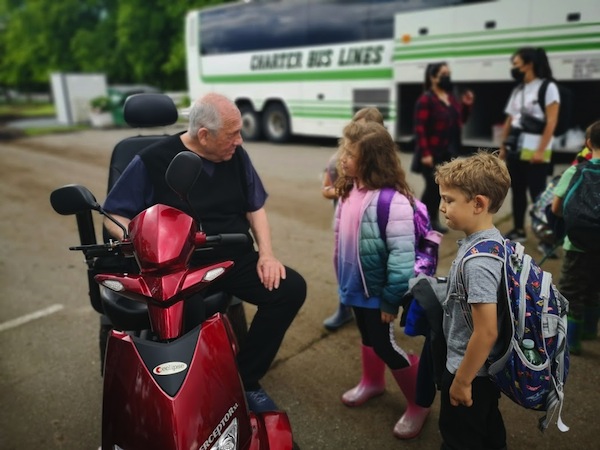
Syd Belzberg talks with Vancouver Talmud Torah kids at Stable Harvest Farm. (photo by Shira Sachs)

“The children loved to take their harvest home to share with their families. Many children helped to prepare the family meals, including washing, chopping and plating their meals. There was so much to learn – how healthy food can taste so yummy, how I can help my family make dinner, how the food can make my body feel good.”

“This is from some cute kid, and I see his picture in front of me,” Syd Belzberg told the Jewish Independent in a recent phone interview. “That’s heart-warming. That’s where it’s all at. That’s beautiful.”

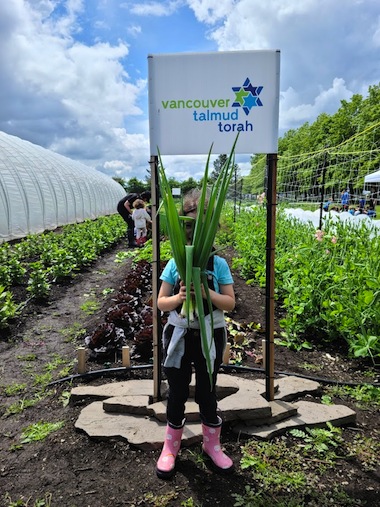
photo - Vancouver Talmud Torah Grade 1 students have a plot on Syd Belzberg’s farm, where they grew scallions and other vegetables
Vancouver Talmud Torah Grade 1 students have a plot on Syd Belzberg’s farm, where they grew scallions and other vegetables. (photo by Jessie Claudio)

The note came after Vancouver Talmud Torah Grade 1 students visited Belzberg’s Stable Harvest Farm in Langley last month.

Belzberg got the idea for the farm about a half dozen years ago. He read a newspaper article about Vancouver Sun reporters who had started a breakfast program for schoolchildren in the 1980s. “I got in touch with them and got involved a bit, supporting some of the schools with money,” said Belzberg.

But he wanted to have more of an impact and, after he retired a couple of years ago, he decided to reinvent his Langley acreage, which had been home to his many horses several decades ago, but had laid empty for some 17 years. He based his concept on that of Coastal Roots Farm, “a nonprofit Jewish community farm and education centre” located near the home he has in California. “They do a lot of wonderful things,” said Belzberg, “and I thought this would be a heck of a thing to try and copy in a way.”

He hired Kristjan Johannson to manage the farm and the first crop was planted in January 2020. Despite flooding on the property, they gave away about 90,000 pounds of organic vegetables to a half-dozen food banks, as well as to community meals programs.

“This year, we decided to try and double it,” said Belzberg. And they more than doubled it, giving away an estimated 250,000 pounds of food, while continuing to work on the property.

Belzberg established the Stable Harvest Farm Society, he said, “to make this a legacy for my family.” Of his five kids, only one lives in Vancouver, and that daughter, Tammi Kerzner, “has been a massive help to me to build this,” he said.

“There are many facets to what I want to do,” said Belzberg, “but I wanted to get the food thing right because I didn’t know what we’d have to go through to be successful.”

Belzberg’s approach with this project has been similar to that which he has taken with his other endeavours.

“When I started in the car business [Budget Rent a Car] in ’62, I had trucks and other things in mind, but I wanted to rent cars and learn about that first,” he said. “It’s the same thing here. I wanted to prove we can get the vegetables right before I started to do anything else.”

Educational programming is a main component of the farm. “David Bogoch had a lot to do with teaming up with TT. He is such a supporter of it,” said Belzberg about collaborating with the school. “And my children went there. I have a great-granddaughter now who goes there. So it was a natural [fit]. The part that really put us over the top was Emily [Greenberg], because she’s fantastic. She’s so on top of it, and she’s got Jessica [Claudio] there, who goes to another level.”

“Mr. Belzberg has been a very generous supporter of VTT,” said Greenberg, who met Belzberg for the first time when he first saw the school’s rooftop soccer pitch that he funded. That was in her second week as head of school, she said.

“And we’ve had close relationships with David Bogoch, who is quite close to Mr. Belzberg, and he kept talking to me about this farm that Mr. Belzberg was creating … that Mr. Belzberg had a dream to make this farm a centre for Jewish education and Jewish values and the Jewish community and that he would love to see children using this farm, in addition to how it supports the needy in Vancouver.”

Belzberg eventually invited Greenberg for a visit and they spoke about his vision and she “went away and thought about how we could make that happen from our end and, ultimately, bring kids out there.”

The first thing that happened, said Greenberg, was that Johannson came to the school and helped the kids plant seedlings. “Then we had, basically, a little nursery there at the school and watched them grow and supported them.” The plan was for the kids to plant the adolescent seedlings in April at the farm but COVID restrictions had increased, “so we weren’t able to bring the kids to Langley because it was cross-boundary.” But the planting was filmed and a multi-series educational video was made.

“Thankfully, the regulations changed again and we were able to go in the third week of June and send all of our Grade 1 kids out there,” said Greenberg. “They were able to help reap the harvest and they each brought home a bag of veggies from Mr. Belzberg’s farm and made the most amazing salads and soups and all sorts of things and we’ve got some great pictures of what they made that night. We had parents who were ecstatic, watching their kids eat raw vegetables – including scallions.”

The kids had grown the scallions, as well as lettuce and radishes, and their bags were supplemented with some other vegetables from the farm, such as tomatoes and carrots.

On their visit, the kids also got to see the part of the property that will become a bird sanctuary – “there’s a hundred and some odd different types of birds and owls that feed there and it became a natural habitat,” said Belzberg.

Another aspect of Stable Harvest is bees. Belzberg works with beekeeper Carolyn Essaunce, who owns the Honest to Goodness Farm Co. Essaunce also made a trip to VTT and spoke to each senior kindergarten class.

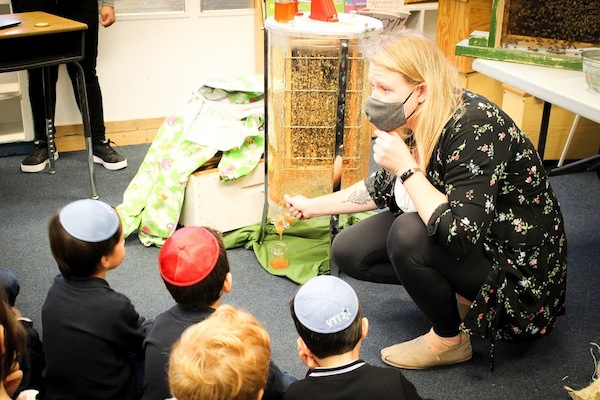
photo - Beekeeper Carolyn Essaunce speaks to VTT senior kindergarteners about bees and honey
Beekeeper Carolyn Essaunce speaks to VTT senior kindergarteners about bees and honey. (photo from VTT)

“She brought a whole honeycomb with live bees,” said Greenberg. “She helped them understand how, when you take a honeycomb and you put it in a machine and spin it, how you get the honey out…. They understood what it was to produce honey and then they all went home with some of Mr. Belzberg’s honey…. That is definitely something we hope to repeat yearly.”

Experiential learning is the future of education, said Greenberg. “For us, we want to prioritize learning through nature and to exposure to nature, but also, of course, finding ways to make sure that Jewish values are part of that…. So this has been a tremendous opportunity for us. It’s only the beginning – we look forward to bringing many more of our grades out to Stable Harvest Farm next year. There’s obviously a science aspect but we also want our kids to be shomrei adamai, guardians of the earth, and understand the power of nature. There’s an empowerment that happens when they’re part of growing a plant and the excitement that happens. And the understanding of the life cycle and how that eventually nourishes us and nourishes those in need – it’s a tremendous marriage of all of the values we have as educators, but also as a Jewish day school.”

VTT has invested a lot of time in iSTEAM over the last two years, she said, “integrating the innovations that have been coming out of Israel and using that as the platform from which to explore science, technology, engineering, art and math. A great example that you have at Mr. Belzberg’s farm is drip irrigation, which is an Israeli innovation…. We love the fact that our kids can be proud of a technology that’s come out of Israel and understand how innovation can revolutionize an entire industry and, ultimately, help people live a better, healthier life.”

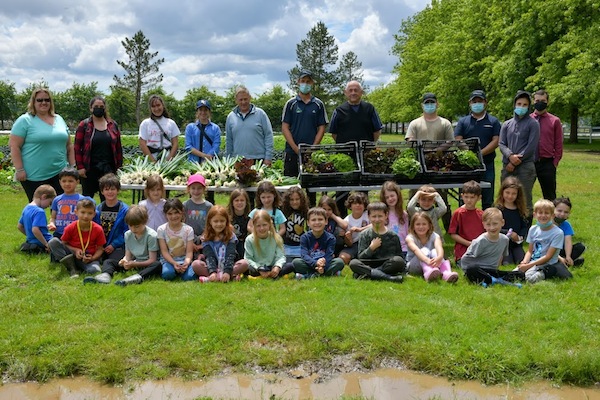
photo - All the workers show off the produce reaped during the VTT schoolchildren’s visit to Stable Harvest Farm
All the workers show off the produce reaped during the VTT schoolchildren’s visit to Stable Harvest Farm. (photo by Galit Lewinski)

Greenberg’s goal is to get all of the VTT students out to the farm at least once over a two-year span. “We have a lot of ideas,” she said, “and Mr. Belzberg, thankfully, is very flexible. He just says, ‘Tell me what works for you and we’ll make it happen.’ He always says that: ‘We’ll make it happen.’”

And there is lots that Belzberg plans to make happen. Next year, for example, he hopes to build a large kitchen on the farm for cooking classes, education and other activities. Already, the farm has had its first stand, on June 19, and joined its first farmer’s market, in White Rock, on June 20.

“It’s a helluva way to give back and it fills a vast need and I can afford to do it,” said Belzberg when asked why the farm is important to him. “It’ll hopefully continue forever,” he said.

“When I sat there with the TT kids, and they’re coming up to me and shaking my hand, and when I see the letters that are coming back, the salads, the fact that these kids are into food, I give TT all the credit in the world,” said Belzberg. “It was one of the 10 happiest moments of my life when I sat there a week or so back and watched the kids being in the ground, getting their hands dirty. What could be better than that? And the smiles on their faces.”

Format ImagePosted on July 9, 2021July 7, 2021Author Cynthia RamsayCategories LocalTags education, Emily Greenberg, environment, farming, nature, philanthropy, Syd Belzberg, Vancouver Talmud Torah, VTT

CABGU online series

As the winter blues threaten to sink in, and COVID continues to be a part of life, Canadian Associates of Ben-Gurion University of the Negev (CABGU) has been looking for ways to keep people engaged through a series of virtual events. Each event seeks to offer insights, share research and encourage discussion about varied topics.

For the art lover, A Virtual Art Tour, scheduled for Feb. 7, 8:30 a.m., offers participants a guided stroll through one of the few public art collections in Israel’s Negev Desert. “Ben-Gurion University is home to one of southern Israel’s most dynamic and innovative fine arts collections,” said Maayan Amir, the collection’s curator and senior lecturer in the department of art. “Many of the pieces featured in the collection can be found scattered throughout the Be’er Sheva campus, enlivening the landscape while complementing it as well.”

On the medical front, questions have been raised during the pandemic about ethical decision-making. How do medical personnel make life and death decisions? What type of protocol is followed and how should the vaccine be distributed? Three top doctors from Israel and Canada will participate in a moderated discussion on Feb. 10, 4:30 p.m., sponsored by the Dr. Edward Feldman Memorial Fund. The event is a collaborative initiative between CABGU and the Israel Medical Association. Among the speakers are Dr. Yoram Singer, director of the Negev Home Palliative Care Unit at Ben-Gurion University; Dr. Sandy Buchman, medical director of the Freeman Centre for Advancement of Palliative Care at North York General Hospital; and Dr. Elliott Malamet, lecturer on Jewish ethics and philosophy at Hebrew University.

CABGU also offers monthly lunchtime webinars on STEM-related topics called Webinar Wednesdays. Coming up on Feb. 3, 9 a.m., BGU professor and president Daniel Chamovitz will be joined by Sigal Abramovich from the university’s department of earth and environmental sciences for a discussion about the impact that climate change is having on the environment. Research from BGU that looks at the role cannabis can play in supporting people with autism will be the focal point of a webinar on March 3, 9 a.m.

Register for any of these webinars at bengurion.ca.

Posted on January 29, 2021January 27, 2021Author CABGUCategories IsraelTags art, Ben-Gurion University, BGU, climate crisis, education, environment, health, medicine
Let’s create more land

Let’s create more land

In his December presentation, Michael Geller showed this photo of a building in Paris, where modular housing was added atop an existing apartment building to provide more units.

An old adage says that investing in real estate is always a good idea. “Buy land, they’re not making it anymore,” said Mark Twain. But local housing guru Michael Geller rejects this notion.

“I think sometimes you have to create land,” Geller said. Looking at Vancouver from above, he said, you see a lot of green and a lot of blue. But you also see a lot of grey. Making better use of parking lots, rooftops, the top levels of parkades and underused space around existing buildings are among the ways Geller imagines we can create more space for housing.

Geller spoke at Tikva Housing Society’s annual general meeting, held virtually on the first night of Chanukah. Tikva is a nonprofit society that provides access to affordable housing, primarily for Jewish low- to moderate-income adults and families. Its vision is “a safe, stable and affordable home for every Jewish person who needs one in Greater Vancouver.”

creenshot from Michael Geller’s presentation at the Tikva Housing Society annual general meeting Dec. 11. It was one of eight ideas he suggested to create more space for housing
A screenshot from Michael Geller’s presentation at the Tikva Housing Society annual general meeting Dec. 11. It was one of eight ideas he suggested to create more space for housing.

In honour of the eight nights of Chanukah, Geller offered up eight ideas, including building houses like we build cars – in factories. Also, taking the concept of laneway housing to new heights by allowing the construction of housing on parking lots. And designing apartments that can be divided into two studio suites or opened up to create family accommodation. Plus, matching people who live alone, or in a couple, and have extra bedrooms in their house to connect with people who need housing.

He showed one instance of a high-rise complex in West Vancouver where two new low-rise buildings were constructed amid the landscaped gardens around the older buildings.

Geller was an early adopter of the concept of modular housing, having written a thesis on the subject in university. Modular housing consists of units manufactured and moved as completed (or mostly completed) structures to their temporary or permanent sites. He showed a photo of a building in Paris, where modular housing was added atop an existing apartment building to provide more units. The top levels of many urban parkades might make ideal locations for modular housing, he said, since few people park there unless the entire structure is full.

In European countries – Geller is doing work in Russia at present – families use space for more than one purpose, allowing better utilization of limited footage. Student accommodations, he suggested, could be developed by transforming a living area into a second bedroom through a pocket door or similar. Larger apartments could be made more flexible with extra external doors and tiny kitchenettes that allow one apartment to become two smaller ones – or those two smaller ones to be easily retrofitted for a growing family. He called these types of lock-off suites, “a mortgage helper in the sky.”

Identifying new municipal, provincial and federal lands for affordable housing is another option.

“I really like golfing at Langara,” Geller said. “But, I must say, if you were to take a 40-foot strip off that golf course all the way along Cambie Street, you could create a lot of land, which could be used for affordable housing and some market housing to support the non-market housing.”

He admitted that some of his golfing friends might think this is a terrible idea.

Many of Vancouver’s older residents are “over-housed,” according to Geller, meaning that one or two people might live in a three- or four-bedroom home. Not everyone would be comfortable sharing their home with erstwhile strangers, he admitted, but some would.

“They might want to share with another senior, they might want to share with a younger person who is willing to help around the house, to pick up prescriptions, to pick up food, to drive them to see friends,” he said.

Another idea Geller mooted was “the Tikva Suite.”

“Maybe we should start a program where we basically approach every member of the Jewish community who owns an apartment building and say, rent us a suite, give us a suite, and the clever accountants in the community can work out some way so there can be a tax receipt for this and that way you can have a suite in every one of those buildings,” he said. “It’s a dream, but many of the dreams I’ve had over the last 50 years actually do materialize. They take awhile, but this is not such a crazy idea.”

Geller is a planner, real estate developer and retired architect with five decades of experience in the public, private and institutional sectors. He is adjunct professor at the Simon Fraser University Centre for Sustainable Development.

Beginning with a seven-unit building in South Vancouver in 2007, Tikva Housing Society has grown to support the housing needs of 288 individuals. The society provides housing directly through three complexes – with another under construction – as well as through rent subsidies. The AGM heard that the society has net assets of about $2.6 million.

At the meeting, outgoing chair Shelley Karrel announced the launch of a new Jewish Housing Registry, an online platform for people who are looking for housing. It is a partnership between Tikva, Jewish Family Services, Jewish Federation of Greater Vancouver and the other Jewish housing societies: Vancouver Jewish Building Society, Yaffa Housing Society, Haro Park Centre and Maple Crest Apartments (which is under the auspices of Royal Canadian Legion Shalom Branch 178). The registry will provide a single source for housing applications and will also provide partners with a more accurate way of determining the scope of the community’s housing needs. (See jewishindependent.ca/jewish-housing-registry-live.)

The 2011 Census reported 26,250 people in Metro Vancouver’s Jewish community, of which more than 16% reported incomes below the low-income cutoff, giving Vancouver the second highest rate of Jewish poor in Canada. Average rent for a two-bedroom apartment in Metro Vancouver is more than $2,000 a month and the vacancy rate is about one percent.

Format ImagePosted on January 15, 2021January 18, 2021Author Pat JohnsonCategories LocalTags affordable housing, environment, Michael Geller, Tikva Housing Society, Vancouver
Getting rid of landfill garbage

Getting rid of landfill garbage

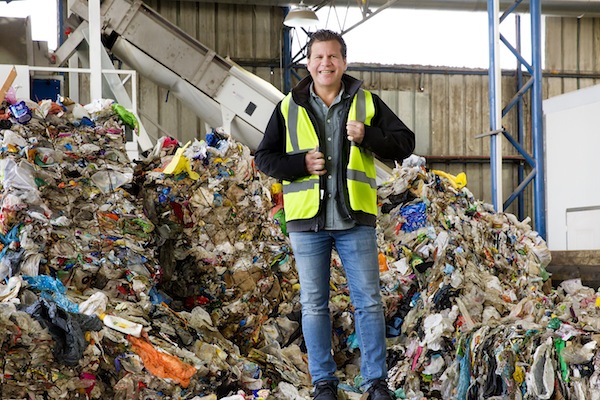
UBQ chief executive officer Tato Bigio in the factory at Kibbutz Tse’elim, in the Negev. (photo from UBQ)

Garbage is piling up everywhere – in landfills and elsewhere on the ground, in oceans and other bodies of water, and even in outer space. And there is growing awareness that our attempts at reducing garbage through recycling has not worked as first imagined – only a small percentage of what we put in our recycling bins ends up being recycled. However, a new Israeli company offers some hope for improvement.

Based in Kibbutz Tse’elim in the Negev, UBQ is producing plastic pellets out of household garbage. The name UBQ is not an acronym, but an abbreviation of the word ubiquitous, conveying that the problem of garbage is everywhere and ever-present. The company launched in 2018, after six years of research. Its chief executive officer, Jack “Tato” Bigio, recently spoke with the Jewish Independent via Zoom from his office in Tel Aviv.

Originally from Peru, Bigio came to Israel in 1984, when he was 18, to attend the Hebrew University of Jerusalem. In the following years, he went from corporation to corporation, developing his business and management skills, until, in 2012, he joined UBQ.

A concept was proposed: to take household waste, such as paper, cardboard, plastics, diapers, food scraps, etc., and turn it into a thermoplastic composite material. This, Bigio explained, “means turning all this waste into a new plastic that can replace conventional plastic materials made out of oil, to make end products.”

Thermoplasticity is a characteristic of a material that is affected by heat – that is liquid when hot and solid when cool, such as sugar or wax.

“UBQ is a plastic that has mechanical properties … very similar to common plastics made out of oil,” said Bigio.

The UBQ process is able to take any garbage stream and, instead of it going to landfill, converting it – upcycling it – into UBQ plastic, regardless of the exact mix of garbage collected.

“The waste balance will be different in different places, depending on the way they handle the source [garbage],” said Bigio. “If the proportions are a little different, the reaction process of UBQ knows how to handle these differences.

“One of the incredible things we’ve developed is kind of a reactor. Once we know what is in the source of our waste, we can manage a process where different percentages are balanced out in the end material.”

While the exact process, which produces no waste itself, remains a protected secret, Bigio said, “There is enough water in the waste, so we don’t need water. And we will convert the waste, 100% of it, into UBQ material. We don’t use any additives or any chemicals, no accelerates or enzymes. It’s just a very incredible system that involves physical and chemical reactions with temperature … sheer forces, conditions like oxygen, certain gases…. It’s a very green and low-temperature conversion, which makes it really hard to believe.”

All of UBQ’s factory and office trash is recycled in the making of the plastic.

The location of the initial UBQ factory was selected for a number of reasons.

“We chose that kibbutz, which is in the south of Israel, because we wanted to develop this amazing technology in a perfect place to be able to enjoy the practices of being revolutionary – not only in the material and science, but also in the engagement of different communities,” said Bigio. “Today, we have Bedouins, Russians and Israelis working together at UBQ.”

UBQ plans to open more plants around the world, beginning in Europe. And, soon, consumers around the world will have more opportunities to choose between products made from conventional plastic and those made from UBQ plastic.

“Waste is an unlimited source of material,” said Bigio. “So, if you buy a product made with UBQ, you will not only be enjoying the product you buy – if it’s a box, or chair, or table – but, by buying it, you will be making good with the environment. You’ll be saving waste, you’ll be saving carbon emissions, and it doesn’t cost a penny more than regular plastics…. We’ve come out with a technology that makes our material competitive to regular plastics.

“One of the reasons for it is that we use waste, and waste is a negative cost – they pay us to take waste. The other benefit of UBQ is that it works in temperatures that are very low compared to regular plastics. We work at 200°C; regular plastic made out of oil is between 800 to 1200°C. Also, we don’t use any water, because there is enough water in the waste.”

Though it might take a few years before Canadians have the option of buying things made with UBQ plastic created from our own garbage, products made out of UBQ plastic produced in the Israeli plant are already finding their way into local stores. UBQ products can be recycled just like other plastics.

UBQ opened a second and much bigger plant in the Netherlands, and the list of countries interested in having plants includes Japan, Australia, Singapore, Thailand, Argentina and Chile.

“It will take some time until we reach all these markets, but we expect to be, in the next 10 years, phenomenally dominating the plastic market,” said Bigio.

Right now, landfill waste is something Bigio said “pollutes oceans, rivers, natural environments, and is killing animal life … at the end of the day, it creates a lot of harm to human beings. If you really care about the future or [coming] generations, you better start working on helping make a difference.”

Bigio encouraged others to think innovatively to find new ways of reusing existing materials. “It’s just a matter of wanting to do it,” he said. “Governments, multinational companies … individuals can choose to do the right thing.”

For more information, visit ubqmaterials.com.

Rebeca Kuropatwa is a Winnipeg freelance writer.

Format ImagePosted on January 15, 2021January 13, 2021Author Rebeca KuropatwaCategories IsraelTags environment, plastics, recycling, science, Tato Bigio, technology, UBQ
Saving Israel’s environment

Saving Israel’s environment

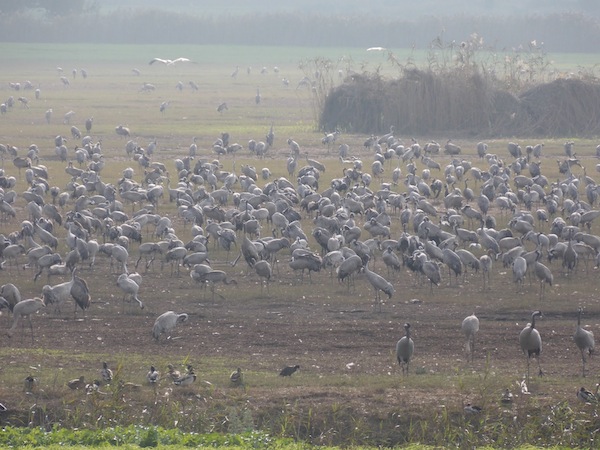
Israel’s Hula Valley is a major stopping place for migrating birds. (photo by D.J. Tiomkin)

Jay Shofet, the director of partnerships and development for the Society for the Protection of Nature in Israel (SPNI), presented an overview of the broad range of work his organization does in addressing environmental issues in the Holy Land during a Nov. 19 webinar hosted by the Jewish Community Centre of Victoria with the Canadian SPNI.

With 35,000 member households in Israel and thousands more around the world, SPNI is the largest Israeli group of its kind. It engages in environmental lobbying of the Knesset and hopes to foster a love of nature through its endeavours. SPNI has delivered environmental education in the Israeli school system and is known for promoting the country’s hiking trails.

Shofet began with the history of the environmental movement in Israel and the “traditional Jewish call for wise environmental stewardship of the land.” It was from this concept that SPNI was founded, in 1953, by a group of scientists, teachers and kibbutzniks who were trying to prevent the draining of swamps in the Hula Valley in northern Israel.

Among the highlights of SPNI’s history is an initiative it spearheaded in the 2000s: a cross-border and environmentally friendly cooperation with Jordan and Palestine to use barn owls rather than pesticides to reduce the rodent populations in agricultural lands.

Israel houses what the United Nations refers to as a “global biodiversity hotspot,” Shofet said. “It’s important to note that Israel is a land bridge between three continents and four climatic zones.”

The numbers of bird and animal species in Israel exceed that of the United Kingdom; the country is also home to a wide variety of flora. Species from Europe, North Africa and Asia commingle with those native to Israel and the eastern Mediterranean. And, each year, Israel is a major migration route for hundreds of millions of birds, including pelicans, which makes the country a destination for birders.

Elsewhere, SPNI has been active in stopping what it believes to be the wrong type of afforestation, the introduction of trees in areas to which they are not ideally suited and that infringe on the natural habitat, such as the batha, a unique Mediterranean scrubland, or what Shofet called “the Serengeti of Israel.”

SPNI is in charge of blazing and maintaining the Israel National Trail and other parts of the more than 10,000 kilometres of trail systems in the country. “It’s a rite of passage for young Israelis to hike the Trail,” Shofet said about the INT.

Recently, the organization has focused on maintaining what Shofet described as a “sustainability mindset.”

“Renewable energy, moving away from fossil fuels, is what the environmental movement is about today,” he said. “Climate change is the organizing principle of the movement…. Our bottom line is to find nature-based solutions to mitigate climate change.”

At the top of current environmental issues for Israel is land-use planning, said Shofet. One of the densest populations of the OECD countries, Israel confronts obstacles in the use of its land. In 2015, SPNI lobbied to stop a group of business and political powerhouses, including former United States vice-president Dick Cheney and media tycoon Rupert Murdoch, from fracking in the centre of Israel.

Shofet emphasized that densely packed, sustainable cities like Tel Aviv are at the heart of protecting Israel’s biodiversity. “This is the only way to keep the open spaces open and to keep nature well-protected,” he said.

“Not all of Israel has to look like Tel Aviv, but Israel does have to build its cities in a smarter way and avoid suburban sprawl,” he told the audience. “Suburban sprawl is killing our open spaces and making life less interesting for people. Cities can be the solution to the environment. If the world had the global footprint of New York City, there would be no global warming.”

A niche for SPNI is urban nature. Such spaces are needed in green cities, said Shofet. To demonstrate this, he showed slides of the Jerusalem Bird Observatory near the Knesset, a place where schoolchildren and tourists alike visit and learn about ornithology up close, and Gazelle Valley Park, also in Jerusalem, Israel’s first urban nature reserve.

The final part of Shofet’s talk touched on the work SPNI is doing during the pandemic to try and ban Israel’s currently legal hunting season. As a start, SPNI has succeeded in getting the Ministry of Environmental Protection to call the laughing dove and the quail endangered species.

SPNI is also rehabilitating the nation’s rivers, trying to protect the diverse number of species and habitats found in its sea, promoting the use of solar energy, working to ensure that Israel has clean and accessible beaches, and encouraging the planting of trees in a way that is mindful of the country’s ecosystem.

Shofet’s concluding remarks offered a hopeful note to the current global environmental situation and Israel’s role in it, pointing out that the entrepreneurial spirit of the start-up nation is well-suited to tackling the challenges of adapting to the green economy.

For more information, visit natureisrael.org.

Sam Margolis has written for the Globe and Mail, the National Post, UPI and MSNBC.

Format ImagePosted on December 4, 2020December 2, 2020Author Sam MargolisCategories LocalTags Canadian SPNI, conservation, environment, Israel, Jay Shofet, JCC Victoria, lobbying, nature, preservation, SPNI
Shabbat with Bubbie

Shabbat with Bubbie

“I learned about climate marches and I learned about dancing bubbies,” said my niece Fae, 9, when we were discussing Bonnie Sherr Klein’s new children’s book, Beep Beep Bubbie, over FaceTime. Among other things, my niece Charlotte, 7, learned “you can learn to ride a bike at 53 and anything is possible.… And I learned about grandmothers who can shush a crying boy.”

Amid much laughter, including talk about dogs pooping – Bubbie has a dog – and what my nieces recalled of Vancouver from their visit here last year, Beep Beep Bubbie offered more discussion than I had anticipated. But, before I get to that, I have to say, for the record, that my nieces have dancing bubbies in their lives, and bubbies who can shush crying children, so they more related to these aspects of Bubbie’s character than learned from them. With that qualification and butt covering, I continue with the review, starting with the basic story of the book.

It is Shabbat and Kate and her little brother Nate are going to visit their grandmother, who is going to take them to Granville Island to buy apples for Rosh Hashanah. The kids have been told there’ll be a surprise waiting for them at Bubbie’s. That surprise, though – Bubbie’s new scooter – isn’t a happy one initially for Kate, who “already missed the Bubbie she used to have. That Bubbie danced and took them to climate marches.” However, during the afternoon’s adventures, Bubbie’s scooter not only allows her to venture farther from home than she otherwise would have been able to manage, but has other advantages, as well.

After their trip to Granville Island, Kate shares a library book that she’s brought along for the visit. About American educator, activist and suffragist Frances Willard, Kate and Nate find out that Willard “fought for women to have the right to vote. When Frances was 53 years old, she learned to ride a bicycle to show that women could do anything.” A conversation ensues about why Willard wouldn’t have known how to ride a bike. “People were afraid women’s ankles would show under their petticoats,” explains Bubbie. “Can you believe it?”

Well, at my nieces’ house, this part of the book was met with disbelief and more laughter, as Charlotte was keen to show off her ankles, which were hard to see, given the placement of their computer and her being the height of a 7-year-old. But, before things deteriorated into mayhem, Fae said, “I also learned that girls are tough.” And, she “learned another reason why women weren’t treated fairly in the past.”

“And what was that reason?” I asked.

“Because women didn’t ride bikes because their ankles were going to show. And they couldn’t vote, [it was] like they didn’t have an opinion.”

“It’s definitely not fair,” said Charlotte about people thinking that girls showing their ankles was wrong.

All in all, Beep Beep Bubbie elicited much talk and not an insignificant amount of gymnastics. The illustrations by Élisabeth Eudes-Pascal are wonderfully colourful and fun; full of energy and movement. Both Fae and Charlotte gave a resounding “yes” when asked if they liked the pictures.

One the drawings is a two-page spread of Bubbie, Kate and Nate and the park, where they join in the fun of flying kites. One young person is in a wheelchair, and Charlotte asked why Bubbie had chosen a scooter instead. Not knowing the answer, I asked the author. Here is her response: “I chose a motorized scooter over a wheelchair, btw, because it felt more sportif,” wrote Klein in an email, “and I am lucky enough to be able to transfer, which keeps me a bit more mobile.”

I like knowing, but the reasons aren’t important, as far as the story goes. Art is to be interpreted and my nieces and I talked about a lot of ideas, from serious to silly, during our FaceTime book review session.

Published by Tradewind Books, Beep Beep Bubbie can be purchased from pretty much any online bookseller. Enjoy!

Format ImagePosted on November 27, 2020November 25, 2020Author Cynthia RamsayCategories BooksTags activism, aging, art, Beep Beep Bubbie, Bonnie Sherr Klein, children's books, Élisabeth Eudes-Pascal, environment, illustration, suffrage, Tradewind Books, women
Casting positive impact

Casting positive impact

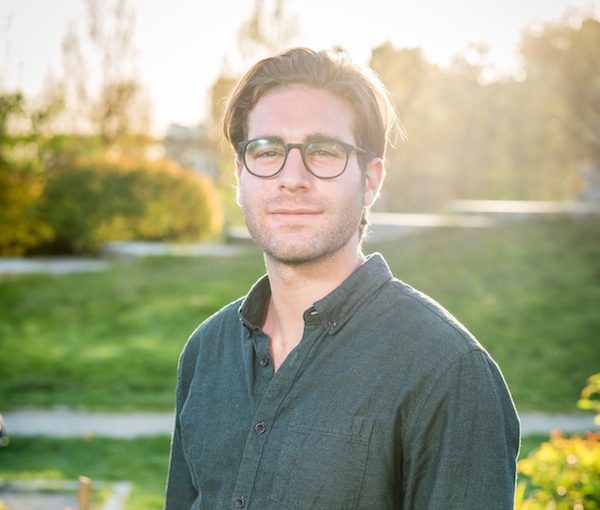
Aaron Friedland, creator and host of the podcast Impact in the 21st Century. (photo from Aaron Friedland)

If you’re looking for a new, uplifting podcast to cast away the oppressive weight of pandemic blues, consider Impact in the 21st Century, recently launched by Vancouverite Aaron Friedland. The Vancouver-based founder of the Simbi Foundation, which promotes literacy and education worldwide, felt it was time to give voice to the inspiring things that people are doing.

“There’s a lot of really bad news and horrible things going on and, as a species, we seem to be more interested in those stories,” Friedland told the Independent in a recent interview. “There are lots of podcasts available that celebrate big businesses and a very capitalist ideology. Our goal is to help showcase the amazing, impactful things that many brilliant people are doing and that often go unnoticed, and to mainstream what positive impact really means.”

To date, Friedland has interviewed Neil deGrasse Tyson, an astrophysicist and scientific educator; David Suzuki, an academic, broadcaster and environmentalist; Maryanne Wolf, a Jewish author and Harvard academic researching the brain; Ndileka Mandela, the granddaughter of Nelson Mandela; and Alex Honnold, a rock climber and subject of the movie Free Solo. “It’s so nice to be the one doing the interviewing, and the people I’m speaking with are such brilliant minds with brilliant insights to share,” Friedland said. “I feel deeply privileged to be getting that information firsthand.” The plan is to release a new podcast every two to three weeks.

The Royal Bank of Canada has sponsored Impact in the 21st Century, but Friedland said he’s always looking for more sponsors. “Our goal is to reach a point where we have enough podcast sponsors that, with each episode we release, we can build another Bright Box,” he said. The Bright Boxes, which cost $55,000 per box, are classrooms comprised of shipping containers, refurbished with solar technology and aimed at enhancing learning in overcrowded classrooms in places that have little or no access to electricity.

Friedland’s next podcast will be an interview with Canadian cultural anthropologist Wade Davis. His dream interviewees are Elon Musk and David Attenborough, but he’s biding his time until those happen. “It could be they’re not ready yet,” Friedland quipped. “We look for subjects who have a track record of creating longstanding positive impact, and whose vision and values really align with ours.”

Listeners can stream Impact in the 21st Century anywhere they access their podcasts, or online at simbifoundation.org.

Lauren Kramer, an award-winning writer and editor, lives in Richmond. To read her work online, visit laurenkramer.net.

Format ImagePosted on November 27, 2020November 25, 2020Author Lauren KramerCategories TV & FilmTags Aaron Friedland, environment, Impact in the 21st Century, podcast, science, Simbi Foundation, tikkun olam, writing

Nature in Israel talk

On Nov. 19, the Jewish Community Centre of Victoria will host a webinar dedicated to Nature Israel (Society for the Protection of Nature in Israel, SPNI) and the organization’s role in addressing Israel’s environmental challenges.

For more than 60 years, SPNI has been dedicated to protecting and preserving Israel’s natural resources, environment, natural assets and landscape. The work carried out by SPNI now will determine what the land of Israel will look like for generations to come.

photo - Jay Shofet
Jay Shofet

The Canadian Society for the Protection of Nature in Israel (CSPNI) is a registered charity with the mission to raise awareness of, and funds for, the work of SPNI to protect and preserve Israel. CSPNI is, therefore, lending support to this program, which will be led by Jay Shofet, director of partnerships and development at SPNI.

A Brief History of Israel’s Environmental Movement: A Snapshot of Today’s Sustainability Challenges and Successes will highlight the programs run by SPNI. As well, Shofet will trace the growth of Israel’s environmental movement, from its early-decades focus on a romantic notion of conservation, through its growth and professionalization stage in the 1990s, to its grassroots focus on sustainability in the last decade. Then, he will give a snapshot of where things stand today: how a new ethos of dense, sustainable cities is slowly developing; how land-use planning affects everything; how the push for renewable energy is fighting against entrenched economic interests and old infrastructure; and how Israel’s world-class biodiversity is threatened by habitat loss and fragmentation – and what SPNI is doing about it.

The webinar begins at 10 a.m. To register, go to jccvictoria.ca/webinars-3.

Posted on November 13, 2020November 11, 2020Author JCC of VictoriaCategories LocalTags conservation, education, environment, history, Israel, Jay Shofet, JCC Victoria, SPNI
NDP proud of their record

NDP proud of their record

Selina Robinson (photo from Selina Robinson)

Premier John Horgan sent Selina Robinson a message: “A mensch is a good thing, right?”

Robinson, the NDP government’s minister of municipal affairs and housing, is seeking reelection in the riding of Coquitlam-Maillardville. She sees herself as the Jewish maven around the cabinet table.

“I said yes, who called you a mensch?” Robinson recalled. “He just wanted to double-check.”

As she and other New Democrats campaign toward the Oct. 24 provincial election, Robinson and fellow cabinet member George Heyman spoke with the Jewish Independent. (In this issue, we also speak with Jewish candidates and spokespeople for other parties.)

As minister of housing, Robinson takes pride in the development of a major initiative called Homes for B.C.: A 30-Point Plan for Housing Affordability in British Columbia. Her ministry engaged with housing groups, renters, developers, economists, local government officials, planners and other thinkers. Then they convened people in a “World Café,” an engagement exercise in which people from different perspectives sit at a table and must come to agreed-upon recommendations on a topic.

“It was from that that we picked the best ideas and so it really came from all sides of the housing sector rather than pitting them against each other,” she said, acknowledging that she had to convince some to buy into the process because bureaucracy is not always amenable to novel approaches.

She cited two particular areas that she wants to “kvell about.” BC Housing, the agency that develops, manages and administers a range of subsidized housing in the province, is building housing on First Nations land.

“The feds, I don’t think, are building a lot of Indigenous housing and they’re supposed to,” she said. “No other province has stepped up to do that.… You’re a British Columbian and you need housing … if it’s land on reserve, it’s land on reserve – we’ll build housing.”

By providing housing in First Nations communities, it also helps people remain at home, rather than moving to the city, where housing is even more expensive and possibly precarious, she said.

“I’m very proud of that,” Robinson said.

The other point of pride is, Robinson admitted, “a geeky piece of legislation.” When she stepped into the role as the government’s lead on housing availability and affordability, she recognized that there is no data on what kind of housing exists and what’s needed.

“Local governments are responsible for land-use planning and deciding what kind of housing goes where – this is going to be multifamily, this is going to be single-family – but, if you were to ask them, how much do you have, how much more multifamily do you need, they couldn’t tell you, because nobody was collecting the data.”

She brought forward legislation that mandated local governments to do a housing needs assessment every five years to identify whether more housing options are needed for different age groups and types of families.

She also cited the government’s development of social housing, through the allocation of $7 billion over 10 years to build 39,000 units. So far, 25,000 units are either open, in construction or going through the municipal development process.

“My biggest worry is that the Liberals [if they are elected] will cancel all of those that are still in the development stage because they did that in 2001 when they formed government,” she said. “We’re so far behind the eight ball because they did that. I’m not saying it would have fixed everything, but, if there were another 5,000 units of housing out there, it wouldn’t be as bad as it is because there would be another 5,000 units.”

Every Friday, Robinson lights Shabbat candles and then shares a reflection on social media about her week.

“Lighting the Shabbat candles just grounds me in my identity,” she said. “I make myself take 10 minutes on a Friday at sundown to stop and to clear my head and to remind myself why I do the work. It’s not for the pay. It’s not for any of that; it’s not worth it. It’s who I am, what are my values and what’s important to me? What did I hear this week that reminds me of why this work is important?”

Robinson admitted she’s being partisan in saying that she believes NDP values are Jewish values.

“From my perspective, taking care of the world – whether it’s the environment, the people and all that’s within it – is our collective responsibility,” she said, adding with a laugh: “I think all Jews are New Democrats who just don’t know it yet.”

* * *

George Heyman, minister of environment and climate change strategy, is seeking reelection in the riding of Vancouver-Fairview. He is a son of Holocaust refugees, who escaped the Nazis with the help of Chiune Sugihara, the Japanese diplomat in Lithuania who illegally issued visas to about 6,000 Jews, many of whose descendants now live in Vancouver.

photo - George Heyman
George Heyman (photo from George Heyman)

In 2019, Heyman took a family trip to Poland, which broadened his awareness of his family’s history and where he met family members he never knew he had. The Independent will run that story in an upcoming issue.

Speaking of his record in government, Heyman expressed pride in bringing in CleanBC, which he calls “a very detailed, independently modeled set of measures to get us to our 2030 target and beyond.”

He also said the government “completely revamped the province’s Environmental Assessment Act, incorporating the principles of the UN Declaration of the Rights of Indigenous Peoples.”

Collaborating with the First Nations Leadership Council, the government adapted the legislation to bring in affected local communities at the beginning of a project, before a proponent spends millions of dollars then has to go back to the drawing board due to local concerns.

“We’ve been investing in clean technology, we’ve approved transit plans that were stalled for years that the mayors of Metro Vancouver thought were critically important,” Heyman added. “We’re going to see the Broadway [SkyTrain] line commence to relieve the tremendous congestion on the Broadway corridor, both on buses and on the roads. And we’ll be working on ultimately being able to work with UBC and the city and the federal government to extend that to UBC.”

The government, he said, updated the Residential Tenancy Act to address tenants who were being threatened with eviction for suspect renovations and that saw people getting notices of rent increases as high as 40% because of loopholes in the act.

“We closed those loopholes, we held rent increases to the cost of living unless there is a legitimate demonstrated need to do renovation and repair and it’s fair to receive some compensation rent to pay for that,” he said.

Like Robinson, Heyman cited the construction of affordable housing, as well as supportive housing, to get homeless people off the street and provide them with services they need. He said the government has created 20,000 childcare spaces in the province “with significant fee reductions for families as we work our way toward a $10-a-day program.” Increased staffing in schools, mandated by a Supreme Court decision during the previous regime, is also an accomplishment, he said, as well as adding more investments in new schools for seismic upgrades, fire safety and heating and ventilation systems.

On the opioid crisis, Heyman acknowledged a surge in deaths since the beginning of the pandemic. “While there is much more to do, we managed to flatten the level of deaths up until COVID hit,” he said.

Also parallel to the pandemic was a realization of “the terrible state of many of our long-term-care homes.”

“We saw that deteriorate under the previous government,” he said. “With COVID, we saw the results of that. We saw people dying because workers were having to go to two or three different care homes, increasing the risk of infection, simply to cobble together a living. We took measures to allow our healthcare workers to work in one institution without suffering the loss of pay and we’re also investing in more beds and more equipment for long-term-care homes.”

New Democrats have been governing in a minority situation with the support of the Green party since 2017. Horgan called the snap election on Sept. 21, facing criticism for breaking fixed election date legislation and going to the polls during a state of emergency.

Format ImagePosted on October 9, 2020October 8, 2020Author Pat JohnsonCategories LocalTags British Columbia, COVID-19, democracy, economics, elections, environment, George Heyman, governance, healthcare, NDP, New Democrats, policy, Selina Robinson
Segal helms Liberal message

Segal helms Liberal message

Rachael Segal is media spokesperson for the BC Liberals. (photo from BC Liberals)

Facing a campaign unlike any other, with shaking hands and kissing babies prohibited by social distancing protocols, all parties needed to reimagine how they would reach voters. Rachael Segal, media spokesperson for the BC Liberals, had to figure out how to get her party’s message to British Columbians.

“We can’t have a media bus, so, as the person responsible for media relations, how I connect with media now is very different than how I would do it in a normal campaign,” she said. “I’d be on the bus, I’d be with the leader.”

Instead, the leader is often driving himself to the modest-sized events that typify the 2020 campaign. Instead of facing a phalanx of TV cameras and radio mics, party leader

Andrew Wilkinson speaks to a pooled camera, with his message then shared among the media consortium. It’s an experience all parties are dealing with. But the leaders, as well as candidates in 87 ridings across the province, still have to communicate their positions.

“Obviously, Andrew still needs to get out there and get his message out there,” said Segal. “We’re making announcements daily, just like we would on a campaign normally, they’re just different.”

Wilkinson, a medical doctor as well as a lawyer, is particularly sensitive to the health risks and safety of his team, Segal said.

Segal, who grew up in Kerrisdale, is the official campaign spokesperson for the party during the election and is second-in-command at party headquarters when in non-campaign mode. As senior director of the party, her role is a loosely defined collection of responsibilities that she describes as “basically whatever hole is there, I try and fix it.”

One of her primary responsibilities is stakeholder relations, which means meeting with particular community groups and connecting them with the leader and other members of the legislature.

“Andrew and I have done Shabbat dinners, we’ve done Rosh Hashanah meals, we’ve done tons of Jewish community events,” Segal said by way of example. She also hosts the party’s podcast and started a young professional women’s group “to try to engage the 30-to-50-year-old women demographic, which is the largest swing demographic in British Columbia.”

Segal came to the role in April 2019. She already had a long resumé in education, politics and media.

She attended Vancouver Talmud Torah elementary and Magee high school and received her undergraduate degree at the University of Victoria, where she was the first president of the Jewish student organization when Hillel House opened there. She served as national president of the Canadian Federation of Jewish Students before graduating from UVic in 2005. She then went to the University of Leicester, in the United Kingdom, for a law degree, followed by a master of laws from Osgoode Hall, in Toronto.

She worked on Parliament Hill for Conservative MPs David Sweet and Scott Reid, as well as Senator Linda Frum, and was a senior policy advisor overseeing corrections and the parole board for then-minister of public safety Steven Blaney.

While studying in Toronto, Segal worked full time as an on-air legal and policy correspondent for Sun News, until that network shut down. She worked in criminal law and then civil litigation for a time but found it not her speed and returned to media, joining Toronto’s Bell Media radio station News Talk 1010. She returned to Vancouver in 2018 and covered as maternity leave replacement for the B.C. regional director of the Canadian Jewish Political Affairs Committee. She joined the BC Liberal party staff three days after that position ended.

“This election is really about who British Columbians can trust to lead them through economic recovery,” said Segal. “When we think about the ballot question, that’s really what British Columbians are voting on. Who do they trust to lead them through the next stage of this pandemic from an economic perspective? We have an incredible team who are all very experienced. We have former ministers, we have doctors, we have lawyers, we have just a really diverse and interesting team of very smart people.”

Given significant turnover – seven cabinet ministers have opted not to seek reelection – Segal questioned who would be on the frontbenches of a reelected NDP government.

“The question is, what does an NDP cabinet look like in the next government and do they have the bench strength to be the best party to lead this province economically?” she said.

Segal takes seriously her position as one of the few Jewish individuals on the campaign team.

“It’s a real privilege to be able to represent the community within this political sphere and it’s something I take very not lightly,” she said.

Of her job on the campaign and her slightly less hectic role the rest of the time, she added: “My job is pretty different, wild, fun. Every day is a new adventure. It’s pretty great. And we have such an incredible team, so they make it all even better.”

Format ImagePosted on October 9, 2020October 8, 2020Author Pat JohnsonCategories LocalTags British Columbia, COVID-19, democracy, economics, elections, environment, governance, healthcare, Liberals, policy, politics, Rachael Segal

Posts pagination

Previous page Page 1 … Page 3 Page 4 Page 5 … Page 10 Next page
Proudly powered by WordPress