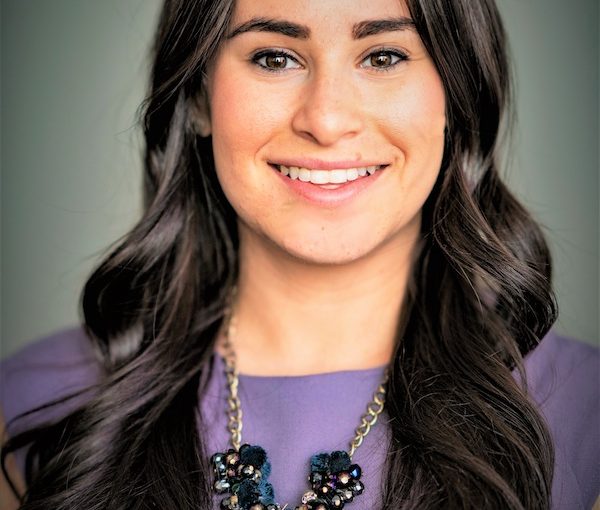
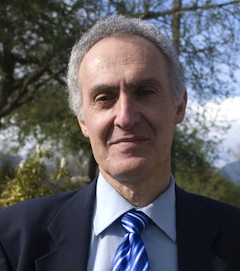
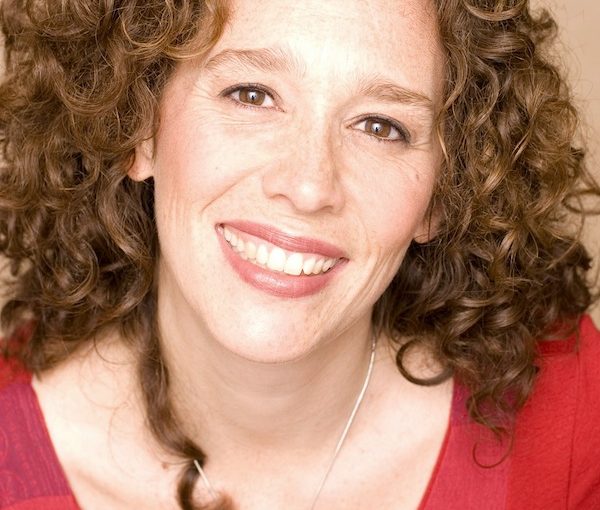
Rachael Segal is media spokesperson for the BC Liberals. (photo from BC Liberals)
Facing a campaign unlike any other, with shaking hands and kissing babies prohibited by social distancing protocols, all parties needed to reimagine how they would reach voters. Rachael Segal, media spokesperson for the BC Liberals, had to figure out how to get her party’s message to British Columbians.
“We can’t have a media bus, so, as the person responsible for media relations, how I connect with media now is very different than how I would do it in a normal campaign,” she said. “I’d be on the bus, I’d be with the leader.”
Instead, the leader is often driving himself to the modest-sized events that typify the 2020 campaign. Instead of facing a phalanx of TV cameras and radio mics, party leader
Andrew Wilkinson speaks to a pooled camera, with his message then shared among the media consortium. It’s an experience all parties are dealing with. But the leaders, as well as candidates in 87 ridings across the province, still have to communicate their positions.
“Obviously, Andrew still needs to get out there and get his message out there,” said Segal. “We’re making announcements daily, just like we would on a campaign normally, they’re just different.”
Wilkinson, a medical doctor as well as a lawyer, is particularly sensitive to the health risks and safety of his team, Segal said.
Segal, who grew up in Kerrisdale, is the official campaign spokesperson for the party during the election and is second-in-command at party headquarters when in non-campaign mode. As senior director of the party, her role is a loosely defined collection of responsibilities that she describes as “basically whatever hole is there, I try and fix it.”
One of her primary responsibilities is stakeholder relations, which means meeting with particular community groups and connecting them with the leader and other members of the legislature.
“Andrew and I have done Shabbat dinners, we’ve done Rosh Hashanah meals, we’ve done tons of Jewish community events,” Segal said by way of example. She also hosts the party’s podcast and started a young professional women’s group “to try to engage the 30-to-50-year-old women demographic, which is the largest swing demographic in British Columbia.”
Segal came to the role in April 2019. She already had a long resumé in education, politics and media.
She attended Vancouver Talmud Torah elementary and Magee high school and received her undergraduate degree at the University of Victoria, where she was the first president of the Jewish student organization when Hillel House opened there. She served as national president of the Canadian Federation of Jewish Students before graduating from UVic in 2005. She then went to the University of Leicester, in the United Kingdom, for a law degree, followed by a master of laws from Osgoode Hall, in Toronto.
She worked on Parliament Hill for Conservative MPs David Sweet and Scott Reid, as well as Senator Linda Frum, and was a senior policy advisor overseeing corrections and the parole board for then-minister of public safety Steven Blaney.
While studying in Toronto, Segal worked full time as an on-air legal and policy correspondent for Sun News, until that network shut down. She worked in criminal law and then civil litigation for a time but found it not her speed and returned to media, joining Toronto’s Bell Media radio station News Talk 1010. She returned to Vancouver in 2018 and covered as maternity leave replacement for the B.C. regional director of the Canadian Jewish Political Affairs Committee. She joined the BC Liberal party staff three days after that position ended.
“This election is really about who British Columbians can trust to lead them through economic recovery,” said Segal. “When we think about the ballot question, that’s really what British Columbians are voting on. Who do they trust to lead them through the next stage of this pandemic from an economic perspective? We have an incredible team who are all very experienced. We have former ministers, we have doctors, we have lawyers, we have just a really diverse and interesting team of very smart people.”
Given significant turnover – seven cabinet ministers have opted not to seek reelection – Segal questioned who would be on the frontbenches of a reelected NDP government.
“The question is, what does an NDP cabinet look like in the next government and do they have the bench strength to be the best party to lead this province economically?” she said.
Segal takes seriously her position as one of the few Jewish individuals on the campaign team.
“It’s a real privilege to be able to represent the community within this political sphere and it’s something I take very not lightly,” she said.
Of her job on the campaign and her slightly less hectic role the rest of the time, she added: “My job is pretty different, wild, fun. Every day is a new adventure. It’s pretty great. And we have such an incredible team, so they make it all even better.”
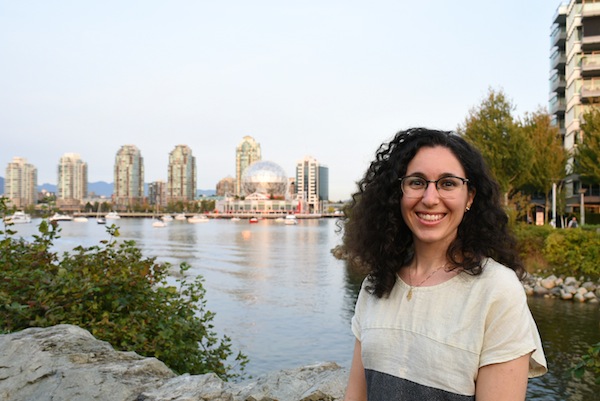
Maayan Kreitzman said the Green party knew it was getting the “full package” when they tapped her as their candidate in the provincial election for the riding of Vancouver-False Creek. There are schisms in the environmental movement between those who see value in direct action protests and those who endorse electoral politics. Kreitzman backs both.
Kreitzman is a leading member of the Vancouver chapter of Extinction Rebellion, a global movement that practises civil disobedience to draw attention to the climate and ecological crisis, she said, based on “a theory of change that learns from many movements in the past that have basically put their bodies in the way of injustice.” She cited as models the U.S. civil rights movement, the Indian independence movement and the suffragists.
The group shut down the Burrard Street Bridge last year and is currently involved, with other groups, in a camp in Burnaby that is physically blocking the construction of the TMX pipeline.
But Kreitzman has harsh words for the environmental movement and its limited impacts.
“The environmental movement over the last 30 years has won some battles but we’re obviously losing the war because the climate and ecological catastrophe continues unabated essentially,” she said.
While she believes in blockades, she also believes in ballots.
“I definitely believe in both,” she said. “I think when the Green party chose me as a candidate they knew that they were getting the full package. They were getting somebody who believes in direct action, who believes in doing things that are illegal when they are ethical and the right thing to do. There are other people in the Green party that believe that, too. [Former federal Green leader] Elizabeth May got arrested on Burnaby Mountain in 2018. I’m certainly not alone in that.”
Beyond the shortcomings of the environmental movement, she excoriated the political system’s status quo.
“It’s utterly failing. It’s not fit for purpose. It has not delivered the systemic changes to our economy that we need to see in order to actually have a sustainable life and future on this planet,” she said.
Above a range of policy topics she champions, Kreitzman wants to create a citizens’ assembly on climate and ecological justice – this parliament of ordinary people selected to reflect demography “would devolve power from elected government to a more representative and radically democratic form of government.”
“Citizens’ assemblies go through a very rigorous and well-facilitated deliberative process where they have access to experts and all the best information and then they are empowered to make either decisions or recommendations, depending how their terms of reference are set up,” she explained. “The citizens’ assemblies are able to make way better, faster and more radical decisions on issues that are totally intractable for elected politicians because elected politicians operate on such short cycles and they have such perverse incentives. It’s very hard and we’ve seen how totally incapable elected politicians around the world are of making the kinds of decisions that we need in order to survive on this planet.”
Kreitzman has been thrown into politics mere days after completion of her PhD in resources, environment and sustainability at the University of British Columbia. Her research specialized in sustainable agricultural systems and, more specifically, perennial agriculture.
She was born in Vancouver to a Canadian father and an Israeli-Canadian mother, attended Vancouver Talmud Torah and Eric Hamber high school and was active in Hillel at UBC, as well as in the Graduate Students Society.
She wants to win the election – but winning isn’t everything.
“This race is not just about that,” she said. “It’s also about telling the truth and just giving a platform to a sustainability scientist, a youngish person and somebody who is willing to talk very openly about the failures of our current government systems. Not just our current government and the NDP, but our current government system and their lack of democracy, and the failures of the environmental movement itself, because neither have been effective and so far nothing has really been effective.”
While she is critical of government generally, she has harsh words for the NDP government particularly.
“This government’s record on the environment has been a total loss, it’s a complete failure,” Kreitzman said. “They’ve embraced the oil and gas industry even more than the BC Liberals have and I never thought I would say those words, that the NDP government has actually been worse for climate change and the environment than the BC Liberals have been. It’s shocking, but it’s true.”
She referenced a report from Stand.Earth, which outlines subsidies to fracking and indicates that the oil and gas industry receives four times as much in provincial government subsidies than it produces in royalties to the province.
As the candidate in Vancouver-False Creek, she is sounding the alarm that sea-level rise will make parts of the most densely populated neighbourhoods of Vancouver uninhabitable.
* * *
Kreitzman’s colleague Scott Bernstein is running for the Greens in Vancouver-Kingsway. He sees it as an ideal opportunity to contrast NDP policy with his ideas because he is facing off against Adrian Dix, the minister of health.
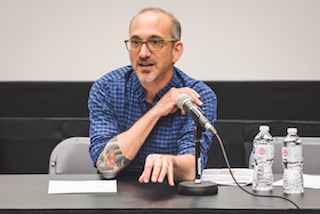
Scott Bernstein (photo from Scott Bernstein)
Bernstein is director of policy at the Canadian Drug Policy Coalition, which is based in the faculty of health sciences at Simon Fraser University. While he has a graduate degree in environmental studies, his career has shifted to drug policy. He was a junior co-counsel on the landmark 2011 Insite case at the Supreme Court of Canada, which found that the federal government’s failure to grant an exemption allowing users to consume illicit drugs at the Vancouver safe consumption site breached the Charter of Rights because it undermined the “maintenance and promotion of public health and safety.”
He also worked at Pivot Legal Society in the Downtown Eastside and operated a private practice for a time as well, before coming to the drug coalition about three-and-a-half years ago. He has worked for George Soros’ Open Society Foundations, in New York, focusing on drug policy at the UN level and in Africa, and he spent two years with the U.S. Peace Corps in Uzbekistan.
The record-breaking recent months of opioid deaths contrasts, Bernstein said, with the response to COVID.
“There are a lot of structural problems with how the government is dealing with the overdose crisis and it really was highlighted when we had another public health crisis and, all of a sudden, we saw how the government could sort of snap to attention, dedicate funding, have information flow, have protocols and guidelines and resources available to address COVID where, in reality, the overdose crisis is now in the fifth year since it was declared a public health emergency in B.C. and we’ve never seen the response that we saw with COVID, that materialized in a few weeks,” he said. He credited retiring Minister of Mental Health and Addictions Judy Darcy as “a wonderful and caring person,” but added: “they also didn’t give her sufficient resources to deal with the problem and she doesn’t have a lot of power in the cabinet.”
* * *
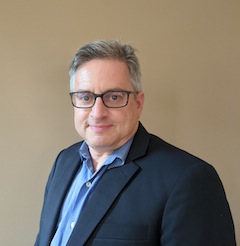
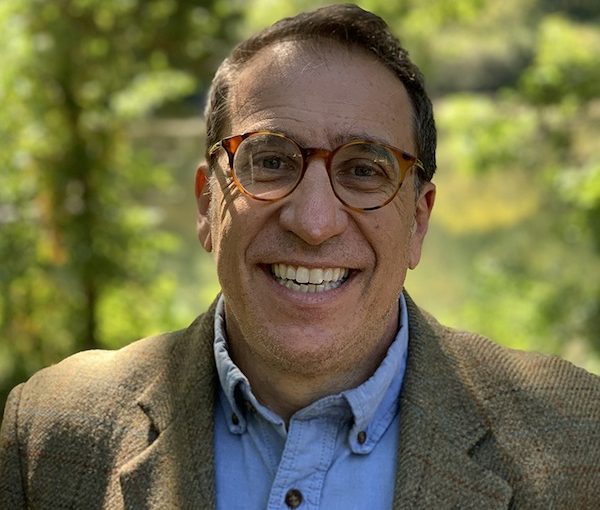
Ian Goldman, the Green candidate in Vancouver-Fairview, grew up in Toronto and moved west in 1988 to attend law school at UBC. He later did a master’s in international relations, also at UBC, and has practised immigration law in private practice since 1998.
Ian Goldman (photo from Ian Goldman)
The first-time candidate is up against George Heyman, the NDP minister of environment and climate change strategy.
“It’s unfortunate that, in my area, the NDP have really strong support in the sense that he’s not really feeling pressure, I don’t think,” Goldman said. “Hopefully, I can make him feel some pressure. That’s the most important thing for me.”
The New Democrats have taken climate change more seriously than previous Liberal governments, he said, “But I think they’re more of a status quo party. They say they’re taking it seriously but then their actions show them out to be more status quo, no serious climate action, really.”
COVID is a serious issue, he said, but it has allowed governments at all levels to push environmental issues and climate change to the back burner, he argued.
“As soon as the pandemic’s over, people will wake up and say, oh my God, we’ve got a really serious issue here again,” said Goldman. “That’s why I joined the Green party. I’ve always been interested in environmental issues. My kids and I and my wife go for a lot of outdoor trips, we go hiking, a lot of outdoor activities we do together. That’s where my interest in the environment comes from.”
He added: “If people are really serious about tackling this issue, they should at least consider the Green party.”
* * *
Michael Barkusky (photo from Michael Barkusky)
Michael Barkusky, an economist and certified public accountant, is in a rematch with Andrew Wilkinson, now the leader of the Liberal party, in the riding of Vancouver-Quilchena. He acknowledged it’s an uphill battle in the Liberal stronghold.
“What I’m trying to do is strengthen the Green party in general,” he said. But it is also an opportunity to press the party leader on environmental issues.
“I think the BC Liberals need to improve their green credentials substantially to be relevant in the long term,” said Barkusky, who came to Canada from South Africa in 1980. (More about his background and career is in our story from the last election, at jewishindependent.ca/apartheid-impacted-views.) He said former premier Gordon Campbell was innovative on a range of policies, including the carbon tax. He said Campbell’s successor, Christy Clark, backtracked on Campbell’s environmental policies.
The Liberal party is, Barkusky said, a “broad church with some very conservative elements and [Wilkinson] probably can’t do a lot of things that he would do if he had a completely free hand. I think the pressure needs to be kept up on them as much as it has to be kept up on the NDP.”
As he campaigns, Barkusky said, voters tell him they think the NDP ran a good government in part because of the Green party’s influence.
“And now they [the NDP] are trying to say they’ll do a better job without us,” he said. “I can’t buy that.… Quite a lot of voters in the riding agree with me. They feel that we had good government in the last three years and they credit the Green party with being an element of it being good.”
While he disagrees with the Liberals’ promise to eliminate the provincial sales tax for a year, he said changing it could be justifiable. Reducing it from seven percent on most items, or changing the number of items it covers, is a discussion worth considering, he said. But he sees the promise as akin to the NDP’s promise in the last election to eliminate tolls on bridges.
“It’s just kind of instant popularity,” he said. “A relatively bad policy that will resonate well with a certain constituency.”
Barkusky finds it interesting that there are four Green candidates in Vancouver who are Jewish, and noted that the federal Green party just elected a Jewish woman to lead it.
“That’s a lot of tikkun olam consciousness,” he said.
***
Note: This article has been amended to reflect that Maayan Kreitzman is a leading member of the Vancouver chapter of Extinction Rebellion, not of the British Columbia chapter, as originally stated.
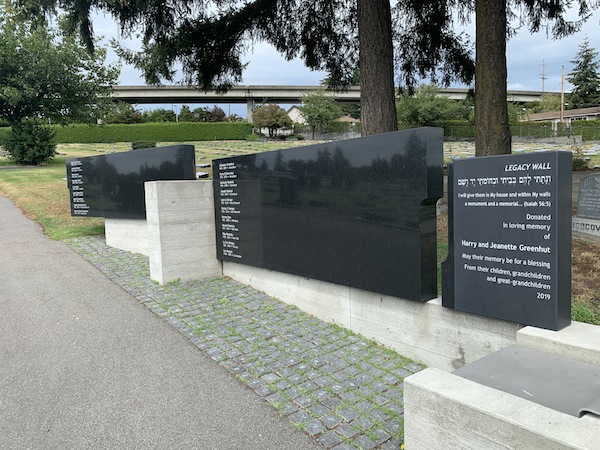
The new black granite memorial wall at Schara Tzedeck Cemetery in New Westminster allows people to memorialize loved ones buried in other cities. (photo from Schara Tzedeck)
What’s new at the cemetery? Not a question one tends to ask, but the Schara Tzedeck cemeteries in New Westminster and Surrey have seen some significant upgrades and additions in recent months.
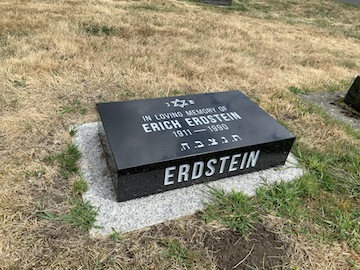
At the New Westminster cemetery, which saw its first burial in 1929, 50 graves that did not have headstones have received permanent markers. More than 100 others will ideally also see stone markers added in the coming years as the cemetery board’s Chesed Shel Emet Fund is replenished.
There are plenty of reasons why a grave might not have a permanent headstone, according to Howard Jampolsky, executive director of the Schara Tzedeck Cemetery Board.
“Sometimes, somebody had no family, maybe they were destitute, alone in the world,” he said. “Sometimes, the families just don’t have money; sometimes, one spouse dies and they get a headstone and the other spouse dies and there is no one to put the headstone.”
Whatever the reasons, the graves, some dating back to the 1950s, had temporary markers.
The Chesed Shel Emet Fund was set up primarily with donations from cemetery board members, Jampolsky said, and the first batch of 50 headstones was purchased for these unmarked graves and placed in the last few months.
One of 50 headstones placed on graves that, until now, had only temporary markers. (photo from Schara Tzedeck)
“We were hoping to do a big unveiling ceremony, where all the graves would be unveiled and we would invite the community,” he said. But COVID intervened. He hopes such a ceremony will occur in the future.
The headstones cost about $525 each and the board is welcoming donations from the community to the fund so they can proceed with placing more stones.
Also at New Westminster, a new black granite memorial wall has been created to commemorate people who are buried in other places.
“Sometimes, someone lives in Vancouver their entire life and they die and get buried in another place, maybe they’re sent to Toronto or Israel or somewhere else,” Jampolsky said. “This is an opportunity to memorialize somebody who lived in the city and contributed to the city’s life and they don’t have a headstone here. The other possibility is people who have parents or family buried in other places where they live and don’t have the ability to go and visit. If you want to come on the yahrzeit, you can come and put a rock on top of that.”
The New Westminster cemetery also has seen a green irrigation initiative recently completed.
“We spend a lot of money irrigating our green grass here, a lot of water,” he said. “We used potable city water.”
They have now drilled a well and are also capturing rainwater, which is pumped through the irrigation system. Not only is this better for the environment, Jampolsky said, but the $150,000 cost will be recouped in about eight years at current water rates. He sees the greening initiative as in keeping with Jewish burial tradition, which is respectful of the land, rejects concrete casings and does not include embalming.
In other significant news, the Surrey cemetery, which had its first burial about a dozen years ago, now has a chapel. Until now, funerals at the Surrey site were graveside only. A sad irony is that the pandemic has meant that, after the first couple of funerals in the new chapel, services had to be again curtailed to graveside only, and with limited attendance.
The $500,000 structure was completed in late 2019 and reflects the philosophy of the board, Jampolsky said, that all members of the community be treated equally. Those being buried in New Westminster had funerals in a chapel, while those in Surrey did not. The new Surrey chapel was funded within the existing budget, but, if a community member wanted to contribute to the chapel, Jampolsky said, naming opportunities could be considered.
“The other thing we’re doing in Surrey is spending more time and effort and money to make Surrey look a lot nicer,” he said. “We are doing more landscaping work, we’re planting flowers and doing things that make it look very, very nice. We’re putting a lot of effort into that property.”
The Surrey cemetery contains about 2,000 plots while the much older New Westminster site has about 10,000. While approximately 5,000 of the New Westminster plots are filled, Jampolsky acknowledges that he can’t accurately predict how long the cemetery has before it is full.
“It really depends,” he said. There are about 80 burials annually in New Westminster. That would suggest about 60 years before it is full. But the community is growing quickly, so perhaps it would be only 50 years. At the same time, a plot may be purchased and not used for decades, he said. If a young family purchased plots today, it is reasonable to assume some burials might not occur until the 22nd century.
Nigel Savage, president and chief executive officer of Hazon, is one of the keynote speakers for Jewish Federation of Greater Vancouver’s annual campaign opening on Sept. 8. (photo from JFGV)
Nigel Savage, president and chief executive officer of Hazon, is looking forward to addressing the Vancouver Jewish community Sept. 8 as one of the keynote speakers for Jewish Federation of Greater Vancouver’s annual campaign opening. “The pandemic is a reminder of why we have and why we need central institutions like federations for the Jewish community,” he said.
“Hazon is working to turn the Jewish community outwards, address environmental sustainability and to use that process to strengthen Jewish life,” explained Savage in an interview with the Independent. “I think of the Vancouver Jewish community as one made of people who choose to live in the Pacific Northwest and have a sensibility of caring for the world and its natural resources, so I want to sketch out what may be possible for all of us in the long term.”
Savage was a professional fund manager in London, England, where he worked for NM Rothschild and was co-head of UK equities at Govett. After nine years in the financial world, he opted to take a sabbatical year and study at Pardes in Jerusalem. “I had an amazing time and stayed on in Israel as I tried to figure out what I wanted to do with my life,” he recalled.
A friend invited him to join a hike from the Mediterranean Sea to the Sea of Galilee, and Savage, who described himself as “a chubby, nerdy, intellectual English kid who grew up in Manchester and never really set foot outdoors,” agreed. He loved the hike and, as he began doing more physical activities outdoors, recognized it as a great way to bring Jewish tradition to life and connect with others. “We didn’t enter Jewish history in a synagogue or JCC. We entered it in relationship to the land of Israel, with a relationship to food, land, climate, language. That’s what the Torah is a record of,” he said.
Savage’s time in Israel was the impetus for the creation of what is today one of the largest faith-based environmental organizations in the United States. Hazon’s goal is to strengthen Jewish life and contribute to a more environmentally sustainable world. It calls itself the “Jewish lab for sustainability” and strives to effect change through immersive experiences and by inspiring individuals and communities to commit to change – particularly with respect to food systems.
Hazon is focused on Jewish outdoor, food, farming and environmental education (JOFFE) and, since its inception in 2000, has been dedicated to helping establish and inspire change. “In the Bay Area, there’s Urban Adama and Wilderness Torah, and, in north San Diego, there’s Coastal Roots Farm. In Boulder, there’s the Milk and Honey Farm and, in Toronto, we have Shoresh,” he said.
“In each place, people are doing slightly different programs with similar goals,” Savage explained. “Those goals are to reconnect the Jewish community to land and food, to reconnect people to Jewish tradition, to reconnect people to each other and to use that process to strengthen Jewish life and create the kind of world we believe in.”
Savage’s list of accolades suggests that he is achieving his goal at Hazon. In 2015, he was awarded an honourary doctorate by the Jewish Theological Seminary and he’s been named a member of the Forward 50, the annual list of the 50 most influential Jewish people in the United States, on two occasions.
He noted that September 2022 is the start of a new seven-year cycle in Jewish life. “Imagine if the Vancouver Jewish community began to envision Jewish life in Vancouver over the next seven years. If we wanted the Vancouver Jewish community to be on the cutting edge of Jewish communities around the world around issues of sustainability by 2029, what would that look like?”
Savage suggested that every Jewish institution in the city could begin a process to establish a coherent food plan over the next seven years. It might include policies regarding use of plastic bottles, whether to serve meat and soda, carbon neutrality goals for community buildings, and other actions in relation to food and land use.
“At Hazon, we want to treat these questions as real questions and involve people in the Jewish community, from teenagers to rabbis. We want to start a real conversation which draws on Jewish tradition, the best of what’s happening in Vancouver and Canada, and use that process so that, by 2029, the Vancouver Jewish community has integrated food polices in all its institutions that reflect our values.”
Hazon’s goal is to invite communities to unpack questions like these and to act as a resource on matters of sustainability and Jewish efforts to promote it.
“If we think about the nature of obesity, diabetes and heart disease, these are chronic illnesses,” Savage noted. “The world needs us to slowly and steadily change how we’re living so that all these people can live sustainably on this planet. Right now, we have a 10- or 15-year window to change the trajectory of Jewish civilization. We can’t complete this task by ourselves, but neither are we free to desist from it.”
Savage will be joined at the Federation campaign launch by fellow keynote speaker Sarah Hurwitz, author of Here All Along: Finding Meaning, Spirituality and a Deeper Connection to Life – in Judaism (After Finally Choosing to Look There) and former speech writer for the Obamas. To register for the event, which starts at 5 p.m., go to jewishvancouver.com/faco2020.
Lauren Kramer, an award-winning writer and editor, lives in Richmond. To read her work online, visit laurenkramer.net.
It is time for Jews to restore and transform the ancient and largely forgotten Jewish holiday of Rosh Hashanah l’Ma’aser b’Heimot (the New Year for Tithing Animals) into a day devoted to considering how to improve our relationships with animals. The holiday occurred on the first day of the month of Elul (Aug. 21 this year) and was initially devoted to counting domesticated animals intended for sacrificial offerings (Mishnah, Seder Moed, Tractate Rosh Hashanah 1:1).
There is a precedent for such a transformation. Rosh Hashanah l’Ilanot (New Year for Trees), a day intended for tithing fruit trees for Temple offerings, was reclaimed in the 17th century by mystics as a day – Tu b’Shevat – for appreciating nature and its beauty and bounty.
It is important that Rosh Hashanah la’b’Heimot (the New Year for Animals) becomes a day devoted to increasing awareness of Judaism’s powerful teachings on the proper treatment of animals and to a tikkun (healing) for the horrible ways that animals are treated today on factory farms and in other settings.
Currently, with regard to animals, Jewish religious services, Torah readings and education are primarily focused on the biblical sacrifices, animals that are kosher for eating, and laws about animal slaughter. This emphasis on animals that are to be killed should be balanced with a greater emphasis on Judaism’s more sympathetic teachings; for example, “God’s compassion is over all his works [including animals]” (Psalms 145:9) and “the righteous person considers the lives of his or her animals” (Proverbs 12:10). Another example is that farmers are not to yoke a strong and a weak animal together, nor to muzzle an animal while the animal is threshing in the field. As well, the Ten Commandments indicates that animals, as well as people, are to rest on the Sabbath day and there are many parts in the Torah mandating that Jews are to avoid tsa’ar ba’alei chaim, causing any unnecessary “sorrow to animals.” Moses and King David were deemed suitable to be leaders because of their compassionate care of sheep when they were shepherds.
Despite these and additional teachings, most Jews ignore the widespread abuses of animals. For example, egg-laying hens are kept in cages so small that they can’t raise even one wing, and they are debeaked – without the use of anesthetics – to prevent them from harming other birds by pecking them, due to their natural instincts being thwarted. More than 150 million male chicks are killed annually, shortly after birth, at egg-laying hatcheries because they can’t lay eggs and haven’t been genetically programmed to have much flesh. Dairy cows are artificially inseminated annually so that they will be able to continually produce milk, and then their babies are taken away almost immediately after birth, often to be raised for veal, under very cruel conditions.
Renewing and transforming the ancient holiday is especially important today because a shift away from animal-based diets, in addition to lessening the mistreatment of animals, would reduce the number of diet-related diseases that are afflicting Jewish and other communities. A shift would also reduce environmental and climate change threats to humanity that are greatly increased by the massive exploitation of animals for food. And it would encourage Jews to consider plant-based diets that are more consistent with Jewish mandates to preserve human health, treat animals with compassion, protect the environment, conserve natural resources, help hungry people, and pursue peace and justice.
Transforming the holiday would show that Judaism is applying its eternal teachings to today’s important issues, and improve the image of Judaism in the eyes of people concerned about animals, vegetarianism, the environment and related issues, by reinforcing a compassionate side of Judaism. The holiday might even bring back some Jews who are currently alienated to some extent from Judaism, especially those who are concerned about animal welfare, and strengthen the commitment of vegetarian and vegan Jews who are already involved in Jewish life, but feeling somewhat outside the Jewish mainstream, as they are often among a small minority in their congregations.
The first day of the Hebrew month of Elul is an appropriate time for this renewed holiday because this date is the beginning of the month-long period of introspection during which Jews are to examine their deeds before the High Holidays of Rosh Hashanah and Yom Kippur. Starting on that date and for the entire month of Elul (except on Shabbat), the shofar (ram’s horn) is blown in synagogues during morning services to awaken people to their responsibilities, and that is an appropriate time to consider how we can improve conditions for animals. It is significant that, for chiddur mitzvah, to enhance mitzvot (commandments), the shofar and other ritual objects should ideally come from animals that have been raised without cruelty and have died natural deaths.
A coalition of Jewish groups is leading a campaign to make this renewed holiday an important part of Jewish life today and I was part of recent Zoom events in the United States, United Kingdom and Israel, at which rabbis, Jewish vegetarian and vegan activists, and environmentalists discussed many issues related to the renewal initiative and answered questions about it. The group is also compiling lists of Jewish organizations, rabbis and other influential Jews who support the initiative. And it is planning to use the next year to create sample holiday haggadot, outlines of sample holiday seders, and other materials that can help expand holiday activities in the coming years.
Working to renew an ancient Jewish holiday that most Jews are completely unaware of may seem audacious, but it is essential, in my opinion, to helping revitalize Judaism, improving the health of Jews, sharply reducing the massive mistreatment of animals, and shifting our precious but imperiled planet onto a sustainable path.
Richard H. Schwartz, PhD, is professor emeritus, College of Staten Island, president emeritus of Jewish Veg and president of Society of Ethical and Religious Vegetarians. He is the author of several books, including Judaism and Vegetarianism and Who Stole My Religion? Revitalizing Judaism and Applying Jewish Values to Help Heal Our Imperiled Planet, and more than 250 articles at jewishveg.org/schwartz. He was associate producer of the documentary A Sacred Duty: Applying Jewish Values to Help Heal the World.
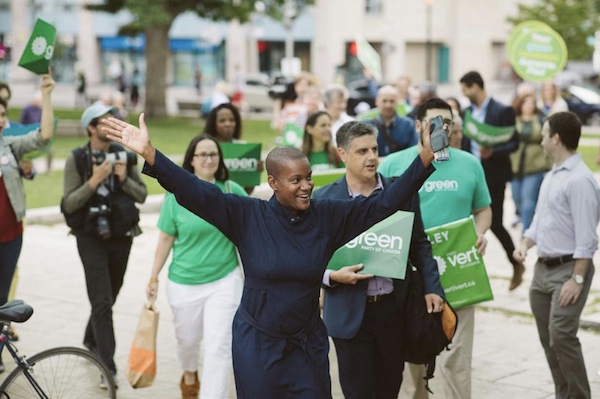
Annamie Paul is running to succeed Elizabeth May as leader of the Green Party of Canada. (photo from Annamie Paul)
Annamie Paul wants to be the first woman of colour and the first Jewish woman to lead a political party in Canada. But, in the process, the human rights lawyer and former diplomat who is running to succeed Elizabeth May as leader of the Green Party of Canada has been taken aback by the overt antisemitism thrown at her since it became widely known that she is Jewish.
“You almost can’t believe what you’re seeing,” said the Toronto native, who has worked extensively overseas. “There are very explicit comments questioning my loyalty to Canada because I am Jewish. There are those who have suggested that I am seeking to infiltrate the party on behalf of Zionist elements.”
Paul said what disappoints her most is the almost complete silence from others when antisemitic posts are made on social media, such as the Facebook group for Green party supporters.
“The comments were whispers at first, innuendo, and now they’ve become very explicit,” she said. “If people are allowed to make these comments unchecked, it really emboldens them and that’s definitely what I’ve noticed over the last week or two.”
Amid a litany of such comments – including items not directly targeting her but equating Israelis to Nazis on Green-oriented social media sites – only one single individual not on her campaign team has called out the offensive posts. At the urging of Paul’s campaign, moderators removed some of the most disturbing ones.
“It’s taken me aback,” she said. “It wasn’t something I was fully prepared for, to be honest.”
She differentiates between people who are deliberately provocative and those who are uninformed.
“I accept that there are a certain number of people who still need to be educated … and, while it’s perhaps not my responsibility to do that, I’m willing to do that because I think if I can create a little more understanding, then that’s important,” she said.
Paul spoke at a Zoom event organized by Congregation Beth Israel and moderated by Rabbi Jonathan Infeld on July 8. That conversation was primarily about Paul’s life, Jewish journey and career. In a subsequent interview with the Jewish Independent, she delved more deeply into policy and her experiences with antisemitism and racism.
Born in Toronto to a family from the Caribbean, she was among the first students in Toronto public schools’ French immersion program. Her mother, a teacher, and grandmother, a nurse and midwife, worked as domestics when they arrived in Canada. Her mother went on to get a master’s of education and taught in elementary schools for more than three decades; her grandmother became a nurse’s aide.
Paul credits her mother’s broad-mindedness and spiritual bent for the openness that led her to embrace Judaism in early adulthood. Paul was converted by the Hillel rabbi while completing a master’s of public affairs at Princeton University. She also has a law degree from the University of Ottawa. She chose Ottawa in part because its law faculty emphasizes law through an Indigenous lens. In addition to seeking at an early age to be an ally to Indigenous peoples – she started law school at 19 – she saw parallels between the Canadian situation and her own heritage as a member of the Black diaspora.
“We have been stripped of all of the things that Indigenous peoples are fighting for still in this country,” she said. “Through colonialism, we lost our identity, we lost our culture, our language, our religions. We really can’t tell you anything with any great degree of precision about our ancestors. When I saw other peoples fighting for those things, I understood intuitively how important it was.”
Paul has worked as a director for a conflict prevention nongovernmental organization in Brussels, as an advisor at the International Criminal Court in The Hague, and as a political officer in Canada’s mission to the European Union. She co-founded and co-directed an innovation hub for international NGOs working on global challenges and has served on the board and advised other international NGOs, including the Climate Infrastructure Partnership and Higher Education Alliance for Refugees. She is married to Mark Freeman, a prominent human rights lawyer and author. They have two sons, one in university in London, U.K., the other in high school in Toronto.
Returning to Canada after spending about 13 years abroad, Paul looked at Canadian politics with fresh eyes. While she had been courted to run provincially by the Ontario Liberal Party in the early 2000s, she opted to run federally for the Green party in 2019. She took about 7% of the vote in Toronto Centre, which was won by Finance Minister Bill Morneau. She is one of nine candidates running for Green leader.
She chose the Green party because, she said, “we don’t have time to fool around with the climate emergency.”
“I celebrate the compromise that is the spirit of Canadian politics,” Paul said. “This is the Canadian way. But there are some things that you simply have to do all the way or it really doesn’t work. One of those things is the climate emergency. If we don’t hit our targets, then we are setting ourselves up for disaster. The Liberals, the NDP, the Conservatives, they’re just not committed to that goal and so I wanted to make it clear that I was aligning myself with the party that was very, very committed to reaching those targets.”
COVID-19, for all the health and economic devastation it has wrought, also presents opportunities, said Paul. In Canada, federal and provincial governments came together and political parties set aside partisanship to an extent. Canadians who may have been skeptical that a massive challenge like climate change could be ameliorated see what concerted governmental action – and massive investments – can look like. “[Canadians] know that money can be found if it’s needed and they know that we can mobilize very quickly,” she said.
The billions of dollars being invested into the economic recovery should be directed toward projects that explicitly advance a green economy, she said, such as a cross-Canada energy grid that produces electricity from renewable sources to be shared throughout the country. This is just one of a range of opportunities that Paul sees emerging from this extraordinary economic challenge.
“For a country as wealthy and well-educated as Canada, if we want to be, we can really be first in line for all of this,” she said. “It’s exciting.”
The Green leader has limited constitutional authority in a party dedicated to grassroots policymaking, Paul said. If party members adopt a policy that challenges the leader’s core values, the leader may be required to walk away. Such a scenario emerged in 2016 after the party adopted a resolution to boycott Israel. Following a showdown, the resolution was rescinded and May carried the party into the subsequent election. As a result, Paul said, the party is on record supporting Israel’s right to exist and opposing the boycott, divestment and sanctions (BDS) movement.
Paul opposes the Netanyahu government’s Jordan Valley annexation plan because she believes it contravenes international law. But she also urged vigilance against those who might mask their antisemitism in anti-Zionism. And she stressed the unlikelihood of pleasing everyone on either side of the Israel and Palestine divide.
“I don’t feel that there’s anything these days that you can say in terms of that conflict where you’re not going to attract criticism that you were too soft or you were too hard,” she said. “It’s very difficult.”
But, while she doesn’t have the magic answer to resolve the longstanding conflict, her background in diplomacy and international law makes her confident in asserting that negotiated settlement is the route to any eventual solution.
“Dialogue always has to be the preferred option,” she said, adding that international law must be applied to all sides. “State actors, non-state actors, they are all subject to international law. Their obligation is to respect international law and to protect fundamental human rights. There are no exceptions to that.”
At a time when North Americans and others are facing our histories of racism and injustice, Paul finds herself at an opportune intersection.
“I’m very aware of what I represent as a candidate,” she said. “I’m a Black woman, I’m a Jewish woman.… I know people are very interested in my identities and I embrace that…. I would say, though, that [I hope] people will take the time to get to know me and not to create a one-dimensional image of me simply focused around those identities. I feel that I’m very prepared because of the work I’ve done, my academic studies, etc. I’m very well prepared to take on this role and all of the elements of this role.
“You’re not just an environmental advocate as the leader of the Green party, for instance, you also need to be able to talk about foreign policy, you need to be able to talk about economic theory, you need to be able to talk about rural revitalization and what are we going to do about long-term care and should we decriminalize illicit drugs. You need someone who is three-dimensional and I know that I’m three-dimensional and I hope people remember that.”
As a Jew of colour, Paul also has insights on antisemitism in the Black Lives Matters movements and racism in the Jewish community.
“The Black diaspora is not a monolith,” she said. “The Jewish community is not a monolith, either. Don’t ever take the actions of some members of the community as an indication of how the entire community feels.… I would just say don’t let that push you out of wanting to support the community in the way that you should. In terms of Black and Indigenous lives in this country, the statistics just take your breath away. Not just the criminal justice statistics but also health, education, life expectancy, they are really very troubling and those communities need as much help as they can get from people who really understand, who have suffered a great deal of persecution historically, as well, and have had to create opportunities and overcome barriers and still do.”
The leadership vote takes place Sept. 26 to Oct. 3. The deadline to join the Green party to vote in the election is Sept. 3.
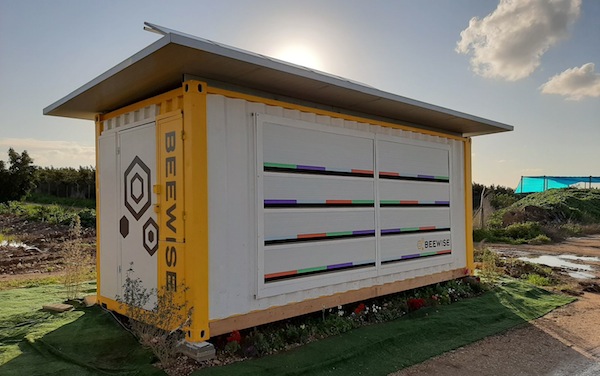
Beewise wants to replace traditional, wooden hives with high-tech, autonomous ones. (photo from Beewise)
What do cucumbers, avocados and coffee all have in common? Aside from being absolute necessities (yes, avocados, too), they’re all crops pollinated by bees. And, if things keep heading in the current direction, we’re screwed.
Bees are extremely important. About one-third of all plants and plant products consumed by humans are dependent on bee pollination. Unfortunately, the combination of modern demand and natural stresses such as climate change, pests and illness mean that the global bee population is dying at a dizzying rate, endangering our diets and well-being.
To combat this, efforts are being made to rehabilitate the bee population. In Israel, these endeavours are given a very Start-Up Nation twist, complete with computer vision, artificial intelligence and precision robotics, which are all part of the world’s first autonomous beehive, developed by Israeli start-up Beewise. Called Beehome, it’s a device that can house up to 40 bee colonies – that’s two million bees – and take care of their health and upkeep through an app on the beekeeper’s phone or tablet.
“It’s what’s called a disruptive innovation,” said Beewise chief executive officer Saar Safra. “We’re coming to replace all the beehives in the world.”
Beewise chief executive officer Saar Safra. (photo from Beewise)
The idea for an autonomous beehive came from Safra’s business partner, Eliyah Radzyner. A beekeeper by profession, Radzyner was aghast at the fact that beekeeping methods have not progressed for ages. He was convinced that a computer, machine or robot could do a much better job, and joined forces with Safra, a serial entrepreneur.
At present, most beehives around the world look like they did some 150 years ago – plain wooden constructions whose upkeep requires beekeepers to dress in full hazmat mode and light a smoker before opening them up, taking care of pests, supplying the bees with food and water and harvesting the honey. All this extensive manual labour means that commercial beekeepers, who take care of most of the bees in the world, only get to each hive about once every few weeks. Lots of bees are lost in between rounds to illness, pests and other problems.
“If you manage to identify the problem at the outset and take care of it in a specific manner, then, first off, it will be a lot less invasive; second, you’ll resolve the problem before it becomes a concern; and, third, you’ll save the bee,” Safra explained.
“We built a beehive that knows how to do these things,” he said, listing its three main components: artificial intelligence, computer vision and precision robotics.
The first, he said, is in charge of recognizing and identifying problems at the very outset. A real-time response is then carried out using computer vision to detect and monitor the situation, with precision robotics executing the required solution. The only things in the autonomous hive that require a human hand are filling the water and food and collecting the honey, which is harvested by machine.
In Beewise’s hives, even the honey is harvested by machine. (photo from Beewise)
While there are other companies trying to take care of bees amid the crisis, no one else has built an autonomous beehive. Currently in beta stage, Beehome is now being used by some commercial beekeepers.
“At first, there’s skepticism, because it’s so left-field,” Safra noted. “The moment we show people the device and that it works, there’s unbelievable excitement.
“There are beekeepers who are second, third or fourth generation. The beekeeper sees how his business is disappearing before his eyes, on his watch,” he added. “Then you suddenly show him this technology, this solution, and he sees that it works. Imagine what a relief that is.
“The idea that we’re saving bees using technology is an amazing thing,” Safra said. “When you take AI and apply it to traditional industries that haven’t been touched in 150 years, the yield is incredible.”
The funding for Beewise came from venture capital funds, as well as from European and Israeli grants. And doing business in Israel has been wonderful, said Safra, who returned to the country some two years ago after 15 years in the United States.
“The ecosystem in Israel is amazing. It’s simply optimized for start-ups,” he said. “There’s also a crazy infrastructure in terms of services and everyone knows how to work in startup mode.”
Beewise aims to be the new standard, Safra said. “There are 90 million beehives around the world. They’re all wooden beehives that don’t work anymore.
“We’re doing well by doing good,” he concluded. “Every hive that I create and which functions and succeeds – the result is more bees alive.”
Israel21cis a nonprofit educational foundation with a mission to focus media and public attention on the 21st-century Israel that exists beyond the conflict. For more, or to donate, visit israel21c.org.
Montreal-based musician Elizabeth Leslie has a new EP out, Brave Animal, which, among other topics, tackles climate change. (photo from Eric Alper PR)
It had always been musician Elizabeth Leslie’s dream to visit Scotland, which her Sephardi ancestors had made their home. For years, she had envisaged hiking the Highlands, reveling in its beauty and experiencing the misty, “dreary” British weather that she had heard so much about.
Learning about the Leslie clan and their lives as Jews intrigued the young Canadian musician, who had been raised in Eastern Canada and is now based in Montreal. But so did the idea of experiencing a truly Scottish spring. So it came as a rude shock, she said, when she finally arrived to the British Isles to be greeted by a drought of parched hillsides and 25˚C weather. Her image of Scotland’s Highlands, she admitted, appeared to be sorely out of date.
“It wasn’t green rolling hills anymore. It was just glaring sun,” said Leslie. “I was peeling off layers and [there was] yellow grass and rampant tourism.”
That experience became a seminal moment for the musician, who attributes the erosion of the Highlands to humanity’s greed and the unrealistic goals of 21st-century capitalism. “Capitalism affects everything,” she told the Independent. “It’s a selfish beast and it’s unsustainable.… Capitalism mixed with climate change and the fact that climate change is a product of capitalism, [makes it] glaringly obvious that we need to completely reimagine the way we live.”
Her recently released EP recording, Brave Animal, speaks to that urgency. Its lead song, “To the Next,” is the summation of what she sees for future generations left to navigate the impacts of a warming planet. Its dark-wave melody is as hypnotic as its lyrics:
“There is only one place left to go / And I’m afraid that it is far / If you listen close / You will soon hear / All their words / Are full of fear.
“Men might be masters of this world / But little girl / We’re going to the next / Men might be fighting against this world / But little girl / We’re fighting for the next.”
According to Leslie, the song was written before Swedish climate change activist Greta Thunberg rose to notoriety. Still, its refrain hits to the heart of a question that is commonly voiced these days.
“When I wrote this song,” Leslie said, “Greta wasn’t around … but [she is] exactly the kind of girl I am speaking to in the song and she is metaphorically what that little girl is.”
Leslie added, “I mean, who is there to comfort Greta Thunberg? Why is there a teenager fighting [against] climate change and why aren’t the older guys in suits doing it with their millions of dollars?”
In Leslie’s eyes, change is motivated by leadership, and she believes there is a dearth of examples for young people to follow these days.
“There’s really no adult role models out there who are really standing up – at least in music,” or none willing to tackle a topic that is already defining a generation’s social and environmental expectations, she said. “I am just trying to give them some glimmer of hope, I guess.”
For this artist, probing difficult questions seems to come naturally, even when the questions are unpopular with those around her. When she learned some years ago that her Scottish ancestors were Jewish, she searched for more information and unearthed stories of the Leslie clan – started by a Jew who had served in a distinguished position for Mary, Queen of Scots, and was a Knights Templar – despite warning from her mother about antisemitism.
Although her mother wasn’t Jewish, she was concerned about her daughter taking on an identity that had been subjected to persecution throughout millennia. The warnings, though, didn’t deter Leslie, who later converted to Judaism.
“My mom had like 10 cups of tea per day and my dad drinks scotch every other night and my uncle plays the bagpipes and all that stuff, so it was a huge surprise in a lot of ways,” said Leslie about discovering her Jewish heritage. “But, for some reason … I always had a feeling about it.”
Although Leslie said her visits to shul are more infrequent these days, she sees a parallel between the values she was raised with and the ethics that Judaism espouses. Fairness and protecting the environment are at the heart of both her identity as a Jew and as a musician, she said. As is social justice. She said she was incensed when she found a book about the Leslie clan and learned that her ancestors were forced to convert to Christianity.
“That connection with the culture and values and also a really deep need to right the wrongs of the past” were key to her decision to convert, she said. “I just found it so unrighteous that my family was forced into this religion [of Christianity]. We already had a religion. I just felt it was so unfair and I wanted to turn back the clock.”
Her identity as a Jew has also been shaped by her relationships. Leslie, who self-describes as a non-binary queer person, was first introduced to Judaism when she dated a woman who had been raised Charedi and maintained a Jewish household. Leslie said the exposure to Jewish traditions was both fascinating and “extremely familiar.”
“I think one thing I love about Judaism is … we have never forgotten who we are,” said Leslie. “And I think that sort of cultural preservation is really important, especially in the face of recent antisemitism, in face of capitalism and climate change and everything, that sort of centreness is a power. And I think it is really important.”
Leslie’s music can be purchased through a number of online venues, including Spotify or by connecting through her Facebook page.
Jan Lee’s articles and blog posts have been published in B’nai B’rith Magazine, Voices of Conservative and Masorti Judaism, Times of Israel, as well as a number of business, environmental and travel publications. Her blog can be found at multiculturaljew.polestarpassages.com.
Tzeporah Berman is international program director for Stand.Earth. (photo from Tzeporah Berman)
There is no silver bullet when it comes to responding to the climate crisis, according to Tzeporah Berman. The 25-year veteran of environmental activism and international program director for Stand.Earth said it needs a multi-pronged approach.
“A lot of people like to say it’s negotiations or policy work or protests, but, in my experience, the most effective campaigns that have made change have been the ones where there has been a diversity of tactics and approaches,” Berman told the Independent. “The most effective initiatives are the ones that are not just about educating, but are about motivating people to take action on an issue…. What we need to try and do is motivate people to make change.”
Berman was among those who started Stand.Earth (formerly ForestEthics) about 20 years ago. According to the website, the group “designs and implements strategies that make protecting our planet everyone’s business. Our current campaigns focus on shifting corporate behaviour, breaking the human addiction to fossil fuels and developing the leadership required to catalyze long-term change.”
In the 1990s, Berman was an organizer of the Clayoquot Sound logging protests that contributed to agreements to prevent clearcutting. More than two decades later, as construction of the then-Kinder Morgan-owned Trans Mountain pipeline expansion ramped up, Berman participated in the sit-ins on Burnaby Mountain.
“The War in the Woods … it was this tipping point moment on the issues and Canadian history, where people were engaged from all walks of life,” she said. “Whether or not the rainforest should be clearcut was a conversation around everyone’s kitchen table. I think that’s true today of climate change and pipelines, that it’s one of these rare moments in history where it is a populist issue, where everyone is engaged in the conversation, and I think that’s why you see, in both circumstances, such a diversity of people showing up.”
Last year, the concern reached a fever pitch in Canada and elsewhere, with unprecedented numbers of people marching in the streets calling for climate action. Asked what Berman thought of elected officials such as Prime Minister Justin Trudeau or NDP leader Jagmeet Singh participating in marches like last September’s global climate strike – that, at their heart, target leaders such as them to address climate change through policy decisions – she said she believes they show up with good intentions.
“We’re living in this strange moment where our elected officials are starting to understand the urgency and importance of climate change, but that is not yet translating into their policy proposals,” she said. “It’s like there’s a time lag and they’re saying the right words about urgency and joining marches, but their policies represent the best thinking on what climate policy should be from 10 years ago. I don’t think they’re being disingenuous when they join a protest … but one of the big problems that we have is that so many people believe that they’re doing enough and other people need to do more. We like to celebrate how progressive we are, but we have a very mixed record. Canada is among the worst in terms of G7 countries with our climate plan.”
Despite estimates of more than one million people in Canada marching in climate strikes last year, Berman said the environmental movement is sorely outnumbered resource-wise in comparison to the oil and gas industry lobby. In a tweet sent at the beginning of this year, Berman spelled out 10 tips for successful activism.
“Do stuff that makes the world respond. Don’t just respond to the world,” she wrote. She expanded, telling the Independent that advocates need to be sure they are the ones setting the agenda, not governments and corporations. “Campaigners and campaigns are not proactive enough, we just respond to what decision-makers are doing. Instead of doing that, what if, months before, you looked at what you think needs to happen in order to protect the climate, our water, the air, produced a report with recommendations for policy, and then held a press conference and a public information night. Then you’re putting a proposal out there of what you think needs to happen in the world.”
Last November, Berman presented to 400 people at Temple Sholom, giving an overview of the scientific evidence of climate change and the role of nations and individuals moving forward. She spoke of the loss of the “culture of engagement.”
“Today, we have a weak civil society engagement muscle and an overextended hyper-consumer muscle,” she said during the presentation.
“We got lazy,” she explained to the Independent. “We live in a democracy, we assume it’s functioning, and leave it up to the politicians…. I’m not exactly sure how it happened, but I think it’s a culture that was eroding over the last generation. Growing up, it was expected in our community that you volunteer – for your synagogue, for your church. We don’t really have that culture now and the result is we’re not engaging in our communities as much as I think we used to. I notice now that we’re starting to see it more as a result of the more active student movements, but I think that’s because they’re scared.”
The role of community groups such as religious institutions should not be underestimated, she added. “People are going to be more willing to engage in the issues if they feel safe, if they feel a sense of common purpose, if they trust the people they’re organizing with. It’s one thing to hear scientists, or read an article. It’s a very different thing to sit down with people in your community … and organize. A lot of people right now are searching for what they can do. [Institutions] should be providing leadership and structure.”
Berman continues to be a leader in her own right. Late last year, she was awarded $2 million US from the Climate Breakthrough Project to fund her efforts to limit new oil and gas development globally to align with the United Nations Paris Agreement goals of a safe climate. The project will be housed within Stand.Earth.
Shelley Stein-Wottenis a freelance journalist and comedy writer. She has won awards for her creative non-fiction and screenwriting and enjoys writing about the arts and environmental issues. She is based on Vancouver Island.
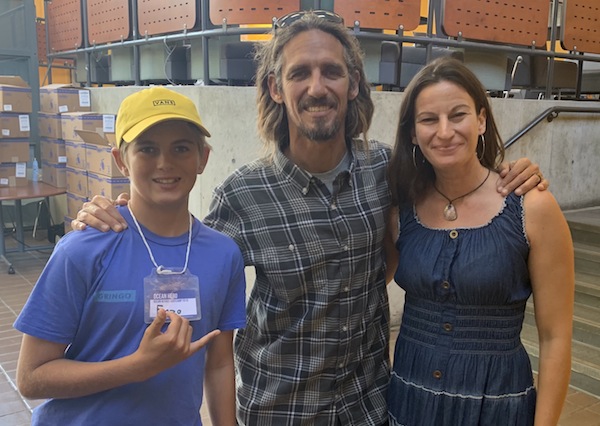
Chatting surf, water refill stations and plastic pollution at Ocean Heroes Bootcamp, left to right: Enzo Ackermann (Ocean Hero), Rob Machado (professional surfer/environmentalist) and Sondra Weiss (art educator). (photo from Sondra Weiss, Founder, Lost Art of Love Letters)
Organized and led by Captain Planet Foundation and Lonely Whale, Vancouver’s Ocean Heroes Bootcamp has a singular purpose – finding ways to save our oceans from plastic pollution.
One of the bootcamp presenters is Sondra Weiss. She offers participants a unique way to inspire action.
Having grown up in Connecticut, close enough to the ocean to fall in love with it, Weiss then went to the University of California. After graduating, she took an art museum educator position, a role she maintained for about two decades. Eventually, however, her love for the ocean drew her to start up the Lost Art of Love Letters.
“I launched this project about four years ago, thinking the world needs more love,” Weiss told the Independent. “As I listen to the news, or my students, or people in the world committing suicide, I just thought that love is a great antidote for everything happening in the world.”
Weiss lives in Santa Barbara, Calif., and was asked to come to Vancouver last year to help with the Ocean Heroes Bootcamp.
“Last year was the second year that they did Ocean Heroes, when I was in Vancouver,” said Weiss. “It brings together 250 local and international youth activists between the ages of 11 and 18, from 20 countries and 24 U.S. states, and the idea is to collaborate worldwide to fight plastic pollution.”
Based out of the University of British Columbia dorms and hosted by Ocean Wise and the Vancouver Aquarium, the next bootcamp is scheduled for June 26-29, though that may change depending on the progress made dealing with the COVID-19 pandemic. Weiss is to lead a part of it called Love Letters to the Sea.
“It is an art-integrative letter-writing project that promotes positive changes for the ocean,” said Weiss. “So, rather than feeling overwhelmed by environmental issues, community members can take action and promote innovation by using their voices to drive policy solutions.
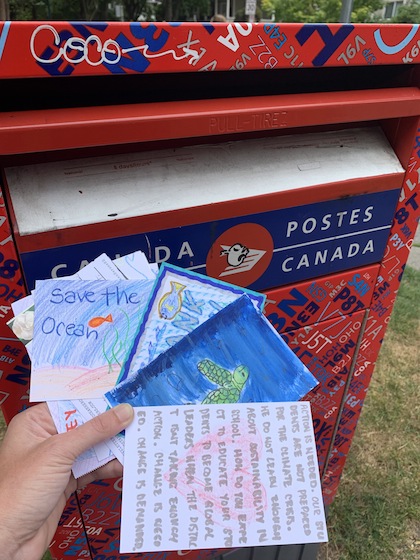
A lot of the letters are sent out to local businesses, council members and political figures to say either thank you for the work they do for the ocean environment, or to ask them to make changes. (photo from Sondra Weiss, Founder, Lost Art of Love Letters)
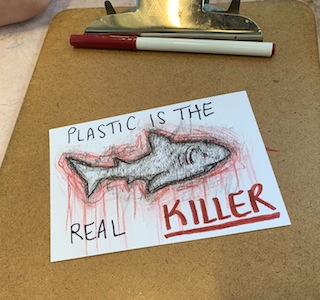
“Participants take pen to paper and brush to paint to express their sentiments, their solutions, for ocean love. And, a lot of the letters are sent out to local businesses, council members and political figures to say either thank you for the work they do for the ocean environment, or to ask them to make changes.”
Last year’s focus was on eliminating single-use plastic bottles. Participants were tasked with developing ideas to help the community achieve this goal.
“As mentors in bootcamp, in general, we come up with ideas and have the youth collaborate, come up with campaigns and talk to experts in different fields, figuring out how to create the most change, being creative and positive the whole time,” said Weiss.
Each Ocean Heroes Bootcamp draws many different people from all around the world, she said, including youth who have created changes in their community or on a wider scale.
“There are experts leading panels, workshops and group activities … and Love Letters to the Sea, my personal activity, is more artistic-based,” she said. “So, there are writing prompts for writing, but there are also images to inspire art. There are watercolours, crayons and coloured pencils for campers to express themselves in various ways.”
While there are age gaps, some of the younger kids have inspired more change than some of the older ones. Regardless of age, all are passionate about the issues and put any age-related ego aside to learn from and with one another, said Weiss.
“One of the beautiful things is that youth from all around the world are working together toward the one topic – and the topic is plastic pollution, what plastic pollution and consumerism is doing to affect the planet as a whole,” she said.
Weiss hopes that the letters “help motivate the people doing good work and also helps the community to remain civically engaged … and be part of society, knowing we can make change and, as an educator, working with youth shows them to use their voice for change.
“We can use that same thing – the letter writing, it has been tried and true throughout the years. When someone wants to try and make a decree, the people will use a letter. Or, to really express something to a friend going through a hard time, or a family member, a lot of times, we’ll take pen to paper and write it down. It’s a great way to slow down. We live in such a fast-paced society. We need to slow down and really think about what’s in our hearts.”
Still, Weiss is well aware of the power of technology when well-used. She has worked with Jack Johnson’s band to create a song written by middle school kids who wrote love letters to the sea.
“They took lines from the letters, which became lyrics for a song,” said Weiss. “Letters are personal, but the way to reach the masses is through music and video. And, we created it into love letters, which are strong and powerful.”
Some of the lyrics produced include: “Water can’t be broken, but we can make her cry / Going to write a love letter to the ocean, let her know we are always going to try.”
“It was phenomenal that the students got to express themselves and sing it out,” said Weiss. “They wrote the notes and the music, and then we went into a recording studio and recorded a different version.
Love Letters to the Sea works to create positive changes for the ocean and environment. (photo from Sondra Weiss, Founder, Lost Art of Love Letters)
“Letter writing is such a great way to get ideas onto paper and out of your mind and heart. The next stage is to bring music and video to a larger global audience.”
Weiss sees artistic letters as a gateway to reaching people on a different level, touching people’s minds in a different way to promote change.
“Images or music definitely help ignite that,” said Weiss. “For me, when you are talking to them and you see the light in their eyes go up, you see them drawn into the conversation.
“So, what does it takes to ignite someone to care? That’s what I ask at the bootcamp. I ask the youth if they are going to write an organization and ask them to limit their plastic packaging. And I ask them what they think would get them to consider the financial cost … and think more about the overall cost, the environmental cost. We learn so much from the kids and they inspire us as much as we inspire them – and the relationships maintain year-round.”
While Ocean Heroes Bootcamp is free to attend for accepted youth and their chaperones, including room and board, there is a $100 reservation fee and travel costs that may be waived via scholarship. All applications to attend the bootcamp are reviewed by Captain Planet Foundation and Lonely Whale. Qualified candidates are contacted by the Ocean Heroes headquarters team to complete registration.
The Ocean Heroes HQ team accepts a maximum of 300 youth leaders each bootcamp. Each attendee is paired up with a team of squad leaders, peers who guide them through the program and ensure they have the tools, support and information they need to graduate from the camp with a successful campaign plan to eliminate plastic pollution. For more information, visit oceanheroes.blue.