Spring. Every year, it returns like a miracle and Israel is carpeted with wildflowers. There are nearly 3,000 types of wild plants in this tiny land, a wonderful profusion, among the most abundant on earth. Israel boasts a variety of different ecological systems – deserts and marshes, high mountains, dense forests and open fields, with wildflowers to suit each habitat.
Wildflowers are protected in Israel and nature reserves prohibit the picking of any flowers, even the most common, which helps them to propagate over wider areas. In turn, this brings the sunbirds, which feast on their nectar.
The Song of Songs, which we read every Passover, is a most beautiful love poem. King Solomon wrote it as a dialogue between a young shepherd and his beloved: “Rise up, my love, my fair one and come away / For lo, the winter is past / The rain is over and gone / The flowers appear on the earth / The time of singing is come / And the voice of the turtle is heard in the land.”
The flowers he refers to, nitzanim, still carpet the fields – shiny red poppies flaunting scarlet beauty in the grass.
In Jerusalem Forest, delicate cyclamens bloom in the crevices between the rocks. Called Solomon’s Crown (in Hebrew), they lift their pink, cream or lilac heads on slender stalks. Clumps of wild violets, the dew shimmering like diamonds, add their touch of magic.
Israel’s rainy season, mid-October to late March, leaves a bequest of green. Sharon Valley is dotted with tulips and narcissus. “I am the rose of Sharon, a lily of the valleys” – it is believed that King Solomon was referring to the magnificent black tulips of the Galilee.
In spring, even the weeds in Israel are pretty – the milk vetch, which is a thistle, adds purple blooms to the roadside. The rockrose is abundant in forest glades and the orange ranunculus bursts into bloom. Like its velvety cousin, the anemone, it is a protected wildflower in Israel.
The perfume of daffodils – which suffused the winter – still wafts on the breeze and the white, cream, yellow and blue noses of lupins are pushing through the soil. Oleanders are in bud, growing wild by the banks of the River Jordan and near streams in Galilee, promising a burst of summer beauty. And the blue statica reminds us that we, too, have a Mediterranean coast like the famed Riviera. This lovely sea plant flowers from mid-spring to mid-summer, when its corolla drops off and only the sepal remains.
Who says Israel has almost no natural resources? When you see the splendour in the grass of the land’s spring glory, the wildflowers glowing like jewels, you’ll echo the poet’s words: “Had I but two loaves of bread / I would sell one of them / And buy white hyacinths to feed my soul.”
Dvora Waysman is a Jerusalem-based author. She has written 14 books, including The Pomegranate Pendant, which was made into a movie, and her latest novella, Searching for Sarah. She can be contacted at dwaysman@gmail.com or through her blog dvorawaysman.com.
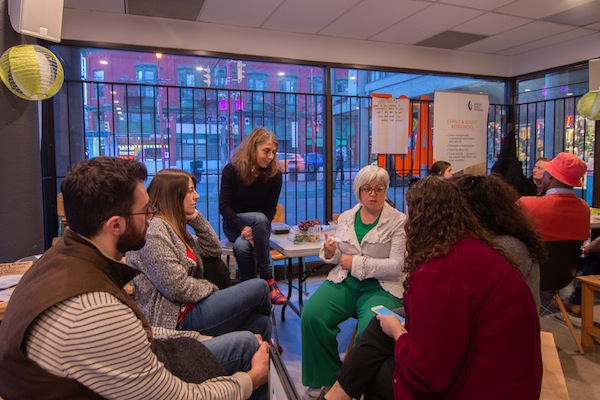
Transportation and sustainability consultant Tanya Paz, centre, participates in Tu b’Shevat Circle: Teachings from the Earth, an event spearheaded by Or Shalom Synagogue in partnership with Jewish Family Services, JQT Vancouver and UNIT/PITT Society for Art and Critical Awareness. Or Shalom’s Rabbi Hannah Dresner is seated on the stool to Paz’s right. (photo by Matt Hanns Schroeter)
More than two dozen individuals whose work involves food security and climate change issues met on Feb. 9 for Tu b’Shevat Circle: Teachings from the Earth, an event spearheaded by Or Shalom Synagogue in partnership with Jewish Family Services, JQT Vancouver and UNIT/PITT Society for Art and Critical Awareness.
Those who gathered work or devote time to such organizations as Grandview Woodland Food Connection, Sustainabiliteens, Coquitlam Farmers Market and Extinction Rebellion. They came together to explore various topics, including how their Jewishness intersects with their work in secular organizations, envisioning a sustainable world and the Jewish community’s role in social justice.
“I noticed that so many of these organizations are spearheaded by young Jews and felt it important to create an opportunity for them to see one another and recognize this aspect of kinship in their work … and whether this commonality enhances the work, draws them into kinship or stimulates any collaboration,” said Or Shalom’s Rabbi Hannah Dresner.
Or Shalom brought on Carmel Tanaka to organize a gathering. Through meetings with young adults and stakeholder groups, Tanaka met a number of people whose careers relate to food security and social justice, but most weren’t working for Jewish organizations nor were they connected to one another within a Jewish context. She and Dresner agreed it was worth bringing them together to see what conversations would blossom.
Tanja Demajo, chief executive officer of Jewish Family Services, said JFS provided funding for the event because they believed in the value of the project.
“There are a lot of Jewish and young Jewish people who are interested in food security and questions of accessibility, which is very interesting from a perspective of … whether this work is modulated by [Jewish] values and how this translates to day-to-day practice,” she said. “At the end of the day, it didn’t really matter if the different participants were working in a Jewish or non-Jewish community.”
Some attendees revealed that, for them, being Jewish is secondary to their focus on environmental issues.
“The room was full of people who identify in varying degrees with their Jewishness and, for some, it’s an important aspect of their identity and, for others, it isn’t integral,” Tanaka said.
Dresner spoke to the indelible connection between environmental action and Judaism. “In my understanding of Judaism, saving our world is at the heart of what it means to have a Jewish spiritual life,” she said. “Creative energy, or the vitality of spirit, is always flowing toward us. It’s what I’d call the ‘world that’s always coming,’ or the ongoing nature of creation. We can encourage and aid this vitality, helping to direct it where most needed, or we can impede the flow. When we are selfish and impede creative flow, the result is a deprivation of generative spirit, spirit denied to corners of creation, and we see results like species blinking into extinction.”
The rabbi wants to spend more time with young Jews working in social justice. “The Judaism I believe in mandates their work as the highest mitzvah of our moment,” she said. “It’s a misconception born of the compartmentalized Judaism in which many of us were raised not to understand that attention to the environment is a Jewish priority.”
Aaron Robinson, chair of Grow Local Society Tri-Cities, a food security group that runs the Coquitlam Farmers Market, said his work for the organization won’t ever have a Jewish mandate, but his Judaism is tied into what he does. “Personally, I can never underestimate the role that Jewish values play in the way I see the world, especially when it comes to tikkun olam,” he said, adding, “I guess it’s become engrained in me, but it was nice to bring it back to the surface to see, wow, there is this Jewish connection to all this work that we’re doing.”
Robinson appreciated the opportunity to connect with other Jews working in similar fields and hopes the conversations will continue.
Some people discussed not feeling supported by the Jewish community to undertake the work they do within a Jewish context. Tanaka said she believes the Vancouver Jewish community hasn’t focused attention on these issues until recently, citing the 2019 climate march and protests as a galvanizing factor, and said it’s time for the local community “to support young Jewish adults who are doing this kind of work … because these are Jewish issues at the end of the day.”
Some at the event suggested funding for environmental advocacy was needed. Dresner said there was also a desire for bridge building. “They seem to be asking for an arm of organized Jewish community to create some occasional containers for their gathering, just to share within the hybrid of their niche or to explore potential collaborations,” she said. “Or Shalom will be looking at finding funding to continue holding this group and its outgrowth in a loose, nurturing embrace.”
Demajo said the JFS food security program has already benefited from the event. “Being exposed to more city-wide programs and initiatives and being exposed to all different voices gives a different perspective to JFS,” she said, “because it opens up new ideas.”
Shelley Stein-Wotten is a freelance journalist and comedy writer. She has won awards for her creative non-fiction and screenwriting and enjoys writing about the arts and environmental issues. She is based on Vancouver Island.
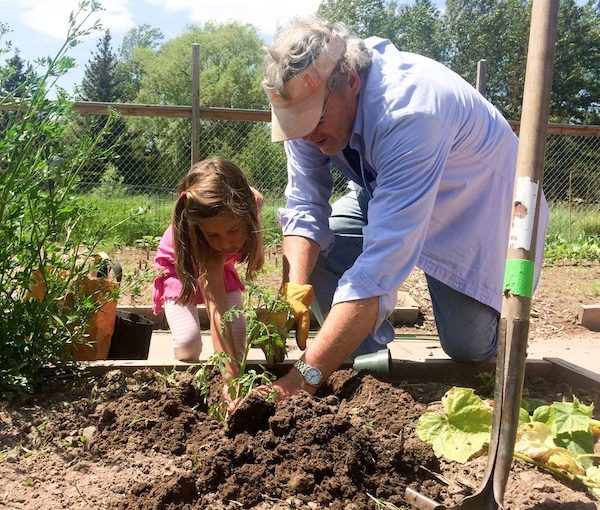
People who spend time gardening, doing yard work and have direct contact with soil feel more relaxed and happier. (photo by Brad Greenlee)
It’s natural to long for spring when it’s cold outside. But there’s a good reason why you may pine for green. Living landscapes are an important part of the outdoor lifestyle that North Americans enjoy, but the benefits go beyond the barbeque and backyard baseball. Green spaces are necessary for our health.
“The advantages of grass and landscaping surpass the usual physical benefits that result from outdoor activity,” said Kris Kiser, president and chief executive officer of the Outdoor Power Equipment Institute (OEPI). “Numerous studies have found that people who spend more time outside or are exposed to living landscapes are happier, healthier and smarter.”
Researchers have studied the impact of nature on human well-being for years, but recent studies have found a more direct correlation between human health, particularly related to stress, and the importance of people’s access to nature and managed landscapes.
Getting dirty is actually good for you. Soil is the new Prozac, according to Dr. Christopher Lowry, a neuroscientist at the University of Bristol in England. Mycobacterium vaccae in soil mirrors the effect on neurons the pharmaceutical provides. The bacterium stimulates serotonin production, which explains why people who spend time gardening, doing yard work and have direct contact with soil feel more relaxed and happier.
Children who are raised on farms, in a “dirtier” environment than an urban setting, not only have a stronger immune system but are also better able to manage social stress, according to the National Academy of Sciences.
Studies have shown that people who spend more time outside or are exposed to living landscapes are happier, healthier and smarter. (photo from pxhere.com)
Living near living landscapes can improve your mental health.
Researchers in England found that people moving to greener areas experienced an immediate improvement in mental health that was sustained for at least three years after they moved. The study also showed that people relocating to a more developed area suffered a drop in mental health.
Greening of vacant urban areas in Philadelphia reduced feelings of depression by 41.5% and reduced poor mental health by 62.8% for those living near the vacant lots, according to one study.
According to Dutch researchers, people who live within a half mile of green space – such as parks, public gardens and greenways – were found to have a lower incidence of 15 diseases, including depression, anxiety, heart disease, diabetes, asthma and migraines.
A 2015 study found that people living in areas with more trees had a boost in heart and metabolic health. Other studies show that tasks conducted under the calming influence of nature are performed better and with greater accuracy, yielding a higher quality result. Spending time in gardens, for instance, can improve memory performance and attention span by 20%.
Living landscapes can also make you smarter. Children gain attention and working memory benefits when they are exposed to greenery, says a study led by Payam Dadvand of the Centre for Research in Environmental Epidemiology in Barcelona. In addition, exposure to natural settings may be widely effective in reducing attention deficit/hyperactivity disorder symptoms in children.
Research has shown for adults, as well, that being around plants helps them concentrate better at home and at work. Charlie Hall, Ellison Chair in International Floriculture at Texas A&M, believes that spending time in gardens can improve attention span and memory performance by as much as 20%.
A National Institutes of Health study found that adults demonstrate significant cognitive gains after going on a nature walk. In addition, a Stanford University study found that walking in nature, rather than a concrete-oriented, urban environment, resulted in decreased anxiety, rumination and negative affect, and produced cognitive benefits, such as increased working memory performance.
Living landscapes also can help you heal faster. Multiple studies have discovered that plants in hospital recovery rooms or views of esthetically pleasing gardens help patients heal up to one day faster than those who are in more sterile or austere environments. Physicians are now prescribing time outdoors for some patients, according to recent reports, and Park Rx America is a nonprofit with a mission to encourage physicians to prescribe doses of nature.
All of these benefits reinforce the importance of maintaining our yards, parks and other community green spaces. Trees, shrubs, grass and flowering plants are integral to human health. Not only do they provide a place for people and pets to play, they directly contribute to our mental and physical well-being.
Having always lived in and around rainforest, CBC Vancouver’s Matthew Lazin-Ryder said the desert is a place he still struggles to fully understand.
“The desert has always seemed to be an imaginary place,” said Lazin-Ryder, contributing producer of the radio-documentary What Happens in the Desert. “My only contact with the desert has been in movies, storybooks, religious metaphors and things like that. The closest I have ever gotten to the real desert is having spent a little time in New Mexico, but, even then, I don’t think I was in true, scientific desert. My impression of what the desert was in my imagination was different than reality.
“One thing I wasn’t prepared for in my time in New Mexico was how cold it got at night, because it can get really cold. The imaginary desert in my mind was always hot – nights are sweltering, empty spaces, desolation.”
Matthew Lazin-Ryder, contributing producer of the CBC radio-documentary What Happens in the Desert. (photo from CBC Radio)
In the radio documentary, which is an episode of the CBC Radio show Ideas, Lazin-Ryder explores various perceptions of the desert, stemming from culture, such as movies, novels and poetry, which often only portray one aspect of the landscape.
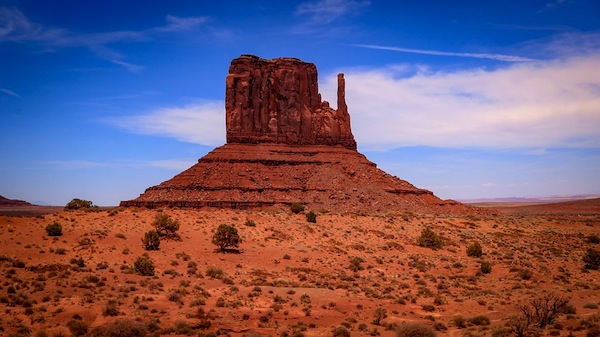
“An example we use in the documentary is Monument Valley in Utah, which, if you’ve seen a western film, it’s in so many movies,” Lazin-Ryder, who is a member of the Jewish community, told the Independent. “So, Monument Valley is that part of Utah, with red sand and rock, with these big towers of rock jutting out of the middle of the desert. John Ford, legendary western director, shot over 10 movies there at Monument Valley and lots of other classic western movies have used the backdrop of this valley as the setting.”
However, while it may seem that many films are shot in Monument Valley, most are actually shot in less-known locations in states like Texas, California and Arizona.
“It’s never specifically that this movie or story is taking place in Monument Valley,” said Lazin-Ryder. “It just becomes a symbol of the desert, which is a stand-in for an alien place, an exotic place, a place that you’ve never been to.”
From a religious perspective, the experts Lazin-Ryder interviews often speak of duality, where the desert is both a place where God is absent and where God is felt the strongest.
“The desert, in the Old Testament, is a place of deep spirituality and is also, for the Israelites, the place where they encounter God, where God travels with them,” he explained. “In the Christian New Testament and Christian culture later on, the desert becomes a place, not of exile and separation from God, but a place you go to escape civilization and to connect with God. Simultaneously, it’s a place where there are dangers … and the devil lives there and there are poisonous creatures, and it’s a place of death, wasteland and absence of God. But, at the same time, the desert is the place, both for the Israelites and early Christians, a place to go to connect with God.
“In a sense,” he said, “the desert, through its absence, represents God, because you can’t fully describe God – you can’t fully describe absence. The desert represents this strange relationship that we have with God, in a religious metaphor – at the same time that God is everything, God is nothing, and indescribable.”
In the documentary, Lazin-Ryder talks about the way the desert is portrayed in science-related and apocalyptic movies – movies that portray the future world as a desert; that climate change, if it continues apace, will leave the whole earth a desert.
“The seas will dry up, the forests will die and everything will be desert waste … which is not particularly an ecologically valid prediction … but, it’s a helpful metaphor for people to think about the dangers of climate change,” he said.
“The other thing is that, when talking about climate change and things like switching to less carbon-intensive energy, the desert becomes a very easy thing for people to say … ‘Hey! You know what would be great? Let’s just put a whole bunch of solar panels and windmills and stuff in the desert, because that’s empty land and it gets a lot of sun.’ You can Google it – there are all kinds of plans that people have pushed, to put acres and acres of solar panels in the Mojave Desert, the Sonoran Desert or the Sahara Desert.
“It’s this kind of a science-fiction idea that, hey, we have these empty spaces on the earth – let’s absolutely fill them with solar panels and windmills. But, the problem with that is – it comes from this thinking about deserts as though they are empty, ownerless places, absent of life. And, the problem is that that’s not true. Deserts are full of life, of plants and of animals that have adapted in interesting ways. And, we also don’t quite understand the place that deserts have in the broader ecosystem, in terms of the carbon cycle.”
While we hear in the news about desertification, in actuality only some deserts may get bigger and others drier, he said. Very few reports talk about the fact that some deserts may get wetter and, in a sense, shrink.
Desert systems are intricate and delicate and we, as humans, often only notice a change when it is already too late. Lazin-Ryder gave the example of the Joshua trees in the Mojave Desert that are dying, and the efforts to preserve them.
“Those kinds of problems are expected to increase as climate change goes on,” he said. But, talking about the desert as merely land available to fix the problems that we have created, “neglects the fact that they are not absent, marginal places. They actually have a place in the world. Deserts are a natural thing that should exist on the earth,” he said. “And there will be increasing pressures to put things in the desert, to put people in the desert, to grow food in the desert – despite the fact that they are as important and as under threat as places like the rainforests and wetlands that we’re trying to preserve. So, on one hand, we’re afraid the future might become desert, but, on the other hand, we may want to think about how to preserve the deserts we already have, as there are many threats to the desert.”
Lazin-Ryder hopes listeners of the documentary will gain a better grasp of the nuances of the desert. For most people in the West, he said, “interaction with the desert is in an imaginary sense … either in religious texts, fiction or movies.” The show tries to get people to consider “what those metaphors and symbols do to our thinking – not just about the desert, but of all the natural world; in what places are worth preserving, celebrating, and what places we think of as marginal, empty, dead or inherently bad.
“We get lots of stories told to us all the time, about what parts of the earth are good or bad,” he said. “I think, ultimately, beyond whether we’re talking about deserts, dry land or wet land, my ultimate hope is that it helps people think about the stories that we tell ourselves about the natural world, versus trying to gain an understanding about how the natural world actually works.”
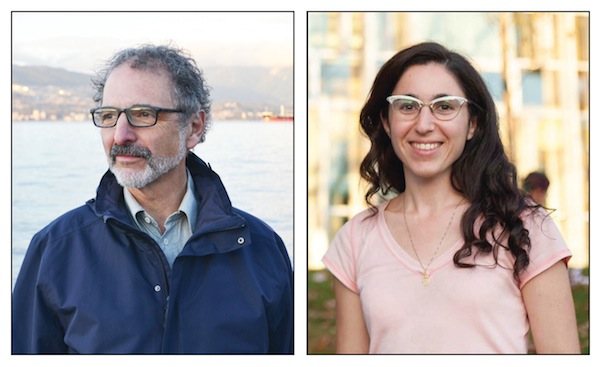
Dr. Larry Barzelai and Maayan Kreitzman will talk about environmental activism at Limmud on March 1. (photos from the interviewees)
Environmental activism is among Canada’s top news stories in recent days and the issue will be confronted from both a Jewish and a broader perspective by two leading voices at Limmud Vancouver next month.
Dr. Larry Barzelai, a Vancouver family doctor, assistant professor at the University of British Columbia’s faculty of medicine and B.C. chair of Canadian Association of Physicians for the Environment (CAPE), will present alongside Maayan Kreitzman, a PhD candidate at the Institute for Resources, Environment and Sustainability at UBC. The pair acknowledges that they come at the topic using different tactics, but aim for the same objective.
Kreitzman has been among those blockading the port and traffic.
“The actions happening in the streets right now are in response to this Coastal GasLink natural gas pipeline construction on Wet’suwet’an land,” she said. But this is only one element of the much larger picture, which is that oil and gas development is “occurring unabated and greenhouse gas emissions and ecological destruction is continuing unabated throughout the world, when we know that these activities are threatening our life-support system and are putting billions of people at risk over the next decade. People are already being impacted today.”
The issue brings together a host of concerns, she said, including “indigenous rights and sovereignty, the Canadian government’s complicity in a climate-unsafe future … as well as the business side of that from the private sector.”
Kreitzman has heard the complaints that disruptive protests may turn off potential allies and anger the general public.
“I think people’s emotions are valid and there is a valid concern about disrupting ordinary people that need to make a living and need to take care of their families,” she told the Independent. “On the other hand, I think many of the people that sometimes make these kind of complaints aren’t really the people that are struggling to feed their families. People that come from a place of privilege need to recognize that these protests inconveniencing them is a small price to pay for the types of progressive changes that will benefit all of us, including their children.”
Kreitzman said she and Barzelai will “bring a concise summary of the latest science to people so that they really understand the magnitude of the situation that we’re in.”
She said, “We’ll be speaking to a spectrum of different actions, from the personal to the more conventional campaigning type of approaches, like report-writing, research, lobbying, letter-writing, to direct-action approaches, which is what I’m most interested in, where people that have privilege start putting their bodies on the line and breaking the law on purpose, using the message of nonviolent civil resistance, which has been successful in many movements throughout history.”
Barzelai takes a more conventional approach to advocacy, but shares Kreitzman’s sense of urgency.
“Climate change, which we’re calling a climate emergency, is upon us,” he told the Independent. “It’s dramatic and we have to take big steps to do something about it. Maayan is taking a bit more radical approach to this. Myself and my group are a bit more middle-of-the-road, shall we say, but I think we both have the same endpoint in mind – that things have to change dramatically.”
CAPE, which has been around for about 25 years, focuses on the health impacts of environmental decisions and climate change.
“We see diseases that are spreading, we see cancers that are becoming more rampant, we are seeing the floods and the wildfires and the temperature changes that are dramatically affecting people’s health and we figure it’s our responsibility as doctors to look at climate change from a health perspective and to inform people of what’s going to happen unless we make dramatic changes,” he said.
Fracking is one area where he thinks British Columbia is “really going down the wrong path.”
“They’ve bought this myth that natural gas is clean energy, which it is absolutely not, and they are doing their best to increase rather than decrease global warming, and we think that’s the crucial issue that needs to be discussed in Canada and especially in B.C.,” he said.
Kreitzman and Barzelai will speak at Limmud Vancouver on March 1.
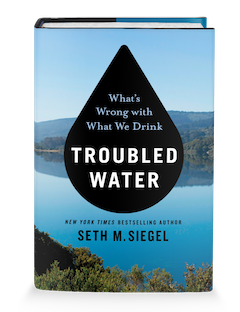
Seth Siegel’s latest book is Troubled Water: What’s Wrong with What We Drink. (photo from Seth Siegel)
With approximately seven percent of the world’s renewable water resources within Canada’s borders, it would seem that we should have little to worry about when it comes to agriculture and potable needs. But our drinking water is at risk, said Seth Siegel, author of Troubled Water: What’s Wrong with What We Drink.
Siegel has spent the last half-decade studying the quality of drinking water. While his book focuses specifically on U.S. water sources, he said water quality is also a concern for Canadians and he worries that neither country is really prepared to address the threat of contaminants from our technological age: plastics, undetected chemicals and aging, inadequate infrastructure.
All of the issues that Siegel examines in his book regarding U.S. drinking water have been raised in recent years in Canada-based research. In many ways, Siegel’s exposé on the environmental impacts of toxic substances, chemicals and medication in the United States is a mirror into our own environmental dilemmas, as Canada is home to many of the same industries and technological challenges. It’s also home to its own significant problems with water purification in rural indigenous communities.
Lead in drinking water
The Flint, Mich., lead water crisis of 2014 may have faded from newspaper headlines, but researchers are still warning about the levels of lead in American and Canadian drinking water. While we are exposed to lead daily in minuscule amounts from the environment, both countries’ federal governments publish guidelines to stringently limit exposure – because lead is a neurotoxin. In Canada, old (pre-1970s or so) water pipes or solder were made with lead, while more recently made pipes do not contain the substance.
In March 2019, Health Canada tightened the guidelines for lead in potable water from a maximum of .01 micrograms (mcg) per litre to .0005 mcg/litre. The decision coincided with a yearlong investigation by Canadian journalists to determine how prevalent lead was in tap water. Some 300 homes in 11 cities were tested and, as expected, newer homes connected with updated water systems had acceptable readings but neighbourhoods with lead service lines or antiquated interior pipes had excessive lead in tap water. One older home in Whistler produced readings more than 12 times the maximum limit, and some 20 communities in Montreal were found to still have lead service lines.
What often makes things worse, Siegel told the Independent, is that updating service lines and interior water lines aren’t inexpensive undertakings and homeowners, who may not have the expertise to weigh the urgency of those changes, often have to bear the cost of upgrades.
Microplastics and more
Lead isn’t the only health risk homeowners face. Microplastic contamination, which has been traced, in part, to the use of plastic bottles, is a growing concern in Canada, home to a robust bottled water industry. Researchers at McGill University, the University of Toronto and several institutions in the United States are currently undertaking studies to determine the prevalence and effect of microplastics in the environment, including on local marine life.
While the World Health Organization states there isn’t enough evidence to confirm that ingesting microplastics is harmful to humans, Siegel and other researchers disagree. As he details in his book, there is now compelling research to suggest microplastics can actually “disrupt the human body’s hormone-related activity,” especially in children.
Becoming advocates
Still, Siegel cautions that his book isn’t an appeal to simply throw out the technology we use. “None of this is a call to ban plastic,” he said, noting that, “just more than 100 years since its first commercial use, plastic is the dominant material of our times. If one wanted to do so, it would be nearly impossible to go even a day without contact with it in some form.”
The answer, he said, is advocacy: educating ourselves and taking proactive approaches that steer both companies we invest in and the experts that oversee their products’ safety, so that materials are exhaustively tested and verified as safe for dependent, long-term use.
“Because your health and the health of your family rely upon your drinking water being of good quality, it’s important for you to get this right,” said Siegel, who said he hopes the data he has provided will help inspire a “citizen’s movement” to change the way drinking water is tested, approved and protected in the United States and elsewhere.
Troubled Water is Siegel’s second book on drinking water management. His New York Times bestseller, Let There Be Water: Israel’s Solution for a Water Starved World, published in 2015, delved deeply into Israel’s national water management system and the mechanisms that have made the country a sought-after resource on drought management in an era of climate change.
A graduate of the Hebrew University of Jerusalem and a successful entrepreneur and expert in patent law, Siegel said the book’s concept has been licensed in his name, but he is not charging royalties for its use. He said he wants to encourage other countries to use it as a template to inspire environmental change in their communities.
“[Every] country in the world is dealing with the same contaminants,” said Siegel. “They may have a different regulatory regime. Obviously, not everybody has the U.S. [Environmental Protection Agency] … but, whatever the local problems are, they are more similar than different.”
Both of Siegel’s books, as well as other resources, are available through his website, sethmsiegel.com.
Jan Lee’s articles and blog posts have been published in B’nai B’rith Magazine, Voices of Conservative and Masorti Judaism, Times of Israel, as well as a number of business, environmental and travel publications. Her blog can be found at multiculturaljew.polestarpassages.com.
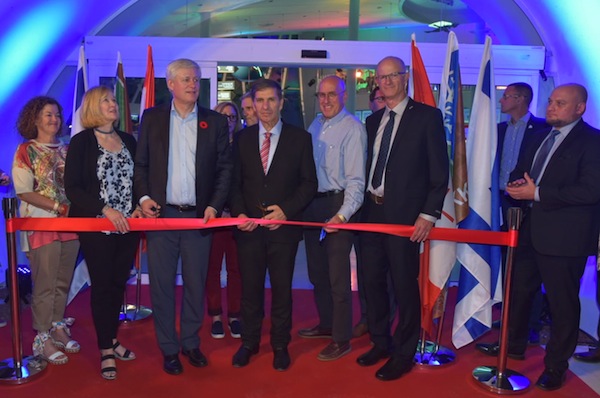
Laureen and Stephen Harper, centre left, and Daniel Atar, KKL-JNF world chair, centre, were among those who cut the ribbon at the Nov. 6 official opening of the Stephen J. Harper Hula Valley Bird Sanctuary Visitor and Education Centre. (photo by Michael Huri)
Former Canadian prime minister Stephen Harper was in Israel earlier this month for a four-day visit with a delegation from the Jewish National Fund of Canada, where he took part in the dedication of the new visitors centre at JNF Lake Hula Park in northern Israel, which is named in his honour.
Budgeted at $25 million Cdn, one-fifth of which was raised by the JNF of Canada, the Stephen J. Harper Hula Valley Bird Sanctuary Visitor and Education Centre south of Qiryat Shmona is seen as “the flagship project of Keren-Kayemet L’Yisrael (KKL),” the JNF’s Israel-based sister organization. Harper contributed to the cost of the project, and the auditorium is named for his wife, Laureen, in recognition of her service to Canada, friendship to Israel and dedication to the preservation of nature and wildlife.
Stephen Harper was honoured at the JNF of Canada’s 2013 Negev Dinner in Toronto. At the time, then-JNF chief executive officer Josh Cooper said: “Given his well-documented love of animals, we felt this would be an appropriate project to present to him.”
Now completed, six years after fundraising began, the facility promises to transform the experience of ornithologists and bird watchers who come to the Hula Valley. There, they can watch the twice-a-year seasonal migration of 500 million birds from more than 500 species, from Europe and Central Asia to Africa, and back.
The Hula Valley, located in the shadow of Mount Hermon, is considered the crown jewel of Israeli conservation efforts. Known in the Bible as Merom, up until the 1950s, it was full of swampland that was notorious for breeding malaria-carrying anopheles mosquitoes. In the 1950s, the wetlands were drained, with the hope that fertile farmland would result; instead, environmental devastation and the extinction of some indigenous species followed. Farming in the area was never successful and JNF ultimately decided to reflood part of the former lake.
Known in Hebrew as Agamon Hula (Little Lake Hula), the flat valley is filled with an array of birds, including cranes, pelicans and eagles. Visitors can observe the birds and also cycle around the site.
***
At the gala dinner Nov. 5 in honour of Harper, which took place at the Waldorf Astoria Hotel in Jerusalem, Israeli Prime Minister Binyamin Netanyahu spoke about the danger Iran’s nuclear ambitions poses for Israel, the Middle East and the West.
“Iran expands its aggression everywhere. It seeks to envelop Israel. It seeks to threaten Israel. It seeks to destroy Israel. We fight back,” Netanyahu said. “I also want to say, given Iran’s efforts to expand its nuclear weapons program, expand its enrichment of uranium for making atomic bombs, I repeat here once again – we will never let Iran develop nuclear weapons. This is not only for our security and our future; it’s for the future of the Middle East and the world.”
Netanyahu was particularly concerned about Tehran’s plans to start injecting UF6 (uranium hexafluoride) gas into the centrifuges to enrich uranium to five percent at the heavily fortified underground Fordow Fuel Enrichment Plant, located inside a mountain 32 kilometres northeast of the Shi’ite holy city of Qom.
Earlier in the day, Iran’s nuclear chief Ali Akbar Salehi promised that his country would violate the element of the 2015 nuclear deal known as the Joint Comprehensive Plan of Action, which Tehran had worked out with the P5+1 (China, France, Germany, Russia, the United Kingdom and the United States). The United States left the deal last year and has imposed sanctions on Iran in an attempt to force it to renegotiate the document. Tehran, in turn, has begun violating the deal in an attempt to pressure the United States to recall the sanctions.
Under the 2015 agreement between Iran and world powers, Iran agreed to turn Fordow into a “nuclear, physics and technology centre,” where 1,044 centrifuges would be used for purposes other than enrichment, such as producing stable isotopes, which have a variety of civil uses. The deal bans nuclear material from Fordow and, by injecting UF6 into centrifuges, the facility will become an active nuclear site rather than a research plant as permitted under the pact.
***
Since leaving Parliament after the Conservative party was defeated in the 2015 federal election by the Liberals, Harper has become president of the Awz venture capital fund advisory committee. The fund, founded by managing partner Yaron Ashkenazi, specializes in investments in Israeli security and intelligence startups, and manages $100 million in assets. The fund has invested in 12 companies to date, according to the Israeli financial website Globes.
Harper, an enthusiastic supporter of Israel, has visited many times. On Jan. 20, 2014, he addressed the Knesset plenum, saying: “It is, thus, a Canadian tradition to stand for what is principled and just, regardless of whether it is convenient or popular. But, I would argue, support today for the Jewish state of Israel is more than a moral imperative, it is also of strategic importance, also a matter of our own, long-term interests…. For too many nations, it is still easier to scapegoat Israel than to emulate your success.”
About the education centre, he said in a statement, “This park is one of the greatest restoration stories, just like this country is to the Jewish people. It is a magnificent honour to have this centre named after my name, and I am grateful for this beautiful occasion.”
Gil Zoharis a writer and tour guide in Jerusalem, Israel.
Ilana Zackon and Ariel Martz-Oberlander played current-day partisans in the immersive theatre piece Time Machine. (photo from Radix Theatre)
Two Jewish theatre artist-creators, Ariel Martz-Oberlander and Ilana Zackon, teamed up this summer to create an immersive piece based on the Jewish partisan movement, as part of Radix Theatre’s futuristic play Time Machine, set on a boat, the Pride of Vancouver.
The show took place on the yacht over a five-hour journey up Indian Arm (traditionally known as səl̓ilw̓ət) and featured both local emerging and established artists presenting new work of various genres, such as theatre, spoken word poetry, sound installation and more. The artists were asked to create a piece inspired by what Vancouver will look like in the year 2050. Some darker, others playful, the works were all grounded in a strong sense of the artists’ identities.
Martz-Oberlander and Zackon wanted to bring their ancestral roots into their piece. The pair created an immersive show in which they played two rebels helping smuggle climate refugees to safety. The 10-minute piece, which ran on a loop for an hour-and-a-half of the boat ride, took place in the boat’s basement bathroom, which acted as a safehouse. Five to seven audience members at a time were summoned by Zackon, dressed as a soldier, down into the dimly lit bathroom, where they were greeted by a similarly dressed Martz-Oberlander; “Zog Nit Keynmol” (“The Partisan Song”) played in the background.
The invited audience soon discovers they are now refugees who have just escaped fires in California. The soldiers, members of a new wave of partisans called PAP, explain that the refugees are being brought to another safehouse and prepared to enter the new world. The soldiers explain that their resistance cohort has based their movement on the survival lessons of their ancestors, partisan fighters in the forests of occupied Europe. The audience members are given new names, briefed on the types of skills, such as hunting moose, that they will need to survive in their new lives and, eventually, led into a discussion on identity.
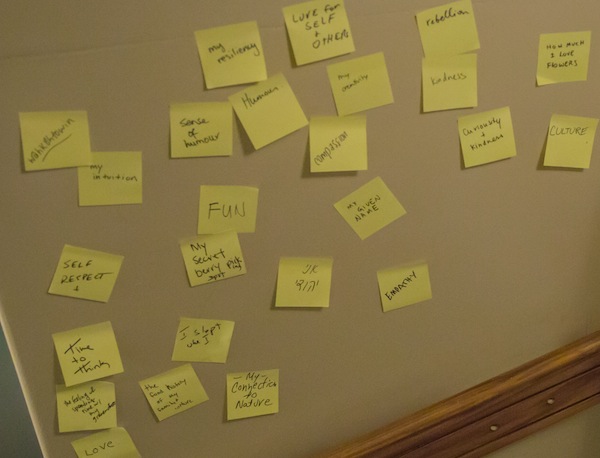
“What’s better: start over or remember where you’re coming from?” Martz-Oberlander’s character asks. The two soldiers bicker over their differing views and invite the audience to contribute. After the group has spoken, the soldiers receive word that it is safe to move the refugees. Before leaving, audience members are given the option of writing down “one thing about their identity they don’t want to lose in the new world” on a sticky note. The notes lined the stairwell and, as the loop continued, more and more words were added, creating a tapestry of human identity. The notes lined the bathroom walls for the remainder of the boat ride, and included such items as “curiosity and kindness,” “time to think,” “my favourite berry picking spot,” “my knowledge of languages” and “the giggles of my daughter,” among many others.
Audience members were given the option of writing down “one thing about their identity they don’t want to lose in the new world” on a sticky note. (photo by Didier Brûlé-Champagne/DBC Photographie)
A number of the boat passengers who attended the piece were Jewish and shared how they connected with their ancestors through remembering their stories. Many non-Jews had never heard of the partisan movement and the two artists felt the work they did helped educate people on an important part of history.
Zackon and Martz-Oberlander also received, from the Jewish Museum and Archives of British Columbia, transcripts of interviews with Jewish refugees coming to Canada during the 1930s and 1940s. These testimonials were hidden around the safehouse and incorporated into the performance. The two artists hope to receive the opportunity to continue developing and expanding this work and to incorporate more of their own personal family stories about immigration to Canada.
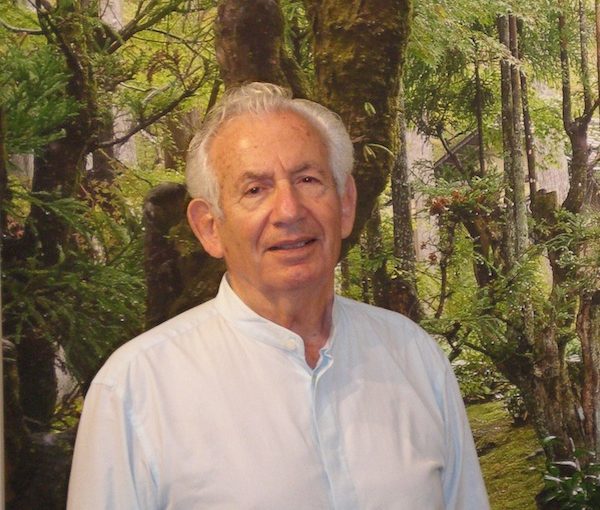
Michael Seelig is donating the proceeds from his exhibit Trees to the Zack Gallery. (photo by Olga Livshin)
Trees, Michael Seelig’s new solo photography exhibit at the Zack Gallery, opened last week. It is a fundraiser for the gallery, which is located in the Jewish Community Centre of Greater Vancouver.
Such philanthropic initiatives “are of ultimate importance to the gallery and the community, as everybody wins when the gallery is well-supported,” said Zack director Linda Lando. “We have approximately three benefits a year, and they come in different ways. Sometimes, they’re initiated by the artist, sometimes by myself or another staff member of the JCC.”
Seelig’s decision to donate all the proceeds came from the heart, and it’s not the first time. His previous show at the Zack, which was held five years ago, was also a benefit. “This is my way of contributing to the JCC,” he said in an interview with the Independent. “We have a longstanding connection to the centre. My wife was president of the JCC some time ago, and we’ve given several donations to the community over the years.”
Unlike his previous show, which focused on architectural images – Seelig was an architect before he retired – this show is all about trees. A cornucopia of greens dominates the gallery walls.
“When Linda asked me to do a show this year, I didn’t have much in mind,” he said. “I started going through my photographs, selected the best 20, and then realized that eight of them were photos of trees. Looking back, I’ve always photographed trees. Maybe I have an affinity for trees. So, I thought I’d make it the theme of this entire show.”
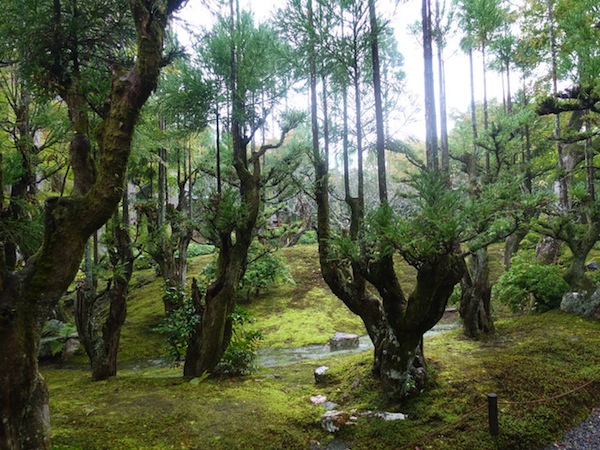
“Garden Kyoto” by Michael Seelig.
Seelig has been drawn to trees and their unique charm for a long time. “I think my love of trees comes from my childhood, when I was growing up in Israel,” he said. “Jewish people are the only ones I know who have a holiday dedicated to trees: Tu b’Shevat. During that holiday, we cherish trees, plant them, take care of them, so they can take care of us. That tradition probably influenced me from a young age to love trees and photograph them. I take photos of trees wherever I travel.”
In the Zack exhibition, there are pictures of trees from Israel and Scotland, Canada and Japan.
“There is a book I read recently,” Seelig said, “called The Hidden Life of Trees, by Peter Wohlleben. He is a German forester and writer and he knows trees. He says trees form communities. They communicate with each other and with us. It was a fascinating book, and I agree with the author; his book inspired me. Have you noticed that old stumps sprout new growth sometimes? That is because there are other trees around. Trees are life-givers; they create the air we breathe. Without trees, there would be no life on earth.… In Canada, and particularly in British Columbia, we often take trees for granted. Most of us do not pause to look at them and admire their beauty, solidity and permanence. We forget that, without trees, our planet cannot survive. This show pays homage to trees in many parts of the world.”
Seelig’s trees are all different; each one has its own shape and personality. Some are gnarled and twisted, while others stretch up in straight lines.
“I like it that they don’t talk to me,” he joked. “Trees are my models, but they’re more obedient than people when it comes to posing for a photo. I can take my time snapping pictures of trees. They are perfect photography objects. A tree just stands there. You can walk around it, see it from 360 degrees or from underneath. And every view is different. You can’t do this with a person.”
In addition to Seelig’s photographs of trees, the show includes several watercolours, most of which he painted specifically for this exhibit. Only two small works are exceptions. “When I was looking through my archives in preparation for this show, I found a small painting, created by my father in 1940. He painted a street in Haifa, and there is a tree in the image. The second painting is mine; I painted it in 2010, also in Haifa. Seventy years passed between these two paintings, but their colour schemes are surprisingly similar. And there are trees in both paintings.”
The sizes of the images on display vary greatly. While Seelig’s father’s painting would fit in a school notebook, and most of the photographs are the perfect size for a family home, a huge triptych on canvas of one of his Kyoto garden photos would enliven a hotel foyer or a corporate conference room. “I invited some designers to the show,” Seelig said. “Maybe one of them would like it.”
Seelig’s approach to photography is consistently organic. He doesn’t edit his photos with Photoshop, doesn’t even crop them.
“My pictures are exactly what I see,” he said. “And now you see them, too. There are other photographers who manipulate their photos with editing software, many of them wonderful artists, but I don’t do that. I don’t call myself an artist either, even though I use my creativity for many things in my life. I used artistic judgment for my work as an architect, before I retired. Now, I make greeting cards and wedding invitations with my photographs and my paintings. I illustrated a couple of children’s books, written by my daughter and her husband. Even making dinner for our friends is a form of art for me.”
The Trees exhibit runs until Oct. 20.
Olga Livshin is a Vancouver freelance writer. She can be reached at olgagodim@gmail.com.
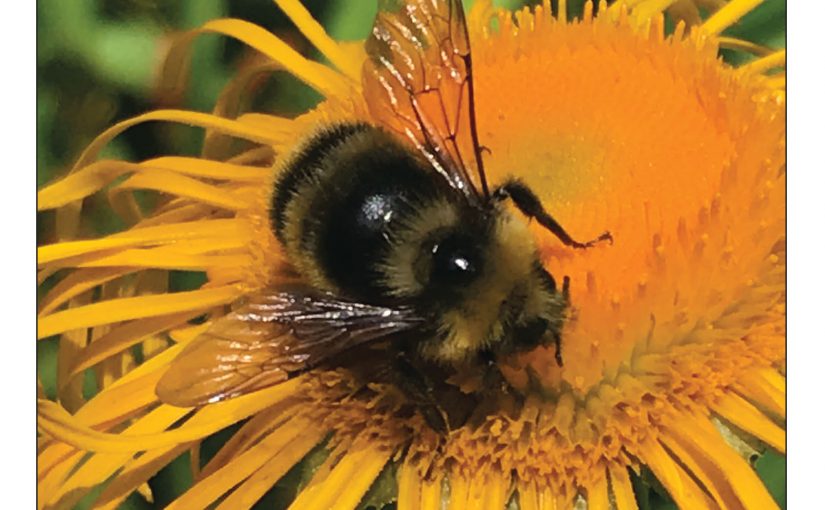
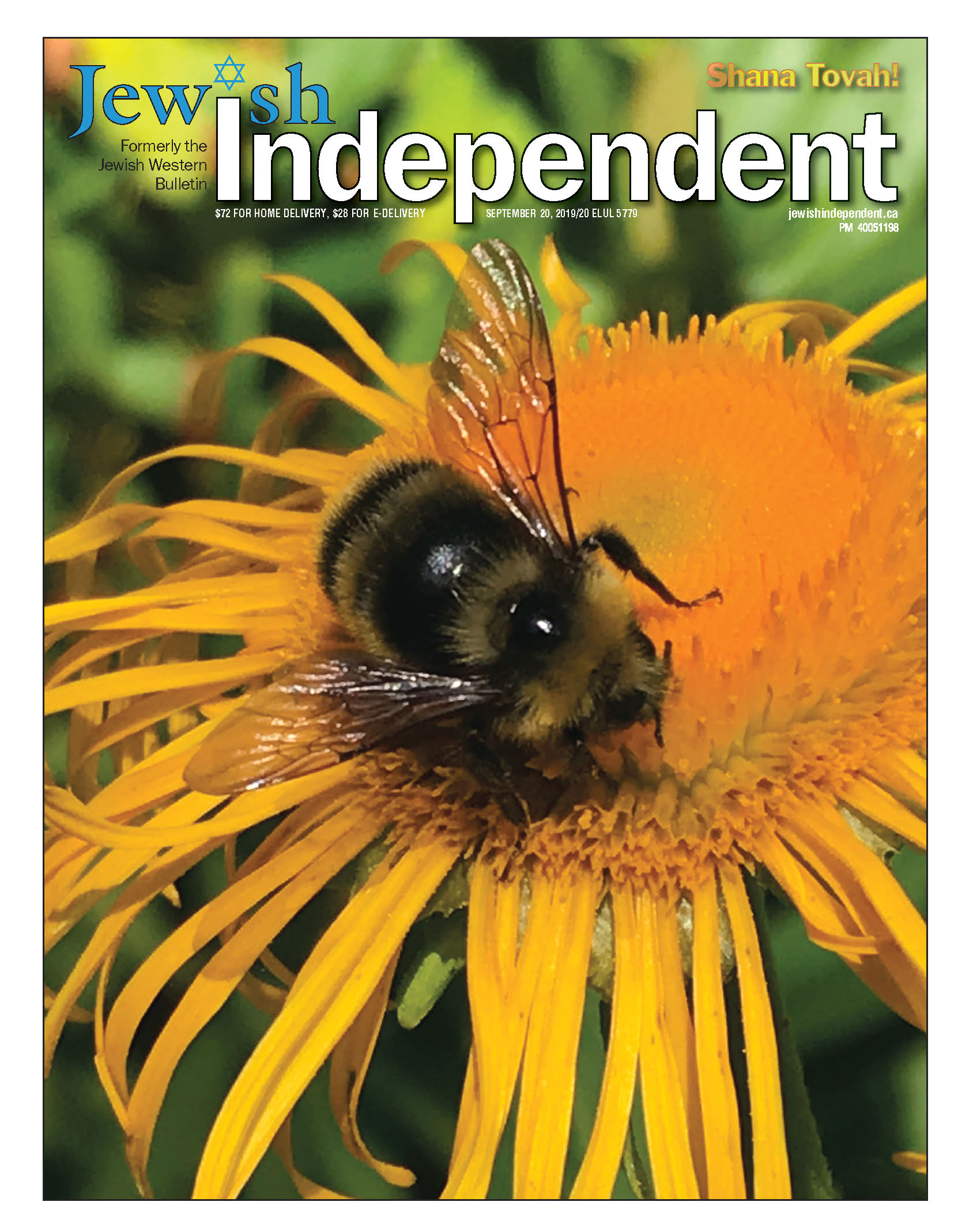
This year’s Jewish Independent Rosh Hashanah cover photo features a bumble bee on a heartleaf oxeye daisy flower – it was taken in Saanich, B.C., by David Fraser. Many native bumble bees are in decline, a concerning trend given the role they play in pollination of plants, including many food crops. Pesticides, habitat loss and introduced bee parasites and diseases are thought to play a role in this decline.
Apples are one of the main symbolic foods we eat on Rosh Hashanah, as we wish for a sweet year, with the help of some honey. Apples are the fruit of choice for this wish perhaps because Rosh Hashanah coincides with the sixth day of creation, when humans – Adam and Eve – were created and they ate the fruit (apple) of the Tree of Knowledge in the Garden of Eden. It could also be that apples symbolize the relationship between God and the Jewish people, as poeticized in the Song of Songs, or that the Zohar (kabbalah) describes paradise as a holy apple orchard.
Regardless of the reason for the fruit selection, apple production is dependent on bees and other pollinators. It would be fitting then for us to wish for more than a sweet, fruitful year, when we are dipping our apple slices into honey. We might consider our role in the decline of not only the bumble bee populations but of the environment at large, and what we can do to reverse it.