Skip to content
  • Home
  • Subscribe / donate
  • Events calendar
  • News
    • Local
    • National
    • Israel
    • World
    • עניין בחדשות
      A roundup of news in Canada and further afield, in Hebrew.
  • Opinion
    • From the JI
    • Op-Ed
  • Arts & Culture
    • Performing Arts
    • Music
    • Books
    • Visual Arts
    • TV & Film
  • Life
    • Celebrating the Holidays
    • Travel
    • The Daily Snooze
      Cartoons by Jacob Samuel
    • Mystery Photo
      Help the JI and JMABC fill in the gaps in our archives.
  • Community Links
    • Organizations, Etc.
    • Other News Sources & Blogs
    • Business Directory
  • FAQ
  • JI Chai Celebration
  • JI@88! video

Recent Posts

  • Sharing her testimony
  • Fall fight takes leap forward
  • The balancing of rights
  • Multiple Tony n’ Tina roles
  • Stories of trauma, resilience
  • Celebrate our culture
  • A responsibility to help
  • What wellness means at JCC
  • Together in mourning
  • Downhill after Trump?
  • Birth control even easier now
  • Eco-Sisters mentorship
  • Unexpected discoveries
  • Study’s results hopeful
  • Bad behaviour affects us all
  • Thankful for the police
  • UBC needs a wake-up call
  • Recalling a shining star
  • Sleep well …
  • BGU fosters startup culture
  • Photography and glass
  • Is it the end of an era?
  • Taking life a step at a time
  • Nakba exhibit biased
  • Film festival starts next week
  • Musical with heart and soul
  • Rabbi marks 13 years
  • Keeper of VTT’s history
  • Gala fêtes Infeld’s 20th
  • Building JWest together
  • Challah Mom comes to Vancouver
  • What to do about media bias
  • Education offers hope
  • Remembrance – a moral act
  • What makes us human
  • המלחמות של נתניהו וטראמפ

Archives

Follow @JewishIndie
image - The CJN - Visit Us Banner - 300x600 - 101625

Tag: education

Tournament expands

Tournament expands

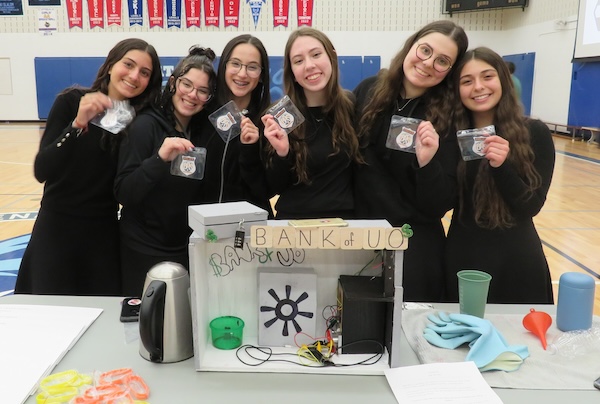
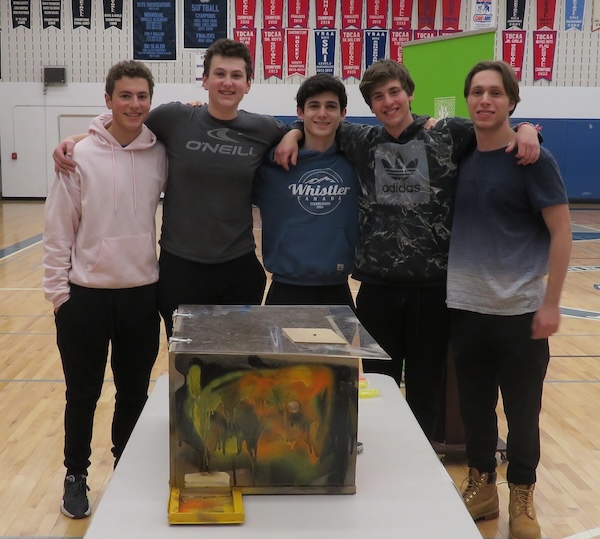
Weizmann Institute’s International Physics Tournament – the “Safe-Cracking Tournament” – is open to students in grades 11 and 12. (photo from Weizmann Canada)

Registration is now open for the Weizmann Institute’s International Physics Tournament. New this year – teams from Western Canada will be able to compete. A Zoom information session is scheduled for Sept. 23.

“Each spring, for the past 29 years, teams of highly talented high school students from around the world arrive at the Davidson Institute of Science Education, the educational arm of the Weizmann Institute of Science in Israel, to take part in the international physics tournament, commonly known as the ‘Safe-Cracking Tournament,’” Morgan Leibner, annual and education programs officer at Weizmann Canada, told the Independent.

In the competition, teams of high school students (grades 11 and 12) design and build a safe that has a locking mechanism based on principles of physics. “Teams are challenged to put their knowledge to the test, where they break into each other’s safes by solving the physics riddles,” explained Leibner.

“Throughout the tournament, participants gain experience in building systems that they invent,” she said. “It is a unique opportunity for students to put physical principles and their imagination into practice – it is a totally different, enjoyable, exciting and encouraging way of learning physics and collaboration, with the goal of competing internationally at the finals.”

While the finals take place in Israel – or online, as they did this year because of the war – there are semi-finals in Canada. They’ve usually taken place in Montreal, with school teams from Montreal and Toronto competing.

“This year, our goal is to expand the program to include a West Coast tournament, which will take place in Vancouver,” said Leibner. “We anticipate teams participating from Vancouver, Calgary and Winnipeg. One winning team will be selected from the West Coast and a second team will be selected from the East Coast to represent Canada at the finals in Israel.”

The registration deadline is Oct. 9 and, once accepted, “teams are required to check in with Weizmann Canada staff every one to two weeks to discuss their work, as well as their challenges and successes,” Leibner said. There are various milestones teams must meet by certain dates, with the semi-finals taking place in Montreal and Vancouver in early February, and the finals at the institute March 23-27, situation permitting.

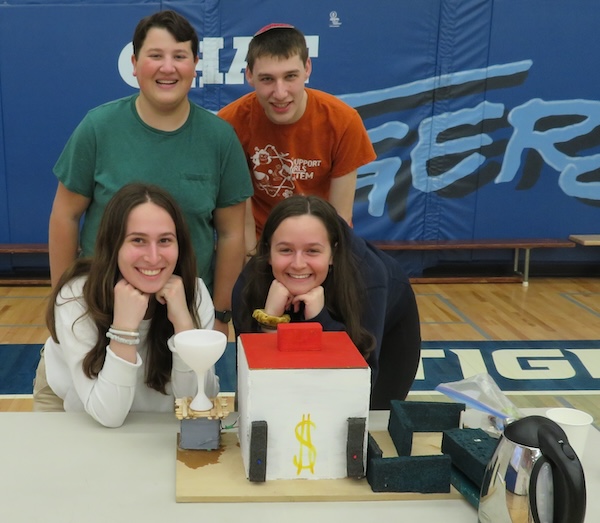
photo - Teams of three to five compete regionally for a chance to reach the finals in Israel.
Teams of three to five compete regionally for a chance to reach the finals in Israel. (photo from Weizmann Canada)

“The finals have been conducted virtually when circumstances make it unsafe for students to travel to the institute,” said Leibner. “In that case, students submit a video of their safe to the judges, explaining the locking mechanism and the physics principles required to open the safe successfully. The students’ videos are judged on roughly the same criteria and a winner is announced at a virtual Zoom session.”

The 2024 virtual closing ceremony can be watched at youtube.com/watch?v=InI8CDoDqDk.

Weizmann Institute of Science has hosted various versions of the high school physics tournament since 1973. “In fact, the winner of the first-ever physics tournament is Dan Gelbart – a notable Canada-based engineer and inventor. He won the tournament at the age of 16 with an original motor he designed and built himself using spare materials, some even sourced from his mother’s kitchen!” said Leibner.

Gelbart, who was born in Germany and raised in Israel, has lived in Canada since the 1970s. Based in Vancouver, he co-founded Creo, a local printing technology company that was bought by Eastman Kodak Co. in 2005, and he has co-founded several other companies. According to a profile on the Weizmann Institute’s website, Gelbart has registered some 145 patents. He also has volunteered as an adjunct professor at the University of British Columbia and has a YouTube channel – the most recent video, which was posted a couple of years ago, is a tour of his workshop and its instruments.

Typically, the physics tournament attracts between 200 and 300 participants a year, from Israel, Canada and other countries.

“The international tournament offers students an incredible opportunity to meet similarly scientific-minded youths from across the world,” said Leibner. “The tournament also offers a teacher development conference for the physics teachers accompanying teams to the tournament.”

photo - “The international tournament offers students an incredible opportunity to meet similarly scientific-minded youths from across the world,” according to Morgan Leibner, annual and education programs officer at Weizmann Canada
“The international tournament offers students an incredible opportunity to meet similarly scientific-minded youths from across the world,” according to Morgan Leibner, annual and education programs officer at Weizmann Canada. (photo from Weizmann Canada)

Participants work in teams of three to five students and their local teacher/mentor – who is the one who must submit the team’s registration – coordinates with the tournament’s physics consultant throughout the process. The team’s safe is judged on its quality and complexity; team members’ level of understanding of the physics concepts being employed is key, as are the esthetics and originality of the safe they build.

“Local mentors are past participants of the physics tournament themselves,” said Leibner. “They have firsthand knowledge of the competition, what is required to build the safe, and what it is like to compete in the tournament. They have also participated in other educational opportunities at Weizmann Institute in Israel and have experienced living on campus and working with the community of scientists. Our mentors have a deep love and appreciation for science and an understanding that promoting STEM in education is incredibly important.”

For information on the tournament and to submit an application, visit weizmann.ca/physics.

Format ImagePosted on September 13, 2024September 11, 2024Author Cynthia RamsayCategories LocalTags competition, education, high school, Israel, Morgan Leibner, physics, safe-cracking, science, STEM, Weizmann Institute

Education a key issue

Students across British Columbia have returned to the classroom. On university campuses, the activism that had roiled those spaces during the last academic year has returned to a boil. Jewish students are facing more of the horrible same.

Even public high schools are not immune, with reports of harassment of Jewish students and inappropriate comments by teachers and other students.

About a year ago, the government of British Columbia announced that Holocaust education would become a mandatory part of the Grade 10 curriculum. This came as a surprise to many people, who were shocked that it is still possible for a student to graduate from the public education system in this province without encountering anything about the Holocaust. To be clear, this is probably not usually the case, but what a student learns about that dark history has been left to the discretion of teachers.

Starting next year, that will no longer be the case. Students will have to study the Shoah. This is a positive development in many ways. Holocaust education is an entry-point to critical discussions about human rights, dignity, oppression, genocide, totalitarianism and a vast range of crucial topics. 

From a Jewish perspective, at a time of increasing antisemitism, this is especially welcome. The dangerous potential of unchecked antisemitism is, of course, the ultimate and unique lesson of the Holocaust. Sensitizing young citizens to this message is an important part of addressing anti-Jewish racism. 

The curriculum is still in development and we trust that educating about the Holocaust will be done in the context of a larger history of antisemitism. It would be a mistake to let students conclude that antisemitism is a product exclusively of a different place (Germany) and time (1933 to 1945). The Holocaust, students must understand, was part of a much longer trajectory of anti-Jewish racism and it must not be seen as anomalous in this larger context.

While there was much satisfaction at the announcement that this history would become mandatory in the curriculum, there is cause for concern.

When dealing with issues of extraordinary sensitivity – gender, race, sexuality, religion, treatment of historical events – parents, elected officials and the broader society depend on the ability and integrity of teachers to deliver this content in appropriate ways. This is where we have reasonable apprehensions. 

While it is the government that mandates curriculum content, it is obviously teachers who deliver it. The teachers’ union, the British Columbia Teachers’ Federation, has a long history of disseminating anti-Israel materials and adopting biased approaches to the issues of Israel, Palestine and the conflict there.

This year, a group of (mostly Jewish) educators applied to the BC Teachers’ Federation to create a specialist group to help equip teachers to educate on the Holocaust. Astonishingly, the BCTF rejected the application for recognition – a recognition that is, apparently, almost rubberstamped for most other topic areas – without any suitable explanation. Given the history of the BCTF on this subject, many people have understandably come to their own conclusions about what was behind this rejection.

By the nature of their roles, teachers have a vast amount of leeway in transmitting information. The government will set out learning outcomes and expectations for this component, but the potential for inappropriate messaging in individual circumstances is great. Off the top of our heads, for example, we can imagine teachers equating the Holocaust to contemporary events and universalizing beyond the edges of what is reasonable given the uniqueness of the Holocaust in the context of antisemitism throughout the ages.

Not only does the government need to create a curriculum for the subject matter, it might do well to consider a curriculum for teachers to address appropriate and inappropriate ways of addressing the topics raised, including comments from students who have seen the inescapable propaganda accusing Israel of “genocide” and equating Israelis with Nazis.

In just over a month, British Columbians will elect a new government. Whichever party forms government will necessarily have to find a way to work with British Columbia’s teachers to ensure the useful delivery of this curriculum material.

When candidates call or knock on your door, it would be good to remind them that Holocaust education is an important issue for you (as are many other issues, addressed in the story here). Let them know that ensuring this new component of the curriculum is handled appropriately is something you will be watching for as a new government – NDP, Conservative or, given the bizarre upheavals in politics recently, some other group – sets course on this important initiative. 

Posted on September 13, 2024September 11, 2024Author The Editorial BoardCategories From the JITags antisemitism, BC Teachers' Federation, BCTF, curriculum, education, Election, history, Holocaust education, politics, racism
New KDHS head of school 

New KDHS head of school 

Dr. Seth Goldsweig (photo from KDHS)

The start of the school year is always a time of fresh beginnings. This is especially true at King David High School this year. On Sept. 3, Dr. Seth Goldsweig will welcome new and returning students as the school’s top administrator. It is the first time in 16 years – a lifetime in student years – since KDHS has had a new principal.

Goldsweig arrived this summer from an extensive period as a teacher and administrator in Toronto, replacing Russ Klein, who retired as King David’s head of school. (For more on Klein’s career and retirement, see jewishindependent.ca/king-david-head-retires-soon.) In a conversation with the Independent, the new head of school raved about the Vancouver community and the embracing welcome he has received. 

“The transition has been amazing because of the people here,” said Goldsweig. “People have gone out of their way to make me feel good and to feel supported. I have Shabbat dinner plans for as long into the future as I can want.… You get a sense that it’s a very warm Jewish community here just by how warm and kind everyone has been to me.”

Goldsweig taught in Jewish day schools before becoming vice-principal at Toronto’s Robbins Hebrew Academy and then vice-principal at the Leo Baeck Day School, where he spent the past 11 years.

“I’ve always wanted to be head of school,” he said. “On top of my PhD, I’ve done additional programs to train educators to be leaders of Jewish day schools and so this has always been something that I’ve aspired to do. When this job came up, it certainly sounded appealing being in a place with beautiful mountains and amazing people, but also the timing worked out because my kids, Danielle and Josh, are graduating from the Jewish high school in Toronto, called TanenbaumCHAT, and they’re going on to university, so the timing worked out.”

His route to Vancouver was circuitous. He was born in smalltown Vermont to parents who left New York City for a rural life. (Were they hippies? “They would say no. I would say yes,” Goldsweig replied.)

“I grew up on a dirt road in a town with just a few thousand people and two or three Jewish families,” he said.

At 18, he left to do environmental studies at Binghamton University in upstate New York, then lived in Israel for five years, doing a semester at Ben-Gurion University in Beersheva and another semester at the Arava Institute for Environmental Studies on Kibbutz Ketura, which is located in the Arava Valley.

He then returned to the Arava Institute the next year as a staff member, followed by three years at the Pardes Institute of Jewish Studies in Jerusalem. In the Pardes educators’ program, he studied Judaic texts coupled with a focus on Jewish education toward a master’s degree from Hebrew University of Jerusalem. His PhD, in educational leadership and administration, is from Lesley University, and he has a related certificate from Hebrew College and studied education at Harvard as well. His PhD dissertation was on Jewish day school financial sustainability.

In Israel, Goldsweig met his wife, Amy, who is from Toronto. The pair taught in Boston for a time before moving to Ontario to be close to family when they learned they were having twins.

Goldsweig became bar mitzvah at a Reform synagogue in South Burlington, Vt., and belonged to a Conservative congregation in Toronto. His educational career included stints at schools affiliated with both movements and he is excited by King David’s pluralistic approach.

“I’m a big believer in Jewish pluralism,” he said. “I think there’s a great importance in leading and connecting with Jews that are like you and not like you.”

This year, he plans to visit all the synagogues in town “just to get to know the entire Jewish community in Vancouver.”

In Toronto, Goldsweig said, there are many different schools to choose from.

“You are not trying to be everything for everyone, you’re trying to do what you do really well,” he said. “Here – and I really love this – everyone’s in one building. So, the goal is to find ways to make everyone feel welcome and heard and connected and I really think that’s a beautiful thing.”

Goldsweig lauded his predecessor.

“Russ was an incredible head of school and is still an important member of our community,” said Goldsweig. “He’s done amazing things with the school.”

This year’s enrolment of about 270 students is on par with last year’s and Goldsweig does not foresee any dramatic changes in the near future. 

“My job for this year is really to spend a lot of time learning from everyone in the community and getting a sense of what the Jewish community in Vancouver is all about and what King David High School is all about so we can make sure we’re meeting the needs for the community now and well into the future,” he said. 

Format ImagePosted on August 23, 2024August 22, 2024Author Pat JohnsonCategories LocalTags education, KDHS, King David High School, Seth Goldsweig
Education a main focus

Education a main focus

Syd Belzberg, left, founder of Stable Harvest Farm in Langley, and farm manager Kristjan Johannson. (photo by Cynthia Ramsay)

The Jewish Independent visited Syd Belzberg at Stable Harvest Farm in Langley last week, taking a tour of the 65-acre property with Belzberg and farm manager Kristjan Johannson. Much has happened since the JI last visited, in 2021, just a year after the reimagined farm opened.

The land had laid empty for many years, having previously been a horse farm. An organic produce farm for the past four years, its focus is education. (See jewishindependent.ca/hands-on-learning-at-farm.)

About 100 students a day visit from late April to the end of June, then again from the first week of September to the end of October. 

“We’ve got it down to a science,” said Johannson. “About an hour-and-a-half a session, two hours. They come in, they get a welcome speech. We have picnic tables up in the main season. We do a 12-station immersive tour, partnered with BC Agriculture in the Classroom [Foundation], so it’s all specific to the curriculum of the province.”

There are elementary and intermediate student groups who do the sessions. Participants receive workbooks and, every six or seven minutes, a cowbell rings and they move to the next station, where another agriculturalist meets them. University students lead the programs.

The farm also runs harvest projects for the kids. “Radishes were a big hit this year,” said Johannson. There were six beds of radishes planted and harvested.

Over the summer, it’s camp, church and other groups that come to the farm, said Belzberg, and they have different reasons for doing so: perhaps to see the bees, or the butterflies. “This summer, we kept the amount of guests down because we are developing and changing so many things,” he said.

The growing process begins indoors. “We’re able to push the season in that way,” said Johannson. “We start all our plants indoors in the nursery tunnel and that way we get a 30- to 60-day head start, and then it allows us, in a short season, to get two crops of most produce.”

photo - Rows of produce are planted alongside rows of flowers, so that the flowers take the brunt of the bug activity
Rows of produce are planted alongside rows of flowers, so that the flowers take the brunt of the bug activity. (photo by Cynthia Ramsay)

In addition to the planting beds, there are gardens. Belzberg’s friend David Bogoch, another member of the Jewish community, started the Biblical Garden, as well as a couple of other flower beds, which Bogoch maintains with the Stable Harvest Farm team.

“Rabbis normally spend 20 to 30 minutes in here,” said Belzberg of the Biblical Garden, which features four of the seven plants the Hebrew Bible uses to describe the land of Israel – wheat, barley, figs and grapes. “We can’t grow dates, pomegranates or olives, but we’re working on pomegranates and olives!” said Johannson, referring to a greenhouse that’s under construction. 

Johannson also noted that there was a “very happy, healthy ‘Tree of Knowledge,’” an apple tree, but though the “Fujis are looking very good,” the fruit is not quite ready for harvesting. 

Vancouver Talmud Torah probably brings the most kids to the farm, said Belzberg. Grade 3 students, for example, may come in and plant vegetables in spring and then they come back in the fall, as Grade 4s, to harvest what they planted.

When students participate in an education tour, they leave with something the farm produces. That might be honey from one of the 30 hives on the farm (1,500 pounds of honey was extracted a few weeks ago by 40 to 50 volunteers) or bee-forage bookmarks with seeds embedded in them.

“You take the bee off [the bookmark] and plant it in the ground and they [still] have our bookmark with all our information on it,” explained Johannson. “Basically, you have a bunch of kids guerrilla gardening, chucking paper and pouring water on it and having plants that turn into bee forage. Then, they also get popcorn from us or they get sunflower seeds, so, if you’ve got a garden at home, you can plant the corn and plant the sunflowers. If you don’t, you can eat the sunflower seeds and pop the corn.”

Johannson and Belzberg have been working together since the retrofit in 2020, when the farm was converted from housing horses to growing produce.

“We do lots of cover crops and set-asides,” said Johannson, standing next to a field (block) that is lying fallow for a year. “That’s how we build fertility here organically. There are three different types of clover … and all this clover fixes nitrogen from the atmosphere in the ground and then all of this down here will be our organic matter for the next season. We’ll do that on rotation. There are five blocks, so this block here was a cover crop last year.”

Farm heritage chickens and Nigerian Dwarf goats, as well as other animals that pass through or unofficially make their home somewhere on the farm, help keep the soil healthy. “They’ll end up eating all this down and then pooping it [around],” explained Johannson.

We drove past some wheat, which is grown especially for Lubavitch BC’s Model Matzah Bakery.

“Originally, we would just supply the wheat and they would do their thing,” said Belzberg. “In the last year, we changed it…. Everything here was planted by the kids in May. They’re coming back Sept. 8 to harvest it. Then we will store it for them and, at Pesach time, they’ll use it … [in] making the matzah with the bakery, so they’ve got the full cycle.”

For the Lubavitch BC program, some of the wheat harvested by the kids in September won’t be put through a thresher, but rather, in the weeks before Pesach, at the Matzah Bakery, the kids will learn how to remove the grain from the chaff by hand. They’ll put the grain in a stone mill and grind it into flour. “For the sake of expedience, we already have the dough ready,” noted Johannson. “And the kids grab it, it goes onto some sheets and then goes into a pizza oven. They are so good, very efficient,” he said of Lubavitch BC. “They’re the same as our [education] project out here, you’re in and out in an hour and 15.”

photo - Stable Harvest Farm has Jewish and non-Jewish community partners
Stable Harvest Farm has Jewish and non-Jewish community partners. (photo by Cynthia Ramsay)

Stopping at several “tunnels,” in which there are rows of flowers alternating with produce – melons, tomatoes, cucumbers, etc. – Johannson picked some treats for the Jewish Independent while talking about the layout.

The flowers are good for pollinators, but also attract the aphids and other bugs, he said. “We come through when they’re all pest-affected, we bag [the flowers] up and remove the pests out of the game.”

There have been challenges over the years – notably, in 2021, both the heat dome and the atmospheric river – and there have been some less successful crops. Johannson pointed to a field of Phacelia. “It’s still going to flower, but … it was too hot when they went in. A lot of the time, with vegetables, with life, with people, if you don’t have a good start to things, things don’t end up well.” The area will become a different cover crop next year, he said.

And there have been other learning opportunities. “This we called the Coyote Area,” said Belzberg as we passed another part of the property. “But we had to change it about a month ago because we had a group of kids out and they were afraid to come [see it]. Now it’s called Beaver Park.”

Belzberg would like to see even more school groups come to the farm, and he’d like to see multiple events happening at one time. In progress are many significant initiatives, from planting more trees (for birds and shade), to grooming an area of the farm for scavenger hunts and orienteering, to building a nature-based playground, to creating an overnight camping section, to adding a picnic area, and to converting what used to be a riding arena into a place where kids can come and do educational projects when it’s raining.

The education aspect of the farm gives Belzberg the greatest satisfaction and enjoyment, he said. “That’s my passion.”

While all the activities at the farm are at no cost to visiting groups, busing kids out to Langley can be expensive, so the farm takes some of their programs to the schools themselves. Belzberg gave Talmud Torah as an example: a program held at the school can reach 500 kids in one or two days, he said.

As well, Belzberg and his team are trying to get funding for a program that would help schools with the cost of busing. “We’re looking to be able to subsidize some or all of that cost,” he said.

As to what Belzberg gets from all these efforts?

“It’s a work of love,” he said. “It’s coming out here, developing it and seeing it grow and become more beautiful [and], mostly, when you get the kids out here.” 

Format ImagePosted on August 23, 2024August 23, 2024Author Cynthia RamsayCategories LocalTags agricultural goods, education, environment, farming, Kristjan Johannson, Lubavitch BC, organic, Passover, Stable Harvest Farm, Syd Belzberg, Vancouver Talmud Torah, VTT
Creating adjoining schools

Creating adjoining schools

Left to right: Anne Yu, school board president, Pythagoras Academy; Michael Bouchard, head of school, Pythagoras Academy; Sabrina Bhojani, head of school, Richmond Jewish Day School; and Michael Lipton, school board president, Richmond Jewish Day School. (photo by Briana Bolt)

As the 2023/24 school year ended, Pythagoras Academy (PA) and Richmond Jewish Day School (RJDS) announced a collaboration aimed at enhancing educational opportunities for students in the upcoming school year. The new partnership will see the two institutions merge their efforts to form adjoining schools.

“We are excited to cultivate this unique and transformative journey with Richmond Jewish Day School,” said Michael Bouchard, head of school at Pythagoras Academy. “This partnership represents a bold step forward in education, where collaboration and shared values pave the way for enhanced teaching and learning opportunities.”

The schools will integrate elements from both institutions’ educational philosophies, promoting a harmonious environment where students can thrive academically, socially and emotionally. By leveraging the strengths of each school, the partnership aims to set a new standard for educational excellence in Richmond.

As part of the announcement, school leaders from both Pythagoras Academy and Richmond Jewish Day School participated in a ceremonial handshake, symbolizing their commitment to this partnership. Members of the board and key stakeholders were also present to mark this milestone.

“This collaboration is not just about combining physical resources, but creating a beautiful synergy,” said Sabrina Bhojani, head of school at Richmond Jewish Day School. “Together, we can better support nurturing environments where students can learn, grow and succeed.”

This move is based on successful precedents set by joint schools like those in Ontario, where similar partnerships have demonstrated increased student engagement and academic achievement. The integration of diverse perspectives and educational methodologies will enrich the learning experience at the new adjoining schools.

For more information and to arrange interviews or school tours, contact RJDS at 604-275-3393 and Pythagoras Academy at 604-370-0199. 

– Courtesy Pythagoras Academy

Format ImagePosted on August 23, 2024August 22, 2024Author Pythagoras AcademyCategories LocalTags adjoining schools, education, Michael Bouchard, Pythagoras Academy, Richmond Jewish Day School, RJDS, Sabrina Bhojani

New year for Israel Connect

If you’re asking, “What can I do for Israel?” consider joining Israel Connect, a program where local adult volunteers connect, one-on-one, via Zoom, with Israeli high school students who want to improve their English conversation and reading skills. The program starts up again this fall, organized by Chabad Richmond in partnership with the Israeli Ministry of Education.

There are currently 47 Metro Vancouver-area volunteers participating in the Israel Connect program as tutors/mentors, and Chabad Richmond is looking to increase that number, since the need in Israel continues to grow.

“We’re looking for volunteer retirees, seniors or any adults who have some free time to join the Israel Connect program. No previous tutoring or teaching experience is necessary and the curriculum is provided,” said Shelley Civkin, the local Israel Connect coordinator. “If you’re an adult fluent English-speaker, you have basic computer skills and you own a computer with a camera, that’s all you need,” she said.

Volunteers do not need to speak Hebrew and can tutor from home. Basic training and technical support are available. Time preferences of volunteer tutors/mentors will be coordinated beforehand and Zoom sessions take place in the morning between 7 and 10 a.m. Vancouver time, any day between Sunday to Thursday.

“Israel Connect asks for a minimum commitment of one school year, in order to ensure consistency for the students,” said Civkin. Sessions are once a week for 45-60 minutes, at the same time each week. 

“It’s a very practical and impactful way for community members to support Israel and build bridges between diaspora Jews and Israelis,” said Rabbi Yechiel Baitelman, director of Chabad Richmond. “You’ll be doing a mitzvah, while investing in the future of Israel and its people. Plus, proficiency in English will give them an advantage in accessing post-secondary education and getting better jobs. Helping students improve their English inspires them to learn and grow, while empowering them to reach new heights.”  

Israel Connect is now the largest external provider of services to Israel’s Ministry of Education, slowly removing the most significant barrier to social and economic mobility, focusing on teens from less advantaged neighbourhoods.

The curriculum consists mainly of a tour of Israel, focusing on the wealth of historical, cultural and biblically significant cities and sites. It’s not uncommon for both the students and the tutors to learn something new about Israel at each lesson.

“Most volunteers really enjoy helping their Israeli students and develop a lasting bond with them. It often goes beyond simply tutoring the curriculum, and turns into friendship and mentorship,” said Civkin. “This kind of one-on-one tutoring makes a huge difference in their lives, both educationally and personally. It gives them a feeling of confidence that they can converse in English without being judged or marked. It’s incredibly satisfying to know that you’re doing something tangible to help Israeli students better their lives.” 

Civkin said several tutors have visited their students on trips to Israel and keep in touch beyond the school year. 

To volunteer, or for more information, contact Civkin at 604-789-5806 or [email protected].

For anyone who can’t participate as a tutor, Chabad Richmond welcomes financial support for the Israel Connect program, which covers overhead costs like technical support, staffing and other administrative costs. To support the program, call Chabad Richmond at 604-277-6427 or email [email protected]. 

– Courtesy Chabad Richmond

Posted on August 23, 2024August 22, 2024Author Chabad RichmondCategories LocalTags Chabad Richmond, education, Israel Connect, Israeli students, retirees, seniors, volunteering
A new way to teach reading 

A new way to teach reading 

Lisa Gelberman (photo courtesy)

Over the years, Toronto-based educator Lisa Gelberman saw a consistent problem with the education system: it did not address the fact that a third of students in North America have various reading difficulties. 

“When kids struggle academically, they struggle behaviourally, they struggle socially, and long-term success becomes more unlikely. It’s a huge spiral,” said Gelberman, principal at Kayla’s Children Centre (KCC). 

In her view, the need was so great to help those falling through the literacy cracks, that she took matters into her own hands to find a way to solve the problem. Over time, she developed an online reading program called Literacy Decoded, which launched in 2022. Its aim is to train teachers to support students with learning disabilities, dyslexia and other developmental delays. Several Toronto Jewish schools (including Bais Yaakov High School and Eitz Chaim Schools) have purchased the course and adopted its curricula. She has sold it to hundreds of educators across North America. 

Comprising mostly Jewish students, KCC is a school, therapy clinic, recreational centre and camp for children with special needs, and some students, including those who have extreme delays, have learned to read because of the program.

“The Jewish community sees the importance of supporting children with learning disabilities and dyslexia,” Gelberman said. “There are going to be fewer kids leaving the Jewish school systems for secular schools, because now their own schools have the training and resources needed. Now their needs are being met and [the program is] changing their educational outcome,” she contends. 

The mother of five began her career as a teacher at a public school, teaching first grade for three years, then, having taken various course qualifications, she began teaching special education. Later, she led a class for students with learning disabilities, dyslexia or severe ADHD. Afterwards, she taught children with autism. 

“I was always very passionate about teaching children to read,” she said. “Developing curricula and exploring different paths to teaching kids to read is my purpose.” 

Up until about five years ago, Gelberman said, most schools across North America used a methodology called the “whole language approach.” But a full third of children do not pick up reading from this method, she argues. “So, kids struggle, and I just knew there’s something I had to do about it.

“Every year,” she continued, “I got so close to teaching this one child to read [but] he came back after the summer and it was like everything I taught him was lost. I didn’t understand why. That’s when I started to look for other programs to help.”

She discovered the Orton-Gillingham approach, and, on her own dime and with a year-and-a-half of study, she became certified to teach it.

After being hired by Kayla’s, Gelberman applied the Orton-Gillingham methods with the institution’s kids and found success in teaching children who previously had found it incredibly difficult to read.

Building upon the program, she videoed her own son, who showed signs of dyslexia and was having trouble reading, learning with the approach and used it to show teachers and parents how to implement it.

“He’s jumped three grade levels in six months. And even his teacher at the time couldn’t believe it,” she said.

“And that’s how I actually was able to improve upon the program…. I was training the teachers, and other schools were asking me to come in [to do] staff training, but I simply didn’t have the time. So, I decided to develop a course of my own.” 

image - Lisa Gelberman has created an online teaching program, Literacy Decoded, based on the Orton-Gillingham method. (image from Lisa Gelberman)
Lisa Gelberman has created an online teaching program, Literacy Decoded, based on the Orton-Gillingham method. (image from Lisa Gelberman)

It was important for Gelberman to gear her own program towards Jewish day schools, which she claims have fewer resources, in general, to divert to kids who are lagging. Particularly for the Jewish community, she’s made a special effort to ensure the content – words and images – is appropriate. 

According to Gelberman, the two years of remote learning during COVID made the program more relevant and needed, given how so many children who require in-person interaction to absorb materials were denied this interaction during a critical time in their learning.

“I’m just so happy that the children who would have fallen through the cracks are now able to read,” she said, adding that KCC children are being mainstreamed, when they ordinarily would not be.

Four years in development, “huge pieces” of Gelberman’s program do not involve memorizing words, nor looking at pictures, tools she said have been relied upon heavily as teaching aids. Instead, in her course, what seems to work is the sounding out of words, learning different sound combinations, and learning syllable types.

The program is asynchronous, that is, it proceeds at the teacher’s pace, and each lesson is through video, so the lessons feel “live.” In addition, Gelberman offers monthly coaching sessions with teachers, where they share with each other their struggles and problem-solving methods.

“I truly feel the right training from the right teachers can and will teach kids to read,” she said. 

Dave Gordon is a Toronto-based freelance writer whose work has appeared in more than 100 publications around the world. His website is davegordonwrites.com.

Format ImagePosted on August 23, 2024August 22, 2024Author Dave GordonCategories NationalTags education, Kayla’s Children Centre, Lisa Gelberman, literacy, Literacy Decoded, online learning, Orton-Gillingham, Toronto

Upstanders toolkit launched

Upstanders Canada held a nationwide webinar last month to introduce a toolkit aimed at confronting antisemitism in the various forms it may manifest – particularly in the inherent biases people may not be aware they carry.

At the June 23 launch, Pat Johnson, the founder of Upstanders Canada, discussed the toolkit, called Be An Upstander: How Allies Can Recognize and Contest Antisemitism. Among those attending the online event were representatives of several faith-based organizations. Most attendees were not part of the Jewish community.

Johnson outlined how antisemitism works and the characteristics contained within antisemitism, such as “othering” (casting a group of people as different from the rest of society), victim-blaming, and inverting the victim and the perpetrator. 

The toolkit demonstrates how these characteristics of antisemitism can lead to projection – where a society places the blame for things it fears, hates or does not understand onto Jews. This can lead to conspiracy theories in which complex world problems are simplified into a clearcut package that frequently places the blame on Jews.

Antisemitism is a foundation of many conspiracy theories in that the theories usually rest on the belief that a powerful group of Jews controls events. The theories do not need to specify Jews as the people behind what is considered wrong, but rather can use references to “Hollywood,” “cosmopolitan elites” or “globalists,” which equally fulfil the purpose of implying that Jews are doing nefarious, self-serving deeds behind the scenes.

Feelings of envy and inferiority, the toolkit points out, may distinguish antisemitism from other forms of racism. Whereas many types of prejudice come from a sense of superiority, antisemitism is derived in part from the belief that Jews “think they are better than everyone else.” This, in turn, leads to “punching up,” or, as Johnson says, “the idea that attacking a perceived ‘superior’ is a way to advance social justice, though the person being punched is always a victim.”

Johnson offered a picture of what antisemitism may look like when it is not obvious.

“Blatant antisemitism is easy to recognize,” he said. “It is also the form of antisemitism most likely to turn violent and is, therefore, the most dangerous. But all people of goodwill recognize and condemn that form of antisemitism. More subtle, unconscious forms of antisemitism exist in inherent biases, stereotypes and tropes that people may carry without even recognizing them.”

The stereotype of affluent, high-ranking or privileged Jews, for example, brings with it a specific danger, one that may not be violent but is nonetheless harmful. Antisemitism, Johnson explained, becomes the “perfect prejudice” because the concept of powerful Jews renders the notion of taking antisemitism seriously invalid as their supposed power makes them immune to discrimination.

The toolkit touches upon some historical tropes about Jews, such as an alleged “persecution complex” and Jewish “untrustworthiness and disloyalty” in business settings, citizenship and elsewhere. It also discusses blood libels, the Holocaust and blaming the killing of Jesus on Jews.

Regarding equating anti-Zionism with antisemitism, Johnson notes that Zionism is the manifestation of Jewish self-determination in a state and that “anti-Zionism is not criticism of Israel, it is opposition to the existence of the state of Israel.” He discounts the idea that pre-existing biases against Jews have no impact on opinions about the Jewish state and admonishes those who accuse Israel of using historical discrimination for political advantage. The toolkit references the three Ds developed by Israeli politician and human rights activist Natan Sharansky to determine if anti-Zionism is antisemitism: demonization, double standards and delegitimization.

image - Be An Upstander coverThe toolkit adds, “Zionism does not preclude Palestinian self-determination. Coexistence is the only path to peace and it is the responsibility primarily of the people who live there. The responsibility of overseas observers should be to encourage that coexistence – not to exacerbate the conflict by stoking intolerance, here or abroad.”

One of the problems well-intentioned individuals have when contesting antisemitism is not feeling adequately prepared to respond. For this, the toolkit not only provides many strategies for preparing, but offers encouragement and empowerment. 

Be An Upstander, a 20-page pdf document available online, comes with numerous links that allow readers to explore in greater depth subjects surrounding antisemitism and ways of responding appropriately to it. 

In addition to Johnson speaking about the toolkit, the launch event featured short speeches from Deborah Lyons, Canada’s special envoy on antisemitism; Zara Nybo, a campus media fellow for HonestReporting Canada and Allied Voices for Israel at the University of British Columbia; and Rabbi Lynn Greenhough of Kolot Mayim Reform Temple in Victoria, which hosted the event. Television personality Shai DeLuca emceed from Toronto.

The Upstanders toolkit was created in partnership with Kolot Mayim, with financial support from the Union for Reform Judaism, the Anti-Defamation League and the Jewish Federation of Victoria and Vancouver Island.

Upstanders is a movement of mainly non-Jewish people standing up against antisemitism. It is a nonpartisan, non-denominational organization, open to Canadians across all differences of identity, orientation, outlook and ability. To find out more and to view the toolkit, visit upstanderscanada.com. 

Sam Margolis has written for the Globe and Mail, the National Post, UPI and MSNBC.

Posted on July 26, 2024July 25, 2024Author Sam MargolisCategories LocalTags antisemitism, education, Kolot Mayim, Upstanders Canada
RJDS and JFS grow together

RJDS and JFS grow together

The JFS Moishe Farm Project garden at Richmond Jewish Day School. (photo from RJDS)

Richmond Jewish Day School and Jewish Family Services have embarked on a new initiative, the JFS Moishe Farm Project. At the back of the school, there is now a garden, growing a variety of fruits and vegetables, such as squash, butternut squash and zucchini. The project aims to increase food security in the Lower Mainland by providing fresh produce to RJDS families and JFS clients. 

Food security is an essential aspect of this initiative. It means that all people, at all times, have access to nutritious, safe and sufficient food that meets their dietary needs and preferences for an active and healthy life. With prices of fresh food and produce increasing, food security has become an increasingly difficult goal to achieve. Ensuring access to fresh and healthy produce is a fundamental part of this project. 

photo - The JFS Moishe Farm Project garden
The JFS Moishe Farm Project garden. (photo from RJDS)

Teaching students about proper nutrition and its effects on learning, brain function and mental health is essential. Proper nutrition is not just about having enough food, it’s about having the right kind of food that fuels bodies and minds. A balanced diet rich in fruits and vegetables can significantly enhance cognitive function and overall well-being. By engaging in this gardening project, RJDS is not only providing fresh produce but also educating students about the importance of nutrition, sustainability and community involvement.

Larry and Marcy Vinegar and Glenn Laufer donated the ground cover and irrigation system for the garden, Daniel Garfinkel donated the seeds and plants. Volunteers have planted, harvested and coordinated this project and helped the school use its land to produce and give back to community in sustainable and helpful ways. Through this objective, RJDS students and community can see firsthand the fruits of their labour and understand the value of hard work, patience and teamwork.

RJDS is planning various activities and workshops around the garden. Students will participate in planting, tending and harvesting. They will learn about different fruits and vegetables, their nutritional benefits, and how to prepare the produce in healthy and delicious ways. These activities will be complemented by lessons on the environmental impact of food production and the importance of sustainable farming practices.

The long-term vision for this project includes expanding the garden and increasing the variety of produce. RJDS hopes to eventually supply a significant portion of its community’s fresh produce needs and possibly even create a surplus that could be shared with other organizations.

This project is more than just a garden. It is a symbol of RJDS’s and JFS’s commitment to the community’s health, well-being and future. By working together, a sustainable, healthy and connected community can be created. 

– Courtesy Richmond Jewish Day School

Format ImagePosted on July 26, 2024July 25, 2024Author Richmond Jewish Day SchoolCategories LocalTags education, environment, food security, Jewish Family Services, JFS, Richmond Jewish Day School, RJDS

Name inspires artist’s work

Growing up in Vancouver during the 1960s and ’70s, I was the dancer, my brother was the guitarist and my sister was the writer, soon to blossom into a visual artist as well.

Devorah Stone, my sister, is one of the contributors to this year’s Calling All Artists exhibit, which opens at Victoria’s Congregation Emanu-El on Aug. 26. Since the early 2000s, the mostly annual event has celebrated artists of many kinds – sculpture, ceramics, textile, poetry, mixed media, fabric, music – who offer their interpretation of a rabbinical or biblical text that they’ve studied with the synagogue’s spiritual leader, Rabbi Harry Brechner.

photo - Devorah Stone created a honeybee circle for this year’s Calling All Artists exhibit, which opens at Congregation Emanu-El Aug. 26
Devorah Stone created a honeybee circle for this year’s Calling All Artists exhibit, which opens at Congregation Emanu-El Aug. 26. (photo from Devorah Stone)

“This year’s theme is ‘animals’ and since my name means ‘Honeybee’ in Hebrew, I went with that,” Devorah told me. “The bees in my work are all hand-felted, a technique that involves pocking at wool and shaping the form. I decided to present the bees in circles because they are so crucial to the circle of life.”

The artists’ works are up for six months in the shul’s social hall. Devorah has been involved with the event for the last 10 years. Rabbi Brechner gives a lecture on the theme and how it pertains to Jewish traditions, sacred writings and thought once a month for five months before the celebration. This year, his teaching focused on the significant symbolic and ritual roles animals play in Jewish texts.

“I’ve learnt so much about both art and Judaism attending the rabbi’s lectures,” said Devorah. “Anyone can join … you don’t even need to be Jewish.” 

The Calling All Artists project is run by self-proclaimed “den mother” Barbara Pelman. She said there is a chapbook written every year with an explanation of each artist’s creative process and a copy of that is given out to guests.

“In last year’s Calling All Artists, I did the kohain gadol’s (high priest’s) breastplate with references to all the various colour and gem stones as described in the Torah,” said Devorah. “The only difference was the mannequin I used was a woman’s so I pretended that there might have been female priests at the time of the Temple!

“I’ve also done a collage of a person wearing a tallit and the burning bush, a three-dimensional piece of the Rosh Hashanah dinner, and another collage on a wooden cradle of the story of Abraham and Isaac.” 

Devorah has always been fascinated with art.

“As a child, there was nothing better than a box of crayons and endless paper,” she said. “I drew space ships, planets and alien worlds. I also drew castles and princesses. I loved it. My imagination had no limits.” 

In her 20s, Devorah spent four years at the University of Victoria, earning a bachelor of fine arts. All the while, she felt inspired by Emily Carr and Indigenous art.

“I loved the way Carr personified nature and her magnificent trees,” she shared. “I marveled at the complexities, elegance and craftsmanship of the First Peoples of the land.”

Our parents also brought us up with a strong Jewish identity.

photo - Devorah Stone
Devorah Stone (photo courtesy)

“Being Jewish, I was taken by the imaginative work of Chagall, his goats and houses and how everything seemed to be floating or suspended,” said my sister. “Later on, I began to be influenced by the school of Bauhaus design, especially Kandinsky, his calculated and yet whimsical designs.” 

After Devorah moved to Victoria 20 years ago, she joined the Pandora Arts Collective Society. The group exhibits its works at the Little Fernwood Gallery twice a year and Devorah recently sold a painting there.

The collective is a community of people whose mandate is to facilitate and support mental health through the social and educational benefits of a free and welcoming creative arts space. The studio is open to everyone: professionals, students and beginners. The atmosphere is especially sensitive to people who are using art therapeutically. Devorah is on their board and has planned events for them in the past.

“We inspire and mentor each other,” she said. “I have learnt so much about art from that group. I’ve been introduced to many different kinds of art and artists, as well as being influenced by so many artists in our synagogue. The joke is that you can’t throw a rock without hitting an artist in Victoria!” 

When she was living in and around Vancouver, Devorah brought up three children, two of whom live in the Lower Mainland. She visits all of us frequently and spends a lot of time on the ferry.

“I love doing fast sketches of the scenery as it goes by,” she said. “I also do fast sketches at outdoor concerts and festivals, which Victoria has so many of.” 

Devorah uses pencil crayons, acrylic paint and watercolours, creates collages and sometimes three-dimensional art made out of whatever she can find.  

“I love experimenting and I feel that all my art is influenced by being Jewish,” she said. “It all has a profoundly Jewish way of seeing nature and of being.”

The best way to view Devorah’s art is through Instagram @devlovesart. 

Cassandra Freeman is a journalist and improviser who lives in East Vancouver.

Format ImagePosted on July 26, 2024July 25, 2024Author Cassandra FreemanCategories Visual ArtsTags art, Calling All Artists, collage, Devorah Stone, education, Emanu-El, Harry Brechner, identity, Judaism, multimedia, painting

Posts pagination

Previous page Page 1 … Page 8 Page 9 Page 10 … Page 45 Next page
Proudly powered by WordPress