Skip to content
  • Home
  • Subscribe / donate
  • Events calendar
  • News
    • Local
    • National
    • Israel
    • World
    • עניין בחדשות
      A roundup of news in Canada and further afield, in Hebrew.
  • Opinion
    • From the JI
    • Op-Ed
  • Arts & Culture
    • Performing Arts
    • Music
    • Books
    • Visual Arts
    • TV & Film
  • Life
    • Celebrating the Holidays
    • Travel
    • The Daily Snooze
      Cartoons by Jacob Samuel
    • Mystery Photo
      Help the JI and JMABC fill in the gaps in our archives.
  • Community Links
    • Organizations, Etc.
    • Other News Sources & Blogs
    • Business Directory
  • FAQ
  • JI Chai Celebration
  • JI@88! video

Recent Posts

  • האלימות בישראל מורגשת בהרבה מגזרים
  • טראמפ עוזר דווקא לנושא הפלסטיני
  • New rabbi settles into post
  • A light for the nations
  • Killed for being Jewish 
  • The complexities of identity
  • Jews in time of trauma
  • What should governments do?
  • Annie will warm your heart
  • Best of the film fest online
  • Guitar Night at Massey
  • Partners in the telling of stories
  • Four Peretz pillars honoured
  • History as a foundation
  • Music can comfort us
  • New chapter for JFS
  • The value(s) of Jewish camp
  • Chance led to great decision
  • From the JI archives … camp
  • עשרים ואחת שנים להגעתי לונקובר
  • Eby touts government record
  • Keep lighting candles
  • Facing a complex situation
  • Unique interview show a hit
  • See Annie at Gateway
  • Explorations of light
  • Help with the legal aspects
  • Stories create impact
  • Different faiths gather
  • Advocating for girls’ rights
  • An oral song tradition
  • Genealogy tools and tips
  • Jew-hatred is centuries old
  • Aiding medical research
  • Connecting Jews to Judaism
  • Beacon of light in heart of city

Archives

Follow @JewishIndie
image - The CJN - Visit Us Banner - 300x600 - 101625

Tag: physics

Tournament expands

Tournament expands

Weizmann Institute’s International Physics Tournament – the “Safe-Cracking Tournament” – is open to students in grades 11 and 12. (photo from Weizmann Canada)

Registration is now open for the Weizmann Institute’s International Physics Tournament. New this year – teams from Western Canada will be able to compete. A Zoom information session is scheduled for Sept. 23.

“Each spring, for the past 29 years, teams of highly talented high school students from around the world arrive at the Davidson Institute of Science Education, the educational arm of the Weizmann Institute of Science in Israel, to take part in the international physics tournament, commonly known as the ‘Safe-Cracking Tournament,’” Morgan Leibner, annual and education programs officer at Weizmann Canada, told the Independent.

In the competition, teams of high school students (grades 11 and 12) design and build a safe that has a locking mechanism based on principles of physics. “Teams are challenged to put their knowledge to the test, where they break into each other’s safes by solving the physics riddles,” explained Leibner.

“Throughout the tournament, participants gain experience in building systems that they invent,” she said. “It is a unique opportunity for students to put physical principles and their imagination into practice – it is a totally different, enjoyable, exciting and encouraging way of learning physics and collaboration, with the goal of competing internationally at the finals.”

While the finals take place in Israel – or online, as they did this year because of the war – there are semi-finals in Canada. They’ve usually taken place in Montreal, with school teams from Montreal and Toronto competing.

“This year, our goal is to expand the program to include a West Coast tournament, which will take place in Vancouver,” said Leibner. “We anticipate teams participating from Vancouver, Calgary and Winnipeg. One winning team will be selected from the West Coast and a second team will be selected from the East Coast to represent Canada at the finals in Israel.”

The registration deadline is Oct. 9 and, once accepted, “teams are required to check in with Weizmann Canada staff every one to two weeks to discuss their work, as well as their challenges and successes,” Leibner said. There are various milestones teams must meet by certain dates, with the semi-finals taking place in Montreal and Vancouver in early February, and the finals at the institute March 23-27, situation permitting.
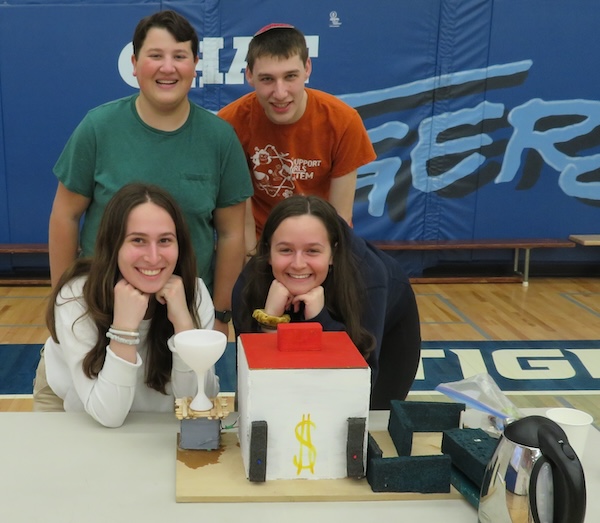
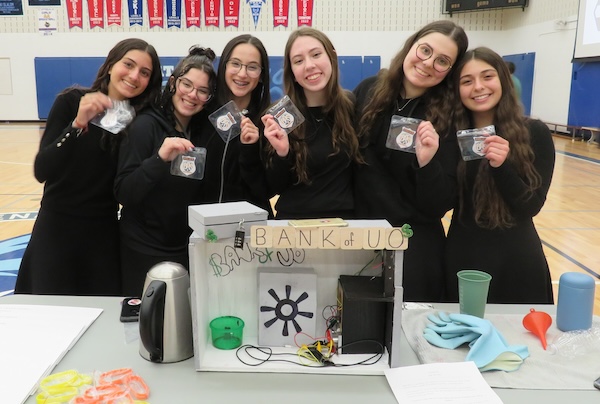
photo - Teams of three to five compete regionally for a chance to reach the finals in Israel.
Teams of three to five compete regionally for a chance to reach the finals in Israel. (photo from Weizmann Canada)

“The finals have been conducted virtually when circumstances make it unsafe for students to travel to the institute,” said Leibner. “In that case, students submit a video of their safe to the judges, explaining the locking mechanism and the physics principles required to open the safe successfully. The students’ videos are judged on roughly the same criteria and a winner is announced at a virtual Zoom session.”

The 2024 virtual closing ceremony can be watched at youtube.com/watch?v=InI8CDoDqDk.

Weizmann Institute of Science has hosted various versions of the high school physics tournament since 1973. “In fact, the winner of the first-ever physics tournament is Dan Gelbart – a notable Canada-based engineer and inventor. He won the tournament at the age of 16 with an original motor he designed and built himself using spare materials, some even sourced from his mother’s kitchen!” said Leibner.

Gelbart, who was born in Germany and raised in Israel, has lived in Canada since the 1970s. Based in Vancouver, he co-founded Creo, a local printing technology company that was bought by Eastman Kodak Co. in 2005, and he has co-founded several other companies. According to a profile on the Weizmann Institute’s website, Gelbart has registered some 145 patents. He also has volunteered as an adjunct professor at the University of British Columbia and has a YouTube channel – the most recent video, which was posted a couple of years ago, is a tour of his workshop and its instruments.

Typically, the physics tournament attracts between 200 and 300 participants a year, from Israel, Canada and other countries.

“The international tournament offers students an incredible opportunity to meet similarly scientific-minded youths from across the world,” said Leibner. “The tournament also offers a teacher development conference for the physics teachers accompanying teams to the tournament.”
photo - “The international tournament offers students an incredible opportunity to meet similarly scientific-minded youths from across the world,” according to Morgan Leibner, annual and education programs officer at Weizmann Canada
“The international tournament offers students an incredible opportunity to meet similarly scientific-minded youths from across the world,” according to Morgan Leibner, annual and education programs officer at Weizmann Canada. (photo from Weizmann Canada)

Participants work in teams of three to five students and their local teacher/mentor – who is the one who must submit the team’s registration – coordinates with the tournament’s physics consultant throughout the process. The team’s safe is judged on its quality and complexity; team members’ level of understanding of the physics concepts being employed is key, as are the esthetics and originality of the safe they build.

“Local mentors are past participants of the physics tournament themselves,” said Leibner. “They have firsthand knowledge of the competition, what is required to build the safe, and what it is like to compete in the tournament. They have also participated in other educational opportunities at Weizmann Institute in Israel and have experienced living on campus and working with the community of scientists. Our mentors have a deep love and appreciation for science and an understanding that promoting STEM in education is incredibly important.”

For information on the tournament and to submit an application, visit weizmann.ca/physics.
Format ImagePosted on September 13, 2024September 11, 2024Author Cynthia RamsayCategories LocalTags competition, education, high school, Israel, Morgan Leibner, physics, safe-cracking, science, STEM, Weizmann Institute
Exploring the science of life

Exploring the science of life

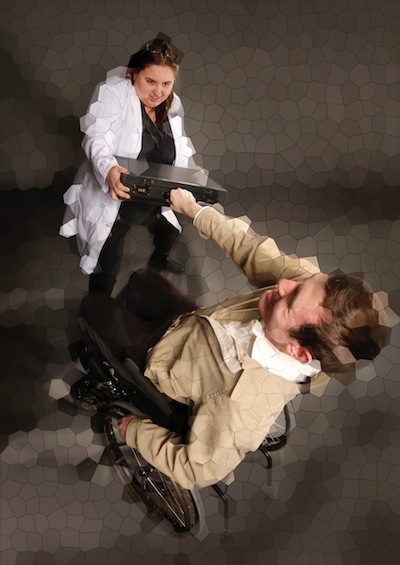
Amy Amantea and Jake Anthony in Sequence, which runs March 14-24 at Presentation House Theatre. (photo by Tim Matheson)

“To direct this play requires a willingness to grapple with the concepts, to accept that sometimes questions are more important than answers, not everything is answerable, and to be committed to entertaining possibilities. It’s heady stuff,” director Rena Cohen told the Independent about Sequence, which opens next week at Presentation House in North Vancouver.

Describing the play as “a science thriller that will challenge as much as it entertains,” Cohen, who is also managing artistic director of Realwheels Theatre, explained, “In Sequence, we follow two absorbing stories. In one, a professor confronts a student who’s defied probability by taking a multiple-choice exam only to get every answer – 150 of them – wrong (the chance of achieving this is one in a pentillion). In the second story, the ‘Luckiest Man Alive’ – his status cemented by his uncanny ability to predict the winner of the Super Bowl coin toss for 20 years running – is confronted by a young woman who claims to know his secret.

“Each of these narratives is presented coherently, cleverly and simultaneously, and it’s how they intertwine through ‘wormholes’ in the dialogue that makes the play fascinating, and mystifying. Playwright Arun Lakra compares the structure of the play to two strands of intertwining DNA. You could argue it’s comparable to a Möbius strip-like dramatic encounter. You’re following two narratives, only to have the carpet swept out from under you.”

For readers who don’t have Wikipedia or a dictionary handy, a Möbius strip, or band, is “a surface with only one side and only one edge. It can be made using a strip of paper by gluing the two ends together with a half-twist.” It’s a non-orientable surface, which means it “cannot be moved around the surface and back to where it started so that it looks like its own mirror image.” The example given for further explanation, is that “no matter what, a human right hand, cannot be rotated in such a way that it becomes a human left hand. The right hand is, therefore, orientable.”

How does one direct a play like Sequence so that it’s enjoyable and comprehensible?

“There are ways we harness the ‘language of theatre’ to capture audiences’ attention, to heighten a moment,” said Cohen. “Sometimes, it’s in the way an actor delivers a line, the way they land on a phrase containing important information. We also signal key moments using lighting and/or sound, so even if, when information doesn’t necessarily register on a conscious level, you absorb it.’”

The material of the play – “Wading into new intellectual territory, learning the mathematical concepts used to understand randomness and probability” – was initially a challenge for Cohen.

“My last physics course was in high school, the last time I studied math was in CEGEP [a post-secondary school program in Quebec] and I’ve never taken a biology course,” she said, “so some of the references in the play – regarding genetics, for example – may not be complicated to a Grade 10 biology student, but they’ve been a challenge to me.

“Sequence is also very fast-paced, and there’s a ton of stage business, most of which is – incidentally – performed by Amy Amantea, our actor who lives with blindness. She’s fearless.”

And, added Cohen, “Working with an integrated cast of performing artists with disabilities and able-bodied artists means there’s a wider range of experience, and we’re challenged to become an ensemble in a few short weeks.”

photo - Krista Skwarok and Byron Noble
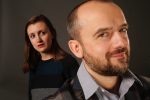
Krista Skwarok and Byron Noble. (photo by Tim Matheson)

Amantea (as the professor) will be joined in the performance by actors Jake Anthony (the student), Byron Noble (the “luckiest man”) and Krista Skwarok (the woman who purports to know his secret).

“Two members of the cast live with disability: Amy is legally blind and Jake lives with autism,” said Cohen. “The casting speaks to our (Realwheels’) commitment to fostering interchange between mainstream and disability arts sectors. That means interchange between artists, and we’re all learning from each other.

“Amy Amantea has such a generous spirit, so much heart and decency and, in Sequence, she’s playing a dark, angry character. Her character is also very funny and over-the-top, and this is new territory for Amy, who left the performing arts after she lost her sight 11 years ago. Furthermore, Amy’s character lives with severe sight loss, but of a type that’s different from her own, so there’s a whole other layer of challenge. She also has the most ‘stage business.’

“Jake Anthony is a sensitive actor, and an incredible advocate for persons with autism; getting to know him means gaining appreciation for the gifts that accompany autism,” continued Cohen. “Jake is a decisive and determined individual, very focused, so lovely and respectful to everyone, and he’s bringing tremendous insight into his character, a young man of faith, and an inveterate optimist.”

Skwarok is a recent graduate of Langara College’s Studio 58 theatre program, said Cohen, “and this is her first professional gig. Such bright energy, she’s super-smart and quick and creative and game. Expect to see a lot more of her – Krista’s talent is explosive.”

As for Noble, Cohen said he “is loaded with charm.” In Sequence, she said, his character “is slick, playful and, yes, he’s a charmer – and we get to see his character grow and other unexpected qualities emerge. It’s beautiful to watch. Byron is the most seasoned actor in the Sequence company, and we’re all benefiting from his experience and generosity.”

She said this play feels made for Realwheels “because it isn’t about disability, yet disability forms the landscape against which universal issues are debated onstage.”

She explained, “The four characters in Sequence are attached to their individual frameworks of the world: faith versus science, fate versus DNA. Did God use evolution as a means of creation? If something isn’t testable, how do you justify believing it? Is there an innate rightness to biological outcomes rooted in our fundamental DNA?”

Sequence has won several awards. The playwright, Lakra, is an ophthalmologist in Calgary, where he splits his time between practising medicine and writing, said Cohen. “This is the first time,” she said, “the play is being produced with an integrated cast – professional actors with disabilities playing alongside able-bodied actors.”

Sequence runs 80 minutes with no intermission, and is not suitable for children. It is at Presentation House Theatre March 14-24 (except March 19), with proceeds from the March 14 preview going to Realwheels Society to cover production costs. For tickets ($28-$10), call 604-990-3474 or visit phtheatre.org.

Format ImagePosted on March 9, 2018March 7, 2018Author Cynthia RamsayCategories Performing ArtsTags Arun Lakra, inclusion, physics, Presentation House, Realwheels, science, Sequence
Proudly powered by WordPress