Skip to content
  • Home
  • Subscribe / donate
  • Events calendar
  • Business Directory
  • FAQ
  • News
    • Local
    • National
    • Israel
    • World
    • עניין בחדשות
      A roundup of news in Canada and further afield, in Hebrew.
  • Opinion
    • From the JI
    • Op-Ed
  • Arts & Culture
    • Performing Arts
    • Music
    • Books
    • Visual Arts
    • TV & Film
  • Life
    • Celebrating the Holidays
    • Travel
    • The Daily Snooze
      Cartoons by Jacob Samuel
    • Mystery Photo
      Help the JI and JMABC fill in the gaps in our archives.
  • Community Links
    • Organizations, Etc.
    • Other News Sources & Blogs
  • JI Chai Celebration
  • JI@88! video

Recent Posts

  • Federation now across BC
  • Israel fighting for its existence
  • Deal strengthens Iran
  • Patriotic belonging diminishes
  • A campaign to engage
  • Upstanders’ first live event
  • Responding to Carney
  • Having your own home
  • Music a family tradition
  • Musical to warm heart
  • Community milestones … June 2026
  • Sharing her passion for Israel
  • Or Shalom reopens its doors
  • JFS from past to future
  • Need holistic approach
  • Sharing stories, advice
  • Journalist shares fears
  • Skills to live together
  • Road to independence
  • Cutting grass with scissors
  • Zionism as a solution
  • Deceit, desire & the divine
  • Reclaiming sacredness
  • Creative project ideas
  • Summer squares and cobbler
  • Thou shalt … summer commandments
  • Legal help for students
  • Revisiting myth of Lilith
  • Wrong person rebuked
  • Canada’s mixed messages
  • Questions for museum
  • Symposium on antizionism
  • Making soccer political
  • CJPAC lauds Pulver’s impact
  • City recognizes Vrba’s legacy  
  • Organ donation saves lives

Archives

Follow @JewishIndie
image - CJN box ad Rockowers 2026

Category: Local

Belong at Bayit and beyond

Belong at Bayit and beyond

Shira Sachs and Dan Shmilovitch at the Bayit’s Belong launch May 12. (photo from facebook.com/thebayit)

Earlier this year, the Bayit in Richmond launched Belong. The goal of the program is “to create a community where belonging grows and isolation disappears.”

Belong was developed by a committee of six Bayit members: Mel Bauer, Matti Feigelstock, Shelley Goldberg, Shira Sachs, Dan Shmilovitch and Rabbi Levi Varnai.

“There are people that you know you should be connecting to, [or] they should be connecting to you as an organization, but, for whatever reason, they’re not. So, we started talking about how we could address that issue as the Bayit,” explained Shmilovitch, who has been active in the Jewish community for more than 30 years.

There is never just one reason why people feel isolated, he said. “People are isolated for a whole range of reasons – health issues, economic circumstances, mental health issues, maybe they are recently widowed or divorced.”

It is easy to assume that Jewish communities are inherently so strong as to make isolation impossible, but this is not the case. Shmilovitch spoke of the need for “deepening Jewish connections … because isolation is a huge problem in every community and it affects the Jewish community as well, for all age groups.”

There are challenges in combating isolation. “As a Jewish organization, as a synagogue, you’re always looking to invite people in,” he said. “But, when you have people who are isolated and really disconnected, your approach has to be different to get that connection because that’s not their mindset. At that moment in time, that’s not where they’re at.”

photo - Left to right: Mike Sachs, Dan Shmilovitch and Rabbi Levi Varnai at the Bayit’s Belong launch May 12
Left to right: Mike Sachs, Dan Shmilovitch and Rabbi Levi Varnai at the Bayit’s Belong launch May 12. (photo from facebook.com/thebayit)

The Belong committee started their planning by examining the obstacles that prevent people from making contact. There is more to being a community member than simply going to shul, explained Sachs, who is a teacher at Vancouver Talmud Torah.

She noted that people can still feel “uncomfortable or isolated” attending social gatherings outside regular services. She talked about how loneliness has a profound effect on a person’s health and can lead to depression. Using her own childhood story as an example, she described arriving in Canada when her mother, now deceased, was pregnant with twins; Sachs is the oldest of four.

“Community became so important to us,” she said. “We didn’t have the language and, within a couple of months, we went from a family of four to a family of six. My mom was a new mother in a new country, with twins.”

Going to shul helped the family make connections, learn about which schools the family wanted for the children. As a parent herself now, Sachs described how this ethos has shaped her own approach to family life. “When we came back from L.A., it was the number one thing to do – find a community and slowly grow with it. Now, how do we do that for others?”

The Belong committee determined multiple strategies for community development, the first of which was through Friday night dinners. The Belong team sought Bayit members who were willing to invite people to meals at home. They also reached out to Jewish Family Services for help locating people in Richmond who needed help.

“If you have a lady who is a single parent, you match them with another single parent,” said Sachs. “If you have a person who is passionate about literature, you sit them with someone who has the same passion. It was all assigned seating.” She added, “It’s comforting to know, ‘I don’t have to worry about that.’ Maybe that anxiety is why people haven’t come to a dinner.”

Belong is also working to offer food deliveries to families in need. “Food security is an issue in the Jewish community,” said Shmilovitch. The program has been running for awhile now but he hopes that deliveries will become more frequent in future.

“There are vulnerable people in the Jewish community – whether they don’t have enough food, feel isolated for a short time or in the longer term. Regardless, it’s hard to come out at the other end. That’s what drives us.”

In addition, Belong has created a support structure for new mothers. Inspired by and in partnership with Mamatefet, a support organization for Hebrew speakers in Vancouver, Mama Belong will work to diminish the feelings of isolation that often follow the birth of a baby. (See jewishindependent.ca/mothers-embrace-mamatefet.) Mama Belong started delivering baskets to Jewish mothers this summer.

The future of Belong came into focus at the May 12 launch. Current members of the Bayit were invited to learn about the new program. Guests were given a card with tear-off tabs that suggested a wide range of ways in which people could contribute, including hosting Friday night dinners, Russian language conversation groups and cash donations, among other ideas. Between 90 and 95% of the attendees folded over a tab.

From Mama Belong to food bank deliveries and Shabbat dinners, the program is striving to create a warm sense of community for those in need. “You never know what’s going to happen at what point in your life,” said Shmilovitch, but “something’s going to happen to connect you.”

Shula Klinger is an author and journalist living in North Vancouver. Find out more at shulaklinger.com.

Format ImagePosted on August 23, 2019August 22, 2019Author Shula KlingerCategories LocalTags Bayit, Dan Shmilovitch, Judaism, lifestyle, Shira Sachs, tikkun olam
Jessies, Order of Canada, Korczak, Rockowers, Federation & VHEC

Jessies, Order of Canada, Korczak, Rockowers, Federation & VHEC

Warren Kimmel won a Jessie Award for his portrayal of the title character in the Snapshots Collective’s Sweeney Todd: The Demon Barber of Fleet Street. (photo from Snapshots Collective)

The 37th annual Jessie Richardson Theatre Awards were held on July 15 at Bard on the Beach’s BMO Mainstage in Vanier Park. Fifty theatrical productions were nominated from last year’s theatre season.

In the small theatre category, the Snapshots Collective’s Sweeney Todd: The Demon Barber of Fleet Street, which included several Jewish community members in its creative team, garnered eight nominations: director Chris Adams and costume designer Emily Fraser were acknowledged, along with the outstanding performances by Jewish community member Warren Kimmel, Colleen Winton, Oliver Castillo and Jonathan Winsby, and the production as a whole for its quality and innovation. In the end, the show won four Jessies, for the performances of Kimmel, Winton and Castillo, as well as nabbing the award for outstanding musical production.

Jewish community member Itai Erdal won the award for outstanding lighting design category for his work in Arts Club Theatre Company’s The Curious Incident of the Dog in the Night-Time. Erdal was also nominated for his lighting in Théâtre la Seizième’s Le Soulier.

At the July 15 ceremony, community member David Diamond received the Greater Vancouver Professional Theatre Alliance Career Achievement Award.

For more information, visit jessieawards.com.

* * *

On June 27, 2019, Governor General of Canada Julie Payette announced this year’s appointments to the Order of Canada, including, as officers, two local Jewish community members: Gordon Diamond, for “his steadfast leadership in business and for his philanthropic support for causes related to health care, education and social services,” and Dr. Peter Suedfeld, for “his groundbreaking research on the psychological impacts of extreme environments and stressors on human behaviour.”

* * *

On June 18, 2019, at Government House in Victoria, B.C., the Janusz Korczak Medal was awarded to Ted Hughes, OC, and Helen Hughes, OC, while the Janusz Korczak Statuette was awarded to Irwin Elman, the past advocate for children and youth of Ontario. The awards were bestowed in recognition of caring for children in the spirit of Dr. Janusz Korczak.

The ceremony started with welcoming remarks by the event’s host, Lieutenant Governor Janet Austin, and Holocaust survivor and writer Lillian Boraks-Nemetz spoke about Korczak, with a personal touch. The awards were presented jointly by Jennifer Charlesworth, B.C. representative for children and youth, and Jerry Nussbaum, president of the Janusz Korczak Association of Canada. And the event was emceed by Jerymy Brownridge, private secretary to the lieutenant governor and executive director of Government House.

* * *

The Jewish Independent won two American Jewish Press Association Simon Rockower Awards for excellence in Jewish journalism this year (for work published in 2018). The awards were presented at the 38th annual AJPA banquet, held in conjunction with the association’s annual conference in St. Louis, Mo., June 23-26.

Bruce Brown’s “The draft: a dad reflects” – in which he shares his experience of sending his son off to serve in the Israeli Air Force – placed first in the personal essay category for its circulation class.

The JI’s editorial board – Pat Johnson, Basya Laye and Cynthia Ramsay – took second place in the editorial writing category for its circulation group. The submission, which included the editorials “Holocaust education needed,” “Impacts of nation-state” and “What is anti-Zionism?” elicited the following comment from the Rockower judges: “Riveting and well-explained editorials on anti-Zionism, the identity of Israel as a nation-state, and a local controversy involving Holocaust education.”

* * *

photo - Ambassador Nimrod Barkan at Jewish Federation of Greater Vancouver’s annual general meeting on June 18
Ambassador Nimrod Barkan at Jewish Federation of Greater Vancouver’s annual general meeting on June 18. (photo from facebook.com/pg/jewishvancouver)

At Jewish Federation of Greater Vancouver’s annual general meeting on June 18 at King David High School, Federation elected two new directors – Karen Levitt and Melanie Samuels – and the board appointed a new executive. While Karen James has completed her term as board chair, she remains on the board as immediate past chair. Alex Cristall takes over as chair, Penny Gurstein is vice-chair, Bruce Cohen is secretary and Jim Crooks is treasurer.

At the AGM, several honours were bestowed: Stephen Gaerber was the recipient of the Arthur Fouks Award, Megan Laskin the Elaine Charkow Award and Sam Heller the Young Leadership Award. Tribute was also paid to James; as well as Jason Murray, outgoing chair of CIJA’s local partnership council; Richard Fruchter, chief executive officer of Jewish Family Services; Rabbi Noam Abramchik and Rabbi Aaron Kamin, rosh yeshivah of Pacific Torah Institute; and Cathy Lowenstein, head of school at Vancouver Talmud Torah. Ambassador Nimrod Barkan attended the AGM as part of his last visit to Vancouver before he completes his term as Israel’s ambassador to Canada.

Federation thanks the directors who came off the board – Eric Bulmash, Bryan Hack, Rozanne Kipnes and Laskin – for their dedication to community and that they chose to share their time and talents with Federation. In Bulmash’s case, he will continue to contribute, but in a different capacity, as he is Federation’s new vice-president, operations.

* * *

At its annual general meeting on June 19, the Vancouver Holocaust Education Centre announced the two winners of the Kron Sigal Award for Excellence in Holocaust Education. The VHEC also inducted two new recipients of the Life Fellows designation.

The designation of Life Fellow recognizes outstanding dedication and engagement with the Vancouver Holocaust Education Centre Society through long-term involvement and significant contributions to the organization’s programs and mandate. This year, VHEC is delighted to have two recipients, Wendy and Ron Stuart, in recognition of their longstanding contributions as artistic directors of the VHEC’s community-wide Yom Hashoah commemoration.

Each year, the VHEC presents the Meyer and Gita Kron and Ruth Kron Sigal Award to a B.C. elementary or secondary teacher who has shown a remarkable commitment to teaching students about the Holocaust and its important lessons. This year’s recipients are Nicola Colhoun and Dr. Christine Paget from West Vancouver Secondary School.

In their remarks, Colhoun and Paget shared, “As social studies teachers … we are tasked with the lofty goal of having students care about what has come before them to shape the world they live in now…. Through the testimonies of survivors, the past becomes tangible, it becomes human, and it becomes relevant to students…. So many of our students come away from the Holocaust Symposium saying things like, ‘I get it now.’ ‘I didn’t realize, but now I understand.’ They understand why the history of the Holocaust matters. And they also understand why they need to speak up for inclusion, and stand against racism and persecution of any kind, from the school hallways to the hallways of power.”

The VHEC’s executive is Philip Levinson, president; Corinne Zimmerman, vice-president; Marcus Brandt, second vice-president; Joshua Sorin, treasurer; Al Szajman, secretary; and Ed Lewin, past president.

Format ImagePosted on July 19, 2019July 18, 2019Author Community members/organizationsCategories LocalTags AJPA, Christine Paget, Gordon Diamond, Itai Erdal, Janusz Korczak Association, Jessie Awards, Jewish Federation, journalism, Kron Sigal Award, Megan Laskin, Nicola Colhoun, Peter Suedfeld, Rockower, Ron Stuart, Sam Heller, Snapshots Collective, Stephen Gaerber, theatre, Vancouver Holocaust Education Centre, VHEC, Warren Kimmel, Wendy Bross-Stuart, Yom Hashoah
Goldene Medina comes here

Goldene Medina comes here

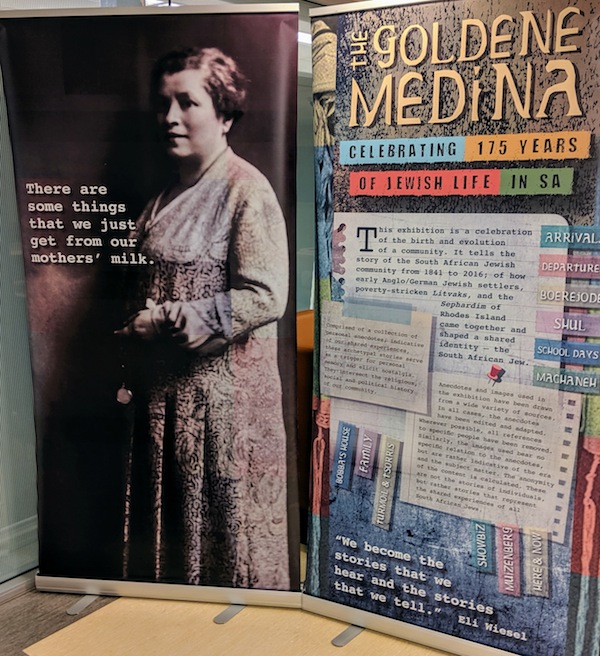
The Goldene Medina exhibit is designed to have the feel of a scrapbook album, to have come from any Jewish South African’s family memoir. (photo from South African Jewish Museum)

The Goldene Medina exhibit arrives in Vancouver July 29 for two weeks. A celebration of 175 years of Jewish life in South Africa, the exhibit was displayed in South Africa, Australia and Israel prior to arriving here, where it is making its North America debut at Congregation Beth Israel. Local Jewish community member Stephen Rom, who is from South Africa, saw it for the first time in Sydney and was instrumental in bringing it to the city.

“You need to remember your past to engage in the present,” reflected Rom. “I was struck by the level of professionalism of this exhibit, which was produced by the South African Jewish Museum in Cape Town. What’s different about it is the way the stories have been written. Nobody is named or personally identified. This is the story of all Jews in South Africa, the community as a whole.”

The Goldene Medina was the Jews’ name for Johannesburg when they arrived during the gold rush in 1886. “This exhibition has soul – it’s not a dry exhibition of facts and figures,” noted Wendy Kahn, national director of the South African Jewish Board of Deputies. “It’s one that tells real stories of families that have been living in South Africa for 175 years.”

“This is a social history,” agreed Gavin Morris, director of the museum, “the story of families and people and their experiences as South Africans and as Jews for 175 years, from our forefathers arriving to contemporary Jewish South Africa. Everything is taken from unpublished memoirs, articles and out-of-print books, to give the exhibit a sense of a scrapbook album, of any Jewish South African’s family memoirs. Our goal was for people to find their own stories in similar stories.”

The stories are excerpts written in the first person and accompanied by photographs old and new. One excerpt, titled “My Mother’s Table,” reads, “At my mother’s table, ‘being full’ was never a reason to stop eating. Some of the many reasons to have some more included: ‘I cooked this especially for you because I know you like it,’ ‘you can’t put so little leftovers back into the fridge,’ ‘it’s freshly made,’ and ‘you don’t like my cooking.’ Refusing more was to snub the generosity and abundance that was on offer. Eating was proof that you were loved and that you knew how to love back.”

Another, titled “Cubs,” reads: “After my mom realized that I only knew Jewish kids, she sent me off to Cubs – not exactly your standard Jewish activity. I came home with my first friend and said, ‘Mom, isn’t it wonderful? Here’s my first friend from Cubs and guess what – we’ve got the same Hebrew teacher!’ He was the only other Jewish kid there and we found each other. My mother gave up after that.”

A third is titled “A Surprise Guest”: “What is the epitome of Jewish chutzpah? Inviting the president of the country to attend your bar mitzvah. And what is Jewish mazel? When the president actually accepts. The bar mitzvah boy delivered his handwritten note to a security guard outside [Nelson] Mandela’s Houghton estate. He hoped to get a card from Mandela in return. Instead, his parents received an official call to say the president will attend. On the day, President Mandela arrived and sat at the main table, between the bar mitzvah boy and his father.”

The excerpts are thought-provoking, poignant, entertaining, informative and never boring. And the photographs are deeply intriguing, telling a story of their own – a timeless Jewish story that has relevance to all Jews whose ancestors have known immigration and resettlement.

Accompanying the Goldene Medina in Vancouver will be the exhibit Shalom Uganda: A European Jewish Community on the Ugandan Equator 1949-1961, curated by Janice Masur.

photo - The Kampala Jewish community gathers for visit of Chief Justice Joseph Herbstein from South Africa, 1958. Gifted by Ilsa Dokelman, in 2005
The Kampala Jewish community gathers for visit of Chief Justice Joseph Herbstein from South Africa, 1958. Gifted by Ilsa Dokelman, in 2005. (photo from Janice Masur)

“As a child, I lived in this remote European Jewish community on the shores of Lake Victoria in Kampala, Uganda, under British Imperial rule, with no rabbi or Jewish infrastructure. Yet, this tiny community of 23 families and 20 children (15 of whom were born in Kampala) identified as Jews and formed a cohesive group that celebrated all the Jewish festivals together,” explained Masur. “Now that most references to Jews in Uganda pertain to … Abayudaya Jews, I want this history – my story about my Ashkenazi Jewish community in Kampala – to be remembered in the Jewish Diaspora.”

The photos and stories that comprise the Ugandan display are, said Masur, “a testament to a determined but isolated group of Jews who were secular in a [remote] place but upheld their Jewish identity and traditions as best as was possible,” given the lack of religious, educational or cultural Jewish institutions. (For more about the Ugandan Jewish community in which Masur grew up, click here.)

The July 29 opening night of the Goldene Medina starts at 7:30 p.m. at Beth Israel, where the display will be up until Aug. 14.

Lauren Kramer, an award-winning writer and editor, lives in Richmond. To read her work online, visit laurenkramer.net.

Format ImagePosted on July 12, 2019July 10, 2019Author Lauren KramerCategories LocalTags Beth Israel, Goldene Medina, history, Janice Masur, photography, South Africa, Stephen Rom, Uganda
Local woman inspires chesed

Local woman inspires chesed

Members of Vancouver Talmud Torah’s Grade 7 chesed club with Gia Tran, a local woman who raises money for cancer research by taking refundable containers to a bottle depot. (photo from VTT)

Since 2014, Vancouver Talmud Torah has offered a chesed (kindness) program to students in grades 3 and 6. Following requests from parents, the school introduced a mandatory chesed program for Grade 7s this year, which nurtures a commitment to volunteering and social justice.

And, this year, the initiative was pursued with a particular dedication, as students mourned the recent passing of Rose Dupaya, who worked as a custodian at VTT. She took ill last fall with cancer and died suddenly, which was a tremendous shock to the school community. In response, the students – who would often greet Rose with hugs – turned their grief into action.

When the Chesed Leadership Club heard about local woman Gia Tran, who takes refundable containers to a bottle depot every day to raise money for cancer research – more than $15,000 in 22 years – they were inspired. Following in Tran’s footsteps, the kids raised $2,000 from a bottle drive for cancer research.

VTT student Julia Andison expressed her gratitude to Tran for teaching her about personal agency. “Gia taught me that even a small act like collecting cans can make a big impact on others. And, as a chesed leader, I was able to communicate this to the younger students in our school, that every little bit counts.”

Students in the chesed club do not follow a curriculum. Unlike with subjects like math or language arts, the club was founded for students to explore their values and lead a program on their own initiative. As a consequence, the program’s success lies in the development of student ideas, teamwork and leadership.

“The minute you offer something optional and student-driven, it takes on a life of its own,” said Shoshana Burton, director of Hebrew (grades 5-7) and chesed programming at VTT.

Students are not admitted automatically to the chesed club. Instead, they submit applications and sign contracts. If they do not follow up on their commitment to leadership, they can be dropped from the program, which is both an opportunity and a challenge to the students’ organizational skills and a way to exercise their moral and management muscles.

All of the students volunteer as part of the program. Some do so once a week while others volunteer their help every day. Many organizations and communities have benefitted from the support of VTT students, including the Muslim Food Bank and residents of the Downtown Eastside.

According to their teacher, the success of the club is in its spontaneous, natural development. “You can’t know the end result when you start. You can’t plan in advance,” said Burton. “The students learn how to work as part of a team, learning to commit to a project.”

Student Celia Joffe spoke of the club’s impact on her. “Helping others gives us a sense of pride and responsibility,” she said. “The project with Gia was amazing because we ended up not only helping the cancer foundation and the environment, but we also made Gia feel special and acknowledged.”

Shula Klinger is an author and journalist living in North Vancouver. Find out more at shulaklinger.com.

Format ImagePosted on July 12, 2019July 10, 2019Author Shula KlingerCategories LocalTags cancer, chesed, Gia Tran, philanthropy, recycling, tikkun olam, tzedakah, Vancouver Talmud Torah, VTT
Court’s segregation decision

Court’s segregation decision

Halifax-based lawyer Hanna Garson. (photo from Hanna Garson)

In 2015, the B.C. Civil Liberties Association and the John Howard Society launched a legal challenge to the federal government’s laws that allow administrative segregation – a form of solitary confinement – in prisons, calling it a cruel and inhumane punishment that can lead isolated prisoners to harm and even kill themselves. They won their case in the B.C. Supreme Court in January 2018, a decision that was appealed by the government the next month. Last week, the B.C. Court of Appeal affirmed the unconstitutionality of provisions that allow indefinite and prolonged solitary confinement of prisoners.

In the January 2018 decision, the B.C. Supreme Court gave the federal government 12 months to pass new laws. In January 2019, the court gave the government an extension to April, but said certain stipulations had to come into effect immediately. Correctional Service Canada was ordered to take several steps, including giving prisoners in segregation more time outside, requiring daily visits from healthcare professionals, allowing inmates legal counsel in hearings related to solitary confinement, and changing the authorization system regarding the placement of an inmate in segregation for more than 15 days.

The federal government was given another extension after the April deadline, to the end of June. Then, on June 24, the B.C. Court of Appeal came out with its decision on the matter – rejecting the government’s appeal.

“This particular case is very interesting, as there are no actual individual complainants,” said Jewish community member Hanna Garson, a lawyer based in Halifax whose focus is ensuring that everyone is treated fairly by the justice system. “So, the court [was] being asked to decide whether or not the written laws themselves breach provisions of the Charter of Rights and Freedoms in Canada.”

According to Garson, sections of the Charter are indeed being breached when it comes to administrative segregation, especially as it comes with no time limit. “People are being put into segregation not knowing when, if ever, they’re going to get out,” she told the Independent. “That really plays on the mind.”

Noting that many people have mental illness or struggle with mental health before they are incarcerated, which “may have led to their negative interaction with the law,” she said, “That population, in particular, is very damaged by periods of segregation.”

The appeal court’s reasons for judgment, written by Justice Gregory Fitch, stated that the Corrections and Conditional Release Act violated Section 7 of the Charter, which protects an individual’s right to life, liberty and security of the person. The court “found that the harm caused by prolonged confinement in administrative segregation undermines the maintenance of institutional security, as well as the ultimate goal of achieving public protection by fostering the rehabilitation of offenders and their successful reintegration into the community.” It also “found that prolonged confinement in administrative segregation is not necessary to achieve the safety or security objectives that trigger its use.”

The judgment noted “that administrative segregation has a small, but significant, disproportionate effect on indigenous men and an even more significant effect on indigenous women” and that the “impugned laws” violated Section 15 of the Charter “to the extent that they authorize and effect a procedure that results in discrimination against aboriginal inmates.”

Section 15 states that, “Every individual is equal before and under the law and has the right to the equal protection and equal benefit of the law without discrimination and, in particular, without discrimination based on race, national or ethnic origin, colour, religion, sex, age or mental or physical disability.”

Another issue, said Garson – who, in addition to being part of the firm Planetta Hughes LLP, is chair of the East Coast Prison Justice Society and is on the board of the Elizabeth Fry Society Mainland Nova Scotia – is that, while prisoners being placed in segregation have access to review boards, administrative segregation review boards consist of the same prison administration that placed them there. “So, it’s not an independent review and so, basically, the people who initially made the decision then question their own decision, which doesn’t necessarily secure a fair assessment of whether or not a person really needs to be segregated,” she said.

While legal counsel is permitted at these reviews, it is not provided in many provinces and few prisoners can afford representation or are not in a mental state of being able to request it, she said. “If you’re running a facility with hundreds of people who may be violent, I can understand a time-out for a moment to see what else needs to be done,” said Garson. “But, there needs to be a time limit and other solutions.

“Long-term, serious mental health treatments take far more expensive staff and thorough training. Are these better solutions though? Without a doubt, yes. Unfortunately, a lot of the constraints are budgetary and this is something that, oftentimes, courts are hesitant to rule on. But, for example, the court did say that, as it says in Section 15 [of the Charter], everyone has a right to be equal before the law and receive equal treatment of the law. So, the court does an assessment of whether or not people are being discriminated against by these laws.”

After hearing testimony and expert opinions, Garson said, “the court decided that both aboriginal people and people suffering from mental illness are segregated far more often … and that the impact on them is far more negative. But, it went further, ordering incarceration facilities to put in place better solutions – better programming that does not involve segregation.

“Usually, the court is hesitant to make decisions that would force the government to put more funding into something. But, it did in this decision, which is, in my opinion, really wonderful and a great precedent. This case is really groundbreaking and, to a certain extent, it was a wonderful thing that it was appealed.”

The B.C. Supreme Court said, “basically, we had to come up with new laws. But then, they suspended it for a year, as the government needs time to pass new bills and stuff like that. In the meantime, the attorney general appealed, because they don’t think it’s fair,” she said.

The Constitution of Canada, which includes the Canadian Charter of Rights and Freedoms, is the supreme law in Canada, she explained. Section 52 (1) of the Constitution Act 1982 mandates that any law inconsistent with the provisions of the Constitution is, to the extent of the inconsistency, of no force or effect. The decision by the appeals court will become a binding precedent in all provinces, not only in British Columbia.

Garson emphasized that she is especially happy with the decision because it is one that has really considered the damage segregation does on the mental health of those being isolated and notes that, “if we really care about rehabilitation, then [segregation] makes no sense as a strategy, especially for those with mental illness.”

Because the court looked at the experiences of those who have been segregated and the decision will affect them, the system and society as a whole in the long-term, Garson said, “It’s more like a living document in that way, and it’s a very exciting case for this reason.”

As for where Jewish law falls on this matter, the organization T’ruah has been leading a campaign to abolish solitary confinement in the United States. In a 2014 report on the compliance of the United States with the United Nations Convention Against Torture, T’ruah notes, “The very first two chapters of our Torah teach us that every human being is created in the image of God, and that no human being should be alone. The practice of solitary confinement violates these principles and diminishes the divine image. It also violates one of the Torah’s central moral teachings, expressed in Leviticus 19:18, that one should ‘Love your neighbour as yourself.’ The rabbis explain that this is taught, so that no one can justify degrading treatment of a member of their community…. If you do thus, know that the person you have dishonoured was created in the image of God.”

The report argues that “Jewish tradition understands instinctively that humans are social creatures. In a story about a character who outlives his family, friends and study partners, the Talmud teaches, ‘Either companionship or death.’ Life alone is unbearable. Jewish law warns against excessive punishment, ‘lest your brother be degraded before your eyes.’ (Deuteronomy 25:3) Even a person who has committed a horrific crime must be regarded as a member of one’s own family and, therefore, deserving of dignity.”

T’ruah contends that Jewish criminal law seeks to inspire teshuvah (repentance) and that there are several principles that should hold in prisons:

“1. No matter his or her crime, the prisoner should be seen as our ‘brother or sister’ and treated with dignity.

“2. No human being should be alone for extended periods of time. Isolation diminishes the human being and can even be deadly.

“3. Prisons should seek to rehabilitate the prisoner and not simply to degrade him or her.

“4. A prisoner should have a fair trial before being placed in solitary confinement. Therefore, solitary confinement cannot be used for those in pre-trial detention.”

Rebeca Kuropatwa is a Winnipeg freelance writer.

Format ImagePosted on July 5, 2019July 3, 2019Author Rebeca KuropatwaCategories LocalTags administrative segregation, British Columbia, Hanna Garson, human rights, Judaism, law, prison reform, solitary confinement, T'ruah
Refugees 40 years on

Refugees 40 years on

Sui Khuu and her husband Dar, with their two children. (photo from Shirley Barnett)

In the last couple of years, Jewish congregations and groups in Vancouver have sponsored refugees from Syria, acts of humanitarianism that are inspired in part from ancient and recent history in which Jewish people were strangers in a new land. But this generosity is not new. Forty years ago, in 1979, a similar phenomenon occurred with Vietnamese refugees fleeing conflict in Southeast Asia.

The so-called “boat people” – about two million Vietnamese – fled their homeland in the years following the war there, which ended in 1975. Across Canada, churches, synagogues, service clubs and other groups came together to sponsor refugees. Among these were several B.C. Jewish groups.

Forty years later, one of the refugees sponsored by a group of Jewish friends reflected on the experience.

Sui Khuu was 5 years old when she arrived in Vancouver with her 4-year-old sister Ngoc Lien (informally called Ileen), her father Vinh and grandparents Namson Khuu and Kim Thi Kiu.

“My mom passed away in [a refugee camp in] Thailand,” Khuu told the Independent recently. “She was five months pregnant. She had malaria and she passed away.”

Khuu has no recollections of her life before Canada, but deeply embedded in her memory is the warm welcome she and her family received from the Jewish sponsors as soon as they arrived here.

Four couples joined together to guarantee to the government of Canada that they would ensure the sponsored family got a secure start in their new country: Peter and Shirley Barnett, Abe and Esther Nobleman, Buddy and Cherie Smith and Paul and Edwina Heller.

With the support of Canadian Jewish Congress and Jean Gerber, who worked there at the time, numerous groups banded together to sponsor Vietnamese immigrants, including Beth Israel, Temple Sholom, the Jewish Community Centre of Greater Vancouver and Emanu-El in Victoria, among others.

“Each group had a name and our group chose the name ‘Hope,’” Shirley Barnett recalled. She has kept in close touch with the family across the decades and remembers how Sui was just 7 or 8 years old when she served as translator for her father and grandparents at government meetings and with doctors, teachers and such.

“By the time she was 9, she was the head of the family, because the grandparents never learned to speak English,” Barnett said. The father worked for the Barnetts at their Elephant and Castle restaurant for years. He is now semi-retired. The grandparents have both passed away.

“They were incredibly resourceful, successful,” said Barnett about the family. The girls finished high school and Ileen became an accountant, while Sui is coming up on 29 years as a pharmacy assistant at London Drugs.

“How did they get the strength to turn out so great?” Barnett asked. “The answer came from their grandmother. I remember one day, as a little one, Sui forgot to take her lunch to school and Grandma packed her lunch and found her way to school without speaking English and Sui told me later she found her grandmother wandering in the hallway just trying to find out what classroom she was in to bring her lunch.”

image - An article in the Jewish Independent’s predecessor about Sui Khuu and her family’s citizenship ceremony in 1984
An article in the Jewish Independent’s predecessor about Sui Khuu and her family’s citizenship ceremony in 1984.

While the grandparents never learned English, they found ways to communicate.

“In those years, my ex-husband, Peter, was still fluent in French and he was able to talk to Grandpa a bit in French,” said Barnett.

Khuu recalls something beyond verbal between her grandmother and Shirley Barnett.

“I can’t imagine how she and Shirley communicated at that time but they totally understood each other,” the daughter said. “That was a great memory. My grandmother was trying to tell Shirley [something] and Shirley totally understood what she wanted her to do.”

She also remembers the Barnetts and Nobelmans picking the family up to take them to dinner, delivering Christmas gifts and taking family members to doctors’ and dentists’ appointments.

“Cherie Smith was in charge of finding them clothes,” Barnett said. “I was in charge of getting them enrolled in a preschool.”

“Shirley got a house for us on East 12th Avenue in Vancouver,” Khuu said. Both girls, now in their 40s, are married and each has a son and a daughter of their own.

Seeing Syrians coming to Canada now evokes memories for Khuu.

“It’s hard when they have young families like what my grandparents and my dad went through,” she said. She is saddened when she hears comments that are unwelcoming toward new Canadians and sees the circle of life in the next generation of refugees finding a home here.

Barnett is effusive about how Sui and Ileen have turned out: “By luck or determination or resilience or whatever they had, they turned out really well. They are just lovely, responsible, charming, caring people.”

Format ImagePosted on June 28, 2019June 26, 2019Author Pat JohnsonCategories LocalTags CJC, immigration, Shirley Barnett, Sui Khuu, Vietnam
Kehila celebrates 20th

Kehila celebrates 20th

Left to right are Toby Rubin, Marie Doduck and Lynne Fader. (photo by Lianne Cohen)

On May 5, the Kehila Society of Richmond celebrated its 20th anniversary. The society honoured Marie and Sid (z”l) Doduck for the support and guidance they have given to the society since its inception, and celebrated members of its first board of directors. The special annual general meeting, which took place at the Richmond Country Club, also saw the initiation of Kehila’s current board and the event featured speaker Dr. Sherri Wise, who shared her story of surviving a terrorist attack in Israel. More than 90 people attended the AGM.

“The difference that Kehila has made for our Jewish community in Richmond … for the quality of living for those residing here – we continue to be an integral part of the Richmond community at large and are partners within it, making a difference every day,” said Lynne Fader, co-executive director with Toby Rubin.

“Kehila’s weekly seniors program on Mondays is an essential service for most of our attendees,” said Rubin. “We are meeting so many of their needs: from free ESL programming to food sustainability and socialization and education. We are very proud of our program and its vitality.”

photo - The Kehila Society of Richmond’s 2019/2020 board of directors
The Kehila Society of Richmond’s 2019/2020 board of directors. (photo by Lianne Cohen)

The 2019/2020 Kehila Society of Richmond board of directors is Sherri Barkoff (co-president and treasurer), Mark Babins (co-president), Keziah Selles (secretary), Ruth Singer (seniors’ representative), Shauna Osten (community outreach), Shelley Morris (human resources), Courtney Cohen (community outreach) and Harley Godfrey (finance committee), with directors Rabbi Levi Varnai (the Bayit representative), Lu Winters (Richmond Jewish Day School), Jeff Rothberg (Beth Tikvah) and Sanford Cohen (Chabad Richmond).

“I am proud of the collaboration that we do with all the organizations in Richmond to help those in need, seniors, families and youth,” said Barkoff.

Kehila’s partnerships include the Multifaith Richmond Food Aid Delivery Program, a faith-based group of organizations working to feed the homeless, isolated, low-income and frail in the general population. Kehila assists with deliveries, cooking and, when viable, food vouchers and items of warm clothing. Kehila has facilitated a partnership with the Richmond SPCA and Tysol Pets to assist with these community members’ animal companions.

Kehila also participates in Light of Shabbat, with Chabad of Richmond. This biweekly, by-donation program has volunteers of all ages doing the cooking, packaging and delivering of kosher Shabbat meals to 30-plus individuals.

The Len Babins Nutritional Subsidy Program is a donor-sponsored initiative focused on RJDS but not exclusively. It provides hot lunches twice a week for children in need at the school; children are screened discreetly through the school counselor. Approximately 254 meals per term per student are provided, with a total of 17 children from 12 families accessing the service. But the number of children served is higher than this because, additionally, Kehila funds a healthy lunch for these same children who, on days of no hot lunch program, do not have lunches.

Chabad of Richmond and Kehila also partner in the Richmond Community Seder, an annual, by-donation event that has been held for numerous years. Generally, about 70 people attend the seder and many take food home for a second seder or out of need. This year, for the first time, a full seder meal and supplies were delivered to those who were unable to attend.

Lastly, Kehila spearheads Rose’s Angels, an annual outreach program that provides warm clothing, hygiene products, children’s books and more to local community agencies whose clients are in need of assistance. This year, more than 1,100 individuals benefitted from the program, which is run through donations of many kinds.

Cory Bretz has made a video of Kehila Society’s work and Lianne Cohen photographed the 20th anniversary event – the video and photos can be found on Kehila’s Facebook page (facebook.com/113139405408718).


Format ImagePosted on June 28, 2019June 26, 2019Author Kehila Society of RichmondCategories LocalTags Kehila Society, Lynne Fader, Marie Doduck, Richmond, Sherri Barkoff, tikkun olam, Toby Rubin
Community milestones – Silber Theatre, RJDS-Pawer tzedakah, Rudolph wedding, Pawer and Baitelman grads

Community milestones – Silber Theatre, RJDS-Pawer tzedakah, Rudolph wedding, Pawer and Baitelman grads

The Arnold and Anita Silber Theatre at Tel-Hai College officially opened last month. (photo from Jewish Federation of Greater Vancouver)

Last month, Jewish Federation of Greater Vancouver chief executive officer Ezra Shanken, as well as board members Karen James, Alex Cristall and Candace Kwinter, and Jewish Community Foundation executive director Marcie Flom were in Israel for the official opening of the Arnold and Anita Silber Theatre at Tel-Hai College. This new 1,200-seat outdoor theatre will be a hub of activity for the university and surrounding area. The theatre is located at the centre of the Tel-Hai campus, and is a key component in the college’s long-term development plan.

The Silbers have long supported Federation’s partnership region of the Galilee Panhandle, and its work there. They have supported a number of projects and established the Friends of Beit Vancouver, a donor-recognition program for supporters of Beit Vancouver. Anita Silber serves on Federation’s Israel and overseas affairs committee, and has for several years. Recognizing that Tel-Hai is a significant economic driver in the region led the Silbers to fund this legacy project and lend their name to it.

The official opening of the theatre began with a welcome reception with Tel-Hai’s board of trustees, followed by a ribbon cutting. The Silbers were joined by their granddaughter, Samantha Addison, and family members from Israel. In reply to the address honouring them that was delivered by Tel-Hai’s president, Prof. Yossi Mekori, Arnold Silber stressed that the students were the primary motivation for this investment. They are the ones to whom the future of the region is entrusted, and it is they who will take it to the next level.

A number of families and individuals from our community agree, and they are funding scholarships, which were awarded to students at the ceremony by James and Cristall: the Coleman Family Scholarships, the Krell Family Scholarships, the Evelynne Loomer z”l Scholarships, the Bernard Lotzkar Scholarships and the Zalkow Family Scholarships.

* * *

photo - Left to right are Lola Pawer, RJDS students Maya Bernal and Penina Berger, and Leslie Diamond
Left to right are Lola Pawer, RJDS students Maya Bernal and Penina Berger, and Leslie Diamond.

Over the course of the 2018/2019 school year, the Student Council Committee of Richmond Jewish Day School took it upon themselves to raise money for the Shalva Centre Hydrotherapy Program in Israel.

With the support of families, the school raised $1,000, which was generously matched by Lola Pawer. Pawer and Leslie Diamond, who is a board member of the Shalva Centre, came to RJDS to teach students about the work Shalva provides for children with disabilities.

The students presented a cheque to Diamond in the amount of $2,000. For anyone wanting to learn more about Shalva or make a donation, visit shalva.org.

* * *

photo - Brett and Caro Rudolph
Brett and Caro Rudolph

Brett and Caro Rudolph have fun at their wedding in Syracuse, Sicily. Brett is the son of Les and Anita Rudolph of Vancouver (previously from South Africa) and Caro is the daughter of André and Svetli Wanne of Vienna. The wedding was officiated by Rabbi Paul Chaim Eisenberg of Vienna and was thoroughly enjoyed by family and friends. Brett and Caro live in Israel.

* * *

photo - Samantha Pawer
Samantha Pawer

On May 25, 2019, Samantha Pawer was conferred the degree of bachelor of science honours in integrated sciences with distinction from the University of British Columbia. Samantha is an alumna of Richmond Jewish Day School and Hugh Boyd Secondary School. Proud are parents Jeff Pawer and Beverly Pawer and big brother Brayden Pawer.

* * *

Moshe Baitelman decided to become a doctor when he took his first biology class in high school. On May 26, 2019, the Vancouverite graduated as valedictorian at Touro’s Lander College of Arts and Sciences in Flatbush, Brooklyn, N.Y. He will begin medical school in the fall.

photo - Moshe Baitelman
Moshe Baitelman

Baitelman chose Touro because it offered a strong Jewish environment as well as academic rigour. He majored in honours biology and minored in computer science. Along the way, he built strong relationships with his professors. “They all pushed me to be my best,” he said.

Living in Brooklyn, Baitelman found support for his career goals via the Gedaliah Society, a local network of Chabad men and women in the healthcare profession who offered advice and shared their own experiences in preparing for medical school. He also served as executive editor of Touro’s science journal and president of the Touro Science Society.

“Moshe has distinguished himself as a gifted, multitalented student with outstanding leadership skills. We are confident that he will become a respected physician, who will create a Kiddush Hashem in all his patient and professional interactions,” said Dr. Robert Goldschmidt, vice-president and executive dean of the Lander College.

Prior to Touro, Baitelman attended Vancouver Hebrew Academy for elementary and then the Pacific Torah Institute. Both schools imparted a strong Torah education with Jewish morals and values, and a first-class education. Baitelman’s education in Vancouver was the solid foundation for a life of strong Jewish identity and commitment to Jewish observance and learning, as well as enabling him to pursue further career education.

Baitelman credits his parents for his drive; they instilled a strong work ethic and have continued to encourage him. He offers similar advice to students getting ready to start college: “Be proactive. It will be the difference between just passing through and actually gaining from college. Find activities that will be conducive to your professional and educational growth – use your network of professors, advisors and other students.”

Format ImagePosted on June 28, 2019July 3, 2019Author Community members/organizationsCategories LocalTags Anita Silber, Arnold Silber, Baitelman, education, graduations, Israel, Jewish Federation, Lander College, Leslie Diamond, Lola Pawer, Pawer, philanthropy, Richmond Jewish Day School, RJDS, Rudolph, Shalva Centre, Tel-Hai College, tikkun olam, Touro, UBC, weddings
Try to make the world better

Try to make the world better

Jewish Family Services Innovators Lunch committee, left to right: Sherri Wise, Tamar Bakonyi, Candice Thal and Shannon Ezekiel. (photo from JFS)

On May 14, Jewish Family Services held its 15th annual Innovators Lunch at the Hyatt Regency downtown. The sold-out event was hosted by CBC broadcaster Gloria Macarenko and featured keynote speaker Lane Merrifield of CBC’s Dragons’ Den. Attended by 620 donors, partners, sponsors and volunteers, it raised an unprecedented $380,000 towards programs and services designed to improve quality of life for 2,000 Lower Mainland residents.

This year’s theme at JFS is “community.” At the luncheon, Richard Fruchter, the agency’s chief executive officer, spoke of JFS’s mission to provide life’s necessities: “food, shelter, accessibility and emotional stability.”

The audience was shown a video presentation created by Michael Millman, which revealed the wide-ranging benefits of JFS’s work. A single mother spoke candidly and with feeling about her struggles. “Before I reached out to JFS, I struggled with everything. We lived on almost nothing,” she said. JFS staff provided housing, food and food vouchers, as well as trauma counseling. JFS partner agency Tikva Housing provided the family with a townhouse in a new development. “It’s a beautiful place, right on the Fraser River … a lovely home for us to have for many years,” she said, adding, “JFS has given us a life. A way to be happy. It’s just been a huge blessing for us.”

A senior with disabilities spoke about how a spinal cord injury felled him at the age of 36. JFS has helped him remain independent with its Better at Home program. In the video, Cindy MacMillan, director of senior services at JFS, explained that a grant from the United Way made it possible for the senior to remain at home. Now he has a housekeeper come in to look after his home, and also enjoys companionship with weekly visits from a JFS volunteer. “It’s working out, I look forward to them!” he said.

photo - JFS board member Jody Dales spoke about her own family’s struggles
JFS board member Jody Dales spoke about her own family’s struggles. (photo from JFS)

“It’s helped him realize that people in his community care about him,” said MacMillan. “It’s really Jewish values in action, in the broader community. Those values of caring and healing happen every time we make a match with a volunteer.”

JFS board member Jody Dales gave a passionate speech about her own family’s struggles. Dales saw her grandmother turn away help when she was struggling with poverty. Having survived the Holocaust, her grandmother still felt that others needed the help more than she did, Dales explained. As a result, Dales said she applauds anyone who comes forward to seek support. Rather than being a sign of weakness, she said, “Only the courageous are able to say, ‘Help me.’” She acknowledged that people tend to experience “a sense of shame in asking for help. But nothing is certain. It could be any of us at any time.”

Dales also explained how big a difference can be made by even a small donation and told the audience, “Let your empathy guide your decisions.”

Merrifield, co-creator of Club Penguin, an online community for kids, spoke about building community in the business world. Designed to be a safe, collaborative environment for play and learning, Club Penguin is founded on an ethos of mutual reliance and philanthropy. Eventually sold to Disney for $350 million, Disney recruited Merrifield to lead the project, ensuring that Club Penguin maintained the integrity of its original goal, “inspiring change in the world.”

Merrifield urged people to work towards social entrepreneurship, where human concerns guide business decisions. Rather than focusing on capital investment, he advised the audience to “invest in people because that’s what keeps us healthy. Revenue is not what you chase for its own sake,” he said. “It is the by-product of creating a great product with a great team.”

photo - Keynote speaker Lane Merrifield, left, and JFS chief executive officer Richard Fruchter
Keynote speaker Lane Merrifield, left, and JFS chief executive officer Richard Fruchter. (photo from JFS)

Right from the beginning, the business plan for Club Penguin was based on philanthropy. A portion of subscriptions went to families that live on less than $51 per day, he said. But “there was no fanfare,” said Merrifield. “We didn’t want this to look like a gimmick.” In the first year, the company gave away hundreds of thousands of dollars.

Merrifield spoke of the need to galvanize the community of kids, teaching them to invest in their community with a “coins for change” program. This virtual fundraiser even allowed children to “ring bells” to attract the attention of other subscribers. Over one billion digital coins were donated annually, for a range of humanitarian causes. Self-organizing kids formed virtual marches, becoming activists in their own right; held candlelit vigils and themed parties.

Merrifield brings the same spirit of social responsibility to his work on Dragons’ Den. He and his fellow panelists (“dragons”) hear pitches by entrepreneurs who are looking for investment and choose which ones to support. Merrifield said he looks for companies that “use recycled materials, hire disabled applicants, plant trees, and make an effort to reduce waste in their packaging and lower their fuel costs.” So far, he has not been disappointed. “Most companies have pretty good answers and that gives me hope,” he said.

On the subject of giving back, Merrifield encouraged people to consider donations – such as those to JFS – not as losses to oneself, but as “investments in the future, to individuals who continue to pay it forward.”

He also asked the audience to engage everyone they could to further the cause of fearless generosity. “Use your collective strength and influence to create change for good,” he said.

He advised, “Pool your talents and leave this world far better than it was when we came into it.”

Shula Klinger is an author and journalist living in North Vancouver. Find out more at shulaklinger.com.

Format ImagePosted on June 21, 2019June 20, 2019Author Shula KlingerCategories LocalTags CBC, fundraising, Innovators Lunch, Jewish Family Services, JFS, Jody Dales, Lane Merrifield, philanthropy, Richard Fruchter, tikkun olam
Using AI in health care

Using AI in health care

Prof. Yuval Shahar, left, and David Berson with Dr. Rachael Ritchie of Vancouver Coastal Health. (photo by Shula Klinger)

The use of artificial intelligence is intended “to harness the power of computers with math and statistics theory to improve the diagnosis and care of patients,” according to Dr. Yuval Shahar, professor of Ben-Gurion University of the Negev’s software and information systems engineering department.

Between May 23 and 30, Canadian Associates of BGU, B.C. and Alberta Region, hosted a visit from Shahar, whose research explores how information technologies can be used to improve numerous aspects of healthcare.

Shahar has spent 30 years working in digital medicine, gained his bachelor and medical degrees from the Hebrew University, and a master’s in computer science from Yale University. He did his doctorate at Stanford University, where he also spent 10 years as a faculty member in the computer science and medicine department. He founded BGU’s Medical Informatics Research Centre in 2000 and, in 2017, was elected as a founding member of the International Academy of Health Sciences Informatics.

During his time in Vancouver, Shahar presented his work to full lecture halls across town, including at Simon Fraser University, University of British Columbia, various government offices, Vancouver General Hospital, Pacific Blue Cross and some start-ups.

The program with which Shahar works requires patients to wear an ECG (echocardiographic) belt around their chest to monitor their heart, as well as a blood pressure cuff. This allows a patient to receive care 24 hours a day. Using Bluetooth, the data collected from these devices are sent to the patient’s cellphone and then to the program’s server in Israel.

MobiGuide was developed with 13 partners in Europe, including Italy, Spain, the Netherlands and Austria. Even with 63 other projects competing for funding – including teams at Oxford and Cambridge universities – the MobiGuide team received seven million euros. “Ben-Gurion already had the necessary technology working,” said Shahar.

The program is led by an Israeli team in the main technology centre at BGU, with the partners from across Europe. Shahar explained how the system works, using the analogy of today’s mapping software. “It’s like a medical version of GPS,” he said. Right now, the program’s focus is on diabetes and hypertension.

One advantage of MobiGuide is the way the server handles massive amounts of clinical research, explained Shahar. For instance, when international guidelines for treating hypertension change, you can update that information in one place and it will be reflected throughout the entire system. That information is then immediately available to all patients and their physicians on the MobiGuide system.

“There are millions of patients on the system now,” said Shahar. “Each cellphone has a customized version of the guidelines in the program so the phone alerts the ‘mothership’ and the server examines the data for anomalies. The mothership knows the full patient history and clinical guidelines.”

The server in Israel also reminds patients to make adjustments, such as to their diet. A phone can contact the mothership to ask for advice, and recommendations are customized for each individual. Personal preferences can be adjusted depending on the patient – for example, when they prefer to be alerted to take their medications. If they are on vacation, they can ask the system not to alert them as frequently.

The system can also be notified to anticipate spikes in blood glucose. For instance, if a patient is attending a wedding and expects to eat rich food, she can tell the system first that it need not be concerned about this. Likewise, if a patient lives alone and has nobody to rely on for support with their health, the system can issue different instructions than for someone with a companion.

Humans are, however, still essential to the smooth running of the system. Shahar relies on “medical-knowledge engineers, graduate students,” who digitize clinical knowledge so that it can be applied on the system. But, he said, “It’s a sign of the future. Chronic patients won’t need to be in clinics all of the time. You want to be there only if there’s no other way.” It is cheaper to offer care in the community, especially in remote areas, even while offering round-the-clock observation.

To date, feedback from patients and the professional community has been consistently good. Compliance with clinical guidelines by physicians has improved, preventing a great deal of human error and possibly fatal mistakes, said Shahar. Likewise, he said, “Compliance was very high, we saw real patient empowerment.”

Patients “said that their quality of life had improved, they felt more secure and safe,” said Shahar. This is important, he explained, because AI in healthcare is not just about technology – human psychology has a huge impact on both patient treatment and outcomes.

As an example of the program’s success, Shahar said, in Barcelona, pregnant women with gestational diabetes were studied. The blood pressure of the research patients was significantly lower than in the control group, who attended in-person clinics. Shahar explained that these data were accompanied by a sense that a “benevolent big brother was monitoring them, and someone was sending alerts and recommendations every few days.”

After a four-year evaluation hosted by a veterans hospital in Palo Alto, Calif., there is evidence that the software developed by Shahar’s team has helped physicians manage oncology data better than before. With only seven to 10 minutes to give to each patient, physicians simply do not have the time to review all the material they need to, while considering its application and significance to individual patients.

In his talk at the Eye Care Centre at VGH, Shahar recalled asking a patient if she minded getting numerous texts from MobiGuide every day. “She laughed, I get 50 texts from my friends, what’s another 20?” he said. But, in reality, she clarified, “How could I mind? This is about the health of my baby.” Shahar added, “They feel that someone knows them deeply.”

According to David Berson, regional executive director of CABGU, Shahar’s visit was a success. He said BGU will examine how Shahar’s research in medical informatics can dovetail with local efforts to revolutionize healthcare, exploring the potential for “patient empowerment, remote monitoring, decision-making support and beyond.”

BGU board member and innovation expert Jonathan Miodowski said there was a need to balance between “blue-sky research and practical solutions” to real-world problems. “Multidisciplinary approach is a hot topic for universities these days – it is critical to bring different perspectives to the research,” he said.

Miodowski described Israel as a world leader in innovation. Last year, Canada raised $4.7 billion in start-up capital, he said, noting that Israeli start-ups, by contrast, raised $10 billion. “For a country that is two-thirds the size of Vancouver Island, that’s pretty significant,” he said. “In a sense, the size of the territory is very convenient. Cross-pollination of ideas is inevitable.”

Miodowski also spoke well of the Vancouver visit. “We planted some seeds on both sides,” he said. “It was very positive. There was real interest in Yuval’s research, real appreciation for what Israel has done in terms of its innovation ecosystem.”

Shula Klinger is an author and journalist living in North Vancouver. Find out more at shulaklinger.com.

Format ImagePosted on June 21, 2019June 20, 2019Author Shula KlingerCategories LocalTags Ben-Gurion University, BGU, CABGU, David Berson, health, Israel, Jonathan Miodowski, MobiGuide, technology, Yuval Shahar

Posts pagination

Previous page Page 1 … Page 105 Page 106 Page 107 … Page 181 Next page
Proudly powered by WordPress