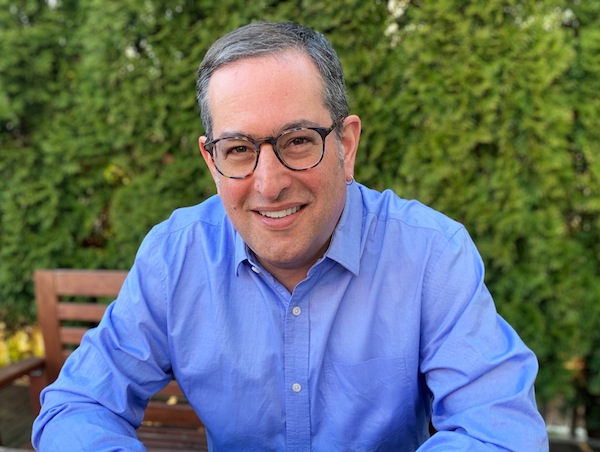
Poet Ieden Wall is the host of the new late night talk show Canadian Jewish TV. (photo from OMNI 1)
Canada’s newest late night talk show, Canadian Jewish TV (CJTV), kicks off Oct. 1 on OMNI 1. Hosted by poet Ieden Wall, the show will feature interviews and performances from some of Canada’s most notable Jewish figures.
Canadian producer Robert Lantos said late night fans across Ontario, in British Columbia and in the Atlantic provinces can expect a unique viewing experience. “Late Night shows are usually hosted by actors and comedians but very rarely do we see a poet get the job,” he said.
Wall is also a journalist, host and media producer, based in Toronto. He burst onto the scene in the 1990s with his reality/comedy series called The Dream Chaser. Since then, he has kept busy producing documentaries, medical marketing videos and commercials for his own production company. His first collection of spoken-word films aired in Australia and the United Kingdom.
In keeping with Wall’s background, CJTV will also feature a spoken-word short-film series based on new poems from Wall’s upcoming book, The Wisdom of the Wall 2. His first book of poetry, Wisdom of the Wall, has sold more than 30,000 copies.
With the loss of established national Jewish media like the Canadian Jewish News, CJTV is aiming to fill the void with a “traditional”-style Jewish show that avoids getting hung up on extreme sides of the political spectrum.
“When you are doing a show like this, you can’t please everybody, so my objective with CJTV is to do a show that my bubbe would be proud of,” said Wall. “My Bubby Bella escaped Eastern Europe before the Holocaust, but not without her share of violent antisemitism. She was not Orthodox in the pure sense, but she lit the Shabbos candles and taught us all to be proud of our Jewish heritage. This show is for her.”
A weekly half-hour show, CJTV will celebrate the contributions that Jews have made to art, history and culture in Canada’s largest city and in all cities across the country. The guest lineup for Season 1 is a “who’s who” of the Canadian media and entertainment industry, including Lantos, Paul Godfrey, Mark Breslin, Dan Shulman, Libby Znaimer and Heather Reisman, as well as an appearance by former prime minister Stephen Harper.
CJTV makes its season debut on Oct. 1 across Ontario. For more about the show, visit cjtv.ca. For more information about viewing times in British Columbia, visit omnitv.ca/bc/en next month.
Among Middle East observers, there has long been a view that the demand for a Palestinian “right of return” is a bargaining chip that would be negotiated away in a final status agreement, perhaps in exchange for a symbolic but small number of Palestinian refugees admitted to Israel and a substantial amount of money as compensation.
In a new book, two prominent Israeli progressives argue that this assumption is wrong, that the right of return is an unwavering demand from the Palestinian side and, as a result, represents a poison pill that guarantees no resolution to the conflict or to Palestinian statelessness.
“The Palestinian conception of themselves as ‘refugees from Palestine,’ and their demand to exercise a so-called right of return, reflect the Palestinians’ most profound beliefs about their relationship with the land and their willingness or lack thereof to share any part of it with Jews,” write Adi Schwartz and Einat Wilf in the book The War of Return: How Western Indulgence of the Palestinian Dream has Obstructed the Path to Peace (All Points Books, 2020).
Wilf, a former Labour member of the Knesset, and Schwartz, an academic and journalist for Ha’aretz, have undeniable left-wing credentials. But, while the Israeli left has long been associated with the idea of compromise and idealism, the authors contend that there is little room for any sort of resolution as long as Palestinians cling to the idea that five million or more of them have the right to citizenship in Israel. Part of the failure of successive peace plans, they write, stems from the inability of negotiators to recognize the Palestinians’ tenacity in holding fast on this core issue – and argue that Israelis need to recognize that truth.
“[D]ecades of shuttling, strong-arming the sides, and endless hours of negotiations came to naught because none of the diplomats or negotiators truly understood and dealt with the root causes of the conflict, choosing instead to turn away and focus on that which appeared easier,” they write.
The status of Palestinian refugees is unique in the world. They have their own international agency devoted to the issue: UNRWA, the United Nations Relief and Works Agency for Palestine Refugees in the Near East, while all other refugees fall under the United Nations High Commissioner for Refugees. In this sole instance, the definition of “refugee” has been amended to become an inheritable status, meaning that the several hundred thousand Palestinian Arabs dislocated by wars in 1948-1949 and 1967 have ballooned to more than five million – even though many or most of the original refugees have died and the vast majority of those seeking “return” have in fact never lived or set foot in the state they claim for their own.
While exponentially more people were made refugees in the same era – in Europe, in the Indian subcontinent and at least 800,000 Jews forced from Arab- and Muslim-majority lands across the Middle East and North Africa – Schwartz and Wilf argue that Palestinians view themselves as having experienced a unique injustice.
They quote Aref al-Aref, a Palestinian writer who was mayor of East Jerusalem under Jordanian rule in the 1950s: “We have been afflicted by a catastrophe, we the Arabs in general and the Palestinians in particular, during this period of time in a way in which we have not been subjected to catastrophe in centuries and in other periods of time.…” Another Palestinian scholar, in 1950, wrote: “It is the most terrible disaster befalling the Arabs and the Muslims in modern history.… It is a deep-rooted disaster, far-reaching and full of dangers. It is an evil growing by the day and by the hour.” Another writer compared it with the Muslims losing Spain in the Middle Ages.
This almost apocalyptic language precludes compromise on what Palestinians have been promised through the generations by their leaders, according to the book. And, while plenty of voices, including academics, activists and politicians, have argued that the right of return would not be such a terrible thing for Israel’s well-being, the authors provide plenty of evidence that the proposed migration of millions of Palestinian Arabs into Israel is perhaps less about justice for refugees than it is about doing to the country through demographics what the Arab world has been unable to do militarily.
“It is well known and understood that the Arabs, in demanding the return of the refugees to Palestine, mean their return as masters of the homeland and not as its slaves. With greater clarity, they mean the liquidation of the state of Israel,” said a senior Egyptian politician in 1949, at the beginning of the refugees’ long history.
As an article in a Lebanese newspaper put it, the Palestinians’ return would “create a large Arab majority that would serve as the most effective means of reviving the Arab character to Palestine while forming a powerful fifth column for the day of revenge and reckoning.” Arab League Secretary-General Azzam Pasha viewed the refugees’ return as making it possible for “an irregular army that would be in a position to cause a great deal of inconvenience to the Jews by acts of sabotage.”
To ensure that the plan was not foiled, no matter how long it took to reach fruition, a now-seven-decade-old scheme was hatched to prevent Palestinian refugees in Syria, Lebanon, Jordan and elsewhere from putting down roots, argue the authors.
“The rehabilitation of the refugees in Arab countries would have meant the end of the war, but that was not what the Arabs wanted,” they write. While the Palestinians were made pawns of the Arab League’s campaign of “denormalization” against Israel, the book portrays most refugees as at least semi-willing players. Attempts to find resolutions to their statelessness have been met with outrage. When Canada’s foreign minister suggested some Palestinian refugees might find a permanent home in Canada, he was burned in effigy in Nablus.
UNRWA, which was presumably begun with the best of intentions, has been consumed by politics and corruption and usurped into what the authors contend is effectively a globally funded branch of the Palestinian liberation movement. Agency-funded textbooks used in Palestinian schools have been shown for decades to inculcate Jew-hatred, venerate terrorists and incite violence. Nevertheless, Palestinians receive through UNRWA among the most per capita humanitarian aid in the world and live a life of which most refugees – and the poor in most Arab countries – can only dream.
From the start, UNRWA’s first annual report, in 1951, noted that many or most refugees were enjoying a better way of life than they had before 1948, receiving universal free education and quality healthcare. The UNRWA schools, now with more than three generations of alumni, have created a uniquely well-educated population of refugees, but, along with reading, writing and arithmetic, the curriculum has created “an embittered, angry and frustrated generation, raised on myths about ethnic cleansing by the Jews, the perfidy of Arab leaders, a sense of victimhood and a refusal to take responsibility for the results of the Palestinians actions in the years and months before Israel’s birth and thereafter,” Wilf and Schwartz write.
The book does not paint an optimistic picture. Western diplomats, peacemakers and politicians refuse to recognize the Palestinian demand of return seriously and continue to believe it can be negotiated away.
“If return were truly just a bargaining chip,” write the authors, “it could have and would have been bargained long ago for a Palestinian state. Rather, it is a Palestinian state that is repeatedly bargained away in order to keep fighting for return.”
There are plenty of issues to discuss – if there were negotiations occurring – but, they argue, the entire Palestinian case rests on the thing Israel must reject.
“The one article that Israel could absolutely not agree to, as it entailed its very suicide, was the one without which the conflict would never end,” write Schwartz and Wilf.
Bonnie Nish, executive director of Word Vancouver. (photo by Andrew Bagoly)
“We believe that Word Vancouver is a vehicle for community connection. It is important on so many levels right now to provide a space for collaboration, discourse, and a safe and accessible platform for people to share their stories,” festival executive director Bonnie Nish told the Independent.
Normally, the annual event takes place in Downtown Vancouver and people drop in to see author talks and participate in other activities. This year’s festival will be online, running Sept. 19-27.
“Like most organizations, we knew we had to either cancel or pivot by late March,” explained Nish about the impact of COVID-19. “Our festival takes place in September, so we had more time than others to make this decision.
“Word Vancouver’s mission,” she said, “is to bring readers and writers together to celebrate literary arts. The question was could we make the change from an in-person festival to an online festival and still serve this mission. We decided that, yes, we could, and, in doing so, we might even extend our reach with the in-person barrier removed. We could now seamlessly collaborate with national partners like Word On the Street Toronto and authors who were not physically in Vancouver, while keeping our main focus on local authors.”
Several changes had to be made.
“We needed to get prepared for the new online delivery format,” said Nish. “With the live in-person festival, we would not have any pre-registrations, as people would just walk into the events as they happened at the Vancouver Public Library. Now, we have a complex communications plan, along with a registration system, so our audience can secure their place and be given step-by-step instructions on how and when to participate.”
On the down side, she said, “We were working with a great site management team last year and we are sad we aren’t able to have them on our team for this festival.”
There have been other challenges, as well.
“We have had to prepare for the decrease of revenue from the exhibitor booths by reducing our staffing substantially,” said Nish. “Our board is very supportive of our new situation but they are also very risk averse, as they should be. We have found the most amazing volunteers and, for that, we are truly grateful. Programming is reduced somewhat, but we still have managed to book 140 authors and schedule over 50 events. Our community collaborations are stronger than ever. We have reinvented the exhibitor platform and now offer online exposure both on our website and during the events. It is a hard sell to some, but we honestly think the reach and return for exhibitors will be close to on par with the in-person version.”
Of the 140 authors participating this year, many are members of the Jewish community, and the Independent was able to speak with two of them – Alex Leslie and Rhea Tregebov – in advance of the festival.
Leslie writes poetry and short fiction, but is working on her first novel. Her latest collection is Vancouver for Beginners (Book*hug, 2019), and its poems are filled with powerful imagery and strong views about her beloved city, where she was born and raised. Leslie’s unique use of language, infused with obvious passion for her subject matter, is energizing to read. Every one of these poems is political in that they call on readers to think about the way in which they inhabit the world, how they think of ownership, place, community and many other concepts. Most of the entries are short narratives (or microfictions) that, in a page, encapsulate the feeling of being in a certain neighbourhood; what we lose when we normalize poverty alongside great wealth; the opportunities we miss when we forget our past, or the misery in our present.
JI: Could you share a bit about your background, both as it pertains to writing, and to your involvement with the Jewish community?
AL: I’ve wanted to be a writer since I was a very young child. In my early 20s, I started taking short fiction more seriously as a writer and trying to publish in literary journals. It took awhile to place my first story, through a long period of reading, frustration, rejection and editing. From there, I published stories until I had enough to put together a manuscript, and that book, People Who Disappear, came out in my late 20s. I’ve essentially continued in the same way – working on material for long periods of time, attending readings, drilling away at projects around the time I spend on my paid work in the mental health field. I’ve always been a wanderer between fiction and poetry communities.
Alex Leslie brings Vancouver for Beginners to Word Vancouver. (photo courtesy)
I’m a member of Or Shalom synagogue in Vancouver and co-curate a storytelling series there…. The Jewish side of my family is originally Ashkenazi, from shtetls in Ukraine, in the regions around Lvov and Odessa (when they immigrated they wrote down they were “Russian”). We’re what is called diasporic, as the communities we came from were lost to the Shoah (Holocaust).
JI: Jewish characters have appeared in your writings. What are some of the ways in which our Jewishness informs your political, cultural or other views/actions?
AL: Yes, my book of stories that came out in 2018, We All Need to Eat, centred around a young Jewish woman named Soma, and Jewish identity is a backbone of that book, as she processes the current rise of the alt-right and her family history that’s bound up in fleeing persecution in Eastern Europe.
For me, a core Jewish value is tikkun olam, which translates roughly to “repair of the world/universe.” Tikkun olam influences my work in the mental health field, as there is the prerogative there of contribution and not turning away from difficult areas of the mind and the concept that energy and goodness can be found in dark places. Persistence and dark humour – humour where others may not find humour! – are practices I’ve taken from Jewishness as well.
JI: Do you still co-curate Koreh at Or Shalom? Why is it important for people to have a platform to publicly read their work?
AL: Yes! Our next Koreh is on Saturday, Sept. 12, for Selichot. We have 10 readers! I curate this with Or Shalom’s Rabbi Hannah Dresner. This Koreh is centred on the idea of the pandemic as a crossing or transformation and everyone is welcome to be part of our audience. Here is the link with the Zoom information: orshalom.ca/event/leil-selichot-a-koreh-event-with-high-holiday-melodies.
This is our third year of curating Koreh. I feel it’s a special space for people who may not consider themselves “writers” to share stories, poems and reflections on their experiences and how they relate to the world. We’ve had Korehs focused on the natural world, on repose/restoration, on sanctuary. Rabbi Hannah asked me to co-curate it with her when we started it up. It was really her concept in the beginning and it’s been a pleasure to get to know so many writers and listeners adjacent to Koreh.
JI: What compels you to write and publish?
AL: My love of writing coincided with my love of reading. I’ve honestly wanted to be a writer since kindergarten. I remember writing stories about our neighbours, and my mother copying them out again in her handwriting. As I got older and wrote more and more, publishing emerged as a natural goal.
I read constantly and loved that I could see the world precisely from another person’s emotional perspective. I suppose that I wanted to replicate that experience, and share in it. Also, for me, it was about language, and using and manipulating language as a medium. Selecting, ordering and controlling words is a fascination for me, the way I suppose a mathematician may feel about algebra, or an investor might feel about predicting stocks. It’s a system.
JI: What is the importance to you of words?
AL: I think that words can put you in another person’s mind, so the power here would be empathy, radical transportation. Words also have a power of deep-layered description – so the power would be complex evocation, mixing emotional and physical parts of reality, making something 2-D into something 3-D, like a life-giving power.
Words can also move us to action. During the pandemic, I have been reading a lot. Endless online stuff is tiring and alienating after a long period of time. I’ve read a few extraordinary novels during this time – two are Breasts and Eggs by Mieko Kawakami and Lost Children Archive by Valeria Luiselli. I also read Norman Doidge’s two books about neuroplasticity. I’m grateful for how these books moved me and took me out of this moment and showed me something I couldn’t have imagined on my own.
* * *
Born in Saskatoon and raised in Winnipeg, Tregebov moved to Vancouver from Toronto in 2004 to teach in the creative writing program at the University of British Columbia. Though she retired in 2017, she holds the position of associate professor emerita and continues to teach a bit. She has written several children’s books and is working on her eighth collection of poetry. Rue des Rosiers (Wolsak & Wynn, 2019) is her second novel.
Based on events leading to the 1982 terrorist attack in Paris on Goldenberg’s Deli, which killed six people and injured many more, Rue des Rosiers is a poignant and lyrical story about two women with vastly different backgrounds but both trying to figure out who they are and their place in the world. Canadian Sarah Levine makes decisions by flipping a penny that she carries with her and, at 25, she is decidedly lost, for a number of reasons. When she has a chance to go to Paris, she does and, while there, her story crosses over with that of Laila, an Arab immigrant living in one of the city’s slum neighbourhoods. In the author’s notes, Tregebov writes that she hopes her novel will “act as a memorial to the six people who died in the attack.” It does that, and more.
JI: Rue des Rosiers has so many layers and motifs, tightly woven, not a phrase seems superfluous. Can you share some of your creative process, from the idea of the novel to its publication last year?
RT: The novel began with two impulses: to explore the relationships among sisters and to understand the impact of terrorism on perpetrators as well as victims. Both are rooted in personal experience. I am one of three sisters, and I was living in Paris in 1982 very near where the attack on Rue des Rosiers occurred. Working through these issues was a long, sometimes joyous, sometimes exhausting process.
JI: Could you speak a bit about how Judaism or Jewish community infuse your work and/or life?
Rhea Tregebov, author of Rue des Rosiers, is one of several Jewish community members participating in Word Vancouver this year. (photo courtesy)
RT: I grew up in the shadow of the Holocaust and the moral issues the Holocaust raises are core. I also grew up in a vital Winnipeg community that modeled ethical commitment and progressive values that I still find of immense value.
JI: Coteau Books, which initially published your novel, has closed. What are some of your thoughts on the future of publishing?
RT: Small presses like Wolsak & Wynn (who, happily, have picked up the novel) are a mainstay of literary publishing. We still have an infrastructure of support that allows these smaller presses. I’m concerned that the consolidation that characterizes the larger presses may contribute to a narrowing of available voices and perspectives.
JI: In an interview, you say, “I’ve said that the book is trying to ascertain the humanity in inhumanity.” Are there any risks in doing this, in finding the humanity in inhumanity?
RT: It can be difficult to attempt to empathically understand behaviour that is anathema to one’s own moral schema. I didn’t want to justify or validate acts or attitudes that dehumanize the Other. But, as one of the characters in the book says, “I’m interested in goodness, the mystery of goodness.” And, to examine goodness, one has to examine evil as its corollary.
JI: In another interview, you mention being “intrigued by the problem-solving involved in writing a novel.” Can you flesh out that idea?
RT: These large projects are so complex and absorbing. In the early stages, you have to hold a world that isn’t yet fully formed in your head. I’ve joked that it felt like wearing a giant hat! I (mostly) love the cut and paste and revision aspects of writing, how solving one small element sometimes acts to realign the entire book in a positive way.
JI: I’m always intrigued by imagery that enriches the storytelling, but is not technically needed for the story to be told. In Rue des Rosiers, you write sentences like, “A scraggly American elm sapling is handcuffed to a post as if it’s committed some crime”; “A gardener in blue coveralls sweeps the sand path, wiping away the traces of pigeon footprints”; “Light is a wave and a particle and so are the bees.” When or how do these types of flourishes enter your writing process?
RT: I think they’re a natural product of my life as a poet. Much of my writing is about looking, and I process looking through words. So having imagery present in the narrative is integral in world-building.
* * *
Word Vancouver is completely free and some events are already full, so visit wordvancouver.ca sooner than later. The festival is welcoming financial support via donations, its Adopt an Author and silent auction programs, information about which also can be found on their website.
A husband competes with his oldest daughter for his wife’s affections, a man ponders whether he is more attracted to a 10-year-old girl or her divorced older sister, a woman has an abortion she didn’t necessarily want, a young man violently rebels against his abusive father. Jonah Rosenfeld tackles difficult subject matter in his short stories, with no compulsion to solve any particular problem or correct behaviours, but to explore the thoughts and feelings of his characters, and thereby offer insight into parts of humanity that we may shy away from contemplating. English readers can now access these stories and ideas, originally conceived in Yiddish, thanks to a newly published translation by Langara College’s Rachel Mines.
The Rivals and Other Stories (Syracuse University Press, 2020) comprises 19 of Rosenfeld’s stories. Born in Chartorysk, Russia (now, Chortorysk, Ukraine), the prolific writer lived from 1881 to 1944, immigrating in 1921 to New York, where he was a major contributor to the Forverts. In total, he wrote 20 volumes of short stories, a dozen plays and three novels. Rosenfeld’s “stories provide a corrective to the typical understanding of Yiddish literature as sentimental or quaint,” writes Mines in the book’s press materials. “Although the stories were written decades ago for a Yiddish-speaking audience, they are surprisingly contemporary in flavour.”
The first Rosenfeld story Mines read, in Yiddish, was The Rivals (Konkurentn), six or seven years ago. “I’d only been studying Yiddish for a few years at that point and was reading to improve my language skills,” she said. “I was so impressed with the story that I decided, just for practice, to translate it into English. Later on, I found out that an English translation had already been published in [Irving] Howe and [Eliezer] Greenberg’s A Treasury of Yiddish Stories, but, by then, I was hooked on both Rosenfeld and Yiddish translation.”
Mines was a Yiddish Book Centre Translation Fellow in 2016 and The Rivals was her translation project during that fellowship year. “I’d already translated several stories before that, but 2016 was when everything started coming together in terms of improving my skills as a translator,” she said.
The project was her own idea, not work assigned by the Yiddish Book Centre, although the centre did support it.
“I should also mention,” she added, “that Vancouver is a veritable hotbed of Yiddish translation (who knew?), with a number of active translators, all of whom have been helpful at various times. Helen Mintz, in particular, was a huge inspiration and support. Her book of translations, Vilna My Vilna, a collection of Abraham Karpinowitz’s short stories, was published (also by Syracuse UP) in 2017. Helen and I spent several years together on Skype, regularly workshopping each other’s translations and helping each other out with advice and information. We’re still doing that, in fact.”
It is his exploration of the psyche that attracts Mines to Rosenfeld’s work.
“I’m interested in psychology – always have been – and particularly in people’s unconscious, and sometimes counterintuitive, reasons for thinking and behaving the way they do. So Rosenfeld’s insight into the darker corners of the human mind was an instant draw. I should say that his stories stand up very well to many current theories of human thought and behaviour. For example, the protagonist of The Rivals is a classic malignant narcissist – he ticks all the boxes. It’s interesting to note that Rosenfeld’s story was first published in 1909, several years before Otto Rank’s and Sigmund Freud’s theories of narcissism came out. Rosenfeld was an intuitive psychologist, and a very perceptive one.
“Another reason Rosenfeld’s stories appeal to me is that they work very well in a 21st-century, multicultural setting,” she said. “I’ve taught a number of the translations to first-year students at Langara, and students are attracted by his stories’ takes on immigration, women’s rights, male-female relationships, generational conflict, culture clash – this list goes on. Clearly, these ideas are as relevant today as they were when the stories were first written.
“Finally, I like Rosenfeld’s attitudes to his characters, even the less admirable ones. He seems interested in and sympathetic to their dilemmas; as an author, he doesn’t judge or blame his characters – he leaves that up to his readers. I like that Rosenfeld is more interested in exploring his character’s situations and psychology than he is in blaming or moralizing.”
Mines, who is retiring this year, taught in the English department at Langara College since 2001. One of the department’s main offerings has been a first-year class on the short story, she said. “Around the time I started translating, I started introducing stories with a Jewish theme to my classes. A bit to my surprise, despite coming from non-Jewish backgrounds, my students found the stories interesting and engaging, so I gradually added more and more stories with Jewish content. The last few years, I’ve been teaching Rosenfeld’s stories exclusively. My students love the stories and readily identify with (or at least understand) the characters and their predicaments. We’ve had many lively discussions!”
In an introductory chapter to The Rivals, Mines poses several questions she hopes keen PhD students or other researchers will take on, including where Rosenfeld’s place might be in the American literary canon. With the disclaimer that she is “just a lowly translator,” Mines said, “But, if pressed for an answer, I’d have to say it’s Rosenfeld’s psychological insights. He’s not entirely unique – other Jewish and/or American authors of his time were psychologically astute and wrote compelling character studies. But Rosenfeld went a bit beyond, in that his stories are almost Greek tragedies – his protagonists fail in their quests (for love, belonging, security, etc.) not because of external forces, but because of some internal, self-defeating habit of thought that they may not be consciously aware of. Rosenfeld isn’t the only author to explore this type of psychological dichotomy, but he does so very consistently.”
Susi and Mænni Ruben, Copenhagen, 1960s. Mænni Ruben’s autograph book, compiled in Theresienstadt, is the focus of a new online exhibit launched by the Victoria Shoah Project. (photo from Victoria Shoah Project)
The Victoria Shoah Project has launched a virtual exhibit of an autograph book compiled by Mænni Ruben, a Danish violinist and graphic artist held prisoner at Terezin (Theresienstadt) concentration camp outside of Prague.
The 1945 Theresienstadt Autograph Book Exhibit features panels and the 40-page book itself, which is replete with signatures, sketches and aphorisms from Ruben’s friends and acquaintances who were also incarcerated at Terezin.
The book records the closing period of the war as survivors were being liberated. It is a story not only of the horrors of Nazism, but of long-lasting friends, and the music and art that united them during dreadful times.
Ruben died in 1976 in Copenhagen. Though he never lived in or visited Canada, the book remained with his widow, Susi, who remarried after his death and settled in Victoria. Upon her passing, in 2018, the book came into the hands of Rabbi Harry Brechner of Victoria’s Congregation Emanu-El. He subsequently showed it to member Janna Ginsberg Bleviss, who became the coordinator of the exhibit project.
“When the rabbi showed the book to me last year, I could see right away that it was special and should go to a museum. It is in remarkable condition for being 75 years old and is a tremendous addition to Holocaust studies,” Ginsberg Bleviss said.
“I was fascinated by the book – who were these people and what happened to them? Reading the pages filled with optimistic greetings, illustrations and pieces of music was like finding a hidden treasure, waiting to be opened. I wanted to discover who these people were and hear their stories,” she added.
“This virtual launch [which took place Aug. 20] is meant to honour both Mænni and Susi, and the memory of those whose lives intersected in space and time in the Theresienstadt camp. None of the artists, musicians, composers or rabbis who wrote in the book are alive, but we can sense their lives through their traces here,” said Dr. Richard Kool, a member of the Victoria Shoah Project.
A number of panels show the powerful drawings of artist Hilda Zadikow, whose husband, sculptor Arnold Zadikow, died at Theresienstadt. One depicts the coat of arms of Terezin under a Magen David made of barbed wire. Another features three sad, grey sketches of the camp itself. In a third, there is a happier scene of colourful opera figures.
Her inscription in the autograph book reads, “Your old friend Hilda Zadikow wishes you all the best and delight in beauty.”
A poignant message comes from Rabbi Leo Baeck, an intellectual and leader of the German Jewish community and the international Reform movement, who wrote: “What you forget and what you don’t forget, that is what decides the course of your life will take.”
Pianist Alice Sommer Herz, the subject of the 2007 book A Garden of Eden in Hell and the 2013 Oscar-winning documentary The Lady in Number 6, was another prisoner at the camp. Sommer Herz, who died at age 110 in 2014, wrote in Ruben’s book: “In memory of music at Theresienstadt and in strong hopes of a better future.”
And a touching note comes from Miriam Pardies, someone Ruben seems to have known only in passing: “We know each other only from having greeted each other in a friendly way, but that too is a good memory,” she writes in the book.
“There is a huge educational value to these pieces for students learning about the Holocaust, or for researchers who want to continue exploring the stories of these most interesting people during an important time at the end of the Second World War,” remarked Brechner.
Ruben and his family were sent to Theresienstadt in 1943. A place where the Nazis kept prominent Jews, the camp housed musicians, intellectuals, artists, religious leaders and hundreds of children. In 1944, the inmates performed a concert for German visitors and the visiting International Red Cross – the performers were forced to act as though life at the camp was normal.
Losing his father at the camp, Ruben returned home after the war. A few years later, he met his wife. They married and both played in the Copenhagen Youth Orchestra – she on cello and he on violin. Mænni Ruben also worked as a graphic designer and Susi Ruben as a fashion designer; they were together for 24 years.
After her husband died, Susi Ruben’s company sent her to Israel, where she met Dr. Avi Deston. They married in 1978 and went to South Africa for 13 years, where Deston taught physics at the University of Transkei. On his retirement, they came to Victoria, in 1992.
The autograph book will be donated to the Canadian Museum for Human Rights in Winnipeg for their Holocaust gallery. To view the virtual exhibit, go to terezinautographbook1945.ca.
Sam Margolishas written for the Globe and Mail, the National Post, UPI and MSNBC.
Avrum Nadigel’s latest book, which he co-authored with the late Dr. David Freeman, is aimed at people contemplating a career in family therapy. (photo from Avrum Nadigel)
Therapist Avrum Nadigel’s latest book hit the shelves this month. Co-authored with the late Dr. David Freeman, Where Would You Like to Start: A Master Therapist on Beginning Psychotherapy with Families is structured as a conversation or interview between veteran therapist Freeman and then-newish therapist Nadigel.
Nadigel is a family marriage therapist based in Toronto. Originally from Montreal, where he had worked for the Jewish community for years, he moved to Vancouver for a spell. It was here that he met Freeman (who passed away in 2010).
Freeman had brought in various therapists to speak on marriage, love and respect at different events. Attending these lectures, Nadigel found what the therapists had to say “redundant and I didn’t find it very helpful for me. I had a pretty severe case of fear of commitment, and they all rambled on about the same thing. But, when David spoke, it blew my mind.”
About a year after hearing Freeman speak, Nadigel met, online, the woman who would become his wife, Dr. Aliza Israel. “She is from Vancouver, but was staying in Toronto at the time,” said Nadigel. “Now, we’re married and have three kids. And that all started because of David’s talk in Vancouver. David’s talk introduced me to a type of therapy called family systems theory.’”
Nadigel read many books on the topic, including Freeman’s, which made Nadigel rethink his previously held suppositions about relationships and marriage. “I changed the way I practise with my own clients,” he said.
Nadigel moved to Toronto when he was accepted into a residency there. He started up a private practice and began to look for someone to mentor him. At his wife’s suggestion, he reached out to Freeman in Vancouver, who, although semi-retired, was happy to supervise Nadigel via Skype.
Nadigel recalled some of the game-changing ways in which Freeman changed his way of thinking.
“When I was single, if I felt anxious or not good in a relationship, I was taught that this meant there was something wrong,” said Nadigel by way of example. A relationship “should be lovely, giving and with good communication, but, as soon as I get anxious, I bolt. Then, David comes around and goes … ‘Perhaps your own internal states of anxiety have nothing to do with the people you’re dating, but with your own internal struggle itself.’ It really changed how I saw discomforting feelings in intimate relationships. It helped me sit with them longer.”
Thinking about his eventual marriage to Israel, Nadigel said, “I often think back to that time and think, ‘How did all this work?’ Maybe, it was one part luck, one part theory and one part having a good therapist in my corner.”
In addition to Freeman’s counsel, Nadigel has done much study on family systems, notably he did post-graduate training with the Western Pennsylvania Family Centre, which teaches Bowen family systems theory, as formulated by the late Dr. Murray Bowen, a psychiatrist and founder of the theory.
Recalling his conversations with Freeman, Nadigel said, “David was very worried about two things. Number one, that people were focusing too much on hacks and behavioural changes, and that the system was much more powerful than that … and that the system would often, not always, but often, thwart any attempts the individual would try to make the change. So, he was very concerned that there were so few therapists offering a larger perspective about human suffering.
“The second thing he was very worried about – I think this is because he was a grandfather at the time of his death, he had two grandkids – was about the disconnect from wise elders in society. I think that’s really coming home to roost right now, the fact that we have the hashtag on Twitter, where it says, ‘BoomerRemover.’
“Some people are thinking that, well, it’s good about this coronavirus – it’s going to kill off all the old people and there’ll be more condos. I don’t know what the hell they are thinking but we really do see the elderly as an inconvenience in a lot of cases, and David thought this creates an impoverished culture – that, when you think of traditional society, it’s the elders who share life lessons that can only be acquired over time, through adversity and history. You can read a book, but it’s very different if an elder tells you what it was like to survive the Blitz in Britain. And David thought that young people in their marriages were impoverished, because of their lack of connection.
“So, with those two things,” said Nadigel, “I thought, maybe, if I can somehow convince David to write another book, I could be the young green therapist and he could be the senior guy. He could speak to me and motivate the next generation of therapists.
“I thought to myself that it should be snappy and quick.… I threw him the idea and I think the same day he got back to me and said he thought the format’s viable – except that, in this case, it would be Skype calls between a young therapist and a senior therapist…. We quickly started working on this once a week.
“Then, David had the manuscript and was going on vacation,” said Nadigel. “We had a few more chapters to write; he really liked where the book was going. Then, I got an email from him, a very brief email, which was odd, because he was much more verbose. It just asked if I could call him.
“I thought, that doesn’t sound good, that maybe he was going to say the book sucks. I called, and it was his now-widow [Judith Anastasia], who answered, and she said, ‘Avrum, I’m sorry to tell you, but David died of a heart attack while we were cycling in Croatia.’ I couldn’t believe it. It was a crazy summer. My dad died, my son was born and David died.”
Several years later, with Anastasia’s blessing and to honour Freeman’s memory and work, Nadigel started to complete their book.
“The book gives you a taste of a master therapist, to experience the wisdom and thinking he brought to thousands of families and couples he’s worked with over 40 years,” explained Nadigel. “And, once you finish the book, you might feel it’s your responsibility now to go and further your training in this area.
“David’s life work was helping people understand that, if you want to do well with your own personal goals and struggles and gridlock, you have to understand what you’re up against,” said Nadigel. “And you don’t do that by just talking about your neurotransmitters and serotonin and dopamine, or meditation…. It’s about certain ways of the here and now, that you either distance or connect through relationships that are happening right now – that are happening with your mother, your father, your sister, your aunt, your cousin. The work is staring you right in the face right now.”
Family system coaching, consultation or therapy, said Nadigel, is based on “the theory and the road map of going back and reworking through some of the gridlock in your family. And those people who are successful at doing something and thinking differently [about] their problems with their relationships – siblings, spouse, kids, whatever – [are] bringing those successes to every relationship. And that does not happen in the clinician’s office.
“Also, this type of therapy understands that human beings don’t get into problems because of their thinking – they get into problems because they are flooded with feelings…. It tries to promote good thinking to balance out strong feelings, toward being a little more strategic in how you conduct yourself in your relationships.”
And Nadigel himself is an example of how the approach can work.
“I’ve often thought that, if I was reading about this book, the interesting angle I always found … is that I was a punk rock alternative musician in Montreal. I was commitment-phobic and really saw marriage and family, marriage considerably, as the death knell of all that’s good in life – [that it’s] boring and sucks the nectar out of a good life. Then, David comes along in Vancouver and he just creates a profound paradigm shift in me, and I have come to a wildly different understanding. I’ve become a marriage therapist myself, a father, all this kind of stuff, so a pretty fundamental transition.
“I was one of these people that, once upon a time, really had a strong distaste for the very thing I’ve embraced,” said Nadigel. “It really is all credit to this one little talk in Vancouver in the JCC. There’s hope there. It doesn’t take years and years. It could be a 50-minute talk.”
Nadigel has created a blog and podcast to support the new book. To access it, visit nadigel.com/start. Electronic and hard copy versions of Where Would You Like to Start are available at amazon.ca.
A new book on an incendiary topic turns out to be not quite as expected. The Conflict over the Conflict: The Israel/Palestine Campus Debate, by Kenneth S. Stern, may be the most comprehensive assessment of the (at least) 20-year battle on North American campuses between pro-Israel and anti-Israel forces.
Jewish and pro-Israel readers picking up the work might anticipate a litany of horrors, anti-Zionist if not antisemitic incidents, brawls, screaming matches, vandalism, boycotts and the like. There is that. But Stern argues that the perception that campuses are aflame in anti-Zionist rage is simply not true. More, he offers proof that the pro-Israel side is far from innocent of engaging in disgraceful tactics, too. There is ill will and there are bad actors on both sides. Most unexpectedly, as much as the book is about the conflict, it is more than anything an exercise in applied ethics on the topic of free expression.
Stern is the director of the Bard Centre for the Study of Hate, an attorney and an author. For 25 years, he was the American Jewish Committee’s expert on antisemitism and he was a lead drafter of the Working Definition of Antisemitism. He is also, it appears, something close to a free speech purist. As such, he rails against efforts by Israel advocates who have organized campaigns to censure (and censor) anti-Israel voices. He doesn’t let the other side off easily, either, calling out acts of harassment like drowning out pro-Israel speakers with the “heckler’s veto.”
The book, from New Jewish Press, an imprint of University of Toronto Press, begins with an empirical assessment. In institutions of higher learning in the United States, Israel is an issue in very few, he writes.
When speaking with Jewish audiences, Stern asks for a show of hands to gauge perceptions on anti-Israel attitudes. He asks for guesses on how many American colleges have divested from Israel.
“Many seem surprised when I say ‘zero,’” he writes. “There are relatively few campuses where Israel is a burning issue, and every year the number of pro-Israel programs … is usually at least double the anti-Israel ones. There are over 4,000 campuses in the U.S. – in the 2017-18 academic year, 149 had anti-Israel activity.… So the campuses aren’t burning.”
He does not dismiss the extreme tensions on a few campuses, however.
“[O]n some campuses where anti-Israel activity is prominent, pro-Israel Jewish students may feel marginalized, dismissed or vilified, sometimes with antisemitic tropes.” Identity politics and the conflation of Jewish people with “whiteness” creates racial conflict. “[T]he labeling of Jews as white becomes a problem when shared victimhood becomes a sacred symbol, a badge of honour, a precondition to enter a club of the oppressed. Antisemitic discrimination is rendered invisible.”
Though bigotry may play a role in the discussion, Stern does not see constructive resolutions in neologisms like trigger warnings, safe spaces and microaggressions.
“Faculty should have the right to give trigger warnings if they want, but I never do, and I think the idea is a horrid one,” he writes. “I teach Mein Kampf. It’s disturbing – get over it. College should prepare one to be an adult, and there are no trigger warnings after graduation day. Why are we encouraging students to be ostriches? Shouldn’t they, rather, be learning how to navigate things that will likely unsettle them over the rest of their lives?”
He quotes CNN commentator Van Jones, a strong civil rights proponent, who opposes “safe spaces” on campus: “I don’t want you to be safe ideologically. I don’t want you to be safe emotionally. I want you to be strong. That’s different. I’m not going to pave the jungle for you. Put on some boots and learn how to deal with adversity. I’m not going to take the weights out of the gym. That’s the whole point of the gym.”
Stern contends a fundamental error has been made in defining terms.
“We want campuses that are open to expression – including, perhaps even especially, difficult and disturbing ideas – but which protect students from real harassment and intimidation. Hate speech codes were efforts to say that ideas themselves can harass and intimidate. Ideas can and should make one uncomfortable (a comfortable college education is a wasted college education). But harassment is something different.”
Strategically, he argues, trying to censor hateful ideas is self-defeating and advances hate agents by martyring them.
“By trying to censor, rather than expose and combat, speech the students perceived as hateful, they were actually helping the alt-right and white supremacists,” writes Stern. “It’s no coincidence that the white nationalists in recent years have wrapped their racist and antisemitic messages around the concept of free speech. Why would progressives allow these haters to steal the bedrock democratic principle of free speech, disingenuously saying that this is what their fight is about? By trying to deny alleged racists platforms, progressives are helping white supremacists recast their vile message as noble protection of a right.”
Another strategic failure, he argues, is buying into the Palestinian narrative’s good/evil dichotomy.
“Israel’s case is best understood as inherently complex and difficult; playing into the ‘all bad’ and ‘all good’ binary of the other side renders those complexities invisible,” he writes.
The conflict on campus spills over, of course. Israel has created a list of 20 organizations, those that urge boycotts of the country, for instance, and bars their members from entering the country. Stern sees this as counterproductive: “You don’t make the case that blacklists (especially of academics) are proper if your goal is to oppose blacklists. You are conceding the argument.”
He gives an example of an anti-Israel campus activist who defends his group’s refusal to meet with Zionists “over cookies and cake” because “you Jews, in all due respect, you wouldn’t sit down with Nazis for tea and cake.”
He also reflects on the “Standards of Partnership” adopted by Hillel International, the Jewish campus organization, which proscribe engaging with groups or individuals that deny Israel’s right to exist, or who delegitimize, demonize or apply a double standard Israel, who support BDS or who exhibit “a pattern of disruptive behaviour towards campus events or guest speakers or foster an atmosphere of incivility.”
Writes Stern: “For those who are not yet ideological soldiers, but want to learn more, and want to do it around their campus Hillel, what sense does it make that adults are telling them they can only bring in certain types of speakers? Yes, the adults defined BDS as hateful. But does it make sense to tell students they have to go elsewhere than the Jewish address on campus to hear about it firsthand from those who support it?”
The litany of bad behaviours on all sides of the ideological divide is likely to make readers of Stern’s book uneasy, whether the reader is Zionist or anti-Zionist. But it is a rare and uncompromising testament to free expression that should give genuine free speech advocates an uplift, particularly in an era when ideologically driven regulation of expression and ideas, especially on campuses, has left many advocates of core liberal, academic values feeling beleaguered.
Last year, I requested two books from Simon & Schuster Canada. Both contained strong female protagonists and stories that sounded compelling. While it took the pandemic slowdown before I had time to read them, I enjoyed both and would recommend them, albeit one with a caveat.
Let’s start with the debut novel, the one I breezed through even though I found the premise tenuous. I wanted to know how Samantha M. Bailey’s thriller Woman on the Edge ended, even as I cursed aloud at the two main characters – Nicole Markham, founder and head of a widely successful athletic wear company, and Morgan Kincaid, a woman who has rebuilt her life after her husband was caught swindling people and then killed himself.
For reasons not revealed initially, Nicole hands her baby to Morgan at a subway stop, then jumps to her death, though video of the incident makes it seem like Morgan may have taken the baby then pushed Nicole onto the tracks. Alternating between Morgan’s attempt to clear her name and how Nicole came to give her baby to Morgan, the read is thrilling, even as it is too obviously contrived. At any point in time, a question or revelation from Nicole or Morgan could have shed light on their respective situations and cleared up critical matters. Yet, both women – unrealistically – keep their suspicions to themselves. The silences are necessary for the plot to work, so I chose to go where I was being led and relish the craziness of it all.
While there is no overt Jewish content in Woman on the Edge, Toronto-based writer and editor Bailey is Jewish. In her first novel, she shows a talent for creating dramatic tension, if not overall story structure. Despite its weaknesses, I found this novel a good escape read.
An absolute pleasure to read, and just as page-turning, is veteran author Alice Hoffman’s latest novel, The World That We Knew, set during the Holocaust. In it, there is magic. It is tangible – the golem Ava, created by Ettie, the precocious daughter of a respected rabbi, to protect Lea – and more abstract, in the loyalty of Ava to Lea and the beautiful friendship that develops between Ava and a blue heron along their journey.
After her husband is murdered and her daughter Lea is almost raped, Hanni knows she must get Lea to Paris, but she herself cannot leave Berlin. So, she turns to the rabbi for help, but making a golem is risky business and he won’t do it. Ettie, though, plans to escape with her younger sister, and Hanni’s payment will help her do that. Ettie has observed her father at work, and is able to bring Ava into being. As Ava becomes more seemingly human, however, and forms a bond with the blue heron, the main tension of the novel arises – will her appreciation for her own life and its possibilities outweigh her responsibility to Lea?
Many other tensions and relationships mingle with history, which is sometimes pedantically told but always interesting. The World That We Knew is a well-woven and moving story that offers an understanding not only of the past but of the emotions that motivate us and the connections we make with one another.
I was introduced to the Sephardi and Mizrahi tradition of a Rosh Hashanah seder by a dear friend, at whose home I celebrate most of the Jewish holidays. This New Year’s, given the pandemic and that we are not in each other’s immediate bubble, I will join their seder on the first night of Rosh Hashanah either outdoors, weather permit, I was looking, perhaps, to prepare myself mentally for this year’s socially distanced gathering, and a Zoom with my family in Ontario, when I thought of the idea for the cover, which is created using watercolour and ink (and surprisingly little Photoshop).
In a Sephardi or Mizrahi seder, special dishes are served of specific foods whose Hebrew or Aramaic names are linked in a blessing to another word that has the same root letters. Puns flourish. So, for example, the Hebrew word for carrot and that for decree have different vowels but the same root letters – gimel, zayin and resh – and the blessing over the carrots translates as, “May it be your will, Lord our God, that that our bad decrees be torn up and our merits and blessings be proclaimed.” The word for leeks, chives or scallions – karti – is akin to yikartu, cut off, so the blessing over these vegetables is, “May it be Your will, God, that our enemies be cut off.”
Spinach or beet leaves also symbolize the hope that God will make our enemies retreat and we can “beat” a way to freedom. Dates carry the hope that hatred will end; the many seeds of a pomegranate that our mitzvot will be many; an apple that we will have a sweet year; string beans that our merits will increase; a pumpkin or gourd that God will “tear” away all evil edicts against us, while our merits are proclaimed. You get the idea.
“Resistance” by Dorothy Doherty. Part of the Beyond the Surface exhibition now on at the Zack Gallery until Sept. 8. (photo from gallery)
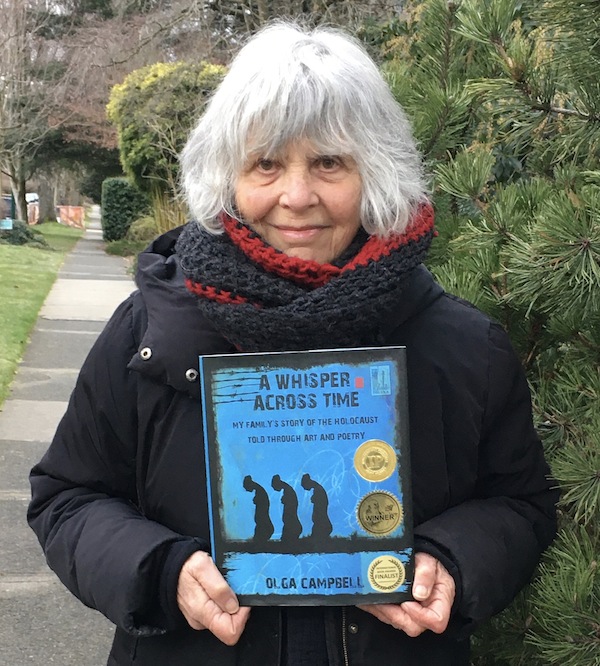
The Jewish Community Centre of Greater Vancouver has opened its doors again, at least partially, and the Sidney and Gertrude Zack Gallery is presenting a new exhibition, Beyond the Surface. Art lovers can make appointments to tour the show in person. It features five local artists – Janice Beaudoin, Olga Campbell, Dorothy Doherty, Jane McDougall and Ellen Pelto – and the Jewish Independent interviewed them recently by email about their art, and how the pandemic has affected them.
Olga Campbell (photo from the artist)
“This exhibit was originally scheduled for June 4,” said Campbell. “Because of COVID, it was a bit late. It was hung on June 18, and the virtual opening through Zoom was on July 8.”
Last year, the five artists attended a five-day workshop in Victoria led by California artist Michael Shemchuk, though some of them had met before then.
“Dorothy and I have been friends for 45 years,” said Pelto. “I met her in a clay class she was instructing. I’ve also known Olga for eight years.”
“I met Olga Campbell in various art workshops in Vancouver and then spent five years on campus with her at Capilano College between 2008 and 2014,” said Doherty. “We took some classes together and worked independently in others, all the while growing in friendship.”
Doherty, who has taken Shemchuk’s workshops several times over the years, met McDougall and Beaudoin at one or another of those sessions. And Shemchuk’s teaching, especially on the paper layering technique, has been instrumental in the birth of this Zack show.
“A couple of us thought that it would be interesting to show some of the work that we had created in his workshop,” Campbell recalled. “We thought that five [artists] would be a good number to demonstrate the cohesiveness of the art, as a result of us all using the same techniques, but also showcase each of our individual styles.”
Dorothy Doherty (photo from the artist)
Doherty came up with the title, Beyond the Surface. She said the rest of the group quickly agreed. “I think the word surface resonated with us because we all do unique surface treatments,” she said. “Surface is really important in art and in life, but we always want people to look beyond appearances – learn about people and artwork in greater depth.”
To produce the works, the artists manipulated a surface in many ways. They layered, sanded, abraded and painted it; even cut into it to reveal what lay beneath.
Beaudoin elaborated: “Beyond the Surface is the ideal name for this show, as the technique we all used is based on the process of layering paper and paint. As we add and subtract paint and materials by sanding or scraping, each artist makes decisions about what elements to reveal and what to hide. The final surface is one that often appears aged and somewhat mysterious, providing the viewer with enticing glimpses of things that are hidden beneath the surface and leaving them to wonder what has been covered.”
In a way, this show’s unusual story echoes its title as well. While a traditional vernissage is an event where art connoisseurs mingle inside a gallery, the pandemic forced Zack Gallery director Hope Forstenzer to show and promote the art digitally.
“She did a virtual tour of our show at the JCC,” said Campbell, “and she is also interviewing each of us in our studios live via Zoom, so that people can see our art and have a virtual tour of our studios.”
Janice Beaudoin (photo from the artist)
The artists mused about the changes in their field and in gallery procedures wrought by COVID-19.
“My sense is that pandemic or no pandemic, artists will always make art. The biggest challenge is going to be getting the art out to the world to enjoy,” said Beaudoin. “There is always a basic human desire to stand before a work of art in person. That is definitely the best way to engage with a painting. However, there is a generation of media savvy younger art buyers who are used to purchasing things by seeing them on a computer screen. I think that galleries that are working to provide virtual viewing options are the ones that will survive. The art world, like all industries, really has no choice but to adapt.
“I also feel that it must be acknowledged that many people still find comfort in seeing art in person. The art world is known for its fun social events – and we know now that the comfort of human contact cannot be fully recreated online. My sense is the future of art shows and museums will be a carefully managed balance of socially distanced in-person viewing and virtual showings.”
“I have been fortunate,” said Campbell. “I continue to meet regularly with three other artists. We create our art at home and then share it with each other on Zoom. With another artist friend, I have been playing Photoshop tennis online. One person sends the other an image, the other person adds another image through Photoshop, and this continues until the piece is finished.… I think that we are in this for the long haul; two years, maybe more. I think that, in the future, art shows will continue in real life – in fact, it is already happening – but I do think that some of the virtual things will remain.”
“It’s hard to say how the pandemic will change exhibition practices in the future,” said Doherty. “I do appreciate all the online exhibits, as there would be no other way to see many of these exhibitions. But I really believe there is no substitute for the gallery system as we know it, with wonderful opening nights and the ability to see the artwork in person. We need that direct exchange of human energy, and the feedback we get from visitors and friends. We need access to art in galleries and to artifacts in museums – it’s how we learn. I have always said, despite my gratitude for online Zoom meetings, that the human experience is not the same. It’s flat instead of three-dimensional. We are looking at screens. We are not looking at the real person. There is no exchange of human energy online. We need direct human contact. That’s what we need to live happy, successful lives.”
Jane McDougall (photo from the artist)
For McDougall, the pandemic hasn’t changed much for her. “I think most visual artists are used to working in isolation. My art practice has remained the same,” she said. “Listening to CBC in my studio keeps me up to date on the world and, of course, most of the talk is about COVID. I feel grateful to live in B.C.
“I am generally a positive person and my thoughts reflect that. I think there will be more of an online presence for art,” McDougall continued. “And, like Hope Forstenzer’s example throughout this show, there will be interactive web calls and taped studio visits. Because of that, artists will become more involved in the galleries. Long term, I think the pandemic will pass. Art galleries and museums will always be an important element in education and sharing the past. Nothing will replace the up close and personal view of art.”
Ellen Pelto (photo from the artist)
Pelto agreed. COVID has changed exhibition practices, she said, and “will inevitably change the future practice of making, exhibiting, buying and selling art. However, people will always need to see art. That will not change. People need to see it to appreciate the scale, proportions, richness of colours and textures, and to feel their evocative response. Some of the positive outcomes include the creation of more and stronger online artistic communities. The online presence increases exposure for artists, and interesting themes will emerge in art that will define the human condition of COVID.”
Beyond the Surface runs until Sept. 8.
Olga Livshin is a Vancouver freelance writer. She can be reached at [email protected].