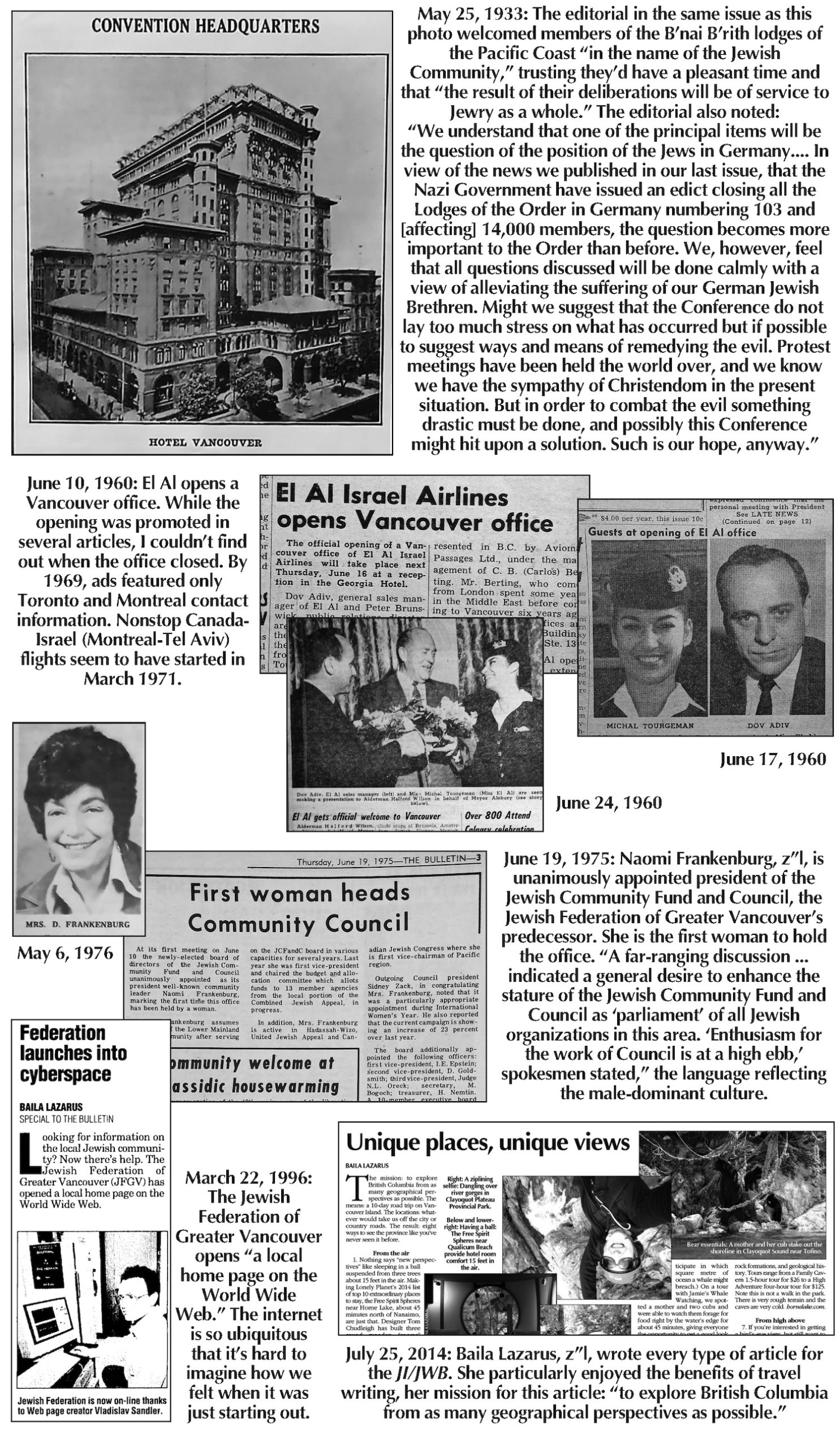
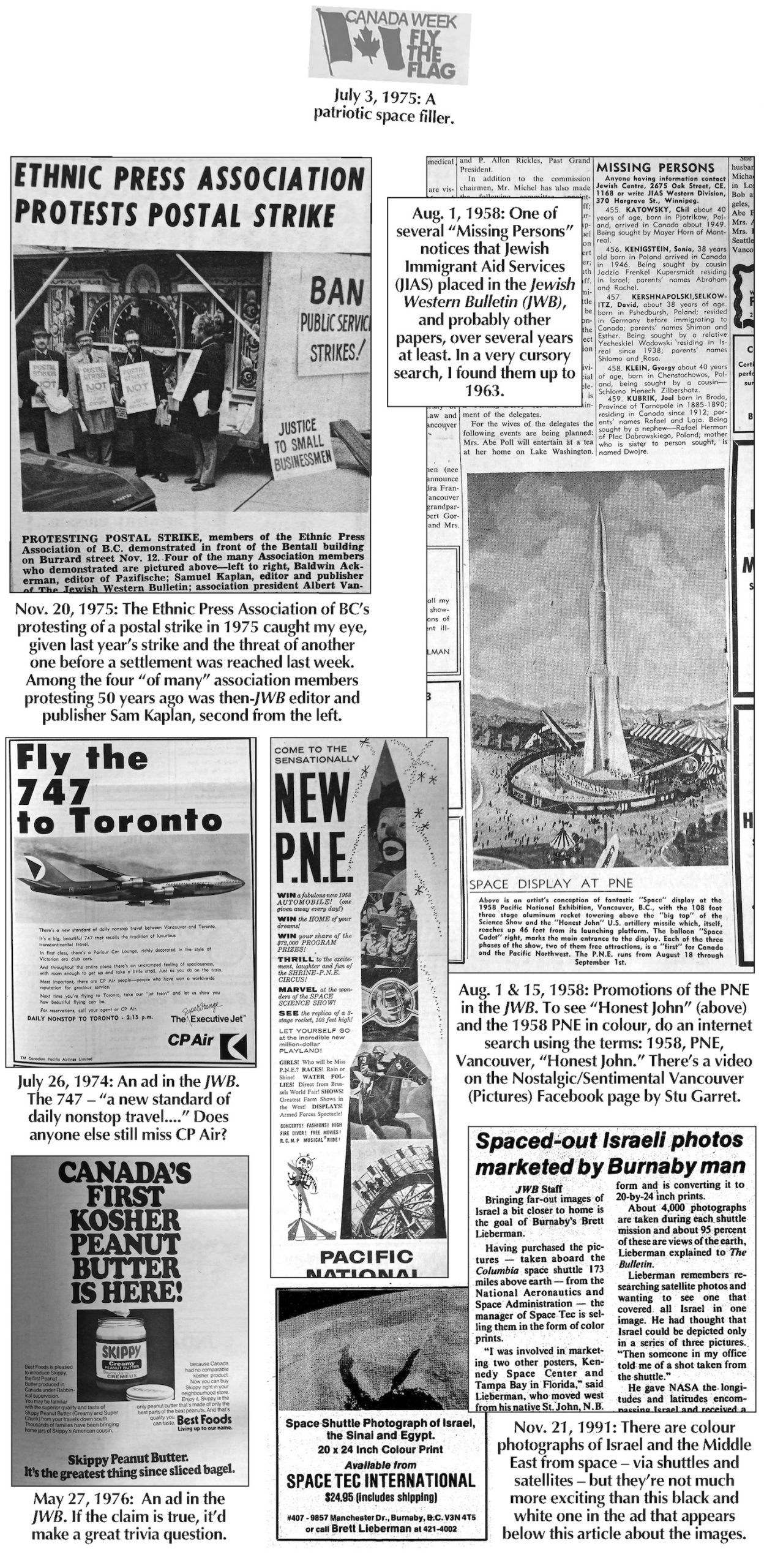
It is sometimes hard to look back over the pages of the Jewish Independent and its predecessor, the Jewish Western Bulletin, knowing what has happened since the articles were published. From the 1933 optimism that there was hope for German Jewry, to the enthusiastic welcome of a seemingly short-lived El Al office in Vancouver, to colleagues who have passed away.
“It may sound like a cliché, but I really believe that music is a unique language. You don’t have to know how to read it, you might not understand the lyrics, but it can still touch your heart and soul,” Omer Shaish told the Independent. “At the end of the day, it doesn’t matter what genre you listen to, it will always make you feel something. That’s what I always hope to do when I get on stage – use the music to touch people’s hearts and souls.”
Omer Shaish brings My Broadway Shpiel – stories, Broadway tunes, popular Hebrew songs and original music – to Vancouver Aug. 21. (photo from omershaish.com)
Shaish brings My Broadway Shpiel to Vancouver Aug. 21, 7:30 p.m., at Temple Sholom. In addition to offering a night of Broadway tunes, popular Hebrew songs and his own original music, the performance will raise money for Temple Sholom’s campership program.
While Shaish never attended summer camp growing up, he did talk about growing up in the Jewish community.
“We’re one big family and I love that about us,” said the singer, who was born and raised in Rishon LeZion, which is about 20 minutes south of Tel Aviv.
“I spent most of my teenage years and my early 20s in Tel Aviv, where I was surrounded by great art, amazing people and incredible food!” said Shaish, who knew from a young age that he was going to be a singer.
“My parents say that, as a toddler, I’d pick up anything that could resemble a microphone and sing at the top of my lungs – everywhere. I always loved having an audience,” he said. “Even though, in real life, I sometimes come across as a bit shy and introverted, having an audience to sing for always made me feel at home. Up until today, having an audience, no matter how big or small, brings me to life.”
Shaish started his career as a vocalist in the Israeli Air Force Band, performing on military bases and in Jewish communities in Europe and Canada. He also is an actor, performing in Israel before moving to New York City in 2007 and graduating from the American Musical and Dramatic Academy. He has numerous theatre, vocalist and soloist credits to his name, but mainly has been touring internationally as part of the classical vocal trio Kol Esperanza and with his self-produced, one-person show My Broadway Shpiel.
“Even though I love acting, I’ve been focusing on singing in the past few years,” he told the Independent. “I realized, throughout the years, that I feel more at home just being myself on stage. I enjoy sharing these moments with the audience and it makes every show feel different and so alive. Playing a character can be interesting, too, but, for me, there’s nothing better than simply being myself.”
At the moment, Shaish calls Baltimore, Md., home. Previously, he toured the United States for many years, and lived a few years in Los Angeles and in Miami.
“I absolutely love traveling, seeing the world and meeting lovely, interesting people,” he said. “My friends always make fun of me and say that they never know where I’m at, to which I reply with, ‘neither do I.’ It can be exhausting at times, but it’s always worth it. I feel very lucky to do what I love and that gives me a lot of energy to keep at it.”
He’s looking forward to performing here.
“I love Vancouver!” said Shaish. “I’ve been there many times and I think it’s one of the most beautiful places on earth. The last time was only a few months ago, for rehearsals and a recording session. I’ve performed in Vancouver before and I can’t wait to be back and enjoy the views, the fresh air and, of course, the wonderful people!”
About the show he’s bringing with him, My Broadway Shpiel, he said, “As I tell my story and share some anecdotes about the Jewish story of Broadway, I sing some classics from Fiddler on the Roof and West Side Story, and all the way to some surprises by ABBA and Elvis Presley!”
One of his favourite moments in the performance is when he shares the experience of living in the United States with a foreign name.
“I have heard so many variations of my name from so many people that I have met,” he said. “‘Omer’ apparently isn’t very easy to pronounce. So, one day, I thought, why not write a song about it? I took Liza Minelli’s ‘Liza with a Z’ and turned it into ‘Omer with an E.’ At first, I wanted that to be the name of my show, but My Broadway Shpiel felt more fitting.”
As for the importance of music, he said, “This brings me back to how I see music as a language. It has superpowers. It can take us away from one reality and bring us to a completely different one within a split second. It triggers our emotions in such a powerful way. When people talk to me after a show and say that I made them laugh, made them cry, or made them forget about their day, I know I did something right.”
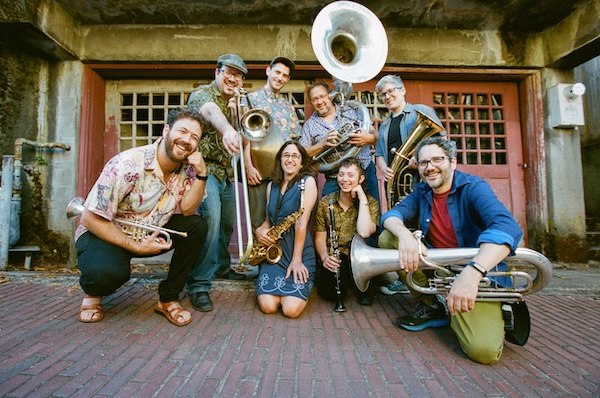
Seattle band Shpilkis helps open the Mission Folk Music Festival July 25. (photo from shpilkisseattle.com)
“We’re delighted to be featured at a folk music festival that understands the vast and expansive variety that makes up folk music, and to bring our unique sound to a community that may have never heard klezmer before,” Michael Grant of the band Shpilkis told the Independent. “We have a secret agenda to get hundreds of Mission Folk Fest enthusiasts into a Yiddish dance line! We love playing festivals and expect this to be a beautiful time.”
The Mission Folk Music Festival’s introduction to Shpilkis begins, “Are you ready to shake your tuchus, Mission folkies? Have we got the band for you!” Shpilkis is part of the weekend festival’s opening night lineup July 25. They play a midday concert on July 26 and share the stage for two different afternoon performances July 27. It’s the Seattle band’s first time participating in the festival, though trombone player Jimmy Austin has played it before, with a different group.
Grant plays the trumpet. He and Austin will be joined in Mission by Zimyl Adler (clarinet), Layne Benofsky (baritone), Stefanie Brendler (French horn), Nancy Hartunian (alto and soprano sax), Gary Luke (sousaphone) and Joey Ziegler (drum kit).
Shpilkis formed in 2017, originally convened by Brendler, said Grant. “The low brass players had been in a successful Seattle Balkan band together, and the rest of us knew each other from Jewish community and music spaces. In 2018, we added our sax and trombone players, and, in 2023, finally found a drummer!”
Some of the members play in other groups or musical projects, but Shpilkis is the primary band for all the musicians, he said.
Shpilkis plays traditional Eastern European Yiddish music, as well as more recent forms of it. The band’s description notes that “members come to this glorious music from a hodgepodge of backgrounds: religious, spiritual, secular, pagan; East Coasters, Midwesterners and Pacific Northwesterners born and raised; Jews and gentiles; music-educated and self-taught, with foundations in jazz, punk, folk, classical and pop.”
“Klezmer, particularly by the later 20th century, is a melting pot of styles – you can hear Greek, Balkan and Eastern European melodies mixed in with Americanish sounds – particularly jazz and even bluegrass,” Grant explained. “We love drawing from across the historical spectrum of klezmer music, from traditional 19th-century repertoire that’s been unearthed via the Kiselgof-Makonovetsky Digital Manuscript Project from a Kiev archive, to songs that were written in 1980s Brooklyn or Philadelphia, to fusion and contemporary repertoire. We always arrange songs to put our unique, raucous klezmer brass stamp on it, thinking, ‘How do we get our audience out of their seats and dancing to this?’ Klezmer is inherently dance music, so we prioritize songs that can both be played and danced to at a simcha or nightclub.”
But klezmer is even more than that.
“Klezmer is the sound and musical language of our people,” said Grant. “It is exciting because it is inseparable from the Ashkenazi diaspora, as it integrates the musical influences of its changing environment and geographies while staying rooted in tradition. We as klezmorim love playing klezmer because it connects us to the past, present and future of Jewish cultural expression beyond borders.”
For the full Mission Folk Music Festival lineup – which features more than 20 acts, performing a range of genres – and tickets, visit missionfolkmusicfestival.ca.
People from many cultures show love via food and, of course, Jews are no exception. And what a palate our culture has, since we have lived in so many places. Two children’s books from Collective Book Studio, one new and one from recent years, highlight the flavourful diversity of Jewish culture, while teaching other valuable lessons.
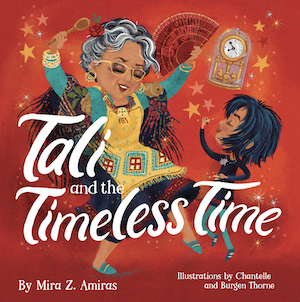
Coming out this August, Tali and the Timeless Time by Mira Z. Amiras, with illustrations by Chantelle and Burgen Thorne, shares the love of a granddaughter for her grandmother, and vice versa. Every Friday, Tali helps her nona get ready for Shabbat. Nona gives hugs, tells stories, still tries to get Tali to nap, even though she’s older now. When Nona dozes off, Tali explores in the backyard, cleans up the small fountain there, feeds the goldfish. When Nona awakes, it’s time to cook.
“We bake!” says Tali. “Today, it’s bourekas, yummy for eating. Nona makes them with filo (which it turns out is cheating). She says her nona let her ’cause it doesn’t need kneading.”
The week before, the pair made stuffed grape leaves – yaprakas, dolma or dolmades. Nona’s favourite dish is huevos (eggs) cooked in tomatoes with feta and arroz (rice).
While Tali’s grandmother might get Tali’s name wrong, or forget a word or two, she has these recipes ingrained in her.
“I’m having big thoughts,” says Tali, “but Nona’s not listening – she’s singing ‘chakchouka,’ it’s sometimes called, not just huevos, in the Holy Land, Tunisia and the land of the pharaohs. In Mexico, it’s a lot like huevos rancheros….” But Nona loses focus, she starts dancing with “her zills and her fans.” Tali finishes making dinner, the pair eat together, then dance some more.
In another role reversal, Tali tucks Nona into bed for the night, not sure she should leave her alone. Luckily, Tali and her family live nearby.
It’s a lovely book, “timeless time” being a beautiful description of a day spent with a loved one, doing this and that, in no particular order, sharing stories, mixing up past with present, making memories that will adapt over time.
Family and food are also at the heart of 1, 2, 3 Nosh with Me, written by Micah and Joshua Siva, and illustrated by Sviatoslav Franko, which was published a couple of years ago. In it, the dog Buckwheat shows us the yummy food the family eats, starting with the “One golden challah, to celebrate Shabbat…” We work our way up to “Ten crispy latkes, served by candlelight.” In between, we have matzah balls, matzot, kugel, knishes, apples for a sweet new year, sufganiyot, bagels and hamantashen. (It’s not clear why the Hanukkah treats are separated, but that’s a quibble.)
Tali covers a few Sephardi staples and Buckwheat has the Ashkenazi favourites down. Between the two books, the breadth of world Jewry, as seen through just some of its traditional foods, is impressive.
While the odd recipe or food-related article can be found in the Jewish Western Bulletin even before it became the Bulletin, regular food columns or special sections seemed to have become a part of the paper under Sam and Mona Kaplan, who owned the paper from 1960 to 1999. The Independent has carried on the tradition, with its annual Food & Drink issue, which you hold in your hand, and with the inclusion of recipes in our three holiday issues, Rosh Hashanah, Hanukkah and Passover. One thing that becomes apparent in flipping through the archives is that tastes change, and not every recipe, or recipe name, withstands the test of time.
“‘You’re dead, Weiss!’ Declan shouted. He turned back to his friends. ‘This is our chance. Let’s get him!’”
And so the chase after sixth-grader Matthew Weiss begins, led by bully classmate Declan Bollard, with Declan’s three followers right behind. It leads to an adventure all the kids might have been happy to forego, but also a lesson in humanity that they all needed, even the bullied Matthew, who discovers not only his self-worth, but that people who seem to have everything going for them probably don’t.
Michael Seidelman’s latest novel for readers around Matthew and Declan’s age – called Imaginary Heroes – is propelled by fear and anger but resolved by putting those feelings to constructive use, refusing to be defined by others, trusting in ourselves and braving the day, whatever challenges we face.
Like the character of Matthew, Seidelman has Tourette’s Syndrome and was bullied growing up because of it, which makes his descriptions of Matthew’s feelings so realistic that readers’ hearts will break a little.
Most kids ignore Matthew’s involuntary actions and sounds, a few laugh, but Declan menaces, with Booker, Booker’s twin sister Sam, and Cricket as an audience. After a particularly nasty incident at lunch, where, thanks only to Booker’s intervention, Declan steals Matthew’s dessert instead of beating him up, Seidelman writes:
“The bell rang, and Matthew did his best to hold back his tears until the lunchroom was empty. Then he let it all out. Every day, he had to deal with those jerks, and this wasn’t even one of the worst days. At least Declan hadn’t hurt him physically this time. So far, at least.”
Arriving just in time for class nonetheless, the teacher berates Matthew for not getting there earlier. The adults – teachers and other kids’ parents – are little help to Matthew, just as they were to Seidelman as he was bullied growing up.
“Though many teachers and school administrators were of little to no help with the bullying I endured, there were a few who stood up for me, and those individuals have not been forgotten,” writes Seidelman in the acknowledgements. “And again, I must thank my parents and family; without their support, I truly don’t know where I would be today.”
The character of Matthew also has a supportive, loving family. And he has two imaginary friends, who not only help get him through the school days, but really step up when he, Declan, Booker, Sam and Cricket find themselves in a literal hole, with no apparent way out. The journey that ensues is a danger-filled adventure during which all the kids find out more about themselves and one another, and what bravery and humanity entail not only in life-threatening moments, but also in life in general.
To purchase an electronic or hard copy of Imaginary Heroes, or Seidelman’s Garden of Syn trilogy, visit michaelseidelman.com.
Dr. Terri Elizabeth Givens, professor of political science at the University of British Columbia, started her lecture with a quote from Dr. Martin Luther King Jr.: “It takes empathy, patience and compassion to overcome anger, hatred and resentment.”
“And this really rings true during these times,” said Givens, who was giving the keynote address at Vancouver School of Theology’s May 27-29 conference called Compassion: Mutual Care in Troubled Times. “As an American, in particular, I’m very concerned about the situation. I really think it’s hard during times like this to have empathy and patience and compassion.”
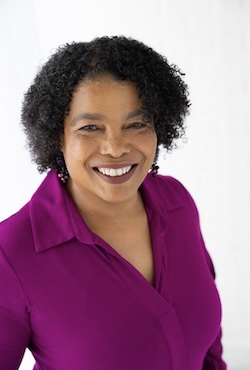
Rabbi Laura Duhan-Kaplan, director of inter-religious studies at VST, introduced Givens, who spoke on May 27, giving the |opening lecture of VST’s annual inter-religious studies conference. Givens is the author of several books, including Radical Empathy: Finding a Path to Bridging Racial Divides. Her next book, Reckoning: Creating Positive Change Through Radical Empathy, will be released in October. She has written on immigration policy, European politics, right-wing politics and more.
Dr. Terri Elizabeth Givens gave the keynote lecture for the Vancouver School of Theology’s May 27-29 conference Compassion: Mutual Care in Troubled Times. (photo from terrigivens.com)
Givens grew up in Spokane, Wash., did her undergrad at Stanford University and PhD at the University of California, Los Angeles. Her first job was at University of Washington, in Seattle, then she and her husband moved to Austin, where their careers took off. Before UBC, Givens worked at McGill University, first as a lead and advisor on the university’s plan to address anti-Black racism, then as an associate dean.
She started studying the radical right in Europe in the mid-1990s, having first become aware of their existence in 1986, when she visited France as an undergrad. At that time, Jean-Marie Le Pen was on the rise.
“I was one of the first Americans to even pay attention to this topic,” said Givens, who added that all her research is “really about how do we create change – that’s the underlying push for all of this.”
The professor shared some of her personal history, how she was raised, her father’s death in 2001, instances of racism experienced by her parents– her mother, who grew up in rural Louisiana in the 1930s, and her dad, who was born in 1928 near Pittsburgh. Her parents met in Los Angeles but chose to live in Spokane because they thought it would be safer for their kids.
“I think, in telling my story, I’m trying to talk about the different identities we have,” she said. For example, she is a mom, a teacher, an athlete, and more.
For Givens, integrity also has multiple variations. There’s physical integrity, taking care of ourselves. There’s integrity in terms of being honest and straightforward. And there’s integrity in terms of having a solid foundation.
Identity and integrity come into play with radical empathy, which comprises, according to Givens, six steps: a willingness to be vulnerable, becoming grounded in who you are, opening yourself to the experiences of others, practising empathy, taking action, and creating change and building trust.
About the first step, she said, “It’s not about being vulnerable with others, it’s aboutbeing vulnerable with yourself…. We have a really hard time [with that] – even just giving ourself a pat on the back is hard…. But the reason that’s so important is … you need to become grounded in who you are, and that’s an ongoing process.”
Taking care of yourself and being grounded in yourself allows you to be open to others, she said.
Radical empathy is circular, said Givens. “It’s a constant movement towards becoming who you want to be. You want to have goals for yourself that reach beyond where you are now, but also you want to have a process to get there.”
We can tap into our integrity, she said, by telling our story, where we fit in family, community, education, health, love and marriage, relationships, and work.
“Empathy is not absolution,” she said. “It doesn’t mean I have tosay everything is OK…. Sometimes, people do things that I don’t believe are good for anybody. And so, that’s an important component and, for me, it helps me tap into my integrity because I have to create those boundaries and make sure that I understand where I fit into this broader picture and in the community.”
As she ages, the health aspect is something she is dealing with more. “My dad had a heart attack at 72, my mom had a stroke at 75. Why those things happen, how to understand that, is a big part of our ability tofunction.”
With respect to love and marriage, she said, “When people ask me what’s important in the relationship, it’s, well, you want to be with somebody who makes you a better person. And that it’s reciprocal.”
This is something that applies to relationships in general, she added.
“Work is a huge part of our lives. I think sometimes we forget how important it is to make sure that our work is something that, regardless of what you do, you take pride in it. It may be something that you don’t want to be doingforever but, where you are right now, it’s important that your work is a part of your story.”
We can’t change the past, but we can change how we go forward, Givens said. “There are these lifelong self-reflection processes that help us learn from the people around us, whether they’re clients or colleagues or friends, and cultural humility is being willing to say I don’t know everything.”
She said, “Too many leaders are full of themselves. It’s good to be modest about your capabilities. And here’s wherevulnerability comes in. You have to be willing to admit mistakes. And I really believe that, if you have integrity, that’s not so difficult, to admit mistakes – it’s like, I’m a human being, I’m not perfect, and [having an] awareness of bias…. We know that the system is set up often in a biased way and we talk about meritocracy but what does that mean? It’s not just that you hire people who look like you or are really similar to you – it’s being willing to look beyond that and say, no, this person is the best person for the job even though we don’t have a whole lot in common.”
Givens spoke about having a curiosity about others, having an open mindset, listening without judgment and seeking, with empathy, to understand people. “And then, cultural intelligence is being attentive to other cultures and to adapt as required.”
In the question-and-answer period, Duhan-Kaplan asked about mistakes made by our ancestors, and how we deal with them. She also asked about dealing with the expectations “placed on us in a charged environment – we might open social media for some entertainment and then what we get is, whatever perspective we have, people are ridiculing it and calling us names,” said Duhan-Kaplan. “Cultural humility – once you start to get defensive about yourself and your identity, how do you keep being open to changing?”
“I still struggle with that,” said Givens.
“As a person who’s been racialized, who has ancestors who were enslaved, and yet I have ancestors who were killing Indigenous and pushing Indigenous out of their homelands,” she explained, “one of the things I’m coming to is that we’re a sum of all of this – and all of us are…. And, again, it comes back to acceptance. I have to accept the fact that, if I look in my family history, there are these evil people and there are some really good people.”
History is ugly, she concluded. “I think it’s better to know it and understand it and be willing to say, but I’m here to be better.”
For Givens, the opposite of empathy is apathy because apathy allows us to feel badly about what’s happening but then just throw up our hands and say, “the world is crazy, you can’t do anything.” Her books highlight ways that people can get involved, what they can do, and she incorporates taking action into everything she does, she said.
Ultimately, it’s the actions, the outcomes, and the way we are engaging with the world that is important, said Givens.
Vancouver School of Theology is offering Summer School courses that will be of particular interest to Jewish community members: Rabbi Or Rose teaches Mystics in Modernity, Rabbi David Seidenberg’s class is Kabbalistic Hints in Tanakh, and Rabbi Laura Duhan-Kaplan presents Zechariah: Spiritual Activism for Difficult Times. Classes run July 21-25 at VST or online. Register at vst.edu/vst-summer-school.
Elana Wenner (with folder) leads the Jewish Museum and Archives of British Columbia walking tour of Jewish Strathcona. (photo from JMABC)
Having taken the Jewish Museum and Archives of British Columbia’s tour of Jewish Strathcona, I know firsthand how interesting and worthwhile it is. This summer, there will be a little more swing to the July 27 tour – Kol Halev Performance Society will once again take part, but in an expanded role.
“Kol Halev has created a script for theatrical additions to the tour, along with musical components. Actors in full period costume will accompany the group and act out key scenes from the stories told along the way,” Elana Wenner, director of programming and development at the museum, told the Independent. “A full musical dance number is included as well, along with a reenactment of a wedding that mirrors cultural traditions from the past.”
Wenner got in touch with Sue Cohene, co-founder and current president of Kol Halev, after having taken some theatrical tours produced by other museums in the city and elsewhere.
“In the past,” said Wenner, “Kol Halev has put on productions based on BC Jewish history in conjunction with JMABC, before I worked here.”
“Kol Halev has been involved with the Jewish Museum since 2006, performing at their various galas and special events over the years,” Cohene explained. “In 2017, the museum created a photographic exhibit, shown alongside Kol Halev’s historically based play, Two Views from the Sylvia, which was presented at the Waterfront Theatre.
“Kol Halev Performance Society and the Jewish Museum and Archives have a long-standing collaboration and we update the museum on a regular basis about our shows, community teachings and future plans.”
A couple of years ago, said Cohene, Marcy Babins, interim executive director of the museum, suggested that she meet with Wenner, then the newly appointed director of programming and development, to discuss possible joint ventures.
“Connecting with Elana has been like carrying on a family tradition,” said Cohene. “Elana’s grandmother, Irene Dodek, was instrumental, along with Dr. Rabbi Yosef Wosk, in bringing Kol Halev on board to provide entertainment and theatrical historical education for Jewish Museum projects. Elana’s mother, Dr. Gail Wenner, has danced with Kol Halev and continues to share her creativity by creating historically influenced hats for our performers.”
Last summer, Kol Halev added a Yiddish dance performance to complement one of Wenner’s Jewish Strathcona walking tours. This summer, actors from the performance group will portray early Jewish community leaders during the tour, in addition to weaving in some traditional dance pieces.
Cathy Moss, one of Kol Halev’s main writers since the group was established, worked with the research provided by Wenner to create a script.
“Elana shared the tour route and basic information about Strathcona historical community leaders from the early 1900s to the 1940s,” said Cohene. “She kindly led Kol Halev on the tour, where we all looked at locations that could accommodate acting and dancing.”
“Elana did a great job compiling the research on the area,” said Moss. “Once I took the tour, it was easy to see what a compelling cast of characters inhabited Strathcona in the early days. It was fun to write dialogue for such interesting and lively folks.”
Moss relied on the museum’s material for each location along the tour, writing the dialogue for the characters based on the biographical details and context Wenner provided.
“The tour is great and informative on its own,” said Moss. “I would add that inviting Kol Halev to be part of it was an excellent idea. It adds another dimension that makes the experience that much more enjoyable. The wedding dance in particular will be appreciated by the tour-takers. It’s very entertaining.”
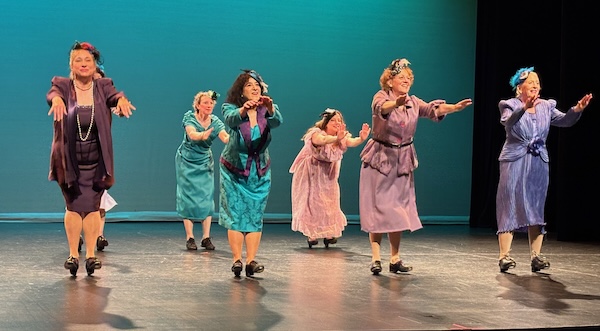
Kol Halev rehearses the Patsh dance, choreographed by Santa Aloi. The group will dance and act in the July 27 JMABC Strathcona walking tour. (photo by Adam Abrams)
Kol Halev has several on-site rehearsals planned before the shows in which they’re participating – the July 27 public tour and a private tour in late June – “particularly to familiarize dancers and actors who were not involved last year,” said Cohene.
“We will have between eight and 10 dancers this summer and a few actors,” she said. “It’s a small working production that has room to grow.”
Cohene will be part of the performances.
“I’ll be playing a mother-in-law role in the 1940s wedding dance, which was choreographed by Tamara Thompson Levi,” she said. “I’ll also tap dance in the Yiddish Patsh dance choreographed by Santa Aloi.”
Wenner leads the Strathcona walking tours.
“This tour is a journey through the footsteps and choices made by the first community leaders in Vancouver,” she said. “It follows in the footsteps of community-building, highlighting the institutions and people who laid the groundwork for today’s thriving Jewish Vancouver institutions. Along the way, we see buildings that held components of the first Jewish community organizations, as well as the homes of some of the first leaders. We also explore the ideas of what Jewish community requires in general, and what it was like to live as a Jew in this part of the world at the turn of the last century. The tour is a synthesis of past and present, weaving together the origins and future of Vancouver’s Jewish community.”
The Jewish Museum has four different walking tours on offer this summer. In addition to the Strathcona neighbourhood tours led by Wenner on July 13 and 27, Aug. 10 and 24, Daniella Givon leads tours of the Mountain View Jewish Cemetery on July 6 and Aug. 10. In Victoria, Amber Woods leads both the Downtown (July 6 and Aug. 10) and Jewish cemetery (July 20 and Aug. 24) tours. All the walks start at 10:30 a.m. For tickets, visit jewishmuseum.ca, email [email protected] or call 604-257-5199.
Hastings Mill Store was part of this year’s Heritage Discovery Day. (photo by Cynthia Ramsay)
This year’s Heritage Discovery Day – which has been hosted by Vancouver Heritage Foundation since 2003 – featured nine sites in Kitsilano, highlighting, but not confined to, the Craftsman style of house, which, according to the self-guided tour book, “is characterized by decorative brackets, exposed rafter ends, mock trusses in the gable ends, expansive low-pitched gable roofs and a rich variety of finishing materials and textures.” Saturday, June 7, was an ideal day for the event and this year’s Summer cover features photos taken throughout the neighbourhood, while going house to house. Driving home along Cornwall Avenue, the number of people enjoying Kits Beach was incredible. When it’s sunny here, the people emerge!
City Farmer Garden’s Cob shed, made with clay from Haida artist Bill Reid. (photo by Cynthia Ramsay)One of the heritage homes on the tour. (photo by Cynthia Ramsay)Kits Beach on June 7. (photo by Cynthia Ramsay)
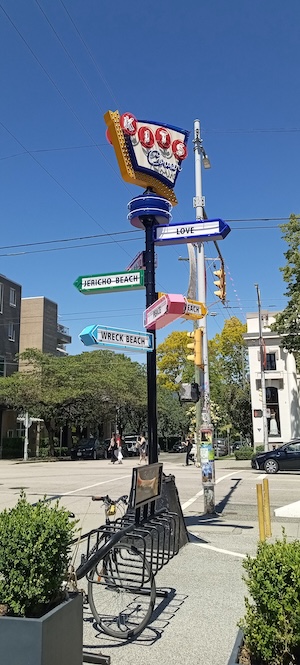
Kits directional post. (photo by Cynthia Ramsay)
A cyclist amid the flowers. (photo by Cynthia Ramsay)