It is sunny today. (Some other today!) I am on my balcony watching birds fly. The sky is blue everywhere, unharried by even a wisp of cloud. There are sailboats on the water and there is snow on the mountaintops. The gentle breeze is friendly, ruffling the tiny hairs on my exposed skin.
Although it is before noon, I have indulged. I am inspired by a smidgen of whiskey and the smoky vapour of a cigar of unknown heritage. (I drank from a new crystal beaker my Bride purchased for me to celebrate my existence.) Sensitized by their appeal, I can see my life experience stream like an indie film before my eyes.
I am watching how the birds launch themselves into empty space, beating their wings strongly until they catch a current, an unseen wave they sense will carry them forward. Then they glide, onward and upward. They fly singly or in flocks. Those flying together know well the strength and advantage that lies in union. Isn’t that always a better idea if it can be managed?
I think back to my youth, my life path, and extrapolate to the lives of younger people, and those not so young. I recall how I launched myself into the unknown – so eager to be off on my own that I was heedless there were any dangers. Some of us hung back and had to be encouraged into flight by our near and dear. Some of us traveled in packs. Some of us remained a long time on the home perch. Some had their departures well-planned, orchestrated by vision or friends and family.
For those of us who took off, we sometimes had to walk before we could fly, we had to work hard to get to the take-off point. This might have been particularly true for those of us who were the children of immigrants, of ethnic minorities often discriminated against. When we did make it off the ground, how proud we were to be sailing in the wind of life under our own power. It was great to feel the lift of independence under our wings. It gave us energy.
We were always looking for that wave that would propel us forward. We didn’t always find it. For many of us it was work, work, work, just to stay on an even keel. We squared our shoulders and kept on keeping on. We couldn’t help seeing others on their flights ahead of us, wishing we could also really soar.
How did we learn to fly? How did we know we could? Surely, we watched others, our parents, friends, people we knew. Some of us crashed and burned, a few of us never even tried – the grapevine and the media brought us the news of these events daily. We felt the downdrafts as well as updrafts and we all had our share of scary moments. For some of us, more than our share! But most of us kept on moving, looking to gain enough speed for lift-off.
And many of us eventually did take off. We got to feel the exhilaration of flight, to feel the current we had caught through effort and attention to the tasks at hand. When we stopped to think, it was great to relish and feel the momentum we had attained, to appreciate the distance we had traveled. It was great to contemplate the things we could look forward to if we kept on flying.
Sustaining the effort on the trip was never something one could take for granted – not all of us are built for distance. When I watch flocks of birds flying south for the winter, I am always mindful that each member takes a turn at the head so the leader can rest. Most of us do not have volunteers to take a turn at the head of our efforts to get ahead, to accomplish the tasks we have set ourselves. It is almost always totally up to us alone. It is always so special when there is a partner at the ready with a helping hand. Lucky, lucky, lucky! We have to be open to that.
I am one of the lucky ones. Coming to the end of my journey, closer every day, I can see that now. The wounds I have sustained along the way, many of them self-inflicted, have not proved fatal to this point. I can rest on my perch more often and watch the passing parade.
The flights that remain for me to take are more measured and more likely to be in the thick of a flock. I am complacent when overtaken and passed by the many more eager flyers. Sometimes, I am more concerned about our companions who have fallen behind. We are spending more time in the planning for others than in the doing for ourselves. And, I do have a partner ready to give a hand. Lucky, lucky, lucky!
Max Roytenbergis a Vancouver-based poet, writer and blogger. His book Hero in My Own Eyes: Tripping a Life Fantastic is available from Amazon and other online booksellers.
It is sometimes hard to look back over the pages of the Jewish Independent and its predecessor, the Jewish Western Bulletin, knowing what has happened since the articles were published. From the 1933 optimism that there was hope for German Jewry, to the enthusiastic welcome of a seemingly short-lived El Al office in Vancouver, to colleagues who have passed away.
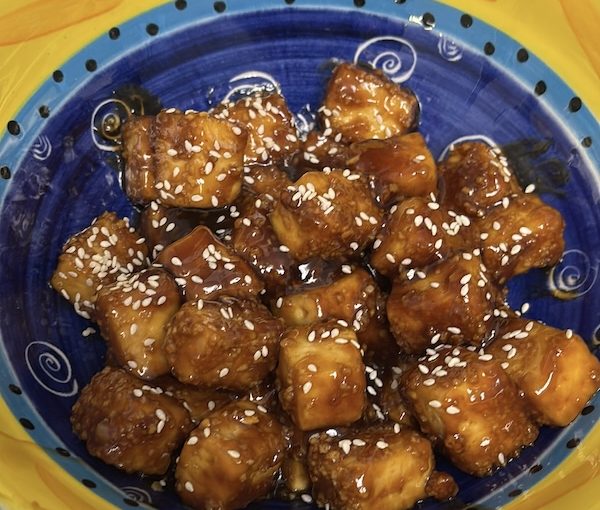
A tofu dish worth the effort. (photo by Shelley Civkin)
As far as my husband Harvey is concerned, tofu is a four-letter word. Spoken only in hushed tones. And for sure not in mixed company. If given a lie detector test and asked if he believed tofu was evil – as in, unforgivable and heinous – he would reply unconditionally in the affirmative. And he would pass the test. I, on the other hand, think quite highly of tofu. I have great respect for its versatility, inexpensiveness and health benefits. Granted, it’s undeniably bland when left to its own devices. But zhuzh it up with some seasoning, cover it in sauces and marinades, pair it with rice or noodles, and you’ve got yourself a very respectable, even snazzy, lunch, dinner or snack. Think of it as the tabula rasa of the food world.
The other day, as I was contemplating what to make for lunch, Harvey was busy frying a couple of eggs on his little Proctor Silex one-burner cooktop. (He can’t go near our induction stove because of his pacemaker with defibrillator, so he was on his own.) It was the perfect time for me to indulge in a tofu-forward meal.
Enter garlic sesame tofu from eatwithclarity.com. Sweet, salty and tangy, this recipe is delicious when freshly cooked and hot, and tastes even better cold the next day. The recipe calls for it to be served over rice with steamed broccoli, but I think it would be just as yummy over rice vermicelli noodles. It’s a bit labour intensive – not baked Alaska intensive, but do set aside about one to one-and-a-half hours to make this dish. It’s not a lunch you can throw together in 10 minutes like say, a PB&J sandwich. But, if you have the time, it’s totally worth the effort.
GARLIC SESAME TOFU
tofu 1 tbsp low-sodium tamari or soy sauce 1 16-ounce block of extra firm tofu 1 tbsp cornstarch 3 tbsp breadcrumbs
sauce 5 cloves garlic, minced (I used only 2) 1 tbsp oil 1/3 cup low-sodium tamari or soy sauce 2 tsp toasted sesame oil 2-3 tbsp honey or maple syrup 1 tbsp rice vinegar 1 tbsp cornstarch 4 tbsp water, divided
Preheat oven to 400˚F and line a cookie sheet with parchment paper.
Drain excess liquid from tofu by wrapping it in paper towel, placing it on a plate, covering it with another plate and pressing it down with a heavy object on top (I used a cast iron pan). Let it sit for about 30 minutes. Pressing the tofu makes it crispier.
Cut the pressed tofu into one-inch squares and put the squares in a large bowl. Toss with 1 tbsp tamari or soy sauce. Add 1 tbsp cornstarch, then 3 tbsp breadcrumbs (or Panko), until all pieces are evenly coated.
Put all the tofu squares on a baking sheet lined with parchment paper and bake for about 30 to 35 minutes or until golden brown.
During the final 10 minutes of baking, prepare the sauce.
Mince the garlic and sauté it with 1 tbsp oil in a large non-stick pan for 2 to 3 minutes or until lightly browned. Be careful not to over cook it or it will become bitter.
Add in 1/3 cup tamari or soy sauce, 2 to 3 tbsp honey or maple syrup, 1 tbsp rice vinegar, 2 tbsp water and 2 tsp sesame oil.
In a separate bowl, whisk together 1 tbsp cornstarch and the remaining 2 tbsp of water and then add this to the fry pan.
Heat over low heat for 3 to 5 minutes or until the sauce starts to bubble and thicken.
When the tofu is done, toss it in with the sauce. Garnish with sesame seeds and serve over rice with steamed broccoli (or rice vermicelli noodles). Enjoy!
You could likely make this same recipe using slabs of tofu, instead of cubes, essentially turning it into a fake-steak, but you’d still have to cut it so it’s not too thick. Different presentation, similar result, I’m guessing. Don’t quote me on that.
I’m told you can substitute tofu for all kinds of other proteins in dishes like lasagna, spaghetti and meat sauce, chicken casseroles, etc. That is, unless you have a husband who’s like a police sniffer dog. I tried it once, and Harvey busted me from 10 paces away. Luckily, I got off with a mere warning that time.
Since we’re on the topic of health foods, if you haven’t already discovered hemp hearts (also called hemp seeds), you’ve got to give these a try. For me, they’re the equivalent of Frank’s Red Hot sauce – “I put that sh*t on everything.” These little gems are deliciously nutty tasting and packed full of protein, omegas 3 & 6, amino acids and important nutrients like iron, magnesium, fibre and zinc. Plus, they’re gluten-free, vegan, paleo- and keto-friendly. And, if that isn’t enough to convince you, they’re grown in Canada! Oh, and they’re kosher! Manitoba Harvest is a big producer of hemp hearts, and you can buy them practically anywhere.
These little nuggets of nuttiness are an equal opportunity food – you can put them on salads and on toasted bagels, in smoothies, sprinkle them on casseroles and cereal, and even eat them straight out of the bag by the spoonful. You can bake with them, cook with them and substitute them for breadcrumbs in some recipes.
Manitoba Harvest has an extensive lineup of hemp heart recipes at manitobaharvest.ca/blogs/hemp-resource-hub and I’ll definitely be trying some of them soon. The point is, I used to sneak these tiny protein warriors into our dinners without my hubby knowing until, one day, he relented and agreed to try a “test” spoonful (for the first time, or so he thought). Alert the media: he was instantly and completely culinarily hooked!
Moral of the story is this: don’t try to sneak in a known verboten food unless your partner is even slightly flexible in his/her culinary adventurousness. And, know this: there is absolutely no way to disguise a Brussels sprout. You can purée it, hide it in soup, barbeque it and smother it in maple syrup and feta, but it’s still a Brussels sprout. Like Sarah Palin said: “You can put lipstick on a pig, but it’s still a pig.” I respectfully submit that this is true of that mini cabbage-like vegetable that Harvey wouldn’t eat if it were the last food left in an Israeli bomb shelter. In all fairness, I feel the same way about okra. I’m only human, after all.
Shelley Civkin, aka the Accidental Balabusta, is a happily retired librarian and communications officer. For 17 years, she wrote a weekly book review column for the Richmond Review. She’s currently a freelance writer and volunteer.
:איש צבא בכיר לשעבר שמשתייך למחנה השמאל בישראל אומר על בנימין נתניהו
זה כמעט שנתיים לא השיגה ישראל הכרעה במלחמתה נגד ארגון טרור המצויד ב”טנדרים וכפכפים”, כדברי ראש הממשלה, למרות שכבר הרגה כשני אחוז מתושבי הרצועה. אבל אל דאגה, האיש הזה החליט לפצות אותנו על הכישלון בחזית הקטנה בפתיחת חזית נוספת, ראויה ללביאים שכמותנו, בפותחו במלחמה נגד מדינה ששטחה גדול משטחנו פי 66 ואוכלוסייתה מונה פי עשר מאוכלוסיית ישראל, כולל ערבים וחרדים שלא נושאים בנטל הבטחוני, וממעטים לשאת (שלא באשמתם) בנטל הכלכלי והטכנולוגי
ישראל שיכולה הייתה לסיים את המלחמה בעזה כבר לפני שנה, לשחרר את כל חטופיה ולהיכנס, תחת חסות אמריקאית, להסכמי נורמליזציה, בריתות צבאיות וכינון יחסים דיפלומטיים עם המדינות הסוניות המתונות, לו רק הסכימה לקדם את פתרון שתי המדינות, החליטה להעדיף את החזון המשיחי, את העליונות היהודית, את הגזענות, את האפרטהייד ואת מלאכת השמד והגירוש של תושבי הרצועה
ישראל שהפכה עבור הפלסטינים את רפיח וג’יבאליה למה שסטלינגרד מסמלת לרוסים, ומרד גטו ורשה ליהודים, מעניקה עכשיו לאיראנים על מגש של כסף את מה שהעניקו היפנים לאמריקאים בפרל הארבור: מוטיבציה מטורפת להשיב מלחמה שערה המוזנת על ידי עלבון צורב. התלכדות פנימית, ונחישות סבלנית וארוכת טווח לפגוע בנו אנושות
התבונה המדינית המינימלית מחייבת לנטרל איומים אפשריים ולחזק בריתות אזוריות בבואך להבעיר חזית חדשה גדולה ומאיימת. אבל אנחנו, סרבנים אולטימטיביים שכמותנו לכל פשרה, לכל הסדר, העדפנו להעצים את ההתלקחות האזורית, כי זו הייתה הדרך היחידה לשמר את לכידותה של הממשלה, להשכיח את מחדל העוטף ואת החטופים, וללכד שוב את עדר הכבשים הפבלובי על ידי השמעת רעם תופי המלחמה. עובדה, כולם מריירים
המלחמה שפתחנו נגד איראן בשורת חיסולים המזכירה מלחמת כנופיות יותר מאשר מלחמה בין אומות לא תשיג הכרעה. היא אולי הצליחה להנחית מכה ראשונית מכאיבה, אבל מהר מאוד היא תהפוך למלחמת התשה והקזת דם שעלולה להימשך שבועות, חודשים ואפילו שנים, וזאת בשעה שאורך הנשימה שלנו, בכל מובן אפשרי קצר יותר מזה של האיראנים
כדאי להיזכר במלחמת איראן עיראק שנמשכה 8 שנים גבתה קרוב למיליון הרוגים, חיילים ואזרחים, איראניים, מעל למיליון נכים, שני מיליון עקורים ואומה שמשננת עד היום בהתלהבות את הסיסמה ‘ג’נג, ג’נג תא פירוזי’ (מלחמה, מלחמה עד הניצחון)
המוטיבציה להשיג נשק גרעיני ולהגיע למאזן אימה מול ישראל שכבר מזוינת בנשק כזה רק תתחזק, והנזקים שאנחנו נסב לפרויקט הגרעיני יתוקנו תוך חודשים או שנים מועטות
אני רוצה להאמין בכל לבי שמישהו סביב שולחן מקבלי ההחלטות לקח בחשבון את התסריט ההגיוני הזה ואולי מישהו הרגיע אותו שמיתקפה מוצלחת תערער את המשטר ותביא להפלתו. אולי. אין לדעת. כרגע מסתמן שהסולידריות של אזרחי איראן עם המשטר דווקא גדלה תחת רושם המהלומה הראשונה
אז יצאנו למלחמה להשיג מטרה מוגבלת מבלי לקחת בחשבון שאולי היא תתרחב לעימות מתיש וארוך. לא צריך אלפי טילים ביום כדי להכניס את מדינת ישראל לטרפת, לסגור את נמלי התעופה והים שלה ולגרום לה נזקים כלכליים, נפשיים ולאומיים חמורים
מספיק כמה עשרות שיגיעו למטרות מדי שבוע כדי לסגור את המרחב האווירי, לשבש את שגרת החיים, לחבל אנושות בכלכלה המקרטעת ובמוסדות החינוך, להפוך את המציאות כאן לבלתי אפשרית, לפחות לאלו שלא מצוידים במקלטים אטומיים
אז יצאנו למלחמה להסיר סכנה עתידית שנויה במחלוקת וקיבלנו סכנה מיידית שלא ברור עד כמה אנחנו מוכנים להשלכותיה
“It may sound like a cliché, but I really believe that music is a unique language. You don’t have to know how to read it, you might not understand the lyrics, but it can still touch your heart and soul,” Omer Shaish told the Independent. “At the end of the day, it doesn’t matter what genre you listen to, it will always make you feel something. That’s what I always hope to do when I get on stage – use the music to touch people’s hearts and souls.”
Omer Shaish brings My Broadway Shpiel – stories, Broadway tunes, popular Hebrew songs and original music – to Vancouver Aug. 21. (photo from omershaish.com)
Shaish brings My Broadway Shpiel to Vancouver Aug. 21, 7:30 p.m., at Temple Sholom. In addition to offering a night of Broadway tunes, popular Hebrew songs and his own original music, the performance will raise money for Temple Sholom’s campership program.
While Shaish never attended summer camp growing up, he did talk about growing up in the Jewish community.
“We’re one big family and I love that about us,” said the singer, who was born and raised in Rishon LeZion, which is about 20 minutes south of Tel Aviv.
“I spent most of my teenage years and my early 20s in Tel Aviv, where I was surrounded by great art, amazing people and incredible food!” said Shaish, who knew from a young age that he was going to be a singer.
“My parents say that, as a toddler, I’d pick up anything that could resemble a microphone and sing at the top of my lungs – everywhere. I always loved having an audience,” he said. “Even though, in real life, I sometimes come across as a bit shy and introverted, having an audience to sing for always made me feel at home. Up until today, having an audience, no matter how big or small, brings me to life.”
Shaish started his career as a vocalist in the Israeli Air Force Band, performing on military bases and in Jewish communities in Europe and Canada. He also is an actor, performing in Israel before moving to New York City in 2007 and graduating from the American Musical and Dramatic Academy. He has numerous theatre, vocalist and soloist credits to his name, but mainly has been touring internationally as part of the classical vocal trio Kol Esperanza and with his self-produced, one-person show My Broadway Shpiel.
“Even though I love acting, I’ve been focusing on singing in the past few years,” he told the Independent. “I realized, throughout the years, that I feel more at home just being myself on stage. I enjoy sharing these moments with the audience and it makes every show feel different and so alive. Playing a character can be interesting, too, but, for me, there’s nothing better than simply being myself.”
At the moment, Shaish calls Baltimore, Md., home. Previously, he toured the United States for many years, and lived a few years in Los Angeles and in Miami.
“I absolutely love traveling, seeing the world and meeting lovely, interesting people,” he said. “My friends always make fun of me and say that they never know where I’m at, to which I reply with, ‘neither do I.’ It can be exhausting at times, but it’s always worth it. I feel very lucky to do what I love and that gives me a lot of energy to keep at it.”
He’s looking forward to performing here.
“I love Vancouver!” said Shaish. “I’ve been there many times and I think it’s one of the most beautiful places on earth. The last time was only a few months ago, for rehearsals and a recording session. I’ve performed in Vancouver before and I can’t wait to be back and enjoy the views, the fresh air and, of course, the wonderful people!”
About the show he’s bringing with him, My Broadway Shpiel, he said, “As I tell my story and share some anecdotes about the Jewish story of Broadway, I sing some classics from Fiddler on the Roof and West Side Story, and all the way to some surprises by ABBA and Elvis Presley!”
One of his favourite moments in the performance is when he shares the experience of living in the United States with a foreign name.
“I have heard so many variations of my name from so many people that I have met,” he said. “‘Omer’ apparently isn’t very easy to pronounce. So, one day, I thought, why not write a song about it? I took Liza Minelli’s ‘Liza with a Z’ and turned it into ‘Omer with an E.’ At first, I wanted that to be the name of my show, but My Broadway Shpiel felt more fitting.”
As for the importance of music, he said, “This brings me back to how I see music as a language. It has superpowers. It can take us away from one reality and bring us to a completely different one within a split second. It triggers our emotions in such a powerful way. When people talk to me after a show and say that I made them laugh, made them cry, or made them forget about their day, I know I did something right.”
Since Oct. 7, 2023, antisemitism and intimidation have been rife on campuses, including the University of British Columbia, where there have been numerous incidents of graffiti and personal attacks on the university’s president, among others. (photo from Hillel BC)
Jewish university students and their allies are reflecting on a challenging year at British Columbia’s postsecondary institutions. Activists continue to make life difficult – but leaders at the campus organization Hillel BC are emphasizing the resilience of students and the unity of the community.
The first full academic year since the Oct. 7 terror attacks and the ensuing war wrapped up recently. In some ways, it was less chaotic than the previous year, but more intense, according to Ohad Gavrieli, executive director of Hillel BC.
“If we could summarize this year,” Gavrieli said, “it would be that there were fewer fires but they blazed with greater intensity.”
Last year, campuses across North America, including at the University of British Columbia, the University of Victoria and Vancouver Island University, were occupied by anti-Israel protest encampments.
“Last summer, the encampment occupied the campus, literally and figuratively, for months, demanding responses and counter-narratives that detracted from our primary work,” said Gavrieli.
Those disruptions ended before the new academic year, but 2024-’25 began with a flurry of hostility from anti-Israel activists. UBC’s main Point Grey campus seems to be the locus of the activism, with other campuses showing similar but reduced agitation commensurate with their size, he said.
At UBC, the activists’ scattershot tactics have been honed into more targeted protests, boycotts and campaigns, he said. At the same time, Hillel, Jewish students and a significant group of allies are more prepared than they were when the explosion of anti-Israel – and often overtly antisemitic – activism roiled campuses beginning in October 2023.
The 2024-’25 school year opened with vandalism, including a pig’s head being mounted on a gate near the home of the university’s president in a protest that apparently targeted the RCMP, Israel and the UBC administration. The head was accompanied by a sign reading “Pigs off campus.” The incident, for which anti-Israel activists took credit online, was an apparent reference to the surname of UBC’s president, Benoit-Antoine Bacon, but, in online discourse, Israelis, Zionists and Jews are often depicted as pigs.
The UBC campus, and others, were swathed in anti-Israel graffiti as students returned to school last September.
Anti-Israel activists have targeted UBC’s president Benoit-Antoine Bacon in various ways. (photo courtesy Hillel BC)
In October, a conference featuring an Israeli archeologist had to be relocated from UBC’s Green College after the facility’s windows were smashed and hateful messages were spray-painted on the building during the night before the scheduled event.
In November, a coordinated “Strike for Palestine” was organized, including an occupation of UBC’s Global Lounge, the office where students access international academic exchanges. Anti-Israel groups also gathered outside the Buchanan Building, the main arts complex, demanding UBC’s financial divestment from Israel.
In December and January, the campus was blanketed with posters accusing UBC’s board of governors of supporting genocide. Graffiti and harassment continued, with some students reporting they no longer felt safe in class.
In February and March, UBC saw a student referendum campaign calling for divestment from Israel. This was followed by another “Student Strike for Palestine.”
When Vancouver and Whistler, including UBC, hosted the Invictus Games, an international adaptive sports competition for wounded, injured and sick military personnel and veterans, protesters homed in on the presence of Israeli soldiers and veterans, causing disruptions and engaging in further extensive vandalism.
As the school year ended, convocation ceremonies were targeted, with protesters and some graduates wearing keffiyehs or other symbols and carrying or unfurling signs, disrupting numerous graduation events throughout the province.
Despite these and many more challenges, Gavrieli said, Hillel continued to serve as a refuge of safety, belonging and Jewish pride.
“We continued to host weekly Shabbat dinners, hot lunches and holiday celebrations across our campuses, including new programming at UBC Okanagan and Thompson Rivers University,” he said.
The campus organization has seen significantly increased interest in their programs and expanded involvement over the past two academic terms, as students, faculty and staff converged on Hillel for emotional and practical support. These programs include significantly enhanced mental health services, said Gavrieli, as well as building organizational capacity empowering students to advocate for themselves and their community.
The achievements of Jewish students and their allies were marked at a Night of Resilience, held at Hillel UBC on March 27.
Looking back at the year past, Gavrieli emphasized the high points, especially the strength of Jewish students who have “risen with courage, dignity and pride.” He also cited continuing healthy dialogue with university administrators and other stakeholders, though he expressed the wish that university leadership were more vocal in condemning hate-motivated language and acts, and addressing abuse of podium. Many professors and teaching assistants have pressed their personal political opinions on students, Gavrieli said, including instances in which the subject matter was not remotely related to the instructors’ disciplines.
Relations with campus security and the respective police services have been universally positive and constructive.
“We have received nothing short of exemplary cooperation from all areas of security and policing,” Gavrieli said.
Other achievements include a “We Are Here” toolkit, an online resource that helps students file formal complaints and access support. This technological response systematized reporting procedures to make intelligence gathering more effective and to ensure easy and immediate access for students needing supports.
Hillel staff successfully assisted several students in navigating institutional processes, according to Gavrieli, including challenging biased grading. They condemned the disruption of academic spaces, voiced concerns to the administration and stood with students who felt abandoned.
Gavrieli expressed gratitude to individual and organizational allies in the Jewish community, who have ensured that the campus organization has the resources it needs to respond as best as they can to the situations arising on campuses province-wide.
Roman Chelyuk is one of a small but increasingly visible group of non-Jewish allies who have coalesced around Hillel in recent years. Growing up in Ukraine, Chelyuk had Jewish peers and family friends, and has traveled twice to Israel. He was supposed to travel there again last month with the Canadian Jewish Political Affairs Committee but the conflict canceled that mission.
Roman Chelyuk was one of the non-Jewish allies honoured at the event Night of Resilience, held at Hillel UBC on March 27. He is pictured here with Ishmaeli Goldstein, Hillel’s campus advocacy specialist. (photo courtesy Hillel BC)
He first connected with Hillel when the Ukrainian students’ club did a joint program with the Jewish students and he hung around, partly motivated by the isolation he was seeing among his new Jewish friends.
Chelyuk, who just graduated in international relations, was treasurer and, for a time, interim president of the Israel on Campus club.
One of the clearest signs he sees of the changed situation on campus is that Jewish students are challenged in making connections with other affinity and interest groups like the one through which he was first introduced to Hillel. Joint initiatives with other student clubs have largely dried up.
“That was easy to organize before Oct. 7 and it was not after,” he said. “It’s generally heartbreaking.”
Sara Sontz, who expects to graduate next spring in sociology, was president of UBC’s Jewish Students’ Association this past year.
“It’s definitely still been challenging,” she said, citing protests on campus, professors derailing topics by discussing the Israel-Hamas conflict when it is unrelated to the discipline, even singling out students with Jewish names and asking for their opinions on current events.
“I find it really frustrating because students are there to learn on a specific topic for their degree and it’s frustrating when Jewish students are then forced to almost hide their identities because they don’t want to be called on or put into an awkward position within the class,” she said.
“We haven’t let all the hate and all the protests affect how strong we feel about ourselves and our community. I think that’s the most important thing.”
– Sara Sontz
“I’ve always been open about my Jewish identity,” said Sontz, “but, after Oct. 7, I and many other Jewish students stopped wearing our Magen David necklaces or, for some, they stopped feeling comfortable even going to class – and some stopped going to class – just because of the safety concerns and the emotional discomfort.”
There are silver linings, Sontz said.
“I always try to look for the bright side,” she said. “The one thing I found is that the community got stronger after Oct. 7, due to the necessity of having to have a unified front, to have a community to go to when you have such difficult problems and having your fellow Jewish students, or Hillel and Chabad on campus, really provided that safe space.”
She hopes for better things in the new academic year, though her optimism has limits.
“It’s constant,” she said. “It’s never-ending.… But we haven’t lost hope. We are a really strong community.… We haven’t let all the hate and all the protests affect how strong we feel about ourselves and our community. I think that’s the most important thing.”
Vancouver hosted the largest convention in the city’s history over the weekend. About 50,000 members of Alcoholics Anonymous descended on the convention centre and BC Place stadium. Among the throngs was a booth representing Jewish Addiction Community Services – JACS Vancouver.
Rabbi Joshua Corber, the organization’s recently appointed director of addictions and mental health services, wanted the group to have a presence at the massive international confab. The booth shared information about JACS’s work, as well as literature from partner agencies in other cities.
For Elana Epstein, who attended the booth and greeted passersby, the experience was transformative – but not for the reasons she expected.
Epstein and her family have shared their journey with addiction and recovery openly, including in these pages (jewishindependent.ca/family-hopes-to-save-lives). She and husband David Bogdonov and their son Noah Bogdonov have become some of the most familiar faces in this community speaking about and advocating for awareness around addiction and recovery.
At a public event at King David High School last fall, the family shared the path they have been on since Noah began his recovery journey two years ago. The entire family has become engaged with this cause. Noah and Elana have both become professionals in the field – Noahrecently moved to Calgary to launch a new recovery centre and Elana was credentialized and recently hired to lead JACS’s new family group, which began earlier this week.
But it was not recovery – or, at least, not recovery in the sense she anticipated – that uplifted her at the AA convention. It was the outpouring of empathy and words of encouragement she received from passersby to her as a Jew, and to the Jewish community more broadly.
A steady stream of people dropped by to peruse the information at the booth, but Epstein was deeply moved by the number who just expressed a few words of support for the situation Jewish people find themselves facing in today’s world.
This sort of acknowledgement is something that has been glaringly absent among her non-Jewish circles in Vancouver, she said.
“I personally needed it,” she said. “I haven’t felt that kind of outreach since the war started.” In one of her local circles, her experience has been quite the opposite.
Since Oct. 7, 2023, at the latest, most Jews have probably, consciously or unconsciously, at different times and in different spheres, become aware of dangers and vulnerabilities when we identify ourselves in public. Any reservations Epstein had quickly evaporated, leaving her “completely surprised.”
“Tears,” she said of her response. “Overwhelming gratitude. I really didn’t expect this and it is a beautiful thing. A really beautiful, heartfelt thing.”
There were other surprises – a lot of non-Jews subscribed to stereotypes that addiction did not exist in the Jewish community. For Epstein, though, it was the few words from a stream of strangers that raised her spirits.
Why did it take strangers from other cities to say the words she needed to hear? Maybe it is easier to speak with people you don’t know. By putting herself out there as a visible Jew in a primarily non-Jewish environment, she attracted the goodwill of people who wanted to share expressions of kindness. Are people who deal in addiction and recovery more sensitive to the pain of others? Is there some other explanation?
We would like to imagine this was an indication that the world is kinder than some recent evidence would suggest.
For one thing, there is a simple phenomenon: haters are loud. The chanters who march through the streets condemning Israel (and often Jews) are few but extremely vocal. Their stickers, spray-paint and graffiti might suggest numbers greater than they represent.
Empathy is quiet. Seeing a Jewish individual standing invitingly at a booth presents an opportunity for a few quiet words that maybe some people have been waiting to express.
It may be rare enough that it bears highlighting. It is still, though, a reminder that compassion abounds, often in places we least expect it. This is a small example – and just one – that modest acts of kindness have profound ripples.
As we enjoy the full bloom of summer, with its (hopefully) bright days and reinvigorating outdooractivities, we thought it was worth sharing that the world can be a more welcoming place than it sometimes seems.
We naturally share with friends our moments of disappointment and distress, seeking commiseration when the world lets us down. Remember also to share your moments of uplift, as this one individual chose to do. We need them.
Before Passover, a relative of ours in New Jersey asked if we would have problems getting Manischewitz wine. I told her all would be fine. Even though US alcohol had been taken off Manitoba’s shelves, we would just buy other brands of kosher wine instead, I said.
I felt confident about this possibility until I marched to the kosher section of the wine shop and saw the notification. The store encouraged us to buy whatever was available “right now” because all kosher wine, no matter where it is made, is imported through the United States. We were fine for Passover and, to be honest, my family is more flexible about wine the rest of the year, so the situation didn’t worry me too much.
A Manischewitz joke from my mom, visiting from the States, made me wonder about how much kosher wine is available now in Manitoba, and I did some googling. Between the provincially run Liquor Marts and the private wine shop that caters to those who keep kosher, I saw about six wine varieties available.
Then, my husband told a story he’d heard from someone attending minyan. Their family kept kosher. To get the kosher wine they wanted during Manitoba’s ban on US alcohol, they placed a special order with Happy Harry’s liquor store in Grand Forks, ND. The dad drove from Winnipeg, crossed the border, picked up two cases of wine, paid the duty at the border and drove home again. It was a 470-kilometre round trip, more or less, to resolve the issue.
You don’t think a lot about this when supply chains function between countries, but, in the absence of kosher wine imports, you have whatever odds and ends are left – and Kedem grape juice, which is still available.
Plenty of Jewish Canadians may be asking what they will drink on the holidays. This made me think about the Babylonian talmudic tractate I’ve just started studying, Avodah Zara. This tractate, compiled by about 500 CE, concerns how one lives alongside idol worship. It considers issues like whether Jews should do business with non-Jews before their festivals, because the money they earn might go towards ritual sacrifice to idols.
It gets more specific though. Jews lived in diverse places, with many different cultures around them. The rabbis wondered, what if there were a water fountain and the water spurted out of a Greek god or an idol? Jews may not drink “from Zeus’s lips.”
The rabbis then suggest a more concerning health issue about these fountains with pipes. There was danger, they posit, because these pipes brought water from ponds or rivers. You might swallow a leech. Medical suggestions about what to do if you swallow a leech (or, heaven forbid, a hornet) follow. Apparently, one is allowed to boil water on Shabbat to deal with this problem, or swallowing vinegar might help.
This discussion on Avodah Zarah, page 12, examines how to deal with many issues in communities where we Jews interact with others, working and living together, specifically mentioning Gaza and Bet She’an. Yes, those two locations have been in the news … funny how little changes.
This tractate page describes how to cope with another even more difficult dilemma. During this period – the Mishnah was compiled by about 200 CE, and the Gemara was added by 500 CE – some people believed that Shavrirei, a water demon, came out at night. If you got thirsty at night, you must wake up someone else to accompany you, as the demon would only be a problem if you were alone. However, if you were alone and thirsty, there was another solution. One knocked on the jug lid and recited an incantation: “shavrirei verirei rirei yirei rei.” Maybe reducing the name of the demon at each repeat results in causing the demon to disappear, too?
To most modern thinkers, this whole approach will seem bizarre. An entire tractate is devoted to avoiding idol worship, since Jews believe in only one G-d. Yet, at that time, Jews also seemed to believe that dangerous demons existed, swallowing leeches could be resolved by consuming hot water, and a person would die from swallowing a hornet but might delay their demise by drinking vinegar. Worldviews are complicated, and full of contradictions.
These days, Jews, both in Israel and the diaspora, live in community with non-Jews. We must cooperate and get along even when our traditions don’t jibe. Further, we must consider when our actions are meaningful and when they’re tokenism. Some examples of avoiding idol worship suggest that Jews should avoid even the appearance of worshipping idols. For instance, if you get a thorn in your foot near an idol statue, don’t bow down there to pull out the splinter! It looks bad.
From the outside, sure, Jews in Canada can stand behind our country’s counter-tariffs and the choices made by our country and provinces to deal with trade issues. It’s within the rights of provinces to pull US alcohol from our shelves. That said, how then do Jewish families who require kosher wine to say Kiddush, celebrate Shabbat or weddings or holidays? According to at least one household, it requires crossing the border, paying the duty and getting on with things.
It’s not clear whether the counter-tariffs, lack of US alcohol sales or decreased Canadian tourism to the United States will make any difference in the Canada-US trade relationship. Like the incantation to get rid of the demon Shavrirei, perhaps reducing the names of those who bother us makes them disappear. Maybe it’s just a ritual that makes us feel better. We can’t tell from here.
Over time, our priorities differ. Sometimes, we’re scared of a water demon. Other times, we’re feeling thrashed about by trade talks with an “orange” ruler of a different sort. In both cases, we might respond with token acts or incantations, which mostly don’t change things. Yet, the rabbis point out, water is essential to life. We must drink, so we come up with hopefully safe solutions to quench our thirst. Wine is a little less necessary, but we bless it multiple times a year, so does the kosher wine shortage matter more now? The issue creates discord between our Canadian and Jewish identities, as we live in the diaspora.
Perhaps all will be resolved when Canada’s internal trade between provinces improves. Maybe we’ll think less about this when the weather cools and we’re not quite so “thirsty.” Here we are, almost 2,000 years after these issues were first discussed, still wondering the best ways to live in diverse societies, meet our needs and get along with our neighbours.
Joanne Seiff has written regularly for the Winnipeg Free Press and various Jewish publications. She is the author of three books, including From the Outside In: Jewish Post Columns 2015-2016, a collection of essays available for digital download or as a paperback from Amazon. Check her out on Instagram @yrnspinner or at joanneseiff.blogspot.com.
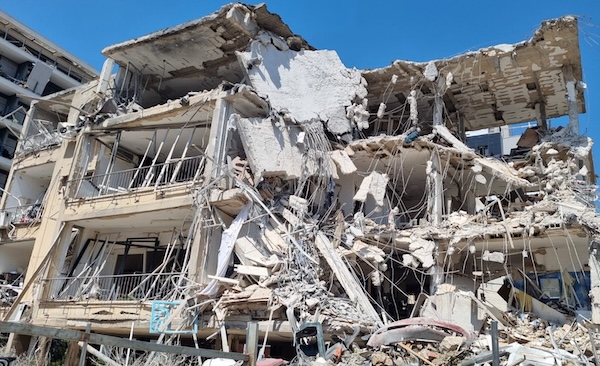
Several Iranian missile barrages targeted residential areas in Ramat Gan and other areas of Israel. (photo by Yoram Sorek / Wikimedia Commons)
A missile alert blared! Early Friday morning, like 2 a.m. early, we ran into our saferoom, seemingly to seek safety from yet another Houthi missile from Yemen. As usual, I was the last to get there. Not because I heroically brought up the rear, but because I lagged behind, looking for my glasses and Ventolin puffer – in the heat of battle, I can’t seem to remember where I put them.
As I entered our sanctuary and slammed the heavy steel door shut, my wife exclaimed in disbelief, “We’re attacking Iran!”
Dumbstruck at first, thoughts then flew through my mind at hypersonic ballistic missile speed, including the prayer for the army, “He who blessed our forefathers Abraham, Isaac and Jacob, may He bless the fighters of the Israel Defence Forces, who stand guard over our land….”
The purpose of the siren that morning? Get Israelis in front of the TV, announce this remarkable development and prepare us for the days ahead. To advise us we were under emergency lockdown and we should remain close to safe areas until further notice, in anticipation of Iran’s retaliation.
So there we stayed for the rest of the night, watching history unfold. In shock. In awe. In fear.
* * *
Much later that morning, I noticed we were out of Manischewitz wine, needed for that evening’s Shabbat dinner. Now, I am not a religious person, but we are living in existential times. I needed to say the blessings.
“I’m going to the grocery store to buy some Manischewitz,” I told my wife.
“No!” she said. “We can be attacked any moment. We can do without the wine.”
“OK. I’ll go to the corner store,” I said by way of compromise. “We need the wine for the blessings tonight. I’ll be back in a minute.”
I guess everyone was looking for Manischewitz that day, as our corner store was sold out. I made my way to the store a bit further down the road, running, hoping not to be caught in a missile barrage. But that store also had sold out. Guess a lot of people wanted to say the blessings that Shabbat.
I tried one more store, a bit farther away, running faster, still hoping not to be caught in a missile barrage. Sold out there as well.
Determined to buy my Manischewitz, I ventured even further away, towards the main street, hoping even harder to not be caught during a missile alert, so much farther from home than expected. Found it! That night, we said the prayer for the IDF.
* * *
Speaking of blessings, I talked with a friend who has become very religious. As we discussed the situation, he asked what people who don’t believe in prayer are doing now. “Praying,” I deadpanned.
* * *
A few days later, my city was hit by two Iranian intercontinental missiles in the middle of the night. The impact was tremendously loud and tremendously scary. Our building shook. The destruction was immense, several blocks wide. With all the confusion and damage, there was no looting. Not here and not in other areas of the country suffering the same outrageous fortune from the mullahs’ missiles.
In the morning, my wife and I walked along the main street – where I bought the Manischewitz – surveying the damage. You could still smell the dynamite. The huge front window of the bookstore was blown out. Now, if I were a looter … forget the TVs and stereos from the store next door or the perfume from the nearby pharmacy. As a bibliophile, I would probably loot the bookstore, grab a few bestsellers – not.
The scene was very humbling. Very depressing.
* * *
My wife and daughter are sleeping in the saferoom. I remain in our bedroom across the hall, sprinting to join them several times a night as missile alerts blare. I’ve put an extra pair of glasses and my inhaler on a shelf to avoid delays.
Our saferoom is a messy fortress stocked with mineral water, canned goods, medications and passports. We each have packed an overnight bag, should our place be hit by a missile. How helpful are an extra pair of pants and underwear should we lose everything? We also put some shoes near the fortified steel door – we can’t imagine walking over rubble and shards of glass in our bare feet. Of course, we packed some personal keepsakes: photographs, favourite books, my plastic superhero figurines.
* * *
There was another missile alert the following Friday morning. As we made our way to the saferoom, I again brought up the rear. Again, not because of heroism but, this time, to grab the pots of food simmering on our stove. Dinner was my wife’s specialty. I wasn’t going to risk it to a ballistic missile fired by angry mullahs. This time, the Manischewitz was chilling in the fridge.
* * *
Anxious speculation comes to an end. Another Machiavellian Trump triumph. Doing the right thing, the moral thing. Several B-2 stealth bombers flew over 35 hours under the guise of a two-week bluff. To defeat tyranny, or at least to destroy those dang nuclear sites, “By wise counsel thou shalt make thy war.” (Proverbs 24:6)
* * *
The ceasefire is holding. We unpacked our overnight bags and put the keepsakes back in place. Batman, the Green Arrow and the Flash are safely back on the library shelf.
* * *
The financial cost to Israel of the 12-Day War, as it’s now referred, is huge, some billions of dollars. A war brought by surprise to the enemy – not against the Persian people but against the myopic, maniacal mullahs of the Islamic Republic of Iran. So please continue donating to your favourite Israeli charity or buy Israel Bonds or come visit and spend your tourist dollars here.
Israel lost 28 people during the war. According to Jewish mysticism, one soul is like an entire universe. But, while 28 universes were destroyed – and I don’t say this lightly – it was only 28, which is testament to Israel’s great preparedness and adherence to Home Front Command instructions. At every opportunity – billboards, newspapers, public service announcements, movie trailers – instructions were given. And again. And again.
* * *
Bring them home now.
Bruce Brown, a Canadian-Israeli, made aliyah more than 25 years ago. He works in high-tech by day and, in spurts, is a writer by night. He is the winner of a 2019 American Jewish Press Association Simon Rockower Award for excellence in Jewish writing.
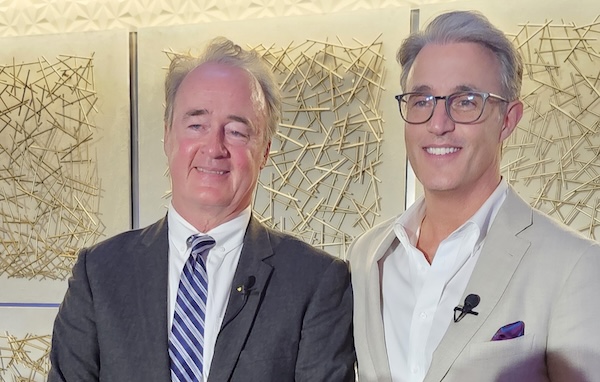
Warren Kinsella, left, and Ben Mulroney at Montreal’s Beth Israel Beth Aaron Synagogue June 19. (photo by Dave Gordon)
In 1980, when Warren Kinsella was in Calgary performing with his punk rock band, one of his friends tapped him on the shoulder to say some men in the crowd were giving a Nazi salute.
“I didn’t believe him. I didn’t think it was possible,” said Kinsella, now a Toronto Sun columnist, at a recent talk. “There, in fact, were three big guys, shaved heads, T-shirts, jeans, suspenders, Doc Martin boots, coloured laces, and they were making Nazi salutes.”
Kinsella confronted one of them, twice asking him to stop the salutes, and was greeted with an expletive and the word “Jew.” As the Irish-Catholic Kinsella tells it, a fist came his way, he hit back – a fight involving his buddies and the skinheads erupted. Eventually, the “skinheads retreated, battered or bruised,” said Kinsella. After the show, one of them pointed at Kinsella, saying, “We’ll be back.”
“And the truth, my friends, is they never really left.”
On June 19, at Montreal’s Beth Israel Beth Aaron Synagogue, Kinsella was joined by syndicated radio host Ben Mulroney, who acted as the moderator of the event called Weaponizing Genocide: Exposing Propaganda and Hate in the Age of Misinformation. It was a fundraiser for the Foundation for Genocide Education, which was founded in 2014 by Heidi Berger, a child of Holocaust survivors. The nonprofit aims to ensure that the subject of genocide is taught in North American high schools.
Since that incident 45 years ago, Kinsella has battled Jew-hatred as a lawyer and as a journalist – at times with rifles jammed in his chest, police protection, bomb threats and death threats.
“I’ve seen lots of hate, but I have never seen it as bad as it is,” he said at the June event. What the Jewish people are fighting is not only a seven-front military war, but a propaganda war “we are losing,” he said.
Kinsella, the author of 10 books, will soon publish The Hidden Hand: The Information War and the Rise of Antisemitic Propaganda, along with an accompanying documentary.
Exactly 18 months before Oct. 7, 2023, social media profiles started popping up all around the Muslim world, Kinsella said. They had “very few followers” and were filled with “stuff about soccer matches and celebrities and pictures of kittens.” On the morning of the seventh, as Hamas and its allies were attacking Israel, thousands of these social media profiles came to life, he said, noting those that had just a few followers suddenly had half a million.
“They pushed out lies,” he said, such as “there had been no murder, no rapes.”
“It was an indication of how sophisticated and how effective these guys were, as they were able to get that word out into the stratosphere,” said Kinsella.
“Antisemites,” he added, “know that … this is the greatest political, cultural and economic revolution of our lifetimes,” with Generation Z’s primary source of information being TikTok, “one of the principal platforms for antisemitism on the planet.”
After the event, Berger told the Jewish Independent that social media literacy for students is critical, to “learn when the term genocide is being used to manipulate their views and their emotions.”
In his remarks, Kinsella said some three million members of Gen Z in Canada believe Israel should be wiped off the map and that Hamas was justified in its actions. Weeks before Israel sent troops into Gaza, he said, young people across Western democracies were chanting the lies that they had seen online.
These were organized campaigns of protests, with professionally made signs, and the “disrupting and terrorizing of Jewish neighbourhoods with military precision,” said Kinsella. “They had talking points. They had food, drink, transportation. They even had legal representation for free….And many of them were being paid to show up.”
He said, “It was principally a campaign to seize the sympathies of our young. And it’s a campaign that’s winning.”
Kinsella, president of Daisy Consulting Group, who has worked for various high-profile US and Canadian political campaigns, noticed that protesters used pithy phrases “very much like what political mainstream parties do,” such as “from the river to the sea” and “free Palestine.”
“Who’s against freedom?” he asked. “It’s nice.”
Media, government and nongovernmental organizations continue to take Hamas at its word, said Kinsella, citing an early example. On Oct. 17, 2023, when the Gazan Health Ministry declared that Al-Ahli Arab Hospital in Gaza City had been bombed by Israel and that 500 people were dead, it made headlines around the world. “The bombing was cited as evidence of Israel’s genocidal war,” yet evidence later showed it was a Palestinian Islamic Jihad rocket that hit the parking lot, and perhaps a few dozen were killed.
The day of the Montreal talk, Iran bombed Soroka Medical Centre in Beer Sheva, Israel – a war crime that almost no media reported on, said Kinsella.
“The line I always use with politicians: facts tell, but stories sell,” said Kinsella. “That’s why they try to overwhelm us, because they know if our story gets heard, if it gets seen, if it gets read, they will be defeated, because, at the end of the day, their story is a litany of hate.”
Dave Gordonis a Toronto-based freelance writer whose work has appeared in more than 100 publications around the world. His website is davegordonwrites.com.