Skip to content
  • Home
  • Subscribe / donate
  • Events calendar
  • News
    • Local
    • National
    • Israel
    • World
    • עניין בחדשות
      A roundup of news in Canada and further afield, in Hebrew.
  • Opinion
    • From the JI
    • Op-Ed
  • Arts & Culture
    • Performing Arts
    • Music
    • Books
    • Visual Arts
    • TV & Film
  • Life
    • Celebrating the Holidays
    • Travel
    • The Daily Snooze
      Cartoons by Jacob Samuel
    • Mystery Photo
      Help the JI and JMABC fill in the gaps in our archives.
  • Community Links
    • Organizations, Etc.
    • Other News Sources & Blogs
    • Business Directory
  • FAQ
  • JI Chai Celebration
  • JI@88! video

Recent Posts

  • Sharing her testimony
  • Fall fight takes leap forward
  • The balancing of rights
  • Multiple Tony n’ Tina roles
  • Stories of trauma, resilience
  • Celebrate our culture
  • A responsibility to help
  • What wellness means at JCC
  • Together in mourning
  • Downhill after Trump?
  • Birth control even easier now
  • Eco-Sisters mentorship
  • Unexpected discoveries
  • Study’s results hopeful
  • Bad behaviour affects us all
  • Thankful for the police
  • UBC needs a wake-up call
  • Recalling a shining star
  • Sleep well …
  • BGU fosters startup culture
  • Photography and glass
  • Is it the end of an era?
  • Taking life a step at a time
  • Nakba exhibit biased
  • Film festival starts next week
  • Musical with heart and soul
  • Rabbi marks 13 years
  • Keeper of VTT’s history
  • Gala fêtes Infeld’s 20th
  • Building JWest together
  • Challah Mom comes to Vancouver
  • What to do about media bias
  • Education offers hope
  • Remembrance – a moral act
  • What makes us human
  • המלחמות של נתניהו וטראמפ

Archives

Follow @JewishIndie
image - The CJN - Visit Us Banner - 300x600 - 101625

Author: Pat Johnson

Richmond adopts IHRA

Richmond city council adopted the International Holocaust Remembrance Alliance working definition of antisemitism Feb. 13 after a contentious discussion, as part of a broader anti-racism framework. The vote was 6 to 3.

Councilor Alexa Loo had originally moved adoption of the IHRA definition but withdrew it and proposed adoption of a broader anti-racism statement. The motion that passed endorsed terminologies and definitions from the federal government’s Anti-Racism Strategy, which includes anti-Asian racism, anti-Black racism, Islamophobia and antisemitism.

“Today, Mayor [Malcolm] Brodie and Richmond city council sent a strong message that antisemitism or hate in any form have no place in society,” said Ezra Shanken, chief executive officer of the Jewish Federation of Greater Vancouver, in a statement after the vote. “The IHRA definition will help the people of Richmond identify antisemitism in all its manifestations so that they can help put a stop to it and protect the values of diversity, equality and community that we cherish.”

Three speakers addressed council supporting the motion and two spoke in opposition. An opponent said the definition is an attempt to “shut down criticism of the Israeli occupation,” stating, “A significant amount of what is considered antisemitic is simply critical speech directed toward Israeli human rights violations against Palestinians.”
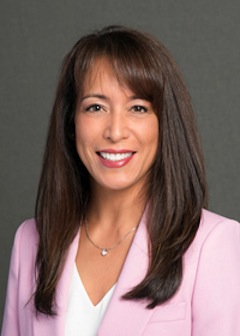
photo - Councilor Alexa Loo, who originally moved adoption of the IHRA definition but withdrew it and proposed adoption of a broader anti-racism statement
Councilor Alexa Loo, who originally moved adoption of the IHRA definition but withdrew it and proposed adoption of a broader anti-racism statement. (photo from City of Richmond)

“We’re not getting into geopolitics here,” said Loo, speaking to her motion. “We’re not condoning government actions. But we are setting out what behaviours are acceptable here in Richmond and we’re working to keep our community safe.”

Councilor Carol Day cited differences of opinion on the definition of antisemitism as justification for voting against it, but the mayor disagreed.

“If unanimity of opinion is the standard here, we will never get there,” said Brodie. “I do believe that the community has spoken on this one and that’s why I’m going to support what’s in front of us.”

Councilor Andy Hobbs refuted arguments he had heard that the IHRA definition is “a slippery slope” and contended that adoption would not prevent “anybody from criticizing a state, whether it’s Israel or whether it’s China or whether it’s another country.” Those free speech rights are enshrined in law, he said.

Councilor Michael Wolfe, who voted against, said the motion had “put a wedge into the community.” He noted that council received 27 messages opposed to the motion and nine in support. “It’s 3-to-1,” he said.

Day, who with Kash Heed also opposed the motion, noted opposition from, among others, the New Israel Fund of Canada, Canadian Labour Congress, the B.C. Civil Liberties Association, the Canadian Association of University Teachers, 40 faculty associations, Independent Jewish Voices Canada “and even Holocaust scholars.”

“Clearly, I don’t know as much as the scholars know,” said Day, “but if they are against it, why are they against it? Is it our job, as a Richmond city councilor, to override all of these groups that I just mentioned and go with something that has been brought down by the federal government? I don’t think it is.”

She said that city council’s responsibilities are roads and infrastructure. “I think this is, to be honest, way above our pay grade,” said Day.

Michael Sachs, a Richmond resident and community leader who is also regional director of Jewish National Fund of Canada, was one of the speakers in favour of the motion. He took exception to Day’s comment.

“A city councilor should be representing and serving the citizens of the city and the community,” Sachs told the Independent. “In actuality, the fact that she is trying to dismiss it is below the pay grade.”

Sachs also noted that Wolfe’s argument that he had received a 3-to-1 ratio of messages opposing the motion is a misreading. All five Richmond-based Jewish organizations – Beth Tikvah Congregation, the Bayit, Chabad Richmond, the Kehila Society and Richmond Jewish Day School – endorsed a letter of support. They collectively represent about 4,500 people, said Sachs.

Although Loo had earlier proposed adoption of the standalone IHRA definition, Sachs said he and others agree that the broader scope is preferable. Anti-Asian hatred and antisemitism both saw startling spikes during the pandemic and the demographics of Richmond, which has an Asian-Canadian majority, makes this especially relevant, he said.

While the IHRA definition was adopted as part of a larger package, Sachs said the discussion at council focused almost exclusively on antisemitism.

“The definition is now on record, it’s been passed,” he said.

Despite assertions that free expression was on the table, Sachs said the facts disprove it.

“At the end of the day, no one’s free speech is really being removed,” he said. “In actuality, hate speech is still continuing to rise.”

Posted on February 24, 2023February 22, 2023Author Pat JohnsonCategories LocalTags Alexa Loo, antisemitism, Ezra Shanken, IHRA, International Holocaust Remembrance Alliance, Malcolm Brodie, Michael Sachs, Richmond city council
Jewish film fest coming soon

Jewish film fest coming soon

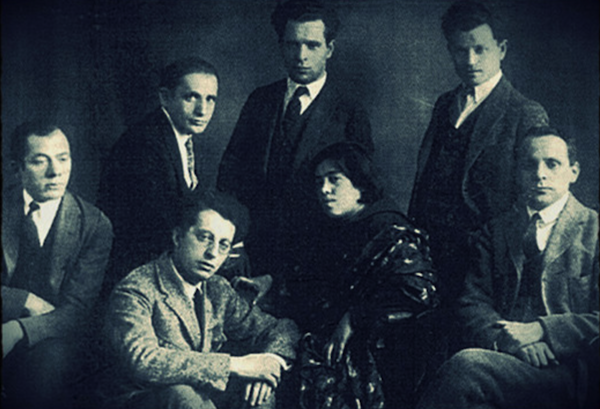
A 1923 studio portrait of the In zikh (Introspectivist) poetry group. Celia Dropkin is surrounded by (clockwise from bottom left): Jacob Stodolsky, Aaron Glanz-Leyeles, B. Alquit, Mikhl Likht, N.B. Minkoff and Jacob Glatstein. (photo from Yiddishkayt)

The Vancouver Jewish Film Festival is welcoming audiences back to the theatre this year. Screenings take place at Fifth Avenue Cinemas March 9-16 and the Rothstein Theatre March 17-19, with some films streaming online March 19-26. Here is but a sampling of the many festival offerings. For the full lineup and tickets, visit vjff.org.

Poetry that burns

As much as the world has progressed in the last century, Celia Dropkin’s unabashedly sexual, emotionally raw, intense, even violent, poems would cause a stir today. Most of her poems are short but powerful, saying things that still would not be said in polite company. A new film, a work-in-progress, offers insight into Dropkin’s life and the circumstances that fueled her creativity, love, anger, imagination.

Burning Off The Page: The Life and Art of Celia Dropkin, an Erotic Yiddish Poet will make its public debut at the Vancouver Jewish Film Festival. Scheduled to be at the screening are local film director and co-producer Eli Gorn and author Faith Jones, who is featured in the film, which includes comments from several writers/scholars and musicians, as well as from some of Dropkin’s relatives. Bracha (Bee) Feldman is the writer and co-producer of the documentary.

Dropkin was born in Belarus in 1887. Her father died when she was little, leaving her mom, a young woman, with two small kids to raise, “mostly resolved to become No One’s wife.… So my mother’s concealed, hot ache / rushed, as from an underground spring / freely in me. And now her holy / latent lust, spurts frankly from me,” writes Dropkin in her poem “My Mother.”

Unconventional views of motherhood were among the many unique aspects of Dropkin’s writings – she had six children herself, one dying in infancy. She was also greatly influenced by a dead-end love affair with Hebrew writer Uri Nissan Gnessin, who she met in her late teens. In 1909, she ended up marrying Samuel (Shmaye) Dropkin, who, because of his political activities, had to flee Russia to the United States a year later; she and their first son joined him in New York in 1912.

In New York, Dropkin was part of the burgeoning Yiddish cultural scene in the 1920s and ’30s. Despite the acclaim she received for her avant-garde work, she never garnered the respect her male counterparts did, and was criticized for depicting women as sexual beings. She struggled with depression, and wrote about it and the dark sides of love. Dropkin died in 1956, having spent the last years of her life painting – a talent for which she also had.

Burning Off the Page is a captivating mix of Dropkin’s poetry, talking heads, music, illustrations, archival photos and videos. (CR)

Life in the “new world”

In iMordecai, Fela (Carol Kane) and Judd Hirsch (Mordecai) are an adorable old couple living the retiree life in south Florida. Their son, Marvin, may or may not be a complete schlemiel (as Mordecai puts it) but each member of the family is dealing with their own stuff.

In a charming opening, Mordecai’s birth in a Polish shtetl is recounted and his memories of the past – including the chasm created in his family by the invasion of Poland and the Holocaust – are cast in striking animation. The family’s real life is also a bit cartoonish – as are the characterizations. Kane, who in this film and elsewhere seems incapable of not being hilarious, is a sweet old bubbe always with a side-eye for any of the other women in town who might be trying to steal her man – after 50 years of apparent devotion. Mordecai is struggling to remember the past while adapting to new technologies – thus the ironic title – and in the process makes friends with a young woman, Nina (played by Azia Dinea Hale), whose own family has its very specific issues.

Although the subjects are sometimes bleak, the film is a breezy dramedy. When Marvin (Sean Astin) explains to his father that Fela is experiencing dementia, the response is subdued brilliance.

“It means that her mind isn’t working like it used to,” says Marvin.

“So, whose is?” the father replies.

There are themes of split personalities, of apples falling not far from trees, and of intriguing coincidences – including running into an old neighbour from Canarsie in the “new world” of Florida. This forces Mordecai to kill off the imaginary brother he invented (it makes sense in the film) for comedic gold.

iMordecai isn’t going to win best picture, but it is a fun and sometimes poignant confection that veers from cheezy to charming to slapstick. When it gets serious, it gets a bit shlocky but damned if the final scene doesn’t get you in the throat. (PJ)

Maintaining a legacy

The stress and anxiety are palpable as Greg Laemmle is forced to consider selling his business, which has been in the family more than 80 years and which is an L.A. institution. But director/producer Raphael Sbarge didn’t start out to make a documentary of this crucial moment in 2019 – and what came after. He was simply interested in the history of the Laemmle family, which goes back to Hollywood’s beginnings.

“Though we had no idea where this film was headed, Only In Theatres took on a life of its own through changing markets and slipping sales,” writes Sbarge on the film’s website. “Then, the pandemic hit and the Laemmle story became the microcosm of the macrocosm – theatres were forced to ask big questions about resilience and viability. The entire Laemmle Theatre chain closed for more than 16 months, and many never reopened. We were able to witness the Laemmles’ extraordinary challenges and triumphs during what was the most tumultuous and emotional 24-month period in the theatre’s history.”

Laemmle Theatres was established in 1938 by brothers Kurt and Max Laemmle, who were nephews of Carl Laemmle, founder of Universal Pictures. The next generations to run the theatres were Max’s son, Robert, and Robert’s son, Greg, who has three sons. The cinemas were apparently groundbreaking in Los Angeles for screening independent and foreign films, and Only In Theatres sets Laemmle’s in the context of the importance of film in general, and arthouse cinemas specifically. He interviews many filmmakers, who talk about the movies that inspired them and the value of seeing a movie in a theatre, of having that collective experience.

Only In Theatres begins with how Greg and his wife Tish met, and gets into the family’s history. Among the interviewees is Greg’s (at the time) 103-year-old great-aunt Alyse, who was married to Kurt and was there when the legacy began.

In July 2019, after a bad year, Greg Laemmle must decide whether to sell that legacy. It is a gut-wrenching choice on many levels and, after months of agonizing over it, considering various purchase offers, he decides he can’t let go. Less than three months later, COVID hits.

Only In Theatres is both a love letter to arthouse cinemas, and an insight into the burden of legacy and how all the accolades in the world don’t pay the bills. If you truly want a business you love to succeed, then show ’em the money. That’s the support that ultimately matters. (CR)

Tradition vs. modernity

Against the magnificent backdrop of the Italian countryside, a family of French Orthodox Jews arrives on an annual two-week sojourn to inspect citrons to be packaged and distributed as etrogs for Sukkot.

Where Life Begins picks up the story of two families – the Italian Catholic farmers and the French Jews – who go back a long way. This year, though, Esther (played by Lou de Laâge), the 26-year-old and still unmarried (!) daughter of the French Zelnik family, is engaged in a profound internal struggle with her faith. She is bridling against the constraints of her religious obligations. At the same time, Elio (Riccardo Scamarcio), one of the sons of the original farm family and now in charge of orchard operations, is questioning the obligations to the land that have befallen him.

photo - Lou de Laâge (Esther) and Riccardo Scamarcio (Elio) in Where Life Begins
Lou de Laâge (Esther) and Riccardo Scamarcio (Elio) in Where Life Begins. (photo from Menemsha Films)

The French/Italian, Catholic/Jewish dichotomies are gently juxtaposed but the more powerful contradictions and stressors have to do with separation from family – literal in Elio’s case, figurative but no less wrenching in Esther’s. More immediately, both are confronting their lives in terms of the footprints of the past and the futures they envision for themselves. Each aches for a different path but to embark on it would require a massive break with expectations and everything they have known.

This annual pilgrimage is a tradition made extra festive by the singing and dancing of Georgian migrant farm workers. The joyfulness of the foreigners from the east may not prove that happiness is something one has to travel to find, but it suggests that uprooting from familiar surroundings need not be all grief and loneliness either.

The narrative of Where Life Begins is not an original storyline. Tradition and modernity in conflict; family obligations versus self-actualization; the possibility of forbidden love: these are among the oldest themes in literature and film. Handling these topics with originality and artfulness is what makes or breaks a film like this. This movie does it with nuance and absent simplistic tropes. The southern Italian landscape makes the whole thing easy on the eyes. (PJ)

Format ImagePosted on February 24, 2023February 22, 2023Author Pat Johnson and Cynthia RamsayCategories TV & FilmTags Celia Dropkin, documentary, iMordecai, Laemmle Theatres, movies, romance, Vancouver Jewish Film Festival, VJFF
Vernon’s Jewish community

Vernon’s Jewish community

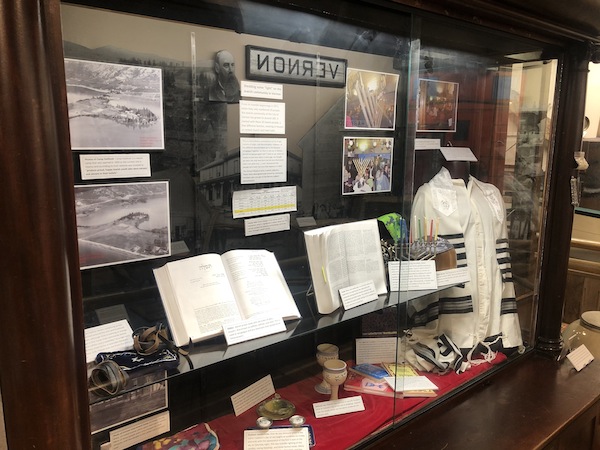
The exhibit Shedding Some Light on the Jewish Community in Vernon is at the Museum and Archives of Vernon until the beginning of April. (photo from Alexandra Fox)

If you are passing through the Okanagan between now and the beginning of April, check out the exhibit on Vernon’s Jewish community, which recently went up at the Museum and Archives of Vernon. Last month, I sat down with collections and exhibits intern Alexandra Fox to chat about it.

Between sips of hot chocolate at a local café, we bonded over the fact that we are two queer Jews from the Lower Mainland, who grew up spending winters up on SilverStar Mountain Resort with family, and both find ourselves currently in Vernon. We also share a love of local Jewish community history.

Carmel Tanaka: What inspired you to curate an exhibit about Vernon’s Jewish community?

Alexandra Fox: When I came here, I found that there weren’t a lot of openly Jewish people and most of the non-Jewish community was not aware of the Jewish community. I wanted to shed some light on a community that has often gone under the radar and that’s why I titled the exhibit Shedding Some Light on the Jewish Community in Vernon. It was partly a pun on certain traditions of lighting candles, too.

Basically, I wanted the exhibit topic to be something that meant a lot to me. I come from a multifaith family, with my dad being Jewish and my mom being Protestant. Growing up, Jewish identity had been a confusing thing for me as, technically, I am not Jewish, due to it being matrilineal but it was always the religion I connected with the most. Maybe this is in part due to always being told that I look Jewish. However, you cannot always tell if someone is Jewish, as there is so much diversity in the community. I wanted to curate this exhibit so that I could honour my identity a bit more.

CT: What have been some of the reactions to the exhibit?

AF: The reactions to the exhibit have all been positive so far and I believe it will stay that way. I’ve had a few questions about certain Jewish traditions that are represented by the items in the exhibit but they have all been very respectful. Some of my co-workers have also congratulated me on making an excellent exhibit.

CT: During the research and curation of the exhibit, did anything surprise you? Did you face any challenges?

AF: I was surprised by how small the Jewish community was when it started in the 1970s – it numbered only 20 people – and how small it really still is. The 2021 Census … in the case of Vernon, it shows that most Jewish people identify as Jewish but are not practising. This trend doesn’t surprise me because I think a lot of Jewish people in other communities are the same, but the numbers of Jews (both ethnically and religiously) are so small.

Some of the challenges that I faced while creating the exhibit were during the call-out phase and during the editing phase. Since our museum didn’t have any Jewish objects in the collection, I had to do a call-out to the community…. I felt limited to reaching out to practising Jews rather than those who identify as ethnically Jewish because I didn’t have a lens into the community and was only able to reach out to the Okanagan Jewish Community Centre and Chabad House. Only the Okanagan Jewish Community Centre agreed to loan some objects to the museum for the exhibit.

CT: What resources did you use in compiling the exhibit?

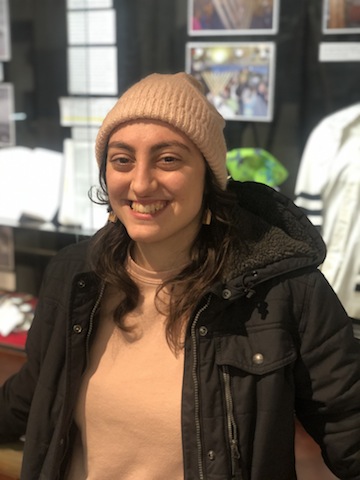
photo - Alexandra Fox, curator of the exhibit Shedding Some Light on the Jewish Community in Vernon
Alexandra Fox, curator of the exhibit Shedding Some Light on the Jewish Community in Vernon. (photo from Alexandra Fox)

AF: The resources I used to compile the exhibit were from Census data analyses, the Okanagan Jewish Community Centre website, the Chabad website, some existing pictures in Vernon’s museum archives, as well as Ronnie Tessler’s research from the Jewish Museum and Archives of B.C., which focused more on Kelowna than on Vernon.

CT: Community archival projects are limited to the availability of resources. If you were able to continue researching Vernon’s Jewish community, what stories would you like to dive further into?

AF: Only after finishing the exhibit did I find out that one of the people who developed SilverStar was Jewish, so if I were to continue researching Vernon’s Jewish community, I would totally dive further into finding out about that family. I would like to know if the SilverStar community even knew about Dr. [Michael] Lattey being Jewish.

Also, if I were able to continue researching Vernon’s Jewish community and developing the exhibit, I would extend the call-out to more community members so that I could expand the range of people represented by the exhibit, such as Vernon’s very own, the Saucy Soprano Melina Schein, who won Food Network’s Wall of Bakers and who I only found out about after the exhibit.

As an intern at the museum, I seemed to be quite limited in who I could extend the call-out to and I wish I had met with you, Carmel, before the coffee meetup because then I could reach more community members, especially those not affiliated with community organizations or synagogues.

I would also like to dive deeper into the 2021 potential sale of Nazi memorabilia by Dodd’s Auction, a local and much beloved auction house. The memory of the Holocaust is very present in Vernon’s Jewish community so when these items were included in the auction, the community – Jewish and non-Jewish – successfully demanded that it be halted, and the items were returned to the consigner. It’s important to me to ensure that these stories and this part of local history are heard.

CT: Your exhibit, the first of its kind in Vernon to my knowledge, is a wonderful “Jewifying” of museum space. Why is it important for the Jewish community to share our stories in rural towns like Vernon?

AF: “Jewifying” the museum space, as with creating space for any other groups that have been historically left out of museum space, is a very important thing. I think it is especially important in museums located in rural towns because these are the places that are most likely to have fewer interactions with any minority groups…. In many rural towns, the Jewish people (or any other minority group) feel like they have to hide that part of themselves and I think it is very important to show them, and the rest of the community, that you don’t have to hide your identity.

CT: Is there anything else that you’d like to add?

AF: I’d like to add that this is the first exhibit I have curated and, although limited by time and other factors, I poured my heart into this exhibit, which had a personal connection to me. When embarking on this exhibit, as mentioned earlier, I wanted to do something that was personal to me. It was either something about Jewishness or queerness and I decided to choose the former. My sister is in Israel right now, volunteering on a kibbutz, and I felt that curating this exhibit would be my way of honouring my identity.

***

For more information on the exhibit, visit vernonmuseum.ca/vernon-museum/vernons-jewish-community.

Carmel Tanaka is the founder and executive director of JQT Vancouver, and curator of the B.C. Jewish Queer and Trans Oral History Project (jqtvancouver.ca/jqt-oral-history-bc) and the Jewpanese Oral History Project (@JewpaneseProject on Instagram). She has family ties to Vernon, and it was a Japanese-Canadian friend who tipped her about Fox’s exhibit.

Format ImagePosted on February 24, 2023February 22, 2023Author Carmel TanakaCategories LocalTags Alexandra Fox, history, museums, Okanagan, Vernon
Erez’s new CD shows mastery

Erez’s new CD shows mastery

Itamar Erez’s May Song is inventive on many levels.

The most difficult thing for artists to do, and the aim which is most central to their consciousness, is to create something original, something new, something that is their own. We recognize the music of the greats because of their distinctive musical signatures, and all artists work towards this, with varying degrees of success. Itamar Erez, as evinced on his five previous recordings, and no less on his latest musical offering, May Song, is just such a distinctive artist – one with a voice and musical signature all his own.

An Israeli-Canadian guitarist, pianist and composer based in Vancouver, Erez is already quite celebrated, and deservedly so, and has been recognized by his musical peers and reviewers the world over (including the Jewish Independent). He is a globetrotter, musically and literally. His music is tinged with timbres, melodies and rhythms that evoke the confluences of the many cultures of the world.

Created and recorded in 2021, and released in October 2022, May Song is the most recent step on his musical journey, and it breaks new ground in a number of ways. Significantly, Erez’s guitar is not present here – the emphasis is on composing and improvising from the keyboard.

“Over the last three to four years, piano is definitely more my focus,” he said. “Music was written with the piano in mind, and involved some polyrhythms and layers that are not possible to be performed on the guitar without some overdubs, which was not the direction I wanted to take.”

Erez began his career as a writer of through-composed music for others to play. Though he still creates such compositions, he has evolved as a composer, and is in a creative phase where he celebrates the improvisational qualities of music.

“I think that there is a shift in my music over the years,” he said, “going from through-composed music and being a composer who writes for others in the early days to a composer/performer/improviser, where the improvising part is growing to be just as important as the rest.” About May Song, he said, “I felt that the best part of the music is in what happens in the moment. The tunes will sound different each time. So this is a time of letting go of controlling the music and letting it unfold.”

His collaborating musicians on this recording have been working with him regularly for some years now. Jeff Gammon on bass and Kevin Romain on drums are tremendously in sync with Erez, bringing out the nuances of his musical gestures and style. No less, his longtime collaborator on clarinet, the world-class and gifted François Houle, carries the melodies on several tracks.

Conceived, prepared and recorded during the pandemic, Erez describes the project on his Bandcamp page as being “all about, for me, emerging from darkness and doubt into lightness and joy….”

Picking up on this thought, permit me to put forward my own take on this progression in the recording – as the moods and content move, generally speaking, from darkness to light, from doubt and concern to resolution.

The album begins with “Chant,” an invocation, as it were. Beginning with sparse piano string harmonics, it moves into Middle Eastern-sounding modal patterns, finding in-between notes as harmonies, evoking maqam-like (maqam = Arabic mode) gestures. The music gives way to sweet chords, a simpler melodic setting, a chant with out-there harmonic invention, always questioning.

“Hourglass,” with its quick five-beat underpinning, evokes a state of restless anticipation. Here the polyrhythmic utterance is quite pronounced, as the clarinet states the melody in a different metrical frame. The ensemble is tight and the rhythmic threads are followed excellently. There is an interweaving of improvisations followed by an extended solo for drums.

About polyrhythms, and in the hope of clearing away any mental barriers to the enjoyment of the music, let me briefly explain the concept. Polyrhythmic work is the putting together of two different beat patterns simultaneously. In “Hourglass,” the repeated five-beat pulse is overlaid by a melody in a different beat pattern. This gives the music a sense of suspension, and may even sound improvisatory while being a compositional device. So it is freer and more indeterminate than a strict groove.

Track 3, “Catch Me If You Can,” continues this five-pulse underpinning, but is brighter and livelier, a playfulness, a glimmer of hope. It segues into a quick three-beat, and there is a conversation between this three and the five, free and harmonically uncluttered.

“You And Me” features a steady three-beat underpinning, with a sadder more contemplative mood. A call-and-answer dialogue gives way to a piano improvisation over the groove. A bass solo intervenes, and the dialogue continues until its plaintive ending.

“March” reintroduces the clarinet, and very much sounds like a movement out of darkness into light. The darker chords never take over the mood, though some darkness lingers. By turns, explosions of melody give way to broader strokes. The clarinet solo begins to soar, inviting all to break free.

“May Song,” the title track, opens by stating the melodic theme contemplatively, then gives way to a five-beat pattern overlaid with the theme in cross-rhythm. This is varied with a second theme, which is somewhat anthemic and declarative, yearning and even victorious. By the end, there is a sense of quietude, gratitude and resolution.

Finally, “Long Way Home” begins in a quiescent manner, with a bit of a crying voice, but it continues the declarative, resolved and personal statement previously arrived at. The piano is answered in bass and drums, and a dialogue ensues, giving way to a slow, patterned statement of increasing force. Yes, there may still be some darkness to be overcome, but we have arrived at a hopeful state nonetheless.

May Song is inventive on many levels – melodic, harmonic and rhythmic. Never idle, the music is varied, always searching, with an intensity even in its quieter moments. There is a mastery here, especially in the use of polyrhythmic elements, but complexity is always balanced with an enjoyable harmonic and melodic richness. Erez’s musicians all evince a depth of feeling and understanding that give the music great integrity.

About his future direction, Erez shared, “My upcoming album will be a duet album with Hamin Honari (an amazing Persian percussionist). We went to the studio for two days recording improvisations … this is the first time I did something like that, it felt very exciting.”

Speaking for myself, I truly look forward to following Erez on his continuing musical journeys. He is a singular artist of prodigious talent, to whose music it is always rewarding to listen.

May Song is available for digital download at itamarerez.bandcamp.com. For information about upcoming shows and all things Itamar Erez, visit itamarerez.com.

Moshe Denburg is a Vancouver-based composer, bandleader of the Jewish music ensemble Tzimmes, and the founder of the Vancouver Inter-Cultural Orchestra (VICO).

Format ImagePosted on February 24, 2023February 22, 2023Author Moshe DenburgCategories MusicTags Itamar Erez, May Song, music
Building skills and confidence

Building skills and confidence

Shelly Bordensky is the JCC Inclusion Services support worker for PRISM. (photo from JCCGV)

A new program at the Jewish Community Centre of Greater Vancouver aims to equip 13-to-17-year-olds with leadership skills, personal insights and paid work experience. Funded by a grant from the Diamond Foundation, the Pre-employment Program for At-Risk Youth within an Inclusive Supportive Modality (PRISM) is seeking referrals of young people who could benefit from this supportive introduction to the world of work. The workshops begin March 23 and meet weekly on Thursdays, 3:30-7 p.m. The referral deadline is March 9.

“Our definition for youth who may benefit from this program is intentionally broad,” said JCC Inclusion Services support worker Shelly Bordensky. “The goal of the program is to limit risk factors for youth, such as social exclusion – youth who may live in lone-parent homes; are recent immigrants or refugees; are living with mental health challenges or diverse abilities; are historically underserved; or are otherwise marginalized – by building skills, networks of support, and exposure to possible future career paths in Jewish communal work.”

“When you care about a teenager, whether as a parent or other trusted adult, you are keenly aware that raising a child includes preparing them for life out in the real world,” added JCC social worker Lisa Cohen Quay. “The amazing part of the PRISM program is that it isn’t just about a first job. Sessions include learning about what jobs exist in Jewish agencies, meeting with a vocational counselor, writing a resumé, taking care of your mental well-being, and so much more – not the least of which is the opportunity to try working in an area of interest at the JCC.”

Quay further explained that this paid work opportunity also gives teens an adult employer to serve as a vital future reference. “It will be wonderful if this program excites teens to come be part of the work force with those of us serving in Jewish agencies, or in another community centre,” she said. “The relationships and insights they develop in PRISM can set them on that course.”

PRISM is an offering of JCC Inclusion Services, under the direction of Leamore Cohen. For more information and accessibility supports, Cohen can be contacted at [email protected] or 604-638-7288.

– Courtesy Jewish Community Centre of Greater Vancouver

Format ImagePosted on February 24, 2023February 22, 2023Author Jewish Community Centre of Greater VancouverCategories LocalTags education, inclusion, PRISM, youth
Book Fest epilogue event

Book Fest epilogue event

Jack and Edie Austin (photos from JCC Jewish Book Festival)

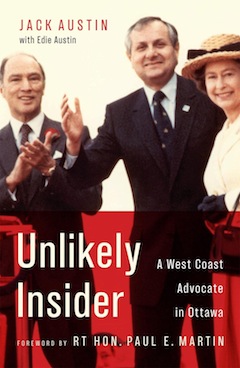
image - Unlikely Insider book coverFormer federal cabinet minister and senator Jack Austin, who has been involved in politics and public policy for more than 50 years, and his daughter, Edie Austin, editorial page editor of the Montreal Gazette, will be in conversation with Ronald Stern, founder and president of Stern Partners, on Feb. 28, 7 p.m., at the Rothstein Theatre as a Cherie Smith JCC Jewish Book Festival epilogue event.

The two will discuss their book, Unlikely Insider: A West Coast Advocate in Ottawa, about Jack Austin’s public service. With both historical perspective and an eye to the future, Austin reflects on events and people whose impacts are still being felt, and on the enduring challenges of Canadian life. For tickets ($18) to attend the event, visit jccgv.com/jewish-book-festival.

– Cherie Smith JCC Jewish Book Festival

Posted on February 24, 2023February 24, 2023Author Cherie Smith JCC Jewish Book FestivalCategories BooksTags Edie Austin, Jack Austin, JCC Jewish Book Festival, politics
Series tries to inspire climate action

Series tries to inspire climate action

Tikkun olam, repairing the world, is a central tenet of Jewish life, but sometimes the task can seem overwhelming. The climate crisis looms large for all of us, but especially for younger folks, who will bear the brunt of its effects. A new graphic novel for 6-to-12-year-old readers offers an optimistic, fun story about the power of kindness – towards ourselves, other people, animals, the environment – to energize and inspire us to action, to at least try and fix things.

I Can Hear Your Heart Beep, published by Planet Hero Kids in Vancouver, is the first book of the children’s graphic novel series Steve and Eve Save the Planet. Written by Paul Shore and Deborah Katz Henriquez, with imaginative and colourful illustrations by Prashant Miranda, the book is being released on Feb. 25, in recognition of International Day of the Polar Bear, which takes place Feb. 27. One of the book’s two main characters is a polar bear, Steve, who lives in the Arctic. Steve, Eve (an electric vehicle) and their friends come to realize that it is up to them to do whatever they can to clean up the environment and try to stem the global warming that is, among other things, reducing the animals’ food supply.

image - I Can Hear Your Heart Beep book coverEve ends up in the Arctic accidentally. Bullied and ostracized by her “gassy car cousins,” who tell her, “You’re just a heartless machine, sister – like us – you’ll never make a difference in this world!” she takes off (she has wings) to find her “pack,” other electric vehicles. On her way to Norway, she experiences a malfunction that lands her in the Arctic, where she is found by Steve, who’s having problems of his own – driven to stealing food because he’s so hungry, and missing his parents, who went away to find food and haven’t returned.

I Can Hear Your Heart Beep is the genesis story of the two likely-to-become environment heroes, Steve and Eve. We find out their motivations and meet their first sidekicks/allies, the other Arctic animals, and Burger the Booger, their first nemesis of, no doubt, more to come.

For readers wondering about the choice of an electric car as a heroine, Shore writes on the book’s website: “The spark that started our Planet Hero Kids journey first became visible when my pyjama-wearing 8-year-old daughter spontaneously hugged an electric car! That day of our first EV test drive, my daughter laid her little body on the car’s hood with arms outstretched across it, and with one ear against the smooth metal she said, ‘she has a heartbeat.’ The fact that the car seemed calm, gentle and fun … seemed to tell her that the machine was as friendly as a family pet.

“The realization that young children intuitively understand what is healthier for them and the planet sent me in search of partners to help create an uplifting climate action kids book that would cultivate hope and a sense of opportunity during the challenging era in which our children find themselves growing up.”

Shore took the idea to Henriquez, who, he told the Independent, he “first met at an author’s reception at the JCC book festival several years ago!” The pair began their collaboration, eventually connecting with Miranda.

I Can Hear Your Heart Beep can be ordered from Amazon. For more information on the series, visit savetheplanetbook.com.

Format ImagePosted on February 24, 2023February 22, 2023Author Cynthia RamsayCategories BooksTags children's books, climate crisis, Deborah Katz Henriquez, Paul Shore, Planet Hero Kids, Prashant Miranda, tikkun olam

Concerns over inflation

Last fall, the Jewish Federation of Greater Vancouver surveyed the impact of inflation on its community partner organizations. As with many recent reports on the effects of rising prices, the feedback was sobering, said Shelley Rivkin, vice-president of global and local engagement at Federation, which conducted the survey.

When asked about how the rise in food and fuel will affect their ability to provide the same level of service, 95% of the organizations that responded said they were either concerned or very concerned about inflation. A similar response was returned when community members were asked about paying school, camp, synagogue or Jewish community centre membership fees.

For social service and housing providers, the main concerns were the level of care, due to reduced staffing; the number of affordable housing units available; food programs for students and families in need; and low-cost (or free) social and recreational programs for seniors. Other organizations cited concerns about the future of kiddush and seniors lunches, volunteer appreciation, building maintenance and upkeep, prepared meals for food bank recipients, and membership subsidies.

The survey notes that rising costs are affecting, to varying degrees, the ability of agencies to maintain their current level of service, recruit and retain staff, raise funds and balance budgets. Some organizations have been unable to provide staff with a cost-of-living-adjustment raise, thereby threatening their capacity to retain staff and deliver programming, and higher salary expectations mean that positions are vacant for longer, limiting the ability to grow programs. Food costs for hot lunches are up 20% and there has been a 25% increase in salaries for kitchen staff.

Rivkin stressed that, in the four months since the survey was conducted, costs have come down for some items, but the price of food continues to rise.

“Our agencies and synagogues survived COVID, and we thought we were past the difficult times,” she said. “However, we are now seeing the impact of inflation on them. When we decided to undertake the survey, we had no idea about the depth and breadth of the impact of inflation or that these pressures would affect everything from staff salaries to the cost of paper supplies. We are now working with our community agencies to explore ways to reduce costs. We recently hosted a lunch-and-learn featuring speakers from the Buying Networks Canada.”

The Buying Networks Canada is a Toronto-based organization that helps nonprofit, charitable and faith-based organizations across Canada save money on such things as food and beverages, office supplies and equipment, maintenance, and numerous other products and services.

In the summer of 2022, Jewish Family Services (JFS), one of Federation’s community partners, released information on the impact of inflation. Among the points in the JFS report were an increase in the number of clients asking for food voucher assistance, a record number of intakes for home support and the challenges Ukrainian newcomers on a limited income face with rents and food costs.

Food insecurity, according to JFS, has grown in recent months and the organization expects an increase of 150 new clients, if trends continue. Higher prices at the gas pump have resulted in fewer volunteer drivers. The greater need for services has translated into a higher workload for JFS staff.

“Community that JFS serves is on fixed income, and those individuals are the ones who suffer tremendously during this time,” said Tanja Demajo, chief executive officer of JFS. “What that means for JFS is that the number of people reaching out for help is on constant rise. Between the rise in prices, number of clients and cost of staffing, we as an agency have to ask ourselves what is our priority. This is the time when we get clarity, more than ever, who we are and what we need to do. Our goal has always been not to leave anyone behind. We hope that, even during the challenging times such as these, we can remain true to that.

“Since COVID,” she added, “staffing has been a significant challenge. It is very uncomfortable for many agencies to speak about issues of salaries, but the reality is that the professional staff has always been underpaid in the nonprofit world. With inflation, this issue has further grown and, unless taken seriously, it may impact the whole social sector in irreversible ways. Providing social support is based on relationships, and with constant changes those relationships get eroded.”

Anat Gogo, executive director of Tikva Housing Society, another Federation partner agency, is also concerned. “Inflation significantly impacts the delivery of housing programs due to increased costs and reduced availability of resources,” she said. “It can also make it more difficult for low-income households to afford adequate housing, so we are reaching out to our donors to assist us in ‘gapping’ the additional … funding needed to meet our commitment to the delivery of affordable housing and rent subsidies.”

Sam Margolis has written for the Globe and Mail, the National Post, UPI and MSNBC.

Posted on February 24, 2023February 22, 2023Author Sam MargolisCategories LocalTags Anat Gogo, economy, food security, housing, inflation, Jewish Family Services, Jewish Federation of Greater Vancouver, JFS, Shelley Rivkin, social services, Tanja Demajo, Tikva Housing Society
Helping feed community

Helping feed community

Dr. Randall and Shalene Trester, who run West 1st Chiropractic Wellness Centre. Last year, their food drive collected more than 400 pounds of food for the Jewish Food Bank. (photo by Allison Kuhl)

Since 2016, patients at West 1st Chiropractic Wellness Centre have been bringing in non-perishable food items destined for the Jewish Food Bank. These donations are collected and, in turn, provided to those in the community who face food insecurity.

The Jewish Food Bank struck a particular chord with chiropractor Dr. Randall Trester and his wife Shalene, who run the centre, which will celebrate its 20th anniversary this September.

“I had a few friends that had been helping with the food bank and they told me how difficult the situation is for some people. I felt we just had to get involved,” Shalene Trester told the Independent.

The Tresters hold the food drive every December, reminding clients ahead of time by posting information throughout the centre and via email correspondence.

“Our patients are really the ones who should get all the credit. We organize it every year and it’s amazing to see the generosity of our patients,” said Shalene Trester, who manages the office. “Our patients look forward to participating. It’s awesome to see the overflowing boxes at the end of the food drive. It’s such an awesome feeling to give back to our community every year.”

The most recent drive saw an increase in the amount of food donated. “There was a greater need,” she said.

“The Tresters have been supporting us for many years through their annual food drive and donating all the food to us,” said Carol Hopkins, the coordinator of the Jewish Food Bank. “Last year, they donated 410 pounds of food. We really appreciate their support.”

Distribution for the JFS Grocery Program is held weekly at JFS’s the Kitchen, located at 54 East 3rd Avenue in Vancouver, and at hubs throughout the Lower Mainland. For those unable to pick up their grocery order at one of the hubs, JFS offers a delivery service.

“We currently serve approximately 900 people and provide more than 12,000 kilograms of healthy food every month,” said Hopkins. “The JFS Grocery Program does not offer any meats, poultry or shellfish. We ensure that kosher items are available for clients who do keep kosher.”

The majority of supplies at the Jewish Food Bank are bought, and the team relies heavily on donations – non-perishable food or money. Among the benefits of hosting a food drive, the Jewish Food Bank notes on its web page, are “engaging your community members and helping to spread the word on the issue of hunger, [while] also providing an incredible service to your neighbours in need.”

Some of the best items to donate are rice; canned or dried beans, lentils and legumes; whole grains (oats, barley, millet, bulgur, quinoa, couscous); canned fish (tuna, salmon, sardines); canned tomatoes and tomato sauce; and pasta. According to the Jewish Food Bank, a $10 donation can buy $30 of food at wholesale prices or provide four days of healthy snacks for five children.

Soap, shampoo, toilet paper and diapers are greatly appreciated and needed as well.

The Jewish Food Bank funders include Jewish Women International-B.C. and many community members. Any person or organization wanting to organize a food drive should call 604-558-5698 or visit jfsvancouver.ca/food-drive.

Sam Margolis has written for the Globe and Mail, the National Post, UPI and MSNBC.

Format ImagePosted on February 24, 2023February 22, 2023Author Sam MargolisCategories LocalTags Carol Hopkins, food security, Jewish Family Services, Jewish Food Bank, JFS, Randall Trester, Shalene Trester, tikkun olam
A unique bat mitzvah

A unique bat mitzvah

Chaya Mushka Hecht gives her bat mitzvah speech. (photo from Chabad Okanagan)

More than 50 women and girls gathered recently to celebrate a Jewish community milestone in Kelowna. It was the bat mitzvah of Chaya Mushka Hecht, the eldest daughter of Rabbi Shmuly and Fraidy Hecht, who have been serving together as co-directors of Chabad Okanagan for the last 12 years.

Raising their family while serving the Kelowna and outlying communities, the rabbi and his family have made it a priority to try and infuse their next generation with the gift of passion for a life of service and dedication to community, and making the world better for all.

In her bat mitzvah speech, Mushka spoke about her namesake, Chaya Mushka Schneerson, the Lubavitcher Rebbe’s wife, of blessed memory (obm). She shared a story about the rebbetzin helping prevent a family – who she did not know – from being evicted from their home. (For the full story, see jewishpress.com/judaism/parsha/a-beautiful-story-about-the-rebbetzin/2021/02/11.)

“I learn from this story to help someone else whenever I can, even when I know I will not get anything in return,” said Mushka. “I also learn from this story to help others just for the mitzvah and not to show off to others how great you are that you helped someone.”

For her part, Mushka has initiated several programs, including arranging a Monday night class for women that ran for almost a year. The class was about trusting in G-d and the healing it can bring to people. The book they learned from, Gate of Trust, was originally written in Arabic by 11th-century Spanish Torah scholar Rabbeinu Bachya Ibn Pekudah, and they started the last chapter just before Mushka’s bat mitzvah.

Mushka also carries with her Shabbat candle sets, which include candles, matches, blessings and a prayer, to give to any Jewish women that she meets while she’s out. She does this to encourage Jewish women to appreciate the gift of Shabbat and to celebrate their power in bringing Divine light to the world.

As well, she has stood with her brother on a street corner in downtown Kelowna distributing free cookies that she baked. Many passersby – none of whom were Jewish – expressed their surprise and appreciation.

After seeing Mushka around over the last couple years, and knowing the rabbi and his family and the work they do, Member of Parliament Tracy Gray (Kelowna-Lake Country) said she was “honoured to bestow upon Chaya Mushka a special parliamentary award for young leadership in honour of her bat mitzvah.”

The certificate offered congratulations to Mushka on her bat mitzvah and best wishes for her life journey. It read, in part: “This certificate recognizes your life dedicated to the service of others, even at such a young age, and your initiation into the prominent leadership role as a proud Chabad woman.”

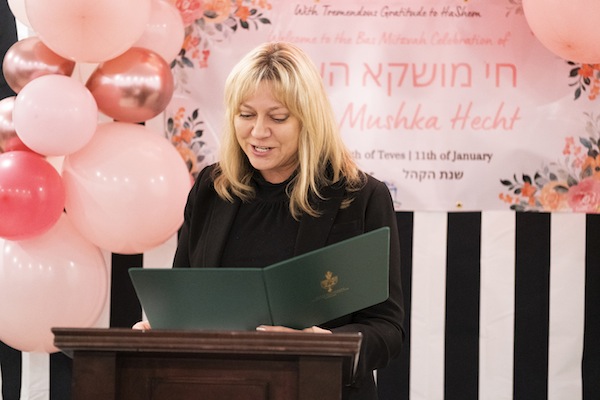
photo - MP Tracy Gray reads the certificate she presented to Chaya Mushka Hecht on the occasion of Mushka’s bat mitzvah
MP Tracy Gray reads the certificate she presented to Chaya Mushka Hecht on the occasion of Mushka’s bat mitzvah. (photo from Chabad Okanagan)

“At the event, the women celebrated the honourable feminine power of leadership,” said Rabbi Hecht. “My role model and beloved life teacher was the Lubavitcher Rebbe, obm, who was passionate about establishing women in leadership groups and conventions as early as the ’50s.”

Fraidy Hecht spoke about the infinite and unconditional value of every human soul, and how precious children ought to be to their parents, first and foremost, for simply being a child of G-d here on earth in their care, and how blessed they are to be their child’s Divinely chosen custodian.

Everyone in attendance at the bat mitzvah received a book of Psalms, a mini-biography of Chaya Mushka Schneerson, and a copy of the novelette that Mushka wrote and published in honour of her bat mitzvah. The message of the novelette was how girls her age are being called upon to be a light and positive influence in the world.

Attendees participated in various activities, including beading, singing and dancing, and had dinner together.

Mona Steinberg, a member of the Chabad Okanagan community, shared her reflections of the event.

“Mushka’s bas mitzvah was just so wonderful, Mushka’s speech was so intelligent and mature,” she said. “I can tell she has worked hard to become an important and dedicated future leader and inspiration for Jewish women. [They] should be very proud.”

“The world has become a better place,” remarked Olya Krasavina, from Yumster Life Photography in Kelowna.

– Courtesy Chabad Okanagan

Format ImagePosted on February 24, 2023February 22, 2023Author Chabad OkanaganCategories LocalTags Chaya Mushka Hecht, Judaism, milestones, tikkun olam, Tracy Gray, youth

Posts pagination

Previous page Page 1 … Page 143 Page 144 Page 145 … Page 667 Next page
Proudly powered by WordPress