Skip to content
  • Home
  • Subscribe / donate
  • Events calendar
  • News
    • Local
    • National
    • Israel
    • World
    • עניין בחדשות
      A roundup of news in Canada and further afield, in Hebrew.
  • Opinion
    • From the JI
    • Op-Ed
  • Arts & Culture
    • Performing Arts
    • Music
    • Books
    • Visual Arts
    • TV & Film
  • Life
    • Celebrating the Holidays
    • Travel
    • The Daily Snooze
      Cartoons by Jacob Samuel
    • Mystery Photo
      Help the JI and JMABC fill in the gaps in our archives.
  • Community Links
    • Organizations, Etc.
    • Other News Sources & Blogs
    • Business Directory
  • FAQ
  • JI Chai Celebration
  • JI@88! video

Recent Posts

  • Story of Israel’s north
  • Sheltering in train stations
  • Teach critical thinking
  • Learning to bridge divides
  • Supporting Iranian community
  • Art dismantles systems
  • Beth Tikvah celebrates 50th
  • What is Jewish music?
  • Celebrate joy of music
  • Women share experiences 
  • Raising funds for Survivors
  • Call for digital literacy
  • The hidden hand of hate
  • Tarot as spiritual ritual
  • Students create fancy meal
  • Encouraging young voices
  • Rose’s Angels delivers
  • Living life to its fullest
  • Drawing on his roots
  • Panama City welcoming
  • Pesach cleaning
  • On the wings of griffon vultures
  • Vast recipe & story collection
  • A word, please …
  • מארק קרני לא ממתין לטראמפ
  • On war and antisemitism
  • Jews shine in Canucks colours
  • Moment of opportunity
  • Shooting response
  • BC budget fails seniors
  • Ritual is what makes life holy
  • Dogs help war veterans live again
  • Remain vital and outspoken
  • An urgent play to see
  • Pop-up exhibit popular
  • An invite to join JWest

Archives

Follow @JewishIndie
image - The CJN - Visit Us Banner - 300x600 - 101625

Story of Israel’s north

Story of Israel’s north

Kiryat Shmona musician Ben Golan will perform at the Yom Ha’atzmaut celebrations in Vancouver April 21. (photo from Ben Golan)

“Music for me is a way to say: we are still here, still alive, still building a future. It gives people a place to feel, and also the strength to keep going,” said Ben Golan, who will headline our local celebration of Israel’s 78th Independence Day, on April 21.

Golan is a musician and producer from Kiryat Shmona, a city in our community’s partnership region, the Upper Galilee, in Israel. He is the founder of the initiative Patifon.

“For 17 years,” he said, “I’ve been producing music and running a recording studio in the city. Over time, I realized that my work isn’t just about producing songs. It’s about building something that can sustain a real musical community in the north, giving a stage to local creators and creating a movement that feels connected to this place.”

Patifon, which means record player or turntable in Hebrew, serves as a hub for local artists.

“It all started simply, with jam sessions in the studio,” explained Golan. “People began coming to play, sing, meet and connect. Slowly, it grew, until the gatherings were too big for the studio to handle. There wasn’t enough space, but there was a hunger for music. Then, thanks to the youth centre and the amazing Elad Kozikaro, who gave us a budget and the perfect space, we got a shelter, which, in times like these, is a valuable commodity in the north. We moved in, completely renovated it and turned it into the most beautiful music lounge; a place where you can come and feel at home, even if it’s your first time there.”

The lounge morphed into Patifon.

“We started filming live sessions of artists and bands there, with proper sound and respect for the music,” Golan said. “All the sessions were uploaded to YouTube under Patifon and, over time, it started to catch on and reach more and more people. Suddenly, what began as a small local gathering became a stage watched by people outside the north.

“As the audience grew and we realized this needed more breathing room, we opened a community pub. Students from Tel-Hai College volunteer there as part of a scholarship program and help keep the place alive and running.”

For Golan, Kiryat Shmona is not just where he was born and grew up. He calls the city and the Upper Galilee his “inner language.” 

“In this city, I learned what the rhythm of a community really is: people who know each other, who will always help you when you need something. There’s a different kind of air here,” he said.

“I have a stream right by my house. It seeped into my music without me even intending it to – a mix of rough and tender, of truth and esthetics, of wanting to shout and needing a moment of quiet to breathe,” he explained. “The nature here, the open space and the distance from the centre taught me how to really listen – not to the noise, but to what lies underneath it.

“Continuing to create in the north, especially after Oct. 7, is not a romantic choice for me – it’s a stance,” he said. “The region went through a real upheaval: fear, evacuation, uncertainty and, also, a kind of pain that people who don’t live here sometimes don’t fully understand. Out of all of that, creativity becomes a tool for connection and healing.”

Golan chose to stay in Kiryat Shmona out of a sense of mission.

“I believe the periphery holds immense talent, real hunger and stories you can’t fake – it just needs infrastructure, a home and support,” he said. “I want the young people and artists here to feel that they don’t have to leave in order to become something. On the contrary – that this place itself can become a source of inspiration, an opportunity and a creative centre that generates culture rather than just consumes it.”

Coming to Vancouver for Yom Ha’atzmaut, Golan said he brings messages of resilience and hope – and he takes those words seriously.

“Independence, for me, is also the ability to choose to create despite the difficulty, to choose community, to choose light,” he said. “I want to bring the story of the north: people who continue to build, to organize events, to create music and to hold each other up even when reality is complicated. In my music, there is room for both joy and pain, because both are part of our lives – especially in this time.”

On April 21, Vancouver band HaOptziot will also take the stage at the community celebrations, playing covers of various Israeli hits.

For tickets ($36/adult, $12/youth, $75/family pack) to the Yom Ha’atzmaut celebrations, go to jewishvancouver.com/yh2026. 

Format ImagePosted on March 27, 2026March 26, 2026Author Cynthia RamsayCategories MusicTags Ben Golan, HaOptziot, Jewish Federation of Greater Vancouver, Kiryat Shmona, music, Patifon, Yom Ha'atzmaut
Sheltering in train stations

Sheltering in train stations

Another day, another missile alert: Israelis sheltering at the Herbert Samuel Hotel miklat. The writer and his wife take refuge there, but their dog, Max, won’t leave home. (photo by Gil Zohar)

Those who think history doesn’t repeat itself may wish to WhatsApp my 97-year-old mother, Joyce, to discuss how millions of Londoners like herself sheltered in the British capital’s Tube stations during the Blitz and later in the Second World War. The Luftwaffe bombings traumatized her and her two younger sisters, Anita and Renee. Today, the same “rain” of terror is falling across Tel Aviv, Haifa and Jerusalem.

In Tel Aviv and in the neighbouring cities of Ramat Gan and Bnei Brak, nine underground stops on the Red Line of the Light Rail are open 24/7 as public bomb shelters, including on Shabbat, when there is no transportation service. Some denizens of Greater Tel Aviv have taken to sleeping on the station platforms overnight rather than returning home after each all-clear alert.

At the time of writing, the Red Line is not operating. Commuters from Jerusalem to central Israel have been temporarily required to change trains at Ben Gurion Airport before continuing to Tel Aviv.

Not surprisingly in a country where kvetching is the national sport, some people have complained that not all the underground stations have been opened to serve as protected spaces. The Ministry of Transportation has published a list of stations deemed safe, which the frantic hordes may freely enter when the missile alert screams.

The Carlebach station – named after Esriel Gotthelf Carlebach (1908-1956), the Leipzig, Germany-born pioneering journalist, founding editor of the daily Maariv, and cousin of Berlin-born troubadour Rabbi Shlomo Carlebach – has not been opened, as it is not considered suitable as a secure shelter for engineering reasons.

In the eternal capital of the Jewish people, Yerushalmis are also taking cover underground. While all the stops on Jerusalem’s single tram line are on the surface, the Navon Train Station – which is 90 metres below street level and was designed to function as a nuclear bomb shelter – is now serving its secondary purpose apart from transportation.

Home Front Command (HFC) and Ministry of Defence officials have praised the Israeli public for its resilience in quickly reaching a safe place to shelter when the siren goes off.

Israel updated its national building code in 1992 following the Gulf War the previous year, when Saddam Hussein rained Scud missiles down on Tel Aviv and Haifa from Iraq. Previously, zoning laws had required condominium apartment buildings to incorporate a basement bomb shelter, but the threat of heavier-than-air poison gas attacks made those shelters potential death traps. Thus, gas masks were distributed, and every apartment in new residential buildings is now required to have a reinforced and sealed security room, called a mamad in Hebrew. Typically, these are a bedroom protected with extra thick concrete and equipped with a steel door and heavy shutters. A wet towel placed by the door makes for a reasonably airtight seal. Some newer buildings have been designed so that the area around the elevator shaft and stairs serves as a protected miklat (shelter) for the entire floor. It’s a uniquely Israeli way of getting to know one’s neighbours.

The number of fatalities has been miraculously low in the night-and-day barrages from Iran and Lebanon since the current war started on Feb. 28. At press time, 28 people – including two soldiers – had been killed in the hundreds of missile and drone attacks targeting civilian regions in the Jewish state. More than 400 ballistic missiles had been launched. No information has been released on the number of drones fired.

Nine Israelis were killed and more than 40 injured in Beit Shemesh on March 1 when an Iranian missile hit a residential neighbourhood, destroying a synagogue and collapsing the adjoining bomb shelter. The shelter was in a pre-1991 building that had been retrofitted.

A Thai agricultural worker in central Israel and four Palestinian women in a beauty salon in the village of Beit Awwa, southwest of Hebron, were killed on March 18 by debris from an Iranian missile. Barrages employing cluster munitions have hit multiple locations – including near my home in downtown Jerusalem. More than 100 residents in Dimona and Arad were wounded in missile strikes on those two southern cities March 21; most were not in bomb shelters, according to an HFC investigation. 

Train service has been interrupted at Tel Aviv’s Savidor station and in Holon, where, as well, several buses were damaged. Military censorship prohibits publishing the addresses of hits.

photo - Max prefers to stay home when the sirens sound
Max prefers to stay home when the sirens sound. (photo by Gil Zohar)

On March 15, Israel Railways reopened the train stations in Hod HaSharon-Sokolov, Bnei Brak, Rishon LeZion HaRishonim and Dimona, which had been shut down when the war began. Full service resumed on the lines from Herzliya to Ofakim, and Herzliya to Jerusalem. While the latter stops at Ben Gurion Airport, service at the international air hub remains greatly reduced. Some travelers are choosing to take a bus to Amman, Jordan, or Sharm el-Sheikh, Egypt, to fly abroad. The situation remains fluid.

For my wife and me, four overseas guests at our Pesach seder have had to say “Next Year in Jerusalem” because their flights have been canceled. We live in a charming stone building in the city centre, which was built in 1886 and has neither a miklat nor a mamad. When the siren sounds, we head to the Herbert Samuel Hotel across the street. There, the synagogue two floors below ground level doubles as the reinforced space. Last Friday, as the Sabbath approached and the air raid alert rang, a guest was playing the violin, serenading those present with the strains of “Shalom Aleichem.”

And what of our dog Max? The poor mutt refuses to leave his comfort zone – our unprotected apartment. With every second meaning the potential difference between life and death, we leave him to lie on the sofa and howl at the sirens. 

Gil Zohar is a journalist and tour guide who lives in Jerusalem.

Format ImagePosted on March 27, 2026March 26, 2026Author Gil ZoharCategories IsraelTags bomb shelters, Iran war, Israel

Teach critical thinking

We are failing in a battle we cannot afford to lose. Canadians and the world are trying, unsuccessfully, to control the spread of misinformation and disinformation at the source, policing online platforms, flagging content and regulating perpetrators. 

This “supply-side” approach is fundamentally flawed. Information today moves too fast, too freely and too globally to ever be contained. Controlling what is produced is a losing battle. Our main hope is to vaccinate consumers of information against the pandemic of lies.

In recent issues, the Independent has reported on steps being taken by the provincial and federal governments to police boundaries (for example, provincial legislation that would create “bubble zones” around religious institutions) and strengthening hate crime laws (the federal government’s Bill C-9). These are deeply necessary and well-intentioned steps.

They are also like plugging a collapsing dike. 

In the immediate term, we need to police speech that is hateful and potentially violent. In the longer term, we need to educate citizens to differentiate between truth and lies so they are less susceptible to bigoted ideas and misinformation.  

B’nai Brith Canada has launched a national digital literacy campaign that is timely and necessary. (See story, page 12.) Even this initiative, though, should go further. Digital literacy alone is not enough. Canadians – and people everywhere – require a much broader foundation in critical thinking and media consumption. They need to know not just how to use digital tools, but how to question and critique all manner of information: how to evaluate sources, how to distinguish fact from fiction, commentary from reporting, propaganda from legitimate information.

If individuals are equipped to interrogate what they see – if they instinctively ask, “Who created this? Why? What evidence supports it? What motivations might the creator have beyond informing me?” – then misinformation loses some of its power. It stops spreading, not because it has been removed, but because it has been assessed and rejected by its targets.

Importantly, this is not just about young people, though teaching students these skills early is essential. Misinformation does not discriminate by age, and neither should our response. In many cases, older generations, who did not grow up in a digital environment, are even more susceptible.

The world is experiencing a tsunami of information. Everything – everything – depends on the ability of each of us to navigate these surging waters. If people cannot tell what is real, they cannot make informed decisions or vote responsibly. If they cannot distinguish truth from manipulation, democracy itself erodes.

This is especially relevant right now to Jewish Canadians, who are deeply concerned by surging antisemitism and antizionism. We are wringing our hands over how to successfully confront this crisis. If we can train people to identify misinformation, propaganda and assorted falsehoods and conspiracies, the Jew-hatred problem may not entirely resolve itself. Those steps would, however, almost certainly be the most effective and enduring contemporary response to an ancient and enduring bigotry. 

A society that can think critically is a society that is less easily misled. And, in today’s world, that may be the most important skill of all. 

Posted on March 27, 2026March 26, 2026Author The Editorial BoardCategories From the JITags antisemitism, antizionism, B’nai Brith Canada, digital literacy, disinformation, education, internet, misinformation, online hate

Learning to bridge divides

A friend from my grad school, Jill, has a distinguished academic career. She’s now the chair of her university’s religious studies department. She’s co-authored a book on dialogue in education and works with an organization called Essential Partners, which “helps people build relationships across differences to address their communities’ most pressing challenges.” This work shows great promise in helping people listen and learn from one another. 

This dialogue-oriented academic approach draws on the Socratic seminar, an ancient learning technique I was taught as a young teacher. It gets students to interact, do analysis and to listen carefully to one another. 

I was thrilled that this technique was used in one of my twins’ public school English classes. His regular teacher was on leave and an experienced, retired teacher took over the classes as a long-term sub. As a former English teacher, I watched my Grade 9 student dig into the material. He did prep work to learn how to participate, including writing journal entries and eventually producing a literary analysis essay. The cherry on top was that this whole unit focused on Elie Wiesel’s book Night. The students finally accessed some Holocaust education (mandated by the province but not previously implemented) as part of this rigorous unit.

Then my kid reported that classmates said the sub was “trying to Jewify” them. Later, classmates said he only got high marks because he was Jewish and a teacher’s pet. In a polarized political climate, this teacher did everything right to facilitate safe dialogue and teach important texts. Even so, antisemitism popped up – showing how necessary dialogue like this is for our society at this moment.

Our household likes to discuss and debate. We don’t shy away from difficult topics. I think we succeed at this type of conversation at the dinner table, though we could all benefit from improvement in our listening habits. 

When I became a parent, I stepped back from the academic work I used to love. I became a caretaker when we had twins, due to health challenges. I also mostly stopped teaching, due to all the moves necessary for my husband’s work.

To “get back” some of this work, I’ve explored different opportunities in the last year. I spoke on “finding hope,” as part of an ethics, politics and humanity panel at an interfaith conference. I committed to teaching two workshops at Limmud. In another foray, I took advantage of a podcast’s call for entries and applied. This local academic podcast focuses on “peopling the past.” They requested submissions to examine the relevance of the ancient world in understanding contemporary issues. 

I wanted to explore how the Babylonian Talmud, in tractates Zevachim and Menachot, examines boundaries, definitions and understandings of “appropriate sacrifice.” I saw fascinating parallels between this ancient discussion and how textbook definitions of words like “apartheid,” “genocide” and “colonization” are being manipulated today. I thought it could make a great case study of how the Talmud recorded hundreds of years of comparison and dialogue between rabbis (scholars) and how that model might be applied to analytic discussion today. 

The rabbis disagreed about definitions and details. It was a high stakes conversation for them. Ritual sacrifice in the Temple was a thing of the past, but they felt it essential to understand and record the right way to do this, so the Jewish people would know how to manage if the Temple were rebuilt. Further, if the Temple is never rebuilt, what could we learn from the “right” and holy way to do sacrifice?

Months passed. The deadline for hearing back from the podcast organizers passed. I inquired politely but heard nothing. Then, I did something I should have done in the first place. I researched more about the nearby academic organizing this. I learned this academic was heavily invested in Palestinian activism. Once I read this, I figured I would never even hear back about my proposal. Yet, to my surprise, I got a polite form letter, which (of course) turned down my submission.

My pitch might not have been competitive. I’ve got two master’s degrees but no PhD or university affiliation. The topic maybe was too controversial. Perhaps my write-up was too plainspoken. After sleeping on it, I realized none of that mattered. In fact, I was relieved. After all, considering my family’s challenges in listening more and talking less at the Shabbat table, I wondered if I could have pulled off a podcast conversation with a person so firmly entrenched in an opposing and confrontational viewpoint.

Studying Daf Yomi (a page of Talmud a day) since January 2020 helps me shed light on these career-building experiences. Every day, I read rabbis’ debates, over centuries, that model dialogue and analytic questioning. There are aspects of the Socratic seminar in these texts and the ways in which scholars build relationships and bridge differences to solve their communities’ challenges. Repeatedly, I see this difficult, but meaningful, process play out between rabbis who lived almost 2,000 years ago, in a text compiled a little over 1,500 years ago.

A reflective teacher evaluates what was or wasn’t successful in an assignment or lesson plan. This recent rejection allowed me that reflection. I’d take off points if I assessed myself. First, I failed to do enough research to realize that this podcast, while geographically convenient, wasn’t a good fit for ideological reasons. Second, it helped me examine ways I can grow as a listener and work to create meaningful spaces for respectful, safe dialogue across deep divides. Studying Talmud for a few minutes a day, across six years, gives me even more respect for the role of civilized, rigorous discussion and safe spaces to disagree. Some people aren’t ready to grow this way. They cannot leave space for that intellectual growth. When challenged, they respond with rejection or name calling, as my kid experienced.

Finally, I realized why sometimes academics spend a lot of grant money and time on choosing the “right” professor to travel to their institution. It’s sometimes too uncomfortable to sit in the room with someone who is not an easy match. Still, we might learn more from the dialogue with those more challenging discussion partners. Learning to bridge divides and live together is sometimes the most meaningful work, after all. 

Joanne Seiff has written regularly for the Winnipeg Free Press and various Jewish publications. She is the author of three books, including From the Outside In: Jewish Post Columns 2015-2016, a collection of essays available for digital download or as a paperback from Amazon. Check her out on Instagram @yrnspinner or at joanneseiff.blogspot.com.

Posted on March 27, 2026March 26, 2026Author Joanne SeiffCategories Op-EdTags antisemitism, critical thinking, dialogue, education, Socratic seminar, Talmud
Supporting Iranian community

Supporting Iranian community

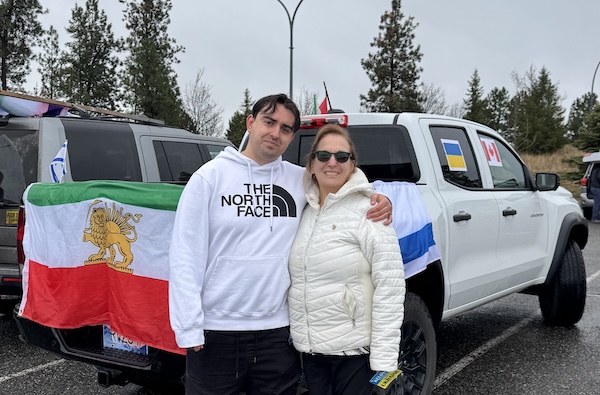
Harley Kushmier and his mother, Samantha Kushmier, at the March 8 Car Rally for Iranian Voices. (photo from the Kushmiers)

Members of the Kelowna Jewish community participated in the Car Rally for Iranian Voices on March 8.

photo - Harley Kushmier at the March 1 weekly rally in Kelowna in support of those protesting the Iranian regime
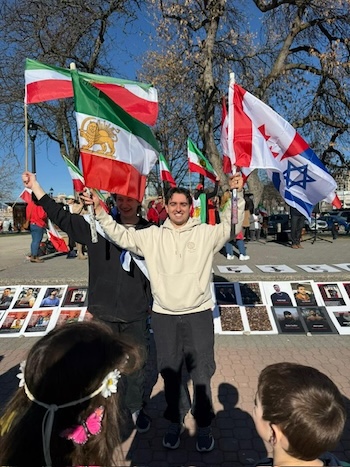
Harley Kushmier at the March 1 weekly rally in Kelowna in support of those protesting the Iranian regime. (photo from the Kushmiers)

Every Sunday in downtown Kelowna a protest is held in support of loved ones lost in the Shir-o-Khorshid (Lion and Sun) Revolution – the ongoing anti-regime protests in Iran – and of those who remain detained in Iran, subjected to unspeakable hardship. The protests ask that Crown Prince Reza Pahlavi be recognized as transitional leader of the country.

Rally organizers thanked Israel for its support and help, and asked the local Jewish community to attend the car rally. Organizers also reached out to the local Ukrainian community to join. 

Samantha Kushmier and son Harley Kushmier are part of the Okanagan Jewish community.

Format ImagePosted on March 27, 2026March 26, 2026Author Samantha Kushmier and Harley KushmierCategories LocalTags Iran war, Okanagan, protests, rallies, solidarity
Art dismantles systems

Art dismantles systems

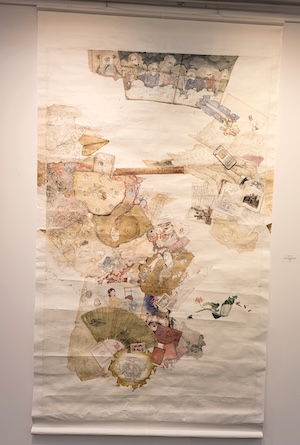
“I Betrayed Him and the Fate of Becoming Him” by Yongzhen Li is part of Li’s solo exhibit – Structures of the Unsaid – at the Zack Gallery. (photo from Yongzhen Li)

On March 5, the Zack Gallery opened its first solo exhibition by a non-Jewish artist in years. Called Structures of the Unsaid, it presents the work of Yongzhen Li, a recent immigrant from China. By coincidence, it is also Li’s first solo show, and the show’s name reflects the artist’s feelings about his native China’s patriarchal culture and collectivist society. 

“The art committee and I asked Li to be part of the Zack Gallery exhibitions over a year ago,” said Sarah Dobbs, the gallery’s curator. 

“His talent, the way he handles the surface of the paper and the themes that we felt resonate with the Jewish community were the primary reasons for selecting him for a solo show,” she said. “The way he works – using ink, rice paper and mugwort water, which stains the surface before the image appears – reflects his deep skills as an artist. This was the primary pull for us to exhibit him. In addition, the water residue acts as a form of embodied memory, recalling the imperative to remember – the surface carries what cannot be seen. 

“His practice emerges from absence, where the creation of each piece is a gesture of repair within fracture, like a quiet form of tikkun, a concept found in the Zohar,” she explained. “Painting is how he wrestles, remembers and remakes meaning. So, the conceptual nature of his work, combined with his skills, was a no-brainer. The committee and I just immediately voted him yes!”

Li and his wife, Jiamin, came to Canada in 2024, settling in Oshawa, Ont.

“I like the food here – so many Asian groceries,” he said with a smile. “But language is hard for me. It’s always been so, even before we came here. Language has always felt too thin. The words seem to flatten what I feel, while images allow it to remain alive.” That’s why he asked his wife to act as his interpreter during his interview with the Independent. 

Li’s road to the arts was not simple. 

“My father is a petroleum worker,” he said. “And so was his father before him. It is traditional in China that a son follows his father’s work. It is a good job, with a decent pay, and it was already arranged for me after I graduated, but I didn’t want to do it. I always felt like an outsider in my family. I didn’t want to know my future for the next 50 years. I knew it wouldn’t make me happy. I wanted to do art. I wanted to be free in my choices.”

That was his first rebellion, his first step against the established routine, but not his last.

“I was about 13 at the time…. By Chinese tradition, children of artists who follow their fathers into art start their artistic training at 6. I was already too old, but I needed to do it. Otherwise, I felt that I had nothing of my own. Fortunately, I had a good art teacher at school,” said Li, adding with a grin: “And I became popular with my classmates.” 

photo - “Underground World” by Yongzhen Li, whose solo exhibit at Zack Gallery runs to April 13
“Underground World” by Yongzhen Li, whose solo exhibit at Zack Gallery runs to April 13. (image from Yongzhen Li)

His next step upon graduation was the Academy of Fine Art in Xi’an, one of the largest cities in China, with an ancient history and a long artistic tradition. The famous Terracotta Army, a UNESCO World Heritage Site, is located just outside the city. The Xi’an academy is considered one of the best art schools in China, but Li didn’t like his time there. 

“There was no creative freedom,” he said. “The professors were rigid, wanted me to copy them, to follow their instructions without thinking. It didn’t work for me.” 

Once more, Li went against the established mode. He quit the academy and found a job to support himself and his wife. He worked with social media while teaching himself to be an artist.

“People thought I was crazy to quit,” he said. “My parents wouldn’t help financially – they didn’t approve of my actions. Besides, they were getting a divorce. And I was already married – we met at the academy. Jiamin was also a student there.” 

When COVID struck, the young couple experienced the restrictions that were placed on people worldwide.

“We became all isolated, had to stay at home,” Li recalled. “But we watched lots on the internet, especially YouTube videos. In China, the world internet is not available – it is illegal there to access YouTube or Google or Facebook. Chinese people have their own limited internet version, allowed by the government, but many young people ignore those restrictions and download apps to watch the real internet. We did too and we learned a lot. We could finally see for ourselves how the world worked. We decided to emigrate to Canada.”

Canada was a revelation to Li. “I’m free here,” he said. 

To make ends meet, Li works for a delivery company, but, in his spare time, he continues to paint and learn, and his art evolves. When he lived in China, his themes tended to be narrow, tied to certain events or ideas, but his latest imagery explores more complex issues of identity, memory and resistance.

“Art has become my emotional refuge as well as a method of self-liberation,” he said. 

It also allows him to process his inner tension and vulnerability, as he struggles for personal and creative autonomy. His large painting “Underground World,” finished in the past month, is symbolic of his current trend of using traditional Chinese motifs and media to address contemporary and universal topics.

The painting looks like a collage, denoting the artist’s inner journey; many aspects intertwine and contradict one another. Family history versus personal fragility. Government direction versus private uncertainty. 

“I am not searching for villains. I am dismantling systems,” Li says in his artist statement. “I refer to structures that appear normal: family control, humiliation disguised as education, and forms of care that carry hidden violence. Tragedy most often happens not through cruelty, but through what is socially justified, well-intentioned and unquestioned.” 

As for his life in Canada, Li said, “I’m thinking of taking some art classes here. There is so much choice, so much freedom for an artist.”

Structures of the Unsaid is on display until April 13. To learn more about Li, visit his website, yongzhenli.com. 

Olga Livshin is a Vancouver freelance writer. She can be reached at [email protected].

Format ImagePosted on March 27, 2026March 26, 2026Author Olga LivshinCategories Visual ArtsTags art, China, immigration, painting, social commentary, Yongzhen Li, Zack Gallery
Beth Tikvah celebrates 50th

Beth Tikvah celebrates 50th

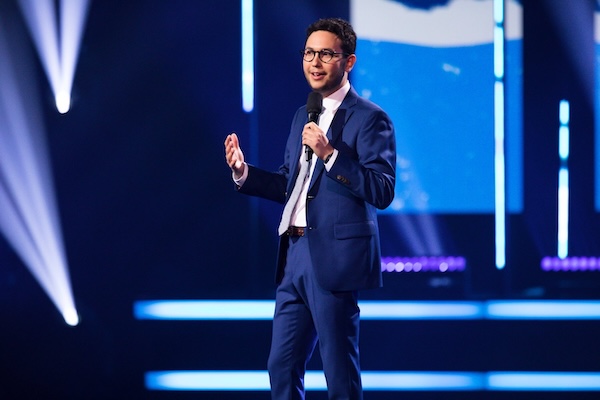
The delayed celebration of Beth Tikvah’s 50th anniversary takes place April 19, with a night of comedy headlined by Juno Award-winning comedian Jacob Samuel. (photo from byjacobsamuel.com)

Beth Tikvah, the Conservative synagogue in Richmond, was founded in 1973. That placed the 50th anniversary in 2023, and a celebration was planned for October. Then the catastrophe of 10/7 occurred, and the event was indefinitely postponed.

Now that all the hostages are home and the war that began that day has ended (though a different one continues), the congregation thought it was not just appropriate to come together to celebrate the milestone of their community, but necessary.

A communal celebration – with laughter – is something the community needs, Rabbi Susan Tendler told the Independent. 

“People just really need to laugh,” she said, and to find strength in community. 

Tendler herself arrived as Beth Tikvah’s spiritual leader at the height of another collective crisis – the COVID pandemic. Her family was greeted warmly, but from a distance, as intense social isolation rules were still in place.

Six years later, she is effusive in her love for her role and her adopted community. Beyond the immediate Beth Tikvah and Richmond communities, she said, the relationship among Metro Vancouver’s rabbis is extremely unusual, with deep ties across denominations. Tendler is currently chair of the Rabbinical Association of Vancouver, the main conduit for that tight union.

Jews at Beth Tikvah, in British Columbia and worldwide are resilient but tired, she said.

“We are fierce and we are resilient, and we are strong and we are agile and we are constant,” she said. “But we all can feel the weariness from it.”

Coming together to celebrate is necessary, she said, noting that Purim this year seemed to unleash a collective wellspring of joy.

The delayed celebration of Beth Tikvah’s 50th anniversary takes place April 19, with a night of comedy featuring Juno Award-winning comedian Jacob Samuel and emcee Kyle Berger, himself a funnyman of some repute. 

Berger’s brother, Tadd Berger, is the synagogue’s president, as was older brother Ryan and mother Marilyn before him.

The Bergers were not founding members of the congregation, said Tadd Berger, but they showed up more than four decades ago.

“Beth Tikvah is a special place,” he said. “It’s always been a special place for me. I was bar mitzvahed at Beth Tikvah, I was married at Beth Tikvah. It has always been a centrepoint of my person, of my growth, of my community. A lot of who I am today is a result of opportunities and programs and events and things that I had at Beth Tikvah.”

He called his leadership role at this moment in the history of the shul and the community a responsibility, an honour and a privilege. 

While the celebration next month caps a half-century of growth, Berger is looking to the future.

“Our membership has been growing the last several years,” he said. “I think that we will continue to grow. We’ll continue to find more ways to connect with and service and support the larger Jewish community, especially the Richmond Jewish community.”

Beth Tikvah is the only Conservative synagogue south of Fraser River, Berger noted, so he views the shul as serving a larger geographic region, stretching southward. 

He is also proud of the range of programs the community delivers, including food security programs and services for youth and seniors, which are open to members and non-members. 

“We see ourselves as Richmond’s synagogue and here to support the whole community,” said Berger. “That’s how we want to continue and, [in] the coming 50 years, I hope that that gets us embraced more and more by the community. “

The solemnity of the period since Oct. 7, which occurred just as the world was emerging from the COVID pandemic, means it has been a long time since a festivity of this type has occurred, according to one of the organizers.

“The event is the first big fundraiser we’ve had in a long time,” said Alisa Magnan, who is co-chairing the celebration with Mindy Zimmering. “We’re raising badly needed funds for programs and it’s a great chance to support the community and get together and have some fun.”

Magnan echoes the rabbi in noting that it is time for the community to kick back and have a good time amid the many challenges.

“I wanted to be able to get together and celebrate our community and find some joy after such difficult times,” she said.

In addition to the anticipated guffaws (induced, the PR promises, by “smart, clean humour”), the event will include a 50/50 draw in addition to food stations featuring pasta, barbecue, salads, Mexican cuisine and crêpes for dessert. Tickets and more information for April 19’s  Eat, Laugh, Schmooze: A Night of Comedy & Connection are at btikvah.ca. 

Format ImagePosted on March 27, 2026March 26, 2026Author Pat JohnsonCategories LocalTags Alisa Magnan, anniversaries, Beth Tikvah, comedy, Jacob Samuel, Kyle Berger, milestones, Susan Tendler, Tadd Berger

What is Jewish music?

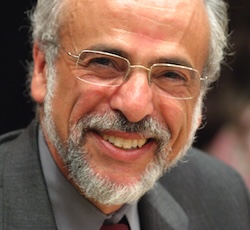
On March 8, Joshua Jacobson, professor emeritus of music at Northeastern University in Boston, Mass., spoke on the topic Jewish Music: What’s That?

photo - Prof. Joshua Jacobson was the latest speaker in Kolot Mayim’s Voices of Jewish Music series
Prof. Joshua Jacobson was the latest speaker in Kolot Mayim’s Voices of Jewish Music series. (internet photo)

The Zoom lecture was the fifth of six talks in Kolot Mayim Reform Temple’s 2025/26 Voices of Jewish Music series.

How can music even be Jewish? Jacobson asked. Does music keep kosher? Is music circumcised? Did music have a bat mitzvah? He played an excerpt of African-American clarinetist Don Byron performing the klezmer number “Der Nayer Doyne.” 

“You don’t have to be Jewish to compose or perform Jewish music,” he said. “And that’s why I prefer the terminology, the music of the Jewish people. Although I will admit that, for the sake of convenience, I often do use the term Jewish music.”

But the question of what constitutes Jewishness remains. The word represents an ever-widening expanse, including an abundance of liturgical music, a vast array of music influenced by the cultures in which Jews have lived and the languages they have spoken, and the contributions of Jews who have entered the community by choice.

“There is no single Judaism, not anymore. It’s a big tent,” Jacobson said.

One school of thought Jacobson pointed to came from Swiss-American composer Ernest Bloch, who said, “Racial consciousness is something that every great artist must have. A composer who says something is not only himself, he is his forefathers. He is his people.”

Leonard Bernstein wrote in his senior thesis at Harvard University in 1939: “It is easily understandable that a composer whose parents were immigrants still maintains a close contact with the old racial traditions. If their traditions are part of his childhood, they are inevitably part of his life.”

Jacobson played Irving Berlin’s “White Christmas” to illustrate that any music composed by a Jew could be considered Jewish music.

The Nazis, however, defined Jewish in purely racial terms, Jacobson said. They would not allow any music written by a Jew to be heard or even studied in Germany and German-controlled countries. Nor would the Nazis allow Jewish-German conductor Bruno Walter to lead a concert of Ludwig van Beethoven’s works. Jews, the Nazis believed, would spoil the music with their “Jewish accent.”

Jacobson played excerpts of Beethoven’s Symphony No. 6, asking if members of the audience could distinguish between a performance led by Walter and one by conductor Wilhelm Furtwängler.

“How many of you think that the first one was conducted by a Jew? How many of you think the second one was conducted by a Jew? How many of you think that it’s a ridiculous question? – which, of course, it is. Did one of these have a discernible ‘Jewish accent’? No,” Jacobson said.

image - In his March 8 talk, Prof. Joshua Jacobson gave Irving Berlin’s “White Christmas” as an example of how any music composed by a Jew could be considered Jewish music
In his March 8 talk, Prof. Joshua Jacobson gave Irving Berlin’s “White Christmas” as an example of how any music composed by a Jew could be considered Jewish music. (internet image)

Defining what constitutes Jewish music by what exists within borders or, as in much of Jewish history, in exile, can be an equally insurmountable task. As an example, Jacobson played part of a track from Arab-Israeli hip-hop group DAM, which is in Hebrew.

Many Israelis write music that doesn’t sound geographically constrained, he said.

Nonetheless, the professor did offer a definition of traditional Jewish music in his talk, saying it is music that has been used – whether sung, played or listened to – by Jews more than by other people, and, therefore, it has become associated with Jewish people.

Cantillation, the way the Torah and other biblical books are chanted, is the oldest form of Jewish music, Jacobson said. Demonstrating the cantillation styles of Babylonian, German and Yemenite Jews, he showed that the practice is similar, although not entirely the same, in Jewish communities throughout the world.

“Some scholars think that these are variations on an ancient theme, he said. “The variations are due to acculturation. German cantillation betrays the influence of German music. Yemenite cantillation betrays the influence of the culture in which they lived, the Yemenite culture.”

Jacobson said we find Jewish music in many styles and periods, and perhaps the problem in seeking a definition is that there are so many Jewish “musics.” He returned to Bloch, who once said that he could not say what Jewish music is, but one knows it when it is heard. According to Bloch, “It is something that both you and I can recognize and feel, even if we cannot analyze it.”

To Jacobson, the term Jewish music “is itself a wide tent in which all may not agree on a definition, but it’s something that we cherish, and something that fulfils us.”

An authority on Jewish music, Jacobson is also the founder and director of the Zamir Chorale of Boston. He has guest-conducted many ensembles, including the Boston Pops Orchestra, the Bulgarian National Symphony and Chorus, the New England Conservatory Orchestra and the Boston Lyric Opera Company. He has written articles on various aspects of choral music and has published more than 100 compositions and arrangements.

The final speaker in this year’s Voices of Jewish Music series is author Michael Posner on April 12 at 11 a.m. Posner will explore Leonard Cohen’s Jewish heritage, philosophy and musical legacy – and how Judaism influenced Cohen’s lyrics, philosophy and life. For more information, visit kolotmayimreformtemple.com. 

Sam Margolis has written for the Globe and Mail, the National Post, UPI and MSNBC.

Posted on March 27, 2026March 26, 2026Author Sam MargolisCategories MusicTags Jewish music, Joshua Jacobson, Kolot Mayim, speakers, Voices of Jewish Music
Celebrate joy of music

Celebrate joy of music

The annual North American Jewish Choral Festival brings hundreds of singers together to enjoy a musical experience of Jewish identity and community. This year’s festival takes place Aug. 2-6 in Stamford, Conn. (photo by Jennifer Weisbord)

The annual North American Jewish Choral Festival (NAJCF) brings hundreds of singers together to enjoy a musical experience of Jewish identity and community. The five-day event, led by world-class conductors, takes place this year in Stamford, Conn., from Aug. 2 to 6. Registration to attend is now open, and all singers are welcome, from beginners to professionals.

“The festival is for anyone who wants to celebrate the joy of Jewish music,” said Maestro Matthew Lazar, festival founder and director. “This summer, we are highlighting American Jewish music, which beautifully intertwines US history, Jewish history and a range of genres. It is important to note that America is the first place where Jews had the freedom to be composers as Jews, opening up unlimited musical opportunities.”

NAJCF – which is a program of Zamir Choral Foundation – works to provide an environment of creativity and camaraderie, as well as a feeling of hope, unity and Jewish identity, to encourage singers to share a bonding experience and forge new friendships.

“The North American Jewish Choral Festival is my happy place,” said Cantor Mira Davis of New York City. “It’s a community of people who are like-minded, love each other, love Israel and love Jewish music – a place where you can be yourself.  The friends I’ve made at NAJCF will last a lifetime.”

NAJCF participants include amateur singers, professionals, cantors, conductors and lovers of Jewish music of all ages. Attendees have the unique opportunity to interact with and learn from top experts in Jewish choral music in a supportive setting. There are a variety of uplifting musical 

activities, including daily community sings; workshops and seminars on a wide range of topics; and evening concerts featuring guest choirs and notable performers.

“Being able to connect to this type of music and this type of text is something you can’t get anywhere else,” said NAJCF participant Dor Kaminka, an Israeli-American composer and conductor now residing in Los Angeles, Calif.

“Whether you’re a novice or a pro, you’ll leave with new skills, new music and new friends to cherish from this transformative choral festival,” concluded Lazar.

For more information and to register for NAJCF 2026, go to go to zamirchoralfoundation.org/north-american-jewish-choral-festival.

* * *

Applications are now open for another Zamir Choral Federation program: the Jewish Choral Conducting Institute (JCCI). The institute – a long-held vision of Lazar – is the first in the world to professionally train the next generation of conductors of Jewish choral music. Its creation was helped in large measure by a major gift donated by Cantor Robert Lieberman and Rabbi Vicki Lieberman, who will be honoured at this year’s HaZamir Gala Concert on March 15 at Lincoln Centre.

“Choral music lies at the intersection of text, music and community. It implants cultural identity, history, memory and catharsis,” said Lazar. “The conductor integrates music and text with mastery, precision and excellence, creating inspiring and transformative musical moments. The institute provides the specialized, intensive training needed to make all this possible.”

Each cohort is composed of 12 to 15 conducting students from around the world. Fellows gather at in-person retreats and workshops, and monthly online meetings, and receive one-on-one mentoring sessions with Lazar, as well as guest presenters. Upon completion of the program, fellows receive a certificate in Jewish choral conducting.

Lazar brings his knowledge of Jewish and Western music and an understanding of the text/music relationship that defines choral music. He has worked with maestros Leonard Bernstein, Zubin Mehta, Carlo Maria Giulini, Daniel Barenboim and others. Through his expertise, he models, encourages and nurtures the talents of future conductors of Jewish music.

“The Jewish Choral Conducting Institute provides a pipeline of talent to ensure strong Jewish choral leadership for the Jewish future,” he said.

The JCCI’s international Lazar Fellows deepen their development through ongoing mentoring and critique. These mentoring meetings foster ongoing growth within a supportive international community of Jewish choral conductors.

Applications for the fall 2026 cohort of the JCCI’s Lazar Fellowship are now open and due by 5 p.m. EST on April 30. For more information, visit zamirchoralfoundation.org/conducting-institute-2,  or email [email protected] to request the application details.

– Courtesy Zamir Choral Foundation

Format ImagePosted on March 27, 2026March 26, 2026Author Zamir Choral FoundationCategories WorldTags choral conducting, choral music, Jewish Choral Conducting Institute, Jewish music, NAJCF, North American Jewish Choral Festival
Women share experiences 

Women share experiences 

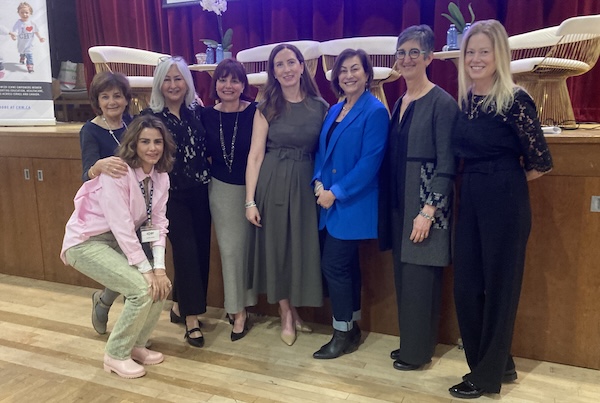
Left to right, at CHW Vancouver Centre’s SHE DAY event March 8: Ruthi Akselrod, Laura Lewko (kneeling a bit), Pam Wolfman, Toby Rubin, Jocelyn Brown, Ruth M’Rav Jankelowitz, Tamara Shenkier and Laura Mossey. (photo by Shula Klinger)

On March 8, CHW (Canadian Hadassah-WIZO) launched its first SHE DAY event. Hosted at the Jewish Community Centre of Greater Vancouver, the celebration of International Women’s Day included a panel discussion, a shuk (market) of women-led businesses and kosher refreshments.

CHW Vancouver Centre president Toby Rubin, who introduced the panel, also shared that, starting in October, the Vancouver CHW team would be under the joint leadership of Pamela Wolfman and Jocelyn Brown, who moderated the discussion between Dr. Tamara Shenkier, Ruth M’Rav Jankelowitz and Laura Mossey.

Shenkier, who is an oncologist, educator and advocate, recently retired. Her 30-year career included numerous leadership roles in medical education and governance, and she spent the last decade-plus focusing on breast cancer. She is a founding member of the Jewish Medical Association of British Columbia.

Jankelowitz has spent three decades in commercial and hospitality design, and her portfolio includes many household names, including DKNY, Timberland and Nike. Her company, Janks Design Group, has created the spaces of such eateries as OEB, Nando’s and Tap and Barrel.

Mossey brought her voice as a non-Jewish Zionist and educator to the panel, sharing some of the influences that have helped frame her identity and worldview.

The conversation was dominated by the topic of antisemitism and its marked increase since the Oct. 7, 2023, Hamas terror attack on Israel.

“Things were bubbling in the cauldron but, since then, I have felt as though I am ‘the Jew,’” said Shenkier, who spoke of feeling more exposed and more vulnerable in recent months than ever before. She talked about changes to medical curricula that followed consultation with “thought leaders,” rather than medical experts, and how students were being encouraged to contemplate their practice through the lens of race – though, she noted, “Jews were never mentioned as a marginalized, persecuted community.”

Mossey, too, has seen efforts to erase Jewish identity. For example, the Coquitlam school district now asks parents to share their identity in questionnaires, she said, and “Jewish wasn’t included.”

Brown asked panelists about the biggest challenges they have faced – as Jews and/or Zionists – in their personal and professional lives.

“The hardest thing for me was the silence – from colleagues, friends, employees,” said Jankelowitz. “I gave them countless chances to learn and nobody asked. It was pretty astounding. So, I made my voice louder.”

Mossey addressed the dangers of misinformation and disinformation, highlighting the need for strong leadership.

“We are all vulnerable,” she said, describing a history lesson she gave to Grade 10 students. She taught them about the origins of Black Friday: when, on Nov. 18, 1910, suffragists protesting at Parliament in London, England, for the right to vote were physically and sexually abused. Given that today’s students can graduate without being taught about democracy, she said, “it’s imperative that they hear about the challenges that have been faced by women, somehow, from anyone who’ll show leadership.”

Mossey pointed to the hypocrisy of “safe classrooms” after the provincial teachers’ federation donated $50,000 to UNWRA, many of whose teachers and doctors have been shown to be Hamas operatives.

Asked to speak about resilience, all three women talked about the importance of setting boundaries. Jankelowitz said she had let go a client of 10 years. “I designed all of their stores. They had unionized and the team made a statement about genocide and apartheid, citing Amnesty International and Francesca Albanese [of the United Nations]. I don’t want to create spaces that will alienate my own community,” she said.

Jankelowitz also shared a positive experience: meeting a woman at a Business Network International event who asked to be educated about Zionism. “In one week,” said Jankelowitz, “I put together a historical dossier, links, books … to this day, she’ll come and ask me to verify what she’s heard, she tells me, ‘So I can fight it.’”

Mossey also has not been shy about living according to her values. She has worn emblems in support of Israel and shows her solidarity with Jewish students in various ways. When a principal asked her to hide her social media feed from public view, her response was unequivocal: “No.”  

She recalled a conversation with a Jewish student, where she explained her purpose: creating a safe learning environment for all kids.

Asked to offer their advice to other women, Shenkier talked about her own life, cautioning against falling into unhelpful extremes: “being in denial, moving ahead as if nothing has happened,” and, on the other side, “absolute paralysis, anxiety, rumination, catastrophizing.” Find a middle ground where healing can really be possible, she said. “You need to acknowledge and sit with your pain. The community will sit with you, without trying to fix it.”

Shenkier advised people to “separate who you are as a human being from your thoughts, feelings and projections.” She added, “expunge the word, ‘should,’ from your vocabulary. Focus on your strengths. Say ‘no.’ Stop comparing yourself to others, do what brings you joy.”

Earlier in the discussion, Shenkier had spoken of the mythical person who can “have it all,” and the damage caused by such a mindset, which she described as “oppressive.” She stressed the importance of “self-awareness gained through introspection.”

Mossey recommended: “carry your burden, share it, talk and let friends help you. Be physical to get through the stress.”

“Focus on what you can control,” said Jankelowitz. “You don’t need permission to use your voice. The room doesn’t decide if you belong to it.”

Mossey asks one question when she is challenged on her position on Israel: “Do you believe in the Jews’ right to self-determination?” She said the response helps her decide, in an instant, whether the conversation is worth pursuing.

“Don’t waste your time talking to people who aren’t interested in learning,” said Mossey, who has read dozens of books about Judaism and Israel, yet said she would not call herself an expert on the topics.

The panelists explored the theme of resilience at some length. 

“What does resilience look like in the current climate?” Brown asked.

“Showing up for the community, for my team at work, being consistent in my beliefs,” Jankelowitz shared. “Equip yourself with the facts.”

Mossey responded with stories about her mother – a 17-year survivor of a high-risk cancer surgery –  who taught her the word’s meaning: “Lean into your faith, keep your family close, and do something every day” to stand up for your cause. 

Commitment to personal values and professional ethics are also vital, added Mossey. “I’m not going to make myself smaller to avoid offending a kid who knows nothing about history,” she said.

Brown asked panelists to share an example of when their identity had felt like a strength as opposed to something they “needed to explain, manage and protect.”

Shenkier’s happy childhood in Montreal was a “grounding, not a cloak I can put on and take off,” she said. She considers herself lucky to have been a physician, a career where “the constant questions, the examination of one’s ethics and the practice of empathy were all congruent with my faith.”

Mossey recalled a meeting where she was asked to “identify herself.” She felt that traditional labels, such as “white,” “heterosexual” and “cisgendered woman,” were unhelpful. On that day, she said, “What differentiates me is my character. So, now I identify as a Zionist.”

Jankelowitz, who was once a logistics officer in the Israel Defence Forces, agreed: “owning the identity is more powerful than hiding it,” she said.

As the questions came to an end, the audience rose in a standing ovation.

Toby Rubin reminded attendees that, if anyone faces antisemitism, they can find support through CHW.

Event sponsors included Sylvia Cristall, Laura Lewko, Ruth Freeman, Brown (Acubalance Wellness Centre), Rubin and Wolfman; the national corporate partner was real estate development company Israel Canada. The afternoon was catered in part by Ricci Leigh-Smith’s team at Perfect-Bite, and organized by Amanda Aron Chimanovitch, community engagement and event officer for CHW, Western Canada.

Proceeds from SHE DAY events – which took place in Montreal, Calgary, Edmonton and Delray Beach, Fla. – went to the Eden Association Trauma Therapy Centre. Founded in 1997, the centre provides trauma care to young women and girls in southern Israel, where the need has increased greatly since Oct. 7.

The next CHW Vancouver Centre event is Games Day on May 6 at Richmond Country Club. Proceeds from it will go to supporting post-traumatic stress disorder therapy at Shamir Medical Centre and psychological rehabilitation at Hadassah Hospital in Israel. To register, go to chw.ca/region/western-region. 

Shula Klinger is an author and journalist living in North Vancouver.

Format ImagePosted on March 27, 2026March 26, 2026Author Shula KlingerCategories LocalTags antisemitism, Canadian Hadassah-WIZO, CHW, health care, Laura Mossey, mental health, Oct. 7, philanthropy, SHE DAY, Tamara Shenkier, Toby Rubin, women

Posts pagination

Page 1 Page 2 … Page 662 Next page
Proudly powered by WordPress