
For many people, dizziness is not a fleeting sensation but a persistent and debilitating condition. Vertigo, imbalance and concussion-related symptoms affect an estimated 30% of the population and they increase with age.
For decades, patients have been given generalized exercises that may or may not help. For high-performance athletes, the consequences can be career-ending. For older adults, the costs can be even more serious, as falls remain a leading cause of injury and mortality.
The science of diagnosing inner-ear-related balance issues has progressed, but treatment has not similarly advanced. It is this unaddressed space – between diagnosis and meaningful treatment – that Dr. Eytan David encountered repeatedly over 25 years in practice.
Some young people collect stamps, others are into video games. For David, dizziness, vertigo and imbalance were early interests.
“The whole idea of what we call in science ‘sensory transduction’; that is, how physical phenomena in the outside world interact with our brain,” he explained.
Senses conjure memories and emotions, he said, “like a smell will bring you back to your grandparents baking in the kitchen.”
“What is the chemical interaction that happens in the smell nerve, then interacts with the brain, that revives these memories?” David asked. “Similar things happen with vision and similar things happen with hearing. Properties of sound waves and that mechanical transduction into chemical and then nerve impulses was an interest of mine. On a very, very basic level, the inner ear is the ultimate original gyroscope. It is the reason why we’re able to stand upright and evolve out of the primordial slime. The idea of a gravity sensor and how that was so basic to brain function and out of which came hearing function was evolutionarily interesting to me.”
David came to Vancouver as a young child, when his American-Israeli parents moved here after studies in Oregon, where he was born. He attended Vancouver Talmud Torah and Eric Hamber Secondary School, then McGill University, before graduating from the University of British Columbia’s medical school, where he is now a clinical instructor.
His early interest in balance issues would eventually collide with a growing professional frustration. Over decades of practice, David saw patient after patient arrive with similar complaints – dizziness, vertigo, imbalance – and leave with limited options.
Even as diagnostic tools improved dramatically over the past two decades, allowing physicians to identify specific inner-ear dysfunctions with increasing precision, treatment methods lagged. Put plainly, medicine had advanced in its ability to identify the problem, but not to fix it.
Traditional rehabilitation for balance disorders has long relied on exercises such as standing on one leg or tracking a visual point while moving the head. These techniques, developed decades ago, can be effective in some cases, but are rarely tailored to the specific underlying cause of a patient’s symptoms. As a result, outcomes vary widely.
There had to be a better way, the doctor believed. During the COVID pandemic, while many people were withdrawing, David was beginning a research marathon that eventually led to StabilityLAB, his storefront clinic on West Broadway in Vancouver. StabilityLAB has already become one of Canada’s most advanced facilities for addressing vertigo, dizziness, concussions and balance disorders.
Every patient begins with a comprehensive baseline assessment – using virtual reality and advanced balance platforms to identify the underlying cause of symptoms. David’s diagnoses are grounded in objective, measurable science, which is a shift from the more subjective way things used to be done.
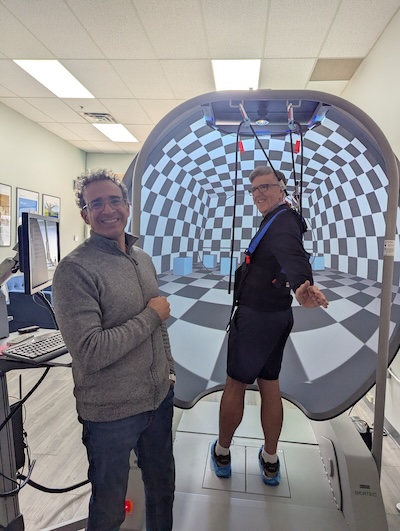
Using a force-sensing platform and virtual reality, the system, called Bertec, measures how well a patient’s brain integrates signals from three sensory systems – vision, the inner ear, and the body’s joint and pressure receptors – to maintain balance. By systematically removing or distorting each sensory input across six conditions, David can pinpoint which system is failing, rather than relying on a patient’s description of symptoms. A second test then maps how far and how confidently a patient can shift their body weight in eight directions, revealing asymmetries and neuromuscular weaknesses that may never show up on an MRI or standard physical exam. Together, the two assessments produce hard data where there was previously only guesswork, giving clinicians a precise, reproducible baseline to guide treatment and track recovery.
Originally developed for diagnostic purposes, the system allows clinicians to control both the physical and visual stimuli experienced by the patient.
Where others saw a diagnostic tool, David saw potential for solutions to what he and his colleagues were seeing in patients.
To prove his hypothesis, he began a five-year process of experimentation, iteration and validation – a research project layered onto an already demanding clinical practice. David effectively built a new therapeutic protocol from the ground up, using decades of clinical experience and his understanding of vestibular biology, the sensory network in the inner ear and brain that controls balance, spatial orientation and eye movement. The outcome was a new type of treatment: computerized vestibular retraining therapy. In a typical session, a patient stands on a platform that subtly – or, as I discovered, not so subtly – shifts or tilts while visual environments change around them.
In my firsthand experience with the process, the doctor harnessed me into the enormous half-egg device, then tracked my motion as I was surrounded by sometimes funhouse-like undulating lines projected on the inner wall. Then the floor moved beneath me. Then I was navigating an outdoor obstacle course. Then I was engaged in video game-like challenges.
It was fun, perplexing and fascinating. The science behind it, though, is absolutely serious.
According to data from David’s clinic, most patients experience reductions in dizziness and measurable improvements in balance function. Most importantly, there are significant decreases in fall risk among patients after the regimen of a dozen or so sessions.
More than 85% of patients show measurable improvement in balance and dizziness. Patients experienced a 47% reduction in fall risk. Dementia risk for patients with vestibular dizziness declined 8%. Studies found a 27% reduction in dementia risk and mortality from all causes when vertigo is treated using David’s system.
While the outcomes are dramatic, the remaining question is whether these improvements reflect compensation – relying more on vision or muscle awareness – or something deeper.
David’s research suggests the latter, that there is neuroplasticity in the vestibular system and it can be manipulated to heal. If confirmed through broader research, this would challenge a longstanding assumption that the inner ear has limited capacity for recovery once damaged.
General practitioners, ear, nose and throat specialists, and sports medicine doctors across Canada see these cases every day. What has been missing, David believes, is a reliable, evidence-based pathway to rehabilitation.
StabilityLAB, which opened in April 2025, represents an attempt to fill that gap – bringing technology used in advanced research environments into a clinical setting accessible to the public.
The system is currently unique in Canada, and the protocols developed by David and his colleagues are supported by peer-reviewed research. Expansion plans are already underway, beginning with Toronto.
Falls are a leading cause of injury worldwide, particularly among older adults. Dizziness is also associated with increased risk of dementia and early mortality. Even modest improvements in balance can translate into meaningful gains in independence, safety and quality of life. Measuring progress allows both doctor and patient to identify successes and challenges.
“For the first time, we’re able to drill down … and show people how they’ve done over time and whether they’re at risk or if they’re improving,” said David.
As complicated as the science may be, the goal is simple.
“We’re aiming to decrease fall risk and get people more active and back to their day-to-day goals,” he said.