Innovators in serving the community

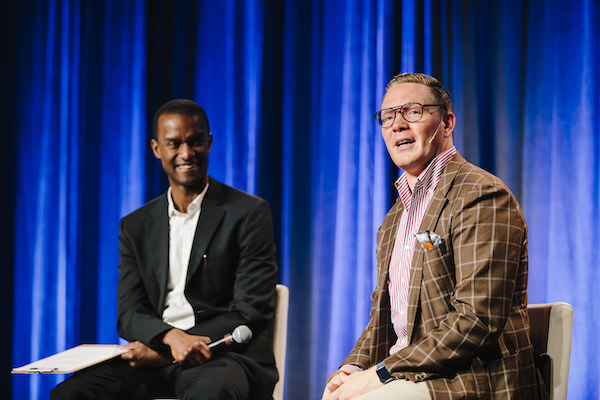
Emcee Michael Newman, left, and keynote speaker Anders Sörman-Nilsson at the Jewish Family Services Innovators Lunch. (photo by Josh Bowie)

“I believe that the next trend is not necessarily digital transformation, but it is the alignment of two of these trends: sustainability and digitalization,” Swedish-Australian futurist Anders Sörman-Nilsson told guests at the 17th Annual Jewish Family Services Innovators Lunch on May 10. Organizations that align digital transformation and sustainability have a 2.5 times better chance of being top performers, he said.

Sörman-Nilsson was the keynote speaker at the lunch, which took place at the Hyatt Regency, the first in-person Innovators since the beginning of the pandemic.

As the founder of Thinque, a think tank and trend analysis firm that reaches global brands across four continents, Sörman-Nilsson is responsible for data-based research and foresight regarding future trends. Beyond his research, he is known for co-creating the Adobe Creative Intelligence test for B2B (business-to-business) marketing. He currently hosts two social innovation podcasts, the 2nd Renaissance Podcast and Entrepreneurs Organization’s Scaling Impact Podcast, and is the author of three books, Aftershock (2020), Seamless (2017) and Digilogue (2013). Sörman-Nilsson’s approach to futurism involves seeking out what he calls “avant-garde ideas” that can drive meaningful change.

Sörman-Nilsson aims to challenge the misconception that integrating technology into an organization’s operations impedes human connection. He gave the example of his family’s business, a clothing store, which thrived on personal interaction out of a brick-and-mortar building in a “highly analogue fashion,” using a pen and paper. He said such an approach is suited “for a world that no longer exists” and that the eventual bankruptcy of the store after 104 years of business was due to the failure to adopt new technologies. He dedicated Digilogue to his parents, exploring in it “how to win the digital minds and analogue hearts of tomorrow’s customers.” He emphasized that technological tools and personable business principles can not only coexist, but enhance one another.

Sörman-Nilsson urged businesses to conduct “pre-mortem” analyses to identify changes that could prevent obsolescence or bankruptcy. He asked people to imagine that it is 2030 and your company has gone under – what were the trends you missed, what were the signs you ignored and what were the investment decisions you delayed that contributed to your company’s failure? To avoid such an outcome, he encouraged organizations to focus on “mega trends” based on the United Nations Sustainable Development Goals, such as prioritizing affordable and clean energy, responsible consumption, and improving global health and well-being. These goals are “a good indicator of where the world and smart capital is moving,” he said, and reflecting one or more of them in the product or service you provide and in your day-to-day operations and external marketing efforts is key for long-term success. “Mega trends are powerful,” he said, “but they’re particularly exponential when you sit at the intersection of two overarching aligning trends, like digitalization and sustainability.”

Sörman-Nilsson uses the UN Brundtland Commission definition of sustainability, which he described as “meeting the needs of the present without hindering future generations from meeting theirs.” He spoke about the concept of “conscious capitalism,” where an organization is purpose-driven and prioritizes stakeholder well-being. Building a sustainable “ecosystem of impact” – otherwise known as a supply chain – is crucial in winning over today’s consumers, he argued, adding that technology is the most efficient way to achieve this. Better data collection, for example, can lead to less waste, or to gauging more accurately consumer needs. In his Innovators Lunch talk, he compared such technological integration to tikkun olam, as it reflects one’s responsibility to repair the world. He also advocated for the practice of “effective altruism,” which, he said, means that “the investment of your dollar in philanthropy should go the furthest,” giving the example of investing in mosquito nets in Africa. He connected this idea – helping the most people as possible – to tzedakah, justice and charity, as well as to tikkun olam.

Sörman-Nilsson reminded the audience that major tech players are raising the bar with predictive technologies that have the power to solve problems before they arise. He challenged businesses to use technology to streamline mundane tasks, which would allow workers to focus on more meaningful and humanistic responsibilities. He emphasized the importance of merging humanism and technology to leverage the best of human intelligence and artificial intelligence. He stressed the need to “ask the right questions” and incorporate human creativity and ethical decision-making when engaging with technological tools. By doing so, he said, brands can enhance their ability to cultivate community.

Headlining this year’s JFS Innovators Lunch, Sörman-Nilsson shared his insights with more than 500 guests. Over the past 16 years, the Innovator’s Lunch has raised more than $5 million for JFS, supporting services such as food, counseling, housing and comprehensive care for children, youth, adults and seniors. Event committee chair Candice Thal said, “I believe that giving back to the community is not only a responsibility but a privilege.” This event, she said, is “our way of caring for others,” the funds raised helping JFS provide services for more than 3,000 community members.
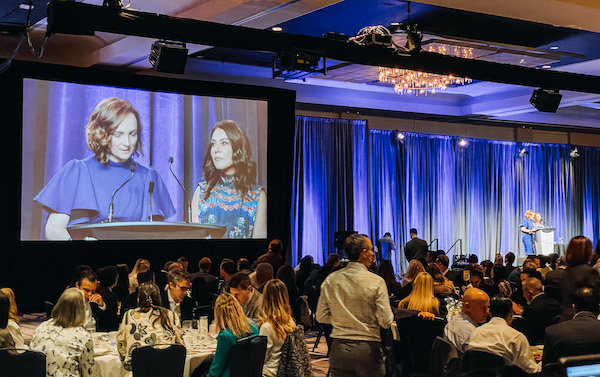
photo - Left to right: Tanja Demajo, chief executive officer of Jewish Family Services, and Innovators committee chair Candice Thal
Left to right: Tanja Demajo, chief executive officer of Jewish Family Services, and Innovators committee chair Candice Thal. (photo by MJ Dimapilis)

The event was emceed by Michael Newman of Global BC News. Following a land acknowledgement from Elder Rose Guerin of the Musqueam First Nation and welcoming remarks from Thal and Tanja Demajo, chief executive officer of JFS, there was a video entitled Building Future, Today, which showcased how JFS not only helps individuals, but their families, creating a ripple effect on the entire community and future generations. Rabbi Dan Moskovitz of Temple Sholom, who did the blessing over the meal, underscored JFS’s mission with the story of “Sam,” a man who sought the rabbi’s help after falling on hard times. “We know many people like Sam,” said Moskovitz. While change is constant, he said, some things never change: “People still get sick, they are hungry, inadequately housed, lonely and vulnerable.” He concluded, “The work of JFS, your support of Jewish Family Services, has never been more important or more necessary.”

Moskovitz’s sentiment was shared by Jody Dales, chair of the JFS board of directors, who shared how the Jewish community helped her after she tried to take her own life when she was 19 years old, living on her own and barely making ends meet at a minimum-wage job. “The blade didn’t cut deep enough to do any real damage but it penetrated enough to scare the hell out of me,” she said. “In the darkest moment of my life, the faintest ray of hope appeared, and I called my mom. And because she was part of the community, thiscommunity, her well-placed phone call set off a chain of events that tracked me into the office of a professional who saved my life. It took me years to ask for help, only days to receive it, but a lifetime to heal.”

In a very different place today, Dales said she shared her story so that people could “understand the complexities of despair, dread and depression. I doubt that there’s a person in this room for whom at least parts of this conversation don’t resonate.”

Among the tools that continue to help her, she said, “is dedicating my life to a life of service. It’s hard to feel bad about yourself when you’re making other people feel good about themselves. And there’s no agency that I know of that makes people feel good about themselves better than Jewish Family Services.”

For Dales, JFS can make such an impact because of the “intangibles” they offer – making all people feel seen and valued. “JFS is overwhelmed with need,” she said, and the only thing holding the organization back from helping more is money. She highlighted the event’s gift-matching sponsor, the Paul and Edwina Heller Memorial Fund, and encouraged people to donate. To do so, visit jfsinnovators.ca/donate.

Alisa Bressler is a fourth-year student at Queen’s University in Kingston, Ont. She is an avid reader and writer, and the online director of the arts and culture publication MUSE Magazine. Bressler is a member of the Vancouver Jewish community, and the inaugural Baila Lazarus Jewish Journalism Intern.
First Jewish Prom a success

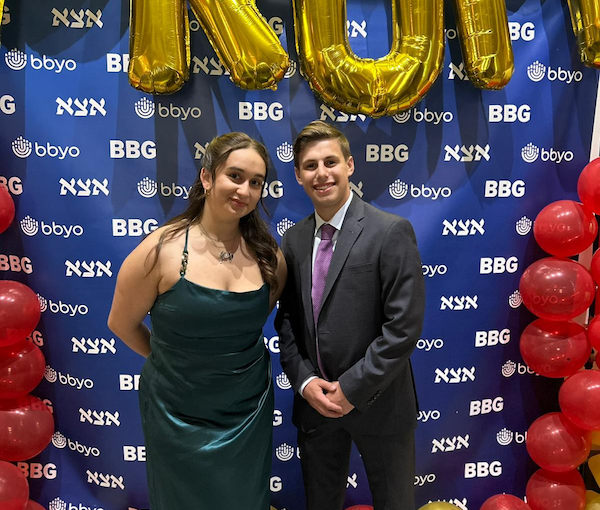
Rachel Gerber and Judah Moskovitz, regional co-presidents of BBYO Vancouver, at the first annual Jewish Prom on May 6. (photo from BBYO & JCC Teens)

BBYO, in partnership with the Jewish Community Centre of Greater Vancouver (JCC), held its first annual Jewish Prom on May 6. Organized by BBYO’s regional teen board, this inaugural event brought Grade 11 and 12 students together for an evening of celebration and connection. From the decorations to the music, the celebration not only exceeded expectations but also established itself as an annual event within Vancouver’s Jewish teen community.

From its inception to its execution, the planning process embraced BBYO’s core principles of youth empowerment and involvement – the event was planned by the teens, for the teens. The prom was held at Heritage Hall on Main Street, and the venue was transformed. It was a red-carpet theme for the occasion, complete with lights, balloons, confetti and Oscars-themed centrepieces. Teens enjoyed a snack bar, dessert bar, beverages and popcorn. There was a photobooth on site, along with carnival games, and a live DJ kept the energy up. The décor and set-up provided the perfect backdrop for the evening’s festivities.

With more than 125 students in attendance, the atmosphere was electric from the start. The DJ played a mix of popular hits and classic dance tunes. Students from various schools came together, forging new friendships and rekindling old ones as they danced, socialized and had fun.

The BBYO Teen Regional Board worked hard to ensure that the event was both safe and enjoyable for everyone. The planning process brought together teen committees, professional staff, philanthropists and other community leaders who provided guidance and raised money in support of this initiative. Staff, volunteers and professional security were on site during the event, which was alcohol- and drug-free.

“We are thrilled with the success of our first-ever BBYO prom,” said Rachel Gerber and Judah Moskovitz, BBYO’s regional board co-presidents. “Our goal was to provide an opportunity for Jewish teens completing high school to come together and reconnect, for a fun evening, and we definitely achieved that. We want to thank everyone who attended and helped make the event such a success.”

BBYO Vancouver’s Prom is anticipated to become a highlight of the annual social calendar, bringing together Jewish teens throughout the Lower Mainland, Sea-to-Sky Corridor and Vancouver Island. BBYO Vancouver is looking forward to next year’s prom, which promises to build on this year’s event. The regional board is already brainstorming ideas for new decorations, themes and activities.

In addition to prom, BBYO holds weekly teen meetings at the JCC, regular social events in Vancouver, as well as in Langley and on the North Shore. Within just a year, the regional board has engaged more than 300 Jewish teens from various Metro Vancouver high schools, an accomplishment that began with a cohort of fewer than 20 teens, primarily from King David High School.

As the regional board continues to grow, with seven emerging leaders and increasing interest in leadership roles from more teens, BBYO’s local impact expands further – notably, Moskovitz’s election to BBYO’s AZA international board as grand aleph shaliach. Working alongside a teen counterpart from Spain, Moskovitz will assume responsibility for all Judaic content and teen programming for BBYO internationally.

BBYO is a leading global, pluralistic, Jewish teen movement aspiring to involve more Jewish teens in more meaningful Jewish experiences. BBYO welcomes Jewish teens of all backgrounds, denominational affiliation, gender, race, sexual orientation or socioeconomic status, including those with a range of intellectual, emotional and physical abilities.

With a network of hundreds of chapters across North America and in 62 countries around the world, BBYO reaches nearly 70,000 teens annually. For more information about BBYO Vancouver and its teen-led board, contact Efrat Gal-Or, regional director, at bbyoteens@jccgv.bc.ca.

– Courtesy BBYO & JCC Teens

Prince George proclaims Jewish Heritage Month

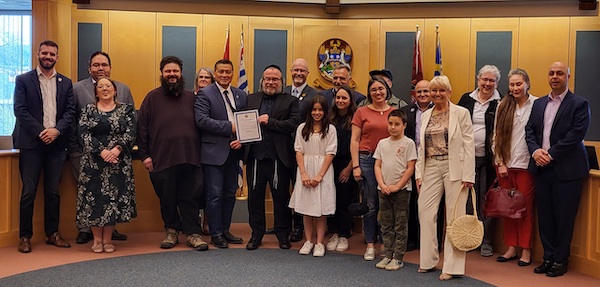
Members of the Prince George Jewish community with Mayor Simon Yu. (photo from Eli Klasner)

Members of the local Jewish community were invited to attend the official reading and proclamation of May 2023 as Jewish Heritage Month in Prince George. Mayor Simon Yu made the proclamation at the May 8 city council meeting. It read:

“Whereas: the Canadian Parliament adopted Bill S232, which designates May as Jewish Heritage Month and recognizes the significant contributions of Jews to Canadian society; and

“Whereas: Jewish Heritage Month will celebrate inspirational Jewish Canadians and educate Canadians about Canada’s Jewish community; and

“Whereas: the diverse ethno-cultural heritage of British Columbia contributes greatly to life in this province, and the Jewish population of British Columbia is approximately 30,000 people, making it the third-largest Jewish community in Canada; and Jewish Heritage Month is an opportunity to celebrate the richness of Jewish culture and traditions, and the government of British Columbia encourages all British Columbians to learn more about the history of Jewish-Canadians and to reflect on the many contributions they have made to the province.

“Now, therefore, as mayor of the City of Prince George, I proclaim that May 2023 be observed as ‘Jewish Heritage Month’ in the City of Prince George.”

– Courtesy Eli Klasner

Community milestones … Wasserman & Feldman

Theatre critic, author and actor Jerry Wasserman is the winner of this year’s Max Wyman Award in Critical Writing.

photo - Jerry Wasserman
Jerry Wasserman

The annual award celebrates critical commentary on the visual, performing and literary arts in the province of British Columbia. It is intended to honour informed and compelling writing that stimulates critical thinking, fosters ongoing discussion about the role of arts and culture in contemporary society and demonstrates the value of creative commentary in our understanding of the world around us.

The winner receives a prize of $5,000 and a gold and emerald pin designed by Vancouver artist Robert Chaplin. A mentee, named by the laureate, receives a $1,000 prize. This year’s mentee is Angie Rico, an emerging writer and media artist.

The award was established in 2017 by philanthropist Yosef Wosk to honour the career and lifetime contributions of the Vancouver author, arts critic and commentator Max Wyman. It recognizes writers who have amassed a significant body of work. Eligible subjects of criticism include the visual arts, architecture and design, theatre, literature, dance, music, film and television, as well as more general cultural commentary.

Wasserman began working as a theatre critic on CBC national radio in the mid-1980s and broadcast weekly reviews on Vancouver’s The Afternoon Show from 1987 to 2003. He has since served as theatre critic for the Province and, currently, the Vancouver Sun. About 400 of his articles and reviews have appeared in those papers; since 2004, his website, vancouverplays.com, has received more than 1.6 million visits. He taught English and theatre at the University of British Columbia for more than four decades and served as head of the department of theatre and film from 2007 to 2012. His acting resumé includes stage appearances for the Arts Club, Playhouse, City Stage, Westcoast Actors, New Play Centre, United Players and Western Gold Theatre, and more than 200 film and TV appearances, from The X-Files, Look Who’s Talking and Alive to I, Robot, Watchmen and The Last of Us.

The jury citation reads: “Jerry Wasserman’s remarkable career in many ways embodies the aims of this award. His decades as a teacher and as a performer give his writing about the theatre a sympathetic and thoughtful understanding that is expressed in language that is lively, direct and deeply informed. The jury was unanimous in its appreciation of the way he has encouraged and enhanced a wider appreciation of the richness of the Vancouver arts scene and the talents of those who make that richness possible – both through his print and media reviews and through his website, which is a consistent source of information and critical context on all things theatre in Vancouver.”

Wosk commented: “Jerry Wasserman’s voice has been a steady and trusted source of information and context about the Vancouver theatre scene for decades. He treats criticism and commentary as an integral part of the cultural fabric, and sees the role of the critic not as an antagonist to the performer and creator but as a collaborator. I am delighted that he is to receive this award.”

* * *

Brighton Feldman has been named to the U-18 Canadian National Rugby Team for a tour in the Netherlands this summer. At the school-based age group, however, team members have to pay all their own travel expenses, so Feldman has started a GoFundMe page.

photo - Brighton Feldman
Brighton Feldman

“Ever since I started playing rugby, I’ve wanted to wear the leaf on my chest,” he writes. “Now that I have that opportunity, I need a little help to get me there. I promise to work my butt off and come away with some wins. Any support is appreciated.”

Feldman is the son of Steve Feldman and Kristen Sandborn of Victoria, and grandson of Pearl Feldman of South Surrey, B.C. He is a graduate of Congregation Emanu-El Hebrew School and is completing Grade 12 at Royal Bay Secondary School in Victoria. He plays basketball and rugby for his school teams, as well as playing rugby for the WestshoreFC and, now, for Team Canada. He has previously played and captained the B.C. Bears provincial rugby team.

Next year, Feldman will be attending the University of Victoria, working towards a degree in physical and health education. At UVic, he will compete as a member of the Vikes Rugby Team.

To help Feldman represent Canada in the Netherlands, make a donation at gofundme.com/f/brighton-play-for-team-canada.

Düsseldorf returns painting

Wilhelm von Schadow’s “The Artist’s Children” (1830).

The German city of Düsseldorf reached an agreement recently with the heirs of Max Stern (1904-1987), a Jewish art dealer forced to flee the city in 1937, ending a long-standing battle over the ownership of a painting, according to The Art Newspaper, which first reported the deal.

The family portrait from 1830, “The Artist’s Children,” by 19th-century Romantic painter Wilhelm von Schadow, has been held by the city since 1959, when it acquired the canvas from a private collector. It was discovered when a researcher from the National Archives in Ottawa found it in a catalogue for a 1967 Düsseldorf Museum Kunstpalast exhibition, which listed the painting’s location as the Stadtmuseum. In recent years, the Max Stern Art Restitution Project, based at Montreal’s Concordia University, and the Dr. Max and Iris Stern Foundation sought to reclaim it, contending that Stern sold the painting under duress.

Founded in 2002, the Stern Project, headed by Dr. Clarence Epstein, is seeking to track down the 220 Old Masters and Northern European artworks that formed Lot 168 in the November 1937 sale at Cologne’s Mathias Lempertz auction house, known as Auktion 392. The paintings constituted the inventory of Düsseldorf’s Galerie Stern that Nazi officials forced him to liquidate at vastly discounted prices. As well as the 1937 auction canvases, the Stern Project is seeking to regain the paintings the art dealer left with Cologne shipping agent Josef Roggendorf, which the Gestapo confiscated in 1938, when Stern was already in Britain.

As part of the agreement, Düsseldorf handed over the portrait on condition that the municipality immediately buys it back. The terms of the settlement, including how much the city paid to re-acquire the artwork, were undisclosed.

In a press release, Düsseldorf mayor Stephan Keller said he was pleased with the “fair and just solution” between the parties and that von Schadow’s artwork “will remain in Düsseldorf.” He added that the painting will go on view at the city’s Museum Kunstpalast starting in August.

Stern took over Galerie Stern on Königsallee, which was founded by his father Julius, in 1934. By order of the Nazi government, the gallery was “aryanized” in 1937. Its inventory was sold at a forced auction for a fraction of its value.

Armed with a single suitcase stuffed with his remaining possessions, Stern fled to London that year. But, in May 1940, when Hitler’s invasion of Britain seemed imminent, Scotland Yard rounded up more than 2,000 German and Austrian citizens, mostly Jews, and incarcerated them as enemy aliens. Stern was sent to an internment camp on the Isle of Man.

Hearing that some detainees were being sent to Canada to free up soldiers guarding British camps, Stern volunteered to join them. In North America, he believed, he would be well-positioned to help his mother and one sister in Britain, as well as his other sister and her family in France. But Canada, where he was greeted by bayonet-wielding soldiers, was even less hospitable than Britain. As Stern recalled years later, “We had to stage a hunger strike to convince the Canadian authorities that we were certainly not Nazis but, on the contrary, anti-Nazi.”

Held in a camp first near Fredericton, N.B., and later in Farnham, Que., he was put to work cutting down trees. Still, he remained optimistic, thankful for the food, shelter, clothing, exercise and 20 cents per day in pay. He also welcomed the opportunity to teach. Twelve years earlier, he had earned a doctorate in art history, which he put to use in classes for his fellow internees.

Stern’s talent and positive outlook caught the attention of William Birks, scion of the Montreal jewelry family, who headed the local branch of the National Committee on Refugees. Birks was openly critical of Canada’s restrictive and antisemitic immigration policy, which he called “narrow, bigoted and very short-sighted.” He believed the government should have sent trade missions to Europe to recruit men like Stern, “not wait for them to seek and beg us.” In 1941, he sponsored Stern’s release and move to Montreal.

Needing a job and hoping to assist in Canada’s war effort, Stern looked for work in an airplane factory. When he was not hired, he turned to the thing he understood best – art. “You’ll starve,” people told him, but he was certain he could be successful as a dealer in Montreal, because he had spotted a void he knew how to fill. Most of the city’s galleries were pushing stuffy 19th-century European genre and landscape paintings. No one was promoting or selling home-grown works because, as he later explained, “Canada didn’t have any confidence in its own artists.”

Stern pitched his vision to Rose Millman, who had just opened a space on rue Sainte-Catherine called the Dominion Gallery of Fine Art. Impressed by his assurance and expertise, she offered him a job for $12.50 a week. Stern said he wanted $17.50 and her promise to make him a full-fledged partner once he built up her business by conquering Canada, as he put it, “by selling Canadian artists.”

Within months, he was mounting exhibitions by contemporary Canadian painters. Over the years, they would include John Lyman, Goodridge Roberts, E. J. Hughes, Stanley Cosgrove, Jean-Paul Riopelle, and others whose names he would play a pivotal role in establishing. Stern secured their loyalty and best work by offering them monthly retainers for an agreed-upon number of works, already an established practice in France, Britain and the United States, but not yet in Canada.

Stern’s first major coup came in 1944, when he visited Emily Carr, then 72, at her home in Victoria. She showed him a room packed with 300 paintings. Struck speechless by her talent, he asked if he could mount an exhibition.

Laughing, she replied, “You will not sell a single painting.” The recipient of critical praise, Carr had yet to enjoy commercial success. “If you let me choose the paintings,” Stern replied, “I think I can make it a perfect success.”

In 1947, Stern and his wife Iris became the sole owners of the gallery.

Following the defeat of Nazi Germany, Stern endeavoured to track down his confiscated paintings. His efforts were largely unsuccessful. He died childless in 1987, and left his estate to Concordia University and McGill University in Montreal, as well as Hebrew University in Jerusalem.

The three schools later founded the Max Stern Art Restitution Project to reclaim the estimated 400 artworks lost during the 1930s. To date, the project has recovered 24 pieces, including paintings by Otto Erdmann, Nicolas Neufchatel and Jan Brueghel the Elder.

The case of von Schadow’s “The Artist’s Children” proved to be particularly complicated due to questions of provenance. When the city of Düsseldorf acquired the portrait in 1959, it was hung in the office of the city’s mayor. Decades later, when the Stern Foundation filed a claim for the artwork, it pointed out that, in 1937, Galerie Stern allowed for the piece to be reproduced in a book about paintings of children. But Düsseldorf city officials pushed back, arguing that the book did not prove the gallery owned the artwork at that point. There was no evidence of the painting being surrendered under Nazi persecution, the city contended.

In 2017, a scheduled exhibition in Düsseldorf about Stern and the Restitution Project was abruptly canceled due to local opposition, leading to intense controversy. The city’s stance apparently softened following the 2020 municipal elections.

“We couldn’t prove that it was not a restitution case, so we, as the city government, recommended to the assembly that it should be restituted,” Miriam Koch, the Düsseldorf city official in charge of culture, told The Art Newspaper. “The big parties in the city council supported restitution.”

According to Lynn H. Nicholas’ 1995 book The Rape of Europa: The Fate of Europe’s Treasures in the Third Reich and the Second World War, more than 140,000 pieces of artwork were looted under the Nazi regime. Most of them remain unclaimed.

Gil Zohar is a writer and tour guide in Jerusalem.

קנדה גדלה במיליון איש

קנדה גדלה במיליון איש בשנה בגלל מהגרים. זאת לאור ההחלטה של ממשלת טרודו לפתוח את שערי המדינה לאזרחים זרים מכל העולם, כדי להניע את הכלכלה ולתמוך באוכלוסייה המזדקנת. ולכן כצפוי בשנה שעברה צמח מספר התושבים של קנדה בלמעלה ממיליון איש, כמעט רק בגלל המהגרים שמגיעים במספרים גדולים. המגמה תימשך לפי כל ההערכות. יש לזכור שגם היחס האוהד של הקנדים תורם לכך שיותר עולים היגרו אליה

הלשכה המרכזית לסטטיסטיקה של קנדה פרסמה בדוח האחרון שלה כי כי אוכלוסייתה של קנדה גדלה בשנה שעברה ביותר ממיליון בני אדם. מדובר בגידול משמעותי ביותר והוא נבע כמעט כולו ממהגרים ותושבי-קבע חדשים שהגיעו במהלך השנה  שעברה. מדובר בגידול האוכלוסין החד ביותר שידעה קנדה בשנה אחת אי-פעם, והוא מדגיש עד כמה הפכה ארצו של ראש הממשלה הליברלי, ג’סטין טרודו,  ליעד מועדף על מהגרים מכל רחבי העולם

לפי הנתונים החדשים, מראשון בחודש ינואר שנה שעברה ועד הראשון בינואר בשנה הנוכחית, גדלה אוכלוסיית קנדה בלא פחות ממיליון איש. ולפיכך כיום מספר האוכלוסייה בקנדה עומד על קרוב לארבעים מיליון בני אדם. בפועל מדובר בגידול של  קרוב לשלושה אחוזים. זהו השיעור החד ביותר בקרב המדינות המפותחות וכן בגוש הג’י שבע המכובד, שכולל את שבע המדינות עם הכלכלות הגדולות ביותר עולם. בהנחה שמגמה זו תימשך אוכלוסיית קנדה אמורה להכפיל את עצמה בתוך עשרים ושש השנים הבאות

לפי נתוני הלשכה המרכזית לסטטיסטיקה של קנדה תשעים ושישה אחוזים מהגידול באוכלוסיית המדינה נובע, מהגירה לקנדה של תושבים הבאים מכל רחבי העולם

כדי להניע את כלכלתה קדימה ולתמוך באוכלוסייתה ההולכת ומזדקנת של המדינה, מסתמכת קנדה בשנים האחרונות יותר ויותר על הגעתם של מהגרים. מאז עלייתה לשלטון לפני כשמונה שנים (בשנת אלפיים וחמש עשרה) של הממשלה הליברלית ברשות טרודו, הוגברה משמעותית קליטת העולים מחו”ל

מלבד הקליטה של כוח העבודה הזר, קנדה גם מנהלת תוכנית קבועה שבמסגרתה היא קולטת זמנית פליטים מאזורי מלחמה מכל רחבי העולם. ובהם מהמדינות הבאות: אפגניסטן, סוריה, אוקראינה. וכן מאזורי מוכי אסונות כמו אלה שנהרסו ברעידות האדמה ובהם  מדינות כמו טורקיה

מומחים אומרים כי מבחינה כלכלית קליטת המהגרים מוכיחה את עצמה מאוד משתלמת: מספר המועסקים במשק הקנדי נמצא בעלייה מאז חודש ספטמבר אשתקד. לפי הצהרות קודמות של הלשכה המרכזית לסטטיסטיקה הקנדית, להעסקה של עובדים שאינם תושבי קבע, יש תרומה משמעותית המגמה המתפתחת הזו במדינה. המהגרים אחראים לכמעט  לכמאה אחוז מהגידול בכוח העבודה הקנדי

לפי הערכות עד לשנת אלפיים שלושים ושש המהגרים הם צפויים להפוך לכשליש מאוכלוסייתה של קנדה. לשם השוואה, בשנת  אלפיים ואחת עשרה עמד שיעורם של המהגרים רק על כעשרים ואחד אחוזים

לרצון של מהגרים להגיע לקנדה תורמת גם התדמית שלה כמדינה שמקבלת מהגרים בזרועות פתוחות, לפחות באופן יחסי לעומת מדינות אחרות. במדד קבלת המהגרים שפרסם בחודש דצמבר אשתקד, מכון הסקרים גאלופ, דורגו הקנדים בצמרת הרשימה של אזרחי העולם הסבורים קהילותיהם הן מקום טוב למחיה עבור מהגרים. לצד זה, הלשכה המרכזית לסטטיסטיקה של קנדה מדגישה כי הגידול במספרם של תושבי הקבע והמהגרים הזמניים עשוי להציב אתגרים חדשים בפני כמה מחוזות וטריטוריות ברחבי בקנדה. זאת בכל הקשור לשיכון, לתשתיות, תחבורה ולהספקת שירות לתושבים שמספרם הולך וגדל במדינה השנייה בגודלה בעולם מבחינת שטח (אחרי רוסיה)

Garden welcomes visitors

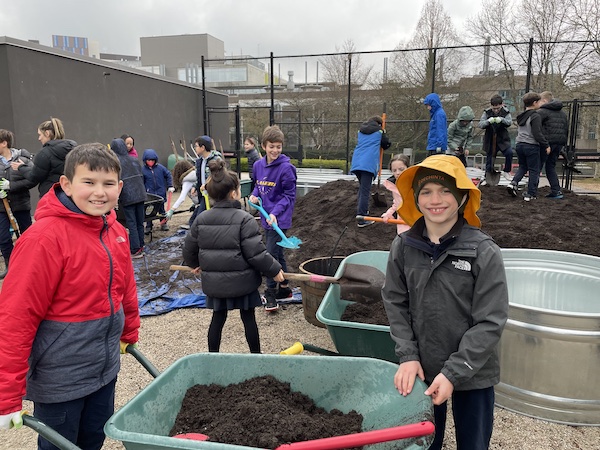
Vancouver Talmud Torah students of all ages worked together to prepare the Vancouver Jewish Community Garden. (photo from VTT)

The first few weeks of spring have been a particularly busy time for Vancouver Talmud Torah (VTT) students. Armed with child-size wheelbarrows, shovels, rakes and plenty of enthusiasm, students spent last March preparing the soil for Vancouver Jewish Community Garden. VTT’s head of school, Emily Greenberg, said the formidable task of building up the garden, which will provide crops for a variety of food security initiatives in the community, has been a big hit with the kids.

“We had every single one of our students, including our littlest 3-year-olds, coming out to the garden and helping to move soil into the planter boxes,” Greenberg said, adding that it took about a week to fill all of the planters. “At the beginning of the week, I saw a mountain that was easily over seven feet tall of dirt and, by the end of the week, they had taken it down to the ground.”

Their work paved the way for two community days in early April, in which families from throughout Metro Vancouver turned out to help.

The Vancouver Jewish Community Garden is the brainchild of three Jewish agencies: VTT, Congregation Beth Israel (BI) and Jewish Family Services (JFS). Approximately 1,800 square feet of the 6,000-square-feet garden will be dedicated to growing food to support various BI and JFS initiatives. The property will also include an education centre, walking paths and seating areas.

BI’s Rabbi Jonathan Infeld said the synagogue has been looking for ways to grow food that could support its philanthropic programs, such as the Veggie Club, which cooks up fresh soup that’s distributed through JFS, and One Heart Dinner, which provides sit-down meals to community members experiencing homelessness or food insecurity. He said the new garden will not only supply BI’s programs with freshly grown food, but serve as an outdoor classroom for its Hebrew school and for expanding community education programs.

“We will be creating and using this opportunity for our Hebrew school students to literally learn [about] Judaism connected to the land while getting their hands dirty in the garden,” Infeld said.

According to the rabbi, the garden’s unique gift isn’t just that it can teach community members how to grow food. “This garden is truly about feeding hunger, whether we are talking about those who physically hungry or those who are spiritually and Jewishly hungry as well,” he said, noting Judaism attaches communal responsibility to the act of growing food, instructing Jews to dedicate parts of their crops to those in need, a commandment that dovetails with the garden’s very purpose.

“Judaism [also] commands us to say blessings before and after every time we eat, to recognize that we are given a gift of food from God. When we go to the supermarket and we buy our food and prepare it and make it, it’s easy to forget from where it came.”

The tasks involved in building and tending this garden, he explained, also serve to remind us that food doesn’t arrive easily. “It needs a lot of hard work, it needs our interaction and it needs divine intervention” in order to feed a family. “By being involved in the farming and producing and the growing of food, our community will be able to see in front of their eyes what the Jewish laws pertaining to eating are really all about,” Infeld said.

For JFS, it made sense to support a program that produces food for community sustainability initiatives and also serves as a classroom for youth education, said JFS chief executive officer Tanja Demajo.

“The garden is a very important part of the food justice and inclusion and community engagement [programs] that we are trying to build through the Kitchen and our food initiatives,” she said. “So, it really wasn’t hard for us to lend our support and voice. It was very meaningful, and what’s even more meaningful is this opportunity to build partnerships between VTT and BI. That’s quite unique and amazing.

“It is really neat to see how we can all think through different lenses of the ways to build a community; how to put education … and community engagement and food production together and create this accessible space for everyone to participate in.”

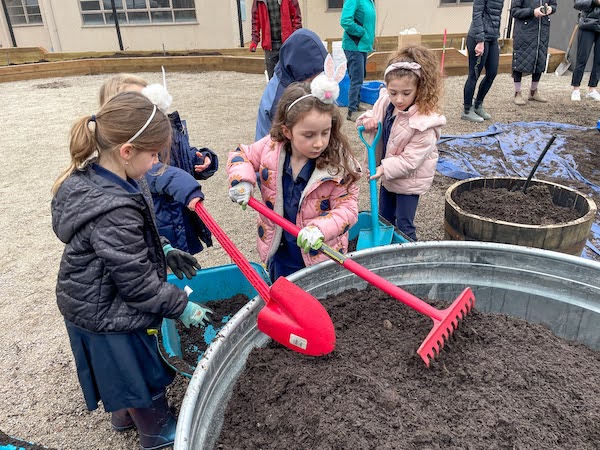
photo - Vancouver Talmud Torah students filling planters at the Vancouver Jewish Community Garden
Vancouver Talmud Torah students filling planters at the Vancouver Jewish Community Garden. (photo from VTT)

Greenberg said this may be the first project of its kind – several Jewish agencies with differing mandates partnering to create a community garden.

“That is something that we are really proud of and we hope it sets a standard for collaboration, because we are always stronger together, and we know that this is something that was only achievable because we were able to work together to accomplish it,” she said.

According to Greenberg, several founding donors played an important role in making the garden possible.

“The Diamond Foundation secured a long-term lease of this land for future development,” she said. “We would like to thank the Diamond Foundation for allowing us the opportunity to use this land for a Jewish community garden on a temporary basis.”

Greenberg said they are also grateful to the Jewish Federation of Greater Vancouver, in partnership with the Jewish Community Foundation and the Ronald S. Roadburg Foundation, for their significant financial seed gifts.

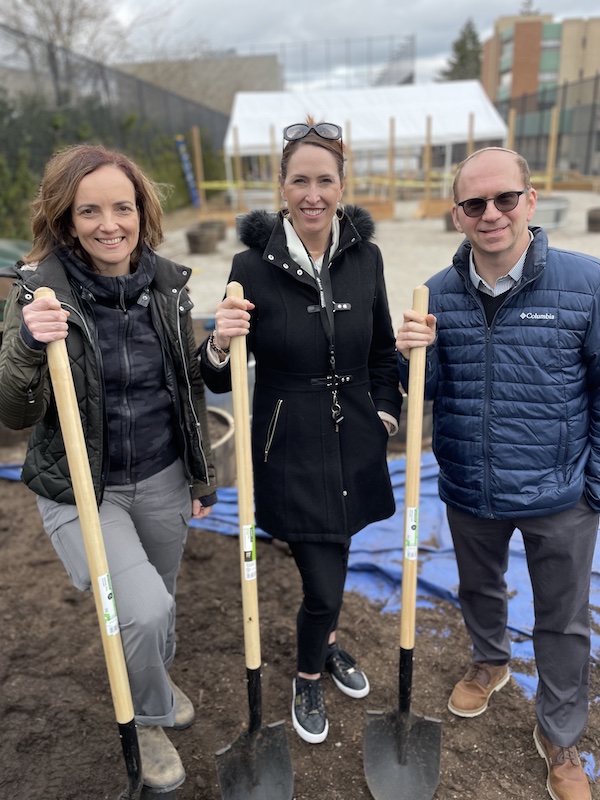
photo - Left to right: Tanja Demajo (Jewish Family Services), Emily Greenberg (Vancouver Talmud Torah) and Rabbi Jonathan Infeld (Congregation Beth Israel) contributed leadership and labour to the new Vancouver Jewish Community Garden, a joint initiative of their respective organizations. The community is invited to an open house May 28
Left to right: Tanja Demajo (Jewish Family Services), Emily Greenberg (Vancouver Talmud Torah) and Rabbi Jonathan Infeld (Congregation Beth Israel) contributed leadership and labour to the new Vancouver Jewish Community Garden, a joint initiative of their respective organizations. The community is invited to an open house May 28. (photo from VTT)

With the planters filled and seeded, the garden is now well on its way. Community members spent April planting a cornucopia of flowering plants like black-eyed Susans, purple coneflowers, sweet peas and sunflowers. Fruit trees, including apple and plum, already had been planted, along with grapes, raspberries, strawberries, and lettuces.

“Once we begin having students regularly in the garden, we will be holding lessons for all students, from rishonim (3-year-olds) to Grade 7,” Greenberg said, noting that the new classroom melds well with the school’s iSTEAM (Israel innovation, science, technology, engineering, arts and mathematics) program. “The garden gives us an opportunity to dive deep into iSTEAM and look at, for example, drip irrigation,” an Israeli invention that the community garden will be using and which is now used globally. “It’s completely transformed the agricultural sector,” Greenberg said. “So, for kids to see how innovation has come out of Israel and is then being transplanted all over the world … [it is] a very meaningful way for them to engage in learning about Israel as well.”

Finding ways to build connections to Israel is also a priority for BI. “We are always looking for opportunities to meet our goals of bringing Jews closer to God, Torah and Israel,” Infeld said. Michelle Dodek has been hired to help teach the Hebrew school students about the ancient and enduring connection between Judaism and the land.

Demajo said work in the garden doesn’t stop now that the plants are in the ground. There will still be room for more volunteers to get their hands dirty and participate in its maintenance.

“There will be a place to engage, whether it is with growing food, whether it is with programs that are more social or it’s more related to education,” Demajo said. Individuals who didn’t have an opportunity to volunteer for the build-up of the garden can reach out to Maggie Wilson at mwilson@jfsvancouverbc.ca for more information and to register as a volunteer.

On May 28, 3-5 p.m., the garden, which is located adjacent to the synagogue, will open its doors to visitors for the first time. Organizers are asking those who would like to attend the open house and fundraiser to register using the link at talmudtorah.com/vjcg, so they have an idea of how many people will be attending.

Jan Lee is an award-winning editorial writer whose articles and op-eds have been published in B’nai B’rith Magazine, Voices of Conservative and Masorti Judaism and Baltimore Jewish Times, as well as a number of business, environmental and travel publications. Her blog can be found at multiculturaljew.polestarpassages.com.

Spotting disinformation

On May 30, the Global Reporting Centre’s Peter Klein will give the talk Disinformation and Democracy. (photo from VST)

Emmy Award-winning journalist Peter Klein will be the keynote speaker at this year’s Making Meaning in a Time of Media Polarization conference, organized by the Vancouver School of Theology (VST). Klein’s talk on the evening of May 30 – titled Disinformation and Democracy – is free and open to the public.

Klein, a professor at the University of British Columbia School of Journalism, Writing and Media, also heads the Global Reporting Centre, an independent news organization based at UBC that focuses on innovating global journalism. His lecture will explore the role that disinformation plays in both confusing the public and in undermining journalism.

“Open information is central to democracy,” said Klein. “There is no open society without open dialogue. In the past, the challenge was simply to restrict governments from curtailing the media. That was a challenge in itself, but, today, there are so many forces of propaganda and disinformation, many much more subtle than dictators arresting journalists.”

The origins of disinformation go back a long way, Klein noted. He referred to a Jan. 24, 2018, message on World Communications Day from Pope Francis who spoke of the “crafty serpent” in the Book of Genesis that created “fake news” to lure Adam and Even to “original sin.”

Klein will focus his talk on more contemporary efforts to lead people astray – from Germany’s Hitler to the Russian newspaper Pravda to Iraq’s Saddam Hussein. He will first look at disinformation from a North American context, then provide several international examples.

The Global Reporting Centre recently competed a study on disinformation attacks on journalists, or what he refers to as a “special subset of disinformation.”

“Attacking the messenger is an old trick that people in power have traditionally used, but social media has made it so much easier to undermine the authority of journalists,” said Klein, who has served as a producer for 60 Minutes, created video projects for the New York Times and written columns for the Globe and Mail, among other publications.

“Publish a critical story about a politician or business leader, and there’s a chance they or their supporters will come after you any way they can,” said Klein. “What we found in our study is that those wanting to undermine media do so by attacking on basis of race, gender and a number of other factors, which vary geographically.”

Though social media is what Klein calls “the pointy end of the stick,” mainstream media has, sometimes through disinformation, become polarized, too, he said. The Dominion Voting Systems case against Fox News, ending in April when the network paid a $787 million US settlement, is a clear example. Fox had falsely claimed that Dominion manipulated the results of the 2020 American presidential election.

“Fox had to pay for this, but they’re still standing, and I don’t necessarily see much change at the network,” Klein said.

The latter part of Klein’s talk will examine ways to combat disinformation. A key element of lessening the problem comes down to “public sophistication,” said Klein.

“We’re awash in fake news, not just political but calls to your cellphone that the RCMP is going to arrest you because of unpaid taxes, ads for incredible deals on household goods that just need a small deposit to hold the item, and the classic Nigerian prince scheme. I think we’re getting better at spotting that kind of fake information, although people still fall for it on a regular basis – including me recently, when looking for a deep freezer. As the public gets more sophisticated, so do the scammers.”

The same holds true for disinformation, according to Klein, and people need to improve their ability to identify falsehoods. He spoke about the visit a few years ago to the Global Reporting Centre by a journalist who exposed that torture was being committed by Iraqi special forces fighting ISIS. Following the visit, an Iraqi graduate student arrived at Klein’s office and presented a video that portrayed the journalist as a fabulist and a torturer himself.

“It turned out this video was part of a disinformation campaign in Iraq meant to undermine his embarrassing reporting, but she fell for it. We’re all susceptible, but if we can be better educated about disinformation and better equipped to spot it, we have a chance to combat it,” Klein said.

“In many ways, we’re more powerful than those who are combating traditional heavy-handed censorship and attacks on media. My parents fled Soviet-controlled Hungary, where public dialogue that was not in line with the state narrative could get you tossed in jail. We have the agency to combat it,” he said.

photo - Rabbi Laura Duhan-Kaplan, director of the conference Making Meaning in a Time of Media Polarization, which looks at how religious communities might respond to a crisis in public discourse
Rabbi Laura Duhan-Kaplan, director of the conference Making Meaning in a Time of Media Polarization, which looks at how religious communities might respond to a crisis in public discourse. (photo from VST)

Making Meaning in a Time of Media Polarization, which will be held May 30-June 1, will be VST’s eighth annual inter-religious conference on public life. Its participants will seek answers on how spiritual and religious leaders might proceed at a time when social media, politicians and some news organizations sow polarization and cultivate outrage.

“Under COVID restrictions, our society’s stress points started to crack. We saw bad actors use media and social media to divide people, and we saw innocent, well-meaning people get drawn in,” said Rabbi Laura Duhan-Kaplan, director of Inter-Religious Studies and professor of Jewish studies at VST, who is the conference director.

“Ideally, in spiritual communities, people learn how to live a meaningful life with others. So, we started to think about how religious communities might respond to a crisis in public discourse,” she said. “We designed a conference where media experts can help us understand the crisis, and religious teachers can help us respond.”

To register for Klein’s talk – which will take place at Epiphany Chapel in-person, as well as online – visit vst.edu/inter-religious-studies-program/conference.

Sam Margolis has written for the Globe and Mail, the National Post, UPI and MSNBC.

A family metaphor

As British Columbia’s Jewish community and friends come together Sunday to celebrate Israel’s 75th anniversary – a concert at the Queen Elizabeth Theatre, capping a multitude of celebratory events over the span of weeks – no one doubts that this moment is unlike any in the short history of the state, or in the relations between the Jewish state and the Diaspora.

The General Assembly of the Jewish Federations of North America took place recently in Tel Aviv and the news service JNS headline noted modestly: “Jewish Federations’ annual conference becomes embroiled in political battles.”

It is true that the umbrella of the Federation system has generally tried to steer clear of internal Israeli politics. This is part of a larger family dynamic in which the instruments of the Diaspora are expected to not rattle the cage of Israel and Israeli officials are expected to retain a level of polite distance in commenting on Diaspora affairs. This separation has always been porous, especially when it comes to issues that directly affect Diaspora Jews, such as recognition of non-Orthodox conversions, egalitarian prayer at the Kotel and similar matters. But fears that proposed judicial reforms, and other plans of the new governing coalition, will alter the fundamental democratic DNA of the state have lowered the bar for engagement by overseas mishpachah. Indeed, weekly demonstrations in cities across North America and Europe, including in Vancouver, by the group UnXeptable represent a new wrinkle in the stay-in-your-lane status quo.

It is interesting how little criticism we have heard of this phenomenon. Time was, such behaviour would have been seen as “airing dirty laundry in public.” Israel (and Jews) have enough people criticizing them that we don’t need to add to the pile-on ourselves, the thinking has tended to go. It may be a sign of the widespread revulsion to the proposed judicial reforms themselves that have eclipsed this long-held reluctance to publicly criticize. Or it may be something more fundamental. Perhaps Diaspora Jews and Israelis are now engaging on a more equal footing.

Of course, we should not overstate our influence. Like buttinsky in-laws, we may significantly overestimate the weight of our interventions. Israeli officials have long chided overseas critics for their uninvited advice. And indications are that average Israelis don’t think a great deal about us at all.

Michael Steinhardt, the American philanthropist who cofounded the Birthright Israel program, wrote in the online journal Sapir recently that we may be seeing a complete inversion of the Israel-Diaspora relationship. The paradigm since 1948 has been that the Diaspora’s role is to “build” and “save” Israel.

“Israel is doing just fine,” Steinhardt writes. “We non-Orthodox Diaspora Jews, on the other hand, are not. ‘Supporting Israel’ has become a kind of narcotic, giving us a sense of self-worth and achievement that allows us to ignore the tempest that has put our own future in doubt.”

While Israel still faces challenges, Steinhardt seems to argue that it has evolved to a point where it can handle them on their own. At the risk of taking the family symbolism to its extreme, Diaspora Jews may be behaving like empty-nesters, their role now diminished, struggling to find a new identity.

He specifically cites assimilation, disengagement from Jewish life, declining Jewish education and synagogue attendance, which was already in decline before being pummeled by the pandemic.

“And then there’s the increasing pressure of antisemitism on campuses, city streets, and in public institutions,” writes Steinhardt. “Taken together, these constitute a well-documented existential threat to Diaspora Jewry that is far more immediate and profound than anything Israel faces today.”

It may be hyperbole to suggest that these crises facing the Diaspora, however serious, are “far more immediate and profound” than Iran’s nuclear ambitions, continuing terrorism or, perhaps, even the self-inflicted divisions caused by overreach by the new government. But it deserves discussion.

When our family members grow up (there really is no end to the metaphor), we do not give up supporting them. We continue to offer advice and wisdom – whether they want it or not.

And perhaps this is the correct lesson from the metaphor: when the once-dependent member of the family reaches a level of maturity that they can engage in an equal footing with the rest of the kinfolk, the dynamic rightly changes to a discussion between equals, in which either side is freer to offer criticism and advice, and both sides are free to take or reject it.

Surely we can all agree on this: when you reach 75, you ain’t no kid.

Hate crimes down a bit

The number of antisemitic hate crimes in Canada declined a fraction last year, according to the B’nai Brith Canada League for Human Rights Annual Audit of Antisemitic Incidents 2022. The decline, though, is from 2021, which saw the highest number of incidents since the audit began 40 years ago so, despite the marginally good news, 2022 remains the second-worst year on record. In all, 2022 saw 2,769 incidents, down 1.1% from the 2,799 incidents reported in 2021.

“When viewed from a historical perspective … the numbers are less reassuring,” Marvin Rotrand, national director of the League for Human Rights, writes in the report. “In 2012, the Jewish community sounded the alarm when that audit noted 1,345 antisemitic incidents, the highest ever since we first began auditing in 1982. Ten years later, the number is an alarming 105.9% higher than that reported in 2012, and the second-highest total since we started tracking 41 years ago.”

Aron Csaplaros, British Columbia regional manager for B’nai Brith Canada, noted the most significant finding is that the majority of hate incidents are online.

“The audit says that 74% of hate is now online and that violent incidents are down,” he told the Jewish Independent. Violent incidents across Canada dropped to 25 last year from 75 the year previous. “But incidents have been moving online in the past decade or so and it’s kind of equally, if not more, dangerous when hate is online because it’s much easier to spread, more people read it,” he said. “It’s about context. It’s obviously different than a violent incident but it is equally as dangerous.”

Csaplaros does not have a clear explanation on why violent incidents saw such a drop. It may have to do with the fact that 2022 saw slightly less incendiary conflict in Israel and Palestine, overseas problems that invariably have repercussions worldwide.

“Obviously, we’re happy that violent incidents have gone down,” he said. “Hopefully, the reason for that is that certain provinces have adopted, for example, the IHRA [International Holocaust Remembrance Alliance] definition of antisemitism, and that might have filtered down into education for police forces and how they respond and deal with these situations. But we don’t really have a theory on why the violent incidents have gone down.”

In British Columbia, the number of violent crimes declined from two in 2021 to a single incident in 2022: a threat against Victoria’s Jewish Community Centre during the annual Jewish film festival in the capital city. Other B.C. instances include 51 cases of vandalism, 53 cases of harassment and 137 cases of online hate.

Csaplaros acknowledged that it is difficult to place a number on online antisemitic incidents.

“There are, unfortunately, probably thousands, millions of anti-Israel and antisemitic comments online and, obviously, just because of the sheer number of them, we don’t catch all of them,” he said.

The criteria B’nai Brith uses to measure hate online includes the question, “Is it antisemitic in that it targets Jews as a people and attribute negative things to them? For example, that they caused COVID, or do they use antisemitic stereotypes like Jews control the banks and so on and so forth,” explained Csaplaros. “With a lot of these comments, they are clearly antisemitic.”

B’nai Brith, he said, uses the “three Ds” measure created by Natan Sharansky: delegitimization, demonization, and applying double standards to the state of Israel.

While 74% of incidents were online, 15% involved vandalism, 10% in-person harassment and 1% were violent incidents.

In British Columbia overall, incidents declined more than 40%, to 242, compared with 409 the previous year. (For the purposes of the report, British Columbia and Yukon are reported together.) Examples of B.C. incidents included in the B’nai Brith report are the Simon Fraser University student society’s passing of a resolution referring to Israeli “war crimes and apartheid” and a Tweet accusing Jews of Satan worship and seeking world domination.

“At the end of the day, hate is hate,” said Csaplaros. “It’s important to have a record of how many antisemitic incidents occurred, regardless of whether it was a Laith Marouf-type thing or a violent incident or a swastika drawn on the sidewalk. Hate and antisemitism is hate … and it’s important to record all of that.”

Laith Marouf is a Montreal activist whose Community Media Advocacy Centre received more than $133,000 in federal government consulting fees before his antisemitic social media postings became widely known, including one in which he called Jewish people “loud mouthed bags of human feces.”

Csaplaros called on the province of British Columbia to join half of Canada’s other provinces in adopting the IHRA definition of antisemitism and to follow Ontario’s lead by introducing Holocaust education into the elementary school curriculum. The core curriculum in British Columbia does not mandate any Holocaust education, Csaplaros said. Students can learn about the Holocaust in elective courses and may learn about it in core courses, depending on the teacher’s choices.

The full annual audit is online at bnaibrith.ca.