The experience of a lifetime

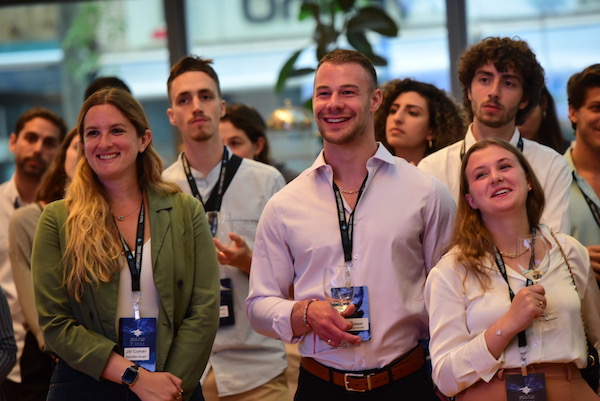
There was no question that Zac Abelson (centre) would attend the Excelerate23 Summit in New York City this past March. (photo from Zac Abelson)

“I believe my Excel journey is only just getting started,” Zac Abelson told the Independent. “The last summer and the Excelerate conference have solidified my belief that there are not only bright young leaders in the world that will one day make an incredible impact, but that the Jewish community will forever be one that is strong, defiant, welcoming and passionate.”

Born in South Africa, Abelson moved to Canada with his family when he was 8 years old. “I have now lived in Vancouver for 15-plus years, being part of the Chabad Jewish community while growing up in South Surrey,” he said. “I learned my bar mitzvah on a tape recorded by my grandfather with the Chabad rabbi and went back to do my bar mitzvah with my grandfather in South Africa.”

Last year, Abelson was one of 60 international students chosen for a Birthright Israel Excel summer internship in Israel. One of the highlights of working with Deloitte, the company with which he interned, was “getting to learn and understand how the Israeli culture conducts business and truly see the impact they have on the world without most people knowing,” said Abelson.

Birthright Israel Excel, which started in 2011, is described as a business fellowship that offers select students an internship in Israel, followed by membership in a “community of peers focused on professional development, personal growth, Israel engagement and philanthropy.”

The most exciting part about being selected for the program, said Abelson, was the people.

“Excel selects not only the best and brightest but also the most genuine and caring individuals,” he said. “Being able to spend 10 weeks in a tight-knit community made every moment a life-changing experience and every memory one I will never forget. Mix those people with all that Israel has to offer and you have a recipe for an incredible summer.”

It was “an adjustment to be surrounded by so many talented people from the best schools in the world,” he acknowledged. “One can see it as daunting, but I chose to see it as an opportunity to learn and mix with the people who will push me to be a better version of myself.”

Abelson has just completed his studies at the University of British Columbia Sauder School of Business, graduating with a bachelor of commerce. “I now work full-time in real estate development,” he said, “helping shape and grow diverse and sustainable communities.”

In March, Abelson was one of more than 300 Birthright Israel Excel fellows from around the world who gathered in New York City for the Excelerate23 Summit.

“Having had such an incredible time with the Birthright Excel community this past summer in Israel, attending the Excelerate Summit in New York City was no question,” he said. “The opportunity to again be surrounded by such incredible Jewish leaders and innovators is rare and one I wanted to take full advantage of.”

Throughout the March 24-26 weekend, attendees participated in networking, industry panels and discussions about topics such as business development, Jewish identity and Israel engagement. The summit also held workshops on combating antisemitism.

Among the events Abelson attended was one entitled Scrappy to Scaled: How Entrepreneurs Turned Startups into Sustained Multi-Figure Operations.

“This was a fantastic session where we truly got to hear the grit required to turn an idea into a reality,” he said. “What I found fascinating was listening to Nathan Resnick – seeing how, rather than conforming to the expectation of what businesspeople and investors would look for, he allows his true light and personality to shine through, ultimately getting investments in the person over the product.

“Additionally, listing to [activist and former NBA player] Enes Kanter Freedom speak about his journey from hatred of the Jewish people to now embracing the community was eye-opening. It was unbelievable to see how his deep passion for acceptance and the international community drives him every day despite all that he has had to sacrifice. It also puts into perspective the sad reality of how stuck in the past the world still is and how unwilling to speak on important issues many sporting organizations still are.”

When asked what three things he would recommend about the Excel program, Abelson said, “One, you don’t know the value of an international network until you truly have one. Excel has allowed me to since travel the world and feel comfortable knowing there will always be an Excel fellow somewhere close by.

“Two, the feeling of connecting with like-minded, passionate and bright Jewish business leaders … will fill you with joy and hope for the future of both Israel and the world.

“Three, the Excel experience is more than just adding the internship to your resumé. It’s an experience of a lifetime that everyone in interviews will be intrigued with and ask you more about. Few in the workplace have such a wonderful story to tell.”

For more information about the programs offered, visit birthrightisraelexcel.com.

Boundaries are a good thing

The house directly behind ours is for sale. This neighbourhood doesn’t have back lanes, so we look out over their backyard as well. Occasionally, when I’ve stepped outside with the dog, I encounter a family checking out that house’s yard, just beyond my fence. I always call out, smiling, welcome them and say I hope they will be our new neighbours. I’ve had several wonderful interactions, and one that gave me the creeps – the potential buyer, a man in camouflage with a woman trailing behind, left me unsettled. I took my big dog back inside and locked the door.

Our shared back fence needs to be mended. There is a tree, partly on our property, which needs to be trimmed. We never managed to meet the old neighbours, who we hear were seniors who couldn’t manage the upkeep and needed to downsize. We planned to try again to talk to the neighbours about the fence and the tree, but then the For Sale sign went up. Now we await the next occupants.

Overall, we’re delighted with the friendliness of our new neighbourhood. We took our weekend morning dog walk with another neighbour and her baby and participated in our community clean up. It’s a thoughtful place, where we help each other remember the yard waste pickup days or we look out for lost items. Yet fences exist for a reason – not just to keep dogs and kids in the yards, but also to provide us with personal space.

These encounters reminded me of Robert Frost’s famous poem “Mending Wall” and its unforgettable line “Good fences make good neighbours.” This poem (which is available online and worth reading) often springs to mind when I’m considering how to navigate in the world.

Jewish life also has lots of boundaries and reminders for how to order our lives and relationships. This is such a big part of our tradition that it’s hard to offer only one example. There are the ways we read the Torah portion each week, or how we get married or how we bury loved ones, how we are to educate our kids or how we should treat our elders. Our tradition offers us lots of structure and ideas for how we are to behave in a Jewish context.

All this came to mind when talking to a friend about work boundaries, which we’ve both struggled with addressing. She works unpredictable shifts. They sometimes seem assigned at random and she’s worked every weekend in recent memory. Her schedule isn’t dependably the same. There are weeks where she works six days in a row. Other times, she is told to go home early due to lack of work, or has several days off unexpectedly. It becomes very hard to make solid plans, like when I might see her next, or even when she can easily pick up groceries or consistently go to a once-a-week event.

I have a household that thrives on routine. For best success, we plan the heck out of things. If my kids have an afterschool activity and I’m taking them there, I’ve often thought out dinner and gotten it into the slow cooker before I start work in the morning. We have a dog that doesn’t like to be alone, a fair number of household medical appointments, and our old house is still undergoing needed renovations. We parents are spread thin! For me, having an unpredictable work meeting or emergency outing can disrupt this fragile equilibrium. Planning makes everything possible. It’s how I fit in my various paid and volunteer commitments, my kids’ and household needs, and also, I joke, my eating and sleeping.

In most Jewish practices, we’re a people of moderation, things have to be in balance. Like Frost’s poem, sometimes what makes us “good neighbours” are those walls, the boundaries we create to make structures that enable us to cope. We need structure. In religious life, we might call some of those structures rituals or behavioural expectations: derech eretz, how we are to behave towards one another. Whether it’s from the Tanakh (Torah, Prophets and Writings) or from rabbinic teachings, we’ve got a framework that helps us create those metaphoric walls.

Unfortunately, it can be hard to actually maintain our own boundaries when things get out of hand. It’s hard to stand up to a difficult work situation or a bully at school and say, “No, this is out of bounds.” Yet, most of the time, this is what we have to do to maintain our dignity and move forward. Sometimes, we have to remind others that “this isn’t in the job description” or, for kids coping with a bully, “No, I don’t have to respond when you say hurtful things. I can walk away and tell an adult.”

Good boundaries help us become better people, better workers, or even more thoughtful in our Jewish practice. However, it’s hard to find the courage to respond appropriately and draw one’s “line in the sand.”

Today, my twins went to the backyard for raucous playtime with pool noodles. They hopped on and off the deck, sparring with their imaginary swords, as they dueled and chased each other. Much later, right before bedtime, I heard that one of them saw a woman at “that house for sale.” My son demonstrated her expression of distaste as she gazed at them and his bad feeling about it – but my kids were safe in our yard as they played, laughing on our side of the fence.

Setting boundaries for ourselves, or fixing a literal fence, can sometimes mean everything. It may make good neighbours or give us orderly schedules that allow us to more calmly cope with our lives. Staying healthy and promoting our well-being might not always be wrapped up in spa days or vacations. We might promote wellness by saying no when others overstep. We can embrace structures, rituals, traditions or routines that make us feel best, allowing time for pool noodle sword play or a consistent day off work. We need boundaries in all things, work and play, because it’s the good fences that make good neighbours.

Joanne Seiff has written regularly for CBC Manitoba and various Jewish publications. She is the author of three books, including From the Outside In: Jewish Post Columns 2015-2016, a collection of essays available for digital download or as a paperback from Amazon. Check her out on Instagram @yrnspinner or at joanneseiff.blogspot.com.

Mental health concerns

Smartphones, even if you hug them, won’t hug back. It’s not revelatory, but an effective allegory to understand what’s missing with screen interactions.

Though screens replaced direct, in-person human interactions during the pandemic, by necessity, it only worsened a problem that still exists: the less real the contact, the worse the depression and loneliness.

Toronto author Dr. H. David Burstein draws this correlation in his first book, Smart Phones Don’t Give Hugs: A Guide Out of Loneliness (Talk+Tell, 2022). The book takes an in-depth look at loneliness and depression, its modern causes and how it might be alleviated.

“Humans are social creatures who have a need to connect and cooperate with others, with the purpose of being part of something bigger than themselves,” said Burstein. “We want to be needed and to know we are loved.”

image - Smart Phones Don’t Give Hugs book cover

More than two years of gathering socially via a screen have led people to lose the ability to really connect with one another in an organic off-the-web way, he said.

“Maybe we are so enchanted by the social aspect of technology that we have forgotten what it was like to shake hands or bump fists, as opposed to like, comment and subscribe. We have forgotten how to foster lasting human connections,” he said. This, he believes, has contributed to the general worsening of people’s mental health.

A Statistics Canada survey on mental health over the course of the pandemic, which was released in September 2021, found that one in four Canadians reported depression, up over the previous year from one in five. Toronto’s Centre for Addiction and Mental Health (CAMH) showed in surveys last year that loneliness and depression spiked during the pandemic and continue to be a growing problem.

In addition to his own findings, Burstein corrals some of the wisdom available from various Jewish sources, including Dennis Prager, author of The Rational Bible; Rabbi David Wolpe of Temple Sinai in Los Angeles; Abraham Isaac Kook, former chief rabbi of Israel; Rabbi Noah Weinberg, Aish HaTorah founder; and Rabbi Harold Kushner, author of When Bad Things Happen to Good People, who died only recently, on April 27.

One of Burstein’s tips is to pay attention to the signs your body is giving you.

“Just like when we’re thirsty, we drink; when we’re hungry, we eat; our emotions are not to be ignored. If we’re lonely, we need to be with people,” he said.

But an obstacle for many people is understanding that there’s a problem.

“It is difficult for people to admit being lonely because they think it means that they feel like a loser,” he said. “But I have also learned that when we are challenged, there are three ways we can react. One is to confront, second to retreat, third to ignore. My tendency had been to respond instinctively with the last two, but this time I decided to lean into the subject. It is a heavy subject requiring a lot of self-reflection, so I had to pace myself. I wrote the book for my own clarity, and to help others as well.”

Included in those “others” are his three teenage children. He is increasingly worried about their well-being, given the amount of time they spend on screens. Though quick to point out that there are benefits to screen time, moderation is key, said Burstein, and the quality of consumption is important, too.

Through the process of writing, Burstein became more aware of what, in his own life, needed work.

“I take my personal relationships more seriously,” he said. “I still worry about what tech is doing to us.”

Jonathan Wasserlauf is a freelance writer, and a political science major and law student based in Montreal.

Food insecurity at UBC affects Jewish students, too

Food insecurity is a growing problem on the University of British Columbia campus. The Alma Mater Society (AMS) Food Bank saw a 600-visit spike in the past year. Around “40% of undergraduate students and 50% of graduate students said they were worried about running out of food at least once in the past 12 months,” according to the 2022 AMS Academic Experience Survey.

In an open letter to the UBC board of governors, UBC Sprouts highlighted how “[d]espite UBC’s self-proclaimed dedication to reconciliation and equity, they perpetuate food insecurity which disproportionately affects Black, Indigenous, racialized, immigrant, low-income, houseless and/or disabled UBC community members.”

However, Jewish students are also an underrepresented minority group that is subject to this inequity.

Keeping kosher has been one of my greatest personal, physical and spiritual challenges so far in my life. Finding meals on campus that nourish myself and that are within the dietary restrictions of kashrut, all while staying true to my faith and not compromising my values, has been an uphill battle.

As one representing hundreds of Jewish UBC students, I believe there needs to be more access to kosher food on campus.

In Hebrew, the word kosher means “fit” or “acceptable,” according to halakhah, which is Jewish law. Any food grown from the earth is naturally kosher. However, any food that has been processed and prepared by humans must be carefully supervised by an Orthodox rabbi.

You can think of keeping kosher as a form of hygiene. The facility, the kitchen and production line in which a product is manufactured, processed and prepared must be kept very clean – undergoing frequent checks by an Orthodox rabbi – and must avoid cross-contamination with non-kosher food (like pork and shellfish), all with zero signs of any animal infestations (like rats).

In Jewish tradition, mixing milk (representing life) with meat (representing death) is another big no-no. For example, I cannot eat a cheeseburger or order a meal at a café that cross-contaminates dairy utensils with meat utensils. So, even a restaurant that advertises as 100% vegetarian or vegan is not officially kosher until it strictly meets the dietary, hygienic and/or rabbinical supervision requirements above.

Many vendors throughout campus incidentally sell kosher, pre-packaged snacks with a hekhsher, an official certification by an Orthodox organization approving a product as kosher. Although pre-packaged snacks are available, they do not constitute a sufficient meal on their own. There needs to be fresh kosher meals that are healthy, ready-made and affordable.

Since last summer, I have been doggedly persistent at trying to improve vendor availability of kosher food at UBC. I had been in correspondence with UBC Hillel BC, Chabad Jewish Student Centre, UBC Food Services and UBC’s VP Finance and Operations team to arrange a supplier setup and establish “requestor” contact on campus, along with a potential supplier such as the vegan Kosher Experience food truck. But UBC’s bureaucratic system has delayed this process indefinitely.

Kosher food has the potential not only to serve Jewish students, but vegan, vegetarian and Muslim students as well.

While UBC food security initiatives like the UBC Meal Share program, AMS Food Bank, Sprouts, Acadia Food Hub, Agora Café, and the residence meal plan (which has provided some kosher meals since 2020 and kosher meals can be requested in advance, but are only available at designated times for students living in select residences) offer nutritional support for students facing food insecurity, none of them provides kosher-certified meals from a kosher-certified kitchen. For example, the dining halls collaborate with UBC Chabad “to provide support and consultation on kosher food availability at UBC,” but they do not provide kosher-certified meals from a kosher-certified kitchen, according to a statement.

Regarding the plethora of options above tackling food insecurity, one UBC student remarked, “I really like the diversity that the market offers. When I was walking by, you can see a lot of different ethnic foods, a lot of foods that people would enjoy.” Yet, the diversity of food options (such as halal) and the accommodation of dietary needs (such as gluten-free foods) at UBC happens to include everything except kosher-certified meals. Or, namely, it excludes Jewish students.

For many Jewish students applying to university, kosher food is the deciding factor in their enrolment. If other top Canadian universities, such as the University of Toronto or McGill University, offer access to kosher food, then why can’t UBC?

In my personal experience living off campus, there are some days where I wake up late, rush out the door with no meal and, with no access to kosher-certified meals on campus, go hungry throughout the day. I am tired of it.

With UBC’s recent approval of allocating $500,000 toward food security programs and the AMS’s recent launch of their food security initiative, the AMS Food Bank can establish a contract with the leading Orthodox kosher certification organization in British Columbia – Kosher Check – to supervise the preparation of kosher meals (such as falafel and sandwich wraps) in the facilities of the AMS Food Bank.

While establishing and maintaining a kosher kitchen may not be feasible, having access in the Nest to a microwave, refrigerator and a dry goods rack designated only for kosher-certified meals would be the first most practical action to take.

I stand tall and proud to share my identity with others on campus. But, if there is not even any access to kosher-certified meals on campus, it furthers the marginalization of Jewish students like myself.

If the AMS and the UBC are committed to equity, diversity and inclusion, then they must commit to making kosher-certified meals accessible on campus.

Eitan Feiger is a third-year history student at UBC

Editor’s note: The original version of this letter to the editor was published in the Ubyssey.

Healthy food Harvey won’t eat

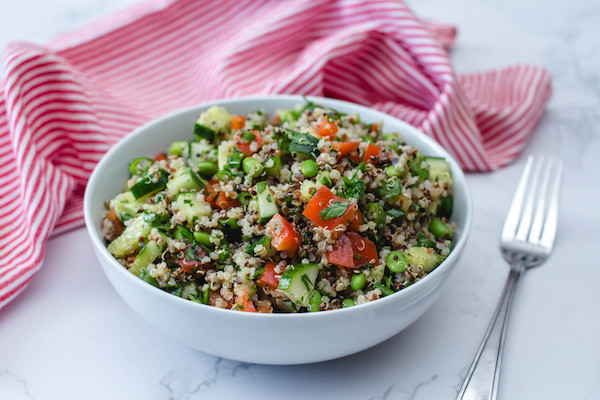
You can really put anything in a quinoa salad, depending on your taste. (photo from flickr / Marco Verch Professional Photographer)

Until recently, I had a very casual relationship with healthy foods. Neither me nor the veggies/tofu/fruit could commit. But now we’re besties. Not that I have eschewed chips, Cheezies and chocolate, by any means. I’m just branching out.

For decades, my meals could be described as culinary grenades just waiting to go off. If I tried to make something new, it was sure to result in one of two things: either Harvey or I would end up with food poisoning, or the meal would be so unspeakably disastrous that we’d have to go out for dinner or order in.

Then the pandemic happened. With restaurants closed and/or my anxiety in high gear about being around crowds who might spread COVID, we ate at home almost all the time. It came down to this: I could spend eternity eating the same three dishes, or I could start expanding my culinary repertoire (I use the word repertoire lightly). In hindsight, I could have boycotted the kitchen entirely. As it was, I was relying on Harvey to pick up the slack more than half the time, and I didn’t feel that was fair. What I’m trying to say is that I basically kitchen-shamed myself. Looking at friends’ food posts on Instagram and Facebook made me feel unspeakably inadequate. How had I gotten to my late 60s without being able to easily conjure up at least a dozen go-to dishes for dinner on any given night? That’s a rhetorical question, by the way.

Whereas I used to consider my dearth of cooking skills a life choice, now I realize how essential those skills are. Plus, I got tired of eating chicken, beef, fish. There are only so many ways to jazz up that same limited rotation. It was getting old, and so am I.

Enter quinoa, or what a nutritionist I knew once described as “the most complete non-animal protein on the planet.” It’s high in fibre, low in sodium, high in calcium, potassium, iron, magnesium and zinc. And it’s naturally gluten-free. Basically it’s a superfood. Just remember to rinse and drain quinoa well before cooking in order to remove any saponins, which have a bitter, soap-like taste.

It took awhile to be convinced of quinoa’s intrinsic goodness, especially given its unusual smell while cooking. But little by little I warmed up to it, and now it’s indisputably one of my favourite foods. Harvey, however, would rather have the combo platter of a colonoscopy and a dental implant than eat quinoa. We all make choices.

One of my favourite quinoa dishes is a simple salad that could also serve as a main dish, depending on how much stuff you add to it. To make enough for two solid meals, I’ll use about two cups of cooked quinoa (Google directions for cooking), diced cucumber, fresh blueberries and fresh mint, cut up. In the summer I add diced up mango. I’ve also been known to add canned chickpeas, diced tomatoes and pine nuts. I’ve seen recipes that include bell peppers, red onion, grated carrots, dried cranberries, and a variety of herbs. You can really put anything in there, depending on your taste. To boost the animal protein content, you could add tuna, salmon or chicken as well.

What elevates this salad to the next level is the dressing you put on it. In my pre-cooking days, I used to think that olive oil was enough to render any salad palatable. Expanding my dressing and sauces repertoire has resulted in much yummier salads. Here are four dressing options I use regularly.

HONEY MUSTARD DRESSING

1 tbsp grainy Dijon mustard
2 tsp honey
2 tbsp olive oil
juice of 1/2 a lemon
salt and pepper to taste

Combine mustard, honey and lemon juice and whisk them together. Then whisk in the olive oil. Voila!

SESAME GINGER DRESSING

1/2 tsp ground ginger
1 1/2 tbsp maple syrup
2 1/2 tbsp soy sauce
2 tsp white vinegar or rice wine vinegar
1 tsp sesame oil
1/2 tsp sesame seeds
juice of 2 limes

Whisk all ingredients together and enjoy this savoury dressing.

LEMON DRESSING

1/4 cup olive oil
grated zest from 1 medium lemon
1 tbsp fresh lemon juice
1 medium clove garlic, minced
1 tsp grainy Dijon mustard
1 tsp honey
1/2 tsp kosher salt
1/4 tsp ground black pepper

Whisk ingredients together and enjoy!

CAPER VINAIGRETTE

1 tbsp red wine vinegar
1 tsp grainy Dijon mustard
1 clove garlic, minced
2 tbsp capers, drained and chopped (or more, to taste)
3 tbsp finely chopped flat leaf parsley
1/4 cup plus 2 tbsp olive oil
1/2 tsp ground pepper
1/4 tsp salt

Combine all ingredients. This one is a very versatile dressing. I often use it on baked salmon and it’s delicious. It works well on chicken, too. I love capers, so I always add loads, but that’s a taste thing.

Check out Food and Wine magazine’s online suggestions for five ways to dress a quinoa salad at foodandwine.com/grains/quinoa/5-ways-dress-quinoa-salad. They venture into more unusual flavour profiles than I’d be willing to try, but for those of you who are more culinarily adventurous, go for it!

Quinoa is the true tabula rasa of foods, since it’s rarely eaten on its own, and it’s never usually the star of the show. It gets its street cred from its supporting cast of veggies, fruits, proteins and dressings. It can be cast for breakfasts, lunches, dinners or snacks, and it’s equally happy served hot or cold. Unlike some prima donna foods, it doesn’t complain about about uninvited guests. It plays well in the sandbox, and you rarely have to call its parents to come pick it up from school for bad behaviour. I have only good things to say about quinoa, even though it sometimes gets an undeservedly bad rap. And, bonus, it lasts well in the fridge for a good week, unadorned. Case closed. Eat your quinoa.

Shelley Civkin, aka the Accidental Balabusta, is a happily retired librarian and communications officer. For 17 years, she wrote a weekly book review column for the Richmond Review. She’s currently a freelance writer and volunteer.

חודש שלישי ברציפות של הפגנות

(photo by Roni Rachmani)

בוונקובר כמו בעשרות רבות של ערים ברחבי העולם ממשיכים ישראל ויהודים מקומיים להפגין נגד המהפכה המשפטית של ממשלת נתניהו, ובעד שמרית הדמוקרטיה בישראל. ההפגנות בוונקובר נערכות זה החודש השלישי ברציפות עד כה נערכו כבר שנים עשר אירועים, בכיכר רובסון בדאון טאון בסמוך לוונקובר ארט גלרי – בימי ראשון בשתיים עשרה בצהריים. משתתפים בהן בין עשרים לחמישים איש לכל היותר. למארגני האירוע ברור שמטבע הדברים לישראלים וליהודים שגרים כאן אין רצון להשתתף באירועים קהילתיים כאלה או אחרים, או בהפגנות הקשורות בישראל. חשוב להם להראות שגם כאן יש הפגנות תמיכה בדמוקרטיה הישראלית ונגד הצעות החוק של נתניהו ואנשיו להריסתה, גם אם המשתתפים בהן הוא מועט באופן יחסי לערים אחרות בעולם

מארגני ההפגנות בארץ ובעולם כותבים באתר שלהם בפייסבוק: “עכשיו זה הזמן. הזמן השחור. עכשיו זה הרגע לקום ולזעוק: הארץ הזאת בנפשנו היא
מה שקורה בה היום יקבע מי היא תהיה ומי אנו וילדינו נהיה. (דויד גרוסמן)

ישראל נמצאת כעת תחת מתקפה על בסיס קיומה – על הדמוקרטיה שלה. מול המתקפה הזו קמה מחאה חסרת תקדים בישראל, בקרב ישראלים רבים ברחבי העולם. בשבת נצא מהבית – מוונקובר ועד סידני כדי לקחת חלק במאבק לעצירת המהפכה המשטרית, כדי להשמיע את קולנו במלחמה על

הדמוקרטיה. תביאו שלטים ודגלים, תביאו כלים מוזיקליים.
תבואו צבעוניים. אנחנו רוצים לשתף את הקהילות הפלורליסטיות וססגונית תזמינו את החברים שלכם, את המשפחות שלכם, את הילדים שלכם, את ההורים שלכם. תזמינו חברים שאוהבים את ישראל ורוצים לתמוך המאבק שלנו על הדמוקרטיה בארץ. הפיצו ושתפו”

בן הסיסמאות שמופצות בהפגנות בוונקובר ובערים אחרות בעולם כולל בישראל: “שקרן קטן”, “בא לריב”, “מלשכת ראש הממשלה מבקשים להבעיר”, “נתנהיו הסיר את הדמוקרטיה מהקבוצה”, “עשבים שולטים”, “אף אחד לא מדבר על צדק”, “יחריב לוין”, “שמחה ואסון”, “שהמדינה תישרף”, “דיקטטורה בעזרת אשם”, “מושחתים שתו אותנו בקשית”, “צדק עזב את הקבוצה”, “חירות עזב את הקבוצה”, “חירות סוף”, “אנו מחריבים בזאת”, “אתה ואני נהרוס את העולם”, “חיקקה בנוסקר”, “השר לביטחון על הפנים”, “משנכס אדר מרביצים בשמחה”, “ישראל מתפרקת”, “אני ימני דמוקרטי”, “הועדה למינוי שפוטים”, “איך אומרים איראן בעברית”, “אל תקרע לי עם”, “ביי-טק. ההפיכהמרסקת את הכלכלה”, “ביבי איבדת את זה”, “נלחמנו למען המדינה, עכשיו נילחם עליה”, “לא יהיה כלום, כי לא נשאר כלום”, “Jוקה עכשיו”, “אנחנו חרדים!”, “שלוש רשויות: מבצעת, מבצעת, מבצעת”, “אין לכם רשות (שופטת)”, “דמוקרטיה על מלא”, “אנחנו המחנה המשותף (הרוב הדמוקרטי)”, “אחדות עכשיו”, “שלא ידע דמקורטיה”, “נבצרות עכשיו”, “מר קלקלה”, “רפורמה עושים לאט לאט. הפיכה עושים מהר מהר”, “לא לדיקטטורה! נלחמים על הדמוקרטיה”, “חובה להתנגד”

מרבית המשתתפים בהפגנות בוונקובר כו העמיתים בישראל די מיואשים ממה שקורה בארץ, משלטונו המפחיד של בנימין נתניהו, שכל שחשוב לו הוא לשמור על כיסא ראש הממשלה. רבים לא מאמינים שאפשר לחזור אחורה לשלטון אחר – ללא נתניהו. לרבים ברור שכיבוש השטים כתוצאה ממלחמת ששת הימים מצד אחד ריבוי הילודה אצל החרדים ויוצא מדינות ערב, הביאו למצב הנוכחי, שבו הימין, החרדים והקיצוניים עושים כמעט כרצונם. מספר מפגינים שחזרו מישראל סיפרו על מצב הרוח שם שהוא קודר ביותר. לכולם כמעט ברור שהאשם העיקרי במצב הבלתי נסבל הזה שמביא נזק גדול ישראל הוא נתניהו. הוא נמצא בשלטון כבר למעלה מחמש עשרה שנים