Skip to content
  • Home
  • Subscribe / donate
  • Events calendar
  • News
    • Local
    • National
    • Israel
    • World
    • עניין בחדשות
      A roundup of news in Canada and further afield, in Hebrew.
  • Opinion
    • From the JI
    • Op-Ed
  • Arts & Culture
    • Performing Arts
    • Music
    • Books
    • Visual Arts
    • TV & Film
  • Life
    • Celebrating the Holidays
    • Travel
    • The Daily Snooze
      Cartoons by Jacob Samuel
    • Mystery Photo
      Help the JI and JMABC fill in the gaps in our archives.
  • Community Links
    • Organizations, Etc.
    • Other News Sources & Blogs
    • Business Directory
  • FAQ
  • JI Chai Celebration
  • JI@88! video

Recent Posts

  • Sharing her testimony
  • Fall fight takes leap forward
  • The balancing of rights
  • Multiple Tony n’ Tina roles
  • Stories of trauma, resilience
  • Celebrate our culture
  • A responsibility to help
  • What wellness means at JCC
  • Together in mourning
  • Downhill after Trump?
  • Birth control even easier now
  • Eco-Sisters mentorship
  • Unexpected discoveries
  • Study’s results hopeful
  • Bad behaviour affects us all
  • Thankful for the police
  • UBC needs a wake-up call
  • Recalling a shining star
  • Sleep well …
  • BGU fosters startup culture
  • Photography and glass
  • Is it the end of an era?
  • Taking life a step at a time
  • Nakba exhibit biased
  • Film festival starts next week
  • Musical with heart and soul
  • Rabbi marks 13 years
  • Keeper of VTT’s history
  • Gala fêtes Infeld’s 20th
  • Building JWest together
  • Challah Mom comes to Vancouver
  • What to do about media bias
  • Education offers hope
  • Remembrance – a moral act
  • What makes us human
  • המלחמות של נתניהו וטראמפ

Archives

Follow @JewishIndie
image - The CJN - Visit Us Banner - 300x600 - 101625

Month: September 2019

Terraces in Jerusalem

Terraces in Jerusalem

Patch cultivation, or box fields, in the Judean Lowlands. Image is from the 2017 article “The Origin of Terracing in the Southern Levant and Patch Cultivation/Box Fields” by Shimon Gibson and Rafael Lewis in the Journal of Landscape Ecology. (photo from Rafael Lewis)

Rosh Hashanah is upon us and that means time for a special seder with blessings over eight different fruits and vegetables. One of the chosen fruits is the pomegranate (rimon in Hebrew), most likely because the Israeli pomegranate ripens around the Jewish New Year. Over the pomegranate, we recite the following blessing: “May it be Your will, G-d and the G-d of our ancestors, that we be filled with mitzvot like a pomegranate [is filled with seeds].”

Interestingly, the pomegranate is one of the seven species mentioned in the Torah (Deuteronomy 7:12-11:25). Jerusalem has never been considered prime agricultural land, but farmers of old actually grew pomegranates and other fruits – once they had cleared the rocky hills for cultivation.

How challenging was ancient Jerusalem’s topography and climate? Jerusalem has no natural resources (including water) or fertile land. It is situated on a range of hills running north to south between the Mediterranean Sea to the west and the Jordan Rift Valley to the east. The Hills of Ephraim extend from the Jezreel Valley southward through Shechem (Nablus) and Ramallah. The Judean Hills run southward from Jerusalem through Bethlehem and Hebron down to Beersheva. The watershed runs through the heart of the range. Jerusalem is about 800 metres above sea level; the hills to the north, Shechem, 950 metres; and, to the south, Hebron, 1,000 metres.

Today, Jerusalem’s annual rainfall is about 553 millimetres, with rainfall limited to the months of November through March. Historically, however, while there were fluctuations – including two periods of severe drought – it still appears that, until the Middle Ages, Jerusalem was receiving more precipitation than it does today.

Given that less-than-compelling physical description, it is somewhat amazing that any early people stuck around to farm on Jerusalem’s hillsides. Those who stayed applied the ancient technique of terracing, which, as Haaretz’s Nir Hasson has stated, is simply “a series of steps, with the earth held back by a wall of stones to enable tilling the mountainside.”

Setting up and maintaining the terracing, however, is easier said than done. After you manually clear the rocks (a process called izuq in Hebrew), you have to haul over a layer of fertile soil. But your preparations still aren’t complete. You then have to lug back the cleared rocks to create retaining walls. The retaining walls keep the terraces from collapsing during Israel’s rainy season. Only then could you get down to planting.

Most of the farming on the terraced areas of the Judean Mountains was done without artificial irrigation. Farmers harvested pomegranates, grapes, olives and figs watered solely by rainfall.

How do we know people used terraces so long ago? Jon Seligman, an archeologist and the Israel Antiquities Authority’s director of external relations and archeological licensing, wrote his doctorate on the “rural hinterland” of Jerusalem during the Byzantine period. He concluded that, given Jerusalem’s hilly and rocky topography, there must have been terraces. In fact, in Hebrew, the word step also refers to terrace.

Other scholars have noted that, at some Judean Mountain sites, such as Mevasseret Yerushalayim, the terraces were natural features of the landscape. That the terraces were already there did not rule out all the problems, though. For instance, archeologists discovered that the soil in this area was a different colour, implying farmers had dragged in earth from other locations. When the terrace was wide enough, the farmer worked with a plow. When it was very narrow, the farmer was forced to use a hoe or mattock.

Overall, the size of the irrigated areas in the Judean Mountains was quite small. In these irrigated terraces, farmers chose to grow vegetables, rather than to cultivate orchards. The irrigated areas consisted of three parts: construction of a storage system to hold spring water, slightly raised channels to convey the spring water and level terraces.

In the valleys of the mountains, farmers occasionally had to deal with draining off excess water caused by floods or heavy rains. They did this by extending the terracing deep into the valley. Where necessary, they built drain lines. The drain lines were built at levels lower than the channels. On a needs basis, farmers constructed stone walls to divert excess water.

There is evidence that early terracing took place initially in the lower parts of hill slopes, closer to the wadi (valley or ravine which is dry except in the rainy season) beds, which were also terraced, with newer terraces later being built further up the slopes following woodland removal.

Apparently, the chief consideration in ancient and Arab settlements in the Judean Mountains was on preserving cultivatable areas. Hence, most of these settlements ended up on mountain plateaus and adjoining ridge crests.

But how did early people come to consider terracing? For more than 100 years now, some archeologists have been suggesting box fields or patch cultivation may have sparked early attempts at terracing. Box fields or patch cultivation denote the natural step-like appearance of the rocky slopes of hills, with thin layers of chalky marl interposed between limestone or dolomite strata.

Some researchers contend that these box fields were used on deforested slopes. Shimon Gibson and Rafael Lewis write in a 2017 article in the Journal of Landscape Ecology that their appearance on Jerusalem’s hilly slopes (and in other parts of ancient Israel and Jordan) were “sufficiently broad and deep enough to accommodate the root systems of one or sometimes two trees, usually olive trees. While limited in size, they constitute leveled cultivable soils on sloping rocky ground.”

Moreover, “box fields were also recorded as a phenomenon on the hill slope of Sataf, west of Jerusalem. During excavations at this site, the remains of houses and installations dating from the Chalcolithic period (4800-3500 BCE) were found adjacent to two springs of water. Due to the very steep angle of the Sataf hill slope, there can be no doubt some form of retained fields must have existed there during that period…. Indeed, an agricultural terrace from the Early Bronze I (3330-3050 BCE) was excavated at the site, and it too may have been a development of a box field.”
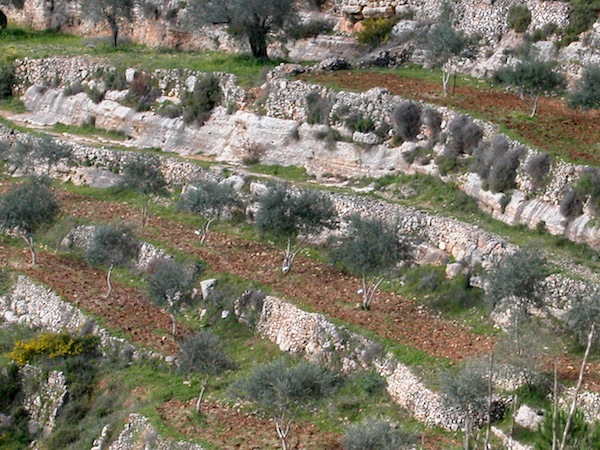
photo - Terraces at Sataf in the Jerusalem Corridor
Terraces at Sataf in the Jerusalem Corridor. (photo from Photo Archive of JNF)

About 35 years ago, at the Sataf Spring, the Jewish National Fund began to reestablish the ancient terraced fields. The organization’s purpose was to preserve the cultural heritage of terracing and to preserve the landscape. The terraces are more or less the same size as the ancient steps. The trees found at the terraces are from the original species – basically, the biblical seven species, which includes olives, pomegranates, dates, grapes and figs.

Part of the terraces have trees, which grow from rainfall only, and part of the terraces contain organic vegetables and herbs irrigated by Sataf’s springs. Spring water travels to the vegetable plots via channels. These channels are simply opened and closed by earth and stone banking. When Jerusalem has a “wet winter,” i.e. with plenty of rain, the fields are watered solely by rain.

The terraces are maintained by a small staff headed by Gidi Bashan and a large number of volunteers. The work is all done by hand. There is no mortar used in the stone walls. Consequently, heavy rains occasionally seep in between the stones, eventually pushing out the stones. The collapsed walls must then be rebuilt, one stone at a time. In addition, there are some 55 small allotments, which allow Jerusalem residents – for a token fee – to farm in their spare time.

Terracing in the Judean Mountains has altered the flow of both the spring water and the run-off water. It has largely halted the growth of the area’s natural vegetation. It has changed the course of paths and roads.

South and west of Jerusalem, Arab villages have continued to employ terracing. Thus, according to EcoPeace Middle East (formerly known as Friends of the Earth Middle East), Battir, a village south of Jerusalem, still uses irrigated terraces, which date back 4,000 years. The terraces are the product of centuries of work. With the billion collected stones “piled one on top of another, generations have engaged in traditional farming. Spring water – stored in small pools – is channeled to the terraced fields by open canals. Today, Battir families grow olives, cabbage and eggplant just as was done in antiquity.

Terraces in any given area will look different, as it depends on what on-site raw materials are available.

From the First Temple period onward, thousands of agricultural terraces were in use around the Judean Mountains. They were destroyed and rebuilt during the Hellenistic, Roman and Byzantine periods. Farmers – including Arab families, until Israel’s War of Independence – and Jerusalem residents were able to make a living from a small number of repaired ancient Jerusalem-area terraces. While terraced farming will no longer provide enough produce to feed a large and expanding population, it is hoped that some terraces will continue to be part of Israel’s cultural heritage.

Deborah Rubin Fields is an Israel-based features writer. She is also the author of Take a Peek Inside: A Child’s Guide to Radiology Exams, published in English, Hebrew and Arabic.


Format ImagePosted on September 20, 2019September 17, 2019Author Deborah Rubin FieldsCategories IsraelTags farming, history, irrigation, landscapes

Value of is and ought

Ought is one of the 3,000 most frequently used words in English. We say one ought to do something as an indication that some action is good, proper, expected or owed. The word should carries many of the same implications. In recent years, should and ought have been criticized as being negative words, engendering guilt and removing individual initiative from people. People have begun to say, “I don’t like shoulds” or “Religion is too full of shoulds.”

The contemporary psychological pushback against ought and should is rooted in efforts to help people feel better about themselves. Moreover, it is suggested that, to liberate ourselves from should statements, we must more clearly express what we want and why we want it. It is important to fill in the gap between, “You should take out the garbage,” with the reasons why such an action is desired.

In many ways, the contemporary discussion is based in the work of David Hume (1711–1776), the great Scottish philosopher. He noted that many people make factual observations, describing events or people, and then make a casual transition from statements about what is to claims about what ought to be. In his Treatise of Human Nature, Hume cautioned against using descriptive statements (about what is) as the basis for prescriptive statements (about what ought to be). For example, the observation that locally grown produce is readily available in the market and the claim that one ought to eat local are not connected. What is missing is the explanation of why eating local might be environmentally beneficial, economically justified and morally desirable. The present situation may be described as it is. But if we think that something should (according to our values) be changed, we can begin to think about how to change things that are into what we believe they ought to be.

The claim that there is a smaller Jewish community now because of the Holocaust does not immediately lead to the conclusion that one should financially and politically support the state of Israel. Making the moral claim is not enough. We must be able to give reasons to fill in the gap between the demographic implications of the deaths of so many Jews and the importance of Israel to the continuation and rebuilding of the Jewish people.

Yet ought and should are also ways of thinking aspirationally, articulating what we hope or want to be. My colleague, Rabbi Harold Schulweis, has written about the is/ought dilemma in a way that reminds us of the power and possibility of ought (and should):

“Think ought. Not what is a Jew, but what ought a Jew to be. Not what is a synagogue, but what ought a synagogue to be. Not what prayer is, but what prayer ought to be. Not what ritual is, but what ritual ought to be.

“Focus from is to ought, and our mindset is affected. Is faces me toward the present; ought turns me to the future. Ought challenges my creative imagination, opens me to the realm of possibilities and to responsibilities to realize yesterday’s dream.

“Ought and is are complementary. Without an is, the genius of our past and present collective wisdom is forgotten. Without an ought, the great visions of tomorrow fade. Ought demands not only a knowledge of history but of exciting expectation. Is is a being, ought is a becoming. Ought emancipates me from status quo thinking. Ought is the freedom of spirit.”

The Torah tradition is built around the idea of ought and should. “Barukh atah … Praised are You who commanded us” is a core concept of Judaism, critical to who we are as Jews. This idea is at odds with contemporary sensibilities that seek to discard shoulds and oughts. We recognize responsibilities, obligations, mitzvot, as essential to the building of individual character and collective community. Whether those obligations are interpersonal or directed toward the Holy One, they encourage us to look beyond ourselves to see a greater good.

Many times during the Days of Awe, we will use the words should and ought. Instead of thinking of these words as ways of placing guilt on others, let us try to explain why something – attending shul with the family, marrying within the Jewish community, giving tzedakah – is important. Let’s try to fill in the reasons for our claims of should and ought.

As well, the Yamim Nora’im lead us to see statements of should and ought as moral claims that extend beyond past history. We might hear such comments as indications of our responsible aspirations and our hopeful desires. Then should and ought can be motivational terms. They push us forward toward making the world, our society, our family and our closest relationships a bit better.

Rabbi Baruch Frydman-Kohl is rabbi emeritus of Beth Tzedec Congregation in Toronto and is a rabbinic fellow of the Shalom Hartman Institute of Jerusalem. He is the author of scholarly articles in the area of Jewish philosophy and mysticism. For more articles from the SHI, visit hartman.org.il.

Posted on September 20, 2019September 17, 2019Author Rabbi Baruch Frydman-Kohl SHICategories Celebrating the HolidaysTags Judaism, Rosh Hashanah, tikkun olam
Feminine aspects of repentance

Feminine aspects of repentance

At Rosh Hashanah, the new moon is revealed.

The Zohar, that classic mystical text from the 13th century, describes the High Holidays as a developmental process of female empowerment, which culminates in Yom Kippur.

According to the Zohar, the place we return to when we repent is our supreme mother, the Sephira, and we receive understanding from the Tree of the Ten Sephirot. Returning to our mother means to be gathered to the mother’s womb, a sort of death in order to be reborn, a self-nullification for gaining a new life.

This inversion has to do with the complex relationship between a mother and her children: she gives them life and they establish her motherly essence; she gives them life and they mark the beginning of her end, as “one generation passes and another generation comes.” Children return to their mother to understand their origin, and thus reveal their future.

Thanks to these paradoxical relationships between the generations, the mother has the power to heal, to sweeten and to explain every question and shattering in our lives.

“Returning to the mother” is not always an absolute, unequivocal and affixed teshuvah (repentance). It is a teshuvah that is coming into being, the same way that the world to come is coming into being, and the status of which is always (a world) “to come.”

According to Shaarei Orah by Rabbi Joseph ben Abraham Gikatilla, “the world to come” is also another name of the sephira (kabbalistic attribute) Understanding. Understanding is constantly giving birth to souls and, thanks to her, we are renewed and recreated every day, especially at the beginning of the year, at Rosh Hashanah.

At Rosh Hashanah, the new moon is revealed. The year begins with coverage and concealment, due to a cloud that covers the sun. In the kabbalah, the sun is the male. The moon, which is usually identified as the Shechinah (divine presence) and is also the lowest sephira, called Malchut (kingship), gets her light from him. When the sun is not shining, the Shechinah is hidden as well, and our world is in darkness. How can the light of Genesis be lit? The Zohar says:

“… Through teshuvah and the sound of the shofar, as it is written: Happy the people who know the blast. Then, O YHVH, they will walk in the light of Your presence (Psalms 89:16).

“Come and see: on this day, the moon is covered and does not shine until the 10th day, when Israel turns back in complete teshuvah and Supernal Mother returns, illumining Her. On this day, Mother embarks on Her journey and joy prevails everywhere.

“Thus it is written, Yom ha-kippurim hu, it is the Day of Atonement (Leviticus 23:27) … the verse should read Yamim Kippurim, Days of Atonements … because two radiances shine as one, Upper Lamp illumining Lower Lamp. This day, She shines from the upper light, not from light of the sun; so it is written, ba-keseh le-yom haggenu, on the covering until our festival day.”

The Zohar emphasizes that the only way to cleave the cloud is with the sound of shofar and teshuvah – both mental and supernatural ways to reach the supreme source and attract new life out of it. The Zohar teaches, symbolically, that this task is assigned on every New Year: to cleave the cloud with repentance, to cancel the decree by the voice of the shofar.

Only then, after the 10 days of repentance, will the light illumine Yom ha-Kippurim. It is a double light: that of the supernal mother (Understanding) which illumines her daughter (Shechinah), and the two will reunite into one. That is why this day is called Yom ha-Kippurim, the day of two feminine lights illumining together, without the aid of any masculine light from the outside.

According to another commentary in the Zohar, unlike at Rosh Hashanah, when the masculine God appears, exposing and lifting His left hand in a gesture of sentence and vengeance, on Yom ha-Kippurim, we realize that this same hand is meant to support Shechinah and lift her from the dust, as is written in the first part of Song of Songs: “Let His left hand be under my head.” (2:6) On this day, Shechinah, the female hero, appears as a bride and we all are her bridesmaids, accompanying her to “Mother river” of the sephira Understanding, to immerse in it and clean her from our sins.

Finally, after being atoned, the dance of sephirot culminates in Sukkot, and the celestial couple is united. The second part of the verse – “and His right hand embrace me” – is implemented, and light and happiness fill the world. At Rosh Hashanah and Yom ha-Kippurim, we pray facing Shechinah and Understanding, and their light envelops and shields us after the cloud is cleaved.

***

The Book of Zohar sees King David as “The Hero with a Thousand Faces”: the archetypal sinner, the court jester and, eventually, also the partner of teshuvah herself. In Psalms 130, King David says: “Out of the depths I cry to you, Lord / Lord, hear my voice / Let your ears be attentive / to my cry for mercy / If you, Lord, kept a record of sins / Lord, who could stand? / But with you there is forgiveness / so that we can, with reverence, serve you / I wait for the Lord, my whole being waits / and in his word I put my hope / I wait for the Lord / more than watchmen wait for the morning / Yea, more than watchmen wait for the morning / Israel, put your hope in the Lord / for with the Lord is unfailing love / and with him is full redemption / He himself will redeem Israel / from all its sins.”

This psalm begins with calling to God out of the depth, continues with asking God’s forgiveness, ends with yearning and anticipation that grow out of God’s absolution, and reaches the point of redemption and salvation. There are hidden words of praise to God and, as in other psalms, David’s ability to turn his supplications into poetry and to converse with his soul, so bound up with the divine soul, is outstanding.

According to King David, forgiveness is possible only when we are “with God,” and the mercy and redemption are in Him and “with Him” and, therefore, are in us, when we are attached to Him. The space that enables us to undergo the process of “making teshuvah” is created, and we are able to “return to the place” that is our origin and the root of our soul.

King David is not only a great poet, but also the archetypal sinner who, according to our sages, was born to set up “the yoke of repentance.” The sages deal a lot with David’s sins, justify him and even declare radically: “Whoever says that David sinned is merely erring.” (BT Shabbat 56a)

At one point, a scene is described in which David enters the Beit Midrash during a dispute about the world to come, the scholars taunt him about Batsheva and he reproaches them about a flaw in their morality: “… when they are engaged in studying the four deaths inflicted by beit din [court], they interrupt their studies and taunt me [saying], ‘David, what is the death penalty for he who seduces a married woman?’ I reply to them, ‘He who commits adultery with a married woman is executed by strangulation, yet he has a portion in the world to come. But he who publicly puts his neighbour to shame has no portion in the world to come.’” (BT Sanhedrin 107a)

It is evident that our sages were deeply engaged with questions of evil inclination, reward and punishment and, mostly, they identified with King David’s image. This colourful hero – the fighter, the fallen, the worldly, the dancer, the poet – seems to them the most likely to repent and to be fully pardoned either by men or by God. In fact, it might be said that each generation has its own King David. They see him in a different light and cast upon him their own personal traits, their fractures and their hopes to be redeemed.

The Zohar regards David as the hero with a thousand faces. David of the Zohar is poor and deficient, empty and, therefore, filling up and being a penitent (ba’al teshuvah). He knows how a man’s bruised and low soul can be elevated from the depths to a level of joy and thankfulness.

According to the Zohar, the place we return to when we repent is our Supreme Mother, the Sephira, and we receive understanding from the Tree of the Ten Sephirot. Returning to our mother means to be gathered to the mother’s womb, a sort of death in order to be reborn, a self-nullification for gaining a new life.

And what has King David to do with this feminine process? Surprisingly, the Zohar identifies King David as the Shechinah, the same Shechinah that seemingly has nothing of her own, even though the other sephirot depend on her, and she is the most concentrated and colourful of them all. David is like a hero returning from a voyage, radiating myriad lights collected from all his sins and fractures. Had they remained in the form of fractures alone, darkness would have prevailed in the world. Thanks to Understanding – the mother and the wife – they have turned into a spectacular kaleidoscope of lights.

David refuses to hide his sins. After having confessed, acknowledging his deeds and admitting them, the sin loses its form, returns into its raw essence and finally turns into praise to the Lord. God, on his part, forgives our sin and gathers us to Him. Thus, David turns his soul into a lever of teshuvah out of love. Precisely these factors – his feminine side, his majestic quality and his skill to turn a confession into praise – enable David to ascend to mother Understanding and immerse us in the river of forgiveness.

Dr. Ruth Kara-Ivanov Kaniel is a research fellow at the Shalom Hartman Institute and was ordained as a rabba by the Hartman-HaMidrasha at Oranim Beit Midrash for Israeli Rabbis in 2016. These articles are based on her originals in Hebrew and are meant to be read together. For more articles from the SHI, visit hartman.org.il.

Format ImagePosted on September 20, 2019September 17, 2019Author Dr. Ruth Kara-Ivanov Kaniel SHICategories Celebrating the HolidaysTags Judaism, kabbalah, Rosh Hashanah, women, Yom Kippur, Zohar
לעשות עסקים בישראל

לעשות עסקים בישראל

סטיבן הרפר (wikimedia)

ראש ממשלת קנדה לשעבר מנסה לעשות עסקים בישראל – חלק א’

יש לנו סינון די פשוט. כל מי שעובד איתי, עבד איתי שנים ארוכות בממשלה בצורה כזו או אחרת. אני חושב שהייתי ידוע גם בקרב תומכיי וגם בקרב מתנגדיי, בתור מי שהייתה לו אג’נדה ברורה וסט מוגדר של ערכים פוליטיים, לטוב ולרע. המבחן הפשוט שבו אנו משתמשים בכל מה שאנו עושים הוא האם זהו סוג העסקים שאני בתור ראש ממשלה הייתי רוצה להיות קשור אליהם ושהייתי מוכן להתייצב ולצאת בהצהרה רשמית לגביו, שהייתי רוצה להיות מקושר אליו ושהייתי רוצה לראות שהוא קורה. אם הוא לא כזה – בלי קשר אם הוא רע או לא חוקי או וואטאבר – אז זה לא סוג העסקים שנחפש.

כך הגדיר ראש ממשלת קנדה לשעבר סטיבן הרפר (בן השישים) את גבולות הגזרה המוסריים שלו בעשיית עסקים, בין היתר עם גופים סיניים, בראיון לעיתון “גלובס” שנערך בעת ביקורו האחרון בישראל.

הרפר כיהן שלוש קדנציות רצופות כראש ממשלה ימני שמרני, מאלפיים ושש ועד שהודח בבחירות האחרונות על ידי ראש הממשלה הליברלי הנוכחי, ג’סטין טרודו. הרפר הוא נוצרי אוונגליסט שנחשב תומך נלהב של ישראל וביקר בה כמה וכמה פעמים. בביקור האחרון כרה”מ נשא נאום במליאת הכנסת שבו אמר בין השאר את המילים הנחרצות: זו מסורת קנדית לעמוד לצד מה שעקרוני וצודק ללא קשר למה נוח או פופולרי. עמידה לצד ישראל היא למעלה מצו המוסר, היא גם בעלת חשיבות אסטרטגית וגם עניין של האינטרסים ארוכי-הטווח שלנו. עבור אומות רבות עדיין קל יותר לראות בישראל שעיר לעזאזל מאשר לחקות את הצלחתה.

לאחר התבוסה בבחירות הקים הרפר את את הרפר ושות’ – חברת ייעוץ שמעמידה לרשות לקוחותיה את רשת הקשרים שלו.

החברה מסייעת לתאגידים שפועלים בסביבה בעלת סיכון פוליטי או גיאו־פוליטי, בנגישות לשווקים ופיתוח קשרי ממשל. עם זאת, כמו ראשי ממשלה ונשיאים אחרים הוא מוסיף להיות מעורב בפוליטקה הבינ”ל. הרפר עומד בראש ארגון “האיחוד הדמוקרטי הבינלאומי” – ארגון גג של מפלגות מרכז-ימין, המקביל לאינטרנציונל הסוציאליסטי, מהצד הימני-שמרני, ומסייע למפלגות שמרניות אחיות להיבחר בארצותיהן. מזה כשנה כולל הארגון גם את מפלגת הליכוד מישראל.

בראיון דיבר על הצורך של יזמים צעירים ביד מכוונת. זה לא הדבר היחיד שאנו בהרפר ושות’ עושים אבל רבים מלקוחותינו הן קרנות השקעה, חלקן בתחום הטכנולוגיה, והסיפור פה בישראל שונה. מבלי להעליב, רוב הזמן אתה פוגש בניעשרים ושלושים חכמים וכו’, אבל אתה יודע – יש להם עוד הרבה מה ללמוד בחיים. זו חלק מהסיבה שהם מעסיקים אותנו. הם זקוקים לפרספקטיבה הרחבה. אך לעומת זאת, במקרה שלנו, כשאנו מתעסקים עם ישראלים מנוסים יוצאי מערכת הביטחון הם בשלים ומקצועיים, ואנחנו עובדים איתם כדי להפיק הזדמנויות עסקיות, אז זה בהחלט תחום מרתק.

עניין שמוסיף הרפר לגלות בפוליטיקה העולמית לאחר פרישתו קיבל ביטוי משמעותי גם עם פרסומו של הספר שכתב בשם “כאן ועכשיו: פוליטיקה ומנהיגות בעידן השיבוש” – משחק מילים באנגלית אותו ניתן לקרוא גם כ”ימין כאן וימין עכשיו”. הספר מנתח את הסיבות לעליית הפופוליזם ובראשן בחירותו של נשיא ארה”ב, דונלד טראמפ והברקזיט בבריטניה. את הספר, שאותו הרפר עצמו מתאר כמדריך למדינאות שמרנית בעידן הפופוליסטי, תיאר השבועון הקנדי “מקלינז” כמעין מתכון לשיפוץ המצע הרפובליקני בארה”ב, שבו הוא מתרה בהנהגה הרפובליקנית למצוא דרכים לשמור את הקולות המתנדנדים שהעלו את טראמפ.

Format ImagePosted on September 18, 2019September 17, 2019Author Roni RachmaniCategories עניין בחדשותTags business, Israel, Stephen Harper, ישראל, סטיבן הרפר, עסקים
Marriage no fairy tale

Marriage no fairy tale

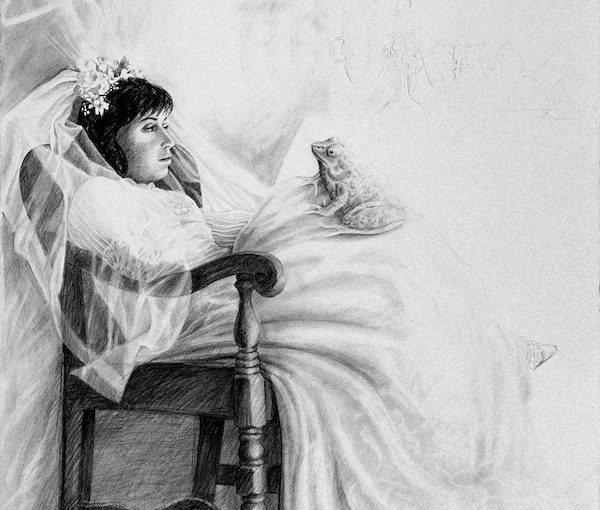
“Kiss! Kiss! Kiss!” by Lilian Broca is part of the exhibit Brides: Portrait of a Marriage, which is at the Italian Cultural Centre’s Il Museo until Sept. 30.

In most romance novels and fairy tales, a love story ends in a wedding and the couple lives “happily ever after.” In real life, it’s not that simple. Marriage has its challenges.

The show Brides: Portrait of a Marriage, which opened at the Italian Cultural Centre’s Il Museo in Vancouver this summer, examines some of the aspects of marriage that fairy tales purposefully omit. The show incorporates the works of several local artists in different media: textile art by Linda Coe, photography by Grace Gordon-Collins, drawings by Jewish community member Lilian Broca and a tapestry by fellow Jewish community member Barbara Heller.

“I always wanted a show about brides,” Angela Clarke, curator and director of Il Museo, told the Independent. “We have weddings at the centre almost every week. There is so much energy, so many emotions. But the Roman goddess of marriage, Juno, was not a happy woman. Hers was not a happy marriage, and the controversy attracted me.”

Brides is part of the museum’s Gendered Voices series, and looks at marriage from a woman’s perspective.

“This exhibition places the institution of marriage under the looking glass,” said Clarke. “Each participating artist tackles the deep psychological complexity and immense social pressure involved in a traditional marriage. Historical perspectives and family dynamics, personal reflections and the impact of feminism are explored in the show.”

Each artist contributed her own personal outlook. Coe’s fabric panels belong to her Dirty Laundry series. Colourful and sophisticated-looking hangings were all created from fabric snatches that were once parts of women’s dowries, used and reused for several generations before they ended up in the artist’s stockpile.

“The eight fabric panels represent eight stages of a woman’s life,” explained Clarke. “Each one incorporates relevant texts from Renaissance romance novels and etiquette manuals. In the 16th century, such manuals were very popular in Italy, especially among the middle classes. They were written to instruct young brides in the proper comportment, in the ways to become a successful bride and mother.”

In addition, those eight panels reference the eight requisite parts of a romance novel, from the Middle Ages to the modern Avon romances. “Those stages have names, the same names as the panels,” Clarke said. “No. 1, Stasis (infant). No. 2, Trigger (young girl). No. 3, Quest (betrothal). No. 4, Surprise (courtesan). No. 5, Critical Choice (bride). No. 6, Climax (wife). No. 7, Reversal (matron). No. 8, Resolution (widow). Every love story published these days must follow this structure.”

Heller’s tapestry and Gordon-Collins’s photographs explore wedding dresses and the commodification of weddings. The tapestry shows a bride in a beautiful dress, but her face is blurry, unimportant, and the dress becomes the focal point, a uniform, a symbol.

The photos, in the photogram or X-ray style, lack faces altogether, only the wedding attires of four generations of women of the artist’s family can be seen.

“Grandmother’s wedding tunic was modest, especially in comparison to the artist’s daughter’s wedding dress, much more opulent and sensual, and designed for one-time use only,” said Clarke. “Here, we can trace how, through the generations, the weddings grow into an industry, and the wedding accessories become commodities.”

While neon-bright colours dominate Gordon-Collins’s images and Coe’s collages shimmer with the patina of gold, Broca’s contribution to the show is a sequence of stark black and white lithographs, all from her Brides series.

“My mother passed away in 1989,” Broca said, as she explained the roots of her series. “I was devastated by her death, although it was a blessing after suffering for years from cancer. Soon after her passing, I started dreaming about her as a young bride. I decided to draw my dreams.”

Her drawings reflect the dichotomy between the happily-ever-after concept and the fact that most marriages in the past were arranged, and not unions of love.

One of the drawings, “Kiss! Kiss! Kiss!” depicts a bride sitting in a chair, regarding a frog in her lap. A few more frogs – potential princes? – wait at her feet, expecting her to choose between them.

“I knew my bride would not kiss that frog,” said Broca. “So I added several other potential grooms. Some small, others big…. Still, I had a feeling she would resist them all.”

The work “Upon Reflection” is even more powerful. It shows a bride in a gown and veil looking into a full-length mirror. The image in the mirror depicts the bride, face and posture serene, as befits the occasion, but Broca has left the image of the bride herself white and, from within it, there is the drawing of a woman, the bride, trying to escape.

“That woman, upon reflection, discovers how much she doesn’t wish to be married, to be tied down. What happens next is up to the viewer’s imagination,” said the artist.

For Broca, black and white was the only possibility for the series. “It was the most appropriate way to describe what I felt…. After the first two or three drawings, I began to realize that many brides were not happy at the altar – I showed them. Only a very few happy brides appear in my drawings. Not because happy brides are a minority, but because happy brides are difficult to portray without slipping into a less-than-powerful mode. I may be wrong, I may be able to do it today, but, at that time, it didn’t seem possible.”

Clarke knew about Broca’s series and wanted to include it in its entirety in the show, but that wasn’t possible. “We couldn’t include so many that Angela wanted because they had been sold,” said Broca. “We couldn’t borrow them. The owners live in the U.S. and Eastern Canada. As it is, the two works in the exhibition were borrowed from local owners.”

Brides is at the Italian Cultural Centre until Sept. 30.

Olga Livshin is a Vancouver freelance writer. She can be reached at [email protected].

Format ImagePosted on September 13, 2019September 10, 2019Author Olga LivshiCategories Visual ArtsTags Angela Clarke, art, Barbara Heller, Brides, Il Museo, illustration, Italian Cultural Centre, Lilian Broca, tapestry, women
Yiddish Fiddler draws crowds

Yiddish Fiddler draws crowds

Steven Skybell and Jennifer Babiak in the Yiddish version of Fiddler on the Roof, which is slated to run through January 2020 in New York City. (photo by Matthew Murphy)

It’s no wonder the current Fiddler on the Roof on stage in New York City has been extended several times since it debuted Off-Broadway last summer. The immense draw isn’t just the splendid choreography, the well-known beloved music, the compelling, stellar cast, the emotional dialogue – it’s the authenticity that strikes a chord. Based on a collection of vignettes by Yiddish literary icon Sholem Aleichem, this production of Fiddler is entirely in Yiddish, the guttural tongue that the people on whom the characters are based would have used in real life.

This is the first time in the United States that Fiddler is being staged in Yiddish. Directed by the venerable actor Joel Grey, it opened at the Lower Manhattan’s Museum of Jewish Heritage in July 2018 and transferred to the more commercial Stage 42 near Times Square in February 2019. It’s expected to run through January 2020. It has both English and Russian supertitles.

“When Fiddler on the Roof in Yiddish first premièred last summer for a limited eight-week run under Joel’s vision, it was a show that moved people to tears and I knew it had to be seen by as many people as possible,” producer Hal Luftig told the Independent.

Set in 1905 in a Jewish shtetl in the town of Anatevka, on the outskirts of czarist Russia, Fiddler is centred around Tevye (played by Steven Skybell). He’s a poor dairyman with a wife and five daughters. Three of his daughters are of marrying age and the expectations are a matchmaker will find them a husband.

But, despite tradition, the strong-willed girls have their own idea of who they want to marry – and it’s all for love. Their marital choices give Tevye plenty of tsouris (aggravation). Eldest daughter Tsatyl (Rachel Zatcoff) marries a poor tailor in need of a sewing machine. Second daughter Hodl (Stephanie Lynne Mason) falls in love with a penniless Bolshevik revolutionary who winds up in Siberia. And though Tevye convinces his wife, Golde (Jennifer Babiak), that it’s OK to break from the matchmaker tradition, it is too much even for him when his third daughter, Khave (Rosie Jo Neddy), falls in love with a gentile – he banishes her from the family, declaring her dead.

Meanwhile, the political climate is very antisemitic. There are pogroms, and the czar is expelling Jews from the villages. At the end of the musical, the Jews of Anatevka are notified that they have three days to leave the village or they will be forced out by the government.

The original Broadway production opened in 1964 and, in 1965, won nine Tony Awards including best musical, best score, book, direction and choreography. Zero Mostel was the original Tevye. The music was by Jerry Bock, lyrics by Sheldon Harnick and book by Joseph Stein. The original New York stage production was directed and choreographed by Jerome Robbins. In 1971, there was a critically acclaimed film adaptation that garnered three Academy Awards, including best music.

The Yiddish translation was originally performed in Israel in 1965. It was crafted by Shraga Friedman, an Israeli actor who was born in Warsaw, escaped the Nazis in 1941 and settled in Tel Aviv.

In the New York production, the set design, credited to Beowulf Boritt, is simple. The word Torah (in Hebrew) is painted across the main banner and is torn apart and sewn back together as a symbol of what the Jewish people have endured.

From the very start, the audience gets drawn in when the cast forms a circle and sings “Traditsye” (“Tradition”). Another familiar tune – “Shadkhnte Shadkhnte” (“Matchmaker Matchmaker”) has the audience moving in their seats. While most of the music and lyrics are basically the same, there are some changes. “If I Were a Rich Man” becomes “Ven Ikh Bin a Rothshild” (“If I Were a Rothschild”).

While most of the cast is Jewish, some are not, and very few of the actors actually knew Yiddish before the show. Jackie Hoffman, who brilliantly plays Yente the Matchmaker, grew up with some Yiddish in her home but was far from fluent in it.

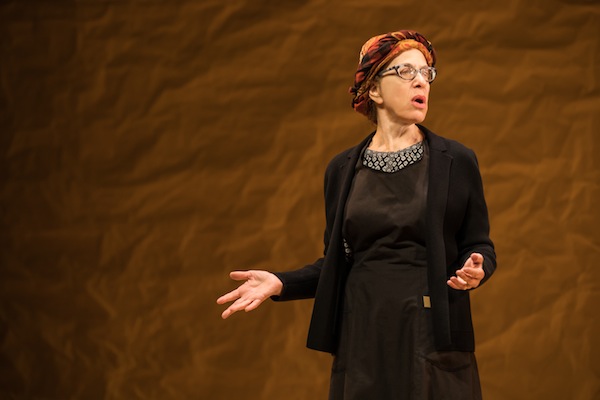
photo - Jackie Hoffman plays Yente the Matchmaker
Jackie Hoffman plays Yente the Matchmaker. (photo by Matthew Murphy)

“I didn’t learn the language for my role, I learned my lines,” admitted Hoffman, who grew up on Long Island, N.Y., in an Orthodox home and attended a yeshivah for nine years. “It was difficult, but when I’m hungry to learn a role, that helps a lot. We have great coaches who are relentless. I did hear Yiddish in the house growing up, my mom and grandmother conversed, and I’m now grateful for every word I’ve learned.”

Hoffman and the cast were taught the language phonetically. Many had seen Fiddler performed in English in various theatrical productions, as well as the film. “It feels bashert this is the first production of Fiddler that I have ever been in and it is clearly the most meaningful,” said Hoffman, who has been in dozens of television shows and films, including Birdman, Garden State and Legally Blonde 2. “It merges the Jewish part of my life with the career part,” she told the Independent.

It is hard to leave the theatre without thinking of the similarities between Tevye’s Anatevka and many parts of the world today, including the United States. Jewish traditions are often challenged and antisemitism is once again on the rise.

“I don’t think that antisemitism ever went away, but it is a very scary time now,” said Hoffman. “It is mind-blowing how current the piece feels in that way.”

At the end of each performance, it’s clear by the enthusiastic applause and the long standing ovations, that the audience feels they have experienced something great. “They seem blown away by it,” said Hoffman. “They are impressed that we’ve pulled off a three-hour musical in Yiddish and they’re staggered by how pure and emotional an experience it is.”

At Stage 42 on 422 West 42nd St. in Manhattan, Fiddler on the Roof in Yiddish runs just under three hours with one intermission. For tickets, call 212-239-6200 or visit fiddlernyc.com.

Alice Burdick Schweiger is a New York City-based freelance writer who has written for many national magazines, including Good Housekeeping, Family Circle, Woman’s Day and The Grand Magazine. She specializes in writing about Broadway, entertainment, travel and health, and covers Broadway for the Jewish News. She is co-author of the 2004 book Secrets of the Sexually Satisfied Woman, with Jennifer Berman and Laura Berman.

Format ImagePosted on September 13, 2019September 16, 2019Author Alice Burdick SchweigerCategories Performing ArtsTags Fiddler on the Roof, Jackie Hoffman, musical, New York, theatre, Yiddish
Survivor dances duet of life

Survivor dances duet of life

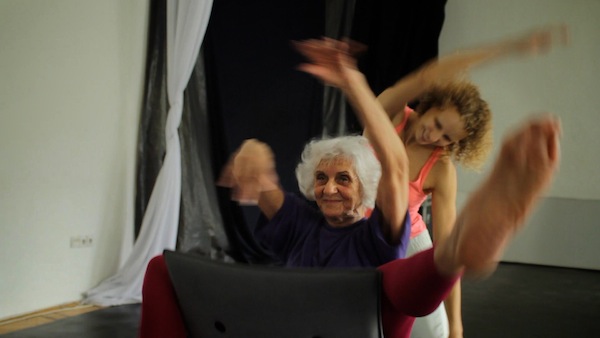
Éva Fahidi, in front, and Emese Cuhorka in a still from The Euphoria of Being, directed and written by Réka Szabó.

Éva Fahidi was 18 years old when she and her family were taken to Auschwitz. The men and women were separated. The women’s selection committee cut the line after Fahidi: “I went one way, and my whole family the other way. It was over. We are talking about a fraction of a moment, when one didn’t even have the faintest idea of what was really happening.” Forty-nine members of her family were murdered, including her mother, father and sister.

Fahidi tells this part of her story as dancer Emese Cuhorka, covered from head to toe in a black leotard, moves around her, expressing with her body some of what Fahidi is expressing verbally. This is but one of many moving scenes in The Euphoria of Being, written and directed by Réka Szabó. The Jewish Independent has chosen to sponsor the documentary’s screening at this year’s Vancouver International Film Festival, which runs Sept. 26-Oct. 11.

Szabó had heard Fahidi give a talk in Berlin, and she had read Fahidi’s memoir, The Soul of Things. She wrote to Fahidi about wanting to make a performance about her, with her it in. The almost-90-year-old Hungarian Holocaust survivor responded positively: “Every person should possess some form of healthy exhibitionism,” she says in the film. “I have more than is needed, so I don’t have any excuses.”

Cuhorka reminds Szabó of Fahidi. From this resemblance came the concept of a duet. At one of the first rehearsals, Fahidi shows Cuhorka what she’s able to do physically. “And, from the outside, it is like seeing an entire life at once,” says Szabó, as she watches them move together.

photo - Réka Szabó
Réka Szabó (photo by Dusa Gábor)

The documentary covers the three-month period prior to the October première of what would become Sea Lavender. The work is the collaborative creation of the three women and, while what we are shown of the final result is powerful, it is the process and the bonds formed by the women that have the most impact, and give the film its inspirational quality.

Fahidi is remarkable. She is smart, spirited, well-spoken and endearing. When she talks about her Holocaust experiences, it is as if she is reliving them; her eyes look unfocused, her body appears heavier, her anger remains. She says her family should have left Hungary in 1935. “But my poor father, he couldn’t see beyond his nose,” she says. So proud was he of what he had built, he couldn’t leave it behind and only go with the clothes on his back. “This is the eternal tragedy,” she says, “that you don’t see things for what they are when you see them. Absolute idiocy.”

The film then cuts to a photo of the family – her parents, sister and her – as Fahidi describes the way in which she imagines them being gassed. She talks about a documentary she saw on Zyklon B, how it was first tried on geese. Such factual expositions lay raw the depth of her grief.

Yet, when Szabó asks Fahidi to list some of the things that helped her survive, Fahidi remarks that you have to appreciate and value the fact that you’re alive. “The fact that you exist, in itself, is euphoric,” she says. Hence, the name of the documentary and of the choice of “the flying chair duet” as the final scene of the performance. In discussing the nature of tragedy, Fahidi concludes that it’s no use thinking about it because you always end up in the same sad place. “Meanwhile,” she says, “you live happily.”

Seeing Cuhorka and Fahidi work and perform together is delightful – the two really do bear similarities, and their mutual respect is evident. The closing text of the film notes, “At the age of 93, Éva is still performing regularly. So far, we have staged 77 performances of Sea Lavender in numerous cities, such as Berlin, Budapest and Vienna.” While it is too much to hope that the show will come to North America, it is satisfying to know of the project’s life-changing effect on Fahidi, who, apparently, “can’t imagine being alive and not performing the piece anymore.”

The Euphoria of Being screens Sept. 27, 12:30 p.m., at International Village 8, and Oct. 3, 7 p.m., and Oct. 4, 10 a.m., at Vancity Theatre. For tickets, visit viff.org.

Format ImagePosted on September 13, 2019September 10, 2019Author Cynthia RamsayCategories TV & FilmTags dance, documentary, Emese Cuhorka, Éva Fahidi, Holocaust, memoir, Réka Szabó, survivor, Vancouver International Film Festival, VIFF

Canada is not “broken”

An opinion poll released last week indicates that 52% of Canadians agree with the statement that our society is “broken” – a spike of 15 points over three years ago – while just 19% of respondents disagreed with the statement.

The poll, conducted by Ipsos and provided exclusively to Global News, also suggests that two-thirds of respondents believe the economy is rigged to benefit the rich, while 61% agreed with the statement that “traditional parties and politicians don’t care about people like me.” Commentary provoked by the poll has focused on the portent these results have for a surge of populist parties or ideas in the coming federal election.

It should not be a surprise, perhaps, that people think the economy benefits the rich or that politicians have at heart the best interests of people other than little-old-us. We have been complaining about our politicians since the profession was invented and probably every one of us, no matter where we fall on the income scale, thinks we’d be doing better economically if it weren’t for some systemic force or policy that prevents us from getting ahead.

The really provocative result in this poll is the perception apparently held by more than half of Canadians that our society is broken. Admittedly, the question is ill-formed. What does “broken” even mean in this context? Regardless, the idea that we live in a broken society probably says more about the individual respondents than it does about our society as a whole. Canadians are among the most privileged, advantaged, wealthiest, healthiest and least oppressed people in the world. With some grievous historical and contemporary exceptions, Canada is one of the most egalitarian societies on earth.

We may dislike our politicians or have misgivings about this or that development, but for a poll to suggest that half of Canadians think this is a broken society makes us wonder if we are a country of naïve and entitled people. It would be instructive for Canadians who feel this way to take an eye-opening trip almost anywhere else in the world.

This is not to dismiss the very real cases of injustice, inequality or other systemic problems our country faces, but this poll indicates that half of Canadians don’t have the faintest idea how fortunate most of us have it here.

It also creates the potential for some very concerning political consequences. If Canadians march into the polling booth next month certain that this is a broken society, it is anyone’s guess what kind of ideas they might be willing to support to “fix” it.

Posted on September 13, 2019September 10, 2019Author The Editorial BoardCategories From the JITags Canada, elections, lifestyle, politics, survey

Roll out welcome mat

Bill 21, Quebec’s law that forbids most public employees from displaying any religious symbols like a turban, a Magen David or a hijab, may become an issue in the federal election. On CBC Radio’s political program The House last weekend, MPs representing the Liberal, Conservative and New Democratic parties all took effectively the same position: the law is discriminatory but provinces have the right to proclaim their own laws and, what’s more, the Constitution’s notwithstanding clause means Quebec can pretty much do whatever it wants.

There is a political calculation in all this, of course. Many Quebeckers support this law and any federal party needs to appeal to a chunk of these voters in order to succeed in the province during next month’s vote. As a result, party leaders are mostly making the right noises about this discriminatory law, while hoping to move on to the next topic ASAP.

With federal leaders basically throwing up their hands on the issue, which calls into question the most fundamental rights of Canadians of all religions, what can be done?

One individual interviewed on the program is a teacher who is Sikh. Her choice was to move from Quebec to British Columbia, where she could continue her chosen profession without diminishing her religious beliefs, which include wearing a turban.

If federal leaders will not act forcefully, perhaps leaders in the provinces outside Quebec can do something. Throughout history, Canada has been enriched by refugees and immigrants who sought freedom and opportunity – our gains roughly equating the loss to their places of origin. Why not apply the same principle to inter-provincial relations?

Perhaps provinces like British Columbia should roll out the welcome mat for teachers, school administrators, wildlife officers, Crown prosecutors and other civil servants from Quebec who no longer feel welcome there. Actively recruiting these experienced professional people of different cultures and religions would strengthen our communities and send a message to Quebec that cultural difference is an asset, not a liability.

In the absence of forceful federal leadership on this front, it would be encouraging to see provincial governments stepping up where they can.

Posted on September 13, 2019September 10, 2019Author The Editorial BoardCategories From the JITags Canada, diversity, economics, employment, immigration, politics, Quebec, racism

Apple-picking and tzedakah

My family helped pick a neighbour’s apple tree on Labour Day weekend. It was heavy with fruit. I love this activity, as it connects us viscerally with the changing season. It also connects with the beginning of the Torah portion Ki Tavo (Deuteronomy 26:1-29:8). This portion instructs the Israelites to give some of their first fruits to the priests for the divine altar and, also, to give 10% of their harvest as a tithe, for those who are less fortunate.

Even though we make applesauce, apple chips, apple crisp and eat lots of fresh apples, we always pick more than we can use. It gives us a chance to interact with our neighbours and to help elders who need help cleaning up their yards. It also gives us a way to make a physical donation to those who might need it more than we do.

Each year, we choose places to donate the apples. This year, we made a visit to Chabad and dropped off apples. We know the Torah Tots preschoolers might like apple slices or applesauce. (My kids were once those preschoolers and remember snack very well!)

We also dropped off apples and visited a friend of ours. He works at the Welcome Home, a Ukrainian Catholic mission house in the North End of Winnipeg. Welcome Home works in part as a food pantry, offering weekly hampers and meals to the hungry. It also provides places for kids to play, people to gather and worship, and access other supports. It’s housed in a big old building that used to be a duplex. It was originally built as a rooming house for the new immigrants. The house was quiet on a weekday, only receiving occasional donations when we visited. However, you could almost hear the bustle of a weeknight dinner for the community, or the single immigrants or whole families who lived in these small rooms long ago when they first arrived in Canada.

I’m not mentioning this to boast of our tzedakah (charity) activities. I’m suggesting that, for many working families, donating 10% of their salaries doesn’t seem like a financially realistic goal. What about donating actual produce? That was something we could do. A few hours of apple picking and sorting seems like fun for my household, but the food is also meaningful. If we don’t pick it, in many yards, it’s left to fall and rot on the ground.

Community involvement is a way for us to show our gratitude when we feel blessed and lucky to be alive, but the involvement doesn’t have to be formal. We don’t all have to serve on a committee or make large, tax-deductible donations. It can be simpler than that. This past summer, my kids took swimming lessons at a lake and we often stopped for ice cream on the way home. The place where we bought ice cream had a tin on the counter. They collected change to support the food bank. So, each kid was handed change to donate. You get ice cream after a swimming class and you’re grateful. Give back.

This lesson can be extended further though. Part of the apple-picking exercise, the awkward part, might be knocking on your neighbour’s door. Yet, this is when you might learn your neighbour just had hand surgery, or was now too physically fragile to be able to pick up the fallen apples. It’s a chance to make informal and meaningful connections with others.

No matter how functional (or dysfunctional) our infrastructure is, government financial supports or provincial services don’t always manage to meet essential needs. This is when we can do more by reaching out to others who live nearby.

Rosh Hashanah, our new year, is an opportunity. We think about how we can do better and start anew. In many ways, this yearly “check-in” is our chance to reflect on how we can make more of a difference. Sometimes, if you’re lucky enough to have more than you need, it’s easy and very important to donate money. Perhaps you can sponsor a Jewish activity, a needed renovation in the Jewish community or support a project to increase the capacity of organizations that offer services to those in need.

For many of us, though, our commitment to helping others happens in a more modest way. It might be a dime dropped into the pushke (collection tin) or finding a way to feed others. It might be picking apples or donating an extra can of tuna to the food bank. It could be volunteering to help a new mom so she can take a shower while you watch the baby. It’s offering another working parent a play date so that he or she doesn’t have to pay for child care.

We can all invest more in helping others. Let’s be grateful for what we have by trying to give a bit more of ourselves and our labours to others who might need it this year. It’s the right thing to do.

My family and I wish you a very sweet new year, full of good health and lots of apples and honey.

Joanne Seiff has written regularly for CBC Manitoba and various Jewish publications. She is the author of three books, including From the Outside In: Jewish Post Columns 2015-2016, a collection of essays available for digital download or as a paperback from Amazon. See more about her at joanneseiff.blogspot.com.

Posted on September 13, 2019September 10, 2019Author Joanne SeiffCategories Op-EdTags charity, family, Judaism, lifestyle, tzedakah

Posts pagination

Previous page Page 1 … Page 3 Page 4 Page 5 Page 6 Next page
Proudly powered by WordPress