Artist Mari Sue Baga listens as Rabbi Shmuly Hecht talks about a painting of the Lubavitcher Rebbe that she made in his honour.(photo from Okanagan Chabad House)
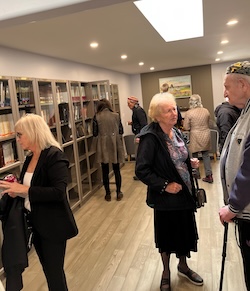
On March 9, the Chabad Living Library officially opened its doors to the public. The afternoon event was attended by members of the Okanagan Valley community and beyond, celebrating the launch of this new addition to the cultural and educational landscape of the region.
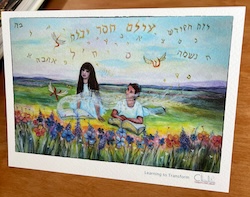
One of the highlights of the event was the unveiling of an original artwork by local Jewish artist Mari Sue Baga. The painting, entitled “Living Legacy,” depicts the Torah as a living, breathing guide, illustrating the timeless wisdom that inspires and shapes Jewish education throughout one’s life.
Artist Mari Sue Baga’s painting, entitled “Living Legacy,” hangs in the Chabad Living Library. (photo from Okanagan Chabad House)Artist Mari Sue Baga’s “Living Legacy” has been made into a card. (photo from Okanagan Chabad House)
Baga spoke about her work and shared her inspiration behind the piece. She also surprised Rabbi Shmuly Hecht with a painting of the Lubavitcher Rebbe (Menachem Mendel Schneerson) that she had made in his honour. She presented it to Hecht, thanking him for his service to the community.
Hecht is the rabbi and emissary of Chabad to the Okanagan Valley. He spoke to the crowd about the significance of the library and its mission. He described a library as an inexhaustible source of wisdom, emphasizing that Jewish sacred literature, passed down by the sages, offers endless lessons to illuminate life’s path. He also explained that the Chabad philosophy – blending intellectual growth with emotional harmony – is embodied in the new library’s offerings.
“The essential thing is the deed,” Hecht concluded, encapsulating the library’s focus on both knowledge and action.
“In a small Jewish community, you’ve got to be creative, and keep finding new ways and avenues to engage and inspire,” he said. “The library was a perfect idea and just what the community needed. Our vision for the future is to make the library go mobile, and offer its services to communities all throughout the several-hundred-kilometre radius of space that we service, so we can include more Jewish people in the impact.”
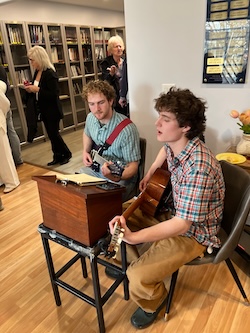
The launch featured a variety of activities for all ages, including crafting sessions for the children. Guests were treated to sushi prepared by Jewish sushi chef David Dodgson & Co. Live music from Isaac Bloom and fellow University of British Columbia Okanagan students set a lively tone, enhancing the celebratory spirit.
A unique feature of the library is its double play kitchen – one for meat and one for dairy – designed to teach children about kosher kitchen practices in an interactive way. The library also features approximately 100 children’s books that instil Jewish ethics and morals, relevant to families of all backgrounds and affiliations.
For adults, the library’s collection of more than 1,000 books offers a treasure trove that spans a wide range of subjects, everything from Jewish heritage to practical life lessons aimed at helping individuals grow and thrive.
Guests were invited to explore the library’s exclusive collection of books that can’t be found anywhere else in the Okanagan Valley. The library is also fully automated, with all the books input online. Members get a card with a QR code and the system reminds the member in two weeks to return the book. Everyone who became members of the library during the launch event (or signed up online prior to it) were gifted a special item, made possible by local Jewish photographers Andrew and Arlene Simpson.
In a game of Jewish Jeopardy, participants competed in teams for a chance to win a Star of David necklace. However, because of the team format, organizers decided to hold a raffle for all those present instead, and the winner of the necklace was Ezra Cipes.
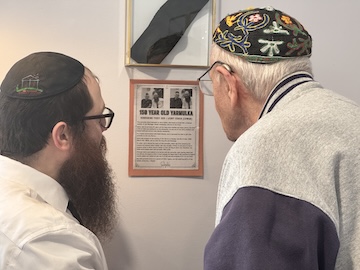
The new library houses a 150-year-old yarmulka donated by Jerry Cohen, housed in a glass frame. Cohen, 91, was present for the dedication.
Rabbi Shmuly Hecht and Jerry Cohen look at the 150-year-old yarmulka that Cohen donated to the library. (photo from Okanagan Chabad House)
The event was possible thanks to the generosity of many individuals and families whose contributions helped bring the library to life.
The library’s offerings are not only about the books – it’s about creating a space where the community can learn, grow and connect. One of the visions is for community members to come by on Friday and pick up challah, wine and other Shabbat items, along with some books to make Shabbat more meaningful and more enjoyable. There’s also a little Judaica gift shop shelf.
Hecht concluded the launch event by reminding the community of the wisdom shared by Jewish sages: “Don’t say, when I have time, I will study – perhaps you will never discover that you actually have time.” He encouraged all to seize the opportunity to enrich their minds and souls through the library’s collection.
The Chabad Living Library is a project of the Okanagan Chabad House. It is open Fridays and Sundays, 11 a.m. -1 p.m.; and Tuesdays, 5-6:30 p.m.
Those interested in becoming a member or learning more about upcoming events and programs, contact Okanagan Chabad House at 250-575-5384 or [email protected].
Rose’s Angels co-founder Courtney Cohen, left, with May Stefanov, tenant relations coordinator with Tikva Housing Society. (photo from Rose’s Angels)
Rose’s Angels recently completed its 12th year of giving, donating collected items to 14 Richmond not-for-profits, including Richmond Family Place, Colt Young Parent Program, Mamas for Mamas, Turning Point Recovery Society, Jewish Food Bank, Tikva Housing Society and Pathways Clubhouse.
Rose’s Angels, which operates under the auspices of the Kehila Society of Richmond, was created in 2012 by Courtney Cohen and co-founder Lynne Fader, in memory of Cohen’s grandmothers, Rose Lewin and Babs Cohen, who were both philanthropic and believed in giving back to community.
This year, an abundance of personal care items, non-perishable food, children’s arts and crafts, books and baby formula was donated. For many recipient agencies, baby formula and diapers are among their top priority items, and Rose’s Angels was able to give a large quantity of these items this year.
Donors, volunteers and other community members are integral to the success of Rose’s Angels. Letters were sent out to partner agencies, family, friends and others in January. Last month, monetary and physical donations were collected, Richmond Jewish Day School hosted a hygiene-item drive, and gift cards to grocery stores were purchased. Donations were then packaged and delivered by volunteers.
Cohen reflected on her hope to continue the legacy of her parents and grandparents.
“I hope to instil in my children the importance of tikkun olam (repairing the world) by focusing on one mitzvah at a time,” she said.
To learn more about or donate to Rose’s Angels, email [email protected] or call the Kehila Society at 604-241-9270.
Author Israel Ellis with his new book, The Wake Up Call, after a Feb. 10 talk at Beth Tikvah Synagogue in Toronto, where he joined journalist Dave Gordon in conversation. (photo by Dave Gordon)
In his new book, The Wake Up Call: Global Jihad and the Rise of Antisemitism in a World Gone MAD, author Israel Ellis brings the events of Oct. 7, 2023, into a compelling, fact-based and easy-to-read focus.
Backed up by scores of footnotes and references, the book is a no-nonsense look at the Hamas terror attack of Oct. 7 and, poignantly, the attack on democracy Ellis believes happened in the months prior to them. The addition of personal stories from Oct. 7 survivors and family members adds another level of documentation to an already all-encompassing book.
Ellis weaves in his own lived experience and perspective as a Jewish Canadian in the diaspora with firsthand accounts of contemporary antisemitism and his reflections on being the father of an Israel Defence Forces lone soldier fighting in Gaza. His personal observations allow the reader to connect with him, as well as better understand the interconnectedness of Jews, no matter where they live, and Israel.
For non-Jews, it can be daunting to begin learning about what happened on Oct. 7, and the global repercussions. Many non-Jews do not know the history of the Middle East, how the state of Israel fits into this history, or what the definition of “antisemitism” is. Ellis helps fill in these blanks, and this is why I am so excited to introduce this book to my friends.
Since Oct. 7, 2023, Canadians (and people from other countries) have seen large pro-Palestine protests in the streets of all the major cities and in academic spaces, with large university encampments set up across the country. Most people in the Jewish community see these protests for what they are: pro-terror and anti-democratic. But, for a Canadian with little knowledge of what the Israeli/Palestinian conflict is, these protests and encampments can look like a fight for human rights. No doubt, some individuals believe they are marching for human rights while chanting“intifada revolution,” but many are there to show support for Hamas, to some degree or another. This is why the knowledge, geopolitical insight and historical context Ellis brings with his writing is so vitally important.
I read a lot of books on Israel, as a non-Jewish Canadian interested in educating myself, and Ellis’s new book has become a favourite. One of the reasons is that Ellis writes about many protests and political events that are still fresh in our minds. He discusses protests that took place in Toronto and the encampments at McGill University (and others). He shows the utter incompetence of Canadian politicians, such as Toronto Mayor Olivia Chow, in handling the rise of radical Islam. He strongly condemns Canada’s minister of foreign affairs, Mélanie Joly, who shook the hand of Mahmoud Abbas, leader of the Palestinian Authority, in what is a now-famous Ramallah photo-op. These events, along with many others, are documented in Ellis’s book, illustrating a pattern of political complicity and complacency that he says has contributed to the eroding of Canada’s moral backbone.
As a Canadian university student, I have experienced firsthand my peers sympathizing with and rallying for terrorist organizations. The university institutions have been complacent in protecting neutral academic spaces, allowing terrorist propaganda to infiltrate our lectures and giving some professors the ability to promote hatred of Israel and the Jewish people.
A quote from The Wake Up Call that gave me chills reads: “There is no coming invasion. It is already here. Jihad has already been invited into our universities, professions, communities and public institutions. October 7 was a wake-up call. It is an example of the hunger for Global Jihad, and what can happen if it is allowed to be satiated. To think that these events are restricted to a narrow strip on the Mediterranean is a complete miscalculation of reality.”
The Wake Up Call should be read by anyone – uninformed or well-informed, Jew or non-Jew – who wants to better understand the political, social and historical context behind the current rise in anti-democratic, pro-terror narratives that have taken over many Western spaces.
Zara Nybo, a fourth-year student at the University of British Columbia, is a StandWithUs Canada Emerson Fellow. Connect with her via Instagram: @zaranybo.
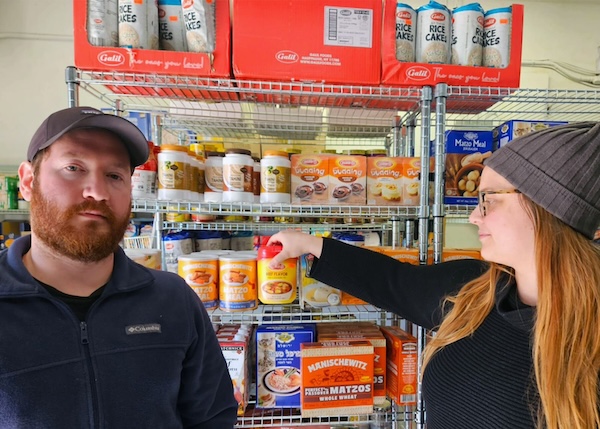
Tal Kinstlich and Stephanie Schneider, the owners of Vancouver’s Kosher Food Warehouse. (photo from Kosher Food Warehouse)
Canada is exempting key imported Passover foods from the current diplomatic trade war with the United States. The ministry of finance sent The CJN a list of kosher-for-Passover products imported from the United States, which are going to be allowed into Canada without being hit by the extra 25% retaliatory import tariffs that Ottawa began imposing on March 4.
The list includes matzah and related matzah products, cake mixes, chocolate, margarine, most juices (but not apple), gefilte fish, and canned fruit and vegetables. However, US exports of nuts, spices, dairy, wine, coffee, chicken and meat products are not exempt.
The development comes after Canada’s biggest kosher food importer recently predicted that the on-again-off-again tariff dispute would rocket prices for imported kosher-for-Passover food by up to 60%. Canadian Jewish leaders have been lobbying Ottawa to give relief to the country’s Jewish community as it heads into the holiday season.
While the news will likely bring a sigh of relief to consumers, it is only a temporary reprieve: it covers only Passover foods and runs only until the end of Passover.
For more on how these food tariffs are impacting Canadian kosher food stores and suppliers across Canada, and what advice they have for you, listen to the episode of The CJN Daily that features the owners of Vancouver’s Kosher Food Warehouse, Tal Kinstlich and Stephanie Schneider. Jack Hartstein also joins: he’s the vice-president of Montreal-based Altra Foods, the largest importer of kosher foods in Canada. The link is thecjn.ca/podcasts/key-passover-imports-will-be-exempt-from-tariff-war-with-u-s-ottawa-confirms.
Ilan Rabchinskey’s photograph of Tamarind Street Corn Cups in Sabor Judío: The Jewish Mexican Cookbook inspired me to make them. (photo by Ilan Rabchinskey)
Since reviewing Sabor Judío: The Jewish Mexican Cookbook by Ilan Stavans and Margaret E. Boyle for the Independent’s Hanukkah issue, I’ve tried several more recipes. And I’ve really enjoyed everything. So much so, that I pulled out the cookbook to try some Passover meals, and found some foods I would never have thought to make.
Stavans and Boyle have a section on Passover (Pésaj) in which they discuss some of the Mexican Jewish traditions. For example, some families incorporate Mexican history into the seder discussions, and the bitter herbs on the seder plate can include a variety chiles. They list 12 seder favourites, but, throughout the cookbook, they point out which dishes – like Stuffed Artichoke Hearts – are considered essential components of the Passover meal by some.
Snapper Ceviche con Maror, from Sabor Judío: The Jewish Mexican Cookbook by Ilan Stavans and Margaret E. Boyle. (photo by Ilan Rabchinskey)
Of the seder favourites, I made Snapper Ceviche con Maror, Tamarind Street Corn Cups, Apricot Almond Charoset Truffles and Tahini Brownies. The photos by Ilan Rabchinskey drew me into the corn cups, as I’m not a huge corn fan and might not have made them otherwise. I will do so again, however – they were easy, and they were a very tasty break from the ordinary. The snapper ceviche, too, will be a repeat, and the brownies were some of the best I’ve tasted, not too sweet, and very light, almost fluffy, but moist – I broke up a chocolate bar instead of using chocolate chips, which worked really well, and the sea salt on the top tasted so good. While the truffles were also delicious, they tasted more familiar, and were very date forward – I might try to mix up the date-apricot balance when I make them again.
The Jewish connections were obvious for some of these recipes, not so much for others. The snapper is served with a dollop of horseradish: “The use of maror, or horseradish, in this recipe was an invention during a Passover seder in Mexico City, creating a savoury contrast among the fish, the jalapeño and the horseradish,” write Stavans and Boyle.
The Jewish link to the corn cups is that the tamarind-flavoured hard candies the recipe calls for – Tamalitoz – were created by Jack Bessudo, who is of Mexican Jewish descent, and his husband, Declan Simmons. Since Tamalitoz are not available here, I bought another tamarind-flavoured candy from a local Mexican store and it worked quite well.
The brownies recipe comes from Israeli immigrants to Mexico, who shared with the cookbook writers that “tahini is also infused into their adaptations of mole, the sesame flavour substituting for more common varieties that rely on peanut or almond.”
Chag sameach!
SNAPPER CEVICHE CON MAROR (serves 6; prep time 25 min plus chilling)
3/4 cup fresh lime 1/4 cup fresh lemon juice 1 small jalapeño chile, seeds removed, finely chopped 1 small red bell pepper, seeds removed, finely chopped (about 1/2 cup) 1 small yellow bell pepper, seedsremoved, finely chopped (about 1/2 cup) 1/2 small red onion, thinly sliced 1 small garlic clove, minced, grated, or pushed through a press 1/8 tsp ground cumin 1/2 tsp kosher salt 1 pound red snapper fillets, skin removed 2 tbsp finely chopped fresh cilantro 1 tsp extra-virgin olive oil prepared horseradish, for topping (optional)
1. In a large bowl, stir together the lime juice, lemon juice, jalapeño chile, red and yellow bell peppers, red onion, garlic, cumin and salt.
2 . Using a sharp knife or kitchen shears, cut the fish fillets into 1/2-inch pieces and add to the citrus mixture, stirring to combine. Cover the bowl and refrigerate for 30 minutes.
3. Just before serving, stir in the cilantro and oil. Serve immediately, dolloped with horseradish, if desired.
TAMARIND STREET CORN CUPS (serves 4; prep time 40 min)
for the corn 3 tbsp unsalted butter 1/2 large white onion, finely chopped 2 medium garlic cloves, peeled and finely chopped 1/2 serrano chile, seeds removed, if desired, and finely chopped 1 1/4 tsp kosher salt, plus more as needed 2 fresh epazote leaves (whole) or 1 tsp dried oregano 5 cups fresh corn kernels (from about 10 cobs of corn, or use frozen corn kernels) 2 1/2 cups water 1/4 cup mayonnaise
for serving crumbled Cotija cheese crushed chile piquin or red pepper flakes crushed Tamalitoz candies,tamarind flavour fresh lime juice
1. Melt the butter in a large frying pan set over medium heat. Add the onion and garlic and cook, stirring occasionally, until soft and translucent, about5 minutes.
2. Add the serrano chile, salt and epazote leaves (or oregano), followed by the corn kernels and the water. (The water should barely cover the mixture.) Raise the heat to high and bring to a boil, then lower the heat to medium and cook, stirring occasionally, until the corn is tender and the liquid has almost completely evaporated, 30-35 minutes. Taste and add more salt, if needed.
3. Remove from the heat and discard the epazote. Add the mayonnaise and stir to combine.
4. Divide the corn mixture into four tall cups. Top with the Cotija cheese, chile piquin and crushed tamarind candies, to taste. Drizzle each cup with a little lime juice just before serving.
TAHINI BROWNIES (serves 6; prep time 15 min, baking time 22 min)
3 tbsp almond flour 1/4 cup cocoa powder 1/2 tsp kosher salt 1/4 cup extra-virgin olive oil 1/2 cup well-stirred tahini 4 ounces baking chocolate, roughly chopped 2 large eggs 1/2 cup granulated sugar 1 tsp vanilla extract 1/2 cup chocolate chips flaky sea salt, for sprinkling
1. Heat the oven to 350˚F and lightly grease an 8-by-8-inch dish. In a small bowl, whisk together the almond flour, cocoa powder and kosher salt and set aside.
2. Combine the oil, tahini and chopped baking chocolate in a small saucepan set over medium-low heat and cook, stirring often, until the chocolate is melted and the mixture is smooth. Remove from the heat and let cool slightly.
3. Meanwhile, in a large bowl, vigorously whisk together the eggs and sugar until frothy, 3-5 minutes. Whisk in the vanilla, followed by the cooled chocolate mixture.
4. Add the dry ingredients to the chocolate mixture and stir to combine, then fold in the chocolate chips.
5. Transfer the batter to the prepared pan, smoothing the top, then sprinkle lightly with flaky sea salt. Bake until a tester inserted in the centre comes out clean, 18-22 minutes. Remove from the oven and place the pan on a wire rack to cool. Serve warm or at room temperature.
APRICOT ALMOND CHAROSET TRUFFLES (makes about 3 dozen; prep time 15 min plus chilling)
2 cups pitted and chopped medjool dates 1 cup chopped dried apricots 1 cup golden raisins 1 cup roasted salted almonds 1 tbsp honey 3 tbsp sweet red wine (or grape juice)
1. Working in batches, add the dates, apricots, raisins, almonds and honey to a food processor and pulse until a textured paste forms. Transfer the mixture to a bowl and stir in the wine, 1 tablespoon at a time.
2. Scoop out tablespoons of the mixture and, using lightly moistened hands, roll them into balls. Place the truffles on a baking sheet or large plate lined with parchment paper as you go.
3. Refrigerate the truffles (uncovered is fine) for 2 hours, then transfer to a container with a lid and continue to refrigerate until needed. Serve chilled or at room temperature.
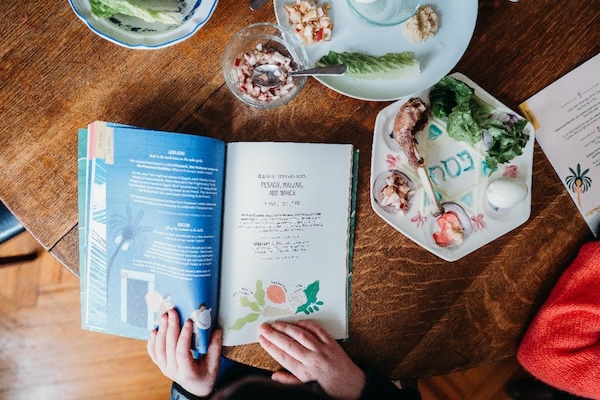
In Every Generation: A PJ Library Family Haggadah can be downloaded from pjlibrary.org/passover. (photo from PJ Library)
Passover is the ultimate Jewish story – a tale of freedom, hope and food – which makes it the perfect holiday to share with the entire family. Passover is time for gathering, reflecting, telling stories and working towards a world with freedom for all. But planning to cover all that with kids may feel lofty – especially if you’re a little hazy on the details yourself. The free Jewish book program PJ Library has you covered as a go-to destination for making Passover special.
Visit PJ Library’s Passover Hub at pjlibrary.org/passover to find everything you need to plan your Passover seder, set your table and answer your kids’ questions. There, you’ll find PJ Library’s free downloadable Passover Guide, a family-oriented primer that lays out how to prepare for the seders and the foods you need for your table, as well as offering up meaningful activities to make the most out of all eight days. The guide covers three main sections: how to get ready, what you need to get through the seder, and what comes after the festive meals have come to a close.
Also available for digital download from the hub is In Every Generation: A PJ Library Family Haggadah. It follows the arc of a traditional Haggadah and features all the major songs, prayers and moments, but also incorporates helpful framing and stories for kids so they can get the most out of this experiential meal. It also has new question prompts to help you reinvigorate your seder. The online version can be downloaded for free, while the PJ Library Haggadah is available for purchase in paperback from Amazon.ca.
Beyond the guide and the Haggadah, the Passover Hub features downloadable activities to keep little ones entertained during the seder, book lists, a step-by-step video playlist to help kids learn (or brush up on) the Four Questions, and recipes. There are fun and easy recipes like Charoset Breakfast Balls, a perfect grab-and-go breakfast that’s healthy and packed with protein, Chicken Skewers with Avocado Dip, or cholent, a classic hearty Jewish dish made in the slow cooker.
About PJ Library
PJ Library’s goal is to inspire joyful Jewish experiences by sending free storybooks and activities to families with children ages 0-12 and offering ways to connect with community. The program was founded in 2005 by the Harold Grinspoon Foundation and, with the support of donors and partners, now distributes books in seven languages to more than 650,000 children in more than 40 countries every month. The PJ Library family experience is built around the monthly storybooks and also includes family-focused holiday guides and other free gifts. Anyone who visits PJ Library’s website can hear original storytelling podcasts and explore a vast collection of Jewish parenting resources. The program welcomes families across the diversity of Jewish life. Learn more or sign up for monthly children’s books at pjlibrary.org.
Sussita entrepreneur Itzhak Shubinsky driving a Sabra Sport car, from the newspaper Barkav, in the 1960s. (photo from Haifa City Museum)
For a trip down memory lane, cruise over to Haifa’s City Museum at 11 Ben-Gurion Blvd., in the German Colony, to see Sussita: The Exhibition. The display, which continues until May 25 (the opening was delayed by Hezbollah rocket fire from Lebanon), documents Israel’s failed automobile industry during the early decades of statehood.
Alas, the doorways of the museum’s 19th-century Templar building are too narrow to permit restored examples of the fibreglass shell cars to pass through. So, on hand is a stripped-down version of a Sussita, and a trove of fascinating documents and photos. Missing are full-size examples of the Carmel truck and Sabra Sport roadster that Autocars Co. Ltd. assembled at its Haifa workshop and then in the city of Tirat Carmel.
The exhibit was curated by Yifat Ashkenazi, together with filmmaker Avi Weissblei. The latter produced the 2020 documentary Desert Tested, which told the Sussita’s story.
Like Shai Agassi’s Better Place electric car company, which went through almost $1 billion in venture capital before declaring bankruptcy in 2013, Israel’s ultimately insolvent auto industry never thrived.
A Sussita Autocars Co. Ltd. advertisement in the 1960s, featuring its “5 Road Champions!” (photo from Haifa City Museum)
The Sabra’s aerodynamic curves evoke the glamour of early James Bond films. Nonetheless, even though they were jump-started by foreign firms, Haifa’s car business never quite managed to compete with Detroit.
Discussing Autocars’ 1966 Sussita at carsurvey.org, one classic car aficionado noted: “What things have gone wrong with the car?
Almost everything! It was a very cheap car made of a fibreglass body attached to a very simple welded pipes chassis, with a Triumph engine. The car was unstable, seriously dangerous, unreliable and very badly built.”
Folklore has it that camels liked to munch on the cars’ fibreglass body. But the relative paucity of dromedaries in 1960s Israel makes the truth of this story doubtful.
Founded in the mid-1950s with assistance from Britain’s ReliantMotor Co., Autocars initially assembled quirky but popular three-wheeled micro-cars. The first four-wheeled blue-and-white vehicle, the Sussita, was also designed by Reliant.
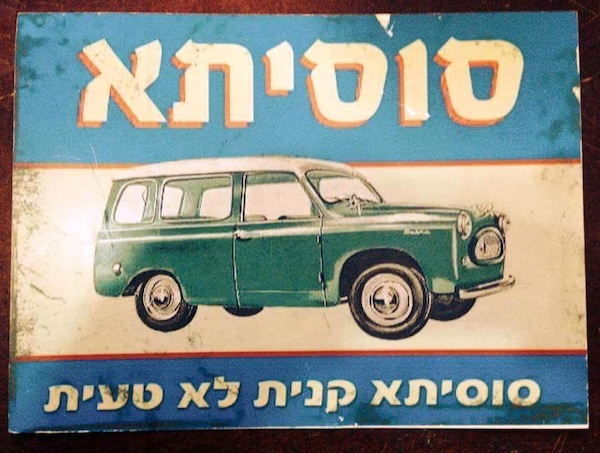
The Sussita, meaning mare in Aramaic, developed a reputation as a reliable workhorse. By 1960, Autocars was exporting the cheaply priced car – available in estate, van and pick-up models – to the United States and Canada. Rebranded as the Sabra – a genus of cactus originally from Mexico that had become a descriptor of native-born Israelis – the car sold poorly in North America due to its inferior quality.
That year, in 1960, Autocars’ owner Itzhak Shubinsky spotted the coupé Ashley GT at London’s Sports and Racing Car Show. Changing business strategy, he purchased the bodywork moulds and created the Sabra Sport, which made its debut at the 1961 New York Motor Show. The roadster car was also sold as a hardtop coupe. Fewer than 150 were exported to the United States, while a similar number were sold in Belgium.
Reliant also launched the car in Britain. Anglicizing its moniker to Sabre, the prickly cactus morphed into a swashbuckling sword.
Advertising for the Sussita: “You bought Sussita, you were not wrong.” (photo from Haifa City Museum)
Expanding production, in 1961, Autocars introduced the Carmel, named for the mountain that defines Haifa. The car featured a 1,200cc Ford Cortina engine mounted in a Reliant chassis.
By 1965, Autocars declared bankruptcy and was taken over by Britain’s Leyland-Triumph. Revamping the product line, the following year it introduced the Gilboa, a four-door version of the Carmel. In 1967, it produced an off-road, front-wheel drive utility called the Dragoon.
But the red ink continued to spill. In 1971, Leyland severed its ties with its Israeli subsidiary. Three years later, Autocars was bought by Rom Carmel Industries, which brought out its Gilboa-based Rom 1300.
Sputtering along, in 1978, the company was purchased by the Netanya-based foundry Urdan Industries. Restyled again, the Rom 1300 became the Rom 1301. But declining sales could not be reversed, going from a peak of manufacturing more than 3,000 cars annually during the 1960s to just 540 cars rolling off the assembly line in 1980, the last full year of production. In 1981, the plant shut its gates.
For more about the exhibit, visit hcm.org.il/eng/exhibitions/11128/sussita.
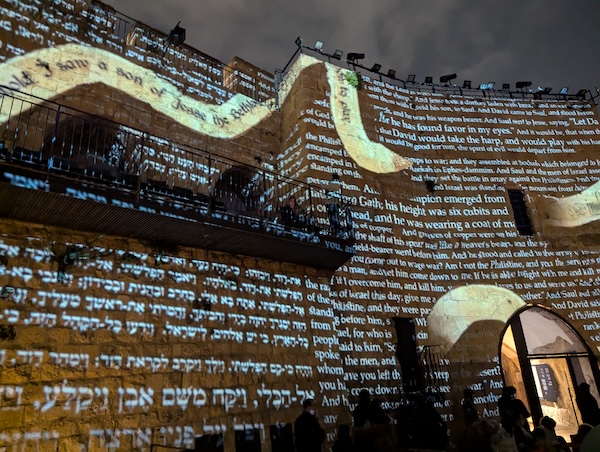
Light projections on the internal walls of the Tower of David, in Jerusalem, part of the Night Spectacular. (photo by Pat Johnson)
Tourism to Israel plummeted after Oct. 7, 2023. For example, January 2024 saw an 80% drop in visitors from a year previous. Those who did travel to Israel were often on solidarity missions or volunteer programs.
In March, I visited for 10 days, speaking with scores of Israelis about the situation, their grief, determination and changed attitudes, among other things. During that period, there was not a single siren in central Israel, though, days after my departure, the ceasefire ended and war in earnest began again.
It may seem frivolous or disrespectful to speak of “tourism” or “sightseeing” in moments such as these. The example of Israelis, however, is, as ever, resilience and getting on with it. Museums are open and, no matter what brings you to Israel, making time for recreation is necessary and, in many cases, adds depth to the understanding of what is happening now. A few of my destinations and choices are a bit odd – not what every visitor might choose – but others, like the Tower of David, should be on your must-see list.
Story of Jerusalem
The Tower of David Museum tells the story of Jerusalem. With a multimillion-dollar investment in new technologies upgrading the experience, the centrality of the city of Jerusalem in multiple traditions is underscored by the imagery of the city as the “navel of the world.”
From 5,000-year-old idols and 3,000-year-old stamps indicating a thriving bureaucracy, to Theodor Herzl and the modern state, the museum tells the story of a place with more history than geography.
A not-to-be-missed component is the immersive, after-dark sound and light show called the Night Spectacular. Perhaps less informative than just, well, spectacular, the 40-minute program projects the epochs of the city’s history (that is, its litany of invasions) onto the interior walls of the imposing citadel. Combo tickets to the museum, permitting evening entry for the show, are available. The effect is all-immersing, more powerful and moving than I could have anticipated. It will captivate visitors of every age.
History of Jewish militias
Like the Haganah Museum in Tel Aviv (see below), the Museum of the Underground Prisoners Jerusalem takes a politically ecumenical approach to the history of Jewish militias fighting the British in pre-state Israel.
Located in the former British Mandate-era jail, the museum tells the story of resistance fighters from the Haganah, the main defence force of the pre-state Jewish community, the Revisionist Irgun (Etzel) and the more radical Lehi (“Stern Gang”).
Jewish prisoners were captured and punished for sabotage against the British, including the smuggling of Holocaust survivors and others into Palestine. Some of the prisoners were executed in the prison yard and these lives are commemorated movingly.
Holocaust remembrance
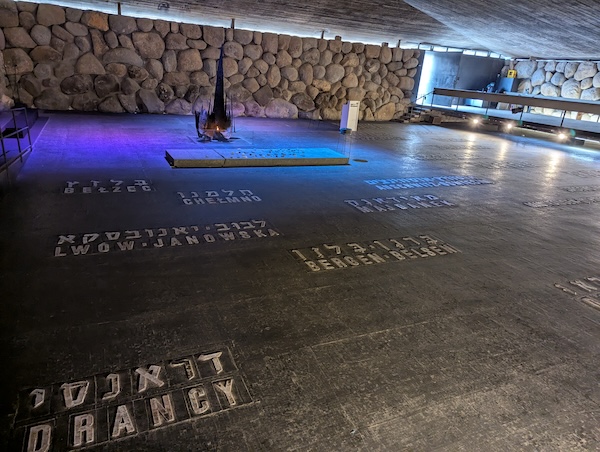
Yad Vashem: The World Holocaust Remembrance Centre is always a moving pilgrimage. The primary exhibit space – an A-frame hall with windows at the peak, reminding us that the events took place in full view of the world (and, arguably, God) – provides a chronological history of the Shoah. The slash across the top of the Moshe Safdie-designed building also represents the permanent scar this history has left on humankind.
Like the Tower of David, Yad Vashem has had a huge infusion of money to update the exhibits and add high-tech components.
The eternal flame, at Yad Vashem. (photo by Pat Johnson)
A simple, but crucial, aspect of the exhibit is at the start, after visitors traverse the “bridge to a vanished world,” and a short film loops the story of the pre-Shoah Jewish civilization that was destroyed. This contextualizing of what was lost is an irreplaceable part of the experience.
The permanent exhibit, including the emotional Hall of Names, is what the public most often sees and it provides the history of the Holocaust for people of all levels of knowledge. The vast work of the centre remains mostly out of sight, with archives, research, recording and publication being a less visible but no less important component of Yad Vashem’s mandate.
Har Herzl Pathway
For a British Columbian, it is hard to fathom what Israelis call “mountains.” The Mount of Remembrance (home to Yad Vashem) and Mount Herzl (or Har Herzl) are hardly recognizable as distinct geographic places, let alone mountains.
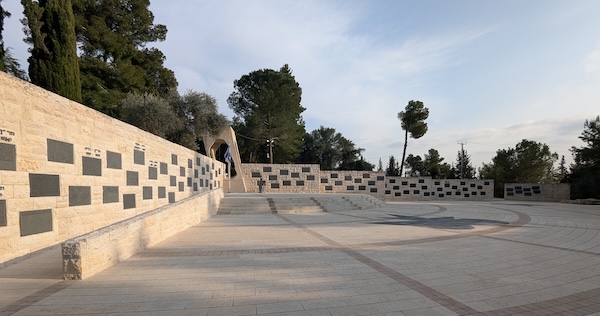
Monument to Israeli victims of terror, part of the many cemeteries on Mount Herzl, final resting place of soldiers, leaders and the fallen. (photo by Pat Johnson)
In any event, from Yad Vashem, it is a relatively short walk to the Herzl Museum, which is adjacent to the grave in which the founder of political Zionism was reinterred in 1949 from his original resting place in Vienna.
Between these two destinations are the resting places of most of Israel’s leaders, as well as cemetery after cemetery filled with soldiers and civilians killed in Israel’s successive wars and terror attacks.
It was only by happenstance – well, if you are arriving by foot, you can’t miss it, but those arriving by vehicle might – that I discovered a memorial walking path between Yad Vashem and the Herzl Museum, snaking through these sad, chronological rows of graves.
The trail, as a distinct entity, is a bit of a mystery. A post-trip web search indicates there is seemingly not even an agreed-upon name for the path. The information at the entryway says that it was developed by Jewish youth movements but the specific groups go unnamed. The signage is likewise a bit perplexing, without always clear directions or explanations. The larger message, though, does not require plinths: Israel and thousands of Israeli families have paid an enormous price for the country’s existence.
Learning about Herzl
Having meandered through the sombre cemeteries of Israel’s war dead and the resting places of most of the country’s prime ministers, presidents and other historical greats, you arrive at the imposing grave of Theodor Herzl. Nearby, the museum bearing his name tells the story of the man with the crazy dream of a Jewish state.
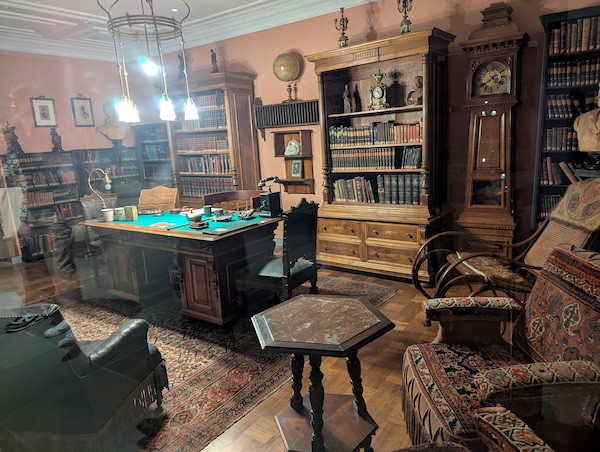
Replica of Theodor Herzl’s office, including his original desk and other artifacts, at the Herzl Museum, Jerusalem. (photo by Pat Johnson)
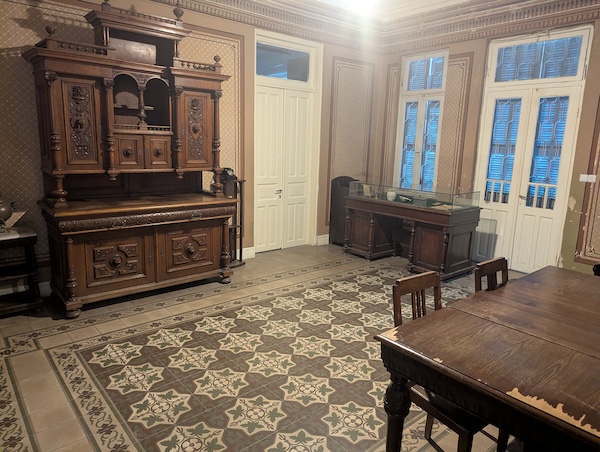
Museum-goers are given a guided tour from room to room, following a cheesy video of a pair of dramatic impresarios didactically directing an actor preparing for the role of Herzl but who has no idea who the man was. The actor (and, not at all subtly, the visitor) is educated on the Dreyfus Affair, which was the polarizing moment when the secular, assimilated Herzl concluded the Jews would never be free without a state of their own. The displays take visitors through his activism, and we eventually join delegates at the First Zionist Congress.
The museum includes the re-creation of Herzl’s home office and many important relics of his life.
Connecting past, present
Gush Katif Museum is an unexpected little museum in Jerusalem’s Nachlaot neighbourhood, which tells the story of the 17 Jewish settlements that were evacuated during the “disengagement plan” from Gaza in 2005.
The Israeli government withdrew from Gaza two decades ago in hopes of allowing a sort of pilot project in Palestinian self-government. In the process, and amid (yet another) emotional national dialogue, Jewish settlements in the enclave were evacuated.
With a decidedly political agenda, the museum finds relevance today, as many Israelis look at the situation in Gaza and, with 20/20 hindsight (or something like it), question every decision that may have led to today’s realities.
In an interesting thought experiment, a Jewish resident evacuated from Gaza, speaking in the museum’s introductory film, inverts the common perception of Jewish settlements in the area. Rather than the probably prevailing view of Jewish settlements as an imposition on Palestinian land, he makes the case that Israel gave 90% of Gaza to the Arabs and some still wanted to erase the Jewish presence entirely. (Ignoring the ideological point and contesting the details, Jewish settlements in the Gaza Strip took up something around 20% of the land in the small area.) It’s a perspective that challenges the idea that, even absent a negotiated two-state solution, the Palestinians deserve 100% of the occupied territories. Presumably, it is just this type of questioning the museum hopes to engender.
The Gush Katif Museum explores more than modern history, of course, going back to the earliest Jewish settlement in the area, and the successive expulsions by the Romans and the Turks.
Origins of the IDF
Moving on to Tel Aviv, the Haganah Museum tells the story of the Jewish militia that morphed, upon statehood, into the Israel Defence Forces.
The museum is located on Rothschild Boulevard, in one of Tel Aviv’s oldest buildings, originally the home of Eliyahu Golomb, a founder and ideological leader of the Haganah.
The home of Eliyahu Golomb, founder and ideological leader of the Haganah. This was the site of many clandestine and pivotal meetings of the underground resistance. (photo by Pat Johnson)
While there were other military operatives, the Haganah was the de facto militia of the Yishuv, the pre-state Jewish community. The museum, though, takes a broader view, beginning with the role of “tower and stockade settlements” on the peripheries of the proto-state, through the First World War Zion Mule Corps, the Jewish Legion (which helped the rise to prominence of Revisionist leaders like Ze’ev Jabotinsky), and touches on the roles of Revisionist Etzel (the Irgun) and its breakaway group Lehi (the “Stern Gang”) in taking the fight to the British. In an ideological and military skirmish after independence, these groups would be forcibly unified into the IDF.
The museum includes the crucial role the Haganah played in the Aliyah Bet, the illegal migration of Jews into pre-state Israel during the period of British blockade of Jewish refugees.
At the entry to the building is a relief mural by Israeli sculptor Moshe Ziffer, with figures in traditional kibbutz-style clothing, linking the movement to the pioneering Zionist ethos, as well as fighters shielding and defending Jewish families. There are also ancient symbols in the artwork, implying the Maccabean revolt, and including modern symbols of the transition to statehood, in 1948.
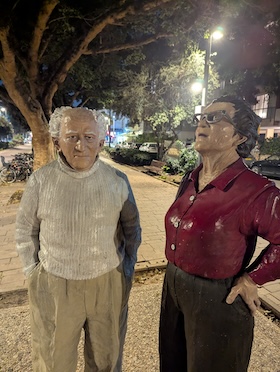
Statues of David Ben-Gurion and his wife Pola, by artist Ruth Kestenbaum Ben-Dov, on Tel Aviv’s Independence Trail. (photo by Pat Johnson)
Independence Trail
The Haganah Museum is a central part of the cobbled-together tourist route branded “Independence Trail.” What would ostensibly be the centrepoint of the trail – Independence Hall, the home of Tel Aviv’s first mayor, Meir Dizengoff, and the place where David Ben-Gurion read aloud Israel’s Declaration of Independence on May 14, 1948 – is surrounded by scaffolding amid ongoing renovations without a set date for reopening.
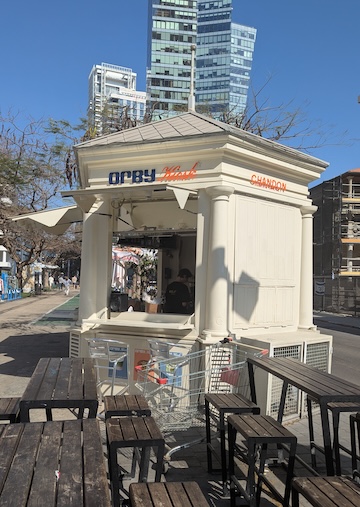
An easy-to-follow map of the ambling tour is available at the tourism kiosk in the pedestrian boulevard between the Haganah Museum and Independence Hall. The tour begins (if you want to do it in un-Israeli orderly fashion) at the city’s first kiosk, a restoration of which still serves refreshments to Tel Avivians and tourists.
The site of the first kiosk in Tel Aviv. The location is still a destination for refreshments. (photo by Pat Johnson)
The walk continues past the Nahum Gutman Fountain, which depicts the history of Jaffa and its sister-city-come-lately Tel Aviv, from the setting-off place of Jonah on his way to the fish’s belly, through Egyptian invaders, Crusaders, Napoleonic forces on up to Herzl and to the Declaration of Independence that took place a few steps away.
Other stops on the trail include the site of Herzliya Hebrew Gymnasium, the world’s first modern Hebrew-language high school; the Palatin Hotel, the resting stop for famous names of the 20th century; Tel Aviv’s Great Synagogue; several buildings that are notable more for being examples of the Bauhaus or International Style of architecture than for historical import; the Tel Aviv Founders Monument; a statue of Dizengoff, astride his horse; and several others. The map and trail provide a quick and easy guide to important sites that you might otherwise overlook in a small area of central Tel Aviv.
Tragic walking tour
An unusual, if not terribly uplifting, activity is the Tragic Tel Aviv Walking Tour, which visits sites in the city centre where terror and even Second World War attacks killed civilians.
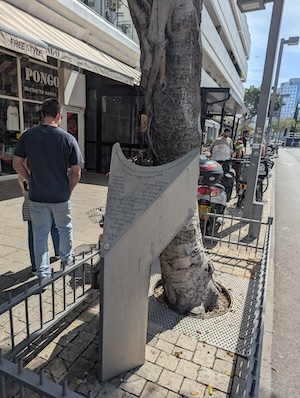
Easily missed: A monument to one of Tel Aviv’s many terror attacks. (photo by Pat Johnson)
On Sept. 9, 1940, Italian war planes operating from the island of Rhodes, made sorties over Haifa and Tel Aviv, killing 137 people, with many more injured. The attacks targeted no Allied (that is, British) military infrastructure and shattered what, to then, had been a feeling of relative isolation from the European war among the residents of pre-state Palestine. The monument to the bombing in Mikhoels Square, at the corner of Levinsky and Aliyah streets, is modest and easily overlooked if you are not explicitly seeking it – or even if you are.
Led by former Torontonian Jeffrey Levi, the tour then proceeds through sadly seemingly endless locations of suicide bombings and other terror attacks, many of which took place during the Second Intifada. In some cases, the historical events that left Israelis dead or wounded are not commemorated at all, or are marked by likewise inconspicuous markers.
If there is an uplifting message in this tour, it is in the innocuous manner in which most of these historical tragedies are commemorated (or not). As Levi recounts the devastations of the past, Tel Avivians hustle by, literally and figuratively moving past the past.
Tamar Eisenman, left, and Sagit Shir bring their children’s music project, City Birds, to Vancouver for a March 23 concert at the Rothstein Theatre, as part of Chutzpah! Plus. (photo by Javier Ortega)
Looking for fun, positive music for your kids that will get you moving to the beat and singing along with them? Check out City Birds on March 23, 11 a.m., at the Rothstein Theatre.
The creative and talented duo with seemingly boundless energy is coming to Vancouver for the Chutzpah! Plus Spring Edition, which runs March 19-23.
“Our goal is to weave a musical tapestry that captivates the imagination of the children and to accompany them on their mammoth journey of growing up, while also resonating with the hearts of older kids and parents,” write Tamar Eisenman and Sagit Shir on their City Birds website. “Our work is a celebration of families and about telling stories where children and parents find comfort, joy and inclusion.”
Even people without kids will appreciate the music’s playfulness, its folk and rock rhythms, and unique lyrics, all intended to uplift.
“It’s a lot of fun, and the inclusive elements are a key part of our craft – whether it’s mentioning all types of families, using different pronouns, or embracing a creative, childlike perspective that also serves as a wonderful reminder for grownups,” Eisenman told the Independent.
Both Eisenman and Shir are accomplished musicians. Eisenman has released multiple albums over the years and is currently touring with a couple of shows, including City Birds. Shir is the co-founder of the indie rock duo Hank & Cupcakes, and she teaches music and songwriting, specializing in early childhood music education. They each have some 20 years of music writing and touring to their credit.
“We met through Ariel, Sagit’s husband/partner,” said Eisenman. “Ariel and I went to high school together, and we’ve been really good friends ever since. I think I was about 18 or 19 when I first saw Sagit perform. She was singing with her trio in small music venues around Jerusalem, covering my favourite songs by Tori Amos, Suzanne Vega and others. Her voice and performance completely blew me away!”
“I remember that cover band!” said Shir. “Tamar was always a musical presence I was aware of beyond her years-long friendship with Ariel (who was also her bassist at some point). I remember being in awe of her musical and performative talents and generally admired how she ‘had it together’ at an age where I was just starting to seriously explore my musical tendencies.”
After Shir and her family moved back to New York City, she and Eisenman reconnected and started meeting up more often, sometimes with their kids.
“If I remember correctly, in September 2023, Sagit invited me to a friend’s show in the Lower East Side, where we first talked about the idea of writing and composing songs for kids and families, with LGBTQ awareness at the core. I personally felt there was a gap in family entertainment in that space,” said Eisenman.
“Sagit had her ukulele with her and, after the show, we hung out outside the club, brainstorming our first ideas for the project. From there, we each worked individually on some concepts, exchanging demo recordings, lyrics and ideas back and forth. As the songs took shape, we rehearsed, and, once we had about six songs ready, we performed at our daughters’ schools for the first time.”
The feedback was wonderful, said Eisenman. “That’s when we knew we wanted to keep folk Americana as the foundation of our sound – while adding some punk rock, of course. We wanted the music to feel close to home, reflecting the styles we personally connect with,” she said.
“It was also important to keep it organic and live, creating something that we, as adults, could relate to just as much as kids,” she continued. “The music is for everyone – it exists in that ‘in-between’ space: for kids growing up, for parents who were once kids, and for all of us witnessing that journey. It’s a fascinating timeline when you think about it. And then there’s our secret ingredient – Ariel. He’s such an incredible musician and he plays bass and other instruments on the record.”
While the meeting at the club may have been the first time the two musicians sat down together and brainstormed about writing and performing music geared towards children, Shir said the idea for City Birds came earlier.
“Tamar brought it up when our families went on a small vacation in upstate New York some time before,” said Shir, “and I was so excited at the prospect of collaborating with Tamar, whom I secretly admired, that I wrote the first lines of ‘The Family Song’ that very night.”
That Shir had worked on some songs already helped when the two started working together. For those pieces, Eisenman said, “we refined the lyrics, arranged the music together and made adjustments as needed.
“Other times, we each brought in songs, fragments or ideas and we’d have a little creative ‘ping-pong’ session to develop them,” she added. “For example, I wrote the verse of a lullaby I was working on, and Sagit added the B section musically, then we expanded the lyrics together from there. There’s really no single format or structure; we try to keep the process open, flexible.”
While their being Jewish doesn’t necessarily inform their music, Eisenman said their cultural heritage is an inherent part of who they are – “both in a traditional sense and as part of our roots,” she said. “The Hebrew language is, of course, dear to our hearts and, as my native language, it’s especially meaningful to me. Being able to incorporate it into our songs is a lot of fun as well.”
Shir’s background in early childhood music education no doubt plays a key role in their songs’ appeal.
The daughter of two teachers, Shir said, “I’ve found myself specializing in teaching language through music, especially Hebrew. I find that, with very young students, teaching them Hebrew through music almost works like magic. They find themselves learning important basic concepts such as colours, body parts and feelings without even realizing it’s happening. Music makes the language-learning process effortless and fun. I started the company Global Kids Music LLC a year ago and feel lucky to have found my calling.”
The March 23 Chutzpah! show will be City Birds’ Canadian premiere. The two musicians are “so happy for the opportunity to share our music with the Vancouver community and go on this musical journey together,” said Eisenman. “We’ve got a few surprises planned – including a special tribute to the music from back home.”
Chutzpah! Plus Spring Edition includes theatre March 19 (Iris Bahr), comedy March 20 (Talia Reese), dance March 21-22 (Belle Spirale Dance Projects & Fernando Hernando Magadan) and music March 22 (Yamma Ensemble).
The creative team of Bema Productions’ staging of Rite of Passage, with director Zelda Dean (centre). (photo from Bema Productions)
Victoria’s Bema Productions is staging Rite of Passage, a story of family, grief and coming of age by Los Angeles-based playwright Izzy Salant, at Congregation Emanu-El’s Black Box Theatre March 19-30.
The play centres on Harold, an autistic youth preparing for his bar mitzvah. His mother is suddenly absent and others are not sharing with him why she is not there. Harold’s father struggles with whether he should tell Harold the truth.
“The complex and incredibly human characters go through terribly hard times, yet handle it with grace and humour, even when things are in turmoil and the stakes are high,” Dean told the Independent.
At a young age, Jesse Wilson, who plays Harold, became involved in the local theatre scene that worked with the Victoria Society for Children with Autism. Noticing his passion for the arts, his mother encouraged and supported him in taking classes and performing.
Wilson appeared in Bema’s 2019 production of O My God, in which he played the autistic son of the lead character. He has also performed with a Victoria-based summer Shakespeare company.
“Because autism presents in such a diverse way, depending on the individual, I worked closely with Jesse, who is on the spectrum, to ensure that we portrayed the character in an honest way,” Dean said.
Salant, who will be in Victoria for opening night, said the play follows his family’s story. His mother died by suicide in 2007, and he had written extensively about the experience and his grief. But, he said, he had not explored his family’s grief as well.
“I sat down with my father and aunt for around six hours in the fall of 2016 and, later that same year, I wrote the first draft of the play in a playwriting class as a sophomore at the University of Massachusetts Amherst,” Salant, a journalist and social media manager at Jewish News Syndicate, told the Independent.
Rite of Passage playwright Izzy Salant. (photo from jns.org/writers/izzy-salant)
At the time, the play was called From the Point of View of a Journalist. Several drafts later, it became Rite of Passage. After numerous workshops and rewrites, the work remains focused on the central premise of how to move forward amid grief.
In 2020, at the start of the pandemic, Salant and his writing partner, Ryan Dunn, posted Peace Talks on New Play Exchange, a digital library. Written in 2019, the play explored the Arab-Israeli conflict and how it extended to college campuses.
Shortly afterward, Dean reached out to them asking about rights. Bema performed the piece on Zoom and, later, live at the Victoria Fringe Festival in 2022.
“My working relationship with Zelda has been amazing and she’s served not only as an amazing confidant and director, but mentor,” Salant said. “So, when I told her about Rite of Passage, she was overjoyed. She watched a live reading of it via Zoom back in 2022 and told me she wanted to do the play, and, three years later, after many rewrites and discussions, here we are.”
The first full reading of Rite of Passage took place at the University of Massachusetts in 2018, and Salant produced it the same year. During the pandemic, he met Noah Greenstein, an actor and theatre producer from Boston, and sent him the script. Punctuate4, a company for which Greenstein associate produced, liked the script and organized different readings throughout the United States.
Regarding the Victoria production, Salant said, “I’ve been incredibly involved from a writing standpoint. I’ve had almost weekly calls with Zelda about what’s working, what may need to be tweaked, rewritten, etc. The script has gone through around three draft changes from the time Zelda told me she was going to perform it this season to the show that you’ll see live.
“I’m incredibly grateful to Zelda for putting on this production, as I am to Punctuate4 for all their work, in part because numerous other theatres in my career have told me they loved the play but don’t know if they could realistically stage it, somewhat because Harold is autistic.”
Besides Rite of Passage and Peace Talks, Salant has written Balagan, The Scenic View and Unrequited. He also has penned several short plays and one-act plays, including 2082, which follows two best friends on a road trip to New Mexico in the aftermath of a breakup. It premiered in 2023.
Currently, Salant is putting together a piece titled Catatonic, which his friends have called “Zionist Angels in America.” It’s a two-part play about the post-Oct. 7 world and Salant’s experience covering it as a journalist.
Salant is a member of the Dramatists Guild and the Alliance of Jewish Theatre. He is a graduate of the Kennedy Centre Playwriting Intensive and an Abby Freeman Artist in Residence at the Braid, a nonprofit Jewish literary organization in Santa Monica, Calif.
“I consider myself a Jewish artist through and through. Judaism is a core of my identity and I never want to shy away from expressing it,” Salant said.
Tickets for Rite of Passage can be purchased through the Bema Productions website at bemaproductions.com.
Sam Margolishas written for the Globe and Mail, the National Post, UPI and MSNBC.