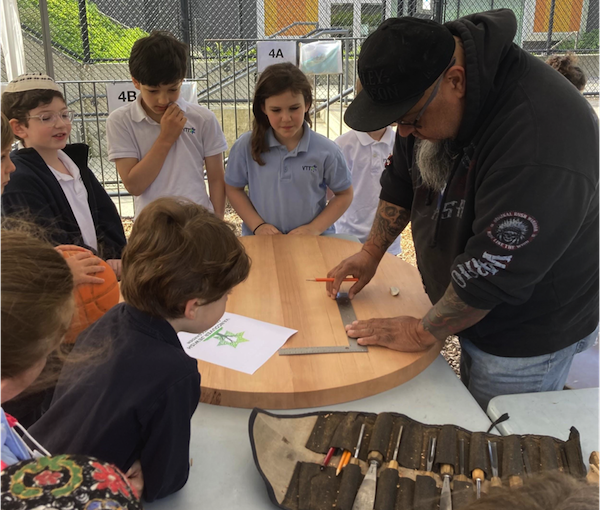
Gerry Sheena shows students his method of carving. (photo from Vancouver Talmud Torah)
Vancouver Talmud Torah invited Interior Salish Nation carver Gerry Sheena and his son Matthew Sheena for a week-long program where each grade participated in a session to learn about the history of Indigenous carving, the tools used and the process of carving and design.
Gerry Sheena has been carving for more than 17 years and his work is shown in galleries throughout British Columbia. He describes his carving style as “traditionally Salish, informed by modern painting techniques and innovative use of colour and design.”
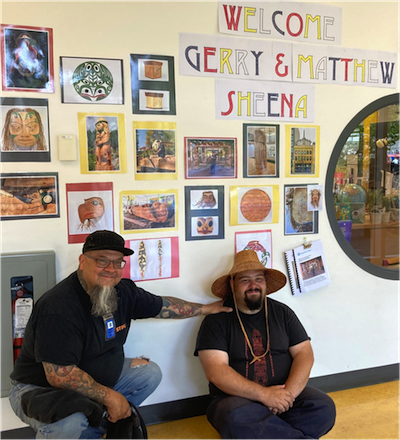
The Sheenas’ visit related to the applied design, science and technology curriculum, notably the woodworking aspect. However, VTT has been working on creating a more meaningful implementation of First Peoples’ education, which sparked the idea of integrating the two areas and having presenters from the First Nations community educate students on carving, drumming and storytelling. The timing for the presentation was matched with the month of June, which is National Indigenous History Month. Teacher-librarian Nicolle Wade created a display of Indigenous books and shared Learning to Carve Argillite by Sarah Florence Davidson and Robert Davidson, to give students an idea of what they would be seeing. She also installed a welcome display shining the light on Gerry Sheena’s art.
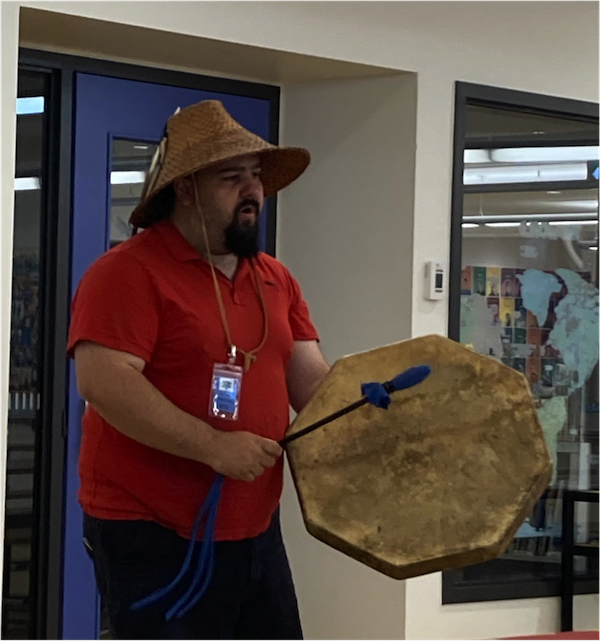
Matthew Sheena at Vancouver Talmud Torah. (photo from VTT)
The program was unique in that the Sheenas were at the school for an entire week, not only presenting but also working in the playground, carving a welcome sign for the soon-to-come community garden. Students were able to come out every recess and lunchtime to watch Gerry Sheena carve and listen to Matthew Sheena drum, and additional Q&As took place organically. Teachers had the opportunity to bring their classes out to watch the carving take place firsthand.
“Having an Indigenous carver join our VTT community for one whole week has helped us to organically elevate Indigenous education and ensure that our students are engaging in meaningful learning about the Indigenous peoples and their traditions. We are honoured to have Gerry and Matthew Sheena join us from the Interior Salish Nation as we find ways to recognize National Indigenous History Month now and moving into the future,” said Emily Greenberg, VTT head of school.
Gerry Sheena shared how he got started in carving, his love for art and his happiness when creating totem poles, masks, paddles and many other ceremonial carvings. Matthew Sheena is a passionate drummer and graced the school with his drumming and singing of a Squamish Nation song, “Snowbird,” acknowledging the land and sending a powerful message to love and to lead “through your heart, spread love to others around you and to be kind.”
Among the many lessons learned from the week were:
• The power of passing on knowledge through storytelling.
• The connection to the land being the foundation of Indigenous ways of knowing and practices. The land, plants, animals and sky are all teachers, and taking care of the land and everything living is of utmost importance.
• Honouring language. The Sheenas taught students how to say thank you, and the importance of respecting elders and cherishing their roots.
• Older students had questions about residential schools that the Sheenas approached in a gentle and meaningful way.
• Matthew Sheena spoke to the students about always reaching for the stars, never giving up no matter what life throws at you, and being the best you can be every single day. Also, he encouraged them never to give up on art, drawing, singing and dancing – and to do things that bring them joy and will help them tell a story. He said his favourite tool when carving is a pencil and spoke about the power of the pencil to create.
During their week at Vancouver Talmud Torah Gerry Sheena and his son Matthew Sheena taught students and teachers about carving, drumming and storytelling. (photo from VTT)
VTT was so grateful to spend time with Gerry and Matthew Sheena, both of whom inspired students and faculty through their presentations. The themes of building community, recognizing that everyone can be a potential source of inspiration and knowledge, and fostering respect by encouraging students to speak honestly, listen to one another, be active in problem-solving, take care of the land and value their surroundings were a few of the key takeaways from the week.
VTT aims to grow in the area of Indigenous education and make links to Jewish history, cultures and traditions, as the Sheenas’ presentations revealed that there are many similarities. The week’s activites and interactions left students with more knowledge and understanding of First Nations peoples, and it is hoped that students will continue to reflect upon questions like, What do I know about Indigenous education and First Nations communities? How can I contribute to changing the world we live in by storytelling and passing on knowledge? How can I learn more about Canada’s relationship with Indigenous people? How can I build meaningful relationships? How can I protect the world we live in; the land, animals and people? and What connections does First Nations education have to Jewish education?
Jessie Claudiois director of learning and innovation at Vancouver Talmud Torah.
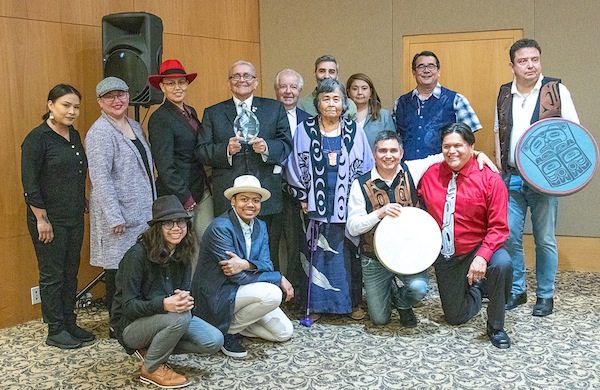
On May 25, the Centre for Israel and Jewish Affairs honoured Chief Dr. Robert Joseph (holding the sculpture) with the Victor Goldbloom Award for Outstanding Interfaith Leadership. (photo from CIJA)
On May 25, the Centre for Israel and Jewish Affairs honoured Chief Dr. Robert Joseph with the Victor Goldbloom Award for Outstanding Interfaith Leadership.
In memory of the late Dr. Victor Goldbloom, the Victor Goldbloom Award recognizes the contributions of leaders from various faith communities in advancing interfaith relations.
Joseph is a hereditary chief of the Gwawaenuk First Nation and the founder and current ambassador for Reconciliation Canada, an Indigenous organization dedicated to dialogue with multifaith and multicultural communities. He is also the former executive director of the Indian Residential School Survivors Society and a member of the National Assembly of First Nation Elders Council. As a result of his work, he has received numerous awards and recognition for bringing people of different faiths together.
Joseph is a dear friend to the Jewish community who has worked with Robbie Waisman, a Holocaust survivor, to make connections between survivors of the Holocaust and the residential schools.
On May 26, representatives from the Sikh, Roman Catholic, Evangelical, Ismaili, Muslim, Ahmadiyya, Ukrainian Catholic, Anglican, Baha’i and Black-Canadian communities, as well as Indigenous leaders, joined to celebrate Chief Joseph’s lifetime of work serving British Columbia, urging people of all faiths toward truth and reconciliation, and renewing relationships between Indigenous people and all Canadians.
***
Left to right: Emmett Simkin, Max Koenigbaur, Zachary Bordan, Joseph Gabay, Ezra Heayie, Sierra Brosgall and Ziv David. (photo from KDHS)
The Maccabiah Games take place every four years in Israel, and the 21st Maccabiah will take place July 12-26, with some 10,000 athletes from 80 countries competing in more than 40 sports. Seven King David High School students were selected to play in a variety of sports and faculty member Matt Dichter is the coach for a basketball team. KDHS is so proud and wishes them all a successful time in Israel!
***
On May 31, Birthright Israel Excel selected 60 college students worldwide for its fellowship in business and technology, which began on June 7 and runs in Israel for 10 weeks. Forty participants are from the United States, while 20 come from Argentina, Brazil, Canada, Ecuador, France, Mexico, South Africa, Spain and the United Kingdom. Thirteen of them will be visiting Israel for the first time.
Zac Abelson (photo from Birthright Israel)
One of the participants is University of British Columbia Sauder School of Business student Zac Abelson, 21, who is majoring in commerce, with a double minor in operations and logistics, and entrepreneurship. He will be doing his internship with Deloitte.
Since 2011, the Birthright Israel Excel Fellowship has selected top students from hundreds of applicants for summer internships with leading business and tech companies in Tel Aviv. This year’s cohort features an equal number of women and men and the most first-time visitors to Israel. Their internships will be in such areas as environmental sustainability, software development, consulting, finance, venture capital, engineering, marketing, cybertech, biotech, business development and startup development. Students will intern each Israeli workweek, Sunday through Thursday, and attend an evening series of speakers from across Israeli society.
A core component is the one-on-one pairing between each Excel fellow and an Israeli, enabling the foreigners to acclimate quickly to the local culture and see the country through a more authentic lens than as typical tourists. Many peer-to-peer relationships grow into long-term friendships. Some have invested in each other’s business ventures.
Birthright Israel Excel fellows enjoy free time to explore Israel with their peers, and three weekend trips as a group bring them throughout the country: the north, typically including the Golan Heights, a winery tour and a rafting trip down the Jordan River; Jerusalem, including the Western Wall and the Machane Yehuda outdoor market; and the south, for a desert trek, a mud bath in the Dead Sea and a sunrise hike on Masada.
After their return home, the Excel fellows enter a network that provides resources for professional and personal development, Israel engagement and encouraging them as philanthropists.
Birthright Israel Excel fellows have gone on to positions at companies such as J.P. Morgan Chase, Bain & Company and Google. Others have developed strategic partnerships with Israeli companies and started their own companies, often hiring other fellows.
The Masorti synagogue in Chernivtsi Ukraine has become a refuge for Ukrainians fleeing the war. Its new aron kodesh, built by grateful refugees, has become a symbol of the partnership being forged between small, out-of-the-way communities and those fleeing for safety. (photo from Schechter Institutes Inc.)
As the war in Ukraine continues, educational and religious organizations that helped support the country’s fledgling Jewish communities are finding they have a new mandate these days: to help the millions of refugees that have been left homeless by the Russian invasion.
More than 12 million people have fled their homes in Ukraine, eight million of whom are internally displaced. According to a May 5 report by the United Nations Office of the High Commissioner for Human Rights, most of those affected are women and children. In many cases, the refugees have either lost family members in the bombings or have been separated from loved ones. A significant number are struggling to find shelter, food and resources.
Schechter Institutes Inc. president Rabbi David Golinkin told the Independent that synagogues and Jewish day schools have become refuges for Jews and non-Jews alike in recent months. The institute’s educational program, Midreshet Schechter Ukraine, which partners with Masorti Olami, provides funding and educational services for Conservative communities in Ukraine. Golinkin said three of the four Masorti (Conservative) synagogues are located in regions that have been hit by bombing, including in Kyiv, where Schechter had just opened a facility in January.
Golinkin said the two nonprofits had spent more than a year finalizing the purchase of a building that would be big enough to house a sanctuary, as well as a full array of youth programs and services. Two weeks after purchasing the property, however, Russia invaded Ukraine, forcing the community to suspend the opening. As Russian troops advanced toward Kyiv, community members were urged to leave the city. Some congregants sought refuge at the Masorti synagogue in Chernivtsi, near the Romanian border, while others headed out of the country to Poland, Moldova or Romania.
Three months into the war, the Chernivtsi synagogue, tucked away in southern Ukraine, has become known for its hospitality toward those fleeing the conflict. A steady flow of refugees fills the city every day, many turning up at the Masorti facility looking for a bed or a meal. Others head to the Chabad House located nearby. Golinkin said the two organizations have learned to work together, and will refer refugees to the other community when their own facility is full. No one is turned away, whether they are Jewish or not.
Schechter and Masorti Olami also work with partners across Western Europe, Israel and North America to help Ukrainians who are seeking refuge outside of the country. Rabbi Irina Gritsevskaya, who serves as the executive director for the educational programs of Midreshet Schechter and oversees programs in Ukraine, said hundreds of refugees have relocated to Israel, Berlin and other places with the help of Masorti congregations across Europe. She said the most moving example was the rescue of a teenage boy from eastern Ukraine whose parents had died. Volunteers made the 1,000-kilometre trip through war zones to bring him to Chernivtsi.
“[It] was a terrifying experience for him,” Gritsevskaya said, “since it took three days without basically sleeping or eating [to reach Chernivtsi]. Finally, with a lot of help from the Israeli government, we managed to bring him [to Israel].” She said he seems happy with his new home and his new school. “He always wanted to come to Israel,” she said.
Cities in eastern Ukraine are still hemorrhaging populations, driven by the escalating war in border cities and villages. Yuri Radchenko, who leads the Masorti synagogue in Kharkiv, is the director and co-founder of the Centre for Inter-Ethnic Relations in Eastern Europe, a think tank of researchers who specialize in Eastern European and Jewish history. He said most of the members of his small synagogue were able to flee the city. A few chose to remain behind.
“Some teachers [have] elderly parents who are … unable to move from the city,” said Radchenko. He estimates that 30-50% of Kharkiv’s two million residents escaped before the Russians captured parts of the city, which has been heavily damaged from Russian shelling. Many residents sought cover for months in Kharkiv’s fortified subway and other makeshift shelters. Recent estimates suggest at least a quarter of Kharkiv’s residential housing has been destroyed, along with crucial infrastructure.
Still, Radchenko said many who fled the country hope that they may one day be able to return home. “People understand that it is hard to make a change,” he said, noting that immigrating to another country often means starting at a lower employment level in an unfamiliar culture. He speculated that some residents will follow the example of other postwar populations and return to rebuild their city if Ukraine wins the war. And, indeed, many of the residents who sought shelter in Kharkiv’s underground shelters are gradually returning home to repair their apartments and clean up the rubble.
Radchenko said he can empathize with them. Much of his own work was put on hold when he was forced to flee. “I would come back to Kharkiv,” he said definitively. “[If] I could move back, I would not wait. I think I would visit to see how it looks like, but I would come back if my apartment and the district where it’s located were safe.”
For now, Schechter and Masorti are taking the long view of the war. Russia’s continuing attacks mean increased risk to civilian populations, more refugees on the run and more uncertainty. The conflict also means an even greater need to bolster resources at the Chernivtsi synagogue, so that Jews can continue to come and pray, learn and find a good kosher meal there, and refugees can find support. But Schechter and Masorti know that a significant number of Jewish communities in Ukraine will need to be rebuilt. And that will take both time and money.
The Masorti synagogue in Chernivtsi Ukraine has become a refuge for Ukrainians fleeing the war. Its new aron kodesh, built by grateful refugees, has become a symbol of the partnership being forged between small, out-of-the-way communities and those fleeing for safety. (photo from Schechter Institutes Inc.)
Schechter’s director of development Michal Makov-Peled said the Cantors Assembly will be hosting an hour-long telethon of music and stories on June 12 to raise money for Schechter and Masorti Olami’s emergency campaign. She said the funds will go toward assisting Jewish communities in Ukraine, as well as increasing support for refugees, which is expected to be an ongoing need, for now.
“We have 11 apartments that we are renting [to refugees in Chernivtsi],” Makov-Peled said, adding that they also distribute food to Jewish communities in Kyiv and Odessa, where residents are slowly returning, but which have been economically impacted by the conflict.
In Chernivtsi, communities are also finding rhythm and a new way of life. Some are exploring ways to expand the small synagogue’s services, others want to pay back the generosity they have been shown. Gritsevskaya said the synagogue now has a new aron kodesh (ark) to house its Torah, built by grateful visitors who saw a need. “Many aren’t members of the Chernivtsi community, but were just passing through,” said Gritsevskaya.
The June 12 Cantors Assembly performance, Mivtza Ukraine, will be aired around the world on YouTube and Facebook. To make a donation or for more information, log on to cantors.org/mivtzaukraine.
Jan Leeis an award-winning editorial writer whose articles and op-eds have been published in B’nai B’rith Magazine, Voices of Conservative and Masorti Judaism and Baltimore Jewish Times, as well as a number of business, environmental and travel publications. Her blog can be found at multiculturaljew.polestarpassages.com.
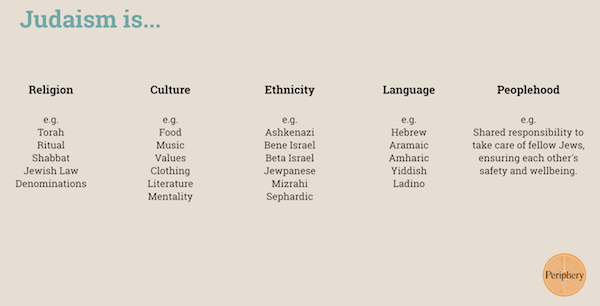
A page of the Intro to Judaism booklet that can be downloaded as part of the Periphery curriculum, which offers a framework to talk and learn about diversity within the Jewish community.
“Make space for a productive and respectful conversation” – this is the first suggested action to frame the use of the recently released Periphery curriculum.
Periphery – a film and photography exhibit exploring the ethnic diversity of Toronto’s Jewish community (jewishindependent.ca/discussing-jewishness) – came out last fall. The new curriculum builds on that 27-minute documentary. It comprises another nine short videos, all under eight minutes each, and lesson guides for students in grades 8 through 12 in both the Jewish and public school systems. There is also a guide for Jewish groups and organizations, which could be used for non-Jewish groups.
Launched by the Toronto-based nonprofit No Silence on Race and the Ontario Jewish Archives (a department of UJA Federation of Greater Toronto) with the organization Facing History and Ourselves (an American group with a Toronto branch), the curriculum is Ontario-focused. That said, most of the information is broadly based and relevant to Canadians no matter where they live, and no matter their age.
There are differences in the curricula for each of the three grade groupings (Grade 8, grades 9 and 10, and grades 11 and 12), the Jewish versus public school content, and the community dialogue package. However, the basic format and information is similar, with appropriate adaptations for probable starting points in knowledge and experience.
The common learning aims include “a greater awareness and understanding about who Jewish people are and the ethnic diversity within Jewish communities”; “Possess a stronger framework for understanding the complexities of intersectional identity, using their own identities as a foundation”; “Understand the difference between individual and group identity with a focus on belonging and recognition”; and the role of students and community members in creating inclusive community spaces. In addition, for example, the Jewish community curriculum also suggests that participants: “Discuss the intersections of race, privilege, mobility (i.e Jewish professional opportunities), power as it relates to Jewish identity and ashkenormativity.”
Before delving into the films and lesson suggestions, the curriculum offers a few activities that help frame what viewers are about to watch and discuss – beginning with making “space for a productive and respectful conversation.”
The most extensive part of the guides is the screening prompts and activities. They are organized by topics based on those of the videos, such as “Hyphenated Identities,” “Immigrating to Canada” and “Finding Strength in One’s Heritage.” They include pre-screening and post-screening questions for each film and topic, and these questions elicit self-evaluation and the sharing of stories and views on identity, race, multiculturalism, sexuality, antisemitism and social justice, as well as discussion of the experiences and opinions of the interviewees featured in the films.
The final part of the guide attempts to have participants take what they have learned out into the world, beyond the classroom or boardroom or office. For example, the title of the last section of the Jewish community dialogue is “Now What?: Social Justice within the Jewish Community and Beyond.” It begins with discussion from a global perspective – using a quote from Canadian anthropologist Wade Davis to talk about questions like, “What does it mean for us to hear from different voices of humanity?” It then highlights a quote from the Mishna and one from Pirkei Avot to further reflect on the idea that repairing the world, tikkun olam, begins within the community.
In addition to the curricula, there are related materials available to download, from worksheets to help understand the concepts being discussed and organize one’s thoughts, to an introduction to Judaism, to a glossary of terms. The poem “Unpacking the Periphery,” by Akilah Allen-Silverstein, can also be downloaded. It concludes “For each other as allies, I pray we can stand tall / Diminish the fine lines, deepen our understanding, / Listen with compassion / Listen with empathy / Act with courage / Act with reason / Because this is the season / To do better / To act on the Open Letters / To be more than trend setters / But intentional change makers.”
All of the Periphery curricula and resources are free and downloadable at peripheryexhibit.org.
A few dozen cyclists participated in last year’s ORT Vancouver Ride for STEM. (photo from ORT Vancouver)
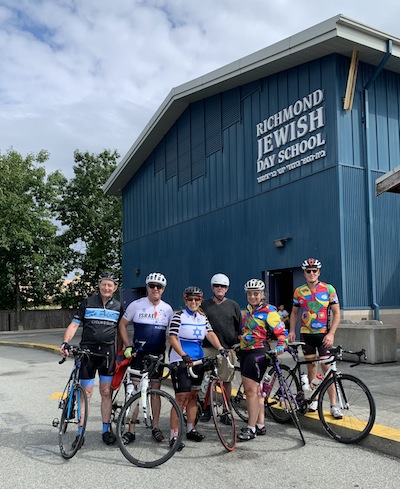
The third annual ORT Vancouver Ride for STEM takes place on Father’s Day, June 19. The cycling event, which begins and ends at Richmond Jewish Day School (RJDS) grounds, raises funds for STEM programming – science, technology, engineering and math, said Mary Tobin, longtime executive director of ORT Vancouver.
Participants can choose from a five-kilometre, 36-kilometre or 72-kilometre ride, all of them within Richmond, which is a naturally flat environment.
Founded in Russia, in 1880, World ORT is one of the largest education and training organizations in the world. To date, more than two million students have been educated by ORT and 300,000 students benefit worldwide from World ORT projects in more than 100 countries every year. ORT schools and training centres operate in North and Latin America, Eastern and Western Europe, Africa, Asia and the Pacific, as well as in Israel.
Katia Fermon, director of Jewish life and community engagement at RJDS, said half of the funds raised will go to ORT Vancouver and half will fund programs at her school.
During the pandemic, RJDS, like many schools, was forced to adapt to remote and virtual education. Now integrating a hybrid approach, the technology that was implemented by necessity is being leveraged to strengthen the delivery of educational programs.
“Starting this year, we are trying to push our STEM programming with graphic design, programming with robots and more online education,” said Fermon. The plan is to implement more technology, design skills, programming and coding skills into the curriculum.
“Now we need the hardware to do it,” she said.
Cyclists in last year’s ORT Vancouver Ride for STEM. (photo from ORT Vancouver)
Since the cycling event takes place outdoors, the partners were able to run the fundraiser right through the pandemic. Last year, she said, 35 or 40 riders participated, raising about $26,000. Because pandemic restrictions have been eased, the event is taking place during the school year this time and students and parents are encouraged to participate.
Because of the varying route length options, the return times of riders is staggered. As a result, the social component of the day takes place at the beginning.
“There’s a little reception at the start,” Fermon said. “We greet everyone, they get their water bottle, their snacks, we do a couple of pictures. We did it last year and it was very heartwarming. I don’t know of any other Jewish ride, so it becomes a very Jewish moment where we feed you, you say hi to old friends – ‘I haven’t seen you since the bat mitzvah!’ – it’s a very Jewish reception.”
Organizers are inviting everyone – not just riders – to get involved. With more cyclists than ever anticipated in this year’s event, more volunteers are still required. There is a silent auction that anyone is welcome to participate in by dropping by RJDS on the day. And, of course, donations of cash or auction items are welcome.
Jewish Family Services of Vancouver Island (JFSVI) will launch a green market at the Jewish Community Centre of Victoria on June 12, thanks largely to a grant from the Jewish Community Foundation of Greater Vancouver.
The grant has allowed JFSVI to hire Ora Stefanic, a former director at University of Victoria Hillel, as the market’s coordinator. “It is a privilege for me to be a part of such an important cause and I hope that people will not only benefit from this opportunity to purchase great quality produce at a low cost, but that it will also help support local farms,” Stefanic told the Independent.
“Ora brings a tremendous amount of experience, energy and enthusiasm to this project,” said Leah Kinarthy, head of JFSVI.
The market is not a handout of free processed food or items nearing their expiration date. Rather, according to JFSVI, purchasing fresh produce at close to wholesale prices will both allow people to preserve their dignity and reduce food waste.
“We believe that the Saanich Green Market would be the only fresh produce market offering wholesale prices on Vancouver Island,” Kinarthy said.
JFSVI expanded its programs in 2022. In March and April, the organization distributed gift cards for Thrifty Foods, a subsidiary of Sobeys, to individuals in need through a grant from Community Food Centres Canada, a group that addresses food insecurity across the country.
JFSVI received a $10,000 grant from CFCC for the gift cards and the Jewish Community Foundation grant to hire a part-time market coordinator was also $10,000.
“With shortages, inflation and higher prices, basic food staples are becoming increasingly difficult to afford for families with children and seniors and many others on fixed or reduced incomes,” Kinarthy said. “We have had very positive and grateful, and some happy but surprised, reactions from people who received this unexpected bonus funding. Some people were overcome with emotion and cried over the phone, as their situation was desperate and this helped them a lot.”
Kinarthy got the idea for a green market after pondering how to use JFSVI revenues to assist the greatest number of people with the finances available.
While on the CFCC website, Kinarthy discovered a section promoting fresh produce markets. “I read all of their extensive materials and realized that this was doable for our community. I am especially drawn to the premise of people receiving assistance through very low costs to buy farm-fresh produce rather than free food that is about to expire.”
Following the June 12 grand opening, the Saanich Green Market will run every other week for a full year, though there will also be a market on June 19.
Kinarthy emphasized that it is a 12-month pilot project. She and her board are currently applying for a grant from the Victoria Foundation to help fund the purchase of tents and other equipment to ease the burden of initial expenses. If successful, JFSVI plans to put more money into purchasing fresh food, particularly if demand exceeds expectations. Should enough funding arrive through donations and grants, they hope to hold a weekly market the following year.
JFSVI was recently accepted into the Good Food Organizations program offered by CFCC. The program, which includes more than 270 charities across the country, works to eradicate poverty, food insecurity and improve the health and well-being of low-income Canadians.
JFSVI also distributes grocery gift cards for four Jewish holidays: Rosh Hashanah, Hanukkah, Purim and Passover. In April, they delivered grocery gift cards for Passover via post, email and in-person to 36 households – or roughly 80 people – on Vancouver Island.
The organization budgeted additional funds for the Passover cards. Due in significant part to the largesse of the Fernwood General Store (formerly Aubergines), JFSVI was able to purchase them for kosher food at a discount.
Fairway Market, another Island-based grocery chain that consistently offers kosher products, offered gift cards at Passover to residents outside of Greater Victoria, as well.
Serving members of the community throughout the Island, JFSVI was started as a grassroots organization in the mid-1990s. It became a registered charity in 1996, when it was called the Jewish Assistance Association. Aside from food support, JFSVI has worked with clients on several other concerns, including housing, home support care and the prevention of social isolation. Anyone wishing to donate to the Saanich Green Market or JFSVI can send an etransfer to [email protected] or visit the JFSVI website, jfsvi.ca.
The JCC of Victoria is located at 3636 Shelbourne St., and the Sunday markets run from 11 a.m. to 1 p.m.
Sam Margolishas written for the Globe and Mail, the National Post, UPI and MSNBC.
Gaynor Levin is retiring from Congregation Beth Israel after 25 years. (photo from Gaynor Levin)
After 25 years of contributing to the communal fabric of Congregation Beth Israel, Gaynor Levin is retiring. Anyone who has had the pleasure to interact with Levin – who has worked in many different capacities at the shul – knows that she prides herself on making sure that every detail under her sphere of influence is taken care of perfectly, with a smile every time.
Levin arrived in Canada from South Africa in 1991, with Vancouver as the goal but settling in Calgary initially. She had been a teacher at a Jewish day school in Cape Town for six years and took a job at the Calgary Jewish Community Centre.
“We came from summer in Cape Town and arrived in mid-December. It was -20 in Calgary,” she said with a laugh and a little shiver.
After 11 months, Levin and her husband, Ivor, made the move to Vancouver, where they have been ever since. Her career in the Jewish community continued, as the mother of two began work at Beth Israel as a Hebrew school teacher in 1997.
After a couple of years, looking for a new challenge, she took on the half-time position of program coordinator. “It was always a team effort,” she told the Jewish Independent. “I organized big family events and adult education programs.”
As the synagogue calendar grew, new positions were added to early childhood programming and Levin worked collaboratively with volunteers and shul employees to expand the services Beth Israel provided.
By 2014, the synagogue building had been completely redeveloped.
“The shul needed a rental manager and a manager of member relations,” Levin said. “I describe this job as customer service…. I am responsible for all of the happy events.”
With the exception of funerals, she became responsible for scheduling and helping organize all lifecycle and other gatherings. She explained that the member relations part of her job dovetailed nicely with the events part because it’s often around simchahs that families think of joining a synagogue. She also took on the responsibility for the rabbi’s calendar and for booking the Schara Tzedeck mikvah when necessary for conversions.
Working at the synagogue, Levin has seen many changes over the years. For example, recently, there have been a number of conversions for same-sex couples who have adopted, or who have had a baby by surrogate, and want to convert their new infant child to Judaism.
Outside of the religious domain, Levin’s job entailed renting out the synagogue’s various spaces to different groups. Jewish organizations such as King David High School and the Jewish Federation of Greater Vancouver have used the BI ballroom over the years for large events, as have many other organizations. For example, this past May, B.C. Children’s Hospital Foundation held their Balding for Dollars fundraiser at the synagogue. Ballroom dancing, rhythmic gymnastics, Girl Guides meetings and Weight Watchers gatherings were all regularly scheduled rentals under Levin’s tenure. There were also the occasional brushes with celebrity when TV shows were filmed on the premises.
“Whenever new people looking to host an event would walk into the shul, they would always be amazed. When they see it from the outside, nobody thinks it will look like this inside,” Levin explained. “It’s the best kept secret in the city. Central location, parking, a choice of many beautiful rooms.…”
While still clearly engaged with her job and the synagogue, Levin said 25 years is a good chunk of time in one place and she’s happy to leave now, feeling great about what she’s accomplished. She said she looks forward to attending events and services without the responsibility she’s had for years. “I love BI – it’s a second home to me and always will be,” she said, smiling.
Levin said her work with the membership in particular was personally rewarding and she enjoyed being “the face people knew when they joined the shul or needed help with an event.” She laughed when she said she never wants to give up buying the flowers for Yontif or gifts for guests of the shul because that was a favourite part of her job.
“I loved the people I worked with. It felt like a family – from the custodial staff to the president of the board,” she said.
Anyone looking to book the BI for an event can still catch Levin until the end of June. After that, she’ll be continuing her volunteer work in many Jewish organizations around the city – and watch out for her if on the Grouse Grind, as she’s climbing it at least three times a week.
Michelle Dodekis a freelance writer living in Vancouver.
Maiya Letourneau has been head librarian of the Isaac Waldman Jewish Public Library since last November. (photo from Maiya Letourneau)
Maiya Letourneau, head librarian of the Isaac Waldman Jewish Public Library in the Jewish Community Centre of Greater Vancouver, has always wanted to work with books. “I grew up in Winnipeg,” she said. “My mom worked in a bookstore, and I always liked books.”
Letourneau received a bachelor’s degree in education before completing the two-year library program at the University of British Columbia last summer. Since November 2021, she has been head librarian at the Waldman.
“When I learned about the job at the JCC library, I was excited,” she told the Independent. “I often went to the JCC in Winnipeg as a child, and to work at the JCC in Vancouver felt like a great opportunity to reconnect. And to work with books was all I wanted.”
Before she started this job, Letourneau worked as a student librarian at UBC and as a teacher-librarian at the Vancouver School Board. “A teacher-librarian is a great job,” she said. “You teach the children how to use a library, both its paper and its digital resources. I worked with the elementary school children. We had story times often, and I taught them how to ask questions about the stories we read.”
Letourneau considers reading one of the highest needs and pleasures of any human being. “Not every school has a library,” she said, “but I think all schools should have one. It helps with students’ literacy rates. Reading helps kids down the road in their lives.”
Books have certainly defined her life. She reads a wide variety of genres and on a broad array of topics. She talks about books with shining eyes, like a person with a sweet tooth enjoying a selection of treats in a cake shop. “I’m reading a lot of the books from the Waldman Library. It is an amazing collection. I might not have a deep knowledge of Jewish literature yet, but I have a deep appreciation of it. It’s been great fun for me to read our books, to learn our collection.”
Her latest read was Gary Shteyngart’s Our Country Friends. “It was a bit humourous and very relatable,” she said. “The story was about COVID and the isolation we all experienced recently because of the pandemic. A wonderful novel.”
Passionate about her job, she not only wants to offer patrons the best books and movies but also to find great new material for the collection. “I often go to GoodReads to get a feel of what people are reading, but my main resource is the Jewish Book Council,” she said. “I regularly log into their website. Another resource is when people come in and ask about a book they want to read. Listening to our readers is paramount.”
Letourneau gives a lot of thought to improving everyone’s reading-related experience. “One of our programs involves authors visiting the library. Another is a monthly Jewish Book Club, led by the former head librarian, Helen Pinsky. We also have a grant for an iPad learning program – people could borrow an iPad from the library for several months, and our volunteers would teach them how to use those iPads to access the Waldman’s digital resources. We have over 600 digital books in our collection, and not all of them are duplicated in the paper format.”
Letourneau’s concern over library accessibility is profound. “During the pandemic, we were closed for several months,” she said. “Now, we are open, and more people are feeling comfortable coming to the library in-person again, but I want to do more, to bring books to the people, like bookmobiles. COVID taught us to look for ways to bring the books outside the library.”
One of the new ways to connect readers to books will be a cart the library ordered recently. “We are on the second floor of the JCC,” explained Letourneau. “Nobody is passing the library on the way to their meetings or the gym or the swimming pool. The library is not often a destination by itself, but our research suggests that people would be glad if the books came to them. We are going to have the library mobile book cart roaming around the JCC, in the atrium on the first floor or near the café. I’m sure it will increase our book circulation.”
She also initiated a major change at the Waldman: it is now free to access books, and not only for JCC members but for the general public as well.
“We have something they don’t,” she said, referring to most other libraries. “We offer Jewish authors and Jewish content the city public library might not have. It is especially important for newcomers to Canada. We have many Hebrew books and, when people just arrive from Israel, they want to read the language they know. Their children want the familiar language, as well, before they learn English. That’s why our Hebrew collection is so important.”
Letourneau is not alone in her dedicated work. She has the library’s volunteers to help her.
“The volunteers are the backbone of this library,” she stressed. “The credit goes to the previous librarians. They built such a great group of volunteers. Some of them, about 70%, are over 55, seniors who want to help for various reasons.
“Others are young students who want to learn how a library works. The Waldman is the best place for them. We are a small library and, here, they can learn every aspect and every task in a library, not just one activity, like shelving or front desk, which they might learn from a larger library.”
While many older and longtime users consider the library an access point to information, a quiet refuge and a serious place, she wants to add some new features to attract younger readers.
“I’d like to add a sense of playfulness for the kids,” she said. “Maybe some games, like Dungeons & Dragons. I’m thinking of ways to make the genre of fiction more visible on the shelves, too. There are some wonderful genres of books – fantasy and science fiction – by Jewish authors. Teenagers like those books.”
In general, Letourneau regards it as her duty to promote reading as much as possible and is willing to consider many possibilities of what a library can offer and be. “Whatever gets people reading,” she said with a smile.
Olga Livshin is a Vancouver freelance writer. She can be reached at [email protected].
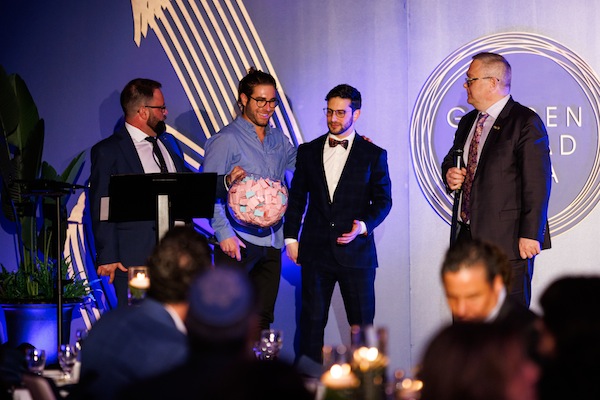
Left to right, Alex Monchamp, Aaron Friedland, David Kaye and Howard Blank prepare to draw the 50/50 winner at King David High School’s Golden Thread Gala on May 12. (photo from KDHS)
“The reality is King David took a student who genuinely struggled, exposed me to meaningful ways to make a difference – they gave me passion and purpose, they provided me with academic rigour to realize my dreams, provided me with confidence, and then added a fundamental layer of Jewish and humanist values,” said Aaron Friedland, addressing a full house at King David High School’s Golden Thread Gala on May 12.
“And what is interesting is how unremarkable my story at King David is,” he continued. “There are simply too many grads who King David has helped to overcome the odds and flourish – and it’s the outcome of brilliant and caring educators investing in us.”
Friedland is founder and executive director of the Simbi Foundation, which helps underserved and refugee communities access education. He is a National Geographic Explorer and a PhD candidate in the field of econometrics, focusing on the interplay of economics and education. And these are only a few of the many accomplishments and projects on Friedland’s growing resumé.
He came to King David in Grade 8, he said, after having attended four different elementary schools. “I’m incredibly dyslexic,” he shared, “and there was a time when teachers told my parents I likely wouldn’t make it to university.”
But there is more to King David than preparing students for university, he added. “The world doesn’t just need more university grads. The world needs more global citizens who are passionate about creating positive impact and who have the skill set to realize their dreams. Tonight is about celebrating a school that has developed a tried-and-true approach to developing global citizens who thrive while engaging in tikkun olam, or repairing the world. And I’m not sure if you’ve seen or have been reading the news, but the world could use a little repair.”
Mentioning COVID-19, Russia’s war on Ukraine, the challenge to Roe v Wade in the United States and generally declining literacy rates, he spoke about the need for hope. He then cited primatologist and anthropologist Jane Goodall, whom he had interviewed on Simbi Foundation’s Impact in the 21st Centurypodcast.
“Jane explained, ‘Hope isn’t just wishful thinking – it’s rolling up our sleeves and doing something about the problem.’ And she shared a few pieces of wisdom,” said Friedland.
“When we’re feeling a lack of hope, it’s important to remember just how much power we each possess.
“When we’re feeling stuck, we must think globally and act locally. She means that we must find causes we’re passionate about and start making a difference immediately,” he said. “No action is too small. Jane spoke about the addictive nature of helping. And, once we’re helping, we’re part of the solution and it feels great – so we do more of it.
“And, when I pushed Jane further, she explained that she stays hopeful for three reasons. One, our amazing human intellect. Two, the indomitable human spirit – meaning, we don’t give up. And three, the power of young people.
“Jane believes in the power of young people so strongly,” said Friedland, “that it is where she invests all of her time, specifically high schoolers, because she believes that those are the people who are going to change our planet and change the world. And, after speaking with Jane, it got me thinking about how King David is the exact breeding ground for the types of people who come out and positively impact the world and give us hope.”
A visit to KDHS by farmer J.J. Keki, a leader of Uganda’s Abayudaya Jewish community, was the spark for Friedland’s tikkun olam work and further study. The Simbi Foundation began its life as the Walking School Bus and the organization now builds solar-powered classrooms, known as BrightBoxes, in Ugandan and Indian refugee settlements, with each installation providing up to 6,000 students with access to education and electricity. The foundation’s chief operating officer and co-founder is Ran Sommer, another KDHS graduate.
The Golden Thread Gala celebrated the almost 750 students who have graduated from KDHS since it was established – and it raised $202,491 for the school.
The gala, which was held at Congregation Beth Israel, began with a piano and vocal performance by student Joseph Gabay, and also featured a song performed by students Kailey Bressler, Rachel Gerber, Mhairi Hemingson and Kiera Katz; group member Sara Bauman was unable to attend. Alex Monchamp, deputy head of school, stepped in to welcome the crowd because head of school Russ Klein couldn’t be there either, but Klein’s emcee duties were taken on by actor David Kaye, another KDHS alum. As part of his emceeing, Kaye interviewed on stage two other KDHS grads – Jordan Grubner and Ava Katz – about their time at the school and how it prepared them for the larger world.
Rabbi Stephen Berger, head of Judaic studies, did the blessing over the bread before the meal and gave a few remarks, as did gala committee co-chairs Heidi Seidman and Sherri Wise, and KDHS board members Alain Guez and Chana Charach. Howard Blank led the live auction.
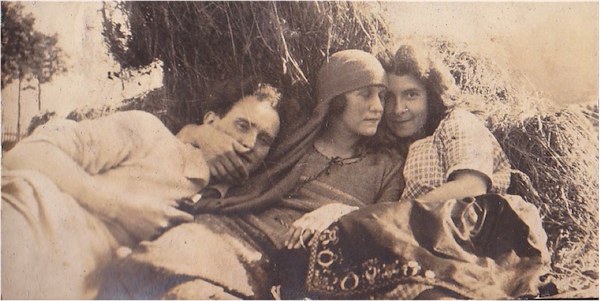
Jan Cherniavsky, Elspeth Rogers Cherniavsky and Gaby Bettelheim, Austria, 1922. (photo from Alix Morgan)
The Anschluss, Evian Conference, Munich Agreement and Kristallnacht: 1938 was a watershed year in Holocaust history. These events marked a turning point in the lives of the Jews of Europe and on the international stage, where political decisions made by Western democracies would reverberate for generations to come.
Some have argued that the genocide of European Jewry “started with the washing of the streets” of Vienna in the weeks immediately following Anschluss.[1] They assert a “critical correlation between these events and the genocide that lay ahead.”[2] Appreciating what transpired on the streets of Vienna after Anschluss and understanding how those events paved the road to genocide is imperative in the study of the Holocaust.
For Canadian students learning about these events eight decades later, it can be difficult to grasp the horror, fear and disbelief felt by Austrian Jews as they were brought under Nazi rule, overnight. One meaningful way to convey their experience is through primary sources. Personal letters, diaries and photographs from the time can evoke the range of emotions felt by Jewish individuals and families as they struggled to comprehend and respond to the events of 1938.
In 2021, the Vancouver Holocaust Education Centre was privileged to receive a donation of personal letters which do just this. The donation, arranged with assistance from Elspeth Rogers Cherniavsky’s grandchildren, Alix Cherniavsky Morgan and Nick Gudewill, comprises 39 pages of correspondence written by Elspeth to her mother, in Vancouver, during Elspeth’s visit to Vienna in May and June 1938. With clarity and compassion, the letters give a firsthand account of the circumstances facing dozens of Elspeth’s Jewish friends.
Elspeth Rogers Cherniavsky
Elspeth Rogers was born in Vancouver in 1900 and grew up in her family’s mansion, Gabriola House, which still stands on Davie Street. She attended Crofton House School, volunteered with Alexandra Orphanage and, in her leisure time, rode her horse in Stanley Park.
Elspeth’s father, prominent Vancouver industrialist B.T. Rogers, founded B.C. Sugar Refining Co Ltd. (now known as Rogers Sugar) in 1890. The B.C. Sugar factory remains a Vancouver landmark, its origins and history linked to the completion of the cross-continental Canadian Pacific Railway and the expansion of industry in Vancouver. Elspeth’s mother, Mary Isabella Rogers, was born into the Angus family of Victoria. She became a leading patron of music in Vancouver in the first half of the 20th century and is credited as the de facto founder of the Vancouver Symphony Orchestra.[3]
Elspeth’s connection to Jewish social circles in Vienna came through her husband, Jan Cherniavsky, whom she wed on June 1, 1922, at St Paul’s Anglican Church on Jervis Street, in the high society event of the season.[4] Jan was a classical pianist with the internationally renowned Cherniavsky Trio of musical brothers: Leo, Jan and Mischel Cherniavsky.
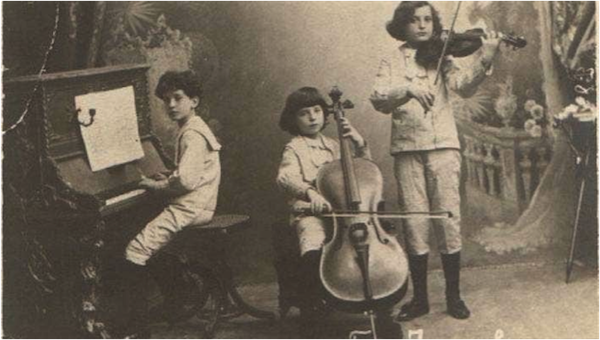
Their father, Abraham Cherniavsky, harnessed his young sons’ musical talents to secure the family’s passage out of Russia, with its antisemitic restrictions, at the turn of the century. The Cherniavskys moved to Vienna in 1904 to study music and gain the support of influential people there. The Bettelheim family of Vienna quickly embraced the Cherniavsky Trio and promoted them in Vienna’s music circles. The Bettelheims used their connections in England to facilitate the trio’s move to London in 1906, launching their international career.[5]
The Cherniavsky Trio: Jan, Mischel and Leo photographed in Minsk, 1904. (photo from Alix Morgan)
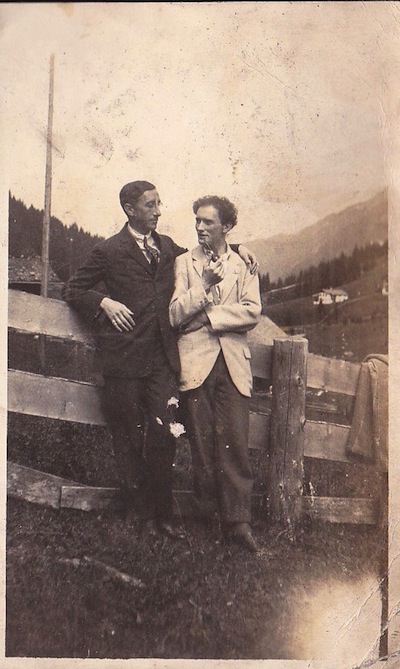
Throughout his life, Jan Cherniavsky returned to Vienna frequently and maintained his boyhood friendship with the Bettelheim family, particularly with Karl Bettelheim, who was closest in age to Jan. After Jan married Elspeth, he immediately took her to Vienna to meet Karl and Karl’s wife Gaby.
During the 1920s and ’30s, Jan and Elspeth lived alternately in Vancouver, London and Vienna, as dictated by the international performance schedule of the Cherniavsky Trio. Elspeth and Jan rented a flat in Vienna and lived for a time there with their children. With the Cherniavsky connections in the music world and the Rogers family connections in the sugar industry, Jan and Elspeth amassed a large circle of Jewish friends in Vienna, including composers, performers, sugar refinery magnates, timber products manufacturers, academics, art collectors, lawyers, doctors and engineers.
Letters from Vienna
Elspeth and Jan were living in England in the spring of 1938 when Nazi Germany annexed Austria. Disturbing news reports of mob violence and persecution compelled the Cherniavskys to travel to Vienna to check on the well-being of their many Jewish friends there, particularly Karl Bettleheim.
Elspeth, by her own description, had always been “mortally afraid about everything”[6] and was particularly trepidatious about visiting Vienna during this “reign of terror” with a husband who was Jewish by birth. But the couple was determined to see their friends and offer what help they could. As Canadians, the Cherniavskys hoped their citizenship would protect them and possibly allow them to assist their friends in their urgent search for a means to flee the Nazis.
So it was that eight weeks after Anschluss, in May 1938, Elspeth and Jan Cherniavsky arrived in Vienna by car. On May 29, 1938, Elspeth wrote home to her mother in Vancouver describing the scene that met them in Vienna:
“It was a mad-house in Vienna and we began to feel, after a few days, that we were losing our senses too…. Hitler’s photograph is everywhere until it stinks and swastikas cover everything. Streicher’s paper, Der Sturmer, on sale at every corner and the pictures in it make you sick…. I walk for blocks to look for a shop that is not marked ‘Aricshes Geschäfft’ [Aryan business].”
Unlike Nazi Germany, where the persecution of Jews evolved over a period of five years, daily life for Austrian Jews changed overnight and their fate was far worse. Anti-Jewish laws rendered Austrian Jews stateless, subjecting them to random arrest and dehumanizing attacks, and denying them protection of the police and the rule of law. The scale of the violence, both planned and spontaneous, and the alarming number of ordinary Austrian citizens who turned against Jews, created an atmosphere of terror in which Austrian Jews, as observed by Elspeth, felt “absolutely trapped and hunted.” Elspeth wrote in her letter of June 6, 1938:
“When we got to Germany, everything seemed peaceful in comparison to Austria. People didn’t Heil Hitler quite so avidly as in Wien…. After five years the people in Germany must be a little tired & yet I believe they are starting there on another wave of persecution. But think how violent it is in Vienna to do in two-and-a-half months what it took five years to do in Germany.”
Upon reaching Vienna, the Cherniavskys went immediately to Karl Bettelheim’s flat. Karl could no longer practise law, his car was confiscated and his assets registered with the Nazi authorities in anticipation of expropriation. Though he had lived his entire life in Vienna and fought for Austria-Hungary in the First World War, Karl lived in fear of being visited by the SS, molested in the streets or arrested in a raid. He told Elspeth, “he never thought that he would feel like a criminal and a fugitive.”
Karl’s despair and hopelessness radiate from the pages of Elspeth’s letters, as he spoke frequently of suicide. Understanding that his life in Austria was over, Karl was desperate to get himself and his teenaged daughter out of the German Reich, even though it would mean leaving everything behind. But it was “almost impossible” to find a country that would accept Jewish refugees and unlikely for Karl to muster the financial resources to support himself in a new country, with the crippling flight tax imposed on fleeing Jews.
Elspeth and Jan visited many of their friends in Vienna and found them in a similar state of anguish and panic:
“We can’t do anything much, it is true, but we can talk over prospects and perhaps some suggestions…. It was like going from one death bed scene to another, some had lost everything already and felt the worst was over and those that hadn’t waited for it to come…. It is like seeing people drowning slowly (only I think that is too human a way to describe it) and not doing much to help them.”
Elspeth’s letters are filled with stories of their friends’ public humiliation and social isolation: taken from their homes and forced to clean the streets, ousted from their professions, arrested and jailed without warrant, robbed of their assets and businesses, prohibited from public spaces and even turned on by their neighbours and employees.
“Lili Bettelheim, for eight hours, had to clean lavatories with her hands, to pick up dirt on the floor and even more unspeakable things – with her teeth and all the time not be allowed to go to the lav herself….”
“Rosa Lemberger was in prison for three weeks with four other women in a one-roomed cell … and was allowed out only when she signed a paper saying she would give all her money and properties to them….”
“We went to see the Strakosches. Their factory has been taken away. At least bought from them at such a small sum it was practically taken and they have lost everything … Georg Strakosch was in prison too….”
“[Dr. Patzau] had been one of the 4,000 rounded up…. Just before we left Vienna we heard that all they know is that he is either at Dachau or Munich – or Bremen. I think that is rather bad – sometimes they come back from there in urns….”
“We went to see poor Mrs. Dub. She had a small pension 800 sch. from the newspaper her husband [Mortiz Dub] worked for all his life. The first month it was cut down to 400. This month she was told she would have none….”
“Poor Pepi [Josef Hupka] broke down completely when we left – he has so little hope. He has some very fine drawings by Schwind which were exhibited in the Albertina.… He wants to sell them – but a new law by Goebbels says a Jew will be imprisoned if he asks too much for an art treasure – so Pepi is frightened to sell.”
Although the worst of the mob violence had quelled by the time Elspeth and Jan arrived in Vienna, Elspeth observed an atmosphere where the “terrorizing is more subtle and secret and everyone lives in daily fear.” It was dangerous for Jews to go out in public, and equally dangerous to meet in homes, so the Cherniavskys met their friends in back rooms, behind locked doors, using whispers, away from windows where they might be seen or overheard.
During these clandestine reunions, many of the Cherniavskys’ friends broke down in tears, speaking of suicide and swallowing sedatives to survive the daily nightmare. They begged Elspeth and Jan for help in leaving the country. Eight weeks after Anschluss, their friends had moved past denial and were resigned to the necessity of flight, accepting that their fate would be complete financial ruin and the permanent dissolution of their families and community.
Who wants them?
Anschluss brought 185,000 Austrian Jews within the German Reich; almost all lived in Vienna. The ensuant refugee crisis was acute, with hundreds of thousands of Jews seeking protection and very few countries willing to offer it. Jan and Elspeth were determined to use their Canadian citizenship and international connections to help their Viennese friends caught in the Nazi regime. At the British consulate in Vienna, they saw “about a hundred people waiting to get permits to go to England.” Their meeting with a CPR agent regarding immigration prospects in Canada was unsuccessful. Obtaining official permission to leave was difficult and illicit flight was risky.
“We talked with Karl about his plans – how he is to get out & where to go – as we must get him out…. Jan & I have most pessimistic views of his chances of getting out, but we left promising to do anything we can.… We had the usual dismal talk and discussed the possibilities of every country. Jan is a walking atlas and full of geographical information….
Karl Bettelheim and Jan Cherniavsky in Gargellen, Austria, 1922. (photo from Alix Morgan)
“Of course everyone asks us about Vancouver – if we came from anywhere else it would be the same. It is terribly cruel to say, ‘I’m afraid you would have no chance and besides it is almost impossible to get in.’ We try to think of other places where living would be cheaper and where there would be more opportunities. But the trouble now – where to go? Who wants them?”
Elspeth’s observation was confirmed just five weeks later. In July 1938, the Evian Conference addressed the Jewish refugee crisis, and all but one of the 32 countries in attendance refused to relax their immigration restrictions to admit Jews fleeing Nazi persecution. The Western democracies turned their backs on the Jews of Europe. As if in direct response to Elspeth, the Nazi paper Völkische Beobachters, reporting on the outcome of the Evian Conference, smugly proclaimed on July 15, 1938: “Germany has offered the world its Jews. No one wants them!”
Fate of their friends
The Cherniavskys were able to help Karl and his daughter Trauti reach safety in England in 1938. Trauti secured a permit to study and work as a children’s nurse in Northamptonshire, while Karl lived in London. Karl and Trauti stayed in England as registered “enemy aliens” until their immigration to the United States in 1940. The Cherniavskys assisted other Bettelheim family members in building new lives and businesses in Vancouver.
The younger Viennese friends mentioned in Elspeth’s letters made it out of Europe before the start of war, immigrating to England, the United States, Canada and Australia. But, tragically, most of their older friends either could not, or would not, leave Vienna.
Karl’s brother, retired judge Hofrat Ernst Bettelheim, and his wife Elly, were deported to the Theresienstadt ghetto in 1942. They perished in Theresienstadt within a year.
Mrs. (Gisela) Dub was deported to Theresienstadt and subsequently transferred to Auschwitz concentration camp in May 1944. Mrs. Dub was murdered in Auschwitz.
Following the aryanization of the Strakosch sugar refining factory and seizure of his property, Georg Strakosch committed suicide in Vienna, just weeks after Elspeth and Jan left the city. The remaining family fled to Switzerland and eventually immigrated to the United States.
Pepi (Josef) Hupka, once dean of law at the University of Vienna, fled with his wife Hermine to Amsterdam in 1939, only to be forced into hiding when the Nazis invaded the Netherlands in 1940. The Hupkas were caught by the Nazis in 1944 and deported to Theresienstadt, where Pepi died in April 1944. Hermine was deported to Auschwitz and murdered. Decades later, following a legal battle for restitution of the Moritz von Schwind drawings mentioned in Elspeth’s letter, Hupka’s grandsons received what remained of their grandfather’s looted art.
Legacy
Elspeth Cherniavsky was deeply affected by what she witnessed in Vienna in the spring of 1938:
“I don’t think we can ever feel quite the same again … I just wish a few more people could see these things. To read leaves one feeling sorry but still quite cold-blooded about such things – but to see and talk to all these people makes you shudder and think that we should never mind anything, as long as we are free and have enough to eat and exist.”
The sense of chaos and urgency she experienced in Vienna is reflected in the feverish pace of her writing – a “jumbled account I have been scribbling in haste.” Yet her “screeds,” with their vivid details and biting commentary, transport the reader into “the mad-house” that was Vienna in 1938; “that filthy country that is so beautiful,” where “everything is so upside down that no one really knows anything.”
The public acts of cruelty and dehumanization, the uncontested violence carried out in broad daylight, the disintegration of the rule of law, and the collapse of basic human morals – all these elements described in Elspeth’s letter were on full display in Vienna in May 1938 for those who cared to see. But it was the “cold-blooded” indifference of bystanders and the international community that emboldened the perpetrators and demoralized the victims, setting the stage for genocide.
Elspeth’s perspective on the history she witnessed is unique. She was removed from the events, protected by her Canadian passport and non-Jewish status, yet also deeply connected through her intimate relationships with the victims. Elspeth’s perception was also coloured by her belief that, as a Canadian, she ought to be in a position to help. Her letters resonate with growing frustration that she could not do more. Elspeth’s refusal to simply stand by and watch history unfold distinguishes her from other non-Jewish North Americans who witnessed the atrocities in Vienna in 1938.[7] Though she did smuggle some valuables out of the country for Karl Bettelheim and Pepi Hupka, Elspeth never got over the fact that she was too much a “coward” (in her own estimation) to smuggle Mrs. Strakosch’s conspicuous diamond necklace past the border guards.
During her life, Elspeth was invariably described in relation to the others: “the sugar king’s daughter,” wife of the distinguished pianist, or daughter of Vancouver’s patron of the arts. When described in her own right, it was often as a “socialite” or “Vancouver society girl.”[8] Michael Kluckner writes: “Throughout her life, Elspeth was frustrated by her inability to accomplish anything which she felt to be sufficiently worthwhile – she called herself stupid for her lack of self-confidence.”[9]
And yet, 34 years after her death, on the 80th anniversary of Anschluss, Elspeth’s letters were published in German by a small press dedicated to the voices of strong and inspiring women. In an anthology entitled 1938: Why We Must Look Closely [10], Elspeth’s letters are presented as a summons to moral and civil courage.
Elspeth’s wish that more people could witness the dehumanizing cruelty of the Nazi regime and understand the dangers of indifference has not fallen on deaf ears. With the donation of her letters to the VHEC and their presentation in our online collections catalogue, the preservation and accessibility of this historic correspondence is ensured for future generations.
The VHEC is grateful to the Cherniavsky and Gudewill families for entrusting Elspeth’s letters to its care and for the opportunity to introduce them to students, researchers and historians around the globe.
Lise Kirchnerhas worked with the Vancouver Holocaust Education Centre for two decades in the development and delivery of education programs with special focus on the pedagogical use of the VHEC’s collection. For this article, which was originally published in Zachor, Spring 2022, she thanks Beth Harrop, Ben Cherniavsky, Nick Gudewill and Alix Morgan for their generous assistance and support.
ENDNOTES
Sculptor Alfred Hrdlicka as quoted in James E. Young, The Texture of Memory (New Haven: Yale University Press, 1993), 110.
Ilana Fritz Offenberger in The Jews of Nazi Vienna, 1938–1945: Rescue and Destruction (London: Palgrave Macmillan, 2017), 43.
David G. Duke, VSO 100: A Century of Memorable Moments (Vancouver: Vancouver Symphony Society, 2018).
Vancouver Daily World, June 2, 1922, page 7.
Felix Cherniavsky, The Cherniavsky Trio ([Edmonton]: Felix Cherniavsky, 2001), 44-46.
All quoted text taken from the letters of Elspeth Cherniavsky unless otherwise noted.
For example, Helen Baker, an American woman in Vienna during Anschluss, wrote in her letters home to family: “My feelings about the Jews are equally mixed. I feel so sorry for them, but would like to boot them out of America.” See: Erin Harper, “Accidental Witness,” March 31, 2021, 12 Days that Shook the World, podcast, United States Holocaust Museum, accessed April 6, 2021.
Vancouver Daily World, Dec. 16, 1921, page 6.
Michael Kluckner, M.I. Rogers: 1869-1965 (Vancouver: M. Kluckner, 1987), 118.
Barbara Schieb and Jutta Hercher, eds., 1938: Warum wir heute genau hinschauen müssen (Munich: Elisabeth Sandmann Verlag, 2018).