Skip to content

  • Home
  • Subscribe / donate
  • Events calendar
  • News
    • Local
    • National
    • Israel
    • World
    • עניין בחדשות
      A roundup of news in Canada and further afield, in Hebrew.
  • Opinion
    • From the JI
    • Op-Ed
  • Arts & Culture
    • Performing Arts
    • Music
    • Books
    • Visual Arts
    • TV & Film
  • Life
    • Celebrating the Holidays
    • Travel
    • The Daily Snooze
      Cartoons by Jacob Samuel
    • Mystery Photo
      Help the JI and JMABC fill in the gaps in our archives.
  • Community Links
    • Organizations, Etc.
    • Other News Sources & Blogs
    • Business Directory
  • FAQ
  • JI Chai Celebration
  • JI@88! video
image - Weizmann Canada Physics Tournament 2025
image - The CJN - Visit Us Banner - 300x600 - 101625

Recent Posts

  • Vrba monument is unveiled
  • Music to build bridges
  • A better future possible
  • Anne Frank exhibit on now
  • Human rights in sport
  • Telling the story of an icon
  • Crawl bigger than ever
  • JCC Maccabi in Toronto
  • A way to meet fellow Jews
  • Time to include
  • Add Jewish joy to the mix
  • Reminder of humanity’s light
  • From the archives … editorials
  • Year-round holiday recipes
  • מדוע עזבתי את ישראל ואינני חושב לחזור ארצה
  • OJC hosts Oct. 7 memorial
  • A journey beyond self
  • Antisemitism a problem
  • Young man is missed
  • Orr action sparks complaint
  • Prison sentence for hate
  • Etgar Keret comes to Vancouver
  • New fall lecture series
  • Series explores music
  • Doc on Zapiro screens Nov. 6
  • Joy of shared existence
  • Community milestones … October 2025
  • MAID vs Jewish values
  • Cheshvan a great month, too
  • Bull, bear or bubble?
  • From the archives … a coin, etc.
  • מדוע האנטישמיות הולכת וגואה בעולם
  • New bio gives Vrba his due
  • Joy brighter than ever
  • When approaches differ
  • New leadership at the JCCV

Archives

Follow @JewishIndie

Tag: carving

Zack exhibit celebrates nature

Zack exhibit celebrates nature

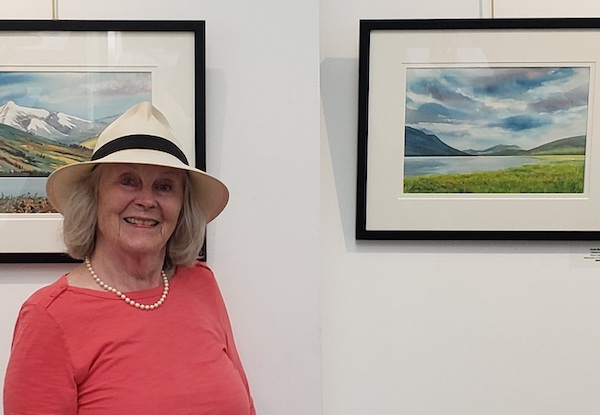
Enda Bardell (photo from Enda Bardell)

Creativity manifests itself in people’s lives in different ways and at different times. For Enda Bardell, various forms of art occupied her for decades, while Mike Cohene discovered woodcarving only a few years ago, on his way to retirement. Their double show, Artistry in Wood and Water, opened at the Zack Gallery on July 26.

Bardell told the Independent that she was born in Estonia. In 1944, when she was a young child, her family fled from Estonia, then occupied by the Nazis, to Sweden. Her mother worked at a paper factory there, and Bardell played with paper dolls she made herself. She also drew all the dolls’ colourful outfits. “I gave the dolls away to other girls, to make friends,” she recalled. “My first attempts at fashion design.”

A few years later, the family was forced to move again. The Russian communist government wanted the return of all the Estonians who had escaped the Nazis during the war, and Sweden was going to comply with that demand. But Bardell’s father didn’t want to live in communist Russia, so they became refugees again, this time ending up in Canada.

“In 1951, we came to Winnipeg,” said Bardell. “I went to school there and I desperately wanted to fit in. To belong. To be Canadian. I participated in many school clubs and activities. Entered an art class, too. My teacher praised me and recommended that I send one of my drawings to an interschool art competition. I did. And I won. I knew then that I was an artist.”

Interested in landscapes and abstracts, Bardell painted a lot as a teenager, but, after her high school graduation, she became deeply involved in fabric art. “I sold my batiks at craft fairs and house parties. People liked them, and someone suggested I should open my own store,” she said. “I did. I designed lots of different textile objects: skirts, pillowcases, aprons, etc. I felt that I needed a business course, in addition to my art education, so I took it. My store was very successful.”

But, as soon as the store achieved that success, running it lost its challenges. “I became bored,” said Bardell. “It was time for a change.”

She sold the store and did many other things in her professional life. “I always want to try something new, something I’ve never tried before. At one time or another, I was a lamp designer. I worked in banking. I was a realtor. I designed costumes for the Vancouver movie industry,” she said.

She also traveled a lot. “I have visited 38 countries. I like adventures, like it when I can’t speak the tongue. Then I have to express myself through body language. I have to be creative,” she said.

Art always shimmered on the periphery of her life, a constant creative supplement to her various commercial careers. First, abstract oils and acrylics, and, later, watercolours. Painting eventually metamorphosed into the focus of her existence. In the past two decades, she has participated in multiple solo and group exhibitions in Canada and abroad. In 2008, she even participated in an art show in her native Estonia, the Estonian Art in Exile exhibition at KUMU, the National Museum of Art in Tallinn. KUMU acquired one of her acrylic abstracts for their permanent collection; another of her paintings is in the Tartu Art Museum in Estonia. Her paintings are represented by many local galleries.

The current exhibition at the Zack is the result of a trip Bardell took to Yukon shortly before the COVID pandemic temporarily closed all travel. “My son lives in Yukon,” she said. At his prompting, she applied and was granted residency for one month at Ted Harrison Cabin in 2018. “We hired an RV and traveled there for two weeks,” she said. “Yukon was amazing: mountains, rivers, lakes. The place resonated with me. I took 1,400 photos during our travels. Based on the selection from those photos, I painted 40 watercolour pieces during my stay at the cabin. It was a privilege to stay in that wonderful place, especially because I had met Ted previously.”

Many of Bardell’s paintings in this series involve rivers and lakes. “I like water,” she said. “I have always lived on the water, except for one year in Winnipeg. I swim year-round here, summer and winter. Sometimes, I have seals swimming with me. It feels magical.”

When she submitted her Yukon series to the Zack Gallery, it was accepted, on the condition that it would be a double show, as gallery exhibitions must have a Jewish connection. Bardell’s Jewish connection became Mike Cohene, a local woodcarver. His colourful carved fish complement perfectly Bardell’s watercolours of Yukon’s rivers and lakes.

Unlike Bardell, Cohene didn’t do anything artistic until 2009. “I had a solid clothing business,” he said. “Awhile back, I started thinking about retiring and selling the business.”
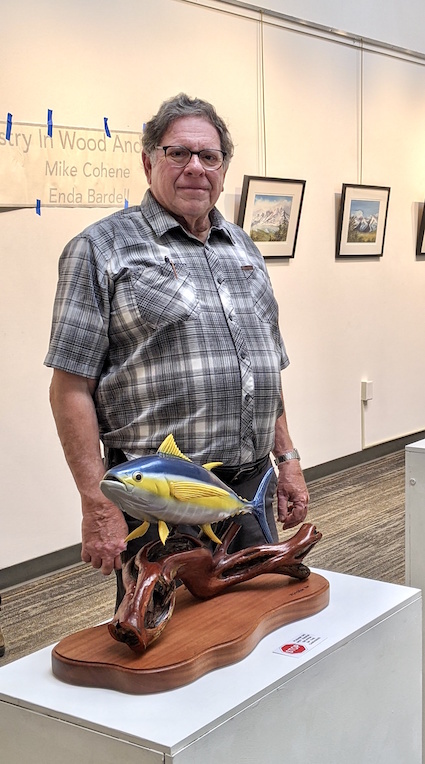
photo - Mike Cohene
Mike Cohene (photo by Linda Babins)

In the summer of 2009, Cohene visited Steveston Farmers Market. “They had a booth of the Richmond Carvers Society – I thought their works were outstanding,” he said. “I always whittled but I never considered myself artistic. I started talking to the man in the booth, expressing my admiration. He said anyone could learn to do it. He invited me to come to the club meeting in September. I went.”

Since that day, he has learned a lot about the artistry and the technique of woodcarving. His journey began with woodcarving classes at the society. Later, he took a course at Emily Carr University of Art + Design and enrolled in carving workshops.

“My first carving was a bear cub,” he said. “Then I made a dolphin. Then I started carving fish and birds…. I’ve always been a fisherman, but I never studied fish anatomy before. I caught a fish and tossed it into a bucket. Now, I catch a fish and study it: the fins, the tail, the scales, how the colours change. I look at fish from a new perspective.”

In 2017, Cohene participated in his first two-artist exhibition at the Zack Gallery, with photographer Joanne Emerman. Since then, his art has become even more refined. “I learned more sophisticated techniques and tools,” he said. “I got several residencies in B.C. and Oregon.” Three years ago, he began teaching woodcarving to other Richmond Carvers Society members.

To create his wooden creatures as life-like as possible, Cohene uses various reference materials. “Mostly I use my own photographs,” he said. “When other people photograph wildlife, they give it their own interpretation, but I want to follow my own vision.”

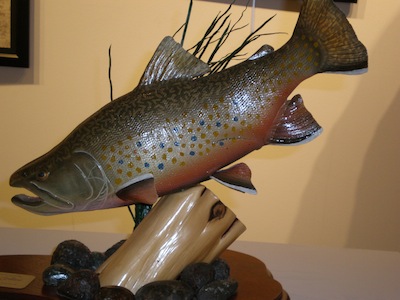
His statues of fish include rocks and corals, all carefully carved and painted in bright, realistic colours. “Sometimes, one statue takes up to 20 coats of paint – different wood parts absorb paint with different intensity,” he explained.

He also uses tree branches as mounting blocks – they are not carved, just sawed off, polished and lacquered. “I only use dead wood for my statues. I often walk along the beach and pick up interesting pieces of driftwood. I’ve never harmed even one living tree,” he said.

Recently, Cohene has started exploring First Nation carving. The motifs attract him, and he has several pieces on display at the gallery, including two decorative oars.

He also creates Judaica – mezuzot, chanukiyot and dreidels – some of which can be seen at the gallery. Cohene has been to Israel 34 times. “Once, I brought 12 kilograms of olive wood with me from Israel, and I make many of my Judaica pieces from the reclaimed Israeli wood,” he said. “Olive wood has such a beautiful texture. And dreidels are fun to make.”

Whatever he works on, Cohene always gives it his all. “For me,” he said, “woodcarving is a form of self-fulfillment.”

Artistry in Wood and Water runs until Sept. 5. To learn more, visit the artists’ websites: endabardell.com and mikecohene.com.

Olga Livshin is a Vancouver freelance writer. She can be reached at [email protected].

Format ImagePosted on August 18, 2023August 17, 2023Author Olga LivshinCategories Visual ArtsTags carving, Enda Bardell, environment, Judaica, Mike Cohene, painting, watercolour, Yukon, Zack Gallery
Learning about First Nations

Learning about First Nations

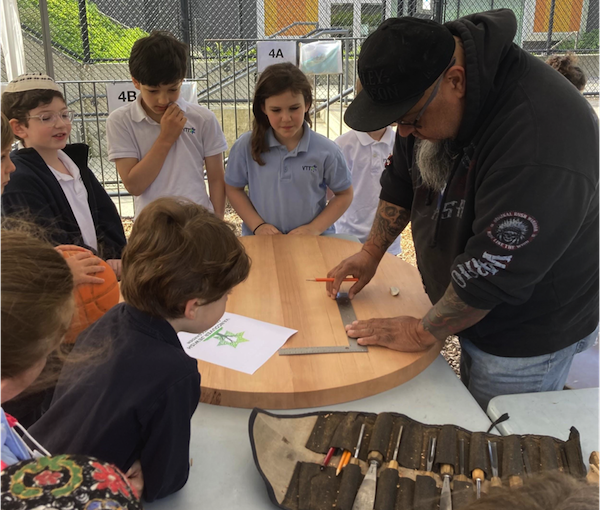
Gerry Sheena shows students his method of carving. (photo from Vancouver Talmud Torah)

Vancouver Talmud Torah invited Interior Salish Nation carver Gerry Sheena and his son Matthew Sheena for a week-long program where each grade participated in a session to learn about the history of Indigenous carving, the tools used and the process of carving and design.

Gerry Sheena has been carving for more than 17 years and his work is shown in galleries throughout British Columbia. He describes his carving style as “traditionally Salish, informed by modern painting techniques and innovative use of colour and design.”

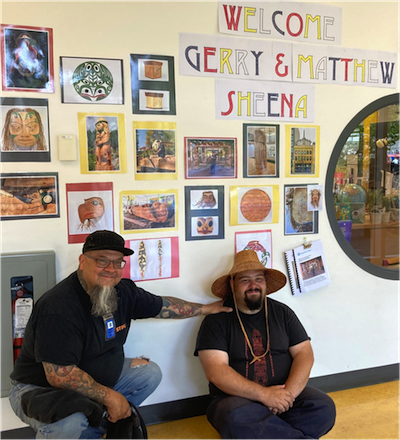
The Sheenas’ visit related to the applied design, science and technology curriculum, notably the woodworking aspect. However, VTT has been working on creating a more meaningful implementation of First Peoples’ education, which sparked the idea of integrating the two areas and having presenters from the First Nations community educate students on carving, drumming and storytelling. The timing for the presentation was matched with the month of June, which is National Indigenous History Month. Teacher-librarian Nicolle Wade created a display of Indigenous books and shared Learning to Carve Argillite by Sarah Florence Davidson and Robert Davidson, to give students an idea of what they would be seeing. She also installed a welcome display shining the light on Gerry Sheena’s art.

photo - Matthew Sheena at Vancouver Talmud Torah
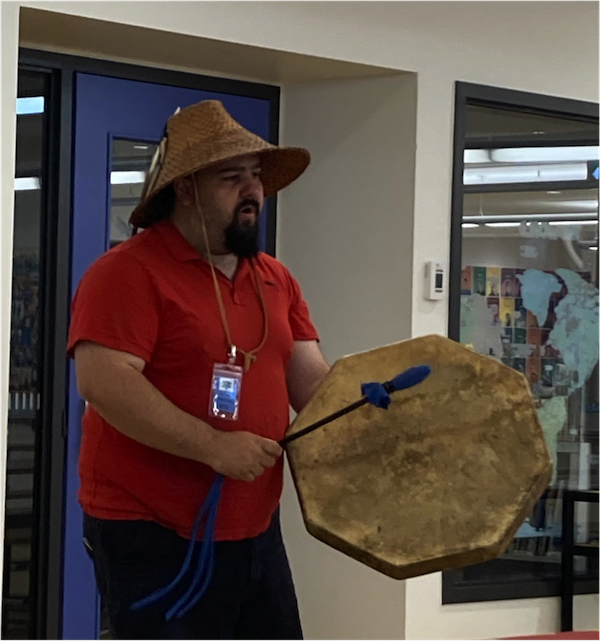
Matthew Sheena at Vancouver Talmud Torah. (photo from VTT)

The program was unique in that the Sheenas were at the school for an entire week, not only presenting but also working in the playground, carving a welcome sign for the soon-to-come community garden. Students were able to come out every recess and lunchtime to watch Gerry Sheena carve and listen to Matthew Sheena drum, and additional Q&As took place organically. Teachers had the opportunity to bring their classes out to watch the carving take place firsthand.

“Having an Indigenous carver join our VTT community for one whole week has helped us to organically elevate Indigenous education and ensure that our students are engaging in meaningful learning about the Indigenous peoples and their traditions. We are honoured to have Gerry and Matthew Sheena join us from the Interior Salish Nation as we find ways to recognize National Indigenous History Month now and moving into the future,” said Emily Greenberg, VTT head of school.

Gerry Sheena shared how he got started in carving, his love for art and his happiness when creating totem poles, masks, paddles and many other ceremonial carvings. Matthew Sheena is a passionate drummer and graced the school with his drumming and singing of a Squamish Nation song, “Snowbird,” acknowledging the land and sending a powerful message to love and to lead “through your heart, spread love to others around you and to be kind.”

Among the many lessons learned from the week were:

• The power of passing on knowledge through storytelling.

• The connection to the land being the foundation of Indigenous ways of knowing and practices. The land, plants, animals and sky are all teachers, and taking care of the land and everything living is of utmost importance.

• Honouring language. The Sheenas taught students how to say thank you, and the importance of respecting elders and cherishing their roots.

• Older students had questions about residential schools that the Sheenas approached in a gentle and meaningful way.

• Matthew Sheena spoke to the students about always reaching for the stars, never giving up no matter what life throws at you, and being the best you can be every single day. Also, he encouraged them never to give up on art, drawing, singing and dancing – and to do things that bring them joy and will help them tell a story. He said his favourite tool when carving is a pencil and spoke about the power of the pencil to create.

photo - During their week at Vancouver Talmud Torah Gerry Sheena and his son Matthew Sheena taught students and teachers about carving, drumming and storytelling
During their week at Vancouver Talmud Torah Gerry Sheena and his son Matthew Sheena taught students and teachers about carving, drumming and storytelling. (photo from VTT)

VTT was so grateful to spend time with Gerry and Matthew Sheena, both of whom inspired students and faculty through their presentations. The themes of building community, recognizing that everyone can be a potential source of inspiration and knowledge, and fostering respect by encouraging students to speak honestly, listen to one another, be active in problem-solving, take care of the land and value their surroundings were a few of the key takeaways from the week.

VTT aims to grow in the area of Indigenous education and make links to Jewish history, cultures and traditions, as the Sheenas’ presentations revealed that there are many similarities. The week’s activites and interactions left students with more knowledge and understanding of First Nations peoples, and it is hoped that students will continue to reflect upon questions like, What do I know about Indigenous education and First Nations communities? How can I contribute to changing the world we live in by storytelling and passing on knowledge? How can I learn more about Canada’s relationship with Indigenous people? How can I build meaningful relationships? How can I protect the world we live in; the land,  animals and people? and What connections does First Nations education have to Jewish education?

Jessie Claudio is director of learning and innovation at Vancouver Talmud Torah.

Format ImagePosted on June 24, 2022June 22, 2022Author Jessie ClaudioCategories LocalTags carving, drumming, education, Gerry Sheena, Indigenous culture, Matthew Sheena, Vancouver Talmud Torah, VTT
Wildlife takes over the Zack

Wildlife takes over the Zack

The Intersection of Science & Art, now at Zack Gallery until March 24, features the works of Joanne Emerman and Mike Cohene. (photo by Olga Livshin)

The Intersection of Science & Art exhibit at Zack Gallery features the works of two artists – Joanne Emerman, professor emerita of physiological sciences at the University of British Columbia, for whom photography has been a hobby for decades; and Mike Cohene, whose woodcarving unfolded unexpectedly in the past few years, after a lifetime of other pursuits.

Emerman explained that, for her, science and art have always intersected. “I worked for 33 years in cancer research. I only retired four years ago. I’m a scientist. I often used my photo camera, attached to the microscope, to photograph cells.”

Her hobby, especially her photos of animals, seems an extension of her scientific imagery.

“My photographs show how animals adapt to their environment. Every feature you see in the pictures is a result of natural selection, the survival of the fittest,” she said. “The individuals with adaptations suited to their environment will live long enough to breed and pass down those traits to their offspring, whereas the individuals that don’t adapt will die off. For the natural selection to work, several factors must be present, including the overproduction of offspring. They must ‘reproduce like rabbits.’ Also beneficial are variations due to mutations. They increase the likelihood of survival.”

Because of her scientific leanings, Emerman tries to capture in every shot the most significant characteristics of each animal, the ones that contributed to the survival of the species, like the stripes of a zebra, the legs of a tortoise or the fins of a turtle. She also documents the endless variations in nature in her thousands of photo frames.

Of course, to photograph exotic creatures, she has had to travel widely.

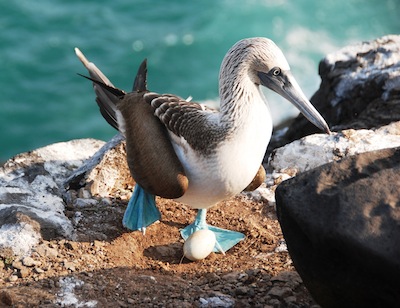
photo - Joanne Emerman tries to get as close to the animals as she can with her camera, as is evidenced by this blue-footed booby photo
Joanne Emerman tries to get as close to the animals as she can with her camera, as is evidenced by this blue-footed booby photo. (photo by Joanne Emerman)

“I’ve always traveled a lot,” she said, “all over the world, and photographed during my travels…. I love animals but I love them in the wild. I never photograph animals in cages. The pictures in this show are all of animals and birds in their natural habitat. I took them in the Galapagos Islands and several South African game reserves. I tried to get as close to the animals as I could with my camera.”

The quality of the images reveals Emerman as a master photographer, although she is mostly self-taught. “I never took any classes on photography until I retired four years ago,” she said. “Then I decided to learn, and enrolled in a basic photography course at Emily Carr. I thought I would know everything they had to teach, or almost everything – I mean, it was called basics – but I learned so much!”

Eventually, the time was right for this show, her first gallery exhibit. “I was retired. I thought, maybe I should exhibit my pictures. I never did before. I submitted to the Zack Gallery, and the jury accepted me.”

Another first for her was meeting Cohene. Linda Lando, the gallery director, introduced them.

“Linda said, ‘We have a wonderful carver. He carves fish and birds. His works will complement yours.’ She put us together,” explained Emerman.

Cohene’s artistic journey started in 2009.

“In the summer of 2009, I visited Steveston Farmers Market,” he recalled. “They had a booth of the local woodcarvers club. I looked at their works and thought, outstanding! I could never do anything like that. I’m not artistic, though I always whittled. Professionally, I had a clothing business until I sold it awhile back. The man in the booth talked to me and said, come to the club in September. You can do it. So I went.”

His first carving was a baby bear, and he loved it. After that came a dolphin and then some fish.

“I felt good about my carving but I wanted to learn more,” said Cohene. “I started attending woodcarving classes at the Richmond Carvers Society – enjoyed it so much, took a course at Emily Carr.” He also participated in an intensive 10-day workshop with world-renowned master fish carver Dale Barrett of Redmond, Ore.

photo - Mike Cohene began woodcarving in 2009
Mike Cohene began woodcarving in 2009. (photo by Olga Livshin)

Cohene carves what interests him: wildlife, fish and birds mostly. “I’m a fisherman, have been all my life, but I never studied the fish anatomy before. I caught a fish and tossed it into a bucket. Now, I catch a fish and study it: the fins, the tail, the colour of scales. I look at fish from a different perspective now.”

To carve and paint his creations as realistically as possible, he uses reference material. “I take photos of what I catch or search for photos online,” he explained. “Sometimes, when I take commissions, people send me photos of the fish they caught and they want me to carve it.”

An active member of the Richmond Carvers Society, he regularly participates in the carvers’ juried exhibitions in British Columbia and Oregon. He has already collected a few “best in the show” awards for his work. However, as with Emerman, the exhibit at the Zack is his first gallery show.

Cohene has a second line of woodcarving, totally unrelated to his life-like creatures: Judaica. “A couple years ago, I brought 12 kilos of olive wood from Israel,” he said. “Each piece of wood was reclaimed from trees that had been in the fire of Har Carmel. I make mezuzot and dreidels from this olive wood, and people like them.”

To learn more about his carving, visit his website, mikecohene.com.

The Intersection of Science & Art opened on Feb. 23 and runs until March 24. Emerman is given an exhibit-related talk – Looking through the Lens of a Microscope and the Lens of a Camera – on March 21, 7 p.m., at the gallery. The suggested admission is a donation of $5. For more information, visit jccgv.com/content/jcc-cultural-arts.

Olga Livshin is a Vancouver freelance writer. She can be reached at [email protected].

Format ImagePosted on March 3, 2017February 28, 2017Author Olga LivshinCategories Visual ArtsTags carving, Joanne Emerman, Mike Cohene, photography, Zack Gallery
Proudly powered by WordPress