Jewish Family Services Vancouver Island will extend its hours for the Sept. 18 community resource fair that launches the Jewish Federation of Victoria and Vancouver Island’s annual campaign this year. (photo from jfsvi.ca)
The Jewish Federation of Victoria and Vancouver Island (JFVVI) is trying something a little different for its annual United Jewish Appeal campaign launch this year. On Sept. 18, they will celebrate Jewish diversity in British Columbia with a community resource fair. The event will be held at the Jewish Community Centre of Victoria, from 1 to 4 p.m., and will feature presenters from both Vancouver Island and the Lower Mainland.
“We are changing things up this year,” said Coral Grant, executive director of JFVVI. “Usually, we have a guest speaker. The past few years, it has been on Zoom. This year, we wanted to reach the wider community by having a launch we could do in person. We are really hoping that, with this fair, we can encourage people to come out and see what is available in the Jewish community in British Columbia, as well as locally.”
As it does every year, the JFVVI campaign runs from Sept. 1 to Dec. 31. Mailings and outreach through fliers to members of the community are currently underway and, soon, volunteer canvassers will continue these fundraising efforts. For 2022/23, the campaign’s objective is to raise $175,000 – or $10,000 more than it did in 2021/22. The previous year’s campaign exceeded its target, as it included a separate campaign raising funds for Ukraine.
The response to the call for fair presenters was tremendous – JFVVI quickly ran out of available display space at the Victoria JCC. The fair will take place in the main area of the building, the same location as the Lox, Stock and Bagel Deli, which ordinarily operates Tuesdays to Fridays, 11:30 a.m.-1:30 p.m.
Many of the 20 tables will be operated by representatives from Vancouver-area organizations, such as the Jewish Museum and Archives, the Jewish Federation of Greater Vancouver, the pluralistic Jewish teen movement BBYO, the Canadian Jewish Political Action Committee (CJPAC), Birthright Israel and March of the Living.
Among the local groups will be the JFVVI, the Victoria Jewish Choir, PJ Library, the Victoria Shoah Project, Canadian Hadassah-WIZO, the Centre for Israel and Jewish Affairs (CIJA), the Jewish Burial Society, the theatre group Bema Productions and the Hebrew school from Congregation Emanu-El. All of the Victoria congregations – Chabad of Vancouver Island, Congregation Emanu-El and Kolot Mayim Reform Temple – will be participating and the Mekorah Institute, co-founded by Rabbi Matt Ponak and dedicated to bringing integrated and sustainable spiritual transformation to individuals and religious lineages, will be there, too.
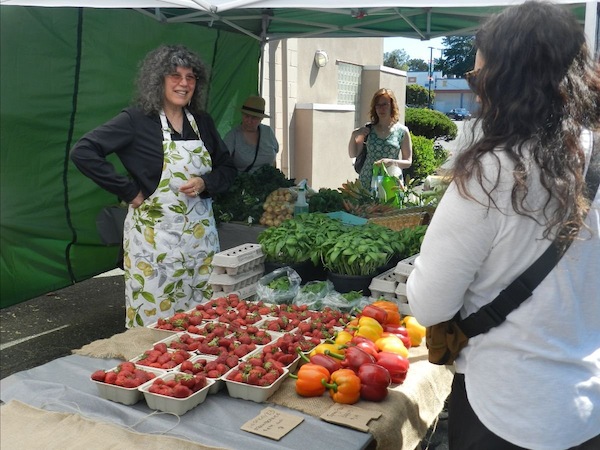
At the fair, the Victoria JCC will highlight the Victoria International Jewish Film Festival, now in its eighth year, which takes place both online and in person at the Vic Theatre in downtown Victoria Nov. 1-6. Jewish Family Services Vancouver Island, which sells fresh produce at wholesale prices every second Sunday in the summertime from the JCC parking lot, will extend its hours for the occasion.
Recent estimates on the size of the Jewish community in Victoria range from 1,500 to 3,000 people. One point on which most can agree, however, is that, whatever the number, it has been increasing. The city is now home to three synagogues, a secular humanist group, a kosher bakery and numerous other organizations and social and cultural activities.
“There are a lot of folks who have moved here recently, and it may be interesting for them to find out what is happening here,” Grant said. “For the locals, having some of the organizations from the Mainland may be an eye-opener. We are really hopeful that, in covering a broad spectrum of organizations, the community will find something which is new and exciting for them.
“I am really excited,” she said, “because this is an in-person gathering and I’m excited that we have been able to collaborate with people on the Mainland to showcase the diversity in the province and bring some of that to the Island. To do this as a campaign launch is kind of a novelty for us and, hopefully, it will all come together and work.”
About to embark on its 36th year of operation, JFVVI is the umbrella organization of the Jewish community in the capital region and Vancouver Island. It raises funds for local groups and supports organizations, individuals and families both regionally and in Israel with grants and scholarships and through partnerships with community leaders. It coordinates, plans and promotes social, educational, cultural, health and welfare programs and activities in the Jewish community. The JFVVI is committed to building strong, vibrant Jewish communities throughout the Island.
For more information about how to donate to the Jewish Federation of Victoria and Vancouver Island, visit jewishvictoria.ca.
Sam Margolishas written for the Globe and Mail, the National Post, UPI and MSNBC.
Jonathan Cohen and Mayim Bialik, co-hosts of the podcast Mayim Bialik’s Breakdown, help launch the Jewish Federation of Greater Vancouver’s annual campaign on Sept. 8. (PR photo)
Television viewers watched Mayim Bialik grow up, most notably as the character Blossom Russo on the series Blossom, and in a string of other TV and movie roles, including playing the child version of Bette Midler’s character in Beaches. More recently, Bialik has been nominated four times for an Emmy Award for her role in The Big Bang Theory and it was announced last month that she and Ken Jennings will jointly fill the late Alex Trebek’s shoes as hosts of the game show Jeopardy.
But, when Bialik speaks to a Vancouver audience Sept. 8, she will not be acting or holding the cards with all the answers. She will be opening up about an issue that is close to her own experience: mental health.
Bialik is one of three headliners at the opening event of the Jewish Federation of Greater Vancouver’s annual campaign. She will be beamed in live from Los Angeles, along with her podcast partner Jonathan Cohen. They co-host Mayim Bialik’s Breakdown, which is described as “a quirky, informative and interactive podcast breaking down the myths and misunderstandings about mental health and emotional well-being.” While the pair will join from Los Angeles, live on stage at Congregation Beth Israel will be Fran Drescher.
Best known for her titular role in the 1990s sitcom The Nanny, Drescher is also an accomplished producer and author who has won several awards in the health field. Only recently, she has begun to open up about the traumas and major health issues she experienced earlier in her life, including those she says she never adequately dealt with at the time. At the campaign launch, she will reflect on how important mental health issues are to overall well-being.
In a recent interview with the Independent, Bialik and Cohen shared some of their vision and a little of what audiences can expect when they speak. Mental wellness is a core theme of the opening event, in part because these issues have become more pervasive due to stress, uncertainty and isolation caused by the pandemic. Bialik has been open about her own experiences with these challenges.
“I think one of the things about mental health is, depending on what you’re dealing with, there can be a lot of isolation,” Bialik said. “Talking about it, and being part of challenging the stigma, I think, makes you feel less alone. I definitely feel less alone. A lot of my fears around my challenges have definitely gotten less. I have less fear about talking openly about it. I think that’s really made an impact on me.”
On the podcast, she and Cohen discuss their personal experiences, welcome experts and also introduce a buzzy crowd of celebrities like Sarah Silverman, Dustin Hoffman, Margaret Cho and Howie Mandel. Topics include managing anxiety, overcoming trauma, alternative medicine, body positivity, grief and gratitude.
A lot of the time, Bialik said, people tell her and Cohen that the show raises questions viewers didn’t know they needed to ask, or that they didn’t have the ability to express to their medical professional – or maybe they do not have access to professional care.
“We are not doctors of that sort, we’re not looking to make diagnoses,” she said. “But, in sharing our experience, a lot of people are hearing their stories and that’s been really, really very powerful. We’ve had some incredible interactions with some of our fans. One of the reasons that we do a lot of giveaways and things like that is it creates a sense of community and it lets people know that we are real people behind our microphones.”
They hope to hear from audience members in Vancouver.
“We really want to have an interactive component to the evening because, for us, we are very interested in other people’s stories and we really enjoy that part of our podcast,” said Bialik. “So we’re excited to bring that to an audience live and be able to share, and also hear what other people want to share. We are also quite funny together – we think so, but other people have told us that as well – so it will be a way for us to show how we use our humour to interact and especially discuss difficult things like mental health.”
In addition to the podcast, the pair have pitched a few TV pilots, which have yet to get picked up, but they have more up their sleeves.
“It’s been a very fun partnership and we have lots of ideas of ways we’d like to change the world,” she said.
“We also both like to explain things,” said Cohen, “which sometimes makes us compete for airtime, but usually results in a further understanding of something.”
They both balked jokingly when asked if they were drawn together by their “nerdy” pursuits. Bialik is a neuroscientist and Cohen’s expertise is artificial intelligence.
“Neuroscientists and people in AI are the new superstars,” said Cohen.
“It’s not really nerdy,” Bialik insisted with a laugh.
But seriously, she continued: “Really, when we started talking again and connecting again, [that] was when we started realizing how much we had in common in terms of our interest in science and mind and body.”
Bialik is tough to pigeonhole. A mother, a scientist, an actor, an author, a game show host, a proud Jew, a vocal Zionist – she doesn’t feel a need to choose between her complex identities.
“I don’t know if it was ever really a question of settling for just one,” she said. “I’m a mother and I think that is the role I most enjoy personally. In terms of professional activities, I really did enjoy being a scientist and the knowledge that I acquired does not go away just because I’m not a full-time scientist. I do love advocating for causes that are important for me. I love writing. I do love writing. I guess it’s hard to pick just one.”
Hosting Jeopardy is a very different kind of job than being an actor, she acknowledged.
“I obviously have to be myself, but I have producers and judges talking in my ear the whole time, so it’s a big division of attention and that can be hard,” she said. “It’s a lot of really difficult words to pronounce, which I do get to practise a little bit that morning before we tape each set of episodes, but [it’s] very, very different and you have to be ready for anything because anything really does and can happen at Jeopardy.”
As one of Hollywood’s most visible Zionists, Bialik has been a lightning rod for anti-Zionism and antisemitism. But that’s not new, she said.
“The fact is, I’ve been dealing with antisemitism and anti-Zionism for decades in my professional presence,” Bialik said. “I will say that the climate of North America has definitely shifted.… [But] for me, it’s always been an issue. It’s one I was raised to know about and be aware of. I think I’m more touched, as many of us are, by the increase in antisemitic acts, and violent acts especially, against Jews. As someone who has been going to Israel and continues to go to Israel – I’ve been probably a dozen times – that’s always something on my radar. There’s definitely been more of this kind of hatred and activity and specifically targeting me. But it’s also been something that I’ve always had to think about.”
The Thursday, Sept. 8, Federation annual campaign launch at Beth Israel starts at 7:30 p.m. Tickets, $18, are at jewishvancouver.ca.
Supporters join Gary Averbach as he completes his walk from Calgary to Vancouver. (photo from Instagram @bobswalkforcancer)
When Gary Averbach told friends and family he was going to raise money for cancer research by walking from Calgary to Vancouver, they asked him if he was joking or crazy. His podiatrist urged his kids to get him to rethink his scheme. But when he strolled into Vancouver Aug. 11, he was greeted with a hero’s welcome at Jack Poole Plaza by those same people and plenty more who joined his cause.
The 79-year-old Averbach was inspired to raise at least $500,000 after he suffered the loss from cancer of four people close to him in a mere seven weeks last year. First, his cousin, business partner and friend Robert (Bob) Golden passed away. Averbach decided to do the fundraising walk in Bob’s honour. He connected with the B.C. Cancer Foundation and the planning for Bob’s Walk for Cancer was set in motion. Sadly, Averbach would soon find himself walking in memory and honour of three more people – cousins Ronnie Onkin and Darlene Spevakow, as well as his longtime and beloved housekeeper, Angelita Tica.
“At that point, I said, I can’t just do this walk for Bob,” Averbach told the Independent while taking a break from his walk in British Columbia’s Shuswap region last month. “I’ve got to include them as well because they are just as worthy of being included as Bob. Although it’s called Bob’s Walk, I made it clear that I’m walking for the four of them and everybody I’ve lost and anybody that has lost loved ones to cancer. There isn’t a family that that hasn’t happened to.”
The name of the campaign caused a little confusion on the road. As he trod along highways and byways, people yelled out encouragement to “Bob.” Averbach gave up correcting well-wishers.
“For awhile there, I was maybe correcting people but I thought, let me be Bob. It doesn’t matter, as long as they’re supporting me.”
What he didn’t get used to was the outpouring of support. All along the way, from the very first day of his trek, passersby sent shouts, honks, thumbs up and words of encouragement.
The cancer foundation helped Averbach set up a fundraising and information website, where people could follow his progress. He also blogged his journey, including interesting or thoughtful reflections on what had taken place that day or things that had popped into his head during his long, solo trek across the province.
Walking has always been a favourite pastime for the Vancouver businessman and philanthropist.
Gary Averbach’s fundraising journey took him from Calgary to Vancouver over several weeks. (photo from Instagram @bobswalkforcancer)
“I love sports and I wish I could be a good athlete but I was born with one eye weaker than the other,” he said. “Because I do not have good depth perception, I cannot be a good athlete. But one thing I always knew was that I had good stamina and I could walk for hours. I walked all through Israel when I was in my 20s and I’ve always enjoyed walking as a way to keep fit.”
Padding through some of North America’s most dramatic scenery was an experience, he said. Although he had been on the route many times, it was always at 100 kilometres an hour. The majesty of the Rockies, the rivers, streams, waterfalls and wildlife led him to change the theme song of his venture from “High Hopes” to “What a Wonderful World.”
“Watching closely like you do when you’re walking, it does make you realize not just how beautiful it is – you can’t do that when you’re driving – but also how amazing it is, how everything works together, like the water starts with a glacier and ends up being a river going out to the Pacific. Everything follows its path. And the flora, the way it changes here.”
He was in Banff National Park on Canada Day, but noticed that every day seems like Canada Day in some rural areas. The maple leaf flies frequently in small towns, he said.
“I think there’s a level of patriotism in the countryside that doesn’t exist in the big city,” he remarked.
He also noticed signs of the times. The pandemic and its associated labour shortages have led even the legendary 24/7 diner Denny’s to reduce its hours, and some of the motels his team stayed at along the way were short-staffed.
On foot, Averbach was also more aware than he might have been behind the wheel that the road system is not uniformly modern.
“It is so piecemeal,” he said. “There are some sections of the Trans-Canada that would not even be rated a good country road, especially going through some of the towns. It’s a disgrace in some cases.”
He had some trepidation about wildlife he might encounter – bears, obviously, were a worry – but infrastructure, more than luck, may have prevented any interactions with Smokey or Yogi. Wildlife-protecting fences have been installed along much of the country’s highway system, with overpasses for animals to safely get from one side to the other.
“I didn’t see a single bear,” Averbach said – not even from a distance. Mosquitoes, beetles and grasshoppers, on the other hand, were plentiful.
“If I was an entomologist, it would be fascinating,” he said.
Averbach was assisted by a team of two, Bart Zych and Alex Krasniak.
“Alex primarily drives the van behind me, he follows me like a puppy dog,” joked Averbach, noting that people undertaking adventures like this are required to have a vehicle adjacent for traffic safety. The usual schedule was to walk five hours, rest for a bit and then continue for another three or four hours.
“Bart is the person who does all the logistics. He arranges the hotels before we go from one place to the other. He even does my laundry much better than I do,” Averbach said. “He meets us and he brings us sandwiches.”
Averbach is a warm weather guy – he trained for the walk in Hawaii and Palm Springs – and didn’t appreciate the cold mountain weather in the early days of the walk. Even near the end, he encountered rain, despite it being the height of summer. On the other hand, he also traipsed through Canada’s desert zone.
“If I had my druthers, I’d rather be in hot temperatures than the really crappy weather we had in the mountains,” he said.
When he first spoke with the Independent, Averbach was worried about meeting his target of $500,000.
“For awhile there, it slowed down at about $320,000, $330,000,” he recalled. “I started to think, am I going to be able to reach my goal, which is a half-million?”
As of his arrival in Vancouver, he had surpassed his minimum goal of $500,000 and now has his sights on more.
“According to commitments and some of the cheques that are in the mail, we are probably somewhere around $570,000,” he said. The campaign will continue and the website will stay active until his 80th birthday, on Oct. 10.
He offers special thanks to friends in the Jewish community – donations in multiples of $18 are a sure sign of Jewish philanthropy.
“Over two-thirds of the donors, maybe even three-quarters of the actual donors, were from the Jewish community,” Averbach said. “The Jewish community really came out and supported me.”
While he is happy to be in his own bed and will continue pushing to raise more funds until his birthday, at least, he is not resting on his laurels or basking in the accolades.
“Been there, done that,” he quipped. “My 15 minutes are over.”
He was touched, though, by the crowd of about 200 who greeted him as he completed his journey.
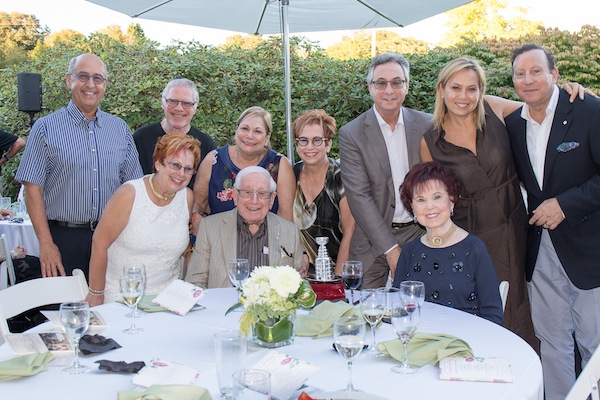
Joseph and Rosalie Segal (seated) and family at the 2016 Summer Garden Party fundraiser for Vancouver Hebrew Academy. (photo by Jocelyne Hallé)
Joseph Segal, an entrepreneur and philanthropist who was recognized by the governments of British Columbia and Canada with the highest civilian honours, a Second World War veteran who helped liberate the Netherlands, a businessman who founded and led iconic companies and a community-builder whose imprint on the Jewish and general communities in Vancouver is indelible, passed away May 31. He was 97 years old and was actively engaged in philanthropy to his final hours.
Segal was born in 1925, in Vegreville, Alta. After the death of his father, when Joe was 14, the family experienced financial hardship and young Joe Segal experienced hard labour while building the Alaska Highway. He fought in the infantry in the Second World War where, with his compatriots in the Calgary Highlanders, he participated in the liberation of the Netherlands.
After the war, he arrived in Vancouver and, with $1,500 in savings, started selling war surplus goods, then founded Fields department stores. Eventually, his business took over the Zellers store chain – which Segal described as “a case of the mouse swallowing the elephant” – and, later, obtained a large share of the venerable Hudson’s Bay Company before he launched Kingswood Capital Corp., which has interests in real estate, manufacturing and finance.
In recent years, while lauded for his business acumen, Segal was most prominent as one of Canada’s leading philanthropists. For his work in both fields, he was a recipient of both an Order of Canada and an Order of British Columbia.
In addition to leaving his mark on a vast number of institutions and causes in the Jewish community, he was a strong supporter of charities such as Variety Club, the United Way, Vancouver General Hospital and B.C. Children’s Hospital.
Among his community roles was serving on the board, and as chancellor, of Simon Fraser University. Perhaps his most visible contribution in Vancouver was his donation to SFU of the historic Bank of Montreal building at 750 Hastings St., creating a home for the Segal Graduate School of Business.
In 2010, Joseph and his wife Rosalie donated $12 million to the VGH and UBC Hospital Foundations to create the Joseph and Rosalie Segal and Family Centre, a 100-private-room acute care centre serving the mental health needs of people in crisis.
Joseph and Rosalie Segal modeled philanthropy for the successive generation of their family, including children Sandra, Tracey, Gary and Lorne, their spouses and, now, grandchildren and great-grandchildren.
At Joe Segal’s funeral on June 1, Gary Segal reflected on his parents’ 74 years of marriage, calling it “a love story for the ages.”
“My father worshipped my mother, he relied on her support and wisdom and insights,” he said. “They were true partners in everything they did and accomplished in life.”
Gary Segal called his father “a natural-born philosopher, a generous man, caring. He would never forget anything or anybody. He was passionate about life. He had many dreams – his own and those that inspired others. He had the ability to talk to people and make everybody, no matter what stage in life, feel important, like they mattered, that somebody cared about them.”
Although he knew the impact that his father had had on the world and the people in it, “to see these genuine expressions of sorrow and appreciation for the person my father was has been truly extraordinary for me and for my family.”
He shared three core tenets of his father’s philosophy:
• Don’t worry about what you can’t control, worry about what you can.
• You need to commit to life and you need to commit to happiness.
• Money is only worth something if you do something good with it.
Gary Segal quoted actor John Barrymore, who said, “You’re never old until regrets take the place of dreams.” In that respect, said Segal, although his dad lived to 97, “My father was not old. He never aged. Right up to the last minute, he was young. He was always young at heart, in spirit, and right up to the end, he had his dreams.”
Longtime friend and book collaborator Peter Legge reflected on a half-century of friendship after the pair met when Legge was an adman at radio station CJOR.
“Joe was a man who shared all he could with those who needed help,” said Legge. “Never to lift himself up, but to lift up those who needed help.”
Rabbi Yitzchok Wineberg noted that some people are saying the passing of Joe Segal is the end of an era.
“I beg to differ,” said the city’s longest-serving rabbi and Chabad emissary. “Joe didn’t live his life for himself or for himself and Rose. He lived his life for his children, for his grandchildren, for his great-grandchildren. They were there to observe everything he did and be inspired by it…. This family will continue his legacy. It’s not the end of an era, it’s a milestone. It’s a date that we all know we are going to have to face one day and, especially at such a funeral, we think about our own mortality. But it’s not just what you’ve accomplished in your lifetime. It’s what’s going to be accomplished after you leave this world. For that reason, I feel it’s not the end of an era. It’s just a continuation, and God should help that we should celebrate many happy occasions together in the future and we should be there for one another just as Joe was there for everybody else.”
Rob Schonfeld, a grandson, said that it may sound strange to be shocked that a 97-year-old man has passed away.
“But Grandpa Joe was so larger-than-life and still 100% on his game,” he said. “None of us really internalized that this day was going to come.”
Of Segal’s 11 grandchildren and 18 great-grandchildren, Schonfeld said: “We all had really unique and different relationships with him. None of them was the same and it’s because he always treated us as individuals. He respected us as grown-ups – even when we were little kids. I think that allowed each of us to bond with him in really different ways.”
Schonfeld shared one of his favourite “Joe-isms” – “You can’t ride two horses with one ass” – and said Segal’s secret weapon was “reading everything in sight.”
Rabbi Andrew Rosenblatt of Congregation Schara Tzedeck compared Segal with the biblical Joseph. The moment before the Exodus, the rabbi observed, Moses was looking for the bones of Joseph to carry with the Israelites to the Promised Land.
“He’s fulfilling a promise, granted, but it’s more than that,” said Rosenblatt. “Moses needs a symbol of what it means to succeed materially in this world and to succeed with others. Joseph is that symbol. He is a symbol of somebody who can have material success and can have spiritual success as well. There are two chests that walk with the Jews through the desert. One holds the tablets that Moses brings down from Sinai and the other one carries Joseph. Our Joseph is a little like that, too. He is a lesson, a paragon, a role model, an icon. Just like the biblical Joseph, his personality, his legend, survives even him. Joe Segal will continue to be that for so many in our community.”
The rabbi remarked that he was professionally forbidden from sharing the many stories of individuals who Joseph Segal helped when called on to assist an individual or family in crisis.
Rosenblatt added that Segal specifically asked for donations in his memory to be given to Yaffa House and to the Jewish Food Bank.
The Independent spoke with some of the people who worked with and knew Segal in different capacities.
David Levi served with Segal on the board of the Phyliss and Irving Snider Foundation and is on the board of governors for Camp Miriam, one of the causes Segal championed.
“Over the years, he’s given [Camp] Miriam quite a large amount of money and he was always very supportive of giving money to the camp and the kids. It was a central focus of his,” Levi said, noting that Camp Hatikvah was another cause Segal admired.
“Joe’s view, I think, on camp in general is that it built a connection to Judaism for kids at a young age and he saw camps making that connection to the Jewish community and to Israel. Those were important things for him,” Levi said.
“The thing about Joe was his complete commitment to the community – to the Jewish community and to the larger community.” But Levi stressed that large gifts to major organizations were not the only way the legendary philanthropist operated. Echoing Rabbi Rosenblatt, Levi referred to “Joe’s secret life.”
“He would get calls not only from individuals but from rabbis and other leaders in the community on a very personal level for people who needed a hand up or needed some financial means for a brief period of time,” Levi said. “It was smaller amounts of money, but, in his mind, as important as the organizations that he worked with. People would call and say we have this family and they are really having a tough time and they need an injection of $1,000 or $500 and Joe would quietly do that. He never really talked about it. He certainly never talked about the individuals he supported. But he was always available for those kinds of emergency calls.
“He believed in hard work but he also believed that people who had difficulty in achieving the kinds of things that he would hope everybody would be able to achieve, people who are challenged by mental or physical disabilities, he would help in any way he could,” Levi said.
Bernie Simpson, who is also on the board of Camp Miriam, echoed Levi’s reflections of Segal’s support for Jewish camping.
“For over 50 years, Joe was a strong supporter of Camp Miriam,” said Simpson. “He joined the late [B.C. Supreme Court] Justice Angelo Branca, who was the chair of the finance committee of Miriam in rebuilding the camp in 1970. Fifteen years ago, Joe was responsible for the building of the camp infirmary through the Snider Foundation, honouring Joe and Rosalie Segal’s close friends Mike and Rita Wolochow.… Joe’s support of the camp policy that every child should have a Jewish camping experience, regardless of their financial means, goes back to when he was a youth himself from very humble beginnings. Several years ago, he praised the camp and its leadership for their devotion to the youth whose attendance at camp was possible through the campership fund. He will be sorely missed.”
Simpson said Segal was in frequent contact with his wife, Lee Simpson, when she was president of the board of the Louis Brier Jewish Aged Foundation, to catch up on developments at the Jewish home and hospital.
“I understand, from other organizations, he would constantly keep in touch with what was going on in the community,” said Simpson. “He looked at the big picture.”
In a message to the Independent, Vancouver Hebrew Academy (VHA) said, “Mr. Segal took his responsibility to the Jewish community very seriously and he showed it in many ways. Of course, he was a strong financial supporter of Vancouver Hebrew Academy, as he was for many of our institutions, but his advocacy went further than that. He believed strongly in Torah education and what it means to the future of the Jewish people. In the summer of 2016, Joe and Rosalie were the honourees at VHA’s Summer Garden Party. There, Joe spoke passionately and emotionally of the importance of our mission.”
Rabbi Don Pacht, VHA’s former head of school, remembers fondly the conversations with Joe Segal about the school, the community and his admiration for those who chose to dedicate themselves to building community.
“I often came away from our visits encouraged in the work we were doing,” said Pacht. “Mr. Segal always had words of wisdom to offer … and sometimes a bottle of scotch too!”
Michael Sachs, executive director of Jewish National Fund of Canada, Vancouver branch, reflected on a long relationship.
“He was a titan in the business world and a leading philanthropist to all communities, but most of all he was a family man through and through,” said Sachs. “I have many fond personal memories with Joe from my childhood up until a few weeks ago. He touched everyone in our community and I count myself amongst one of those touched.”
Segal’s legacy was celebrated and remembered outside of the Jewish community, including by many organizations that Segal, wife Rosalie and the family had collectively supported.
“Joe was an enthusiastic champion of the university,” Simon Fraser University said in marking Segal’s passing. “His advice, energy and wisdom supported eight presidents and his business savvy and connections helped SFU to thrive. His commitment to community-building and philanthropy was recognized in 1988 with a doctor of law, honoris causa, from SFU and in 1992 with the President’s Distinguished Community Leadership Award, honouring his innovation, optimism and strong sense of public service to SFU’s community.”
The VGH & UBC Hospital Foundation issued a statement honouring Segal.
“A pledge of $12 million in 2011 to initiate planning of a new purpose-built mental health facility was the largest individual donation to this cause in B.C. at the time. This commitment initiated a $28 million fundraising campaign and the construction of an $85 million purpose-built mental health facility which stands as his legacy: the Joseph & Rosalie Segal & Family Health Centre.”
It continued: “Joe never retired, and his mind and memory were sharper at 97 than many people years his junior. Until very recently, he remained active in business, working from home as was required throughout the pandemic. Similarly, he continued to support the causes he cared about, offering sage advice, wisdom and guidance. He continued to support VGH and UBC Hospital’s most innovative clinician-researchers and surgeons, kicking off a campaign in support of the Vancouver Stroke Program and seed-funding research for innovative medical talents, as well serving as the honourary chair of the Brain Breakthroughs Campaign.”
After performing “My Way” in its original format, Paul Anka sings a custom rendition of the song to Joseph and Rosalie Segal at a 2013 gala spearheaded by Lorne Segal, which celebrated Joe Segal’s life and achievements, and raised $2.3 million for Coast Mental Health. (photo from Lorne Segal)
Coast Mental Health declared Segal “B.C.’s most significant supporter of mental health services.” His devotion to the cause began in 1999, when he first attended the Courage to Come Back Awards, where he heard people share personal stories of living with mental health and emotional challenges. His devotion to the cause was born out of a belief that no one is immune from the detrimental effects that mental illness can have if not properly treated.
Lorne Segal has chaired the Courage to Come Back Awards for the past 17 years, and the family as a whole has championed the cause.
Shirley Broadfoot, the founding chair of Courage to Come Back, recalled meeting Joe Segal for the first time.
“He was inspired by the power of the evening but said, ‘You really don’t know how to fundraise.’ It was true. We didn’t. So his son, Lorne, took on the role of chair for Courage and all that changed. Through Lorne’s leadership, Courage has risen to be the largest event in Vancouver. We could never have imagined that the awards would flourish and go on to give hope to people for 24 years, including through a global pandemic, while raising over $22 million and honouring 139 heroic British Columbians,” she said.
Coast Mental Health chief executive officer Darrell Burnham added: “Joe Segal was an incredible leader who gave so much to the community of Vancouver. I met Joe in the ’90s, and I was so pleased when he chose mental health as one of his philanthropic causes. Joe knew everyone in the city. He also had the charisma to engage other philanthropists in social causes that needed visibility and support. When Coast Mental Health Foundation and the Courage to Come Back Awards took shape, it was Joe Segal and his family who stepped up to provide financial assistance to support Coast Mental Health.”
Ezra Shanken, chief executive officer of Jewish Federation of Greater Vancouver, said Segal “was not only a titan in the business and philanthropic worlds, but a genuinely caring and compassionate person – a true mensch. He is among a generation of leaders who helped shape our Jewish community.… Joe was a steadfast supporter of countless worthy causes both within and beyond our Jewish community, including the work of our Federation and our partners. We are deeply grateful to him for his incredible generosity over the decades.”
The Jewish Food Bank operates out of Jewish Family Services’ the Kitchen, on East 3rd Avenue. (photo from JFS)
Like so many other individuals and organizations since Joseph Segal’s death on May 31, Jewish Family Services Vancouver has been reflecting on the impact he has had.
“Joseph Segal was a very generous supporter of the program,” said Carol Hopkins, coordinator of the Jewish Food Bank, which was one of the two organizations people were asked, at Segal’s funeral, to donate to in his memory; the other being Yaffa House.
“He touched the lives of many people through our Seniors Home Support program and annual Passover holiday campaign. However, food security and food access was his passion and a clear priority,” said JFS in a statement. “His dedication to help underwrite our food voucher program was notable. This was a special program for many, especially in the early days, before we had satellite food hubs across the Lower Mainland.”
Those vouchers allowed people to purchase groceries near where they lived. Further, the program presented recipients the opportunity to maintain anonymity and a sense of dignity – by not having to line up at a local food bank or use discount coupons at a till. Segal placed great value on a dignified means of accessing support.
More recently, JFS has directed its efforts towards mitigating food insecurity in the community to the food bank, of which Segal was an ardent and magnanimous backer. Currently, the food bank, which operates from JFS’s the Kitchen, at 54 East 3rd Ave., serves more than 800 clients regularly and delivers more than 10,000 kilograms of healthy food every month.
On its website, JFS notes, “While not a kosher food bank, the Jewish Food Bank does not offer any meats, poultry or shellfish. In addition, for those clients who do keep kosher, it ensures that kosher items are available to them.”
Since its inception, the food bank has been operated in partnership with Jewish Women International-BC. It started with a few volunteers and has operated from various locations since the mid-2000s. It first served clients from the Jewish Community Centre of Greater Vancouver. Later, it switched to the Peretz Centre for Secular Jewish Culture, where it was based until COVID-19 hit.
At the beginning, the food bank was mostly a walk-in model. Clients would come in and people would select the items they needed. This changed to an all-delivery model during the pandemic: bags were packed and then dropped off to clients who needed support.
The number of clients has grown since March 2020, with deliveries going across the region, including the North Shore, Surrey, Coquitlam and Burnaby. In April 2021, the food bank made its move to the Kitchen, where it maintains a warehouse facility with refrigerators and freezers, allowing JFS to keep perishable donations until they are ready to be used.
In addition to providing people the chance to pick up food at the Kitchen, JFS can distribute directly to clients and to its hubs across the Lower Mainland. Food is brought into the Kitchen on Mondays and sent out to different locations from Tuesday to Thursday. In an average week, more than 40 volunteers help the program.
“We are seeing more and more the challenge of food prices going up in conjunction with expensive housing, not to mention seniors on a fixed income,” said Hopkins. “People are having trouble supplying food. Our grocery service allows people to get support and the nutritious food that they need. We really pride ourselves on that.
“JFS is fortunate,” she said. “Distributors supply us with the best pricing that they can. This allows JFS to stretch the financial contributions it receives and buy in bulk.”
JFS depends largely on donations, both monetary – to buy supplies – and of items such as food, soap, shampoo, toilet paper and diapers.
JFS estimates there will be 150 new families accessing the food bank in the coming year, given economic trends; costs are increasing and needs are growing. Rising food prices are changing the perception and the reality of who needs the help of the food bank.
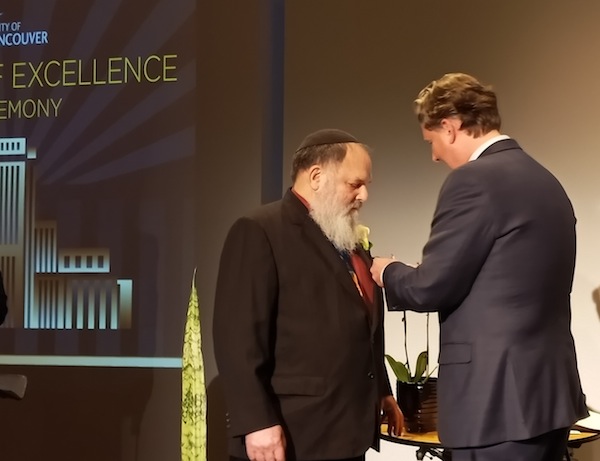
Vancouver Mayor Kennedy Stewart pins the Freedom of the City medal to Dr. Yosef Wosk’s lapel in a ceremony May 31. (photo by Cynthia Ramsay)
Yosef Wosk, a scholar, educator, author, businessperson, art collector, explorer, rabbi, peace activist and philanthropist, has been awarded Vancouver’s Freedom of the City.
The top honour bestowed by the City of Vancouver, the Freedom of the City is in recognition of Wosk’s philanthropic work benefiting libraries and museums, academic excellence, nature conservation, health care, community and social services, heritage preservation, science, humanities, reconciliation, and the arts in Vancouver and around the world.
The honour was bestowed by Mayor Kennedy Stewart at a ceremony May 31 at the Roundhouse Community Centre. Also recognized that night with an award of excellence was Jewish Family Services’ the Kitchen.
Born in Vancouver in 1949, Dr. Yosef Wosk is a multidisciplinary thinker and community activist who founded the Canadian Academy of Independent Scholars, the Philosophers’ Café, and a number of schools. He has championed museums and libraries on every continent, assisted individuals and institutions with publication grants, planted hundreds of thousands of trees, and endowed the City of Vancouver’s Poet Laureate. His extensive travels culminated in expeditions to both the north and south poles.
Wosk is an Officer of the Order of Canada, a Member of the Order of British Columbia, as well as a Fellow of the Royal Canadian Geographical Society. He is the recipient of both the Queen’s Golden and Diamond Jubilee Medals, the United Nation’s Culture Beyond Borders Medal, the President’s Award from the Canadian Museums Association, and a Martin Luther King, Jr. Award for Community Service from the NAACP.
The Freedom of the City is the highest award given by the City of Vancouver. The city grants the honour only in exceptional cases to individuals of the highest merit. The recipient is usually someone who has gained national and international acclaim in the arts, business, or philanthropy, and who has brought recognition to Vancouver through his or her achievements.
The city began honouring individuals with the Freedom of the City Award in 1936. While several Jewish community members have been awarded the medal – most recently landscape architecture Cornelia Hahn Oberlander, just four days before she died on May 22, 2021 – Wosk and his late father, Morris J. Wosk, are the only father-son recipients in its history.
Yosef Wosk delivered an address to the audience, who assembled to witness a number of civic awards presented by the mayor and city councilors. Among the organizations recognized – in the category of Healthy City for All – was the Kitchen, a program of Jewish Family Services Vancouver.
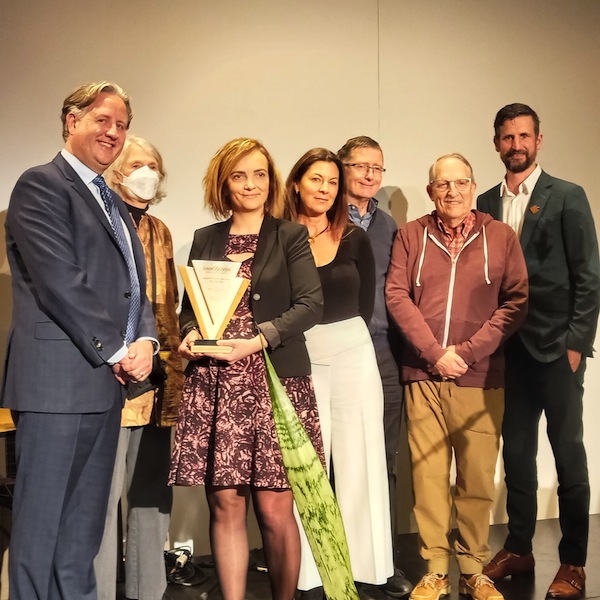
Jewish Family Services’ the Kitchen is honoured for excellence. Left to right: Mayor Kennedy Stewart, Councilor Jean Swanson, JFS chief executive officer Tanja Demajo, JFS board chair Jody Dales, JFS Food Security Task Force co-chair Stan Shaw, JFS volunteer and food security committee member Paul Becker, and Councilor Michael Wiebe. (photo by Cynthia Ramsay)
Recognizing the vulnerability of people with food security challenges in the early days of the COVID-19 pandemic and lockdown, JFS transitioned to delivering food for those most in need. The number of people they served and the frequency of food distribution more than doubled, and JFS saw the need to open a new multipurpose space in Mount Pleasant in March 2021.
The new purpose-designed food distribution centre has enabled JFS to establish all of its food operations under one roof, store and distribute a larger supply of food, prepare meals in-house, and eliminate the need to set up and reassemble the food bank every second week.
The Kitchen now provides a wider array of options, particularly for those with specific dietary needs, and serves a more diverse group of people across Vancouver. Produce, dairy, and healthy and nutritious food items are part of an ongoing food preparation operation that prepares and delivers vegan meals to community members and local Jewish day schools from the main Mount Pleasant location, as well as six satellite locations in the Vancouver area.
Jewish Family Services of Vancouver Island (JFSVI) will launch a green market at the Jewish Community Centre of Victoria on June 12, thanks largely to a grant from the Jewish Community Foundation of Greater Vancouver.
The grant has allowed JFSVI to hire Ora Stefanic, a former director at University of Victoria Hillel, as the market’s coordinator. “It is a privilege for me to be a part of such an important cause and I hope that people will not only benefit from this opportunity to purchase great quality produce at a low cost, but that it will also help support local farms,” Stefanic told the Independent.
“Ora brings a tremendous amount of experience, energy and enthusiasm to this project,” said Leah Kinarthy, head of JFSVI.
The market is not a handout of free processed food or items nearing their expiration date. Rather, according to JFSVI, purchasing fresh produce at close to wholesale prices will both allow people to preserve their dignity and reduce food waste.
“We believe that the Saanich Green Market would be the only fresh produce market offering wholesale prices on Vancouver Island,” Kinarthy said.
JFSVI expanded its programs in 2022. In March and April, the organization distributed gift cards for Thrifty Foods, a subsidiary of Sobeys, to individuals in need through a grant from Community Food Centres Canada, a group that addresses food insecurity across the country.
JFSVI received a $10,000 grant from CFCC for the gift cards and the Jewish Community Foundation grant to hire a part-time market coordinator was also $10,000.
“With shortages, inflation and higher prices, basic food staples are becoming increasingly difficult to afford for families with children and seniors and many others on fixed or reduced incomes,” Kinarthy said. “We have had very positive and grateful, and some happy but surprised, reactions from people who received this unexpected bonus funding. Some people were overcome with emotion and cried over the phone, as their situation was desperate and this helped them a lot.”
Kinarthy got the idea for a green market after pondering how to use JFSVI revenues to assist the greatest number of people with the finances available.
While on the CFCC website, Kinarthy discovered a section promoting fresh produce markets. “I read all of their extensive materials and realized that this was doable for our community. I am especially drawn to the premise of people receiving assistance through very low costs to buy farm-fresh produce rather than free food that is about to expire.”
Following the June 12 grand opening, the Saanich Green Market will run every other week for a full year, though there will also be a market on June 19.
Kinarthy emphasized that it is a 12-month pilot project. She and her board are currently applying for a grant from the Victoria Foundation to help fund the purchase of tents and other equipment to ease the burden of initial expenses. If successful, JFSVI plans to put more money into purchasing fresh food, particularly if demand exceeds expectations. Should enough funding arrive through donations and grants, they hope to hold a weekly market the following year.
JFSVI was recently accepted into the Good Food Organizations program offered by CFCC. The program, which includes more than 270 charities across the country, works to eradicate poverty, food insecurity and improve the health and well-being of low-income Canadians.
JFSVI also distributes grocery gift cards for four Jewish holidays: Rosh Hashanah, Hanukkah, Purim and Passover. In April, they delivered grocery gift cards for Passover via post, email and in-person to 36 households – or roughly 80 people – on Vancouver Island.
The organization budgeted additional funds for the Passover cards. Due in significant part to the largesse of the Fernwood General Store (formerly Aubergines), JFSVI was able to purchase them for kosher food at a discount.
Fairway Market, another Island-based grocery chain that consistently offers kosher products, offered gift cards at Passover to residents outside of Greater Victoria, as well.
Serving members of the community throughout the Island, JFSVI was started as a grassroots organization in the mid-1990s. It became a registered charity in 1996, when it was called the Jewish Assistance Association. Aside from food support, JFSVI has worked with clients on several other concerns, including housing, home support care and the prevention of social isolation. Anyone wishing to donate to the Saanich Green Market or JFSVI can send an etransfer to reachout@jfsvi.ca or visit the JFSVI website, jfsvi.ca.
The JCC of Victoria is located at 3636 Shelbourne St., and the Sunday markets run from 11 a.m. to 1 p.m.
Sam Margolishas written for the Globe and Mail, the National Post, UPI and MSNBC.
Martin Thibodeau, RBC’s B.C. region president, will be honoured at the Ben-Gurion University Gala Dinner June 14. (photo from RBC)
On June 9, Ben-Gurion University president Daniel Chamovitz and members of the Canadian Associates of Ben-Gurion University (CABGU) will visit Vancouver to recognize the launch of its new School of Sustainability and Climate Change (SSCC) and the local supporters who have helped make its opening possible. In particular, Royal Bank of Canada and Martin Thibodeau, RBC’s B.C. region president, will be honoured at the event.
SSCC opened last October at BGU’s Be’er Sheva campus, where its growth has been rapid. Seven months old, the school currently offers two undergraduate degrees and four graduate-level environmental science-related degrees. Its two graduate fellowships, which have supported work in renewable energy and smart city design, were funded by RBC.
“The RBC Research Fund at BGU’s School of Sustainability and Climate Change [is] being established in Martin’s honour, [and] will enable undergraduate and graduate students to be trained as, and pursue meaningful careers as, climate change innovators, entrepreneurs and policy experts,” said David Berson, who serves as CABGU’s executive director for the B.C. and Alberta Region. The funding that is raised at the gala will help further SSCC’s research programs.
SSCC’s mandate isn’t just to address environmental concerns at home in Israel, said Chamovitz. It will have a global reach, as well. BGU is currently working to cement research partnerships with universities and countries that have similar interests in addressing climate challenges. Chamovitz said RBC’s investment in its new school will provide a pathway to meeting that global need.
“RBC was one of the early supporters of SSCC, and this support was essential for leveraging subsequent support,” he said. “The Royal Bank of Canada believes in us,” and that support has served as an encouraging model for other companies to invest in BGU’s programs as well, he said.
Lorne Segal, president of Kingswood Properties and director of the Vancouver Board of Trade, who is an honorary co-chair of the June event with his wife, Mélita Segal, said corporate sponsorship is crucial to startup programs like SSCC. He said corporate support is also vital to finding answers to environmental challenges like global warming.
“Sponsorship from leading businesses and industry leaders does provide imaginative solutions to complex issues impacting our people and the planet,” he said. “Without significant and generous sponsorship support, this crucial work, simply put, would not be possible.”
Segal said supporting initiatives that bring about positive change is part of Thibodeau’s nature.
“Martin Thibodeau truly is a lifelong builder of community,” said Segal. “He is deeply praised by Ben-Gurion University for his commitment to the cause of finding solutions to climate change. It is truly remarkable how much he and RBC Royal Bank have done to enhance the capacity of the Ben-Gurion University community programs and agencies, and advance the conversation on Canada’s transition to a net-zero economy.”
Thibodeau’s support of Canadian Jewish communities and of Israel goes back decades. Originally from Quebec, he served as RBC’s regional president in Montreal until he moved to Vancouver. He oversees some of the largest – and smallest – branches and more than 4,000 employees.
In 2015, while working in Montreal, Thibodeau volunteered as a co-chair for Quebec’s largest multi-day walk for women’s cancers, held by Pharmaprix, to raise money for research at the Jewish General Hospital. “I have been involved with the Jewish community for almost my entire RBC career,” he told the Independent.
He is a strong supporter of the Jewish Federation of Greater Vancouver and the Jewish Community Centre of Greater Vancouver and their community initiatives, and he has been to Israel several times. It was in 2014, said Thibodeau, that he and his wife, Caroline, visited Be’er Sheva and learned of BGU’s environmental research. “[I was] so inspired by the research [and] the innovation,” he said, noting that it wasn’t hard to get behind the creation of a school that was working to find solutions to climate concerns.
“It’s right there in front of me every day,” he said. “I am a proud father of three children and I believe we have a responsibility to make sure that our climate can continue to thrive, and well beyond my lifetime. It is my personal belief that we need to do that today more than ever.”
Thibodeau said it’s been an interesting journey since that first visit to BGU in 2014. “It’s become such a tough priority for the world,” he said of climate change. In Canada, among other things, he supported RBC’s Blue Water Project, which helped provide clean water access to Canadian communities.
Still, Thibodeau is a reticent honouree. He admits that he is uncomfortable with the idea that he will be the guest of honour at a gala, even if it is for a cause he loves. “I’m very humbled,” he said. “I don’t like to have that kind of spotlight on me.” But, he said, raising money for research that might one day create a safer and better environment, that is something he will gladly get behind.
Mélita and Lorne Segal, honorary chairs of the BGU Gala Dinner for Sustainability and Climate Change. (photo by The Collective You)
The gala will also acknowledge Lorne and Mélita Segal, who are well-known for their philanthropy and other work. Both have been recognized by Capilano University with honorary doctor of letters, and Lorne Segal has a doctor of laws (hon.) from the Justice Institute of British Columbia. He was inducted into the Order of British Columbia for his work as founding chair of Free the Children’s WE Day Vancouver and as chair of the Coast Mental Health Courage to Come Back Awards. The Segals regularly open their home to fundraising galas.
“When Lorne and I built our home, we didn’t really do it for ourselves but, rather, to share it with the community,” said Mélita Segal. “Whether it was Dr. Peter AIDS Foundation, Arts Umbrella, Chor Leoni, JNF [Jewish National Fund] or WE Charity … it has been a great joy for us and very fulfilling to give back and share in this way.”
Berson described the Segals as “tireless builders of community, leading by example while creating opportunities for people in the business world to make a difference in the lives of others. Ben-Gurion University, Canada, is genuinely fortunate to have their leadership for this event and for our organization.”
Jan Lee is an award-winning editorial writer whose articles and op-eds have been published in B’nai B’rith Magazine, Voices of Conservative and Masorti Judaism and Baltimore Jewish Times, as well as a number of business, environmental and travel publications. Her blog can be found at multiculturaljew.polestarpassages.com.
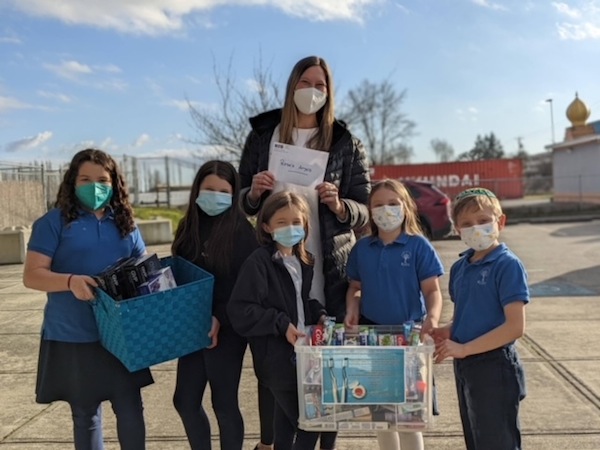
Courtney Cohen with students from Richmond Jewish Day School holding donated items for care packages. (photo from Rose’s Angels)
The ninth annual Rose’s Angels took place over the months of February and March. With the generous help of family, friends and community, it was possible to donate to 10 not-for-profit agencies servicing the most vulnerable in Richmond.
Rose’s Angels has been a community event since 2012, donating more than 6,000 care packages to date in honour of Rose Lewin and Babs Cohen, Courtney Cohen’s grandmothers. The event runs under the umbrella of the Kehila Society of Richmond, where Cohen and Lynne Fader, co-executive director of the society, established the project together.
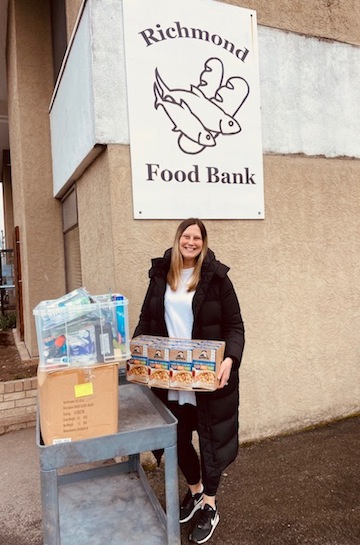
Courtney Cohen at the Richmond Food Bank, one of the agencies with which Rose’s Angels works. (photo from Rose’s Angels)
With the increasing cost of living and many families struggling to make ends meet, Cohen and Fader decided to alter this year’s individual care packages to be primarily gift cards to local grocery/drug stores, rather than comprised of many different items. A gift card allows an individual to go independently and purchase what they require when they need it most. The goal is to return to the large care-package event for 2023, if the COVID safety guidelines allow for it.
Rose’s Angels would not be possible without the support of the Kehila Society, family and friends, community volunteers and donors. Throughout the years, Cohen and Fader have created a strong connection with recipient agencies and so are able to purchase specialized items that are most needed by each agency, making the donations more personal. For example, for one not-for-profit this year, Rose’s Angels put together packages that included new hygiene items for both parent and baby, non-perishable snacks, crayons, gift cards to a local grocery store and a reusable bag.
To learn more about the community-based work done by Kehila Society of Richmond or to donate, visit kehilasociety.org or 604-241-9270.
In announcing the results of the 2021 Jewish Federation of Greater Vancouver annual campaign, campaign chair Lana Marks Pulver expressed deep gratitude for the generosity of donors. Acknowledging the ongoing impacts of the pandemic, she said, “Yet, we have also seen some impressive achievements. Organizations have innovated faster and better. Volunteers have dedicated countless hours, pitching in wherever they are needed. And donors have given more generously than ever before.
“Together, we have generated $11.16 million for our community!”
The annual campaign raised $9.52 million, while $1.64 million was raised for additional support, which includes additional support for special projects, community recovery, emergency relief and donors’ multi-year commitments to Federation’s international partners.
In addition, the community raised more than $388,000 for B.C. flood relief during the campaign period. And the community has come together to generate more than $850,000 so far for Ukraine relief.
“We can all take pride in this remarkable achievement, which reflects our collective commitment to our Jewish values of tzedakah and tikkun olam (repairing the world), and our responsibility to one another,” said Marks Pulver.
“From the start of the pandemic, Jewish Federation took the lead in getting our community through to a brighter future. A successful annual campaign is a big part of our ability to do that and, as chair of the campaign, I am deeply grateful for your support.”
* * *
The Canadian Friends of the Hebrew University is pleased to announce a major gift of more than $5 million dollars from the estate of a Vancouver resident, to establish the Institute for Medical Research, Israel-Canada (IMRIC) Hub for Addiction Research at Hebrew University.
Prof. Rami Aqeilan, chair of IMRIC (photo from CFHU)
The mission of the IMRIC Hub for Addiction Research is to bring about wiser policies, better care and new treatment avenues for those struggling with addiction. This new program will focus on medical research relating to addiction, providing insights into the physical and chemical aspects of addiction, its prevention and treatment.
A silent addiction epidemic affects nearly 11% of adults (more than 615,000) in Israel. In any given year, one in five Canadians experiences a mental illness or addiction problem. Addiction can include both substance addiction (alcohol, drugs and other substances) and compulsive sexual behaviour, problematic use of pornography and problematic use of the internet. Moreover, addiction and mental health issues go hand in hand and must be addressed in tandem. Each year, addiction costs the Israeli economy approximately seven billion NIS and causes untold peripheral damage to families and communities.
“As a result of this generous gift, we at IMRIC are able to engage our best researchers in several specific research projects with diverse perspectives on addiction,” said Prof. Rami Aqeilan, chair of IMRIC. “Additionally, the hub will promote national and international interaction and foster collaboration with Canadian researchers.”