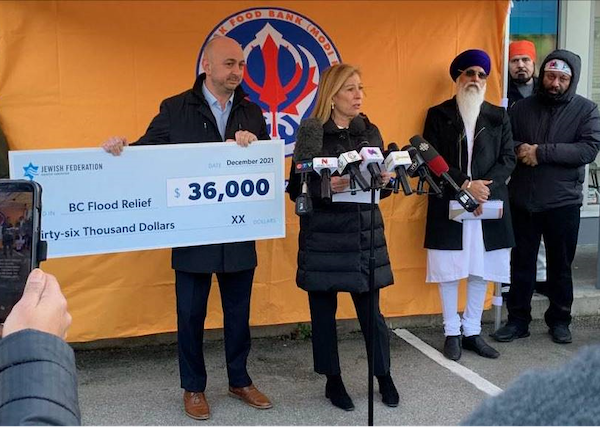
Candace Kwinter, Jewish Federation of Greater Vancouver board chair, and Ezra Shanken, Jewish Federation chief executive officer, present a cheque to the Surrey Sikh Temple and Guru Nanak Food Bank on Dec. 2, as the temple’s head priest and president of the Guru Nanak Food Bank, Narinder Singh, and two volunteers look on. (photo from Jewish Federation)
The Jewish Federation of Greater Vancouver presented a $36,000 cheque for flood relief to Gurdwara Dukh Nirvan Sahib (Surrey Sikh Temple) and the Guru Nanak Food Bank on Dec. 2. The funds will be used to transport urgently needed items to flood victims in Merritt, to offset the cost of rent for a new food bank, and to purchase air mattresses and blankets for people who have been displaced, lost their possessions, or both.
This is the first disbursement from Jewish Federation’s B.C. Flood Relief Funds, which has topped $300,000, thanks to the support of hundreds of donors. The Centre for Israel and Jewish Affairs helped facilitate the partnership – with their main contact being Nick Walia, who is the fundraising coordinator for the food bank – and the Jewish Federation of Victoria and Vancouver Island supported the fund, making it a truly provincial effort from the Jewish community.
Speaking at the Guru Nanak Food Bank, Jewish Federation’s board chair, Candace Kwinter, who was joined by chief executive officer Ezra Shanken, spoke of her pride in being able to partner with the Sikh community, and “to see the remarkable work [they] are doing” at their operations centre. The temple’s head priest and president of the food bank, Narinder Singh, was on hand for the ceremony.
Kwinter spoke of the special meaning this partnership had for the Jewish community during Chanukah: “Chanukah is a time when we remember a miracle that took place after a devastating period of destruction and loss. The holiday takes place at the darkest time of the year, and we light the candles of the menorah each night to bring light and hope into our homes and into the world around us. We want to share that light with our friends and neighbours who need us now, so we can bring them a ray of hope.”
Jewish Federation has long supported non-sectarian humanitarian aid whenever and wherever disaster strikes, and is developing a long-term strategic approach to its flood relief efforts to ensure support will be available as needs evolve over time. To support Jewish Federation’s B.C. Flood Relief Fund, visit jewishvancouver.com/bcflood.
Michelle Pollock, chair of Jewish Federation of Greater Vancouver’s Israel and global engagement committee. (photo from JFGV)
For Montreal native Michelle Pollock, chair of Jewish Federation of Greater Vancouver’s Israel and global engagement committee (IGEC), love and loyalty to world Jewry were firmly established early in life – at home, school and in the community at large.
That deep affinity was further solidified after a two-month trip to Israel with her ninth-grade class. More recently, while serving as president of the Jewish Community Centre of Greater Vancouver in 2016, Pollock took a trip with her husband Neil to visit the Krakow and Moscow JCCs.
“These visits were incredibly powerful,” Pollock told the Independent. “Witnessing the young adults of these communities, discovering and exploring their Jewish heritage was beautiful. Even more inspiring was the hard work and dedication of the Polish and Russian volunteers and staff in creating welcoming spaces to facilitate this Jewish self-discovery.”
In November 2017, Pollock traveled to northern Israel as a participant on a Centre for Israel and Jewish Affairs mission. “Many of the participants on the trip were IGEC members or staff and their passion for our partnership region was infectious. I joined the IGEC soon thereafter,” she said.
A visit to Federation’s partnership region, Etzba HaGalil (the Galilee Panhandle), followed, in November 2019. That experience was multifaceted. The area is known for its physical beauty and the warmth of its residents, said Pollock, but the harsh reality of security issues and the regional challenges of jobs, infrastructure and opportunity also prevail, she noted.
“Seeing this firsthand infused me with gratitude to our Federation, which has worked so closely with the region since the mid-1990s to bring desperately needed aid and programming in a continuing effort to address the challenges faced by its residents,” Pollock said. “Jewish Federation has strategically invested funds to strengthen this region through education and social welfare programs, capital projects and regional development, and building enduring relationships between members of our community and residents of Etzba HaGalil.”
Similar to efforts locally, some of the funds to Israel have been allocated to new programs addressing youth mental health issues, violence and abuse at home, educational gaps and food security – all problems that have been compounded by the pandemic.
As for the challenges in another region in need, Far East Russia, where many Jews live in remote locations, Federation partners with the Joint Distribution Committee. The JDC is a global organization that addresses critical rescue and relief needs in more than 60 countries, including in the former Soviet Union (FSU).
“Working together with the JDC, life-saving aid is provided to over 80,000 elderly Jewish people in the former Soviet Union who struggle to survive on meagre pensions of $2 per day. They are the poorest Jews in the world, most without family or government support. Their distress and vulnerability are exacerbated by the region’s remoteness and freezing winters,” Pollock explained.
Many of these elderly Jews are well-educated and trained as doctors, lawyers, scientists and educators, she said. Having spent most of their working lives under communism, however, they were unable to accumulate savings. When the Soviet Union collapsed, along with the region’s pension and social assistance infrastructure, they were left poverty-stricken.
“Vancouver is geographically the nearest Jewish community to the Jewish communities in the easternmost part of Russia, adjacent to Siberia. As a strategic priority to strengthen Jewish life around the world, Jewish Federation (as the closest Federation) plays a very active role in supporting this region,” Pollock said. “We ensure long-term economic and social stability for Jews living overseas and in Israel by funding much-needed programs that provide a safety net for our most vulnerable people.”
These specialized programs, funded in part by the Jewish Federation of Greater Vancouver through the annual campaign, impact the lives of at-risk youth, low-income seniors and those living in economically fragile areas.
This year, Federation is funding a program directed at youth in the FSU called Active Jewish Teen (AJT). Engagement in the Jewish community, it believes, is an essential first step in making communal responsibility an inseparable part of one’s Jewish identity. Though still building momentum, AJT already has more than 3,200 members in 63 locations across seven countries.
Besides investing strategically, Federation’s IGEC has made solid connections with the groups it is serving in the FSU, said Pollock. It is also attentive to urgent needs arising in other Jewish communities around the world, helping fund operations and campaigns in South America, Ethiopia, the United States and elsewhere, she said.
Closer to home, throughout the year, Jewish Federation’s Israel and global engagement department brings opportunities for the Vancouver community to experience Israeli culture. Next year’s Yom Hazikaron (Israel’s Memorial Day) and Yom Ha’atzmaut will present opportunities for the community to come together in person.
“Building off the success of last year’s virtual Israeli Independence Day celebration, we will include more local talents and have community fun projects such as the community song and more surprises,” said Pollock, adding that there is a contingency plan in place should the COVID situation change.
Further, shinshinim, teenage emissaries from Israel, will be in town in the coming year. The shinshinim engage local young people in various activities and help foster meaningful ties between Disapora Jews and Israel.
Members of the Vancouver community have a chance to travel to Israel next summer, as well. Federation is facilitating a community mission from July 24 to Aug. 5, 2022.
“I know many of us are keen to travel and get back to Israel and this is going to be an amazing experience,” said Pollock. “At this point, we are looking for people to register their interest and there are a number of information sessions coming up.”
To learn more about the trip to Israel and to donate to the annual campaign, visit jewishvancouver.com.
Sam Margolishas written for the Globe and Mail, the National Post, UPI and MSNBC.

Lana Marks Pulver, Jewish Federation of Greater Vancouver annual campaign chair. (photo from JFGV)
The Jewish Federation of Greater Vancouver’s annual campaign is entering the homestretch with an ambitious set of goals. This year, the theme is “strengthened by where we have been, inspired by where we can go.”
“The goal for this year’s campaign is both quantitative and qualitative,” campaign chair Lana Marks Pulver told the Independent. “We aim to raise a minimum of $9.5 million, and we want to strengthen the culture of gratitude within the Federation organization, that affects all constituents, including donors, volunteers and staff.”
As has often been said in the past 21 months, these are times like no other in recent memory. The pandemic has touched us all, yet, for some, the campaign points out, it has “caused a cascading effect of challenges.”
“The goals haven’t shifted due to the pandemic, but the needs have certainly increased because of it. Therefore, we hope to raise more than our financial target to ensure all our partner agencies survive the current uncertainty in which everyone is operating and all community needs are being met,” Marks Pulver said.
“The past year-and-a-half was extremely tough on our community and our partner agencies. However, with the incredible show of support from donors and volunteers, our community proved to be resilient. Our partner agencies were able to survive the uncertainty and continue to provide their much-needed services because of the support from Jewish Federation and our donors.”
Groups within the community that were already vulnerable have faced more challenges. Among the groups Federation is helping are low-income individuals, the elderly and youth struggling with mental health concerns.
Well before COVID-19 hit, the region was one of the most expensive places in the world in which to live and it has become increasingly unaffordable; many, as a result, are left with hard choices regarding paying for rent, bills and food. Meanwhile, most seniors in the community are eager to reconnect socially and spiritually after extended separations from their families and communities.
Increasing numbers of youth, too, are contending with anxiety and depression as they encounter isolation from their peers and continued disruptions to their routines. At one local Jewish school this past year, the demand for counseling services doubled. In light of such statistics, Federation has formed a committee of local professionals and volunteers to develop a comprehensive approach to assist both youth and their families.
The basic plan involves employing a community mental health professional to offer counseling at community locations; collaborating with other mental health organizations in supplying professional development to those working directly with children and youth; and encouraging youth to take leadership roles in raising awareness among their peers about the importance of accessing appropriate support.
The pandemic has had a negative impact on youth mental health globally, including in Federation’s partnership region in Israel. The Mervo’ot HaHermon Regional Council has witnessed a rise in troubling behaviour among youth, especially those whose routines and social opportunities have been disrupted and who may not have supportive adults in their lives. Demand for services in the Israeli municipality has grown by 35%, according to Federation. Because of the need, and based on a successful pilot program in the spring of 2021, Federation is helping efforts to enhance counseling services and create new educational and social programming, in the hope that early intervention will lead the youth in this region along a healthier path.
Marks Pulver concedes that, while there are hurdles to overcome in organizing a campaign in the midst of a pandemic, the community response has been unflaggingly supportive.
“Typically, the campaign goes hand-in-hand with community gatherings,” she said. “A big part of campaign is the opportunity to connect with other community members at events. The pandemic has prevented us from having these gatherings in person and, instead, we have resorted to virtual ones. However, people are ‘Zoomed out’ and tired of the online events; therefore, making it more challenging to get people together.
“Recent experiences, however, have demonstrated the strength of our community and how we come together to help others in a time of need,” she stressed. “This show of support, both financially and with volunteerism, is beyond inspiring and I, personally, am incredibly grateful to be part of this community, that steps up and makes a difference.”
Marks Pulver, who has served as women’s philanthropy chair at Federation and was major donors chair for the past few years, sees her role as campaign chair as a natural progression and feels honoured to lead this year’s effort.
“I am proud to be serving alongside women chairs of both Federation and the Jewish Community Foundation. I believe you get out of life what you put in, and it is this belief that inspires me to volunteer. I also thoroughly enjoy working with others in the pursuit of helping others, and feel grateful for the opportunity to be able to make a difference.”
Jill Zarin is the keynote speaker at Choices on Nov. 7. (photo from Twitter)
Philanthropist and entrepreneur Jill Zarin – most recognized for having been on the reality TV show The Real Housewives of New York City – is the featured guest at this year’s Choices, which will be held virtually on Nov. 7.
Zarin is also the author – together with her mother, Gloria Kamen, and sister, Lisa Wexler – of Secrets of a Jewish Mother, a 2010 book full of recipes, advice and parenting tips. She will join Vancouver-area speakers to talk about how they were able to support community during the pandemic.
The Jewish Federation of Greater Vancouver’s Choices is the largest women’s event within the community. This is the 17th annual gathering and the Independent interviewed 2021 co-chairs Sherri Wise, Leanne Hazon and Courtney Cohen by email about what to expect.
“Jill Zarin is an amazing speaker!” they said. “Attendees will also hear from so many inspiring women in our own community who give of themselves to keep our community strong and connected.
“Although Jill Zarin is most well known for being a television personality, she is in fact an extremely philanthropic person,” they added. “After almost two years of COVID, the committee wanted to have a program filled with humour and uplifting stories and Jill was a perfect match.
“As co-chairs, we have always found we learn something from the women who speak, which inspires us to continue supporting our wonderful community.”
The pandemic has impacted everyone around the world in many ways, said the co-chairs, and so many people have stepped up to try to help their communities navigate this very challenging time. Zarin is but one of the many “who have pitched in their time and tzedakah and ideas to help our Jewish community stay strong,” said the Choices co-chairs.
Ideally, the organizers had wanted to be together in person for Choices 2021. Yet with the uncertainties and changing regulations around COVID, they have once again decided to hold the event virtually, while trying to provide the experience in a way that is still meaningful to people.
Given the ongoing reality of the pandemic, the women said they are “really happy and really lucky” that Choices can be offered online. One of the benefits of a virtual event, they pointed out, is making it more accessible to women province-wide.
Choices is a celebration of the impact of women’s philanthropy. Rather than fundraising, the goal is to get more women involved in the community through giving to the campaign and volunteering. The organizers stress that there are many ways of being involved in philanthropy and making a difference, such as connecting with Jewish Federation or one of its many partner agencies.
The 2021 Federation annual campaign is focusing on the theme of being strengthened by what we as a community have been through in the past year-and-a-half and inspired by where we can go together. This year, Choices is recognizing specifically how women in the community came through the pandemic and made the community stronger with their time and donations.
In a non-pandemic year, Choices would have 500 people in attendance. Past speakers have included musicologist Judy Feld Carr, the Canadian responsible for bringing thousands of Jews from Syria to freedom; Talia Leman, the founder of RandomKid, an organization that empowers youth to do good deeds; Talia Levanon, the director of the Israel Trauma Coalition; and Jeannie Smith, who shared the story of her mother, Irene Gut Opdyke, who rescued Jews during the Holocaust.
The Choices 2021 co-chairs lauded the efforts of Sue Hector and Shawna Merkur, the co-chairs of women’s philanthropy at Federation. They also noted the contributions of Ricki Thal (campaign manager), Kate Webster (campaign director) and the Jewish Federation staff for their invaluable support.
To attend Choices, a person must give to the Federation’s annual campaign or make a donation by purchasing a ticket of the suggested amount. There is a suggested minimum donation of $154 to support the campaign and a suggested minimum donation of $36 for first-time attendees.
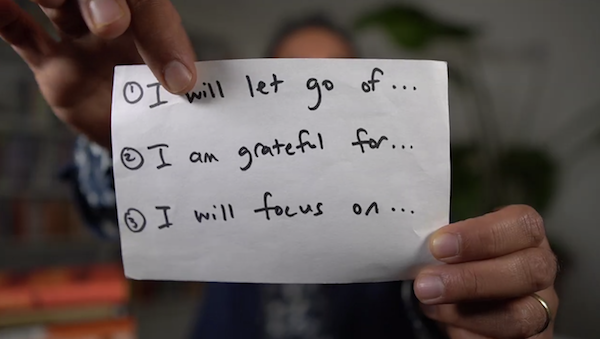
Neil Pasricha, the keynote speaker at Jewish Federation of Greater Vancouver’s The Community of Awesome event Oct. 3, contends that people can be more content in their lives if they take two minutes every morning to finish these three thoughts: “I will let go of … I am grateful for… I will focus on….” (screenshot)
In lieu of the traditional large in-person event that launches the Jewish Federation of Greater Vancouver’s annual campaign, a livestream broadcast from Hillel House at the University of British Columbia Sunday night highlighted the successes and challenges of the pandemic year.
“Donors have given more generously than ever before,” said Lana Marks Pulver, chair of the annual campaign. “Organizations have innovated faster and better. Volunteers have dedicated countless hours pitching in wherever they are needed – that includes more than 200 volunteer canvassers for the annual campaign.
“The pandemic has shown us that we are really good at overcoming challenges,” she said. “We know that, whatever the future holds, we can be there for one another and we will be there.”
Ezra Shanken, chief executive officer of the Jewish Federation, thanked sponsors, in particular Air Canada, which has provided five tickets to anywhere in North America, one for each of the five Jewish day schools in the region, to give to an educator to reconnect with family.
Candace Kwinter, chair of the Federation board, noted that, early in the pandemic, a think tank had predicted that 25% of B.C. nonprofits would not survive the economic and social consequences of the crisis.
“We are very proud that no local Jewish organization has folded,” said Kwinter. “And thank goodness, because demand for their programs and services has only grown.”
A video highlighted the work of Jewish Family Services Vancouver, one of 32 partners supported by the annual campaign. Their services include the Jewish Food Bank, a crisis line and programs for seniors to use iPads to connect with one another.
In the last fiscal year, Kwinter said, Jewish Federation distributed $11.8 million, including $3 million through the Jewish Community Foundation. In addition, the foundation distributed more than $270,000 through their unrestricted grant program, to allow community organizations to adapt.
The Oct. 3 event’s keynote presenter was Neil Pasricha, who is the bestselling author of seven books, including You are Awesome, The Happiness Equation and The Book of Awesome. He is one of the most popular TED Talks presenters. After obtaining his MBA from Harvard, he worked as director of leadership at Walmart for a decade.
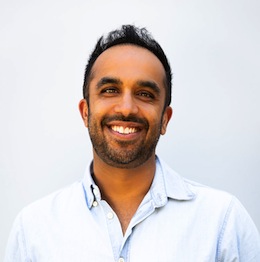
Neil Pasricha (photo by Leia Vita)
The Toronto-based speaker focused on how to be happy, noting that the pandemic has resulted in higher rates of anxiety, loneliness and suicide than ever. With the enthusiastic energy of a 1950s disc jockey, Pasricha disputed what he called the assumption that happiness flows from great work, which leads to big success and then to happiness.
“It’s the opposite,” he said. “You have to be happy first, then you do great work and the big success follows.”
Happy people, he said, are 31% more productive, have 37% higher sales and are 300% more creative.
“Happy people get promoted 40% more often,” he added. “More importantly, happy people live an average of 10 years longer.”
He suggests that everybody take two minutes in the morning to write down three commitments.
“When you wake up, I want you to spend two of the 1,000 waking minutes a day doing a little exercise,” Pasricha said. “You write down these three things. I will let go of … I am grateful for… I will focus on.…”
When we consciously think about and write down the things that bother us, he said, we live life with greater contentment and happiness.
“Saying something that is bothering you, writing it down, actually helps you get it off your chest.”
The Dayson and Barnett families were on hand to celebrate the opening of Tikva Housing Society’s Ben and Esther Dayson Residences. (photo from Tikva Housing)
Although the weather was not ideal, almost 100 people attended the opening of Tikva Housing Society’s Ben and Esther Dayson Residences on Sept. 26.
Due to COVID-19 restrictions, the event had to be held outside under tents. Rhonda Sacks, chair of Tikva, welcomed everyone and thanked the Ben and Esther Dayson Charitable Foundation and the Dayson and Barnett families for their ongoing generosity and support. She acknowledged the three generations of the Dayson and Barnett families who were present and the importance of the younger ones to witness this momentous occasion.
Sacks recognized the Jewish Federation of Greater Vancouver for understanding the immediate need for affordable housing in the Jewish community and thanked them for their leadership and advocacy. Ezra Shanken, chief executive officer of the Jewish Federation, brought greetings and reiterated the importance of not only saying thank you but also showing the younger generation how, because of their great-grandparents, the community is taking care of those in need of affordable housing.
Philip Dayson spoke on behalf of the family and mentioned that it was the desire of his mother, Esther Dayson, to help those less fortunate and to have a lasting legacy, like these townhomes.
The younger generation of the Dayson/Barnett family cut the ribbon at the opening of Tikva Housing Society’s Ben and Esther Dayson Residences. (photo from Tikva Housing)
Many of the residents in attendance took the opportunity to personally thank the donors and their families.
Hannah Amar, one of the residents at the Dayson Residences, spoke on behalf of the 32 families who live there. She spoke of the importance of having safe and secure accommodation, especially during COVID, and how grateful she is to Tikva and to its donors for her beautiful home.
This housing development is part of a partnership of the City of Vancouver and the Vancouver Community Land Trust; there were many donors and partners on the project.
More than 100 people live in the residences, including almost 60 children. As one of the residents said, “The sense of community and Jewish life is beyond what we could have imagined. We are so fortunate to be living here.”
The event also paid tribute to Susana Cogan, z’l, who was the driving force behind Tikva Housing from 2009 to 2017. Cogan was instrumental in developing these residences, as well as others that Tikva owns and/or operates. A commemorative bench in her memory sits adjacent to the children’s playground.
For more information about Tikva Housing, call the office at 778-998-4582.
Grade 2 and 3 students of the B.C. Regional Hebrew School in Coquitlam with teacher Shifra Rabiski. (photo from Lubavitch BC)
In time for the upcoming school year, Lubavitch BC, in partnership with the Jewish Federation of Greater Vancouver, is launching a new curriculum for B.C. Regional Hebrew Schools. There is a need to engage Jewish children with a connection and pride for Israel and its central role in the Jewish past, present and future, and B.C. Regional Hebrew Schools has developed a program that does exactly this. Israel Quest is an immersive curriculum that enables children to form attachments to the Holy Land on practical, emotional and spiritual levels.
Using educational tools such as virtual reality, topography, theatre, filmmaking, STEAM activities and more, students relive the journey of the Jewish people in the land of Israel, from the time Jews entered the land, led by prophets and kings, until the untimely destruction of the Holy Temples. They discover the secret to the Jewish people’s eternal survival as a nation with tools established to keep Judaism thriving in the Diaspora.
Of the new program, Rabbi Dovid Rosenfeld, director of the Hebrew schools, said, “Education is at the core of everything. What we teach children in their formative years creates an indelible impact and foundation for their entire adult lives. And not only are the students themselves transformed, but the positive impact of their learning extends to their families, friends, classmates, communities and beyond.”
B.C. Regional Hebrew Schools is an affiliate of the Chabad Children’s Network (CKids), which has chapters in 26 countries and engages 25,000 children each year. Currently operating in three locations throughout British Columbia, it is gearing up for another year of Hebrew and Judaic learning, starting Sept. 1. Online registration is available at lubavitchbc.com/hebrewschool. More information can be found by calling 778-878-2025.
The annual general meeting of the Jewish Federation of Greater Vancouver took place on June 21. Welcomed were five new directors: Gil Kimel, Dean Lederman, Lana Pulver (chair of the annual campaign), Michelle Pollock (chair of the Israel and global engagement committee), David Porte and Daniel Steiner. They join Bruce Cohen, Alex Cristall, Catherine Epstein (vice-chair), Jessica Forman (chair of the HR committee), Sue Hector, Hodie Kahn, Shay Keil, Rick Kohn, Candace Kwinter, Shawna Merkur, Kyra Morris, Lianna Philipp, Lisa Pullan, Stan Shaw and Diane Switzer.
Kwinter is the new board chair and, as such, her central challenge mirrors that of the community: how to navigate recovery and reopening in a time of great uncertainty.
“Over the past year, I have held a dual role as vice-chair of the board and chair of the Israel and global engagement committee, which has immersed me in our work,” said Kwinter in her remarks in the June 25 Federation Shabbat message. “And, through my position on our Community Recovery Task Force, I’ve gotten to know the organizations in our community and see how our community planning, convening, facilitating and fundraising functions create a valuable synergy. The health and strength of our local community is paramount, and it will continue to be a focus throughout my term.
“Israel also holds a very special place in my heart, and I am actively involved with our partner, the Jewish Agency for Israel’s board of governors, where I serve on three committees: antisemitism; unity of the Jewish people; and aliyah. In 2018, I was privileged to be part of a group of community leaders who traveled to Far East Russia to see the impact of our overseas work. As travel restrictions begin to ease, I hope we will have the opportunity to visit our partnership region in the Upper Galilee Panhandle and resume our Israel experience programs for young adults.
“At the same time,” she continued, “I remain connected to the work we do across the continent as part of JFNA [Jewish Federations of North America]. I have attended several General Assemblies over the years, and now is the perfect time for you to experience this epic gathering of Jewish leaders, because you can participate without the time and expense of traveling.
“Looking ahead, I know we have challenges to face, but this is also an exciting time in many ways. COVID has accelerated change and has prompted us all to look at new ways of strengthening our community. Rather than looking ahead to the ‘new normal,’ we need to work together to create the ‘next normal.’ That will be our collective journey over the next two years, and I am looking forward to the future we can build together.”
At the AGM, four community leaders were honoured. Jonathon Leipsic, who chaired the Federation annual campaign from 2018 through 2020, received the Harry Woogman Award, for his consistent and conscientious leadership and his long-standing and diligent campaign involvement. Yael Segal and Becky Glotmanreceived the Lou Zimmerman Award for their integral role in the revitalization of the Ben Gurion Society, a recognition society for young donors who give $1,000 or more to the Federation annual campaign. And Enav Zusman received the Young Leadership Award.
The 2020/21 annual report can be found at jewishvancouver.com/news-and-publications/annual-reports. In 2020, Federation raised $12.2 million from 2,600 donors: $8.8 million in the 2020 annual campaign; $2 million for community recovery; and $1.4 million in special project funding.
COVID-19 was a crisis that affected – and continues to affect – every aspect of the community. Because of donors’ generosity, Federation this year was able to direct more funding to its partners than ever before.
(British Columbia’s record-breaking heatwave has had devastating effects across the province. The tragic fire in Lytton was not the first that we’ve seen and likely will not be the last. With growing concerns for another wildfire season, Jewish Federation of Greater Vancouver has set up an emergency B.C. Wildfire Relief Fund to assist those affected by wildfires in our province. To donate, visit jewishvancouver.com/bcfire.)
* * *
On May 20, Junior Achievement British Columbia (JABC) inducted new members into its Business Laureates of British Columbia Hall of Fame, including Gordon Diamond. There was also the posthumous induction of 10 Pioneer Laureates, including Morris Wosk, z”l. Diamond and Wosk were featured in the June 25 Jewish Independent article “JA’s newest laureates.” The article accidentally overlooked another posthumous honouree, however: Dr. Walter Charles Koerner, z”l. Here is what the JABC highlighted of Koerner’s life.
Koerner was born in 1898 in what is now the Czech Republic. He developed his expertise in the forestry industry there, through his family’s lumber business.
Dr. Walter Charles Koerner (photo from alchetron.com)
Koerner and his brothers immigrated to Canada in 1939 and founded the Alaska Pine and Cellulose Co., of which he was president. In 1957, the company became Rayonier Canada Ltd. and Koerner became president and later chairman of the board until his retirement in 1973.
Shortly after his arrival in Canada, Koerner made the University of British Columbia (UBC) a focal point of his philanthropy. He believed that a strong university was critical to building an engaged and successful society. He served as a member of the board of governors of UBC, as well as the chair. Not only that, he was the founding chair of UBC Hospital.
Koerner was also committed to preserving Indigenous art forms and supporting the re-emergence of Pacific Northwest Indigenous art. His multiple initiatives included supporting Indigenous carvers, repatriating Indigenous works from abroad and negotiating with then-prime minister Pierre Elliott Trudeau for financial support for the construction of the Museum of Anthropology, to which he donated his extensive collection. In recognition of his efforts in supporting Indigenous culture, the Haida Nation celebrated Koerner as an honorary chief of their nation.
Koerner was a notable philanthropist, who donated millions of dollars to educational institutions and other public organizations and endeavours. Among his many honours, he was a Companion of the Order of Canada, and held an honorary doctor of laws from UBC.
Koerner passed away in 1995.
* * *
Vancouver’s Lilian Broca is among the artists whose works comprise the From Canada exhibition at La Maison de la Mosaïque Contemporaine in Paray-Le-Monial, France.
Every year, La Maison de la Mosaïque Contemporaine organizes and hosts an international mosaic exhibition. The 2021 edition, the 24th, is uniquely devoted to a single country, Canada, through the works of 12 artists whose origins reflect the vast expanse of the territory. This is the first time in Europe that a mosaic exhibition has been dedicated to a North American country, and it is supported by the Canadian embassy in Paris, as well as several other organizations, government agencies and communities.
Joining Broca are artists Maria Abagis, also from British Columbia; Margo Anton, Chris Sumka and Erin Pankratz, all from Alberta; Sophie Drouin, Valerie McGarry, Heather Vollans and Julie Sperling, from Ontario; Suzanne Spahi and Ginette Lussier of Quebec; and Terry Nicholls of Newfoundland.
The exhibit was arranged by Sophie Drouin and Chantal Demonchaux. It opened this month and runs to Sept. 19. For more information, visit maisondelamosaique.org.
Left to right: Jewish Federation’s Shelley Rivkin, CJPAC’s Kara Mintzberg and CIJA’s Nico Slobinsky spoke at an online event June 17 on topics including how individuals can help fight antisemitism in Canada. (PR photos)
Representatives from three Jewish communal agencies spoke at an online event June 17 on topics including online hate, adoption of the Working Definition of Antisemitism, strengthening supports for the investigation and prosecution of hate crimes, and how individuals can help fight antisemitism in Canada.
Shelley Rivkin, vice-president of local and global engagement at the Jewish Federation of Greater Vancouver, Kara Mintzberg, B.C. regional director for the Canadian Jewish Political Affairs Committee (CJPAC), and Nico Slobinsky, director of the Pacific region of the Centre for Israel and Jewish Affairs (CIJA), spoke about how their agencies are confronting the surge in antisemitism, as well as a range of other topics.
Dafna Silberstein, associate director of the Jewish Federation’s Israel and global engagement department, opened the evening.
“We are here tonight to understand the Canadian political process and learn how you can become more involved, how we can become engaged with a range of issues that matters to you and to our community, and to learn what our community organizations are doing to combat antisemitism,” she said.
Rivkin described Federation’s role as “our community’s primary convener.”
“We are an umbrella organization that represents over 25 organizations locally and an additional number of organizations, approximately 10, in our partnership region [in Israel’s Galil Panhandle] and globally,” said Rivkin.
Federation is the central fundraising arm of the community and runs programs and partners with other agencies to care for the most vulnerable. About one in six Jewish British Columbians lives in poverty, she said, including 13.4% of Jewish children. Federation is also critically involved in supporting Jewish day schools and ensuring continued provincial support for those institutions, she added.
Antisemitic incidents and threats have spiked in recent weeks, coincident with the conflict between Hamas and Israel. Rivkin said the relationships Federation has built with other ethnocultural agencies and communities have proven valuable.
“We have a long history of working side-by-side with other ethnocultural communities,” she said. “These relationships and the supports that we provide are very important so that, when we stand up and speak out on behalf of other ethnocultural organizations, we’re building the bridges and relationships so that they will stand up and speak out on our behalf. Especially this past month, we’ve been very proactive in reaching out to the Indigenous community and the Muslim communities, both of whom faced significant losses over this past month.”
Rivkin also noted Federation’s substantial investment – about $1 million annually – in community security.
“Hate crimes against our community remain one of the highest reported crimes in Canada,” she said. “That was why, in 2016, we made the decision to invest in a director of security that is available and responsive to all of our community organizations, in particular those organizations that have stand-alone facilities.”
Slobinsky explained that CIJA represents hundreds of thousands of voices affiliated with Jewish federations across the country.
“Combating antisemitism, educating Canadians about the central role that Israel plays in Jewish life, strengthening the ties between Canada and Israel and ensuring that Jewish voices are represented in the discussion on a range of issues is some of the long-term work that CIJA does,” he said.
Because of CIJA’s lobbying, he said, the federal government has announced an emergency summit on combating antisemitism, to be led by former justice minister Irwin Cotler.
CIJA also promotes the adoption by governments of the International Holocaust Remembrance Alliance Working Definition on Antisemitism, which Slobinsky calls “the gold standard definition for antisemitism” and a vital tool in fighting antisemitism in Canada and around the world.
“For the first time in our history, we have a definition [of antisemitism] that we as a community champion, that the Canadian government has adopted and now Ontario, New Brunswick and Quebec have adopted,” Slobinsky said. “It’s a very useful tool to work with our elected officials, law enforcement, our partners in other communities, when they ask us what is antisemitism, how do you experience antisemitism, how it manifests.… We are defining what our own discrimination, our own oppression, looks like.”
CIJA is also calling on federal and provincial governments to increase supports for existing hate crime teams in British Columbia and to initiate teams to investigate and prosecute hate crimes in jurisdictions where investigation teams do not yet exist.
Of CJPAC, Mintzberg said: “We are all about political engagement.”
“Our focus is on getting our community interested and involved in politics through volunteering and building relationships with elected officials,” she said. CJPAC, she emphasized, is not involved in lobbying or advocacy; that’s CIJA’s job. “We create programs that reflect the mandate of engagement and highlight the importance of getting involved in Canada’s political process.”
Jewish voters have a significant presence in only about 10 of the country’s 338 ridings. Especially during elections, Mintzberg said, CJPAC acts as a “political concierge,” connecting volunteers with candidates. As Canada is currently governed by a minority government, an election could come at any time. She calls on community members to step up now and be prepared when that call comes.
Mintzberg asked that people pledge to volunteer in the next election and participate in a free, one-hour online training course, which can be accessed via cjpac.ca. Slobinsky invited participants to visit cija.ca/takeaction to find ways to mobilize against antisemitism and support other topics on CIJA’s agenda.
Emily Pritchard has been appointed as director of the upcoming capital campaign for the Jewish Community Centre of Greater Vancouver redevelopment project. She brings close to a decade of experience to the role and has led successful capital fundraising campaigns throughout her career.
“We are delighted to welcome Emily on board,” said Alvin Wasserman, president of the JCC. “Her appointment is an indication of the growing strength and immense potential of this enormous undertaking.”
The redevelopment will be the single biggest project in the history of the local Jewish community and will bring diverse groups of people from across the region together around a central community hub.
Emily Pritchard (photo from Jewish Federation)
“I am thrilled to be working on this project. Not only is this one of the most ambitious capital campaigns in the city, it is an excellent example of how a capital project can pull a community together,” said Pritchard. In previous roles, Pritchard has led successful campaigns for Christ Church Cathedral and Covenant House Vancouver.
Over the past few years, the JCC, Jewish Federation of Greater Vancouver and King David High School have engaged in a strategic process with stakeholders regarding the proposed redevelopment of the JCC site. As part of that process, the organizations agreed to collaborate on fundraising.
“The creation of the capital campaign director role is part of our commitment to building an experienced team of professionals,” explained Alex Cristall, Jewish Federation’s board chair. “The proposed redevelopment of the JCC site is a complex, long-term project that will take commitments from across the community, government and beyond to realize. Ensuring we have Emily in place at this early stage will enable us to be fully prepared when the time comes to launch the capital campaign.”
KDHS co-president Neville Israel said Pritchard is “a critical part of our cross-organizational team.”
“As the redevelopment starts to gather steam,” added school co-president Jackie Cristall Morris, “I am confident that she will help bring to life the exciting opportunities ahead of us.”
Proposed redevelopment
The current 60-year-old JCC facility serves 40,000 people a year, comprising more than 300,000 visits annually. In April 2021, the B.C. government announced $25 million to support the first phase of the redevelopment. This followed Vancouver City Council’s unanimous approval of the rezoning and redevelopment plan for the site. Previously, the provincial government and private donors provided support for the planning stages of the project, which is expected to be completed in two phases.
The first phase will result in a renewed 200,000-square-foot multigenerational community centre on what is currently the JCC parking lot. It will include expanded childcare, seniors’ services, arts and cultural spaces, and amenities for all Vancouver residents. More than 15 not-for-profit organizations are expected to call the centre home, and plans include expanded space for the Vancouver Holocaust Education Centre, a new theatre, and more.
Once that is completed, the redevelopment’s second phase will begin on what is currently the site of the existing JCC building. Central to this is a mixed-use rental housing project, with units expected to be offered at or below market value and be open to everyone. In this phase, with support from private donors and supporters of the school, KDHS will move to a new facility that will give the school ample space to provide academic, athletic and extra-curricular programming.