The Jewish Independent briefly spoke with the Jewish Federation of Greater Vancouver about what support local campers could receive, if they needed it.
JI: Does Federation work with the Foundation for Jewish Camp at all?
JF: One Happy Camper is a grant program run through the FJC and federations to provide a $1,000 grant to first-time campers. In communities such as ours, where Federation does not sponsor OHC, PJ Library families are able to apply and receive this grant through PJ Library.
JI: To what camps does Federation give grants and why?
JF: Camp Miriam, Camp Hatikvah, JCC Camp Shalom and Camp Gan Israel. Through our Connect Me In program, we have provided grants to run camps in the regional communities or to pay for transportation for children to attend the day camps in Vancouver.
The Jewish Community Foundation has designated funds established by fundholders to support Jewish summer camps and camperships, and fundholders with donor advised [funds] also make distributions to camps.
Camps can apply for funding through the [Jewish Community] Foundation’s Unrestricted Grant Program for qualifying projects. Recently, the foundation supported Camp Miriam’s Water Security Project through this grant program.
JI: Do they support any individual campers, or how do families with lower incomes access camp for their kids?
JF: Approximately one-third of families receive camperships to send their children to Jewish summer camp. Odds are that if your family did not receive a campership, your child made friends at camp with someone who did. Families can apply for camperships funded by Jewish Federation directly through the summer camp of their choice. The camps then review the applications and make the decisions.
Sam Margolishas written for the Globe and Mail, the National Post, UPI and MSNBC.
Jewish Federation of Greater Vancouver has raised $16.3 million to address the crisis in Israel and is currently distributing $2.8 million to support the needs of survivors and evacuees. This distribution is in addition to the $2.1 million already hard at work on the ground in Israel.
As Israel transitions from “emergency mode” to “emergency routine,” citizens nationwide are bracing for what is likely to be a long and challenging period. More than 300,000 Israelis have been displaced from their homes and communities, their lives turned upside down, physically and emotionally. Their needs range from mental health support to temporary burial service (in unbearable numbers) to educational activities to daily necessities and more.
This second release of funds has gone to the following organizations in Israel.
Bring Them Back Home: psychological support for the families of those missing and held hostage.
Beit Issie Shapiro: treatment and respite for evacuees and survivors with disabilities.
Ramat Negev Regional Council: kitchen centres for evacuated communities and mobile shelters for Bedouin schools.
Shaar Hanegev Regional Council: respite and treatment for young adults and terror attack survivors.
Tel-Hai College: supporting students and alumni through stress and trauma teams and art centres.
Mashabim Community Stress Prevention Centre: mental health care for the northern communities.
Galila: medical kits for communities of the Eastern Galilee Cluster.
Federation thanks everyone who has contributed to the Israel Emergency Campaign for making these vital and urgent supports possible. If you have not yet had an opportunity to donate, visit jewishvancouver.com/israel-fund.
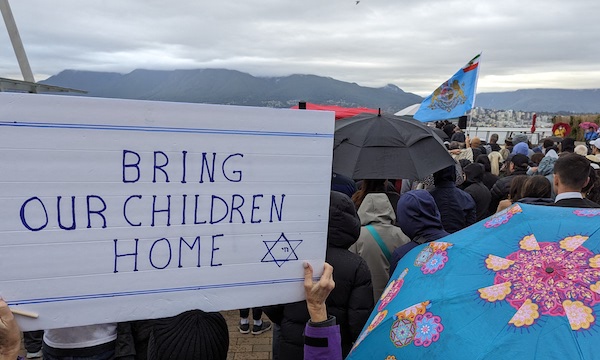
Several hundred people gathered for a second night of vigils, as elected officials, diplomats and allies convened in support of Israel and Jewish community. (photo by Pat Johnson)
For the second night in a row, Jewish Vancouverites and allies came together Tuesday for a vigil to mourn those murdered in the worst terror attacks in Israeli history, and to demonstrate solidarity with survivors, families of the victims, and all the people of Israel. The grief that was inevitable at the powerfully emotional event was made additionally anguished by the news several hours earlier that Ben Mizrachi, a young Vancouver man, was confirmed dead, one of about 260 victims murdered at a concert for peace in southern Israel Saturday morning.
In moderate rain at Jack Poole Plaza on Vancouver’s Coal Harbour waterfront, several hundred people gathered to hear from friends of Mizrachi, as well as from elected officials of all government levels, rabbis, a Holocaust survivors, and others.
Ben Mizrachi remembered in friends’ emotional testimony
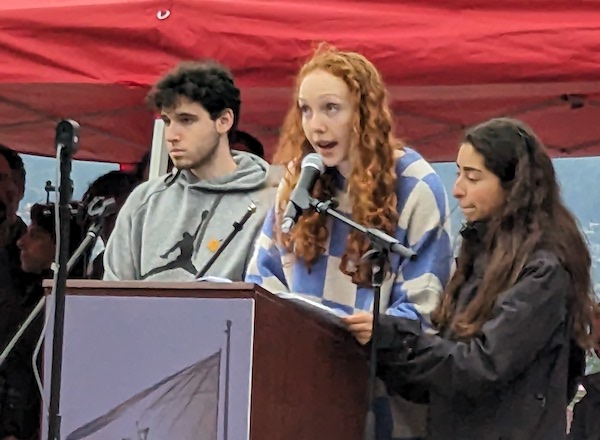
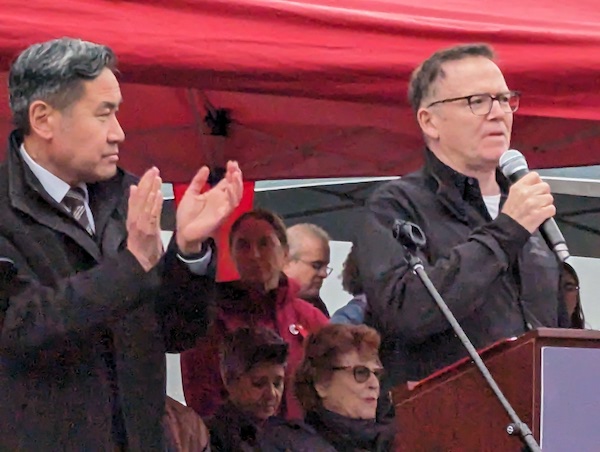
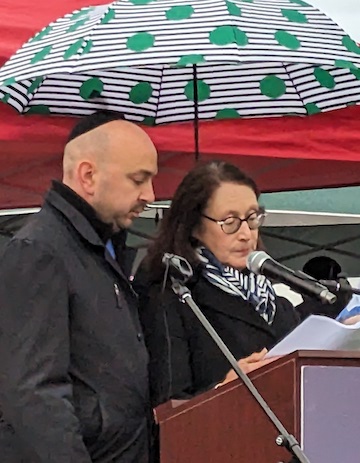
Maytar and Rachel, who graduated alongside Mizrachi in 2018 from King David High School, shared memories of the young man they called “the life of the party” and “a true hero,” who died helping an injured friend at the scene of the attack.
Mizrachi had served as a medic in the Israel Defence Forces, having volunteered as a lone soldier.
“We understand that, during the attack, Ben stayed back with a wounded friend, keeping himself in danger to care for another,” said Maytar. “He used the training that he learned from his time as a medic with the IDF to tend to wounded people at the festival before he died. That was who Ben was. He was a true hero.”
She spoke of Mizrachi’s contributions to the King David community, to his friends and family.
“He was adored by everyone and known to students much younger and older than he was,” she said. “Everyone knew and loved Ben Mizrachi. Ben was a role model to his three younger siblings and valued his close and loving relationship with his family.”
She shared the memories of a fellow student, Eduardo, for whom young Ben became his first friend after moving here from Mexico City.
“Ben welcomed him, befriended him and taught him how to speak English,” Maytar said. “He told us that ‘Ben was much more than a friend, he was my brother and the type of personality that will cheer you up and make you smile.’ He had such a huge heart and you knew you could always count on Ben.”
She continued: “In school, Ben was always the first one dancing at any assembly and the last one cleaning up at the end, even when he cooked — and he loved to cook.”
He could be found in the kitchen at Beth Hamidrash on Shabbat helping to prepare the kiddush, Maytar said. “His kindness extended to every part of his life from such a young age. We all remember that, if we ever had a gathering on Saturday, the party wouldn’t really start until after Shabbat, when Ben would arrive. He was always the life of the party. This past weekend, that’s what he was doing. He was at a party with his friends. He was doing nothing wrong.”
Friends of terror victim Ben Mizrachi remember “true hero.” (photo by Pat Johnson)
Their friend Rachel spoke of Mizrachi’s commitment to his identity.
“Ben was always extremely proud of his Jewish identity and of being an Israeli citizen,” she said. “He loved to share his love of Judaism and he often invited friends to join him and his family for Shabbat services and meals. As a teammate of Ben, we played on multiple sports teams together and he proudly wore his kippah at every game. In Grade 12, Ben was the president of our NCSY [the youth wing of the Orthodox Union] chapter. He was involved in student council, he led weekly prayer services at our school. After high school, he was proud to join the IDF as a lone soldier. He was so proud to be a soldier in the army and to continue living in Israel after his service.”
Rachel then read a message from one of Mizrachi’s teachers at King David, Irit Uzan.
“Ben always stood out from the crowd,” Uzan wrote. “His happy disposition was infectious. He lit up a room with his positive energy and amazing sense of humour. When things got hard for the students, he always found a way to lighten the mood. He encouraged his peers by sharing his own struggles, but it was what he did beyond his studies that always impressed me. He reached out and offered a helping hand wherever it was needed, be it with a peer, a teacher, a staff member or his own family. He wasn’t asked, he just always knew what to do. Ben’s visits to school to catch me up on his life events were visits I always looked forward to. On his last visit, he seemed more eager than usual and I learned this was because he wanted me to know that he had decided to study engineering in Israel. He was so proud of this.”
In tears, Rachel concluded: “Ben, we are so proud of you and we will always miss you. Please pray for Ben’s family, for all the families who have lost their loved ones, as well as those wounded. Keep believing in the state of Israel and continue to be proud of our Judaism, like Ben always was. May Ben’s memory be a blessing.”
Rabbi Shlomo Gabay, spiritual leader of Mizrachi’s shul, Beth Hamidrash, led the vigil in El Maleh Rachamim, the prayer for the soul of the departed.
Reflections from a survivor
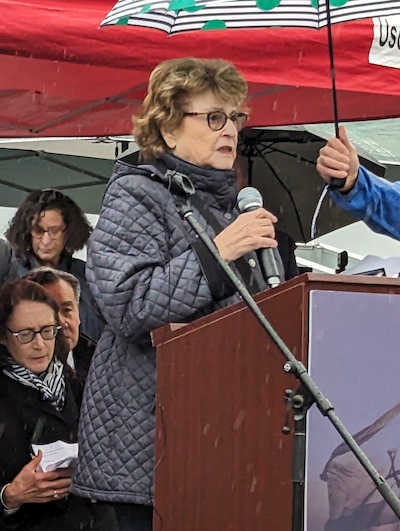
Marie Doduck, a child survivor of the Holocaust who was born in Brussels and came to Canada as a war orphan in 1947, reflected on the terrible echoes of the past the current news brings. She and 30 other Vancouverites who survived as Jewish children during the Second World War gather and, Doduck said, speak about their pasts and the present.
Holocaust survivor Marie Doduck spoke of historical trauma. (photo by Pat Johnson)
“For all the years we have been sharing our stories, for all the years we’ve been teaching tolerance, we know the worst that can happen,” she said. “But it always seems to happen to us. I spend my life as an educator, I share my story and the stories of the Holocaust so that people know and so that the world will remember, so that never again will children lose their childhood to hatred and to violence. And now, this week, I see children being taken from their parents in Israel. I’m reliving what I experienced as a child and it is horrible. I’m watching the news and hearing the sounds that were so terrifying when I was young, the sirens, the bombs falling. I’m seeing warplanes and bomb shelters and I cannot sleep at night.
“I’m seeing it all happen again,” Doduck said. “I see people who do not want peace treating us as if we are not human. I see the children captured. I cannot understand how they use children, how they use women and men like we are nothing. It is unthinkable. It is impossible to believe that humans can do this to other humans. The one place where we are safe they want to destroy. They want to do what the Gestapo did to us in the Second World War.”
With emotion, Doduck posed the question, “Does the world stand for us?”
“I don’t see them standing for us,” she said. “I see it happening again. I am reliving what I went through as a child and all we want, and all we have ever wanted, was peace.”
Support from Ottawa
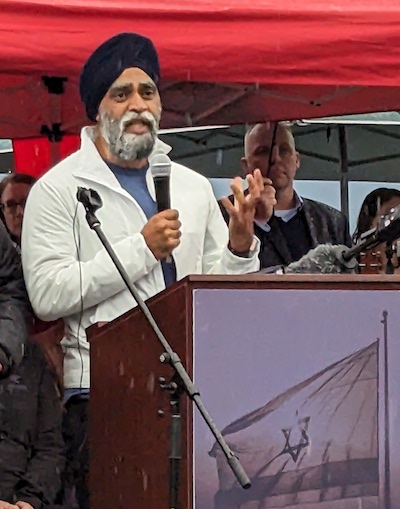
Harjit Sajjan, president of the privy council and minister of emergency preparedness, spoke on behalf of the federal government.
“I know that everyone’s heart is broken because of this brutal terrorist attack, a targeted attack on the Israeli people,” said Sajjan, who is member of Parliament for Vancouver South. “All of you have witnessed and have seen the news and the atrocity that has taken place. Myself and my colleagues here … stand here with you. But I don’t speak here just as a minister but [I am] also speaking to you as a Canadian, as a human being. It hurts so much when we see images from what has just taken place. Your community has gone through this far too often. When we say enough is enough, sometimes those words seem like they have no meaning. But when we come together like this, it gives me hope that we can get through this.”
Harjit Sajjan promised Canada’s government “is with you.” (photo by Pat Johnson)
Across Canada and elsewhere, rallies, public statements and social media comments have celebrated the terror attacks, some, like the president of the Ontario wing of the Canadian Union of Public Employees, lauding them as “the power of resistance around the globe.” Hours before a Jewish community vigil Monday, a rally celebrating the violence was held in the same Vancouver Art Gallery location. Along with many speakers at the Tuesday event, Sajjan condemned the expressions of support for the terror attacks.
“Anybody who glorifies what has just taken place, the atrocities that Hamas has committed, I’m here to say that we denounce you and I denounce you,” he said.
Sajjan referenced his military career, from which he retired with the rank of lieutenant-colonel.
“Over the last two decades, whether in politics or even before, [in] my other job in the military, I’ve seen atrocities committed all over the world,” he said. “And your heart breaks every single time. And you think, what can we do? One thing that always gives me hope is that I look back and remember where I live, in Canada, that we come together, we support one another. That’s how we get through this.
“I remember visiting Entebbe [Uganda] where, you know all too well, when Israeli citizens were taken captive and they were rescued at that time, I went to go pay my respects and remember what took place then. To see the atrocities committed over and over again is something that we all feel today. One thing I’m here to tell you: that we stand by you, we call for the captives to be released, we want humanitarian aid to be flown into all those people who are caught in the middle. But one thing is for sure: our government is with you.”
Other federal officials present were Joyce Murray, member of Parliament for Vancouver Quadra, and Parm Bains, member of Parliament for Steveston-Richmond East.
Message from the province
Selena Robinson, British Columbia’s minister of post-secondary education and future skills, brought greetings from Premier David Eby and the provincial government. She also emphasized the presence of officials from both sides of the legislature.
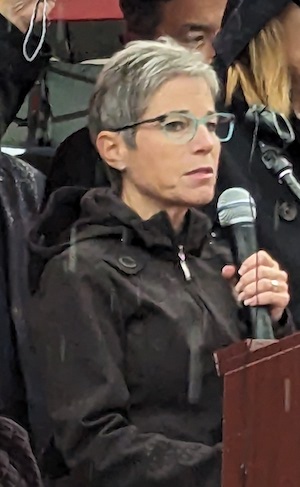
Selina Robinson, one of BC’s few Jewish elected officials, spoke emotionally of living in a frightening time. (photo by Pat Johnson)
“All of government and all members of the Legislative Assembly stand with me, they stand with all of you, against the horrific violence that was perpetrated by Hamas, a terrorist organization, an organization committed to indiscriminately killing and indiscriminately wiping out the Jewish people,” she said. “As a Jew, I have never in my life experienced a more frightening time. To see and bear witness to the carnage, to the babies, to the children, to young people at a concert.
“The stories that Jewish families have been telling for generations all come swarming back,” Robinson continued, her voice breaking. “The stories of pogroms in Russia and Poland at the turn of the 20th century, the Einsatzgruppen, the Nazi mobile death squads, going house to house killing everyone in their sights during the Holocaust. That is what happened this weekend. This is not a path to peace and it’s not the path to freedom. The Palestinians and the Israelis deserve to raise their families without fear, to grow old with dignity, but this vicious depravity is not the answer. It is not a path for peace for anyone. These last days have been so difficult and there are more hard days to come. So, we ask all of you to please be kind, be thoughtful, be supportive and to take care of each other.”
Opposition leader stands with community
Kevin Falcon, BC United party leader and the province’s leader of the opposition, was scheduled to hold a townhall in Kamloops Tuesday night but he cancelled the event and drove to Vancouver to be present for the solidarity gathering, he said, “Because I think it is important that all public officials stand united in saying … without equivocation, without moral equivocation, to be very, very clear, that we stand with you.”
Provincial opposition leader Kevin Falcon, with MLA Michael Lee. (photo by Pat Johnson)
Condemning terrorist brutality is “something that ought to be really easy,” he told the crowd. “But, unfortunately, in this day and age, it doesn’t seem to be easy for some people to come together and denounce unequivocally the violence and slaughter of innocent civilians in Israel, and to remember the right of that country and those individuals to defend themselves as a fundamental right because we cannot forget.
“We stand with the community and we want you to know that,” he said.
In addition to the government cabinet minister and opposition leader, other provincial officials present were cabinet ministers Brenda Bailey, Murray Rankin, Sheila Malcolmson and George Chow, parliamentary secretaries Mable Elmore and Susie Chant and members of the Legislative Assembly Henry Yao and Michael Lee.
Mayor condemns antisemitism
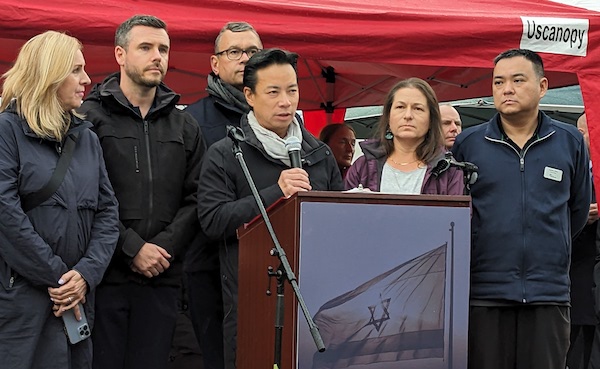
Vancouver Mayor Ken Sim was flanked by city councilors Sarah Kirby-Yung, Peter Meisner, Lisa Dominato, Mike Klassen and Rebecca Bligh as he expressed solidarity with the Jewish community and promised zero-tolerance for antisemitism.
Vancouver mayor Ken Sim, flanked by councillors, committed to fight antisemitism. (photo by Pat Johnson)
“What happened this weekend in Israel was absolutely horrific,” said Sim. “Our hearts are broken, just like yours…. Vancouver is a city of love, Vancouver is a city of peace, Vancouver is a city of inclusion. This is a place where we celebrate our differences in culture and religion. So, it’s absolutely disturbing and incredibly disgusting, in the city that we live in, the city that we are so proud of, that people were actually celebrating what happened. They are celebrating Hamas. That’s not right. Israel has a right to exist. Israel has a right to protect itself. At the City of Vancouver, we stand for all communities, including the Jewish community — especially the Jewish community, during this incredibly brutal time. You are our brothers and sisters, you are our neighbours, you are our friends, you are our family. Let me be very clear — let us be very, very clear — we will not stand for any antisemitic acts or acts of hatred in the city of Vancouver. We mourn with you, we stand with you, we love you and we will always be here for you.”
Dylan Kruger, a Delta city councilor was also present.
Gathered together as one
Tuesday’s vigil was organized by the Rabbinical Assembly of Vancouver, the Jewish Federation of Greater Vancouver and the Centre for Israel and Jewish Affairs.
Rabbi Jonathan Infeld of Congregation Beth Israel, and the head of the rabbinical assembly, spoke of the relentlessness of antisemitism.
“I am standing here as a neighbour of Ben Mizrachi and his family, in sadness and in grief,” said Infeld. “I am standing here today as the father of a young man who is currently in Jerusalem. I am standing here today as the child of Holocaust survivors who never met his grandparents or aunts or uncles because they were murdered as children because of antisemitism. Never would I have imagined again in my life that we would see 40 children, 40 babies in one day, discovered, who were murdered in cold blood because of antisemitism. Never would I have imagined in my life that we would see almost a thousand Jews in one day murdered because of antisemitism. Throughout the day, I’ve been asked, what is this moment about? This moment today, together, as one people, one community, Jews and non-Jews gathered together for solidarity, gathered together to mourn and gathered together to give strength to one another. We are so grateful to our politicians and to our leaders who really, truly, are leaders. All of you sitting here today, you are the leaders. You are sending the message that there is no similarity in morality, there is no equivalence in morality, between those who celebrate murder and those who are gathered together for peace.”
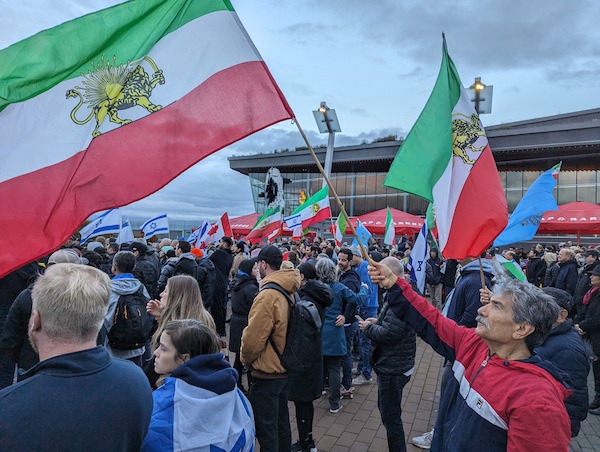
Iranian community members showed solidarity. (photo by Pat Johnson)
Federation leader sends message from Egypt
Jason Murray, vice-chair of the board of the Jewish Federation of Greater Vancouver, read a message from the board’s chair, Lana Marks Pulver, who, with her husband Doug, is in Egypt, leading a group of almost 100 Canadian business leaders in a mission that was slated to travel to Israel in the coming days.
“I share this with you so you know how close I am to the situation both physically and emotionally,” wrote Marks Pulver. “There were two Israeli tourists murdered by a police officer in Alexandria [Egypt]. We continued on with our tour of Egypt much to the chagrin of family and friends. We continued because we will not allow them to win. Never again.
“As for emotion, our 21-year-old niece and 19-year-old nephew are serving in the IDF and are stationed near Gaza. We are feeling sick about what’s happening in Israel and we are feeling sick about the celebratory rallies happening in Canada, rubbing salt in our fresh wounds. How can Canadian citizens possibly justify the celebration of rape, killing and kidnapping of innocent Jews, online and in public rallies? It’s both horrifying and heartbreaking that this is happening in our own backyard. Jews throughout history have consistently proven that we are resilient. This time is no different. Israel will prevail. We as a people will not allow evil to win. Despite thousands of years of antisemitism and countless attempts to annihilate our people, we always come back stronger and more unified as a community.
“I am confident that this time is no different,” she continued. “Let us pray this all ends soon, that Israelis move forward with their lives in safety and that we as a Jewish people proudly stand in our fight against hatred and our desire to live in peace. Am Yisrael chai.”
Gratitude for allies
Ezra Shanken, chief executive officer of the Jewish Federation of Greater Vancouver, praised the elected officials who attended and the police who provided security at the event.
“Often, we see public officials at our events and it’s special then,” he said. “But it’s even more special now. To have this incredible representation of folks behind us and around us in this moment is not something that I take for granted, not these days.”
Ezra Shanken and Karen James (photo by Pat Johnson)
In addition to elected officials, Shanken noted the presence of consuls general from France, Germany and Italy, as well as representation from the consulate of the United States.
Karen James, chair of the local partnership council for the Centre for Israel and Jewish affairs, Pacific region, lauded the unity of the Jewish community.
“I have always known that we are family, but I’ve never felt it so strongly as I do now,” she said. “Tonight, we are hurting. Our hearts are broken but our resolve has never been stronger.”
Severe audio problems plagued the event, which came a night after an earlier vigil, at the Vancouver Art Gallery, planned by Daphna Kedem, who is the lead organizer of UnXeptable Vancouver, though the event was not affiliated with any group. ( To read more about the Monday night vigil, click here.) At that event, a small group of provocateurs were kept apart from the main vigil by a phalanx of police. Police were also omnipresent at the Tuesday event, while protesters were nowhere to be seen.
Speakers at the event urged people to contribute to the emergency fund for victims and to access available mental health supports as needed. Federation’s website, jewishvancouver.com, is the access point for all relevant local resources.
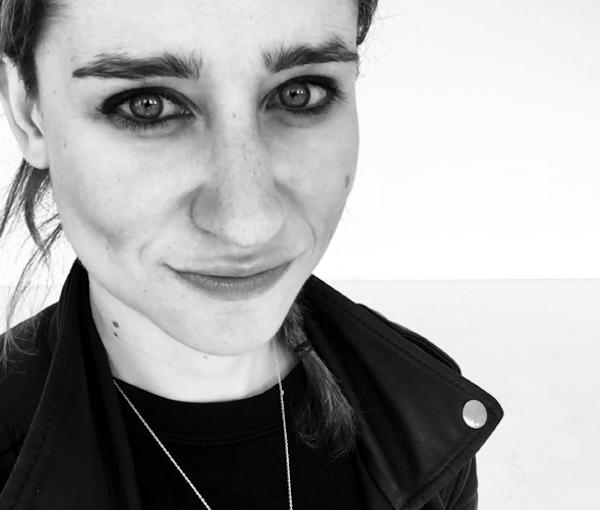
Music and pop culture journalist Eve Barlow will speak at Choices on Nov. 5. (PR photo)
Two large-scale philanthropic events are slated for the coming weeks as part of the Jewish Federation of Greater Vancouver’s annual campaign. On Oct. 22, men’s philanthropy will host the inaugural Texas Hold’em Poker Night, which will take place in the Jewish Community Centre of Greater Vancouver’s Wosk Auditorium. And, on Nov. 5, women’s philanthropy will host the 19th annual Choices event, which will be held this year at Congregation Beth Israel.
Know when to hold ’em
“We wanted to create a new event that brought people together to strengthen their commitment to the community through tzedakah,” said Michael Nemirow, men’s philanthropy chair. “Knowing our community, and the men’s division in particular, our campaign chair, Shay (Shy) Keil, organized a poker tournament … as a way to increase participation through a fun event that people will look forward to attending. We have already received a tremendous response from the community, as well as requests for when the next one will be. If you haven’t yet reserved your spot, please register now at jewishvancouver.com to be part of this special event.”
One of the more popular forms of poker, Texas Hold’em can consist of between two and 10 players. Each player is dealt two private cards (known as “hole cards”) that belong to them alone. Five community cards are dealt face-up, to form “the board.” All players in the game use these shared community cards in conjunction with their own hole cards to each make their best possible five-card poker hand.
Pollock Clinics, which specializes in men’s sexual health, among other things, is presenting the poker event along with Federation. Dr. Neil Pollock and his wife Michelle have a long-standing history of supporting a diverse range of philanthropic causes. Michelle Pollock currently serves as co-chair, with David Fox, of Federation’s Israel and global engagement committee.
Other poker night sponsors include InstaFund, Glotman-Simpson Consulting Engineers and ZLC; beer will be provided in-kind by Mark James of Red Truck Beer Co. There will be three cash prizes – $750, $500 and $250, respectively – for the top three finishers.
Registration for the Texas Hold’em event and a deli dinner begin at 5 p.m., with the tournament starting at 6 p.m. The cost for a poker seat, which includes dinner and drinks, is $180.
Strength of Jewish women
Two weeks following the Texas Hold’em Poker Night, Choices takes place, starting at 11 a.m.
“We are honoured to have the opportunity as co-chairs and friends to bring women from our across our community together to celebrate the strength of women’s philanthropy,” said Choices co-chairs Lisa Averbach and Jaclyn Dayson. “As we are always looking for new ways to engage our community, we have a fresh new format this year. We invite everyone to join us for brunch and to hear from the incredibly impactful speaker, Eve Barlow. Eve will be joining us to speak on the important conversation of antisemitism and how important the ‘Power of Together’ is in our community, families and greater society.”
“Power of Together” is the theme of this year’s annual campaign, and tickets for Choices are $85 plus a minimum donation of $154 to the campaign – or a $36 minimum donation for first-time attendees. In addition to purchasing tickets for themselves, donors can buy an angel ticket (or tickets) to ensure that any Jewish woman who wants to can attend Choices, regardless of their income.
This will be the first time that Choices is held as a brunch, rather than as a dinner event. The main speaker, Barlow, is a music and pop culture journalist. Based in Los Angeles, she is a powerful advocate on social media in the fight against antisemitism and anti-Zionism online.
Originally from Glasgow, Barlow lives in Los Angeles. She has served as deputy editor of New Musical Express, or NME, an entertainment periodical in Britain, and she is a regular contributor to New York Magazine, the Guardian, Billboard, the Los Angeles Times and GQ, among other publications.
In 2020 and 2021, Barlow was selected by The Algemeiner as one of the top 100 people positively impacting Jewish life. For that distinction, the journal cited a quote from a 2020 article Barlow posted on medium.com, which read, “My Zionism is what makes me pro-Palestinian because how could I deny someone’s right to self-determination? I am a Zionist and I am pro-Palestinian.”
The goal of Choices is to engage women in the community “towards the fulfilling work of making the world a better place,” notes the press material. Speakers at previous Choices have included Ellen Schwartz, the founder of Project Give Back; philanthropist and entrepreneur Jill Zarin; and Michelle Hirsch, a Cleveland businesswoman who spearheaded fundraising efforts to help the Jewish community in Houston following Hurricane Harvey in 2017.
Funds raised from Federation’s annual campaign support numerous organizations and causes both locally and internationally, and help seniors, vulnerable families and low-income individuals, among other things. To register for Texas Hold’em Poker Night and Choices, go to jewishvancouver.com.
Sam Margolis has written for the Globe and Mail, the National Post, UPI and MSNBC.
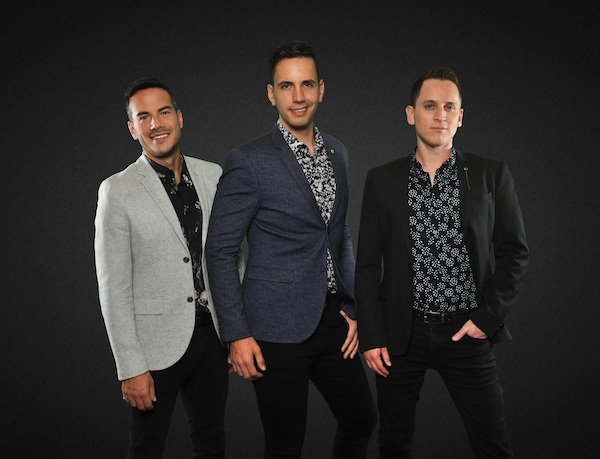
Citizen West performs at the Jewish Federation of Greater Vancouver annual campaign launch Sept. 10, 7 p.m., at Congregation Schara Tzedeck. (photo from Citizen West)
The word “fun” came up more than once in the Jewish Independent’s interview with the three tenors who comprise Citizen West. The group will help launch this year’s Jewish Federation of Greater Vancouver annual campaign on Sept. 10, and the audience should expect a wide range of music, an abundance of positivity and a high-energy – and fun – performance.
Marc Devigne, Cody Karey and Omer Shaish are all accomplished musicians in their own right. Internationally renowned individually, together they have entertained audiences in more than 150 countries. With their multilingual repertoire, their message is that “we are all global citizens and, through music, we can connect with individuals of all cultures and backgrounds.”
“Music unites and connects us through harmony and a common rhythm and is spiritual in its nature,” Karey told the Independent. “I feel my most spiritually connected when experiencing a profound shared moment, and singing or performing from a stage, especially with such amazing company, really does that for me.”
Karey, who is based in Vancouver, explained how he, Toronto-based Devigne and Miami-based Shaish, came together.
“Citizen West is the product of all of us colliding at slightly different times over the last several years,” he said. “We all set out as solo artists and ended up having parallel careers. Initially, we were competitive rivals, but, as we all became connected and got to know each other, it was clear to us that we could really do something special if we combined our efforts and worked together. The three of us have been officially performing as Citizen West since 2020, but our individual connections and the idea of Citizen West go back years earlier. Our pianist, Trevor [Hoffmann], was instrumental (pun intended) in the earliest days of Citizen West as we developed our repertoire and arrangements, so this reunion performance alongside him will be a little extra special.” (Hoffmann is from Maple Ridge.)
While living in different places and following their own professional paths, Shaish said the trio see each other relatively often.
“We perform a lot as headliners on cruise ships,” he said, “so we get to sing together and travel the world together. It’s a lot of fun! The ships have brought us to some really interesting places, such as Alaska, Easter Island and even Antarctica. Those were great experiences to share with these two. We also perform on land, of course, and we come up with new repertoire all the time. We have four produced sets and, on top of that, we try to cater to our clients’ vision and needs.”
Regarding that, campaign director Gayle Morris shared with the Independent Federation’s vision of the Sept. 10 event. “This year, we wanted to try something fresh, drawing upon the incredible success and positivity of last year’s ‘Amazing Happens’ campaign,” she said. “We want our community to leave the evening inspired and excited by a creative approach to campaign opening. Citizen West are an incredible trio of tenors and a
pianist, whose extensive repertoire of music means there’s something for everyone to enjoy!”
When asked for a hint about the repertoire they will perform at the launch, Shaish said, “I don’t want to give away too many spoilers, but I can say that there’s going to be a wide variety of genres, from classical music and Broadway to pop music, rock and even a splash of Hebrew!”
For Shaish, who is from Tel Aviv originally and grew up in Israel, this show will be special.
“Living in the U.S., I often find myself shifting between my roots (Jewish/Israeli music) and my other passion toward pop music and musical theatre,” he said. “I’m truly excited about this performance, because this is the first time that these two worlds collide.”
“There’s always so much more to learn, live and experience, and I feel that it’s with this outlook that Citizen West can explore and take stylistic chances with many genres,” added Devigne, who grew up in a small French community in Manitoba. Karey grew up in Fort St. James, B.C.
“There is a fraternal sense of camaraderie and connection when we work together,” said Karey. “Our slightly different quirks and styles complement each other well and create a compelling blend. The experience of being on the road is very different when you have good people to share that with. It’s also quite fun!”
Devigne echoed this sentiment. “There’s a sense of brotherhood that comes with being in a group,” he said. “It opens up more creative opportunities as an artist and brings more colour, layers and texture to songs. It’s a nice feeling to be on stage and know you have people you can rely on to support and elevate a performance. We feed on each other’s energy on stage and it makes for a great time. We draw inspiration from each other and I truly believe it lifts us all to be better artists and performers when we perform together.”
“I think it goes with the theme of this event,” said Shaish, referring to the Federation campaign launch. “We all discovered the ‘power of community’ or the ‘power of together.’ There’s something very special and powerful in sharing the stage. When the three of us blend with harmonies and our unique chemistry, it feels like true magic.”
The campaign’s opening event – “Celebrate the Power of Community” – takes place Sept. 10, 7 p.m., at Schara Tzedeck Synagogue. It also features Eric Fingerhut, president and chief executive officer of the Jewish Federations of North America, as keynote speaker; Barak Loozon, strategic advisor to the office of Israeli President Isaac Herzog, speaking about Herzog’s dialogue initiatives; and campaign chair Shay Keil, a senior wealth advisor at ScotiaMcLeod and supporter of many Jewish community organizations and initiatives, sharing his story about how Federation campaign donors helped inspire his Jewish journey. For tickets ($18), visit jewishvancouver.com.
Shay Keil, this year’s Jewish Federation of Greater Vancouver annual campaign chair, will share his story at the opening event on Sept. 10. (photo from Jewish Federation)
Gifts to the Jewish Federation of Greater Vancouver annual campaign inspire stories with direct human impacts, says Shay Keil, this year’s campaign chair. He’s knows – because he is one of those stories.
“There are real people behind those gifts and I am one of those people,” he told the Independent. “I was a beneficiary of generosity from this community in my earlier days, when my family required financial assistance in order for me to participate in Jewish life in Vancouver – that means being on subsidies to go to the Jewish day school and Jewish day camps. I will share my story of how their Federation gifts decades ago inspired my Jewish journey that would never have happened without their financial support.”
Keil will bring his personal experience to hundreds of community members at the annual campaign opening event Sept. 10. Keynote speaker for the evening will be Eric Fingerhut, president and chief executive officer of the Jewish Federations of North America. Prior to this role, Fingerhut was the head of Hillel International. He is also a former U.S. congressman.
The event’s musical centrepiece will feature vocal trio Citizen West, made up of Marc Devigne, Cody Karey and Omer Shaish. The trio is known for their multilingual repertoire and three-part harmony, which spreads the message that “we are all global citizens, and through music, we can connect with individuals of all cultures and backgrounds,” according to the group’s website.
Keil, who is a senior wealth advisor at ScotiaMcLeod, said the opening event will emphasize the importance of every individual’s contribution to the greater whole.
“The campaign only has success when we all come together,” he said. “Little gifts matter just as much as big gifts, and increases of all sizes really have impact.”
While he hesitates to put a number to his fundraising goal, Keil said he aims to meet or exceed last year’s campaign achievement of $10 million.
While the pandemic is largely behind us, challenges remain for major undertakings like the annual campaign, he acknowledged.
“The main one is the high cost of living [and] the financial challenges that come with higher interest rate costs,” said Keil. “Although that will affect some, it will affect others less so and our objective will be to continue to ask for increases among those who have the ability to do so.”
As someone who knows personally the impact of the annual campaign on its many beneficiaries, Keil is deeply devoted to the community in general and to the Federation campaign in particular.
“I remain committed to community and this is just yet another example of how I express that,” he said.
The campaign opening event takes place at 7 p.m., Sunday, Sept. 10, at Congregation Schara Tzedeck. Tickets ($18) are at jewishvancouver.com.
“I think what we should all take away from this incident is that we need to move closer to the institutions and find ways to move forward that are more inclusive and diverse,” Maytal Kowalski told the Independent.
Kowalski was fired from her marketing and communications role at the Jewish Federation of Greater Vancouver on July 25, the day after she disagreed with Federation chief executive officer Ezra Shanken at a meeting that included seven people from Federation and the Centre for Israel and Jewish Affairs and 25 to 30 members of UnXeptable, a group started by expat Israelis who oppose the Israeli government’s proposed judicial reforms. Kowalski recorded both the gathering, even though attendees were asked not to, and her dismissal. She shared the recordings with the Independent and other Jewish media. The story was broken by Haaretz, and followed by a piece in the Canadian Jewish News. As they did for the Haaretz and CJN stories, Federation declined to comment when contacted by the Independent, responding: “We cannot comment on individual employee matters due to privacy considerations.”
“I chose to approach Haaretz [first] and specifically Judy Maltz because, while this specific story is Vancouver-focused, this is an incident within a broader context of diaspora Jewish institutions throughout North America, and that’s a subject area that Maltz covers,” said Kowalski. “I didn’t want to single out Vancouver, because this is a systemic problem within our institutions, and my hope was, through Haaretz, maybe someone in
Edmonton or Winnipeg or Phoenix would read it and feel brave enough to come forward with their own story, or feel compelled to push for positive change within their own Jewish federation.”
Kowalski, who describes herself as “someone who really cares about the future of our Jewish institutions and the role they play in our Jewish community,” said a lot of the support she has received “explicitly or implicitly calls for progressive Jews to distance themselves from the institutions, and I want to say to those people that I think that’s the wrong approach.”
Both New Israel Fund of Canada and JSpaceCanada – on whose boards Kowalski sits – have supported her and, she noted, “if you look at how both of those organizations addressed the situation overall, they have talked about how we need to work together as a diaspora Jewish community to do better and be better.”
She said, “I know people will probably expect that I’ll distance myself from the community, but I’m going to do the opposite. I’ve been pushed out by the community before – I am the child of an intermarriage, and my mother’s partner after her divorce was also not Jewish, so I’ve only known being an intermarriage kid, and that was more contentious within our institutions back when I was growing up than it is today.
“But I’ve always stayed connected and, while they can knock me down, I’ll always get back up. Because building strong diaspora Jewish communities is important to me, and if I choose to walk away in defiance now, then it allows a system of discrimination to persist…. I hope that, if someone is reading this and also feels that we need to work for change, that they reach out. Maybe we can have these conversations within our shuls or other spaces that are open to it, and talk about how we use this story as a catalyst for change. If someone is planning to donate to this year’s annual campaign, they should ask about what concrete steps the Federation is going to take to make those changes.”
Born in Winnipeg, Kowalski’s family made aliyah in 1994. She lived in Israel until she moved to Toronto to pursue a degree at York University. “I lived in Toronto until March 2021, at which point my husband and I moved to Vancouver,” she said. “I have always worked in marketing and communications in the nonprofit/charity sector, and was with the Vancouver Foundation prior to coming to the Federation.”
She was with Federation for just under a year, having initially applied for a job with Federation’s Connect Me In team. “I had worked at the Miles Nadal JCC in Toronto early in my career and really loved working in my own community and I wanted to get back to that,” she said. “I was already very involved in other Jewish organizations on a volunteer basis and wanted to also be involved professionally.”
About recording the July 24 meeting, Kowalski explained, “I recorded or transcribed incidents that I felt could become contentious later on, since I didn’t have any workplace protections such as a union, so I felt I had to find means to protect myself.”
Parts of the two recordings have been cited in both Haaretz and the CJN, including that Kowalski was accused of “screaming” at the UnXeptable gathering. In the dismissal meeting, Becky Saegert, vice-president, marketing and communications, at Jewish Federation, says: “So, I heard last night that the registered speakers were passionate and articulate and compelling and my understanding is that you didn’t register as a speaker, but that what happened is that you interrupted our CEO and began, as several people have characterized it to me, and used the words, ‘began screaming,’ and then only stopped when asked by the moderator to sit down.”
Listening to her remarks, Kowalski does interrupt Shanken and speaks with emotion, but she doesn’t seem to be screaming, and she stops speaking once she has made her point, which she does in less than a minute. For Kowalski, that her manager told her several people had characterized her remarks as “screaming” was particularly important.
“It’s like that quote, she said, ‘The only thing necessary for the triumph of evil is for good men to do nothing.’ It’s so hurtful to me to know that all those people were good people who did nothing in this situation, which allowed for this deceitful narrative about my actions to be cemented. So, I think this should also be a learning moment where we ask ourselves, when we see something happening in our community that is wrong or unjust, what action will we take?”
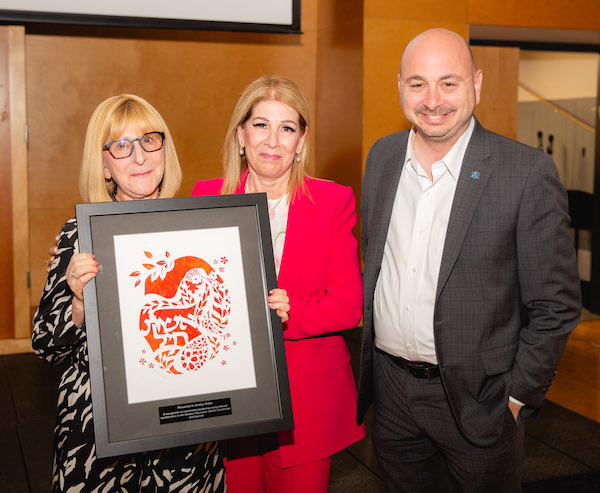
Shelley Rivkin, left, Candace Kwinter and Ezra Shanken
Jewish Federation of Greater Vancouver’s annual general meeting on June 27 at King David High School celebrated Shelley Rivkin, vice-president of local and global engagement, for her contributions to the community. The meeting also honoured several volunteers for their leadership and contributions: Catherine Epstein (Dennis Frankenburg Award), new board chair Lana Marks Pulver (Harry Woogman Award), Stan Shaw (Bob Coleman Award), Brent Davis (Young Leadership Award) and SUCCESS (Community Partner of the Year).
In an email sent after the meeting, chief executive officer Ezra Shanken and immediate past board chair Candace Kwinter shared their joint message that will appear in Federation’s 2022-2023 annual report. In it, they cover much ground, noting that the organization’s “impact resonates farther afield than what the ‘Greater Vancouver’ in our name might suggest. From the Sea-to-Sky to Langley, and all points in between, Jewish community life is thriving – and we are proud to be at the centre of it through our Connect Me In program. On Vancouver Island and in Kelowna, we are now providing security training for volunteers and professionals in their growing Jewish communities.
“As part of her role on the Jewish Agency’s board of governors, Candace traveled to Ethiopia and accompanied some of the 3,000 Jews who were making aliyah. Together, we traveled to Mexico City with the Jewish Agency to see more of their international work, and from Ukraine to Turkey and Syria and beyond, we helped those in need when disaster struck.
“We continued to improve the quality of life for residents of our partnership region in northern Israel. Our work is focused on strengthening the region’s development and regionalism through leadership development and capacity-building while investing in academic excellence. Our long-term investments are helping residents tackle some of the most difficult and complex challenges they face living in Israel’s periphery.
“The political situation in Israel has proven challenging for many in our local community who care deeply about the country,” continue Shanken and Kwinter. “We and our partners have offered multiple events over many months to help people learn more about what is happening and to facilitate discussions.
“Here at home, inflation continued to take a toll on our partners and the people they serve. Across the board, our partners report that inflationary pressures are affecting every part of their work. Ninety-one percent are concerned or very concerned that inflation will affect community members’ ability to fully participate in Jewish life. And 100% of our social service partners are concerned or very concerned that inflation will affect their ability to support their clients’ needs.
“For five years, we have been bringing community together around issues of affordability. Together with key partners, we co-hosted an Affordability Summit on the experiences of children and youth in low-income homes. The three areas of focus identified by our planning council are advocacy for a national breakfast program, creation of a single application point for assistance from multiple organizations, and development of more inclusive, respectful processes.
“This year, we made strides in combatting antisemitism. We were proud to see Vancouver city council and Richmond city council adopt the International Holocaust Remembrance Alliance (IHRA) working definition of antisemitism and the province of B.C. commit to using it as a tool to identify and combat hatred. Identifying antisemitism is the first step in combatting it, which makes these milestones important for all of us, and we want to thank our partners and our advocacy agent, the Centre for Israel and Jewish Affairs, for their work on this.”
Federation also has started “an organizational design initiative intended to build significant capacity within the Federation over the next several years with greater potential for scalability, efficiency, excellence and agility going forward.
“Our unparalleled impact is possible thanks to the strength of our partnerships and the cherished trust of our donors,” Shanken and Kwinter write. “Collective giving is deeply rooted in our tradition, and we play a leadership role in raising the funds our community needs to grow from strength to strength. We invest strategically in initiatives that keep our community strong today, tomorrow and for years to come – as well as in times of crisis. Our partners depend on us to generate the support they need to deliver the vital programs and services on which thousands of people rely.”
The 2022 annual campaign generated more than $13 million for the community: $10.24 million directly through the campaign and $2.91 million in additional support, including special project funding, community relief and emergency relief. The Jewish Community Foundation’s contributions this year surpassed $12.7 million.
“This is more than double the contributions received in the previous fiscal year, which itself exceeded the contributions of the year before that,” write Shanken and Kwinter. “The Foundation strategically disbursed a total of $3.7 million into local, national and worldwide causes, including funding for the Foundation’s Unrestricted Grant Program, which allows response to critical emerging needs in the community.
“JWest also achieved unprecedented milestones. As one of the three lead organizations working together to bring JWest to life, we are excited at the progress made this year. From announcing the capital campaign cabinet to securing $75 million in funding and philanthropic gifts to a $36 million matching gift, this project has gained tremendous momentum.”
* * *
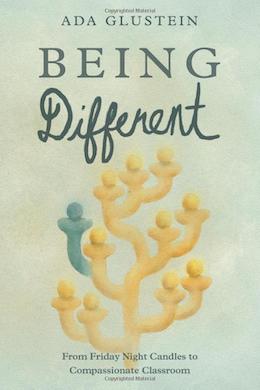
Ada Glustein received a silver medal for Canada-West Region, non-fiction, in this year’s Independent Publisher Book (“IPPY”) Awards for Being Different (self-published).
The “IPPY” Awards are a broad-based, unaffiliated awards program open to all members of the independent publishing industry worldwide who produce books written in English that are appropriate for the North American market. The awards are intended to bring increased recognition to the thousands of exemplary independent, university and self-published books released each year.
A memoir, Being Different tells a universal story about feeling different and longing to belong. Glustein recounts tales of growing up in a Jewish immigrant family during and following the Second World War, and the experiences that stand out during her school days, not knowing how to fit in to the world beyond home. She reflects on her years of teaching diverse children who also experienced life as “different.” She finds her own sense of belonging through helping those children find theirs.
* * *
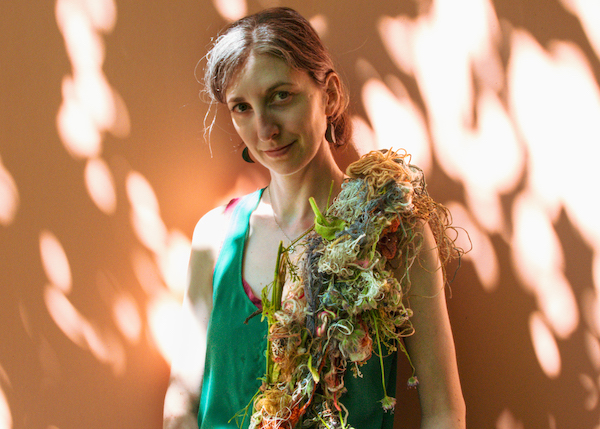
Barbara Adler
Barbara Adler is the new artistic director of the Only Animal Theatre.
“After a rigorous national search by a leadership transition committee comprising board members and affiliated artists, we are delighted to have Barbara take the lead at the Only Animal,” said board chair Eleanor Stacey. “When we began the search process, we knew it would be an immense challenge to find a successor to founding artistic director Kendra Fanconi, who built such a visionary and essential company. Barbara’s distinctive combination of experience, artistry and vision for the future positions her uniquely to lead the company into its next chapter.”
Adler is an interdisciplinary artist and performer whose practice incorporates text, music, event-making and design. Recent projects centre slow and process-led creations that focus work around relational time and seasonal cycles. As a poet and musician, Adler spent over a decade touring North America, Europe and rural British Columbia as a solo artist and with ensembles, including the Fugitives, Proud Animal and Ten Thousand Wolves. She holds a master of fine arts (interdisciplinary studies) and a bachelor’s in art and cultural studies from Simon Fraser University.
Adler is “thrilled to join a company whose irresistible artistry and deeply held ecological values have brought both innovation and care to the climate crisis.” She added, “The Only Animal’s vision of enduring environmental stewardship reminds me that none of us will individually finish the work. I am honoured to add myself to the beautiful story that Kendra and the company have told for 17 years, and humbled by this opportunity to prepare the way for the next generation of voices in the climate struggle.”
* * *
Rabbi Susan Tendler, her husband Ross Sadoff and their kids.
Beth Tikvah Congregation brought the community together for a Shabbat BBQ at Gary Point Park July 7. Sponsored by the Sadoff family in honour of Ross Sadoff’s birthday and under the leadership of Rabbi Susan Tendler, the event drew around 100 attendees. Amid a picturesque setting, the atmosphere buzzed with ruach(spirit). Laughter and joy filled the air as families and friends relished the food, conversations and Shabbat traditions.
Left to right: Ian Felgar, Elena Felgar, Yvette Tarko-Sabi and Donna FelgarRoy Freedman and Caryl KoshenEstelle Bleet, left, and Ann KramerJeff Rothberg and Stacey Kettleman of Star Catering.Libby Seltzer, left, and Mindy Zimmering
Jews of Colour Initiative chief executive officer Ilana Kaufman speaks at Or Shalom on June 6. (photo by Cynthia Ramsay)
On June 6 at Or Shalom, Jews of Colour Initiative chief executive officer Ilana Kaufman spoke about Beyond the Count: Perspectives and Lived Experiences of Jews of Colour. She said JoCI commissioned the survey to find out how many Jews of Colour there are in the United States, “what are our experiences, what are our perspectives, what are our beliefs, and then, how do you parlay that information into making the Jewish community, quite frankly, less racist, more inclusive.”
Kaufman was in Vancouver from Berkeley, Calif., where she is based, to share the survey results with “congregational rabbis, agency professionals, educators, board members, Jewish Federation staff, community members of colour and allies,” said Shelley Rivkin, vice-president of local and global engagement at the Jewish Federation of Greater Vancouver, which organized and funded the series of meetings. “Jewish Federation had been in conversation with Ilana about the work of the JoCI for over a year,” she said.
Or Shalom’s Rabbi Hannah Dresner introduced Kaufman at the shul talk, and Kaufman dove into the data.
“Depending on the age range you’re thinking about … between eight to 20% of the U.S. Jewish community are community of colour,” with the higher numbers being in the younger age groups, she said. “Every day in the U.S., the number of Jews of Colour is increasing, not decreasing. In terms of the data for multiracial families … 20% of U.S. Jewish families identify as multiracial. You may not see the family members of colour, but we’re there. And, if you’re on the coast, that number goes up to 25%, or one in four families. And that number, of course, is getting bigger every day, too.”
Kaufman is working with colleagues to figure out how many Jews of Colour there will be about 20 years from now. By 2042 or 2043, she said, “depending on immigration patterns, the U.S. will become half People of Colour. The majority of those folks will be multiracial and, in the U.S. Jewish community, we don’t know the date [that will happen], but those patterns map onto the U.S. Jewish community as well.”
While Beyond the Count is not a truly representative survey, as that would have cost about a million dollars, which was beyond JoCI’s capacity, the organization “cast the net as far as we could from the Jews of Colour Initiative perch,” said Kaufman. “We were able to have 1,118 qualified survey respondents in our study. It’s the largest dataset of Jews of Colour in the U.S., maybe anywhere in the world, and it’s not representative at all.” The interviewees over-represented in many areas, such as level of education attained and engagement in Jewish activities.
Regarding the methodology, Kaufman said the survey “is unapologetically framed with Critical Race Theory.”
“From our perspective,” she said, “we can’t do this work without framing it in a context where racism is real, and the effects of racism are real. And it doesn’t implicate white people, it doesn’t marginalize People of Colour, it just reveals the infrastructural truth that allows us then to leverage that truth to make change.”
Feminist pedagogy also informed the work, said Kaufman, and “we used a counter-storytelling approach, which means, instead of white folks saying, People of Colour, tell me your story … we had Jews of Colour, our community, centre the conversation and the work to create shape around that.”
JoCI doesn’t define the term “Jews of Colour,” both because race is a social construct and because identity “has to be owned and carried by the self and so we don’t want to be in the business of telling people how to self-identify,” said Kaufman. The organization uses “Jews of Colour” as an admittedly imperfect conceptual framework, she said, pointing out that, while race may be a fiction, racialization is real, and JoCI operates from that space. For those who self-identify as Jews of Colour, JoCI wants to be a space for resources and support.
Kaufman spoke about “whiteness,” also a social construct. Citing historian Karen Brodkin, Kaufman said the G.I. Bill – which offered home loans, college loans and other benefits to veterans after the Second World War – was one of the moments “when European Jews became white.” Instead of rejecting the benefits until their “black and brown family members in uniform” were offered the same opportunities, “there were moments of passive acceptance of the tools of upward mobility that were offered to Jews of European background that were not offered to People of Colour in the United States at that time,” said Kaufman. “And that’s one of the ways that Jews moved into whiteness, from being a highly ethnicized people in the United States.”
But it is a conditional whiteness, she said, and Jews who had lived with a passive acceptance of privilege had that comfort destroyed in 2016 with Charlottesville, “when white supremacists and neo-Nazis reminded Jews who had enjoyed the benefits of whiteness that they’re not safe…. And, in fact, that white identity is not seen as white in the eyes of white supremacists and neo-Nazis.”
Kaufman said one of the ways we can have a more dynamic and thoughtful conversation is to recognize the extent to which racism harms white people. “Even the concept of whiteness is such a flattened idea of who we’re talking about,” she said. “And so, when you think about Jewish ethnicity and you think just about Jewish European ethnicity, it is vast and it is diverse and, at least in the United States, it’s been boiled down to bagels … this caricature of who the Jewish people are.” When we celebrate diversity and grapple with intercultural dynamics, she said, “white folks have a stake in the conversation that’s not about being the target of opposition, but a collaborative part of the conversation” and, to do that, “we certainly have to recognize the privilege that comes with whiteness or being perceived as white…. When we get past our understanding of privilege, we need to get into who we are as ethnic, racial beings, and everybody has an equal stake in that conversation,” she said.
Almost half of survey respondents (45%) selected two or more racial categories. “And that’s the fastest growing population of People of Colour in the U.S., multiracial people, and that also maps onto the Jewish community,” said Kaufman.
One finding of the survey was that most JoCs feel more comfortable in an environment that’s multiracial. “Jews of Colour feel a tremendous amount of stress when [they’re] the only one in a situation…. We have to help people feel welcome without [them] feeling like we’re singling them out,” she said.
Respondents participated in a wide variety of Jewish activities and organizations, including formal Jewish education, attending synagogue, being part of a Jewish youth group and traveling to Israel: 63% of respondents participated in two or more Jewish activities. Yet most JoCs report having had a range of negative experiences in Jewish communal settings. At the top, 75% of respondents agreed or strongly agreed with the statement, “Others have made assumptions about me based on my skin tone,” and 74% with the statement, “I have felt burdened with explaining myself/my identity.” At the lower end, 60% agreed or strongly agreed that “I have felt tokenized” and 58% that “I have been treated as if I don’t belong.”
“A tip on that,” said Kaufman. “Of course, we want to welcome Jews of Colour into our committees to do things that matter…. If we’re reaching for someone because of what we think they look like, we have to stop ourselves. We just have say, we’d love to have you on our committee, but we want to know what you want to be on our committee for, instead of telling them … what we want them on our committee for.”
As an example, when she was asked to be on board, she made it a condition that she not have to talk about diversity. “And so,” she said, “how do you bring people in for why they want to be there, what they’re good at, how they want to grow? You just ask, how do you want to grow professionally, personally? Maybe I can give you that community opportunity if you join us, which is way better than saying, I don’t know you, I don’t know what you like, but I want you on my committee because of how I think you look.”
Overwhelmingly, survey respondents did not feel that American Jewish leaders are adequately addressing “the specific needs of members/participants who are Jews of Colour,” “the need for greater racial/ethnic diversity in Jewish organizational leadership” or “racism/white supremacy within the American Jewish community.” The numbers improve with regards to how these leaders are addressing “racism/white supremacy outside of the American Jewish community.”
“There’s deep comfort in helping those people outside,” said Kaufman. “What happens when those people are in all of us? And how do we collectively adopt a ‘those people’ identity so that we can actually dissolve this barrier between us and them?”
The study focused on racism, not antisemitism, said Kaufman. “Historically, when the U.S. has talked about antisemitism, they haven’t been including Jews of Colour in that conversation. And so, generally, when you hear about who’s being supported by the organizations fighting antisemitism in the U.S., you never see Jews of Colour included in that conversation.”
JoCI has had to be very careful, she said, so that the survey doesn’t become a tool to fight antisemitism among People of Colour. “The Jewish community and our colleague organizations who deal with antisemitism in the U.S. often use a dynamic of anti-Black racism to create support to fight antisemitism, and this has split People of Colour from Jewish people who [are] white.” She talked about the importance of taking on white supremacy. “Inside of white supremacy is both racism and antisemitism,” she said. “And I think it’s incumbent upon the U.S. Jewish community to look at racism and antisemitism side by side and, in our context, the container that holds that is white supremacy. So, I’m very interested in fighting antisemitism, I’m very interested in fighting racism and, I have to say that, in my family’s life and the lives of a million Jews of Colour in the United States, is for us to talk about white supremacy and to target racism and antisemitism in the same breath, at the same time. Because the piece is, we need to be in a relationship with our Muslim brothers and sisters, our Christian brothers and sisters, our family members all in between, because we’re all under threat from the white supremacists…. I’m very interested in fighting antisemitism but I’m not interested in fighting antisemitism if it only means we’re fighting for white, Jewish people.”
Beyond the Count makes four recommendations: support organizations and initiatives led by and serving Jews of Colour; shift organizational leadership to more accurately reflect the diversity of American Jews; prioritize creating spaces and places for discourse and dialogue with and among Jews of Colour; and promote further research by and about Jews of Colour.
Kaufman “helped us better understand the nuances and diversity of the JoC community and how systems of inequality are perpetuated in our own community,” said Rivkin in an email to the Independent. “The issues identified in Beyond the Count must be taken seriously, we can’t offer token solutions. We have to be intentional and first engage Jews of Colour to find out what they see as the key priorities and what path should be taken going forward.”
To do that, Rivkin said, “A key role of Jewish Federation is to bring stakeholders from across the community together to address critical issues and facilitate discussions…. One of our next steps is to explore the feasibility of conducting either a B.C. or Canada wide survey to gain a better understanding of the local JoC perspective.”
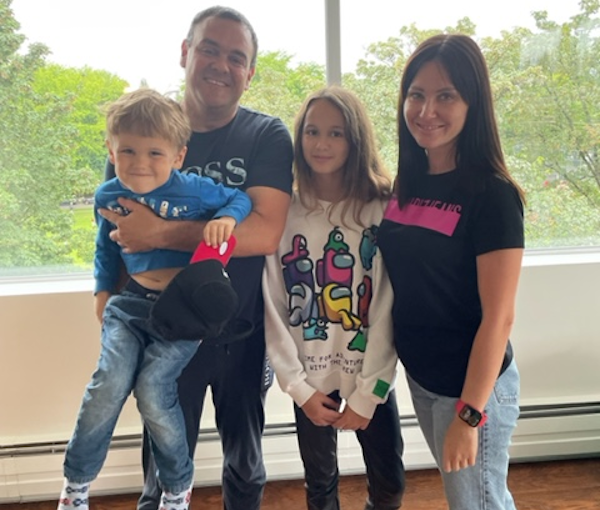
With the help of Jewish Family Services, Belmont Properties and others, the Zubrys family – Alexander, holding Artem, Sophie and Katrina – are getting settled in Vancouver. (photo from JFS)
For Oleksandra Liashyk and her family, who fled the Ukraine-Russia war last year, resettling in Vancouver was an opportunity for a new, though unexpected start. The family of three, who have an apartment and have enrolled their son in public secondary school, are learning English and navigating the ropes that come with resettlement. Still, Oleksandra admitted that it hasn’t been easy, that simply adjusting to a new culture, community and language has been a challenge. “This is absolutely another world,” she said.
It’s a sentiment shared by many of Vancouver’s newest immigrants from Ukraine. Fedor and Yulia, who came from wartorn Chernihiv with their two children, had good jobs as a real estate broker and a fitness instructor. While their children aren’t yet old enough to attend school, the kids are struggling with socialization. “The hardest thing to adjust for our children here was lack of communication with children of their age,” they said. “[E]verything looks quite unusual here.”
Like Fedor and Yulia, many others have left behind established businesses and jobs, professions that will be hard to restart in Vancouver. Lawyers, real estate brokers, accountants, social workers and business owners will need licences, education and a practised familiarity with Canada’s certification processes. But first, they need a place to live and a way to support their families.
According to Tanja Demajo, chief executive officer of Vancouver’s Jewish Family Services, the Ukrainian resettlement program was already in the planning stages when Russia formally announced its intended occupation of Ukraine in February 2022. Well-versed in creating programs to assist new immigrants, JFS knew the program would have to be versatile and able to address the many challenges faced by refugees on the move. Not all immigrants would be able to plan ahead before leaving Ukraine; many would arrive unprepared for their new home.
“Families reach out in many different ways,” Demajo explained. “Sometimes they call us from abroad and they are trying to understand the Canadian systems and how to actually come here. Sometimes we receive a call from other [Canadian] cities when families have already left [Ukraine] and they are thinking about relocating to the Lower Mainland. And sometimes we receive calls from families that are already here and are trying to navigate their next steps.”
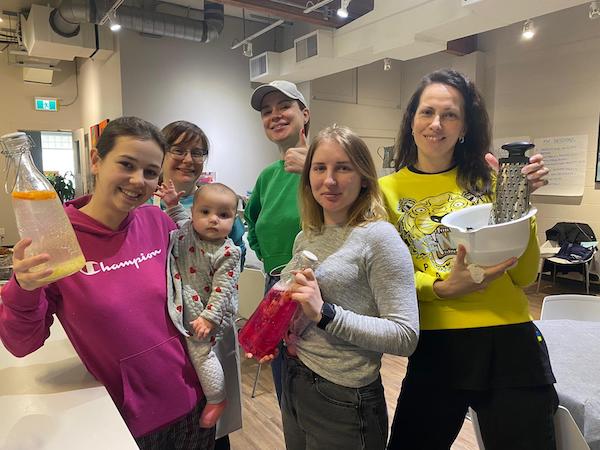
According to Demajo, more than 80% of Ukrainian refugees enrolled in the resettlement program have advanced educations, but lack fluency in English, so JFS partnered with the B.C. Centre for Disease Control to provide its Food Skills program. In it, participants learned how to read labels in grocery stores and purchase food, which then became the ingredients for new Western-style dishes, which they cooked in the JFS Kitchen. “Throughout the cooking, they were also learning English,” Demajo said. “We also had childcare provided as well.” The classes were so successful that JFS is looking at expanding the program.
But the greatest challenge facing new immigrants to Vancouver has been the city’s housing shortage. Residential vacancy rates, which now stand at less than 1%, and the disproportionate cost of rental apartments have made it harder to find housing.
JFS partnered with the B.C. Centre for Disease Control to provide a Canadian food education and cooking class that doubled as an English class for new immigrants. (photo from JFS)
JFS settlement worker Tanya Finkelshtein helps connect new immigrants with “welcome circles” of volunteers that can help get them settled. “Housing is the number one problem in the Great Vancouver area, especially for newcomers. We [are] able to support some of our clients, but it is a serious issue,” said Finkelshtein, who works with about 70 Ukrainian families in JFS’s settlement program.
Affordable housing is key to creating adequate living conditions, including suitable employment.
“We have a family that was initially living outside of Vancouver,” Demajo said by way of example. The family’s efforts to connect with the Vancouver Jewish community were hampered by distance, as was their effort to find suitable employment. By connecting them with Tikva Housing and Temple Sholom Synagogue’s volunteer network, JFS was able to help the family resettle closer to employment opportunities and Jewish community programs. Tikva has since set aside two other units for JFS’s resettlement program.
But the search for housing continues to be a problem for new arrivals, so Demajo reached out to a property management company with well-known connections in the Jewish community. Shannon Gorski, whose family owns Belmont Properties, said JFS was looking for a couple of apartments that could provide temporary housing for Ukrainian immigrants. Gorski, who also serves on the JFS board and is the managing director of the Betty Averbach Foundation, reached out to Belmont’s board of directors “and then I learned … that they had been approached by someone in the rental world, Bob Rennie, and they had already stepped up to the plate.” Gorski said the board agreed to provide four units free of charge for four months.
The offer couldn’t have come at a better time for Alexander and Katrina Zubrys, who had been living out of a hotel since arriving from Kherson. The 1,200-square-foot apartment meant the couple could enrol their two children in a Jewish day school close by.
“The school is located 10 minutes from our house,” said Alexander, who acknowledged that, for his 5-year-old son Artem, “the biggest problem is English.” With the school’s help, Alexander said Artem and Sophie, 13, are adapting to their new surroundings and new language.
According to Gorski, the Zubrys family is the only one so far to request temporary housing from Belmont. “My concern is there are so many other families out there that don’t know that the Jewish community is here to help them,” she said. Thus, the challenge isn’t just finding available housing for current clients, but getting the word out to those arriving who don’t know who or how to ask for help.
As for finding new housing for the program, Gorski encourages other companies to get involved. “We are proud to be able to help the Zubrys family and we would like to help other families once identified,” she said. “And we challenge other property management families to step up as well.”
She is confident that, once alerted that Belmont Properties has donated temporary accommodations to the program, other property owners “would answer the call. I have no doubt that they would.”
Demajo said the settlement program wouldn’t have gotten off the ground without the assistance of the Jewish Federation of Greater Vancouver, which sent out an emergency appeal to the community to fund the project.
“Our community and our Federation have a history of responding quickly and generously whenever and wherever help is needed and we can be incredibly proud of the way our community responded to the crisis in Ukraine,” said Federation chief executive officer Ezra Shanken. “We didn’t spring into action the day the war broke out – we work year-round building communities and partnerships around the world and here at home so that we have the systems in place to make an impact.”
Demajo said Temple Sholom and Congregation Schara Tzedeck are playing a role in supporting new immigrants. Both run their own programs and have collaborated with JFS to make sure new arrivals are supported, she said.
“We continue to support these families now, helping some find vehicles, others looking for new jobs,” said Temple Sholom’s Rabbi Dan Moskovitz.
For the Zubrys family, the support system is what made the 9,100-kilometre migration possible. It’s Gorski’s “big heart” and the help of JFS and other volunteers that made it possible to finally find a new home, said Alexander.
For information about how to offer temporary housing and other help for Ukrainian refugees, contact Tanya Finkelshtein at 604-257-5151.
Jan Lee is an award-winning editorial writer whose articles and op-eds have been published in B’nai B’rith Magazine, Voices of Conservative and Masorti Judaism and Baltimore Jewish Times, as well as a number of business, environmental and travel publications. Her blog can be found at multiculturaljew.polestarpassages.com.