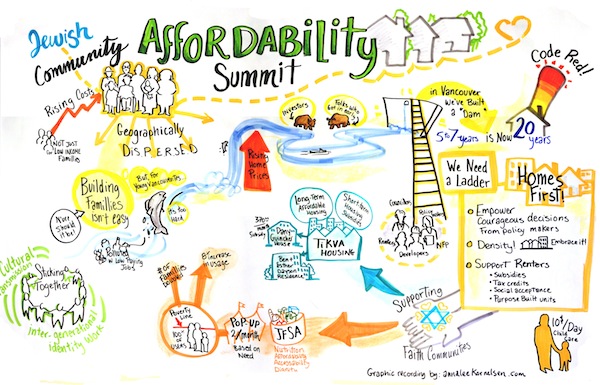
The main issues that were brought up at the Affordability Summit. (image by annaleekornelsen.com)
Vancouver is in the throes of an affordability crisis. It’s in the news, provincial politicians are talking about it as they campaign for the upcoming election, the city is implementing new taxes, but does anyone have the solution?
The Jewish Federation of Greater Vancouver decided it would seek some answers. On March 29, the first-ever Federation-sponsored Affordability Summit took place at Temple Sholom. Attended by more than 60 individuals, including New Democratic Party members of the legislature Selina Robinson and George Heyman, the goal was to give direction to Federation’s planning around affordability and being Jewish in Vancouver.
The evening, introduced by Temple Sholom Associate Rabbi Carey Brown, raised the pressing issue about why the Jewish community needs to deal with affordability beyond the basic human issues.
“This evening stemmed from the awareness that we all feel affordability impacting the sustainability our community,” she said. The other reality, she said, is that as Jews become more geographically dispersed, they are no longer near Jewish infrastructure like synagogues, day schools and the Jewish Community Centre of Greater Vancouver, so their participation in the community diminishes.
Participation in Jewish programming and activities is expensive in itself. Jewish community professionals are seeing a rise in requests for assistance for schools, summer camps and JCCGV activities. This also raises issues about the long-term sustainability of the community’s institutions if families cannot afford to live near enough to use them.
The event’s keynote speaker, Richard Fruchter, executive director of the Jewish Family Service Agency, addressed affordable housing, food security and a steep rise in demand for food banks, and raised some suggestions for solutions, including universal childcare, affordable transit and some novel taxation changes.
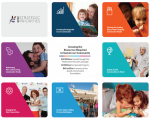
A graphic summary of the speakers’ main points at the summit. (image by annaleekornelsen.com)
Eric Fefer, chair of the Tikva Housing Society board, said his organization is in the process of expanding the number of subsidized housing units in its portfolio, with 10 new units called Storeys (Diamond Residences) opening this summer in Richmond.
Starting this fall, applications will be accepted for the Ben and Esther Dayson Residences, a project Tikva Housing is undertaking in conjunction with Vancouver Community Land Trust. The development will include 32 townhomes and apartments of two, three and four bedrooms. These homes, in the River District of south Vancouver, are expected to be available for occupancy in summer 2018.
These new homes will provide families with subsidized housing in the vicinity of Jewish amenities, but Fefer acknowledged this increased supply doesn’t begin to touch demand.
Following the event’s main session, breakout groups convened to discuss topics in greater depth. In addition to issues of food security and housing, affordable childcare advocate Gyda Chud presented solutions for universal childcare. A session on Jewish education was led by Daniel Held, executive director of the Julia and Henry Koschitzky Centre for Jewish Education in Toronto. He shared insights into the efficiencies Toronto is seeking in their Jewish education system to lower the cost of Jewish day school.
The Jewish education session was an example of using the experience of a community like Toronto’s, with greater breadth and depth of experience than ours, to identify ways to be more inclusive and to reduce costs so more Jewish children can access what Held referred to as “high impact Jewish education experiences.”
The Affordability Summit’s results were recorded by each breakout group moderator and then graphically represented by a talented artist who integrated the ideas for the group to see. Each group produced a few suggestions and this information will be used by the Federation’s planning council to help inform the way forward.
For more information on how to become engaged in activities surrounding affordability in Vancouver, contact Shelley Rivkin, vice-president, planning, allocations and community affairs at Jewish Federation at srivkin@jewishvancouver.com or 604-257-5192.
Michelle Dodekis a freelance writer living in Vancouver and the president of the Hebrew Free Loan Association.
Jane Bordeaux – Amir Zeevi, left, Doron Talmon and Mati Gilad – perform at the Chan Centre on May 1. (photo from Jewish Federation of Greater Vancouver)
What better way to bring folks together in song and celebration of Israel’s 69th birthday than with folk music. And what better band to unite Diaspora Jews than one that writes and performs American-style country-folk songs in Hebrew!
Tel Aviv-based Jane Bordeaux – Doron Talmon, Amir Zeevi and Mati Gilad – will headline this year’s community Yom Ha’atzmaut concert at the Chan Centre on May 1, 7:30 p.m. The trio regularly plays to sell-out crowds.
Their debut album was well-received, with songs such as “Eich Efshar” (“How is it Possible”) and “Whisky” radio favourites, and the video of their song “Ma’agalim” (“Circles”) went viral. A second album is nearing completion and is expected to be released in June.
Talmon and Gilad met in 2012 at Rimon School of Jazz and Contemporary Music in Ramat Hasharon, Israel. It was in a contest of original songs. “The idea was to perform some of my songs, and get some practical experience of a band format – you know, finding musicians, getting a name for the band and that sort of thing,” Talmon told the Jerusalem Post in a 2016 interview.
“We kept on playing after that one,” Talmon recently told the Independent, “and, when we needed a new guitar player, Amir, who’d been serving with Mati in the military band, had just returned from the U.S., and joined the band.”
Though the band has only been together five years ago, they have all been performing for much longer than that.
“I’ve been singing since I was a little child, always had the attraction to writing songs and singing them,” said Talmon. “After I returned from a long trip in South America, I decided to go and study music professionally, so I went to Rimon school for three years, learning music, songwriting and how to form a band, eventually.”
“I’ve been playing since I was 5, piano and then bass guitar,” said Gilad. “When I went to Thelma-Yellin arts high school in the jazz department, I started also playing the double bass. After high school, I served in the military in an army band and simultaneously studied at the Tel Aviv music conservatory. After the army, I started learning in Rimon school and was there for a year learning both classical, jazz and pop music.”
As for Zeevi, he has been playing the guitar for as long as he can remember. “My high school in Holon had a music major, that’s when I started taking the guitar more seriously, meeting great players and teachers,” he said. “In the army, I’ve played in the air force band and, after my release, I decided to go and learn music in the New School university in New York City, learning both jazz and country music.”
Usually, it is Talmon who comes up with the idea for a song, both the lyrics and melody, then the group starts playing with it, sometimes changing its harmony or structure, and building the arrangement. “Since we perform a lot,” they said, “we often try these new songs in shows, to get the feeling of what it is like to perform with them onstage and how does the crowd react, and each time improving and adjusting the song till it feels complete.”
In true country music fashion, many of Jane Bordeaux’s songs have to do with love and loss – ol’ American hurtin’ songs with a modern, Israeli twist.
“American folk-country, the way we see it, is storytelling, about the dark and the bright sides of life, wrapped in beautiful harmonies and joyful rhythm,” the band members agreed. “How can you not get excited from it? Also, we are addicted to the banjo’s sound and it’s going to feature a lot in our new album.”
“The songs are inspired from life, of course, mine and my friends,’” explained Talmon. “Sometimes, a song may be very close to a personal experience or feeling I had and, sometimes, it can be an idea I borrowed from a book I read or a movie I’ve seen, even a sentence I’ve heard.”
“Ma’agalim” is a bittersweet song about life: “It’s not me that’s progressing / It’s just the time that’s moving on.” The video features a wooden doll in a penny arcade. As the cylinder turns, she walks along her track, bundled up in a coat and scarf, passing people in various stages of life, from cradle to grave. Produced by Israeli animators Uri Lotan and Yoav Shtibelman, it really is a must-see (vimeo.com/ 162052542).
“The minute Uri and Yoav, the creators of the clip, showed it to us,” said the band, “we were so amazed by the beauty and sensibility of the video they made, so we can’t really say we were surprised that it went viral – we never had seen such animation before. We feel that there’s a unique connection between the music and the visuals that’s very moving, so people get excited by it, even without understanding the lyrics.”
No doubt a similar connection will be formed between the band and their audience in Vancouver, where they will sing in both Hebrew and English.
“It’s not going to be the same as in Haifa or Tel Aviv,” they said about the Yom Ha’atzmaut concert. “We love adjusting our set to best fit the place we are going to perform. Since the show date is Israel’s Independence Day, and we guess some of the crowd is English-speaking, in addition to our originals, we’re going to play some English covers and Hebrew all-time favourites – and even some special surprises for the Canadian crowd that obviously we can’t tell in here!”
The group starts their tour in Vancouver, then they have a few shows in North America, including one in Toronto.
“We are super-excited about the show in Vancouver,” they told the Independent. “It’s going to be the first show of our first tour outside of Israel and we’ve got a lot of great stuff planned specially for it, so we’re hoping to see you there!”
Tickets for the May 1 community celebration ($18) can be purchased at jewishvancouver.com/yh2017. In addition to this year’s co-sponsors – Canadian Friends of Hebrew University, Consulate General of Israel in Toronto, Georgian Court Hotel, the Jewish Independent and Jewish National Fund – the Jewish Federation of Greater Vancouver event is supported by 46 other community organizations.
The record $8.5 million generated through the Jewish Federation of Greater Vancouver annual campaign will support programs and services on which thousands of Jewish community members rely, and includes $300,000 for community security initiatives. This campaign result is unprecedented and will provide more financial resources to address community needs than ever before.
“I would like to thank everyone who made a gift to the campaign. This record $8.5 million result ensures that our partner agencies can continue to provide critical programs and services, and is already funding important community security initiatives,” said Alex Cristall, campaign chair.
Funds from the campaign support social services, Jewish education, community-building, seniors services, youth services, and arts and cultural programs in the local Jewish community. Funds also support social services and programs for at-risk youth in Federation’s partnership region in northern Israel, and help Jewish communities in need around the world.
“We have a number of challenges ahead of us as a community,” said Stephen Gaerber, board chair, “including the dual issues of affordability and accessibility, engaging young adults and young families, addressing the needs of our growing seniors population and developing programs for the nearly half of our community who now live in underserved regional communities. The record result will help Jewish Federation and our partner agencies address these challenges.”
Over the past year, Federation has become increasingly aware of and concerned about the changing security landscape, and identified community security as one of five areas of opportunity in its 2020 Strategic Priorities.
“We listened to the concerns about community security expressed by our partner agencies, our donors and community members. We responded by making community security a central focus of the campaign and developed a matching gift program funded by a group of generous donors. This helped fuel the record result and enabled us to invest strategically in an issue that is front and centre in our community,” said Cristall.
The $300,000 raised is already at work addressing security needs faced by some high-traffic local Jewish organizations, including security guards and specialized security assessments, as well as additional security for several high-profile community events.
“Jewish Federation has taken the lead on community security for years, and our proactive approach was recently commended by Chief [Constable Adam] Palmer of the Vancouver Police department,” said Gaerber. “Given the threats received recently by our JCC, the fact that we were out in front of this takes on added significance. Every donor to the campaign can be very proud of having played a role in addressing this important issue while supporting the full depth and breadth of community needs at the same time. The record $8.5 million raised is a real testament to how we all care for our community.”
הפדרציה היהודית של אזור מטרו ונקובר ממשיכה להגדיל את היקף התרומות לקמפיין השנתי שלה, שהוא מקור ההכנסה המרכזי של הארגון ו-35 ארגונים היהודים הקשורים בה. בקמפיין של 2016 היקף התרומות עמד על 8.5 מיליון דולר. אשתקד הפדרציה היהודית גייסה תרומות בהיקף 8.3 מיליון דולר לקמפיין השנתי ואילו בשנת 2014 היקף התרומות עמד על 8 מיליון דולר.
כפי שכבר פורסם מתוך ה-8.5 מיליון דולר 300 אלף דולר יוקצו לטובת אמצעי ביטחון לשמירה על מוסדות ואירועים של הקהילה היהודית באזור ונקובר. זאת כולל השכרת מאבטחים לאירועים מיוחדים וקיום הערכות בטיחוניות בעת הצורך. לאור הגברת האנטישמיות ברחבי העולם והגידול באיומי הטרור, היה סביר להניח שהפדרציה תקצה משאבים אף גדולים יותר לטובת תחום הביטחון. בנושא האבטחה אומר יו”ר הקמפיין השנתי, אלכס קריסטל: “הקשבנו לחששות בנוגע לביטחון הקהילה, כפי שהובאו על ידי הארגונים היהודים השותפים שלנו, התורמים וחברי הקהילה. הפכנו את הביטחון בקהילה לנושא המרכזי של הקמפיין ופיתחנו תוכנית מיוחדת לתורמים נדיבים בתחום זה”.
כספי התרומות מהקמפיין השנתי מיועדים מדי שנה לתמיכה בארגונים היהודים המקומיים, בפעילויות ושירותים שהם מעניקים בתחומים חברה, החינוך, התרבות והאמנות. וכן עזרה לקהלי יעד חלשים יתר בעיקרם קשישים ונוער. חלק מהכספים יוקצו כרגיל ליטפול בפרוייקטים מיוחדים בישראל, במסגרת מתן החסות הקבועה של הפדרציה, שכוללת הענקת משאבים לשירותים חברתיים לאוכלוסיית נוער בסיכון בצפון הארץ.
קריסטל מוסיף כי היקף הכספים שגוייסו הפעם הוא הגבוה ביותר עד כה. יו”ר הקמפיין: “הכספים מבטיחים כי נמשיך לתמוך בארגונים השותפים שלנו שיוכלו להמשיך ולספק מגוון של שירותים ותוכניות שכל כך חיוניים לקהילה היהודית המקומית. ואילו יו”ר מועצת המנהלים של הפדרציה היהודית, סטיבן גרבר אומר: “יש לנו מספר אתגרים כקהילה כולל הנושאים הכפולים של אפשרויות ונגישות, מעורבות צעירים ובני משפחות צעירות, מענה לצרכים של אוכלוסיית הקשישים הגדלה שלנו, ופיתוח תוכניות עבור כמעט ממחצית מהקהילה שלנו אשר חייה כיום באזורים רחוקים בפריפרייה, שלא מטופלים על ידי שום ארגון. התוצאה של הקמפיין תאפשר לפדרציה היהודית ולארגונים השותפים שלנו להתמודד עם אתגרים אלה לטובת הקהילה”.
ללשכת הסטטיסטקה הקנדית אין נתונים מעודכנים לגבי פשעי השינאה במדינה. העידכון האחרון מתייחס לשנת 2014. אז המשטרה קיבלה מידע על 429 מקרים של פשעי שינאה בכול קנדה, בהם 213 הקשורים בקהילה היהודית. בוונקובר התרחשו בסך הכל באותה שנה 47 מקרים של פשעי שינאה.
ריו דה ז’ניירו וונקובר זכו באולימפיאדת ההכנסות ממיסחור
אולימפיאדת הקיץ ה-31 שנערכה בריזו זה ז’ניירו אשתקד ואולימפיאדת החורף ה-21 שנערכה בוונקובר בשנת 2010 הן המכניסות ביותר, מבחינת מכירת מוצרים ממוסחרים. כך עולה מנתוני דוח השיווק של הוועד האולימפי הבינלאומי שפורסמו בימים האחרונים.
על פי דוח השיווק של הוועד ההכנסות של האולימפיאדה בריו זה ז’ניירו ממוצרים ממוסחרים שברו את כל השיאים, והגיעו לכשלוש מאות ועשרים מיליון דולר. תקציב האולימפיאדה בריו זה ז’ניירו נאמד ב-11.9 מיליארד דולר. אולימפיאדת הקיץ בבייג’נג שנערכה בשנת 2008 הכניסה “רק” מאה ושישים מיליון דולר ממסחור. ואילו שאר אולימפיאדות הקיץ נמצאות הרחק מאחור.
האולמפיאדה של ונקובר הכניסה יותר מכל אולימפיאדת חורף בתחום מכירת המוצרים הממוסחרים, ופועל מדובר על סכום של חמישים ואחד מיליון דולר. תקציב האולימפיאדה בוונקובר נאמד בעשרה מיליארד דולר. הרחק מאחוריה אולימפיאדת החורף של סוצ’י שנערכה בשנת 2014 והכניסה שלושים וחמישה מיליון דולר ממוצרי מיסחור.
The Bayit joined forces with Chabad of Richmond in an emoji-themed Purim celebration held at Richmond’s City Centre Community Centre March 12. Pictured here, left to right, are Chabad of Richmond’s Rabbi Yechiel Baitelman, Bayit president Mike Sachs, Yoav Rokach-Penn and the Bayit’s Rabbi Levi Varnai. (photo by Lauren Kramer)
In every community, and ours is no exception, there are folks who frequently capture the spotlight for their work while others quietly get things done behind the scenes, flying below the media radar. In our new Kibitz & Schmooze profile, we’ll try to highlight members of Greater Vancouver’s Jewish community who are doing outstanding, admirable and mention-worthy work out of view of the general public. If you know of profile subjects who fit this description, please email laurenkramer@shaw.ca.
Kids and anxiety go hand-in-hand, but, when kids’ anxiety gets out of control, many parents turn to Annie Simpson.
The 39-year-old Vancouver Talmud Torah mom boasts a PhD in psychology and 10 years’ experience in pediatric psychology. She founded the Cornerstone Child and Family Psychology Clinic in Vancouver in January, where she works with nine other psychologists. But Simpson’s focus is on young patients with anxiety disorders, including obsessive-compulsive disorder, panic disorder, selective mutism and depression.
Dr. Annie Simpson (photo from Annie Simpson)
Her interest in selective mutism, an impairment defined as an inability to speak in some social situations despite speaking perfectly fine in others, began six years ago. That’s when Simpson started getting referrals of children with the impairment and wanted to gain a better understanding of how to help them. She traveled to New York to confer with world-renowned expert Dr. Steve Kurtz, helped run one of his camps for selectively mute kids and came back enthusiastic about applying his cognitive behavioural therapy methods in Vancouver.
Within two years, Simpson ran the first camp of her own at the Jewish Community Centre of Greater Vancouver and soon started receiving calls from all over North America, from parents who wanted to enrol their children. Just under one percent of kids have selective mutism.
Simpson’s summer clubs are annual now, and in high demand. “I see a wide variety of impairment, from kids who only speak to one parent to kids who cannot speak at school,” she says. “At the camps, we develop a trusting relationship with the children and then expose them gradually to the feared situation, rewarding their success.”
Camp is Simpson’s favourite week of the year because the progress is so rapid. “The children are improving so quickly and they get so excited about their success,” she says. “With the right supports in place back home, the kids continue to thrive after the camp.”
For parents who don’t seek help for selectively mute kids, Simpson warns that the mutism gets more challenging to treat the older a child gets, and is particularly difficult when kids become teens and have had so many years of not talking.
When she’s not counseling patients, you’ll find this enterprising Vancouverite at B.C. Children’s Hospital, where she’s a staff psychologist in the pediatric OCD Program; at Simon Fraser University, where she’s a clinical associate in the department of psychology; or consulting for AnxietyBC.
***
Café 41 put on a fabulous Argentine-style Purim dinner that was well-attended by members of the community March 12. Yamila Chikiar and Daniel Presman (pictured) own the café with Menajem Peretz. (photo by Lauren Kramer)
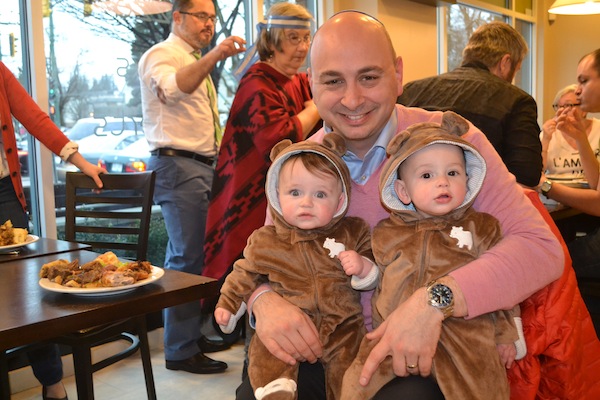
Jewish Federation of Greater Vancouver chief executive officer Ezra Shanken with his nine-month-old twin boys at Café 41 for Purim. (photo by Lauren Kramer)
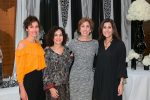
Left to right, Yael Rubanenko Horwitz, Wendi Klein, Debbie Jeroff and Lisa Pullan at Choices on Oct. 30. (photo from Jewish Federation of Greater Vancouver)
For the 12th year in a row, hundreds of women of all ages gathered to celebrate the choice they made to strengthen our community through tzedakah at this year’s Choices event. Co-chairs Debbie Jeroff, Wendi Klein and Yael Rubanenko Horwitz and their committee worked for months to make the event a success, and brought the room to life with their chic black-and-white theme.
“Each of us [came] with our own story, history, talents and tragedies,” said Lisa Pullan, chair of women’s philanthropy for the Jewish Federation of Greater Vancouver annual campaign, as she addressed the packed ballroom at Congregation Beth Israel on Oct. 30. “But what unites us is the choice that we have made to stand together in support of our Jewish community.”
With more than 400 women in the room, including 36 first-time attendees, Pullan declared that “there is definitely strength in numbers.” Case in point is the more than $2,064,000 that was raised through women’s philanthropy last year, accounting for 25% of the 2015 Federation annual campaign’s record $8.3 million total. “Together,” Pullan remarked, “we are making a lasting impact on the community that we love.”
A highlight of the event every year is the inspirational speaker, and this year’s keynote speaker, Talia Levanon, was no exception. As director of the Israel Trauma Coalition (ITC), she and her team provide trauma care and emergency preparedness and response to affected communities in Israel and around the world. ITC is a global leader in providing aid and support to local professionals working in the field in crisis zones.
“Seeing how the ITC social workers in crisis zones have to work through their own traumas to help others was particularly powerful,“ said Pullan. “Talia showed a video in which one of the ITC workers was talking to a client on the phone and had to talk her through a rocket firing, while simultaneously getting out of her own car, lying on the ground and dealing with it herself. It helped us understand in a visceral way the trauma that Israelis experience.”
Community member Stephanie Mrakovich also spoke at the event, sharing the moving story of how her family discovered their Jewish roots and how she came to find her place as a leader in our community. She shared her personal and touching account of her dying grandmother’s revelation of the family’s Jewish heritage. Her remarks can be found at jewishvancouver.com/stephanie-mrackovich-choices-speech.
Choices is the signature campaign event for women’s philanthropy. While the speakers and the theme change each year, what stays the same is the focus on the great work in the community that is made possible by women’s commitment to the mitzvah of tzedakah. To donate or for more information on the annual campaign and the services and organizations it helps fund, visit jewishvancouver.com.
– From e-Yachad, published by Jewish Federation of Greater Vancouver
“Let’s make it easy, not just to be Jewish, but to feel part of the community. We have to make it easy and we have to find ways of connecting,” Alex Cristall told the Jewish Independent in a recent phone interview.
Cristall is general chair of the Jewish Federation of Greater Vancouver’s annual campaign this year. The fundraising effort has so far “been really, really good,” he said, noting “it looks like our numbers are ahead of where they were last year.”
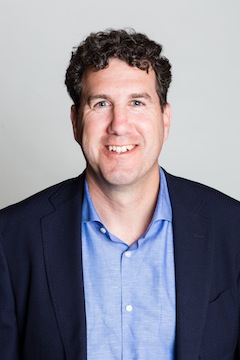
Alex Cristall, general chair of Jewish Federation of Greater Vancouver annual campaign. (photo from Jewish Federation)
At the centre of the current campaign is the community’s 2020 Strategic Priorities. “We have some key areas that over the next few years we are trying to focus on,” explained Cristall, such as “affordability, accessibility, seniors, engagement and connectivity, and security. And, this year specifically, we have set up a matching program,” so that every new donation and every donation increase is matched, with the funds being allocated to security initiatives, to “set up a good, long-term security plan for the community.”
Bernard Pinsky is the chair of the community security advisory committee, said Cristall, and “they’ve laid out a whole framework of things to get us up to date and to get us more centralized and focused, and to continue on with things we’ve done over the years and improve on them. So, this year we have set up a match[ing program] and I think we are almost at $300,000.”
In addition to the 2020 priorities and the focus on security, donations to the campaign fund social services performed by 40 partner organization, including seniors programs, Jewish education, arts and culture, community building, and youth and young adult services.
“Federation has access to so many different things that are going on in the community and, to help those institutions every year, it takes a lot of [fundraising] pressure off them,” said Cristall. “The major selling point is the reach the Federation has … your dollar touches so many different aspects” of the Jewish community.
“In terms of the number of people who benefit, it is in the thousands,” said Becky Saegert, Federation’s director of marketing and communications, in an email interview.
“We want to make being part of our community easy for our constituents and our community members,” reiterated Cristall.
The community has valuable capital infrastructure in the Oak Street area, he said, “but engagement and accessibility … for underserved areas – that is a huge part of our future. And that has to grow more and more. We have to be very creative.”
This outreach is part of the 2020 plans, he said, “for example, supporting White Rock JCC, supporting Burquest JCC.”
“With regard to the regional communities,” added Saegert, “the campaign currently provides funding to five different regional community organizations. Our Regional Communities Task Force, which is currently exploring ways to enhance Jewish community life outside of Vancouver, will be presenting their recommendations to our board in February 2017. We anticipate that the recommendations will increase funding for a number of initiatives in the regional communities. This past year, with the increase in our overall campaign result, we were able to increase our funding to all of our regional community organizations and fund some new initiatives, including a very exciting partnership between Richmond Jewish Day School and Congregation Beth Tikvah.”
While this year’s campaign is well underway, Cristall said, “We cannot have enough canvassers.… We are probably the easiest organization to get involved in. If someone wants to come on and be a canvasser, we’ll give them training. I hosted a meeting at my house to train people and to welcome people…. It’s a very welcoming environment and we welcome all comers to join.”
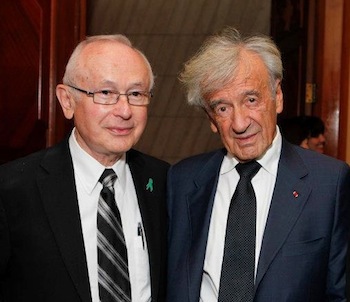
Dr. Robert Krell, left, listens to Prof. Elie Wiesel, as Wiesel addresses the capacity crowd that came to the Orpheum in 2012 to hear him speak (photo by Jennifer Houghton). Elie Wiesel passed away on July 2. May his memory be for a blessing.
The following article was originally published on Sept. 21, 2012, and initially reposted on July 2, 2016. The photographs were added with its republication in the newspaper and online July 15:
“The Jewish people is based on what is called in the Prophets, ‘Edim atem l’Hashem,’ ‘You are witnesses to God.’ Says the Talmud something horrible: the Talmud says God says, ‘If you are my witnesses, I am your God. If not, I am not your God.’… That is the importance of testimony.”
This was part of Nobel Peace Prize-winner Elie Wiesel’s response to a question about the role of March of the Living alumni. “You are now the witnesses,” he said. “Remember, to be a witness to the witness is as important as to be a witness.”
Elie Wiesel with friend and fellow survivor Robbie Waisman (photo by Jennifer Houghton)
Wiesel was in Vancouver to launch the Jewish Federation of Greater Vancouver’s annual campaign on Monday, Sept. 10. The event, which was held at the Orpheum, featured Wiesel in conversation with his friend, fellow survivor Dr. Robert Krell, as well as a presentation of another of Wiesel’s friends, Robbie Waisman, who accompanied this year’s March of the Living program to Poland and Israel. Participant Jenna Brewer read the account written by Monique de St. Croix of Waisman’s emotional return to his birthplace, after which Waisman himself addressed the nearly 2,700 people in attendance.
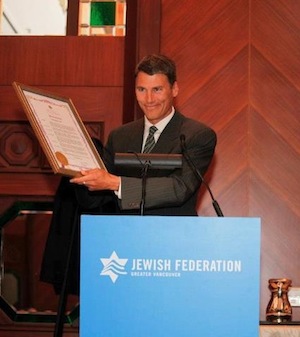
The campaign launch was the culmination of Wiesel’s day here, which included a proclamation from Vancouver Mayor Gregor Robertson declaring Sept. 10, 2012, Elie Wiesel Day.
Among Wiesel’s many activities was the receipt of an honorary degree from the University of British Columbia, where he spoke to university administrators, students and Holocaust survivors. A formal academic procession led Wiesel into the hall and a short panel discussion followed his remarks, involving the university’s president, Prof. Stephen Toope, Prof. Richard Menkis, a professor of modern Jewish history, and Barbara Schober, a graduate student. UBC Chancellor Sarah Morgan-Silvester presented Wiesel with the doctorate.
Also on Wiesel’s itinerary was a morning interview with the Jewish Independent; one of only two interviews he granted while here, the other being with the Vancouver Sun.
Vancouver Mayor Gregor Robertson declares Sept. 10, 2012, Elie Wiesel Day. (photo by Jennifer Houghton)
As editor Basya Laye and I introduced ourselves, Wiesel admitted his dependence on the New York Times, a copy of which he had not yet picked up that day. Once the “bible of journalism,” according to Wiesel, he lamented the Times’ decline in quality as the newspaper industry itself has declined. He wasn’t worried about the change to internet media, however.
“Our stories are not dominated by concern with the press, it’s person to person,” he said. “If you relied on the New York Times, the New York Times’ background, record in those years, is not the best, during the war.”
Wiesel recounted how, years ago, he complained to the Times about how little there was in the paper about the Holocaust while it was happening. Subsequently, he was invited to a luncheon, at which he gave them a piece of his mind. As a result, said Wiesel, in the paper’s offices, they have a plaque/letter saying, “We failed,” as a reminder to themselves.
Yet, admission of failure on the world level – that countries did not do enough to prevent the Holocaust – has not resulted in the prevention of other attempts at genocide.
“Can human nature change?” Wiesel said about that fact. “It’s society. Whatever the issue we have is, for instance, believe me that, I say, a sex story will have the front pages. Not what we try to say, but the sex story will have the front pages. It is our culture. We go with what is easy, what is cheap, and what is accepted as interesting by more people than before. And that goes everywhere, that’s in literature, that’s in the movies. I don’t know where we are heading.”
For his part, Wiesel has spent most of his life – as a witness, storyteller and teacher – trying to ensure that “never again” is a promise kept.
Born in Sighet, Romania (which was in Hungary during the war), Wiesel was 15 when he and his family were taken to Auschwitz. His mother and younger sister were killed there, his father died in Buchenwald, where Wiesel also was imprisoned when the war ended; his two older sisters survived. Wiesel’s book about his experiences in the camps, Night, was first published in 1956. It has since been translated into more than 30 languages, with millions of copies being sold.
A professor at Boston University since 1976, Wiesel was founding chair of the United States Holocaust Memorial Council, which created the U.S. Holocaust Memorial Museum, and, with his wife, Marion, he established the Elie Wiesel Foundation for Humanity soon after he received the Nobel. He has written more than 50 books, and his lengthy resumé continues.
When asked how he would categorize his body of work, Wiesel told the Independent, “Not enough.”
“What would you like to have been able to do?”
“More.”
“In terms of?”
“More,” he repeated. “Not enough. Look, look, on the surface, I’ve done a lot, published many books. Many books have been published about me, and so forth. I have approached presidents and kings, but all of that, somehow, it is not enough. Maybe, deep down, all of us who have survived have had a feeling, if we told the story, the world would change, and the world hasn’t changed. Does it mean that we did not tell the story? Or not well enough? Simply, we did not find the words to tell the story? Had we told the story well enough, maybe it would have changed the world? It hasn’t changed the world.”
“Do you feel like you have failed in some measure there?”
“Not failed,” Wiesel replied quickly. “I didn’t say fail. Failing, if I had not tried. Look, I know I tried. I still try.”
Complementing his activism for human rights, Wiesel is a dedicated student of Talmud and has a deep appreciation of Chassidic and biblical stories, which the Independent referred to as “old” in asking a question about such stories’ relevance today.
“They are not only old, they are immortal,” said Wiesel. As to specific lessons we could learn, he added, “It depends what area. If it’s the Bible, then the eternal truth, or at least the eternal quest for truth. The Talmud, it’s my passion – I grew up with the Talmud and, to this day, every day, I study – I love it. I love study.”
Wiesel explained, “There is so much beauty in all that. There is so much….” He paused. “Truth is a difficult word because my truth may be mine, but not yours, but learning, the quest for truth, is extraordinary. For me to teach those texts is so rewarding, so rewarding. And we take a theme, a talmudic theme or a biblical theme or a prophetic theme, and it can go on, it can last for us for hours and hours and hours in class.
“Come on, the beauty of an Isaiah, the tragic sense of a Jeremiah, and the immortal dimension of a Habakkuk. It is all these. They survived. The very fact that they survived, you know, how did they survive? These are texts conceived, written and spoken 3,000 years ago or so, 2,500, and they survived. What made them survive?”
The concept of truth came up again when the Independent asked Wiesel’s opinion – as a former journalist himself – about how much a newspaper should reflect extremes within the community it serves.
“I gave up journalism. Do you know why?” asked Wiesel. “I liked journalism at the beginning; I loved it. It was to be at the nerve centre of history, come on, I loved it. Then I realized, what, two things. Number one, I repeated myself – which means I changed the names, but the words remained the same.” He paused, then continued, “I am going to spend my life like that? Second, I realized the people that I loved and admired; occasionally, they had such an attitude of fear and respect for the journalist – I said, I don’t want that, I don’t want to inspire that. That’s when I moved to the academic. I gave up, for that reason.”
Hesitant to give advice, Wiesel eventually said, “Young lady, your truth is truth. Listen to it. It’s your truth that matters. Don’t accept somebody else’s truth. And, if you are a journalist, if you have the respect for your own words, that will be read by hundreds or thousands of people, who will read it and maybe be influenced by it – you, just you, don’t listen to [anyone,] not even to your editors. Don’t tell them, don’t even listen to that,” he said, looking at Basya as he made the comment, and laughing. “You decide. When you publish an article under your byline, it’s yours.”
Despite having wondered aloud as to the effectiveness of his efforts to change the world, Wiesel still gets up every morning to do just that. “What is the alternative?” he asked rhetorically. “What is the alternative? There is no alternative. True, I fought many battles and lost. So what? I’ll continue fighting. Look, my life is not a life of success or victory, much more of failures. I tried so many things and failed, you have no idea. Of course, so what? I’ll continue. The only area where I feel I must continue is, first of all, education. Whatever must be done in Jewish life, and in life in general – not only for Jews – education must be a priority. Not the only one, but the main priority, education. Let’s surely aim for that. And then, Israel, to me, of course is – the centrality of Israel in my life is here,” he said, putting his hand over his heart.
A few moments later in the conversation, Wiesel returned to the topic of journalism.
“You know, as a journalist, my love would be to interview, not for news, [but] to have the interview. And that’s really what I loved about it, to meet people, to have real conversations, I mean, real dialogues – not questions and answers, because I know now about you more than you think, simply by the questions that you ask. But that’s the journalist in me.”
“So, you obviously have faith in human nature … and you like to know more about people?”
“I do,” he said, with hesitation. “In spite of. It’s not because of, but in spite of.”
הפדרציה היהודית הכינה תוכנית עבודה ארוכת טווח לספק את הצרכים החדשים של חברי הקהילה ולהגדיל את התקציב למימון פעילותיה.
הפדרציה היהודית של אזור מטרו ונקובר הכינה בשנתיים האחרונות תוכנית עבודה ארוכת טווח עד לשנת 2020. העבודה המורכבת על התוכנית נעשתה על ידי מועצת המנהלים בניצוחו של היושב ראש, סטפן גרבר ובשיתוף פעולה של חברי קהילה רבים. לדברי גרבר מדובר באחד הפרוייקטים החשובים ביותר בהיסטוריה של הפדרציה, כדי לקבוע את סדרי העדיפויות והמשאבים הכספיים הדרושים, כדי להתמודד עם האתגרים העומדים בפני חברי הקהילה היום ובהמשך הדרך. במסגרת היערכות ארוכת הטווח של הפדרציה היהודית החליטה מועצת המנהלים שלה להחתים את המנכ”ל, עזרא שנקן, לשש שנים נוספות עד ל-2022. גרבר: “לצורך ישום העדיפויות של התוכנית האסטרטגית ל-2020 והגשמת מטרותיה, אנו זקוקים למנהיגות יציבה וחזקה ושנקן הוא זה שימשיך לספק את המנהיגות הזו עד 2022. אנו ברי מזל שיש לנו את שנקן בתפקיד המנכ”ל”.
רשימת סדרי העדיפויות של הפדרציה היהודית לארבע השנים הקרובות כוללת שישה פרקים מרכזיים. השקעות אסטרטגיות – למציאת פתרונות כדי שיובטח שהקהילה תמשיך להיות חזקה ותוססת גם בדורות הבאים, שיפור הביטחון והבטיחות של המוסדות היהודיים, עזרה במימון אחקת המבנים של המוסדות השונים של הקהילה ולאפשר לחנך את הילדים והצעירים שהם הדור הבא. כל זאת תוך אבטחת מימון יציב לשותפים בקהילה היהודית הנסמכים על הפדרציה. סגירת פערי המימון – כדי לאפשר למוסדות השונים בקהילה לקבל תקציבים לפעילותם, כדי שיוכלו לספק שירותים חשובים לאלפי חברי הקהילה. התקציבים שהפדרציה השיגה עד היום כבר אינם מספיקים לספק את כל הצרכים החדשים ואין מספיק מימון לכל הצרכים והארגונים. הפדרציה מקבלת מדי שנה בקשות בהיקף של כמיליון וחצי דולר למימון תוכניות ושירותים נוספים שנדרשים. כאמור זה כבר לא מספיק ועל הפדרציה למצוא דרכים לסגירת הפערים, בין תקציב המימון הנוכחי לעומת הצרכים האמיתיים. צרכים חדשים ומתפתחים של הקהילה – כיום כבר כארבעים ושישה אחוז מחברי הקהילה היהודית גרים מחוץ לוונקובר. שינוי משמעותי זה מצריך היערכות חדשה לאספקת תוכניות ושירותים זמינים עבור חברי הקהילה באזורים, שמחוץ לוונקובר. התחברות לדור הבא – ההצלחה של הקהילה בעתיד תלויה במידה רבה ביכולת שלנו להתחבר ולהתקשר לדור הצעיר, ולעזור להם לפתח כישורי מנהיגות ואינטרסים פילנתרופיים. הארגונים היהודים עושים רבות למען הצעירים, אך יש לעשות הרבה יותר אם אנו רוצים שתהיה לנו השפעה לטווח ארוך על המשכיות של הקהילה בעתיד. ישראל והשותפים שלנו בצפון המדינה – אנו מחוייבים להביא יותר מישראל לקהילה בוונקובר באמצעות אירועים תרבותיים. אנו מתמקדים בעבודה עם השותפים שלנו באזור הגליל העליון, בין היתר כדי לסייע לתושבים המקומיים מול האתגרים הסוציו-אקונומיים עימם הם מתמודדים. המפתח להצלחה נעוץ בתמיכה בפרויקטים של שירותים חינוכיים וחברתיים שמסייעים לאוכלוסיה בסיכון לממש את הפוטנציאל שלה. קהילות יהודיות גלובליות נזקקות – הפדרציה תומכת בכמאה שישים וחמישה אלף קשישים יוצאי ברית המועצות לשעבר שגרים באירופה, שרבים מהם ניצולי שואה.
לאור הגידול בצרכים של התוכניות והשירותים של הפדרציה, יש להגדיל את ההכנסות מקמפיין התרומות השנתי מ-8.3 מיליון דולר (שגוייסו ב-2015) ל-10 מיליון דולר. יש להגדיל את הנכסים בניהול של הקרן הפדרציה היהודית מארבעים ושישה מיליון דולר לשישים מיליון דולר. הדירקטוריון של הקרן מכין תוכנית פיתוח עסקית להשגת מטרה זו. במסגרת התוכנית ל-2020 הפדרציה שמה לעצמה למטרה להגדיל את תקציב המתנות המיוחדות מתורמים לשני מיליון דולר.
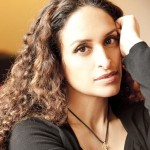
The Jewish Federation of Greater Vancouver has confirmed that it has invited Israeli singer Achinoam Nini (Noa) to perform at the Vancouver Jewish community’s Yom Ha’atzmaut celebrations on May 11 at the Chan Centre.
After initial controversy because of Nini’s political views, including a petition that has stalled at just over 430 signatures and the withdrawal of funding by JNF Canada, Pacific Region, support has grown.
The Jewish Independent was one of the first to publicly support Federation’s decision, telling the Canadian Jewish News in a Feb. 19 article that the controversy was “unmerited,” and following up in a JI editorial that was published online Feb. 22 and in the newspaper last Friday. (jewishindependent.ca/lets-talk-about-nini) Also on Feb. 22, a group of more than 30 Israeli Canadians sent a letter urging Federation to “stick” to its invitation.
On Feb. 23, Federation announced two new event sponsors: the embassy of Israel in Canada and the consulate general of Israel in Toronto, which is the official representative office of the government of Israel in Ontario and the Western provinces. “We were thrilled when both the embassy and the consulate approached us with offers to be official sponsors of our Yom Ha’atzmaut celebration,” said Stephen Gaerber, chair of the Federation board, in a statement. “As official representatives of the state of Israel, we see support from the embassy and the consulate as strong messages that there is room for diversity both within Israel and within our community. We are also very happy that the deputy consul general is once again planning to represent the state of Israel at our Yom Ha’atzmaut celebration.”
JNF Canada chief executive officer Josh Cooper and president Jerry Werger issued a statement on Feb. 25 clarifying JNF’s position: “We want to be absolutely clear that JNF Canada is not protesting, boycotting, delegitimizing or censoring this event. After hearing from so many of our donors, we simply are not comfortable using charitable funds to support this particular artist.
“JNF Canada is a non-political organization which believes in strengthening the state of Israel for all of her citizens. It remains our position that Yom Ha’atzmaut celebrations and other community events should be inclusive.”
Last week, Federation received letters of support that are cited here and can be found in their entirety at jewishvancouver.com.
In addition to saying, “in no way can we allow for differences of opinion to undermine those core values which unite us in our desire for a strong Jewish future with a strong Jewish democratic Israel at the centre,” Natan Sharansky of the Jewish Agency for Israel wrote, “As one who has often had the pleasure of enjoying Noa’s outstanding voice and spectacular talent, I applaud the Vancouver Federation and I know your Yom Ha’atzmaut celebrations will be wonderful.”
The director general of the Jewish Agency for Israel, Alan Hoffmann, also issued a supportive statement: “Canada and Israel share the same democratic values that allow for a wide range of opinions, including diverse expressions of Zionism. An inclusive dialogue about Israel is at the heart of JAFI’s efforts to build a thriving Jewish future and a strong Israel.”
Former CEO of the Jewish Federation of Greater Vancouver, Mark Gurvis, who is now executive vice-president of Jewish Federations of North America, wrote, “In today’s political environment, which is so highly polarized, it has become all too common to brand political opponents as enemies – disloyal, treasonous. It isn’t unique to Israel – we see it today in every Western democracy. It is a phenomenon that is ultimately a far greater threat to communal or national cohesiveness than the different ideas themselves.”
Gurvis spoke of the compromise that was necessary to arrive at the recent landmark decision in Israel to create an egalitarian prayer space at the Kotel. He concluded that there should be a place at the celebration of “Israel’s central place in our collective Jewish gestalt … for the broadest possible cross-section of people who love Israel. The only way we have a future together as a people is if we make our tent larger, and not smaller. It doesn’t mean we have to agree with one another. It just has to mean we recognize and accept each other’s place in our collective journey.”
Julia Berger Reitman and Linda Kislowicz of Jewish Federations of Canada-UIA also stressed the importance of pluralism and the need to “support the values of Israel and Canada where democracy and freedom of expression are promoted.” They pointed out, “Artists often play a unique social role. Not only do they entertain us, they also help us to confront issues and stretch beyond the usual sensibilities. They help us find new forms of expression through their art.”
From several local rabbis, Federation received letters of support, or was copied on letters that thanked Israel’s representatives for Israel’s support and/or discussed the importance of a large tent and a multiplicity of opinions in Judaism. Writers included Rabbi Dan Moskovitz of Temple Sholom, Rabbi Andrew Rosenblatt of Congregation Schara Tzedeck and Rabbi Philip Bregman of Hillel BC. Beth Israel Rabbi Jonathan Infeld wrote a letter thanking Israeli Ambassador to Canada Rafael Barak and made a short video for his congregation, which can be viewed on the home page of jewishindependent.ca.
Members of the Rabbinical Association of Vancouver – Moskovitz, Infeld, Rosenblatt, Bregman, Beth Tikvah Rabbi Howard Siegel, Har El Rabbi Shmuel Birnham and Or Shalom Rabbi Hannah Dresner – expressed their “appreciation to all of those that have come out in support of our community’s Yom Ha’atzmaut concert and celebration…. Our community, like others, has a spectrum of opinion about Israel, its policies and politics. We are grateful that the spirit of democracy, which is one of Israel’s trademarks in the Middle East, has been championed in Vancouver by Israel’s diplomats.”
The RAV letter concluded with the hope that members of the community would include the May 11 concert “among their observances of Yom Ha’atzmaut.”
More than 50 Jewish community organizations support the annual event.