Skip to content
  • Home
  • Subscribe / donate
  • Events calendar
  • News
    • Local
    • National
    • Israel
    • World
    • עניין בחדשות
      A roundup of news in Canada and further afield, in Hebrew.
  • Opinion
    • From the JI
    • Op-Ed
  • Arts & Culture
    • Performing Arts
    • Music
    • Books
    • Visual Arts
    • TV & Film
  • Life
    • Celebrating the Holidays
    • Travel
    • The Daily Snooze
      Cartoons by Jacob Samuel
    • Mystery Photo
      Help the JI and JMABC fill in the gaps in our archives.
  • Community Links
    • Organizations, Etc.
    • Other News Sources & Blogs
    • Business Directory
  • FAQ
  • JI Chai Celebration
  • JI@88! video

Recent Posts

  • Sharing her testimony
  • Fall fight takes leap forward
  • The balancing of rights
  • Multiple Tony n’ Tina roles
  • Stories of trauma, resilience
  • Celebrate our culture
  • A responsibility to help
  • What wellness means at JCC
  • Together in mourning
  • Downhill after Trump?
  • Birth control even easier now
  • Eco-Sisters mentorship
  • Unexpected discoveries
  • Study’s results hopeful
  • Bad behaviour affects us all
  • Thankful for the police
  • UBC needs a wake-up call
  • Recalling a shining star
  • Sleep well …
  • BGU fosters startup culture
  • Photography and glass
  • Is it the end of an era?
  • Taking life a step at a time
  • Nakba exhibit biased
  • Film festival starts next week
  • Musical with heart and soul
  • Rabbi marks 13 years
  • Keeper of VTT’s history
  • Gala fêtes Infeld’s 20th
  • Building JWest together
  • Challah Mom comes to Vancouver
  • What to do about media bias
  • Education offers hope
  • Remembrance – a moral act
  • What makes us human
  • המלחמות של נתניהו וטראמפ

Archives

Follow @JewishIndie
image - The CJN - Visit Us Banner - 300x600 - 101625

Tag: Israeli-Palestinian conflict

Hike challenges one’s views

Hike challenges one’s views

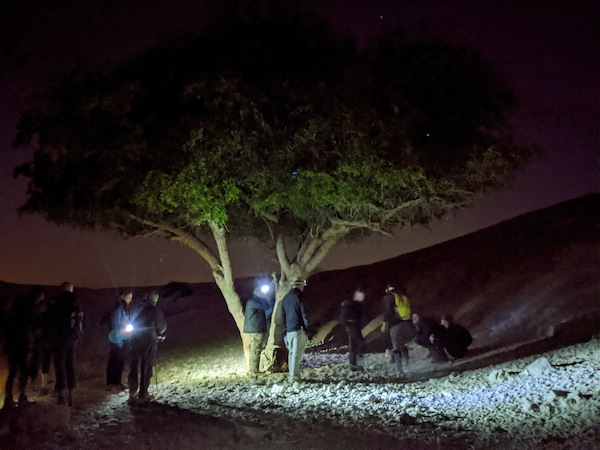
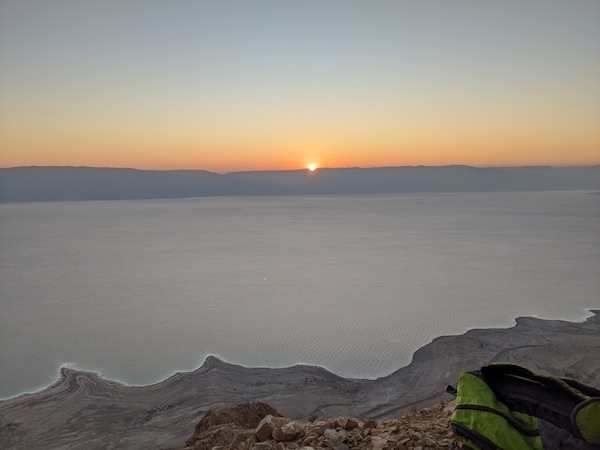
Sunrise at the Dead Sea. (photo from Kevin Keystone)

In this three-part series, the author recounts some of his experiences on Masar Ibrahim Al-Khalil, the Path of Abraham the Friend, which he visited in 2019. The articles have been adapted from a few of the letters he wrote home to family. The events and people described are real but, for reasons of privacy, the names are fictitious. To read Part 2, click here; for Part 3, click here.

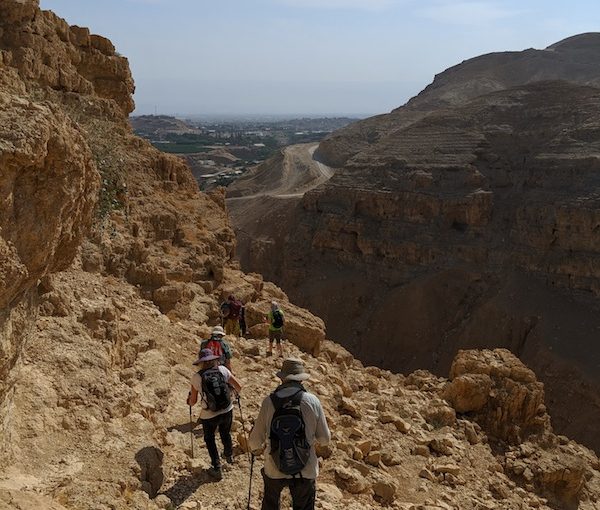
I’m writing this from a rooftop deck in the small community of Arraba, about 15 kilometres from the West Bank’s northern border. We walked two days to get here along the Masar Ibrahim Al-Khalil, the Path of Abraham the Friend, a 330-kilometre trail from Rummanah in the north to Bayt Mirsim in the south. We’re here as part of a guided tour with the Siraj Centre; for 15 years, Siraj has organized walking, cycling and hiking experiences in Palestine.

Tonight, all eight of us will be staying at this villa. It’s unusual for a host to have so much room, but the Hassan family specially renovated their home to accommodate large groups. Noor, her husband and their five children have been hosting hikers on the Masar for five years. Throughout the hike, we’ll stay in homes like this, as well as hotels, guesthouses, Bedouin tents, and even a night in a cave.

Dusk has arrived; the evening view is clear and beautiful. The sun has set over the peaks and valleys of the West Bank, the lights of Palestinian villages and Israeli settlements shimmer around us. Beyond the hill ahead of me, backlit with shades of peach, rose and grey, lies Israel, Netanya and the Mediterranean Sea. A half-moon rises above.

The villages and settlements may seem quiet and peaceable, but are walled off from one another with concrete and hostility. The sea beyond means, for some, Europe, North Africa and its opportunities; for others, impassable waters. What is this place? How did we get here?

* * *

Five of us will walk all 25 days from Rummana to Bayt Mirsim: Felix and Thomas, Quebecois hiking companions in their 40s and 50s; Oliver and Eve, two 50-something activists from the United Kingdom; and myself, a 30-something freelance writer from Toronto. The remaining three will walk one to two weeks: John, a real-estate project manager who hiked Everest for his 60th birthday; and Sue and Howard, a retired teacher-principal duo from California. Neil, a young British doctoral student, hopped off yesterday and will be back for short stints in the coming weeks. Ines, an older Swede, walked with us for just the day.

After the hike, I plan to visit a friend in Beirut. In light of the protests against the government, I shared my reservations with Ines, who lived in Lebanon for two decades. “I lived in Beirut through the civil war,” she said, smiling. “You’ll be fine.”

If not all of us are quite so hardcore, we’re all mostly hikers. Sue and Howard walked 1,000 miles on the Camino de Santiago, Spain’s well-traveled Catholic pilgrimage-turned-hiking trail. I walked the Camino, but at half their age and half as far. Felix and Thomas are also Camino veterans: we all seem to have an affinity for long-distance trails in places of importance and meaning.

We are and aren’t here for the hiking. We’ve come to see Palestine for ourselves and hear directly from Palestinians. For my part, it felt like something of a responsibility. Like many Diaspora Jews, I have supported the state of Israel, either directly or indirectly, and benefited from it. I went on Birthright, the two-week, all-expenses-paid tour designed to build affinity and political support between young Jews and the state. I’m familiar with that side of the story – but after 50 years of occupation and a seemingly never-ending conflict, something didn’t quite fit for me.

Before I left for the Masar, I asked my rabbi for a blessing. In synagogue, she prayed that I would come here “with eyes wide open” and return home “with eyes opened wide.” It’s a prayer I share.

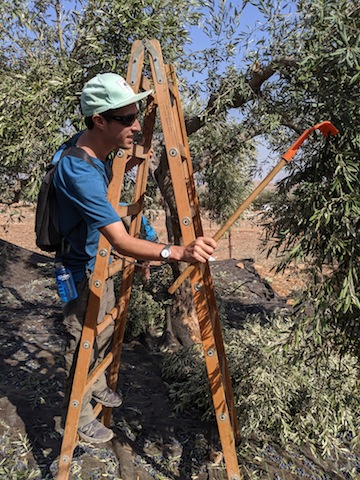
On the Camino, in Spain, locals are largely inured to tourists; here, on the Masar, tourists are rarer. Every local we pass waves hello, is happy and surprised to see us, stops us and wants to give us coffee. Yesterday, we were stopped often by olive-pickers – it’s the season for it. Enthusiastically, they beckoned us over to the stone borders of their groves, where we sat and shared thimbles of coffee spiked with cardamom. As we walked through towns and villages, small children yelled, “Hello! Hello!” and waved to us, their parents replying to our greetings of salaam aleykum (peace be upon you) with wa’ aleykum salaam (and peace upon you) and ahlan wa sahlan, you are welcome here. In these moments, of which there are many, I’m buoyed by unimpeachable hospitality.

This is, however, different from the Camino in other ways. I walked 40 days on the Camino and rarely thought about politics; here, every day is political. I never felt awkward about being Jewish on the Camino – except once, when I asked a local barkeep at a tavern called La Judería if there were any Jews left in the town. He laughed and said: “Not since the Inquisition.” Here, my being Jewish is something I keep to myself, to avoid assumptions about my politics. It’s different when you carry so little on your back and so much in your head. The walking is both easy and hard: mercifully, I have no blisters, but I’m still uncomfortable.

In the evening, after a home-cooked meal, we sipped sweet sage tea in the Hassans’ living room and listened to their story. Noor sat beside her husband Yusef, who spoke to us in Arabic while their son, Rayan, a young man with kind eyes and short hair, translated. If memory serves, Rayan was studying in the United States, which explained his excellent English.

Two years ago, Rayan’s brother, Nader, attended a rally at his university in support of Palestinian political prisoners on hunger strike. Five weeks before we arrived, Israeli soldiers entered the home where we were now staying, at 2 a.m., and arrested him. Nader was taken to prison without charge, where he’ll likely remain without trial for up to seven months. At the end of his time, he could be released; or, he could be detained again for another seven months, without explanation. According to his family, this cycle can repeat indefinitely. The practice is both common and permitted under Israeli military law, which is still in effect in the West Bank, 53 years after the Six Day War.

Noor was quiet, eyes downcast, hands folded in her lap. This was a mother who had lost her son, taken in the middle of the night, who wasn’t sure if or when she would see him again. As I understood from them, adults over 18 are restricted from visiting prisoners: they plan to send their teenage son, Malik, to visit Nader and bring offerings of the family’s love and hope.

photo - Raking trees in an olive orchard, somewhere between Duma and Kafr Malik, West Bank, Palestine
Raking trees in an olive orchard, somewhere between Duma and Kafr Malik, West Bank, Palestine. (photo from Kevin Keystone)

In the short time we’ve been here, we’ve learned of the various ways in which Israel makes life nearly impossible for Palestinians: checkpoints; control over water, electricity, building and agricultural permits; the separation wall; demolition of homes and olive groves; restricted movement internally and internationally; arrest and imprisonment without trial; and, of course, the endless encroachment of settlements, which have been deemed illegal under international law by the United Nations Security Council and the International Court of Justice.

History, of course, is relevant to the present and, here, one can feel the weight of it, but it’s difficult to find a version that isn’t heavy with narrative. A briefing yesterday began with, “When Israel occupied Gaza and the West Bank in 1967….” That’s true, but Israel occupied the territories as an outcome of the Six Day War, which raises questions of how it started and who provoked it. (The answer, as with most things Israel and Palestine, is hotly debated and too extensive to rehash here.) Yesterday, we didn’t talk about the Six Day War, nor the nuances of what came before it. The conflict doesn’t justify the occupation, but to leave out relevant context, to drop the “why” behind the “what,” I’m not sure that’s helpful, either.

On Birthright, we visited an Israeli military base. One of our trip’s soldiers was a pilot in the air force; in the common room, rows of flat, black, airplane-shaped medallions were pinned to a wall. Someone asked what they were. “Those are enemy aircraft,” the pilot said. “Each one marks a plane we shot down.”

The group erupted in applause. I froze, horrified. It reminded me of the story we tell at Passover, when the Heavenly Hosts rejoiced at the drowning of the Egyptians in the Red Sea. “My creatures are perishing,” God silenced them. “And you sing praises?”

* * *

It’s dark now. Stars are appearing in the night sky. Crickets chirp and trucks rumble low in the distance, no doubt carrying goods along labyrinthine backstreets to avoid Israeli-controlled roads, or the possibility of a checkpoint rejection or closure. So much time and life wasted. Tomorrow, we walk. It’s day two, I’m not sure where this road will lead. But all I can do is keep walking.

Kevin Keystone is a Toronto-based freelance writer, editor and researcher. When not hiking long-distance trails, he can be found reading, spending time with friends and family, or with his beloved partner, Aaron. His writing has been published in the Literary Review of Canada, the Jewish Independent and Good Old Boat.
Format ImagePosted on September 11, 2020October 8, 2020Author Kevin KeystoneCategories IsraelTags education, hike, Israel, Israeli-Palestinian conflict, Masar Ibrahim Al-Khalil, Palestine, Path of Abraham the Friend, peace, politics, separation wall, Siraj Centre
On brink of radical change

On brink of radical change

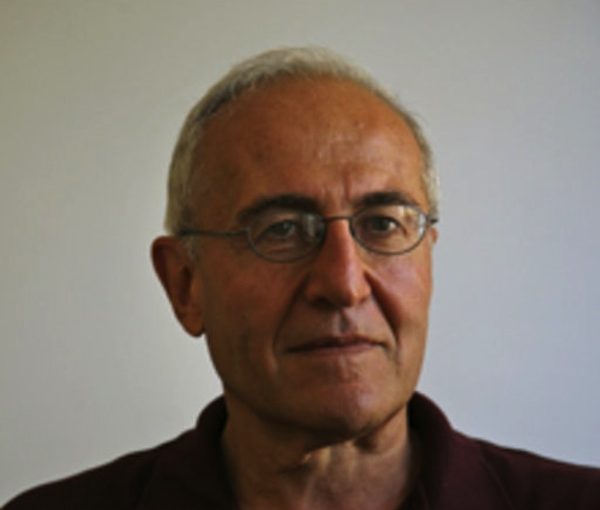
Prof. Shlomo Hasson was slated to bring a pessimistic forecast for the Middle East’s future to a Vancouver lecture March 31, but his visit was canceled due to the coronavirus crisis. (photo from CFHU Vancouver)

The Middle East is in a time of historical change and geopolitical shifts. The outcome is unknown and, for Israel, there may be good and bad consequences.

This is a core message from Prof. Shlomo Hasson, a professor at the department of geography, School of Public Policy, and Leon Safdie Chair at the Institute of Urban and Regional Studies at the Hebrew University of Jerusalem. Hasson was to speak in Vancouver March 31 at an event organized by the Vancouver chapter of Canadian Friends of the Hebrew University, but the lecture was canceled due to the coronavirus crisis. The Independent spoke with him by telephone about what he intended to discuss.

“We are in the midst of turmoil in the Middle East because we have this havoc with Iran and the intensifying tension between the United States and Iran,” he said. “We have the ongoing conflict within the Middle East, especially in Syria, the war now between Turkey and Syria. We have the recent events in Libya, we have a worsening situation in Yemen. I’m not optimistic about the Middle East and, when it comes to the Israeli-Palestinian case … the peace talks were stalled for a long time and now it seems that [U.S. President Donald] Trump’s initiative, in a way, helps to revive the issue but did it in such an awkward way that I’m not optimistic at all about the consequences of this initiative.”

The warming of relations between Israel and Saudi Arabia, as well as with some Gulf states, is cause for limited hope, he said.

“This is indeed a good reason to celebrate because there has been a change, even a significant change, between the Gulf states and even Saudi Arabia, and Israel because [they] are facing the same adversary, which is Iran,” Hasson said. “Israel supports Saudi Arabia because it supports them in containing Iran. In that sense, I think there is something to celebrate but this is very modest, because … the public in Saudi Arabia, for example, does not support Israel. It’s sort of an alliance between the rulers of the countries, but the public is not there yet.”

An additional crisis is climate change, which is hitting the region especially hard and will continue to do so, although this also presents opportunities for Israel to build bridges.

“We face the problem of water scarcity and droughts and flooding,” Hasson said. “I think that, especially in this crisis, Israel can help a lot because we have the technology, we’ve mastered the know-how and we can help the Middle East and Africa, while coping with this issue.”

Speaking before the most recent Israeli elections, Hasson predicted that, regardless of the outcome, they wouldn’t play a significant role in the bigger Middle East picture.

“Israel is not the central actor here,” he said. The central actors are Saudi Arabia and Iran, with China, Russia and the United States intervening from outside.

“Israel is in a position of reacting to these global, regional and intra-state developments,” he said. Even if Blue and White had won, said Hasson, it is still a right-wing party and the Israeli populace is developing a rightward consensus. “I don’t think that these elections are going to present a significant change in Israel’s political behaviour.”

He compares this moment in Middle East history to the pivotal epochs of the past.

“About 100 years ago, we still had the Ottoman Empire and, after that, we had the colonial regimes, the Sykes-Picot regimes, and then we have the nation-state regimes. The Middle East is at the brink of a change, a radical change, and nobody knows for sure what’s going to happen to the Middle East,” said Hasson. “But, in a way, it’s going to affect everything, it’s going to affect the global structure, it’s going to affect the relationships between the United States, China and Russia.”

Format ImagePosted on April 3, 2020April 1, 2020Author Pat JohnsonCategories WorldTags CFHU, elections, Hebrew University, Israel, Israeli-Palestinian conflict, Middle East, peace, politics, Shlomo Hasson
Among Canada’s best books

Among Canada’s best books

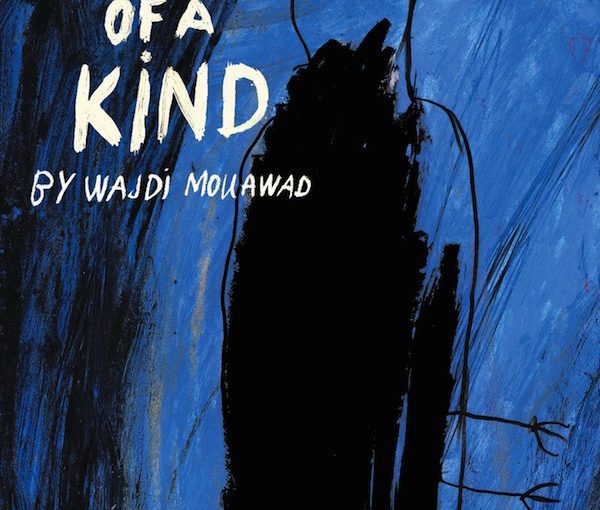
In the play Birds of a Kind by Wajdi Mouawad, the character of Eitan, injured in a terrorist attack in Jerusalem, lies in a coma. As his estranged parents and his grandmother hope for his recovery, they bitterly dig ever deeper into their familial dysfunction. At one point, the doctor tells them about Eitan, “What matters is the voices of those dear to him. His parents, his friends.”

His father responds, “His friends are in Berlin.” His mother, “Or New York.” His grandmother, “But his fiancée is here.” (The Palestinian fiancée that his parents cannot fathom and regarding whom they are nasty, based on a mix of racism, fear, guilt, concern over their own identity, secrets they have kept and more.) The doctor tells the trio, “The stronger the emotional attachment, the quicker the brain responds. We reconstruct ourselves through affection.” Godspeed to Eitan, then.

Birds of a Kind is a fascinating, if somewhat predictable, story and Mouawad’s exposition of complex and hyper-relevant topics, such as group identity versus individual choice, is nuanced and poetic; he uses language beautifully. It is no wonder that Montreal-based translator Linda Gaboriau earned the play its 2019 Governor General’s Literary Award for translation (from French to English).

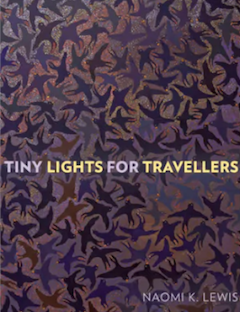
Also faring well in last year’s awards was Calgary writer Naomi K. Lewis, whose Tiny Lights for Travellers was a finalist in the non-fiction category of the prize, which is funded and administered by the Canada Council for the Arts.

image - Tiny Lights for Travellers book coverLewis is extremely candid and self-critical in this travel memoir. Readers learn about her family, her struggle with developmental topographical disorientation (which means she can’t envision a map in her head and, therefore, often gets lost), the complicated messages about Judaism she received growing up, her insecurities about being Jewish (including a botched nose job when she was a teen) and her failed marriage, among other things. We follow her on her literal and metaphorical journeys to self-discovery, -understanding and -acceptance, as her personal story is interwoven with her retracing of the route her grandfather took in 1942 to escape from Nazi-occupied Netherlands to southern France, from where he then traveled through Spain and Portugal to get to London, England.

While Tiny Lights for Travellers includes excerpts from Lewis’s grandfather’s journal of his escape, it is mostly about Lewis and her exploration of identity, family history and the Holocaust. As Lewis notes well into her book, “the journal seemed a tease, so withholding, the anomalous 30-page confession of someone who otherwise lived inside his own experience with no desire to make himself known to anyone.”

Lewis may have set out with a goal of learning more about her grandfather, of connecting to her past, “trying to find what made me,” but there are not clear links from the past to the present. The journey is revealing in the end, just not about her grandfather or exactly how she came to be who she now is, but rather in coming to terms with who that person is.

Format ImagePosted on April 3, 2020April 2, 2020Author Cynthia RamsayCategories BooksTags #ShowUpForShabbat, Birds of a Kind, Governor General’s Literary Award, Israeli-Palestinian conflict, Judaism, literature, memoir, Naomi K. Lewis, politics, Tiny Lights for Travellers, Wajdi Mouawad

Loss-loss only solution

The parallels between the Trump impeachment trial in the U.S. Senate and the release of the Trump administration’s Israeli-Palestinian peace plan are striking. Donald Trump, a master of diversion, unveiled his incendiary proposal for the Mideast at the height of the Senate’s process. Just as the impeachment trial was, in some senses, a process whose outcome was predetermined by the Republican majority, so too is the Mideast proposal outcome predetermined in that it barrels over the Palestinian opposition and rubber-stamps almost everything the more extreme elements of the Israeli body politic have long demanded.

The approach is counterintuitive – like almost everything this U.S. president has done. Supporters might contend that, since all the rational thinking of the best diplomatic minds has not resolved this problem, a 180-degree turn that electroshocks the status quo might be better than nothing. The proposal is so one-sided that, out of sheer outrage, it has at least forced the Palestinian leadership to articulate what they will (or, rather, won’t) accept to a degree greater than they have expressed in recent years.

In the end, though, this emphasis on winning and losing – the Trump plan would be a clear win for Israel and a commensurate loss for Palestinians – is precisely the wrong approach. We may believe that the Palestinian leadership has betrayed their people by rejecting previous offers of coexistence, and conclude that what their people get is what their leaders deserve. But the Palestinian people deserve better than this.

Israel and the Zionist project have always had to contend with the realities and vagaries of coexistence – what other choice do Jews really have? Despite early warnings, coexistence with their neighbours was a widespread expectation among the early Zionists, some of whom thought (naïvely, in retrospect) that they would be welcomed with open arms by the other peoples in the region. But, even with the history of conflict and the absence of anything to give us a great deal of hope, some slow evolution that leads toward coexistence is the only realistic alternative to the status quo of suspended violence and intermittent war.

We need to recognize, above all, that a lasting resolution is not going to look like a win for one side and a loss for the other. Likewise, it is not going to resemble a win-win, as negotiators in various arenas, as well as salespeople, like to say. It will be a lose-lose proposition. An enduring peace and coexistence will almost certainly occur only when both sides are willing to accept a loss on many or most of their key demands – and accept that loss as a price for their children’s lives and well-being.

More immediately, we should be very wary of any master plan for peace that is scribbled out in the middle of an election campaign or another drama like an impeachment. The contents of such a plan are almost certainly more geared to the outcome it is trying to influence (votes for Likud or the Republican Party) or distract from (the U.S. president’s impeachment and trial or the Israeli prime minister’s loss of immunity from prosecution) than the problem it is ostensibly meant to address. Israelis and Palestinians, both, deserve self-determination and lasting peace.

Posted on February 7, 2020February 6, 2020Author The Editorial BoardCategories From the JITags impeachment, Israel, Israeli-Palestinian conflict, peace, Trump, United States
An advocate for two states

An advocate for two states

Eli Kowaz is communications director at the Israel Policy Forum. (photo from Eli Kowaz)

This article is one in an occasional series about people with British Columbian roots having positive impacts in Israel and elsewhere.

For Vancouver-born Israeli Eli Kowaz, there is only one path to ensuring Israel remains both a Jewish state and a democracy: a two-state solution. The road to that ideal may be long and the slogging hard, but this is the core mandate of the Israel Policy Forum, where he serves as communications director.

Though focused on Israel and its situation, IPF’s mission is to “shape the discourse and mobilize support among American Jewish leaders and U.S. policymakers for the realization of a viable two-state solution.”

Israel currently has military control over the entire land from the Mediterranean Sea to the Jordan River but, to continue being a Jewish state as well as a democracy, Kowaz said, Israel faces a decision.

“It can decide to annex the West Bank, keep the entire land and, if it wants to be a Jewish state, it will have to give up on the democracy aspect because, if it was to grant all the citizens living between the Jordan and the Mediterranean equal rights, then already today, Jews would be about 50-50, a small majority,” he said.

The answer is not cut and dry, he acknowledged. The Jordan Valley is a vital Israeli security interest and, come what may, Israel is likely to maintain military control there for the foreseeable medium-term. But both Israeli Prime Minister Binyamin Netanyahu and U.S. President Donald Trump have recently obfuscated their countries’ erstwhile support for a two-state solution. In Netanyahu’s case, it’s at least partly political, said Kowaz.

“He is dependent on his right-wing coalition partners, he’s willing to say things and even do things to secure his position as prime minister, even though he’s already surpassed [David] Ben-Gurion as Israel’s longest-serving one,” Kowaz said. “A lot of it is right-wing pandering to those people. Another part of it is a genuine security concern. The research done by the top security experts in Israel and others show that there is a way to keep that area secure while advancing a gradual separation of Palestinians and an eventual two states. Obviously, it’s not something that’s happening tomorrow.”

Kowaz, now 29, grew up in Vancouver’s Oakridge neighbourhood with an Israeli father, Joseph Kowaz, who moved to Vancouver in his 20s, and a mother, Andrea (Rogow) Kowaz, who moved here from New York at a young age. His late maternal grandparents were community leaders and academics Dr. Sally and Dr. Robert Rogow.

He attended Vancouver Talmud Torah and Hebrew Academy for elementary school and Magee and King David high schools, “so I kind of got a taste of Orthodox Jewish education, more of a secular traditional and also public school, so it was nice to have,” he said.

Kowaz did a gap year in Israel after high school, studying at Hebrew University and Ben-Gurion University. Returning to Canada, he graduated from McGill University in Montreal and then completed a graduate degree in digital media at Ryerson University in Toronto. His final project for his degree addressed ways to remember and educate about the Holocaust in the 21st century.

“From the beginning, I wanted to do something that was Israel-related,” said Kowaz. “So, it was either move straight to Israel or look for something Israel-connected that was outside of Israel.” He moved to New York City and soon got work at IPF. He moved to Tel Aviv last year and, in July 2018, married Tal Dor, a former graphic designer for the Israel Defence Forces newspaper BaMahane. She occasionally gives Kowaz advice and support from her experience.

Part of a generation that gained political awareness during the Second Intifada, Kowaz said he has been affected by the violent imagery of those days.

“I obviously want the best for everyone, but Israel is most important to me and I want Israel to be a Jewish state,” he said. “I want Israel to be a state that’s also accepted in the world to the best that it can be. Obviously, there will still be people that hate us but I don’t want Israel’s best allies to be Hungary, Poland, these right-wing [governments] with elements of fascism. We don’t want those to be our best friends, so, at the end of the day, I don’t think we have a perfect partner and the Palestinians, they’re never going to be a perfect partner, but we should do what’s best for Israel, which is at least preserve conditions for a two-state solution, a form of separation to secure Israel as a Jewish and democratic state as a goal for the next five, 10, 15 years. Keep that a possibility. And, right now … I think it’s definitely still an option. It’s still on the table. We haven’t killed it. But it’s treading in the wrong direction.”

The Israel Policy Forum began in 1993, said Kowaz, on the very day the day of the famous handshake on the White House lawn with Yitzhak Rabin, Bill Clinton and Yasser Arafat.

“At that time, Yitzhak Rabin was looking for American Jewish support for his vision of peace,” he said. “Even back then, AIPAC were already becoming close with Binyamin Netanyahu, who [had been] Israel’s ambassador to the UN and, at that time, he was already opposition leader.”

IPF does a lot of work in Washington, D.C., with policymakers, convening roundtable discussions and panels with congresspeople, congressional staffers and opinion leaders, as well as organizing events in synagogues around the United States, all focused on preserving conditions for two states.

Their positions are credibly backed up, said Kowaz, by security experts in Israel, called Commanders for Israel’s Security, which was begun by former major-general Amnon Reshef, a hero of the Yom Kippur War, and includes a cadre of 290 former IDF generals, Mossad and Shin Bet division heads and others.

“They work in Israel, so we work closely with them to relay their policy proposals and their messaging to an American audience,” he said. “It represents about 80% of the retired security establishment. It doesn’t get more legitimate than that. These are people that, I think, between all of them have 6,000 years of experience at the highest positions, making decisions constantly with people’s lives.”

While AIPAC has an upstart challenger on the left, J Street, Kowaz sees IPF as a more fact-based alternative to the politically oriented advocacy groups.

“People are looking for a voice that is different, that’s more policy-based, less trying to rally the troops and more looking at the facts,” he said. “I think we provide that kind of home and, in a way, everything’s very fact-based.”

Kowaz looks forward to continuing to work toward the perpetuation of Israel as a Jewish democratic state.

“It really doesn’t matter to me what the role is, I think that’s where I’d like to see myself,” he said, adding: “I’ve given up on the professional soccer career.”

Format ImagePosted on December 13, 2019December 12, 2019Author Pat JohnsonCategories IsraelTags advocacy, Eli Kowaz, Israel, Israel Policy Forum, Israeli-Palestinian conflict, peace, two-state solution
Rockets raining down

Rockets raining down

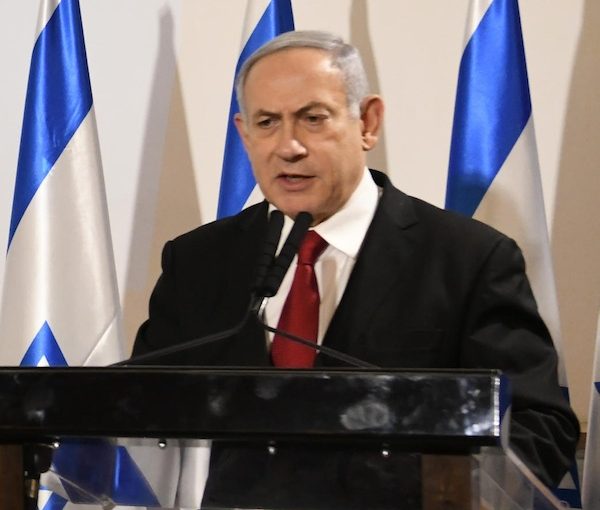
Israeli Prime Minister Binyamin Netanyahu talks about the rockets being fired from Gaza. (photo by IGPO via Ashernet)

Rockets were falling on southern and central Israel as the paper went to press this week. After the Israeli military killed Islamic Jihad commander Baha Abu al-Ata, Gaza once again erupted into full war footing.

The Iran-backed Palestinian Islamic Jihad called the assassination “a declaration of war against the Palestinian people” and declared, “Our response to this crime will have no limits.” Because they’re usually so restrained.

Schools were closed and Israelis, especially in the “envelope” area near the Gaza Strip but also in Tel Aviv, hunkered down in bomb shelters as Iron Dome deflected some but far from all of the rockets launched from the enclave.

The new, or renewed, conflict does not occur in a vacuum. Political leaders in Israel are in the midst of difficult negotiations to form a government after the second inconclusive election this year. Some critics claim the fighting is a scorched earth attempt by incumbent Prime Minister Binyamin Netanyahu to shake up the status quo and tip domestic politics in his favour. But, among those who reject this assessment is Netanyahu’s chief rival, Benny Gantz, who is now leading the efforts to cobble together a working alliance in the Knesset.

It all has a feel of déjà vu, of course, because this scenario, in different permutations, has played out repeatedly. As we posited in this space recently, some people say the status quo cannot hold. It can. It has for decades. But intermittent, terrible flare-ups like this are a part of and a price for that status quo, a high price paid by both Israelis and Palestinians. Until someone finds a path for both peoples to coexist more peacefully, this is life.

Format ImagePosted on November 15, 2019November 13, 2019Author The Editorial BoardCategories From the JITags Gantz, Gaza, Islamic Jihad, Israel, Israeli-Palestinian conflict, Netanyahu, peace
Status quo OK?

Status quo OK?

Israeli Prime Minister Binyamin Netanyahu places his vote on election day. (photo by Haim Zach/IGPO from Ashernet)

Unless something dramatic happens between when we write this and when you read this, the future of Israel’s government remains uncertain. To avert a third election in a year, the most viable option for a stable government would appear to be a “national unity” or “centrist coalition” involving both major parties, Likud and Blue and White.

This was the subject of face-to-face discussions between leaders and President Reuven Rivlin, but no agreement was reached. So Binyamin Netanyahu, the incumbent prime minister, has a few weeks to try to cobble something together. If he fails, Rivlin will probably call on Blue and White leader Benny Gantz to give it a go. Some bets are that, if it comes to that, there will be enough Knesset members desperate enough to avoid a return to the polls that some accommodation will be made. Perhaps the likeliest possibility is a Likud-Blue and White unity government without Netanyahu. (This scenario would become likelier if Netanyahu officially faces criminal charges in the next few days.)

Any broad coalition of this sort would lead to a degree of progress on some fronts – if far-right and religious parties are excluded, some policies and legislation that appeal to the secular majority are likely to advance – while progress on some other fronts would likely stall.

One example is the peace process – although there is, basically, no progress to stall at this point. There is great divergence in Israel over what the next steps should be vis-à-vis the Palestinians. In a broad-based coalition government, that uncertainty would define government policy, probably leading to inaction.

During the recent election, Netanyahu went further than previous leaders, promising to annex chunks of the West Bank to Israel. Gantz and the centre-left in Israel have been confounded by the reality that, while they seek a two-state solution and recognize a one-state situation as demographically unsustainable, until Israel sees a benefit to ending the occupation and can be certain that an independent Palestine in the West Bank will not be a launch pad for terror, independence will not come and the occupation will not end. Without that, no peace, no Palestine.

As a result, we will likely see more of the status quo, until some force acts to alter it. While Netanyahu’s provocative promise to annex areas would have altered the status quo for the worse, a precipitous end to the occupation that left a vacuum to be filled by those wishing to do Israel harm would likewise be a change for the worse. The tense status quo Israelis and Palestinians have now is definitely not great, especially for Palestinians, but it is better than outright war.

An old tale has the rabbi of a medieval Jewish community visiting the duke who has threatened to throw the Jews from his realm. The rabbi returns to his community and tells his people, “I convinced the duke to let us stay – if I can teach his dog to talk within five years.” The Jewish community is dumbfounded. “What a promise? It’s impossible!” The rabbi says, “Relax. I’ve got five years. The dog could die. The duke could die. I could die. Meanwhile, I bought us five years.”

The occupation, the statelessness of the Palestinian people, the recurring missile attacks from Gaza and the violence against civilians are not things we should understate or dismiss. But neither should we believe that any change is necessarily an improvement. The status quo is better than war and it is better than the dissolution of the Jewish state. The status quo is not ideal, but it may be better than currently available alternatives.

Format ImagePosted on October 4, 2019October 2, 2019Author The Editorial BoardCategories From the JITags Benny Gantz, Binyamin Netanyahu, elections, government, Israel, Israeli-Palestinian conflict, peace
In solidarity with neighbours

In solidarity with neighbours

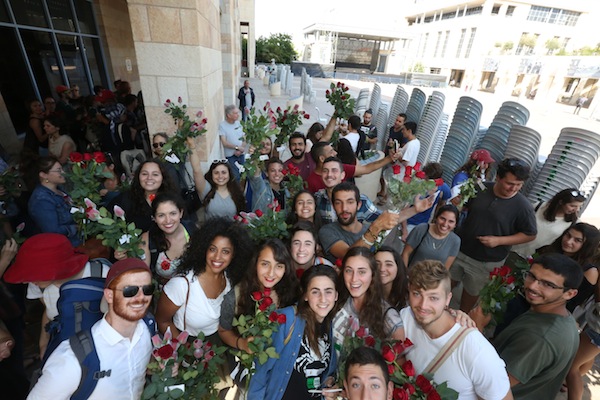
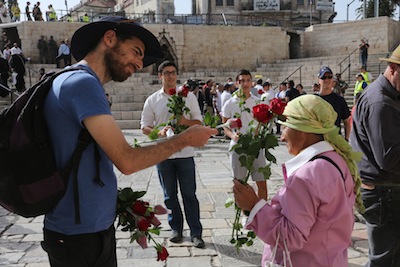
One of Tag Meir’s annual events is Flowers of Peace. Participants hand out roses on the streets of the Old City in Jerusalem on Jerusalem Day. This year, they gave out some 2,000 flowers as a message of peace to Muslims and Christians in the city. (photo from Tag Meir)

To counter what Tag Meir head Gadi Gvaryahu described as incitement by radical settlers through Tag Mechir (Price Tagging), Tag Meir (Light Tagging) was formed.

Tag Meir, which started in 2011, is operated by members of the same segment of religious Zionistic Judaism that started price tagging (attacking Palestinian property and people) in 2009. Members of Tag Meir started visiting victims on both sides of the conflict in an effort to show solidarity and repair physical and psychological damage.

Today, Tag Meir is supported by many organizations and institutions in Israel from all segments of Jewish society – secular, Reform, Conservative, Orthodox and ultra-Orthodox Jews – coming together to stand against hate and intolerance.

Though he now lives in Rehovot, Gvaryahu still considers Jerusalem home. He is the eighth generation of his family to live there.

Gvaryahu was deeply affected by the assassination of Yitzhak Rabin and the fact that the killer had come from his segment of religious Zionism, Kippot Srugot (Knitted Kippot). He decided he had to put his passion for helping animals aside – he is a farm animal behavioural researcher by training – to find ways to mend Israeli society.

“I decided it’s about time to be more involved in public business – not politics, but more education,” said Gvaryahu. “Me and a few other families initiated a synagogue, an Orthodox synagogue in Rehovot, named after Yitzhak Rabin.”

Gvaryahu realized there was something wrong with the education system when he received a call from the head of his son’s yeshivah, demanding his son apologize for an outburst.

“Six months after Yitzhak Rabin’s assassination, a famous rabbi came to my son’s school,” recalled Gvaryahu. “He said that now, with Rabin dead, all his bad things were forgiven. And he didn’t even mention that he was murdered. He just treated him like someone who’d sinned a lot, talking to the whole synagogue, like 400 students, including the head of the synagogue … and they were all silent, except one person – my son.

“My son said, ‘How dare you say that? He just passed away! And, how dare you say that he has sins? He was killed, murdered!’ Then, he left the room, crying.”

When the rosh yeshivah called, Gvaryahu commended his son’s actions and said, “This rabbi should apologize. I’m not going to ask my son to apologize.”

Eventually, they consulted a leading rabbi who declared that Gvaryahu’s son “did a wonderful job and there’s no reason for him to apologize.”

It was at that point that Gvaryahu decided they needed to start their own school.

The first time that Israelis heard the term “Price Tag” in the context of payback was in December 2009. It was dubbed so by a small group of extreme right-wing West Bank settlers who had begun indiscriminately attacking Palestinians.

Gvaryahu explained the psychology behind it: “Something happened to us by Palestinians, by the army, by politicians, whatever … someone will pay the price. The thinking is, we don’t care that you’re innocent, we don’t care that you are Christian, Muslim…. You’re not Jewish, you’ll pay the price. We’ll burn, damage your mosque, your house, your car, your olive trees, and that’s called, ‘Price Tag,’ happening almost daily in the West Bank. Most of them, we don’t hear about. But, after a terror attack by Muslims, unfortunately, we have a bunch of them in the last two months … there’s been attacks by extreme settlers.”

While Tag Mechir destroys, Tag Meir aims to rebuild and bring light. “So, we call the people, the victims, in hospitals, villages, wherever, mosques, monasteries or churches, and we create a solidarity visit,” said Gvaryahu.

photo - Flowers of Peace volunteers on Jerusalem Day
Flowers of Peace volunteers on Jerusalem Day. (photo from Tag Meir)

“Over the years, we’ve gained many, many Jewish, Christian and Muslim friends, and that’s very important. It’s important, because it’s a correct response to that crime, because they want to create terror or fear, especially among Muslims and Christians. So, those visits strengthen the relationship between Jews and Muslims and Christians. We have three Facebook pages – one in Hebrew, one in Arabic and one in English – with 35,000 followers.”

People in Israel not connected to Tag Meir have started solidarity visits by themselves, aiming to mend fences with Palestinian neighbours. “First, you know, I’m happy about Tag Meir,” Gvaryahu said about this development. “Second, that they get that this is the right way to respond to a hate crime or a price tag attack – it’s wonderful. It’s what we want to happen.

“This isn’t something that can be solved quickly. It’s education. We try to educate society, especially the Zionist society, we hope.”

This year, due to the rise in Tag Mechir attacks, Tag Meir held an education symposium on Sept. 10 at the Van Leer Jerusalem Institute, near the home of the president of Israel, Reuven Rivlin. Among the speakers were the former head of the Israeli security agency, Shin Bet, Yaakov Peri, senior rabbis from different segments of society, and the mother of one of the Jewish victims of terror, Sarah Rosenfeld.

“Her son [Malachi Moshe] was murdered and she will give her strong condemning opinion about ‘price tag,’” said Gvaryahu prior to the symposium. “When we came to visit the Rosenfeld family, she said that, if Malachi would be with us, he would join Tag Meir.

“This is very unique about Tag Meir, that we visit both settlers and victims of Tag Mechir on the Palestinian side. It’s not that pleasant an activity sometimes, but we feel it’s very important.”

One of the yearly events Tag Meir hosts is a flower giveaway called Flowers of Peace. They go out into the streets of the Old City in Jerusalem on Jerusalem Day and hand out roses. “This year, we spread 2,000 flowers all over the Old City,” said Gvaryahu. “It’s a symbolic act, sending a message of peace to Muslims and Christians in Jerusalem.”

While Gvaryahu said 40% of the people in Jerusalem are Muslim, Jerusalem Day is only celebrated by the Jewish population. He said some of the songs that are traditionally sung must irritate the Muslim population. “Unfortunately, we don’t celebrate it, in our opinion, in the right way,” he said. “We just march with Israeli flags from West Jerusalem to the Western Wall through the market. Not all the songs are horrible, but a few of them are. So, this is our response. We march with Flowers of Peace.”

For more information, visit tag-meir.org.il/en.

Rebeca Kuropatwa is a Winnipeg freelance writer.

Format ImagePosted on September 20, 2019September 17, 2019Author Rebeca KuropatwaCategories IsraelTags coexistence, Gadi Gvaryahu, Israeli-Palestinian conflict, Judaism, peace, Tag Mechir, Tag Meir, tikkun olam
Laying out Israel’s case

Laying out Israel’s case

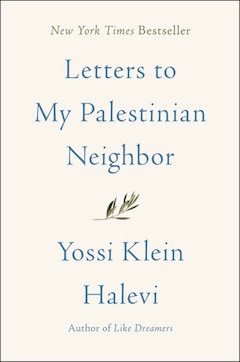
Yossi Klein Halevi’s Letters to My Palestinian Neighbour is recently out in paperback. (photo by Ilir Bajraktari / The Tower)

Yossi Klein Halevi grew up in the right-wing Zionist youth movement Betar, the ideological stream of Ze’ev Jabotinsky and Menachem Begin. As a youth, he wore a silver outline of the land of Israel “as we understood it” that included not only the West Bank but also the area that became the kingdom of Jordan, which the British had severed from historic Palestine. As he’s aged, he’s emphatically mellowed.

His book Letters to My Palestinian Neighbour, recently out in paperback, is, he writes, “an attempt to explain the Jewish story and the significance of Israel in Jewish identity to Palestinians who are my next-door neighbours.”

He lives in the French Hill neighbourhood of Jerusalem and repeatedly throughout the book reflects on how he is face-to-face with the division between their places.

Each chapter – essay, really – begins with “Dear neighbour.”

image - Letters to My Palestinian Neighbour book cover“From my apartment, I can just barely see the checkpoint you must cross – if you have a permit at all – to enter Jerusalem.” He talks about when, “before the wall was built, before so much else that went wrong, I tried to get to know you.”

In 1998, he set out on a pilgrimage into Islam and Christianity, a religious Jew “seeking not so much to understand your theology as to experience something of your devotional life. I wanted to learn how you pray, how you encounter God in your most intimate moments.”

During those comparatively placid times, he recalls, Israelis made little effort to accommodate their neighbours.

“For many years we in Israel ignored you, treated you as invisible, transparent. Just as the Arab world denied the right of the Jews to define themselves as a people deserving national sovereignty, so we denied the Palestinians the right to define themselves as a distinct people within the Arab nation, and likewise deserving national sovereignty. To solve our conflict, we must recognize not only each other’s right to self-determination but also each side’s right to self-definition.”

Klein Halevi made aliyah from the United States in 1982. Now a senior fellow of the Shalom Hartman Institute – “Israel’s preeminent centre for pluralistic Jewish research and education” – he co-directs the institute’s Muslim Leadership Initiative, is the author of numerous books and is a prolific commentator and former contributing editor of the New Republic. He has made the book’s Arabic translation available to download for free.

He argues that each side must be allowed to define themselves.

“So who are the Jews? A religion? A people? An ethnicity? A race?… That question impacts directly on our conflict. It goes to the heart of the Arab world’s rejection of Israel’s legitimacy as the nation-state of the Jewish people,” Klein Halevi writes. “Even Palestinian moderates I’ve known who want to end the bloodshed tend to deny that the Jews are an authentic nation. So long as Palestinian leaders insist on defining the Jews as a religion rather than allowing us to define ourselves as we have since ancient times – as a people with a particular faith – then Israel will continue to be seen as illegitimate, its existence an open question.”

He acknowledges that the problem occurs on both sides.

“Some Jews continue to try to ‘prove’ that Palestinian national identity is a fiction, that you are a contrived people. Of course you are – and so are we. All national identities are, by definition, contrived: at a certain point, groups of people determine that they share more in common than apart and invent themselves as a nation, with a common language, memory and evolving story. The emergence of a nation is an inherently subjective process.”

But he attempts to disabuse Palestinians and Arabic readers of the idea that Israel can be overcome.

“I’ve often heard from Palestinians that, just as the Ottoman Turks came here and left, and the British came here and left, so, too, will the Zionists one day leave. That analogy ignores Zionism’s singular achievement. None of those invaders founded a thriving society, let alone a sovereign state. They eventually went back to their own homelands. More than anything else, I need you to understand this: the Jews succeeded where the Crusaders and the Ottomans and the British failed because we didn’t merely come here. We returned.”

This sense of destiny is evocatively expressed when Klein Halevi writes about the War of Independence.

“Our side began the war with three tanks and four combat planes. And we were alone. That, as it turned out, was a crucial advantage, because desperation forced us to mobilize our entire society for a war of survival. If your side had prevailed, few if any Jews would have been left here. As a result, the Jews fought with such determination that only a handful of our communities fell. There was nowhere left to run; we’d reached the final shore of Jewish history.”

But the author makes an effort to acknowledge some of the harsh realities of that victory and the subsequent Israeli control of Palestinian areas and its effect on people. He recalls a moment during a call-up during his reserve service.

“A chubby teenage Palestinian boy, accused of stone throwing, was brought, blindfolded, into our tent camp. A group of soldiers from the border police unit gathered around. One said to him in Arabic: ‘Repeat after me: one order of hummus, one order of fava beans, I love the border police.’ The young man dutifully repeated the rhymed Arabic ditty. There was laughter.… That last story haunts me most of all. It is, seemingly, insignificant. The prisoner wasn’t physically abused; his captors, young soldiers under enormous strain, shared a joke. But that incident embodies for me the corruption of occupation. When my son was about to be drafted into the army I told him: there are times when as a soldier you may have to kill. But you are never permitted, under any circumstances, to humiliate another human being. That is a core Jewish principle.”

He acknowledges his pain over an eventual partition that would, for example, see the Jewish holy city of Hebron as part of an independent Palestine. But, he says: “The only solution worse than dividing this land into two states is creating one state that would devour itself. No two peoples who fought a 100-year existential war can share the intimate workings of government. The current conflict between us would pale beside the rage that would erupt when competing for the same means of power. The most likely model is the disintegration of Yugoslavia into warring ethnic and religious factions – perhaps even worse. A one-state solution would condemn us to a nightmare entwinement – and deprive us both of that which justice requires: self-determination, to be free peoples in our own sovereign homelands.… If Jaffa belongs to you and Hebron belongs to me, then we have two options. We can continue fighting for another 100 years, in the hope that one side or the other will prevail. Or we can accept the solution that has been on the table almost since the conflict began, and divide the land between us. In accepting partition we are not betraying our histories, neighbour; we are conceding that history has given us no real choice.”

Near the end, Klein Halevi reflects that some simple human goodness could have made a massive historic difference.

“Israel is a restless society of uprooted and re-rooted refugees and children of refugees, and the dark side of our vitality is a frankness that can easily become rudeness, the antithesis of Arab decorousness. Israelis often don’t know how to treat each other with respect, let alone those we are occupying. We are a people in a hurry to compensate for our lost centuries of nationhood, a people that doesn’t pay attention to niceties. Sometimes I think that, if only we’d known how to show your people simple respect, so much could have been different here.”

The new paperback edition includes an epilogue of “letters” in response to his neighbourly missives. Some, the author admits, are predictably harsh, dismissive and threatening. But many are long, thoughtful and inspiring. Klein Halevi has started a conversation. It is invigorating and heartily recommended to be a part of it as a reader.

Format ImagePosted on September 20, 2019September 17, 2019Author Pat JohnsonCategories BooksTags civil society, history, Israel, Israeli-Palestinian conflict, lifestyle, philosophy, Yossi Klein Halevi
Visit complexities of Nablus

Visit complexities of Nablus

Joseph’s Tomb, inside the gate. (photo by Gil Zohar)

“The bones of Joseph, which the Children of Israel brought up from Egypt, were buried in Shechem in the portion of the field that had been purchased by Jacob.” – Joshua 24:32

 “‘And he bought the field where he pitched his tent.’ (Genesis 13:19) Said Rav Yudan bar Simon, ‘This is one of the three places regarding which the nations of the world cannot slander Israel and say, “You stole them!” The places are the Cave of Machpelah [in Hebron], the Temple [in Jerusalem] and the Tomb of Joseph [in Shechem/Nablus].” – Bereshit Rabba, 79:4

There’s little inspiration to be found in the unadorned tomb of Joseph, the favourite of Jacob’s 12 sons. The holy site, located in the gritty eastern outskirts of Nablus among parched olive groves and graveyards of wrecked cars, is today a flashpoint between those who revere the site – Israeli Jews, Palestinian Muslims, Christians of all stripes, and the 600-member Samaritan community living on Mount Gerizim overlooking this West Bank city of 160,000. The traditional anniversary of Joseph’s death on Tammuz 27 (which fell on July 31 this year) is considered an especially auspicious pilgrimage time.

The group of 1,200 pious Jews, armed with permits and prayer books, arrived at the shrine in a convoy of bulletproof buses protected by the Israel Defence Forces. Most were Bratslaver Chassidim, who set great store in their practice of praying at the graves of tzadikim (righteous ones).

The IDF-escorted pilgrimage on the first Tuesday of every month often leads to riots. IDF sappers neutralized a pipe bomb hidden at Joseph’s Tomb prior to the visit of the 1,200 pilgrims and 12 Palestinians were injured during clashes with the IDF. The list of security incidents, arson and terrorism is long and bloody.

In the secular West, the story of Joseph – whose 11 jealous brothers sold their 17-year-old sibling into slavery in Egypt – has been popularized by the rock opera Joseph and the Amazing Technicolor Dreamcoat. Librettist Tim Rice and fellow Academy Award-winning composer Andrew Lloyd Weber, along with actor Donny Osmond as Joseph, captivated audiences from Broadway to the West End with their account of Joseph’s rise to become the vizier, second only to Pharaoh in the Egyptian empire.

But Joseph, the hero of Bible and Quran stories, has hardly been given the royal treatment by Middle East politics. Dotan, where Joseph was thrown into a pit, called Jubb Yussef (Joseph’s Well) today is a ruined caravanserai that collapsed in an earthquake in 1837. Joseph’s tomb, enshrining the bones brought back from Egypt by the Children of Israel some 3,300 years ago together with the remains of Joseph’s sons Ephraim and Manasseh, has fared better.

The plain one-storey is called Qabr an-Nabi Yúsuf (Tomb of the Prophet Yúsuf) in Arabic and is revered by Jews as Kever Yosef ha-Tzadik (Tomb of Yosef the Righteous). The whitewashed limestone building is capped with a cupula and protected by a massive black gate. Barbed wire crowns the looming walls. Signposts in Arabic and English indicate the nearby sites of Tel Balata and Jacob’s Well. None directs visitors to Joseph’s Tomb.

photo - Balata refugee camp
Balata refugee camp. (photo by Gil Zohar)

Tel Balata is the nondescript Canaanite/Israelite Iron Age stratified archeological mound that few tourists bother to visit. Jacob’s Well is covered by a 20th-century Greek Orthodox basilica marking where the patriarch camped when returning to Shechem (ancient Nablus) from Paddan Aram in today’s Iraq. In one of the Torah’s three real estate deals – along with Abraham’s purchase of the Cave of Machpelah in Hebron and David’s acquiring of Mount Moriah in Jerusalem – Jacob bought the plot of land from the sons of Hamor, the father of Shechem. There, Jacob pitched his tent and erected an altar (Genesis 33:18-20).

Some 1,500 years later, Jesus “came to a city of Samaria called Sychar, near the field which Jacob gave to his son Joseph. Jacob’s Well was there.” (John 4:5-10) Drinking water, he chatted up a Samaritan woman, known in Greek as Photine (the luminous one; hence, the church’s name, St. Photini). Christian pilgrims flock to the site to reverently drink drafts of cool water from the deep well in the church’s vault.

Across the street is Balata Refugee Camp, administered by the United Nations Relief and Works Agency for Palestine Refugees in the Near East (UNRWA). Today the largest camp in the West Bank, it houses 27,000 people in a quarter-square-kilometre site that was designated for 5,000 refugees when it was established in 1950.

photo - Ottoman Sultan Abdul Hamid II’s clocktower, erected in 1906
Ottoman Sultan Abdul Hamid II’s clocktower, erected in 1906. (photo by Gil Zohar)

Even for an intrepid, multilingual tour guide like this writer, it is daunting to find the unmarked way to the holy site. The drab building is located next to the Qadari Tuqan School, along a dusty unnamed road where only recently were sidewalks laid. The easiest way to find the landmark is to look for the Palestinian Authority police vehicle parked outside the locked gate. Then, one must locate the pair of PA police officers loitering in the shade nearby, smoking cigarettes and nervously fidgeting with their rifles. Ask politely in Arabic and they’ll let you in, no questions asked, no baksheesh (tip or bribe) required – just don’t mention that you’re Jewish.

Inside the locked gate, you’ll find a simple barrel tomb and the stump of a column of indeterminate age. There’s no evidence of the repeated vandalism that has punctuated the tragic history of Joseph’s Tomb since 1995, when Israel withdrew from the West Bank city, ending the occupation that began in 1967 with the Six Day War.

A photo from 1900 shows the well-maintained compound around Joseph’s Tomb. A carriage road facilitated the pilgrimage of pious Jews from the Old Yishuv who regularly came to pray there. The holy site stood in isolation. Nearby was the Arab hamlet of Balata, with eight houses.

The name Nablus is a corruption of the Latin Colonia Julia Neapolis, which was founded by the Roman emperor Vespasian in 72 CE. In the old city, in 1906, Ottoman Sultan Abdul Hamid II erected a clocktower to celebrate 30 years on the throne of the Sublime Porte.

In the Six Day War, Israel captured the territory, which had been occupied by the Hashemite Kingdom of Jordan since 1948. Once-somnolent Nablus experienced a burst of prosperity, though today, under PA self-rule, the Palestinian economy is floundering. Expanding from a population of 30,000, the city spread out to swallow the nearby villages, including Balata. Joseph’s Tomb became entangled in urban sprawl.

Jewish settlers began to frequent the mausoleum. By 1975, Muslims were prohibited from visiting the site, which some claimed was the tomb of Sheikh Yúsuf Dawiqat, an 18th-century Sufi saint. In 1982, St. Louis, Mo.-born kabbalist Rabbi Yitzchak Ginsburgh established the Od Yosef Chai (Joseph Still Lives) yeshivah at the site.

photo - Palestinian Authority police by Joseph’s Tomb
Palestinian Authority police by Joseph’s Tomb. (photo by Gil Zohar)

Conflict mounted following the Oslo Accords. Tensions boiled over in September 2000, in the wake of then-prime minister Ariel Sharon’s controversial visit to Jerusalem’s Temple Mount. A full-scale battle broke out.

On Oct. 1, 2000, Border Police Cpl. Madhat Yusuf, 19, of Beit Jann in the Upper Galilee, was wounded in the neck in a clash with Palestinians at Joseph’s Tomb. Over the course of four hours, the Druze warrior bled to death because the IDF considered it too risky to evacuate him without a ceasefire.

A week later, on Oct. 7, 2000, the site was handed over to PA police. Within hours, Joseph’s Tomb was pillaged by Palestinian protesters. Using pickaxes, sledgehammers and their bare hands, they demolished the holy site. It was rebuilt by Italian stonemasons.

In the Bible, Joseph – the chaste and handsome prisoner – is wooed by an unnamed would-be lover only identified as Potiphar’s wife. Though many midrashim about Joseph are incorporated in the Quran’s 12th chapter, known as Surat Yusuf, the lady’s name is similarly omitted. However, within several centuries, various Islamic sources identified her as Zuleika. Among these medieval texts, the most popular was the epic Farsi poem “Yusuf and Zulaikha,” composed in 7,000 Persian couplets by 15th-century poet Jami.

The Sufi master regarded the story of Joseph’s temptations as an allegory for the mystical striving after divinity. In Nablus today, pilgrims continue to come to Joseph’s Tomb seeking that union. Alas, Israelis and Palestinians have not found a coat of many cultures to fit them both equally.

Gil Zohar is a writer and tour guide in Jerusalem, Israel.

Format ImagePosted on August 30, 2019August 29, 2019Author Gil ZoharCategories TravelTags history, Israel, Israeli-Palestinian conflict, Jacob's Well, Joseph's Tomb, Nablus, Shechem, Torah, tourism, West Bank

Posts pagination

Previous page Page 1 … Page 3 Page 4 Page 5 … Page 10 Next page
Proudly powered by WordPress