The U.S. president accused Representative Rashida Tlaib of a political stunt when the American politician of Palestinian descent rejected Israel’s offer of permission to visit the West Bank on humanitarian grounds.
Israel’s government had first announced that it would permit visits to Palestine by Tlaib and fellow congresswoman Ilhan Omar, another of the four members of the “squad” of progressive women of colour elected to Congress as Democrats in last November’s U.S. midterm elections. Then, apparently after Donald Trump intervened with his continued vendetta against the women, the government of Prime Minister Binyamin Netanyahu changed their minds and declared that the congresswomen would not be permitted to go to Palestine. Then, in another twist, Israel decided to allow Tlaib admission based on “humanitarian” grounds to visit her grandmother and other relatives in the West Bank. Tlaib rejected the offer.
“Silencing me & treating me like a criminal is not what she wants for me,” Tlaib tweeted about her grandmother. “It would kill a piece of me. I have decided that visiting my grandmother under these oppressive conditions stands against everything I believe in – fighting against racism, oppression & injustice.”
Putting ideology over seeing a nonagenarian grandparent seems a tad distorted, but she’s probably correct that Israel’s actions were over-the-top.
The idea that Israel should ban members of the United States Congress from entering the country (en route to the West Bank, which is occupied by Israeli forces, which means Israel controls who can enter and move around there) is a highly dubious move. Given Tlaib’s and Omar’s unrelenting condemnation of Israel and its policies, including support for the BDS movement, some people argued that Israel should ban them. But almost every mainstream Jewish and Zionist organization in the United States that spoke up argued that they should be permitted to go.
In fact, it would have been smart to invite the two as guests of the Israeli government and give them the VIP tour of Israel. Then, they would have at least have heard the Israeli side of the story, take it or leave it. More to the point, had they refused the invitation to see the modern miracle that is the Jewish state, they might have looked closed-minded.
Instead, the two Democrats have come out of it looking righteous, while Netanyahu looks like Trump’s puppet and Trump looks like, well, like he usually does. Especially when he tweeted that the only winner in the scenario is Tlaib’s grandmother because “She doesn’t have to see her now!” One wonders about what goes through the minds Trump’s grandchildren when he blusters into the room.
On the one hand, the recent vote in Congress to criticize the BDS movement was massively lopsided and indicates that Israel’s special relationship with the United States remains steadfast. But among grassroots Democratic voters and some other Americans, the Netanyahu-Trump bromance is repellent and makes some people naturally less amenable to the bilateral relationship – specifically because it has been so spectacularly and cynically politicized by both leaders.
There are serious and legitimate fears that the solid bipartisanship that has defined this relationship for 71 years is fraying, possibly irrevocably.
It doesn’t matter what one thinks of Trump. It doesn’t matter if you agree with the board member of the Republican Jewish Coalition who told the New York Times, “When I look at what he’s done for Israel, I’m not going to take issue with anything he’s said or done.” The day-to-day cut-and-thrust of politics means we will agree and disagree with our leaders in Canada, or those in the United States or Israel or elsewhere. But the deterioration of the nonpartisanship around the foundational importance of the bilateral relationship between Israel and its most significant ally is a grave concern.
We have an election campaign about to launch here in Canada. There will be moments when Middle East policy comes up and we will disagree. What we should strive to ensure is that, regardless of our opinions about Israel’s leader – and what position he may hold after next month’s Israeli elections – or our thoughts about our own political leaders, one thing we should avoid at all cost is turning Israel into a partisan tool. Let’s just not. And let’s not reward politicians who try.
Tzahi Grad, left, and Ala Dakka are great together in The Cousin. (photo from Shaxaf Haber/Venice Film Festival)
The 30th annual Vancouver Jewish Film Festival, which runs Nov. 7-Dec. 2, has an impressive lineup. Not only is there a wide range of quality films from which to choose, but the reach of the festival has widened, with screenings this year also taking place in West Vancouver and Port Moody. Here are just some of the great films you’ll be able to see.
Peace possible?
After Naftali, a successful Israeli actor-director, proudly shows his newly hired Palestinian worker, Fahed, the trailer for his latest creation – an internet series called One by One, which will bring Israelis and Palestinians together to talk and, eventually, Naftali believes, help bring about peace – Fahed’s response is, “Yes, it’s nice. It’s a little, um, a little naïve, isn’t it?” Begrudgingly, Naftali admits, “Totally, but not impossible.”
Maybe not impossible, but certainly beyond the scope of a web series, as Naftali soon finds out in The Cousin. When a ninth-grade girl is attacked in the neighbourhood, suspicion immediately falls on Fahed, who is arrested, then let out on bail – bail paid for by Naftali, who is pretty sure that Fahed is innocent. As the film progresses, Naftali’s beliefs are seriously challenged, both by his neighbours, who are champing at the bit to mete out their own justice on the not-proven-guilty Fahed, and by his wife, who wasn’t comfortable having a Palestinian worker in the first place. The pressure forces Naftali to confront his own latent racism, which arises rather quickly.
The acting in this film is excellent. Writer, director and star Tzahi Grad is convincing as the somewhat pompous but well-meaning Naftali and Ala Dakka is wonderful as Fahed, a compassionate, laidback, not-so-handy handyman who shows some promise as a rap musician. The supporting characters fulfil their roles believably. The oddball neighbours, who at first just seem to have been added for comic relief, become truly menacing, and Osnat Fishman as Naftali’s wife aptly portrays her transformation from merely nervous and annoyed to scared and angry.
The writing in the film is mainly good. The serious dialogue and action are compelling and there are humourous interjections that work to both lighten the material and shed light on it. However, there are other attempts at humour that are inconsistent with the overall mood and message. And the last three minutes of the film are completely bizarre, and really should have ended up on the cutting-room floor. But this should not stop you from seeing what otherwise is an entertaining, gripping and thought-provoking movie because, if nothing else, it’s such a bad ending that it’s almost good; at the least, it’s memorable, in a shake-your-head-in-wonder way.
The Cousin has three screenings: Nov. 10, 6:45 p.m., at Fifth Avenue Cinemas; Nov. 25, 2 p.m., at Kay Meek Studio Theatre (West Vancouver); and Nov. 26, 6:45 p.m., at Inlet Theatre (Port Moody).
– CR
A tragic thriller
In Act of Defiance, Antoinette Louw, imbues Molly Fischer with backbone, wit and warmth to match her husband, Bram, played with verve and intelligence by Peter Paul Muller. (still from Act of Defiance)
Bram Fischer is one of the great Jewish heroes of the 20th century, yet he is not widely remembered outside his native South Africa. The crackling moral thriller An Act of Defiance, which recreates the attorney’s gutsy exploits during the Rivonia Trial in the early 1960s, brilliantly revives his legacy.
From the outset, the film defines Fischer (played with verve and intelligence by Peter Paul Muller) less by his considerable legal skills and reputation than by the company he keeps: he is a strategist and ally of Nelson Mandela and the other leaders (several of them Jewish) covertly plotting against the apartheid regime. In fact, Fischer is supposed to be at the meeting where the police bust in and arrest the activists.
Free and available to represent the accused against charges of sabotage, Fischer is more than their defender and advocate: he’s an active member of the resistance whose actions – epitomized by a tense, protracted sequence in which he smuggles key documents out of a government building, inadvertently placing his family in danger – express his commitment and courage even more than his legal challenges and parries.
Fischer’s extracurricular activities have the effect of pushing An Act of Defiance out of the realm of courtroom drama and into a full-bore thriller. That said, the film never loses sight of the plight of the Rivonia defendants, who face death sentences if convicted.
Dutch director Jean van de Velde fills the cast with South African actors such as Antoinette Louw, who imbues Molly Fischer with backbone, wit and warmth to match her husband. Along with its other attributes, An Act of Defiance is a moving love story.
An Act of Defiance screens Nov. 11, 3:30 p.m., at Fifth Avenue.
– MF
Faith and family
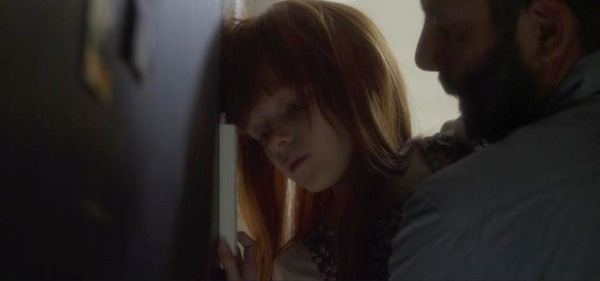
Emily Granin and Moshe Folkenflik share one of several touching moments in Redemption. (still from Redemption)
Redemption, which is called Geula in Hebrew, after the main character’s daughter, is a powerful film, the emotional impact of which builds up imperceptibly, such that you may only find yourself teary-eyed awhile after it has ended, when all the feelings it evokes finally reach the surface.
Co-directors and co-writers Joseph Madmony and Boaz Yehonatan Yacov grab viewers’ attention right away, with a lyrically and musically edgy song accompanying us as we follow Menachem through the streets to the drugstore, where he gets his photo taken – even though his attempts at smiling fail – then pausing to have a smoke before returning to his apartment to relieve the babysitter. Within the first five minutes, we know he is an awkward, sad, kind and generous Orthodox Jew, as well as an attentive, caring and loving father.
Other aspects of his life come into focus as he reconnects with his former friends and band mates, including his reason for reuniting them. Menachem’s 6-year-old daughter, Geula, needs expensive cancer treatments if there’s a chance for her to survive the cancer that killed her mother. Menachem, who works at a supermarket, needs the money that the band could make from playing at weddings.
The renewal of the friendships involves the reopening of some old wounds, and the men’s paths to healing are stories well told, though the film is mainly about Menachem, who, we find out, broke with the group when he became religious 15 years earlier. Moshe Folkenflik plays the widower with nuance, humility and depth, and Emily Granin as his daughter, Geula, captures the strong will, intelligence, bravery and fear of this young girl, playing with subtlety what could have been a maudlin role.
Redemption will be screened twice: Nov. 12, 8:45 p.m., at Fifth Avenue and Nov. 29, 8:45 p.m., at Inlet Theatre. [It will also screen as part of the Victoria International Jewish Film Festival on nov. 4, 1:30 p.m., at the Vic Theatre. For tickets and information to the Victoria festival, visit vijff.ca.]
– CR
Smiles and belly laughs
Nate Kroll, left, and Elliot Gould provide many laughs in Humor Me. (still from Humor Me)
Sam Hoffman’s resoundingly funny debut feature, Humor Me, imagines a well-appointed New Jersey retirement community as the setting for mid-life rejuvenation and resurrection. Neatly avoiding or flipping every cliché about seniors (cute, crotchety or flirtatious), the adult son-aging father dynamic and the theatre, Humor Me is a warm-hearted, flawlessly executed fable.
When his wife takes their young son and leaves him for a billionaire, talented-but-blocked playwright Nate Kroll (New Zealand actor Jemaine Clement) has to move out of their Manhattan brownstone and into the guest bedroom at his dad’s town house at Cranberry Bog. Bob (a note-perfect turn by Elliot Gould) is an inveterate joke teller, but his repertoire doesn’t work on a 40-year-old failed artist.
“Life’s going to happen, son, whether you smile or not,” he declares, a philosophy that the audience can embrace more easily than Nate can. If it contains a bit of Jewish fatalism, well, that’s Gould’s voice. So Bob’s jokes, which are consistently risqué and constructed with an ironic twist, have a faint air of the Borscht Belt about them. (It’s not a coincidence that Hoffman produced and directed the web series Old Jews Telling Jokes.)
There’s not a single stupid character in Humor Me, including Nate’s bland, successful brother (Erich Bergen), and this generosity of spirit means we’re always laughing with Nate’s foils, not at them. It helps immeasurably that Hoffman (best known for producing the TV show Madame Secretary) assembled a veteran cast – Annie Potts as Bob’s girlfriend, Le Clanché du Rand as a flirtatious senior and Bebe Neuwirth as a theatre heavyweight – that nails every last punch line and reaction shot.
Humor Me plays out the way we hope and expect it will, which is to say it delivers on its implicit promises. En route, it provides lots of smiles and several belly laughs. Even Nate, who’s well aware that he’s earned every joke that he’s the butt of, gets his share of one-liners. There’s plenty to go around, you see.
Humor Me is at Fifth Avenue on Nov. 14, 1 p.m.
– MF
For the full Vancouver Jewish Film Festival schedule and tickets, visit vjff.org.
Michael Fox is a writer and film critic living in San Francisco.
Left to right: Yitzhak Rabin, Yasser Arafat and Shimon Peres after the three received the Nobel Peace Prize in Oslo in 1994. (photo by Saar Yaacov via VIFF)
It’s almost painful to be reminded of how close Israelis and Palestinians were to achieving peace 25 years ago with the Oslo Accords. Yet, Mor Loushy, co-director of The Oslo Diaries with partner Daniel Sivan, hopes that the documentary inspires audiences to believe that peace is possible. After all, the impossible almost happened in the 1990s, so why not in the future?
The Oslo Diaries screens as part of the Vancouver International Film Festival, which runs Sept. 27-Oct. 12. The film is based on the personal diaries of the Israeli and Palestinian negotiators in the initially secret peace talks that unofficially began in 1992 in Oslo, Norway, after the late-1991 Madrid Conference – at that time, it was illegal for the two sides to communicate. Those meetings, which eventually became public and official, led to the signing of the Oslo Accords in Washington, D.C., in 1993.
The narrative of The Oslo Diaries comprises archival footage, reenactments and interviews, including the last interview former prime minister and president of Israel, Shimon Peres – who was foreign minister during Oslo and a signatory of the accords – gave in his life. It takes viewers through an abridged version of the negotiations and offers insight into the leadership and compromise that was needed to reach an agreement.
That leadership and the prospects for peace took a literally fatal blow when Israeli prime minister Yitzhak Rabin was assassinated on Nov. 4, 1995. Binyamin Netanyahu, who, the documentary shows, was fierce in his opposition to the peace accords – passionately addressing rallies at which supporters held signs calling for Rabin’s death – was elected prime minister in 1996. The documentary ends with the start of his victory speech: “Dear supporters, friends, the state of Israel is embarking on a new path today.”
The Oslo Diaries is the third film Loushy and Sivan have worked on together; Censored Voices and Israel Ltd. being the other two. The couple is based in Santa Monica, Calif., for a year, after which they and their two children, ages 3 and 6, will return to Tel Aviv. Loushy was born and raised in Tel Aviv and Sivan, born in Haifa, moved to Tel Aviv when he was 18. The Jewish Independent spoke to Loushy by phone recently, in advance of her arrival in Vancouver to participate in VIFF.
While The Oslo Diaries does an admirable job of attempting to present the material without commentary, the filmmakers’ political perspective does come through, in particular with Netanyahu being depicted as the bad guy, so to speak.
“First of all, we never hide our opinion,” said Loushy. “We’re from the left-wing, or part of it. We stand behind our views and, if someone from the right-wing would have made that specific film, it would have been a completely different one. But, what ‘film’ is about, I don’t think that there is an objective film. Every cut that I make in the film, it’s a decision. But, I think that it’s really more important for us to keep it balanced, and we fought a lot about it, we had a lot of discussions about it.”
Given the reactions she has received, Loushy said, “I think that this film is completely not right- and left-wing – this is a film about peace. And I do feel, from the screenings around the world, that it’s past this boundary of camps, on the one hand. On the other hand, in Israel, the situation is difficult: we are divided, there are camps … and our government is the most right-wing government that we ever knew. Every day, there is a new anti-democratic law that passes, and it’s frightening.”
About making the documentary, she said, “We’ve hit such a rock bottom that someone needs to stop for a moment, and it’s part of my duty as a civilian and as a filmmaker to say, OK, let’s talk…. We’ve forgotten about Oslo, and most of the people don’t even know the story behind the code name ‘Oslo.’ Let’s talk for a moment, let’s really see what happened there and what really was there – not from the news or from secondary sources, but from the first sources, the people that were there. Listen for a moment. What exactly happened there? What went wrong?”
She said people have forgotten about the negotiations and that reminding people about them will help. “It gives hope for the future,” she said. “We were that close, we can do it again, it’s not impossible. You just have to stop for a moment and think, what kind of future do we want to leave our children? Do we want the same, as in the present, a future of wars … so many people that are being killed every day, that’s what we want for ourselves? Or do we need a reminder for a second of the place we could have gone to, for the places we can get to? We just need a strong leader that’s going to take us there. And I think that this film does an incredible job of putting this discourse again on the table because, in the past three or four rounds of elections, the word ‘peace’ … [and the prospect of] ‘negotiation’ is no longer on the table, and this is such a crazy thing.”
When asked how much blame she attributes to Netanyahu for the breakdown of the peace process, Loushy said, “It’s a very complex answer because it’s not one answer. I think that he had a lot to do with the peace breakdown but he was not the only one. The people voted for him and, when people voted for him, they knew what they were voting for – it was obvious he was not going to continue with the peace process. So, I think it was the people and I think that, yes, he had an essential part, saying, ‘I believe in the holy grail,’ [in Greater Israel]. This is his belief, and I think he succeeded in that,” she said, citing figures indicating that the number of settlers has quadrupled since 1993.
Loushy said Netanyahu has claimed that “the West Bank is just a part of Israel, and [he] wants more and more settlements, [so] that also the left-wing people right now are saying, OK, how can we resolve it? That there is an unresolved situation because of the settlers.”
Both fanaticism and fear are contributing to the situation, she said, “although I do believe that most of the people want peace, believe in peace, [and] are just too scared to give it a chance.
“And that’s where this film comes in, saying, listen: first of all, the whole Palestinian leadership was interviewed for this film. I was a guest in Ramallah in all of the high places in the Palestinian leadership – there is a partner. He [Palestinian Prime Minister Mahmoud Abbas (Abu Mazen), who was also one of the signatories of the Oslo Accords, for the Palestinian Liberation Organization] wants to talk to us. He wants a solution. I believe it in all of my heart that the Abu Mazen government wants peace.
“So, there is the Palestinian leadership that was interviewed for this film, and I do believe there is a chance, but that people are just too scared and [the film’s purpose is to help people] to remember exactly what happened.”
While the filmmakers interviewed several Israelis who were involved, they could not get access to Netanyahu. “We wanted to [interview him],” said Loushy, “but Netanyahu doesn’t give any interviews to the press…. You see Yitzhak Rabin – in all of the archives, Yitzhak Rabin is giving interviews every other day… [Netanyahu] is connecting through Twitter, and that’s it. He doesn’t give interviews to the press.”
The Oslo Diaries premièred at the Jerusalem Film Festival and there have been screenings all over Israel, said Loushy, who noted the diversity of audiences, which have included secular and observant Jews. “This is amazing,” she said, to have people from both sides sitting together in the theatre. “People want the discourse, want to talk about it again. Of course, every screening, [when there’s] someone shouting at me, I know I did my job…. I made somebody think about something he hasn’t thought [about] before.”
The Jewish Independent is VIFF’s media partner for the Vancouver screenings of The Oslo Diaries, which take place Sept. 28 and 29, and Oct. 12. The documentary is a Canadian co-production, co-produced by Ina Fichman (Intuitive Pictures); Radio-Canada is also listed as one of the film’s sponsors. All of the post-production was done in Montreal, said Loushy, “and we loved it.”
For the full VIFF schedule and tickets, visit viff.org.
Danny Ayalon speaks at Trinity Western University on Aug. 30. (photo by Chloe Heuchert)
On Aug. 30, Danny Ayalon spoke at Trinity Western University. Ayalon, a former deputy foreign minister of Israel and former ambassador of Israel to the United States, is the founder of The Truth About Israel website. The event at Trinity was sponsored and co-organized by the TWU Alumni Association with Natalie Hilder, a former political aide at Parliament of Canada, who hosted and introduced the talk.
Ayalon’s presentation, Insights and Analysis of Israel and the Middle East, was thought-provoking. He described the outstanding issues and argued that peace could be attained if both sides would come together for a resolution. Throughout the interactive lecture, Ayalon mentioned Judaea and its importance in our modern day.
Ayalon has served as an advisor to three Israeli prime ministers: Binyamin Netanyahu, Ehud Barak and Ariel Sharon. In 2002, he was selected as Israel’s ambassador to the United States, a role he occupied until 2006, playing a significant part in the Road Map for Peace, a plan to resolve the Israeli-Palestinian conflict. He later became involved with Nefesh b’Nefesh, which facilitates aliyah by North American Jews, and then he joined the Yisrael Beiteinu political party, being elected as a member of the Knesset in 2009 and bein//g appointed as deputy foreign minister in Netanyahu’s government of the time; he wasn’t a candidate in the next election.
The lecture at TWU began with Ayalon explaining how Israel strives – and is obligated – to bring about peace. He spoke about the peace treaty with Egypt in 1979. President Anwar Sadat, he said, offered Israel an olive branch in 1977 by speaking at the Knesset to identify strategies for peace, which led to Israel’s decision to give up the Sinai Peninsula, an area almost three times the size of the state of Israel. Israel and Egypt have a mutual respect and fight together against Hamas and ISIS, said Ayalon.
Israel also made peace with Jordan, he said. The mid-1990s agreement gave Jordanians land and water and, today, the Israel-Jordan border is peaceful because the governments work together on certain matters, said Ayalon.
Not all peace discussions have gone according to plan, however, and Ayalon described the Oslo negotiations of the early 1990s and the 1993 agreement that was reached, but which was ultimately unsuccessful. The parties would meet again at Camp David in July 2000 and Ayalon was there. He shared some of his firsthand experiences from the discussions, recalling how Israeli prime minister Barak offered Palestinian Authority chairman Yasser Arafat Gaza and half of Jerusalem but to no avail. Ayalon also spoke about the unsuccessful attempt at peace that occurred in 2008 between prime minister Ehud Olmert and PA president Mahmoud Abbas. Again, he said, both sides could not come to an agreement even though Israel offered land.
Ayalon said the ways in which Israel strives for peace are not broadcast on the news, but are, instead, ignored in a way. The major headlines are about Israel’s alleged war crimes, he said, but this not the truth. Israelis fear for their lives every day, he said, because of the bomb attacks and other hostile actions of Hamas, who use their own people as human shields.
“There are 22 Arab countries and Israel is one state, and makes up only [a miniscule part] of the entire Middle East,” said Ayalon. “This is not a war about territory or natural resources but of elimination and extinction.”
When it comes to the United Nations, Israel is outnumbered. There are 193 member countries, with 120 voting against Israel, he said. While some of these countries are bowing to the pressure against Israel in order to keep themselves safe, Ayalon said the result is that many resolutions against Israel are made by the UN, so that Israel has little chance on the international front.
He went as far back as UN Resolution 181 in 1947, which called for the partition of Palestine into Jewish and Arabs states. The Arabs rejected the agreement and denied that Jews had any right to the land. To this day, Ayalon said, Palestinian schools use their curriculum to teach children that Israel is theirs. He said, in order for peace to become a real possibility, the truth must be established – curricula, media and the way in which children are brought up need to change before peace can be achieved.
Chloe Heuchertis a fifth-year history and political science student at Trinity Western University. She was involved in the early stages of the planning for the lecture.
Lili Tepperman is one of five kids featured in Beauty. (photo from NFB)
It’s fine to be who you are,” says Bex Mosch, who turned 9 years old last year, when Beauty was released. Since the age of 3, Bex – formerly Rebecca – says he has known that he is a boy. He and the other “gender-creative” kids interviewed in Christina Willings’ 23-minute documentary have been forced by circumstances to become more mature than most kids their age. And they have more nuanced views on what it means to be human than many adults.
Beauty has its local première during the Vancouver Queer Film Festival’s first short film program, called The Coast is Genderqueer, which takes place Aug. 17. In addition to Bex, Fox Kou Asano, Milo Santini-Kammer, Montreal Jewish community member Lili Tepperman and Tru Wilson are interviewed. Interwoven with the interviews, footage of the kids being kids and meeting their families briefly, parts of Beauty are animated. These illustrations depict some of the kids’ favourite interests and tie together some of their common experiences. None of the parents is interviewed.
“In a way, the concept of this film came to me in the early ’80s,” says Willings in an interview on the NFB media site. “I was thinking a lot about the deconstruction of gender at that time, as were many others. We examined it from every angle, but what’s new now is that it’s children who are leading the conversation, who are saying, ‘Hey! Something’s wrong here!’ Some compassionate, and I would say enlightened, parents are hearing them. The new conversation isn’t ideologically driven, it’s experiential, and there’s a profound purity about that. It’s a breakthrough that I have felt very moved and honoured to witness and, by 2012, I realized this shift was going to be the subject of my next film.”
All of the five interviewees have had to face serious challenges, from being laughed at to being bullied. And, of course, they have had to talk with their parents about how they see themselves, versus how their parents initially viewed them.
“Sometimes, it’s easy to think it would be less stressful just to fit in,” says Lili in the film, “but then I’m not really being myself, and I find that’s an important part of living life because, if everybody’s trying to be like everybody else … it doesn’t make any sense to me.”
David Hare’s Wall purports to have complexity it doesn’t. (image from NFB)
Another NFB film being screened in Vancouver next month is Wall, which is based on British playwright David Hare’s 2009 monologue on the security fence/wall between Israel and the Palestinian territories. Wall is not the first extended exploration of the Israeli-Palestinian conflict for Sir David, who was knighted in 1998. Written in 1997, his Via Dolorosa monologue premièred in London in 1998.
The film Wall has been a long time in coming. According to the NFB media site, in 2010, NFB executive producer and producer David Christensen “had a three-hour drive ahead of him when he chanced upon a podcast of Wall.”
“‘Listening to David Hare’s take on this wall Israel had put up gripped me visually,’ recalls Christensen.
“Riveted by Hare’s reframing of the issue and struck by how he could visualize the piece as an animated film, Christensen immediately called his producing partner Bonnie Thompson, who had the same reaction he did upon listening to Hare’s piece.
“‘For many of us, the issues around the Middle East, Israel and Palestine are complex and polarizing,’ says Thompson. ‘We thought making an animated film was a way to better understand this wall.’”
Canadian filmmaker Cam Christiansen is the animator who brought the concept to life visually, using 3-D motion-capture footage and other “cutting-edge animation tools.”
Wall has been the official selection of six film festivals to date, so it has captured critics’ imaginations. However, most Jewish community members will find it hard to watch, as Hare pays lip-service to the complexity of the situation but never veers very far away from blaming Israel for pretty much everything. When he says, “words become flags. They announce which side you’re on,” anyone with a basic knowledge of the Israeli-Palestinian conflict only has to look at the title of this work to know on which sides he falls. But then he goes on for 80 minutes about it.
There are a few instances when Hare seems about to offer the Israeli side, or at least condemn Hamas, but then he retreats. When he is told about a Hamas torture tactic, he is at first repulsed but then suggests it’s a metaphor for how Palestinians must feel at the hands of Israel. When he sees a poster of Saddam Hussein in a Ramallah café, he wonders about the appropriateness of such a man as a hero but then concludes it’s OK because Israel put up the wall, after all. And, then there’s his exchange with a Palestinian who says that Britain is to blame for all the problems: “Of course it’s your fault. The British were running Palestine in the 1940s. When they ran away and left everything to the Israelis, they didn’t care what happened to everyone else. There was a life here – a Christian life, a Muslim life, a Jewish life – and that life was destroyed.”
This ridiculous statement – and so many others – is not only left unchallenged by Hare or any of the filmmakers, but gets nods or words of understanding. With Israeli novelist David Grossman as the predominant voice defending or explaining Israel’s motivations and actions in Wall, most Jewish movie-goers will know before seeing it just how limited are the views expressed in this film, no matter what complexity it proclaims to convey.
Wall screens four times between Aug. 17 and 21 at Vancity Theatre. For tickets, visit viff.org.
Last week, thousands were on the streets of Tehran for Al-Quds Day events, which consist of calling for the annihilation of Israel. Parallel events were held in other cities, including London, England, where Hezbollah flags flew amid posters bearing modern blood libels, and in Toronto, where a speaker called for the “eradication” of Israelis and Zionists.
Also difficult to ignore are the realities of the incendiary kites being sent over the border from Gaza affixed with flaming tails or petrol bombs. Some international observers have dismissed the incidents, contrasting the Gazans’ unsophisticated arsenal with Israel’s contingent of fighter jets and advanced weaponry. But Israeli firefighters report that 741 acres of forest and 4,500 acres of agricultural land have burned in the past two months thanks to at least 285 individual kite and helium balloon attacks. An estimated 500 kites have been intercepted before they could do damage. Experts say return of flora and fauna in affected areas will take years.
The ongoing hostilities at and near the Gaza border are the latest in the ongoing conflict that keeps the world’s attention focused on the region.
That attention turned to the world of soccer recently. A planned game between the Israeli and Argentine national teams was cancelled after pressure from the movement to boycott, divest from and sanction Israel (BDS).
On social media, the BDS movement profusely thanked the Argentine team for cancelling the match. But the president of the team acknowledged it was not political considerations, but safety concerns, that led to the cancellation. The team – and specifically its megastar Lionel Messi – received threats of violence. As well, at the team’s practice facility in Barcelona, protesters waved Argentine soccer jerseys daubed with fake blood, and it wasn’t clear whether the blood was meant to symbolize Palestinians who have died or Argentine soccer players who might have been harmed if the game had been held as planned and the threats been realized.
There has been a shift from peaceful protest – that was the phrase repeatedly invoked about the conflagrations at the Gaza border – toward overtly violent rhetoric, threats and actions by Israel’s adversaries, who are both literally and figuratively “playing with fire.”
Nonviolent pressure, which is what BDS has claimed to advocate, is a tactic that could, one never knows, lead to some peaceful resolutions. But destroying farmland, endangering children, threatening people with harm and inciting genocide will only lead to more violence.
For weeks since March, each Friday, thousands of Gazans have rallied at the border with Israel, leading to violent confrontations with the Israeli military. The objective is to build up to an incursion of such proportion that Israel’s military is unable to prevent an invasion into Israeli territory. The stated goal of the so-called March of Return is to catalyze the movement toward a “right of return,” which would have the not coincidental consequence of demographically threatening the Jewish nature of Israel.
Of course, even tens of thousands of Palestinians trying to breech the border will not result in this goal. Instead, there is an unstated goal: Hamas seeks to turn global opinion (further) against Israel. Shamefully, it seems that a few dozen Palestinian lives is a small price to pay, in Hamas’s worldview, for the PR benefits they deliver. As the New York Times reported Sunday, at least some of the protesters believe that they have nothing to lose. “It doesn’t matter to me if they shoot me or not,” said a 22-year-old protester interviewed by the paper. “Death or life – it’s the same thing.” That attitude will suit Hamas just fine.
To overseas audiences, march proponents depict it as an unarmed, peaceful, civilian-led mass action – and a peaceful protest is something we could accept, if not agree with. However, evidence shows that it is stage-managed by Hamas and anything but peaceful. Flying swastika-festooned kites with petrol bombs are sent over the border, massive tire fires are set to obscure the view of Israeli soldiers and tug-of-war lines are formed to pull down the border barrier, while crowds simultaneously hurl projectiles. At this past weekend’s action, there were reports of a few protesters armed with pistols.
Writing in the Times two days earlier, Fadi Abu Shammalah, executive director of the General Union of Cultural Centres in Gaza and a documentary film producer, insisted that he loves life, but that he is prepared to risk it to give his children a future with dignity.
A more effective means to ensure that Palestinian children live a life of dignity would be for Shammalah and others like him to write opinion pieces in the New York Times and to agitate elsewhere for the Hamas leadership to abandon both violence and their refusal to live in coexistence with the Jewish state. These are the two prerequisites to Palestinian self-determination. But such actions could well get Shammalah and others killed faster than marching against the border with Israel.
A sovereign country has the fundamental right to protect its borders from invasion. Ideally, this could be achieved without the use of live ammunition, and should minimize casualties as much as possible. Killing unarmed protesters is not acceptable.
Exclusively blaming Israel, however, is unjust. But this is more than misplaced blame: it has the precise consequence of rewarding Hamas’s strategy of sacrificing its own citizens. The more world media and activists condemn Israel and reward Hamas, the more Palestinians will be pushed toward the border. In such a scenario, the blame lies not solely with Israel or even with Hamas. The blame must be shared by these overseas enablers who, by rewarding Hamas, truly deserve part of the responsibility for the deaths and injuries.
Women and their allies across North America marched last Saturday in a massive show of feminist and progressive activism. It was the second annual such event, the first one coming the day after U.S. President Donald Trump’s inauguration last year.
At the Los Angeles Women’s March, actor Scarlett Johansson, who is Jewish, told the audience that she became part of the movement because she felt a rage in her on behalf of women who have been abused and because of things that have happened to her in the past.
“Suddenly, I was 19 again and I began to remember all the men who had taken advantage of the fact that I was a young woman who didn’t yet have the tools to say no, or understand the value of my own self-worth,” Johansson said.
Johansson’s experience is one of millions that have been shared in recent months since the advent of the #MeToo movement. But it was a message that was not heard by all.
Because Johansson was scheduled to speak at the event, Palestinian women’s groups boycotted it. One group accused Johansson of “unapologetic support of illegal settlements in the West Bank.”
The Palestinian groups’ complaint, ostensibly, is that Johansson was a spokesperson for SodaStream, which produces an at-home beverage carbonation system. The fact that SodaStream was based in Maale Adumim, a West Bank Jewish settlement, made it a target for BDS, the movement to boycott, divest from and sanction Israel.
The Palestinian American Women’s Association declared: “While her position may not be reflective of all organizers at the Women’s March Los Angeles Foundation, PAWA cannot in good conscience partner itself with an organization that fails to genuinely and thoughtfully recognize when their speaker selection contradicts their message.”
In a free country like the United States, anyone is free to boycott anything. The Palestinian women’s groups were fully within their rights to stay home. But the idea that Johansson was not a legitimate voice to be heard at the rally because she does not condemn Jewish settlements in the West Bank is a bit of a stretch.
If Johansson’s association with SodaStream was the real reason the Palestinian groups stayed home, as they say it is, it presents an opportunity to reflect on a bit of recent history. In one of their few successful campaigns, BDS managed to force SodaStream to close its West Bank plant, causing unemployment for 500 Palestinians who had worked there. Some achievement.
However, something potentially more significant may be afoot, which has nothing to do with SodaStream or settlements at all.
The Palestinian movement is trying to co-opt the progressive and feminist movements in the name of a nationalist movement that gives no indication that it would, if successful, reflect anything like what North Americans would consider a progressive or woman-friendly independent country.
One of the things that progressive people have come to accept, with much thanks to #MeToo, is that intent sometimes matters less than impact. We have come to accept, for instance, that what a man might call “persistent flirtation” can be experienced by women as coercion, intimidation or worse.
Palestinian groups – and the progressive and feminist groups they infiltrate – should be conscious that what is intended as criticism of Israel, whether they like it or not, impacts on Jews. Of course, not all Jews are Zionists. Nonetheless, when you attack Israel, Jews feel it.
Consider from where we’ve come. A few short years ago, most “pro-Palestinian groups” insisted they didn’t oppose Israel’s existence, they were merely criticizing certain policies of the Israeli government. Now, it is extremely common for people to express outright antipathy to Zionism. Indeed, Zionism is a dirty word among many of the people who organized and participated in the marches last weekend. This is a far step from criticizing certain policies. To oppose Zionism is to oppose the existence of a Jewish state.
The Palestinian movement is trying to kick the Zionists (and that includes most North American Jews) out of the progressive and feminist movements. Is that OK with progressives? Is that OK with Jews?
If both sides don’t do something about it, Zionists and Jews are going to have a sworn enemy on the left and the left is going to be known as a no-go zone for Jews and Zionists. Who thinks that’s OK?
Jewish Voice for Peace held a discussion on antisemitism recently at the New School in New York City and the panel included Linda Sarsour, whose associations and opinions, particularly about Israel and Jews, are controversial.
The school defended its choice by saying that there are “differing views on the issue of antisemitism,” a Trumpian formulation on par with the idea that there are good people on both sides of every issue.
Sarsour, a daughter of Palestinian-American immigrants, rose to national prominence as a co-chair of the Women’s March earlier this year and was dubbed by Politico as “the face of the resistance” to Donald Trump.
She is also highly controversial. When she got into a public spat with ex-Muslims Ayaan Hirsi Ali and Brigitte Gabriel, Sarsour tweeted, “I wish I could take their vaginas away – they don’t deserve to be women.” (Hirsi Ali was subjected to female genital mutilation at the age of 5 in her native Somalia.)
Sarsour is particularly opinionated about Israel. She claims that Israel has a right to exist, but does so in the context of a “one-state solution” that would eliminate Israel’s Jewish identity. She supports the boycott, divestment and sanction movement and has defended sharing a stage with Rasmea Odeh, a terrorist involved in murdering two Israelis and wounding nine others. She has tweeted that “nothing is creepier than Zionism” (nothing?!) and said it is not possible to be a Zionist and a feminist.
So it was a point of contention when Sarsour was invited to join a panel on the subject of antisemitism. Yet Sarsour has something to say that everyone should listen to closely.
She says that antisemitism is “different than anti-black racism or Islamophobia because it’s not systemic.” As one commentator noted, what was more “systemic” than the Holocaust? But Sarsour was making a legitimate case: Jews in 21st-century North America do not suffer systemic economic disadvantage due to their Jewishness. Jews are no longer precluded from housing, universities or any place in the public realm because of their identity. Jews are not randomly pulled over and shot by police. Jews do not experience lower wages or lesser positions of employment because of their identity.
Antisemitism isn’t routinely expressed in the same ways as most other common forms of prejudice and discrimination. However, this doesn’t mean it doesn’t exist or should be dismissed.
Whether left, right or centre, most of us now accept an economic definition of discrimination: lower standards of housing, employment, opportunity and outcome. But antisemitism doesn’t manifest in these ways. However, it can manifest in hate speech, attacks on synagogues and other Jewish institutions, and physical assault. It can lead to genocide, as it has within the memory of the living generation. It can result in the ethnic cleansing of Jews from almost every Muslim-majority country on earth over the course of a couple of decades.
So, antisemitism is not a benign force, even if it does not fit the parameters we now widely use to identify and measure discrimination. In fact, it is, in itself, a form of discrimination to ignore the uniqueness of antisemitism.
Antisemitism can also take the form of a movement to eradicate the national homeland of the Jewish people. There are reasons to criticize Israel, but to argue that Jewish people are the only people in the world not deserving of national self-determination is problematic.
At the heart of the anti-Zionist movement is an imagined firewall between antisemitism and even the most extreme condemnation of Israel, including calls for it to be eliminated. It is fair to make the case that criticism of Israel is not necessarily influenced by anti-Jewish animus. But this is not the case being made by people like Sarsour. Their position is that there is effectively no connection at all between anti-Zionism and antisemitism and that any suggestion of a connection is a strategy to “silence” or discredit criticism of Israel.
The idea that opinions, stereotypes or prejudices about Jews play no role in perceptions of the Jewish state is unreasonable. If there is anything that should cause skepticism toward Sarsour and those like her, it is the stalwart refusal to even consider the presence in their worldview of prejudice about Jews. If any other group of people in the world so much as suggested that they were affected by bigotry or discrimination, people like Sarsour would take these concerns seriously. When Jews make this suggestion, it is rejected outright and labeled a ploy to win a political argument. This, in itself, speaks volumes.
Yael Deckelbaum is using her musical talents and connections to help Israelis and Palestinians press for peace. (photo from Yael Deckelbaum)
Yael Deckelbaum is using her musical talents and connections to help lead thousands of Israeli and Palestinian women to peacefully press for the end of the fighting between their two peoples via March for Hope.
Deckelbaum’s celebrity status in Israel and around the world – through performances with known local artists and bands such as Shlomo Artzi and Machinah, as well as her career with Habanot Nechama and solo albums – helps draw a crowd. Her involvement in the cause began when she joined forces with Daphni Leef, an Israeli activist for social justice.
“I’d sit with her and tell her she’s a better person than I am,” said Deckelbaum. “She was always talking about how we have to change things in Israel – going around in many places in Israel, meeting people, listening to them and trying to learn … what’s wrong and trying to fix things. I decided to take a caravan, go through Israel, sell CDs, maybe bring a sound system, perform … see people from a different angle. Daphni decided to join me. From this idea, it became 20 people, two caravans … a journey we did for 45 days in 40 different places across Israel.”
They met many Israelis from various cities and villages, and Deckelbaum gained a new perspective. Everywhere they went, she would sing and Leef would speak to the people after every show.
“That’s when I decided I would dedicate myself, using music as an instrument, toward change … not just be an instrument for supporting my existence … but to spread a message and how I believe this world should be. [It] was a big turning point in my path,” Deckelbaum told the Independent.
A year later, one of Deckelbaum’s friends shared an email about Women Wage Peace.
“A lot of times, us musicians, we get invited, we go, sing and leave,” said Deckelbaum. “We feel good about it. But, this time, I felt like I had to meet them. A few days later, I was sitting at a table with women from Women Wage Peace. They told me about this march they were planning – a group of mothers who, in the period of military operation, were experiencing terror at home, fear … mothers sitting at home, knowing their sons are somewhere and not knowing if they’d come home from war.
“One of the founders told me she said to herself that she would never forget this feeling of terror, that she can’t sit anymore and do nothing about it. She urged us to do something radical, extreme, because something had to change. She couldn’t live with the feeling of helplessness anymore.”
At one point, Women Wage Peace fasted for 50 days outside the prime minister’s house, demanding a mutual agreement between Israel and Palestine be made.
“They told me they were already connected with Palestinian women who feel the same,” said Deckelbaum. “And then, on Oct. 19, 2016, 1,000 Palestinian women marched with us together in the Dead Sea [area] – the lowest place of the earth. I started to cry, as it touched me in a deep place.
“Many years ago, I had this vision of women marching together … not something I can explain…. Then, I met these women [who] told me about this, and it was coming true. And, it has an energetic meaning that it happened in the lowest place on the earth – women marching to the belly of the earth. So, I cried and offered to give my music to the cause.”
Deckelbaum invited more artists to join and sing, and became the march’s artistic director. She began with songs like “Give Peace a Chance” and “Hallelujah,” and then wrote originals herself. “The melody and the lyrics just came,” she said. “And the ‘Prayer of the Mothers’ was born, directed by Astar Elkayam.”
Deckelbaum was inspired by a message that had been sent to march organizers by Leymah Gbowee. Gbowee is a Liberian woman who led a women’s peace movement, which helped bring an end to the Second Liberian Civil War in 2003, after 13 years of fighting.
“I felt something very real is happening, that I have a chance to do this,” said Deckelbaum. “I put it into the song clip, so you can hear her speaking. And she sang, ‘As the world we live in, peace is possible / Only when women of integrity and faith stand up for the future of their children.’”
This year, Women Wage Peace planned a second march, dubbed, “The Journey to Peace,” which started in the south of Israel near the Gaza border on Sept. 24 and ended in Jerusalem. Other events have followed, and will continue, throughout Israel. The peak of it was on Oct. 6 in Jaffa/Tel Aviv, with a march that Deckelbaum helped organize, “colourful with dancers, musicians, and drummers – happy and hopeful,” she said.
On Oct. 8, there was an event in the desert with Palestinian women. The previous year, 1,000 Palestinian women came. This year, there was twice that number, and the hope is that, each year, it will grow.
“These are the miracles we’re all waiting for – peace between Israel and Palestine, and between and within ourselves and amongst us as people,” said Deckelbaum. “Women Wage Peace isn’t only about making peace with Palestinian women. It’s about making peace between all kinds of women in our society and different places.”
Deckelbaum learned there is a global women’s revolution. She heard of a march in Washington, D.C., in which she participated, and another in Zurich, at which she was invited to sing.
After the video of “Prayer of the Mothers” was released, more marchers all over the world were set into motion. Deckelbaum is now working on a project called Women of the World Unite.
“I believe that women from all over the world are sharing this message, a hope for peace – a message that’s inclusive of all human beings,” she said. “We need women to be more involved in managing the ways of the world – not only by raising children, but also by engaging in the system and how things will work.”
The Jewish Independent spoke over the phone with Deckelbaum when she was in Switzerland doing concerts with an ensemble of religious and secular Jewish, Muslim and Christian women called Prayer of the Mothers Ensemble. It involves 14 women, carrying the message of female empowerment, revolution, evolution and peace.