Skip to content
  • Home
  • Subscribe / donate
  • Events calendar
  • News
    • Local
    • National
    • Israel
    • World
    • עניין בחדשות
      A roundup of news in Canada and further afield, in Hebrew.
  • Opinion
    • From the JI
    • Op-Ed
  • Arts & Culture
    • Performing Arts
    • Music
    • Books
    • Visual Arts
    • TV & Film
  • Life
    • Celebrating the Holidays
    • Travel
    • The Daily Snooze
      Cartoons by Jacob Samuel
    • Mystery Photo
      Help the JI and JMABC fill in the gaps in our archives.
  • Community Links
    • Organizations, Etc.
    • Other News Sources & Blogs
    • Business Directory
  • FAQ
  • JI Chai Celebration
  • JI@88! video

Recent Posts

  • Sharing her testimony
  • Fall fight takes leap forward
  • The balancing of rights
  • Multiple Tony n’ Tina roles
  • Stories of trauma, resilience
  • Celebrate our culture
  • A responsibility to help
  • What wellness means at JCC
  • Together in mourning
  • Downhill after Trump?
  • Birth control even easier now
  • Eco-Sisters mentorship
  • Unexpected discoveries
  • Study’s results hopeful
  • Bad behaviour affects us all
  • Thankful for the police
  • UBC needs a wake-up call
  • Recalling a shining star
  • Sleep well …
  • BGU fosters startup culture
  • Photography and glass
  • Is it the end of an era?
  • Taking life a step at a time
  • Nakba exhibit biased
  • Film festival starts next week
  • Musical with heart and soul
  • Rabbi marks 13 years
  • Keeper of VTT’s history
  • Gala fêtes Infeld’s 20th
  • Building JWest together
  • Challah Mom comes to Vancouver
  • What to do about media bias
  • Education offers hope
  • Remembrance – a moral act
  • What makes us human
  • המלחמות של נתניהו וטראמפ

Archives

Follow @JewishIndie
image - The CJN - Visit Us Banner - 300x600 - 101625

Tag: Israeli-Palestinian conflict

Two states viable

Two states viable

Gershon Shafir was in Vancouver Nov. 9 to discuss some of the issues he raises in his latest book, A Half Century of Occupation. (photo from pages.ucsd.edu/~gshafir)

What does it mean to have a “permanently temporary occupation” in Israel? Gershon Shafir was in Vancouver Nov. 9 to discuss this question. A guest speaker at Simon Fraser University’s School for International Studies, Shafir is an Israeli expat, University of California, Los Angeles, sociology professor and author of the recently released book A Half Century of Occupation: Israel, Palestine and the World’s Most Intractable Conflict.

It’s the 10th book for Shafir and he wrote it specifically for the 50th anniversary of the 1967 war. The permanently temporary occupation is a difficult subject to discuss, he said.

“That’s because the existence of this phenomenon – that Israel is an occupying power – is denied. But what’s going on is an occupation and is considered to be so by the Israeli government itself when arguing in front of the country’s Supreme Court, the international community and the Palestinians that live under it.”

Shafir said the word occupation is a legal term referring to the effective control of a country on a territory over which it has no sovereignty.

“Israel’s occupation is one of the longest belligerent occupations since World War Two and it’s truly exceptional because it’s going into its third generation,” he told the Independent. “In my book, I look at the nature of the occupation, the role played by the Israeli state through settlement, and radicalization by religious settlers. I also study the feasibility of alternative solutions.”

Prior to 1948, Jewish settlement occurred in areas that were least densely populated by Palestinians, allowing the possibility of a separation between the two groups. “But religiously motivated settlers prefer to have their new settlements in the heartland of the most densely populated Palestinian areas, so the settlement process has been radicalized,” said Shafir.

In his lecture, and in more detail in his book, Shafir discussed the extent to which the occupation has transformed the Israeli-Palestinian conflict. As part of his book, he conducted a study that found the built-up area occupied by Israeli settlements is two percent of the West Bank and the demographic ratio of Israeli Jews to Palestinians is 1:7. He questions the widespread consensus that a territorial partition of Palestine and a two-state solution is no longer possible.

“I’ve carefully counted the number of settlers and the places where they reside, and I’ve subdivided settlement into different categories. What you discover is that if you remove 27,000 settlers in the West Bank, a land exchange is possible, as is a territorial partition and a Palestinian state,” he said. “People who say a two-state solution is impossible don’t sufficiently study the feasibility of a one-state solution.”

Shafir added that he’s not advocating a political position in his findings. On the contrary, he’s just suggesting that, based on his research, a two-state solution is still feasible. “Let’s not give up on that idea too soon, because we don’t know what we’ll be walking into,” he advised.

The lecture at SFU was part of a book tour in which Shafir spoke on university campuses in Boston, Seattle, New York and Los Angeles. Shafir comes to this topic with years of pedigree. He was president of the Association for Israel Studies in 2001-2003, and the books he’s authored include Land, Labor and the Origins of the Israeli-Palestinian Conflict, 1882-1914, Being Israeli: The Dynamics of Multiple Citizenship (co-authored with Yoav Peled), which won the Middle Eastern Studies Association’s Albert Hourani Award in 2002, and Struggle and Survival in Palestine/Israel, a collection of life histories, which he co-edited with Mark LeVine.

Lauren Kramer, an award-winning writer and editor, lives in Richmond. To read her work online, visit laurenkramer.net.

Format ImagePosted on November 17, 2017November 15, 2017Author Lauren KramerCategories IsraelTags Gershon Shafir, Israeli-Palestinian conflict, occupation, peace, two-state solution
A novel born of heartbreak

A novel born of heartbreak

Nathan Englander will be in Vancouver on Oct. 22 to discuss his latest novel, Dinner at the Center of the Earth, at a salon hosted by the Cherie Smith JCC Jewish Book Festival. (photo from Cherie Smith JCC Jewish Book Festival)

You won’t have to travel to the centre of the earth to meet award-winning, bestselling American author Nathan Englander. On the afternoon of Sunday, Oct. 22, he will be in Vancouver for a writers salon hosted by the Cherie Smith JCC Jewish Book Festival.

The Jewish Independent spoke to Englander by phone last week. He had just arrived in Seattle by train, his flight there having been canceled. In the midst of a tour for his latest novel, Dinner at the Center of the Earth (Alfred A. Knopf, 2017), he spoke to the JI between back-to-back events.

Englander’s novel is a compelling read in which he explores the Israeli-Palestinian conflict via five characters. To simply quote from the publishers, who sum it up succinctly: “A prisoner in a secret cell. The guard who has watched over him a dozen years. An American waitress in Paris. A young Palestinian man in Berlin who strikes up an odd friendship with a wealthy Canadian businessman. And the General, Israel’s most controversial leader, who lies dying in a hospital, the only man who knows of the prisoner’s existence.”

Each of these characters is fascinating, and Englander displays a remarkable talent for being able to put himself inside people’s heads, to clearly and realistically explain their feelings, their motivations. The characters both set events in motion and are carried along by events out of their control. One of the main characters, “the General,” lies in a coma and yet Englander fully develops him as a living, breathing human being.

The General is obviously based on former Israeli prime minister Ariel Sharon, who died in 2014 after having been in a coma since 2006. Englander’s character is a large man, he has been in a coma for years, he once ruled the country and was a tough, controversial military figure (“an unrelenting warrior”), his wife was named Lily, one of his sons was shot and killed, etc., etc. Nonetheless, Englander was adamant that the character not be seen as Sharon, but as “inspired” by him.

Englander said he knew people would come “locked and loaded with [their] politics to this story…. I thought it was really important that, wherever the parallels are [from] one reality to my fictional reality, that my general be his own character … so that I could fully empathize and fully get into his head. Even for me, I needed to build my own person, whatever the warring personal parallels are.”

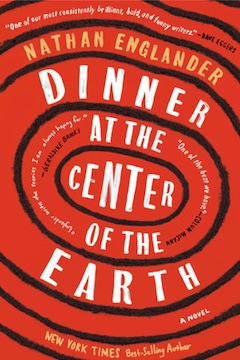
book cover - Dinner at the Center of the EarthReading Dinner at the Center of the Earth, one does get the impression that Englander was trying to sort out his own views about the conflict, rather than make any pronouncements or come down on any particular side.

“It was imperative to me that this not be didactic and not be a big lecture,” he said. “I have a 500-page version of the book that I cut in half. I just wanted it to be story-driven and character-driven, for people to be able to enter into the discussion or to reflect on where they entered the book and where they left it, on their own positions.”

For his part, he said he’s learned a lot about the book from being on the road. One of his first tour events was with fellow writer Jonathan Safran Foer, who commented on the parallels between the dinner of the book’s title and a dinner that takes place between the guard and the prisoner; an aspect that Englander hadn’t considered. “I wish I had been smart enough to consciously think of it,” he said, “but the subconscious takes care of that for you.”

While Englander insists that “there’s no position in this book,” one woman, after a tour event, argued that it takes “a position on peace,” that it’s hopeful about the prospect. From this and other exchanges, Englander admitted, “I really do believe that the more it [peace] seems impossible, the more I believe we have to make it possible.” But, he said, about writing any messages into the book, “I can’t tell you how much of it was conscious intent versus subconscious work. For me, all my conscious intent was this idea of it to land on no side, for us to explore.”

For Englander, two lessons learned from being a reader himself helped shape this novel. One is that a well-functioning book represents a shared experience between an author and a reader. “I used my brain to write it and then there’s this physical thing that you can pick up and read,” he said, and so, in writing Dinner, he fought “against all punditry and ‘mansplaining’ and lecturing and … didactic” inclinations.

The other aspect he keeps in mind while writing, he said, is all the unanswered questions he had as a boy growing up in a religious environment. “It’s the books where people were brave enough to wrestle with the questions that changed me. All of the books that changed my life, that saved me, none of them had answers, they just were by authors who truly were willing to wrestle with terrifying questions. So, for me, I really wanted to structure this [novel] to swing back and forth and back and forth…. I wanted to mirror the circles of the conflict, these unending cycles.”

The story of Dinner at the Center of the Earth had been percolating since Sharon became prime minister of Israel in 2001. About the Second Intifada and Sharon’s election win, Englander said, “That was my first adult political heartbreak of that size…. All those years of work [on peace], it was right there.”

The more distant we get from peace, he said, the more “you may think it’s impossible, but it was really right there for the taking. I just couldn’t shake it. I was desperate to explore this unending conflict. So, yes, it may be just the tiniest glimmer of optimism [in the novel] but I do think it’s optimistic in the end, however dark some of the turns are.”

He hasn’t been writing the novel for 16 years, of course. He had the idea and needed a structure for it, which he found on his last book tour, while in Israel. The front page of the newspaper he was reading had a story on “Prisoner X, this Australian guy [who had a life] so similar to my life in a lot of ways – maybe he got more Zionism and I got more Bible but [he was] a religious, Anglo Jew who ends up moving to Israel.” This man not only “adopted an ideology” but joined Mossad, did “scary deep undercover stuff and then becomes a traitor.” His situation made Englander wonder, “What would it take to flip someone for empathy, out of feeling for the other side? That’s what would interest me,” so Prisoner X became Dinner’s Prisoner Z.

The other notion about Prisoner X that intrigued Englander was that the public only found out about Prisoner X’s existence after the man hanged himself. “He only lived in the moment he died, and there was no X and no cell until the moment he hanged himself.”

Englander’s imagination seems to know no bounds. His stories and novels are set in various countries (Russia, Israel, United States, Argentina, to name a handful) and his characters range from an Orthodox rabbi who supplements his income by being a mall Santa Claus – one of the many people readers meet in Englander’s first book, the collection of short stories For the Relief of Unbearable Urges (Alfred A. Knopf, 1999) – to the General of Dinner, his fourth book. Englander is also working on a second play because, he joked, with 10 years between his first and second book, he had to tell people he “wrote book” for a living and, since his first play in 2012, he’s been writing “books and play.”

One theme that runs through all his work, regardless of form, topic or setting, he said, is that they explore “grey space, or Schrödinger’s cats, multiple realities.”

“As the books go by, I see that I’m clearly … obsessed with this grey space, which I think is probably from having a black-and-white education and growing up in a black-and-white reality,” he said. “Especially now, I can’t understand people who can’t see the other side.”

By way of example, he said, “I learned that in Israel, where I was a Jew living in Jerusalem, whose holy site was the Temple Mount … it became clear to me this wasn’t a disagreement, or something on a spectrum, that my Palestinian neighbour, she is living in Al-Quds and Haram al-Sharif is her holy site. We were living in the same physical space but in literally separate realities.”

This is also the case in the United States now, he added. “There are regular citizens that, because of the dual realities we now have here … you could show them two pictures of an inauguration, one with more people and one with less, and you’d have regular folks say, yes, the picture with less people has more people in it. That’s not an opinion, that’s inhabiting a different reality.”

Human beings can make anything happen, said Englander. “We’ve sent people to the moon and brought them back,” he said, and our cellphones have far more power than did any Apollo mission. So, you want to make peace? “Everyone knows the math there. Don’t anybody pretend they don’t know who’s going to trade what. There are some very minor, tweakable things. Don’t tell me everybody doesn’t know what they need to do to make that peace happen tomorrow, if they wanted it to happen.”

Englander immerses himself in his work. For The Ministry of Special Cases (Alfred A. Knopf, 2007), a novel about Argentina’s Dirty War, he did years of research. “You need to own that world,” he said, in order “to drop my own ministry on top of that city [Buenos Aires].” He said it is akin to being an artist in, say, Cubism: “You need to know how to paint before you can put both eyes on one side of the face.”

With Dinner at the Center of the Earth, Englander said he was returning to familiar ground, which required much less research.

“I’ve had so many different sides of the experience, from the Jerusalem of the Bible that I had my whole life, to living in Israel in the First Intifada to getting a degree in Judaic studies to living in Israel for another five years, to watching the news a million hours a day to reading the papers.” He’s also on the faculty of New York University, which has taken him to cities like Paris and Berlin, both of which are integral places in his latest novel. “I was very interested in exploring territories that felt like ‘my territories,’ including historical [ones],” he said.

For things he didn’t know, he sought advice, such as speaking to a doctor friend about what it means to be in a coma and learning about boats and the mechanics of sailing from people who knew about those things.

As for the writing of the book and how it came out, he said that he reworked the rough draft of the novel for almost a year, while he and his family were in Zomba, Malawi, where his wife, Rachel, was doing research for her PhD. “It was an extraordinary place for me to be, somewhere so far and so radically different from my own realities and where I’d lived…. It was a very special place from which to imagine these places and draw off memory.”

The pre-book festival salon will take place Oct. 22, 2-4 p.m., at a private residence (address will be given to ticket buyers). Tickets are $72, which includes copy of Dinner at the Center of the Earth and a reception. Visit jewishbookfestival.ca to reserve your place at the salon and for more information about this year’s festival, which takes place Nov. 25-30.

Format ImagePosted on October 6, 2017October 5, 2017Author Cynthia RamsayCategories BooksTags fiction, Israel, Israeli-Palestinian conflict, Nathan Englander, peace

Not a voice for peace

The American organization Jewish Voice for Peace claims as its mission the achievement of “a lasting peace for Palestinians and Jewish Israelis based on equality, human rights and freedom.”

As anyone living in 2017 knows, words are occasionally empty vessels, and can at times even express the opposite of what they appear to convey. JVP’s mission is an example.

The JVP website equivocates on whether a one-state or two-state solution is desirable for Israelis and Palestinians. “We support any solution that is consistent with the full rights of both Palestinians and Israeli Jews, whether one binational state, two states, or some other solution. It is up to Israelis and Palestinians to reach a mutually agreed upon solution,” it reads. But a new campaign by the organization is making waves – and showing JVP’s true aims.

The group is calling on young Jews to reject the offer of a free trip to Israel through Birthright. The campaign’s hashtag – #ReturnTheBirthright – underscores JVP’s nonchalance about Jewish self-determination.

Posters for the campaign ask: “How was your trip to Israel? The 5,149,742 Palestinian refugees are curious.”

We could split hairs about the number 5,149,742. Palestinian refugees are defined unlike any other refugees in the world. Thanks to the perpetual Palestinian statelessness created and maintained by the Arab world since 1947-48, and a United Nations definition that makes refugee status an inherited Palestinian birthright, the number of Palestinian “refugees” grows larger by the year.

Explaining the campaign, the group’s website says, “we must acknowledge that the modern state of Israel is predicated on the ongoing erasure of Palestinians. Taking a Birthright trip today means playing an active role in helping the state promote Jewish ‘return’ while rejecting the Palestinian right of return. It is not enough to accept this offer from the Israeli government and maintain a critical perspective while on the trip. We reject the offer of a free trip to a state that does not represent us, a trip that is only ‘free’ because it has been paid for by the dispossession of Palestinians. And, as we reject this, we commit to promoting the right to return of Palestinian refugees.… There are other ways for us to strengthen our Jewish identities, in community with those who share our values. Israel is not our Birthright.”

The campaign invites young Jews to sign a promise declaring: “We are Birthright-eligible Jews between the ages of 18 and 26. We pledge that we will not go on a Birthright trip because it is fundamentally unjust that we are given a free trip to Israel, while Palestinian refugees are barred from returning to their homes.”

There is a host of problems with JVP’s approach. Almost everyone acknowledges that a final agreement between Israelis and Palestinians will include some accommodation for Palestinian refugees. But even top Palestinian officials have acknowledged this is likely to be some sort of compensation or exchange, not a literal and complete right of return that would effectively eliminate Israel’s Jewish majority. By demanding precisely that – a complete and literal right of return for Palestinians, ignoring all the nuance, history, practicalities and implications of such a move – JVP is calling for an end to Israel, despite talk about wanting Israelis and Palestinians to reach a mutually agreed upon solution.

Moreover, if “a lasting peace for Palestinians and Jewish Israelis based on equality, human rights and freedom” is JVP’s genuine objective, they are going about it all wrong. The inevitable outcome of the right of return that is endorsed by JVP would be a Palestinian-majority region between the Jordan and the Mediterranean.

There is plenty to criticize in Israel’s approach to Palestinians, particularly by the current government. But, by polarizing the discussion, encouraging Palestinians to expect complete victory without compromise, groups like JVP make things worse, not better.

When both sides compromise and acknowledge that the other has rights, the potential for peaceful coexistence will emerge. Campaigns that deny the Jewish people’s right to sovereignty in their indigenous homeland do not advance a resolution to Palestinian statelessness; they prolong it.

In the meantime, as Jewish university students return to classes this month, we encourage them to travel to Israel, whether on Birthright or another program, and take the opportunity to open their eyes to the world, to look at it critically and refuse entreaties to bury their heads in the sand.

Posted on September 8, 2017September 5, 2017Author The Editorial BoardCategories From the JITags Israel, Israeli-Palestinian conflict, JVP, peace
Fighting for peace, or to win?

Fighting for peace, or to win?

We need to redefine our “opponents.” In the news, it’s whites against blacks, Palestinians against Israelis. But we don’t have to accept these categories. In Pittsburgh, you can find black and white, Jewish and Arab Steelers fans united against the New England Patriots. (photo by Bernard Gagnon)

The past several weeks have been difficult, but also very easy. Difficult, because it feels like civilization could be spiraling into an irreversible Armageddon of hate, violence and destruction. Easy, because I feel like I know where I stand. I have moral clarity. The neo-Nazis marching down the streets yelling anti-black, antisemitic chants reminiscent of 1930s Nazi Germany are wrong. The people who counter-protest for equality, shouting that hate will not prevail – they’re right. They’re the good guys. The “bad guys” think they’re superior; they think it’s OK to disparage others because of their race or the colour of their skin. “We” believe in the dignity of every human being. Simple.

Until recently, when I had one of those moments of disconcerting humility. I saw a Facebook post of Trump Tower surrounded by big, white garbage bins. The caption read something like, “As usual, Trump surrounded by white trash.”

I am mortified to say that my initial reaction was to chuckle. The joke tickled the funny bone of my youth, growing up in small town New Jersey, where the “white trash” used to make fun of us and “we” would look down on them. But I felt horrible for my reaction, and was forced to ask myself, am I really so much different than those I am quick to blame?

I was similarly disturbed when I saw a video of counter-protesters in Charlottesville screaming at the white supremacists marching. They chanted, “You lost, we won. Go home!” Their argument being – our military defeat ended your right to be in public? Is that what we think? If so, when we “lost” and Donald Trump “won,” should we have conceded, packed it up and stayed home?

Of course not. Defeat makes us dig in our heels and fight back harder. When “we” do it, it’s right, but when “they” do it, they’re a bunch of cry-babies.

This summer, I had the tremendous privilege of participating in a four-day retreat with Pathways, a program sponsored by the American embassy that brings together Arab and Jewish English teachers in Israel to teach them “negotiating skills.” The program was powerful, intense, optimistic, and hopelessly depressing.

I was somewhat familiar with Pathways prior to the retreat because they’d done a workshop at my school with our 10th graders. Our students met with Arab kids from Nazareth, engaging in exercises that stretched their ability to think outside the box, and beyond themselves. They learned how to listen, cooperate and confront challenges with a variety of new and different tools.

One tiny example is when the students were paired to arm-wrestle. The challenge was for each kid to “bring the other’s hand to the table as many times as you can.” Intuitively, the kids begin to wrestle, but one clever boy said to his partner, wait, if we work together, letting each other win, we can both do much better than if we actually fight. The point being – you don’t have to lose in order for me to win. In fact, when we help each other, we both win more.

So, when, at our teachers’ retreat, we were divided in pairs and given the task to play a two-dimensional Connect Four game, I was prepared. Each of us was given a different set of instructions that we were not permitted to share with our opponent. This meant, of course, that we were playing by different rules. The challenge to both of us was to get “as many points as you can.”

My secret paper instructed me to get as many XOXO combinations as possible. I quickly figured out from his strategy that he was going for XXXX. Great. If we could have spoken and I could have explained to him the idea, we would have designed the board to maximize our mutual success. There was nothing that required us to get more points than the other person, only to maximize our own. However, we were not allowed to discuss, and my opponent was out to win. He didn’t understand that I had different rules. He thought he was clobbering me.

In our first round, I was happy to let him take his wins and I took mine. It looked to me like we were neck and neck. But, somewhere in the middle of the second round, his smug attitude was getting to me and I wanted not just to win, but to take him down. I started to block him, and I was scoring big, and he had no idea. It was fun.

When we got to the end and they revealed all the instructions and asked us to tally our points, we were both in for a surprise. It turned out that not only did we have a different set of rules, but I received more points per row than he did. The game was totally and illogically stacked in my favour. It would have been nearly impossible for him to win, even if he had all the information from the start.

It was an interesting exercise, but my partner didn’t really get it, not even after it was over. He protested that it was unfair – that I had all the advantages. And, while it was a game, I felt uncomfortable with this Arab person not understanding why I, the Israeli, had all the advantages and he never stood a chance. A little too close to home. And it was a bit depressing that my partner couldn’t understand that the whole point of the exercise was that it didn’t matter who had more points. It was never about winning and losing.

Sadly, it reminded me of another moment at the retreat, when I was seated by a different Arab man. He told me he lives in Abu Tor, a mixed Arab and Jewish neighbourhood on the border of East Jerusalem. Without thinking, I blurted out, “Hey! My best friend just moved to Abu Tor!” As the words came out of my mouth, I realized that many Arabs are not so happy that Jews are moving to Abu Tor. Indeed, he replied, “Yes, well, I’m sure her area is much nicer than mine because many more resources are invested in the Jewish section than where I live.”

I could have countered with the fact that most Jerusalem Arabs reject citizenship, or that they teach their children to hate us, but the truth is that I just wanted to cry. Because, basically, he was right. Why should he live in the same municipality as my friend and get inferior services? At the same time, why do I have to fear getting stabbed or blown up when I walk down the street? These two questions do not justify each other, they exacerbate each other.

With the “game” stacked unfairly on both sides, how are we supposed to learn to cooperate? We both wanted to; that’s why we were there. But we had to work extra hard to change the rules. And, if we couldn’t figure it out at a retreat where we were all there because we wanted to learn to live together, then what hope did we have out there, where everything is about who is right and who should go away.

From where do we get this need to win? When my kids were 6, 4 and 2, they had an amusing game. When we’d go from the house to the car or from the car to the house, the two older kids would race. They’d run howling and laughing, until they reached their destination, whereupon one would scream, “I win!” and the other would burst out crying. Then the little guy would come hauling up the back announcing proudly, “I lose! I’m the rotten egg!”

When do we go from the stage of enjoying the game and laughing simply because others are laughing, to needing to win and watch our opponents cry?

I’ve always hated competitive games. I happen to be pretty good at many of them and I come from a very competitive family, so I can easily get swept up in the challenge of winning. But I hate when I beat another person and it makes them sad. With my kids, it was often hard to balance the honesty and integrity of playing my best with the desire to see their pride when they win. Fortunately, today my kids can beat me at almost anything, but watching them try to clobber each other is painful.

Still, thanks to Pathways, I discovered an unexpected positive side to this not-always-pleasant phenomenon. When the Arab students came to our school, the kids from both schools were very nervous. What would they talk about? What would they do together? How would they get along with people who they had grown up to believe were their “enemy”?

In one of the first activities of the morning, they divided the kids into groups by table. Every table was mixed, with both Jews and Arabs. To start, they had to make a paper chain of things that everyone at the table had in common. They would write one thing on each piece of paper and attach them together, while everyone had one hand tied behind their back. The kids were laughing, joking, learning about each other and cooperating. By the end, each table felt a strong sense of solidarity. “Table 6 rules!” And “Table 3, we’re taking you down!” could be heard across the room. In less than an hour, having a longer chain than Table 3 had become much more important than who controlled the Temple Mount. It was beautiful. And scary – are we fighting about obstacles to peace, or are we locked in a cycle of violence because we can’t bear to lose?

So, how do we “win”? In Israel, we’ve tried with military might – if they see how much stronger we are, they might just admit defeat and back off. They’ve tried with terror – if we don’t feel safe walking our own streets, maybe we’ll give in, pack up and leave. But these strategies don’t seem to be working. Humans are not wired to accept defeat.

The problem is, as we learned in Charlottesville and as we see here in Israel every day, we can’t win by causing our opponents to lose. To win, we need to rethink the rules and reconsider our objectives.

We also need to redefine our “opponents.” In the news, it’s whites against blacks, Palestinians against Israelis. But we don’t have to accept these categories. In Pittsburgh, you can find black and white, Jewish and Arab Steelers fans united against the New England Patriots. And, at the supermarket, it’s everyone against the jerk in the express line with more than 10 items, who we all want to clobber, regardless of race or religion. And, sometimes, admit it, we’re the jerk in that line.

God knows that none of His children are perfect, but He loves us all just the same. If God is anything like me (and I was created in His image), what could possibly please Him more than if His children could create a new game – a game in which everybody wins?

So, as we enter the last part of Elul, a month of self-reflection, let’s try to shake up the rules – to question what we know and what we think we want. Let’s convert some of our anger into curiosity. Let’s turn a few of our screaming chants into invitations. Not because we’re wrong to be angry or to protest, but because, if we can find each other’s humanity, perhaps we can change the game entirely.

Emily Singer is a teacher, social worker and freelance writer. Singer and her husband, Ross, were rebbetzin and rabbi of Vancouver’s Shaarey Tefilah congregation until 2004. The Singers spent two years in Jerusalem and then moved to Baltimore, Md., where Ross was rabbi at Congregation Beth Tfiloh and Emily taught Judaic studies at Beth Tfiloh High School, until they moved to Israel in 2010. They have four children.

Format ImagePosted on September 8, 2017September 5, 2017Author Emily SingerCategories Op-EdTags Israel, Israeli-Palestinian conflict, peace, spirituality
Anger over flag-raising

Anger over flag-raising

Kids4Peace at Camp Solomon Schechter. (photo from k4p.org)

Camp Solomon Schechter (CSS), located outside of Olympia, Wash., was mired in controversy earlier this summer, after it temporarily flew a small Palestinian flag alongside the large American, Canadian and Israeli flags that usually wave above the camp. The flag was hoisted to welcome a delegation from Kids4Peace, which included Palestinian Muslim and Christian children. The children had come to the Jewish summer camp to foster friendship and understanding.

According to a source at the camp, the decision to raise the Palestinian flag was not a political one, but was intended as an expression of the mitzvah of welcoming guests (hachnassat orchim).

The 13 children from Kids4Peace, whose visit inspired the incident, spent five days at the camp, where they attended Jewish prayers every day and learned about Zionism and Israel. Founded in Jerusalem in 2002, Kids4Peace is “a global movement of youth and families dedicated to ending conflict and inspiring hope in divided societies around the world,” according to its website. The organization works with more than 500 Palestinian, Israeli and North American youth.

“It provided an opportunity for many American Jewish campers to meet a Palestinian for the first time, and to recognize that there are Palestinian partners who want to work – together – for peace,” Kids4Peace Northwest regional director Jordan Goldwarg wrote on the Kids4Peace blog about the camp visit. “It provided an opportunity for Palestinian Kids4Peace participants to experience American Jewish life and to gain a deeper understanding of why a strong, stable Israel is so important for Jews the world over.”

The flag incident was first publicized on the Mike Report, an amateur news blog hosted out of Seattle by right-wing, pro-Israel activist Mike Behar, who was highly critical of the actions of CSS. The news of the raising of a Palestinian flag sparked intense criticism online and among some parents and alumni, including many British Columbians connected to the camp. The apology subsequently issued on the CSS Facebook page was met with so many hostile comments that the page itself was taken offline for a time.

The incident attracted attention in American Jewish papers, as well. Tablet’s Leil Leibowitz, who acknowledged that, on one level, the flag raising was a “sweet gesture,” nevertheless wrote a fiery op-ed accusing CSS of addressing “the Israeli-Palestinian conflict in a mindless, morally preening way, treating it not as something concrete but as a collection of grand symbolic gestures,” and suggesting that training children on such empty theatrics would set them up to join “fringe anti-Israel groups” as adults.

In a letter sent to parents and supporters following the visit, the camp wrote: “For the sake of a teachable moment, we did raise the Palestinian flag as a sign of friendship and acceptance. It was met with uncertainty by some campers and staff, especially the Israeli’s [sic], but all understood that the message of hope for peace by flying the Israeli flag alongside helped develop empathy. Still we plan to take down all the flags for Shabbat since there is no peace and also to relieve the sadness and anger that some feel by the site [sic] of the flag.”

The letter also said the camp remains “unabashedly pro-Israel and we are celebrating Israel alongside our new friends.”

“Camp Solomon Schechter is a proud Zionist and pro-Israel camp,” a subsequent statement said. “We honour the Israeli army and Israeli people on a daily basis at CSS. Our goal was to create a safe space for all, and begin dialogue among the next generation.”

The camp’s executive director, Sam Perlin, and co-board president, Andy Kaplowitz, also issued a statement responding to the depth of the negative responses from some members of the community: “Camp Solomon Schechter regrets raising the Palestinian flag alongside U.S., Canadian and Israeli flags … we neglected to foresee in such actions the serious political implications and, for that lapse in judgment, we are deeply sorry.”

Kids4Peace released an official statement, saying that, “To some, the Palestinian flag evokes the failure of past negotiations, continued hostility toward Israel and a feeling that there is no partner for peace.

“At the same time, the Palestinian youth who came to camp are precisely those peace leaders who are reaching out to work with Israelis to counter incitement and build a new future on a foundation of mutual respect and understanding. These Muslim and Christian youth are also part of the Palestinian people, and they deserve only admiration and support.”

The statement also noted, “Unfortunately, most Americans and Israelis never encounter any pro-peace Palestinian voices. Instead, their perspectives are shaped by painful past experiences and media portrayals that reinforce negative views. But it is wrong to view all Palestinians as enemies of Israel or the Jewish people. That’s why Kids4Peace came to camp in the first place.”

Both the Israeli and American governments have flown Palestinian flags in gestures of welcome or goodwill. The White House flew the Palestinian flag when Palestinian President Mahmoud Abbas met with U.S. President Donald Trump earlier this year. Israel lifted its ban on flying the Palestinian flag in 1993 and there were Palestinian flags flown at the Knesset in 2013, when a Palestinian delegation visited. Likewise, at a ceremony thanking all those who helped douse the wildfires in Israel’s north in 2016, the Palestinian flag was flown at an Israeli air base, next to the flags of Turkey, Russia and Greece.

Matthew Gindin is a freelance journalist, writer and lecturer. He writes regularly for the Forward and All That Is Interesting, and has been published in Religion Dispatches, Situate Magazine, Tikkun and elsewhere. He can be found on Medium and Twitter. This article was originally published by CJN.

Format ImagePosted on August 18, 2017August 16, 2017Author Matthew GindinCategories LocalTags camp, Camp Solomon Schechter, Israeli-Palestinian conflict, Kids4Peace, peace

When peace comes

Speaking at the Israel Museum in Jerusalem Tuesday, U.S. President Donald Trump quoted Theodor Herzl. “Whatever we attempt there for our own benefit will redound mightily and beneficially to the good of all mankind,” Herzl said.

This is not Herzl’s most famous quote, but the words were well chosen. In seven decades, Israel has contributed such an immense amount to the knowledge and culture of the world that Herzl himself could probably not have foreseen it in his wildest imagination – and he had a wild imagination.

The only barrier to the great redounding of which Herzl spoke has been the rejection of Israeli people, knowledge, technology and existence, first by those who would have benefited most – the country’s nearest neighbours in the Middle East – and latterly by many around the world, from the United Nations to college campuses across the West, where boycotting all things Israeli has become almost a rite of passage.

Trump also said Tuesday: “I had a great meeting this morning with President Mahmoud Abbas and I can tell you that he is ready to reach a peace deal.”

The president’s reputation is founded on his deal-making abilities and this is perhaps why he made it his first order of foreign business to travel to the Middle East, site of the world’s most elusive deal. But, telling an audience of Israelis, and global observers who have far deeper knowledge of the situation than Trump does, that Abbas is ready to reach a peace deal displays a degree of naiveté, to say the least.

Herzl’s vision of Israel as an oasis of excellence sharing its knowledge and advancements with neighbours was unquestionably imbued with the colonial attitudes of his era. But it was also founded on assumptions of enlightened self-interest.

“Israel is a thriving nation,” Trump said, “and has not only uplifted this region, but the entire world.” True enough, but it could have done so much more uplifting if others in the region had not rejected most of what the state has had to offer.

When the Arab Spring had its limited expression, it seemed that the peoples of the region might finally be rising up against not just the leaders who oppressed them, but the very scapegoating ideologies and miseducation that kept them down. One by one, most of the oppressors regained the upper hand and the greatest hope for Israeli-Arab peace – that the people and leaders would see coexistence as synonymous with self-interest – faded again.

If Trump thinks he has the magic beans to succeed where so many have failed, may he go from strength to strength.

Posted on May 26, 2017May 24, 2017Author The Editorial BoardCategories From the JITags Israel, Israeli-Palestinian conflict, Middle East, peace, Trump

The future we seek

A different approach to Yom Hazikaron took place Sunday in Tel Aviv. An alternative form of marking Israel’s remembrance day for fallen soldiers – bringing together Israelis and Palestinians who have lost family members to decades of conflict – was the 12th annual such gathering.

About 4,000 participants crowded into an arena for the ceremony convened by Combatants for Peace and Parents Circle-Families Forum, a grassroots organization of bereaved Palestinians and Israelis with the slogan, “It won’t stop until we talk.” Regardless of one’s politics, their website – theparentscircle.com – is a testament to the ability of families who have suffered the worst imaginable tragedy to get beyond anger and try to find or create something constructive in the aftermath.

On the other hand, whatever one’s politics, one should condemn the behaviour of a few dozen apparently far-right thugs who protested outside and disrupted the proceedings. Screaming “traitor,” “enemies” and “Nazis,” the protesters threw sand and spat at attendees, including a member of the Knesset. According to a report in the Jerusalem Post, one individual shouted at those entering the arena: “I hate Hitler – not for what he did but for not finishing the job and killing you.”

Across whatever divides exist among Jews, there should be a clear consensus that language and behaviour like this has no justification.

Yet, while 50 or so individuals with no sense of decency made the experience shockingly unpleasant, remember that 4,000 people came together across lines of race, religion and experience based on two things they share in common: grief and the certainty that something has to change if our respective peoples are to ever know lasting peace.

We can argue whether what the participants did helps advance that ideal future, but we can’t argue that everything done before has achieved it, because it has not.

After hundreds of community members filed out of the Chan Centre at the University of British Columbia Monday night following an uplifting and uncontroversial celebration of Yom Ha’atzmaut, anyone tuned to CBC Radio One heard an interview with David Grossman, re-broadcast from 2010. Grossman, considered one of Israel’s preeminent authors as well as a leading voice for peace, spoke about losing his son Uri, in the 2006 war in Lebanon against Hezbollah, about the necessity of Israeli military strength and about the efforts by then-U.S. president Barack Obama to broker some sort of peace in the region.

The interview was, sadly, timeless. There has not been a U.S. president who has not tried and failed to find peace between Israelis and Palestinians. There is not an Israeli parent who has not feared for their child in the Israel Defence Forces or when a terror attack strikes. One does not need to be a victim who has lost a family member, Grossman said, to be victimized by the circumstance where that kind of anxiety hovers over every day.

There is no doubt it is controversial for the parents, children or other loved ones of dead Israeli soldiers and the parents, children and other loved ones of Palestinians who have died in the conflict to come together. There is a whole range of reasons why many people would find this idea threatening, profane or wrong. But those who came together for the event should be granted by everyone the most minimal acknowledgement: it’s worth a try.

It might not work. But everything else has failed.

It is arrogant in the extreme to assume that we have the only answer. It is equally arrogant to assume there is no solution just because we ourselves can’t conceive of one.

If the current generation – of Israeli leaders, of U.S. presidents, of Diaspora leaders, commentators, activists, diplomats and anyone else – does not have solutions to this conflict, there is one encouraging light. There are young Israelis, Palestinians, Canadians and others who are trying new things. These ideas, too, might not work. But we have to keep trying.

At the local Yom Ha’atzmaut celebration Monday, children – some even toddlers – participated in songs of peace. Children of all ages danced and, even when they weren’t on stage as part of the performance, they filled the aisles with exuberant moves. The main musical attraction, the young Israelis who form the uplifting musical group Jane Bordeaux, chose to spend Yom Ha’atzmaut in Vancouver – their first concert outside Israel.

Will these young people hasten the future we seek?

Posted on May 5, 2017May 3, 2017Author The Editorial BoardCategories From the JITags Israel, Israeli-Palestinian conflict, Jane Bordeaux, peace, Yom Ha'atzmaut, Yom Hazikaron

UBC referendum proceeds

Last week, the B.C. Supreme Court rejected a petition to stop the University of British Columbia’s Alma Mater Society from holding a referendum April 3-7. The question being posed in the referendum is the same one the AMS asked of students in 2015: “Do you support your student union (AMS) in boycotting products and divesting from companies that support Israeli war crimes, illegal occupation and the oppression of Palestinians?”

The question was brought to the AMS by the UBC branch of the Solidarity for Palestinian Human Rights (SPHR), which collected the required number of signatures to have a referendum that was initially scheduled to take place in March. It was postponed when UBC third-year commerce student Logan Presch filed a petition against it. He and his legal representation secured a court order that resulted in the referendum’s delay.

Presch’s petition stated the proposed question “is divisive, creates a toxic atmosphere for students supportive of the state of Israel, and is destructive of open and respectful debate on an important issue.” It also raised safety concerns, he said, noting the 2015 referendum “drove a wedge between religious groups on campus who had previously enjoyed interfaith outreach and collaboration. Students outwardly opposed to the [referendum] encountered a hostile reaction and there were reported acts of antisemitism on campus.”

In an affidavit, Rabbi Philip Bregman, executive director of Hillel BC, recalled that, at that time, anti-BDS lawn signs at UBC were pulled down. He also cited a climate of “a lack of personal security that many Jewish students experience on campus that is exacerbated by referenda such as the proposed question. There is an important line between robust political discourse and circumstances where I am compelled to deal with the personal security of students who study and live on campus who feel threatened by the consequences of this type of proposed question, which I believe foments the antisemitism and hostility I have described…. I believe that these students’ concerns for their personal safety are justified, as acts of violence have often followed hostility to Jews.”

While not Jewish, Presch is a member of the Jewish Students Association and the historically Jewish Alpha Epsilon Pi fraternity. He declined requests to comment but, in an affidavit filed with his lawyer, Howard Mickelson, Presch recalled that the first referendum created a “toxic environment on campus.” He said the question being posed by the AMS was contrary to its mission statement, which is to “cultivate unity and goodwill among its members” and to “encourage free and open debate as well as respect for differing views.” Presch also noted that the AMS code of procedure requires referendum questions to be capable of a “yes” or “no” answer, but that this question is “so loaded with assumptions (which are themselves highly controversial), that it will not be clear what a yes or no vote by my student colleagues will actually mean.”

Mickelson said the court recognized that the question was loaded and that the intention of a “yes” vote could be unclear for the AMS to act on, but denied the petition because the court determined “the society’s bylaws do not require that a question be fair as long as it can be answered yes or no. The standard for a qualifying question is a low one.”

Mickelson said the court recognized the “concerns for student safety” and acknowledged “the responsibility of the AMS and UBC to ensure student safety and respectful debate by all means necessary.”

“Although this case involves the political hot potato issue of the Israeli-Palestinian conflict and the role of BDS on campus, we argued that this was about the interpretation of this society’s bylaws,” said Mickelson, who represented Presch’s petition pro bono. “One of the arguments made by proponents of the question was that, in the context of a referendum, one party that is ‘funded’ or has ‘connections’ may be able to shut down the question against those that may not have the same level of funding…. I thought it was important for the court to understand that I was doing this pro bono.”

Though “disappointed” about the ruling, Bregman said “we really won the battles because the judge didn’t disagree with any of our arguments. We lost because the judge felt he was bound by a very poorly written bylaw by the AMS. So, we go forward fighting this nefarious referendum aimed at marginalizing and demonizing not only Israel but, by extension, those who support Israel.”

Bregman recalled that, in the spring 2015 referendum, UBC had the largest “no” vote ever seen in Canada at that time. “We’re ready to fight the referendum,” he said, adding, “But really, what we’re all about is dialogue and this is something that the SPHR has never taken us up on. Whereas we have dialogue with all sorts of groups on campus, the SPHR has rebuffed all of our efforts.”

The referendum question was to be directed at students starting Monday, as the Jewish Independent was preparing to go to press.

Lauren Kramer, an award-winning writer and editor, lives in Richmond. To read her work online, visit laurenkramer.net. This article was originally published by CJN.

Posted on April 7, 2017April 4, 2017Author Lauren KramerCategories LocalTags anti-Israel, antisemitism, BDS, Israeli-Palestinian conflict, UBC
Bonding over backgammon

Bonding over backgammon

Jerusalem Double tournament at Machane Yehuda market, Jerusalem. (photo from Jerusalem Double via israel21c.org)

On a winter night inside the Mayer Davidov Garage in the Talpiot industrial area of Jerusalem, some 500 university students, mechanics, high-techies and senior citizens – wearing kippot, kaffiyehs and everything in between – played or cheered on contestants in a backgammon championship accompanied by live Arabic music.

Backgammon (shesh-besh in this part of the world) is thousands of years old and remains a popular pastime among Arabs and Jews. And, in Jerusalem, a surprising number of them are playing the board game together since the spring 2016 launch of Jerusalem Double, a project of the nonprofit organization Kulna Yerushalayim (We Are All Jerusalem).

“Backgammon is played throughout the Middle East, so we have this game in common. It’s fun, down-to-earth, accessible and inclusive,” said Zaki Djemal, one of the founders of Jerusalem Double along with Dror Amedi, Mahmoud Schade, Hiday Goldsmith, Kamel Jabarin, Mahmoud Jamal Al-Rifai, Matan Hayat, Noa Tal-El and Shir Hoory.

“Games have an amazing power to reduce tension and create empathy,” said Djemal, 29, also the cofounder and managing partner of fresh.fund, the first student-run venture capital fund in Israel.

Often, players discover other cultural commonalities through the medium of the game. “Shaike, a Jew who runs a car-parts shop, is playing with Munzir, a Palestinian originally from Bethlehem, and they’re speaking in Arabic. Shaike pulls out his oud and Munzir starts singing,” Djemal pointed out to Israel21c.

Djemal, a Harvard graduate born in London and raised in Jerusalem, explained the origins of Jerusalem Double in his recently filmed TEDxWhiteCity talk titled Game Changer: How Backgammon Will Bring Peace to the Middle East.

“I was sitting together with Jewish and Arabs friends at Hiday’s house in Jerusalem,” he said. “We were discussing a project we’d been working on to bring Jews and Arabs together around a shared love for Middle Eastern music, but we couldn’t agree on anything, and very quickly our discussion deteriorated into a heated debate. Then, in the middle of all of it, my good friend Dror said, ‘Guys, why don’t we take a break? Let’s play something. How about backgammon?’… In six short minutes, this game had completely defused all tension.… We thought to ourselves: ‘Why not organize a backgammon tournament for Jews and Arabs … to meet beyond the daily grind of buses, supermarket checkout lines, hospitals? And we wanted there to be crossover between neighbourhoods that for years have been completely segregated.”

Some 150 people showed up for the first Jerusalem Double tournament in Beit Hanina, a Palestinian neighbourhood in East Jerusalem. “A third of them were from West Jerusalem, and it wasn’t easy convincing them to come,” said Djemal.

One of Djemal’s friends, a religious Jew in high-tech, was afraid of coming to Beit Hanina. “He thought it would be dangerous, but we insisted. And he ended up winning the tournament that night. For us, the real victory is that he’s attended every one of the events since and that’s, in a nutshell, what a project like this can accomplish.”

Mahmoud Al-Rifai, 53, was the one who offered to host the event on his home turf. “I didn’t even know how to play shesh-besh, but I went along with it because I met these young people who were trying to do something important and looking for a place to make it happen,” he told Israel21c. “I like to work with people who do things, not just talk about things. And I knew it would work because I’ve done some joint events in Beit Hanina since 2004. To me, it was an attempt to break the stereotype that it’s dangerous here.”

photo - Jerusalem Double, in Hebrew and Arabic
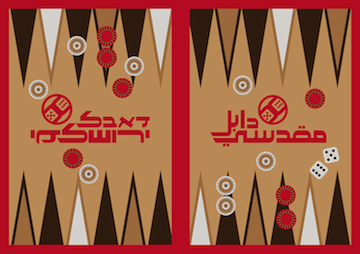
Jerusalem Double, in Hebrew and Arabic. (photo from Jerusalem Double via israel21c.org)

The stereotype-breaking went both ways. Some local teens known to be wary of Jewish Israelis encountered them in a new light at the Jerusalem Double event.

“They were dancing and hugging Jews, playing shesh-besh with them, exchanging phone numbers,” marveled Al-Rifai, whose nonprofit organization, Jerusalem Consortium for Research and Development, holds interfaith meetings and other mixed events. He also is a Sufi master and runs a computer business and a social jewelry-making business for women in cooperation with the municipality.

“It was beautiful and we can’t just stop here,” said Al-Rifai, a self-described diehard realist.

Djemal agreed: “Our plan is to organize an international backgammon championship in Jerusalem with delegations from Turkey, Morocco, Jordan and Egypt all playing backgammon,” he said.

The crowd that came to the fourth Jerusalem Double event, in Talpiot, included Deputy Mayor Ofer Berkovitch and supermarket king-politician-philanthropist Rami Levy. Djemal said 64 people played “and the rest just come for the party. We have a good following and are getting new participants all the time because we’ve created a way for people to interact.”

Jerusalem Double won $35,000 in the Jerusalem Foundation’s 2016 Social Innovation Challenge. The project is also supported by the Pratt Foundation and Jerusalem municipality.

“It’s pretty amazing to see this happening,” said Djemal, whose long resumé includes entrepreneurial ventures, beekeeping, journalism, mentoring and humanitarian work with Israeli organizations IsraAID and Tevel b’Tzedek. The Jerusalem Double cofounders previously started Simply Sing, a series of popular public sing-alongs in Hebrew and Arabic, which they are now reviving.

Djemal said he returned to Jerusalem after five years in the United States because “I thrive on being close to where it’s all happening and being confronted with so many issues that need to be solved. I didn’t want to come back and be complacent. I see a lot of opportunity in the city.”

Israel21c is a nonprofit educational foundation with a mission to focus media and public attention on the 21st-century Israel that exists beyond the conflict. For more, or to donate, visit israel21c.org.

Format ImagePosted on April 7, 2017April 4, 2017Author Abigail Klein Leichman ISRAEL21CCategories IsraelTags backgammon, Israeli-Palestinian conflict, peace
No simple dichotomy

No simple dichotomy

Amna Farooqi speaks at Temple Sholom during her March 13-14 visit to Vancouver. (photo by David Berson)

Amna Farooqi, a rising peace activist who aims to transcend the division between being pro-Israeli and pro-Palestinian, was in Vancouver March 13-14 to speak at Temple Sholom and at the University of British Columbia.

Last year, Farooqi, a Muslim-American woman from a Pakistani family, made international headlines when she was elected head of J Street U, the student organizing arm of J Street, which calls itself “the political home for pro-Israel, pro-peace Americans.” She presents a unique perspective: she is against the boycott, divestment and sanction movement and is pro-Zionist, while also being against the occupation, critical of settlements and deeply concerned for Palestinian dignity and human rights. Temple Sholom, the Progressive Jewish Alliance, Or Shalom, Ameinu Canada and JSpaceCanada sponsored her visit to Vancouver.

Farooqi, who finished her term at J Street U as she graduated from the University of Maryland, continues to be active in J Street and spoke at their annual conference last month, which also included Bernie Sanders as a speaker.

Farooqi told the Jewish Independent that she grew up in a religious but progressive Muslim home where politics were a constant topic of discussion. “Have tea and talk politics,” she said. “Very much like Israelis.”

After 9/11, the topics shifted from things happening in India, Pakistan and throughout the Muslim world to American politics and the condition of American Muslims, she said. “In middle school, I began wearing a headscarf to school. I liked wearing the hijab to provoke conversation, and to say that one can be Muslim and American, one does not have to choose one or the other.”

In high school, Farooqi, who had been raised with a concern for Palestinians, began learning more about the Israeli-Palestinian conflict and fiercely sided with the Palestinians. In 2011, when the Palestine Liberation Organization made a bid for statehood at the United Nations, Farooqi supported it and found herself in an emotional fight with a Jewish friend that came to raised voices and tears. “I realized then that I did not know enough about the conflict,” she said.

Farooqi took Israeli studies courses in college, heeding her parents’ advice that the situation was complex and she should refrain from becoming involved in the debate unless she first studied it in detail. Farooqi’s turning point came when one of her professors had students take part in an involved role-playing exercise, where pro-Palestinian students studied and defended a Zionist (hers was David Ben-Gurion) and pro-Israel students the opposite. This was the beginning, she said, of her “falling in love with Zionism,” without losing her deep concern for the Palestinians.

Over time, Farooqi got more involved with the J Street U chapter at her university, and she spent a semester abroad in Israel studying at Hebrew University, as part of an international student exchange program; the first of several trips.

“My first trip to Israel was an emotionally intense experience from start to finish,” she told the Independent. “There is not a moment in Jerusalem where you are not exposed to diverse perspectives. Everywhere you go there is history, tragedy and beauty.”

She had a Passover seder with a settler family and dined with families in the West Bank. “I remember one visit to the West Bank with some Jews concerned about Palestinian human rights. We visited one family bringing gifts. A young Palestinian child approached my Jewish friends with wonder, and said, ‘You are Jews?’ Bewildered, the child pointed to a nearby house of settlers. ‘But they are Jews.’”

Asked what she perceives as the way forward in today’s increasingly volatile climate, Farooqi said, “It’s a difficult moment. I think the path forward lies in investing in civil society on all sides. None of the governments involved is in a position to show real leadership at the moment.”

Farooqi said the key will lie in building relationships on the ground and in looking at a holistic picture of what drives people on both sides whose behaviour is bstructing peace. “You cannot understand settlers unless you understand the need for affordable housing in Israel,” she said, “and you cannot understand Palestinians who join Hamas unless you understand it may be the only way for them to put food on the table.”

Farooqi said she is excited by the rise of a new Sephardi left in Israel, which she hopes will help inspire a “new, young left” in the country, with ideas that go beyond those of previous generations. And she would like to see more done to help younger Palestinians understand that many Israelis value their rights. “Younger Palestinians need to know that,” she said. “It will change the elections of the future. Palestinians need economic opportunity, and they need real vision and hope. They must be given a real political and economic horizon.”

Speaking of the international Jewish community, Farooqi said, “If you are a pro-Israel, pro-peace, two-state solution person, invest in communal support for that and be careful [about] who we host, who we support, what message are we sending out.”

Even though she is against BDS, she disagrees with the recent Israeli travel ban of BDS supporters. “I oppose the travel ban because going to Israel and actually talking to Israelis made me more pro-Israel,” she said.

She added, by way of warning, that “Diaspora Jews underestimate the far-right in Israel. Many moderates have become disengaged on Israel, whereas big supporters on the far-right have not.”

Speaking of Sanders’ talk at the recent J Street conference, Farooqi said, “I thought it was a great speech, significant for lots of reasons. Sanders talked about 1948 in a beautiful way, talking of the progressive vision of Zionism and his experiences on a kibbutz, but also talking of the effect on the Palestinians. You can acknowledge both. It is rare for a U.S. politician to do that.”

Now that her term at J Street U is over, Farooqi is turning her attention to affairs at home and looking to get involved in organizing in the United States. “We have our own crisis of democracy to deal with,” she said.

Matthew Gindin is a freelance journalist, writer and lecturer. He writes regularly for the Forward and All That Is Interesting, and has been published in Religion Dispatches, Situate Magazine, Tikkun and elsewhere. He can be found on Medium and Twitter.

Format ImagePosted on March 31, 2017March 31, 2017Author Matthew GindinCategories LocalTags Amna Farooqi, Israeli-Palestinian conflict, J Street, peace

Posts pagination

Previous page Page 1 … Page 5 Page 6 Page 7 … Page 10 Next page
Proudly powered by WordPress