Different horror, same hell

As soon as they got into power, German Nazis began to make life hell for German-Jewish men – partly to promote their sadistically comic-book ideal of “Aryan” masculine supremacy, and partly out of a desire to plunder valuables and property. And also, it must be said, out of simple criminal/pathological malice.
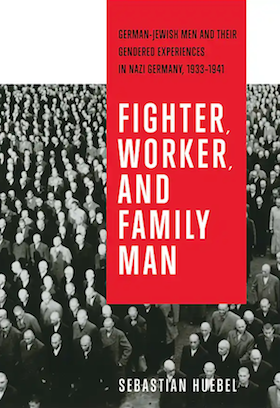
image - Fighter, Worker and Family Man book coverFighter, Worker and Family Man: German-Jewish Men and Their Gendered Experiences in Nazi Germany, 1933-1941 (University of Toronto Press, 2022) is a thoroughly researched book. In it, Sebastian Huebel – a sessional instructor in the history department at University of the Fraser Valley – depicts various strategies used by the Nazis to isolate and degrade German-Jewish men in the years prior to the concentration camps. His metaphor for this program of debasement and humiliation is “emasculation,” and the word identifies the book’s focus: how the Jewish-German (heterosexual) male was shamed by the dispossession of any masculine identity as “fighters, workers or family men” – the traditional markers of masculinity in Europe in those days.

Gender is a rare focus in Holocaust literature and, when the topic of gender arises there, it is almost always about women, and written by feminist scholars, as Huebel notes.

But men’s victimization, as Huebel demonstrates, also deserves scrutiny. During the 1930s, the overwhelming percentage of camp internees were male (“cheats,” “traitors,” “greedy bankers,” “race defilers,” “manipulators of international capitalism,” etc.): in other words, women did not fit the Nazi stereotype of the gendered male Jewish fifth-column “enemy.”

The Jewish male “enemy” was uniformly forced out of work, his business expropriated; he was excluded from the military, and his military service in the First World War ignored. In public, he was ridiculed, he was caricatured in propaganda and openly derided – all, as mentioned, to further the absurd Nazi fantasy of the “Aryan” übermensch. For what reason? Simply to “justify the need for protecting Germany from within” by inventing a supposed internal threat – to this day, a tried-and-true strategy practised by would-be and extant dictators.

(It’s worth noting that Huebel does not address the perceived threat emanating from the predominance of Jewish men in the German Communist and Social Democratic parties, in labour unions, and among other dissidents.)

In private, the Jewish father/husband paradigm crumbled under the weight of Nazi deprecation. With no work, no “bread being won,” the only way the Jewish father/husband could show his worth to the family was to arrange for emigration. But, as Holocaust historians have amply shown, by the time it was clear to the German Jews that the Nazis were not going to go away, the “free world” had closed its doors to them. (Canada’s famous response to the question of how many Jewish refugees should be admitted was “None is too many!”)

On a more positive note, Huebel notes that the at-home father model led to increased bonding – unusual for the time – between father and family, and Huebel offers lots of documentary evidence of signs of love and affection between the unemployed father and his children. As well, fathers frequently became at-home teachers to their expelled children – more evidence of “a new presence at home” that led to a reaffirmation of men’s role as father/mentor-educators.

On the streets, as Nazi violence against men increased, men were often coated with tar, made to walk barefoot over broken glass, made to stand for attention for long hours in bitter cold, and forced to open their mouths for Nazis to spit in. As a result, women were more and more often required to go out in public for menial chores.

The gender-specific treatment of men in the camps has not, Huebel says, been examined as closely as has been the treatment of women. To illustrate his point, he stresses how forced labour demanded of men, particularly in brickworks and quarries, led to disfigured bodies, “violated psyches” and premature death. Those who survived returned home like ghosts, permanently traumatized both physically and mentally, tortured by nightmares and often considering (and committing) suicide.

At no point in his book does Huebel denigrate the experiences of Jewish women under Nazism: “different horrors, same hell,” as Myra Goldenberg and Amy Shapiro said in the title of their excellent 2013 book.

Huebel’s oft-stated intention is to draw attention to the specific way men were abused, from beard-pulling to climbing up and down rock quarries until death. Jewish males were, as mentioned, typically regarded by Nazis as the “greater threat,” and were victimized accordingly.

Overall, Huebel shares the hope, in his conclusion, that a study of the erosion of Jewish male masculinity under Nazism can “sharpen our understanding of contemporary issues related to gender.”

This is a daunting objective, if not fulfilled, at least boldly addressed in this groundbreaking book.

Graham Forst, PhD, taught literature and philosophy at Capilano University until his retirement and now teaches in the continuing education department at Simon Fraser University. From 1975 to 2010, he co-chaired the symposium committee of the Vancouver Holocaust Education Centre.

Ben-Gurion goes global

Canadian Associates of Ben-Gurion University honouree Martin Thibodeau, B.C. president of RBC Royal Bank, speaks at the June 9 gala. (photo from CABGU)

Less than six decades ago, the city of Beersheva, in Israel, had more camels than people. Now, it is home to one of the world’s most innovative post-secondary institutions – Ben-Gurion University – and 400 British Columbians packed a Vancouver ballroom June 9 to help launch the university’s new School of Sustainability and Climate Change.

The Canadian Associates of Ben-Gurion University (CABGU) event at the Fairmont Pacific Rim Hotel honoured Martin Thibodeau, B.C. president of RBC Royal Bank, and featured Prof. Daniel A. Chamovitz, president of Ben-Gurion University (BGU), in conversation with event emcee Robin Gill.

Since taking the helm of RBC in the province, in 2018, Thibodeau has continued an involvement in Jewish community affairs that began earlier in his career, in Winnipeg and later in Montreal. He credits his mother with instilling in him a respect for multiculturalism and a connection with the Jewish experience.

In 2018, RBC Royal Bank created a cybersecurity partnership with BGU, investing in artificial intelligence and machine learning technologies to develop advanced cyber-security techniques. Two years later, RBC British Columbia sponsored the first two research fellowships at the new School for Sustainability and Climate Change and, later this year, Thibodeau will lead a summit to Israel, bringing a group of Canadian business leaders to BGU. He is engaged with a host of community organizations, including the Jewish Community Centre of Greater Vancouver, the Jewish Federation of Greater Vancouver, United Way of the Lower Mainland, B.C. Children’s Hospital, Science World and others. He is also co-chair of RBC’s Diversity Leadership Council.

“I’m always amazed at the dynamic and progressive work that continues to be produced by the scholars and the teams at Ben-Gurion University,” Thibodeau said at the June event. “The world owes a great deal of debt to the outstanding advancements that have already contributed to how we live and work as a society. I am excited to see what the future holds in the hands of these amazing and brilliant individuals.”

Thibodeau, who oversees 7,000 employees in the province, was introduced by Lorne Segal who, with his wife Melita, co-chaired the event. Segal gave an emotional testimonial to his late father, Joseph Segal, who passed away 10 days earlier, at age 97. Segal said his father had not attended many events in the past several years but had been looking forward to being present to honour Thibodeau.

In his presentation, Thibodeau thanked the Segals for their support, and for their presence in a time of mourning. Thibodeau paid credit to Joe Segal, who called him soon after he arrived on the West Coast, invited him for lunch and offered advice and an open ear.

In recorded greetings, Israel’s ambassador to Canada, Ronen Hoffman, called Thibodeau “far more than just a businessman. He is a leader, innovator and community-oriented friend of the Jewish people, of Israel.”

Chamovitz, the university’s president, noted that David Ben-Gurion’s dream of a university “at the gates of the Negev Desert” was intended to uncover secrets: “How to make energy from the sun, water from the air and agriculture from the infertile sands, taking advantage of resources that, until now, were going to waste.”

The changing climate has made innovations such as solar energy, desalinization and agriculture in inhospitable places answers to urgent questions that affect lands far beyond the Negev.

“We all of a sudden realized that what we thought was a local problem is now a global imperative and people from all over the world started coming to Beersheva to learn from our expertise,” said Chamovitz, who grew up in Pennsylvania and has been president of the university since 2019. The Abraham Accords have opened new doors to cooperation between BGU and Gulf States that need these technologies, he added.

The School of Sustainability and Climate Change was announced last year and, so far, 25 departments are collaborating on planetary life-and-death topics. (See previous articles at jewishindependent.ca.)

“My simple challenge was to get them to collaborate in order to really leverage our expertise into something that’s much greater than the sum of each of those departments,” said Chamovitz. Even the department of Hebrew literature is involved.

“Hebrew literature did a big seminar on climate fiction, understanding how climate change is influencing what people write about and how this literature is influencing public opinion about climate change,” he said.

While BGU was created with the development of the Negev Desert in mind, the work they are doing is global, with impacts reaching British Columbia, said Chamovitz.

“You cannot look at British Columbia divorced from the world,” he said. Flooding and heat domes are processes that are happening worldwide. Mitigation and prevention must take place both locally and globally, he said.

Chamovitz credited the leadership of Thibodeau and RBC for making it easier for BGU to go to other major donors to fund the new school.

Another new development at the university, he said, is a high-tech park dedicated to advanced research in cybertech, agricultural technologies and green energy.

CABGU B.C.-Alberta board member Eli Joseph chaired the event and board member Rachelle Delaney was the convener. Si Brown, president of CABGU B.C.-Alberta, opened the event. The corporate sponsorship committee was chaired by board member Adam Korbin, and David Berson is CABGU regional executive director.

Terry Beech, member of Parliament for Burnaby North-Seymour, brought greetings from the federal government. Representing the government of British Columbia, Minister of Finance Selena Robinson spoke of her family’s connections to Israel.

Learning about First Nations

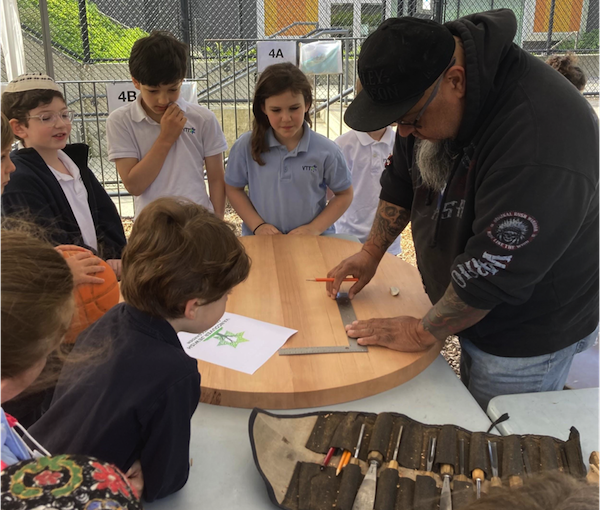
Gerry Sheena shows students his method of carving. (photo from Vancouver Talmud Torah)

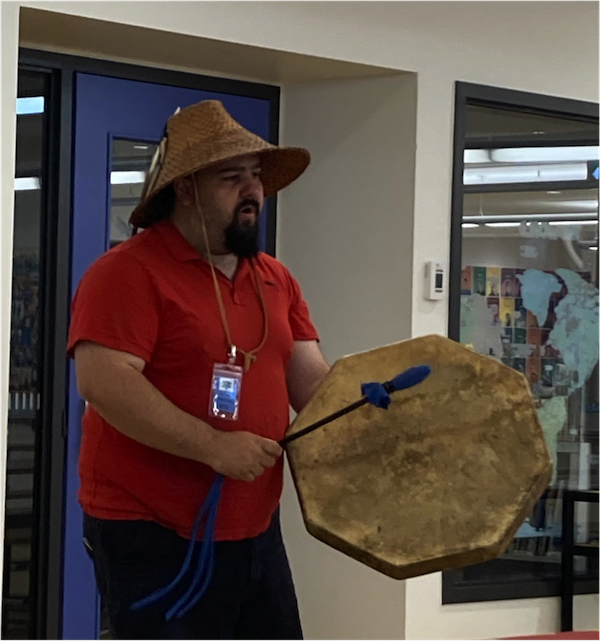
Vancouver Talmud Torah invited Interior Salish Nation carver Gerry Sheena and his son Matthew Sheena for a week-long program where each grade participated in a session to learn about the history of Indigenous carving, the tools used and the process of carving and design.

Gerry Sheena has been carving for more than 17 years and his work is shown in galleries throughout British Columbia. He describes his carving style as “traditionally Salish, informed by modern painting techniques and innovative use of colour and design.”

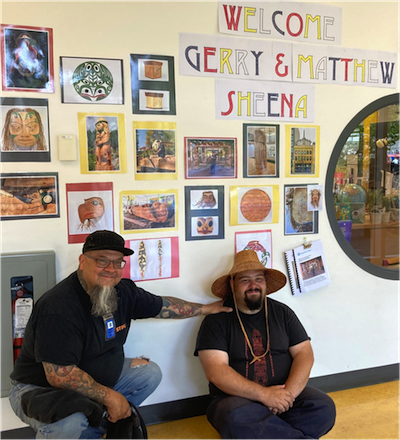
The Sheenas’ visit related to the applied design, science and technology curriculum, notably the woodworking aspect. However, VTT has been working on creating a more meaningful implementation of First Peoples’ education, which sparked the idea of integrating the two areas and having presenters from the First Nations community educate students on carving, drumming and storytelling. The timing for the presentation was matched with the month of June, which is National Indigenous History Month. Teacher-librarian Nicolle Wade created a display of Indigenous books and shared Learning to Carve Argillite by Sarah Florence Davidson and Robert Davidson, to give students an idea of what they would be seeing. She also installed a welcome display shining the light on Gerry Sheena’s art.

photo - Matthew Sheena at Vancouver Talmud Torah
Matthew Sheena at Vancouver Talmud Torah. (photo from VTT)

The program was unique in that the Sheenas were at the school for an entire week, not only presenting but also working in the playground, carving a welcome sign for the soon-to-come community garden. Students were able to come out every recess and lunchtime to watch Gerry Sheena carve and listen to Matthew Sheena drum, and additional Q&As took place organically. Teachers had the opportunity to bring their classes out to watch the carving take place firsthand.

“Having an Indigenous carver join our VTT community for one whole week has helped us to organically elevate Indigenous education and ensure that our students are engaging in meaningful learning about the Indigenous peoples and their traditions. We are honoured to have Gerry and Matthew Sheena join us from the Interior Salish Nation as we find ways to recognize National Indigenous History Month now and moving into the future,” said Emily Greenberg, VTT head of school.

Gerry Sheena shared how he got started in carving, his love for art and his happiness when creating totem poles, masks, paddles and many other ceremonial carvings. Matthew Sheena is a passionate drummer and graced the school with his drumming and singing of a Squamish Nation song, “Snowbird,” acknowledging the land and sending a powerful message to love and to lead “through your heart, spread love to others around you and to be kind.”

Among the many lessons learned from the week were:

• The power of passing on knowledge through storytelling.

• The connection to the land being the foundation of Indigenous ways of knowing and practices. The land, plants, animals and sky are all teachers, and taking care of the land and everything living is of utmost importance.

• Honouring language. The Sheenas taught students how to say thank you, and the importance of respecting elders and cherishing their roots.

• Older students had questions about residential schools that the Sheenas approached in a gentle and meaningful way.

• Matthew Sheena spoke to the students about always reaching for the stars, never giving up no matter what life throws at you, and being the best you can be every single day. Also, he encouraged them never to give up on art, drawing, singing and dancing – and to do things that bring them joy and will help them tell a story. He said his favourite tool when carving is a pencil and spoke about the power of the pencil to create.

photo - During their week at Vancouver Talmud Torah Gerry Sheena and his son Matthew Sheena taught students and teachers about carving, drumming and storytelling
During their week at Vancouver Talmud Torah Gerry Sheena and his son Matthew Sheena taught students and teachers about carving, drumming and storytelling. (photo from VTT)

VTT was so grateful to spend time with Gerry and Matthew Sheena, both of whom inspired students and faculty through their presentations. The themes of building community, recognizing that everyone can be a potential source of inspiration and knowledge, and fostering respect by encouraging students to speak honestly, listen to one another, be active in problem-solving, take care of the land and value their surroundings were a few of the key takeaways from the week.

VTT aims to grow in the area of Indigenous education and make links to Jewish history, cultures and traditions, as the Sheenas’ presentations revealed that there are many similarities. The week’s activites and interactions left students with more knowledge and understanding of First Nations peoples, and it is hoped that students will continue to reflect upon questions like, What do I know about Indigenous education and First Nations communities? How can I contribute to changing the world we live in by storytelling and passing on knowledge? How can I learn more about Canada’s relationship with Indigenous people? How can I build meaningful relationships? How can I protect the world we live in; the land,  animals and people? and What connections does First Nations education have to Jewish education?

Jessie Claudio is director of learning and innovation at Vancouver Talmud Torah.

Still time to save earth

Indigenous activist, scholar and farmer Dr. Randy Woodley was the keynote speaker on May 24 for the Vancouver School of Theology conference Religious Responses to Climate Change. Based in Yamhill, Ore., Woodley addressed the assembled Zoom audience on the topic Indigenous Spirit: Weaving Justice and Peace in a Wounded Land.

“The West has largely failed in its mandate to till and keep the soil; that is, to serve the community of creation, the whole community of creation,” Woodley began, introducing the concept of humankind’s responsibility to assure the well-being of those in its care, namely, the land and all the creatures that reside on it and in it.

Humans are co-sustainers of the earth, he stressed, showing a slide that highlighted the billions of bacteria, millions of protozoa, metres of fungi and thousands of nematodes in just one cup of soil.

Woodley gave examples of the unflattering views Western scholars have often had of Indigenous cultures and how such scholars (and others) have overlooked “many things that ‘primitives’ still know.” While North American curricula contain lessons on Greek, Egyptian and Chinese civilizations, for example, education on ancient American civilizations is lacking.

Indigenous American societies brought about such things as micro-agriculture and macro-environmental management, including botany, agronomy, forestry, raised beds and naturally self-sustaining fertilized gardens, said Woodley. Further, there was sustainable architecture that incorporated passive solar design, solar heating, water capture systems and mass water transport.

“I would argue that the Western worldview has been a failed experiment,” he said. “We need to dump it and we need to adopt a more Indigenous approach.”

He said the “faster, bigger, cheaper” method of food production in the Western world is depleting soils and leading to the loss of crop varieties. At the same time, forests are shrinking, species are going extinct and droughts are increasing. Blame for water waste could be placed on big agriculture, he asserted.

Meanwhile, Indigenous people have lived in North America for more than 20,000 years without permanently endangering the land. He said, “The earth has had enough and is not going to let humans get away with knocking things out of balance forever.

“Nature’s chaos, which we’re understanding now, is actually stable because it continues to adapt. If there’s one thing true about all of creation … it will adapt. Human beings are the only ones who resist that. Adaptation is stability.”

The nature of a closed system is to collapse in on itself or be consumed by other more adaptive systems, he argued. Therefore, he said, the religious response to climate change should be to adapt as well. Within adaptation, there is an order that builds open systems of unity and diversity. The West, on the other hand, introduced chaos and continues to maintain it.

“Lots of different diseases we have are because we have not lived in the way we should with the animal kingdom. We only have a short time to come back from our own unsustainable chaos and back to the Creator’s sustainable order,” Woodley said.

A handful of human generations has accelerated consumption exponentially. Mother Earth is now trying to rebalance the overuse through “random acts of nature,” he said. The planet is reclaiming its territory and “spitting out the inhabitants in order to restore harmony, the top of the food chain temporarily is now Mother Earth herself.”

It was a particular kind of human being, Woodley reiterated – the Europeans and Americans, and not the species itself – that brought us to this perilous stage. Woodley sees a connection between the way Europeans and Americans treat both creation and people, especially women, immigrants, the poor and other marginalized groups – with respect to nature and fellow humans, they have a need to control, exploit, expect production from and objectify, he said.

Practical steps forward, in Woodley’s view, include a critical examination of the Western world approach, the shedding of unhealthy paradigms, and the adoption of a more Indigenous perspective, such as sustainable ecosystems, a respect for the wisdom found in nature and an acknowledgement of the interconnectedness of all living things.

Woodley quoted environmentalist and economist Winona LaDuke as saying, “Food for us comes from our relatives, whether they have wings or fins or roots. That is how we consider food, food has a culture, it has a history, it has a story, it has relationships.”

And he cited a Shoshone elder: “Do not begrudge the white man his presence on this land. Though he doesn’t know it yet, he has come here to learn from us.”

Together with his wife Edith, Woodley runs Eloheh Indigenous Centre for Earth Justice, an organization that focuses on developing, implementing and teaching sustainable and regenerative earth practices. Eloheh is a Cherokee word meaning harmony, wholeness, abundance and peace.

Woodley has written several books, including Indigenous Theology and the Western Worldview: A Decolonized Approach to Christian Doctrine, and Shalom and the Community of Creation: An Indigenous Vision.

Director of the VST conference was Rabbi Dr. Laura Duhan-Kaplan.

Sam Margolis has written for the Globe and Mail, the National Post, UPI and MSNBC.

Inclusivity curriculum

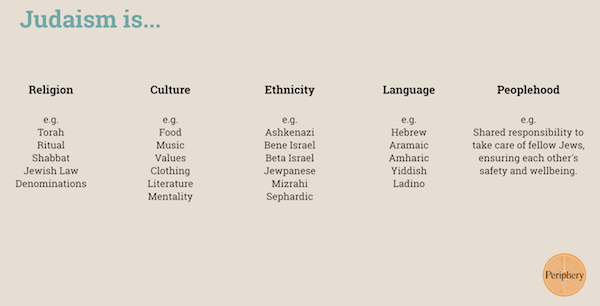
A page of the Intro to Judaism booklet that can be downloaded as part of the Periphery curriculum, which offers a framework to talk and learn about diversity within the Jewish community.

“Make space for a productive and respectful conversation” – this is the first suggested action to frame the use of the recently released Periphery curriculum.

Periphery – a film and photography exhibit exploring the ethnic diversity of Toronto’s Jewish community (jewishindependent.ca/discussing-jewishness) – came out last fall. The new curriculum builds on that 27-minute documentary. It comprises another nine short videos, all under eight minutes each, and lesson guides for students in grades 8 through 12 in both the Jewish and public school systems. There is also a guide for Jewish groups and organizations, which could be used for non-Jewish groups.

Launched by the Toronto-based nonprofit No Silence on Race and the Ontario Jewish Archives (a department of UJA Federation of Greater Toronto) with the organization Facing History and Ourselves (an American group with a Toronto branch), the curriculum is Ontario-focused. That said, most of the information is broadly based and relevant to Canadians no matter where they live, and no matter their age.

There are differences in the curricula for each of the three grade groupings (Grade 8, grades 9 and 10, and grades 11 and 12), the Jewish versus public school content, and the community dialogue package. However, the basic format and information is similar, with appropriate adaptations for probable starting points in knowledge and experience.

The common learning aims include “a greater awareness and understanding about who Jewish people are and the ethnic diversity within Jewish communities”; “Possess a stronger framework for understanding the complexities of intersectional identity, using their own identities as a foundation”; “Understand the difference between individual and group identity with a focus on belonging and recognition”; and the role of students and community members in creating inclusive community spaces. In addition, for example, the Jewish community curriculum also suggests that participants: “Discuss the intersections of race, privilege, mobility (i.e Jewish professional opportunities), power as it relates to Jewish identity and ashkenormativity.”

Before delving into the films and lesson suggestions, the curriculum offers a few activities that help frame what viewers are about to watch and discuss – beginning with making “space for a productive and respectful conversation.”

The most extensive part of the guides is the screening prompts and activities. They are organized by topics based on those of the videos, such as “Hyphenated Identities,” “Immigrating to Canada” and “Finding Strength in One’s Heritage.” They include pre-screening and post-screening questions for each film and topic, and these questions elicit self-evaluation and the sharing of stories and views on identity, race, multiculturalism, sexuality, antisemitism and social justice, as well as discussion of the experiences and opinions of the interviewees featured in the films.

The final part of the guide attempts to have participants take what they have learned out into the world, beyond the classroom or boardroom or office. For example, the title of the last section of the Jewish community dialogue is “Now What?: Social Justice within the Jewish Community and Beyond.” It begins with discussion from a global perspective – using a quote from Canadian anthropologist Wade Davis to talk about questions like, “What does it mean for us to hear from different voices of humanity?” It then highlights a quote from the Mishna and one from Pirkei Avot to further reflect on the idea that repairing the world, tikkun olam, begins within the community.

In addition to the curricula, there are related materials available to download, from worksheets to help understand the concepts being discussed and organize one’s thoughts, to an introduction to Judaism, to a glossary of terms. The poem “Unpacking the Periphery,” by Akilah Allen-Silverstein, can also be downloaded. It concludes “For each other as allies, I pray we can stand tall / Diminish the fine lines, deepen our understanding, / Listen with compassion / Listen with empathy / Act with courage / Act with reason / Because this is the season / To do better / To act on the Open Letters / To be more than trend setters / But intentional change makers.”

All of the Periphery curricula and resources are free and downloadable at peripheryexhibit.org.

Father’s Day ride for STEM

A few dozen cyclists participated in last year’s ORT Vancouver Ride for STEM. (photo from ORT Vancouver)

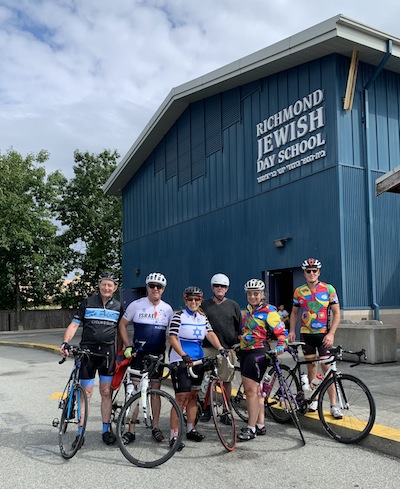
The third annual ORT Vancouver Ride for STEM takes place on Father’s Day, June 19. The cycling event, which begins and ends at Richmond Jewish Day School (RJDS) grounds, raises funds for STEM programming – science, technology, engineering and math, said Mary Tobin, longtime executive director of ORT Vancouver.

Participants can choose from a five-kilometre, 36-kilometre or 72-kilometre ride, all of them within Richmond, which is a naturally flat environment.

Founded in Russia, in 1880, World ORT is one of the largest education and training organizations in the world. To date, more than two million students have been educated by ORT and 300,000 students benefit worldwide from World ORT projects in more than 100 countries every year. ORT schools and training centres operate in North and Latin America, Eastern and Western Europe, Africa, Asia and the Pacific, as well as in Israel.

Katia Fermon, director of Jewish life and community engagement at RJDS, said half of the funds raised will go to ORT Vancouver and half will fund programs at her school.

During the pandemic, RJDS, like many schools, was forced to adapt to remote and virtual education. Now integrating a hybrid approach, the technology that was implemented by necessity is being leveraged to strengthen the delivery of educational programs.

“Starting this year, we are trying to push our STEM programming with graphic design, programming with robots and more online education,” said Fermon. The plan is to implement more technology, design skills, programming and coding skills into the curriculum.

“Now we need the hardware to do it,” she said.

photo - Cyclists in last year’s ORT Vancouver Ride for STEM
Cyclists in last year’s ORT Vancouver Ride for STEM. (photo from ORT Vancouver)

Since the cycling event takes place outdoors, the partners were able to run the fundraiser right through the pandemic. Last year, she said, 35 or 40 riders participated, raising about $26,000. Because pandemic restrictions have been eased, the event is taking place during the school year this time and students and parents are encouraged to participate.

Because of the varying route length options, the return times of riders is staggered. As a result, the social component of the day takes place at the beginning.

“There’s a little reception at the start,” Fermon said. “We greet everyone, they get their water bottle, their snacks, we do a couple of pictures. We did it last year and it was very heartwarming. I don’t know of any other Jewish ride, so it becomes a very Jewish moment where we feed you, you say hi to old friends – ‘I haven’t seen you since the bat mitzvah!’ – it’s a very Jewish reception.”

Organizers are inviting everyone – not just riders – to get involved. With more cyclists than ever anticipated in this year’s event, more volunteers are still required. There is a silent auction that anyone is welcome to participate in by dropping by RJDS on the day. And, of course, donations of cash or auction items are welcome.

More information is online at ortcanada.com/vancouver or by calling Tobin at 604-276-9282.

Gala celebrates alumni

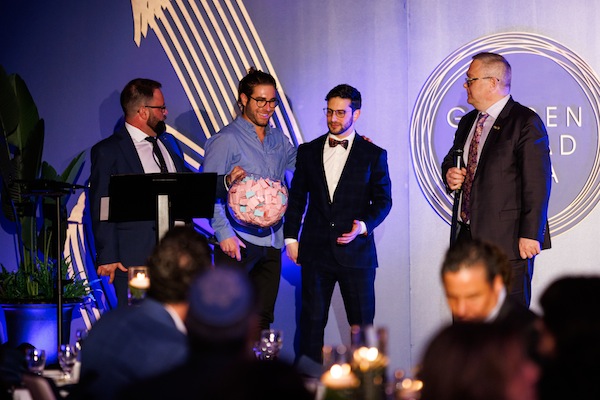
Left to right, Alex Monchamp, Aaron Friedland, David Kaye and Howard Blank prepare to draw the 50/50 winner at King David High School’s Golden Thread Gala on May 12. (photo from KDHS)

“The reality is King David took a student who genuinely struggled, exposed me to meaningful ways to make a difference – they gave me passion and purpose, they provided me with academic rigour to realize my dreams, provided me with confidence, and then added a fundamental layer of Jewish and humanist values,” said Aaron Friedland, addressing a full house at King David High School’s Golden Thread Gala on May 12.

“And what is interesting is how unremarkable my story at King David is,” he continued. “There are simply too many grads who King David has helped to overcome the odds and flourish – and it’s the outcome of brilliant and caring educators investing in us.”

Friedland is founder and executive director of the Simbi Foundation, which helps underserved and refugee communities access education. He is a National Geographic Explorer and a PhD candidate in the field of econometrics, focusing on the interplay of economics and education. And these are only a few of the many accomplishments and projects on Friedland’s growing resumé.

He came to King David in Grade 8, he said, after having attended four different elementary schools. “I’m incredibly dyslexic,” he shared, “and there was a time when teachers told my parents I likely wouldn’t make it to university.”

But there is more to King David than preparing students for university, he added. “The world doesn’t just need more university grads. The world needs more global citizens who are passionate about creating positive impact and who have the skill set to realize their dreams.  Tonight is about celebrating a school that has developed a tried-and-true approach to developing global citizens who thrive while engaging in tikkun olam, or repairing the world. And I’m not sure if you’ve seen or have been reading the news, but the world could use a little repair.”

Mentioning COVID-19, Russia’s war on Ukraine, the challenge to Roe v Wade in the United States and generally declining literacy rates, he spoke about the need for hope. He then cited primatologist and anthropologist Jane Goodall, whom he had interviewed on Simbi Foundation’s Impact in the 21st Centurypodcast.

“Jane explained, ‘Hope isn’t just wishful thinking – it’s rolling up our sleeves and doing something about the problem.’ And she shared a few pieces of wisdom,” said Friedland.

“When we’re feeling a lack of hope, it’s important to remember just how much power we each possess.

“When we’re feeling stuck, we must think globally and act locally. She means that we must find causes we’re passionate about and start making a difference immediately,” he said. “No action is too small. Jane spoke about the addictive nature of helping. And, once we’re helping, we’re part of the solution and it feels great – so we do more of it.

“And, when I pushed Jane further, she explained that she stays hopeful for three reasons. One, our amazing human intellect. Two, the indomitable human spirit – meaning, we don’t give up. And three, the power of young people.

“Jane believes in the power of young people so strongly,” said Friedland, “that it is where she invests all of her time, specifically high schoolers, because she believes that those are the people who are going to change our planet and change the world. And, after speaking with Jane, it got me thinking about how King David is the exact breeding ground for the types of people who come out and positively impact the world and give us hope.”

A visit to KDHS by farmer J.J. Keki, a leader of Uganda’s Abayudaya Jewish community, was the spark for Friedland’s tikkun olam work and further study. The Simbi Foundation began its life as the Walking School Bus and the organization now builds solar-powered classrooms, known as BrightBoxes, in Ugandan and Indian refugee settlements, with each installation providing up to 6,000 students with access to education and electricity. The foundation’s chief operating officer and co-founder is Ran Sommer, another KDHS graduate.

The Golden Thread Gala celebrated the almost 750 students who have graduated from KDHS since it was established – and it raised $202,491 for the school.

The gala, which was held at Congregation Beth Israel, began with a piano and vocal performance by student Joseph Gabay, and also featured a song performed by students Kailey Bressler, Rachel Gerber, Mhairi Hemingson and Kiera Katz; group member Sara Bauman was unable to attend. Alex Monchamp, deputy head of school, stepped in to welcome the crowd because head of school Russ Klein couldn’t be there either, but Klein’s emcee duties were taken on by actor David Kaye, another KDHS alum. As part of his emceeing, Kaye interviewed on stage two other KDHS grads – Jordan Grubner and Ava Katz – about their time at the school and how it prepared them for the larger world.

Rabbi Stephen Berger, head of Judaic studies, did the blessing over the bread before the meal and gave a few remarks, as did gala committee co-chairs Heidi Seidman and Sherri Wise, and KDHS board members Alain Guez and Chana Charach. Howard Blank led the live auction.

Maus not too graphic

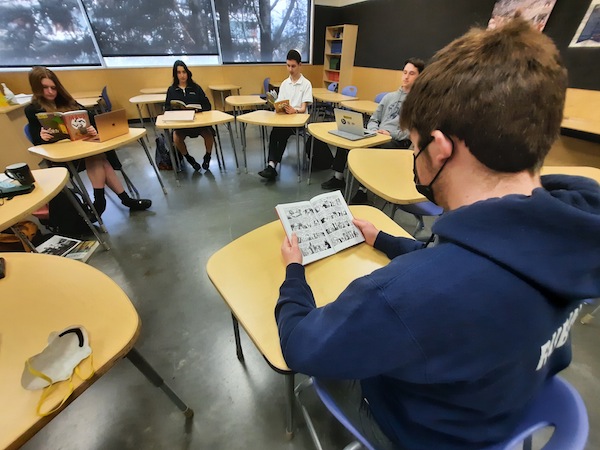
Students in Anna-Mae Wiesenthal’s Holocaust and Genocide Studies class at King David High School discuss the graphic memoir Maus. (photo by Pat Johnson)

In January, the school board in McMinn County, Tenn., voted to remove the graphic novel Maus from its eighth grade curriculum.

The book by Art Spiegelman won a Pulitzer Prize in 1992 under a special category created specifically for Maus. The two-volume collection of previously serialized comic-style narratives was viewed at the time as revolutionary for its approach to a subject like the Holocaust in a medium more commonly associated with superheroes and humour.

In the books, racial and national identities are represented through anthropomorphized animals. Jews are depicted as mice, Germans as cats, Poles as pigs, Americans as dogs, British as fish and so on. In each instance, the characters have the bodies of humans and the heads of the respective animals. This form has been criticized by some critics over the decades as overly simplistic but has caused particular discomfort to many Poles, who do not appreciate being depicted as pigs.

Spiegelman, the author, called the McMinn County decision “Orwellian,” but has seen sales of his books skyrocket since the ban thrust the works back into the spotlight.

The Independent joined in a class discussion with the five students in the Holocaust and Genocide Studies course at King David High School, led by teacher Anna-Mae Wiesenthal. Discussing the Tennessee book banning, students questioned the sincerity of the school board’s grounds for opposing the book.

In a graphic memoir dealing with the attempted annihilation of a people and which touches on history’s most horrific acts of inhumanity, students found it “absurd” that the board’s primary concerns appeared to be a couple of instances of mild profanity and the depiction of a nude cartoon cat.

The book follows the true journey of the author in pressing his father, Vladek, to share his Holocaust experiences openly for the first time.

Nitzan Berger, a great-granddaughter of a Holocaust survivor, observed that many survivors hesitated to share their narratives and that the graphic novels capture the challenges of the younger generation in approaching the subject, as well as the reticence on the part of the older generation to relive the horrors of their past. While the passing down of these stories is important, it can be painful for both generations.

“It’s interesting for us to hear about the stories, but we don’t think about the other side,” she said.

Ethan Dreyshner was struck by the speed with which an entire society, down to its youngest members, could be transformed.

“It just really shows how this whole society was changed to think the Jews were terrible people,” he said. “Six years earlier, Jews were regular citizens. It’s crazy to think that a whole society, a whole population, can just turn on their neighbours that quickly.”

Noting that young people need to begin learning about this challenging subject at some point, students contrasted Maus with Anne Frank’s diary, which for generations has been an entry point to discussion of the topic.

Olivia Levsky said a graphic novel that is intense but not particularly long may be a good starting point as well, especially for young people who rebel against assigned readings.

“It’s a very interesting way to learn something that’s very important to learn,” she said. “I didn’t feel like it was incredibly graphic or too much when I was reading it. It was graphic at times, but the Holocaust was graphic. I didn’t feel it was overly triggering or traumatizing. I didn’t feel it was inappropriate.”

Levsky also noted that Spiegelman, in some respects, depicted the national groups through the eyes of the victimizer.

“He drew each character and each race in the way that the Nazis saw them,” she said, noting particularly the Nazis’ association of Jews with vermin. “I imagine toward the end [of the war], the Americans felt like threatening dogs to the Nazis.”

image - cover of Maus I by Art SpiegelmanStudents concurred with Wiesenthal that there also may have been a practical purpose to depicting each group as a type of animal. It made each character’s identity more immediately understandable to the reader without having to repeatedly point out the race or nationality of each individual – in one instance, a Jew (mouse) hides in plain sight with the mask of a pig (Pole).

Wiesenthal noted that the second volume, which the class has not read together, is somewhat more explicit in its violence.

The teacher also stressed that the book tells the story of the Holocaust experience and intergenerational trauma through one family.

“We often talk about numbers – six million – which can serve to depersonalize what is really an impossible number to grasp,” the teacher said. “I think that we need to remember each of them had a name, each of them had a family. It’s very impersonal, often, the way we attach the number to the Holocaust.”

Maus includes situations in which non-Jewish people assisted in the survival of Jews. While it is not addressed in the book, students discussed the fact that Yad Vashem’s criteria for designation as Righteous Among the Nations excludes people who received compensation for their often-life-endangering efforts.

Shai Rubin noted that, in some cases, Jews may have given valuables voluntarily as gratitude to their rescuers. He also noted that, in addition to risking their lives, many non-Jewish helpers were experiencing economic destitution due to the war and what small amount of food they could provide to Jews in hiding may have come at a great price to their own families.

Of one woman in the story, Rubin said: “There’s a difference between doing something for money and doing something and getting money for it. She did it out of the goodness of her heart.”

In what was a shocking sequence for students, Art, the author, discovers that his father has burned the diaries of Art’s mother, Anja, who committed suicide. In response, the son lashes out at his father: “Murderer!”

This opened a discussion of what Wiesenthal called “the murder of memory” and raised the quote by Elie Wiesel (not mentioned explicitly in the book), who said of the Holocaust and its victims, “If we forget, the dead will be killed a second time.”

The Grade 12 students analyzed the content, style and medium of Maus. They observed that, often when the wrought iron gate to Auschwitz is pictured, the focus is on the words themselves, Arbeit Macht Frei, while, in this book, the eye is drawn to the individual people in the frame, a reminder that the Holocaust can often be depicted in broad strokes but it is, ultimately, about the killing of individuals.

On the medium itself, all the students concurred that it is an effective avenue for conveying challenging material.

“I think this is a really effective form of teaching the Holocaust, especially to kids,” said Dreyshner. “Something like the diary of Anne Frank, you might feel a little disconnected, you can’t see it, you can’t understand it because it’s hard to show actual images of the Holocaust to children. I think a graphic novel really does the job because you can see what happened, you can get a sense of what happened, without seeing the horrific things exactly.”

Richard Helper agreed, but subtly criticized those who are concerned about the graphic nature of the book.

“This is easily digestible, it’s effective, it has quite a bit of information on the specifics of the Nazis’ war machine as well,” he said. “While some people, I think, try and attack it for being either too simplistic or too graphic, we’re teaching a book on the Holocaust.… It’s the Holocaust.”

Wiesenthal, who has a master’s in Holocaust and genocide studies and is pursuing a PhD in the same field, pioneered the course three years ago. Until then, the Holocaust was dealt with as part of the larger Jewish history curriculum.

She acknowledged that most King David students come to the subject with some familial or other knowledge of the subject, whereas non-Jewish students, such as those in places like Tennessee, might have no knowledge of the history.

“It’s important to contextualize it,” she said.

Shalhevet honours Vivian Claman

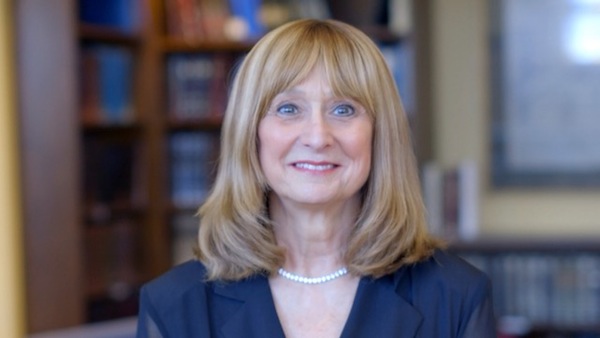
Vivian Claman was one of the founders of Shalhevet Girls High School and served on the school’s board for 14 years. (photo from Vivian Claman)

Vivian Claman was one of the founders of Shalhevet Girls High School. More than 14 years later – during which time she has served on the board of the school, including until recently as president – she is being celebrated at the school’s 2022 gala celebration May 22.

Leslie Kowarsky, president of the Shalhevet board, credits Claman with the school’s very existence.

“There is no one in our community who has not benefited from Vivian’s efforts, whether for Schara Tzedeck, for the Jewish Federation, or for many other worthy causes,” said Kowarsky. “I can say with confidence that Shalhevet would not exist without her tireless commitment.”

Shelley Rivkin, vice-president of the Jewish Federation of Greater Vancouver and the honoree at last year’s gala, echoed those words.

“Vivian has shown unswerving dedication and passion to maintaining and strengthening Orthodox education for girls in Vancouver,” Rivkin said. “She is a dynamic and energetic volunteer and she brought this commitment to her work on Federation’s allocation committee and other community organizations.”

Claman reflected back on the school’s creation. Ten parents, including Terrance Bloom, who would serve as the first board president, came together to address where their daughters would continue their education after they completed Grade 7 at Vancouver Hebrew Academy (VHA).

“My daughter was one of six girls in the Grade 7 class,” Claman said. “We had a little evening meeting to discuss the idea of doing a high school for the girls. My daughter said, I’m willing to try and convince the other girls to try, so we started the school.”

The availability of Orthodox Jewish education in Vancouver has been a recurring challenge and is among the range of issues being address by a new initiative called Torah West, which seeks to retain and attract more Orthodox Jews to live in Vancouver.

VHA now offers Orthodox education for boys up to Grade 10 and Claman said talks are underway to move the boys school and Shalhevet under a shared administrative umbrella.

“It makes the most sense, certainly for the donors,” she said. “They would prefer to have one institution so that we are not separate institutions going to the donors and asking for money.”

Whatever administrative structure is adopted, there will always be a separate boys school and girls school, adhering to Orthodox standards, she said.

Shalhevet is experiencing challenges that reflect larger trends in the community. With the departure of the Pacific Torah Institute yeshivah, some Orthodox families have left Vancouver.

“We absolutely need to have a strong Orthodox community and the only way we’ll do that is if Vancouver Hebrew Academy thrives and Shalhevet thrives,” said Claman. “Right now, though, to be honest, we’ve had a lot of attrition in the last couple of years. We are down numbers in our school. It is very upsetting, but that’s the reality of Vancouver. We kind of have waves. We have ups and we have downs. Right now, we are in that slump. That’s one of the reasons why Torah West is being created.”

In the school year now winding down, there are 10 students across five grades at Shalhevet, down from a peak of 25 or 27, she said.

While those numbers are disappointing, she said, there is a silver lining.

“Because of small numbers, we really can cater to the individual needs of each girl,” she said. “That’s really important. There are a lot of girls who have different issues and it’s really wonderful that they get that kind of attention. At a normal high school, there could be 30 kids in the classroom. The competition is pretty fierce.”

She added that single-gender education has been demonstrated to be advantageous, especially to girls.

“Studies have shown that girls do extremely well when they are on their own without feeling the competition or the pressure of being around boys,” said Claman. “It really does make a difference.”

On being recognized at this year’s gala – the first in-person gala in three years – Claman said she is “overwhelmed, to be honest.”

“I just announced my retirement plan – I had warned them I was going to be leaving the board after 14 years. I thought it was enough – so they decided to honour me. I’d really prefer not to be, but I didn’t really have a choice in the matter,” she said, laughing.

However, she acknowledged: “It’s a really nice way of the school showing appreciation for the many years of really hard work I put into the school.”

As past president, Claman still attends every board meeting and remains very active in school affairs. Nevertheless, as time permits, she plans to devote more hours to her emerging role as a painter.

“I was a fashion designer by profession for many years,” she said. “I retired because it was just too much time away from being a mother of three kids.”

Because she likes being busy and creative, Claman took up painting about seven years ago.

“I had taken a class many years ago in acrylic with a teacher here for one year but this time I decided to take it seriously and I’ve been painting ever since,” she said.

After a friend’s dog died, Claman painted a portrait of the pet and gave it to the grieving friend. That has led to a raft of pet portraits, but she is also receiving commissions for other works as well. (Her portfolio is at vivianclaman.com, though she acknowledges she has not had time to keep it up-to-date.)

Although she is concluding her time as a board member, Claman’s commitment to the school remains steadfast.

“To me, the most important thing about Shalhevet is we provide an Orthodox education for the Orthodox families here,” she said. “It’s wonderful to have a pluralistic community, but we absolutely must have the common denominator of the Orthodox community here. Orthodox families will not live here unless they know that they can send their kids, their girls and boys, to a high school that caters to their guidelines as to what an Orthodox Jewish education should be.”

For tickets to the May 22, 6:30 p.m., gala, which takes place at Schara Tzedeck Synagogue, visit shalhevet.ca.

StandWithUs Canada course

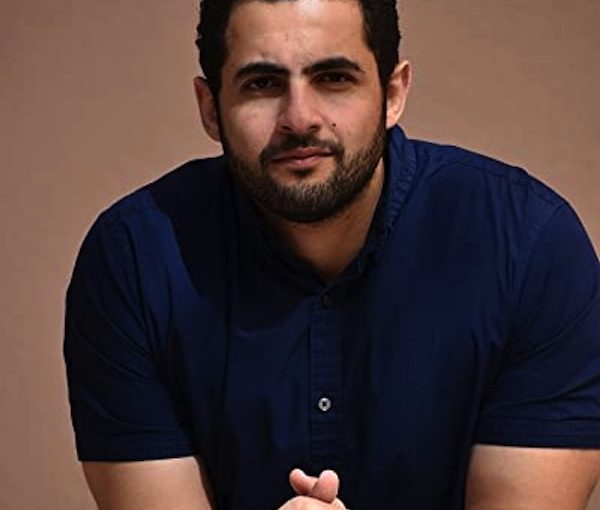
Hussein Mansour Aboubakr (PR photo)

After an almost three-year hiatus due to the pandemic, StandWithUs Canada is again holding events. On May 15, StandWithUs Canada and the Diamond Foundation are presenting the crash course Antisemitism and Anti-Zionism Today: What to Expect on Campus.

The course is a chance for high school (grades 11 and 12) and first-year university students to attend interactive sessions, hear from speakers, meet like-minded students and enjoy a free kosher dinner. Students who register and attend can also receive community service hours and a gift card.

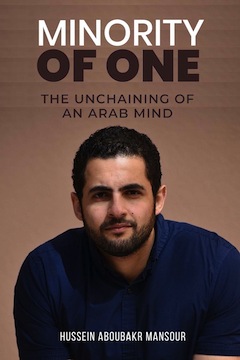
image - Minority of One book coverSpeakers include Penina Edery, high school director, StandWithUs Canada, and Aviv Attia, StandWithUs educator and Israeli speaker. Special guest speaker Hussein Mansour Aboubakr was a dissident imprisoned in his home of Cairo, Egypt, for the crime of wanting to learn more about the country and the people he was raised to hate – Israel and Jews. One of the course sessions will be Aboubakr speaking about his journey. Other sessions will include a panel of students speaking about their experiences with antisemitism and anti-Zionism in high school and university.

The Diamond Foundation is sponsoring this crash course to reach out to Vancouver high school students and their families, to help them learn the skills, get the knowledge and find out about the resources available to support Israel and fight antisemitism. Also involved in presenting the event with StandWithUs Canada are Camp Hatikvah, Masa Israel Journey, King David High School and the Jewish Federation of Greater Vancouver.

The May 15 crash course will take place at KDHS from 4 to 8 p.m. Registration is required to attend. Students can register at forms.gle/hPncontVmAC4Jfor6.

– Courtesy StandWithUs Canada