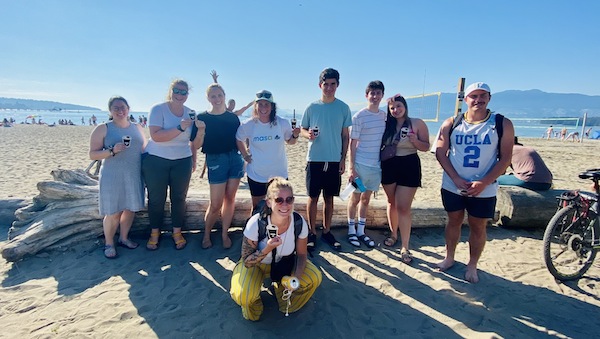
Mahla Finkleman, Canadian national manager of partnership and outreach for Masa Israel Journey (standing, fourth from the left), at Kits Beach in July with participants of the Shalom U’Lhitraot event. (photo from Masa Canada)
While the skies were closed for the first waves of the pandemic, with many organizations canceling their Israel trips, Masa Israel Journey saw an increase of almost 40% of North American students and young professionals traveling to Israel to partake in immersive four-to-10-month programs.
Since its establishment in 2004 by the Jewish Agency and the government of Israel, Masa has served more than 180,000 Jewish students and young professionals ages 16 to 35, from more than 60 countries. Offering experiences in gap, academic and career segments, Masa provides an unmediated and challenging journey into Israeli society, culture, politics and history, as well as access for global Jewry to Israeli businesses, social enterprises and academic institutions. Masa strengthens the Jewish leadership pipeline through the Impact and Leadership Centre, based in Jerusalem. When fellows return from Israel, they are ready to engage as active members in their community and many take on leadership roles.
Masa has regained a strong presence in Canada, with a new Canadian national manager of partnership and outreach, Mahla Finkleman, who sits within the Federation of Greater Toronto, and visits communities across the country. Since Finkleman started just over one year ago, Masa has sent more Canadians than ever before to Israel on programs.
This past summer, working from Vancouver, Finkleman partnered with the Community Kollel for a Shabbat dinner for Tu b’Av. Some 60 to 70 young professionals, including many Birthright alumni, gathered to learn about Masa opportunities and ways to get back to Israel for a meaningful experience, living like a local.
Earlier in the summer, in July, the first of three Shalom U’Lhitraot events took place, welcoming back Masa alumni from Israel and sending off others to Tel Aviv University, Masa Israel Teaching Fellows (MITF) and other programs.
A new condensed version of MITF is available now. MITF is an option for 21-to-35-year olds who have a bachelor’s or associate degree and whose mother tongue is English. Applications are due Nov. 1, with three city options to choose from: Rishon LeZion, Bat Yam and Ramle. The program, which costs $720 US, runs in 2023 from Jan. 5 to July 2, and is an exclusive partnership with Israel Experience.
Each city offers its own unique charm. In Bat Yam, you can take surf lessons and deep dive into the Israeli-Russian community. Rishon is Israel’s fourth largest city, with malls, parks, beaches and a zoo. And, in Ramle, an ancient city with mixed cultures and a rich history, the Pool of Arches is a top attraction, as is the Ramle market – additional perks are the spacious homes and a pool pass.
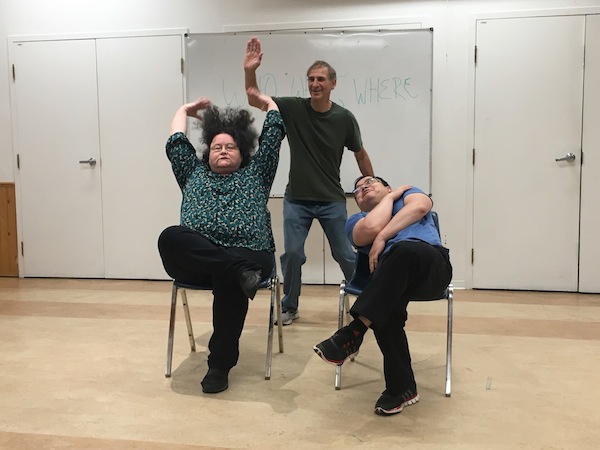
Students Adrianne Fitch and Brian Nguyen, with instructor Irwin Levin behind them. Levin and Cass Freeman teach a free workshop on Sept. 13. (photo by Adam Abrams)
“When I teach a series of eight classes, I see people who are quite scared and nervous and sometimes very shy, and watch them become daring and playful improvisers towards the last class, and that is quite satisfying,” Cass Freeman told the Independent.
Freeman and her husband, Irwin Levin, are teaching an improv workshop with a focus on teamwork at Mount Pleasant Neighbourhood House Sept. 13. As well, Freeman is teaching a series at the Roundhouse Community Arts and Recreation Centre that runs eight Tuesday nights, starting Sept. 20.
“We really care about our students’ experiences,” said Freeman, who has taught improv comedy games on and off since the early 1990s. “We really want them to enjoy themselves and relax so they can be spontaneous. We rarely put people on the spot and, when we do, we coach them, so they don’t have to struggle up there alone.”
Freeman was an injured dancer when she found Vancouver Theatresports, now called the Improv Centre. “I saw them perform one night in the 1980s,” she said, “and I thought, ‘I can do that!’ So, I took a series of classes there and ended up performing in their first-ever Rookie Night. I was terrified, but I remember the audience endowing me as embarrassed, so I just hid behind the other players for a whole scene and did OK.
“Improv is such a positive form of theatre,” she added. “The people are really great, very playful and intelligent. I was quite a negative person in some ways, during my 20s especially. Improv really turned around my life. I was much more accepting of other people’s ideas. And I found the work to be really healing.”
Levin first heard about improv from Freeman. “I was doing standup comedy when I met Cass and found out that she was doing improv,” he said. “I was attracted to both Cass and improv simultaneously! (We met in 1994 and were married in 2000.) Now I will be taking a standup course as well as assisting Cass in improv workshops, so I will be getting the best of both comedy worlds.”
The couple has recently started their own improv business.
“We’d like to spread some playfulness, laughter and joy around our little corner of the world,” said Freeman about the venture. “We’d like to teach improv games for teamwork, stress reduction and creativity or just plain fun in as many different organizations as we can. People in the Jewish community have an amazing sense of humour, so we’d love to teach anyone in the community who is interested.”
Cass Freeman teaches an eight-class improv course at the Roundhouse this month, starting Sept. 20. (photo by Irwin Levin)
Freeman has worked as a freelance journalist in radio, television and print since 1987. Her first article in the Jewish Independent, which was then called the Jewish Western Bulletin, was in 1982 – about human rights activist Judy Feld Carr and her efforts over some 30 years to bring Jews out of Syria. Her most recent article was this past April, a profile of Vancouver Playback Theatre.
Local readers may also know Freeman’s name from The World According to Keith, a 2004 documentary for Bravo TV that she co-produced, about Theatresports creator and instructor Keith Johnstone.
“Keith Johnstone created Theatresports, along with his university students in Calgary, during the late 1970s,” explained Freeman. “He has also taught improv all over the world and there are now more than 150 theatre troupes who perform Theatresports and other formats he has created, like Maestro Impro and his favourite format, called the Life Game. You can see Maestro Impro at Tightrope Theatre in Vancouver.
“Keith trusted me to make a documentary about him because after I watched his righthand man, Dennis Cahill, do a weekend workshop in Calgary, he said to me, ‘You were great, you were like a fly on the wall. We’ve had other journalists here and they were quite obnoxious.’
“Keith became like a second father to me,” said Freeman. “My dad came from England and Keith has the same wicked British sense of humour. We still keep in touch and I have an autographed book from him that says, ‘Be average, Cassandra,’ since he noticed that when I was in his workshops that I tried too hard.”
Another memorable moment in her career came when she was teaching at the Vancouver School Board night school, which she did for about five years. “One night,” said Freeman, “the administrator called me into his office and said, ‘The instructor next door to you is complaining that his students can’t concentrate because your students are laughing too much.’ It was the best insult anyone has ever given me.”
Levin recalled a private workshop he and Freeman did this past July. “One of the students was so inspired,” said Levin, “he has decided to pursue a career in acting.”
But aspirations to be an actor are not the main reason to learn improv.
“Improv can relieve stress, reduce stage fright and improve self-esteem,” said Freeman. “Improv games encourage creativity, quick thinking and communication skills, and are a great tool for breaking the ice, having fun and building team spirit.”
She described improv as a team sport, with almost all the games being about supporting the other person or people onstage with you. This is why it’s a great way to get over stage fright, she said, “because the focus will rarely be on you alone, like it is in standup comedy.”
Freeman and Levin welcome people of all ages, backgrounds and abilities to take their classes, as well as members of the LGBTQ+ community. And, as mentioned previously, fellow members of the Jewish community.
“We’d love to hear someone say ‘oy!’ on our stage. Or any other Yiddish or Hebrew phrases,” said Freeman. “There aren’t many improvisers out there who are Jewish and we’d like to change that.”
There are also not many improv instructors who are Jewish, she said. Nor instructors who have a disability.
“I’m among the many people who have an invisible disability,” she shared. “I’ve had it since I was 19. The way it affects me today, a few decades later, is that I can’t stand in line on pavement and I can’t walk at all unless I’m wearing a very shock absorbing running shoe. So, when I teach, I have to wear runners. At our last workshop, nine out of the 14 people participating said they had something physically wrong with them. We are delighted to be able to teach people with varying physical abilities.”
The free team-focused workshop on Sept. 13, 6-7:30 p.m., is part of Mount Pleasant Neighbourhood House’s Generations Moving Together (GMT) program, which “encourage[s] community involvement, movement, learning and connection between younger and older generations.” To register for the workshop, contact GMT coordinator Daniela Gunn-Doerge at dgunndoerge@mpnh.org or call 604-879-8208, ext. 225. (Refreshments are provided.)
The improv classes at the Roundhouse run on Tuesdays from Sept. 20 to Nov. 8, 6:30-8:30 p.m. It’s $160, but half price for people who have a Leisure Access Card. To register, click here or call the Roundhouse on Sept. 17at 604-713-1800. Freeman and Levin can be reached at casan@shaw.ca or 604-872-4638.
Want to make a difference in the lives of Israeli teens? Consider joining Israel Connect, a program where local adult volunteers connect online, one-on-one, via Zoom, with Israeli high school students who want to improve their English conversation and reading skills. The program starts on Oct. 23 and is organized by Chabad Richmond, in partnership with the Israeli Ministry of Education. It entails a small and rewarding commitment of 45 minutes once a week.
There are currently 15 local volunteers participating in the Israel Connect program as tutors/mentors, and Chabad Richmond is looking to increase that number, since the need continues to grow.
“We’re looking for volunteer retirees, seniors or any adults with flexible schedules to join the Israel Connect program. No previous tutoring or teaching experience is necessary and the curriculum is provided for tutors/mentors,” said Shelley Civkin, local program coordinator. “If you’re an adult and a fluent English speaker, you have basic computer skills and you own a computer with a camera, that’s pretty much all you need. Oh, and, of course, a strong desire to help Israeli youth.”
Volunteers do not need to speak Hebrew and can tutor from home. Basic training and technical support are available.
Time preferences of volunteer tutors/mentors will be coordinated beforehand and sessions take place in the morning between 7 and 11 a.m. Vancouver time, any day between Sunday to Thursday. “All Israel Connect asks is a minimum commitment of one school year, in order to ensure consistency for the students,” said Civkin.
“It’s a meaningful and practical way for community members to support Israel and build bridges between diaspora Jews and Israelis,” said Rabbi Yechiel Baitelman of Chabad Richmond. “You’ll be doing a mitzvah, while investing in Israel and its young people. Plus, good English skills will give them an advantage in accessing post-secondary education and getting better jobs. English proficiency is crucial to Israeli students, since it accounts for a third of their entrance exam marks for university.”
“Partnering with the Israeli Ministry of Education, the Israel Connect program targets teens from less advantaged neighbourhoods in Israel. Most volunteers really enjoy helping their Israeli students and develop a lasting bond with them. It often goes beyond simply tutoring the curriculum, and turns into friendship and mentorship,” added Civkin. “Conversations sometimes continue long after the school year is over. This kind of one-on-one tutoring makes a huge difference in their lives, both educationally and personally…. Estimating the impact of this program on Israeli youth is, of course, speculative, but we do know for certain that it helps improve their school grades. It’s incredibly satisfying to know that you’re doing something concrete to help Israeli students better their lives.”
The curriculum consists mainly of a tour of Israel, focusing on the wealth of historically, culturally and biblically significant cities and sites. It’s not uncommon for both the students and the tutors to learn something new about Israel at each lesson.
To volunteer, or for more information, contact Deborah Freedman at Chabad Richmond, 604-277-6427, or email programs@chabadrichmond.com.
For anyone who can’t participate as a tutor, Chabad Richmond welcomes financial support for the Israel Connect program, which covers overhead costs like technical support, staffing and other administrative costs. To support the program call Chabad Richmond or email admin@chabadrichmond.com.
As a former World Jewish Congress Ronald S. Lauder Fellow, I attended the first Ronald S. Lauder Fellowship Diplomacy Summit. The fellowship is an international cohort of top Jewish students with an interest in global Jewish advocacy who are invited to Europe to participate in high-level meetings with government institutions. From the moment I arrived at the summit in Brussels, the excitement felt by the other fellows and staff was infectious.
We began the trip in the European Union offices, hearing from EU members about the state of Europe and advocating for the European Jewish community. This was followed by a visit to NATO. The number of brilliant minds in these rooms was astounding, and it was such a privilege to watch as my small cohort of young Jewish students and professionals posed challenging questions to EU and NATO leaders regarding the state of European Jewry, global antisemitism and recent world tensions.
The same can be said about our visit to UNESCO in Paris the following day. As a media and information studies student with a niche interest in big tech policies, I was intrigued to learn about the organization’s recent report, History Under Attack: Holocaust Distortion and Denial Within Social Media, directly from its writers. I am hopeful that, combined with efforts to address online harms in countries such as Canada, the UNESCO report will spur positive change in hate speech regulation worldwide.
Once the summit concluded, with my Jewish pride at an all-time high, I hopped on a plane to Israel for a much-needed reunion with family and friends, celebrating Shabbat with my great-aunt and others at her beautiful Jerusalem apartment.
After we studied the week’s parashah (Torah portion), a neighbour began to translate a book written in Hebrew by our relative about our family’s history in Israel. Although I had heard these names growing up, I had not fully understood their weight or meaning. It was there, sitting with family and friends, and with the WJC experience fresh in my mind, that I began to appreciate their significance and what my Jewish heritage really means to me.
My great-great-grandfather was Zvi Pesach Frank, chief rabbi of Jerusalem during the end of the Ottoman Empire and the British Mandate of Palestine. He was instrumental in the creation of the Chief Rabbinate of Israel, and in the appointment of Rav Kook (Abraham Isaac Kook) as the first Ashkenazi chief rabbi. I learned more of his historic contributions and my family’s legacy of working to build and protect Israel.
My experience as a World Jewish Congress Lauder Fellow and attending the summit took on a new layer of meaning. Not only am I inspired and committed to continuing my work in global Jewish advocacy, but I have also developed a determination to follow this path, grounded in my profound pride in my family and their accomplishments over the generations. For that, I am grateful to World Jewish Congress, to my great-aunt and to the Centre for Israel and Jewish Affairs. I look forward to what’s ahead, fully appreciating the rationale supporting my aspirations, and I will hold the summer of 2022 near and dear to my heart.
Following the conference and my visit to Israel, it became clear to me that, in high school – when I found my footing in Jewish leadership and learned more about my intersecting Muslim and Jewish background – I had found the “what” of my life’s passion. It was this summer that I found the “why.”
Tia Sacks is a Vancouver native going into her fourth year at Western University in the faculty of media and information studies. She participated in the World Jewish Congress Lauder Fellowship and is currently the vice-president of the Israel committee at Hillel Western and an intern at the Centre for Israel and Jewish Affairs.
As a new school year approaches, many parents are looking for fresh ways to rekindle their child’s spark for Jewish – and general – learning. Chabad Richmond Hebrew School has put forward a curriculum that offers children an immersive experience.
“Over the course of last year and throughout the summer, we have had moms and dads asking us for advice on how to nurture their child’s Jewish identity,” said Chana Gordon, director of Chabad Richmond Hebrew School. “We believe that … knowledge is power and if you provide a safe and inclusive environment which teaches Jewish values, history and culture, children will thrive mentally, emotionally and in many other aspects of their life.”
Chabad Richmond Hebrew School constantly works to have a curriculum with fresh, new activities and crafts. Using modern methods of teaching, including STEM, they seek to accommodate the needs of every child.
For example, the learning program includes Bereishit: The Story of My Life, which explores the history of the Jewish nation. Beginning with the story of Adam and Eve, and through the birth of the Jewish people, students are taken on an immersive journey allowing them to use their creative minds and imagination.
Through interactive storytelling, inclusive activities and a comprehensive knowledge base, students are encouraged to take an active role of leadership and to express themselves. The program’s aim: students who have a nurtured Jewish identity, a healthy self-esteem, long-lasting friendships and a sense of community.
Chabad Richmond Hebrew School is an affiliate of the Chabad Children’s Network (CKids), which has chapters in 26 countries and engages 25,000 children each year with Jewish education and experiences. To register your child(ren), visit chabadrichmond.com/hebrewschool.
When they were having their animated disagreements so many centuries ago, could the wise Jewish sages Hillel and Shammai have imagined how much we would still look to them today to help us navigate our fragmented world?
Mishna Avot, a third-century collection of teachings, reminds us that “any mahloket (disagreement) that is l’shem shamayim (for the sake of heaven) will continue to exist, but one that is not for the sake of heaven will not continue to exist. What is a disagreement that is for the sake of heaven? This is a disagreement of Hillel and Shammai.”
In our world that is both full of beauty and goodness and yet also permeated with divisiveness and polarization, Hillel and Shammai remind us that it was, and is, possible to hold opposing views while still respecting and learning from one another. A disagreement for the sake of heaven is one in which the parties are motivated by a genuine desire to seek the truth of the matter. There is no selfishness or lust for power. Rather, the disagreement is approached with humility, curiosity and a willingness to listen.
I recently completed an eight-week Mahloket Matters alumni fellowship through the North American branch of the Pardes Institute of Jewish Studies. I had previously studied at this pluralistic yeshivah (place of study) in Jerusalem, which is itself exemplary in demonstrating diversity, inclusiveness and a willingness to face challenging issues in respectful, cooperative and productive ways. What attracted me to applying for the fellowship was the topic – civil discourse. We would be delving into how to navigate difficult conversations and disagreements. When we all met, virtually, at the first class, we found that we shared a common concern about the fragmentation and jagged edges in our world, as well as a desire to learn and to equip ourselves with more skills to better navigate the types of thorny issues we face in our world.
Our studies were grounded in Jewish texts, which provided wonderful launch points for many of our discussions. We shared thoughts and ideas about what it means to have a disagreement l’shem shamayim and tried to bring those ideas forward to today. As Hillel and Shammai taught us, it is possible that sometimes both sides can be right and still hold opposing views. It’s also possible to debate an issue without harming relationships. Entrenched positions leave little room for genuinely listening to the other side or having the humility to admit that one might be wrong, qualities much needed for any truly healthy and productive disagreement.
U.S. Supreme Court Justices Ruth Bader Ginsburg and Antonin Scalia, may their memories be blessed, perhaps provide a more contemporary example of Hillel and Shammai. They were judges who held vastly different views on many issues and yet had a warm and lengthy friendship, never mind a shared love for opera, which they often indulged in together. In a statement that Bader Ginsburg released to the public on the death of Scalia in 2016, she said: “We disagreed now and then, but when I wrote for the Court and received a Scalia dissent, the opinion ultimately released was notably better than my initial circulation. Justice Scalia nailed all the weak spots – the ‘applesauce’ and ‘argle bargle’ – and gave me just what I needed to strengthen the majority opinion.”
Over the eight weeks of our studies, our diverse group from all over North America questioned, challenged, debated and confronted a multitude of issues, from moral foundations to creating our own mini Sanhedrin(Jewish High Court), taking on the role of judges and tackling some controversial issues from all angles. It was an enriching and meaningful experience, the fruits of which we are each now able to bring back to our own communities, with the hope that the small ripples we create through sharing our learning will radiate outwards and help, even in small ways. Help to smooth some of the sharp edges, soften rigid positions and create the safe spaces people need to have productive and healthy disagreements that create the fertile potential for new solutions to emerge – all for the sake of heaven.
Elisheva Grayis a lay leader and active member of the Victoria Jewish community and an alumna of the Pardes Institute of Jewish Studies.
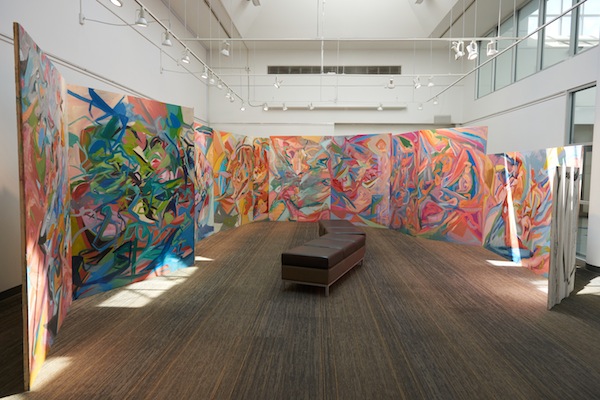
Marty Katzoff’s The Light Within the Shell was created specifically for the Zack Gallery. (photo by Lauren Zbarsky)
The Light Within the Shell exhibit opened at the Zack Gallery on July 4. There is a sign beside the door: “This space is meant to be explored. Wander, sit, experience, enjoy.” The show was created specifically for the gallery.
Created by artist Marty Katzoff, it doesn’t involve traditional paintings hanging on the walls. Instead, it looks like a huge folding screen comprised of a dozen panels. They encircle the room, leaving only a narrow passageway along the walls. Each panel has a colourful abstract painting on its inside surface and a black and white image on its outside. A few small copper sculptures scattered outside the enclosed space complete the installation. Viewers are invited to sit down and meditate on the benches inside the vibrant shell of the exhibit or wander along the outer passageway.
Born in Rhode Island, Katzoff grew up playing sports. “I didn’t do much art until my teenage years,” he told the Independent. “I was going through difficult times in high school. My friend was an artist. She introduced me to the arts. I started making collages and found it therapeutic.”
He never completed high school and worked a variety of jobs. “For the next 10 years, I worked in construction, in restaurants,” he recalled. “And, all that time, I made art. I taught myself to paint. Then I went back to school and completed my BA at Bard College in New York.”
For years, Katzoff worked as an artist in New York, created large murals in indoor and outdoor spaces. He graduated from the University of British Columbia’s master of fine arts program in 2021.
Artist Marty Katzoff at work. (photo by Lauren Zbarsky)
His artistic education vaguely coincided with his newly found fascination with kabbalah, specifically the Tanya, which he has been studying for the past few years. “Before, I had separate ideas about art and spirituality. Now, I’m exploring how Jewish learning is connected to my art, how mythology and tradition transform my spiritual life into my paintings,” he said.
As a child, Katzoff went to a Jewish day school, but kabbalah offered him a different perspective. “I started with a book by Gershom Sholem. Before, I always painted with music in the background. This project is the first I’ve ever done without listening to music. I listened to kabbalah lectures online while I painted. I wanted to discover what I could create while listening to something complex and different … [by the late] Rabbi Yehoshua B. Gordon.”
The idea for the current installation came to him when he was finishing his graduate program at UBC. “One of our family friends lives in Vancouver,” Katzoff explained. “She is Jewish and she told me about the Zack Gallery. I submitted the proposal, and it was accepted. I wanted to create an installation specifically for the gallery, an interactive space, a visualization of light. This show took me 11 months to complete.”
Katzoff sees this exhibit as an amalgam of dreams, painting, architecture, Jewish learning and personal symbolism. Vancouver artist Rosamunde Bordos’s essay about the show, which is available in the gallery, expresses her visual composition in words.
Katzoff’s media, the plywood panels, are all recycled materials. “I have a friend who works in art shipping,” he said. “They ship large pieces in plywood crates. That was where the panels came from. Some of them have holes, so customs could look inside the crates to see the art. I painted around the holes. It was like a collaboration with someone else.”
The size of the panels, some of them taller than a person, left him undaunted. “I always liked to work on a large scale,” he said. “That’s why I did murals in New York.”
His oil paints are also recycled. “I use lots of recycled materials in my art,” he said. “My grandmother was an artist. She gave me her entire collection of pigments for the oil paints I use. I’ll probably work with her paints for the next decade.”
In addition to painting, Katzoff also works as a printmaker. Currently, he teaches printmaking at UBC as a sessional instructor. “For me, printmaking provides the connection with literature, with storytelling and history,” he said. “My brain seems to process that connection better while I’m drawing and etching. My drawings are illustrations, while my painting remains more like a therapeutic activity.”
His abstract copper sculptures, several of which are included in the exhibit, grew organically out of his printmaking. “I make my sculptures reusing the copperplates from my prints,” he said. “I have lots of copper plates. Copper was an important part of Judaism and, after I use the plates for prints, I want to share the metal, recycle it. I make sculptures from it. I also make bracelets and amulets. You can see the remains of the etching if you look closely.”
To learn more, check out martinkatzoff.com. The Light Within the Shell is on display until Aug. 22.
Olga Livshin is a Vancouver freelance writer. She can be reached at olgagodim@gmail.com.
Dror Israel representatives Noam Schlanger and Joanna Zeiger-Guerra visited Seattle, Victoria and Vancouver last month. (photos from Dror Israel)
Last month, two representatives of Dror Israel, Noam Schlanger and Joanna Zeiger-Guerra, paid a visit to the region – Seattle, Victoria and Vancouver.
“We are educators at Dror Israel, a grassroots educational organization which works all through Israel,” Schlanger told the Independent. “Our 16 intentional communities of young, trained educators operate a variety of programs, including a network of innovative schools for at-risk youth and Jewish-Arab encounters, which all aim to bring together Israel’s different populations and create a more just and equal society. Our pedagogy focuses on empowerment and community building.”
Comprised of 1,300 people, Dror Israel works in a multitude of fields in Israel and has an impact on the lives of more than 150,000 people each year.
As for their specific involvement in Dror Israel, Schlanger has led a youth centre in Kafr Manda, an Arab town in Lower Galilee, and now works at the community garden in Acre (in northern Israel). Zeiger-Guerra is an educator who is familiar to many young people in southern British Columbia, having worked at Camp Miriam, the Jewish summer camp on Gabriola Island, for several summers. She is also a Habonim Dror alumna.
“I founded and operate a community garden where I work with mainly elderly Russian speakers, and Joanna mentors a cohort of our young educators taking their first steps in a variety of formal and informal educational settings,” explained Schlanger.
During their local visits, Schlanger and Zeiger-Guerra met with a variety of individuals, groups and communities to inform them of their work, specifically Dror Israel’s coexistence programs and ongoing relief efforts with Ukrainian refugee children. These gatherings included talks at Congregation Emanu-El in Victoria and with the Victoria Multifaith Society.
The pair also met with representatives from the Jewish Federation of Victoria and Vancouver Island and the Jewish Federation of Greater Vancouver. Those encounters involved “thinking about creative opportunities for programming collaboration,” said Schlanger.
For Schlanger, the message Dror brings – an inclusive vision of Zionism that strives to create a place for everyone, and the dream of a just and equal Israel – is a breath of fresh air amid the polarized discourse about the country.
Dror Israel was started in 2006 by graduates of the Israeli youth movement Hanoar Haoved Vehalomed, who served together in the Israel Defence Forces and shared a belief in the founding principles of Zionism. “Through truly innovative education based on dialogue and understanding, we teach leadership and responsibility for self and community. We promote social activism to drive positive change,” the organization states on its website.
Both Schlanger and Zeiger-Guerra live on urban kibbutzim established by Dror, a recent adaptation of the rural kibbutz. Between 30 to 100 young adults, aged 20 to 40, live on each of Dror’s 16 kibbutzim in Israel and work on the organization’s educational, cultural and social projects. With an emphasis on social justice, members of Dror Israel reside in the neighbuorhoods they serve, seeking to bridge gaps and solve local problems.
Throughout the pandemic, Dror Israel has been engaged in opening daycare centres for the children of doctors, nurses and healthcare workers; delivering groceries and medicines to home-bound seniors and those in need; volunteering on farms; and providing online programming for thousands of teens.
“Our message and the story of our work really resonated with everyone we met and sparked a variety of thoughts about future cooperation between Dror Israel and local organizations,” said Schlanger of his time here. “Our hearts were warmed by people’s decision to support our programs. It really attests to the strong, living connection between the Jewish communities here and Israel.”
After more than two years of being unable to visit or host trips to Israel due to COVID, Schlanger said Dror Israel hopes to reinvigorate connections that began many years ago in the region. Aside from delegations of educators to British Columbia, it looks forward to hosting visits in Israel.
“Joanna and Noam were very well-received,” said Sid Tafler, one of organizers of the emissaries’ stay in Victoria. “Many people were inspired by their message of peace and coexistence in Israel, principles they don’t just espouse but practise and live every day.
“We learned about their compassionate and community-building work with youth-at-risk, isolated older people, members of minority communities – including Druze and Arabs – and integrating new olim recently arrived from war-ravaged Ukraine. We have received guests from Dror before and expect we will welcome them again.”
Imam Mohammed Tawhidi once preached hatred, but now is known as “the Imam of Peace.” (photo from imamtawhidi.com)
Imam Mohammad Tawhidi once preached hate towards Jews from the pulpit, and believed the very worst stereotypes about the Jewish people. He was indoctrinated by the Ayatollah’s preachers in Iran. But, today, Tawhidi is known as “the Imam of Peace” for a reason. He’s preaching coexistence and common ground for Jews and Muslims.
In late May, Tawhidi spoke at a United Grassroots Movement event at Beth Emeth Bais Yehuda, a Toronto synagogue, on how people of all backgrounds can – and should – unite against antisemitism and extremism.
An Iranian Muslim of Iraqi origin, Tawhidi sees his former peers actively engaging in hate-filled rhetoric. For example, as in years past, the politics of division and derision were widespread at the Al Quds march in Toronto earlier this year – chants included slurs against Israel and Jews.
Government officials are either incapable of preventing hatred on city streets and property, or unwilling to do so, he said. To answer problems such as these, he encouraged talk attendees to find, and bring together, as many allies as possible, to speak out and even take legal action wherever warranted.
Tawhidi’s change from preaching hatred, to becoming a friend of Israel and the Jews, did not come overnight.
First, he spoke out against ISIS war crimes in the Middle East and Africa. When he was met with condemnation from his peers, he said it opened his eyes to the radical elements that existed within his circle.
“I was still a fundamentalist, an extremist and antisemite,” he said of his views until then. “I thought I was doing this on behalf of God.”
And yet, he began thinking of how he could reconcile the slaughter of innocents in the name of Islam.
The next significant moment for the imam was when he met a Jew. Needing roadside assistance one day in England, it was a visibly Jewish man who helped him.
Later, Tawhidi was invited to a synagogue for an interfaith dialogue. Although he was skeptical, initially, of the people he was communicating with, he left the event feeling a special connection.
His decision to criticize ISIS and radical Islam and preach for peace with Israel and Jewish people was met with a severe backlash.
“I knew I would lose my community, but I also knew I would be welcomed into a new one,” he said.
If he could turn a corner, so can others, Tawhidi maintained. But if they can’t do quite that, then it’s important, he said, to at least defend the truth in public, so that the people who are on the fence or ignorant of the issues can be exposed to all sides.
It’s hopeful for us to note, he said, that the kinds of beliefs he once held are no longer normative in many parts of the Arab world. He highlighted the signatories to the Abraham Accords with Israel, which is breathing new life into modern coexistence, he said.
Further proof of the power of allies, said Tawhidi, is that he received nearly three-quarters of the vote in favour of him winning the position of vice-president of the Global Imams Council, a transnational nongovernmental body of Muslim religious leaders.
Tawhidi stresses that Islam is not a religion that hates Jews, and anything to the contrary is a perversion of the Quran.
To defend against antisemitism, he insisted that Jews and non-Jews must call it out, take legal action when merited, and bring together many communities: “Do not underestimate the power of your allies!” he said.
A staunch supporter of Israel and what he sees as Israel’s right to Judea and Samaria (the West Bank), Tawhidi said, in response to a question from the Jewish Independent, “There can be no circumstances where the Israeli government should give away any land that belongs to the Jewish people. The holy Quran has made it very clear that God, the God of Abraham, wants Jews to live in that region and for Jerusalem to be their capital. That is the teaching of my Quran, and it is clearly stated in Chapter 5, verse 20 onwards.”
As for developing allies out of those who do not support Israel, yet will speak out against antisemitism, Tawhidi said, “You can’t hate a people and you can’t hate a whole country, but I guess they have issues with certain policies of that government, so they need to provide productive and constructive criticism, so that the problems can be solved, and that solutions can be placed forward.”
However, he continued, “a blanket hate on a nation or a people does not come from a person that is worth making a friend, I don’t believe.”
Jon Wasserlaufis a freelance writer, and a political science major and law student based in Montreal.
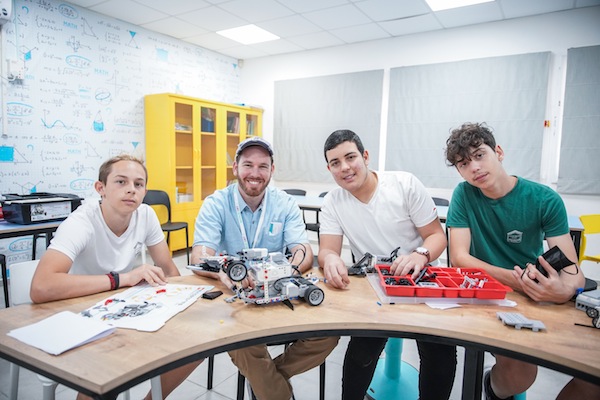
ORT delegate Nata Saslofsky with students from the D. Dan and Betty Kahn STEAM Centre at the Rodman Middle School in Kiryat Yam, Israel. (photo from ORT)
As a town with one of the highest percentages of new immigrants in Israel, Kiryat Yam is welcoming many refugees from Ukraine. One of the most important elements of helping these families process their trauma and settle is ensuring that their children’s education resumes.
Kiryat Yam’s low socioeconomic index means that local students face more academic challenges in comparison to their counterparts in the centre of Israel. But it’s here that kindergarten children are being taught how to build and even program simple robots, enabling them to gain rudimentary familiarity with technology in preparation for studying STEAM (science, tech, engineering, art, math) subjects in the future.
“Through our robotics programs in kindergartens, and continuing at the D. Dan and Betty Kahn STEAM Centre at the Rodman Middle School, we provide under-resourced children with an extra boost from the youngest age possible, so that they’ll gain the tools and the confidence to pursue higher education and fulfilling careers,” said Dan Green, chief executive officer of World ORT. Green was speaking on May 16 to World ORT delegates who, for the first time in more than two years, convened in Israel to experience firsthand the extensive work of World ORT and meet students who are directly impacted by it.
During a packed visit to Kiryat Yam, between meetings with the mayor and high-level municipal and educational representatives, delegates got an up-close view of the natural progression of World ORT’s STEAM education in action. After watching 5-year-olds playing with the robots they’d built and programmed, the group met middle-school students at the Kahn STEAM centre’s robotics lab who were delighted to show off the robots they’d built and coded from scratch.
“I was impressed by the Kadima Mada robotics demonstrations in Kiryat Yam,” said Jack Kincler of Montreal, who serves as the ORT Canada co-president. “It teaches kids from a young age about following a thought process, team effort, and step-by-step execution until the final, rewarding result is achieved.”
As an added value to the program, students who have gained a basic level of proficiency are encouraged to mentor their peers, thereby acquiring additional skills that will serve them well.
Nata Saslofsky of Atlanta, Ga., a member of ORT America’s National Leadership CohORT program, said, “Seeing firsthand the passion and excitement of ORT students for the robots they built from ideation to conception was exciting, impressive and heartwarming. It would be an amazing world if all kids had opportunities to pursue their interests by taking courses in STEAM subjects that advanced their skills and knowledge. I believe this will lead to fulfilling careers that bring them self-worth and an opportunity to give back to humanity with greater impact.”
Technion graduate Natalie Korlick, a resident of Kiryat Yam and originally from Russia, is one of the instructors at the STEAM centre. “I remember when an interest in science was considered nerdy. Today it’s become cool. Everyone wants to learn robotics.”
Korlick, who also works as a math and science tutor, said academic gaps are evident in almost all students from all grades. “It’s as if they lost an entire year,” she said, referring to the sporadic, long-distance schooling during COVID. “This year, they have to work extra hard to catch up.”
If that’s true for the students at Rodman, it’s all the more so for the Ukrainian students, who’ve seen their whole world turned upside down, and who must adapt to a new country, language and mentality. Thanks to her knowledge of Russian, Korlick is able to provide an extra level of support for the newly arrived Ukrainian students.
“Helping these kids who have been through so much and who arrived with little more than the clothes on their backs is exactly what we’re about,” said Conrad Giles, who has served as World ORT president for the last six years. “We couldn’t be happier that our programs are being used to help get them on track to a better future.”
– Courtesy International Marketing and Promotion (IMP)